




Abstract
Although chronobiology is of growing interest to scientists, physicians, and the general public, access to recent discoveries and historical perspectives is limited. Wikipedia is an online, user-written encyclopedia that could enhance public access to current understanding in chronobiology. However, Wikipedia is lacking important information and is not universally trusted. Here, 46 students in a university course edited Wikipedia to enhance public access to important discoveries in chronobiology. Students worked for an average of 9 h each to evaluate the primary literature and available Wikipedia information, nominated sites for editing, and, after voting, edited the 15 Wikipedia pages they determined to be highest priorities. This assignment (http://www.nslc.wustl.edu/courses/Bio4030/wikipedia_project.html) was easy to implement, required relatively short time commitments from the professor and students, and had measurable impacts on Wikipedia and the students. Students created 3 new Wikipedia sites, edited 12 additional sites, and cited 347 peer-reviewed articles. The targeted sites all became top hits in online search engines. Because their writing was and will be read by a worldwide audience, students found the experience rewarding. Students reported significantly increased comfort with reading, critiquing, and summarizing primary literature and benefited from seeing their work edited by other scientists and editors of Wikipedia. We conclude that, in a short project, students can assist in making chronobiology widely accessible and learn from the editorial process.
Chronobiology, the study of biological oscillators that synchronize to environmental cycles, is of growing interest to a wide range of people, from students in school to health care providers (Foster and Roenneberg, 2008). Despite recognition as one of the top 10 Breakthroughs of the Year by Science magazine in 1997, 1998, 2002, and 2005, there is a concern that discoveries in chronobiology remain in scholarly articles and are relatively inaccessible to the public (Hogenesch and Su, 2008). Many publications are not freely available, and their content is directed toward scientists.
In an undergraduate class on biological clocks, we sought to bring knowledge of chronobiology to the public through a Wikipedia assignment. Wikipedia is a free online encyclopedia, collaboratively written and edited by users around the globe. Wikipedia is a popular resource; the academic community and public regularly start their searches for background information with a Wikipedia site (Callis et al., 2009). Wikipedia has, however, been both praised for its influence and criticized for its inaccuracy (Giles, 2005). Our class goals for this project focused on enhancing students’ ability to (1) communicate recent scientific advances with a worldwide audience; (2) find, evaluate, and summarize the primary scientific literature; (3) critique the content of Wikipedia; (4) connect scientific ideas into a coherent story; (5) update Wikipedia with current information on chronobiology while correcting errors of omission and content; (6) participate in large-scale collaboration; (7) master a topic in chronobiology; and (8) have fun editing Wikipedia sites. In 1 month, 46 students (4 sophomores, 24 juniors, 18 seniors, primarily majoring in biology) edited 15 Wikipedia sites 3 times, interacted with experts in the field and other Wikipedia editors, and found that the project provided an exciting, real-world, educational experience that increased the publicly available knowledge of biological clocks.
As an initial objective, we sought to create Wikipedia sites that fulfilled the criteria for “good article” status (Wikipedia, 2011). Specifically, the assignment rewarded efforts to cite the primary literature, describe (but not express an opinion about) published data, and correct errors of omission or accuracy. To capitalize on students with experience in Wikipedia, 12 students served as a Wikipedia Advisory Committee (WAC) to help establish a timeline, guidelines for editing Wikipedia, and the grading rubric. These materials are available through the course Web site (http://www.nslc.wustl.edu/courses/Bio4030/wikipedia_project.html).
Each student nominated 2 sites (1 gene relevant to chronobiology and 1 chronobiologist) for the class to edit (Fig. 1). They evaluated Wikipedia sites for accuracy and completeness and, in less than 200 words, made recommendations for improvement. There was surprising consensus. Of the 92 possible nominations, students recommended only 10 genes and 11 chronobiologists as priorities for editing (Table 1). The class voted online after reading each other’s justifications that a site needed editing. The top 7 genes and 8 researchers were assigned so that 3 to 4 students worked on each site simultaneously and independently in 3 rounds. Over 3 weeks, students researched and edited their first site. The WAC provided a tip sheet on how to edit Wikipedia and answered questions about editing via e-mail. Students were required to add at least 1 citation from a peer-reviewed source and improve the site’s scientific accuracy and organization. Students then had 1 week to research and edit their second site; all of these sites were previously edited by a different group of 3 to 4 students. During the first round of editing, the instructor solicited feedback on student edits from a Wikipedia editor and 6 experts in chronobiology. We presented this feedback to students at the beginning of the second round and encouraged them to use it as a basis for their edits. The instructor graded the first round of edits by selecting the View History tab on Wikipedia, which shows all edits by username and date. Finally, students had 1 week to re-edit their original site based on instructor feedback and online suggestions from other Wikipedia editors. The focus of this round of editing was to organize and clarify the previous edits, adding citations and information where necessary. Students received feedback on a grade sheet after each of the 3 rounds.
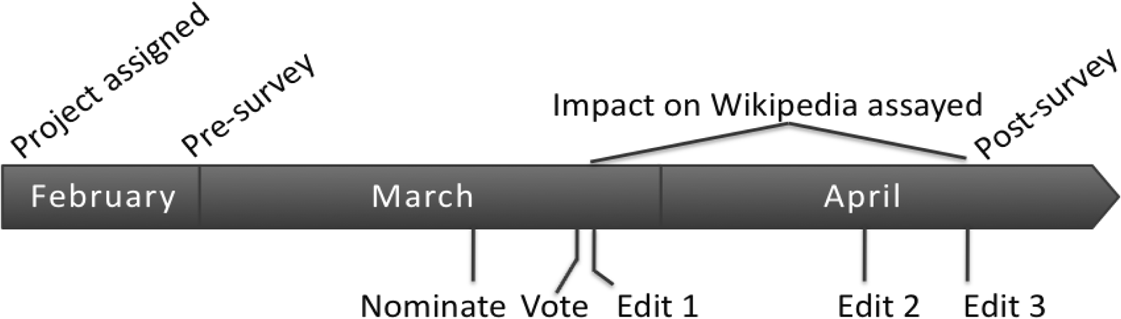
Timeline of a chronobiology Wikipedia project. Over 1 month, 46 students in an undergraduate course on biological clocks selected and edited 15 Wikipedia sites. Each student edited 1 Wikipedia site on a chronobiologist and 1 on a gene relevant to chronobiology.
Wikipedia Sites Edited
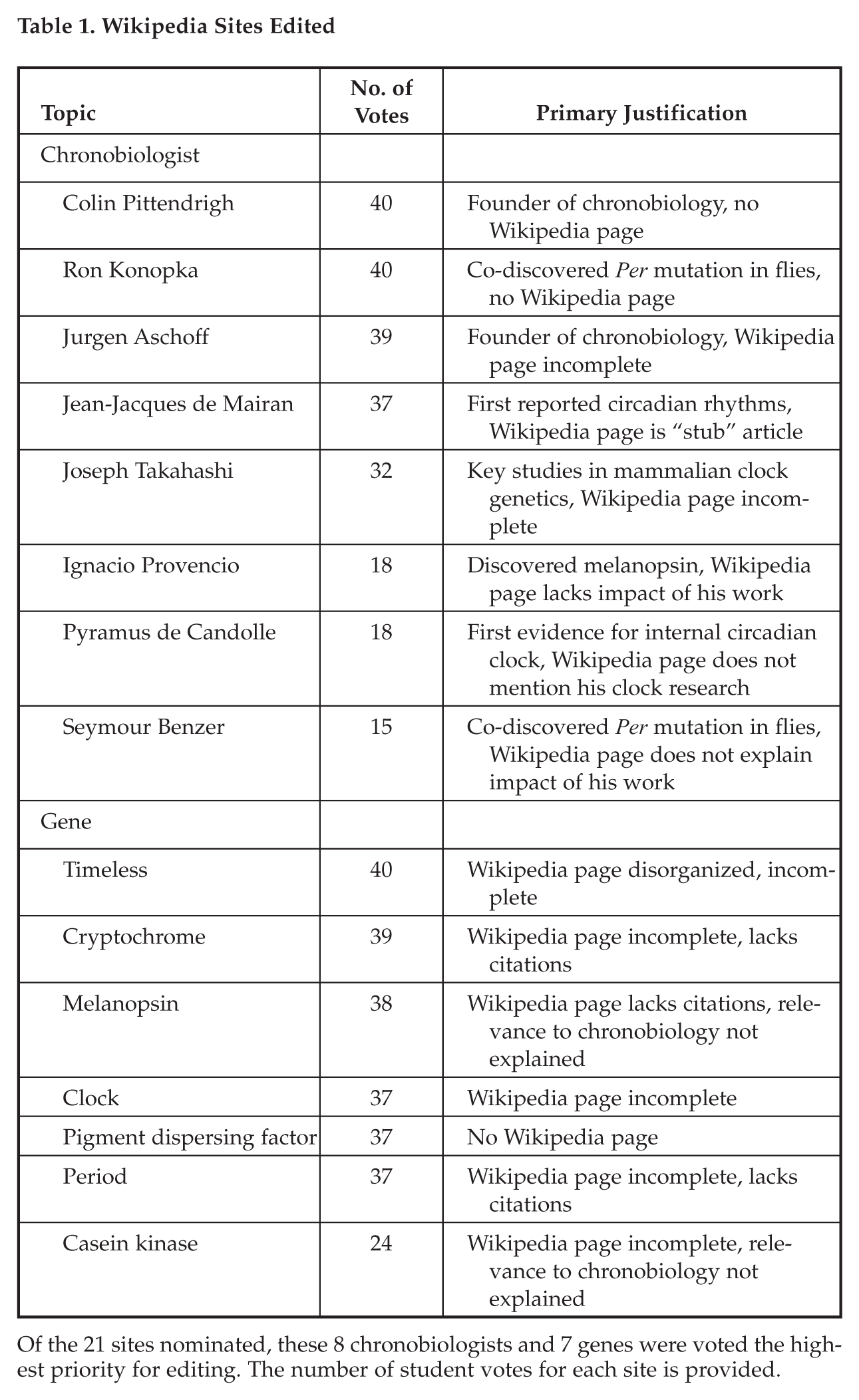
Of the 21 sites nominated, these 8 chronobiologists and 7 genes were voted the highest priority for editing. The number of student votes for each site is provided.
Students (41 of 46 respondents) completed a survey before and after the project to assess its impact on their learning. Using the View History tab of the 15 edited Wikipedia sites, we quantified the text added, number of publications cited, and hyperlinks from each of the sites during March 10, 2011, and May 19, 2011.
Students estimated that they spent an average of 9.0 ± 4.6 h (mean ± SD) over 3 rounds of research and editing Wikipedia sites. Based on pre and post surveys, on a scale of 1 (low) to 5 (high), we found an increase in students’ ratings of the quality and quantity of Wikipedia articles dedicated to the genes and researchers important in chronobiology (rating from 1.8 ± 0.6 before to 2.8 ± 1.0 after, mean ± SD; unpaired Student t test, p < 0.000001). Rather than providing an unbiased assessment of Wikipedia, this likely reflects student pride in their final product. Students also reported more comfort in reading and writing scientific articles (3.7 ± 0.8 before, 4.1 ± 0.8 after; Student t test, p < 0.009), using online literature databases (3.6 ± 1.0 before, 4.3 ± 0.7 after; Student t test, p < 0.0002), and writing about science (3.4 ± 0.9 before, 3.8 ± 0.9 after; Student t test, p < 0.03). Thus, students’ comfort in evaluating and contributing to the scientific literature was significantly enhanced by this short, real-world writing assignment.
Of the 8 chronobiologists and 7 circadian genes selected for editing by the students, 3 did not have existing Wikipedia sites. Following this project, 12 of the 15 sites edited were the top hit in a Google search for the respective chronobiologist or circadian gene. The other 3 sites were in the top 3 hits. Students added an average of 30 ± 14 links per page (mean ± SD), 21 ± 8 citations to each circadian gene site, and 15 ± 4 citations to each site about a chronobiologist. In contrast, 3 related Wikipedia sites (Gene Block, Period1, and Bmal1) did not show increased numbers of links or citations during this 1-month project. Finally, Wikipedia awarded “good article” status to the site dedicated to Augustin Pyramus de Candolle on May 18, 2011, after students had added 12.5 kb of information.
Students appreciated that, through this real-world writing assignment, they interacted with scientists and other Wikipedia editors and provided public access to current information on chronobiology. Importantly, the sites edited by these 46 students are the top hits in a relevant Google search and thus will likely be the first source of information for many people on topics in chronobiology. This short project thus had an immediate and lasting impact on the public understanding of chronobiology.
Some students noted that the simultaneous editing of the Wikipedia sites was stressful. Future implementations of this assignment could match the number of Wikipedia sites with the number of students to avoid this competition. One critique noted that continued implementation of this project could result in diminishing returns because the information on chronobiology is finite. It is striking, for example, that students nominated only 21 different sites to edit when the 46 students, each nominating 2 sites, could have nominated up to 92 sites. This may reflect that a limited number of sites and topics needed editing and that future projects would find it harder to edit Wikipedia sites related to chronobiology. Alternatively, it may be that students shared similar criteria and methods for identifying and prioritizing which sites needed editing. Indeed, several studies using different metrics of quality (e.g., factual accuracy, revert times, and credibility) have concluded that more edits and editors yield higher-quality information (Viegas et al., 2004; Giles, 2005; Chesney, 2006; Wilkinson and Huberman, 2007). Given the rapid addition of new knowledge to the field of chronobiology, we anticipate a growing, not shrinking, usefulness in projects that seek to disseminate current information in a publicly accessible forum.
This project can be easily applied to a diversity of educational topics. The students find it rewarding and gain experience critiquing and summarizing the scientific literature for the public.
Footnotes
Acknowledgements
The authors thank 6 scientists and innumerable Wikipedia editors who critiqued student edits. They also thank David Heyse and Frances Thuet for assistance with online course materials.
Conflict of Interest Statement
The authors declared no potential conflicts of interest with respect to the research, authorship, and/or publication of this article.