




Abstract
Regulatory authorities from developing countries have expressed a need for guidance in locating environmental, health and safety (EHS) information on industrial chemicals. In response, possible sources were identified via a search of the Internet using relevant terms and by soliciting suggestions from more than 200 knowledgeable stakeholders. This initially identified greater than 100 databases, 41 of which were chosen for further profiling and analysis based on their size and comprehensiveness. They were divided for analysis into three distinct groups: (1) data portals that provide information seekers with an efficient simultaneous search of multiple, third-party owned and maintained databases; (2) primary EHS information sources; and (3) databases that provide only EHS-type regulatory decisions but not raw data. Descriptive evaluations of each database were performed, including: (1) scope; (2) ease of access and use; (3) breadth and depth of EHS information available; (4) quality of the underlying information; and (5) procedures to keep the information current. We conclude that, although there exists EHS information to support screening level hazard and risk assessment for the majority of the highest production volume chemicals, information gaps for lower production volume chemicals persist, and Confidential Business Information claims for some chemicals can limit the information available to the general public. A lack of information on uses and exposures to chemicals, particularly in developing countries is especially challenging. Nevertheless, there are reasons (e.g. advances in regulations, marketplace pressures, and computational toxicology science) to be optimistic that going forward information gaps can be closed at an accelerated rate.
Keywords
Introduction
At the 2002 World Summit on Sustainable Development meeting held in Johannesburg (United Nations, 2002), a goal was established that, by the year 2020, chemicals should be “used and produced in ways that lead to the minimization of significant adverse effects on human health and the environment.” Guiding this journey is the Strategic Approach to International Chemicals Management (SAICM), a policy framework that calls on the most advanced countries and other stakeholders to step up and share their knowledge and expertise with developing countries and countries with economies in transition to help promote chemical safety around the world (SAICM, United Nations Environment Programme and World Health Organization, 2006).
Since the inception of SAICM, the International Council of Chemical Associations (ICCA) has been partnering with United Nations Environment (UN Environment) and other stakeholders in an effort to achieve the SAICM goal. Knowledge sharing and information sharing along the life cycle to all stakeholders are critical components. In the past 15 years, there have been advances in the availability and quality of chemical safety information. However, not all SAICM stakeholders understand where and how to most efficiently access and utilize that information. In particular, regulatory authorities in developing countries have expressed a need for greater guidance. Recognizing this opportunity, in late 2017, ICCA and UN Environment agreed to jointly undertake an effort to inventory and evaluate publicly available environmental, health and safety (EHS) information sources on chemicals. They did so in consultation with more than 200 SAICM stakeholder organizations who were provided an opportunity to review and comment on the scope, design, proposed evaluation criteria, and draft reports. The year-long review resulted in the publication and dissemination of a report (UN Environment and ICCA, 2019), which was shared with SAICM stakeholders in advance of the third meeting of the Open-ended Working Group on the International Conference on Chemicals Management held from 2 April, 2019 to 4 April, 2019 in Montevideo.
The report was warmly received by stakeholders, and the sponsors were encouraged to disseminate the results more broadly via a variety of means, including seeking to publish them in a peer-review journal article, hence this summary article. Although other resources certainly exist to assist those who seek EHS information on chemicals (e.g. California DTSC, 2019a; Egeghy et al., 2012; Judson et al., 2009; United Nations Environment Programme and Food and Agriculture Organization, 2019; Wikibooks, 2019), none is believed to be as contemporaneous and comprehensive as this one. Journal space limitations dictate omission of many details, particularly full profiles and evaluations of individual databases, so interested readers are directed to the full report and its appendices (UN Environment and ICCA, 2019).
Methods
For the purposes of this study, EHS information included all data and knowledge that are available to identify and assess chemical hazards and risks and to enable risk management decisions. Publicly available was defined as accessible to potential users from the Internet free of charge. For practical reasons, at a minimum, there must exist an English language description of the database available.
Industrial chemicals in commerce were the primary focus of this study and were defined consistent with pertinent regulations in the European Union (EU) (ECHA, 2016) and United States (US EPA, 2019a). Such a definition exempted active ingredients in pesticides and pharmaceuticals, production wastes, non-isolated intermediates, polymers (although the monomers and any additives are included), naturally occurring chemicals, and several other categories (ECHA, 2016). However, many of the EHS information sources that have been included here for analysis actually do include a broader suite of chemicals, including legacy environmental contaminants, and this is noted in the accompanying descriptions.
Possibly relevant EHS information sources were identified by the following means: A search of the Internet using relevant terms: for example, information on chemicals; toxicity information on chemicals, environmental information on chemicals; chemical risk information; and sources of information on chemicals. This identified several secondary sources that referenced additional primary sources, which were then individually investigated. Suggestions of additional sources not previously identified in steps 1 and 2 were received from an e-mail survey conducted of more than 200 SAICM stakeholders.
Every attempt was made to identify and include for analysis the major, globally recognized sources of EHS information, including those judged to include the largest numbers of industrial chemicals and the most comprehensive and credible EHS information available; however, not all potential information sources that were identified were included. Specifically excluded were those sources that listed only chemical identity and no relevant EHS information; those that did not include, at a minimum, industrial chemicals; and those that provided information considered redundant with sources that were included for analysis (UN Environment and ICCA, 2019).
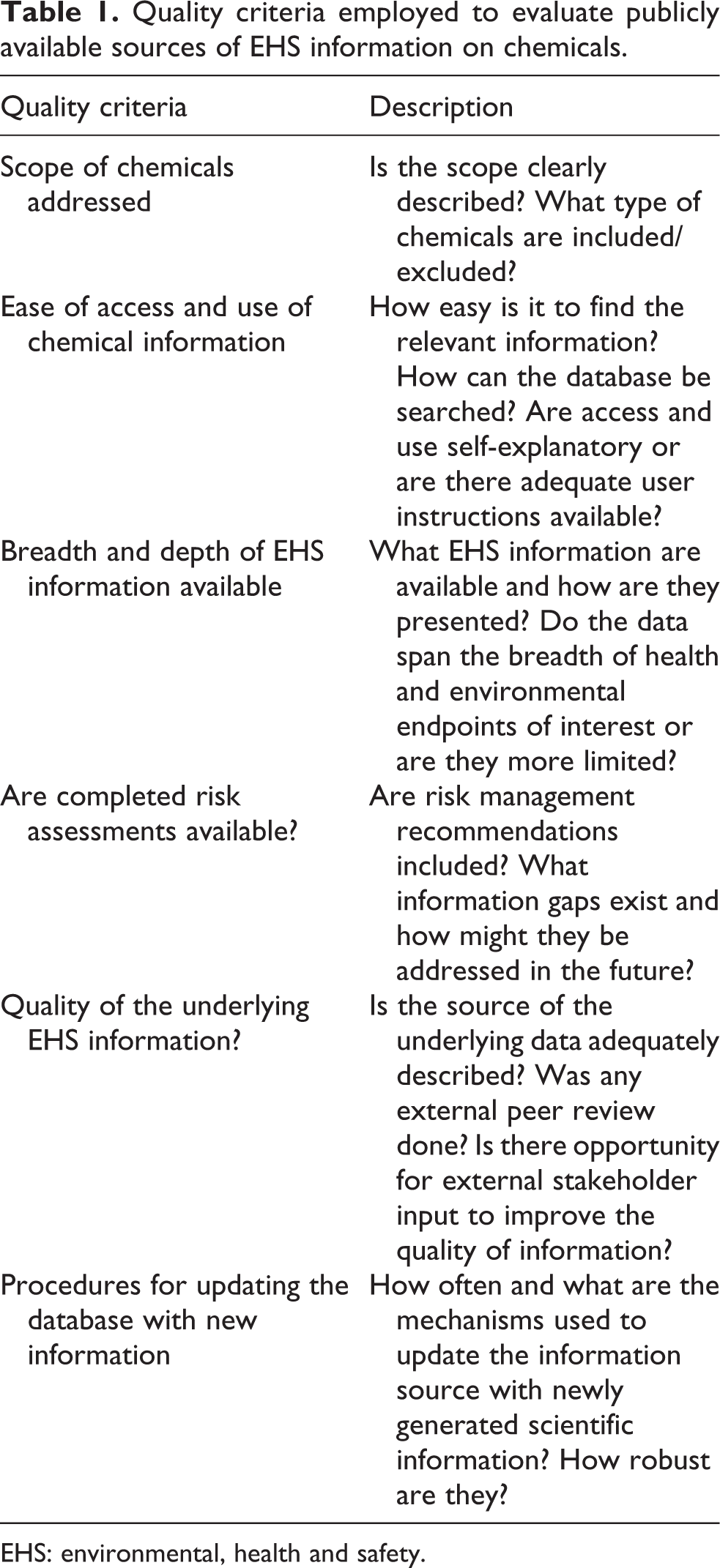
Prior to starting the project, it was anticipated that the various sources would differ with respect to the breadth, depth, and quality of EHS information. Such differences have important implications for the relevance and utility of the source for assessing and managing chemical risks. Therefore, each information source was scrutinized against the five quality criteria described in Table 1. No effort was made to rate or rank the respective information sources on these criteria, instead the characteristics of each source were narratively described using information that was publicly available from the websites maintained by each database owner. In some instances, the websites lacked necessary details to provide adequate descriptions. Because of time and resource constraints, no effort was made to reach out directly to the owners of the databases to request additional details.
Quality criteria employed to evaluate publicly available sources of EHS information on chemicals.
EHS: environmental, health and safety.
During the analysis, it was found that each of the EHS information sources could be categorized as to one of three different types: information portals that provide users the ability to simultaneously search multiple, third-party owned and managed EHS databases; single, primary sources that provide access to EHS information on chemical substances; and single, primary sources that provide access to EHS-type regulatory decisions made about chemical substances, but which do not provide any direct EHS information per se.
Separate tables were prepared to summarize the narrative descriptions of each of the three categories of databases.
Another aim of the study was to improve understanding of the number of industrial chemicals in commerce globally so as to have a better reference point for judging the degree to which information gaps exist. At present, credible estimates are lacking. The starting points for estimates derived for this study (UN Environment and ICCA, 2019) were the US Toxic Substances Control Act Inventory (US EPA, 2019a), registrations under the EU Registration, Evaluation and Authorisation of Chemicals (REACH) program (ECHA, 2019a), Canada’s Domestic Substances List (Government of Canada, 2019a), and the chemical inventories for Japan (Japan’s NITE, 2019a) and China (Asia-Pacific Chemical Inventory Search System, 2019). Collectively, these five nations/regions account for nearly 75% of annual chemical sales globally and greater than 90% of total, annual global chemical-related research and development spending (Cefic, 2019). To address the many inherent uncertainties, lower and upper bound estimates were calculated by making worst-case and best-case assumptions (UN Environment and ICCA, 2019).
Results
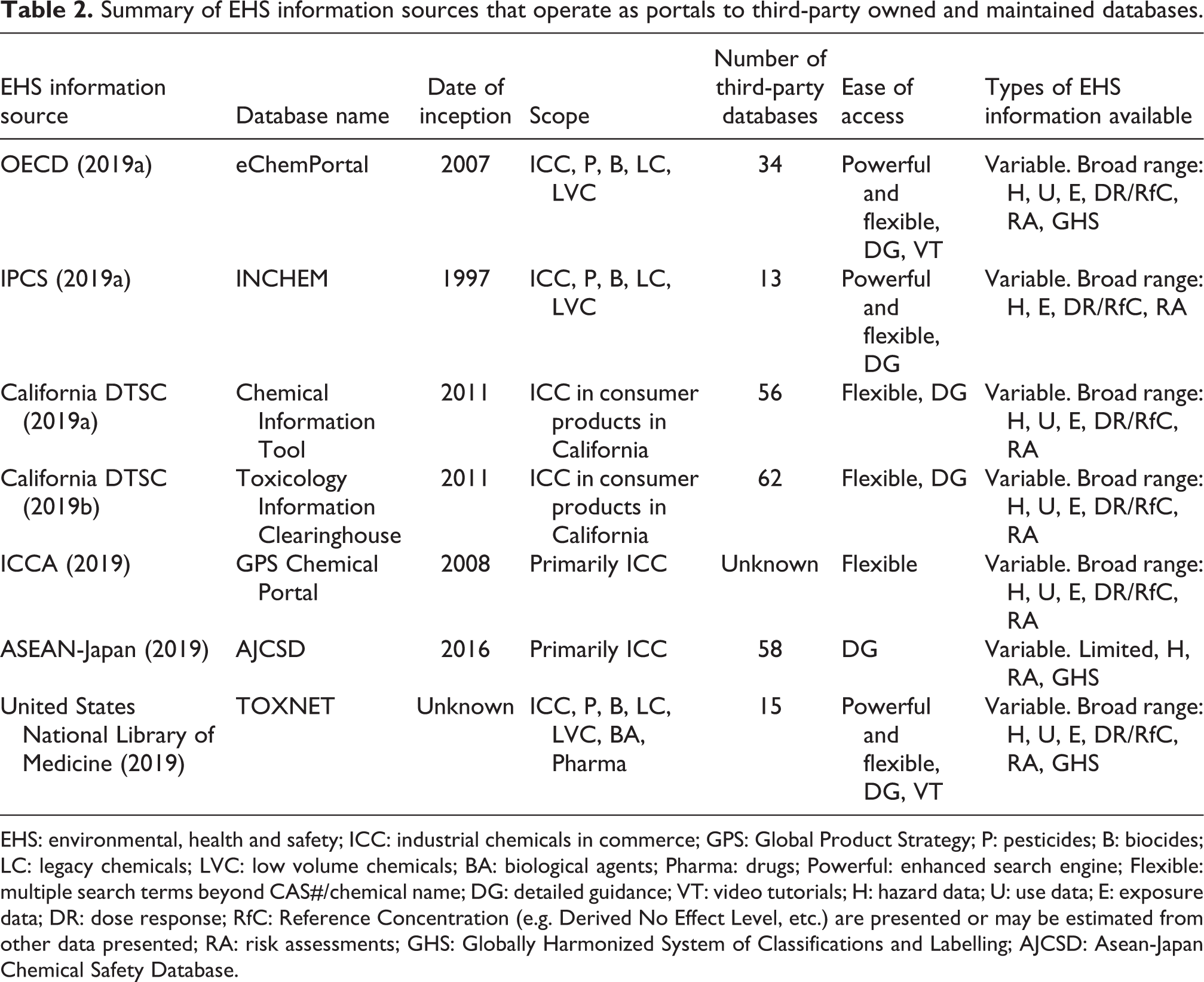
The search initially identified more than 100 possibly pertinent databases, 41 of which were chosen for further profiling and analysis based on the numbers of industrial chemicals included and the comprehensiveness and credibility of available EHS information. Seven of the information sources included for evaluation—the OECD eChemPortal (OECD, 2019a), IPCS’s (2019a) INCHEM, California DTSC’s (2019a, 2019b) Chemical Information Tool (CIT) and Toxics Information Clearinghouse, the ICCA Global Product Strategy Chemical Portal (ICCA, 2019), ASEAN-Japan (2019) Chemical Safety Database, and the United States National Library of Medicine’s (2019) TOXNET—are distinctive from the others because they provide only a search engine that directs users to databases owned and maintained by third parties. Table 2 provides a summary of information about these portals. With the sole exception of the IPCS’s INCHEM portal, all of them became operational only after the advent of SAICM in 2006, which demonstrates the important role SAICM plays in sharing knowledge and information among stakeholders.
Summary of EHS information sources that operate as portals to third-party owned and maintained databases.
EHS: environmental, health and safety; ICC: industrial chemicals in commerce; GPS: Global Product Strategy; P: pesticides; B: biocides; LC: legacy chemicals; LVC: low volume chemicals; BA: biological agents; Pharma: drugs; Powerful: enhanced search engine; Flexible: multiple search terms beyond CAS#/chemical name; DG: detailed guidance; VT: video tutorials; H: hazard data; U: use data; E: exposure data; DR: dose response; RfC: Reference Concentration (e.g. Derived No Effect Level, etc.) are presented or may be estimated from other data presented; RA: risk assessments; GHS: Globally Harmonized System of Classifications and Labelling; AJCSD: Asean-Japan Chemical Safety Database.
These portals provide users seeking EHS information on a broad range of chemicals (i.e. industrial chemicals in commerce, pesticides, biocides, legacy chemicals, etc.) with the capability of searching many disparate individual sources (collectively >100) simultaneously, thereby increasing global reach, scale, and efficiency. All seven portals are relatively easy and intuitive to use and offer options for searching on a variety of terms. Published user guidance for conducting searches is available for the OECD eChemPortal, IPCS’s INCHEM, California Department of Toxic Substances Control’s (DTSC) CIT, Asean-Japan Chemical Safety Database (AJCSD), and TOXNET. There are online classes available for those wishing to learn more about searching TOXNET.
The EHS output from searches conducted with these portals varies considerably depending on what is available from each of the contributing third-party sources. Similarly, the quality of the underlying EHS information available from these sources also differs, and the vigilance with which they are updated with newly available scientific information also varies.
In our judgment, while each of the seven portals has its individual strengths, OECD’s eChemPortal should be the preferred starting point for those who are seeking EHS information on chemicals for the following reasons: (1) it includes the largest, most geographically diverse EHS databases prepared for government chemical programs at the national, regional, and international levels and there is an ongoing commitment to adding more databases over time; (2) it is easy to access and use and has a powerful search engine that allows searches by CAS#, chemical name or synonym, chemical properties, or by Globally Harmonized System (GHS) classification; (3) while the depth and breadth of EHS information available varies across individual sources, it does represent the full range of hazard, dose-response, use/exposure, risk assessment, and risk management that is publicly available for a given chemical; (4) mostly, all of the government databases to which the portal provides access include some level of external peer review and are responsive to public feedback; and (5) explicit descriptions for data update procedures are available from each source. OECD is in the process of hosting initial discussions aimed at assessing the feasibility of implementing a Global Chemicals Knowledge Base Ecosystem that could help achieve a vision of a seamless integration of tools and databases, including the eChemPortal, to reduce redundancies and ensure better alignment of traditional toxicity data tools with the rapidly advancing predictive toxicity tools (personal communication).
The most comprehensive of the third-party information sources that participate through these portals were individually reviewed (UN Environment and ICCA, 2019) and are the subject of further discussion below.
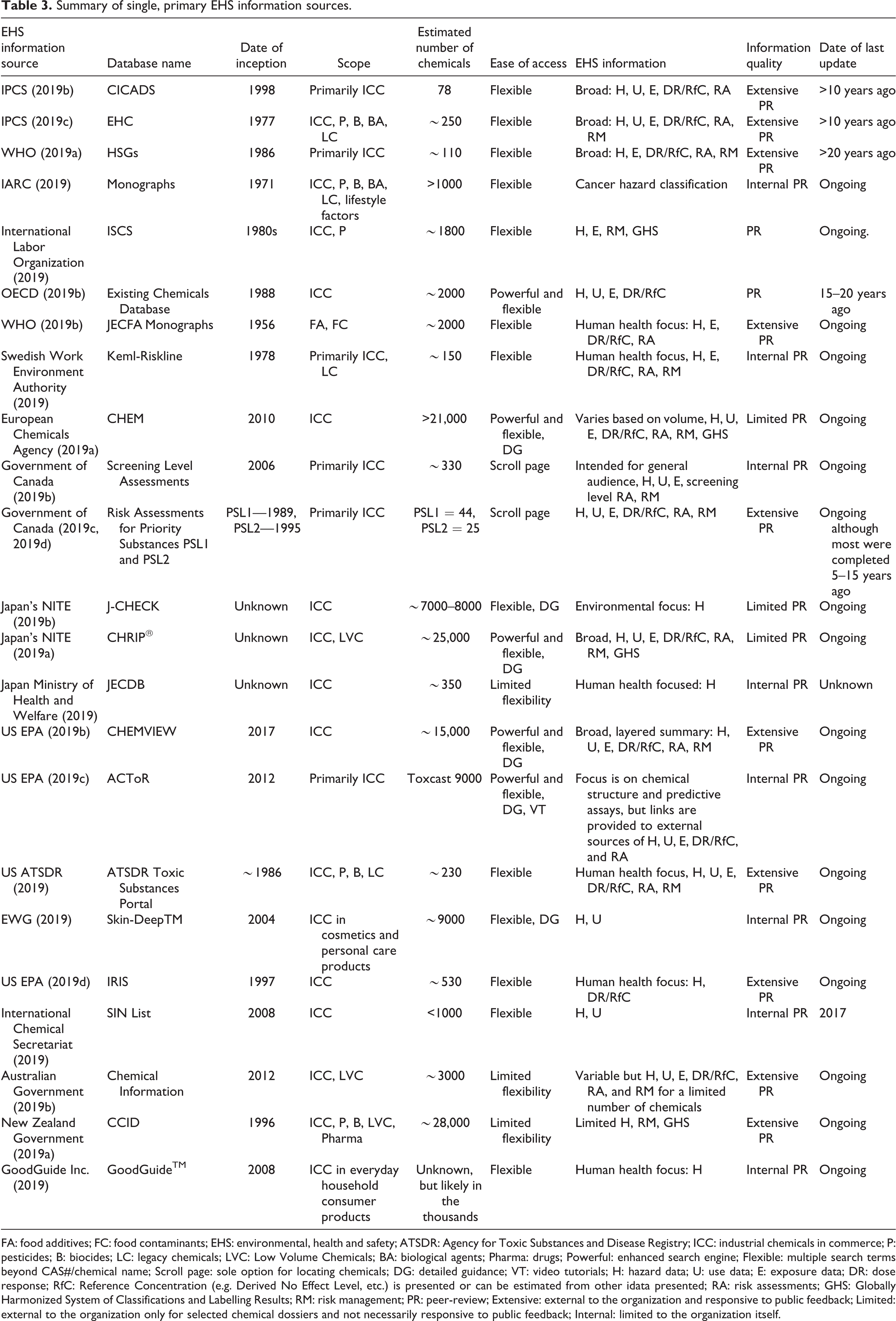
Twenty-four individual primary sources of EHS information were profiled and analyzed and are summarized in Table 3. With a few exceptions, most of these primary EHS sources are from intergovernmental organizations (IARC, 2019; International Labor Organization, 2019; IPCS, 2019a, 2019b, 2019c; OECD, 2019b; WHO, 2019a, 2019b) or individual government agencies that have regulatory authority (Australian Government, 2019b; ECHA, 2019a, 2019b; Government of Canada, 2019b, 2019c, 2019d; Japan Ministry of Health and Welfare, 2019; Japan’s NITE, 2019a, 2019b; New Zealand Government, 2019a; Swedish Work Environment Authority, 2019; US EPA, 2019b, 2019c, 2019d). Three of them are from nongovernmental organizations (ChemSec, 2019; EWG, 2019; GoodGuide Inc., 2019), and one is from a US government, nonregulatory agency (ATSDR, 2019).
Summary of single, primary EHS information sources.
FA: food additives; FC: food contaminants; EHS: environmental, health and safety; ATSDR: Agency for Toxic Substances and Disease Registry; ICC: industrial chemicals in commerce; P: pesticides; B: biocides; LC: legacy chemicals; LVC: Low Volume Chemicals; BA: biological agents; Pharma: drugs; Powerful: enhanced search engine; Flexible: multiple search terms beyond CAS#/chemical name; Scroll page: sole option for locating chemicals; DG: detailed guidance; VT: video tutorials; H: hazard data; U: use data; E: exposure data; DR: dose response; RfC: Reference Concentration (e.g. Derived No Effect Level, etc.) is presented or can be estimated from other idata presented; RA: risk assessments; GHS: Globally Harmonized System of Classifications and Labelling Results; RM: risk management; PR: peer-review; Extensive: external to the organization and responsive to public feedback; Limited: external to the organization only for selected chemical dossiers and not necessarily responsive to public feedback; Internal: limited to the organization itself.
Since it was one of the qualifying criteria for inclusion, all of the primary EHS information sources at a minimum include industrial chemicals, and they are the primary focus for a little less than half of them (OECD Existing Chemicals, European Chemicals Agency’s (ECHA) CHEM, Canada, J-CHECK, CHRIP, United States Environmental Protection Agency (US EPA) databases, and the International Chemical Secretariat (ChemSec) SIN list). The others include a wider range of chemical and/or physical agents, and one (IARC) even includes lifestyle factors.
The ECHA’s CHEM, J-CHECK, CHRIP, and US EPA’s CHEMVIEW databases include EHS information on the largest number of chemicals (i.e. tens of thousands) as their owners are government agencies with responsibility and authority to regulate all industrial chemicals produced or imported within their jurisdictions. The Environmental Working Group (EWG) Skin-Deep and GoodGuide databases also have information on a relatively large number of substances that are contained in personal care and household products. The remainder of primary EHS sources has information available on a more limited number of substances (ranging from hundreds to as many as several thousands). Although the US EPA’s ACToR database provides access to information on over 700,000 chemicals, that information is rather unique as is discussed in further detail below.
Each of the databases is relatively easy to access and search via a number of terms (e.g. CAS#, chemical name or synonyms, etc.), or is otherwise restricted in size so that it can be easily scanned to visually locate the chemical substances of interest. Most of the larger databases include guides or help pages with detailed instructions to assist users with conducting their searches. Some of the more sophisticated databases (e.g. ECHA’s CHEM) include additional features (e.g. pop-up text boxes) that make navigation even more user-friendly.
The breadth and depth of EHS information available from each source varies considerably. Some sources are focused solely on hazard identification and do not include any exposure information or risk characterization/assessment. Of this group, some are focused exclusively on human health hazards (IPCS’s CICADS, IPSC/EC’s ISCS, World Health Organization’s (WHO) HSGs, IARC’s Monographs, JECFA Monographs, KEMI-Riskline, and GoodGuide), and one focuses solely on environmental hazards (J-CHECK). Still others (OECD Existing Chemicals Database, US EPA’s IRIS, EWG’s Skin-Deep, and ChemSec SIN List) include both human and environmental health information but do not address uses, exposure, and/or risk characterization/assessment.
JECFA Monographs/Summary Evaluations and US EPA’s IRIS both present point of departure estimates (e.g. Reference Concentrations, etc.), and IPCS’s CICADS presents dose-response information so that others may conduct risk assessments. These values are available collectively for about 3000 of the highest volume substances.
Even among the information sources that provide human health and environmental risk assessment information, there is variability in breadth and depth of coverage. Canada presents screening level assessments written for general audiences for more than 300 chemicals and has more detailed risk assessments available for 69 chemicals, with plans to conduct more by 2020.
The amount of information available on a given industrial chemical from ECHA’s CHEM is largely dependent on the volume of that chemical produced or imported to the EU. Substantial hazard, use/exposure, and risk information is available for chemicals at or above 1000 metric tons, somewhat less so for lower volume substances, and substances below 10 metric tons have reduced information requirements. Even so, ECHA requires and makes publicly available an assessment of the risks of exposure for a full range of uses and exposure scenarios, although Confidential Business Information (CBI) claims can restrict public access to some of this information. The ECHA website also includes harmonized classification and labeling for more than 4250 substances (ECHA, 2019b).
Agency for Toxic Substances and Disease Registry (ATSDR) has published toxicological profiles, including risk assessments, for nearly 200 substances. Although it presents some information on environmental fate, the focus is primarily on human health consistent with ATSDR’s basic mission.
EPA’s ACToR is unique and distinct because it is focused on helping users predict toxicity of a chemical substance that currently lacks mammalian and eco-toxicity data. It does so largely based on structural and other similarities to other chemicals that have been tested. It is not necessarily directed at general EHS information seekers but instead to chemists and other experts who have specialized knowledge. It has been included for the purposes of this study because of the vast number of chemicals covered in the ACToR database and because the suite of tools available from ACToR are widely expected to gain increasing use in the next few years.
As noted above, most of the primary sources of EHS information are government regulatory agencies or intergovernmental organizations. With a few exceptions, these organizations either directly employ, contract with, or invite experienced scientific experts who evaluate the available health and environmental evidence and conduct the hazard, exposure, and risk characterization/assessments that are made publicly accessible. All of them describe processes they use for peer review of the information. Some of them (e.g. IARC, JECFA, Canada, US EPA, and Australia) have also published detailed technical guidance documents outlining the steps they take to carry out their work. EWG, ChemSec, and GoodGuide rely on internal processes to ensure the quality of the EHS information they publish and none of them describes any external peer review. GoodGuide invites public feedback and has processes in place to correct errors.
Scientific methods continue to evolve, and many chemicals are subject to ongoing testing and research, which makes it a challenge for EHS information sources to maintain current data and perspectives. While acknowledging this challenge, many of the information sources reviewed in this report (e.g. ECHA’s CHEM, US EPA’s CHEMVIEW and IRIS, ATSDR’s Toxicology Profiles, Japan’s databases, EWG’s Skin-Deep, ChemSec’s SIN List, Australia, New Zealand, and GoodGuide) do have well-developed procedures in an effort to stay current. However, others (e.g. IPCS’s CICADS, IPCS’s EHCs, WHO’s HEGs, and Canada’s risk assessments) completed their work 10 or more years ago and no effort is being expended to update the information. Users always need to exercise caution when referencing materials that could be many years out of date.
Each of the individual primary EHS information has its strengths, but in our judgment, information seekers would be best served to start their search with the ECHA’s CHEM database for the following reasons: (1) the relatively large number of industrial chemicals included in its scope; (2) ease of access and search; (3) although the depth and breadth of EHS information available varies by volume produced and/or imported, it does offer the full range of hazard, dose-response, Reference Concentration (e.g. Derived No Effect Level and Predicted No Effect Concentration), use/exposure, and risk assessment and risk management information available for a given chemical; (4) although not every chemical registration dossier is subject to external peer review, ECHA and the national authorities can and do check their completeness and quality and can require the registrants to conduct additional studies to fill data gaps, submit additional EHS information, redo safety assessments, and implement additional risk management up to and including restricting or banning sales of chemicals that cannot be managed safely; and (5) registrants are obligated to keep their registration dossiers up to date with new information or a need to improve the quality of the data has been identified.
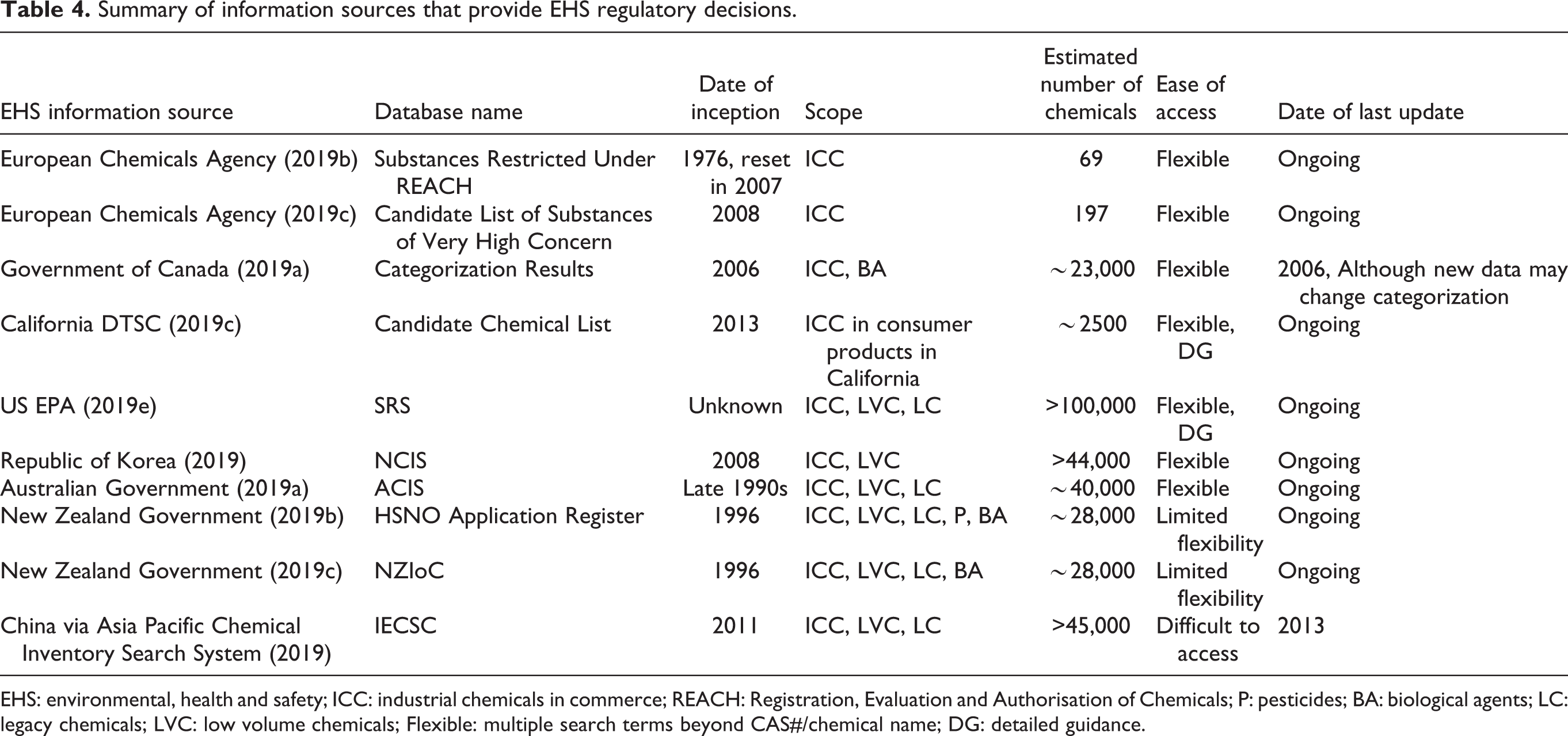
The final category of EHS information sources reviewed are the databases that provide EHS-type regulatory decisions on specific chemicals. Ten such databases were profiled (ECHA’s, 2019c, 2019d, Substances Restricted Under REACH List and Candidate Substances of Very High Concern (SVHC) List; Canada’s Categorization Results (Government of Canada, 2019a); California DTSC’s (2019c) Candidate List; US EPA’s (2019e) SRS; Republic of Korea’s (2019) NCIS; Australian Government’s (2019a) AICS; New Zealand’s (2019b, 2019c) HSNO Register and NZIoC; and China’s IECSC (Chemical Inspection and Regulation Service, 2019)) and are summarized in Table 4. These databases do not provide users with EHS information per se. Instead, they provide key regulatory decisions that, when combined with the pertinent criteria used to make those decisions, give users insight as to how other governments view hazards and risks of those chemicals and are taking regulatory actions to further investigate and manage the risks they pose to human health and/or the environment.
Summary of information sources that provide EHS regulatory decisions.
EHS: environmental, health and safety; ICC: industrial chemicals in commerce; REACH: Registration, Evaluation and Authorisation of Chemicals; P: pesticides; BA: biological agents; LC: legacy chemicals; LVC: low volume chemicals; Flexible: multiple search terms beyond CAS#/chemical name; DG: detailed guidance.
Each of the 10 databases is easily accessed and searched using commonly available terms; however, the China IECSC has somewhat restricted availability (Chemical Inspection and Regulation Service, 2019).
Canada’s Categorization Results database may be the most relevant and valuable for many users because it presents regulatory decisions on all 23,000 chemical substances identified as being in commerce in Canada. Many governments around the world have been looking for simpler, less expensive, and quicker approaches to characterizing the hazard and risks of chemicals, and the results of Canada’s efforts can possibly be leveraged by them for their own purposes.
ECHA maintains two databases of regulatory decisions. The first contains information on substances currently restricted under REACH (69 as of June 1, 2019). Available for each entry is a description of the regulatory conditions that have been placed on them. ECHA also maintains a database of the substances that are candidates for making the list of SVHC’s (i.e. Carcinogens, Mutagens, and Reproductive Toxins; Persistent (P), Bioaccumlative (B), and Toxic, very P very B, and substances of “equivalent concern”). Each entry in this database includes a link to the REACH dossier for that substance.
California DTSC’s Candidate Chemicals List identifies approximately 2300 chemicals found in consumer products that were determined to have at least one quality that can cause harm to human health or the environment referred to as a hazard trait. After a rule-making process has been completed to identify Priority Products that contain one or more Candidate Chemicals, in some instances, producers of such products may be compelled to complete an Alternatives Assessment and submit it to DTSC for review and action.
Our estimates of numbers of chemicals in commerce globally ranged from 40,000 to 60,000 (UN Environment and ICCA, 2019). A sole focus on estimates of total numbers of chemicals in commerce ignores a key point that the vast majority of total annual volume of chemicals produced and sold is concentrated in a much smaller number of commercial chemicals. Geiser (2015) estimated that 2500 chemicals account for more than 95% of chemical volumes, globally. Reliable volume data are only available from US EPA, ECHA REACH, and Japan. Combining their data and assuming 60% overlap in chemical identity between all of them, a figure found when comparing US EPA, Government of Canada, and EU REACH data, yielded an estimate of approximately 6000 chemicals that account for greater than 99% of the total volume produced or imported globally.
Discussion
This article was written primarily to serve the needs of professionals seeking EHS and regulatory information on one or more specific chemicals of interest to them and aspires to be a helpful guide for locating and using publicly available information sources. An initial search of one of the seven portals profiled, especially OECD’s eChemPortal, represents an efficient and powerful first step toward locating such information; however, users must be cautious with interpreting and applying the output of their searches from these portals and must first consult the websites of the individual third-party sources to fully understand the strengths and limitations of the underlying information. We also recommend ECHA’s CHEM and Canada’s Chemical Categorization Results databases as likely being especially useful resources for regulatory authorities from developing countries.
The report should prove helpful to authorities, especially in developing countries, in several important ways: giving ready access to EHS information on a wide range of industrial chemicals in commerce for use in GHS implementation; facilitating the development of strategies for gathering local use and exposure information critical for conducting risk assessments and prioritizing chemicals for further risk management; providing easy access to the most comprehensive EHS information that is available on chemicals of interest allowing identification of missing data for prioritized action to fulfill them; and assisting their discussions on specific chemicals and chemical classes identified as concerns to SAICM (e.g. brominated flame retardants, perfluorinated chemicals, etc.).
Another priority for this work was to provide policymakers with some perspective on the extent of EHS information that is available and the gaps that remain. We estimate there are between 40,000 and 60,000 industrial chemicals in commerce, with about 6000 representing more than 99% of the total volume globally. A number of factors contribute to the uncertainty in the estimates of the numbers of chemicals, including a lack of chemical inventories for many countries in the world; uncertain and variable definitions of industrial chemicals in commerce (i.e. different scopes); varying volume thresholds for reporting; uncertainty as to whether or not listed chemicals are actually on the market; and lack of reporting or misreporting to government authorities.
Twenty-four primary EHS information sources and 10 databases that present EHS regulatory decisions were identified and profiled. Collectively, they contain a range of EHS information for tens of thousands of industrial chemicals in commerce, with EHS information to support varying degrees of screening level hazard and risk assessment for the majority of the highest production volume chemicals. Even still, important gaps exist in our knowledge of hazards of lower volume chemicals (Judson et al., 2009) and how chemicals are used and of exposures (Egeghy et al., 2012), particularly in developing countries where uses and exposures may be different and/or unique (e.g. lack of or ineffectual exposure control), are likely to remain unless more effort is made to collect such information. CBI claims can also limit access to information available to the primary regulatory authorities.
Nevertheless, there are several reasons to be optimistic that going forward information gaps can be closed at an accelerated rate. The combined effect of recently adopted legislation in multiple regions and countries (e.g. EU, United States, and Republic of Korea and China) that requires manufacturers and importers to collect and publicly report hazard, use, exposure, and risk information on their chemicals; the increasing focus on safe substitution and greener chemistry; as well as the advent and acceptance of new tools and methods (e.g. read across, computational toxicology) provide excellent opportunities to close such information gaps more rapidly than in the past.
Footnotes
Acknowledgements
The authors wish to acknowledge the representatives from the two sponsoring organizations: International Council of Chemical Associations and United Nations Environment for providing guidance, counsel, and editorial suggestions. Bill Greggs of Soleil Consulting, LLC made substantial contributions to estimating the numbers of chemicals in commerce. Review and comments on the original report from which this article was derived were also solicited from all SAICM stakeholders, and comments were gratefully received from the International POPS Elimination Network, OECD, Crop Life International, UNITAR, WHO, and representatives from the national governments of Canada, Germany, Iraq, Columbia, Russia, Mexico, Mauritius, the Republic of Congo, Madagascar, and Tanzania.
Declaration of conflicting interests
The author(s) declared the following potential conflicts of interest with respect to the research, authorship, and/or publication of this article: GGB is retired from the Dow Chemical Company where he was the senior executive leading product safety, compliance, and sustainability. He currently provides consulting services on a part-time basis to various industrial and not for profit clients. VG is responsible for product stewardship for the European Chemical Industry Council, which represents the chemical industry to the European Union.
Funding
The author(s) disclosed receipt of the following financial support for the research, authorship, and/or publication of this article: This work was supported financially by the International Council of Chemical Associations (ICCA), which is the worldwide voice of the chemical industry, and while representatives of ICCA were provided the opportunity to review and comment on the study design, analysis, and drafts of the report, all final decisions, including editorial decisions on the manuscript were made by the authors alone. The authors had full access to all of the data in this study and take responsibility for the integrity of the data and the accuracy of the data analysis.
