




Abstract
Brand activism, taking a stance on current and divisive sociopolitical issues, has emerged as a novel means of expressing a brand's values and engaging with the firm's customer base. Yet, globally, companies lack conclusive guidance on the consequences of taking a stance. This research asks a novel question: Should global brands engage in activism? Using varying activism manipulations (e.g., statements and actions), five studies reveal consumer preference for activist global brands. More importantly, guided by schema change theory, the authors find that the positive brand activism effect is particularly strong for global brands associated with negative brand origin, irrespective of consumers’ prior attitude valence. However, brands with positive origin associations benefit from activism only when consumers’ prior attitude valence is in alignment. The authors also identify the mediating effects of self–brand connection, which has downstream consequences for behavioral intentions. Taken together, this work sheds new light on consumer perceptions of brand activism across cultures, elucidates why consumers prefer global brands that engage in activism, and offers actionable insights for global brand managers.
Brand activism involves taking a stand on pertinent and contentious sociopolitical matters, enabling firms to signal their core values and communicate their commitment to create a positive impact (Moorman 2020). Brand activism is increasingly used to showcase brand values, driven partly by growing public pressure on brands to engage in activism (Hydock, Paharia, and Blair 2020; Vredenburg et al. 2020). A recent study found that over 90% of millennials would switch to a brand associated with an activist cause (Rimmer 2022). The rise of brand activism has sparked scholarly interest. However, extant research shows mixed effects, as some demonstrate that the net effect of brand activism is negative (Hydock, Paharia, and Blair 2020; Mirzaei, Wilkie, and Siuki 2022) and, conversely, others reveal positive emotional and behavioral responses (Garg and Saluja 2022; Verlegh 2023). Analysts highlight a growing consumer preference for socially active brands and encourage companies to engage in activism (Accenture 2018; Edelman 2022). Despite initial insights, the evidence remains inconclusive on whether to engage in activism as well as on its differential effects on global and local brands.
Without clear academic guidance available, numerous global brands—those that are marketed in multiple areas around the world in a centrally coordinated, near-standardized fashion (Steenkamp, Batra, and Alden 2003, p. 53)—have started engaging in various activism initiatives tackling racial inequality (Google, Facebook, Airbnb, Nike), gender inequality (Stella Artois, P&G, Gucci), and hate speech (Pernod Ricard, BBC Sport), among others. However, several global brands have been criticized for their perceived inauthentic activism (Ahmad, Guzmán, and Al-Emran 2024). For instance, Starbucks publicly supported the Black Lives Matter (BLM) movement but initially prohibited employees from wearing items supporting BLM, citing dress-code violations. However, after receiving considerable negative publicity for double standards, Starbucks reversed the decision and distributed to its employees 250,000 T-shirts that featured a series of protest picket signs, including a “Black Lives Matter” one. Similarly, fashion brand Boohoo supported the BLM movement but was investigated for possible modern-day slavery. Hence, with little conclusive guidance on whether they should engage in activism, many global brands opt to avoid taking activist stances. In fact, data from As You Sow, an organization advocating for corporate accountability, indicates that roughly half of the Russell 1000 companies refrained from making statements about racial inequality following the tragic murder of George Floyd (Irrera, DiNapoli, and Moise 2020).
Previous research indicates that consumers regard global brands as prototypical exemplars within their product categories and prefer them globally over local brands for their representation of consumer culture and symbolism (Alden, Steenkamp, and Batra 2006; Davvetas, Diamantopoulos, and Liu 2020; Magnusson et al. 2014). Often, consumers embrace global brands not only for their quality, reliability, functional, and emotional benefits but also to construct and signal their self-identity, fostering strong emotional attachments (Baršytė et al. 2023; Mandler, Bartsch, and Han 2021; Xie, Batra, and Peng 2015). We build on the initial research on brand activism and address a set of novel questions: Is there a value for global brands to engage in activism? Will consumers react differently to activism efforts by global brands depending on their brand origin? If so, what are the psychological reasons underlying this effect and what are the related boundary conditions?
We report the results of five studies that define our contributions. First, we clarify that brand activism can help boost consumer purchase intentions for global brands. Second, we identify brand origin as a theoretically and managerially crucial boundary condition, especially for global brands. Specifically, we identify an attenuation of the negative brand origin effect grounded in schema change theory (Rothbart 1981) wherein brand activism substantially helps global brands with negative origin improve their market position. This effect persists even after controlling for ethnocentrism, attitude extremity toward activism, country affinity, and animosity. Moreover, we identify the unique effect of consumer–brand activism stance alignment. For brands with a negative origin, activism proves effective regardless of consumers’ prior attitude valence. In contrast, brands that have a positive origin only see activism benefits when it aligns with consumers' prior attitude valence. Third, we find that consumer preference for global brands can be understood through a process of self–brand connection (Escalas and Bettman 2003), leading to increased behavioral intentions. Consumers regularly use global brands as symbols of their extended selves (Dimofte, Johansson, and Bagozzi 2010). We demonstrate that when global brands engage in activism, consumers feel a stronger connection, resulting in positive behavioral intentions. From a substantive perspective, our findings highlight when it is effective for global brands to engage in activism. This brand activism effect holds across different industries (e.g., fashion, luxury, and sports), activism issues (e.g., immigration control, abortion, and LGBTQ+ rights), approaches (e.g., statement versus actions), and communication methods (e.g., text and social media posts). These findings show the robustness of brand activism for managerial practice.
Theoretical Background and Hypotheses
Brand Activism and Schema Change
Brand activism involves organizations publicly taking a stand on divisive social, political, economic, and environmental issues (Bhagwat et al. 2020). Its aim is to induce societal change by influencing attitudes and behaviors in the marketplace, other organizations, or the government (Eilert and Cherup 2020). Although brand activism and corporate social responsibility (CSR) both seek to contribute to their stakeholders and society (Heinberg et al. 2021), they are conceptually different. CSR is mainly concerned with well-accepted prosocial issues—such as supporting child education, fair-trade participation, or reducing poverty—that usually garner positive or ambivalent responses (Mukherjee and Althuizen 2020) unless perceived as inauthentic (Wagner, Lutz, and Weitz 2009). However, brand activism entails taking a stand on controversial sociopolitical issues (Bhagwat et al. 2020), often leading to stronger and more divisive responses (Hydock, Paharia, and Blair 2020; Vredenburg et al. 2020).
Brand activism has gained academic attention within management and marketing literature. However, extant literature presents conflicting views: Some researchers support its positive impact on market outcomes, while others highlight its negative effects. For example, Bhagwat et al. (2020) show that brand activism elicits an adverse reaction from investors as it signals the firm's allocation of resources away from profit-oriented objectives. Further, while highlighting the negative consumer responses to brand activism, Hydock, Paharia, and Blair (2020) also indicate that the net effect of brand activism at the market level is positive for small-share brands but negative for large-share brands. In contrast, a study involving nearly 30,000 consumers globally shows that consumers are no longer making purchase decisions based solely on functional benefits but also assessing what companies say and stand for (Accenture 2018). Similar positive emotional and behavioral benefits are highlighted in extant research (Verlegh 2023).
Recent research demonstrates a more nuanced perspective highlighting the important role played by alignment of consumers’ prior attitudes with a brand's activism stance. Cause–brand fit literature also supports this assertion (Ahmad, Guzmán, and Al-Emran 2024). For instance, activism researchers found that brand attitudes decreased significantly among consumers who disagreed with the brand's stand, while there was no significant effect among those who supported it (see Mirzaei, Wilkie, and Siuki 2022; Mukherjee and Althuizen 2020). This is observed in investor behavior as well, wherein investors reacted negatively to activism if they disagreed with the brand's stance (Bhagwat et al. 2020). In addition, Garg and Saluja (2022) demonstrate the role of prior political inclination, such that brand activism increases consumer willingness to pay and leads to positive brand attitudes, especially among those who hold liberal views. This consumer–brand stance alignment is observed in practitioner research also. Recent empirical studies and business reports find that if a brand aligns with consumers’ attitudes on social issues, they will increasingly buy from the brand (Verlegh 2023), and seven out of ten will advocate for and defend it (Edelman 2022). Thus, consumers increasingly expect global brands to engage in the activism they support.
Consumers use a variety of schemas to help them build knowledge structure about brands. Schemas are organized units of knowledge that describe a pattern of thought or behavior that act as mental structures of preconceived ideas, categories of information, and the relationships between them (Sujan and Bettman 1989). Schemas are dynamic and evolve with new information and experiences (Loken 2006). These structures help consumers form expectations, aid with information retrieval, categorize environmental stimuli, and assist in decision-making (Magnusson et al. 2014). In most cases, brands significantly shape product category schemas due to their distinctive qualities. This is especially true for global brands, which serve as product category exemplars (Davvetas, Diamantopoulos, and Liu 2020).
Schemas generally evolve gradually as consumers assimilate, adjust, or build alternative schema based on information congruity (Mandler 1982). For instance, congruent information is easily assimilated, while moderately incongruent information leads either to assimilation or the development of an alternative schema without drastically altering the original schema (Sujan and Bettman 1989). Although schema change may occur gradually, the conversion model of schema adjustment (Rothbart 1981) suggests that significant changes in consumer perception can result from highly incongruent brand behavior. Based on this schema model, we posit that brand activism, being divisive, can act as a catalyst for schema change in consumers. However, this effect will vary based on the brand nature (global vs. local) and brand origin perceptions (positive vs. negative), as illustrated in the next sections.
Global Brand Activism and Schema Change
In the contemporary global landscape, the role of global brands transcends mere commercial transactions (Mandler, Bartsch, and Han 2021). With the rise of social media, global brands are constantly in the limelight and face increased scrutiny for their actions (Özturan and Grinstein 2022; Xie, Batra, and Peng 2015). Accordingly, brand activism can act as a conduit through which global brands can signal their responsibilities, commitments, and concerns toward sociopolitical issues, echoing the values held by their consumer base while at the same time gaining competitive advantage (Özturan and Grinstein 2022).
However, given the divisiveness that often results from brand activism, it has a potential to damage relationships with those who disagree with the brand's stance (Nam et al. 2023). As highlighted previously, management research provides mixed findings with regards to the impact of activism. For example, some studies indicate that activism elicits an adverse reaction from investors (Bhagwat et al. 2020) and negative brand attitudes (Mukherjee and Althuizen 2020), hence carrying significant risks. Others indicate increased consumer engagement (Verlegh 2023), positive emotional responses (Garg and Saluja 2022), and benefits for particular segments such as small-share brands (Hydock, Paharia, and Blair 2020). Moreover, researchers highlight the nuanced nature of reactions to brand activism based on alignment between consumers’ prior attitudes and a brand's activist stance (Mirzaei, Wilkie, and Siuki 2022; Mukherjee and Althuizen 2020), political ideology (Garg and Saluja 2022), and speed of engagement in activism as the issue becomes prominent (Nam et al. 2023). Therefore, more guidance is needed on whether global brands should engage in a risky strategy such as activism.
Consumers tend to demonstrate strong positive emotional attachment and elicit greater trust in global brands than in local brands, hence using them to communicate their identity to others (Xie, Batra, and Peng 2015). In general, compared with local brands (Baršytė et al. 2023; Dimofte, Johansson, and Bagozzi 2010), global brands consistently prompt positive affect and respect (Alden, Steenkamp, and Batra 2006) and credibility (Mandler, Bartsch, and Han 2021), and they are perceived as high quality (Steenkamp, Batra, and Alden 2003). Notably, even consumers who are explicitly against the notion of global brands show a positive evaluation of them (Dimofte, Johansson, and Ronkainen 2008). Further, research points toward a growing consumer preference for brands engaging in activism (Edelman 2022; Verlegh 2023).
We posit that when global brands engage in activism, consumers will show heightened positive attitudes and behaviors than for local activist brands. This is because global brands are often perceived as prototypical exemplars for their category, creating an identity and a sense of achievement and identification for consumers (Xie, Batra, and Peng 2015). Moreover, global brands symbolize the aspired values of global consumer culture and have wider reach and influence (Özsomer and Altaras 2008). Consequently, when global brands take a stance on global sociopolitical issues, they enable consumers to better align with the pervasive global consumer culture and sociopolitical discourse by incorporating these values into their self-concepts and project their identity.
Schema change theory suggests that significant changes in consumer perception can occur when information from a trusted and credible source challenges existing beliefs or values (Rothbart 1981). This disconfirmation process can make consumers question their current point of view on an issue and potentially realign with the brand's stance. For example, consider the global brand Nike and its multicountry campaign fighting racial inequality. Nike's extensive global presence, recognition, and emotional connections with its diverse consumer base makes its activism highly influential among consumers. Nike's activism may resonate deeply with consumers who value equality, as there is strong consumer–brand stance alignment. Moreover, consumers who may not have previously considered racial inequality issues might be influenced by Nike's activism to reassess their views and support the brand stance. Global brands, being exemplars, provide more credible and impactful information, leading to greater schema change (Loken 2006; Magnusson et al. 2014). Hence, when a global brand like Nike engages in activism, it may challenge and potentially change a consumer's existing mental framework (schema) about the brand.
Thus, the enhanced emotional attachment and symbolic associations that global brands hold over local brands (Xie, Batra, and Peng 2015) amplify the impact of activism for consumers expressing their values and identity. Global brands often represent broader cultural values and ideals, which resonate with a wider, more diverse audience (Alden, Steenkamp, and Batra 2006). This broad resonance makes the activism by global brands more impactful as it aligns with the aspirations and identities of a larger consumer base. Local brands, while adept at meeting specific local needs and tastes, may not have the same level of influence or symbolic power on global sociopolitical issues (Baršytė et al. 2023). Hence, when a global brand takes a stance on relevant sociopolitical issues, this increased alignment with widespread values and aspirations leads to higher brand evaluation and purchase intentions compared with local brands.
The Moderating Role of Brand Origin
Country of origin is one of the most researched areas within international business (Samiee and Chabowski 2021). Among variations of origin, such as country of design, manufacture, and assembly (Allman et al. 2016; Shukla 2011), it is well established that brand origin is a key attribute influencing consumption decisions (Samiee and Chabowski 2021). Other origin variations help determine the effects of consumers’ perceptions of countries on their rating of products’ quality and choice, which leads to the analysis conducted at the product and not the brand level. Brand origin, however, refers to the integration of origin cues within the brand image and is arguably more salient for consumer identity (Allman et al. 2016; Thakor 1996). Perceived brand origin significantly affects consumers evaluations (for a review, see Samiee and Chabowski [2021]), global brand judgments (Davvetas, Diamantopoulos, and Liu 2020; Mandler 2019), and willingness to pay (Koschate-Fischer, Diamantopoulos, and Oldenkotte 2012), among other outcomes.
Brand origin serves as a critical cue for brand evaluation, shaping consumer beliefs about a brand’s status and trustworthiness (Shukla 2011). For example, global brands like Nike, BMW, and Louis Vuitton maintain strong associations with their respective country of origin (the United States, Germany, and France). As these countries are known for their quality in the focal product category (e.g., sports, automobiles, and fashion), consumers perceive these brands as being superior to many other brands (Lee, Lockshin, and Greenacre 2016). While these brands’ products are now produced across different countries, consumers still categorize them based on their American, German, and French origin. However, brand origin does not always lead to a positive image assessment. Negative perceptions of a country may impact the brands associated with that country (Baršytė et al. 2023; Cakici and Shukla 2017). Consumer animosity studies show that negative country attitudes outweigh perceptions of product quality and brand judgment, making consumers resist buying foreign brands (Leonidou et al. 2019).
Researchers suggest that consumers combine brand origin cues with other product cues to make purchase decisions (Samiee and Chabowski 2021). Based on schema change theory (Mandler 1982), we posit that when a global brand with perceived positive origin engages in activism, consumers may identify it as mildly incongruent information and thus maintain their existing schema. If the activism fits with consumers’ existing schema, they may assimilate this information. Alternatively, if the activism conflicts with their existing views, consumers may develop an alternative schema to preserve their current schema structure about the positive brand origin.
Global brands with perceived negative origin need to develop strategies to alter consumer negative schema and enhance their market position. Recent research highlights CSR as a tactic driving schema change. For example, Özturan and Grinstein (2022) find that foreign brand origin strengthens the positive effect of CSR communication while mitigating the negative effect of sociopolitical activism communication. Moreover, Cowan and Guzman's (2020) examination of 135 different brands across countries shows that signals pertaining to sustainability benefit brands emerging from countries with lower sustainability reputation more than those with higher reputation. Based on these findings and schema change theory, we posit that, for a brand with negative origin, the mere act of engaging in activism can override consumers’ existing negative perceptions, as it signals the brand's commitment to broader societal values. This resultant shift in the brand's identity may prompt consumers to reassess their existing negative schema, leading them to reevaluate the brand more positively, regardless of the specific activism issue. A negative origin brand's willingness to take a stance on a sociopolitical issue will therefore be perceived as a positive shift, overshadowing any incongruence or mismatch between activism and consumer prior attitude valence.
We apply the preceding findings to the activism context and posit that when perceived brand origin is positive, brand activism will either be assimilated or lead to development of a new schema structure, due to the existing positive schema associations with such brands. Consequently, any supplementary positive emotions evoked by the brand's activist stance may marginally contribute to improving consumers’ brand evaluations and purchase intentions. However, activism will act as a schema change catalyst mitigating negative brand origin effects for global brands. Specifically, for global brands with perceived negative brand origin, engaging in activism can drive a schema change leading to strong positive affective response. This could shift negative brand origin perceptions to positive ones, hence enhancing consumers’ brand evaluation and purchase intentions.
The Mediating Role of Self–Brand Connection
We predict a greater consumer inclination to buy global brands engaged in activism. We build this prediction based on a mediation account involving positive inferences pertaining to self–brand connection. This prediction is based on the idea that consumer preference for global brands engaged in activism may arise from positive emotional dispositions resulting from schema changes, particularly for global brands with perceived negative origins.
Branding research establishes that brands are used to construct consumer self-identities (Khalifa and Shukla 2021). Self–brand connection refers to the formation of strong and meaningful ties between a brand and a consumer's self-identity (Escalas and Bettman 2003). Consumers form strong emotional attachment with brands that fit with their self-identity. Global brands, known for their perceived higher quality and stronger prestige associations (Steenkamp 2020), often symbolize aspirational lifestyles (Batra et al. 2000). These brands serve as a pathway to becoming part of a global community (Mandler 2019; Strizhakova, Coulter, and Price 2008). In contrast, local brands are sometimes perceived as less prestigious and of lower quality than global brands, limiting their aspirational appeal (Steenkamp 2020). While global brands symbolize a connection to a global community and aspirational lifestyles, local brands are tied to regional identities that may not have the same broad or cosmopolitan appeal (Baršytė et al. 2023). Moreover, consumers are generally more familiar with and trust global brands due to their extensive marketing efforts and consistent presence across various foreign markets, which fosters stronger emotional attachment (Alden, Steenkamp, and Batra 2006). Drawing on these aspects, we predict that consumers incorporate global brands into their self-concept to expand the “self.” Such brands thus serve as a cue of linking themselves to a global identity. According to consumer–brand identification theory, stronger self–brand connection leads to more positive brand evaluations, purchase intentions, and brand advocacy (Khalifa and Shukla 2021). Thus:
In our conceptual framework (Figure 1), we theorize that brand activism by a global brand positively affects consumers' behavioral intentions (and attitudinal reactions). We posit that such positive effect of activism is moderated by brand origin and prior attitude valence and mediated by self–brand connection.
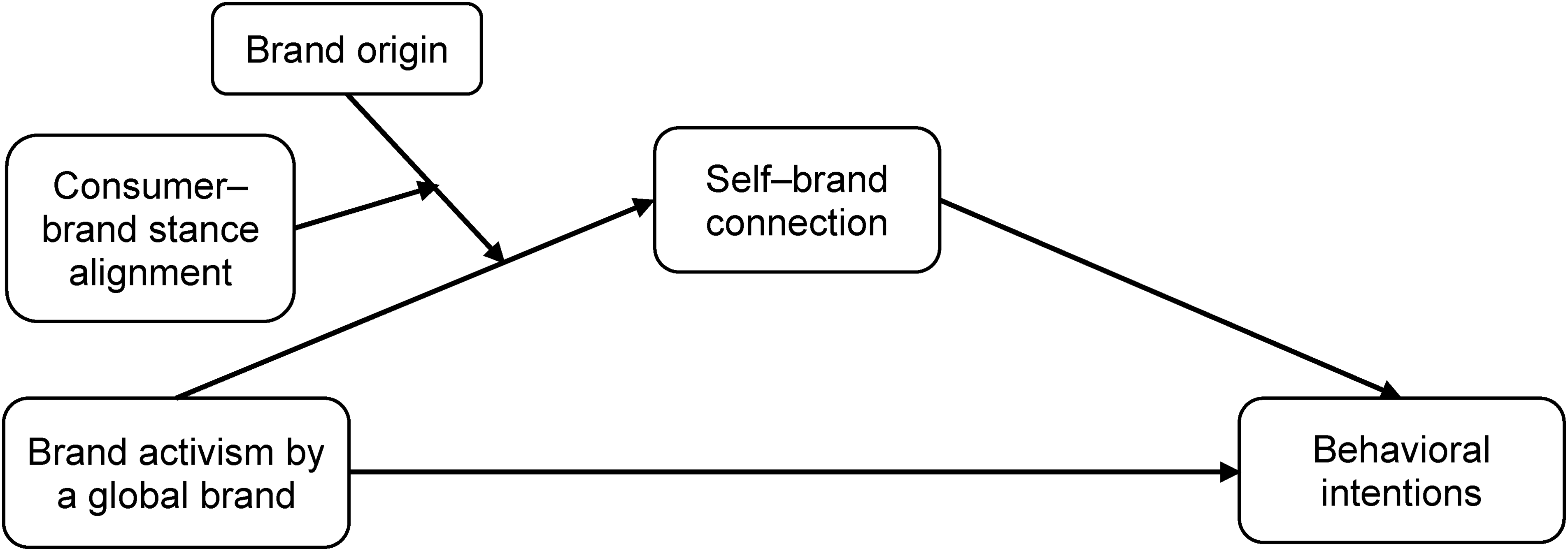
Conceptual Framework.
Overview of Studies
We test our predictions across five progressive studies that build on prior studies. Study 1, conducted in the United Kingdom using the activism context of immigration control, validates the positive effects of activism for a global brand. Study 2 includes U.S. participants and compares consumer preference toward activism between a global versus a local brand using the LGBTQ+ community support context and a different operationalization through a social media post. Study 3 tests the moderating effects of brand origin using the activism context of an abortion ban and the communication approach of a news announcement among North American consumers. It validates our assertion that brand activism benefits global brand substantially, and especially those with negative brand origin. Study 4, involving Spanish consumers, reveals the mediating role of self–brand connection that drives the positive brand activism effect, using the LGBTQ+ context through a social media post. Study 5, using a newspaper advertisement in the United Kingdom, examines the unique effect of consumer–brand stance alignment for the theorized framework.
Study 1
Study 1 examines the direct effect of activism by global brands on consumers’ purchase intentions. We used the topic of immigration control utilizing a text-based scenario as the communication approach.
Method
In this study, 209 participants from the United Kingdom were recruited via the Prolific Academic panel. Of these, nine participants failed attention checks, resulting in a final sample of 200 (Mage = 42.71 years, SD = 14.45; 52.2% female, 45.8% male, 2% nonbinary). After receiving consent, we randomly assigned participants to either the brand activism or control conditions. To manipulate activism, we used a similar protocol as employed by Mukherjee and Althuizen (2020). Participants were first shown two print advertisements of an imaginary fashion brand, “Feltar.” Further, using similar protocol as Davvetas, Sichtmann, and Diamantopoulos (2015), we manipulated the brand's globalness through verbal cues such as “available worldwide.” Participants in the control condition were shown the two ads only. In the brand activism condition, however, participants were informed that the brand had issued the following public statement: “We stand in solidarity with the fight for justice and immigration control and will continue to invest in the community. Therefore, we have committed £500,000 to support non-profit organizations fighting against immigration control. This fund will provide organizations with the much-needed resources to advance their mission.”
Purchase intentions was the dependent variable, which was elicited directly after the manipulation. We employed a single item self-report measure that captured interest in buying Feltar-branded products in the future on a seven-point Likert-type scale (1 = “strongly disagree,” and 7 = “strongly agree”). For the manipulation check, participants were asked one question, “Do you think Feltar is an activist brand?,” on a seven-point Likert scale. We also asked if “Feltar is a global brand” on a five-point Likert scale. Further, we controlled for attitude extremity to activism by asking respondents about the issue importance of immigration control using an 11-point bipolar item (1 = “not at all important,” and 11 = “extremely important”; Mukherjee and Althuizen 2020).
Results and discussion
An ANOVA was employed for the manipulation checks and to measure the effects of global brand activism. The results showed that the brand activism manipulation was effective, as participants in this condition rated the brand as more politically active (M = 4.17; F(1, 199) = 106.47, p < .001) than those in the control condition (M = 2.60). Moreover, participants agreed that Feltar was a global brand (M = 4.80; SD = 1.31).
An ANCOVA with purchase intentions as a dependent variable, attitude extremity as a control variable, and brand activism as an independent variable provided strong support for the predicted positive brand activism effect for global brands (H1). Participants in the brand activism condition were significantly more likely to buy the brand's products (M = 4.38; F(2, 198) = 6.46, p < .01, η2 = .032) than in the control condition (M = 3.63). Attitude extremity has a significant direct impact on purchase intentions (F(2, 198) = 17.94, p < .001). With both the covariate (i.e., attitude extremity) and the predictor variable (i.e., activism) having significant effect on the dependent variable (i.e., purchase intentions), the results provide evidence that global brand activism significantly influences purchase intentions when controlling for attitude extremity.
Using a brand activism manipulation, Study 1 demonstrates that consumers show greater purchase intentions for a brand that is engaged in activism. In the next study, we examine if the positive brand activism effect is stronger for global brands than for local brands.
Study 2
Study 2 aims to compare the effect of brand activism between a global and a local brand, hypothesizing a stronger effect for the global brand. We used the activism context of LGBTQ+ support with social media post as communication type. We also included brand evaluation as a dependent variable alongside purchase intentions.
Method
Initially, 205 participants from the Prolific Academic USA panel were recruited for study. Of these, three failed attention checks, and thus the final usable sample was 202 (Mage = 41.48 years, SD = 14.79; 45% female, 53.5% male, 1.5% nonbinary). After receiving consent, we first asked participants to state their level of affinity and animosity toward the United States as control variables. Affinity was captured using a six-item scale (α = .94) developed by Oberecker and Diamantopoulos (2011) with items “pleasant feeling,” “like,” “feeling of sympathy,” “feeling attached,” “love,” and “feeling inspired” on a seven-point scale (1 = “not felt at all,” and 7 = “felt extremely”). Animosity was captured using three items (α = .89): “I dislike the USA,” “I feel anger toward the USA,” and “I hate the USA” on a seven-point Likert type scale derived from Riefler and Diamantopoulos (2007). We also controlled for ethnocentrism with a six-item, seven-point Likert type scale with the items “A real American should always buy US-made products,” “Only those products not available in the USA should be imported,” “Americans should not buy foreign products, because this hurts American business and causes unemployment,” “It may cost me in the long-run but I prefer to support products made in USA,” “American products, first, last, and foremost,” and “American consumers who purchase products made in other countries are responsible for putting their fellow Americans out of work” (α = .94) from Klein, Ettenson, and Krishnan (2006). These control items were counterbalanced wherein some participants saw it before manipulation and some afterward with no significant difference in the effect.
Participants were then informed that they would be examining an Instagram post from Hyperice, a U.S.-based brand of sports equipment and the official sponsor of the U.S. Men's National Soccer Team. At the Qatar World Cup, the U.S. Men's National Soccer Team took a stance by showcasing a rainbow team logo at its training facility and media center in a show of solidarity with the LGBTQ+ community. Their logo featured the traditional shield but had seven different colors in vertical stripes that represented the rainbow. Thus, our fictitious post about the real event further increased the ecological validity of the study. Participants were exposed to one of the four conditions randomly (see Web Appendix A). Using verbal cues, Hyperice was introduced as a global (vs. local) sports brand (Davvetas, Sichtmann, and Diamantopoulos 2015) available in more than 150 countries (vs. available in the USA only) and also as one of the official sponsors of the U.S. Men's National Soccer Team. In the activism condition, participants were shown the Instagram post with the U.S. Men's National Soccer Team rainbow logo with H matching the Hyperice logo in rainbow color as well. The post stated: “We are fully committed to the rights of the LGBTQ+ community. We stand in solidarity with the USA Men's Soccer Team who have added the rainbow flag to their logo ahead of the 2022 World Cup in Qatar.” In the nonactivism condition, participants saw the regular USA Men's Soccer Team logo with H in black. The post stated: “We are proud to be one of the official sponsors of the USA Men's Soccer Team who are participating in the 2022 World Cup in Qatar.”
Participants were then exposed to the same manipulation check of activism as in Study 1. They were also asked about their purchase intentions as a dependent variable and their attitude extremity as a control variable. In this study, we also captured brand evaluation using three items on a seven-point bipolar scale (α = .98; 1 = “bad,” and 7 = “good”; 1 = “unpleasant,” and 7 = “pleasant”; 1 = “dislike,” and 7 = “like”; Batra and Ahtola 1991). Manipulation checks for globalness/localness of the brand were measured by asking four questions that comprised two for the globalness and two for the localness. The globalness items were “Hyperice is a global brand” and “I think consumers abroad buy Hyperice products.” The localness items were “Hyperice is a local independent brand” and “Hyperice products are sold locally.”
Results and discussion
The manipulation check for brand globalness was successful. Participants in the global brand condition showed that the brand was more global (Mglobal = 4.16, Mlocal = 3.08; F(1, 200) = 53.27, p < .001) and was bought by consumers abroad (Mglobal = 3.94, Mlocal = 3.02; F(1, 200) = 36.35, p < .001). Participants exposed to the local brand condition demonstrated that the brand was significantly more local (Mlocal = 3.40, Mglobal = 2.05; F(1, 200) = 63.83, p < .001) and the products were only sold locally (Mlocal = 3.67, Mglobal = 2.96; F(1, 200) = 22.71, p < .001). The activism manipulation was also successful wherein participants who saw the brand activism condition agreed that the brand was politically active (Mactivism = 4.17, Mnonactivism = 2.74; F(1, 200) = 91.31, p < .001).
A two-way between groups ANOVA with global (vs. local) and activism (vs. no activism) as independent variables and affinity, animosity, ethnocentrism, and attitude extremity as covariates with dependent variables of brand evaluation and purchase intentions was executed. The analysis showed that the direct effects of global (vs. local) brand condition on the dependent variables of brand evaluation (F(1, 194) = .99, p > .05) and purchase intentions (F(1, 194) = .67, p > .05) was nonsignificant. Similarly, the direct effect of the activism (vs. no activism) condition on brand evaluation (F(1, 195) = .55, p > .05) and purchase intentions (F(1, 194) = 2.32, p > .05) was nonsignificant. However, the interaction effects were significant in both brand evaluation (F(1, 194) = 6.83, p < .01, η2 = .034) and purchase intention conditions (F(1, 194) = 3.99, p < .05, η2 = .020). The control variable of affinity had a significant effect on the DVs (brand evaluation: F(1, 194) = 4.22, p < .05; purchase intentions: F(1, 194) = 6.23, p < .05). Similarly, attitude extremity also had a significant effect on the dependent variables (brand evaluation: F(1, 194) = 39.03, p < .001; purchase intentions: F(1, 194) = 29.05, p < .001). However, no significant effect was observed either for ethnocentrism (brand evaluation: F(1, 194) = 1.52, p > .05; purchase intentions: F(1, 194) = 2.91, p > .05) or animosity (brand evaluation: F(1, 194) = .90, p > .05; purchase intentions: F(1, 194) = .02, p > .05).
As demonstrated in Figure 2, activism substantially benefits global brands. Participants’ brand evaluations (t(101) = −2.64, p < .01) and purchase intentions (t(101) = −2.46, p < .05) increased significantly when a global brand engaged in activism. However, this effect was nonsignificant for a local brand (p > .05). The findings are in contradiction with Hydock, Paharia, and Blair (2020), who propose that the net effect of brand activism is negative and is only beneficial for small-share brands. We find that activism substantially increases consumer brand evaluations as well as purchase intentions for global brands. This could be attributed to the nature of global brands, which are seen as exemplars in their category. Thus, when they engage in activism, they carry substantial cultural capital (Xie, Batra, and Peng 2015). On the other hand, local brands may not have such strength of explicit identity and affective associations as are possessed by global brands (Dimofte, Johansson, and Bagozzi 2010). Hence, when global brands engage in activism, they offer an additional avenue for consumers to articulate their own values and sense of identity, compared with a local brand. In the next study, we tackle the challenge of brand origin effects.
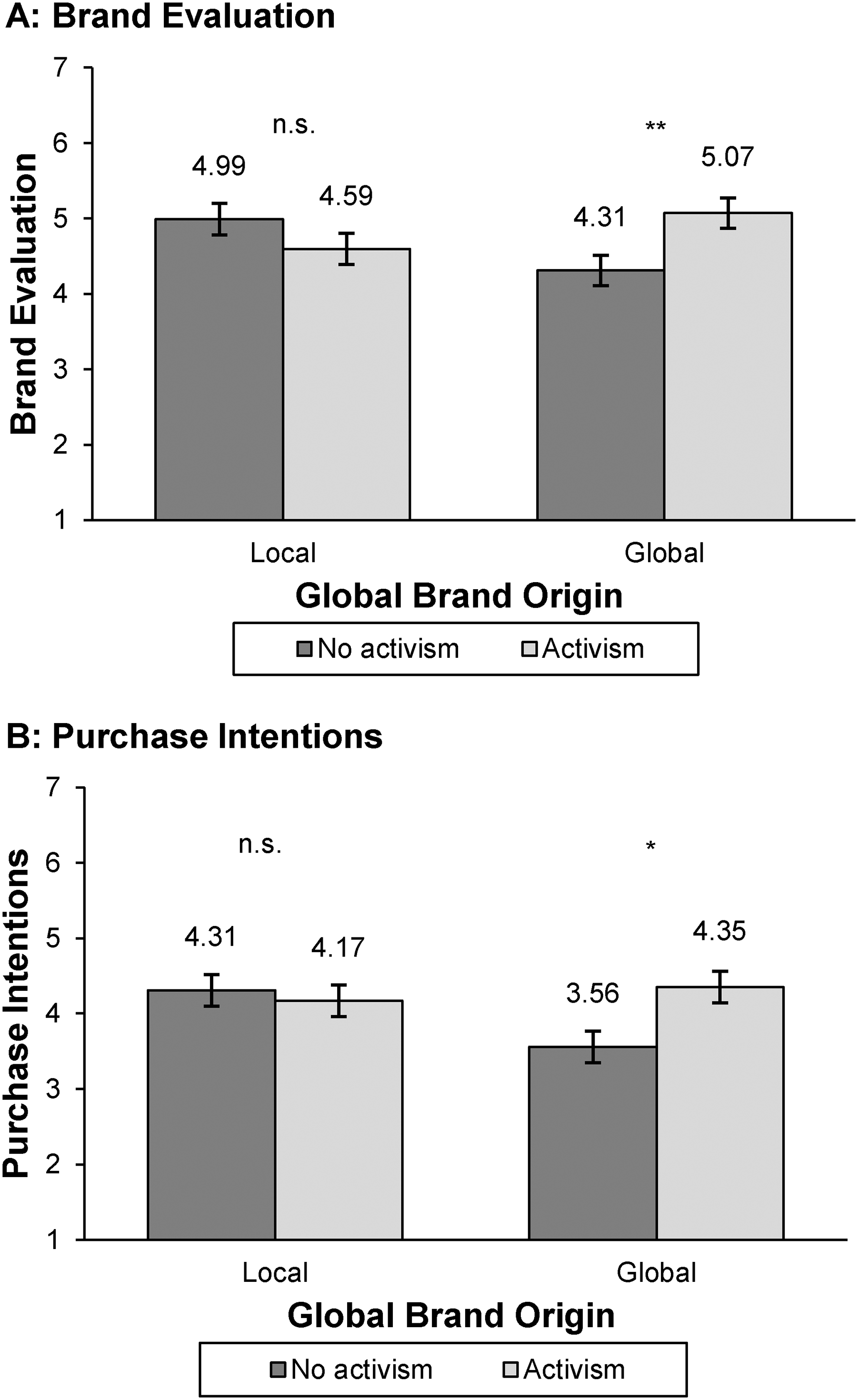
Interaction Effects of Activism (vs. No Activism) and Brand Globalness (vs. Localness) on Brand Evaluation and Purchase Intentions (Study 2).
Study 3
In Study 3, we test whether brand origin serves as a moderator for our brand activism effect. Specifically, we anticipate a significantly greater and positive attitudinal and behavioral change when a global brand engages in activism, particularly if the brand originates in a country with negative origin. We used the activism context of an abortion ban with a news announcement as communication type.
Method
Prior to conducting this study, we ran a pilot study (n = 190) to identify appropriate countries for brand origin manipulation. In the pilot study, participants were given a list of 189 countries and asked to identify a country that they have a positive image of and another country they have a negative image of. Russia (n = 34), North Korea (n = 14), Afghanistan (n = 13), China (n = 10), Iran (n = 10), and Turkey (n = 10) were the top six countries in terms of negative image. Canada (n = 22), the United Kingdom (n = 18), Australia (n = 18), Italy (n = 18), France (n = 16), and India (n = 15) were the top six countries in terms of favorable image. The industry context for this study was fashion brands. With North Korea, Afghanistan, and Iran-based fashion products hardly known among the population, we chose Russia, China, and Turkey as our countries for negative brand origin. We chose the United Kingdom, Italy, and France as the countries with positive brand origin for the main study.
For the main study, we recruited 201 U.S. consumers via the Prolific Academic panel, of whom six failed attention checks and hence were removed from the study, ending with a final usable sample of 195 participants (Mage = 39.23 years, SD = 14.24; 49.7% female, 49.2% male, 1% nonbinary). This study involved a 2 (brand activism vs. control) × 2 (brand origin: positive vs. negative) between-subjects experimental design. Participants were first exposed to a brand origin manipulation. They were randomly asked to choose either a country they have a favorable of or an unfavorable image of. Based on a pilot study, participants were shown six countries (three positive brand origin and three negative brand origin).
Once the participants had made the choice of a country, their affinity (α = .94) and animosity (α = .96) toward the country were measured using scales similar to those used in Study 2. Post–brand origin manipulation check, participants were exposed to the brand activism manipulation. In the brand activism condition, participants were shown a news item about an imaginary brand's (Feltar) support for abortion rights. Participants in the brand activism condition read: “Feltar is one of the world's most valuable fashion brands. Feltar is originally from (brand origin) and now has global presence. Feltar has recently issued a public statement as follows: We stand in solidarity with local communities and peaceful protests against the recent ruling on banning of abortions across the United States. Further to this work, we have committed $500,000 to support non-profit organizations in the United States that work on abortion supportive initiatives. This fund will provide organizations with the much needed resources to advance their mission.” In the nonactivism condition, participants read: “Feltar is one of the world's most valuable fashion brands. Feltar is originally from (brand origin) and now has global presence. Feltar has recently issued a public statement announcing the launch of its first perfume as follows: We celebrate our heritage with a tribute to the emotional connection, and the many ways love is defined and expressed. The new fragrances will be a reflection of modern love and the authentic connections that reflect the strength, joy, and promise we find in one another.” For brand activism manipulation check and the dependent variables of brand evaluations (α = .98) and purchase intentions, we used the same items as in Study 2. We also controlled for the effects of attitude extremity and ethnocentrism (α = .92) in this study, similar to Study 2.
Results and discussion
The manipulation check for brand origin was successful. Participants exposed to the positive brand origin condition showed significantly greater levels of affinity (Mpositive = 4.59, Mnegative = 1.84; F(1, 193) = 310.75, p < .001). Similarly, participants exposed to the negative brand origin condition showed significantly higher levels of animosity (Mnegative = 5.06, Mpositive = 1.49; F(1, 193) = 470.14, p < .001). The activism manipulation was also successful wherein participants saw the brand as politically active (Mactivism = 4.05, Mnonactivism = 2.20; F(1, 193) = 135.04, p < .001).
A two-way between groups ANOVA with activism (vs. no activism) and brand origin (negative vs. positive) as independent variables, attitude extremity and ethnocentrism as covariates, and brand evaluation and purchase intentions as dependent variables was conducted for this study. The analysis showed that the direct effects of brand origin manipulation on the dependent variables of brand evaluation (F(1, 193) = 31.52, p < .001) and purchase intentions (F(1, 193) = 42.45, p < .001) was significant. Similarly, the direct effect of the activism (vs. no activism) condition on the brand evaluation (F(1, 193) = 4.42, p < .05) and purchase intentions (F(1, 193) = 4.82, p < .05) was significant. Moreover, the interaction effects between brand origin and activism were significant for both brand evaluation (F(1, 193) = 14.68, p < .001; η2 = .080) and purchase intentions (F(1, 193) = 10.30, p < .005; η2 = .057). The control variable of attitude extremity had a significant effect on the dependent variables (brand evaluation: F(1, 193) = 27.89, p < .001; purchase intentions: F(1, 193) = 27.35, p < .001), but ethnocentrism had no significant effects (brand evaluation: F(1, 195) = .01, p > .05; purchase intentions: F(1, 193) = .01, p > .05).
As shown in Figure 3, activism significantly benefits global brands with negative brand origin associations (brand evaluation: t (88) = −4.06, p < .001; purchase intentions: t (88) = −3.61, p < .001). However, no significant effect is observed for brands with positive origin (p > .05). In the next study, we examine the underpinning mechanism that drives the interactive effects of global brand activism and brand origin.
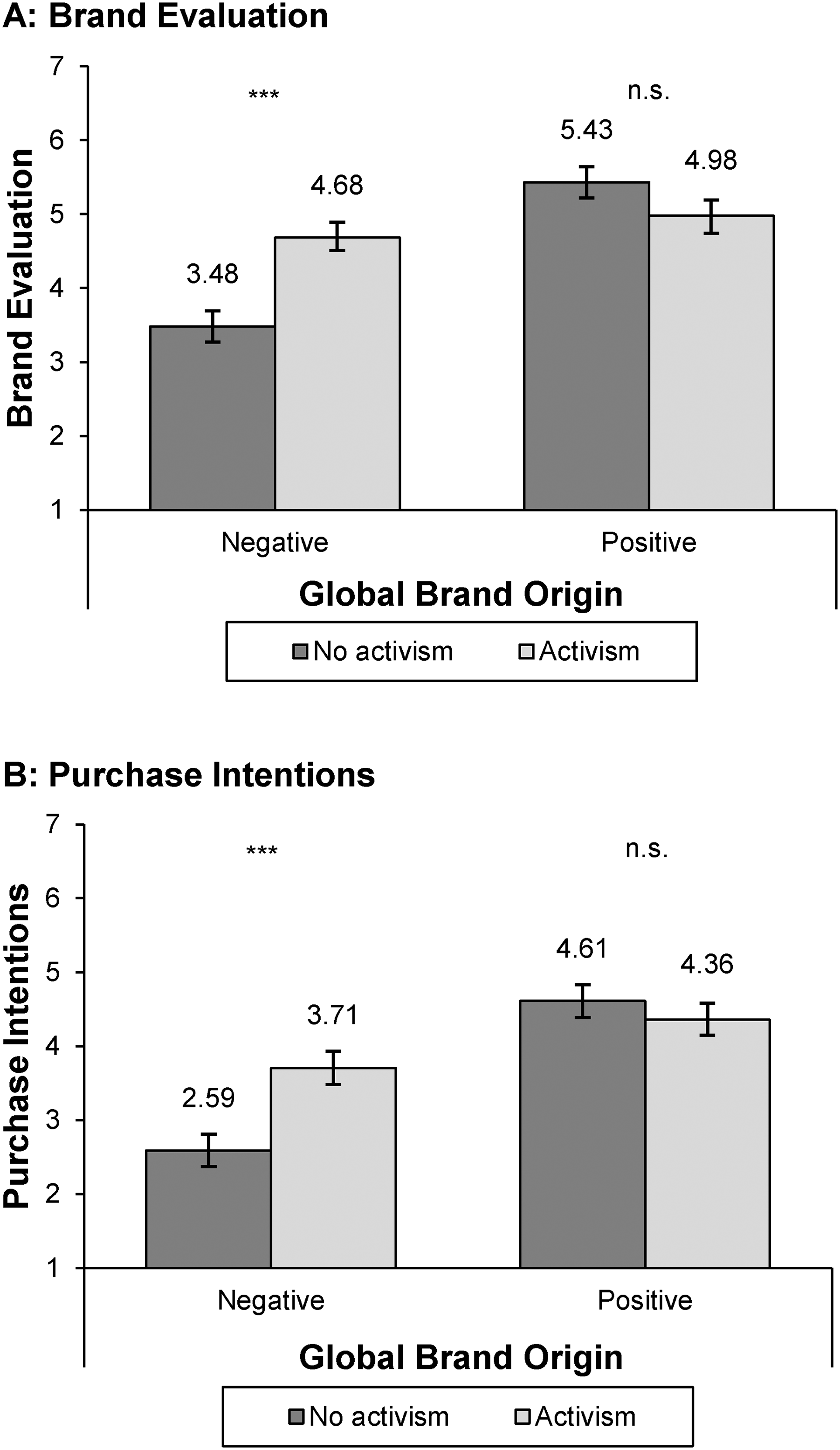
Interaction Effects of Activism (vs. No Activism) and Global Brand Origin (Positive vs. Negative) on Brand Evaluation and Purchase Intentions (Study 3).
Study 4
Study 4 aims to test our mediation account, contending that the effect of brand activism on consumer response is channeled through self–brand connection. We used the activism context of LGBTQ+ with social media post as communication type. We also explore virtue signaling as an alternative explanation for activism, where consumers view activism as hypocritical action (Wagner, Lutz, and Weitz 2009).
Method
Participants were 309 consumers (Mage = 33.02 years, SD = 10.98; 54.70% female, 42.10% male, 3.2% nonbinary) recruited via the Prolific Academic panel in Spain. The experiment protocol was initially developed in English and examined by the multicultural team for any inconsistencies. A bilingual professional translator then translated it into Spanish, and another professional translator then back-translated it into English. The back-translated protocol was compared with the original English version to identify any inconsistencies and was refined further by a third professional bilingual translator. The final protocol was then pilot tested among resident Spanish population (n = 25) to identify any issues.
Before the final study, we conducted an additional pilot study with 20 Spanish participants. Similar to the Study 3 pilot study, we asked them to rate countries by favorability. Participants rated the United States (n = 8) as the most favorable and China (n = 7) as the least favorable. Based on these results, we selected these two countries for the main study. We used a similar measure of affinity (α = .94) and animosity (α = .92) to assess the participants’ attitudes toward the countries. We then randomly assigned the participants to one of two conditions: They received information about a smartphone brand either from the United States (Motorola) or from China (Huawei). Similar to Study 1, we manipulated the brands' globalness through verbal cues by having them read, “X is one of the world's most valuable brands and now has global presence.” Participants were then asked to read a newspaper interview wherein the company spokesperson was asked about the firm's views about LGBTQ+ community. In the brand activism condition, participants read: “X is committed to diversity of community and believes that employees should be treated fairly and equally regardless of their sexual orientation or gender identity. The company offers a range of benefits to its LGBTQ+ employees, including private health insurance and paid time off. X also participates in public events and organizations that support LGBTQ+ rights, and has donated money to support legislation that protects LGBTQ+ rights.” Both companies have released similar such support statements toward LGBTQ+ community in their news releases, adding realism to our study. In the nonactivism brand condition, having read about the brand's globalness, participants were exposed to similar manipulation checks as Study 1 and asked about their brand evaluation (α = .93). To examine the mediation mechanism, we also asked participants’ self–brand connection (α = .97) using the scale developed by Escalas and Bettman (2003). The scale consists of seven items: “This brand reflects who I am,” “I can identify with this brand,” “I feel a personal connection to this brand,” “I use this brand to communicate who I am to other people,” “I think this brand helps me become the type of person I want to be,” “I consider this brand to be ‘me’ (it reflects who I consider myself to be),” and “this brand suits me well” (0 = “strongly disagree,” and 100 = “strongly agree”). We also examined the brands' virtue communication (Wagner, Lutz, and Weitz 2009) consisting of three items, “delivering its promise to consumers,” “the values of the brand,” and “connection with consumers” (α = .76), on a seven-point Likert scale (1 = “strongly disagree,” and 7 = “strongly agree”). Participants’ attitude toward the LGBTQ+ community and ethnocentrism (α = .89) were used as controls, similar to Studies 2 and 3.
Results and discussion
We started our analysis by assessing the convergent and discriminant validity of our process and dependent measures using the Fornell and Larcker (1981) criteria. All the constructs (i.e., self–brand connection, brand virtue communication, ethnocentrism, and brand evaluation) had average variance extracted values higher than the recommended value of .5, and the composite reliability values were above .7. Moreover, no correlation exceeded the square root of the average variance extracted, confirming that the constructs were empirically distinct from each other.
The brand origin manipulation was successful. Participants in the positive brand origin condition showed significantly greater levels of affinity (Mpositive = 4.38; Mnegative = 2.46; F(1, 307) = 219.40, p < .001). Similarly, participants exposed to the negative brand origin condition showed significantly higher levels of animosity (Mnegative = 4.46; Mpositive = 1.80; F(1, 307) = 382.06, p < .001). The manipulation for brand activism was also successful. Participants in the brand activism condition agreed that the brand is politically active (Mactivism = 3.66; Mnonactivism = 2.71; F(1, 307) = 80.31, p < .001).
To examine the mediation with moderation of brand origin, PROCESS macro Model 7 was employed, with brand activism as the independent variable, brand origin as the moderator, self–brand connection as the mediator, brand evaluation as the dependent variable, and attitude extremity and ethnocentrism as covariates. The direct effects of global brand activism on self–brand connection (F(5, 303) = 6.25, p < .001; β = 3.74, SE = 1.36, p < .005; 95% CI: [1.06, 6.41]), and brand evaluation (F(4, 304) = 35.04, p < .001; β = .14, SE = .07, p < .05; 95% CI: [.01, .26]) were significant. The direct effect of global brand origin on self–brand connection was also significant (β = 4.61, SE = 1.37, p < .001; 95% CI: [1.92, 7.30]). Moreover, the interaction between brand activism and brand origin was also significant (β = −3.38, SE = 1.36, p < .05; 95% CI: [−6.05, −.72]). The effects of attitude extremity (β = 1.29, SE = .50, p < .01; 95% CI: [.31, 2.27]) and ethnocentrism (β = 2.85, SE = 1.09, p < .01; 95% CI: [.71, 4.99]) were also significant. Further examining the conditional interaction effects of brand activism and global brand origin on consumer self–brand connection, we observed that the effects were significant (t(152) = −3.96, p < .001) in the case of negative brand origin (β = 7.12, SE = 1.92, p < .001; 95% CI: [3.34, 10.90]) but not significant (p > .05) for the positive brand origin (β = .35, SE = 1.92, p > .05; 95% CI: [−3.42, 4.13]). Figure 4 highlights the interaction effects of brand activism and brand origin on self–brand connection.
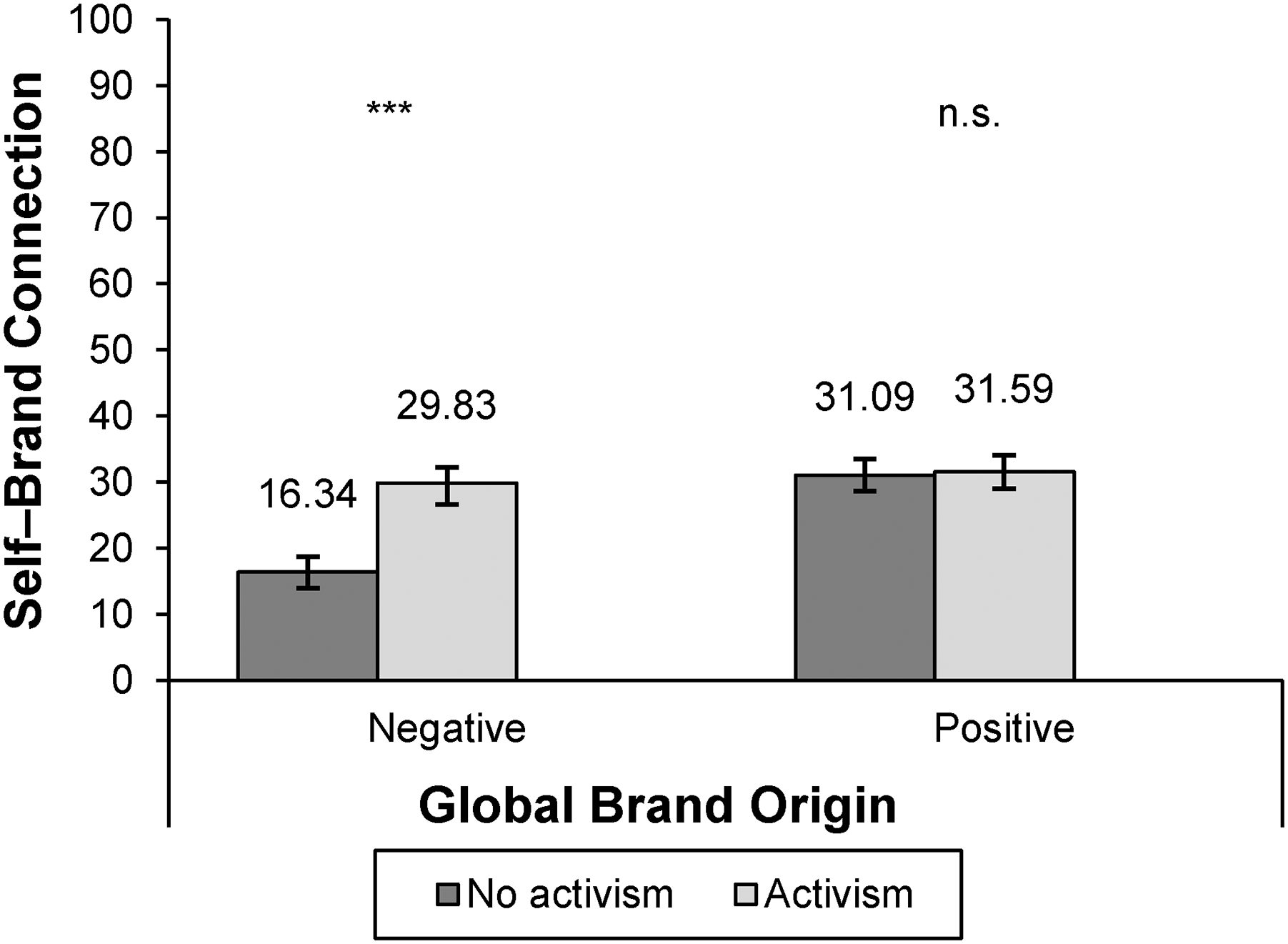
Interaction Effects of Brand Activism and Brand Origin on Self–Brand Connection (Study 4).
The effect of self–brand connection on brand evaluation (β = .03, SE = .03, p < .001; 95% CI: [.03, .04]) was also significant. The indirect effect of mediation for brand evaluation as a dependent variable showed significance in the case of negative brand origin condition (β = .20, SE = .05, 95% CI: [.11, .30]) but not in the positive brand origin condition (β = .01, SE = .06, 95% CI: [−.11, .13]), confirming the mediation with the significant impact for the case of the global brand with negative origin. The index of moderated mediation did not include zero, further confirming the moderated mediation (β = −.19, SE = .07, 95% CI: [−.33, −.05]). Figure 5 provides the moderated mediation model.
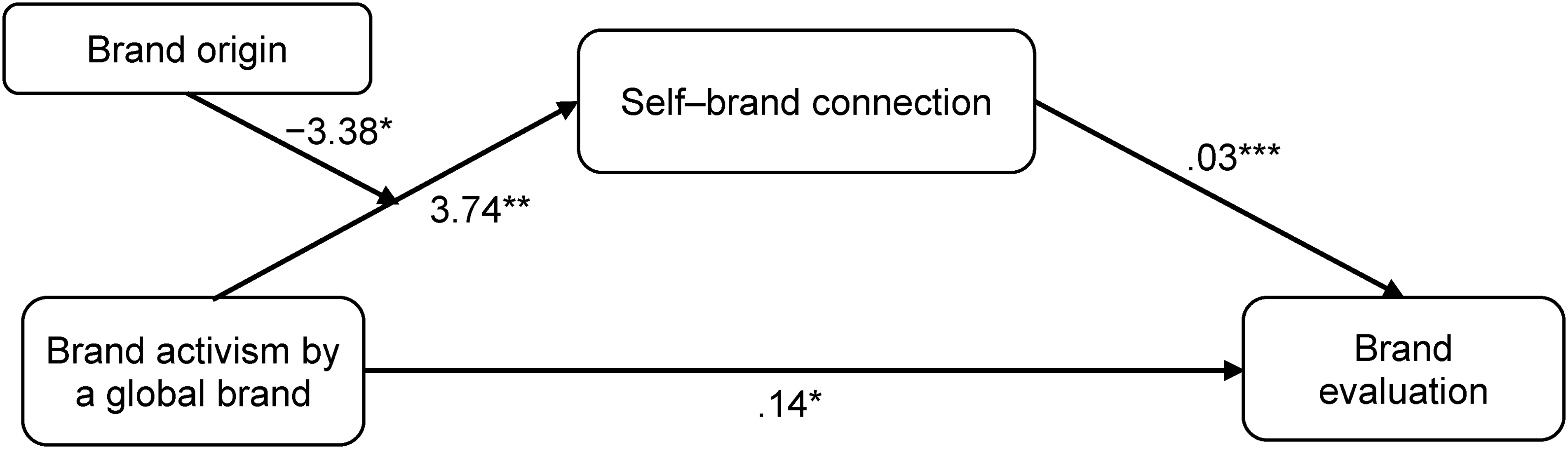
Moderated Mediation Effect for Brand Evaluation and Purchase Intentions (Study 4).
It could also be assumed that activism communication is virtue signaling from the brand, and thus we examined the brands' virtue communication (Wagner, Lutz, and Weitz 2009) as an alternative explanation. Brand activism did not have a direct influence on virtue communication (F(5, 303) = 4.16, p < .001; β = .06, SE = .05, p > .05; 95% CI: [−.04, .17]), nor was the interaction between activism and brand origin significant in this case of virtue communication (β = .04, SE = .05, p > .05; 95% CI: [−.06, .15]).
Study 4 shows that for global brands, brand activism is beneficial in influencing consumers’ brand evaluations. In addition, by identifying the mediation effect, the study offers additional evidence that self–brand connection is indeed a key construct underlying the brand activism effect. Moreover, consistent with our theorizing, this effect is moderated by brand origin, such that global brands with a negative origin benefit significantly more when they engage in activism.
Study 5
Study 5 further examines how prior attitude valence moderates the effect of brand activism on consumer brand evaluation. Extant research suggests that consumers who disagree with a brand's stance on a controversial issue have significantly lower brand perceptions than those who agree with it (Mukherjee and Althuizen 2020). Therefore, we propose that prior attitude valence will moderate the impact of brand activism on consumer responses. We test this in the context of the ongoing Israel–Palestine conflict using a newspaper advertisement.
Method
We recruited 351 British consumers (Mage = 48.95 years, SD = 14.05; 49.9% female, 50.1% male) via the Prolific Academic panel. We first ran a pilot study (n = 40), similar to Study 3, to identify countries with positive or negative associations for British consumers. We asked participants to choose one country with a negative image and one with a positive image from a list of 189 countries. The top four countries with negative images were Russia (n = 13), China (n = 6), Iran (n = 6), and Saudi Arabia (n = 5), while the top four with positive images were Canada (n = 14), Australia (n = 9), Italy (n = 9), and Spain (n = 4). With embargo affecting Iran, we did not include it in the main study.
In the main study, we randomly assigned some participants to indicate their agreement with the statement “Are you in favour of Israel's retaliatory actions against Palestine?” on a four-point scale (1 = “definitely not,” and 4 = “definitely yes”) before the main task, while others answered it at the end, to control for demand effects. We found no difference between the two groups. Participants were then asked to choose a country with a favorable (vs. unfavorable) image from a list of six countries (positive: Canada, Australia, Italy; negative: Russia, China, Saudi Arabia). We used a similar manipulation check of affinity (α = .96) and animosity (α = .97). Next, participants were informed about a fictitious stationery brand, Feltar, that originated from either a positive or a negative country. Similar to Study 1, we manipulated the brand's globalness through verbal cues by having participants read, “Feltar is one of the world's most valuable stationery brands and now has global presence.” Participants were then randomly shown one of three advertisements (see Web Appendix B) where the brand supported either Israel or Palestine (activism conditions) or used a neutral message (control condition).
Manipulation checks and brand evaluation (α = .93) were captured thereafter similar to Study 1. To examine the mediation mechanism, we asked participants’ self–brand connection on an 11-point scale (1 = “not at all,” and 11 = “completely”; α = .97; Escalas and Bettman 2003). Participants’ attitude extremity toward the conflict and ethnocentrism (α = .89) were used as controls, similar to earlier studies.
Results and discussion
As expected, the brand origin manipulation was successful, wherein positive brand origin increased levels of affinity (Mpositive = 4.63, Mnegative = 1.66; F(1, 349) = 963.53, p < .001), and negative brand origin increased levels of animosity (Mnegative = 5.03, Mpositive = 1.38; F(1, 349) = 1,286.26, p < .001). Brand activism manipulation was also successful as participants in the activism condition perceived the brand as more politically active (Mactivism = 3.28; Mnonactivism = 2.30; F(1, 349) = 68.96; p < .001).
To provide robustness to our theorized account, we first examined the moderated mediation model (PROCESS macro Model 7, with brand activism as the independent variable, brand origin as the moderator, self–brand connection as the mediator, brand evaluation as the dependent variable, and attitude extremity and ethnocentrism as covariates). The direct effect of global brand activism on self–brand connection was not significant (F(5, 345) = 5.29, p < .001; β = .10, SE = .10, p > .05; 95% CI: [−.94, .30]); however, its effect on brand evaluation was significant (F(4, 346) = 25.25, p < .001; β = −.33, SE = .06, p < .001; 95% CI: [−.45, −.21]). Importantly, the interaction effect of brand activism and brand origin on self–brand connection was significant (β = −.25, SE = .10, p < .01; 95% CI: [−.45, −.05]). The effect of attitude extremity was marginally significant (β = .07, SE = .03, p = .051; 95% CI: [.00, 13]), but the effect of ethnocentrism was nonsignificant (β = .02, SE = .08, p > .05; 95% CI: [−.13, .17]). The conditional effects of brand activism and brand origin on self–brand connection were significant for negative brand origin (β = .35, SE = .14, p < .01; 95% CI: [.08, .63]; η2 = .44) but not for positive brand origin (β = −.14, SE = .14, p > .05; 95% CI: [−.43, .13]). Regarding the mediation effects, self–brand connection had a significant effect on brand evaluation (β = .28, SE = .03, p < .001; 95% CI: [.21, .34]). The indirect effect of negative brand origin on brand evaluation was significant (β = .10, SE = .02; 95% CI: [.05, .15]); however, positive brand origin did not have a significant effect on brand evaluation (β = .04, SE = .04; 95% CI: [−.13, .04]). This confirms the mediation to be significant for global brand with negative origin. The index of moderated mediation for brand origin was also significant (β = −.14, SE = .05; 95% CI: [−.23, −.05]), providing further robustness to our theorization (Figure 6).
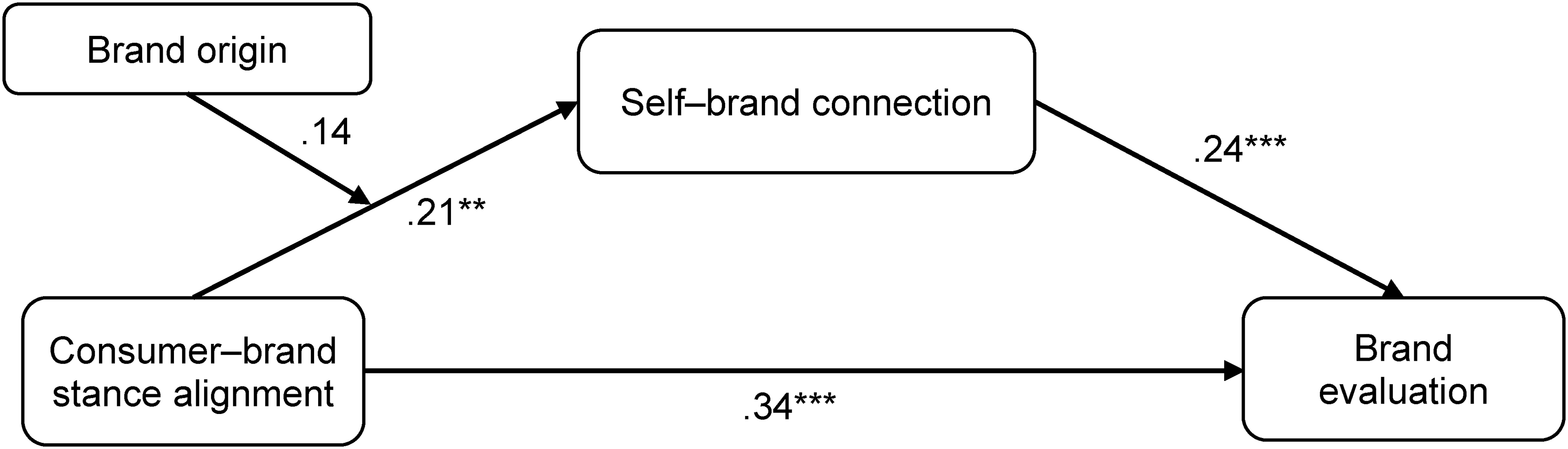
Moderated Mediation Effect for Brand Evaluation and Purchase Intentions (Study 5).
To examine the effect of prior attitude valence alignment, we grouped the participants based on their response to Israel's retaliatory actions, following the procedure used by Mukherjee and Althuizen (2020). Participants who responded “definitely yes” or “probably yes” were considered to be supportive of Israel's actions, while those who responded “probably no” or “definitely no” were opposed to them. We then matched participants’ personal viewpoints with the brand's stance in the advertisement and created three groups: alignment (n = 113), misalignment (n = 120), and control (n = 118). We tested the effect of consumer–brand stance alignment using PROCESS macro Model 7, with consumer–brand stance alignment as the independent variable, brand origin as the moderator, self–brand connection as the mediator, brand evaluation as the dependent variable, and attitude extremity and ethnocentrism as covariates. Consumer–brand stance alignment had a significant direct effect both on self–brand connection (F(5, 345) = 6.01, p < .001; β = .21, SE = .08, p < .01; 95% CI: [.06, .36]) and brand evaluation (F(4, 346) = 32.09, p < .001; β = .34, SE = .05, p < .05; 95% CI: [.25, .43]). The effect of attitude extremity was also significant (β = .07, SE = .03, p < .05; 95% CI: [.01, .14]), but the effect of ethnocentrism was nonsignificant (β = .04, SE = .08, p > .05; 95% CI: [−.11, .20]). Moreover, the overall interaction between consumer–brand stance alignment and brand origin was nonsignificant (β = .14, SE = .08, p > .05; 95% CI: [−.01, .29]). However, the conditional effect was significant in the case of positive brand origin (β = .35, SE = .11, p < .001; 95% CI: [.14, .56]; η2 = .06) but not for negative brand origin (β = .07, SE = .11, p > .05; 95% CI: [−.14, .28]). Figure 7 shows the interaction effects of consumer–brand stance alignment and brand origin on self–brand connection.
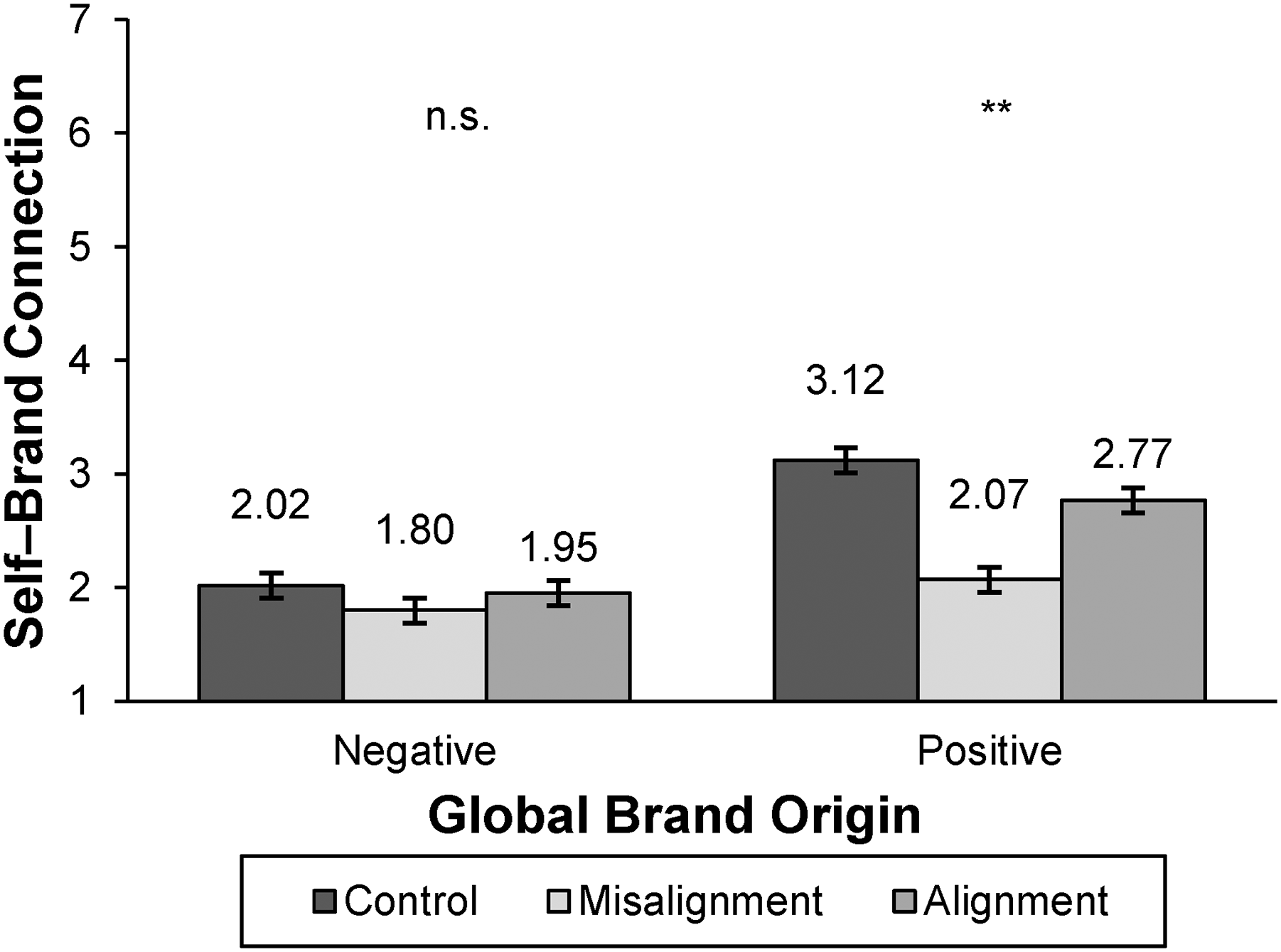
Interaction Effects of Consumer–Brand Stance Alignment (vs. Misalignment vs. Control) and Global Brand Origin (Positive vs. Negative) on Self–Brand Connection (Study 5).
Self–brand connection had a significant effect on brand evaluation (β = .24, SE = .03, p < .001; 95% CI: [.17, .30]). The indirect effect showed significance in the case of positive brand origin (β = .08, SE = .03, 95% CI: [.03, .15]), but not for negative brand origin (β = .02, SE = .01, 95% CI: [−.01, .04]), confirming the mediation effect for global brands with positive origin. The index of moderated mediation was also significant (β = .06, SE = .03; 95% CI: [.01, .14]), further confirming the moderated mediation.
Study 5 supports our theorization that brand activism enhances global brands’ evaluations, especially for negative origin brands, and confirms the significant mediating role of self–brand connection. The results indicate that prior attitude valence alignment is important for brands with positive origin, but not for brands with negative origin.
General Discussion
Brands are increasingly engaging in activism by taking stances on various sociopolitical issues in order to induce positive societal change (Moorman 2020; Vredenburg et al. 2020). Yet, globally, companies lack conclusive guidance on the consequences of taking a stance. This research provides valuable insights on whether and how global brands can engage in activism. Using varying activism tactics, across five studies, our findings elaborate positive consumer responses to global brand activism. Notably, this effect is particularly pronounced for global brands associated with negative brand origin. Additionally, this research sheds light on the underlying mechanism of self–brand connection, which has downstream consequences for attitudinal and behavioral intentions. Overall, this work provides a holistic view on consumer perceptions of brand activism in a global branding context and elucidates why consumers prefer global brands that engage in activism and providing actionable insights for global brand managers.
Theoretical Contributions
Our work contributes to the international marketing field in several ways. First, we offer causal evidence of brand activism's positive impact, particularly for global brands. Unlike prior activism literature that predominantly focuses on individual and market-level outcomes (Bhagwat et al. 2020; Garg and Saluja 2022), our work highlights the unexplored brand-level effects of activism engagement. Given the pervasiveness of brand activism and its growing importance (Bhagwat et al. 2020; Moorman 2020), we specifically contribute to the international marketing literature showing that global brands engaged in activism achieve significantly higher brand evaluations and purchase intentions. Notably, this effect remains consistent across different product categories, countries, and communication approaches.
Second, prior research provides mixed evidence on consumer response to activism (Mukherjee and Althuizen 2020; Nam et al. 2023). Contrary to prior notions suggesting that activism has a net negative effect for large-share brands (Hydock, Paharia, and Blair 2020), we provide an alternative account demonstrating that brand activism has a positive effect, particularly for global over local brands. This differential impact can be attributed to the stronger affective attachment and identity association that consumers have with global brands, enabling them to connect with global sociopolitical discourse that they aspire for (Özsomer and Altaras 2008). In contrast, consumers may not feel strong identification with local brands on such global aspects (Dimofte, Johansson, and Bagozzi 2010).
Third, we introduce brand origin as a novel and critical boundary condition moderating consumer preference for global brands engaged in activism. Guided by schema change theory (Mandler 1982; Rothbart 1981), we document that the effect of brand activism is more pronounced for global brands that are associated with negative brand origin. With brand activism being a divisive action, such moderation may help reconcile the often-polarized views of brand activism and demonstrate its benefits. By identifying the differential effect of brand origin on activism efforts, we highlight when global brands should engage in activism.
In that regard, we add further nuance to this brand origin effect by examining the role of prior attitude valence. Previous research on brand activism has mainly focused on domestic brands, which are likely to elicit positive origin effects among consumers (Mirzaei, Wilkie, and Siuki 2022; Nam et al. 2023). We further demonstrate that activism is more effective for brands with positive origin when consumers’ activism stance aligns with the brand's stance. This alignment enhances consumers’ positive associations and identification with the brand, leading to assimilation (Mandler 1982) and maintenance of existing positive schema. We also show that brand activism benefits brands with negative origin, regardless of consumers’ prior attitude valence. Activism by brands with negative origin disrupts consumers’ existing negative schema (Loken 2006), introducing an element of surprise and a positive contrast that improves consumers’ perception and evaluations of the brand. In doing so, this study introduces an alternative method for brands to enact schema changes, extending beyond CSR communications to engage in sociopolitical challenges that matter to their target audience. By identifying this pivotal consumer brand stance alignment effect, we delineate when and how global brands should strategically engage in activism to optimize positive outcomes.
Fourth, we unveil self–brand connection (Escalas and Bettman 2003) as a pivotal underlying mechanism explaining why global brands fare better than local ones when engaging in activism. We observe that brand activism bolsters self–brand connection, which in turn influences consumers’ attitudes and behaviors. While previous studies have examined factors such as consumer–brand identification (Mukherjee and Althuizen 2020), perceived authenticity (Hydock, Paharia, and Blair 2020), and positive and negative affect (Garg and Saluja 2022), our focus on self–brand connection adds novel insights into brand activism's efficacy, particularly in the global branding domain. Importantly, this effect remains robust while controlling for attitude extremity toward the issue (Mukherjee and Althuizen 2020), ethnocentrism (Klein, Ettenson, and Krishnan 2006), consumer affinity (Oberecker and Diamantopoulos 2011), and animosity (Riefler and Diamantopoulos 2007). Subsequently, we also rule out potential competing explanations, suggesting that brand activism could act as a signal of virtue communication (Wagner, Lutz, and Weitz 2009). Thus, this research not only expands the existing body of research on brand activism but also delineates the process boundaries of its effectiveness.
Finally, we enhance the international marketing literature by empirically demonstrating that the positive effects of brand activism by global brands are consistent across different markets (i.e., the United States, the United Kingdom, and Spain). These impacts reinforce consumers’ motivations linked with global brands. We thus believe that these findings will be of high interest for both researchers and practitioners.
Managerial Implications
As brands are increasingly engaging in activism, our findings reveal that taking a sociopolitical stance will be advantageous, especially for global brands. Thus, we would encourage global brands to strategically highlight in their marketing communications campaigns and social media platforms causes that resonate with their audience, thereby strengthening their self–brand connection. For example, Patagonia's continuous commitment to combating climate change has not only bolstered its reputation as an activist brand but also cultivated a loyal customer base.
Besides, prior studies on brand activism have predominantly focused on brands with a positive origin (Mirzaei, Wilkie, and Siuki 2022; Nam et al. 2023). However, our research extends beyond this scope, revealing that brand activism is also effective for brands with a negative brand origin, influencing consumers’ perceptions irrespective of their preexisting attitudes. Managers seeking to counteract negative brand associations will find that brand activism serves as an effective strategy for schema change. This strategic use of activism can mitigate the adverse effects associated with a negative brand origin, enabling brands to enhance their market positioning.
Corroborating with prior research focusing on domestic brands (Mukherjee and Althuizen 2020), we suggest that brand activism tends to yield greater efficacy when it resonates strongly with the beliefs and values of the majority of the target market. This resonance reinforces positive schemas and bolsters consumer identification with the brand. Market research can help brands uncover the activist causes their customers support and align the brand stance accordingly. Collaborations with social enterprises or advocacy groups can further amplify the impact of consumer–brand stance alignment through shared initiatives and improve the brand's activism efforts. For instance, Ben & Jerry's partnered with Advancement Project National Office, an organization promoting social movements to achieve policy change, and created flavors like “Justice ReMix’d” to support organizations working toward racial justice. This proactive stance on social issues has resonated deeply with their target market, particularly among younger demographics who prioritize brands that align with their values.
Limitations and Future Research Directions
The current findings offer interesting avenues for future research, notably in exploring other brand-related factors such as hedonism or individual traits such as self-construal that may moderate the effect of brand activism on brand evaluation and behavioral intentions. Many global brands are leading brands in their product category. However, at times, leadings brands in a market are not global. Thus, whether the brand activism effect differs between a global brand and a leading local brand is worth examining.
Replication of our research in Eastern or emerging markets with different macro environments and cultural trajectories may offer interesting comparative results. Moreover, identifying the psychological mechanisms that underlie consumer responses to activism such as emotions, motivation, or values would provide fruitful insights. Furthermore, the findings of this study show how activism can help a brand to strengthen consumer–brand relationships; however, this may not necessarily lead to long-term profitability, hence it would be interesting to study the long-term effects of activism on brand equity. Our study focuses on brand activism effects in general. However, there are many other types of brand activism, including persuasive versus disruptive activism, that require further scrutiny. Thus, future research comparing the effects of varying activism types will advance the field.
Supplemental Material
sj-pdf-1-jig-10.1177_1069031X241270606 - Supplemental material for Should Global Brands Engage in Brand Activism?
Supplemental material, sj-pdf-1-jig-10.1177_1069031X241270606 for Should Global Brands Engage in Brand Activism? by Paurav Shukla, Veronica Rosendo-Rios and Dina Khalifa in Journal of International Marketing
Footnotes
Editor
Kelly Hewett
Associate Editor
Ayşegül Özsomer
Declaration of Conflicting Interests
The authors declared no potential conflicts of interest with respect to the research, authorship, and/or publication of this article.
Funding
The authors received no financial support for the research, authorship, and/or publication of this article.

References
Supplementary Material
Please find the following supplemental material available below.
For Open Access articles published under a Creative Commons License, all supplemental material carries the same license as the article it is associated with.
For non-Open Access articles published, all supplemental material carries a non-exclusive license, and permission requests for re-use of supplemental material or any part of supplemental material shall be sent directly to the copyright owner as specified in the copyright notice associated with the article.
