




Abstract
This research examines the influence of CEO versus brand communication on public engagement and digital activism during the Russia–Ukraine war. Brand communication refers to messages sent out through an organization's social media accounts, whereas CEO communication comes from the executive's personal account. The authors depart from an analysis of 236,119 tweets investigating the effects of message sender (CEO vs. brand), message framing (self vs. other), and message appeal (informational vs. emotional) on engagement (i.e., likes, retweets, and replies). To further understand, they subsequently deploy a 2 × 2 between-subjects design (N = 608) that introduces scenarios where either a CEO or brand proposes a public policy campaign, advocating support for U.S. citizens (self framing) or Ukrainian civilians (other framing). Key findings reveal that CEO communications foster greater engagement and digital activism than brand messages. CEO communication that merges self framed with informational appeals or other framed with emotional appeals outperforms brand messages regarding public engagement. In addition, CEO campaigns centered on Ukrainian civilians amplify digital activism, mirroring findings when brands approach the war's implications for U.S. citizens. Together, these insights unveil the intricate dance of message sender, framing, and appeal during global geopolitical events, providing vital knowledge for organizations and policy makers aiming to optimize public backing in times of war.
Keywords
Silence becomes cowardice when occasion demands speaking out the whole truth and acting accordingly.
—Mahatma Gandhi
Communication is an essential component of marketing systems (Layton 2015). In today's world, characterized by multiple global crises, organizations increasingly lean on their CEOs and brands to speak out on pressing social and political matters (Bowler 2022; Deloitte 2022; Sprout Social 2022). This shift may reflect changing consumer behavior, with 40% of global and 60% of U.S. customers resonating with brands that mirror their values (Martin 2022; Sprout Social 2022). However, this trend is double-edged. Alignment with societal values can bolster reputation, image (Edelman 2022; Martin 2022), loyalty, trust (Men and Tsai 2016), investor confidence (Bhagwat et al. 2020), and even political power (Crow et al. 2021). Conversely, misalignment can be perceived as inappropriate or insensitive, tarnishing reputations, impairing finances, and diluting customer loyalty (Aksoy et al. 2022; Hanbury 2020).
In this context, it is crucial to understand the effects of brand and CEO communication. Organizations use brand communication to promote their brand through social media accounts. In contrast, CEO communication involves using personal social media accounts where top executives share their views, sometimes unrelated to the organization or its stance. Both are potent organizational mouthpieces, capable of profoundly shaping public perceptions and behaviors (Forrester 2020; Henning 2023; Jin et al. 2023; Wallach and Popovich 2023).
The digital era has revolutionized the way organizations, through CEOs and brands, interact with the public. Minor online actions, such as retweets or likes on political content, can trigger widespread political discourses (Li et al. 2022; Zhang et al. 2010). Digital activism leverages online platforms to instigate tangible societal change (Deng et al. 2023; George and Leidner 2019; Joyce 2010). In this vibrant digital exchange, communications from CEOs and brands about societal issues become magnets for public responses, ranging from simple engagements to profound digital activism.
Previous instances underscore this dynamic. Mozilla CEO Brendan Eich's stance on same-sex marriage led to a widespread call for a Mozilla boycott, resulting in his resignation (Lee 2014). Disney CEO Bob Chapek's silence on the controversial “Don’t Say Gay” bill drew intense scrutiny and criticism (Pallotta 2022). These examples highlight the need for organizations to intricately understand public reactions to their communications, especially when navigating sensitive terrains like war.
War is complex and multifaceted, involving armed conflict between countries, governments, or societies, with devastating consequences for those directly and indirectly involved. Shultz (2005) emphasizes that large-scale conflicts can fracture and disrupt established marketing systems, expanding the impact beyond immediate conflict zones. For instance, the Russia–Ukraine war has led to a global energy crisis, impacting not just the populations of the warring nations but also all other countries dependent on Russian gas exports. Historically, public interactions with war-themed communication have shaped policies (De Neufville and Barton 1987) and can also be pivotal in navigating the systemic changes that wars introduce to marketing systems and global commerce (Shultz 2005).
As these geopolitical events disrupt global commerce and societal dynamics, the onus falls on marketers and communicators to navigate these complexities. In light of such global challenges, the role of meaningful marketing and communication becomes even more essential (Barrios et al. 2016). Shultz (2007) posits that meaningful marketing involves constructive engagement with societal issues, advocating for an understanding rooted in historical and cultural perspectives. Such an approach requires marketers and policy makers to rise beyond traditional confines, aiming to make the global marketplace a benevolent space where an underlying sense of societal betterment drives engagement (Barrios et al. 2016). This broader perspective on marketing underscores the significance of communication, particularly during sensitive global events like wars.
In such complex scenarios, citizens often turn to private sector leaders for insights and guidance (D’Auria and De Smet 2020; Tsai and Men 2017). A testament to the influence of private sector leaders is that organizations often eclipse governments, media, and nongovernmental organizations in terms of perceived competence and ethics (Edelman 2023). Considering that an overwhelming 72% of respondents expect CEOs to act as guardians of facts and expose questionable science to justify a bad social policy (Edelman 2023), the role of CEO communication becomes increasingly important during crises. Consequently, CEO communication may carry more weight during crises than brand communication, as CEOs are seen as the face and voice of the organization (Hwang and Cameron 2008), responsible for setting the tone and direction of the company. Their actions and statements may influence how the public views the company and public opinion on major public affairs (Branicki et al. 2021; Chatterji and Toffel 2019).
Moreover, we argue that CEO communication may help the public understand complex problems such as wars and their consequences. When a CEO personally communicates about such issues, they can provide simplified overviews of complex realities. People may perceive them as experts, creating a sense of connection and credibility (Giffin 1967; Ismagilova et al. 2020), which may lead to higher levels of engagement and activism. Recognizing the critical role of strategic message sender and framing in times of crisis, this research explores the communicative dynamics of CEOs and brands in the context of armed conflict. Although there is a growing body of literature investigating CEO social media usage (e.g., Grover, Kar, and Ilavarasan 2019; Heavey et al. 2020; Lee 2022; Matthews et al. 2022; Men and Tsai 2016), there is a lack of comprehensive research on how CEO communication influences public perception and behavior, especially during significant sociopolitical events. This article draws on executive symbolism theory (Hambrick and Lovelace 2018) and the spiral of silence theory (Noelle-Neumann 1974), integrates message framing (Tversky and Kahneman 1985) and message appeal (Lee and Atkinson 2019; Xiang et al. 2019), and focuses on the impacts of CEO and brand communications on public engagement and digital activism during the Russia–Ukraine war. In doing so, we align with the concerns raised by Shultz (2016), who emphasizes the profound effects of marketing activities during the war and the need for constructive engagement to address societal challenges.
This research offers three primary contributions: (1) it extends the executive symbolism and spiral of silence theory's application, (2) it reveals the superiority of CEO communication in inducing engagement and activism, and (3) it identifies the conditions amplifying these effects. In conclusion, we urge further exploration into CEO communication, particularly in the realm of global events, emphasizing the broader societal impacts (Michielsen and Van der Horst 2022; Shultz 2022; WWF 2023).
The rest of the article is structured as follows. We first discuss the theories related to message senders before introducing public engagement. Second, we present message framing, message appeal, and digital activism, drawing on relevant literature. Then, we outline our hypotheses and present the conceptual framework. We empirically test this framework through a field study (Study 1) and an experimental study (Study 2). Finally, we analyze the findings, reflect on their implications, and suggest future research avenues.
Theoretical Framework
Executive Symbolism and Spiral of Silence
In the domain of communication, the sender, or the origin of the message, plays a pivotal role in how that message is received and interpreted by the audience (Wilson and Sherrell 1993). In our current communication landscape, societal expectations have evolved, prompting organizations to take definitive stances on prominent societal issues (Edelman 2023; Sprout Social 2019, 2022; Vredenburg et al. 2020). In this context, both CEOs and brands emerge as principal spokespersons for organizations (Forrester 2020; Henning 2023). For example, Nike emphasizes empowerment, whereas Salesforce CEO Marc Benioff is vocal about diverse societal issues (CNNBusiness 2022; Dereń 2023; Novet 2021).
Although both brand and CEO communication are important for building a positive image for the company, there are some key differences between the two. Brand communication is typically more formal and controlled, as it is crafted by the company's marketing and communications team to reflect its brand identity and messaging. According to Chen et al. (2015), when brands communicate in social media, acting as living people able to create interpersonal conversations, it results in high public engagement. Similarly, Vernuccio (2014) claims that organizations would have a more effective communication strategy if they changed their communication style to a more conversational one, as person-to-person conversation is more engaging.
CEO communication, however, is often more spontaneous and may reflect the CEO's personal beliefs and values. Yue et al. (2021) suggest that the public positively perceives CEO communication on organizational news and activities. Tsai and Men (2017) find that when CEOs communicate in a way that shows they care about their followers and are friendly, it helps strengthen their relationship with their followers. Thus, CEO communication can help humanize the company and build a personal connection with customers and stakeholders. Although both types of communication play a critical role in shaping public perception, their impact on generating public response may vary depending on the context.
Jahng and Hong's (2017) findings reveal that people do not show significant behavior changes when a brand communicates during a crisis. However, organizational sociopolitical actions announced by the CEO can increase the positive response from investors if they are closely aligned with the values of its customers, employees, and state legislators (Bhagwat et al. 2020). People may feel more personally connected to a CEO than to a brand. Therefore, they may be more interested in hearing from the CEO about public issues, but they may also scrutinize CEO communication more closely (Sutton and Galunic 1996).
Set against the backdrop of the Russia–Ukraine war, decisions made by organizations, notably the significant number that halted operations in Russia (Statista 2023), have garnered widespread attention. These decisions, communicated in many cases via CEO messages, serve as both strategic moves and resonant symbolic gestures in the broader sociopolitical arena (Pfeffer 1981; Westphal and Zajac 1998).
The notion of executive symbolism, as elucidated by Hambrick and Lovelace (2018), emphasizes the weight symbolic actions by top executives carry, particularly in conveying strategic narratives. In today's interconnected digital ecosystem, a CEO's online messages about events like the war can serve as potent symbols. Such symbols visually encapsulate the CEO's viewpoint on the situation and convey it to a broad audience, potentially signifying their commitment to societal well-being and acting as catalysts for social transformation (Barberá-Tomás et al. 2019; Westphal and Zajac 1998).
The significance of such symbolic gestures can be understood through the lens of the spiral of silence theory (Noelle-Neumann 1974), which posits that individuals are more likely to voice their opinions when they believe those opinions align with the majority view. As CEOs navigate the geopolitical waters, their public communication can establish or alter perceived majoritarian views. Such articulations can embolden or suppress public expression (Sutton and Galunic 1996), contingent on the alignment with the prevailing narrative, underscoring the profound significance of CEO communication in shaping public discourse (Hambrick and Wowak 2021; Khumalo, Dumont, and Waldzus 2022; Wowak, Busenbark, and Hambrick 2022).
Public Engagement
Public engagement involves the vast spectrum of stakeholders, including consumers, employees, business partners, and community members. These stakeholders are intrinsically interwoven into the fabric of business–political dynamics, playing roles as influencers and influenced actors (Bruce and Shelley 2010; Korschun, Martin, and Vadakkepatt 2020). Given the civic orientation of this research, public engagement is conceptualized as any solo or collective endeavor aimed at identifying and rectifying issues that resonate with communities at various scales (i.e., local, national, or global) (Robertson 2018). By embracing this comprehensive perspective rather than the traditional consumer-focused approach, this research aligns with the broader academic sentiment of recognizing all pivotal stakeholders (Cova 2020; Korschun, Martin, and Vadakkepatt 2020; Mesiranta, Närvänen, and Mattila 2022).
The rise of social media platforms has transformed the nature of public engagement. These platforms become arenas where the public interacts with organizations, amplifying the dynamics of public engagement into a digital behavioral paradigm (Jiang, Luo, and Kulemeka 2016; O’Brien and Toms 2008; Smith and Gallicano 2015; Taylor and Kent 2014). Although early research suggests that digital engagement might not correlate with offline actions (Gladwell 2010; Lacetera, Macis, and Mele 2016), more recent studies indicate a probable complementarity between online and offline behaviors (Chou, Hsu, and Hernon 2020; Deng et al. 2023; Ferrucci, Hopp, and Vargo 2020; N. Kim et al. 2023; Lobera and Portos 2021; Ryoo et al. 2023).
For organizations, social media platforms are vital. They serve as conduits for two-way communication, enabling the public and organizations to exchange information, share concerns, and engage in online discourses. This interactive capability is pivotal, especially during tumultuous times marked by political instability, social upheavals, or natural calamities. By proactively participating in these digital dialogues, CEOs can bolster awareness, foster trust, and drive transformative social shifts (Bojanic 2023; Park and Kaye 2017).
Cho, Schweickart, and Haase (2014) assess three different levels of public engagement on social media with nonprofit organizations’ messages: likes, shares, and replies. A study by Kim and Yang (2017) on the differentiation of the three levels of public engagement finds that sensory and visual features in online messages led to likes; informational and interactive elements resulted in replies; and sensory, visual, and informational features resulted in shares. Shahin and Dai (2019) develop a technosocial framework for evaluating how effectively global aid agencies use Twitter’s (now known as “X”) algorithmic capabilities to increase public engagement and social change.
On Twitter, the social media platform used in this article, sharing a post is called a retweet. Following previous studies that measured public engagement in terms of likes, retweets, and replies (e.g., Rossi et al. 2021; Shahin and Dai 2019; Yue et al. 2019), we measure public engagement in terms of likes, retweets, and replies.
Message Strategy: Framing and Appeal
Message framing
Framing a message is a crucial component of communication. How a message is framed can significantly influence how information is interpreted and the decisions made thereafter (Tversky and Kahneman 1985). Within marketing, scholars have explored various dimensions of message framing, including gain–loss, positive–negative, abstract–concrete, and other–self (Agnihotri et al. 2022; Ahmad, Guzmán, and Kidwell 2022; Batteux, Ferguson, and Tunney 2019; Detweiler-Bedell, Detweiler-Bedell, and Salovey 2006; Florence et al. 2022; Kureshi and Thomas 2020; Maheswaran and Meyers-Levy 1990; Skoric et al. 2022; Wan and Rucker 2013). Interestingly, messages emphasizing benefits to others can sometimes be more effective than those highlighting self-benefits (Jäger and Weber 2020).
In the context of the Russia–Ukraine war, we use the lens of other–self framing. The other frame focuses on the impact the war has on the populations at its center—the Ukrainian and Russian civilians. Given the global outcry for support for Ukraine (Bansal 2022), other framing offers a deeply personal story filled with empathy and support. In contrast, self framing centers around the personal effects of the war; for instance, the widespread energy crisis it caused. As many individuals remain tuned into the effects on inflation and energy prices (Jackson 2023), this framing emphasizes the war's global implications and is likely to resonate with a broader audience, making the distant war effects more relatable. This perspective aligns with construal level theory, which suggests different cognitive and emotional responses to events based on their perceived closeness or distance (Trope and Liberman 2010).
A CEO's communication framing about the war may significantly shape public engagement by tapping into cognitive and emotional processes, aligning with audience values and concerns, and leveraging the CEO's inherent authority (Hambrick and Lovelace 2018; Hambrick and Wowak 2021; Trope and Liberman 2010; Tversky and Kahneman 1985). A narrative emphasizing the challenges faced by others, like the Ukrainian people, might evoke strong emotional reactions, leading to increased engagement. However, highlighting global effects might appeal to those concerned about personal implications, although it might not elicit as deep an emotional connection as an other-focused narrative (Batteux, Ferguson, and Tunney 2019).
Message appeal
In advertising, message appeal is typically used to promote goods and services based on their utilitarian or hedonic nature (Albers-Miller and Stafford 1999; Yoo and MacInnis 2005). There are two types of message appeals: informational and emotional (Guitart and Stremersch 2021). Informational appeals are objective and logical, whereas emotional appeals are subjective and value-expressive (Xiang et al. 2019).
Previous studies have shown that message appeals can influence engagement and positive social behavior (Rietveld et al. 2020; Son, Nam, and Diddi 2022). For instance, messages with an informational appeal are effective when the message sender has a high number of followers, whereas emotional appeals are effective in driving engagement with political content and supporting low-carbon policies (Bil-Jaruzelska and Monzer 2022; Gross and Von Wangenheim 2022; Skurka, Eng, and Oliver 2022).
Andreu, Casado-Díaz, and Mattila (2015) study how consumers respond to corporate social responsibility (CSR) initiatives communicated through emotional and informational message appeals. Their findings suggest that informational appeals are more effective in communicating environment-related CSR initiatives, whereas emotional appeals are more effective in communicating employee-based CSR initiatives. This underlines the criticality of tailoring CSR communications, considering many consumers remain unaware of such initiatives and appropriately framed messages can shift their attitudes favorably.
Construal level theory, proposed by Trope and Liberman (2010), posits that the psychological distance of an event or object determines its mental representation. Near events are represented concretely, whereas distant ones are seen in abstract terms. This theory holds a crucial implication for message appeal. When a message, like those about war, is construed as near (affecting one's immediate environment or well-being), an informational appeal that provides concrete details may be more effective. Conversely, when a message is perceived as distant (affecting remote areas or people), an emotional appeal that evokes abstract feelings of empathy or concern may resonate more with the audience.
Given the emotionally potent subject of war, CEO communication, when done carefully and skillfully, can potentially sway many stakeholders, from employees and customers to shareholders and the broader public. Their messaging, influenced by the interplay of message appeal and psychological distance, may shape public discourse, attitudes, and behaviors.
Digital Activism
Twitter's inherent architecture, beyond just engagement metrics, has been pivotal in sparking activism by disseminating new information and nurturing involvement across a diverse network of connections (Valenzuela, Correa, and Gil de Zúñiga 2018). As we advance through this digital era, the nature of activism is continuously shaped by the capabilities of these digital tools (Joyce 2010). Historically, communication has been the mainstay of activists, aiding them in identifying solutions to societal issues (Chon and Park 2020; Oliver 1989). Traditional activism depends on mass participation and experienced leadership, whereas digital activism prides itself on its efficiency, reach, and cost effectiveness (George and Leidner 2019; Joyce 2010). Often, it is a small group of tech-savvy, typically younger individuals who drive digital activism, for example, by employing tools like hashtags to craft narratives and foster online activist communities (Nasrin and Fisher 2022). Moreover, the digital realm provides a unique platform for marginalized communities, offering them an amplified voice previously unattainable via conventional activism methods (Brouard et al. 2023; Schradie 2018).
A remarkable feature of digital activism is its ability to bridge geographical divides, transforming local concerns into global discourses (Kavada 2015). For instance, during the 2019–2020 extradition bill protests in Hong Kong, activists utilized social media platforms like Twitter to spotlight political injustices in Hong Kong on a global scale, reaching out to influential democratic figures and organizations (Sorce and Dumitrica 2022). Yet, the digital arena is not without its challenges. Autocratic regimes and other actors can exploit it to spread misinformation and suppress voices (Carpiano et al. 2023; Dal, Nisbet, and Kamenchuk 2023; Gupta et al. 2022; Kuznetsova 2023; OECD 2022).
Interestingly, the influence of digital activism extends beyond politics, intertwining with marketing. In this interconnected era, organizations find themselves at a crossroads—being both the target and vehicle for digital activism (e.g., Eilert and Nappier Cherup 2020; Legocki, Walker, and Kiesler 2020; Moorman 2020; Mukherjee and Althuizen 2020; Pöyry and Laaksonen 2022; Ulver and Laurell 2020; Weber et al. 2023). This dual role has directed the focus of marketing research toward understanding the influence of brand activism on consumers and vice versa. Among the new developments in brand activism, Vredenburg et al. (2020) underscore the need to align a brand's reputation and the sociopolitical causes it champions. Similarly, Legocki, Walker, and Kiesler (2020) introduce a fresh perspective, highlighting the dual nature of consumer digital activism, wherein consumers utilize their digital voices to critique and champion positive changes.
Although ample research has delved into how political actors influence public opinion, the marketing literature has largely ignored the reciprocal influence. In this article, we posit that heightened public support for certain policies, possibly amplified by digital activism, can sway government stances and actions, as seen in the case against the Pengze inland nuclear power project after the Fukushima accident (Deng et al. 2023). Similarly, businesses can catalyze shifts in laws or regulations (Cova 2020). In some instances, activism exerts such immense pressure that political figures are nudged toward greater transparency and accountability (Korschun, Martin, and Vadakkepatt 2020).
The next section constructs and probes into potential predictive relationships and outcomes to further this dialogue, drawing from the theoretical framework outlined in this section. By intertwining the foundational elements of our research with forward-looking hypotheses, we seek to provide a holistic exploration of the ripple effect sparked by organizations as communicators, inspiring wider public engagement and guiding their attention toward political entities.
Hypothesis Development
The Effects of CEO Communication on Public Engagement
The influence dynamics within geopolitical communication recognize the potent role of CEOs, particularly in addressing critical issues such as the Russia–Ukraine war. The influence pyramid model suggests that key figures like CEOs, due to their socioeconomic stature and intellectual propensity (Robertson and Myers 1969), hold a position at the apex, with the general public at the base (Keller and Berry 2003). As a result, CEO communication has the potential to resonate more effectively, thereby informing and mobilizing the public.
Moreover, previous research indicates that individuals often shy away from engaging with politically charged content on social media due to fears of misinterpretation or judgment (Hampton et al. 2014; Thorson 2014). In this context, CEOs can drive greater engagement and digital activism, given their perceived authenticity and accountability compared with brands. The spiral of silence theory further fortifies this claim by suggesting that people gauge the prevalent opinions around them (Noelle-Neumann 1974). A CEO's communication on a sensitive issue like the Russia–Ukraine war can be perceived as a symbol of courage and credibility (Hambrick and Lovelace 2018), expressing a dominant perspective (Noelle-Neumann 1974), which may garner more public attention and interaction.
By contrast, brand communications, often viewed through the lens of profit-driven motives, might not command the same perception and might face skepticism. Drawing from executive symbolism theory and the spiral of silence theory, we propose:
Message Framing, Appeal, and Their Interactions
Message sender, message framing, and message appeal
People can consider different perspectives, including thinking about past events, future possibilities, distant locations, perspectives of others, and hypothetical alternatives. Based on construal level theory (Trope and Liberman 2010), we argue that when the public thinks about Ukrainian civilians affected by the war, they may transcend a psychological distance regarding social relationships and perhaps space. If these civilians are perceived as similar or close to the individual's own social identity or experience, it might elicit a more concrete and empathetic response. However, if they are perceived as very distant or different, the response might be more abstract, leading to potentially lesser emotional engagement.
The theory also suggests that informational (i.e., cognition intensive) and emotional messaging would be processed differently and likely invite different reactions. Emotional framing taps into individuals’ ability to think about hypothetical alternatives and relate to those scenarios emotionally. By presenting the consequences of the war in a manner that elicits strong emotions (e.g., fear, empathy, anger), emotional framing can potentially bridge the psychological distance. If individuals can easily imagine themselves or their loved ones in such situations, they might feel more compelled to engage.
Besides the relevance of the message sender (i.e., CEO) discussed previously, message framing and message appeals are two message strategies that have been predominantly adopted in the marketing literature. For example, Gursoy et al. (2022) investigated the effectiveness of message framing and message appeal in changing respondents’ COVID-19 vaccination intentions by influencing their vaccine risk perceptions. Similarly, Yoon et al. (2019) investigated effective ways of promoting responsible tourism behavior among consumers by using message framing and appeals. The authors used campaign advertisements as stimuli and employed a 2 × 2 factorial design to study the impact of message framing (gain vs. loss framing) and appeal (informational vs. emotional) on individuals’ attitudes toward the advertisement and their intent to participate in responsible tourism.
The combination of how a message is framed and the appeals it contains can significantly influence various forms of public engagement, such as the number of likes, retweets, and replies it receives. We argue that CEOs may use message framing and appeal to highlight certain aspects of a message and make them more salient to the audience (Hamby and Jones 2022; Trope and Liberman 2010). Building on the findings of prior research, such as Yousef et al. (2022), our article examines the dynamics of message framing and appeal in relation to the sender. In particular, we analyze how CEOs use different framing techniques, whether they highlight the immediate impact of war on affected populations or broader issues like global energy crises, and combine these framing techniques with either emotional or informational appeals. For instance, when a CEO frames a message to underscore the human costs of war, complementing this other-focused framing with emotional appeals that spotlight the needs of Ukrainian citizens can significantly boost public engagement. Conversely, a CEO's message that outlines the wider implications of war, such as an energy crisis, and employs informational appeals might better align with the public's logical and practical concerns. The efficacy of message appeals, when integrated with the specific framing chosen and considering the sender's identity (in this case, a CEO), can play a pivotal role in shaping public engagement.
CEO messages framed on the war consequences to self and with informational message appeal are likely to enhance the level of public engagement as people are risk averse and perceive CEOs as a reliable source of factual information. Conversely, when the message appeal is emotional, the level of public engagement may be weaker for a self-framed message. However, an emotional appeal may increase the effectiveness of CEO messages that are other framed. In sum, we argue that the effect of CEO communication on public engagement (in terms of likes, retweets, and replies) is moderated by message framing and message appeal, such that when a CEO communicates about war-related issues on social media, the interaction between CEO communication, message framing (self or other), and message appeal (informational or emotional) has a significant effect on public engagement. Specifically, we hypothesize that:
The Effects of CEO Communication on Digital Activism
Power distance, a dimension of cultural variation, delineates the acceptance and expectation of unequal power distribution among less powerful members of institutions and organizations. Countries with high power distance, such as South Korea and China, tend to demonstrate deference to authority (Laufer, Garrett, and Ning 2018). However, in countries with moderate power distance, such as the United States, there is sometimes an anticipation of equal rights and more decentralized power structures (Hofstede 2001). In this setting, CEOs might be perceived as influential figures and as symbolic embodiments of courage and authenticity, especially when proposing public policies (Hambrick and Lovelace 2018). The spiral of silence theory bolsters this perspective, suggesting that individuals assess prevailing opinions in their environment (Noelle-Neumann 1974). A CEO's stance on sensitive matters, such as the Russia–Ukraine war, could represent a dominant perspective, potentially garnering greater public mobilization.
The Effects of CEO Communication and Framing on Digital Activism
Given the United States's cultural context of moderate power distance and its inherent emphasis on egalitarianism and individualism, messages from CEOs might be received differently than those from brands. Framing theory, as proposed by Tversky and Kahneman (1985), posits that the effectiveness of a message hinges significantly on its presentation. Particularly for CEOs, the manner in which they frame their messages can do more than boost their persuasive power, as noted by Eilert and Nappier Cherup (2020); it can also elevate their communication to a symbolic level that conveys courage and authenticity, according to Hambrick and Lovelace (2018). When CEOs tailor their appeals to support Ukrainian civilians (i.e., other framing), they may bridge the psychological gap with their audience, transforming an abstract concern into a more concrete and relatable issue. This approach aligns with construal level theory (Trope and Liberman 2010). Moreover, aligned with the spiral of silence theory, such CEO positioning has the potential to catalyze public digital activism. In contrast, brands are often viewed as entities primarily concerned with domestic issues. Consequently, a brand's campaign that addresses immediate problems, such as the energy crisis, may find a more profound connection with the U.S. population than a CEO's broader approach.
The conceptual framework visually depicts the hypotheses (Figure 1). A glossary of the working definitions of the key terms used in this article is provided in Web Appendix A.
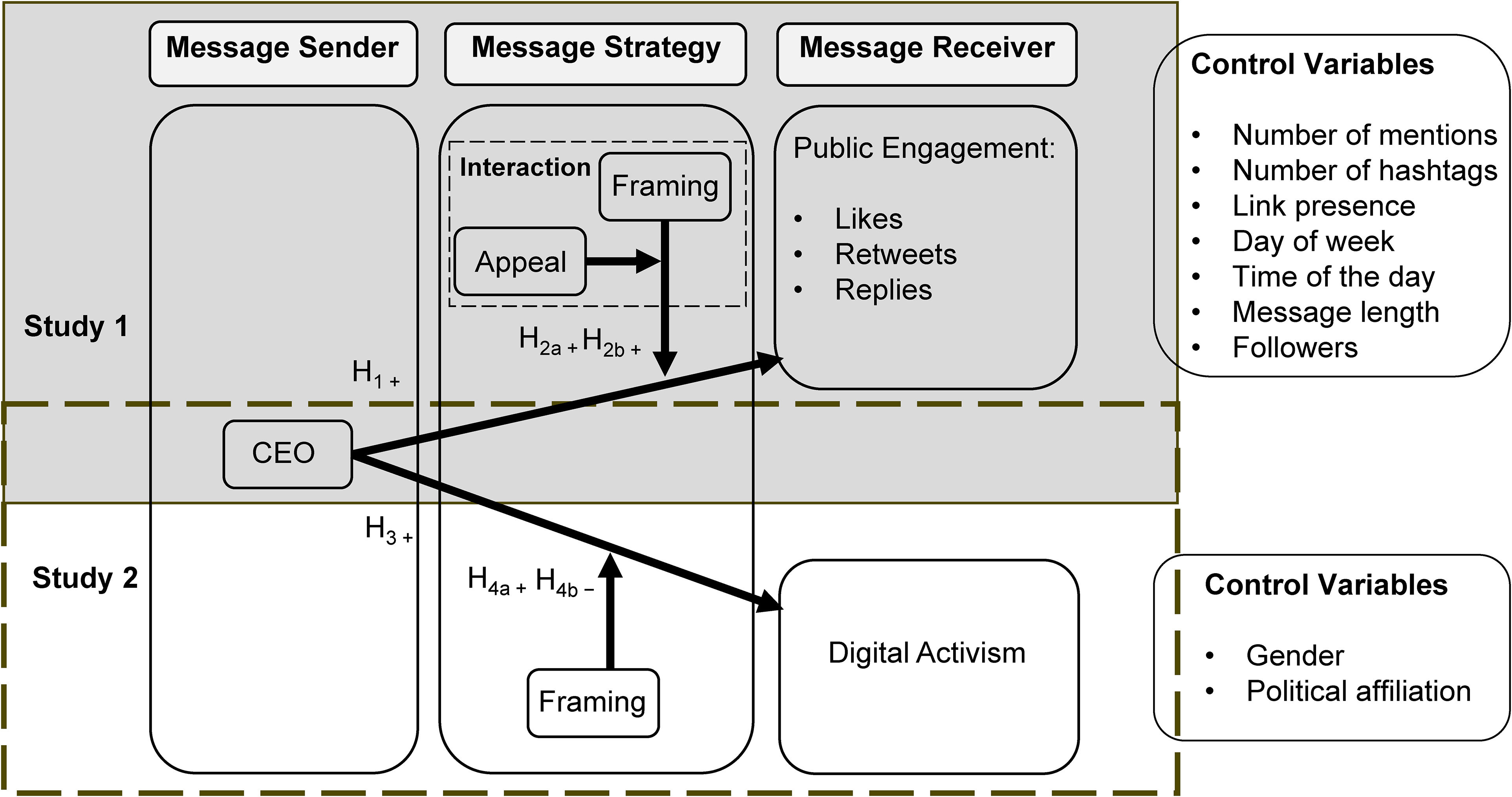
Conceptual Framework for Studies 1 and 2.
Study 1: CEO Communication, Framing, Appeal, and Public Engagement
Method
This empirical investigation provides a baseline tailored to the specific domain's nuances, thereby enriching theory rather than sidelining it. We use data analysis to bridge the domain's intrinsic details with broad theoretical frameworks, delivering actionable marketing insights. This approach ensures greater alignment with practical applications, making our research more meaningful for policy makers (Davis, Grewal, and Hamilton 2021; Pauwels and Perry 2022). In harnessing the power of social media data, we aim to accentuate the significance of marketing research, aligning it with emerging topics and fostering its leadership (Boegershausen et al. 2022).
Our methodological approach combines natural language processing, bidirectional encoder representations from transformers (BERT; a state-of-the-art machine learning technique designed to understand the context of words in a sentence by reading the entire sequence of words at once, rather than one by one [Devlin et al. 2018]), and multiple linear regression models. Natural language processing tools are tailored to glean insights from text data (Shankar and Parsana 2022), and their utility in evaluating various text sources, such as organizational communications, is well established in marketing (Berger et al. 2020; Jalali and Papatla 2019). Leveraging the capabilities of BERT, we identified the framing and appeal within CEO and brand messages, as BERT currently stands at the forefront of classification predictions (Alantari et al. 2022).
The choice of multiple linear regression models is strategic. We deploy multiple linear regression models for each dependent variable (likes, reposts, and replies) to appraise the ripple effects of CEO communication, framing, and appeal on public engagement indicators. This dual-pronged analysis empowers us to spotlight (1) variances in communication efficacy between senders (CEO vs. brand) and (2) the intricate interplay of senders, message strategy concerning framing (self vs. other), and appeal (emotional vs. informational).
Crucially, we account for post-specific characteristics, such as timing (morning, afternoon, or evening) and day, recognizing their potential sway on engagement metrics. Citing the insights from Jalali and Papatla (2019), engagement nuances like the variance between workdays and weekends are incorporated. Complementary to this, other influential variables, like the number of hashtags, mentions, links, followers, and message length, are duly factored in, underscoring their pivotal role in engagement dynamics, corroborated by multiple studies (Gu et al. 2022; Karagür et al. 2022; H. Kim et al. 2023; Pancer et al. 2019; Rietveld et al. 2020; Valsesia, Proserpio, and Nunes 2020).
Data Collection and Sample
We collected data for Study 1 by first selecting organizations listed on the S&P 1500, following previous research as reference (e.g., Chung, Low, and Rust 2023; Kim, Xiong, and Kim 2018; Nezami, Worm, and Palmatier 2018). This index includes the largest publicly traded companies in the United States and comprises three smaller indices: the S&P 500, the S&P 400, and the S&P 600, which represent large-, mid-, and small-cap stocks, respectively.
Study 1 focuses solely on CEO and brand communication on Twitter. 1 Although Twitter has limitations, it is a rich data source for marketing research (Berger et al. 2020). Among all social media platforms, the variables available in Twitter's data set are far more amenable to responding to questions of wider research interest. Our choice of Twitter as the medium of study is deliberate. Twitter's design has proven influential in disseminating unique information and fostering participation through a broader network of acquaintances (Valenzuela, Correa, and Gil de Zúñiga 2018).
In addition, Twitter's data access policies through its application programming interface are more suitable for open-platform data sources. In this study, a tweet is a message originated and publicly posted by a CEO. In contrast, a retweet publicly reposts a tweet originated by either the senders themselves or others.
We compiled the CEO data set by collecting all tweets and retweets from individuals serving as CEOs or interim CEOs of any company listed in the S&P 1500 during the first six months of the Russia–Ukraine war. We employed web crawling techniques and specialized Python code to extract data from Twitter (Berger et al. 2020). This resulted in 6,322 (re)tweets from 120 CEOs who posted during this timeframe. Of these, 55 CEOs posted at least once about the Russia–Ukraine war. We then used Python libraries on the data set to filter only (re)tweets in English that contained specific keywords related to the war (e.g., “war,” “Putin,” “Russia,” “Ukraine,” “Zelensky”), yielding a substantial corpus of 287 tweets.
For the brand data set, we collected all tweets and retweets from brands listed in the S&P 1500 during the same period. Of 1,500 brands, 1,230 had a Twitter account, of which 1,092 (re)tweeted any information during the first six months of the war, which resulted in 229,797 (re)tweets. Of these, 323 brands posted about the Russia–Ukraine war at least once. Then, we applied Python to select only English tweets containing the same specific keywords, resulting in a rich corpus of 1,293 messages. We analyzed the CEO and brand data sets together, resulting in 1,580 messages, 5,041,883 likes, 908,678 retweets, and 206,042 replies for further analysis. Accordingly, we present the different sectors’ representation in the final sample data set (see Web Appendix B).
Data Analysis
Detailed descriptive statistics for the research variables, specifically the aggregated data set of CEO and brand variables assessed in this study, are in Web Appendix C. In our analyses, we excluded messages with zero likes, retweets, or replies in each respective analysis. Consequently, our models evaluated 1,425 messages for likes, 1,140 messages for retweets, and 646 messages for replies as dependent variables. All models are statically significant, with ΔR2
Results
Our regression results strongly indicate that CEO communication on the Russia–Ukraine war significantly outperforms brand communication in garnering public attention and interaction. Specifically, CEO communication is associated with a marked increase in likes (β = 16,603.508, p < .001), retweets (β = 2,863.533, p < .001), and replies (β = 510.025, p = .001). Web Appendix F delineates the estimated likelihood of an increase in the number of likes on Twitter following CEO communication on the Russia–Ukraine war. Web Appendix G presents the analogous likelihood concerning retweets. Web Appendix H offers insights into the estimated surge in the volume of replies.
In light of these findings, our proposed hypothesis (H1) stands substantiated, evidencing that CEO communication about the Russia–Ukraine war elicits greater public engagement in likes, retweets, and replies than brand communication.
Three-way interaction results
In H2a, we postulate that a specific confluence of CEO communication elements would elicit increased public engagement. Specifically, we hypothesize that when CEOs address the Russia–Ukraine war, messages framed around the repercussions for Ukrainian civilians—when imbued with emotional appeal—would increase public engagement as quantified by likes, retweets, and replies on Twitter. Our analysis, as detailed in Model 2 across Web Appendices F, G, and H, revealed compelling evidence supporting this proposition. CEO communication delineating the consequences for Ukrainian civilians, particularly when paired with an emotional appeal, registered a substantial increase in likes (β = 27,190.083, p < .001), retweets (β = 6,765.073, p < .001), and replies (β = 671.630, p < .05).
In H2b, we postulate that when CEOs articulate perspectives on the Russia–Ukraine war, framing messages to emphasize the war's consequences on the self—especially those touching on the global energy crisis stemming from the war—and harnessing an informational appeal would engender a higher degree of public engagement. Diving into the results obtained from Model 8 (see Web Appendices F, G, and H), the data provides strong affirmation for our hypothesis. CEO communications that highlighted the self-centric repercussions of the war, specifically the ensuing global energy crisis, and coupled this framing with an informational appeal witnessed a significant surge in likes (β = 27,117.556, p < .001) and retweets (β = 6,746.939, p < .001). The results for replies are marginally significant (β = 669.205, p = .05).
Looking at the additional layers of the data, interesting nuances regarding the modulating influence of control variables emerged: CEO tweets posted on workdays were less likely to captivate attention regarding likes, retweets, and replies than those posted over weekends. Shorter CEO tweets were associated with greater public engagement, manifesting as increased likes, retweets, and replies. Tweets from CEOs with more followers corresponded to a more pronounced likelihood of receiving likes, retweets, and replies. Notably, messages with emotional appeal, in contrast to those with an informational appeal, experienced a more pronounced tendency to be retweeted.
Temporal nuances also surfaced; tweets posted during afternoon or evening hours were less likely to be retweeted than their morning counterparts. In sum, H2a and H2b find robust validation, underscoring the potency of having message framing and appeal in CEO communications about the Russia–Ukraine war.
Discussion
In the evolving digital communication landscape, CEOs increasingly choose to voice their perspectives on pressing sociopolitical events. A pertinent question arises—how does CEO communication, particularly during the Russia–Ukraine war, influence public engagement when compared with brand communication? Our findings illuminate a crucial facet of digital communication: the profound influence of CEOs, particularly when they voice perspectives on pressing sociopolitical events such as the Russia–Ukraine war. This outperformance of the CEO over brand communication is a testament to the pivotal role the sender plays in shaping public perception and interaction (Hambrick and Wowak 2021; Khumalo, Dumont, and Waldzus 2022; Wilson and Sherrell 1993; Wowak, Busenbark, and Hambrick 2022). Indeed, CEO messages, which are often imbued with personal beliefs and values, resonate deeper with the audience, offering a more spontaneous and personalized touch than typical brand communications. Milfeld and Pittman (2023) similarly highlight the message sender's importance, noting that even assertive messages yield positive outcomes when originating from perceived authoritative sources, such as high-market-share brands. Drawing parallels, CEOs, much like these dominant brands, may carry an inherent credibility that resonates deeply with audiences, bolstering the efficacy of their messages over typical brand communications.
Delving deeper, the findings can be interpreted through the lens of executive symbolism. When communicating on platforms such as Twitter, CEOs are not merely disseminating information, they are weaving intricate narratives infused with symbolic meaning (Hambrick and Lovelace 2018). When set against a contentious backdrop like the Russia–Ukraine war, such messages can act as potent symbols, epitomizing the CEO's stance and potentially influencing large segments of the public. This aligns with the spiral of silence theory, which posits that individuals are more inclined to voice their opinions when they perceive alignment with majority views (Noelle-Neumann 1974). Through their communication, CEOs have the power to shape these perceived majoritarian views, thereby influencing public discourse.
Although our investigation into the impact of CEO communication on public engagement surrounding the Russia–Ukraine war has yielded insightful results, it begets a deeper line of inquiry. The data demonstrates CEO messages’ heightened influence and resonance over traditional brand communications, particularly when they tackle pressing sociopolitical events. However, a critical question emerges beyond engagement metrics such as likes, retweets, and replies: Can CEO communication mobilize people into active, tangible forms of engagement or activism? More specifically, would a CEO's call to support a public policy initiative inspire more active participation than a similar call from a brand? To delve deeper into this question and extrapolate on our findings from Study 1, we embarked on Study 2. This second study ventures beyond observational data, seeking to probe the transformative potential of CEO communication in spurring public activism in real-world scenarios.
Study 2: How CEO Communication and Framing Mobilizes Public Activism
In Study 2, we wanted to investigate if a CEO proposing a public policy to aid Ukrainian civilians could spur more public activism than a brand doing the same. This study builds on our initial findings from Study 1, where we looked at how CEO tweets about the Russia–Ukraine war resulted in public engagement. Instead of observing reactions from secondary data, we designed an experiment to test if CEO communication can transform passive online engagement into active involvement. Importantly, our measures in Study 2 aimed to reflect real-world scenarios: We gauged actual public involvement in a policy campaign. Our prior findings about how CEO communication affects public engagement when combined with certain framing and appeal inspired this approach. To ensure accurate results, in Study 2, we used a 2 (message sender: CEO vs. brand) × 2 (framing: self vs. other) between-subjects design, which lets us compare different groups without participants trying to guess our intentions or being influenced by other factors.
Method
Before performing the main study, we performed two pretests for CEO/brand pair selection and stimuli development. For more details, refer to Web Appendix I.
Participants and design
Six hundred eight U.S. participants (342 men and 266 women) from Prolific completed the study in exchange for financial compensation. Participants ranged in age from 18 to 39 years (M = 30.81 years, SD = 5.28). Following Johnson, Bauer, and Carlson (2022), we focused specifically on U.S. citizens, because we wanted to see the reactions of those who could directly reach out to their local government representatives. We randomly assigned participants to read one of four vignettes featuring a call for action. Web Appendix J discusses the methodological approach integrating BERT and ChatGPT for vignette crafting. Web Appendix K contains an example of the final vignette.
In our study, we operationalized public activism based on participants’ willingness to join an ostensibly genuine political campaign. We informed participants that a CEO or brand invited them to participate in this campaign. Then, we randomly assigned participants to one of the four conditions and presented them with actionable requests “to send a virtual postcard” and “type a personal message” to their local political representatives. Participants had the flexibility to choose one action, or they could perform both actions, sending the postcard and writing a personal message (Johnson, Bauer, and Carlson 2022). It was framed to the participants that these actions were a collaborative effort between the CEO or brand and our research team, suggesting that any message or postcard they submitted would be forwarded directly to the relevant political authority in their area. Consequently, participants who agreed to be part of the campaign either clicked to dispatch a virtual postcard or actively crafted a message addressing their local representative. At the end of the experiment, after participants completed the demographic information, we disclosed a slight experimental deception related to the action task.
Measures
Our dependent variable, public activism, was dichotomously coded: a score of 1 was attributed to subjects who responded positively to at least one call to action, while a score of 0 was assigned to those who declined both solicitations. To validate the efficacy of our first manipulation, we included an item that directly queried participants about the perceived message sender. In addition, we employed a set of items designed to ascertain the success of our framing manipulations.
For the self-framing condition, participants responded to two distinct items. Likewise, for the other-framing condition, we presented two specific items (e.g., “Thinking about the tweet and proposed policy you just evaluated, would you agree the message focuses on helping Ukrainian civilians?”), which participants rated their agreement on a seven-point Likert scale (1 = “strongly disagree,” and 7 = “strongly agree”). The inclusion of these items draws on methodologies outlined in prior research (Fisher and Hopp 2020; White and Peloza 2009; Ye et al. 2015). Finally, to capture a richer profile of our respondents and account for potential confounding factors, we also solicited information about their age, gender, and political affiliation.
Manipulation Checks
We conducted a 2 (message sender: CEO vs. brand) × 2 (framing: self vs. other) ANOVA to assess the efficacy of our manipulations. For the message sender manipulation, the analysis revealed that participants in the CEO condition reported significantly higher mean ratings (M = 5.710, SD = 1.462) than those in the brand condition (M = 3.420, SD = 1.862; F(1, 606) = 282.733, p < .001).
In evaluating the framing manipulation, we consolidated participants’ ratings of the check items into composite measures. The composite reliability coefficient for the other framing was α = .928, while that for the self framing was α = .938. As predicted, participants in the other-framing condition, which emphasized assistance to Ukrainian civilians, registered higher mean ratings (M = 5.989, SD = 1.280) than their counterparts in the self-framing condition (M = 3.132, SD = 1.539; F(1, 606) = 620.890, p < .001). Conversely, scores were significantly greater for participants in the self-framing condition, which centered on supporting U.S. citizens (M = 5.532, SD = 1.343), than those in the other-framing condition (M = 3.086, SD = 1.684; F(1, 606) = 390.353, p < .001). These findings affirm our framing manipulation's effectiveness, reinforcing the subsequent analyses’ robustness and credibility.
Main Results
By employing a logistic regression model, we evaluated the distinct effects of communications from CEOs and brands on public engagement related to the Russia–Ukraine conflict, specifically regarding their capacity to incite digital activism. The results unambiguously support our proposed hypothesis (H3). Specifically, CEO communication emerged as a stronger motivator of digital activism than brand communication. The regression coefficient for this difference was positive and statistically significant (b = .437, SE = .174, 95% CI: [1.100, 2.179], p = .012, OR = 1.548). The odds ratio (OR) of 1.548 suggests that the odds of digital activism being mobilized are 1.548 times higher when the communication is from a CEO than when it is from a brand, assuming all other factors in the model remain constant. The 95% confidence interval for the regression coefficient further reinforces this effect.
Web Appendix L provides a detailed breakdown of the estimated likelihood of enhanced digital activism following CEO communication. These empirical findings robustly validate H3, confirming that a CEO's call for public policy support on the Russia–Ukraine war garners more robust digital activism than analogous brand communication.
Two-way interaction results
Our analyses discerned the combined influence of message sender (CEO vs. brand) and framing (self vs. other) on public digital activism. The binary logistic regression results unveil distinct patterns based on these factors. CEO-led public policy proposals, when emphasizing support for Ukrainian civilians (other framing), yielded odds 2.041 times higher of inciting digital activism than when brands did the same, given all other variables remained constant (b = .713, SE = .349, 95% CI: [1.029, 4.049], p = .041, OR = 2.041). Conversely, CEO messages about challenges faced by U.S. citizens due to the war (self framing) had half the odds of eliciting digital activism than brand messages on the same theme (b = −.713, SE = .349, 95% CI: [.247, .972], p = .041, OR = .490).
In stark contrast, brand-led policy proposals within a self-framing approach doubled the odds of stimulating digital activism (b = .713, SE = .349, 95% CI: [1.029, 4.049], p = .041, OR = 2.041) relative to similar CEO messages. However, brand communication about supporting Ukrainian civilians (other framing) was associated with a decline in digital activism (b = −.713, SE = .349, 95% CI: [.247, .972], p = .041, OR = .490). For comprehensive statistical details, refer to Web Appendix L, and for a visual representation of these interactions, see Web Appendix M.
Given that our digital activism measures involved participants sending virtual postcards or written messages, we visualized the most frequently used terms in word clouds. Web Appendix N shows the terms participants used to support the CEO's proposal for Ukrainian civilians, whereas Web Appendix O emphasizes the keywords from messages endorsing brands’ policies for U.S. citizens during the war-induced energy crisis. Furthermore, Web Appendix P showcases examples of participants’ activist messages. Additional statistical robustness is evidenced by a highly significant chi-square across all models. Control variable analyses reveal partisan differences in digital activism, with Republicans and Independents engaging less than Democrats.
Robustness Checks
To ensure the reliability and validity of our results, we undertook a comprehensive set of robustness checks. Initially, we employed the linear probability model as a simpler alternative to the logistic regression. The linear probability model offers a preliminary examination of the relationships between predictors and a binary outcome, as detailed in Web Appendix Q. Secondly, to address potential sample heterogeneity, we conducted subsample analyses (Wu et al. 2023), with the specifics outlined in Web Appendix R. Thirdly, considering that multicollinearity can inflate standard errors and lead to misleading interpretations (Jo, Nam, and Choi 2022), we conducted multicollinearity tests to confirm that our independent variables were not excessively correlated, with these detailed results reported in Web Appendix S. Despite certain robustness checks leading to a significant reduction in sample size, our primary findings consistently emerged, reinforcing their reliability and consistency. The coefficient directions remained unchanged, maintaining statistical significance across all models, including the main effect in the linear probability model.
Discussion
The compelling results from Study 2 highlight the public's distinct expectations for CEOs compared with corporate brands when addressing geopolitical crises. A CEO's message emphasizing support for Ukrainian civilians may evoke a broader and more altruistic sentiment, thereby inspiring digital activism (Mendini, Peter, and Maione 2022; Omoto, Snyder, and Hackett 2010). One possible explanation for such results is that, against the backdrop of complex situations like the Russia–Ukraine war, the public expects CEOs to assume a global leadership role and act ethically (D’Auria and De Smet 2020; Edelman 2023; Tsai and Men 2017). Conversely, when brands concentrate on aiding U.S. citizens, such a focus may strongly resonate with the public, potentially reflecting a profound sense of local loyalty (Castelló and Mihelj 2018; Ulver and Laurell 2020; Volcic and Andrejevic 2011).
What makes these findings even more noteworthy is the design of Study 2. In contrast to Study 1, this study deliberately incorporated CEO–brand pairs that were less known and perceived as neutral by participants, as established by our preliminary tests. This indicates that despite the inherent difficulty in communicating messages from less recognized or neutral sources, the way the message is framed and the identity of the sender (whether a CEO or a brand) still had a profound effect on digital activism outcomes. This suggests that the substance of the message and the credibility of the sender can, at times, exert greater influence than the audience's familiarity with the source, highlighting the critical role of effective communication during crises (Barrios et al. 2016; Keller and Berry 2003; Milfeld and Pittman 2023; Tversky and Kahneman 1985).
To fully comprehend these results, it is helpful to consult a variety of theoretical frameworks, which enable us to transition from a general outlook to nuanced cultural considerations. Executive symbolism theory, as elucidated by Hambrick and Lovelace (2018), posits that the actions and declarations of senior executives significantly influence the strategic narrative of an organization. In the context of the contemporary digital landscape, a CEO's public statement, particularly during pivotal events such as wars, transcends mere communication; it embodies the principles and stance of the entire organization (Branicki et al. 2021; Chatterji and Toffel 2019). When a CEO publicly speaks up on behalf of Ukrainian civilians, they are not only communicating a message but also signaling global empathy, ethical commitment, and a concern for humanity at large. Such a personal and ethical stance is likely to evoke a more potent public reaction than communications from a comparatively impersonal corporate brand.
The spiral of silence theory posits that individuals are less likely to voice unpopular opinions for fear of social isolation (Noelle-Neumann 1974). However, the findings suggest when a highly influential figure, like a CEO, publicly champions a particular viewpoint, it can disrupt this spiral. By speaking out in support of Ukrainian civilians, the CEO may legitimize this perspective and provide social validation for others to express similar sentiments. This can catalyze a wave of digital activism, as people, previously reticent, feel empowered to join the discourse, bolstered by the CEO's stance (Hambrick and Wowak 2021; Khumalo, Dumont, and Waldzus 2022; Wowak, Busenbark, and Hambrick 2022). The public may perceive that their previously silent or minority opinions now have backing from influential quarters, reducing the fear of social ostracism.
When considering cultural factors, the concept of power distance becomes important. In places like the United States, characterized by moderate power distance, people might expect leaders, especially CEOs, to show global responsibility, perhaps even more so than impersonal corporate entities (Hofstede 2001). In sum, the findings suggest that an interplay of market-driven strategies, whether rooted in the CEO's global visions or the brands’ local focus, possibly impacts public behavior.
General Discussion
Building on the premises introduced at the beginning of this article, our findings make significant strides in the literature, particularly within the domain of CEO communication. First and foremost, this research fortifies the bridge between executive symbolism and the spiral of silence theory, highlighting CEOs’ salient role in steering societal narratives. Second, our results accentuate the unparalleled efficacy of CEO communication in eliciting heightened engagement and activism over comparable brand communications. This underscores the profound gravity and potential ripple effects of CEO messaging in today's digital era. Lastly, our exploration elucidates the specific conditions that magnify these effects, laying the groundwork for further nuanced investigations. With these contributions in mind, we delve deeper into the broader ramifications of our findings in the context of global events and the overarching societal consequences.
The groundbreaking insights of our studies unravel a profound, novel dimension in the realm of marketing research: the impact of organizations, particularly CEOs, in galvanizing public engagement and action toward political entities. The in-depth exploration into the role of CEOs as key message senders vis-à-vis brand communications brings forth compelling sociological, philosophical, and moral considerations.
At the core, our results touch on the very essence of leadership—communication—and its resultant societal influence (Barberá-Tomás et al. 2019; Hambrick and Wowak 2021; Yue et al. 2021). The pronounced influence of CEO communications on the Russia–Ukraine war over brand communications reflects the nature of influence and, perhaps, authenticity in the digital age (Vredenburg et al. 2020). Philosophically, it reiterates the age-old notion that individuals, especially those in positions of immense power and responsibility, can shape societal discourse, perspectives, and actions (Keller and Berry 2003; Weber [1921] 1968). In the modern age, where individual personalities are often given more weight than faceless corporate entities (Khumalo, Dumont, and Waldzus 2022; Mak and Poon 2023; Thomas and Fowler 2023), the CEO emerges as not just a leader of a company but potentially a thought leader and influencer in the global sociopolitical arena.
The sociological implications of our findings are multifold. They suggest an evolving paradigm wherein the digitally equipped public seeks perhaps authentic, empathetic voices amid the overwhelming number of brand messages. The impact of CEO-led messages, especially those centered around empathy for Ukrainian civilians, might amplify the societal expectation that leaders should manage businesses and champion humanitarian causes (Habermas [1962] 1991; Lorenz-Spreen et al. 2020). Such a shift may pave the way for businesses to incorporate more humanitarian-focused approaches in their strategic decision making (Korschun, Martin, and Vadakkepatt 2020; Shultz 2005, 2007), as they recognize the growing importance of sociopolitical stances in shaping public opinion and driving consumer behavior.
From a moral perspective, this article brings a reflection on the ethical obligations and responsibilities CEOs bear when voicing perspectives on pivotal global events (Branicki et al. 2021). Although a CEO's personal stance might elicit significant public engagement and digital activism, it also brings forth the potential dangers of misinformation or bias, especially when these messages can sway public opinion and discourse (Di Domenico, Nunan, and Pitardi 2022; Diaz Ruiz and Nilsson 2023; Prakash 2023; Solomon, Hall, and Muir 2022). The moral weight of such communications necessitates a greater demand for integrity, authenticity, and responsibility from CEOs, ensuring that their stances are strategic and ethically sound.
In a hyperconnected world where lines between the personal and the public are constantly blurred, these findings act as a wake-up call for businesses, especially CEOs, to recognize their growing role in the sociopolitical fabric. As organizations contemplate their broader societal roles beyond mere profit making (Hambrick and Wowak 2021), the cascading influence of CEOs as pivotal message senders offers both an opportunity and a challenge. The opportunity lies in leading transformative change by influencing public discourse, while the challenge is in ensuring that such influence is wielded responsibly, ethically, and for the greater good (Korschun, Martin, and Vadakkepatt 2020; Shultz 2005, 2007, 2022).
Implications for Public Policy and Businesses
In the era of the digital landscape, online platforms have revolutionized the dynamics of engagement and activism. This shift has introduced new responsibilities and opportunities for both policy makers and businesses. CEO communication has proven to wield considerable influence, with the potential to stir significant public reaction and activism. This positions CEOs uniquely, enabling them to play a pivotal role in shaping public opinion. Simultaneously, brands cannot afford to be mere spectators. They must actively strategize their digital presence, considering that even passive interactions such as likes or retweets may carry the latent power to morph into active participation with tangible societal outcomes.
Furthermore, the marked distinction between CEO and brand communications paves the way for strategic collaborations. Policy makers have the opportunity to team up with CEOs for joint campaigns, magnifying the reach and efficacy of public policies. However, businesses might recognize the inherent power of CEO communications and consider positioning their top executives at the forefront, especially when addressing issues of societal and global significance.
Yet, the strength of communication lies not solely in the sender but largely in the content of the message (Tversky and Kahneman 1985). Crafting a message that resonates with the audience is an art that both policy makers and businesses must master. Public policies should be tailored with keen sensitivity to the audience's context. Simultaneously, businesses need to calibrate their messaging based on the communicator (Milfeld and Pittman 2023), with global concerns potentially amplifying the voice of CEOs and local issues finding a more profound echo when channeled through brands.
This digital era also redefines the role of CEOs in the context of major global events or crises. Silence, once a refuge, is no longer a viable option. CEOs are compelled to take informed stances, articulating them with precision and strategy (Feix and Wernicke 2023; Hambrick and Wowak 2021). This proactive engagement can not only nurture deeper connections with the public but also steer society toward the greater good (Korschun, Martin, and Vadakkepatt 2020; Shultz 2022).
Lastly, the landscape is not dominated solely by established players. This article shines a beacon of hope for emerging leaders and nascent brands. The realm of impactful communication is expansive and inclusive. With astute messaging, even the lesser known can rise and leave an indelible mark on society.
Limitations and Future Research
The insights from this article stem from a detailed analysis of CEO communications during the sociopolitical event of the Russia–Ukraine war. The specificity of this situation facilitates an in-depth understanding of communication strategies in times of crisis, emphasizing the importance of message framing and sender, particularly when addressing crises involving war or armed conflict. However, it also raises questions about the broader applicability of our findings across various geopolitical or sociopolitical contexts. Although our focused approach yields rich detail, it inherently restricts the generalization of our insights to other scenarios.
Future research should delve into the authenticity and sincerity of organizational communication, as these elements are crucial for global stakeholder engagement. These meaningful content elements are essential in shaping trust and relationships between organizations and their audiences (Osorio, Centeno, and Cambra-Fierro 2023). A focused study on these aspects could uncover effective communication strategies that resonate with sincerity and authenticity.
Additionally, the evolving landscape of multiple regional conflicts presents a unique challenge for organizations (Rosa et al. 2023). This complexity is particularly pertinent when companies must balance corporate objectives with their responsibilities toward diverse international communities. Investigating how organizations manage this balance and stakeholders’ perceptions of their communication is crucial. The decision-making trade-offs in these contexts and their implications for global stakeholder engagement warrant significant future research.
We also recommend researching CEO communication within lower-middle-income countries to broaden our understanding of the global applicability of our findings (Shultz et al. 2012). Analyzing these environments may reveal whether the engagement and activism patterns identified in the U.S. context are consistent globally or if different economic and cultural landscapes necessitate unique communication strategies.
Further studies could also consider the analogous communication dynamics in the sphere of political leadership. Specifically, investigating how political leaders frame messages on their personal accounts instead of official channels may provide valuable insights into the differential public engagement and activism these messages evoke. Given the pivotal influence of the message sender, as illuminated by our article's focus on CEOs, it would be of interest to discern if patterns exhibited by political leaders mirror or differ from those in corporate communication.
There is also an opportunity to investigate the tangible impact of CEO and brand communications on various business metrics, such as customer perceptions, shareholder returns, sales trajectories, and overall profitability. Foundational studies by Colicev et al. (2018), Colicev, Kumar, and O’Connor (2019), and Kumar et al. (2016) offer potential frameworks for approaching this line of inquiry. Moreover, broadening the scope to understand how organizational communication on sociopolitical issues impacts diverse stakeholder groups, with a particular emphasis on investors, will add depth to this research domain. For instance, Brownen-Trinh and Orujov’s (2023) recent exploration into corporate responses to the Black Lives Matter movement could provide a blueprint. Lastly, future research could build on Study 2, which focused on CEO–brand pairs that were unfamiliar to participants, by exploring how public reactions shift when a study introduces varying degrees of brand familiarity and trust.
Conclusion
The empirical findings from these comprehensive studies significantly advance our understanding of the profound impact CEOs can have when addressing geopolitical issues, particularly the Russia–Ukraine war. The studies conclusively revealed that CEO communications not only eclipse brand communications in their ability to engage the public but also possess the power to mobilize digital activism. Specifically, when CEOs focus on the challenges of Ukrainian civilians (other framing), imbuing their messages with emotional appeal, they drive heightened levels of engagement and foster digital activism. In stark contrast, brand-led messages with a local focus (self framing) resonate deeply with audiences. These insights underscore the nuanced interplay between message framing, message sender, and public reception in the complex realm of digital communication.
As societal expectations evolve, CEOs emerge as not just corporate leaders but global thought leaders, shaping narratives and influencing public actions. This role carries significant ethical implications and responsibilities, particularly in times of war when the potential for communication to either escalate tensions or foster understanding is high. In an era when digital platforms amplify voices from all quarters, CEOs must leverage their influence thoughtfully to act as catalysts for positive change in our globally connected society.
The insights gleaned from our research are intended to contribute meaningfully to the field of marketing research, particularly regarding strategic communication in the context of armed conflicts. Furthermore, we hope to motivate CEOs and brands to adopt responsible and ethically grounded communication practices. By underscoring the vital roles of message framing and the credibility of the sender in wartime scenarios, this article reinforces the urgent need for marketing initiatives to participate constructively in the global dialogue, aiming to alleviate the dire social, economic, and ecological effects of war.
Supplemental Material
sj-pdf-1-ppo-10.1177_07439156241230910 - Supplemental material for Finding the Right Voice: How CEO Communication on the Russia–Ukraine War Drives Public Engagement and Digital Activism
Supplemental material, sj-pdf-1-ppo-10.1177_07439156241230910 for Finding the Right Voice: How CEO Communication on the Russia–Ukraine War Drives Public Engagement and Digital Activism by Kedma Hamelberg, Ko de Ruyter, Willemijn van Dolen and Umut Konuş in Journal of Public Policy & Marketing
Footnotes
Joint Editors in Chief
Jeremy Kees and Beth Vallen
Special Issue Editors
Clifford J. Shultz, José Antonio Rosa, and Alan J. Malter
Declaration of Conflicting Interests
The author(s) declared no potential conflicts of interest with respect to the research, authorship, and/or publication of this article.
Funding
The author(s) received no financial support for the research, authorship, and/or publication of this article.
Notes
References
Supplementary Material
Please find the following supplemental material available below.
For Open Access articles published under a Creative Commons License, all supplemental material carries the same license as the article it is associated with.
For non-Open Access articles published, all supplemental material carries a non-exclusive license, and permission requests for re-use of supplemental material or any part of supplemental material shall be sent directly to the copyright owner as specified in the copyright notice associated with the article.
