




Abstract
The internet raises substantial challenges for policy makers in regulating gambling harm. The proliferation of gambling advertising on Twitter is one such challenge. However, the sheer scale renders it extremely difficult to investigate using conventional techniques. In this article, the authors present three U.K. Twitter gambling advertising studies using both big data analytics and manual content analysis to explore the volume and content of gambling ads, the age and engagement of followers, and compliance with U.K. advertising regulations. They analyze 890,000 organic ads from 417 accounts along with data on 620,000 followers and 457,000 engagements (replies and retweets). They find that approximately 41,000 U.K. children follow Twitter gambling accounts, and that two-thirds of gambling advertising tweets fail to fully comply with regulations. Ads for e-sports gambling are markedly different from those for traditional gambling (such as on soccer, casinos, and lotteries) and appear to have strong appeal for children, with 28% of engagements with e-sports gambling ads coming from users under 16 years old. The authors make six policy recommendations: spotlight e-sports gambling advertising, create new social media–specific regulations, revise regulation on content appealing to children, use technology to block users under 18 years from seeing gambling ads, require ad labeling of organic gambling tweets, and deploy better enforcement.
The Lord Bishop of St. Albans: So…we have very little idea how many [gambling ads] [children]…are actually seeing…online? Guy Parker, Chief Executive Officer (CEO), U.K. Advertising Standards Authority (ASA): That evidence is really hard to get.…We worry about our regulation of gambling advertising. We worry about whether or not we are drawing the line in the right place. —From the House of Lords’ Select Committee Inquiry on The Social and Economic Impact of the Gambling Industry, February 24, 2020
With the introduction of the Gambling Act 2005, the United Kingdom deregulated the gambling market and opened the door to advertising for sports betting, online casinos, and poker (Sweeney 2013). Today, 15 years later, the Gambling Commission (2020b)—the legislative body licensing and regulating gambling in Great Britain—found that 47% of Britons aged 16 years and older have gambled in the last four weeks, collectively losing £14.4 billion within one year. Adult problem gamblers are believed to make up .5% of the U.K. population—340,000 individuals (Twumasi and Shergill 2020). Meanwhile, the number of U.K. children with gambling problems has quadrupled to more than 50,000 in just four years (Gambling Commission 2020b). With the opening of child gambling clinics to tackle rising rates of problem gambling (Marsh 2019), the United Kingdom’s National Health Service and government have recognized this serious and growing issue. Indeed, the manifestos of all main political parties at the last general election pledged to tackle gambling regulation as a priority.
The purpose of this research is to ascertain the volume and content of social media gambling ads on Twitter, compliance with U.K. advertising regulations, and the age and engagement of followers of Twitter gambling advertising. Our opening quote, from the CEO of the U.K. advertising regulator to a 2020 House of Lords inquiry into gambling harms, highlights that policy makers are finding it difficult to keep pace with rapid and profound changes within the gambling industry—particularly online advertising for betting. Given the scant knowledge of the extent of social media gambling advertising, it is highly likely that ads contravening codes are slipping through the net. To address this issue, we present three studies with two objectives. Our first objective is to investigate the volume and content of Twitter advertising sent by U.K. gambling operators and its compliance with advertising regulations. We address this in Studies 1 and 2 using big data analytics and manual content analysis. Our second objective is to ascertain the age of the followers of Twitter gambling advertising and to assess engagement with the ads (e.g., replying, retweeting). We explore this in Study 3 by employing big data analytics. These three studies form part of a larger project commissioned by GambleAware (a large independent grant-making charity) to assess the volume and content of gambling advertising in all media as well as its impact on U.K. children, young people, and vulnerable groups.
We have structured the article as follows. We begin by discussing how recent industry and technology changes have created three major challenges for marketing and public policy in relation to gambling. We then present our three studies followed by a discussion of the empirical contributions. We close with six concrete recommendations for public policy, including steps already taken by regulators as a result of this research.
Industry and Technology Changes and Challenges
The internet has introduced unprecedented changes over the past 30 years (Burkeman 2009) that have led to three major challenges for marketing and public policy in relation to gambling: (1) fundamental changes in the scale, scope, and nature of the gambling industry; (2) the explosion of gambling advertising on social media; and (3) inadequate methodologies for interrogating the sheer amount of online advertising data. In this section, we discuss these three challenges in conjunction with the relevant evidence from the literature.
Challenge 1: The Reinvention of the Gambling Industry
While the history of gambling can be traced back to Mesopotamia around 3000 BCE (Schwartz 2013), internet-enabled technological developments in the past few years have revolutionized the practice of gambling and helped the industry reinvent itself. These fundamental changes can be categorized into form, content, and image. The days of gambling in dark, smoky high-street betting shops appear to be numbered and rapidly replaced by the use of smartphones and tablets to place bets from anywhere on trendy apps offered by large gambling providers such as Paddy Power or Ladbrokes (Newall et al. 2019). After initial registration, this new form of betting can easily take place on logged-in devices without further verification process. The resulting convenience, combined with the constant temptation, is likely to amplify impulsive behavior and continues to normalize gambling as a regular part of life (Deans et al. 2016; Pitt et al. 2017).
However, the content has also changed drastically. While gambling in the twentieth century traditionally focused on bingo, casinos, amusement arcades, lotteries (including scratchcards), and sports (particularly soccer and horse racing; Schwartz 2013), modern online bookmakers accept bets on almost everything from how many untruthful comments former President Trump would make during a speech to humans’ first encounter with aliens (Beckett 2017; Webb 2019). A particularly fast-growing new trend is e-sports gambling. E-sports is the industry surrounding the professional competitive playing of computer games online. Games include Counter-Strike: Global Offensive, Fortnite, and Defense of the Ancients. The market revenues were $950 million in 2019 and were forecast to reach $1.1 billion in 2021 (Newzoo 2021). Mass live venues such as the Royal Opera House in London attract thousands of live spectators, and global audience reach was estimated to be 474 million people in 2021 (Newzoo 2021)—most of them children and young people (Tran 2018). The explosion in popularity of e-sports has prompted conventional bookmakers (e.g., Bet365) to start offering e-sports odds and encouraged the emergence of new dedicated e-sports betting sites (e.g., Midnite). The e-sports betting market was predicted to be worth $15 billion by the end of 2020 (OddsMatrix 2020). As most large sports events came to an abrupt halt during the COVID-19 pandemic, the U.K. e-sports betting market exploded by almost 3,000% between March and June 2020 (Gambling Commission 2020b), indicating its huge future potential. So far, this development has been almost completely under the radar of public discourse, research agendas, and policy making.
These new, creative gambling opportunities have also changed gambling’s image from shady to trendy. The domain shift from offline betting shops with limited appeal and availability (e.g., restricted opening hours, few rural sites, male-dominated environment) to the internet has expanded the clientele (Shepherd 2017). Meanwhile, it is estimated that gambling advertising spend in United Kingdom has increased substantially. Although these figures are difficult to ascertain exactly, as they constitute commercially sensitive information, Ebiquity (published via IpsosMORI [2019]) reported an estimated gambling adspend increase of 24% from 2015 to 2018, while an analysis by Regulus Partners (published by GambleAware [2018]) estimated an increase in U.K. gambling adspend of 56% between 2014 and 2018 to £1.5 billion, with £747 million (49.8%) going into direct online marketing and £149 million (10%) into social media marketing. This reported move to online spend enables gambling providers to use cutting-edge content and techniques. Although previous research has identified three major offline gambling marketing techniques—creating brand awareness, offering financial incentives for a first bet, and using enticing-odds advertising (Newall et al. 2019)—few studies have explored techniques used in social media.
Challenge 2: The Explosion in Social Media Advertising
Social media has had a strong impact on gambling advertising, and one technique attracting particular attention is the “organic post” (Aydin 2020; Fulgoni 2015; Schomer 2019). This is a tweet simply posted on a brand’s Twitter account, rather than paid advertising sent, via complex algorithms, to specific audiences and/or individuals. In contrast to paid ads, where reach depends on adspend and sophisticated targeting, organic post reach has to be “earned” by content creativity, and such posts are perceived as more authentic and trustworthy by users (Quesenberry and Coolsen 2019). Good content will be shared or may even go viral, thus disseminating the message to new audience networks. Organic post effects are, of course, now amplified by the global population’s constant use of smartphones (We Are Social and Hootsuite 2019). It is on this type of advertising that we concentrate in this article.
Academic research in this area is only really just beginning. Although estimates of gambling advertising spend are emerging (IpsosMORI 2019), the volume of advertising that is seen by the public is harder to ascertain. Although several studies have observed the volume of gambling advertising offline (Cassidy and Ovenden 2017; Lopez-Gonzalez and Griffiths 2018), few have focused on online or social media gambling. In the literature review for the project to which our study belongs, Newall et al. (2019) report that researching the volume of online gambling advertising has so far rarely gone beyond self-report study designs. Examples of these (mostly qualitative) studies include O’Loughlin and Blaszczynski (2018), who found that 58% of surveyed Australian undergraduate students recalled seeing paid gambling ads on Facebook, and Thomas et al. (2018), who found that 55% of basketball fans aged 11–16 years remembered seeing gambling advertising on social media. While these studies give some indications of the volume of gambling advertising seen online, they are dependent on (inevitably) faulty recall. Because offline gambling advertising volume has been found to be high (Duncan, Davies, and Sweney 2018), it is likely to be higher on social media.
Challenge 3: The Analysis of Social Media Advertising
The resulting cascade of social media advertising data—which can fall into the category often referred to as “big data”—raises the issue for policy makers highlighted at the start of this article, where the CEO of the ASA admits publicly that methodological challenges render it complex for his organization to identify whether gambling advertisers are targeting specific (vulnerable) groups or, indeed, even to establish the volume of advertising to which these groups are exposed (Parker 2020).
This also, of course, raises a serious issue for researchers. Traditionally, the techniques and tactics used in gambling advertising have been analyzed using manual content analysis (Abarbanel et al. 2017; Cassidy and Ovenden 2017; Deans et al. 2016; Gainsbury et al. 2016; Kim, Lee, and Jung 2013). While this has the advantage of providing in-depth reading of specific content features, it is also rather time- and resource-consuming, which limits possible sample sizes drastically (Erlingsson and Brysiewicz 2017). Accordingly, new, automated methods are needed to cope with the hundreds of thousands of ads posted online. These new big data analytics methods, however, bring their own challenges, such as their limitations in analyzing the meaning of images (Rose and Willis 2019) or textual content, which requires a high degree of hermeneutic reading (Brooker, Barnett, and Cribbin 2016). The combination of regulators not being able to uncover irresponsible social media advertising activity, together with the methodological challenges of analyzing this massive amount of data, could potentially create a “dark space” with no one obeying the advertising rules, no one able to monitor this, and therefore no one able to regulate or inform policy thinking. We thus present our first two studies, which use both big data analytics and manual content analysis toward the shared objective of exploring the volume and content of gambling advertising on Twitter, with a particular focus on adherence to U.K. regulations.
Studies 1 and 2: Volume, Content, and Regulatory Compliance of Twitter Gambling Ads
The legality of gambling advertising and regulatory regimes differs quite substantially across the world. The United Kingdom is one of 18 European countries where licensed operators are allowed to advertise as long as they comply with the standards stipulated in their regulations (Hörnle et al. 2019). Although the licensing of gambling operators (i.e., allowing them to operate at all) is likely to be governed by legislation, advertising is more likely to be self-regulated by a self-regulatory organization, which is funded by a levy placed on the advertising industry and monitored by an independent body (International Chamber of Commerce 2018). In the United Kingdom, the ASA is this self-regulatory organization, which, in cooperation with the Committee of Advertising Practice (CAP), creates and polices the advertising codes (ASA 2019). We measure compliance of Twitter gambling ads against Code 16: Gambling (CAP 2014).
Research Design
To meet our first objective, we employed a “blended” approach (Lewis, Zamith, and Hermida 2013). We combined Study 1, which used an automated process to identify relatively simple patterns in the text of a very large sample of tweets, and Study 2, which used manual content analysis of a much smaller random subsample to examine tweets that included images as well as more complex text, to make a broader and deeper assessment of whether these tweets convey particular impressions about gambling that might contravene the wide scope of Code 16 (e.g., Cowart, Saunders, and Blackstone 2016; Thelwall et al. 2016). This approach has the advantage of utilizing the large-scale capacity of big data analytics while still employing a close hermeneutic reading of images and some richer text (Brooker, Barnett, and Cribbin 2016). The method and findings are presented individually for each study before a discussion bringing together the implications of Studies 1 and 2.
Study 1: Big Data Analysis of the Volume and Nature of Gambling Ads on Twitter
Method
Data collection and sample
Data for Study 1 were collected from Twitter’s public Application Processing Interface (API) over a nine-month period in 2018, employing Method52, a software application developed jointly by the Centre for Analysis of Social Media at the U.K. think tank DEMOS and the University of Sussex’s Text Analytics Group (www.taglaboratory.org). This software was designed to provide a sophisticated and accurate automated classification of social media conversation (Wibberley, Weir, and Reffin 2014).
We began by establishing a comprehensive list of Twitter accounts related to gambling. First, we acquired accounts identified in previous Twitter gambling research by DEMOS (Miller, Krasodomski-Jones, and Smith 2016). Second, we collected tweets mentioning these accounts, manually investigated them, and added any new accounts. Third, we added high-volume accounts sending gambling-related keywords (e.g., “acca,” “odds”). Finally, we used a series of manual searches on Twitter to identify any further accounts, including those not related to gambling on more traditional activities such as football, boxing, casino games, and lotteries. This search revealed posts offering new betting opportunities—most particularly the relatively recent activity of gambling on the outcome of large, professional e-sports tournaments. These four routes resulted in 417 accounts.
These 417 accounts were manually sorted into four categories according to type of account owner. Category 1 was bookmakers (e.g., Paddy Power), which accept bets from the public and make money directly from gamblers. We also included in this category the bookmakers’ affiliates—sales organizations that earn commission for signing people up to bookmakers’ gambling promotions. Category 2 was tipsters, who are individuals offering advice (“tips”) on the outcome of (primarily sporting) events in return for payment or a subscription from users. Category 3 included all types of accounts relating to betting on the outcome of e-sports events. We did not split this third category into bookmakers/affiliates and tipsters, as not enough was known about this industry at the time of research to make this distinction. Category 4 included gambling-related accounts that did not fit into either of these accounts, such as sports journalists or commentators (who also occasionally post gambling offers). These accounts are referred to as “other.” All organic tweets sent from the identified accounts were collected through periodic use of Twitter’s “user timeline” endpoint, which allows an account’s 3,200 most recent tweets to be collected (Sheela 2016). Our data collection produced a sample of 888,745 tweets from the 417 identified accounts.
Data preparation
Classifiers and keyword annotators
The 888,745 tweets spanned a wide range of content including not only betting tips and promotions but also responses to technical issues raised by customers and multiple jokes at the expense of soccer team managers. First, we had to identify the tweets that were actually advertising betting opportunities as opposed to discussions on customer service issues or news items: this would enable us to ascertain the true volume of gambling advertising. Second, as noted previously, research has identified three major marketing techniques used offline: creating brand awareness, using enticing odds advertising, and offering financial incentives (such as free bets) to open a betting account (Newall et al. 2019). We used big data analytics to ascertain the extent of the latter two techniques. We did not believe that analyzing or quantifying the use of techniques designed to raise brand awareness could be completed using big data analytics, so we left this to the manual content analysis (described in Study 2). However, we did believe that big data analytics were well suited to detecting the presence of social responsibility messages relating to terms and conditions, age restriction to gamble, and harm-reduction messages about the consequences of gambling. To conduct the analysis on all these areas, we used natural language processing classifiers, the hallmark of Method52. A classifier is “a hypothesis or discrete-valued function that is used to assign the most categorical class labels to particular data points” (Karim and Kaysar 2016, p. 313)—in this case, specific words and phrases used in tweets that would sort relevant from nonrelevant tweets, identify the use of enticing odds and financial incentives, and detect the presence of social responsibility messages. Each classifier was built using Method 52’s web-based user interface that allows nontechnical analysts to train and use classifiers. We proceeded through an eight-stage process consisting of (1) definition of categories, (2) creation of a gold-standard test data set, (3) training, (4) performance review and modification, (5) retraining, (6) processing, (7) creation of new classifier (back to stage 1), or (8) postprocessing analysis (Miller et al. 2015). We trained three classifiers and one keyword annotator (explained subsequently) to gain the information we required.
Our first classifier, which we called “Relevance to Gambling,” was trained primarily to remove tweets that did not actually offer a bet. We presumed that these would include general banter, customer service, and technical queries. Our second classifier, “Enticement to Immediate Betting,” is based on previous research that highlights the particular dangers of impulsive betting (Lawrence et al. 2009) as well as new guidance accompanying the U.K. gambling codes (CAP 2018a, p. 6) stipulating that “in order not to encourage gambling behaviour that is irresponsible, marketing communications should not unduly pressure the audience to gamble, especially when gambling opportunities offered are subject to a significant time limitation.” This classifier was trained to identify words in tweets that indicated the existence of or a link to a specific and immediate bet. Our third classifier, “Free and Matched Bets,” was based on Newall et al.’s (2019) findings that the advertising technique of offering free or matched bets is a particularly powerful and appealing incentive to young people to open a betting account and gamble immediately. We thus trained a classifier to identify words and phrases in tweets that mentioned or linked to tweets offering these particular incentives.
There is no U.K. legal requirement to include social responsibility messages in gambling ads, but research shows (Critchlow et al. 2020) that three messages can offer consumers some protection: (1) a link to the legal terms and conditions of the bet itself (e.g., a hyperlink titled “Ts&Cs”), (2) an age restriction warning statement to the effect that gambling is not for those under 18 years old (e.g., “18+”), and (3) a harm-reduction message about the social, financial, and psychological dangers of gambling and gambling addiction (e.g., “Be Gamble Aware!”). To detect text carrying these messages, we used a keyword annotator—a simpler function that categorizes only tweets that include the exact wording we were looking for. To ensure that the annotator recorded all the tweets that include the aforementioned conditions, we added and refined words and phrases that were discovered during the analysis. This final list included 23 keywords (see Table 1). Tweets containing one or more of these words and phrases were categorized respectively as (1) terms and conditions, (2) age restriction warnings, and (3) harm-reduction messages.
23 Keywords Used for Social Responsibility Keyword Annotator.

Classifier performance
No classifier used on this scale will work perfectly, but each classifier trained and used for this study was measured for overall accuracy. In each case, we did this by (1) randomly selecting 100–300 tweets to compose a “gold standard,” (2) coding each of these tweets by hand, (3) coding each of these tweets using the software classifier, and (4) comparing the results and recording whether the classifier got the same result as the analyst. Three measurements were taken. “Recall” is a measure of the correct selections that the classifier makes as a proportion of the total correct selections it could have made. If there were ten relevant tweets in a data set, and a relevancy classifier successfully picks eight of them, it has a recall score of 80%. “Precision” is a measure of the correct selections the classifier makes as a proportion of all the selections it has made. If a relevancy classifier selects ten tweets as relevant and eight of them are, indeed, relevant, it has a precision score of 80%. “Overall accuracy” combines measures of precision and recall creating an overall measurement of performance. All classifiers are a trade-off between recall and precision. Classifiers with a high recall score tend to be less precise, and vice versa. Our classifiers trained for this study had an overall accuracy measurement of between 72% and 91%, with an average accuracy of 85% (see Table 2).
Precision, Recall, and Overall Accuracy of Classifiers for Study 1.

Study 2: Manual Content Analysis: A Deeper Dive into Regulatory Compliance and Problematic Content
Although the big data analytics techniques used in Study 1 were able to successfully classify tweets according to particular predetermined words or sets of words that separated betting ads from technical queries, identified the use of specific advertising techniques related to particular words or phrases (i.e., immediate enticement to bet and offering free or matched bets to open an account), and signaled the presence of social responsibility messaging, they could not technically go beyond that. Computerized content analyses and big data analytics are not yet particularly advanced in ascertaining the meaning of pictures or images (Rose and Willis 2019) or textual content that requires a high degree of hermeneutic reading (Brooker, Barnett, and Cribbin 2016). We therefore used conventional content analysis by human researchers examining a smaller number of more complex and media-rich tweets to enable us to ascertain compliance to a much broader range of the regulations within CAP Code 16. Section 16.3 in particular specifies the ways in which gambling must not be portrayed in ads. Although some of these stipulations relate relatively directly to the use of particular word combinations and can thus be analyzed using natural language processing in big data analytics (e.g., “Bet Now!”) most relate to the general impression that is given through a combination of words and images (e.g., ads must not link gambling to “sexual success” or “juvenile or loutish behaviour”). Some of these stipulations are subtle and rely on human judgment (e.g., a computer cannot yet judge what constitutes “loutish behaviour”).
Method
Sample
From our sample of 888,745 gambling-related tweets, we randomly drew a subsample of 250 tipster/bookmaker tweets advertising traditional gambling and 250 tweets advertising e-sports gambling. They all contained media (static images, GIFs, memes, and videos) as well as text and were therefore more complex to analyze. The sample size is in line with previous manual analysis of media content on Twitter (e.g., Cowart, Saunders, and Blackstone 2016; Thelwall et al. 2016). Within the coding process, some tweets had to be excluded due to duplications or wrong classification (e.g., a tweet for traditional gambling in the e-sports sample). The final analysis comprised 241 of the 485,765 tweets from gambling operator accounts offering bets on traditional sporting events such as soccer matches, horse racing, or gambling in online casinos and 181 of the 26,573 tweets from gambling accounts offering bets on e-sports.
Codebook development
In line with standard content analysis method (Neuendorf 2017), the next step was to create a codebook. Our codebook consisted of three parts. The first and main section was designed to assess compliance with section 3 of CAP (2014) Code 16, “Gambling”—the part that relates to gambling advertising content. Sections 16.1 and 16.2 lay out general principles related to gambling social responsibility and applying the spirit as well as the letter of the rules. Sections 16.4 and 16.5 relate to protecting children in particular locations where there may be gambling activity. Section 16.3 (our focus) contains 17 subclauses specifying different types of visual or textual content or messaging that must not be included in or implied by gambling ads—for example, suggesting peer pressure to gamble (16.3.7), implying that gambling can be a reliable way to earn a living (16.3.4), or suggesting that gambling can provide an escape from depression (16.3.3). CAP supplemented these Code sections in 2018 (CAP 2018a) with nine further specific pieces of guidance to advertisers—for example, telling advertisers that they must not use cartoons and animation likely to appeal to children or childish terms and images (e.g., princesses, pirates). Codes 1–27 of our codebook reflected all 17 subclauses of CAP Code 16.3, along with the nine pieces of advice from 2018. Note that we further divided 16.3.14 into two codes for finer-grained analysis, giving this section of our codebook 27 codes. Coders were given instructions in the form of a question (e.g., “Does the advert suggest that gambling is a rite of passage?” [16.3.10]), with response options of “yes,” “no,” or “not sure.” Table 3 lists all codes as well as results of our analysis of the ads for traditional and e-sports gambling.
Codebook for Study 2 with CAP Code Section/Advice, Questions for Coder, and Results for Traditional and E-Sports Gambling.

The second part of our codebook included an additional six items that relate to a specific set of design features that Newall et al. (2019) had identified as particularly common or problematic in research into offline gambling advertising. One feature relates to the presence of a hyperlink to place an immediate bet (our code 29). Three (our codes 28, 30, and 31) relate to branding. Newall et al. highlighted brand awareness as one of the most common techniques in offline gambling advertising. They also drew attention to the problematic role of strong branding in building the affinity and loyalty of young people to gambling brands. We were thus also interested in the role of emojis (our code 32), which have been shown to be particularly successful in communicating positive brand effects such as joy or happiness (Riordan 2017). Of particular importance was the role of the gender and age of the people pictured in an ad (our code 33) because it pertains to CAP Code 16.3.14, which forbids showing individuals younger than 25 years old. We also wanted to explore how many featured individuals were under 35 years and whether men were overrepresented in these ads, as previous research has found that men are more likely than women to take risks and show lower levels of impulsive coping during gambling (Wong et al. 2013).
The third part of our codebook included four items related to sports, current events, and popular culture. Other parts of the research to which these studies belong reported that gambling is becoming normalized in the United Kingdom in part because of advertising that reinforces an association between gambling, sporting events (our code 34), other real-life events (code 35), and contemporary popular culture (code 36) (e.g., Cassidy and Ovenden 2017; Newall et al. 2019) including humor (code 37) (Houghton et al. 2019; Thomas et al. 2012, 2016). Although normalization does not currently underpin regulations, it now features prominently in policy debate.
Testing the codebook
Guided by the principles of coding by Sutcliffe, Oliver, and Richardson (2017), we took distinctive steps to ensure the soundness of the analysis. First, both our team and the wider project team analyzing offline advertising designed, discussed, and tested the codebook. For our study, three researchers (all subject matter experts) then took a random selection of tweets and coded them together, discussing any disagreements and clarifying and agreeing the criteria for coding. Finally, the two researchers who carried out the final coding independently coded a randomly selected subset of tweets, and intercoder agreement was 94%, with variable coefficients ranging from 85%–100% (with >90% being good and 80%–90% being acceptable; see Allen 2017).
Results: Study 1
Volume of Twitter gambling ads
Our first classifier (Relevance) found that approximately 60% (536,339) of all tweets sent from the 417 gambling accounts offered specific bets or gambling opportunities (see Table 4). The other 40% of tweets sent from gambling accounts had no obvious link to placing bets, though it seemed that many are likely to be categorized as “content marketing,” a long-term brand-awareness strategy that aims to “develop stories that inform and entertain and compel customers to act—without actually telling them to” (Pulizzi 2014, p. 10). Because these content marketing tweets require specific attention—particularly with respect to the regulatory framework—we excluded these along with the technical support and customer query tweets from further in-depth analyses.
Total Volume of Accounts and Tweets, Average Tweets per Day, and Results for Classifiers 1, 2, and 3 by Gambling Account Type.
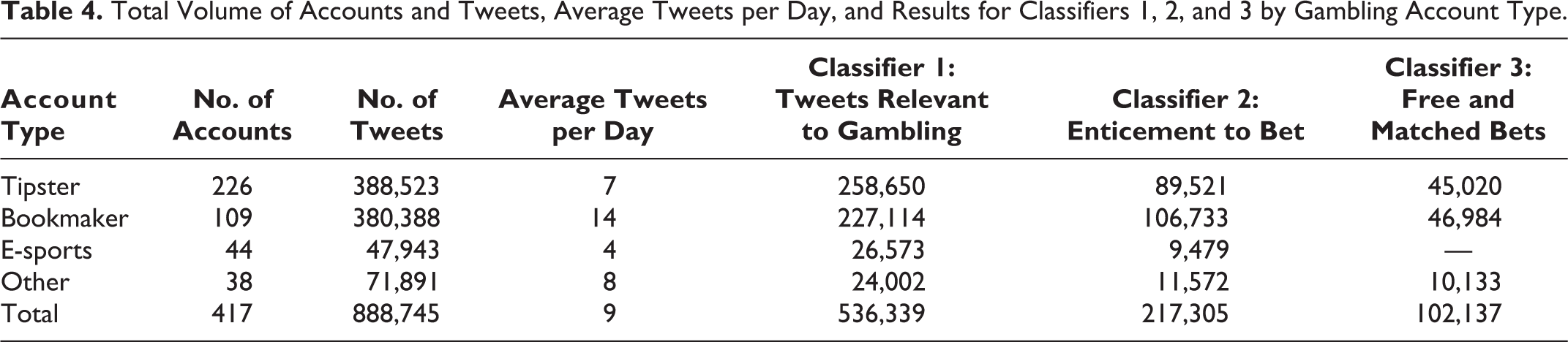
Our big data analysis of the 536,339 relevant tweets enables us to see the sheer scale of gambling activity on Twitter (summarized in Table 4). Each bookmaker account sent an average of 14 tweets per day, with the most prolific account sending 30,080 tweets during the collection period, an average of 122 tweets per day. The five largest operators in the data set—Ladbrokes, Bet365, Coral, Betfred, and Paddy Power—sent an average of 19,100 tweets, or 78 each per day. This indicates a large brand presence. We found that the average bookmaker account was far more active than the average tipster and that accounts offering traditional gambling are far more active than accounts offering e-sports betting.
Spikes during sporting events
Figure 1 shows that tweets both from accounts offering traditional and e-sports gambling are highly responsive to current sporting events, with regular spikes occurring around soccer matches, prominent races, and video game tournaments. A flurry occurred during the Soccer World Cup, with 5,786 tweets sent on the day of England’s first match. Similarly, as Figure 2 shows, e-sports-related tweets increased around major tournaments such as the annual Dota 2 tournament “The International,” which had a global viewership of 15 million people. This event prompted a near doubling in the number of tweets compared with the average across the previous period. Similar spikes occurred around other major tournaments for prominent games including Counter-Strike: Global Offensive and League of Legends.

Tweets per day sent from accounts for traditional gambling.

Tweets per day sent from accounts for e-sports gambling.
Other patterns
We also made some new discoveries by analyzing the time of day of tweets. Figure 3 shows that tweets from traditional and e-sports accounts display broadly similar patterns of activity throughout the daily cycle. However, e-sports accounts are approximately twice as likely to advertise overnight (10

Tweets per hour sent from accounts for traditional and e-sports gambling.
Enticement to immediate betting and free/matched bets
Our second classifier found that 47% (217,305) of all gambling-related tweets included an immediate enticement to bet (see Table 4). These tweets create an urgency to act, as they refer to imminent events (e.g., “Atletico Madrid vs Arsenal.…Back a player to score the 1st goal if he scores a 2nd, we’ll DOUBLE your 1st goalscorer odds. If he scores a 3rd, we’ll TREBLE them! [link to bet].” Our third classifier, “free and matched bets,” found that 45,020 tipster tweets (17%) and 46,984 bookmaker tweets (21%) mentioned free or matched betting to open an account for traditional gambling. However, no such offers were used by accounts promoting e-sports bets.
Social responsibility messages
Our keyword annotator showed that only 64,573 (7.3%) of tweets contained social responsibility messages within the body of the tweet text, with 4.5% mentioning keywords related to terms and conditions, 4.1% related to harm-reduction messages, and only .1% related to age restriction warnings. Some of the warnings were contained in imagery and therefore were not picked up by this text analysis. The manual content analysis showed that 69% of the accounts offering traditional bets included age restriction warnings, terms and conditions, or harm-reduction messages, but that this was true for only 2% of accounts offering e-sports bets—which means that 98% of e-sports gambling ads bore no social responsibility message in any part of the tweet.
Results: Study 2
Overall, we found that 68% of tweets for traditional gambling and 74% of those offering e-sports bets contained content that our coders considered to breach regulations. Moreover, just as in our big data analysis, we found substantial differences in the content of posts offering traditional gambling opportunities and those advertising betting on e-sports. Next, we examine the areas of the code where most breaches occurred. See Table 3 for full results.
Exploiting the susceptibility or inexperience of young or vulnerable people
The coders judged most violations to have taken place against Code 16.3.2 (our code 7), which states that “marketing communications must not exploit the susceptibilities, aspirations, credulity, inexperience or lack of knowledge of children, young persons or other vulnerable persons.” The coders found 37% (n = 89) of ads for traditional types of gambling to breach this. This was mainly due to the presentation of financial incentives that were either too complex to understand or unrealistic (e.g., Footy Accumulator’s “Bet £10 get £60,” William Hill’s “Bet £10 get £30 in free bets”). In contrast, only 6% of ads for gambling on e-sports used exploitative messaging. Those that did tended to make more general exaggerated statements that could be misinterpreted by inexperienced young people (e.g., X-Bet’s claim that “a successful person never loses…they either win or learn!”). One issue that emerges is that because Twitter ads are limited to 280 characters (approximately 40 words), explanations are curtailed and therefore lack the kind of clarity needed to allow for complete understanding of the offers. The opening deal advertised by FreeBigBets.com, for example, includes seven different pieces of information making it unlikely that users—particularly younger users—would be able to process the messaging before opening an account and placing a bet.
Emphasis on money motives
CAP Code 16.3.4 (our code 9) states that gambling marketing must not “suggest that gambling can be a solution to financial concerns, an alternative to employment or a way to achieve financial security.” Moreover, subsequent guidance (CAP 2018b) noted that “new provisions will…prevent undue emphasis on money motives for gambling” (our code 10). However, 34% (n = 81) of ads for traditional gambling had a strong emphasis on monetary benefits, such as urging readers to “make yourself an extra ££££+ a month” or examples of regular earnings up £4,000 each month. Only 5% of e-sports ads were found to employ similar strategies, but these were often related to betting using cryptocurrencies, such as the Counter-Strike: Global Offensive promotion, “NOW you can earn more free coins by flipping the coin.”
Erroneous perception of risk or control
The CAP advice (2018b) states that gambling advertising should not “give erroneous perceptions of the level of risk involved or the extent of the gambler’s control over a bet” (our code 6), yet 27% (n = 66) of ads for traditional gambling did just that (e.g., Counter-Strike claims “Expert #betting tips from real #gamers. Learn from the best and beat the rest counterstrikebetting.com” implying that skill will lead to more control over the bet).
Children and young people
CAP Code 16.3.12 (our code 19) prohibits marketers from using content that is of “particular appeal” to children (i.e., of more appeal to children than adults). Our coders considered that 17% of e-sports ads (n = 30), compared with 3% of ads for traditional gambling (n = 8), were of particular appeal to children. Moreover, the coders were unsure whether an additional 42% (n = 76) of the e-sports tweets appealed more to children than to adults. This flags a concern with the code itself and throws doubts on whether “of particular appeal” is a regulatory concept that makes sense. How can adults judge whether something is of particular appeal to children? In addition, just because content also appeals to adults does not make it any less appealing to children. Beyond Code 16.3.12, and perhaps because of its problematic nature, new guidelines for this code were issued (CAP 2018a) prohibiting “childish” terms and images (our code 20) and the use of cartoons and animations (our code 21). This was much easier for coders to decide, and it was here that we uncovered the most frequent breaches for e-sports ads. In particular, 76% of e-sports tweets (n = 138) contained cartoons or animations—mostly characters from the video games for which they are offering bets. Other examples include a cartoon picture of popcorn to promote 32Red Casinos and an animated unicorn to advertise free play on mobile slots games. Gala Casinos also features cartoon characters as well as “childish” images of treasure and rainbows.
Design features
Branding, age, and gender
The second part of Table 3 summarizes our findings for the use of particular design features, some of which have been highlighted in other research as problematic and may need to be addressed by stronger regulation in future—namely branding, age, and gender. First, in line with previous research by DEMOS (Miller, Krasodomski-Jones, and Smith 2016), we found that 83% of tweets for traditional gambling and 80% of tweets for e-sports bets containing pictures of individuals featured only men. Second, although the CAP Code 16.3.14 (our code 23) specifically prevents the use of images of anyone under the age of 25 years playing a significant role in marketing communications for gambling, we found that ten traditional (4%) and ten e-sports ads (6%) featured people who looked younger than 25. In the e-sports sample, Betspawn features the popular gamers “S1mple” and “Subroza,” who are both 24 years old, while Nitrogen Sport features a gamer who appeared to be high-school age. Beyond this, 35% of individuals in e-sports posts and 48% of those in posts for traditional gambling looked between 25 and 34 years old—reinforcing the youthful image of gambling (see our code 33). Third, according to Newall et al. (2019), branding is one of the three most important marketing techniques used offline by gambling operators. This would appear to be important online as well, with 85% of traditional and 94% of e-sports ads featuring the brand logo on the Twitter profile (our code 31).
Hyperlinks to bets, emojis, and other findings
We found that 89% of e-sports posts and 80% of posts for traditional gambling contained a hyperlink to a bet (our code 29), encouraging immediate and possibly impulsive betting. Moreover, emojis were used in 64% of posts for e-sports and 46% for traditional gambling, reinforcing the image of gambling as a positive and happy activity (Riordan 2017). Finally, although this was not something we set out to measure, we found that none of the 422 tweets had any kind of labeling to show that they are commercial advertising despite the fact that the CAP Code 2.1 states that “marketing communications must be obviously identifiable as such.”
Topical references: sports, current events, and popular culture
The last part of Table 3 shows the results from our analysis into links between gambling ads and sports, currents events, and popular culture that may lead to normalization. In line with the big data analytics findings in Study 1, we confirmed again that the offline findings relating to the strong link between gambling and sports (e.g., Cassidy and Ovenden 2017; Newall et al. 2019) also hold in Twitter advertising. We found that 55% of ads for traditional gambling and 82% of e-sports ads referenced a specific real-world sporting event. For traditional bets, references often included the World Cup, such as Marathonbet’s ad to win a free T-shirt by predicting the correct score and first goal scorer in three named matches. For e-sports, references were overwhelmingly to matches involving Counter-Strike: Global Offensive, Dota 2, Overwatch, and League of Legends. Almost no references were made to other types of popular culture or current events.
Discussion: Studies 1 and 2
Studies 1 and 2 investigated the volume and content of organic gambling advertising on Twitter. Our big data analytics revealed that the volume is high. The five largest operators in the data set—Ladbrokes, Bet365, Coral, Betfred, and Paddy Power—sent 19,100 tweets within eight months, which could result in heavy and overwhelming exposure for individual Twitter users. In line with previous research, we also found a very strong link between gambling and sports, with heavy spikes in frequency around sports events (e.g., Lindsay et al. 2013) and e-sports events. This strategy can normalize the link between sports and betting as well as create a time pressure to gamble, which favors impulsiveness over reflection on the possible risks and downsides of participation. That over 80% of posts for both types of gambling also included a hyperlink to place a bet exacerbates this. This is particularly problematic for children and young people, because neurobiological development during adolescence increases the influence of emotional, impulsive, and affective behavior (Pechmann et al. 2005). This is likely to be further aggravated by late-night tweets offering immediate bets on e-sports events. Because CAP (2018a, p. 6) states that “marketing communications should not unduly pressure the audience to gamble, especially when gambling opportunities offered are subject to a significant time limitation,” it is possible that 47% (217,305) of all gambling-related tweets in our sample contravene this regulatory advice. A similarly worrying trend is the extensive use of “free bets.” We found 19% (102,137) of gambling-related tweets using “free” or “matched” bets to incentivize users to open accounts or to bet on specific events. Because tweets are very short (max. 280 characters) it is highly unlikely that these offers are explained sufficiently and thus might breach CAP Code 16.3.2, which prohibits marketing communications that exploit the susceptibility or inexperience of young or vulnerable groups.
We also found that gambling advertising is difficult to spot. None of the 422 tweets observed by the manual content analysis had any form of labeling that signaled their commercial nature. Therefore, a large share of organic gambling ads may not be clearly identifiable as such by inexperienced users. This is problematic—particularly with regard to children and young people—in two respects. First, these “disguised” advertising efforts are likely to be processed unconsciously with the recipient unlikely to be able to make mental counterarguments (Nairn and Fine 2008). Second, there is a risk that a subconscious association is being made between sports and e-sports and gambling, particularly for young men. This adds more evidence to the concern over the normalization of gambling as harmless, normal, and fun behavior (Clemens, Hanewinkel, and Morgenstern 2017). The strong male bias and the pictures of young people implicitly impresses on audiences that gambling is the preserve of young men. This is relevant for regulators, as the communications from CAP have already identified young men as a particularly vulnerable group (ASA 2017).
Finally, although 68% of posts offering traditional gambling opportunities and 74% of those offering e-sports bets used content that we felt had some regulatory concern, the reasons differed between the two account types. Whereas accounts offering traditional gambling ads presented complex and confusing betting odds, encouraged regular gambling, or emphasized the monetary benefits, accounts offering e-sports betting instead had issues with late-night gambling, “bet now”–type messaging, and potential for misinterpretation of betting in cryptocurrencies. The heavy use of cartoons and animations in e-sports advertising is of particular concern.
Study 3: Age and Engagement of Twitter Audience
While in Studies 1 and 2 we analyzed the tweets sent by gambling providers, our third study investigated our second research objective, which was to assess the age of gambling account followers and to observe engagement with the ads posted by those accounts. Organic social media advertising on Twitter is designed to “go viral.” The general process works as follows: (1) An account holder sends a post (tweet), which is only visible in the newsfeed of its followers. (2) If these followers engage with the post (reply or retweet), it becomes visible to other users that do not necessarily follow the account that originally sent the post. (3) If these users in turn engage with the post, it can expand into entirely new user networks that previously had no relationship with the initial sender of the post. As far as we know, this is the first study of followers of and engagement with social media gambling advertising.
Method
Sampling: followers
Using Twitter’s API, we collected information from all followers of the 417 gambling-related accounts identified in Study 1. This resulted in the collection of 4,824,654 follower profiles. Because CAP regulations only apply to U.K. audiences, follower profiles were passed through a geocoder to infer the country from which a tweet was sent. The geocoder matched user location fields to geographical coordinates by searching for matches within a series of geographical databases (e.g., GeoNames). If no match was found for a given location field, the user was not considered for analysis. We categorized 700,213 followers as U.K.-based and, after removing 78,668 accounts that did not appear to be individual followers (e.g., institutions), the final sample size was 621,545.
Sampling: engagement
To analyze engagement patterns, as well as the ages of those engaging with gambling advertising, we again used Twitter’s API to collect data. This time, however, we collected all replies and retweets sent in response to the 888,745 gambling ads identified in Study 1. This resulted in the collection of 6,381,870 replies and retweets, sent by 1,998,097 individuals. After filtering this down to engagements from U.K.-based individuals only, our final sample included 457,090 retweets and replies from 145,334 people.
Multiview neural network age classification
When Twitter users set up an account, they give personal information such as their age and email address. However, in line with privacy laws, this information is not made publicly available on Twitter’s API. Some users may self-declare their age in their account description field, but doing so is optional. This means that we had to use analytic techniques to estimate the age of those following and engaging with gambling accounts. We trained a different type of classifier in the form of a multiview neural network (MVNN; see Miller et al. 2015) to classify individuals into three age categories based on the U.K. regulatory framework (children: age 0–15 years, young people: age 16–23 years, adults: age 24 years and up). MVNN models have the capacity to extract and combine features from multiple data sources to predict an outcome—in our case, age category (0–15, 16–23, and 24+). The input data for this MVNN came from nine attributes publicly available in the data of each tweet (see Table 5), thus entailing a rather more complex process than in Study 1. Using this sort of data to estimate the age of individuals following and engaging with internet content is in line with a body of previous literature (e.g., Morgan-Lopez et al. 2017; Pandya et al. 2020; Rao et al. 2010).
Publicly Available Description Fields Used for the Age Classification in Study 3.

Similar to other classifiers used in this work, the MVNN is a data-driven approach that learns, via supervised training, a mapping from input data (the nine attributes) to an output (three age categories). We obtained age-labeled data by automatically identifying individuals who self-declared their age within their account description field (e.g., “born in 98, studying at UCL”). All text used for age labeling was then removed from the description fields before training to prevent the model becoming reliant on such information (e.g., modifying “born in 98, studying at UCL” to just “studying at UCL”—i.e., removing the unambiguous age identifier). Applying this process to a large random sample of English-language tweets resulted in 229,198 labeled individual profiles that were then used as training and benchmark data.
The classifier had an overall accuracy of 67.2%, an 11.8% increase over the majority-class baseline accuracy of 55.4% (obtained by classifying all instances as “16–23,” the most populous age category). The classifier’s accuracy for “0–15” estimation can be computed by treating “16–23” and “24+” as a single class: “16+.” In this setting, the classifier achieved an accuracy of 77.5%, compared with a majority-class (“16+”) baseline accuracy of 70.6%. While there is consensus that age classification on Twitter is challenging, our overall accuracy is in range of previous studies classifying age categories on social media such as Rao et al. (2010), Morgan-Lopez et al. (2017), and Santosh et al. (2014), ranging from 66% to 74%.
Results
Age of followers
Table 6 shows that of the 621,545 followers identified as U.K.-based, 41,303 were classified as 0–15 years old. This is 7% of our combined sample of traditional and e-sports gambling account followers (compared with the 10% benchmark of Twitter users in general). We found that 411,968 were 16–23 years old (66%, compared with the benchmark of 71%), and the remaining 168,274 were 24 years old and up (27%, compared with the benchmark of 19%). Beyond this, we found that the child followers make up a substantially higher percentage of followers of e-sports gambling (17%, n = 1,602) than of traditional gambling (7%) even if numbers are considerably higher for traditional gambling (n = 39,848). Although the proportion of 16–23-year-olds was roughly similar across the two account types (traditional: 66% [n = 406,593]; e-sports: 69% [n = 6,468]), a notably higher proportion of people 24 years old and up followed traditional gambling (27% [n = 168,274]) than e-sports betting (14% [n = 1,262]).
Followers of Traditional and E-Sports Gambling Accounts by Account Type and Age (Plus Benchmark).

Engagement with gambling ads (retweeting and replying)
Table 7 profiles the 457,090 U.K. engagements (replies and retweets) with tweets from U.K. accounts offering traditional and e-sports gambling. Children under 16 years old sent 24,626 retweets and replies (5%), 286,409 came from 16–23-year-olds (63%), and 146,055 from people over 24 years old (32%). As with followers, children make up a substantially higher proportion of the e-sports engagements (28% [n = 31]) compared with traditional gambling engagements (5% [n = 24,309]). Again, there is a much larger number of engagements with traditional gambling, even for children. The 16–23-year-old age group produced 66% of the engagements with e-sports gambling ads (n = 747) and 63% of traditional gambling engagements (n = 285,662). Again, engagement is much lower for those over 24 years old: this group comprises 145,987 engagements with traditional gambling (32%) and only 68 engagements with eSport gambling (6%). As this is the first study of this kind, there are no benchmark figures for total Twitter engagements for comparison.
Engagements (Replies and Retweets) with Gambling Tweets by Account Type and Age.

Discussion
The objective of Study 3 was to provide much-needed evidence on the profile of those following and engaging with organic Twitter gambling advertising. The 417 gambling-related accounts from Study 1 had 621,545 U.K.-based followers and 457,090 engagements from U.K.-based users with the 888,745 gambling ads on Twitter. Our most striking finding, that over 41,000 U.K. children follow gambling advertising on social media, is extremely worrying given what we know about child gambling addiction. E-sports presents the area of most concern, as 17% of e-sports followers are under 16 years (vs. 10% of general Twitter followers), and 69% are under 24 years. These high proportions suggest that young people are attracted to the content of gambling ads as, to follow a Twitter account, the user has to actively click the “Follow” button, which will subsequently show the account’s posts in their daily newsfeed. As the volume of e-sports gambling advertising grows, this presents a potentially serious issue.
Similarly worrying are our findings on engagement, which highlight social media–specific issues. The CAP code specifies that gambling advertising must not appear in media where people under 18 years old make up more than 25% of the audience (CAP 2019). With 73% of gambling followers in our sample being under 24 years old, it becomes questionable whether gambling advertisers can post on social media at all while still adhering to the code. Moreover, we found that more than two-thirds (68%) of all replies and retweets were sent from users under the age of 24 years, with 28% of engagements with e-sports tweets from those under the age of 16 years. High numbers of replies and retweets are key indicators of the “success” of organic social media ads (Ashley and Tuten 2015). This is likely to lead to production of content that is, first and foremost, shareable by young people and that may seem to have little to do with gambling, thus preventing the mounting of cognitive defense. This is compounded by findings in Studies 1 and 2 regarding the lack of social responsibility messages. Beyond that, engagement by users under 18 years old will start to include an increasing number of young people in these threads who do not follow gambling accounts, are (so far) not interested in gambling, or are not even legally allowed to gamble.
Recommendations for Policy Makers
Our three studies have uncovered a range of issues for the ASA, CAP, the Gambling Commission, and the government, which ultimately has the power to completely ban gambling advertising. Indeed, the U.K. Gambling Act 2005 will be reviewed by Parliament in 2021, so the recommendations from this research are very timely. We have drawn up six policy recommendations from our research and we are pleased that, following discussions with regulators, the first two of these have already been acted on.
1. Address Problematic E-Sports Gambling Advertising
Our research brought to regulators’ attention e-sports gambling advertising, with its strong appeal to children and young people and the high incidence of noncompliance. In February 2020, CAP (2020) sent a letter to all gambling operators licensed in the United Kingdom reminding them of the advertising regulations and penalties for noncompliance. The research has also prompted regulators to work with off-shore gambling operators to ensure that children are protected from poor practice from non-U.K.-licensed operators.
2. Change the “Of Particular Appeal” Code (16.3.12)
Our research highlighted that in 42% of cases, it was not clear whether e-sports advertising content was “of particular appeal to children” (i.e., of more appeal to children than to adults). We have noted that this is a subjective judgment and that even if content is not of more appeal to children than adults, it may still be highly appealing to children. The code is inherently illogical and unworkable. In October 2020, CAP issued a public consultation on a proposal to strengthen the rules such that the clause “of particular appeal to under-18s” be replaced with “of strong appeal to under-18s” (emphasis added). It is highly likely that this will be enacted in the CAP Code by the end of 2021. However, in the light of the difficulty our coders experienced in ascertaining “particular appeal,” we recommend that the criteria for “strong appeal” are clearly articulated within the revised CAP Code, with specific examples of images and text that would be considered of “strong appeal.” We also recommend that young people themselves are consulted on what constitutes “strong appeal.” To date, CAP has never sought the opinions of children and young people.
3. Use Technology to Exclude People Under 18 Years Old
We used big data analytics techniques to estimate the age of users who follow and engage with gambling accounts, but, for privacy reasons, we were unable to collect actual ages. Twitter and other platform owners have these data, and we recommend that they use their own analytics techniques to screen users under 18 years old out of following and sharing gambling tweets. This could substantially reduce the problem of children being exposed to gambling advertising. This suggestion was well received at two conferences for industry members, regulators, and academics held since the GambleAware study results were shared. Although it would be better if the onus were on the advertiser and not the consumer, the U.K. Gambling Commission has also reacted by publishing guidance (Gambling Commission 2020a) that includes technology-generated steps consumers can take on their Twitter app to reduce the amount of gambling-related content in their newsfeed.
4. Better Labeling of Organic Gambling Ads: More Social Responsibility Messages
The regulations should specify unambiguously that all organic posts from gambling operators must be clearly labeled as advertising. Gambling advertisers should also be required to flag more often and more prominently terms and conditions, age restriction warnings, and harm-reduction messages within tweet text. Research on offline advertising in another part of this research project has made similar recommendations (Critchlow et al. 2020).
5. New Social Media–Specific Advertising Regulations
The ASA (2018) posits that rules apply equally to online and offline advertising. Sometimes this is appropriate, and the wide range of restrictions should apply in both spheres. However, this study has shown that social media presents additional opportunities for advertisers that are well beyond the scope and consideration of traditional advertising regulations such as (1) encouraging engagement with and sharing of content that exposes an ever-increasing number of children to gambling, (2) immediate links to accessible betting on a mobile phone, (3) exposure to gambling opportunities at night, and (4) an incredibly high volume of gambling ads that serves to normalize the activity. We believe that such new, social media–specific regulations should be developed in cooperation with Twitter and other social media platforms as well as technology experts and academics to ensure effective regulations that utilize cutting-edge technological possibilities.
6. Better Enforcement of Current Regulations
That 68% of the traditional and 74% of e-sports gambling ads contravened regulations is a serious issue. We therefore strongly recommend that regulations relating to gambling advertising on social media are given particular attention by the enforcement team at the ASA. To aid this, social media platforms should establish a free, searchable database of gambling advertising. This resource could be maintained by platforms and function in a similar way to existing libraries for political advertising. This database should be made available to regulators and researchers to ensure compliance, transparency, and accountability.
Limitations and Directions for Future Research
Our research is only a starting point for understanding the nature and volume of gambling advertising on social media and the profiles of those who follow and engage with it, and thus, it of course has some limitations. First, although we analyzed a large number of ads, they were exclusively organic (nonpaid) and, thus, not specifically targeted. The opportunities for targeting specific demographic groups might result in a different composition of ads, and so we are not able to comment on how content differed across recipients. Future researchers could create fake social media profiles whose feeds could be analyzed to investigate differences according to demographic attributes such as gender, age, or location. Second, this research was limited to the context of the United Kingdom, with its own market conditions and regulations. However, given that U.K. gambling advertising (both on and offline) has been legal since 2005 and the techniques used by gambling operators and the regulatory debate in this context are mature, this study may well foreshadow what could take place in other countries if action is not taken. For example, in the United States, online sports betting has only been legal since 2018 (subject to state legislation), and U.S. gambling operators such as MGM are currently looking to purchase U.K. companies for their online gambling expertise (Casci 2021). Third, we did not work with children or young people to ascertain “particular appeal.” Even if CAP takes up our recommendations to consult with these groups to test “strong appeal,” academic researchers should also conduct research with them. Finally, early in our analysis we identified “nonrelevant” tweets that were, in fact, content marketing, but these were outside of the scope of this article. Future research might dive deeper into the effects of content marketing on social media, particularly with regard to the normalization of gambling and its image.
Footnotes
Acknowledgments
The authors thank Nathan Critchlow (University of Stirling) and Fiona Dobbie (University of Edinburgh) for their invaluable work and advice on the content analysis codebook. They also thank Steve Ginnis, Holly Kitson, and Yasmin White at Ipsos MORI for coordinating all the research for the wider project of which these studies form part. They are also deeply grateful to the JPP&M review team for their extremely insightful and constructive comments that significantly strengthened this article.
Special Issue Guest Coeditors
Brennan Davis, Dhruv Grewal, and Steve Hamilton
Declaration of Conflicting Interests
The author(s) declared no potential conflicts of interest with respect to the research, authorship, and/or publication of this article.
Funding
The author(s) disclosed receipt of the following financial support for the research, authorship, and/or publication of this article: The research on which this article is based was funded by GambleAware, a national charity instructed by Government to commission research into gambling in Great Britain. GambleAware is funded through contributions from the gambling industry, but decisions about what research to fund are made by the Advisory Board for Safer Gambling (ABSG, formerly the Responsible Gambling Strategy Board [RSGB]), a wholly independent group that provides advice on gambling policy and research to Government. In September 2016, the ABSG (then RGSB) and GambleAware published a Research Commissioning and Governance Procedure that describes how research priorities are set and commissioned, in isolation from the gambling industry.
