




Abstract
This article examines the motivations of liberals and conservatives to boycott and buycott. Nine studies demonstrate that although both liberals and conservatives engage in consumer political actions, they do so for different reasons influenced by their unique moral concerns: Liberals engage in boycotts and buycotts that are associated with the protection of harm and fairness moral values (individualizing moral values), whereas conservatives engage in boycotts and buycotts that are associated with the protection of authority, loyalty, and purity moral values (binding moral values). In addition, the individualizing moral values lead to a generally more positive attitude toward boycotts, which explains why liberals are more likely to boycott and buycott. Liberals’ greater concern for the suffering of others and unfair treatment makes them more likely to engage in consumer political actions. Conservatives, in turn, engage in consumer political actions in relatively rarer cases in which their binding moral values are affected by corporate activity.
Conservatives and liberals prioritize different moral values (Haidt and Graham 2007; Haidt and Joseph 2004): liberals uphold harm prevention and fairness, while conservatives value authority, loyalty, and purity (Graham, Haidt, and Nosek 2009; Haidt and Graham 2007). These differences shape how liberals and conservatives view themselves (McAdams et al. 2008) and their social environment (Reyna, Korfmacher, and Tucker 2005).
This article examines the effect of political ideology on intentional buying and abstention from buying specific products for political reasons—buycotting and boycotting, respectively. I employ Erikson and Tedin’s (2003, p. 64) definition of political ideology as “a set of beliefs about the proper order of society and how it can be achieved” (see also Jost 2006). Conservative and liberal ideologies describe a set of norms and ideals that shape individuals’ thoughts, feelings, and actions (Jost et al. 2003) and represent a large part of consumers’ identity (Ordabayeva and Fernandes 2018). Recent research shows that liberals are more likely than conservatives to boycott and to buycott (Endres and Panagopoulos 2017; Jost, Langer, and Singh 2017), which Jost, Langer, and Singh (2017) argue stems from liberals’ tendency to question, challenge, and criticize existing institutions and authorities.
Boycotts and buycotts are not new phenomena; colonists boycotted British tea in the years preceding the American Revolution; consumers boycotted Nestlé in the 1970s over its promotion of baby formula, especially in poor countries; and, more recently, consumers boycotted Starbucks over its intention to hire 10,000 refugees. However, the percentage of people who engage in boycotts and buycotts has increased from 5% in 1974 to 15% in 1999 around the world (Stolle, Hooghe, and Micheletti 2005), and recent studies estimate the percentage to be about 30% in the United States. About one in three Americans report declining to buy a product in the past 12 months for political reasons, and about one in four Americans report having bought a product in the past 12 months for political reasons (Baek 2010; Copeland 2014; Endres and Panagopoulos 2017; Jost, Langer, and Singh 2017; Newman and Bartels 2011). Despite the increased prevalence of boycotting and buycotting, we still have an incomplete picture of the sociopolitical and psychological underpinnings of why people do so.
Building on moral foundations theory, this article examines when and why liberals and conservatives are more likely to boycott and buycott firms and products. Across nine studies, I find that these actions are influenced by unique moral concerns. Liberals engage in consumer political actions that are associated with moral values of harm and fairness (individualizing moral values), whereas conservatives engage in consumer political actions that are associated with moral values of authority, loyalty, and purity (binding moral values). Individuals of both political persuasions are more likely to boycott and buycott specific firms and products that oppose or support their moral concerns. The results also show that liberals’ heightened tendency to boycott and buycott stems from their greater endorsement of harm and fairness moral values. The greater concern for the suffering of others and unfair treatment drives liberals to extend their moral regard to more permeable groups and individuals, and increases their support for consumer political activism that advances individual rights and well-being.
These findings make five contributions adding nuance to previous research. First, the results show that the alignment with specific moral values mediates the effect of political ideology on the likelihood to boycott and buycott. Second, this article uncovers the less frequent cases in which conservatives engage in boycotts and buycotts: when they perceive deviations from authority, loyalty, and purity moral values. Third, the results show that the endorsement of harm and fairness moral values lead to a more positive attitude toward boycotts, which explains why liberals are more likely to boycott and buycott in general. Fourth, in addition to establishing ideological differences in boycott and buycott and their psychological underpinnings, this article tests the effect of political ideology on political activism by examining participation in political protest. Fifth, this article studies the effect of political ideology across different samples in the lab and in the field, and with attitudinal and real actions.
Political Ideology and Consumer Political Activism
Ideological inclinations can be detected as early as childhood (Fraley et al. 2012), as they are rooted in intrinsic needs and motives. According to the uncertainty threat model, conservatism serves a defense function against threats (Jost et al. 2007), which underlies conservatives’ tendency to justify the system in power and the status quo (Jost, Nosek, and Gosling 2008); to hold more rigid cognitive styles (Kruglanski and Webster 1996) and have high uncertainty avoidance tendencies (Janoff-Bulman 2009; Jost et al. 2003); and to be more sensitive to threats (Jost et al. 2007; Nail et al. 2009), social norms (Jost et al. 2003), and emotional stimuli (Carraro, Castelli, and Machiella 2011).
Recent studies have relied on these differences to examine the role of political ideology in the marketplace. Fernandes and Mandel (2014) show that conservatives seek more variety in choices because of their desire to follow social norms. Khan et al. (2013) show that conservatives prefer national over generic brands due to aversion to risk and ambiguity. Roos and Shachar (2013) find that conservatives prefer light and family-friendly movie genres because of their sensitivity to emotional stimuli. However, these findings have largely focused on conservatives’ motivations and choices, leaving liberals’ motivations and behaviors largely untapped. The bias of describing and focusing on conservatives’ behavior extends to research in social psychology more broadly (Eitan et al. 2018). To understand liberals’ motivations and how they compare with conservatives, I turn to moral foundations theory (Haidt and Graham 2007).
Moral Foundations Theory
According to moral foundations theory (Haidt and Joseph 2004), moral judgments are based on five tenets: preventing harm and protecting others (harm), ensuring a fair distribution of outcomes (fairness), upholding respect for authority and hierarchy (authority), promoting group interests and loyalty (loyalty), and avoiding impure and disgusting things and actions (purity). Being concerned with the well-being and protection of individuals’ rights, harm and fairness moral values are considered “individualizing” moral values. Being concerned with the tightening of individuals into well-ordered and stable groups, loyalty, authority, and purity moral values are considered “binding” moral values (Graham, Haidt and Nosek 2009).
Liberals prioritize individualizing moral values, whereas conservatives prioritize binding moral values (Haidt and Graham 2007). These differences shape how conservatives and liberals view themselves (McAdams et al. 2008) and others (Skitka et al. 2002), their interactions (Fowler and Kam 2007), and support for social policies (Reyna, Korfmacher and Tucker 2005) and campaigns (Winterich, Zhang, and Mittal 2012). In their life narratives, liberals recall events marked with empathy, harm prevention and fairness, while conservatives recall instances that prioritized respect for authority, discipline, and group loyalty (McAdams et al. 2008). In the dictator game, self-identified Republicans distributed outcomes fairly among in-groups (other Republicans), whereas self-identified Democrats distributed outcomes fairly regardless of group affiliation (Fowler and Kam 2007). In the policy domain, conservatives protect social hierarchy and attribute inequality to individual factors such as motivation and discipline (Jost et al. 2003; Pratto and Cathey 2002). Liberals, in turn, protect vulnerable groups and attribute inequality to contextual factors such as chance and opportunity (Skitka et al. 2002). In donation campaigns, conservatives are more responsive to appeals that emphasize binding values (civic duty and promotion of social stability and safety), whereas liberals are more responsive to appeals that emphasize individualizing values (helping others and protection of vulnerable others) (Kidwell, Farmer, and Hardesty 2013; Winterich, Zhang, and Mittal 2012).
The Moral Foundations of Consumer Political Actions
Boycotts and buycotts are specific types of actions in which consumers use their choices as a way of expressing their social and policy preferences (Klein, Smith, and John 2004; Newman and Bartels 2011). Boycotts and buycotts are voluntary actions to join a social political movement and may be influenced by moral values that consumers uphold (Van Zomeren, Postmes, and Spears 2012). Moral values refer to beliefs that something is morally right or wrong (Skitka and Mullen 2002) and form a large part of an individual’s identity (Aquino and Reed 2002; Bénabou and Tirole 2011). Moral values can justify action aimed to protect and affirm moral principles (Van Zomeren et al. 2011). Supporters of social movements have a shared understanding of what is right and wrong (Graham and Haidt 2012).
According to the motivated view of moral reasoning (Haidt 2001), moral intuitions occur automatically without knowledge of how they emerge. People know what they consider morally right or wrong, but they cannot entirely explain why. In addition, their deliberations for why something is morally right or wrong often serve to confirm their presuppositions (Graham et al. 2013; Mercier and Sperber 2011). As a result, intuitive moral judgments appear as self-evident absolute truths (Haidt 2001) and can motivate individuals to join collective action to protect sacred values and promote what they believe is morally right (Koleva et al. 2012; van Zomeren, Postmes, and Spears 2008). The intuitive desire to follow one’s moral priorities influences a wide range of individuals’ cognitions, emotions, and behaviors (Haidt 2001). Politicized consumers may engage in boycotts and buycotts to express their values and influence how these values are incorporated in companies. Therefore, conservatives and liberals are expected to engage in boycotting and buycotting actions, and the moral values they hold will explain these effects.
Boycotts are defined as social dilemmas between the individual benefit of consumption and the shared benefit of a collective refrain from buying (John and Klein 2003; Sen, Gürhan-Canli, and Morwitz 2001). Similarly, Klein, Smith, and John (2004) consider boycotts a form of prosocial behavior intended to help other people than oneself. Boycotters and buycotters engage in costly actions to benefit others. In addition, consumers’ intentions to participate in boycotts can result from the perceived egregious behavior of a firm (Klein, Smith, and John 2004). When consumers are unfairly treated, they feel intense emotions (Aquino, Tripp, and Bies 2001; Bougie, Pieters, and Zeelenberg 2003) and are likely to seek revenge (Joireman et al. 2013). The quest for fairness is common in economic relationships (Fehr and Gächter 2000), as in the marketplace (Bechwati and Morrin 2003), and may extend to the pursuit of fairness for others who may suffer as a consequence of a company’s actions and policies.
By prioritizing harm and fairness, liberals express concern toward larger and more permeable groups, including humans, animals, and even plants, whereas by prioritizing authority, loyalty, and purity, conservatives express concern toward well-defined, shared social groups with whom they identify themselves, be that their family, extended relationships, affiliations, class, or country (Waytz et al. 2019). Liberals morally disapprove of the harm caused by others and are therefore more empathic with the suffering of any social group (Crimston et al. 2016). Given liberals’ stronger concern for harm and care, they may be more likely to engage in boycotts and buycotts that address some harm caused by a company. Liberals are also more sensitive to violations of principles of equality and justice and will therefore be more willing to sacrifice their personal gain for others’ well-being.
In summary, because liberals prioritize preventing harm and promoting fairness, they have stronger intentions to participate in boycotts and buycotts in general. Boycotting and buycotting actions are more commonly associated with the protection of individual rights and the promotion of others’ well-being than with the promotion of system rules and regulations, and the protection of specific in-group members. Therefore, attitude toward boycotts will be more strongly related to individualizing moral values than to binding moral values. This, in turn, explains why liberals are more likely to engage in boycotts and buycotts.
Empirical Plan
Study 1 tests the effect of political ideology on boycotting and buycotting Nike because of the Colin Kaepernick campaign. Web Appendix A tests the effect of political ideology on boycotting and buycotting a company given its support or opposition toward Brexit in the United Kingdom. Study 2 and Web Appendix C test the effect of political ideology across a range of consumers’ actual recent boycotting and buycotting actions and establishes the underlying process of moral foundations. Study 3 tests the serial mediation process of political ideology (on boycott and buycott actions) through individualizing moral values and attitude toward boycott. Study 4 tests the effect of political ideology around the globe. Study 5 establishes the causal effect of political ideology by treating conservative and liberal ideals. Study 6 examines how political ideology is related to political action and protests more broadly. Study 7 tests the effect using online searches on Google as secondary data. All studies use established measures (attitude toward boycott and real boycott action), and diverse participant samples establish the robustness and generalizability of the effects (see Table 1).
Summary of Studies.

This article broadens the lens on the underlying process behind the effect of political ideology on boycotting and buycotting by examining the motivation to signal and uphold fundamental moral values. The results show that the internalized moral foundations of liberals and conservatives drive their boycotting and buycotting tendencies. Liberals are more likely to boycott because of their stronger sensitivity to cruelty, unfairness, and inequality when making moral judgments. Conservatives are less prone to boycott and only engage in boycotts and buycotts in the rarer cases when their binding moral values are affected.
Study 1: Political Ideology and Nike Boycotts and Buycotts
Study 1 examines the intention to boycott and buycott Nike because of its campaign featuring Colin Kaepernick, who protested against police brutality toward African Americans by refusing to stand during the national anthem. I expect liberals to support Nike’s campaign by buycotting its products because they are more empathic to causes targeting violations of harm and justice, and I expect conservatives to oppose Nike’s campaign by boycotting its products because they are more concerned with violations of loyalty, authority, and purity.
Method
Two hundred seven American Mechanical Turk (MTurk) workers participated in the study (Mage = 36 years; 37% female). Participants answered a multi-item scale of political ideology (Kidwell, Farmer, and Hardesty 2013; from 1 = “strongly oppose” to 9 = “strongly support” capital punishment, abortion*, gun control*, socialized health care*, same-sex marriage*, illegal immigration*, and Democrats*, where * marks reversed items). The items were averaged to compose the measure of political ideology (M = 4.19, SD = 1.56; α = .75). Higher scores reflect more conservatism.
Participants were then asked to consider Nike’s campaign of using Colin Kaepernick as a product endorser. To avoid being more appealing to only one side of the political spectrum, the questionnaire described the campaign in two versions: “the company used as a product endorser an athlete who acted in protest against police brutality toward minority groups in the United States,” or “the company used as a product endorser an athlete who acted disrespectfully in public toward the flag of the United States.” Participants were randomly assigned to read one version and then answered how likely they were to boycott and to purposefully buy the products of the company (from 1 = “not at all” to 11 = “very much”; boycott: M = 6.19, SD = 3.63; buycott: M = 6.04, SD = 3.45).
Results
I regressed the intention of boycotting and buycotting Nike on political ideology (higher scores means more conservatism), which resulted in the expected significant positive effect on boycotting (B = .61, SE = .16, p < .001) and negative effect on buycotting (B = −.64, SE = .15, p < .001), as shown in Figure 1. Surprisingly, I observed no interaction between the version of campaign and political ideology on boycotting (p = .30) and buycotting (p = .62). These results show that conservatives and liberals had opposing reactions to the campaign. In addition, individuals of both political persuasions had well-formed opinions about the campaign and did not change their views according to framing version (being against police brutality vs. disrespectful toward the American flag).

Study 1 results: Boycott and buycott intentions as a function of political ideology.
Discussion
Study 1 finds that conservatives and liberals have opposing reactions to Nike’s campaign. Conservatives reported greater intentions to boycott Nike, and liberals to buycott Nike, due to the ad. Web Appendix A shows a conceptual replication by examining consumer reactions to a firm that supports or opposes Brexit in the United Kingdom. In summary, liberals and conservatives engage in boycotts and buycotts that are aligned with their views. Study 2 aims to generalize these effects to multiple recent boycotts and examine their mechanisms.
Study 2: Political Ideology and Willingness to Boycott and Buycott
Study 2 aims to test the effect of political ideology on boycotting and buycotting across multiple recent boycotts. In addition, it tests the mechanism for these effects. Consistent with H1, liberals and conservatives are expected to engage in boycotts and buycotts that are associated with their moral values.
Method
Three hundred eighty-five Prolific Academic workers participated in the study (Mage = 32 years; 52% female). (Prolific Academic is an online platform that provides data at least as accurate as MTurk; Peer et al. 2017.) They answered a single-item scale of political ideology (from 1 = “extremely left-wing” to 9 = “extremely right-wing”; M = 4.26, SD = 1.54). Participants then answered whether they would boycott, buycott, or neither boycott nor buycott to 14 conservative boycotts and 14 liberal boycotts in counterbalanced order. I obtained the list of boycotts by searching for well-known consumer boycotts and categorizing them according to whether they reflect liberal or conservative values to obtain a balanced number of conservative and liberal boycotts.
Participants were not told that the boycotts were conservative or liberal to avoid demand effects or response based on group association. They were told to consider that they were customers of those companies and had to decide whether to boycott or purposefully buy the products of the company because of the issue. Table 2 lists the issues participants were asked to consider.
Study 2 Boycotts.

Participants then answered the 22-item version of the moral foundations questionnaire (Graham, Haidt, and Nosek 2009) about the extent to which different factors are relevant in their moral values. Each of the five foundations is assessed with four items. The questionnaire also included two filler questions: participants were asked to indicate the extent to which some actions are relevant when deciding whether something is right or wrong (1 = “not at all relevant” to 5 = “extremely relevant”). They evaluated two actions per moral dimension (e.g., harm: “whether or not someone suffered emotionally”; fairness “whether or not someone acted unfairly”; ingroup: “whether or not someone did something to betray his or her group”; authority: “whether or not someone showed a lack of respect for authority”; and purity: “whether someone did something disgusting”). Participants also evaluated the agreement with specific and contextualized moral judgment statements (1 = “strongly disagree” to 6 = “strongly agree”) and responded to two statements related to each moral dimension (e.g., harm: “compassion for those who are suffering is the most crucial virtue”; fairness “justice is the most important requirement for a society”; ingroup: “people should be loyal to their family members, even when they have done something wrong”; authority: “respect for authority is something all children should learn”; and purity: “people should not do things that are disgusting, even if no one is harmed”). To obtain the scores on the individualizing and binding moral values, I averaged the evaluations related to the harm and fairness dimensions (α = .80; M = 4.34, SD = .63), as well as the evaluations related to the in-group, authority, and purity dimensions (α = .83; M = 3.35, SD = .73).
Results
I measured boycotting and buycotting in liberal and conservative boycotts by counting the number of times participants reported they would boycott the products of a company in liberal boycotts (M = 6.62, SD = 3.87) and conservative boycotts (M = 1.56, SD = 2.05), and the number of times participants reported they would buycott the products of a company in liberal boycotts (M = .96, SD = 2.11) and conservative boycotts (M = 3.87, SD = 3.44).
I then regressed each measure on the single-item scale of political ideology (higher scores means more conservatism) and found, as expected, significant negative effects on both boycotting in liberal boycotts (B = −.71, SE = .12, p < .001) and buycotting in conservative boycotts (B = −.71, SE = .11, p < .001), and significant positive effects on both boycotting in conservative boycotts (B = .38, SE = .07, p < .001) and buycotting in liberal boycotts (B = .19, SE = .07, p < .01). These results replicate the previous findings that liberals are more likely to join liberal boycotts and oppose conservative boycotts, whereas conservatives are more likely to join conservative boycotts and oppose liberal boycotts. Web Appendix B shows the effect of political ideology for each liberal and conservative boycott.
As expected, political ideology was negatively related to individualizing moral values (B = −.08, SE = .02, p < .001) and positively related to binding moral values (B = .16, SE = .02, p < .001). I then included the individualizing and the binding moral values in the model predicting the number of boycotts and buycotts, controlling for political ideology. The results show that individualizing moral values predicted boycotting in the liberal boycotts (B = 2.26, SE = .28, p < .001) and buycotting in the conservative boycotts (B = 1.88, SE = .25, p < .001), but not boycotting in the conservative boycotts (p = .16) or buycotting in the liberal boycotts (p = .12). In contrast, the binding moral values predicted boycotting in the conservative boycotts (B = .49, SE = .14, p < .001) and buycotting in the liberal boycotts (B = .44, SE = .15, p < .01), but not boycotting in the liberal boycotts (p = .68) or buycotting in the conservative boycotts (p = .20). These results show that individualizing moral values predict support for liberal boycotts and opposition for conservative boycotts, whereas binding moral values predict support for conservative boycotts and opposition for liberal boycotts. Table 3 describes these results.
Study 2 Results: Regression Coefficients and Indirect Effects of Political Ideology and Moral Values on the Number of Liberal and Conservative Boycotts and Buycotts Joined.

Notes: Standard errors are in parentheses. ***p < .001, **p < .01, *p < .05.
I estimated mediation models through PROCESS (model 4; 10,000 samples; 95% confidence intervals; Hayes 2018) to test the indirect effects of political ideology on boycotting and buycotting in liberal and conservative boycotts. The results confirm the indirect effects of political ideology through individualizing moral values on boycott in liberal boycotts (a = −.18, SE = .05, 95% CI = [−.289, −.088]) and on buycott in conservative boycotts (a = −.15, SE = .04, 95% CI = [−.237, −.076]). The results also confirm the indirect effects of political ideology through binding moral values on boycott in conservative boycotts (a = .08, SE = .03, 95% CI = [.034, .133]) and on buycott in liberal boycotts (a = .07, SE = .03, 95% CI = [.024, .134]).
Discussion
Study 2 shows that liberals support liberal boycotts and oppose conservative boycotts by being more willing to abstain from buying products of companies that were subject to liberal boycotts and to purposefully buy products of companies that were subject to conservative boycotts. Conservatives in turn support conservative boycotts and oppose liberal boycotts by being more willing to abstain from buying products of companies that were subject to conservative boycotts and to purposefully buy products of companies that were subject to liberal boycotts. The results also show that the individualizing moral values explain the liberals’ support for liberal boycotts and opposition to conservative boycotts, whereas the binding moral values explain conservatives’ support for conservative boycotts and opposition to liberal boycotts. Web Appendix C reports a replication of Study 2 with a sample of American MTurk workers.
Study 3: Political Ideology and Attitude Toward Boycotts
Study 3 aims to further test the mechanism of the effect of political ideology by measuring generalized attitude toward boycotts and actual participation in boycotts and buycotts (rather than willingness to boycott and buycott specific issues as in Study 2). According to H2, differences in moral foundations between liberals and conservatives would explain why liberals are more likely to boycott and buycott in general; namely, the greater alignment with individualizing moral values would mediate the effect of political ideology on attitude toward boycotts, which would further lead to the likelihood of boycotting and buycotting.
Method
Seven-hundred ninety-one American MTurk workers participated in the study (Mage = 36 years; 57% female). Participants answered the same multi-item scale of political ideology as in Study 1 (Kidwell, Farmer, and Hardesty 2013; M = 4.05, SD = 1.84; from 1 = “strongly oppose” to 9 = “strongly support,” capital punishment, abortion*, gun control*, socialized health care*, same-sex marriage*, illegal immigration*, and democrats*, where * marks reversed items; α = .81). Higher scores reflect more conservatism.
Participants then answered the same 22-item version of the moral foundations questionnaire (Graham, Haidt, and Nosek 2009) as in Study 2. To obtain the scores on the individualizing and binding moral values, I averaged the evaluations related to the harm and fairness dimensions (α = .83; M = 4.37, SD = .75) and the evaluations related to the ingroup, authority, and purity dimensions (α = .90; M = 3.25, SD = .96).
Next, the attitude toward boycotting scale was administered (Sen et al. 2001; α = .93; M = 4.52, SD = 1.47), which assesses participants’ opinions about boycotting in four items (“very negative/very positive,” “not at all favorable/very favorable,” “very bad idea/very good idea,” and “not at all useful/very useful”). Participants also answered whether they have boycotted and buycotted in the past (0 = no, 1 = yes) to compose measures of likelihood of having boycotted (M = .31, SD = .46) and buycotted (M = .20, SD = .40) in the past.
Results
I logistically regressed the likelihood of having boycotted and buycotted on the multi-item scale of political ideology (higher scores mean more conservatism) and found, as expected, significant negative effects on both boycotting (B = −.186, SE = .045, Wald χ2 = 17.15, p < .001) and buycotting (B = −.123, SE = .051, Wald χ2 = 5.79, p = .02). These effects were qualified by a quadratic term (boycotting: B = .119, SE = .019, Wald χ2 = 38.50, p < .001; buycotting: B = .054, SE = .021, Wald χ2 = 6.25, p = .01). Figure 2 shows the estimates of the likelihood of boycotting (Panel A) and buycotting (Panel B). Post hoc comparisons revealed that the effect of political ideology was negative and particularly strong among participants on the liberal end of the scale (less than the midpoint 5; boycotting: B = −.72, SE = .10, Wald χ2 = 52.60, p < .01; buycotting: B = −.25, SE = .10, Wald χ2 = 6.00, p = .01), and it was marginally positive on the conservative end of the scale (more than the midpoint 5; boycotting: B = .24, SE = .13, Wald χ2 = 3.17, p = .07; buycotting: B = .30, SE = .16, Wald χ2 = 3.34, p = .07). This confirms that conservatives also engage in boycotting and buycotting, albeit less strongly than liberals do.
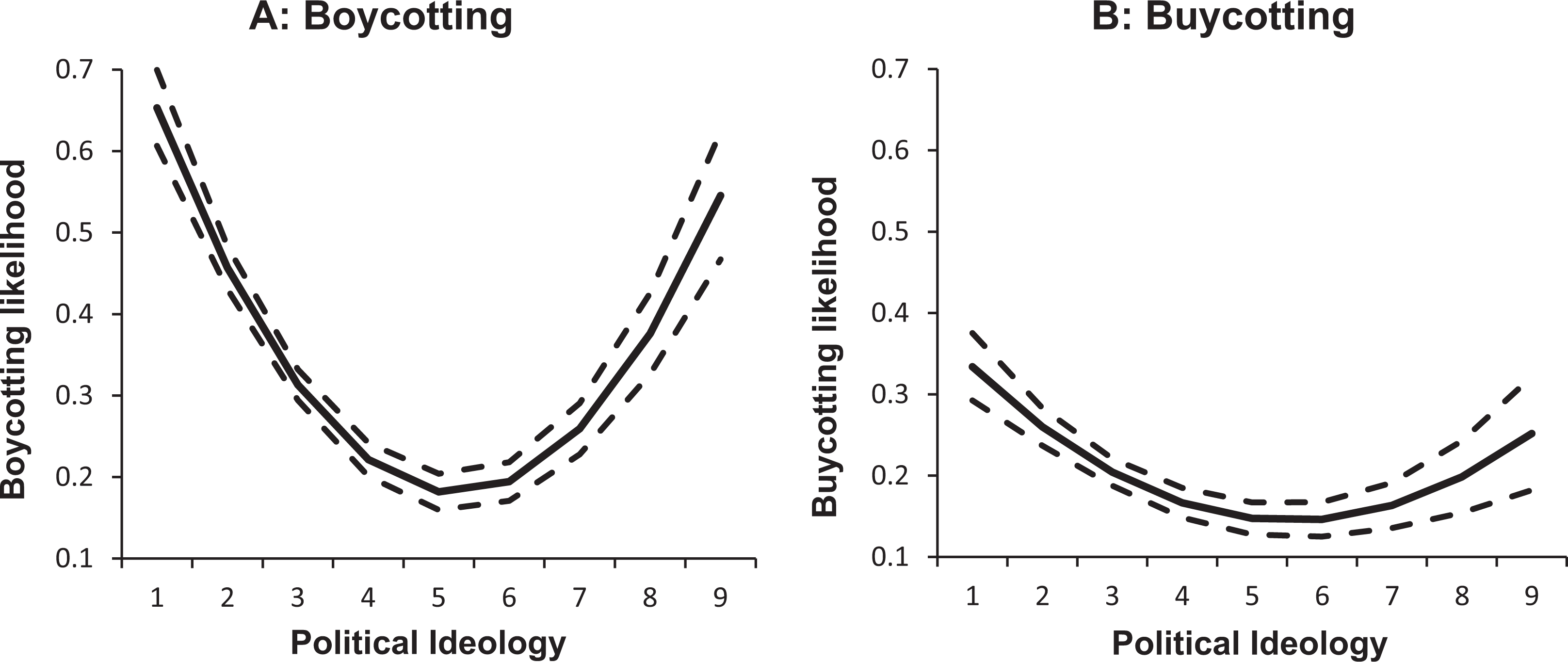
Study 3 results: Boycotting (panel A) and buycotting (panel B) likelihood as a function of political ideology and its quadratic term.
As expected, political ideology negatively predicted attitude toward boycotting (B = −.248, SE = .027, p < .001). This effect was also qualified by a quadratic term (B = .039, SE = .012, p = .001). Figure 3 shows the shape of this effect. Post hoc comparisons revealed that this negative effect was particularly strong among participants on the liberal end of the scale (ideology score of less than the midpoint 5: B = −.412, SE = .055, p < .001) but not among those participants on the conservative end of the scale (ideology score of more than the midpoint 5: B = −.117, SE = .091, p = .20). This finding shows that the effect of political ideology is mainly driven by liberals being more favorable toward boycotting, not conservatives being less favorable.

Study 3 results: Attitude toward boycotting as a function of political ideology and its quadratic term.
Next, I examined the serial mediation process of political ideology on boycotting and buycotting through individualizing moral values and attitudes toward boycotting. As in Study 2, political ideology was negatively related to the individualizing dimension (B = −.14, SE = .01, p < .001) and positively related to the binding dimension (B = .22, SE = .02, p < .001). I then included the individualizing and the binding moral dimensions separately in the model predicting attitude toward boycotting, controlling for the effect of political ideology. The results show a significant effect of the individualizing dimension (B = .41, SE = .07, p < .001) but not of the binding dimension (p = .86). I then included the attitude toward boycotting scale in the models predicting boycotting and buycotting, controlling for the effects of political ideology and of individualizing moral values. The results show significant effects of attitude toward boycotting on both boycotting (B = .746, SE = .076, Wald χ2 = 96.24, p < .001) and buycotting (B = .506, SE = .078, Wald χ2 = 41.84, p < .001). Table 4 presents these results.
Study 3 Results: Summary of Regression Results.
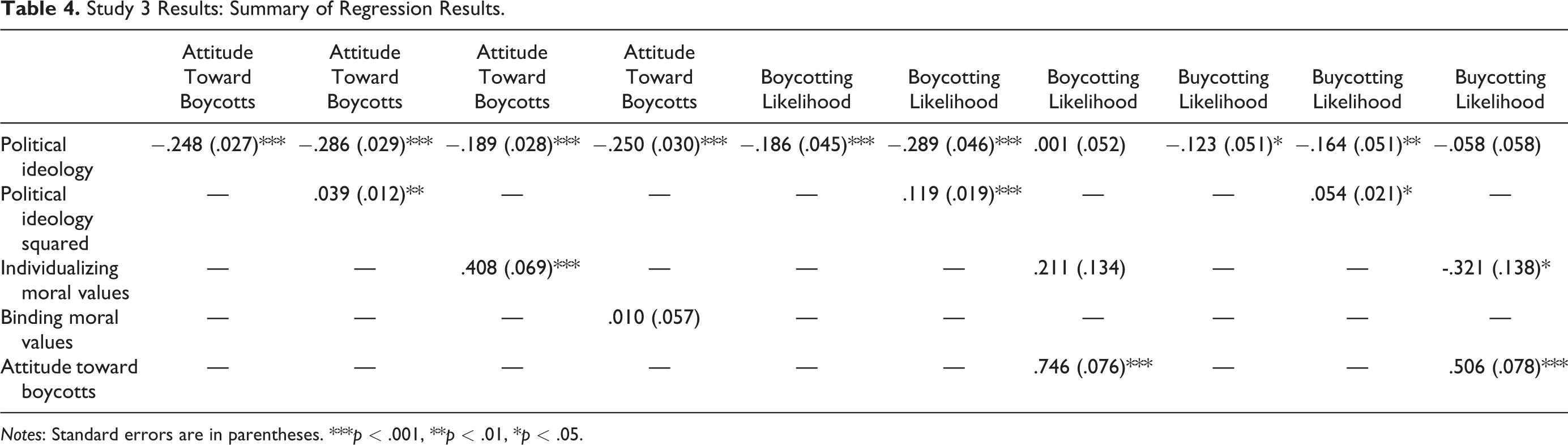
Notes: Standard errors are in parentheses. ***p < .001, **p < .01, *p < .05.
Finally, I estimated serial mediation models through PROCESS (model 6; 10,000 samples; 95% confidence intervals; Hayes, 2018) to test the indirect effects of political ideology on boycotting and buycotting likelihood through individualizing moral values and attitude toward boycotting (political ideology → individualizing values → attitude toward boycotting → boycotting and buycotting likelihood). The results show indirect effects of political ideology on boycotting (a = −.044, SE = .010, 95% CI = [−.065, −.027]) and buycotting (a = −.030, SE = .007, 95% CI = [−.046, −.017]) likelihood. Figure 4 shows each of the estimated paths.

Study 3 results: Individualizing moral values mediate the effect of political ideology on boycotting and buycotting.
Discussion
Study 3 shows that greater concern for individualizing moral values explains the heightened tendency of liberals to boycott and buycott. The individualizing moral orientation mediated the effect of political ideology on boycott and buycott likelihood by driving liberals to hold more positive attitudes toward boycotts. Liberals are more likely to boycott and buycott because of their greater concern about the suffering of others and about fair outcome distribution.
Study 4: Political Ideology and Boycotting Around the World
The preceding studies focus on WEIRD samples (respondents from Western, educated, industrialized, rich, and democratic countries; Henrich, Heine, and Norenzayan 2010). The main goal of Study 4, therefore, is to test the link between political ideology and boycotting around the world in the World Values Survey (WVS), which has surveyed representative samples from a broad sample of countries about their beliefs and opinions since 1981.
Method
Independent variable
The WVS assesses political ideology using a single item. Participants located themselves on a scale ranging from 1 = “left-wing” to 10 = “right-wing” (M = 5.70, SD = 2.38).
Mediator variables
I identified three variables that reflect concern for individualizing moral values, and I recoded them as follows: approval of human rights movement (1 = “strongly disapprove” to 4 = “strongly approve”; M = 3.66, SD = .62), opinion about amount of help for less developed countries (1 = “too much,” 2 = “about right,” 3 = “too little”; M = 2.53, SD = .61), and extent to which the priority in social policy should be to increase primary education (1 = “low priority” to 4 = “top priority”; M = 3.39, SD = .73). Although these items are not perfect proxies, they do reflect concern for harm and fairness.
Dependent variable
The WVS measures boycott tendency by asking respondents about whether they have joined or considered joining boycotts (recoded as: 1 = “would never do,” 2 = “might do,” and 3 = “have done”; M = 1.49; SD = .66). The questions of political ideology and boycott tendency were administered in the six waves from 1981 to 2014, and were available in 92 countries (N = 224,874).
Additional dependent variables
The WVS also measures whether respondents have done or consider doing the following actions using the same recoded scale as for boycotts: attend lawful/peaceful demonstrations (M = 1.70; SD = .74), join unofficial strikes (M = 1.37; SD = .61), occupy buildings or factories (M = 1.18; SD = .44), and sign a petition (M = 1.90; SD = .81). The results for these variables are in Web Appendix D.
Control variables
I controlled for individual- and national-level variables that could be confounded with right-wing orientation. Namely, I controlled for the Gini coefficient to account for inequality (M = 35.59, SD = 9.19), income of respondents to control for economic power (from 1 = lowest step to 11 = highest step; M = 4.68, SD = 2.35), age (M = 40.73, SD = 16.00), and gender (male = 1, female = 2; M = 1.49, SD = .50).
Results
I constructed a multilevel model, adjusting the intercept of propensity of boycotting in each nation. The results show an effect of right-wing orientation and of its quadratic term. Model 1 shows that right-wing orientation is negatively and significantly related to boycotting (B = −.018, SE = .0006, p < .001). Model 2 adds the quadratic effect of right-wing orientation (B = .003, SE = .0002, p < .001). Post hoc comparisons reveal that this negative effect is particularly strong among participants on the liberal end of the scale (ideology score of less than 6: B = −.047, SE = .001, p < .001) and weaker among participants on the conservative end of the scale (ideology score of more than 5: B = −.007, SE = .001, p < .001). Figure 5 shows this effect, and Table 5 shows the coefficients of all models.

Study 4 results: Boycott tendency as a function of political ideology and its quadratic term.
Study 4 Results: Unstandardized Coefficients from the Multilevel Model of the Boycott Tendency in the WVS.

Notes: Standard errors are in parentheses. Gender is coded as 1 = male, 2 = female. Income is coded as 1 = lowest step to 11 = highest step. ***p < .001, *p < .05.
Model 3 adds the control variables and shows significant effects of gender (B = −.103, SE = .003, p < .001), age (B = −.003, SE = .0001, p < .001), income (B = .018, SE = .0006, p < .001), and the Gini coefficient (B = −.0072; SE = .003, p = .01). Male, younger and wealthier individuals are more prone to boycott, and boycott is more common in egalitarian countries.
Models 4–6 add the mediators. The mediators have a positive effect on boycotting: approval of human rights movement (B = .0699, SE = .0098, p < .001), amount of help for less developed countries (B = .0412, SE = .0059, p < .001), and the extent to which the priority is increase in primary education (B = .0395, SE = .0074, p < .001). They are negatively related to right-wing orientation: approval of human rights movement (r = −.076, p < .001, N = 12,464), opinion about amount of help for less developed countries (r = −.055, p < .001, N = 39,303), and the extent to which the priority is to increase primary education (r = −.047, p < .001, N = 17,252).
Finally, I estimated mediation models using PROCESS (model 4; 10,000 samples; 95% confidence intervals; Hayes, 2018) to test the indirect effects. The results confirm the indirect effects of political ideology on boycott through approval of human rights movement (a = −.0017, SE = .0003, 95% CI = [−.0023, −.0012]), opinion about amount of help for less developed countries (a = −.0006, SE = .0001, 95% CI = [−.0009, −.0005]), and the extent to which the priority is to increase primary education (a = −.0006, SE = .0001, 95% CI = [−.0009, −.0003]).
Web Appendix D shows the effect of political ideology on the additional dependent variables, which measure the tendency to engage in other forms of political action (attending lawful/peaceful demonstrations, joining unofficial strikes, occupying buildings or factories, and signing a petition). They essentially replicate the results with similar magnitudes. For all the variables, right-wing orientation has a negative effect, suggesting that liberals are more likely to engage in such actions. In addition, the quadratic effect is positive and significant for all the variables, meaning that the negative effect of right-wing orientation is stronger among those who score at the low end of the scale—that is, liberals.
Discussion
Study 4 makes four contributions. First, it extends the results to boycotts around the world, thereby showing that the findings are not exclusive to WEIRD samples. Second, the effect of political ideology on boycotting is in part explained by variables that reflect concern for individualizing moral values. The study identifies items that capture concern for harm and fairness in the WVS, thus reflecting concern for individualizing moral values and replicate the results of previous studies. Third, the analysis is extended to other forms of political action. The results provide initial evidence that liberals are also more likely to engage in other forms of political action (Study 6 provides additional evidence that political ideology is related to political protest more broadly). Fourth, the WVS data cover boycotts since 1981 and therefore show that the effect is not restrictive to recent boycotts of the present politically polarized times.
Study 5: The Effect of Manipulated Political Ideology
Study 5 tests the causal effect of political ideology on attitude toward boycotting by manipulating political ideology.
Method
Three hundred ninety-seven participants recruited from Prolific Academic (Mage = 30 years; 45% female) completed the study. Only complete questionnaires were considered. To manipulate political ideology, I used the procedure developed by Ordabayeva and Fernandes (2018): Participants performed a recall task in which they described a conversation they had with someone who was either more conservative or liberal than they are. The rationale is that by comparing oneself to someone who is more liberal (vs. conservative), participants would perceive themselves as being more conservative (vs. liberal), building on the assumption that the social contrast influences individuals’ perceptions of their political identity (Feinberg et al. 2017). After the recall task, participants indicated their ideology as a manipulation check on a single-item scale (Jost 2006; 1 = “extremely liberal,” and 9 = “extremely conservative”; M = 3.90, SD = 1.78).
Participants then answered whether they have already boycotted in the past (yes/no; 40% answered yes) and their attitude toward boycotting, as in Study 1 (Sen et al. 2001; α = .94; M = 4.20, SD = 1.47). Finally, participants answered the multi-item scale of political ideology as in Study 1 (Kidwell, Farmer, and Hardesty 2013; α = .70; M = 3.53, SD = 1.40). Seven participants scored more than 3 SDs on the multi-item scale of political ideology and were therefore not considered.
Results
The manipulation check confirmed that the conservative recall task led to more conservative ideology (M = 4.08) than the liberal task (M = 3.72, F(1, 388) = 3.94, p = .048). I also observed a significant effect of the manipulation on the multi-item scale of political ideology (liberal: M = 3.35, conservative: M = 3.71; F(1, 388) = 6.61, p = .01).
An analysis of variance on attitude toward boycotting with the ideology manipulation as a fixed factor revealed a marginally significant effect: opinions about boycotting were significantly more positive in the liberal (M = 4.34) than in the conservative condition (M = 4.06, F(1, 388) = 3.60, p = .058). This effect was not qualified by whether participants had already boycotted in the past (p = .63), which shows that the effect of the manipulation of political ideology influenced the attitudes toward boycotting regardless of whether participants have joined boycotts in the past. Finally, I observed a significant effect of measured political ideology on attitude toward boycotting controlling for the effect of the manipulation of political ideology (single-item scale: B = −.12, SE = .04, p < .01; multi-item scale: B = −.23, SE = .05, p < .001).
Discussion
The results of Study 5 establish the causal effect of ideology on attitude toward boycotts and show that this effect is independent of whether participants were actual boycotters.
Study 6: The Effect of Political Ideology on Political Activism
Study 6 tests the effect of political ideology on political activism (i.e., participation in political protests). I expect liberals to be more likely to engage in political activism.
Method
I obtained the data set from the Measuring Morality Project of Duke University (https://kenan.ethics.duke.edu/attitudes/resources/measuring-morality/); it contains 1,519 respondents randomly sampled from a panel representative of the U.S. population (Mage = 50 years; 51% female). Respondents indicated their political ideology on a seven-point scale (1 = “extremely liberal,” and 7 = “extremely conservative”); M = 4.21, SD = 1.46). They also indicated whether they have attended a political protest or rally in the past 12 months (1 = yes, 0 = no; M = .04, SD = .20). This item served as the measure of political activism (1,474 respondents answered both the political ideology and the political activism measures).
The data also contained responses to the Moral Foundations Sacredness Scale, an alternative measure of moral foundations (Graham and Haidt 2012). This scale contains 18 items asking respondents to indicate how much money they would require to perform actions that violate the five moral foundations in three ways (e.g., for harm: “Kick a dog in the head”). The scale has eight points and ranges from US$0 to US$1 million, increasing by a factor of ten, ending with “never for any amount of money.” It is scored as the number of times that participants answer “never for any amount of money.” The scale has 3 filler items used to subtract the scores on the moral foundations to partial out the tendency to refuse doing things for money. I computed the scores of sacralization of individualizing (M = 3.47, SD = 1.56) and binding moral values (M = 4.68, SD = 2.22).
Results
I logistically regressed political activism on political ideology and found a marginally significant effect (B = −.16, SE = .09, Wald χ2 = 3.11, p = .078), qualified by a quadratic term (B = .16, SE = .04, Wald χ2 = 12.88, p < .001). The positive sign of this effect shows that the negative effect of political ideology is stronger among those who score at the low end of the scale (i.e., liberals). Post hoc comparisons revealed that the tendency to engage in political activism was more pronounced among respondents holding an extreme ideology relative to those with a moderate ideology (scale midpoint 4). Specifically, I observed a negative effect of political ideology among those on the liberal end of the scale (less than 5; B = −.65, SE = .16, Wald χ2 = 16.45, p < .001), and a positive effect of political ideology among those on the conservative end of the scale (more than 3; B = .36, SE = .17, Wald χ2 = 4.54, p = .033). Figure 6 shows the actual average likelihood of political activism as a function of political ideology.

Study 6 results: political activism as a function of right-wing orientation.
The zero-order effect of political ideology on sacralization of individualizing moral values was not significant (B = .02, SE = .03, p = .56). However, controlling for sacralization of binding moral values, the partial effect of political ideology on sacralization of individualizing moral values was significant (B = −.10, SE = .02, p < .001). The zero-order effect of political ideology on sacralization of binding moral values was significant (B = .29, SE = .04, p < .001), as well as the partial effect controlling for sacralization of individualizing moral values (B = .28, SE = .03, p < .001). This is consistent with Graham and Haidt (2012), in which the effect of political ideology on sacralization of individualizing values is weaker than on sacralization of binding values. Conservatives seem to be less willing to violate moral values in general. The correlation between sacralization of individualizing and binding moral values was strong (r = .57, p < .001), which is consistent with the notion that the Moral Foundations Sacredness Scale measures not only moral priorities, but the tendency to violate moral values in general. Therefore, I controlled for the scores on the binding values to account for general differences in sacralization of moral values.
When I included the sacralization scores of individualizing and of binding values as predictors of political activism controlling for the effect of political ideology, the results show an effect of sacralization of individualizing values (B = .25, SE = .11, Wald χ2 = 4.87, p = .027) and of binding values (B = −.16, SE = .07, Wald χ2 = 4.44, p = .035).
Finally, I estimated mediation models using PROCESS (model 4; 10,000 samples; 95% confidence intervals; Hayes, 2018) to test the indirect effects controlling for the sacralization of the other moral values. The results confirm the indirect effects of political ideology on political activism through sacralization of individualizing values (a = −.025, SE = .013, 95% CI = [−.058, −.004]), and of binding values (a = −.043, SE = .022, 95% CI = [−.090, −.003]).
Discussion
The results of Study 6 extend the analysis to political activism more broadly. Extremists are more likely to engage in political activism relative to moderates. In addition, liberals are particularly more likely to engage in political activism. The heightened likelihood of liberals to engage in political activism is explained by their stronger individualizing moral values.
Study 7: Political Ideology and Google Searches
Study 7 tests whether the effect of political ideology on boycotting extends to online searches of conservative and liberal U.S. counties. The millions of searches on Google represent the interests of individuals in a certain geographical area (Ginsberg et al. 2009; Ordabayeva and Fernandes 2018). Therefore, I expected political orientation in a certain area to predict the search level for the terms “boycott” and “buycott” in that area.
I analyzed Google searches in the United States over the 15 years between January 2004 and June 2020, which yielded approximately 6 million searches for “boycott” and about 200,000 for “buycott.” I extracted the search index at the U.S. metropolitan area level from Google Trends (from 0 to 100) and obtained political ideology using Tausanovitch and Warshaw’s (2014) city-level score of conservatism. I then matched search index and political ideology for 107 cities. One search index for boycott and two search indexes for buycott were 3 SDs from the mean and were therefore not considered. The search index for boycott (M = 62.75, SD = 8.43) was more pronounced than for buycott (M = 7.30, SD = 13.59; F(1, 103) = 1,419.04, p < .001).
Conservatism in a given city is negatively related to the search level for the term “boycott” in that area (B = −6.71, SE = 2.94, p = .025) and for the term “buycott” in that area (B = −25.21, SE = 4.20, p < .01), which suggests that the prevalence of liberals in a given city predicts interest in boycott and buycott in that city. These results complement the previous findings by examining the effect of political ideology on interest in boycotts and buycotts in the field using city-level ideology and Google searches in that area.
General Discussion
This research finds that political ideology affects consumers’ attitudes, interest, and actions toward boycotting and buycotting, identifying when and why liberals and conservatives engage in these behaviors. Nine studies show that liberals and conservatives engage in boycotts and buycotts that are associated with their unique moral values. In addition, individualizing moral values predict a more positive attitude toward boycotts, and this explains the greater tendency of liberals to boycott and buycott.
Studies 1 and 2 show that liberals and conservatives have opposing reactions when companies take a stance on politically contentious issues. Study 3 shows that liberals are more likely to boycott and buycott because they have stronger concerns about the harm and the fairness dimensions of morality. Liberals are more sensitive to the suffering of others and to unfair treatment. As a result, they report they are more favorable toward boycotting in general. In addition, the studies uncover the rarer cases in which conservatives also engage in boycotts and buycotts: when firms violate or promote binding moral values, respectively. Study 4 generalizes the effect to boycotts around the world. Study 5 shows the causal effect of political ideology on attitude toward boycotting. When a liberal identity is made accessible, people become more favorable toward boycotts. Study 6 extends the results to political activism more broadly. Political extremists are more likely to engage in political activism, liberal extremists particularly so. Study 7 shows that the effect of political ideology extends to interest in boycotting and buycotting in online searches. The effect of political ideology was tested with established measures and a well-grounded manipulation of ideology developed in previous research, actual, attitudinal, and interest toward boycotts and buycotts in controlled and real-world settings, and across different samples (MTurk respondents in the United States, Prolific Academic respondents in the United Kingdom and worldwide, a representative sample of the U.S. population from the Measuring Morality Project and worldwide from the World Values Survey, and city-level aggregate data from Google).
Theoretical Implications
This article identifies the effects and mechanisms of political ideology on boycotting and buycotting. The greater alignment with harm and fairness moral values among liberals helps explain why they hold more favorable attitudes toward boycotting, which in turn drive their heightened tendency to boycott and buycott in the marketplace. In addition, the present research shows that conservatives also engage in boycotts and buycotts, albeit less frequently, when they are associated with binding moral values (firms associating with violation or promotion of moral values of authority, loyalty, or purity).
These findings contribute to the understanding of consumer motivations to join boycotts and buycotts by showing that consideration of moral values is a key reason. According to moral foundations theory, the main function of morality is to promote cooperation (Curry 2016) and “to suppress or regulate selfishness to make social life possible” (Haidt and Kesebir 2010, p. 800). Consistent with this view, the present research shows that morality serves to mobilize consumers’ collective efforts to protect and promote their moral values in the marketplace. The results show that the consumers’ differing tendencies to boycott and buycott are not simply because of identification with a liberal or conservative ideology, but instead represent differences in the morality associated with these ideologies. How people prioritize various moral values helps explain political differences in boycotting and buycotting and aids understanding and communication between people with different political ideologies.
It will be important for future studies to determine whether the growing polarization of political opinions can account for the parallel increase in boycotting in recent years. Politically polarized individuals are more reactive to corporate actions. Political extremism seems to be growing, in part because of a lack of understanding about public policies (Fernbach et al. 2013). Although consumers are exposed to a great deal of information about companies’ practices through social media, this information may not be reliable or processed diligently. As such, the decision to join boycotts and buycotts is influenced by moral reasoning, which is most often shaped by affective processes that guide judgments in favor of a desired conclusion (Ditto, Pizarro, and Tannenbaum 2009). In this sense, people tend to act more like intuitive lawyers than intuitive scientists (Haidt 2007).
In addition, people affiliate with others with whom they share the same political identity. Motyl (2014) found that people living in communities that voted against their candidate in the U.S. presidential election were likely to move to a new community that voted more heavily for their candidate. People tend to live in politically segregated neighborhoods and participate in similar boycotts and buycotts as their neighbors. Therefore, they may have little opportunity to interact with others of the opposite political ideology, not only in social media, but in real life, which may intensify political polarization.
The findings show that it is important to account for liberals and conservatives’ differing moral values to understand boycotts and buycotts and find common ground between people of opposing ideological convictions. Moral foundations lie at the basis of boycotting attitudes and actions. Because morality is guided by intuition, the reconciliation between liberals and conservatives is possible if each group would consider the moral foundations of their behavior. Analytic and reflective processes can suppress intuitions in moral decision making (Kahane et al. 2015). Although intuitions form the basis of moral judgments, political agreement can be reached with analytic thinking (Yilmaz and Saribay 2017). Ideological camps can reach agreement if the two sides would consider the moral underpinnings of the behavior of others who hold different political opinions and that their moral values are of equal importance.
Future research could also examine the role of moral identity in shaping liberals’ and conservatives’ boycotting and buycotting actions (Aquino and Reed 2002). Specifically, consumers may be more prone to boycotting and buycotting when morality is a key part of their identity. The present research shows that boycotts and buycotts are influenced by consumers’ moral concerns and are indeed more likely among those who hold stronger moral values. Moral identity can therefore be a key contingency factor that makes liberals and conservatives boycott and buycott. When people’s moral identities are made more accessible or salient by the environment, people may be more likely to engage in political action.
Future longitudinal studies may examine how nonboycotters become boycotters and the effects of political ideology and moral values over time. The present research involved observing a cross-section of people whose moral concerns were already integrated with political ideology and shows that moral foundations are the key factors that explain boycotting and buycotting behaviors. However, people have initial moral inclinations, which can lead to identification with a political party or group. The relationship between political ideology and moral values over time is a process of complex mutual influence involving interactions with genetic predispositions and environmental factors (Alford, Funk, and Hibbing 2005). In addition, future longitudinal studies could investigate other models including how participation in boycotts can engender participation in more boycotts over time.
Future research should also examine cross-level interactions between individual and cultural propensities to boycott and buycott. Recent research shows that boycotts are less common in tight cultures than in loose ones (Gelfand et al. 2011). Relative to loose cultures, tight ones are more likely to have autocratic governing systems, more laws and controls, and greater adherence to social norms. In such an environment, collective political action may be suppressed. Future research would benefit from a multilevel perspective to consider both individuals’ predispositions and their social context.
Boycotting and buycotting reflect movement toward a more agentic form of political participation embedded in consumers’ daily lives. Overall, the present study shows that it is important to consider the moral foundations of boycotts and buycotts. It supports the importance of moral values in driving consumers’ political behavior. The conclusion is that much research remains to be studied, and this research can provide impetus for future work on understanding consumer political activism.
Practical Implications for Companies
The present findings have useful implications for marketers. First, they inform marketers that liberal consumers are more likely to engage in boycotts and buycotts. Therefore, boycotts and buycotts are likely to be more prevalent in areas and segments characterized by a greater concentration of liberals (e.g., California, northeastern United States). Recently, a sports store in Colorado that boycotted Nike over the Colin Kaepernick campaign was forced to close after 21 years in business (Horton 2019), which shows that taking a stance on politically charged issues can be damaging if customers are against it (as liberals are in the case of boycotting Nike).
The results also suggest that marketing campaigns addressing harm and fairness moral issues may be more successful. “Fair Trade,” “Not Tested on Animals,” “Equal Pay Day,” and “Against Racial Injustice” are some of the campaigns that have prompt consumers to act politically by addressing harm and justice moral values. Although there may be a backlash against these campaigns among conservatives, the net outcome of these campaigns is likely to be positive given that these campaigns do not address binding moral values. Furthermore, these campaigns may fare better in politically liberal states and locations.
Polarized political opinions drive companies to refrain from weighing into the political arena (Mittal, Malshe, and Sridhar 2018). About 80% of chief marketing officers believe that their brands should not “take a stance on politically-charged issues,” even though about 50% agree with “allowing employees to speak out on political issues” and with “making changes to products and services in response to political issues” (CMO Survey 2020). This suggests that perhaps marketing managers believe in the importance of corporate political activism but are unwilling to use it strategically given the risk of alienating some customers.
The present article provides some guidance to avoid polarized reactions of customers. For instance, some corporate political actions are particularly divisive, such as Nike’s Kaepernick campaign, as it addressed both individualizing moral values of equal rights to ethnic minorities and binding moral values of respect to the national anthem and flag. In addition, some issues are more divisive than others. For instance, illegal immigration and gun controls are particularly polarizing, as they appeal to both the individualizing moral values of harm and care and the binding moral values of social order and cohesion. Companies may refrain from those issues if they are not willing to target a specific political group. However, it is possible for companies to appeal to the moral values of liberals and conservatives without hurting their counterparts. For instance, equal rights and protection of animals are individualizing moral issues the liberals more strongly support, but conservatives do not generally oppose; similarly, patriotism and respect for traditions are binding moral issues the conservatives strongly support, but liberals do not generally oppose. Companies that target less polarizing issues may not be rejected as strongly by the disapproving segments of a politically divided customer base.
Practical Implications for Policy
Voters who are disaffected by the politicians in power may turn to consumer political actions in part because of being frustrated with the political system. Trust in the U.S. government is at historic lows (Pew Research Center 2019). Politicians who strongly appeal to moral values may frustrate supporters during their mandates when they are forced to compromise. They also alienate part of the electorate who do not see themselves as being represented. This frustration with politics and institutions may have contributed to the rise of boycotts and buycotts and extra-parliamentary movements in recent years. In addition, consumers can nowadays be more vocal about their opinions and spread information about boycotts and buycotts online through social media. Companies may therefore feel some pressure to take a stance on politically charged issues. The current state of hyperpolitical polarization accelerates this dynamic even further.
Consumer political actions can drive attention to societal problems by emphasizing individualizing and binding moral values. For instance, inequality has soared to unprecedented levels in the United States and worldwide (Atkinson, Piketty, and Saez 2011), and the preferences of powerful people are more likely to be translated to legislation (Gilens 2005). The needs of less powerful people can be made heard through consumer political actions. Consumers can for instance favor companies that provide more charity donations and social programs for impoverished populations. The reduction of inequality and protection of vulnerable individuals is more appealing to individualizing moral values.
Another current political problem is that the internationalization and financialization of operations might have reduced pressure on companies to provide for their communities. Consumer political actions can demand that companies provide a positive contribution to society, including the communities in which they operate and are headquartered. The retribution of companies to the communities they are based is more appealing to binding moral values.
Consumers can therefore spur a positive change by expressing their moral values through their purchases. This collective consumer endeavor may improve our society. Companies may be forced to respond. As Adam Smith noted (1776/1976, pp. 26–27), “it is not from the benevolence of the butcher, the brewer, or the baker that we expect our dinner, but from their regard to their own interest.”
The understanding of moral foundations can also improve political representation. Partisanship induces people to demonize the other side and to be against to whatever they propose. Politicians should set the example for the respectful behavior of citizens, who should in turn reward politicians who work across political boundaries. If politicians recognize the importance of protection of individual rights, and of social order, rather than pitting one against the other, we may advance on both. The democratic principle requires people to listen to the other side in order to address contentious issues. Politics is not like a team sport. People should value mutual discussion to have a better functioning society.
Conclusion
Participation in boycotts and buycotts among liberals and conservatives is the result of their moral priorities. While boycotts and buycotts are observed at both ends of the political spectrum, they are more prevalent among liberals than among conservatives. Liberals boycott and buycott to promote individualizing moral values that protect individual rights and conditions, whereas conservatives boycott and buycott in rarer cases to promote binding moral values that protect their inner circles. The differential distribution of moral concern explains the consumer political actions of liberals and conservatives, and contributes to the greater tendency of liberals to boycott and buycott.
Supplemental Material
Supplemental Material, PPO943178_Web_Appendices - Politics at the Mall: The Moral Foundations of Boycotts
Supplemental Material, PPO943178_Web_Appendices for Politics at the Mall: The Moral Foundations of Boycotts by Daniel Fernandes in Journal of Public Policy & Marketing
Footnotes
Guest Editor
Kelly Martin
Acknowledgments
The author thanks Nailya Ordabayeva, the editorial team, and the participants at the 2020 AMA Marketing and Public Policy Conference (MPPC) for valuable comments.
Declaration of Conflicting Interests
The author declared no potential conflicts of interest with respect to the research, authorship, and/or publication of this article.
Funding
This research was supported by a financial grant (UIDB/00407/2020) awarded by the Portuguese Foundation of Science and Technology.

References
Supplementary Material
Please find the following supplemental material available below.
For Open Access articles published under a Creative Commons License, all supplemental material carries the same license as the article it is associated with.
For non-Open Access articles published, all supplemental material carries a non-exclusive license, and permission requests for re-use of supplemental material or any part of supplemental material shall be sent directly to the copyright owner as specified in the copyright notice associated with the article.
