




Abstract
Food products claim to be healthy in many ways, but prior research has investigated these claims at either the macro level (using broad descriptions such as “healthy” or “tasty”) or the micro level (using single claims such as “low fat”). The authors use a meso-level framework to examine whether these claims invoke natural or scientific arguments and whether they communicate about positive attributes present in the food or negative attributes absent from the food. They find that common front-of-packaging claims can be appropriately classified into (1) science- and absence-focused claims about “removing negatives,” (2) science- and presence-focused claims about “adding positives,” (3) nature- and absence-focused claims about “not adding negatives,” and (4) nature- and presence-focused claims about “not removing positives.” The authors conduct validation studies using breakfast cereals, a category for which nutrition quality varies but food claims are constant. They find that claim type is completely uncorrelated to actual nutrition quality yet influences inferences consumers make about taste, healthiness, and dieting. Claim type also helps predict the effects of hedonic eating, healthy eating, or weight loss goals on food choice.
When shopping for packaged food, it has become difficult to find products that do not claim to be healthy for one reason or another. According to the U.S. Food and Drug Administration’s (FDA’s) Food Label and Package Survey (Legault et al. 2004), 84% of bottled waters display sodium-related claims; 82% of snacks, granola bars, and trail mixes make fat-related claims; and 76% of hot cereals make fiber-related claims. If the increasing number and visibility of food claims in the marketplace reflect consumers’ growing interest for health and well-being (Andrews et al. 2014; Block et al. 2011), it is also raising important issues for public policy and food well-being. On the one hand, there is growing evidence that these consumers rely on those front-of-package (FOP) claims to inform their decisions, and that FOP claims can have a strong impact on their food purchases—especially compared with the often-negligible effects of objective nutrition information (Bublitz, Peracchio, and Block 2010; Garretson and Burton 2000; Kozup, Creyer, and Burton 2003; Wansink and Chandon 2006). On the other hand, very little is known about how consumers make sense of the diversity of FOP claims in the marketplace, how their understanding influences their food expectations and choices, and whether it is related to actual nutritional quality.
Although the goal of all these claims is to create the perception that the food is good for one’s health, they do so in very different ways. Some claims focus on elements that are absent from the food (e.g., “no preservatives,” “gluten-free”), others on elements that are present in the food (e.g., “made with whole grains,” “high calcium”); some imply that the food has been enhanced (e.g., “high calcium,” “high in vitamins”), others that the food has been left untouched (e.g., “organic,” “fresh”). Accordingly, several important questions arise: First, at what level and on which criteria do consumers distinguish between different types of FOP claims? Second, do consumers associate specific benefits (e.g., “better taste,” “weight loss”) with some types of food claims but not others? Third, are these associations grounded in objective differences in nutritional quality, or are consumers misled by irrelevant information?
These questions are essential from a public-policy standpoint. First, regulators need to understand what drives the perception of a FOP claim: “reduced carbs” and “low sugar” are identical descriptions from a chemical perspective but might lead to very different inferences on the consumers’ part. It is also essential to understand how different FOP claims are translated into consumption benefits: “organic” and “low salt” might be perceived as equally healthy, but consumers will assume worse taste for only the latter. Finally, connecting the subjective nutritional quality of different types of claims to the objective quality of food items bearing those claims can speak to the importance of regulation and consumer education. If consumers correctly believe that one type of claim is associated with better nutritional properties, it might become important to regulate it to avoid deceptive practices. However, if consumers associate a higher nutritional quality with a type of claim that is actually displayed on unhealthy food items, it might signal the need for better consumer education in this domain.
To answer these important questions, we propose a framework describing how consumers perceive FOP claims and the beliefs associated with different types of claims. To achieve these objectives, we utilize multiple methods and a phenomenon-driven approach that is less common than the deductive-conceptual route that characterizes most consumer research, but which can provide unique insights into the important and consequential questions raised (Lynch et al. 2012). Following the example of recent studies (Haws, Reczek, and Sample 2017), we start with the observed phenomenon of many different FOP claims in the marketplace and derive a framework to understand how consumers respond to these claims, using both primary and secondary data. We identify in existing research two major drivers of FOP claims categorization: (1) whether they are based on natural or scientific arguments (nature vs. science dimension) and (2) whether they communicate about attributes that are present in, or absent from, the food (presence vs. absence dimension). By measuring consumers’ perception of common food claims along those two dimensions, we find that the perceptual space of FOP claims can be appropriately divided into four distinct types.
Following the initial measurement pretests and Study 1, we investigate the predictive value of the four health claim types in three additional studies. To maintain continuity throughout these studies, we deliberately focused on breakfast cereals, a familiar and frequently purchased category in which many brands have poor nutrition quality and yet frequently make a wide range of FOP claims (Hieke et al. 2016; Schwartz et al. 2008). Using a large multicountry database including information about food claims and nutritional composition, we show that the type of food claim is orthogonal to the actual nutritional quality of the breakfast cereal making the claim (Study 2). In Study 3, we examine the association between claim type and the perceived healthiness, tastiness, and dieting properties of the food. Acknowledging that actual nutrition quality is unlikely to motivate many consumers (Block et al. 2011), and that consumers have different goals when making food-related decisions (Bublitz et al. 2013), we investigate in Study 4 the moderating impact of three different goals (hedonic eating, healthy eating, and weight maintenance) on preferences for FOP claims. Specifically, we show that the classification of claims helps better predict the effects of hedonic, health, or dieting motives on consumers’ choices between foods with different claims. Finally, we discuss the importance of considering both the diversity of food claims and the diversity of benefits consumers seek in food consumption to inform the ongoing debate about the regulation of food claims and to advance the food well-being paradigm.
A Conceptual Framework of FOP Food Claims
In this research, we focus on the claims displayed on the packages of processed foods sold in grocery stores, such as breakfast cereals, frozen prepared meals, or yogurt. We do not study the claims accompanying ready-to-eat food purchased in restaurants or other food venues and exclude unpackaged foods such as produce, meat, or fish, which carry no FOP claims. Furthermore, we do not study FOP formats that provide some of the nutrition information contained in the mandated Nutrition Facts Panels (such as calories, fat, and sugar; for background information regarding these formats, see Andrews et al. [2014]). Rather, we focus on the claims about a product’s health-related properties found on the FOP. For a summary of the prior literature on consumer responses to health and nutrition claims, see Table 1.
Key Findings in Health-Related Food Claim Research.

Most research on food claims that is published in nutrition and health sciences has studied individual claims. The key finding is one of considerable confusion and misunderstanding of the actual meaning of these claims (Mariotti et al. 2010). For example, Andrews, Netemeyer, and Burton (1998) found that consumers erroneously believe that “no cholesterol” means that the food has no fat. Claims that have a different meaning are sometimes perceived as similar (Andrews, Burton, and Netemeyer 2000). For example, both “organic” and “low-fat” claims can lead to the inference that the food is low in calories (Schuldt 2013). The picture that emerges from these single-claim studies is complex, with limited potential for empirical generalization because the effects of these claims vary greatly across categories, brands, groups of people, and consumption occasions (Belei et al. 2012; Moorman 1990; Provencher and Jacob 2016; Van Kleef, Van Trijp, and Luning 2005).
In contrast, consumer research has tended to lump together all the claims that promise health benefits and contrast them with claims that promise hedonic benefits. For example, Raghunathan, Naylor, and Hoyer (2006) studied the “unhealthy = tasty” heuristic and manipulated healthiness perceptions with a specific nutrient claim (the amount of saturated fat) in one study and with a general health claim (“is generally considered healthy”) in another, implicitly assuming that both types of claims can be grouped together when studying taste inferences. Finkelstein and Fishbach (2010) described a food as “nutritious, low fat, and full of vitamins” in one study and as “containing high levels of protein, vitamins and fiber, and no artificial sweeteners” in another study, implying that both descriptions, despite using different claims, are adequate to study whether people feel hungrier after eating “healthy” food. Recently, Haws, Reczek, and Sample (2017) framed foods as receiving a nutrition grade of either “A−” or “C−” to examine beliefs that people associate healthier foods with higher pricing. While each of these examples and many others focus on differential responses to more- or less-healthy foods, what is missing is an overarching framework of food claims that can summarize the key similarities while abstracting the differences between claims. Such a framework could help consumer researchers, public policy makers, and practitioners better predict individuals’ perceptions and food choices.
Healthy by Presence or Absence
To derive a theory-driven framework of food claims, we draw on the literature examining consumers’ responses to food claims. We first consider the extent to which a food claim focuses on positive attributes that are present in (or added to) the food, or on negative attributes that are absent (or removed) from it. These attributes can be nutrients such as protein or fat, ingredients such as sugar or additives, or any other characteristic of the food that is perceived as either positive (e.g., “pure”) or negative (e.g., “processed”) from a health standpoint.
The positive (vs. negative) frame plays a central role in motivation, emotions, and decision making. Levin and Gaeth (1988) found that people perceived beef to be leaner, both before and after tasting it, when it had a “75% lean” claim (positive frame) compared with a “25% fat” claim (negative frame). Wertenbroch (1998) also found that a positive-focused claim (“75% fat-free chips”) improved healthiness expectations compared with a negative-focused claim (“25% fat”) but noted that it reduced taste expectations. The presence–absence dimension is also related to the important distinction between promotion (wanting to achieve something) and prevention (wanting to avoid something) orientations (Gomez, Borges, and Pechmann 2013). Similarly, most nutrition scoring systems that compute an overall score of nutritional quality treat the presence of positive attributes and the absence of negative attributes differently (Katz et al. 2009; Nikolova and Inman 2015).
Healthy by Nature or Science
The second dimension of the framework distinguishes between claims promising that the food is healthy because the natural qualities of the food have been unaltered (nature focus) or because the food has been scientifically improved (science focus). Naturalness is defined as the absence of human intervention (i.e., not adding anything, not removing anything) and is a key construct in food psychology (Rozin 2005). Even in very different food cultures, people tend to view food processing (e.g., fortifying food or removing negative ingredients) as the opposite of naturalness (Rozin, Fischler, and Shields-Argelès 2012). Beyond the amount of transformation, perceived naturalness is also influenced by the nature of the processing (e.g., chemical transformation is perceived as less natural than physical transformation) and by the familiarity of the transformation (Evans, De Challemaison, and Cox 2010; Rozin 2005).
Touting the natural characteristic of a food product is commonly used to claim health benefits (Rozin et al. 2004). This can be done by claiming that the food itself is “natural” or “unprocessed” or by claiming that some of its ingredients or properties, such as its flavors or colors, are natural rather than artificial. Science-based claims are also very common (Siró et al. 2008), as many food claims assert that the food has been improved based on nutrition or food science by modifying the amount of microelements such as vitamins, fats, salt, or gluten. Although it is true that some foods (e.g., some types of fruits, vegetables, or fish) can be, say, naturally low in fat or high in omega-3 fatty acids, the focus of our research is on processed foods developed by a food manufacturer. In this context, we expect that unless claims about the level of nutrients or microingredients (e.g., “low fat,” “high vitamins”) specify that the food is naturally high or low in these quantities, they will be perceived as science-based, rather than nature-based. Indeed, the use of a quantifier (“high” or “low”) implies that modifications were made, rather than the state of nature being preserved.
The Four Types of Claims
The two dimensions that we have described both exist on continuums. For instance, a FOP claim with an absence focus can suggest the complete absence of an ingredient (e.g., “no artificial colors”) or a reduction in the quantity of an ingredient (e.g., “low salt”). In the same way, some nature-focused claims can have stronger associations with the concept of nature (e.g., “organic”) than others (e.g., “no additives”). For clarity of exposition, we describe the dimensions of presence–absence and nature–science as separating the landscape of claims in four types of claims 1 shown in Figure 1. However, we do acknowledge that individual claims can vary in how strongly they are perceived on each of the two dimensions.

The presence–absence, nature–science framework and the four types of food claims.
Science and absence focus: Claims of this type promise that the food is healthy because negative characteristics of the food have been eliminated or removed altogether. We therefore call this type of claim “removing negatives” and expect that it includes claims such as “low fat” or “light.” Science and presence focus: Claims of this type promise that the food is healthy because positive characteristics have been fortified or added to the food. We therefore call this type of claim “adding positives” and expect that it includes claims such as “high vitamins” or “probiotics.” Nature and absence focus: Claims of this type promise that the food is healthy because no negative characteristics have been added to the food. We therefore call this type of claim “not adding negatives” and expect that it includes claims such as “no additives” and “no artificial colors.” Nature and presence focus: Claims of this type promise that the food is healthy because the natural positive characteristics of the foods have not been removed or altered. We therefore call this type of claim “not removing positives” and expect that it includes claims such as “made with whole grains” and “unprocessed.”
Study 1: Measurement and Classification
Method
We started with a list of the 107 health claims displayed on packaged foods sold in the United States between 1998 and 2007, as recorded in the ProductScan database for food product packages (Datamonitor 2007; see Appendix A). We first eliminated all product-specific claims (e.g., “American Grassfed,” which is only used on meat), because using such claims would make it impossible to disentangle the perception of the claim from the perception of the food itself. For the same reason, we chose to eliminate trademarked claims, such as “Healthy Choice,” which is owned by ConAgra Foods. Finally, we eliminated claims that were uncommon, based on their frequency in the data. This led to a reduced list of 58 claims.
To further refine this list, we conducted two pretests on Amazon Mechanical Turk (MTurk), in which we asked a total of 432 U.S. participants (249 in the first batch, and 183 in the second batch) to rate their familiarity with the 58 claims that we had selected. This allowed us to further refine our list by eliminating 21 claims that were unfamiliar to participants (e.g., “no tropical oils,” “halal”), bringing the final number of claims to 37 (see Figure 2).

Study 1: dendrogram of food claims.
We then use bipolar items to explore how consumers would rate those claims on our dimensions of presence–absence and nature–science. First, the presence–absence dimension captures the extent to which the healthiness of the food comes from the presence of positive elements or the absence of negative elements. As such, the two measures of the presence–absence dimensions were “The claim [e.g., ‘low fat’]” followed by a bipolar seven-point scale, with the first item anchored at −3 = “focuses on the negative aspects of the food,” and +3 = “focuses on the positive aspects of the food,” and the second item anchored at −3 = “suggests that something bad is absent from the food,” and +3 = “suggests that something good is present in the food.”
In the context of food, “natural” is defined as the absence of human intervention and thus is the opposite of scientifically improved. As such, we used the following bipolar scales to measure the nature–science dimension: The first item started with “The claim [e.g., ‘low fat’] means that…” followed by a seven-point scale anchored at −3 = “the nutritional properties of the food have been enhanced,” and +3 = “the naturally-occurring properties of the food have been preserved.” The second item started with “The claim [e.g., ‘low fat’] is…” followed by a seven-point scale anchored at −3 = “science-based,” and +3 = “nature-based.”
For the main study, we recruited 443 participants on MTurk. We excluded the 42 respondents who failed the attention check (which instructed people to select both “never” and “often” to the question “How often do you shop for canned food?”). To reduce survey fatigue, each participant was asked to evaluate only 8 claims randomly chosen out of the 37. The order of presentation of the claims was randomized, and we ensured that each claim would be evaluated by an approximately equal number of participants. Each claim block in the survey started with a prompt that asked participants to imagine that they were grocery shopping and encountered a food product bearing the claim. We purposely did not mention a product category, brand, or food type to assess general responses to these claims.
Results
Factor analyses
Each claim was viewed by 75 to 83 respondents. On average, participants reported being highly familiar with all the claims they evaluated (M = 4.82 on a seven-point Likert scale, “A lot of foods claim to be [claim, e.g., low fat],” anchored at 1 = “Strongly disagree,” and 7 = “Strongly agree”). None of the claims scored less than 3.45 on the familiarity measure, which is not significantly different from the midpoint (p = .87). The correlation between the two valence measures was .92, and the correlation between the two naturalness measures was .71, suggesting that the measures of both constructs are internally valid. None of the pairwise correlations between measures belonging to different constructs were significantly different from zero (all |rs| < .21), which also replicates the results of the pretest. To test discriminant validity, we conducted a confirmatory factor analysis on the four measures (Gerbing and Anderson 1988). A chi-square test showed that the hypothesized two-factor solution fits the data better than a model assuming that all four measures are loading on a single latent construct (χ2(1) = 66.1, p < .001). From the results of this confirmatory factor analysis, we created a unidimensional index of each construct by averaging the two measures. The correlation between the valence and naturalness index was low and not statistically different from zero (r = .15, p = .35).
Classification
We classified the 37 claims using hierarchical and nonhierarchical clustering techniques. We first used a hierarchical clustering procedure using Ward’s method on the four standardized measures of naturalness and valence, as recommended by Arabie and Hubert (1994). The dendrogram of the clustering procedure shows that a four-cluster solution maximizes the dissimilarity between clusters and the similarity within clusters (see Figure 2). Although solutions with more clusters are possible if one prefers a more granular classification, four clusters provide the best balance in terms of dissimilarity between groups and homogeneity within groups. The Calinski–Harabasz pseudo-F was higher for the hypothesized four-cluster solution (92.2) than for either a three-cluster or five-cluster solution (respectively, 58.4 and 88.4). The dendrogram in Figure 2 also shows that the differences between clusters become small after the four-cluster solution and that there is no obvious number of clusters at which to stop. Below four clusters, a two-cluster solution distinguishes between positive- and negative-focused claims, indicating that valence is more discriminatory than naturalness. However, the two-cluster solution leads to a 58% loss in the homogeneity of the clusters (F-value of 38.3). The cluster memberships of all claims remained identical if we used the Centroid method, a nonhierarchical K-means procedure, or unstandardized variables. Additional analyses, available from the authors upon request, showed that we obtain the same four clusters independently of the gender, age, ethnicity, income, and education of the respondents. The classification was also identical for people with a low or high body mass index, low or high nutrition knowledge, and low or high interest in nutrition information. These results suggest that our two dimensions are appropriate to describe the perceptual space of FOP claims, with proper between-group reliability.
Cluster comparison
An attractive feature of the bipolar scales (ranging from −3 to +3) is that zero is interpretable as indicating that the claim is perceived as equally positive and negative or equally natural and scientific. Because our theoretical dimension exists on a continuum, a potential concern would be that some claims are judged as neither positive nor negative, or neither scientific nor natural. However, this is not the case: like the dendrogram, the perceptual map (Figure 3) shows that the four clusters form cohesive and distinct groups starting with the two science-based clusters, the “removing negatives” cluster contains claims that are science-based and have an absence focus, such as “low salt” or “low fat.” All these claims have negative values on both the nature–science and presence–absence scales, indicating that they are not just relatively less natural or positive than other claims but that they are perceived as science- and absence-focused at an absolute level. This reflects the fact that although “removing negatives” claims such as “low salt” are sometimes used on foods that naturally lack the negative component, consumers perceive these claims as science based rather than nature based.
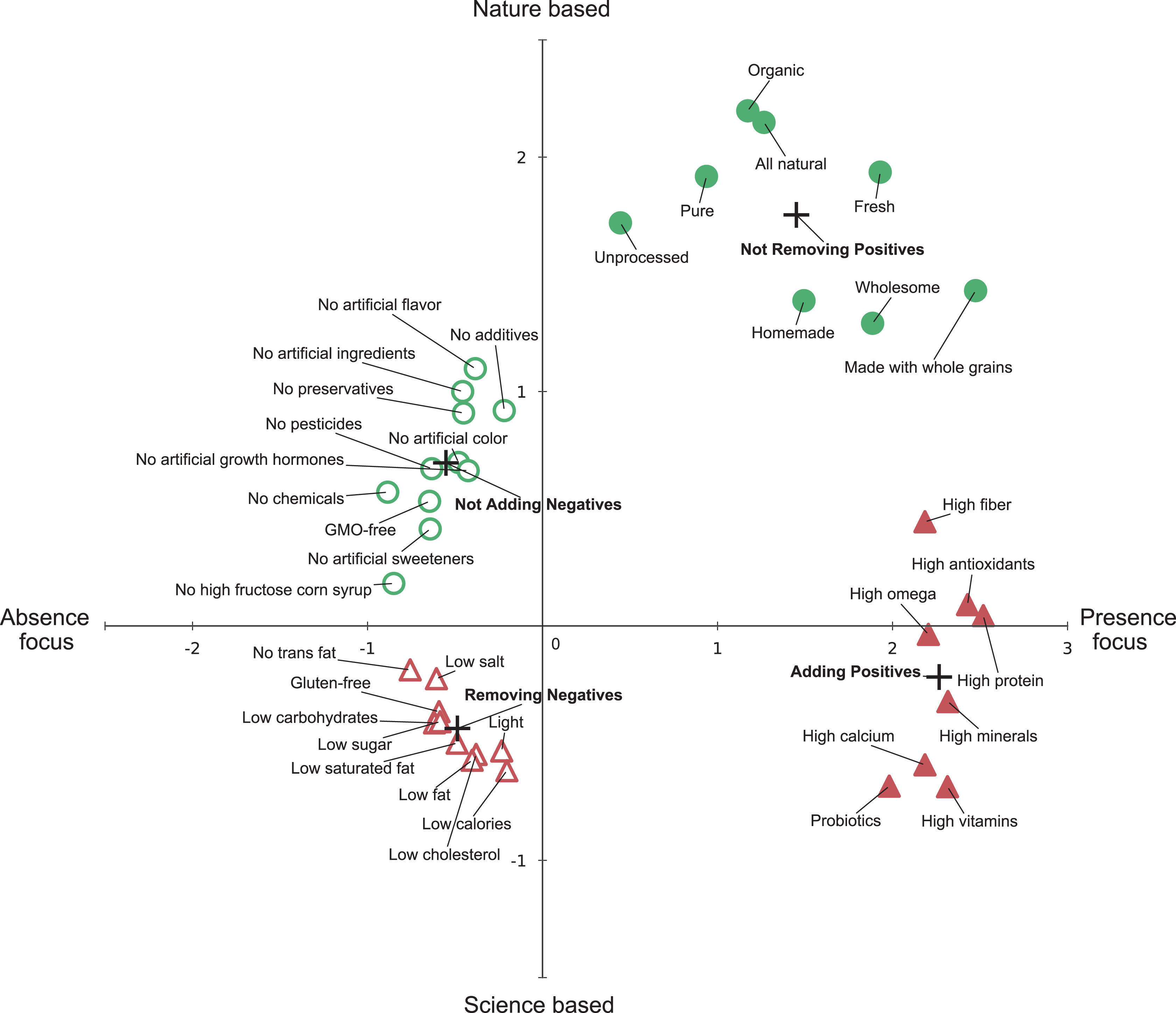
Study 1: perceptual map of food claims.
The “adding positives” claims are perceived as science based and focused on the presence of positive elements, such as “high antioxidants,” “high omega,” or “probiotics.” All these claims have high presence ratings and are perceived to be, on average, as science based as the “removing” claims. However, there is more variance on naturalness among the “adding positive” claims. “High fiber” is actually considered more natural than scientific, and three other claims— “high antioxidant,” “high protein,” and “high omega”—are very close to zero on the naturalness scale. This could be because fiber is perceived as natural (whereas calcium is not). Still, Figure 3 shows that there is a significant distinctiveness gap between clusters: Even “high fiber,” the least-science-based claim within its science cluster, is distinctively more science based than “wholesome,” the least-natural claim of the positive- and nature-based cluster.
Moving to natural claims, “not adding negatives” claims are all perceived as negative focused and nature based, both at an absolute level, and with minimal variance on both dimensions. This cluster includes claims such as “no additives,” “no artificial flavor,” and “no preservatives.” Finally, claims in the “not removing positives” cluster are all perceived to be strongly based on nature and focus on the presence of positive items, despite large variance in this latter dimension.
To examine the extent to which those differences are statistically meaningful, we ran a series of analyses of variance (ANOVAs). The first ANOVA revealed significant differences in presence–absence focus between clusters (F(3,33) = 159.13, p < .001). As expected, planned contrasts revealed the two presence-focused clusters (“not removing positives” and “adding positives”) to have a higher score than for the two absence-focused clusters (“not adding negatives” and “removing negatives”) (M = 1.86 vs. M = −.52; F(1, 33) = 324.7, p < .001). In addition, those scores were similar when comparing the two natured-based clusters with the two science-based clusters (M = .29 vs. M = .74; t(35) = 1.07, p = .29). This suggests that the presence–absence dimension is orthogonal to the nature–science dimension in our sample.
A second ANOVA revealed significant differences in the nature–science dimension across the four clusters (F(3, 33) = 93.6, p < .001). As expected, planned contrasts revealed that the two nature-based clusters (“not removing positives” and “not adding negatives”) were perceived to be more natural than for the two science-based clusters (“removing negatives” and “adding positives”) (M = 1.14 vs. M = −.34; F(1, 33) = 239.0, p < .001). In addition, those scores were similar when comparing the two presence-focused clusters and the two absence-focused clusters (M = .54 vs. M = .31; t(35) = .76, p = .45). This is further evidence for the lack of dependence between the nature–science and the presence–absence dimensions. Finally, the distinctiveness between the different clusters shows that treating our continuous dimensions as dichotomous is not only conceptually helpful but also ecologically valid: claims were rarely, if ever, found to be “neither natural nor scientific” or “neither positive nor negative.”
Discussion
Study 1 developed reliable measures of the two dimensions of the proposed theoretical framework and showed that these two constructs are distinct. Cluster analyses showed that the proposed framework is an appropriate description of the 37 most common food claims, with four distinct clusters emerging: “removing negatives,” “adding positives,” “not removing positives,” and “not adding negatives.” Study 1 also showed that this classification is robust across individual differences in sociodemographic factors and attitudes toward nutrition. The final analyses showed a fairly equal distribution of the 37 most common claims across four homogeneous clusters, which differ from one another only as expected (i.e., positive and negative claims are statistically different in terms of presence–absence but not of nature–science dimensions, and conversely for natural and positive claims).
Although Study 1 showed that the most common “healthy food” FOP claims can be meaningfully classified according to their presence–absence and nature–science orientations, two constructs that have been shown to have important implications for food choices, it did not examine the association between these types of claims and the actual and perceived differences in the nutritional properties of the food. In the next three studies, we examine this predictive validity in the context of breakfast cereals, a popular food category in which food claims are common (Hieke et al. 2016) and that often has a “health halo” despite large differences in actual nutrition quality (Schwartz et al. 2008). Study 2 examines the association between claim type and actual nutrition quality. Study 3 examines the association between claim type and perceived healthiness, tastiness, and weight impact. Finally, Study 4 examines how the classification of claim helps better predict the effects of three important goals (healthy eating, hedonic eating, or weight-loss goals) on consumers’ choice between different foods with or without food claims.
Study 2: Association Between Claim Type and Nutritional Quality
Method
We downloaded information about nutritional quality and food claim frequency in March 2017 from OpenFoodFacts.org, the most comprehensive collaborative database on food and nutrition (Julia, Ducrot, and Péneau 2015). OpenFoodFacts contains detailed information on commercial food products at the stockkeeping-unit level, including the claims, mentions, and labels written on the package. It also contains the nutrient profiling score developed for the British Food Standard Agency (FSA; Rayner, Scarborough, and Lobstein 2009). Like the proprietary NUVAL score (Nikolova and Inman 2015), the FSA score is a continuous indicator of the nutritional quality of foods per 100 g or 100 mL, which varies between −15 (best) to 40 (worst). It allocates positive points (0–10) for content in energy (KJ); total sugars (g); saturated fatty acids (g); and sodium (mg) and negative points (0–5) for content in fruits, vegetables, legumes, and nuts (%); fibers (g); and proteins (g). The validity of the FSA nutrient profiling system as a measure of the healthiness of food has been established in multiple studies. Donnenfeld et al. (2015) found that people with a diet in the top quintile of the FSA score (i.e., those with the unhealthiest diet) had a 34% higher chance of cancer over a 12-year period compared with people in the bottom quintile of the FSA score (i.e., those with the healthiest diet). The FSA score is also predictive of cardiovascular diseases (Adriouch et al. 2016) and metabolic syndrome (Julia et al. 2015).
Results
Out of the 633 food products tagged as “breakfast cereals,” 460 (72.7%) made a health or nutrition claim (i.e., after excluding claims such as “carbon compensated” or “fair trade”) and 173 (27.3%) did not. The total number of distinct claims was 54 (1.95 on average among the products with at least one claim). We categorized these 54 claims as “adding,” “removing,” “not adding,” or “not removing.” In most cases, there was either an exact match with one of the claims examined in Study 1 or a similar wording (e.g., “30% less fat” vs. “low fat”). We categorized the few claims that had no correspondence in Study 1 (e.g., “no added thickener”) using our definition of the nature–science and presence–absence dimensions.
We created an index of nature–science focus for each of the breakfast cereals as the number of natural claims minus the number of scientific claims divided by the total number of claims. This index ranges from 1 (only natural claims) to −1 (only scientific claims) and a score of 0 indicates an equal number of natural and scientific claims. We created a similar index for presence focus (1 = only presence-focused claims, −1 = only absence-focused claims, and 0 = equal number of presence- and absence-focused claims).
Each dot in Figure 4 shows the nature index and the presence index for each of the 460 products with at least one claim. Because many products perfectly overlap in their scores, the dots were adjusted around their true position on the chart. Figure 4 shows that very few products (those not located in one of the four corners) mixed claims of different types. In fact, 81.8% of the cereals only made one type of claim. This suggests that food manufacturers, like the consumers in Study 1, tend to view the four types of claims as distinct and avoid mixing claims from different types. The data also reveal that most foods made “not removing” claims, with “organic” being the most frequent claim in our sample.

Study 2: claim type and nutritional quality of breakfast cereals.
Figure 4 also shows the nutritional quality of each food using the Five-Color “5C” Nutrition Label categorization of the FSA score recommended by the French ministry of health (Ducrot et al. 2016). The healthiest cereals are in green (FSA ranging between −15 and −1). The range of FSA score of the other colors are: yellow (0–2), orange (3–10), pink (11–18), and red (19–40). The lack of a dominant color in any part of the chart suggests that the type of claim is uncorrelated with the nutritional quality of the breakfast cereals carrying it. To test this formally, we conducted a regression with the continuous FSA score of the food as the dependent variable and its nature index, presence index, and their interaction as independent variables. Confirming the impression given by Figure 4, this model explained almost no variance in nutritional quality (adjusted R2 = .005), indicating that the type of claim had no association with the actual healthiness of the food. Unsurprisingly, the coefficients were not statistically significant (respectively, p = .32, p = .72, and p = .40 for naturalness, valence, and their interaction). We conducted a similar analysis at the claim level by using each claim as a data point and applying the FSA score of the food bearing the claim. This analysis yielded similar results (adjusted R2 = .002), in support of the conclusion that claim type is a very poor predictor of objective nutritional quality.
Discussion
Overall, Study 2 shows that the vast majority of breakfast cereals make only one type of claim and, when they make more than one claim, they seldom mix claims from different categories. The four claim types created by the naturalness-valence framework thus describe well the health and nutrition claims displayed on breakfast cereals. Second, and most importantly, it shows that the type of claim itself is completely uncorrelated with the actual nutritional quality of the food as measured by the FSA score. Although certain types of food claims may be significant predictors of other unmeasured dimensions of healthiness (e.g., the presence of pesticides), Study 2 shows that they are not reliable predictors of the overall nutritional quality of the breakfast cereals, which can have significant implications for public policy if consumers do not realize this. So, do consumers realize this discrepancy?
In Study 3, we probe this question by examining the inferences that consumers make about the properties of breakfast cereals based on their claims. Importantly, we go beyond actual and perceived healthiness to focus on several dimensions that consumers care about when choosing food products. Researchers and practitioners have begun to acknowledge that consumers’ food choices are not only driven by nutrition value but also driven by the full range of benefits that they expect to derive from the food (Bublitz et al. 2013). Here, we focus on three central (and sometimes conflicting) benefits that have received significant attention in the literature: the healthiness of the food (as measured by expectations about the food’s overall healthiness), the hedonic benefits (as measured by the expected taste of the food), and the dieting properties (as measured by the food’s expected ability to help in losing weight and/or staying thin).
Study 3: Association Between Claim Type and Perceived Health, Taste, and Dieting Properties
Method
To explore the perceived benefits of different types of food claims, we asked participants to evaluate breakfast cereal boxes bearing different types of food claims. To increase the generalizability of the analysis, we tested a total of 16 claims (four from each cluster), selected on the basis of their centrality within their cluster and the frequency of their use in the chosen product category. The four “removing negatives” claims were “low fat,” “light,” “low calories,” and “low sugar.” The four “adding positives” claims were “high fiber,” “high proteins,” “high antioxidants,” and “high calcium.” The four “not removing positives” claims were “made with whole grains,” “wholesome,” “organic,” and “all natural.” Finally, the four “not adding negatives” claims were “no artificial flavor,” “no preservatives,” “no additives,” and “no artificial colors.” The selection of the claims was validated through discussions with the nutritionist of a leading breakfast cereal manufacturer.
To minimize participant fatigue, each respondent sequentially evaluated four food claims, randomly drawn from each of the four clusters. For each claim, participants were asked to imagine a breakfast cereal box bearing the claim and to indicate on 1– 7 Likert scales whether they believed that this particular breakfast cereal would be “healthy,” would be “tasty,” and “would help [them] lose weight or stay thin.” An attention check was included at the beginning of the survey, and an additional attention check was inserted among the inference ratings for each claim. After rating the claims, the participants answered attitudinal and sociodemographic questions and were thanked and debriefed.
Results
Each of the 363 Americans recruited on MTurk evaluated four claims, yielding a total of 1,452 observations. Because of the repetitive nature of the study, we inserted claim-level attention checks (participants were asked to select “disagree” for an additional question about the claim). Results revealed that for 67 observations (4.6%), participants had not paid attention to that particular claim, leaving 1,385 data points. The results were unchanged by removing these observations. We conducted three separate regressions, one for each inference, using the type of claim as the predictor. Because claim type has four levels, we created three orthogonal contrasts to measure (1) the focus on presence versus absence, (2) the basis on nature versus science, and (3) the different effects of being based on nature for presence- (vs. absence-) focused claims. Appendix B shows the mean scores on overall healthiness, taste, and dieting for the 16 claims as well as the mean for each claim type.
Table 2 illustrates that the main effect of claim type is statistically significant for all three dependent variables (all ps < .001), showing that inferences about healthiness, taste, and dieting all differed on the basis of which of the four claim types was displayed. Unlike actual food healthiness (as measured by nutritional quality), which was unrelated to claim type in Study 2, Table 2 and Figure 5 show that claim type leads to strong differences in perceived healthiness. Presence-focused claims are perceived to be healthier than their absence-focused counterparts (p < .001). We interpret this finding as a framing effect (Levin and Gaeth 1988): by drawing the consumers’ attention to the positive aspects present in the food (rather than to the negative aspects absent from the food), presence-focused claims are framing the food as “healthy” (rather than “not unhealthy”), which leads to more favorable judgments of overall healthiness.

Study 3: effects of claim type on food inferences.
Study 3: Results of Inference Analyses.

*p < .05.
**p < .01.
***p < .001.
Notes: These coefficients can be interpreted as follows: People expect that foods claiming the presence of positive attributes are healthier (by .30 points on a seven-point scale), tastier (by .22 points), but worse for dieting (by .25 points) than foods claiming the absence of negative attributes.
We also observe, consistent with previous findings with U.S. respondents, that science-based claims are viewed as healthier than nature-based claims. Beyond replicating the positive association between science and healthiness found in North American consumers (Masson et al. 2016; Rozin, Fischler, and Shields-Argelès 2012), this result might also reflect how consumers interpret the producers’ intentions. Indeed, claiming that a product is healthy because of the modifications it has undergone signals a clear intention to engineer a healthy product.
Finally, the science-based claims are judged as healthier when they are focused on the presence of positive elements (i.e., the difference between “not removing” and “adding” positives” is stronger than the difference between “not adding” and “removing” negatives, p < .001). This result again suggests that the perceived intention of the manufacturer might play a role in shaping healthiness perceptions: to the extent that adding specific positive nutrients to a food item is more deliberate and intentional than removing negative nutrients that were incidentally present, consumers perceive “adding” as healthier than “removing.”
Taste inferences are influenced as well by the type of claim displayed on the food. First, presence-focused claims also lead to better taste inferences than absence-focused claims (p < .001). This framing effect is parallel to the one observed for healthiness: drawing attention to the positive aspects that are present in the food leads to more favorable judgments. However, the natural (vs. scientific) frame on taste expectations had an effect opposite to what we had observed for healthiness perceptions: people expect the food to taste better when claims are based on nature than when they are based on science (p < .001). The observation that taste expectations are worse when the food claim is scientific with a negative frame (i.e., the difference between “not adding” and “removing” negatives is stronger than the difference between “not removing” and “adding” positives; p < .001) also tells us that consumers do not view all food transformations as equal: processes that remove elements from the food are perceived as more taste-degrading than processes that add elements to the food.
Finally, claim type also has a significant influence on inferences about the “dieting” properties of the food (“would help me lose weight or stay thin”). Foods are expected to be better from a dieting standpoint when they have an absence-focused claim over a positive-focused one (p < .001). This result reflects consumers’ belief that the form of the food must match its function: to lose weight, one has to consume food from which certain elements are absent or removed. For dieting, science-based claims also dominate nature-based claims (p < .001) in general (suggesting that dieting food must be engineered for that purpose) and particularly among absence-based claims suggesting that specific actions have been taken to remove fattening elements from the food (p < .001). As Figure 5 shows, “removing negatives” claims (“light,” “low fat”) clearly dominate “not adding negatives” claims (“no artificial color”) when it comes to dieting inferences.
Discussion
Despite the lack of association between claim type and objective nutritional quality, consumers expect claim type to be a strong predictor of the healthiness, taste, and dieting properties of breakfast cereals. Study 3, therefore, demonstrates the gap between actual and perceived healthiness as it relates to food claims, which has important implications from a regulatory standpoint. Indeed, a key principle in the regulation of food claims is that claims displayed on products should not be misleading or deceiving, such that consumers should not expect benefits that the food will not deliver.
This study also highlights the importance of distinguishing between the different types of benefits consumers can seek in their food consumption. In particular, Study 3 shows that consumers’ evaluations of food claims differ when they judge whether the food is healthy versus whether the food would help them lose weight. Healthiness increases with science and presence focus (and both dimensions do not interact). For dieting, however, only one type of claim stands out: those about “removing negatives.” These diverging results should remind us of the importance of considering consumers’ goals when making predictions about the impact of food claims. Whereas weight-loss goals are often confounded with healthy eating goals in research and practice, our explorations suggest that they are very different.
The dissociation between inferences about health, taste, and dieting underscores the importance of understanding the role of consumers’ goals in predicting their food choices. Although many studies have examined the difference between health and taste goals, dieting goals have been less studied, despite their prevalence (Snook et al. 2017). In particular, we know relatively little about the effects of these three goals on people’s choice between foods with different types of claims or without any claim. Drawing on the results of Study 3 and on prior studies (Gravel et al. 2012), we expect that hedonic eating goals will lead consumers to choose brands with nature-based claims over science-based ones. We also expect that healthy eating goals will increase the choice of brands with presence (vs. absence) claims. We also expect weight-loss goals to increase the choice of “removing negative” claims (e.g., “low fat,” “low sugar”). Finally, because all food claims purport to be adding value, we expect lower choice for brands without a food claim relative to brands with any type of claim. We test these hypotheses in the next study.
Study 4: Predicting Choices Among Food Claims: The Role of Goals
Method
Study 4 used a mixed design. Participants were randomly assigned to one of three shopping goals (hedonic vs. weight loss vs. healthy eating) and had to choose one product out of five in two within-subject replications: buying a box of cereals and buying a milk carton. We studied milk in addition to cereals because they are complementary foods that are easy to justify in a decision-making study and because studying two categories allows us to examine the robustness of the findings for another category that uses health and nutrition claims frequently (Hieke et al. 2016) and in which all four types of claims are often displayed. Our dependent variable is the type of product that was selected, as a function of the shopping goal.
To investigate the impact of claim types on preferences, we constructed the study so that four of the five products presented bore a claim representing each of the four clusters (i.e., “adding positives,” “removing negatives,” “not adding negatives,” and “not removing positives”), while the fifth product bore no claim. To keep a reasonably sized choice set, we selected a representative claim from each cluster that best fit the product categories on the basis of consultation with industry experts. For cereals, the claims were “high fiber” (adding positives), “low in sugar” (removing negatives), “no artificial flavors” (not adding negatives), and “made with whole grains” (not removing positives). For milk, the claims were “high vitamins” (adding positives), “low fat” (removing negatives), “no artificial growth hormone” (not adding negatives), and “all natural” (not removing positives).
We collaborated with PRS In Vivo, a leading market research company specializing in point-of-purchase insights, to design the product packages used in the study and to gain access to a panel of breakfast cereal buyers as respondents. These packages were created by a professional graphic designer based on five different store brands of corn flakes. To avoid a confound between claim type and package design elements (brand name, color, layout, etc.), we randomized the pairing of food claims to packages: in total, PRS In Vivo designed five different versions for each brand (one for each of the four claims and one version without any claim), yielding a total of 25 packages (for a subset of the packages, see the top panel of Figure 6). Because milk, unlike cereals, is often sold in less obviously branded cartons, the graphic designer created five versions of the same unbranded design, one for each of the four claims and one without any claim (see the bottom panel of Figure 6). The role of the control package without any claim is to allow us to measure the absolute effect of claim type on choice rather than simply the relative effect of each type of claim.

Study 4: example of stimuli for cereals (top) and milk (bottom).
The market research company recruited U.S. residents to participate in the study, which was administered online. To manipulate the shopping goal while avoiding possible conflicts with the participant’s own health-related goals, we used a scenario in which the participants were the purchaser but not the primary user of the product. Specifically, the participants were asked to imagine that they had teenage guests visiting their house and had to buy cereal and milk for their breakfast. In the hedonic eating condition, they were instructed to “buy something that your teenage guests will enjoy eating.” In the healthy eating condition, they were told, “your teenage guests care about healthy eating.” And in the weight loss condition, they were told, “your teenage guests are trying to lose weight.”
We prescreened participants on the following criteria: regular buyers of breakfast cereals and milk (to ensure familiarity with the product category), female, and between 18 and 64 years of age. We focused on female buyers because they remain the primary buyers of groceries (Food Marketing Institute 2014; Wardle et al. 2004). Participants then viewed five cereal packages (four with different food claim versions and one with none) side by side and were asked to select the one that they would purchase. Next, they viewed the five milk cartons (four with different food claim versions and one with none) presented in a similar way and were asked to select the one that they would purchase. After choosing a cereal box and a milk carton, the participants answered sociodemographic and attitudinal questions and were thanked and debriefed.
Results
We obtained data from a total of 611 participants (determined by cost considerations), yielding a total of 6,110 observations: 611 individuals × 2 within-subject choice repetitions (milk and cereals) × 5 products (four claim types plus no claim). We coded, for each of the 5 × 2 products presented to a given participant, whether the product was chosen or not. We then used a conditional logistic regression to understand those food choices as a function of (1) the goal assigned to the customer and (2) the claim displayed on the chosen product. Because there were three shopping goals, we used the dieting goal as the baseline and created two contrasts, one capturing the difference between hedonic eating and dieting goals and the other capturing the difference between healthy eating and dieting goals. For the five claim conditions (four types of claim plus no claim), we used four contrasts capturing the effects of (1) food claims in general (any claim vs. no claim), (2) presence versus absence focus, (3) nature versus science basis, and (4) the different effects of naturalness among absence-focused claims (comparing “not adding negatives” vs. “removing negatives”). Apart from the first contrast (comparing the effects of all the claims with the no-claim condition), the claims were coded as in Study 3.
We analyzed the participants’ choices using a conditional logistic specification using the CLOGIT procedure in STATA. In line with additional analyses showing that cereal and milk choices were independent (the predictors had the same effects on both), the choices for each product were analyzed as independent replicates (i.e., the reported coefficients reflect choices for both products, accounting for the repeated nature of the design). The pooled coefficients for milk and cereal choices are reported in Table 3 and the choice probabilities in Figure 7. As expected, participants were more likely to choose one of the cereals or milks with a claim than one without (p < .001 in the baseline dieting condition), and this effect was similar in the two other goal conditions (all ps > .14). However, the type of claim also had a strong impact.
Study 4: Results of Choice Model.

**p < .01.
***p < .001.
Notes: These coefficients can be interpreted as follows: In the dieting goal condition, consumers were more likely to choose a brand with a claim than one without a claim (β = .813) and this effect did not vary across goals (β = −.221 and β = .336 are not statistically significant). Consumers in the dieting goal condition were more likely to choose a brand with a nature-based (vs. science-based) claim (β = .165), but both healthy eating and hedonic eating goals reduced (and, in fact, reversed) this effect. The same consumers were less likely to choose a brand with a presence (vs. absence) focused claim (β = −.161), and this was the same across goals.

Study 4: effects of claim presence, claim type, and shopping goal on purchase probabilities.
As shown in Figure 7, the healthy eating and hedonic eating goals led to similar food choices. As expected in these two goal conditions, consumers choose brands with a nature-based claim over a science-based one and the presence/absence dimension has a limited effect. The pattern is radically different when people have the goal to lose weight. In this condition, they strongly prefer brands claiming to have removed negative attributes, as we predicted. Table 2 supports these results by showing that, overall, absence-focused claims tend to dominate presence ones (β = −.161, p < .01 in the dieting condition). We did not observe any interaction with shopping goal (all ps > .31), which suggests that this preference for absence-focused claims holds regardless of the participants’ shopping goal. Naturalness also has a positive impact on choice overall (β = .165, p < .01), but this main effect is qualified by significant interactions with shopping goal (β = −.803, p < .001, for healthy eating and β = −.594, p < .001, for hedonic eating). The superior performance of “removing” claims in the dieting goal was captured by the significant interactions in the bottom row of Table 2 (β = −1.463, p < .001, for healthy eating and β = −1.021, p < .001, for hedonic eating).
Discussion
First, Study 4 showed that food claims significantly increased choice probabilities for breakfast cereals and milk, despite their lack of association with actual nutrition quality (at least for cereals). This confirms the results of prior research showing that food claims, unlike nutrition information, can significantly influence people’s food choices (Bublitz, Peracchio, and Block 2010; Garretson and Burton 2000; Kozup, Creyer, and Burton 2003; Wansink and Chandon 2006). It also extends prior research by showing that food claims boost choice regardless of consumption goal even when claim, brand, and package design are independently manipulated and when multiple products with different claims are present.
Second, and more importantly, Study 4 showed that not all food claims are equal and that our classification allows us to better predict the effects of people’s consumption goals on which supposedly “healthy” brand they will choose. Specifically, the key result of Study 4 is that the intention to lose or maintain weight leads to radically different food choices than the other two consumption goals. In this condition, brands with an absence- and science-based claim about “removing negative attribute” (“low sugar” for cereals and “low fat” for milk) dominate brands with any other claim. This result reinforces the importance of going beyond just “health” goals to also understanding the role of dieting-related goals and inferences. We interpret this finding as reflecting the “promotion focus” associated with the goal of losing weight: when trying to improve on their present self, consumers favor food that has been scientifically improved as well, and from which the negative elements have been removed. In contrast, consumers who shop with a prevention-oriented goal of staying healthy favor natural food, which has not been transformed in any way. 2 The same is true of shoppers with a taste goal.
Finally, we observe a different pattern of results between Studies 3 and 4. When participants rated claims in a separate evaluation and in the absence of other information (Study 3), they expected breakfast cereals with presence claims to be tastier and healthier than cereals with absence claims. In a joint evaluation in which they had to choose between multiple brands with or without a claim, and when products, brand names, and other package cues are present, people no longer pay attention to the presence–absence dimension and instead focus on the nature–science dimension. This suggests that the effects of the presence/absence dimension of FOP claims should be studied when all the other value signals are present, whereas those of the naturalness of claims hold regardless of how much additional information is conveyed on the package. This result is consistent with prior studies that also found different responses to food claims when they are presented jointly versus separately (Newman, Howlett, and Burton 2014).
General Discussion
Healthiness is a multifaceted construct. Prior research has aimed to reduce this complexity by using either a macro level of analysis, considering all claims that a food is healthy as a single category, or a micro level of analysis, by studying each claim separately. In the present research, we offer a mesolevel of analysis by distinguishing food claims on the two key dimensions of nature–science and presence–absence. We show that this approach yields significant implications for research, food marketing, and public policy.
Contributions to Research on Food Well-Being
Many studies in food health and well-being simply compare “healthy” versus “unhealthy” foods. While such a simplification may often be perfectly adequate for assessing some consumer responses, the more detailed understanding of what makes something “healthy” offered herein provides richer theoretical insights into understanding consumer food decision making, starting with their lay theories about food healthiness. For example, while Raghunathan, Naylor, and Hoyer (2006) demonstrated that people tend to follow the intuition that unhealthy = tasty, our results suggest that taste and health inferences are not always negatively correlated, as the unhealthy = tasty heuristic (UH = T) would have predicted. In particular, the results of Study 3 show that the association between health and taste expectations depends on the type of claim. Claims based on nature were rated as healthier and less tasty than claims based on science, which is consistent with the UH = T. However, claims based on the presence of positive attributes (e.g., “high antioxidants,” “wholesome,” “organic”) were rated as both healthier and tastier than those based on the absence of a negative attribute. In other words, health and taste were positively correlated for presence-focused claims, which is inconsistent with the UH = T. This suggests that the UH = T only operates for one particular meaning of healthy, one based on science and focused on the absence of negative attributes. In fact, whereas the correlation between the ratings of taste and dieting inferences in Study 3 was negative (−.71, p < .001) across all types of food claims, the overall correlation between health and taste inferences was positive and significant (.32, p < .001). From those results, we conclude that the negative correlation between healthiness and taste found in prior studies might have been driven by the conflation of healthiness and weight loss properties, likely because of the broad definition of “healthy” used in these studies. These results also reinforce recent findings showing the boundary conditions of the UH = T (Werle, Trendel, and Ardito 2013).
Similarly, studies showing that consumers eat larger quantities of a food when it is perceived as healthy have sometimes simply described the food as “healthy” (Chandon and Wansink 2007; Haws, Reczek, and Sample 2017; Provencher, Polivy, and Herman 2008). Here, we have shown that such associations between healthiness and tastiness may depend on what people understand “healthy” to mean. If people think that “healthy” means that something has been removed from the food, even if it is something nutritionally bad, then it may explain why healthy food is predictive of worse taste. However, the relationship might not hold for other forms of healthiness (e.g., healthy in the sense that nothing negative has been added to the food).
Our results also further our understanding of what makes a food appear natural or not. Rozin, Fischler, and Shields-Argelès (2009) argued that naturalness is more strongly influenced by whether something was added (or not) to the food than by whether something was removed. For example, they found that skim milk is judged to be more natural than milk with added vitamin D. In contrast, we found no differences in naturalness between “adding positive” and “removing negative” claims. Perhaps the distinction comes from the specific combination of claim and food used in Rozin, Fischler, and Shields-Argelès’s study (in particular, consumers’ familiarity with skim milk). This underscores the importance of studying a wide variety of claims.
Implications for Food Labeling Regulation and Management
Traditionally, the guiding principle in the regulation of food claims has been that they should not be misleading (Mariotti et al. 2010). For instance, a company cannot claim that a product will “strengthen the immune system” if no proof exists that it will. Now, regulators are increasingly considering individuals’ perception of food claims and not just their veracity. Although none of the claims that we studied explicitly stated that the product will make people healthier (or help them lose weight or stay thin), consumers interpreted some types of claims as such. Our results could, therefore, motivate legislators to regulate some of these food claims more strictly. In particular, we believe that our framework can help identify claims that lead to stronger inferences than others, and that should perhaps be more stringently regulated.
Although this is a legal gray area at this stage, a precedent can be found in the domain of tobacco products. Some manufacturers grow tobacco without pesticides or artificial fertilizers, which allows them to display the label “organic,” “natural” or “additive-free” on the cigarettes using this tobacco. While those claims were not misleading in a legal sense (the tobacco was indeed produced according to the legal definition of those claims), many consumers misinterpreted the claims as indicating that the tobacco was less dangerous (Kelly and Manning 2014), which led to a class action in the court of New Mexico. Regulators are currently deciding whether to force tobacco manufacturers to include a disclaimer that organic tobacco is as dangerous as regular tobacco (Baig et al. 2018) or to outlaw the claims altogether.
Our results also have methodological implications for the regulation of food claims. Legislators do not typically rely on statistical analyses to determine how claims may be misunderstood but instead rely on their interpretation of what a rational consumer would do. Our approach offers an alternative method, which assesses the degree to which food claims are extrapolated by actual, not ideal, consumers. The FDA has recently started taking steps in this direction and has opened a public consultation on the meaning of “natural” (FDA 2016). We hope that our research can motivate similar initiatives and encourage regulators to study lay consumers’ understanding of food claims.
Another worrying result from a consumer welfare perspective was our finding that the most effective claims for people with a hedonic eating goal (which is also the most common goal when shopping for food, e.g., Glanz et al. 1998), were “all natural” and “made with whole grains.” These two claims were singled out by the Center for Science in the Public Interest as meaningless and misleading (Silverglade and Heller 2010), as “made with whole grains” can be used on a product only containing a small fraction of whole grains, while “all natural” can be applied to virtually any product. Ethical food marketers can draw on our results to decide whether to communicate health-related aspects of food at all. For example, given that people had negative expectations about both healthiness and taste of foods labeled “light” and “low fat,” marketers should consider not making these claims, even when they could, unless the brand is specifically trying to attract consumers trying to lose weight. In contrast, displaying food claims belonging to the “adding positives” cluster would allow business practitioners to increase the perceived healthiness of their products without harming taste expectations. Similarly, the claim-specific scores reported in Appendix B suggest that firms would be better off substituting some claims for others. For example, we found that “made with whole grains” dominates “wholesome” on all three dimensions of expected taste, healthiness, and dieting properties of the food. Marketers who only care about improving food expectations should obviously choose the former, but marketers who care about the regulatory implications or the ethics of their decisions should be mindful of the fact that the improved healthiness or dieting expectations may not be scientifically justified.
Limitations and Future Research Directions
Our parsimonious framework of FOP claims constitutes a stepping stone in understanding the rich and complex issue healthiness judgments made by consumers in response to the cues used by food manufacturers in the marketplace. Indeed, although the four types of clusters that we have identified feature very diverse claims, our framework also highlights commonalities in how those claims are perceived in terms of health, taste, and dieting properties. Nonetheless, several opportunities for future research exist to further improve this framework.
First, the disconnect that we highlight between objective and subjective nutritional quality of the food was based on a single metric: the food’s FSA score. While the FSA score is a robust and reliable measure of nutritional quality, it is unidimensional and does not distinguish between the overall healthiness of the food and its dieting properties: for instance, it treats sugar (which is fattening) and sodium content (which is not) as “unhealthy nutrients.” A more granular measure of objective healthiness could be used in future research and would help make the case that subjective healthiness is uncorrelated from objective healthiness on all dimensions.
A second limitation lies in the number of product categories that we have studied. Although the classification of food claims in four distinct clusters did not reference any particular type of product (Study 1), we have restricted ourselves in subsequent studies to one or two categories in which all four types of claims are commonly found (breakfast cereals and milk). Accordingly, it would be important to study whether people’s misunderstanding about the actual healthiness of foods with different claims extends beyond the products that we studied. Indeed, perceptions of health claims have been shown to interact with the type of food product bearing the claim (e.g., Van Kleef, Van Trijp, and Luning 2005). For instance, we have found in our study that “scientific” claims are judged as contributing more to healthiness than “natural” claims and hypothesized that consumers view those claims as cues that “a good product was made even better.” If this is the case, this finding might not apply to products that are considered unhealthy (e.g., chocolate bars, chips), and we might instead observe that “natural” claims (e.g., “organic”) that suggest that the product “was not made worse than it is” would be seen as a better predictor of overall healthiness.
We have also shown in Study 2 that some food brands make more than one claim and that, when they do, they choose claims of the same type. Future research should examine possible interaction effects of claims on consumer response and misunderstanding of the claim. Whereas claims of the same type probably reinforce one another (e.g., “low fat,” “low calories”), claims from different types may be perceived as incompatible (e.g., “homemade,” “probiotic”), leading some consumers to reject the food. It would be interesting to study whether some combinations of claims should be avoided. For example, our result that claims are first categorized by the presence of positive attributes or the absence of negative ones, and only then by naturalness, suggests that it would be worse to combine absence- and presence-focused claims than nature- and science-based claims.
Finally, although we isolated the impact of health claims presented on products’ FOP, other information is also present for consumers when selecting products for consumption. The nature of this information is wide ranging, including branding and packaging elements (such as those present in our Study 4). Importantly, however, other cues and information related to healthiness also exist such as FOP symbols and back-of-package Nutrition Facts Panels. Systematically examining the relative impact of these FOP claims compared with the information provided by FOP symbols, both reductive and evaluative (Andrews, Burton, and Kees 2011; Andrews et al. 2014), as well as Nutrition Facts Panel information (Balasubramanian and Cole 2002), is critical to understanding how consumers comprehend and use these various sources of information, and what public policy changes, if any, should be made. Furthermore, we know that nutrition knowledge and other individual differences variables influence nutrition comprehension (Andrews, Netemeyer, and Burton 2009), so determining the types of consumers at greater risk of confusion from food claims in general is critical.
Footnotes
The 107 Most Common Food Claims (and the 37 Claims Used in Study 1).

| Claims Used in Study 1 | Other Claims | |
|---|---|---|
| All natural | Allergen-free | No allergy |
| Fresh | American Grassfed | No antibiotics |
| Gluten-free | Fair Trade | No caffeine |
| GMO-free | Free range | No calories |
| High antioxidants | Functional food | No carbohydrates |
| High calcium | Grade A food safety inspection | No carbonation |
| High fiber | Halal | No cholesterol |
| High minerals | Healthy choice | No dairy |
| High omega | Heart healthy | No fat |
| High protein | Helps promote healthy cells and tissues | No filters |
| High vitamins | High amino acids | No genetic modification |
| Homemade | High bran | No lactose |
| Light | High carbohydrates | No meat |
| Low calories | High DHA | No MSG |
| Low carbohydrates | High fruit | No nitrates |
| Low cholesterol | High GABA | No phosphates |
| Low fat | High iron | No saccharin |
| Low salt | High magnesium | No salt |
| Low saturated fat | High omega-3 | No saturated fat |
| Low sugar | High omega-6 | No sodium |
| Made with whole grains | High polyphenols | No sugars |
| No additives | High potassium | No sweeteners |
| No artificial color | Kosher | No tropical oils |
| No artificial flavor | Lean | No wheat |
| No artificial growth hormones | Local | Pasture raised |
| No artificial ingredients | Low alcohol | Real food |
| No artificial sweeteners | Low caffeine | Slimming |
| No chemicals | Low glycemic | Strengthens your immune system |
| No high fructose corn syrup | Low lactose | Support healthy arteries |
| No pesticides | Low protein | Sustainable |
| No preservatives | Low sodium | Traditional |
| No trans fat | Low trans fat | Vegan |
| Organic | Made with real foods and fruit | Vegetarian |
| Probiotics | Megatrend: Health | |
| Pure | Milk from cows not treated with rBST | |
| Unprocessed | No added hormones | |
| Wholesome | No alcohol | |
Mean Rating by Claim Cluster and Individual Claims.

| Claim | Study 1 Ratings | Study 3 Inferences | |||
|---|---|---|---|---|---|
| Valence | Naturalness | Tasty | Dieting | Healthy | |
|
|
|
|
|
|
|
| Light | −.2 | −.5 | 3.7 | 5.6 | 5.1 |
| Low sugar | −.6 | −.4 | 3.6 | 5.2 | 5.4 |
| Low calories | −.2 | −.6 | 3.7 | 5.5 | 5.0 |
| Low fat | −.4 | −.6 | 3.8 | 5.3 | 5.0 |
| Gluten-free | −.6 | −.4 | — | — | — |
| Low carbohydrates | −.6 | −.4 | — | — | — |
| Low cholesterol | −.4 | −.5 | — | — | — |
| Low salt | −.6 | −.2 | — | — | — |
| Low saturated fat | −.5 | −.5 | — | — | — |
| No trans fat | −.8 | −.2 | — | — | — |
|
|
|
|
|
|
|
| High fiber | 2.2 | .4 | 3.7 | 4.9 | 5.6 |
| High antioxidants | 2.4 | .1 | 4.2 | 3.9 | 5.6 |
| High proteins | 2.5 | .0 | 4.3 | 4.3 | 5.1 |
| High calcium | 2.2 | −.6 | 4.5 | 4.3 | 5.7 |
| High minerals | 2.3 | −.3 | — | — | — |
| High omega | 2.2 | .0 | — | — | — |
| High vitamins | 2.3 | −.7 | — | — | — |
| Probiotics | 2.0 | −.7 | — | — | — |
|
|
|
|
|
|
|
| Organic | 1.2 | 2.2 | 4.2 | 4.2 | 5.0 |
| All natural | 1.3 | 2.1 | 4.3 | 4.5 | 5.4 |
| Wholesome | 1.9 | 1.3 | 4.4 | 4.2 | 5.0 |
| Made with whole grains | 2.5 | 1.4 | 4.5 | 4.7 | 5.4 |
| Fresh | 1.9 | 1.9 | — | — | — |
| Homemade | 1.5 | 1.4 | — | — | — |
| Pure | .9 | 1.9 | — | — | — |
| Unprocessed | .4 | 1.7 | — | — | — |
|
|
|
|
|
|
|
| No artificial colors | −.5 | .7 | 4.1 | 3.3 | 4.7 |
| No additives | −.2 | .9 | 4.2 | 4.1 | 5.0 |
| No preservatives | −.5 | .9 | 4.4 | 4.3 | 5.2 |
| No artificial flavor | −.4 | 1.1 | 4.7 | 3.8 | 4.8 |
| GMO-free | −.6 | .5 | — | — | — |
| No artificial growth hormones | −.4 | .7 | — | — | — |
| No artificial ingredients | −.5 | 1.0 | — | — | — |
| No artificial sweeteners | −.6 | .4 | — | — | — |
| No chemicals | −.9 | .6 | — | — | — |
| No high fructose corn syrup | −.9 | .2 | — | — | — |
| No pesticides | −.6 | .7 | — | — | — |
Acknowledgments
The authors gratefully acknowledge the comments and support of Scott Young, Eric Singler, and Richard Bordenave from PRS INVIVO, the comments of Amandine Garde, François Mariotti, and Maria Langlois, and the suggestions of the editors and reviewers.
Editorial Team
Maura Scott and Beth Vallen served as guest editors for this article.
Declaration of Conflicting Interests
The authors declared no potential conflicts of interest with respect to the research, authorship, and/or publication of this article.
Funding
The authors disclosed receipt of the following financial support for the research, authorship, and/or publication of this article: This work was made possible by financial support provided by INSEAD and the ADL Partner Ph.D. Award. PRS INVIVO designed the stimuli for Study 4 free of charge and paid for the cost of participants recruitment.