




Abstract
Adolescence is identified as a key period for identity development, but anthropological literature hints at cross-cultural variations. Past research suggests Japanese adolescents may experience more identity exploration/confusion compared to Western counterparts, but the reasons behind these findings remain unclear. This comparative study investigates how adolescents in England and Japan perceive and engage with their environments, and aims to identify similarities/differences that could explain cross-cultural variations in identity development. Using autophotography, 98 teenagers aged 13 to 15 years across 10 schools in England and Japan documented important aspects of their lives. We applied template analysis to qualitatively analyze these photographs/texts. Overall, we identified two shared themes between countries: “This Is Me,” reflecting personal identity through self-discovery and skill development, and “Connectedness,” emphasizing relationships and belonging. A Japan-specific theme, “Reflections Through Time,” captured the broader temporal lens of Japanese adolescents, sometimes with a sense of melancholy. This notably differed from English adolescents in our study, who focused on the present in a positive manner. These findings suggest cultural differences in how adolescents engage with their environments, which may contribute to cross-cultural variations in identity development. Our findings point to the importance of biocultural approaches in developmental research by considering the role of culture.
Plain language summary
Past research from Euro-Western populations has found that adolescence is a key period of identity development, but studies suggest there could be some differences in the way identity develops across cultures. For example, in Japan, studies suggest teenagers may be less likely to be certain about “who they are.” To understand cultural variations in developmental processes, we need to understand cultural differences in the developmental environment. In this project, we asked teenagers aged 13-15 years in England and Japan to photograph the important things, people, and places in their lives. We qualitatively analysed the photographs and accompanying texts through a template analysis, identifying shared topics and themes across multiple photographs.
In both countries, we found that adolescents photographed things to showcase who they were (This is me), including what kinds of skills they were developing. They also photographed their connections to their family, friends, school, local area, and beyond (Connectedness), showcasing how they engaged with and valued different aspects of their environment. However, we found that adolescents in Japan were more likely to consider and refer to time (Reflections Through Time), and not all reflections were positive. These were in distinct contrast to photographs from England, which were overwhelmingly positive and focused on the present.
Our results show that, in both England and Japan, identity development seems to be an important part of being a teenager, and connectedness to the wider world underpins their developmental environment. However, teenagers in Japan may think about themselves and their lives differently than teenagers in England, which may explain why teenagers in Japan may be less certain about their identity. Our results highlight the importance of understanding and considering culture when thinking about developmental processes and pathways.
Human adolescence, roughly and broadly spanning from around 10 years of age to the early 20s, has been argued to be a key developmental life stage (Christie & Viner, 2005). From an evolutionary anthropological perspective, adolescence is thought to facilitate the acquisition and development of knowledge, skills, and behaviors in preparation for adulthood (Worthman & Trang, 2018); and these characteristics likely emerged as they conferred survival and reproductive advantages in later life. While exact manifestations of adolescence may vary between populations depending on local socio-ecological contexts, cross-cultural analysis of ethnographies suggests that adolescence as a period of learning between childhood and adulthood is an evolved human universal (Schlegel & Barry, 1991; Worthman & Trang, 2018). Indeed, this “evolved period of learning” coincides with heightened levels of developmental plasticity (Dahl et al., 2018; Worthman & Trang, 2018), associated with neurodevelopmental processes such as synaptic pruning (Spear, 2013) and “recalibration” of the hypothalamic-pituitary-adrenal axis related to the stress response (Gunnar et al., 2019). Studies show social cognition processes such as perspective-taking continue to develop throughout adolescence, while peer influence is heightened during early adolescence, suggesting that adolescence may be a critical period for social and cultural learning (Blakemore & Mills, 2014; Worthman & Trang, 2018).
Learning about the world may occur in reference to learning about oneself, and adolescence has also been argued to be a key period for identity development (Branje et al., 2021; Christie & Viner, 2005; Crocetti, 2017, 2018; Erikson, 1950, 1968; Marcia, 1966). While various models for adolescent identity development exist, Erikson (1950, 1968) proposed that adolescents must navigate a state of identity confusion and crisis (i.e., uncertainties around who they are) before developing and committing to their own identity. Building on this, Marcia (1966) proposed that adolescents may experience four identity states in the process of identity development, including: diffusion, where adolescents are not exploring aspects relating to their identity and have not made a commitment; foreclosure, where adolescents have committed to an identity without exploration; moratorium, where adolescents are exploring aspects relating to their identity and have not made a commitment, conceptually similar to identity confusion; and achievement, where adolescents have committed to an identity after a period of active exploration. Adolescents may transition between these different states of identity exploration and identity commitment, including reconsidering and revisiting their commitments (Crocetti, 2017), and in this process, they develop an understanding of themselves in relation to the different domains of their lives (Branje et al., 2021). Key domains may include aspects such as the personal self, or how you view yourself based on your own characteristics; the relational self, or how you view yourself based on your relationship with other people; the public self, or how you view yourself based on your social roles and public reputation; and the collective self, or how you view yourself based on group membership (Cheek & Cheek, 2018).
Variations in Identity Development
Early models of adolescent identity formation assumed broadly universal developmental stages and trajectories where identity exploration was followed by commitment. For example, Erikson (1950), after providing cross-cultural comparisons of childrearing practices among Sioux pastoralists and Yurok fishers (Native Americans), noted that individuals “emerge from a long and unavoidably fearful infancy with a sense of identity and an idea of integrity” (p. 160), concluding that the process of ego development must be universal (although noting that the outcome of ego development may be highly influenced by local context and culture). More recent academic literature continues to portray adolescence as a period of developing certainty in self-concept (e.g., Branje, 2022; Branje et al., 2021; Sugimura, 2020), but with a focus on investigating individual variations and optimal developmental pathways. Building on findings that a lack of identity exploration and low commitment are associated with poorer psychosocial outcomes such as depression, anxiety, eating disorders, and delinquency (e.g., Abu-Rayya, 2006; Meeus et al., 2012; Potterton et al., 2022; Vleioras & Bosma, 2005), moratorium followed by achievement is typically presented as an optimal developmental trajectory.
These universal pathways of identity development are underpinned by the idea of “evolved biological norms.” However, an evolutionary anthropological perspective places additional importance on developmental plasticity in response to the physical and socio-cultural environment (Borgerhoff Mulder, 2005; Cronk, 1991). Specifically, an adaptationist approach assumes that optimal development can vary between environments, and that individuals adapt to these environments in different ways to maximize their biological fitness (survival and reproduction)—thus, some cross-cultural variations in adolescent development are to be expected. Any assumption (or claim) of universality must therefore be evidenced across cultures, mirroring more recent calls from cultural psychology to integrate culture to understand development (S. J. Heine & Ruby, 2010; Mistry & Dutta, 2015).
Against this backdrop, existing understandings of identity development tend to center Western norms of adolescence, which prioritize the development of independence (Arnett, 2001; Glass & Emmott, 2024; Greenfield et al., 2003; McElhaney & Allen, 2012). For example, in the US and UK, characteristics such as independent decision making and financial independence are viewed as markers of adulthood by adolescents (Arnett, 1998; Vaghi & Emmott, 2018). Norms promoting independence might contribute to moratorium through fostering independent identity exploration, suggesting that typical identity development pathways could be influenced by local culture. Anthropological evidence suggests that independence is not a universally valued trait; for example, among the Aka hunter-gatherers of the Congo basin, anthropologists report that children have a strong and confident sense of self-identity from a young age as “Aka” (Hewlett & Hewlett, 2012). Similarly, Margaret Mead described how Samoan teenagers in the 1920s had defined understandings of their social roles and expectations from childhood, meaning they did not experience a period of “storm and stress” which is often attributed to identity confusion (Mead, 1928, p. 19). In these two examples, both authors suggest adolescence is not a key period of identity development, or at the very least, adolescents in these populations do not seem to experience a process of active identity exploration followed by identity commitment. While one could argue that Aka and Samoan adolescents in these examples were limited to foreclosure in terms of their identity development, developmental models which frame developmental processes most often seen in White, Western, middle-class populations as “typical” and “optimal” is both intellectually and ethically problematic (Greenfield et al., 2003; Keller, 2018; Miller-Cotto et al., 2022). Ethnographic evidence suggests that significant role-changes during adolescence are not necessarily experienced across societies; and that in many cultures, children and young people are given age-appropriate but similar responsibilities as adults (such as childcare and food production; LeVine & New, 2008; Schlegel & Barry, 1991). This implies that identity could be established well before adolescence, eliminating the need to explore one’s identity during the teenage years.
The broad implications here, drawing on an evolutionary anthropological perspective, are that there may be adaptive plasticity in how children and adolescents develop their identity (Worthman & Trang, 2018). What is optimal in terms of developmental pathways and outcomes may vary depending on local socio-ecological conditions, leading to different cultural norms and values which reinforce or discourage certain paths and forms of identity development. This is reflected in work by Keller (2009) who describes differences in self-concept between interdependent/collectivist and independent/individualistic cultures: those from interdependent cultures tend to view themselves “as part of a social system” while those from independent cultures tend to view themselves “as the centre of mental states and personal qualities.” She proposes that developing an interdependent self-identity may be more adaptive in cultures where small-scale collective action is frequent and required, such as in subsistence-based farming societies; whereas developing an independent self-identity may be more adaptive in cultures where social encounters are more anonymous with high levels of individual competition, such as those typically experienced by White, Western, middle-class families in urban areas. In line with this, Greenfield et al. (2003) outline how adolescents in Western populations such as the US and UK (typically part of independent/individualistic cultures) tend to engage in autonomous behaviors earlier with fewer parental controls than Asian, African, and Latin American counterparts (typically part of interdependent/collectivist cultures). This may lead to differences in how adolescents perceive and engage with the external world, potentially impacting their identity exploration and development.
Indeed, recent studies suggest notable variation in “typical” identity development trajectories between Euro-Western populations and Japan, suggesting local context and culture must be considered for a holistic understanding of identity development (Sugimura, 2020). In one study, around 80% of Japanese adolescents were classed as being “in moratorium” with aspects of their identity between the ages of 13 to 16 years (Hatano et al., 2020), which contrasts with the findings from Dutch adolescents aged 12 to 16 years where around 26% were classed as being “in moratorium” (including “searching moratorium”; Meeus et al., 2012). The reasons for these differences are not entirely clear, although they could reflect recent rapid social-cultural changes in Japan, which leave adolescents unable to commit to an identity (Sugimura, 2020). However, this assumes that high levels of identity instability and uncertainty are an atypical and recent phenomenon for Japan; a notion that remains unverified. Contradictions and unpredictability have been found to be more readily accepted by people from East Asian cultures (Spencer-Rodgers et al., 2009), meaning commitment to stable and clear self-concepts may not be as necessary or encouraged compared to Euro-Western cultures. All in all, while studies have begun to identify variations in identity development within and between populations, the determinants of these differences are broadly underexplored.
Our current knowledge of identity development has primarily relied on Western studies, heavily influenced by Euro-Western norms and assumptions around adolescence. Evolutionary anthropological theory, accompanying ethnographic evidence, and recent studies from non-Western populations suggest that adolescent identity development may be more diverse than currently represented. While emerging evidence has begun to reveal variations in identity development within and between populations, the reasons behind these differences are currently broadly speculative. An evolutionary anthropological perspective guides us to pay particular attention to local culture and socio-ecological conditions as key determinants of development, meaning how adolescents exist within and engage with their environment could underpin differences in identity development.
Study Aims
Here, we present an exploratory comparative qualitative study in England and Japan, investigating common themes in how young adolescents exist with and within their environments across two cultural contexts. By carrying out an autophotographic study where adolescents capture snapshots of their lives, we reveal what adolescents in these two countries tend to identify as “important” for them, and in doing so, we evidence how adolescents in these two countries typically relate to, and engage with, their external world during this crucial developmental period. By directing focus on identifying similarities and differences between England and Japan, we help identify themes for future research to investigate how and why adolescent identity development may vary between these two cultures. Note, this study served as the first phase of the Adolescent Sociality Across Cultures project, which explores the impact of the wider social environment on adolescent development (see https://www.adolescentsociality.com/). The aim of the first phase was to facilitate adolescents as they self-identify important domains of their external world while minimizing researcher bias, enabling us to identify collective themes for further study, ensuring our research focus was relevant and meaningful for adolescents.
Methods
This study applies an evolutionary anthropological approach, with its traditions in an ethological approach to understanding human development and behavior. We apply an adaptationist framework, where we assume that optimal developmental trajectories can vary between environments, and that individuals adapt to these environments by developing in different ways—thus, some cross-cultural variation in adolescent identity development is to be expected. An ethological approach in particular champions the importance of naturalistic participant observations “in the real world” (Laland et al., 2011); however, direct naturalistic observations are particularly challenging with adolescent participants in low-fertility, post-industrialized populations: first, societal age-segregations mean it may be impossible or inappropriate for adult researchers to access adolescents in their “natural environments.” Second, adolescent behavior may be particularly sensitive to being observed (Blakemore & Mills, 2014), increasing the risk of observer effects (where participants change their behavior because they are being observed). While these limitations are typically addressed through anonymous surveys, this requires application of researcher-led boundaries in designing survey questions, conflicting with our desire to minimize researcher bias (Emmott & Morita, 2025).
We therefore employed autophotography as a method, which is a participant-led qualitative data generation method where photography is used to self-document participant views and lived experiences (Glaw et al., 2017). In the current study, adolescents aged 13 to 15 years old in England (London and Devon) and Japan (Tokyo, Saitama, and Aomori) were requested to take photographs of important aspects of their lives over a week using point-and-shoot cameras, then provide a written explanation for these photographs. Here, we make the assumption that participants pay attention to, and preferentially photograph, aspects of their lives that they consciously view as important.
Autophotography allows participants to share glimpses of their lives with researchers without direct researcher presence. The selective, “snapshot” nature of photography, combined with our request for participants to photograph “important things,” means that our study does not produce a comprehensive representation of adolescent lives and their environments. Instead, the benefit of our method, in addition to enabling researchers to gain some insight into potentially private/typically inaccessible domains of adolescent lives, is that it allows adolescents themselves to select and show us what is most important to them. Given our aim to identify and understand the important aspects of adolescent lives as described by adolescents themselves, the selective nature of photography is therefore a crucial methodological component of the study. By collectively analyzing photographs and accompanying texts within and between countries, the method allows identification of “important things” at the cultural level.
This project was run as part of a research program to establish and explore collaborations to understand adolescent sociality across cultures, with an initial focus on England and Japan (see https://www.adolescentsociality.com/). Due to differences in country-level requirements and legislation, ethics permission was obtained separately for data collection in England and Japan. Data collection in England was reviewed and approved by the University College London (UCL) Research Ethics Committee (ref: 14733/001), and data collection in Japan was reviewed and approved by The University of Tokyo (ref: 18-376, 21-50, 21-433, 23-13, and 24-631), Sophia University (ref: 2019-14, 2020-13, 2021-42, 2022-034, and 2023-019), and Hirosaki University (ref: 0002). All participants, parents/guardians, and schools who took part in the project gave consent and permission to take part in the study. Consent could be withdrawn at any time during the project, and participants were able to request deletion of their data at any time before the publication of the photographs/research results. Supplemental Information on ethical and consent materials are available at https://osf.io/gdhz8/.
Data Collection
We selected field sites through a hybrid of purposive and convenience sampling. We broadly selected urban and rural locations in each country to capture socio-ecological diversity while maintaining comparability, with specific locations selected based on researcher familiarity and connections (see Figure 1). Tokyo Prefecture, Japan, and Greater London, England, were selected as large, densely populated, and wealthy metropolitan regions with a 2018 population estimate of 14.89 million and 8.9 million, population density of 7,252 per km2 and 5,665 per km2, and GDP per capita of $74,590 and $77,232, respectively (OECD, n.d.). Aomori Prefecture, Japan, and Devon County, England, were selected as less-wealthy rural areas, with a 2018 population density estimate of 133 per km2 and 120 per km2, and GDP per capita of $35,751 and $33,359, respectively (OECD, n.d.). Both rural areas are situated approximately 3 to 5 hr from the capital city by train. During fieldwork preparation, an additional field site, Saitama Prefecture, Japan, was added due to researcher connections with a school. Situated directly to the north of Tokyo, our field site in Saitama is broadly comparable to suburban areas of Tokyo Prefecture or Greater London (with a population density of 1,940 per km2 in 2018; OECD, n.d.), with relatively easy access to the Tokyo City Area.
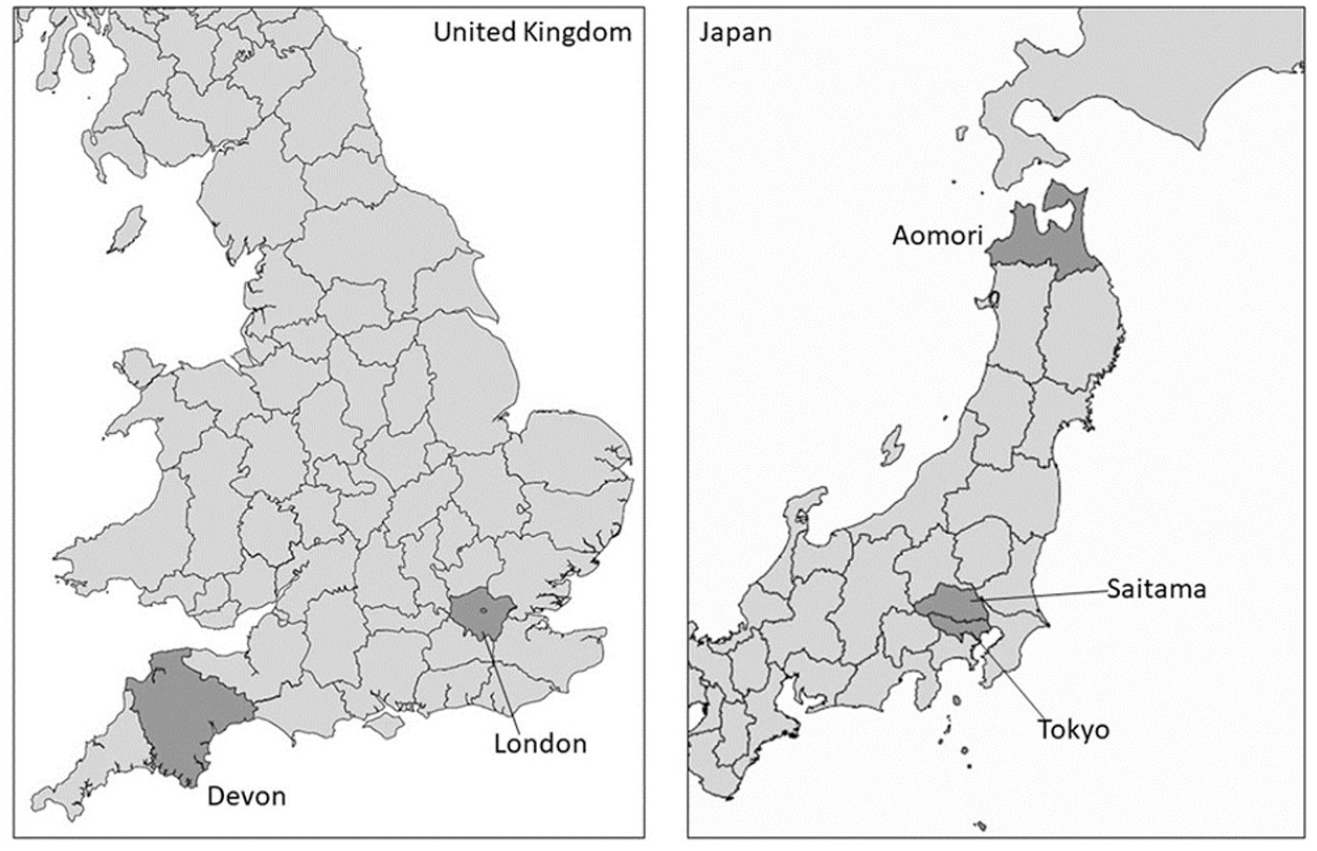
Location of field sites in England (within the United Kingdom) and Japan.
Recruitment began by contacting secondary schools in selected field sites, inviting their eligible students to take part in a photography-based research project. In England, the project targeted Year 10 students who are typically aged 14 to 15 years. In Japan, the project targeted second or third year junior high school students typically aged 13 to 15 years. In total, we recruited two schools each from London, Tokyo, and Aomori, and one school from Saitama. In Devon, we recruited three schools in total due to challenges with facilitation in one school, which prompted us to recruit an additional school. In total, we recruited 45 students across five schools in England, and 53 students across five schools in Japan. Participants were recruited from the whole year group, with the exception of two schools in Devon (Devon:1 and Devon:3; see Table 1), where participants were recruited via their GCSE (General Certificate of Secondary Education) art classes. In 2019, approximately 3.6% of students took Art GCSE examinations in England (national secondary education exams, typically taken at age 15–16 years; National Society for Education in Art and Design, 2023), meaning photographs from Devon:1 and Devon:3 likely represent data from particular types of students who enjoy art. A brief outline of school characteristics and the number of participants per school is outlined in Table 1. Overall, schools in England tended to be larger in size compared to schools in Japan, as secondary schools in England typically cater to a wider age-range. Schools in Aomori were notably smaller, likely due to demographic differences with comparatively fewer numbers of young people in the area. Note, while school London:1 and London:2 were both Catholic schools, both schools served the local community and had a multi-faith student body.
Brief Summary of School Characteristics and Participant Numbers Per School.
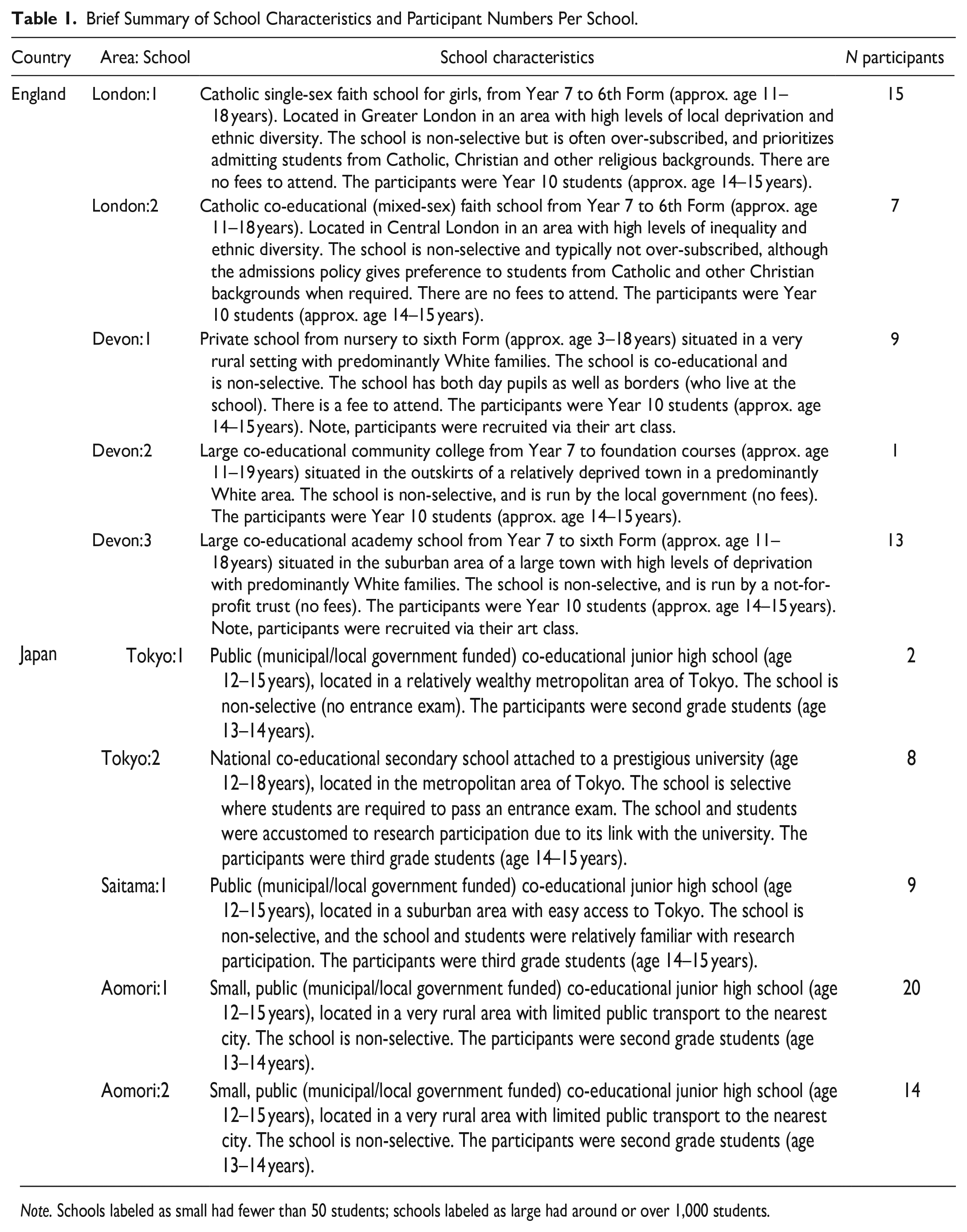
Note. Schools labeled as small had fewer than 50 students; schools labeled as large had around or over 1,000 students.
The data collection period in England ran from April 2019 to January 2020, and the data collection period in Japan ran from August 2019 to December 2019. Once the schools decided to take part, in England, information on the project was disseminated to eligible students by their teachers. In Japan, information on the project was disseminated to students (potential participants) via an information session run by researchers. Students who decided to take part first attended a workshop session where researchers: introduced the project aims (i.e., to better understand adolescence from the perspective of adolescents themselves); explored photography as a way to capture important things in their lives; discussed ethical photography practice; discussed the importance of privacy and risks of identification; discussed publishing rights; and practiced how to take photographs using point-and-shoot cameras. In both countries, students were loaned point-and-shoot cameras for approximately 1 week (although a small number of students used their own cameras or mobile phones), and were asked to photograph important people/places/things in their lives. While a minority of participants were familiar with using cameras, for most students who took part, a camera was a relatively novel object (with several students stating it was their first time using a camera; day-to-day, participants typically used their smart phones to take photographs). Students then attended a second session, where they selected photos to submit to the researchers, and gave titles to their chosen photographs and produced accompanying text. The format of the sessions mirrored project work and writing tasks delivered in school lessons, and all students who took part were able to follow the activities and tasks. All sessions were held on school premises, within or outside of timetabled classes depending school preferences. In all sessions, researchers made an effort to minimize priming for what was important for students, for example encouraging students to suggest their own thoughts and ideas when they raised questions around what to photograph or what to write. In general, students took their time in selecting their photos, suggesting they carefully considered photographs that represented important people/places/things in their lives. Supplemental Information on data collection materials are available at https://osf.io/gdhz8/.
While the data collection methodology was broadly similar between countries, there are some differences to note. In England, the timing of the project coincided with changes to data protection legislation with possibility of significant fines for institutions found to be in breach of this legislation. Consequently, the university data protection and ethics approval procedure became highly sensitive to institutional risk, discouraging data collection of any identifiable information including photographs. We therefore required student photographs and text to be publicly published first, thereby transforming photographs into public data, before it could be used for research (note, the privacy implications of this were carefully explained to all participants, verbally and in writing, and additional participant consent was taken regarding publication of photographs). In contrast, in Japan, photographs and text were treated as research data first and foremost with researchers being responsible for data protection. Based on a decision made by researchers, identifiable photographs could not be published online without removing identifiable aspects such as faces. As a consequence, in England, participating students took part with an understanding that their chosen photographs would be published and publicly shared, and students were permitted to self-select and submit up to eight photographs. In Japan, students had the additional option of choosing to share their photographs with researchers only without publishing them publicly. In Japan, due to time constraints, participants were permitted to self-select and submit approximately 3 to 5 photographs (depending on the schools/situation). The published photographs and accompanying text are available at https://www.adolescentsociality.com/ at time of publication.
Data Analysis
We implemented template analysis of the photographs and their accompanying text, taking an interpretive phenomenological approach to understand the data. Template analysis is a form of thematic analysis where a coding template is iteratively developed and applied collectively, incorporating both deductive and inductive analytical processes (Brooks et al., 2015). An interpretive phenomenological approach directed us to concentrate on participants’ subjective experiences within their respective environments in our analysis, although our analytical focus was on identifying country-level themes rather than describing individual experiences.
In terms of researcher characteristics, the project lead for England (Emmott) is half Japanese and half English, who spent her childhood in Japan before moving to England. The project lead for Japan (Morita) is Japanese, and visited England on three occasions for research (including to facilitate one workshop as part of this project). We had a broad range of researchers on the team spanning various academic disciplines unified by evolutionary sciences (e.g., evolutionary anthropology/psychology/biology/demography), and most team members were early and mid-career researchers at the time of data collection.
With the diversity of researcher characteristics in mind, to improve the validity and reliability of our data analysis, a subset of the research team met prior to initiating data collection. In this pre-fieldwork meeting, we consciously documented our preliminary assumptions, acknowledging that we expected student photographs to center on themes of Connections, Status, Skill, and Identity (see Supplemental Information for an excerpt of meeting minutes: https://osf.io/gdhz8/). This proactive step facilitated the explicit recognition of our preconceptions and biases, and also informed the development of our initial coding template.
Post data-collection, data from England and Japan were initially analyzed independently by local analysis teams, then amalgamated through a series of joint discussions and validation meetings across both teams. Note, while the coding templates for England and Japan were developed independently, lead researchers maintained contact between countries throughout the project, and both teams likely drew on past project discussions including the pre-fieldwork meeting. This inevitably led to similar initial coding templates between the countries: in England, the initial template began with Connectedness and Identity (see: https://osf.io/x5dqh), while in Japan, the initial template began with Commitment, My Self, and Connections (see: https://osf.io/gb8us). In England, the photographs and text were analyzed in collaboration with the lead researcher and four additional anthropology students (at both undergraduate and postgraduate levels) who were not involved in the data collection process. One or two additional researchers involved in data collection participated in the discussion meetings. This decision was made to diversify the perspectives of the researchers, and especially to incorporate interpretations from those closer in age to the participants. This approach was not feasible in Japan due to the restricted access to the unpublished photographs which was limited to the project’s researchers. Consequently, in Japan, the template analysis was conducted by seven researchers who all participated in some of the data collection sessions.
After the completion of country-specific analyses, team members from both countries convened to discuss the results and finalize the findings. These discussions involved presenting preliminary findings, identifying overlapping themes between countries, and identifying country-specific themes. Further information outlining the analysis process is depicted in Figure 2, and Supplemental Information and materials including draft templates are available at https://osf.io/gdhz8/ (note, some of the theme names and codings vary between the draft templates and the final results presented here).
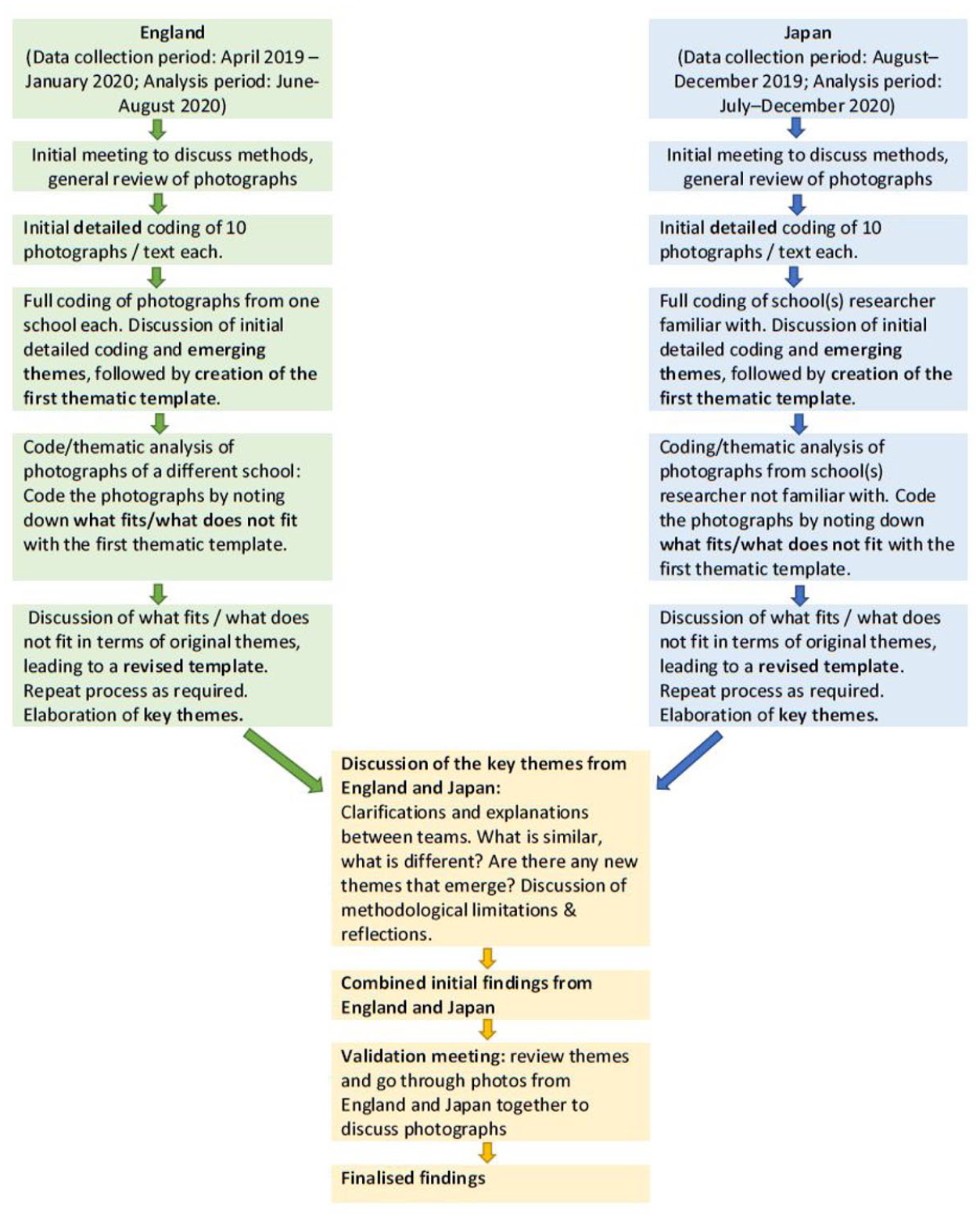
Flowchart of data analysis and validation steps.
Results
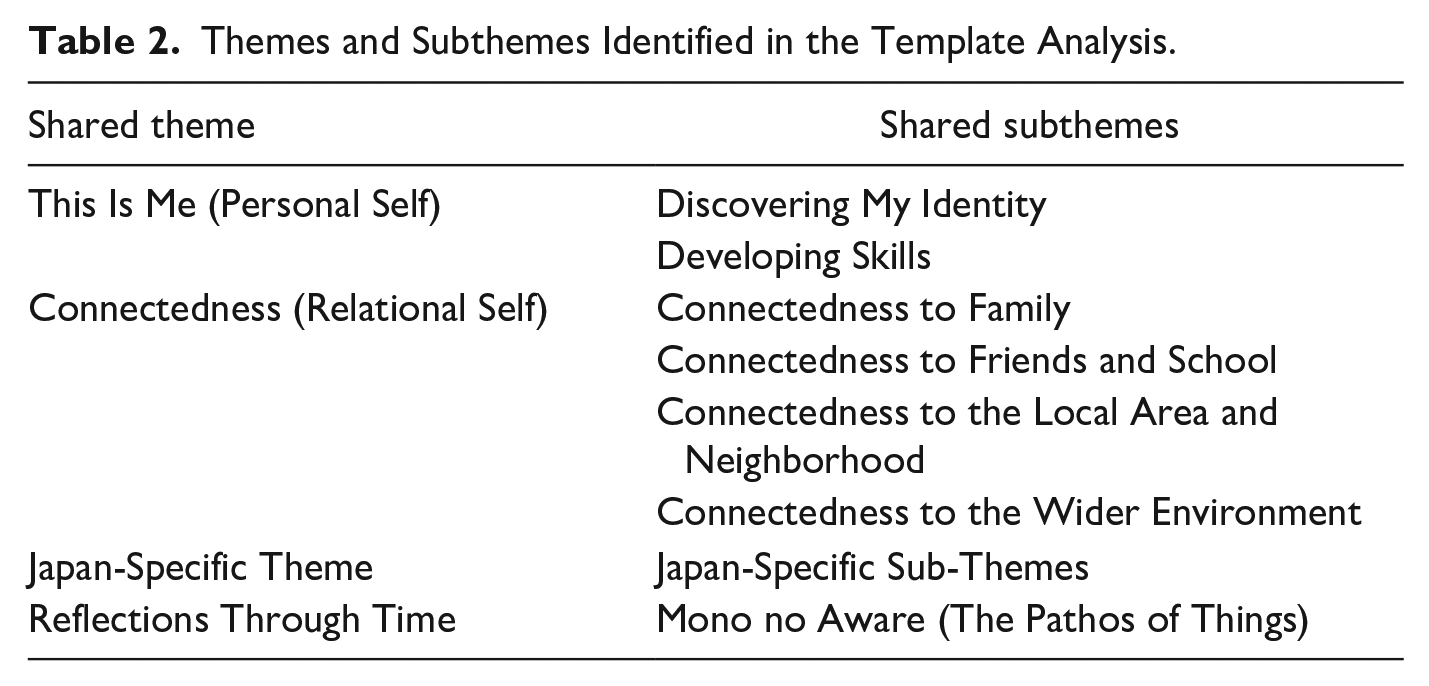
Across England and Japan, two shared themes were identified: This Is Me, capturing the development of the “personal self” through self-discovery and skills-development, and Connectedness, capturing the development of the “relational self” and reflecting feelings of belonging, including connectedness to family, friends and school, the neighborhood, and the wider environment. An additional independent theme, Reflections Through Time, was identified among photographs and associated text from Japan. This theme captured thoughts, feelings and emotions which referenced the past or the future. Notably, these reflections were not always positive—which was in distinct contrast to the photos and texts from England. Some photographs and texts reflected the concept of Mono no Aware (もののあはれ), broadly translated as the “pathos of things,” capturing reflexive thoughts and emotions which emerge when regarding the transience of the external environment or objects through time. Consideration of time (past-present-future) was not something identified in England, as students in England focused strongly on the present.
Table 2 outlines the identified themes and subthemes. Note, these themes are interconnected, with overlap between themes and subthemes, and one photograph could be categorized across multiple themes. While our method is not conducive to making individual-level inferences, we broadly indicate theme prevalence using quantifiers such as “many,” “some,” and “few.” We elaborate on the themes below, with particular focus on similarities and differences between England and Japan. Examples cited are all available at https://www.adolescentsociality.com/photos, and the Japanese text written by the participants has been translated to English by researchers (note, the quotes translated for the present paper may vary from the original translations published online).
Themes and Subthemes Identified in the Template Analysis.
Shared Theme 1: This Is Me (Personal Self)
Many photographs across England and Japan represented aspects of participant lives with personal significance, such as people, locations, objects, or events. Instead of focusing on the subjects within the images, participants typically used the associated text to expand on how the photographs represented aspects of themselves, using the photographs to symbolize and convey their personal identity. Two prominent sub-themes emerged within this overarching theme: Discovering My Identity and Developing Skills.
Discovering My Identity
Many photographs and descriptions centered on participants’ cherished possessions (e.g., clothes and books) as well as their hobbies (e.g., music, art, sports). The photograph texts were often characterized by positive emotions and feelings, with explanations of why these objects were important to the participants and what they represented. These items were not merely objects of interest, but were tools to communicate and showcase key characteristics about the participants themselves.
For example, one male student in London, England, submitted a picture of his PlayStation and some games, titled The Gaming Experience. He explains, “Gaming has always been a part of me (emphasis added) and it is something that lingers around me. The inspiration of this is to portray my collection of PlayStation inspired products including my PS4, my controllers, my LED display and my headset.” Similarly, in Tokyo, Japan, a student submitted a photograph of books with the title, A Part of my Personality, with the accompanying text, “The book that moved me for the first time in my life, and important books (behind). It greatly moves my heart. Sacred treasures of humans letting me enjoy a plethora of emotions. My brother (twin) went and borrowed the book Sekaichizu no Shitagaki (A Draft of the World Map) for me when I had the flu.” In both cases, the objects represent significant formative experiences and how this relates to the current “self.”
At first glance, the participants’ focus on these objects could be described as relatively mundane, or may even be perceived as consumerist/superficial. However, the depth of connection between participants and what these objects represented were often significant and profound, echoing an essential part of their self-identity. The fact that many participants used the photographs as a way to reflect the “self” underscores the well-established notion that identity development is a pivotal aspect of adolescence within the cultural contexts of England and Japan.
Developing Skills
In both countries, many photographs represented the participants’ strong commitments and dedication to schoolwork and extra-curricular activities such as sports, drama, and art. For example, one female student from Devon, England, submitted a picture of medals with the title competitive nature, explaining, “These are my taekwondo accomplishments and the more I accomplish the more confident I become and that largely helps me day to day when out and about and in school.” Similarly, one female student from Saitama, Japan, submitted a picture of a basketball, titled My Basketball, explaining, “Basketball. Because I like basketball, was a member of a girls basketball team, liked it since elementary school.”
Some photographs from Japan incorporated the concept of “time” or its flow into their descriptions, for example by emphasizing their past journey around skills development or how it related to future goals and ambitions. In contrast, photographs from England typically focused on the present. For example, one student from Aomori, Japan, submitted a photograph of their mechanical pencil, explaining, “I have used this pencil since entering junior high school. It’s the first mechanical pencil I’ve used, so I have an attachment to this.” Note, mechanical pencils are typically not allowed in elementary/primary school. Thus, the mechanical pencil signifies a school transition, and the value of the pencil is formed by its link to this transition as well as its usage through time. In comparison, a student in London, England, submitted a photo of a school workbook and pens, explaining, “Something I do every week, learning and getting educated,” capturing the process of skills development in the present.
Shared Theme 2: Connectedness (Relational Self)
Many photographs from both countries captured the importance of connectedness and belonging in their lives. This was expressed directly, through photographs of people, as well as indirectly, through photographs of objects that represented the relationship they had with others. Some photographs also captured the wider environment which represented the physical spaces and locations where the feelings of connectedness and belonging were fostered. Overall, we identified sub-themes of connectedness to family, friends/school, local area/neighborhood, and the wider environment. This theme overlapped with This is Me in that students often described how the relationships and feelings of connectedness related to their “self.”
Connectedness to Family
Many photographs captured people and objects relating to the participants’ families, including parents, siblings, cousins, grandparents, and pets, often reflecting strong emotional connections. For example, one student from London, England, took a photograph of an ornate golden table lamp titled lamp of light, explaining, “This lamp was something me and my dad bought for my mums [sic] birthday and when we gave it to her she said the lamp of light.” Here, the lamp represents a special moment which stemmed from gift-giving, reflecting a connection between the student, father, and mother. In Japan, one student from Tokyo, Japan, took a photograph of a toy walrus, stating, “My late grandmother bought this for me at an aquarium when I was little. I love my grandmother, and this is a treasure which inspired my first dream to become a Walrus zookeeper when I was younger.” For this student, the connectedness with their grandmother persists through time regardless of her presence, alongside an understanding of how the connectedness has impacted their future goals (overlapping with personal self).
Connectedness to Friends and School
Many photographs captured friends, either directly or by representing them through significant objects (such as gifts they received) and places (such as classrooms). In Japan, important relationships tended to exist within school, with connectedness sometimes spanning year groups with older and younger students. For example, one student from Tokyo, Japan, took a photograph of some letters the student received during the last year of primary school from younger students. They state, “When I was in Year 6 [final year of primary school], I received love letters from Year 1 children every day. I don’t think I will have an opportunity to write letters and love letters in the future. I could cry thinking about the effort these children put into learning and writing these letters.” This student, 14 at the time of the project, had kept these letters for 2 years and brought them out to photograph for our project. Arguably, this reflects how the student continues to value the connectedness they experienced to the younger students in their primary school, beyond their immediate peer group. This was seemingly in contrast with photographs from England which focused on current connectedness with friends within their year group, or team-mates and peers from their extracurricular activities (overlapping with skills development). For example, one student from London, England, took a photograph of their class, stating, “Representing my secondary school family. Together we are one strong unity and community.” Here, the student reflects the close relationship they have with their classmates within their year group—but also implicitly excludes the wider student body from the connectedness.
Connectedness to the Local Area and Neighborhood
Some photographs focused on local spaces and neighborhoods they spent time in, such as parks, libraries, and neighborhood landscapes. Students seemed to reflect, and sometimes explicitly recognize, how the physical spaces in their local neighborhoods and school interrelated with their personal development and connectedness. For example, one photograph from London, England, titled late nights at the park depicted a group of teenagers playing and socializing around a swing at the local park at night. This was accompanied with the explanation, “Staying out till dark is a big thing for teens. Although it may be cold and sometimes wet and rainy, staying out at the park is a good way to spend time before facing the homework that’s waiting at home.” In this description, it is particularly notable that the student describes spending time in the park despite unfavorable conditions such as being dark, cold, and wet, highlighting its importance. For this student, the local park is an important space which facilitates fostering connections with friends, providing an opportunity to experience enjoyment and play with others before engaging in burdensome homework. Similarly, one student from Aomori, Japan, took a photograph of their school sports ground, stating “I was able to photograph it looking nice, but the sports ground is actually plain. This sports ground is important because I play baseball here.” Here, the student explicitly focuses on the space as an important component for playing baseball, presumably facilitating their identity and skills development as well as connectedness to their friends and school.
Connectedness to the Wider Environment
Some photographs captured the wider environment experienced by students beyond their immediate neighborhood. Unsurprisingly, in urban areas, this was more likely to depict the built environment (such as photographs of city landmarks), while in rural areas, photographs tended to focus on the natural environment (such as fields and mountains). This theme differed from Connectedness to the Local Area and Neighborhood in that the photographs did not represent a specific location or space, but represented the wider world in which students and their neighborhoods were situated. The meanings behind the photographs were not always clear, although sometimes it was driven by the visual appreciation of the scenery.
Specifically for photographs of the natural world (such as photographs of the sunrises and greenery), a few photographs touched upon the impact these sceneries had on the participants’ emotional state and wellbeing. For example, one student from Devon, England, took a photo of the sunrise over their neighborhood from their bedroom window, titled Stillness. They state, “I like to wake up to this view as it lets my [sic] channel my inner peace and let me start the day fresh.” Similarly, a student from Saitama, Japan, also took a photograph of the sunrise over their neighborhood, explaining, “This is a photo of the rising sun between the black clouds. When I see different types of sunrises every morning, I feel it’s beautiful, and I feel a sense of peace.” Therefore, for some students, the connectedness to the wider environment seemed to mirror a meditative process.
Japan-Specific Theme: Reflections Through Time
Some photographs from Japan situated participant feelings, emotions, and thoughts in reference to the past and/or the future. Interestingly, photos in England predominantly focused on the present (with exception of one student who explicitly reflected on time and growing-up), validated through negative case analysis. In England, students primarily described what they did or liked, such as “I enjoy going to the zoo” (Devon, England) or “I love making different food” (London, England). Where time was mentioned, it was typically used as a descriptor of the present (e.g., “I have lived in my home for 11 years,” Devon, England), meaning student photographs from England remained anchored to the “present self.”
While similar photographs focusing on the present were also present in Japan, it was not unusual to find students from Japan contextualizing their thoughts and experiences with reference to time. For example, one student from Saitama, Japan, took a photograph of a wristwatch, explaining, “My father bought this for me when I started junior high school. Once I use this watch for 10 years and fulfil my dream of becoming a nurse, I will buy a second watch!” Here, the student refers to their dream career, and connects the past (start of junior high school) to their future through the watch in the present. References to future careers were absent in England. Another student from Aomori, Japan, took a photograph of a wallpaper machine. The student explains, “My father used the room for over 10 years, and he smokes, so there is heavy tar on the walls, and it did not come off, so we asked the decorator to replace the wallpaper, and I took the photograph as I saw a [Japanese TV celebrity] use this machine to apply glue to wallpaper on [a Japanese TV show] and I was interested. I felt this is important, because thinking about using the room after it is refreshed makes me happy, and I thought it’s important to keep looking after the room.” Here, the student’s happiness is derived from imagining the future, leading to the motivation of future actions to take care of the room.
Mono No Aware (The Pathos of Things)
A small subset of photographs from Japan depicted somewhat melancholy feelings and thoughts in reflection of the past, mirroring the concept of Mono no Aware (もののあはれ), broadly translated as the “pathos of things” relating to the understanding and acceptance of the transience, closely related to the Buddhist notion of impermanence (無常, mujō; S. Heine, 1991). These particular photographs and accompanying texts captured the students’ reflexive thoughts and emotions which emerged through recognition of life’s fleeting moments in which they have no control over. This was in contrast to photographs from England, where described thoughts and feelings were predominantly positive (with the exception of one student), focusing on the present. For example, one student from Tokyo, Japan, captured a photo of their local library, titled My Place [of Belonging]. They explain, “I took a photo of the library which I often visit. The environment at my home is not very suitable for studying, so I spent most of my time here in Year 6 which I devoted to the junior high school entrance exams.” Here, their place of belonging is not overtly positive in description; rather, the student reflects on how the significance of the location emerged through a situational consequence of their home environment and the need to study in their past. Another student from Aomori, Japan, photographed the school baseball ground, stating, “The sports ground I use every day was covered in snow, and I felt the joy of winter coming, and the sadness that I can no longer play baseball outside.” Here, the student reflects on how the season brings change, pushing baseball-playing into their past which they mourn, alongside welcoming winter.
Discussion
In line with past research, we found identity development to be a significant component of adolescent lives in both England and Japan, with photographs and accompanying texts showcasing the “personal self” of students, including skills development (This is Me). We also found that photographs focused on participant connectedness to multiple levels of their socio-ecological environment, showcasing their “relational self” (Connectedness), complementing studies that find connectedness/belonging to be a key predictor of health and wellbeing (Allen et al., 2021; Parker et al., 2022). While past research involving adolescent “connections” has tended to focus on interpersonal relationships (particularly with peers, parents and romantic partners; Smetana et al., 2006), our study points to how adolescents in these two countries connect with their worlds beyond their immediate social networks including their neighborhood and local area. According to ecological systems theory, child and adolescent development is influenced by a complex, multi-level system around the individual (Bronfenbrenner, 1979), and past studies have shown that neighborhood factors independently relate to adolescent mental health and wellbeing (Thorpe et al., 2023; Turkmani et al., 2023). In line with this, and mirroring long-standing arguments by anthropologists (Glass & Emmott, 2024), our results point to the importance of continuing to focus on the wider context beyond the microsystem (i.e., immediate environment) to understand the complex processes and determinants of adolescent development.
Our findings also point to some interesting differences between England and Japan. First, within our Connectedness theme, we noted that photographs in England tended to focus on connectedness to peers within the same year-group at school, whereas photographs in Japan additionally captured connectedness with older or younger students, and from the past as well as the present. In Japan, age is an important component of social hierarchy (Nakane, 1984), and such hierarchies also exist within schools via senpai (senior) and kohai (junior) relationships which are underpinned by the responsibility of senior students to guide junior students (Wang, 2022). In school environments, older students are expected to act as role models and may have responsibilities to teach and discipline younger students, particularly in extracurricular school clubs (Wang, 2022). In contrast, children and adolescents in England tend to be age-segregated at school, and in a cultural context where children are viewed as immature and vulnerable (Emmott & Gibbon, 2024), older children and adolescents are not socially expected to guide or teach younger children. Thus, our results may reflect differences in typical adolescent social network structures between England and Japan, stemming from differences in cultural norms and education systems.
Second, we identified that photographs in Japan were more likely to reference time, resulting in a Japan-specific theme of Reflections Through Time. These were in distinct contrast to photographs from England which were overwhelmingly focused on the present. Past research has found cross-cultural differences in temporal orientation, with individuals from Euro-Western populations more likely to focus on the present, while those from East Asian populations are more likely to focus on the past and future (Gao, 2016). Japan has been described as a “high-context” culture where communication requires understanding contextual cues beyond words or sentences (Broeder, 2021), as well as being described as an “interdependent” culture where individuals view themselves as part of a wider social system (Keller, 2009). Thus, it may be normative for students in Japan to think more holistically and relationally compared to students in England, including how things change and relationships with time. Note, in England, students who took part in the project were preparing for their GCSE (secondary school) qualifications, with some students preparing for their practice “mock” GCSE exams—which may have focused their attention and goals to the present. Further, in England, many students remain at the same school after their GCSE qualifications, and the majority of our students from England would not have been expecting or thinking about school transitions. In contrast, in Japan, many students were in the final year of their junior high school, with imminent transitions into high school. This may have encouraged greater consideration of time and change, such as thoughts about future careers.
Finally, while photographs from England were overwhelmingly positive in framing, a small but notable number of photographs from Japan depicted melancholy reflections aligned to the concept of Mono no Aware, or the impermanence of things. Mono no Aware has been described as a distinctively Japanese aestheticism traced back to The Tale of Genji written in the 11th century, which subsequently came to wider national prominence in the 18th century (Ward, 2022). It is closely tied to the concept of Mujō in Buddhism, or the understanding that life is impermanent and ever-changing (S. Heine, 1991). In its contemporary form, Mono no Aware can be described as the resignation to the transience of nature, and the appreciation of beauty that lies within. Our findings from Japan may therefore reflect a cultural schema where individuals situate themselves in reference to changes through time, with recognition and subdued appreciation that things come to an end. This may also explain why past research has found that Japanese adolescents are more likely to be in the state of “moratorium” compared to Euro-Western counterparts (Hatano et al., 2020): if viewing oneself in relation to the transience of life is permitted or encouraged in Japanese culture, committing to an identity may be more challenging (or perhaps not desired or necessary), leading to higher levels of uncertainty.
Overall, these findings contribute knowledge on how adolescents in England and Japan may be engaging with their environments during this crucial developmental period. Our results suggest that adolescents in both contexts are similar in focusing on their identity development, scaffolded by their connectedness to different levels of their socio-ecologies beyond their immediate social network. However, our results also point to the importance of culture in how adolescents engage with and think about their lives/environment, with Japanese adolescents more likely to be reflexive with reference to time. Such cultural differences may explain some observed variations in adolescent identity development between Japan and Western European countries.
Limitations
There are several notable limitations to our study which impact our findings and interpretations. First, the photographic nature of the project means that participants visually captured snapshots of their lives. While this method complemented our study aim to identify similarities in what adolescents tend to self-identify as important, our findings do not provide a comprehensive description of the lived experiences of adolescents across England and Japan. Importantly, due to our methodological focus on identifying shared themes and patterns within and between countries, our study does not describe any variation at individual level.
Second, a minority of students seemed hesitant to submit their photographs and text to the researchers. In one school in Devon, for example, a researcher noticed that one student was not engaging in the writing task. Upon a quick conversation, it became apparent that the student was worried about incorrect spellings, and required reassurance that we were not assessing them, and that we could help them with spellings. This then led to the student engaging with the writing task. Our data collection method mirrored the format of art projects and writing tasks students regularly engage in at school, and this familiarity likely facilitated participation overall. However, the example above highlights how our method also overlapped with participant experiences of assessment and evaluation at school, and this may have amplified the feeling that the photographs and texts were going to be viewed and judged by others. This indicates that our study suffered from some observer effects, which of course is impossible to eradicate where active data collection by researchers is involved. Nonetheless, to address this limitation, we recommend combining autophotography with additional methods such as ethnographies and interviews to deepen interpretation and understanding of the data.
Third, particularly for England, more girls took part in the project than boys. This was driven by one school in London being an all-girls school, and one school in Devon where the project was linked to a GCSE art class which was mainly taken by girls. We did not explicitly collect participant gender information, and gender was not considered in our analyses. However, studies suggest girls develop their relational identity more strongly than boys (Meeus et al., 1999), meaning we may have over-representation of social relationships in our data. A number of boys did take part in our study, and we were able to identify themes beyond immediate social relationships—but it is not clear from our findings if important aspects of adolescent lives vary between boys and girls.
Fourth, in this study, the photographs were coded by researchers without participant involvement, meaning our interpretation of the data may not accurately reflect participant intent. We had originally planned to schedule an engagement event to showcase the participant photographs and discuss them with participants and others, but this event was cancelled due to the COVID-19 restrictions. We attempted to mitigate against potential researcher bias by applying an extensive validation process (Figure 2), as well as on-boarding four university student researchers in England to diversify our perspectives. Still, a small number of photographs did not have accompanying text, and interpretation of these photographs were particularly challenging. We therefore strongly encourage future research to involve participants with interpretation in autophotogrpahy or similar projects.
Finally, the direct implication of this study is limited to the population context in which this study was conducted; namely, younger adolescents attending mainstream schools in England and Japan. Anthropological studies have evidenced a range of developmental environments and processes across populations, including ethnographic accounts of a lack of identity exploration during adolescence in some cultures (Hewlett & Hewlett, 2012; Mead, 1928). We therefore support calls to explore the diversity in bio-psycho-social processes across populations, particularly beyond the East-West dichotomy which is prevalent in psychological research.
Future Directions
Current knowledge of developmental processes are predominantly built on Euro-Western studies (Glass & Emmott, 2024), but both anthropological theory and evidence suggest that there is plasticity in how children and adolescents learn about their world and themselves, influenced by the local culture and how adolescents engage with their environments. Our study suggests that, even between populations which are broadly economically comparative (Global North, G7 nations), variations in culture may lead to variations in how adolescents think about and engage with their world—potentially leading to differences in “typical” developmental trajectories. Thus, our study cautions researchers against assuming developmental processes identified in Euro-Western contexts are universal, and encourages researchers to adopt a biocultural/biosocial framework by considering how culture may shape development (Glass & Emmott, 2024).
Footnotes
Acknowledgements
We would like to thank all the participants who took part in the project. We would also like to thank the schools and teachers who facilitated the project, including the Secondary School attached to the Faculty of Education, The University of Tokyo, Ageo Higashi Junior High School, Hirosaki Higashimeya Junior High School, Hirosaki Susono Junior High School, and other anonymous schools and teachers who supported and facilitated the project. We would also like to thank Prof. Rebecca Sear, who provided project feedback, Ms Hirose and Ms Chihiro Sato, who assisted in conducting fieldwork in Japan, and Esther Kraner, who supported some of the literature search for this manuscript. Our thanks also go to Dr Rie Toriyama, who provided us with expertise on cultural psychology to enhance the project, and Prof. Ruth Mace, who supported the project grant application.
CRediT
Conceptualization: Emily H. Emmott; Data curation: Emily H. Emmott; Formal Analysis and Validation: Yasuo Ihara, Yudai Tokumasu, Mari Nozaki, Atsuko Saito, Tetsuya Kawamoto, Shingo Ito, Anushé Hassan, Laura J. Brown, Thea Dennett, Andrew Crane, Catherine Borra, Amanda Nesci, Masahito Morita; Funding acquisition: Emily H. Emmott, Masahito Morita; Investigation (Data Collection): Emily H. Emmott, Anushé Hassan, Laura J. Brown, Yudai Tokumasu, Mari Nozaki, Atsuko Saito, Tetsuya Kawamoto, Shingo Ito, Masahito Morita; Methodology: Emily H. Emmott; Project administration: Emily H. Emmott, Masahito Morita; Writing—Original Draft: Emily H. Emmott; Writing—Review & Editing: Masahito Morita, Yasuo Ihara, Mari Nozaki, Atsuko Saito, Tetsuya Kawamoto, Laura J. Brown.
Declaration of Conflicting Interests
The author(s) declared no potential conflicts of interest with respect to the research, authorship, and/or publication of this article.
Funding
The author(s) disclosed receipt of the following financial support for the research, authorship, and/or publication of this article: The direct costs of this project were funded via the ESRC-AHRC UK-Japan Connections Grant (grant ref: ES/S013733/1; Co-PIs: Emily H Emmott and Masahito Morita). Yasuo Ihara was further funded by MEXT KAKENHI (Grant-in-Aid for Scientific Research on Innovative Areas; grant ref: JP17H06381).
Ethical Approval
Data collection in England was reviewed and approved by the University College London (UCL) Research Ethics Committee (ref: 14733/001), and data collection in Japan was reviewed and approved by The University of Tokyo (ref: 18-376, 21-50, 21-433, 23-13, and 24-631), Sophia University (ref: 2019-14, 2020-13, 2021-42, 2022-034, and 2023-019), and Hirosaki University (ref: 0002). All participants, parents/guardians, and schools who took part in the project gave consent and permission to take part in the study. Consent could be withdrawn at any time during the project, and participants were able to request deletion of their data at any time before the publication of the photographs/research results. Supplemental Information on ethical and consent materials are available at  .
.
Data Availability
All research data from England, and some research data from Japan with participant consent to be published, are publicly available at . We request users to be mindful of the different creative commons copyright of the photographs. We are not able to share unpublished photographs from Japan due to data protection and participant preferences.