




Abstract
Minority stressors harm sexual and gender minority youth (SGMY). This may be mitigated by promotive and protective factors and processes that manifest resilient coping. SGMY increasingly interact with information communication technologies (ICTs) to meet psychological needs, yet research often problematizes youths’ ICT use, inhibiting understanding about ICTs’ potential resilience-enhancing utilities. This study analyzes text and video responses of 609 SGMY aged 14 to 29 residing in Canada or the United States to an open-ended survey question about the benefits of using ICTs. Constructivist grounded theory integrating multimodal coding was used to analyze the data, producing a framework of digital resilience—digital processes and actions that generate positive growth—with four themes: Regulating Emotions and Curating Microsystems; Learning and Integrating; Advocating and Leading; and Cultivating Relationships and Communities of Care. Implications for clinical practice, survey innovation, and application of findings in fostering affirming digital microsystems for SGMY are discussed.
Keywords
Sexual and gender minority youth (SGMY) experience greater exposure to stressors than youth who are not SGMs (i.e., cisgender and heterosexual). For example, cross-sectional data from 3,508 SGMY between the ages of 14 to 18 years old living in the United States (US) or Canada showed higher self-reported levels of adverse childhood events (e.g., household dysfunction, neglect, and abuse) compared to the general population (Craig, Austin, et al., 2020). SGMY routinely experience targeted harassment and abuse attributed to their sexual and/or gender identities and expressions, which can lead to negative outcomes and behaviors including depression, anxiety, self-harm, and substance use (Davis et al., 2020; Russell & Fish, 2016). Due to this targeted harassment, victims may also internalize homophobia and transphobia, which further predicts negative outcomes for SGMY (Blais et al., 2014). Altogether, this points to the cumulative impacts on SGMY of minority stress—the unique and compounding risk exposures experienced by SGM populations (Meyer, 2003).
Although SGMY commonly experience minority stress (e.g., bullying, family instability), their individual coping responses to and the resultant outcomes of these stressors are varied. Resilience, defined as the ability to adapt constructively to risk exposure—including threats to well-being—is a key construct in understanding their exposure-outcome scenarios (Ungar, 2019). Resilience is a state developed through promotive and protective factors and processes that are enacted in various defined and observable settings called “systems” (Overton, 2013). The bioecological theory of development organizes these systems in a nested fashion, providing increasingly expansive units of analysis with which to understand developmental processes that foster resilience (Bronfenbrenner, 2005). Individuals are located within microsystems (i.e., immediate settings such as the family), a mesosystem (i.e., the dynamic relationships between different microsystems that the individual belongs to), an exosystem (i.e., distal settings such as government that indirectly impact an individual), a macrosystem (i.e., the broader sociocultural context), and a chronosystem (i.e., changes in the systems over time; Bronfenbrenner, 2005; Bronfenbrenner & Morris, 2006).
Bronfenbrenner (2005) describes direct interactions between an individual and these systems as “proximal processes” that can manifest positive developmental outcomes that foster resilience. Proximal processes supporting development include differentiating between perception and response; directing and controlling one’s own behavior; coping successfully under stress; acquiring knowledge and skill; establishing and maintaining rewarding relationships; and modifying and constructing one’s own physical, social, and symbolic environment (Bronfenbrenner & Ceci, 1994, p. 569). To illustrate, an SGMY may experience bullying in their school microsystem due to their minority status but express resilience in utilizing their biopsychosocial microsystem (e.g., distractive coping mechanisms; Garnett et al., 2015) or the mesosystem (e.g., permitting a trusted teacher to report it to an affirming parent; Goodboy & Martin, 2018). These relationships between risk exposures and proximal processes that promote improved well-being—such as education (Sanders et al., 2015), support networks (Weinhardt et al., 2019), and personal traits (e.g., self-esteem; Thoits, 2011)—are significant predictors of outcomes in the resilience literature (Masten, 2014).
Furthermore, information communication technologies (ICTs) such as smartphones and tablets have developed such that communications across long distances are now instantaneous, portable, networked, and widely accessible, spawning a unique “cybersystem” with more ambiguous time- and space-based borders than the systems in the physical world (Shelton, 2019). The cybersystem may be conceptualized as a complex digital ecosystem comprising several interconnected digital microsystems, including social media pages, websites, and online entertainment, thereby building on the original bioecological model (Stokols, 2018). As well, the cybersystem resembles the larger meso-, exo-, macro-, and chronosystem in that its subsystems interact with each other and with systems and individuals in the physical world. “Gen Z,” born 1995 to 2010, is the first generation who have had lifelong access to rapidly improving ICTs (Prensky, 2001) but, to date, the cybersystem has been largely considered through a risk- and deficit-based lens that problematizes youths’ technology use (Rao & Lingam, 2021). However, in a systematic review of research assessing outcomes of youth aged 10 to 19 who use the internet, Sage et al. (2021) note that online activity may foster resilience for youth who experience harm offline. Specifically, SGMY engage in various proximal processes, such as seeking information (McInroy et al., 2019); meeting other SGMY and building communities (Craig, Eaton, et al., 2021; Craig et al., 2015); appraising and responding to online negativity (Craig, Eaton, et al., 2020); receiving reciprocal peer support (Armangau & Figea, 2021; Austin et al., 2020; Lytle et al., 2018); coming out (Craig & McInroy, 2014); and engaging in digital activism (Tortajada et al., 2021; Wargo, 2017). Altogether, this repertoire of proximal processes could resemble a kind of digital resilience, which may improve SGMY psychosocial outcomes offline.
Despite this body of evidence pointing toward the resilience-enhancing potential of ICTs for SGMY, scholarship has only recently begun to incorporate the cybersystem into the bioecological framework (Stokols, 2018). Further work is required to consider different levels of risk exposure among different subsections of internet-users and the technological features that mitigate this risk; elaborate on the proximal processes that may constitute digital resilience; identify the digital microsystems where these processes are occurring; and articulate interactions between digital and physical systems and between different digital microsystems (Ungar, 2019). Given the patterns of risk exposure and technology use among SGMY, it is critical to gain a better understanding of the digital systems they are interacting with and their potentially resilience-enhancing benefits. Therefore, this study aims to address these research gaps using a constructivist grounded theory approach that situates the experiences of SGMY within the cybersystem. Secondarily—in keeping with the technology-engaged focus of this study—we also aim to assess brief pre-recorded video narratives as an ecologically valid and information-rich qualitative data source for researchers seeking to tap into the unique ways youth are embodying resilience and communicating to others online with video media (Green et al., 2015).
Methods
This study used qualitative methods to explore SGMY’s experiences of using ICTs and to develop a constructivist grounded theory (Charmaz, 2014) of digital resilience in SGMY. Two research questions guided this study: (a) What digital activities do youth report engaging in to cope with stress? and (b) How do these online proximal processes develop resilience and improve self-reported well-being? Study protocols were approved by the University of Toronto Health Sciences Research Ethics Board.
Data Collection
Data were derived from a subset of a mixed-method, cross-sectional online survey (n = 6,309) described elsewhere that explored the online experiences, mental health, and well-being of SGMY in Canada and the US (Craig et al., 2017). The sample was generated using a targeted online recruitment approach (e.g., social media, website, and emails) and consists of self-identified English-speaking SGMY aged 14 to 29 residing in the US or Canada with technological literacy sufficient to complete the online survey.
This study reports on data from SGMY who responded to a single open-ended survey prompt: “Share a story about how the internet or social media has helped you feel strong or deal with stress in your life.” Participants had the option of uploading a video response or entering a text response. Participants provided additional consent at this stage of the survey, given the added risk of providing video data. Of the 1,146 participants who consented at this stage, 609 of them responded to the prompt. There were 504 text responses (84,070 words) with a mean of 166.81 words per response and responses ranged from 1 word to 1,659 words. There were 105 video submissions (338.40 minutes) with a mean of 3.22 minutes per response and responses ranged from 17 seconds to 18.03 minutes. Participants contributed videos through a web-based secure file system called WeTransfer, which enabled participants to securely upload files on any mobile device or via their web browser. To our knowledge, the option of a video submission represents an innovation in internet-based survey research as it allows participants to respond in a manner that is holistic and expressive (Craig et al., 2017) and captures nonverbal data (Craig, McInroy, et al., 2021).
Participants
Participants (n = 609) ranged in age between 14 and 29 (m = 18.36 years) and were able to choose from various non-exclusive options for gender identity, sexual orientation, and ethno-racial categories, or were able to write their own response in English. A full breakdown of participant demographics is shown in Table 1. Where available, participant demographics are provided alongside their quotes to provide further context about their potential positionality and development.
Demographics of Sample (N = 609).
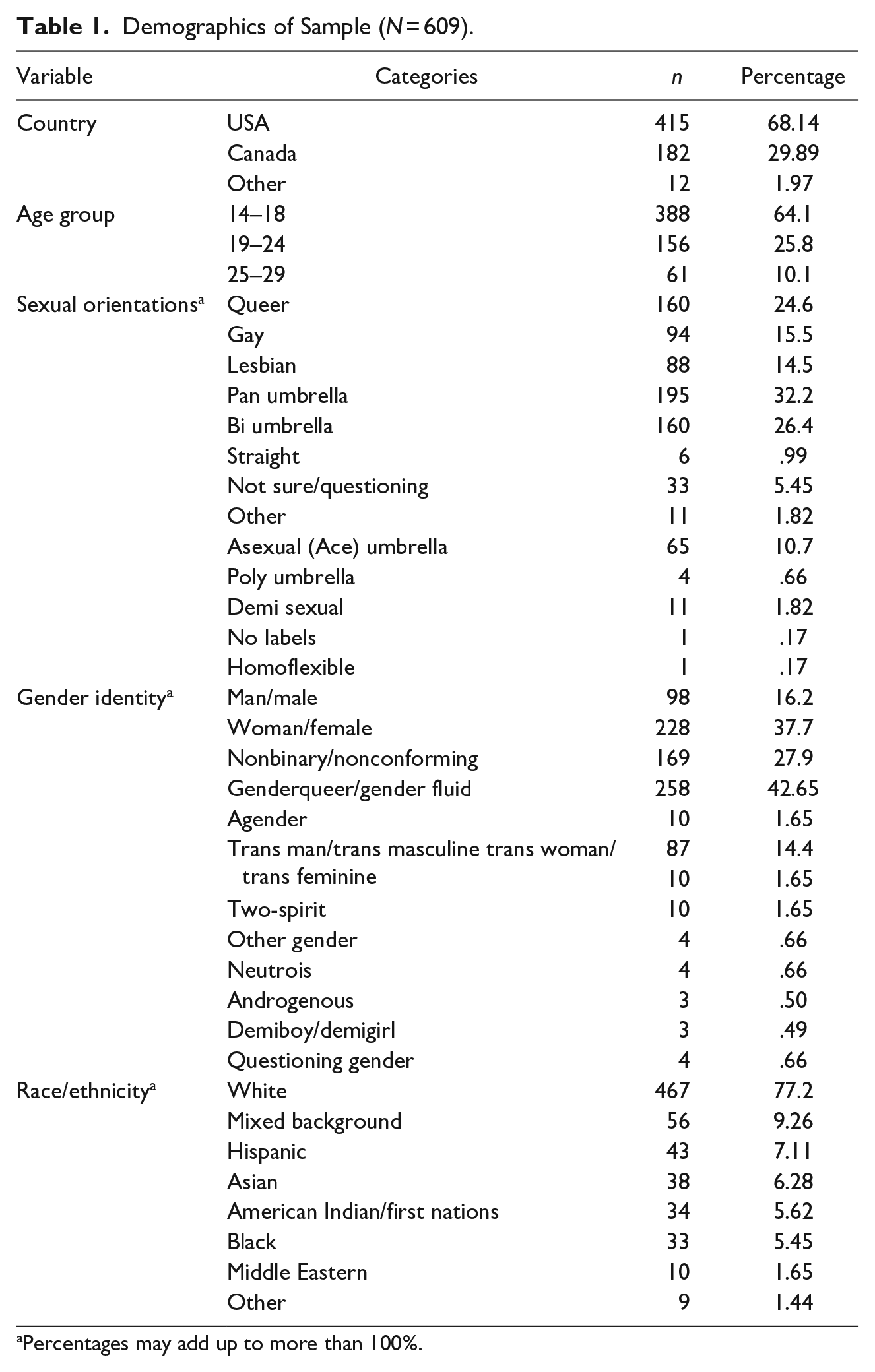
Percentages may add up to more than 100%.
Data Analysis
Constructivist grounded theory was utilized by using NVivo 12 data analysis software (QSR International Pty Ltd, 2018) to analyze and integrate audiovisual and text responses. Grounded theory is an inductive qualitative analytic method that aims to produce a theory (e.g., relationships, structures, and hierarchies) that is “grounded” in the data rather than informed by prior theory or other data (Charmaz, 2014). Each response was coded by three independent coders who were trained graduate students from ethnically diverse backgrounds identifying primarily as sexual and gender minorities. A multimodal analytic process designed in a previous study with SGMY (Craig, McInroy, et al., 2021) guided the coding, whereby each participant’s video submission was first coded as three separate modalities (i.e., text, video, and audio) before being integrated and coded altogether, allowing the coders to appreciate each unique data modality as well as their combined informational value. Background theory on minority stress and resilience were used as sensitizing concepts to aid the analysis (Bowen, 2006). Given that constructivist grounded theory situates the researcher as co-constructing meaning and considers context (Charmaz, 2014), internal processes occurring during the coding (e.g., the coders’ immediate reactions to and interpretations of participant emotions) and disruptions in the data (e.g., gaps in the video, breaks in the text) were noted as part of the analytic procedure. Initial coding consisted of systematically identifying codes in vivo (Charmaz, 2014). Focused and axial coding confirmed codes against emerging themes and a model was constructed that characterized patterns and relationships in the data (Charmaz, 2014). The analysis of multimodal data by three coders of each data type was intended to support rigor and to capture richness in the data (Natow, 2020). To further enhance trustworthiness, each coder maintained an audit trail (Cutcliffe & McKenna, 2004) and the research team met for 12 hours (four times for 3 hours) to discuss the developing analysis.
Findings
The coding process identified a diverse range of online proximal processes that supported positive development and manifestations of resilience. Codes were then abstracted into sub-themes and categorized into four themes that collectively described digital resilience, which we define as “digital processes and actions that generate positive growth.” The themes are Regulating Emotions and Curating Microsystems; Learning and Integrating; Cultivating Relationships and Communities of Care; and Advocating and Leading; which are treated as a continuum of increasingly complex, adaptive, and differentiated responses to minority stress. Each theme was additionally plotted along an intrapersonal-interpersonal-group axis that further discerned between individual-level (e.g., coping strategies, user behavior), interpersonal-level (e.g., learning from others, confiding in others), and group-level microsystems and proximal processes (e.g., participating in online fan communities) to further differentiate the themes. Finally, thematic overlap was incorporated into the emerging model to account for potential relationships between and co-occurrence of different proximal processes, and the ambiguous boundaries of digital microsystems (e.g., parasocial relationships with YouTube vloggers; Chen, 2016). The themes are summarized and thematic relationships elaborated on in Figure 1.
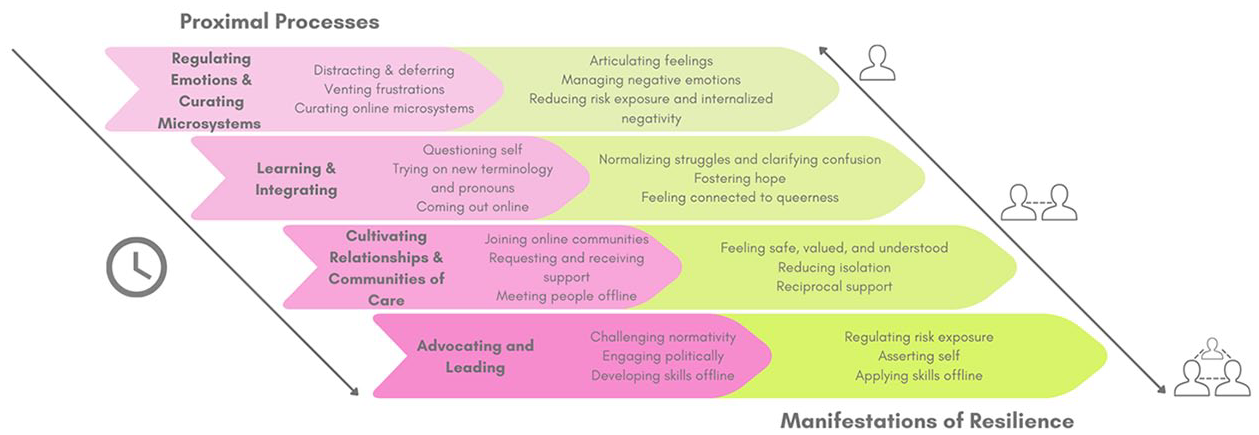
Graphical representation of processes and manifestations of digital resilience.
Theme 1: Regulating Emotions and Curating Microsystems
The first theme describes intrapersonal digital proximal processes that participants used to emotionally regulate themselves in response to risk exposure, as well as reduce further risk exposure (e.g., harassment online, non-affirming home environment offline).
One process that participants appeared to utilize was distraction. A participant explained in a video response that, “Just having [social media] as a distraction from everyday life and stresses and school and all that is a good experience for me, personally” (Video #2060: Age 15, bisexual woman, White), before concluding the recording with a smile to, perhaps, indicate contentment. Another participant explained, “Social media allows [me] to disassociate for a while instead of thinking about what makes [me] stressed” (Text #67: Age 19, pansexual woman, White). Participants described a variety of digital proximal processes that helped them to achieve this, including playing video games; watching videos; reading articles, blogs, and fanfiction; and streaming music. These processes do not involve attending to the stressors themselves, but rather serve to manage or defer the feelings of stress that they produce. As such, this is a less adaptive coping mechanism and may become problematic if utilized excessively to cope with emotional dysregulation (Amendola et al., 2019).
Another process that participants engaged in was venting about challenges they were experiencing in their lives and the negative impacts of these challenges. Unlike distraction, venting acknowledged the feelings and sources of stress, and several participants indicated that the anonymity of the online environment facilitated this process. Indeed, most of the participants in the present study chose to submit anonymous text responses, and of those who submitted video responses, several chose not to show their faces—a pattern we noted especially among participants who discussed self-harm and suicidality. In the following text response, a participant reflected on how online anonymity enhances their ability to communicate without having to filter themselves: Social media is an outlet for me to help me get things off my chest, mostly Tumblr where people don’t know that it’s me. I can say whatever I want, and I don’t have to worry about people judging me since I only have two followers. (Text #3046: Age 17, queer bisexual woman, White).
Notable in this extract is the participant’s stated goal of “[getting] things off my chest” and their observation that they “only have two followers,” indicating that they may be describing a form of journaling or a sense of freedom from being largely unobserved. Since several participants described feelings of secrecy and shame while they were questioning their sexual and gender identities, it is significant that social media provides the ability for SGMY to express themselves safely and anonymously in public forums.
The final proximal process captured by this theme is curating affirming digital microsystems, which was aided by functionalities that are commonplace on social media platforms, including the ability to delete undesirable comments, block other users, represent oneself with avatars, and utilize expansive gender descriptors. This curation allowed SGMY to autonomously create digital microsystems to meet a range of psychological needs while mitigating against online hostilities. In the following extract, curation emerged as a key proximal process that reduces online risk exposure: I’ve stated many, many time [sic] that I’m pans[exual] because I want people to know who I am, even if some are negative about it. So, I got a direct message [on Instagram]. . . saying things like “You’re to [sic] pretty to be such a freak” and “even if you hot af [as fuck] you’re still going to hell”. He ended up spamming me so much that I blocked him. (Text #5118: Age 15, pansexual person, White).
Curation also appeared to be protective for youth experiencing harm offline. This participant described their internalization of the queerphobia they had been exposed to offline by their family, and the online content they consumed that helped them counterbalance these perspectives: I had multiple hospitalizations because I felt that being queer was wrong. . . But then I found an LGBT account on Instagram. It made me see how other queer people felt, and they were feeling the same way I was. Social media has helped me see that my gender identity isn’t twisted. It’s my family’s perspective of gender identity and expression that is twisted. I might not be alive right now if it weren’t for Instagram. (Text #5364: Age 16, trans pansexual man, White).
Interactions between the proximal processes of venting and curating are also evident in this latter extract. The chronosystem clarifies how this interaction occurs: social media websites are digital microsystems that continuously archive content, thereby changing them over time. As such, one user’s venting may be stored and later consumed by other users as a form of digital intimacy (Kirby et al., 2021; Thas, 2017).
Theme 2: Learning and Integrating
The second theme describes intrapersonal and interpersonal processes that involve accessing educational information about LGBTQ+ identities from online sources. These processes appeared to normalize identity confusion and provide opportunities to experiment with various identity-related terminology and pronouns, which offered clarity and a feeling of connection to LGBTQ+ identities, as has been found elsewhere (Bates et al., 2020). In some cases, participants shared their experiences of “coming out” to others in digital spaces and discussed the significance of this milestone.
The internet was often the first place that participants went to for information and resources for questioning and understanding their identity—particularly if such sources did not exist offline. As this participant described: I live in a very conservative area, so I was never very comfortable asking questions offline. Online, I was able to look up terms, share my experiences and hear from others. It made me feel more comfortable knowing I could Google something and not have to worry about invasive questions. (Text #1866: Age 15, pan/bisexual woman, White).
As alluded to by the participant, the unilateral nature of online searches made them a safe way of accessing information because they prevented the asking of invasive questions by another person.
SGMY also discovered and resonated with identities and terms that they were previously unaware of in a variety of ways; including being connected to educational content by others. In one video extract, a participant shared that they expressed doubt about their gender identity on an Instagram page they ran, and a follower of their page responded: At one point I had posted about how I felt disconnect with gender. . . And somebody had direct messaged me on Instagram saying “Hey. . .I can show you some links and stuff and different identities that I think might fit [you]”. . .So this wonderful human being on Instagram sent me links to Tumblr, which had all the identities and definitions and the more I looked into it and searched certain ones, the more I realised, “hey, that’s me”, which felt really good. (Video #2563: Age 14, queer non-binary person, White).
Participants commonly expressed happiness when learning about relevant terminology that addressed identity-related questions. Several individuals conveyed specific appreciation for the information on sites such as Tumblr and Reddit, as evidenced in another engaging video response: “I didn’t know there was a word for [my identity] until I got a Tumblr and until I learned that the word was, in fact, ‘pansexual’. . . That was a really good moment in my life because . . .I was given a word to connect to my identity. . . For that I’d like to thank social media” (Video #2557, Age 17, pansexual woman, White).
These clarifying proximal processes may be especially empowering for youth identifying with emergent gender and sexual identities such as asexual, pansexual, and gender non-conforming (Borgogna et al., 2019), that have garnered comparatively less societal understanding and acceptance. This was illustrated well in an extract from a video submission from an older participant, in which they to speak off-camera: “Nobody ever talked about being asexual, you know? I had to find that on the internet, and it was just like this click [participant snaps fingers], like, this is what’s wr- this is what it is, this is what didn’t feel right all this time. So, had I not had the internet to step in to where my “gay” education was failing me, I dunno what I would’ve done because I was so torn up about not being normal. But I am normal, it’s just a different type of normal” (Video #272: Age 23, asexual woman, White).
In this extract, we also see how this information can normalize experiences of genders and sexualities that may be confusing or stigmatized as “wrong,” a word that this participant initially appeared to select as a self-descriptor, before cutting themselves off and describing themselves instead as “just a different type of normal.” Several participants who submitted videos also communicated similar normalizing sentiments through nonverbal, environmental cues. For example, one participant narrated while drawing a picture of a person’s face above a banner reading the word “QUEER” and concluded their video with the sentence, “I don’t think I would identify as queer if it weren’t for social media” (Video #3034: Age 16, non-binary, agender queer person, mixed ethnic background). Another participant spoke in their video submission about the acceptance they had experienced online while the camera faced a decal on the wall reading, “BE Who You ARE” (Video #3922: Age 15, pansexual genderqueer/fluid person, Hispanic).
Many participants emphasized the process of coming out as a significant milestone. Given the liminal state of “outness” across different time periods and systems, coming out emerged as a highly dynamic aspect of an individual’s chronosystem (Hong & Espelage, 2012) aided by a repertoire of social media sites termed elsewhere as “social transition machinery” (Haimson, 2018). Furthermore, participants noted the influence of others’ social media content on coming out (Gomillion & Giuliano, 2011), including vlogs and National Coming Out Day posts in their decisions to come out, as seen in this extract: I took time and did my research and even watched videos about other people and their experience with coming out. . . I began to realize that it was close to “National Coming Out Day” so I thought to myself that maybe that was something that I could possibly do. So, I decided to make a status about that and sure enough, throughout the day, I got numerous comments on it. . . Not a single one of them were bad at all. (Text #5838: Age 19, gay man, White).
Another participant spoke to the affordances that social media provided them in their coming out process: I don’t know how many coming out videos I watched. . . Tumblr was a great place to learn more about my identity, and others as well. And when I finally did come out? It was through a Facebook and an Instagram post!. . . Without social media at my fingertips, I don’t know where I’d be, still in the closet? Likely.” (Text #703: Age 16, gay man, Asian).
In the last sentence, the participant speculated what life might be like if they did not have access to social media—a rhetorical device that was prevalent among the responses. Participants overwhelmingly made ominous predictions about what their lives would be like in the absence of ICTs, citing not accepting themselves, remaining closeted, worse mental health, and suicide as potential outcomes—altogether speaking to the sense of hope engendered by these important technology-mediated proximal processes.
Theme 3: Cultivating Relationships and Communities of Care
The third theme expands on digital curation processes by integrating interpersonal and group-level units of analysis. These more networked processes enhanced social connection and provided access to LGBTQ+ communities of care (i.e., “ways in which care is organized or offered within LGBT contexts”; Gahagan et al., 2018, p. 34).
Many participants reported experiencing unsupportive and invalidating offline microsystems and attributed their mental health problems and suicidality to these circumstances. Participants mitigated this risk by curating and consuming affirming online interpersonal and group microsystems. In one video submission where the participant opted to stay off camera, they filmed their pet dog, whom they noted was an important source of comfort, and discussed their different experiences of “care” and “support” offline versus online, at times seemingly on the edge of tears: In eighth grade I was ready to die. . . As I made more friends. . . I started to feel a little bit better. And I wouldn’t have had that without the internet, because at the time I was being bullied really badly in school, and there wasn’t really anything for me, anymore. . . until I met [my online friends]. . . The amount of support you have online compared to the support that people are supposed to give you in real life is insane. People around you tend to pretend like they care. . . [but] really all they want to hear is that everything is okay. But the ones online, they are there for you; when no one else is they’ll be there for you and that’s a wonderful thing and a wonderful feeling to have when it feels like there’s no one else left – no one that wants you and no one that cares about you. And if I didn’t have the support I had online, I wouldn’t be here today. . . I’ve made it this far and I have a feeling I can make it even farther as long as I stick with my support group and the people that care about me. (Video #139: Age 19, non-binary queer person, White).
Of note here is the participant’s comparison of support in their offline and online microsystems, their assertion that there is “supposed” to be some equivalency between the two, and their observation that online systems were more supportive for them. Other responses elaborated on the support provided in online spaces, describing “a lot of people who don’t judge you” (Video #462: Age 19, bisexual woman, Asian), and “emotional support. . . in my fandoms” (Text #2140: Age 19, cisgender pansexual woman, White). Another participant discussed their surprise at strangers offering their support in comments on their blog posts and the strength they found in this: It’s been kind of like a backbone for me to keep me going; even when I’m having issues, I know that there are people out there that do care even know they don’t know me personally. (Audio #2692: Age 15, pansexual asexual non-binary person, White).
Altogether, these descriptions suggest that digital communities of care could be highly diffuse and perhaps not readily identifiable as discrete microsystems. This may be affirming for SGMY because of microsystemic or broader macrosystemic norms that allow members to “come as they are” and receive support without having to qualify themselves or identify themselves in fixed, static ways (Eaton, 2017).
Experiences of such communities of care may vary in relation to the intensity of engagement with these digital microsystems. As one participant described, “I didn’t lurk in any of the forums, just started talking to people. I made a few friends very quickly, and I’m meeting them in the real world in a week!” (Text #2122: Age 19, cisgender bisexual woman, White). This excerpt points to potential differences in the experiences of “lurkers”—“users who regularly login to online communities but seldom post” (Sun et al., 2014, p. 110)—who may utilize fewer proximal processes than SGMY who engage more intensely in online microsystems (Setoyama et al., 2011). One such proximal process, mentioned in the same extract, occurs in the mesosystem whereby this respondent met their online friends “in the real world,” enhancing their offline microsystems.
Altogether, participants reported feeling resilient, safe, strong, cared for, validated, supported, and less isolated because of their engagement with other users and groups online. As one participant summarized: The internet gave me an outlet, let me know I wasn’t alone and I wasn’t delusional. I would spend a lot of time in nonbinary groups and talking to supportive friends. It was a sense of community I wasn’t able to have in person, and it gave me the strength to last until I was able to get into a better situation [emphasis added]. (Text #4374: age 18, non-binary, pansexual, mixed ethnic background).
Theme 4: Advocating and Leading
The final theme describes interpersonal and group proximal processes that challenge online hate and cisheteronormative understandings of genders and sexualities, and further LGBTQ+ political causes using a range of communicative skills. These processes appeared to support the regulation of risk exposure whereby participants made sustainable decisions about when and how to engage with harmful content online. As well, these activities connected participants with others who shared their political interests and prompted them to further apply their skills and take action offline.
The following example shows a participant who recalled responding to hateful comments on an affirming video about a transgender girl: I watched a video about a seven-year-old transgirl who’s [sic] parents accepted her. I saw a lot of hate in the comments. . . something along the lines of “He’s not really trans, there’s no such thing”, the usual stuff. It hit me really hard, because I’d come here hoping for positive things, so I wrote a comment. Afterward, I felt as if I had somehow lessened the hate in the world, and that made me feel as if I was strong enough to change some things in the world. (Text #2026: Age 14, questioning non-binary, genderqueer, transgender man, White).
While challenging online hate may manifest feelings of empowerment among SGMY, targeted individuals may place themselves in risky situations when advocating for themselves, as exemplified by the following extract: I’m out to all my friends. At home I’m definitely not out, my parents are like very religious and they’re actually downstairs right now so just recording this right now is actually like kinda risky. (Video #4476: Age 19, gay cisgender man, Hispanic).
In this extract, the participant articulated their developing risk-taking skills and shared their story in a video response lasting over 11 minutes, suggesting that even interacting with an online survey—and especially submitting a video response—may reasonably be interpreted as a manifestation of resilience. In the following audio extract, another youth considered the benefits of such bravery and hardiness in the face of hate: If we want to get the word out, we have to brave these treacherous waters of the masses and the general public and be as strong as we can to take the hits of negativity and anger [sigh]. Because it’s the only way we can get the word out, it’s the only way we can help try to change things is to get away from those happy, closed areas. (Audio #4394: Age 20, questioning trans woman, White)
While such emotional labor may be taxing on the individual (accentuated by the timing of this participant’s sigh), one safer way participants self-advocated was by educating others. This participant explained how information available on the internet equipped them with knowledge they used to educate and bond with their grandmother: Being online has been a very large part of my life. . . It has also very much helped to educate myself, my friend, and my family so that they can become more accepting. In fact my grandmother. . . researched gender identity after I told her I was agender and her research actually gave me an opportunity to explain the gender identity spectrum to her and bond with her! (Text #3273: Age 17, pansexual non-binary person, mixed ethnic background).
The online-offline mesosystem is apparent in this theme, as many youths described how their online activity translated into self-advocacy offline. One youth recalled, “The YouTubers were talking about the importance of talking so I went to the admin and the district chair of the [school district] and went, “Can we have a QSA (queer students association)?” And they went, “Why not?”” (Video #5683, no demographic information provided).
Similarly, another participant who took active roles in online microsystems by moderating LGBTQ+ forums submitted a video response and contemplated how this led them to embody resilience in their confident demeanor and articulate narrative: I run a subreddit. . . and I moderate another one. . . which has like 50,000 subscribers. . . Basically I see a lot of kids who are bullied, who really don’t have a lot of good role models, don’t know where to look for support and help. . . I try to be sort of a ‘big sister’ guide to those kids that I deal with in my group. And um, I think it’s helped me grow as a person, as a leader, as a person who’s involved with the LGBT community outside of the internet. . . Overall my online experience has basically been the reason I had such a smooth sailing coming out and I’m so confident in myself these days – confident enough to make this video [emphasis added]. (Video #106: Age 16, cisgender lesbian woman, White).
Here we also see a relationship with the previous theme, whereby playing an active role in communities of care may build key leadership skills. This extract further demonstrates the utility of video submissions in our data collection, with the participant noting their own confidence and self-assurance in appearing on camera. This style of submission contrasted with text responses and other video submissions that either did not include or obscured the participant’s face, thus potentially providing important nonverbal indicators of resilience and development. Developing self-advocacy and helping skills like this may have positive developmental impacts for the individual and manifest wider community-level benefits, as exemplified by the following older participant: Now that I feel like I’ve really made it, I’ve done my best to use my job at an LGBT newspaper. . . to connect with countless others in the trans community and support them in any way that I can. (Text #643: Age 25, bi/pansexual trans man, White).
Discussion
By capturing the experiences of SGMY who used ICTs, this research emphasizes the importance of how development and resilience are shaped by the digital microsystems that SGMY have access to and participate in (Shelton, 2019). Using a constructivist grounded theory approach, this study built upon the bioecological model by elaborating on the cybersystem as a complex digital ecosystem comprising several interconnected SGMY-curated digital microsystems, including social media pages, websites, and online entertainment. These digital microsystems offer a diverse range of opportunities for youth to interact with functionalities and users, and surmount minority stress through adaptive proximal processes, including our emerging themes of: (a) Regulating Emotions and Curating Microsystems; (b) Learning and Integrating; (c) Cultivating Relationships and Communities of Care; and (d) Advocating and Leading. While the bioecological framework has been effective in contextualizing proximal processes among SGMY in previous research (Craig et al., 2015), the present analysis has expanded on this work by clearly articulating key digital domains where proximal processes are occurring and theorizing the linkages between different systems both online and offline.
Theoretical Synthesis
We chose the term “digital resilience” to encompass this repertoire of digital proximal processes because of the observable self-reported benefits described by the participants. Participants reported engaging in these proximal processes to exert agency; foster supportive relationships; cope adaptively with stress; develop and apply knowledge and skill; clarify their gender and sexual identities and express their authentic selves; structure their online and offline microsystems according to their needs; and translate online learning into their offline lives. These manifestations could be viewed as evidence for resilience because they leverage access to resources including coping strategies, targeted behaviors, personal capacities, and environmental interactions that support SGMY in coping with adversity and mitigate risk factors associated with minority stress (Craig et al., 2015; Craig, Eaton et al., 2021; Ungar, 2011).
This unique theoretical synthesis unifies an emerging body of literature indicating that ICT use may manifest resilience among SGMY in several ways, including utilizing more adaptive coping strategies (Craig, Eaton, et al., 2020); strengthening support networks (Austin et al., 2020); accessing information about LGBTQ+ themes (Fox & Ralston, 2016); reducing identity-related distress (Bond & Miller, 2017); and fostering greater agency and civic engagement (McInroy & Beer, 2020). Further, this study adds to the existing literature by expanding upon the bioecological framework and theorizing the numerous interconnected online microsystems that SGMY may interact with to supplement their offline development and resilience. This aligns with research suggesting that resilience involves both facilitative processes and manifestations that enhance resilience, as many of the manifestations of resilience (e.g., supporting others) may in themselves also be considered proximal processes, creating a kind of positive feedback loop (Cui et al., 2020; Masten, 2001, 2011; Rutter, 1987, 2012; Ungar, 2011, 2019). The cybersystem may be particularly enabling of these processes because it undermines the spatial, temporal, and social boundaries that exist in physical systems (Duguay, 2016).
Altogether, these findings suggest that digital experiences are essential for this generation of SGMY in supporting developmental trajectories that lead to manifestations of resilience—especially among SGMY who lack viable offline alternatives. Further, in the absence of non-affirming environments, many SGMY demonstrated considerable resilience in performing various proximal processes to access support, role models, and resources that affirmed their SGMY status—including simply participating in this research. The findings suggest considerable potential in understanding not only the ways that digital technologies can influence development but also how SGMY can harness them through their interactions with the cybersystem to overcome adversity, receive support, actualize their identity, and translate online skills into offline environments.
Implications for SGMY Support Services and Networks
The online support available to SGMY largely appeared to be peer-to-peer, which may be a protective factor against suicidality in trans populations (Austin et al., 2020; Kia et al., 2021). Although there may be limits to the support that can be safely provided by such networks, SGMY may encounter institutional and interpersonal stigmatization and discrimination when receiving support from qualified professionals (Fripp & Carlson, 2017; Lardier et al., 2020). The findings of this study emphasize the importance of SGMY utilizing technology in agentic and resilience-enhancing ways to support their own development and mental health (Craig et al., 2017) and giving back through community leadership and advocacy. To address the insufficient cultural competency around LGBTQ+ issues in formal practice, practitioners should integrate this knowledge into their support of SGMY while striving to reduce barriers to affirmative care for this population (Craig, Leung, et al., 2021).
Multimodal Data Analysis
The findings are further strengthened by our constructivist grounded theory approach, which supported the creation of a theoretical model that centers the unique lived experiences of our SGMY participants and incorporates written and audiovisual data sources. The effective integration of multimodal coding in the present study also raises important methodological considerations that researchers can integrate into online research with SGMY. These considerations include the feasibility of triangulating data sources in online surveys and the analytic value of data multimodality.
Several authors have noted how solely analyzing transcribed audio may degrade or exclude important multidimensional elements (Craig, McInroy, et al., 2021; Evers, 2011; Gibbs, 2010). Additional audiovisual information allowed for the analysis of aspects such as video location; content and length of the video; how participants spoke and expressed themselves; their demeanor; and how they interacted with the camera, adding rigor, and depth to the analysis (Craig, McInroy, et al., 2021).
While our constant comparative approach ensured that the themes remained consistent between the video and written submissions, the videos provide an added layer of information about the participants that was made possible through the analysis of various non-verbal aspects of the videos (e.g., setting, behavior, and body language). Overall, this approach produced more holistic data than through verbal or written self-reported experiences alone. Video submissions allowed for a “deeper emergence of the participant perspective” (Craig, McInroy, et al., 2021, p. 4) because the SGMY participants could narrate their experiences in a way that captured the uniqueness of their personalities and stories, evidenced by the intimacy, depth, and variety of videos provided by the participants. Studying displays of orientation beyond the writing and speaking integrates nuances from the videos, which provided important information that would otherwise be excluded, including the importance of pets as support, curation of videos through decisions to be seen on camera or not, variation in the ways the SGMY engaged with the camera including eye contact, clothes that people wore, objects included in the videos, and behaviors that communicated confidence, nervousness, or sadness (Bezemer, 2008).
Notably, non-verbal expressions of pride in SGMY identity and community were prevalent in the video submissions. Many participants filmed themselves with symbols that represented identity pride, such as flags or inspirational quotes that would not be symbolically represented to the same extent in the text responses. Another unique element of the video submissions was that many participants were able to be creative with their submissions and wrote poems, showed art, and used creative filming techniques, which provided more depth of insight into the participants’ personalities, passions, and strengths.
Nonetheless, a considerable majority of participants elected to provide written text responses rather than video responses, which also warrants further discussion. Some participants who submitted text responses elaborated on this decision in their answers, with common justifications including lacking the means to upload a video response, lacking a convenient or safe environment to speak clearly, and feeling uncomfortable appearing on camera. If these patterns of participation could theoretically be systematic—which may be the case for SGMY and other “invisible” populations experiencing marginalization—then this may afford the analyst opportunities to sensitize themselves to important developmental and environmental differences between participants and use that context to produce a more thorough and nuanced analysis.
Practically speaking, the option to submit video or text submissions may also have increased the accessibility of the study for a wider range of participants. Of those participants who elaborated in their text response on their reasons for not submitting a video response, some expressed their thanks for including the opportunity to type an answer to the question. Similarly, several participants who submitted video responses recorded themselves for much longer than the suggested 3 to 5 minutes and incorporated artistic and written elements in their responses to structure and symbolize their responses, which may in themselves represent processes and manifestations of resilience that the analyst may witness, react to, and interpret in real time. Not only does utilizing video data improve data richness, but empowering participants to contribute to research on their own terms may also mitigate against extractive research practices and build trust between vulnerable communities of interest and researchers. As such, researchers should consider innovating online surveys with SGMY by including response options for open-ended questions.
Limitations
There are several limitations to the study. SGMY without internet access could not participate, potentially excluding certain demographics with poor or unreliable internet access (e.g., low-income participants or SGMY living in remote rural locations, or underserved areas with poor infrastructure). Despite efforts to capture a diverse demographic, our sample is not representative of all SGMY. Open-ended survey data is not as rich as other qualitative methods such as interviews or focus groups as the scope of the answer is confined to a single question and there is no opportunity for clarification or follow up with participants. As such, while this approach may offer breadth in population sampling, the data may lack the depth elicited through semi-structured interviews. Finally, while the integration of video is key strength of this work and multiple coders were used for each data type, video analysis may be more vulnerable to implicit biases because coders can see study participants and may make unfounded judgements about the data based on visual interpretations (Craig, McInroy, et al., 2021).
Conclusion
Using innovative qualitative data collection methods that integrated audiovisual and text responses and multimodal coding to explore SGMY’s self-guided support-seeking experiences using ICTs, this study advanced a grounded theory of digital resilience among SGMY. Using a bioecological framework for resilience as a sensitizing concept, the study demonstrated that online ICTs are a dynamic ecosystem where SGMY utilize several important intrapersonal, interpersonal, and group proximal processes thematically organized around emotional regulation, identity work, peer-support, and leadership, which mitigates against minority stress and manifests resilience.
Footnotes
Acknowledgements
We would like to acknowledge the youth participants for their contributions and Sreedevi Krishnan for their assistance in coding the data. Shelley L. Craig is the Canada Research Chair in Sexual and Gender Minority Youth. Andrew D. Eaton is an Ontario HIV Treatment Network (OHTN) Endgame Leader.
Declaration of Conflicting Interests
The author(s) declared no potential conflicts of interest with respect to the research, authorship, and/or publication of this article.
Funding
The author(s) disclosed receipt of the following financial support for the research, authorship, and/or publication of this article: This study was funded by a Social Sciences and Humanities Research Council Grant (Grant # 895-2018-1000).
