



Abstract
This study explored how mentoring begins and the benefits provided for African American sexual and/or gender minority (SGM) youth. Participants were mentors and mentees living in three Mid-Atlantic cities. Mentees (ages 15–21, n = 14) identified as African American; cisgender male, transgender female, or non-binary assigned male; and had sexual interest in men. Mentor participants (ages 18+, n = 13) mentored such youth. Qualitative in-depth interviews were conducted with mentoring relationship partners (both partners did not necessarily participate). All interviews were audio-recorded, transcribed, and imported into Atlas.ti. Using a basic interpretive qualitative analysis, a codebook was developed through inductive and deductive techniques. Analysis focused on mentees’ and mentors’ descriptions and interpretations about how they formed a mentoring relationship and any observed benefits that arose. Themes showed mentoring relationships were formed through introductions via social circles or social media. Mentoring was described as providing a trusted confidant and support with identity formation, relationships, transitioning to adulthood, and health. Results indicate a potential for natural mentoring relationships to provide trusted adult support to SGM adolescents in ways that are experienced as authentic and beneficial to the mental health of African American SGM male youth.
Mentorship has been of growing interest over the past several decades as an integral part of positive adolescent development (Lerner et al., 2014). Mentorship is defined as a relationship between an older, more experienced person and a youth mentee for the purpose of promoting the young person’s development and well-being through the mentor’s guidance, advice, coaching, challenging, protection, confirmation, counseling, and encouragement (Baker, 2015; Balmer et al., 2011; DuBois & Karcher, 2014; DuBois & Silverthorn, 2005; Herrbach et al., 2011).
Naturally Occurring Mentoring
Mentoring relationships are classified as “programmatic” or “naturally occurring.” A programmatic mentoring relationship takes place within an organization or as part of a program, whereas naturally occurring mentorship occurs spontaneously within a community or through one’s social circles without organizational management or oversight (Herrbach et al., 2011; Hu et al., 2008). Approximately 69% to 75% of adolescents’ mentoring relationships arise naturally as opposed to through formal programs (DuBois & Silverthorn, 2005; Erickson et al., 2009; Raposa et al., 2017).
DuBois and Silverthorn (2005) suggest that adolescents who experience distress, marginalization, and a lack of resources and support may receive significant benefits from a natural mentoring relationship. Mentors could be an adolescent’s extended family member, coach, teacher, neighbor, friend, or someone from their existing social network (Bowers et al., 2014; DuBois & Silverthorn, 2005; Fruiht & Wray-Lake, 2013; Van Dam et al., 2018). Research shows that natural mentorship may provide an adolescent with enhanced emotional support, such as feeling less isolated, more cared for, and a greater sense of belonging (Bowers et al., 2015; DuBois & Silverthorn, 2005; Van Dam et al., 2018). Natural mentorship may also enhance mental and behavioral health by helping youth become more resilient, increase self-esteem, increase life satisfaction, engage in fewer physical fights, and increase birth control use (DuBois & Silverthorn, 2005; Hurd & Sellers, 2013; Southwick et al., 2007; Van Dam et al., 2017, 2018). There is also evidence that natural mentors can have a positive impact on educational outcomes (e.g., completing high school, attending college), promote cognitive development through role modeling, teach new cognitive skills, challenge negative views, increase positive coping with day-to-day stressors, and encourage seeking resources (Bowers et al., 2015; DuBois & Silverthorn, 2005; Hurd & Sellers, 2013; Radziszewska & Rogoff, 1991; Southwick et al., 2007; Van Dam et al., 2018).
Natural Mentoring of African American Adolescents
As a result of socio-environmental influences such as structural racism, disproportionate residence in low resources communities, and the legacy of Jim Crow laws, African American adolescents tend to experience a higher degree of discrimination, poverty, and limited access to social resources and support than their white peers, often resulting in lower academic achievement, poorer school attendance, a lower high school graduation rate, and higher rates of delinquency (Alexander et al., 2001; Mauer, 1999; Ogbu, 1981; Pinkney, 2000; Raffaele-Mendez, 2003; Roderick, 2003; Stevenson, 2003; Voelkl et al., 1999; Watson et al., 2015). There is some evidence that these adverse socio-environmental influences may also strengthen the relational closeness in African American adolescents’ own communities through racial cohesion (Cox et al., 2018; DuBois & Hirsch, 1990; Lu & Steele, 2019). This closeness can provide many opportunities for youth to obtain natural mentoring from adult community members (Hurd & Zimmerman, 2010; Smith & Moore, 2000; Stewart, 2007; Zimmerman et al., 2002).
Natural Mentoring of Sexual and Gender Minority Adolescents
Some research has looked at the impact of natural mentors in the lives of sexual and/or gender minority (SGM) youth. For instance, data from Wave III of the National Longitudinal Study of Adolescent Health showed that 81% of sexual minority youth have natural mentoring relationships (Johnson & Gastic, 2015). Of the total sexual minority youth surveyed, 9.6% identified as African American. Sexual minority youth were significantly less likely than heterosexual youth to have a family member as a mentor (Johnson & Gastic, 2015). Weston (1997) suggested that SGM youth may experience homophobia and rejection from their families of origin, and thus, they tend to create their families of choice or familial networks. SGM youth may also have a desire for interaction and support from peers and older members within the LGBTQ community rather than family (Davis et al., 2009).
Adolescents who are African American and SGM may experience the effects of intersecting identities and being a “double minority” (Jones & Hill, 1996). In addition to implicit and explicit racial bias, these youth often experience adverse socio-environmental influences that are rooted in heterosexism and cis-genderism (Bossarte et al., 2009; Kosciw et al., 2012; Ryan & Futterman, 1998; Woodford et al., 2018). These experiences can include heightened prejudice, violent victimization, familial disconnection, and intimate partner violence, as well as homophobia from the African American community, rejection in the white LGBTQ community, masculinism in the African American gay community, and transphobia in many different communities (Brennan et al., 2012; Fields et al., 2012; Jones & Hill, 1996; Kraft et al., 2000; Lenning & Buist, 2013; Malebranche et al., 2009; Williams et al., 2004; Wilton, 2009). These adolescents tend to experience increased harassment, bullying, and violence, leading to higher rates of depression and suicidal attempts (Hailey et al., 2020). Some African American SGM adolescents might mask their sexual and gender identities to avoid potential physical and psychological harm. Consequently, it may be considerably more difficult for these youth to obtain authentic social support from trusted adults and community members. Mulcahy et al. (2016) suggest that mentors with similar identities (SGM of color) could be a powerful support for SGM adolescents.
The present study focuses on African American SGM adolescents who are involved in natural mentoring relationships. Reed et al. (2019) conducted a study of 168 young Black men who have sex with men in natural mentoring relationships. They found that, contrary to other findings, more than two-thirds of the participants mentioned a family member, primarily female, as a mentor. This finding may be counterintuitive, given the discouraging picture the literature paints of SGM young people’s experiences in their families of origin. However, it opens new possibilities for further exploration of the family as a source of resilience for this population. The authors concluded that such mentoring relationships were able to promote identity development, enhance cognitive skills, and promote social and emotional growth among the young men.
Despite the existence of some literature on natural mentoring of LGBTQ youth and mentoring of African American youth, there remains a dearth of literature on the natural mentoring of adolescents and young adults with intersectional identities, specifically African American and SGM. While some research points to the presence of mentors in the lives of African American SGM youth (Davis et al., 2009; Johnson & Gastic, 2015; Levitt et al., 2017; Reed et al., 2019; Sterrett et al., 2015), little is known about how these mentoring relationships are formed.
To address this research gap, the goal of the present study was to explore the formation and benefits of mentoring for SGM youth with intersecting minority identities. We were particularly interested in how natural mentoring relationships may enhance social support for this marginalized group. We sought to address three research questions: (1) How do natural mentoring relationships form for African American SGM adolescents? (2) What are the areas of focus for these mentoring relationships? and (3) What characteristics of natural mentoring relationships appear to have the greatest potential to contribute to the overall well-being of African American SGM adolescents?
Method
This study was part of a larger project involving the development of a mobile application (app) for the mentors of young African American SGM at risk for HIV (see Kaufman et al., 2020). In-depth interviews were conducted with 17 African American SGM adolescent mentees and 20 mentors to such adolescents (not necessarily matched pairs) as formative research for the app development. Study procedures were approved by the Johns Hopkins Bloomberg School of Public Health Institutional Review Board. Study staff were trained on the ethical treatment of human subjects, including the importance of confidentiality and mandated reporting procedures for minors.
Recruitment
Participants were recruited through organizations focused on youth and/or LGBTQ services in Baltimore, Philadelphia, and Washington, D.C., as well as through passive recruitment methods (e.g., posting flyers in each city, handing out flyers at local LGBTQ events, advertising on streaming radio and social media). Potential participants were screened to determine whether the relationship between the youth and adult met the definition of mentoring; that is, the mentor is a non-parental adult who provides guidance and support for the mentee when needed.
Participants
Participants were mentors and mentees living in the three cities. Mentee participants were included if they identified as African American; identified as cisgender male, transgender female, or non-binary assigned male at birth; were ages 15 to 24; expressed a sexual interest in men; and reported currently having a non-familial adult mentor (i.e., someone who supports their positive development and well-being) whom they had known for at least 3 months. The sexual and gender identities were chosen due to their increased risk for HIV compared to heterosexual, cisgender or transgender males, as the parent study was focused on HIV prevention among SGM youth. Mentor participants were included if they were at least 18 years of age, serving as a non-familial mentor to an adolescent meeting the mentee inclusion criteria, and had at least 3 months of mentoring experience with such a mentee at the time of participation. The sexual and gender identities of mentors were not considered for eligibility. Study participation was not contingent on one’s mentor/mentee also participating. A description of mentee and mentor demographics by city can be found in Table 1.
Participant Demographic Characteristics (n = 27).
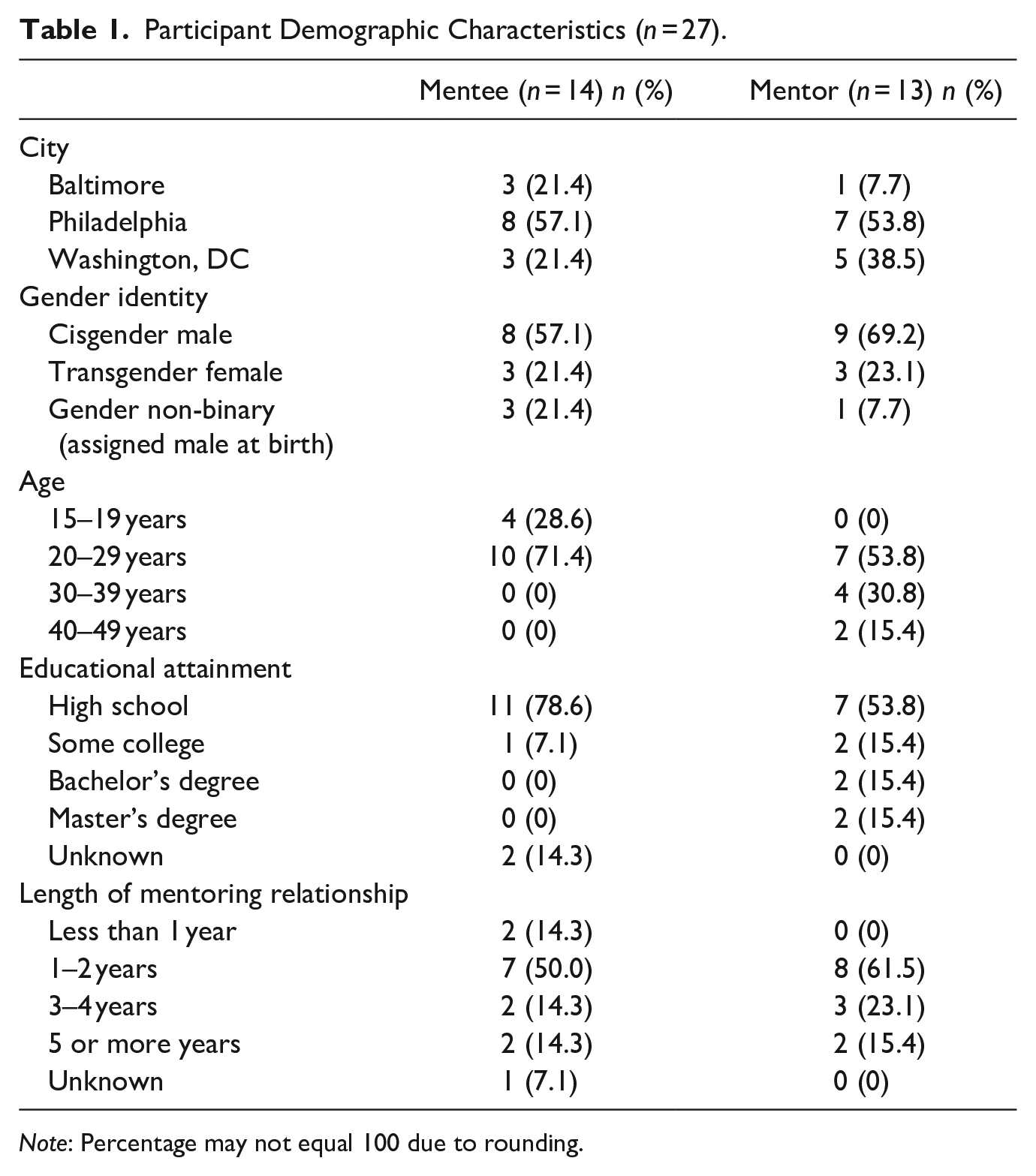
Note: Percentage may not equal 100 due to rounding.
Data Collection
Participants completed an oral consent process followed by a one-time, individual, semi-structured qualitative interview lasting 45 to 60 minutes. Interviewers were an African American cisgender gay male (for the mentee interviews) and an African American cisgender female with over 25 years of mentoring program leadership experience (for the mentor interviews). Interviews focused on how the mentoring relationship formed, characteristics of the relationship, mentoring discussions around sensitive health topics (or why such conversations were absent), and how a mentor could broach such conversations in a youth-friendly manner. Findings focused on mentoring discussions regarding sexual health and HIV are reported elsewhere (Kaufman et al., 2020). In this paper, we report on themes related to the formation of and the benefits provided by the relationship as observed by the mentors and mentees.
Analysis
All interviews were audio-recorded, transcribed verbatim, and imported into Atlas.ti (version 8.2) for coding and data extraction. This study applied a basic interpretive qualitative analysis, which allows the research team to explore participants’ experiences through their own descriptions and interpretations (Merriam, 2002). A codebook was developed by two team members separate from the interviewers through inductive and deductive techniques. Data analysis focused on mentees’ and mentors’ descriptions and interpretations of how they formed a mentoring relationship and any observed benefits that arose connected to the mentoring. The second author, who was not involved in data collection, primarily analyzed the data. First, the transcripts were read to get a general sense of the data. Second, the transcripts were reread while the coder made notes about the formation of the mentoring relationships and associated benefits. Third, all notes were reread without making any summary, description, or explanation to get a complete picture of how to interpret the data. Finally, the notes were reread again, and the coded content was grouped into three themes: formation of natural mentorship, mentoring topics, and benefits of mentoring for the mentee. Subthemes within each theme were also identified, including any divergence between mentor and mentee perspectives when sufficient data were available.
To ensure rigor of this qualitative research, the authors engaged in several processes to increase the study’s trustworthiness (Elliott et al., 1999; Lincoln & Guba, 1985). To address credibility, member checks were conducted by discussing the themes that arose from the data with key informants from the community who played a role in recruitment (see Acknowledgments). This provided a chance for the authors to verify their findings and interpretations. While a qualitative study is not, by its nature, meant to generalize beyond the sample included, the authors attempted to ensure transferability through purposive sampling of individuals in long-term mentoring relationships with the demographic characteristics of interest. The authors also asked broad questions during the interviews that could be applicable to other similar mentors and mentees. Dependability was ensured through the second author checking themes and interpretations with all other authors, who are knowledgeable about the target population but also come from diverse backgrounds with varying expertise. Finally, the goal of this research was not to replicate earlier work (confirmability), but rather to explore a form of mentoring that has not been well documented to better understand the process of mentoring relationship development for SGM youth of color. Throughout the coding and analysis stages, the first and second authors met frequently to minimize bias in interpretations, and direct quotations from participant interviews were selected to support the conceptualization of the findings.
Results
The Formation of Natural Mentoring Relationships
Initial meeting
Participants reported initially meeting their natural mentor or mentee in a range of settings. These included the house-ball community, a distinct social network within the larger African American SGM community (brought to mainstream audiences through the television show POSE) that aims to provide support for its “house” members and has social gatherings in the form of balls and dance competitions (Hosek et al., 2015; Murrill et al., 2008). Participants also talked about meeting their mentorship partner in high school environments where the mentor was a teacher or coach, LGBTQ-related organizations, LGBTQ pride events, through social media (e.g., Instagram), and via introductions from mutual friends.
We met at a [University] party through a mutual friend and then we became friends from there. (Mentee, Philadelphia, Cisgender Male)
You know, she’d come over to the person’s house, they were really cool with her. So, they introduced me to her and ever since then we all had a good connection. (Mentor, Washington, D.C.)
These initial meetings seemed to take place in settings where the mentees already felt somewhat comfortable affiliating with other SGM peers or LGBTQ communities. This answered the first research question as to how mentoring relationships form for African American SGM.
Relationship development into mentorship
When asked to describe how they spend their time together, mentors and mentees mentioned activities such as going to the mall, bowling, attending a gathering, or just sitting and talking.
Talk, catch up. He [mentor] is a party promoter. So, he does promote a lot of events. I perform at some of his events. (Mentee, Philadelphia, Non-Binary)
When we hanged out, we got something to eat. We talked and we laughed. (Mentor, Washington, D.C.)
When participants were asked how they knew the relationship was mentorship, they described just knowing this was the case without having a formal conversation about it or any sort of formal agreement.
I was growing up inside the LGBTQ community and I wasn’t [looking for a mentor]. It was something that happened naturally. (Mentee, Philadelphia, Non-Binary)
Some participants talked about how informal names, including familial-type names, were adopted for each other. Those instances often made it clear to the partners that this was a mentoring relationship or that they were part of a “chosen family.”
She [mentee] always calls me Auntie, and she ask me questions and I help her. (Mentor, Washington, D.C.)
It was more of like he took me on and played like a God mom role to me. (Mentee, Philadelphia, Cisgender Male)
While formal naming of the relationship as mentorship was not common at first, mentees felt these relationships had that element because they felt they were able to depend on the mentor much like they might a family member. Mentors knew they had adapted that role because they were guiding the youth on many aspects of their lives as SGM young people.
Communication between mentors and mentees
Participants were asked how often they tend to communicate with their respective mentor or mentee or see each other in person. Participants reported a high frequency of contact in these mentoring relationships, commonly meeting once a week, multiple times a week, or even daily.
We used to see each other back in the day once in a blue moon, but now I see her every day. (Mentor, Washington, D.C.)
Aside from in-person contact, participants reported staying in regular contact via texts or messaging each other through Facebook or Instagram three to four times per week or even daily. Some participants reported they might also occasionally connect with one another using FaceTime video calls or through traditional phone calls.
That’s every day [to communicate with each other] through text or social media. We will comment to a post. If it’s like a serious situation, we’ll call. (Mentee, Philadelphia, Non-Binary)
Overall, participants reported they started natural mentoring relationships through both online or offline introductions, and they reported a high frequency of contact through in-person meetings and virtual messages, video calls, or phone calls. These natural relationships developed over time to become close, almost familial in nature.
Mentoring Topics
The second research question focused on the areas in the youth’s lives where these mentoring relationships were most utilized. Mentee and mentor participants were asked which topics they discuss the most in their mentoring relationship. Participants reported four major topics: sexual and gender identity, transitioning from adolescence to adulthood, relationship issues, and health.
Sexual and gender identity
Several participants reported their initial conversations often focused on sexual and gender identity issues because this was such a large concern in the lives of the mentees.
We talked about the identity at the end but that was the first. That was the main topic. That was the biggest topic once we got all the little miscellaneous topics. The biggest topic was gender identity (Mentor, Washington, D.C.)
We used to [talk about sexual identity]. That was like when we first started to get to know each other because he wanted to know like what I liked and what I was attracted to or what am I doing with myself. (Mentee, Philadelphia, Cisgender Male)
It is not surprising issues of identity was one of the most frequent areas of focus for these mentoring relationships, as these youth tended to be in a developmental stage (late adolescence and early adulthood) where sexuality and gender roles are central to their identity formation.
The transition from adolescence to adulthood
After moving past discussions of identity, participants commonly discussed topics related to daily activities and developmental tasks involved with the transition from adolescence to adulthood, such as finding a job, housing, schooling, and financial planning.
A lot of support, actually. Like even with helping me find my job, helping me find my house I live in. He helped me with a lot, I suppose. (Mentee, Philadelphia, Cisgender Male)
If these youth were navigating stigmatizing aspects of their identities (e.g., racism, homophobia, transphobia) and where they fit in with school, jobs, and the community more broadly, it is not surprising that having a mentor who shares some of their own characteristics would be helpful in these tasks necessary for becoming an independent young adult.
Interpersonal relationships
Mentors and mentees reported spending a lot of time talking about relationship issues, including both romantic and family relationships.
So we talk a lot about any issues that may come up in my relationships. Or if maybe my relationship is too perfect, I’ll tell him I have suspicions on certain things. So we talk about that. (Mentee, Philadelphia, Non-Binary Individual)
He [mentee] has a lot of mental health issues – depression, self-worth, family rejection. We talk about that a lot. (Mentor, Philadelphia)
Inherent in these conversations were discussions of self-worth, particularly when relationships caused feelings of rejection or insecurity. Such topics are typical of adolescents and young adults who are in the developmental stage of navigating romantic partnerships.
Mental and physical health
Although participants were asked specifically about whether they discussed sexual health issues in their mentoring relationship, some organically mentioned health as a topic of conversation prior to being asked. They reported talking about sexual health issues, such as HIV symptoms and testing, sexually transmitted infections, safer sex practices, and other HIV prevention methods, such as pre-exposure prophylaxis (PrEP).
Participants also reported talking about mental health issues, including the mentee’s self-esteem, experiences of depression and anxiety, and the feelings associated with being hurt in relationships.
We also focus on mental health like talking about self-esteem; talking to him about depression, anxiety; talking to them about healthy relationships. Oh, my God, so much. We were actually just talking about them before you arrived (Mentor, Philadelphia)
Mental health issues were reported by both mentors and mentees to be a topic of great importance in the mentoring relationships, as the mentees often had trouble navigating the challenges of being a SGM in the Black community and struggled to maintain a positive perspective and manage mental distress symptoms.
After the mental breakdown. . .he [mentor] told me that it is anxiety that I might have. But I have to wait because it’s not gonna happen [snaps finger] like that [it’s not going to improve]. (Mentee, Philadelphia, Non-Binary)
Overall, mentors and mentees reported discussing a wide variety of topics relevant to SGM youth, including identity formation, mental health, sexual health, relationship challenges, and developing the skills for a successful transition to adulthood and independence. While many of these topics are typical areas of concern for youth in this developmental stage, having a mentor that could help with navigating these issues in the context of intersecting racial and sexual/gender minority identities seemed to be particularly important for these young people.
Benefits of Mentoring for the Mentee
The third research question sought to identify the characteristics of these mentoring relationships that had the greatest perceived impact on the overall well-being of African American SGM adolescents. According to the participants, these characteristics included viewing the mentor as a trusted confidant and source of support and the ability of the mentee to be their authentic selves in the mentoring relationship.
A trusted confidant
Both mentor and mentee participants reported that their mentoring relationship contributed to improving the well-being of the mentee in several ways. First, from the mentee perspective, participants felt free and comfortable to talk about anything with their mentor. For instance, one mentee reported his mentor was a good listener:
You know how you got your best friend? You just tell him stories about what happened, or I call them the Jack Chronicles, just the crazy stuff that happens to you like who DM-ed [direct messaged] you or what happened, stuff like that. (Mentee, Philadelphia, Cisgender Male)
Mentors reported that trust and confidentiality were naturally built in their relationship over time by allowing the mentees to raise any topics desired.
Everything he wants to tell me, I will always let him know. . .there’s confidentiality. I wouldn’t feel uncomfortable discussing anything he wanted to discuss. (Mentor, Washington, D.C.)
This comfort and high level of trust in the mentoring relationship allowed the pairs to discuss many personal and sensitive topics, providing a way for the mentee to confide in a trusted adult about any challenges that arose. Other mentees explained that they felt understood by their mentors even if nothing was said; there was comfort in the quiet moments. This gave mentees a sense of confidence and ease in their relationship and eliminated any awkwardness in exchanges about sensitive topics.
If it’s too much detail, I may leave a few things out. But it’s like, he knows me so well that he knows I’d be leaving out details. (Mentee, Philadelphia, Cisgender Male)
A source of support
As SGM and persons of color, mentees reported the need for a strong support system to deal with life challenges. In the mentoring relationship, they relayed receiving emotional support that helped with navigating intimate and family relationships.
[My mentor] is there for emotional support. He is someone that I can tell what I want to, like in terms of since a young age growing up to how old I am now, and [he] just sit there and listen and give me some feedback. (Mentee, Philadelphia, Cisgender Male)
They also received informational support from mentors about safe sex, financial management, career advice, and housing information.
[Interviewer: What kind of support has your mentor given you?] Safe sex [advice], financial–what is it?. . .stability - so much - picking the right boys to talk to. You know, all about respecting your mama and all that other crazy stuff. (Mentee, Philadelphia, Cisgender Male)
This degree of social support was consistent with previous research showing that LGBTQ individuals often create “chosen families” where those not related by blood or marriage step into supporting roles much like family members would do (Hailey et al., 2020).
Ability to be one’s authentic self
Mentees reported that their mentoring relationships were primarily based on a trusting friendship that allowed them to be their authentic selves, something they were often not safe doing in other contexts due to stigma surrounding their intersecting identities.
Because we built that type of friendship, I don’t keep nothing from him. It’s like he’s my mentor but he’s also like my best friend. (Mentee, Philadelphia, Cisgender Male)
Moreover, mentors talked about how they, themselves, could be authentic in the mentoring relationship, even when a conflict arose.
Overall, these mentoring relationships were described by the participants as comfortable, confidential, supportive, genuine, and unrestricted for both the mentee and mentor. They provided the mentees with a trusted confidant, a source of emotional and instrumental support, and the opportunity to be their true selves.
Discussion
This study’s findings suggest that African American SGM youth with a supportive mentor find benefits in receiving guided direction; being listened to; feeling able to be themselves; and having someone to confide in for issues related to family, romantic relationships, identity, mental and physical health, and becoming an adult. Results also point toward these relationships serving a critical purpose in adolescent development and identity formation for SGM mentees, with mentors standing in as alternative family members for youth who may have been stigmatized by their families of origin due to their sexual and gender differences (Arnold & Bailey, 2009; Stone et al., 2020).
Previous research has shown that sexual minority youth have a desire to talk with and consult mentors when they face challenges or need to make important decisions (Davis et al., 2009; Johnson & Gastic, 2015). Research also indicates that SGM often turn to natural mentoring relationships for such support (Davis et al., 2009; Johnson & Gastic, 2015; Weston, 1997) or receive mentoring from similar others regarding questions about sexuality and sexual health (Levitt et al., 2017; Torres et al., 2012). The current study expanded on previous research by describing how such mentoring relationships originate for youth with intersecting (often stigmatized) identities, how the mentoring relationship develops, and what specific benefits may be derived for the mentees. A more nuanced understanding of these issues can help to inform ways in which mentoring for these youth can be better promoted and expanded (in this case, the goal was to inform the development of a mobile app to support mentors of African American SGM youth).
Previous research has also shown that there are psychological benefits for African American LGBTQ youth with chosen families, such as improved coping skills and less psychological distress overall (Arnold & Bailey, 2009; Wong et al., 2014). Chosen families can serve as a protective factor against experiences of rejection, discrimination, and oppression for youth with intersecting race and SGM identities (Hailey et al., 2020). The current findings align with previous work in which mentors were often reported to become a member of such chosen families (designated as “Auntie” or “God Mom”), playing a part in helping mentees explore and normalize their identities and mature on a positive trajectory, without the stigma and shame often associated with being a SGM in the African American community.
Two previous studies presented different perspectives on the role of mentors for such youth. In one study focused on HIV prevention in gay family and house networks, SGM of color who joined houses or constructed family communities mostly reported low self-esteem and a lack of interpersonal communication skills (Levitt et al., 2017). In another study assessing the social and risk behavior networks of young adult, ethnically diverse sexual minority males, about one-fourth who had a relationship with a non-parental adult engaged in risky behaviors with the adult, such as substance use and unprotected sex (Sterrett et al., 2015). These different perspectives suggest a need for further investigation of the mentoring opportunities and experiences of SGM minority youth, as these mentoring relationships cannot be assumed to be monolithic or uniform across different youth and settings (Adam et al., 2019; Arreola et al., 2013).
While there is certainly some level of risk of harm in any mentoring setting (Rhodes et al., 2009), these previous studies do not present a complete picture of the potential influence of mentoring for SGM youth. The mentors participating in the current study, as well as those described by mentee participants, tended to bring a positive influence to the life of these youth, including safe spaces for the mentees to be themselves and avoid hiding their true identities. This friendship freed mentees from having to conceal parts of themselves, providing a respite from the stress of having stigmatized identities. In contrast, LGBTQ youth, particularly those who are African American, often otherwise may seek social acceptance by hiding their stigmatized identities, an inauthenticity that evidence indicates can contribute to a variety of negative consequences, including negative affect, anxiety, depression, elevated risk behavior, and mental illness (Cole et al., 1996; Lenton et al., 2013; Meyer, 2003; Newheiser & Barreto, 2014). While “coming out” can provide many psychological benefits (Floyd & Stein, 2002; Maniago, 2018; Wax et al., 2018), doing so in the African American community may be riskier (Cyrus, 2017). The current findings suggest that youth appreciate being able to be out to a supportive mentor who provides a sense of safety. It is possible the youth could practice coming out to others or to weigh the risks and benefits of doing so with the guidance of their mentor.
Mentoring pairs that form naturally start from a foundation of trust that takes time to be fostered and earned. The trusting relationships built through natural mentoring appear to offer multi-faceted social support for SGM youth and may be experienced as protective in terms of mentees’ mental health and confidence, which prior research suggests could accrue through cultivation of better coping and a sense of purpose in youth (Hurd et al., 2014). Mentors and mentees interviewed tended to form their natural pairings through social media and technology, in addition to in-person introductions though a third party. The use of technology and social media expands the pool of potential mentors who can create and sustain bonds with African American SGM youth. Mentors and mentees also used digital communication and social media to stay in touch after they had established their mentoring relationship, processes that have the potential to deepen and lengthen the amount of time youth and mentors stay in supportive relationship with each other (Kaufman, 2017).
Limitations
There are some limitations to this study. First, participants were recruited via word of mouth, through contact with LGBTQ organizations and establishments, and at LGBTQ-focused events, which may have produced a sample not fully representative of SGM minority adolescents with natural mentoring relationships. Second, keeping in mind that the focus of this research is on transgender female and cisgender male mentees with sexual interest in men due to the parent study being focused on developing an app to enhance mentoring around HIV prevention, these results cannot be generalized to other LGBTQ youth populations, particularly lesbian, female bisexual, or transgender male or nonbinary assigned female at birth individuals. Third, because the mentor and mentee participants were not paired in this study and one group contributed more to certain findings than another group, systematically comparing the data provided by the two groups was not possible. Fourth, this study was part of a larger study that did not aim to compare different types of mentoring relationships, such as having shorter or longer duration and initially meeting through a formal organization as opposed to informal social networks; thus, this study was unable to examine participants’ potentially varying experiences across these different types of mentoring relationships. Finally, as a qualitative study, generalizability even to SGM African American males in varying stages of transition to adulthood should not be assumed; rather, as with all qualitative research, the aim was to provide insight into the experiences of the participants included in ways that could inform future research and development of interventions that are responsive to the needs of SGM African American young persons.
Implications
Sexual and gender minority youth are at significantly higher risk than their cisgender heterosexual peers for substance use and mental health problems. Meta-analyses show that LGBTQ youth have up to six times higher odds of lifetime substance use (Marshal et al., 2008) and three times higher probability of mental health problems (e.g., depressive symptoms, suicidality) than their heterosexual peers (Marshal et al., 2011). High perceived support from family, friends, and other adults has been proven to offset poor mental health among adolescents and is most protective in areas of low socioeconomic communities of color (Wight et al., 2006). The findings of this study indicate a potential for natural mentoring relationships to provide trusted adult support in ways that are experienced as authentic and beneficial to the mental health of African American SGM young persons. More research is needed to further elucidate the mechanisms of natural mentoring for this population that are most likely to contribute to positive adolescent development (identity formation, novel experiences) and lifelong mental health and wellness, and subsequently, to develop, refine, and demonstrate the efficacy of interventions that facilitate these processes.
Footnotes
Acknowledgements
Thank you to the following organizations for their assistance on this project: Joy Baltimore, Sasha Bruce Youthwork, The Attic Youth Center, COLOURS, Big Brothers Big Sisters Independence Region, MENTOR Independence Region, MENTOR Maryland|DC, The Children’s Hospital of Philadelphia, and Casa Ruby. We are also immensely grateful to James Conley, III for his assistance with this study and to the Johns Hopkins Adolescent and Young Adult Working Group for their support. Thank you also to Drs. Renata Sanders, Carl Latkin, and Nick Ialongo for their guidance and support on this line of research.
Declaration of Conflicting Interests
The author(s) declared no potential conflicts of interest with respect to the research, authorship, and/or publication of this article.
Funding
The author(s) disclosed receipt of the following financial support for the research, authorship, and/or publication of this article: This research was funded by an Administrative Supplement to the Johns Hopkins University Center for AIDS Research, National Institutes of Health (NIH) funded program (P30AI094189), which is supported by the BI, NIDA, NIHMD, NIA, NIGMS, and NIDDK. Research reported in this publication was also supported by the National Institute on Drug Abuse under Award Number K01DA042138. The content is solely the responsibility of the authors and does not necessarily represent the official views of the NIH.
