



Abstract
The literature suggests gender expression to be a key experience of transgender young people that may impact upon the development of their gender identity and psychological well-being. The present study aimed to explore participants’ experiences of expressing their gender identity around others, with a focus on interactions with new people (with whom they do not have an existing relationship). Semi-structured interviews were conducted with eight young people aged 16 to 17 who identified as male and were assigned female at birth. Three superordinate themes were identified: (a) using gender expression to shape identity; (b) experiencing and making sense of others’ responses; (c) a changing relationship with gender expression. The process of gender expression enabled participants to explore, develop, and strengthen social and self-identity, and had both positive and negative impacts upon their well-being. Initially gender expression seemed to be an effortful process in which participants felt pressured to conform to social expectations to be viewed as male, yet over time they navigated a way to express themselves in a manner that felt more comfortable and authentic. Findings highlight the need to facilitate young people to express and be affirmed in their gender identity, and to provide adequate support with the social experiences surrounding it.
Keywords
Introduction
Transgender young people are individuals whose gender identity differs from the sex they were assigned at birth. In recent years, the number of adolescents seeking support with gender dysphoria (distress resulting from the incongruence between assigned and experienced gender) has significantly grown (Gender Identity Development Service [GIDS], 2021a). It is key that both specialist and general health services understand how best to care for this growing population, who face increased risk of experiencing psychological distress (Connolly et al., 2016) due to exposure to stigma and victimization (Reisner et al., 2015).
Gender expression refers to the way we present our inner sense of gender to the world, such as through appearance or behavior (Stonewall, 2017). Though not always the case, transgender peoples’ gender expression may become more aligned with their gender identity (as opposed to their birth-assigned sex) as they transition to life in their identified gender (Austin, 2016). Socially expressing gender identity is a central part of the daily lives of transgender young people, and it is hoped that further exploration of this shared experience will contribute to increased understanding of how it influences their well-being and sense of self.
Gender Expression and the Development of Gender Identity
The establishment of identity is thought to be the primary developmental task of adolescence, during which young people explore different identities through social interactions, and eventually form a more stable sense of self (Erikson, 1968). Exploring and expressing one’s gender in social relationships is therefore a key part of the development of our internal sense of gender identity. Social learning and cognitive-developmental theories propose that we develop and reinforce our sense of gender identity through social interactions in which we express our gender around others and receive reinforcing feedback (Bandura & Walters, 1977; Kohlberg, 1966). Interactionist theories similarly propose that we construct and enact our gender through social interactions and activities that are stereotypically associated with a particular gender category (West & Zimmerman, 1987). Butler (1988) proposes that these interactions can be with both a real or imagined “audience,” reflecting how social influences on the development of gender are thought to operate at both an interpersonal and wider societal level.
While these theories were devised with reference to the development of cisgender identity, research with transgender adults indicates that these ideas also apply to the development of transgender identity. For example, Lev (2013) outlines how, once participants became aware of feelings of difference and disclosed this to significant others, they explored various gender identities in order to identify one which “fit.” Once identified, they began to explore ways of aligning their gender expression with their internal sense of self and integrated their post-transition identity within their existing self-concept. Morgan and Stevens (2012) and Kuper et al. (2018) found that participants often described childhood gender non-conforming interests and a sense of dissatisfaction with their bodies or mind-body dissonance (often noticed in puberty) as early stages of their development which were followed by further exploration of different identities and ways of expressing themselves. Exposure to others with similar gender-related experience, and validation of their gender expression by these, and gender-conforming, peers was also key to participants developing awareness of their gender identity and progressing in their transition (Devor, 2004; Kuper et al., 2018). Gender expression therefore likely provides a means by which transgender young people can explore, develop, and communicate their gender both intra- and interpersonally.
Gender Expression and Well-Being
Prior research has found gender expression and related social experiences have both positive and negative impacts upon the psychological well-being of transgender individuals. Kozee et al. (2012) propose that expressing oneself in a way that is congruent with one’s gender identity, while feeling authentic and genuine, is important to well-being, and in a study with transgender adults found greater gender congruency to be associated with reduced anxiety and depression, and greater life satisfaction. Gender expression is also important in providing opportunities for affirmation, or social recognition and support, of one’s gender identity. Sevelius’ (2013) gender affirmation framework proposes that social affirmation of gender is important in confirming transgender individuals’ sense of self, and further studies have found affirmation to be related to increased psychological well-being and self-confidence, and reduced dysphoria (Rood et al., 2016; Russell et al., 2018; Sevelius et al., 2021).
However, by disclosing and expressing their gender identity, transgender youth also risk being disaffirmed, or misgendered, and exposed to gender-based social oppression, stigma, and victimization (Reisner et al., 2015). Minority stress theory (Meyer, 2003) proposes that increased exposure to hostile social attitudes and negative social experiences (described as external stressors) may make people with minority characteristics vulnerable to developing proximal (internal) stressors such as internalized negative feelings about one’s identity. This theory has been used to explain the mental health disparities between transgender people and the general population (Hendricks & Testa, 2012) and combined these external and internal stressors have been found to increase transgender youth’s vulnerability to psychological distress in comparison with cisgender peers (Perez-Brumer et al., 2017).
To be affirmed in their gender and avoid stigma some transgender individuals may therefore feel it important to express themselves in line with gender norms (Ross, 2014). In qualitative studies with adults, Ross (2014), Roen (2002), and Rood et al. (2016) found that participants experienced differences between expressing their gender in existing social relationships and around new people; they felt a need to express themselves in line with gender norms in public in order to be perceived as their gender, while they felt more comfortable expressing themselves more fluidly around family, friends, and in private. Adhering to social norms was often described as feeling mentally/physically tiring and inauthentic, but participants found that over time, as they “passed” more consistently and became more confident in their identities, they felt less concerned about how they were perceived by others and liberated from gender norms.
The Current Study
Prior research suggests that gender expression is key in the development and communication of transgender identity, and that related affirmative and adverse social interactions influence the psychological well-being of transgender individuals. Though these experiences have been explored with transgender adults, qualitative research is yet to focus on the experiences of youth, where the influence of gender expression is likely to be accentuated. While social acceptance of one’s identity is key to adolescent development (Newman & Newman, 1976), transgender young people are likely to have less control over their social world and gender expression than adults, being exposed to systemic barriers such as how their school or parents wish them to dress, and having more limited access to gender-affirming medical interventions (GIDS, 2021b).
Research conducted with adults has indicated that expressing oneself in existing social relationships and around new people are distinct experiences (Roen, 2002; Rood et al., 2016; Ross, 2014). Though both areas warrant further exploration, the present article will focus on adolescents’ experiences of expressing themselves around new people who are unaware of their birth-assigned sex as this has received less attention in youth literature which largely focuses on experiences with family, peers, health care, and education.
Given the nuanced nature of this experience and absence of existing research, it was felt a qualitative approach using Interpretative Phenomenological Analysis (IPA) would best enable an in-depth exploration of the lived experience of participants (Smith et al., 2009). IPA is particularly concerned with personal meaning and sense-making, and aims to produce an account based in lived experience as opposed to pre-existing theory. It acknowledges that researchers do not access experience directly through participants’ accounts, but through a process of interpretation and revisiting of the data. As IPA is interested in exploring how people make sense of a specific experience, a relatively homogeneous sample is recommended. We therefore felt it important to focus on one gender group, and young people who identified as male and were assigned female at birth were selected as referrals of this group have recently seen a large increase and are most representative of the transgender young people accessing services in the United Kingdom (GIDS, 2021a).
The study aims to understand what it is like for transgender adolescents to express their gender identity around new people across different settings. It will also explore the meaning participants make of their interactions with others and how this influences their well-being.
Method
Participants
Approval was gained from a local ethics committee prior to recruitment. Purposive sampling was used to recruit participants from a national specialist gender identity service for people under the age of 18 in the United Kingdom. We aimed to reach young people aged between 15 and 18 who identified as male and were assigned female at birth. To be included in the study, participants had to have been living socially in their gender for the majority of their time outside of the home for at least 1 year. They could not have commenced masculinizing physical treatment, though could have accessed hormone blockers prior to participation.
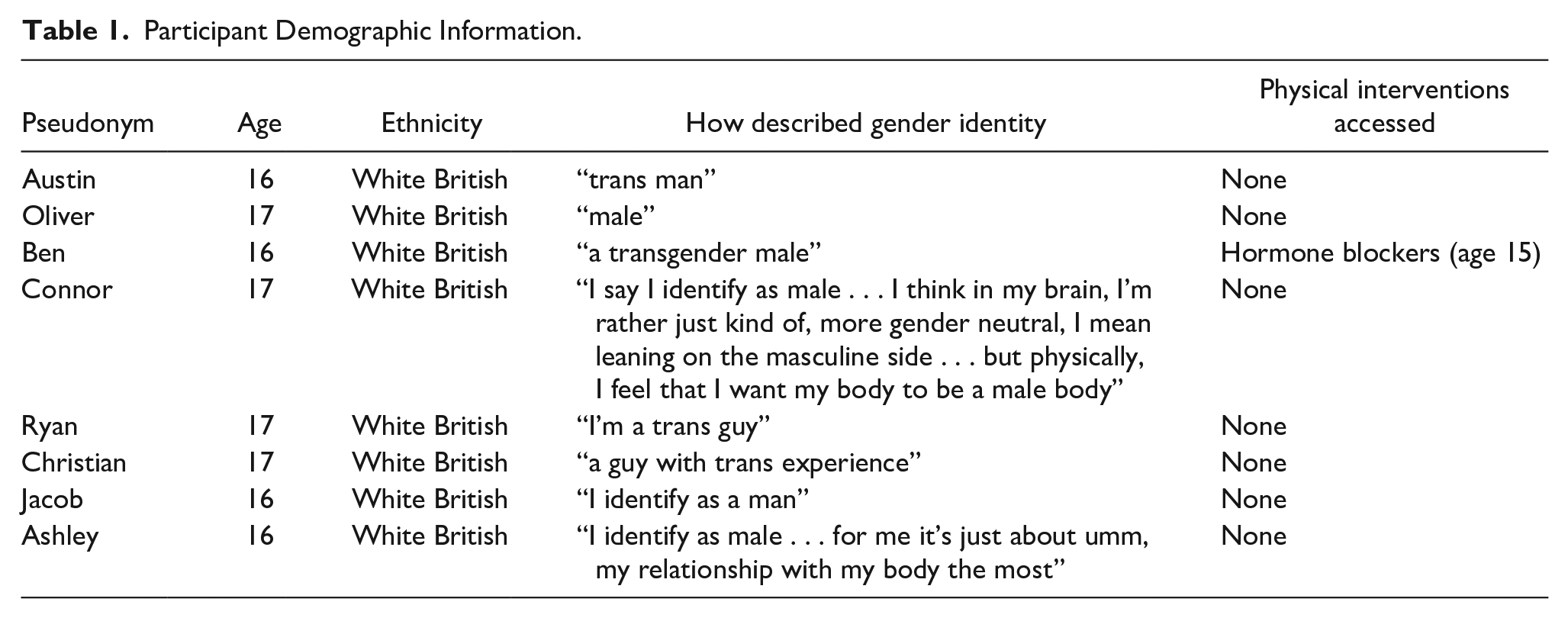
Clinicians provided information to potential participants, and a poster advertising the study was displayed in the clinic waiting room. Eight potential participants expressed interest in the study, and after being contacted by phone to further discuss the research decided to participate (see Table 1 for a summary of participant demographics).
Participant Demographic Information.
Data Collection
A semi-structured interview schedule was developed with reference to IPA methodology, the existing literature, and feedback from clinicians, researchers, and experts by experience. A pilot interview was conducted with two transgender young people to ensure that participants felt comfortable and questions encouraged discussion of phenomenological experiences. The final interview schedule included broad questions about participants’ experiences of expressing their gender identity, allowing themes to emerge from the data. These ranged from questions about how they expressed their gender identity and what this experience was like across different settings, such as “Can you tell me what it’s like to express your gender identity in public?,” to questions about how they experienced interactions with others and how these experiences had influenced their lives, such as “Can you tell me about a time when you’ve felt others have perceived your gender in the way you wanted them to?”
Data collection was completed between December 2018 and April 2019. The first author met with participants to review information about the study and informed written consent was obtained. Participants were remunerated £20 before commencing the interview to ensure that they felt able to withdraw from the study and still receive payment. Interviews were audio recorded and lasted between 38 and 83 minutes (M = 65 minutes). Afterward, participants were given time to speak about their experience of the interview, and given information about further support. Interviews were transcribed verbatim by the first author and a transcriber, with any identifiable information removed to ensure anonymity.
Data Analysis
Data analysis was informed by the processes described by Larkin and Thompson (2012). The first author read each transcript several times for familiarization, and to reflect upon her initial observations. Detailed line-by-line coding was then carried out to identify the experiential claims and concerns of the participant which were noted in conjunction with the first author’s interpretation of the participants’ own interpretative account. Connections between the emerging themes were clustered into groups and assigned a descriptive label. Following completion of this case-by-case analysis, the first author and second authors considered all the identified themes across the transcripts and those that appeared connected were clustered together into new themes and checked against the original transcripts. The authors then considered this final list of themes and grouped these into super- and sub-ordinate themes that best illustrated the relationships between participants’ experiences based on their interpretation of the accounts.
Quality Measures
A range of credibility checks were conducted throughout the research process to ensure the quality of the research and ensure themes were reflective of participants’ experiences (Walsh & Downe, 2006). The data were regularly revisited and discussed by the researchers, and consultations about the analysis were held with clinicians, peer research groups, and an independent IPA expert. The first author also reflected on the potential influence of their own assumptions and beliefs on the research, being interviewed by a peer researcher about their own experience of and interest in the research topic and keeping a reflective journal throughout all stages of the research process, both of which were discussed in research supervision. Of particular relevance, the interviewer considered the influence of her own gender identity as a cisgender woman on data collection and analysis, noting for example how, having not shared the experience of questioning her own gender, she may be inclined to focus on experiences that seemed novel or difficult to her. To mediate this effect the interviewer made a conscious effort to be led by the areas that participants wished to address during interviews, and during data analysis paid attention to the overall balance of how participants described their experiences.
Results
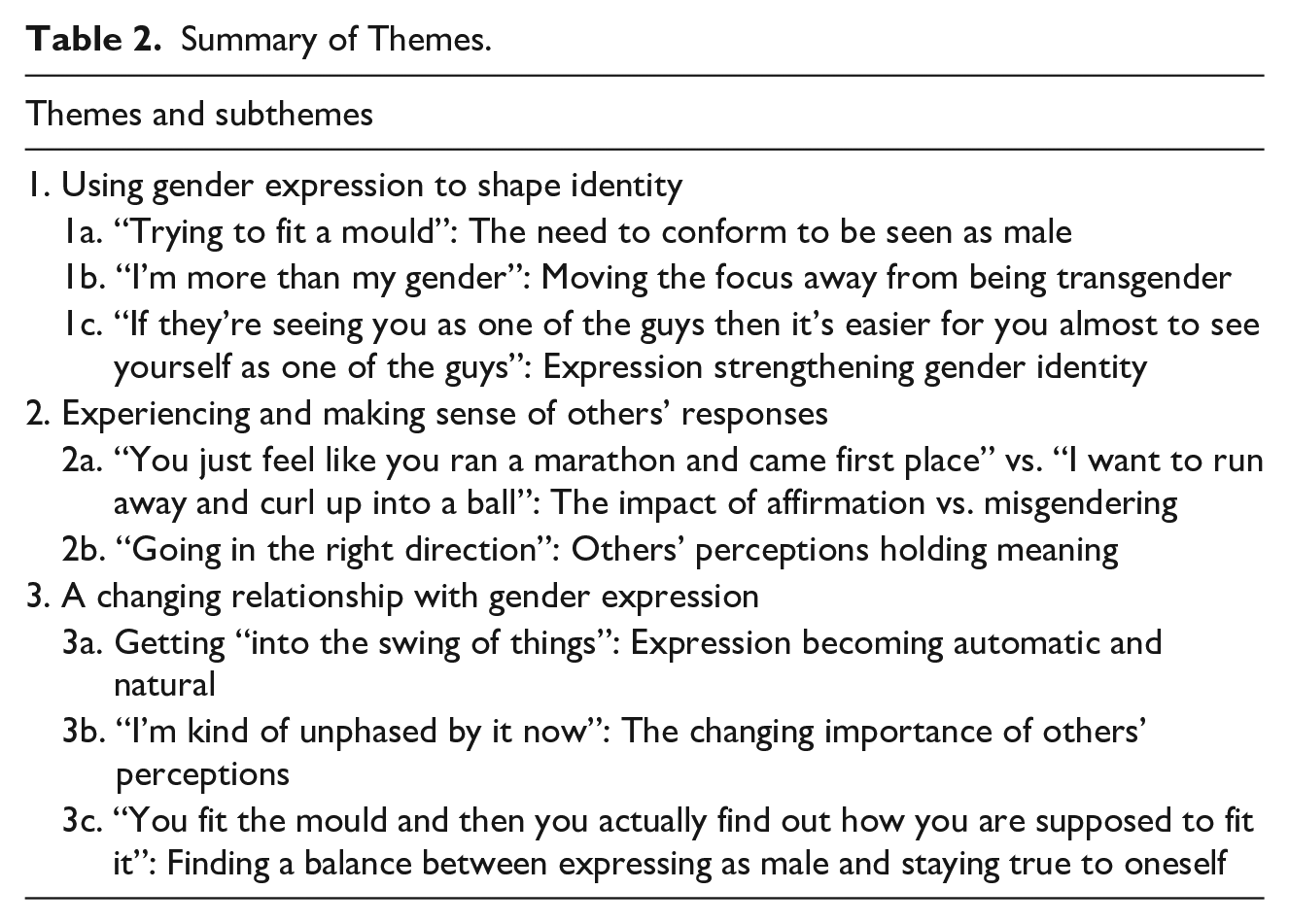
The analytic process generated three superordinate themes and eight subordinate themes (represented in Table 2). These illustrate broad aspects of shared experience while also highlighting differences in meaning-making. Each theme will be discussed, drawing on participants’ accounts to demonstrate the range of ideas.
Summary of Themes.
Theme 1: Using Gender Expression to Shape Identity
The first superordinate theme illustrates how participants used their gender expression both to shape how they were perceived by others (social identity), and how they viewed and felt in themselves (self-identity).
“Trying to Fit a Mould” (Jacob): The Need to Conform to Be Seen as Male
Participants described feeling a need to conform to socially constructed expectations of masculinity to be recognized as male, both in their outward appearance and behavior, and more internally, such as the way they managed and expressed emotions: I will maybe be a little bit more of a dickhead, than I actually am . . . I obviously I don’t try and be like specifically mean, but, you know, I do like to look a little bit more of a dick. (Ryan)
This example demonstrates the lengths participants would go to; Ryan was willing to adopt qualities that would often be described as socially undesirable in order to be perceived as male. He appeared to feel that he needed to behave in a way that was not congruent with his inner sense of self, how he “actually [is]”, in order to be recognized as male.
For some, social expectations were a welcome guide to the otherwise difficult task of figuring out how to express as and be seen as male, particularly where gender norms were congruent with participants’ worldview and sense of self. Others were more conflicted, describing expectations as an unwanted, but necessary, guide for making others understand their gender: “I mean it’s stereotypes, not necessarily any truth. But by fitting yourself into stereotypes, you fit the mould better and when you are desperately trying to fit a mould, stereotypes can be the way to fit it” (Jacob).
Connor was the only participant who felt he was not influenced by social norms in his gender expression: I just try and live my life as me and I don’t try and let my gender and people’s perception of gender stereotypes influence that as much as possible . . . quite a few people around me . . . I think they have quite a similar mind-set . . . that has encouraged me to be more genuine in who I am. (Connor)
While being “genuine” appeared really important to Connor, there is a sense that he found it difficult and had to actively “try” to resist the pervasive pressure to conform; something that had become easier since finding a more accepting social network.
“I’m More Than My Gender” (Ryan): Moving the Focus Away From Being Transgender
Most participants spoke about how their gender expression was motivated by wanting to be seen and feel like a “normal [male]” (Ashley), as opposed to transgender. In part this reflected a, possibly developmental, desire not to stand out as “different” (Jacob), but also a wish to be appreciated for themselves rather than the focus always being on their gender: It’s such a good feeling, when you’re, when you are treated as just a guy, not a different one, you know, cos being trans is big part of my life, but it’s not the only part of my identity. You know, I was the one who doesn’t like being late . . . who gave really good high fives. (Jacob)
Several participants also discussed wanting to be perceived as a “normal male” to stop others from making assumptions based on their transgender identity: “their own opinion on what trans people are like will then affect them, rather than them getting an opinion of you” (Christian). They seemed to feel that a transgender identity was not positively valued by society, and as a result usually did not disclose their transgender status to others. Though alleviating some concern, non-disclosure often led to stress around being “outed” (Christian), or how to discuss their birth-assigned gender with the people in their lives in future.
“If They’re Seeing You as One of the Guys Then It’s Easier for You Almost to See Yourself as One of the Guys” (Austin): Expression Strengthening Gender Identity
Some participants also spoke about how expressing themselves in line with masculine norms made them feel more male in themselves: Going to the barber shop . . . being laddish with people—it is just an ordinary every boy’s experience . . . all this stuff that’s just sort of everyday for them—it’s regular, it’s normal—you want it to become regular and normal for you. (Austin)
Expressing himself in line with masculine norms enabled Austin to access male experiences, which seemed to strengthen his gender identity. However, he implied that these experiences did not yet feel “regular and normal,” and this was something he desired and would signify his status as a “normal” male.
Participants also described how being gendered correctly by others could strengthen their own perception of themselves as male. However, the impact of gender affirmation was limited, at times being interpreted as a “mistake” (Connor).
Theme 2: Experiencing and Making Sense of Others’ Responses
The second superordinate theme explores how participants experienced and made sense of others’ responses to their gender expression.
“You Just Feel Like You Ran a Marathon and Came First Place” (Austin) vs. “I Want to Run Away and Curl up Into a Ball” (Ben): The Impact of Affirmation vs. Misgendering
Most participants found being gendered correctly, or affirmed, to feel significant and positive in the moment, and to have a lasting effect on their emotional well-being and confidence: “They wouldn’t even know that it just- it- it’s like a- I wouldn’t say it’s euphoric but it is, it- you just feel like you ran a marathon and came first place” (Austin).
It was key to Austin that others “wouldn’t even know” the impact gendering him correctly would have; being recognized as male by strangers seemed to signify that he appeared male, rather than this being the result of politeness or kindness.
In contrast, both Ryan and Christian described how being gendered correctly did not feel overly special: it’s not like in my head, there’s these big fireworks going off or anything, it’s like, it’s just like it’s nothing because your pronouns and stuff shouldn’t make you feel good or anything, because you are comfortable with them. . .Whereas when they get it wrong, that’s when you feel something ‘cause you’d normally be annoyed. (Christian)
However, there was a conflict between statements such as this and the way in which Christian and Ryan later remembered instances of being gendered correctly as salient and positive. This conflict perhaps reflected participants’ desire to feel like a “normal male” to whom these moments “shouldn’t” feel significant.
Participants described experiences of misgendering more similarly. All found it uncomfortable in the moment, and many described how it contributed to longer-term difficulties with decreased confidence, depression, and anxiety: “If I’m having a bad day I really feel like I just can’t face even the possibility of being misgendered. It just stops me from doing anything and it makes me sort of stay home and miss out” (Ben).
“Going in the Right Direction” (Austin): Others’ Perceptions Holding Meaning
For many participants, being gendered correctly or treated as male was viewed as an achievement: “It’s a reminder that you’re going in the right direction in the sense of what you want to look like and what you wanna be” (Austin). Austin’s use of the term “right direction” implies that he felt there is a “correct” way to express his gender so that he is recognized as male in the world, and that this experience marked progress in relation to his own goals.
Conversely, being misgendered appeared to be interpreted by some participants as a failure: As if you’d written, sort of. . . an eight page essay on the wrong topic. So you’d put a lot of work into it and did it completely wrong. So, um, but because you can’t change it, if- you just feel like “oh am I going to be consistently writing the wrong essay type thing?,” um, so, that, ugh, is just . . . defeating. (Austin)
Here Austin seemed to attribute misgendering experiences as his own responsibility for expressing himself “completely wrong.” He communicated a sense of defeat and hopelessness shared by other participants; despite their efforts they were ultimately unable to control others’ perceptions.
Ryan was an exception to this experience, instead externalizing the responsibility for misgendering to the other person or situation: “I don’t even look like a girl, like, why would you assume that about me? It’s like umm, sort of like when someone originally meets you and then you just immediate assume you’re a bad person” (Ryan). Ryan seemed to feel confused and attacked by experiences of misgendering, and while talking appeared animated and angry. While potentially protective of his self-esteem, a further interpretation may be that being viewed as female felt incomprehensible to Ryan as it was so completely removed from his view of himself.
Theme 3: A Changing Relationship With Gender Expression
The final superordinate theme illustrates how participants described a changing relationship with expressing their gender around others over time.
Getting “Into the Swing of Things” (Oliver): Expression Becoming Automatic and Natural
Most participants described how expressing themselves as male became less effortful and more automatic and felt more “natural” over time: It feels a bit, sort of, odd and unnatural and when you first do it, you’re sort of looking at every man you see going, right how are you sitting, how was your leg positioned . . . it can feel very analytical and . . . it feels like every movement you’re doing is very precise . . . it takes a lot of effort at the beginning, but once you’ve done it a lot, it then feels more natural. (Jacob)
This quote highlights the feeling of exhausting hyperawareness shared by participants when initially expressing their gender, that became more natural over time. Although possibly a result of acclimatization, Jacob’s experience could also reflect continued development of gender identity; gradually his expression became more aligned with his sense of self, and therefore felt more “natural.”
This shift also reflected how some participants had come to accept that they could not be completely in control of how others perceived them, describing physiological and systemic barriers to expressing themselves as male, such as physical characteristics, waiting times for physical interventions, and the prevalence of gendered activities and facilities: “A lot of the time I don’t pass, and there’s nothing I can do about that. Umm, cos I’ve basically tried everything” (Ashley).
“I’m Kind of Unphased by it Now” (Oliver): The Changing Importance of Others’ Perceptions
For most participants others’ perceptions became less important and the experience of being gendered correctly or misgendered felt less significant and had less impact over time: It changed over time, now when like, I go out of the house and it’s not like, even a thought in my mind, if I am walking down the street and someone is going to look at me . . . and just for one second, they think of me in their whole day, like “oh it’s a girl,” whereas I used to be like “I need to make sure no one could possibly misunderstand,” but . . . not really, not unless, not unless I know I am going to be hanging around people, that I sort of want to impress. (Christian)
The reduced impact of others’ perceptions could reflect habituation to social experiences, and also that participants became more confident over time. However, the quote from Christian also demonstrates that his response was dependent on the situation: though he felt comfortable with strangers perceiving him as female for “one second,” there is also an implication that he felt differently about people he would be around for longer periods, and those he wanted to “impress.” Other participants also shared that the importance of others’ perceptions varied depending on context. For example, many felt it was important to be perceived as male by people they would be meeting again as “first impressions” (Ben) were important and difficult to change. Some participants also described feeling more preoccupied in public, which seemed to be linked to concerns for their emotional and physical safety.
“You Fit the Mould and Then You Actually Find Out How You Are Supposed to Fit It” (Jacob): Finding a Balance Between Expressing as Male and Staying True to Oneself
Most participants described that over time their gender expression had become less stereotypically masculine, and they felt more comfortable doing things that they previously concerned may be considered “feminine”: I was like “yeah I’ll put glitter on, why not.’ . . . I’m less self-confused, while I am not necessarily happy with how I look or anything like that, in my head it’s at least “you’re a guy” and doing that doesn’t change that, whereas before when I was still, sort of like “is it weird that I feel this way?.” . . . I don’t know how people would view me, that sort of thing. (Christian)
It appeared that Christian’s self-identity as a male had become more stable and robust; he felt more confident that it would not be altered by doing things that may be perceived as “feminine.” He also felt less concerned about how “people would view [him]” if he participates in such activities, suggesting that affirmation from others may also have become less important in maintaining his sense of self.
This process felt important to participants as they were able to re-integrate parts of themselves they had previously put aside, and be their authentic selves: So right at the beginning, it was really good, I was feeling really comfortable and people were seeing me how I truly, how, they were seeing me more than they ever have before. And then a little bit later, it was, it started to get a bit like “oh I am putting on a bit of a show,” . . . they’re seeing me better but it’s still not the truth for a while. Umm and then . . . once most people started to see me as a guy, I was able to slowly stop putting on some hyper-masculine show and be able to be more confident in myself. (Jacob)
As highlighted by this quote, it was important to most participants to behave in a way that was congruent with their “true” self and to be seen as their “true” self by others. While participants felt the need to be “hyper-masculine” in order for the world to recognize their “true,” male, selves, doing so also prevented them from acting in accordance with other aspects of their “true” self. Over time, participants found a balance between being perceived as male, and being themselves. For Jacob, being authentic became easier once he felt he was consistently being perceived as male by others; as though he felt more confident of his social identity and less concerned that it may change.
Discussion
The findings suggest that gender expression was a key part of the development of participants’ gender identity. Participants used gender expression to shape their social identity, feeling a need to conform to binary social expectations of masculinity to be recognized as male. This reflects the binary understanding of gender held by many societies, and similar pressures described by transgender adults in prior research (Roen, 2002). While participants seemed to differ between viewing these expectations as welcome or unwanted, there was not the sense that this was influenced by any social commentary around “passing,” instead reflecting how these expectations did not feel congruent with some participants’ sense of self.
As found in studies of transgender identity development, rather than solely being a means to communicate gender and develop a social identity as male, gender expression also appeared to enable participants to explore, develop, and strengthen their internal sense of their gender identity (e.g., Kuper et al., 2018; Morgan & Stevens, 2012). Being perceived as male by others influenced participants’ self-concept and strengthen their gender identity, possibly serving as the reinforcing feedback highlighted in social learning and cognitive-developmental theories of identity (Bandura & Walters, 1977; Kohlberg, 1966). Nevertheless, independent of receiving feedback from others, engaging in “masculine” behaviors also resulted in participants feeling more “male” in themselves. This mirrors interactionist and performativity models of gender (Butler, 1988; West & Zimmerman, 1987) and suggests that the process of enacting behaviors associated with one’s gender identity is also part of the development of transgender identity.
Gender expression and related social experiences were also a key influence on participants’ well-being. As reflected in the literature on gender affirmation (Sevelius, 2013), being gendered correctly seemed to confirm participants’ sense of self and was related to improved emotional well-being, while being misgendered led to reduced confidence, anxiety, and low mood. Minority stress theory (Meyer, 2003) can also be used to explain this observation; negative social experiences acting as an external stressor which led participants be more expectant of, hypervigilant and reactive to, rejections (Mendoza-Denton et al., 2002), and therefore act less confidently or avoid potentially threatening interactions (Link & Phelan, 2001). To cope with experiences of misgendering some participants in the present study appeared to engage in emotion management, such as re-attributing the meaning of these experiences, which have similarly been observed in work with transgender adults (Schrock et al., 2009).
Participants described how their gender expression changed over time, becoming less effortful and “hypermasculine” and more aligned with their authentic sense of self, and others’ perceptions becoming less important. This could be explained by their gender expression becoming more automated (Ericsson et al., 1993), and less anxiety-provoking as they habituated to the experience (Eckman & Shean, 1997). There was also a sense that as participants’ gender identity became more stable it was possible to experiment with other behaviors without fear of altering their own and others’ sense of themselves. Research with adults has similarly found these changes to be related to internal factors of greater self-acceptance and strengthened sense of identity, and an external factor of increasingly being perceived as male (Rood et al., 2016).
In line with Kozee et al.’s (2012) conceptualization of gender congruence, some participants also described how expressing themselves in a “hypermasculine” way felt inauthentic, and they found it important to express themselves in a way that was more congruent with their sense of self. Gender congruence may also help to explain some of the variation observed in participants’ expression; the extent to which they conformed to gender norms perhaps being related to the nuanced differences in the way they self-identified (see Table 1) and the inherent complexities of defining gender which varies across numerous dimensions (Kuper et al., 2018). In addition, differences between participants may also reflect their stage of identity development, some being in the process of identity exploration where social feedback is important, and others being closer to finding a stable sense of self (Erikson, 1968).
Clinical and Policy Implications
The findings suggest that gender expression and social affirmation of gender identity are key to the development and well-being of transgender adolescents. Clinicians with expertise in working with gender variant adolescents are well-placed to provide support, and may encourage young people to self-define their gender and explore how they can express their identity in ways that feel authentic. Support could involve work with young people, their families, and wider systems to facilitate understanding of gender variance and the importance of expression and affirmation (e.g., The Family Acceptance Project, Gendered Intelligence, 2021; Ryan, 2010). While clinicians may be able to help young people advocate for change, educational and public systems should also take steps to reduce barriers to gender expression and make activities which are stereotypically gendered more accessible to all gender expressions. Though guidelines have been developed to facilitate gender-congruent expression and affirmation in schools (e.g., Brighton & Hove City Council, 2013), the present findings suggest that young people continue to face difficulties. Changes to policy need to be balanced with sufficient training to ensure that young people feel physically and emotionally safe to express their gender identity in schools, family, or health services (Department of Children, Schools and Families, 2009).
The findings also demonstrate that it is important transgender young people are supported to manage stress associated with expressing their gender identity around others. Interventions to develop self-esteem and social support have been associated with increased resilience among transgender individuals (Grossman et al., 2011; Singh et al., 2014), and school peer support groups have also been found to promote a positive in-group identity and improve the well-being of transgender youth (Toomey et al., 2011). Transgender-affirmative cognitive behavioral interventions, for example, may be particularly helpful in addressing the meaning-making and behavioral avoidance associated with experiences of misgendering that participants described (Austin & Craig, 2015).
Future Research
Further qualitative research would be useful to explore the experiences of other gender variant young people, such as those identifying as female or non-binary, who may face different barriers to gender expression and affirmation. Prior studies also suggest that transgender young peoples’ social experiences may differ depending on visual conformity to gender norms (Gower et al., 2018), and therefore future research may benefit from investigating the experiences of youth who have not yet experienced puberty or who have already accessed physical interventions. In addition, this study focused on the experience of expressing one’s gender identity to new people: though not presently reported on, participants’ accounts suggested that they had different experiences with those with whom they had existing social relationships, and further research in this area is called for.
Research is also warranted in exploring the causal links between experiences of affirmation and misgendering on well-being, and the influence of participant characteristics, such as demographics, access to support, and resilience/coping strategies, on the impact of these experiences.
Limitations
While participants were informed that the research was independent, interviews were conducted at the gender clinic which may have affected participants’ willingness to be open. Furthermore, as gender performativity has been observed to influence qualitative interviews (Jachyra et al., 2014), a wish to be perceived as male by the researcher may have also influenced the interviews, for example, by limiting emotional expression. Future research could experiment with alternative methods of data collection to overcome these challenges, such as focus groups or video diaries. The present sample was also limited in terms of cultural diversity. This appeared to mirror the demographics of those referred to the service which speaks to the barriers faced by ethnic minority youth in accessing mental health care services (Lu et al., 2021). A lack of diversity may have influenced the experiences described, as, for example, transgender youth from different racial backgrounds are likely to differ in experiences of victimization and access to social support (Hatchel & Marx, 2018). To increase diversity, future research would benefit from utilizing varied recruitment methods, for example, through community and educational services and social media.
Conclusion
Findings suggest that participants shaped their social and self-identity as male through their gender expression. Initially, gender expression appeared to be an effortful process in which participants felt a pressure to conform to social expectations of masculinity, and others’ perceptions of their gender had a significant impact on their well-being. Over time, participants’ relationship with gender expression seemed to change, and they navigated a way to express themselves in a way that felt more comfortable and authentic, and that was less influenced by the responses of others. This research highlights the importance of facilitating young people to express and be affirmed in their gender identity, and to provide adequate support with associated social experiences.
Research Data
sj-docx-1-jar-10.1177_07435584211043879 – for How Transgender Adolescents Experience Expressing Their Gender Identity Around New People: An Interpretative Phenomenological Analysis
sj-docx-1-jar-10.1177_07435584211043879 for How Transgender Adolescents Experience Expressing Their Gender Identity Around New People: An Interpretative Phenomenological Analysis by Hannah Wilson, Aiysha Malik and Sam Thompson in Journal of Adolescent Research
Footnotes
Declaration of Conflicting Interests
The author(s) declared no potential conflicts of interest with respect to the research, authorship, and/or publication of this article.
Funding
The author(s) received no financial support for the research, authorship, and/or publication of this article.

Author Biographies
References
Supplementary Material
Please find the following supplemental material available below.
For Open Access articles published under a Creative Commons License, all supplemental material carries the same license as the article it is associated with.
For non-Open Access articles published, all supplemental material carries a non-exclusive license, and permission requests for re-use of supplemental material or any part of supplemental material shall be sent directly to the copyright owner as specified in the copyright notice associated with the article.
