



Abstract
The objective of this study is to explore the inclusiveness of lesbian, gay, bisexual, transgender, and queer (LGBTQ) adolescents in junior high school from the perspective of LGBTQ adolescents in Sweden. Semi-structured in-depth interviews were conducted with 10 GBTQ adolescents, aged 16 to 19. The study was approved by the Swedish Ethical Review Authority (Dnr: 2019-03816). A Braun and Clark inspired thematic analysis was performed through a theoretical lens inspired by Berger and Luckmann. The analysis resulted in three themes: (a) a navigator among peers as friends and bullies, (b) adults in school supported inclusion in and exclusion from the group of peers, and (c) non-heterosexuality and non-binary gender understanding as teaching projects in junior high school. In summary the LGBTQ adolescents face multiple challenges related to identity development in hetero- and cisnormative school environments, including adults and peers and their (re)actions. Inclusive and exclusive strategies exercised by the self, adults, and peers affect adolescents’ experiences of their school time. Initiatives to increase awareness and knowledge about the LGBTQ subject in school can lead to enhanced inclusion, but also to an enhanced sense of not belonging. Inclusive initiatives can contribute to enhanced inclusion or its opposite, motivating further research into LGBTQ adolescents’ experiences of junior high school from a relational perspective.
The mental health of adolescents that are lesbian, gay, bisexual, transgender, and queer (LGBTQ) has been the focus of many studies from Western societies during the past 20 years and suggestions have been made on how to improve the adolescents’ well-being (Madireddy & Madireddy, 2020; Russell & Fish, 2016; Taylor, 2019). Adolescence is considered as the end period of the individual’s development from child to adult, and often the adolescents struggle to establish their identity, including their sexual and gender identity (Erikson & Erikson, 1998). The age for coming out as homosexual has decreased over time and is currently suggested to occur at the age of 14 (Baams et al., 2015). The period of adolescence stretches from the start of puberty to the end of growth. The ages of 11 to 13 can be defined as pre-adolescent and 14 to 19 as adolescent, although 19 is not necessarily the end of adolescence (Best & Fortenberry, 2013). The period can be seen as a selective affirmation or rejection of the individual’s identity from childhood and as society’s way to identify youth by accepting who they become (Erikson & Erikson, 1998). School is a central part of the adolescents’ life. Not only is it mandatory and occupies a large proportion of the person’s waking hours a day, but it is also considered the arena where the youth can make friends and find role models. However, school as an historic institution is run by the adult generation and is hence influenced by this generation’s norms and beliefs (Magnus & Lundin, 2016; Stargell et al., 2020). Even though society is rapidly becoming more LGBTQ friendly through, for example, the adoption of legislations permitting same sex marriages (Hamilton & La Diega, 2020) and guidelines of how to perform optimal care of children and youth experiencing gender dysphoria (The National Board of Social Services, 2021), LGBTQ persons are still suffering from past believes of homosexuality seen as an abnormality (Colvin et al., 2019; Katz, 2007; Roberts, 2019; Stargell et al., 2020). Generally, adolescents who want to be acknowledged as LGBTQ challenge society’s current norms of heteronormativity (Bosse & Chiodo, 2016). Heteronormativity marginalizes or sanctions those outside of the normative heterosexual sphere within an institution through the assumption that privilege and power are held by heterosexuals and is therefore the norm and ideal in society (Jackson, 2006; Magnus & Lundin, 2016). Also, cisnormativity prevails where high schools often enact heteronormative and cisgendered traditions so that gender and sexual minority students feel less of a belonging to the school (Gannon-Rittenhouse, 2015). Society’s perception of LGBTQ individuals can lead these individuals to reject their own identities due to internalized homophobia (Yolaç & Meriç, 2020).
Multiple studies show that LGBTQ adolescents get bullied in school and have poorer mental health than their peers (Eisenberg et al., 2019; Kosciw et al., 2018; Williams, 2017). When faced with situational pressures, the adolescent is more self-reliant than in earlier stages of age-development and coping strategies have become more powerful in guiding action and regulating emotions (Rogers et al., 2017; Zimmer-Gembeck & Skinner, 2011). However, growing up facing recurring situational pressures may have implications on the LGBTQ youth’s sexual and gender identity development (Adegboyega et al., 2019; Helms et al., 2014). Hobaica and colleagues (2019) show that transgender youth experienced sex education in schools to be gendered, insufficient, and exclusive of trans identities, resulting in a delayed understanding of their own identity and a need to search for more information outside the school context. Several studies show that LGBTQ adolescents appreciate having supportive school personnel if they are bullied in school, as it seemed to help them cope with the situation (Day et al., 2019; Gower et al., 2018; Marshall et al., 2015).
Adolescence can hence be a challenging period. As seen for young people identifying with LGBTQ, this period can come with the added challenge of not complying with society’s norms in terms of heteronormativity and cisnormativity. This can represent a potential threat with regard to their identity development (Adegboyega et al., 2019) and mental health (Russell & Fish, 2016; The Swedish Agency for Youth and Civil Society, 2010; Williams, 2017). Internationally, research focuses on the situation for LGBTQ adolescents in high school or college (Madireddy & Madireddy, 2020), but little to our knowledge that frames the situation in the junior high environment. Within the Swedish context, every fifth person in the group of 16- to 25-year-old individuals who are homo- or bisexual report experiences of physical abuse by a parent, partner, or other close adult; a figure that was twice as big as compared with non homo- or bisexual persons in the same age group. Furthermore, young LGBTQ individuals express that they have been subjected to unfair treatment, bullied and experienced threats (The Swedish Agency for Youth and Civil Society, 2010, 2019). However, the Swedish school curriculum establishes that no student shall be the subject of discriminating acts due to their sexual or gender identity and that the institution shall work for the promotion of the individual’s well-being and development (The Swedish National Agency for Education, 2019). Research in the LGBTQ field in Sweden is scarce (Swedish Research Council for Health, Working life and Welfare, 2019). This motivates the exploration of LGBTQ adolescents’ experiences of junior high school in a Swedish context. It seems important to increase the understanding of how LGBTQ adolescents experience, act, and interact in the school environment. The current study’s aim is to explore the inclusiveness of LGBTQ adolescents in junior high school from the perspective of LGBTQ adolescents in Sweden.
Method
The study was a retrospective interview study, where LGBTQ adolescents contributed with their lived experiences of junior high school within the Swedish context. The thematic analysis was inspired by the methods of Braun and Clarke (2006) and a theoretical lens by Berger and Luckmann (1966).
Theoretical Framework
Berger and Luckmann’s (1966) understood “society” in terms of an ongoing dialectical process composed of three moments of externalization, objectivation, and internalization, where socialization refers to the comprehensive and sustained governance that leads individuals into the objective world of (sub)society. A key concept in the current study is socialization of adolescents during junior high school. Primary socialization occurs through individuals’ growth. Secondary socialization refers to the internalization of institutional or institutional-based “sub-worlds,” such as junior high schools, which are determined by the division of labor and social distribution of knowledge. An institutional world is experienced as an objective reality, confronting individuals with undeniable facts, external to the individual, and persistent in their reality. Institutions require legitimations, which permit the individuals to interpret the reality of the institutions. New generations learn these legitimations through socialization, where institutions’ transmitted knowledge supplies institutionally appropriate rules of conduct, motivating the dynamics of institutionalized conduct and roles to be played (Berger & Luckmann, 1966). Individuals externalize their own being into the social world and internalize it as a reality. The specific societal context, where the individuals are, influence their understandings of “reality” and “knowledge,” which also applies to adolescents in understanding their sexuality and gender identities. Berger and Luckmann (1966) showed that the structure of everyday makes sense to the individual and gives everyday life meaning because everyday life is apprehended as normal and self-evident. However, if the reality of everyday life becomes problematic and the integration of what the individuals perceive as normal and self-evident no longer holds true, their understanding of everyday life is threatened. Human activity is subject to habitualization and repeated actions become a pattern in individuals (Berger & Luckmann, 1966).
The current study took place in the sub-world of junior high schools among LGBTQ adolescents. It meant that sexuality and gender identity were at stake in the study. Berger and Luckmann (1966) show that human sexuality and gender constructions are socially controlled by its institutionalization in the course of the particular history in question. Human sexuality is directed and structured in every particular culture. Every culture has a distinctive sexual configuration, consisting of its own specialized patterns of sexual conduct and assumptions in the sexual area. The relativity of these configurations indicates that human sexuality and gender are the products of socio-cultural formations rather than of a biologically fixed human nature (Berger & Luckmann, 1966).
Recruitment
The sample consists of 10 LGBTQ adolescents who met the inclusion criteria. Inclusion criteria to participate were identifying the self as LGBTQ, aged 16 to 20 at the time of interview, no longer a student at junior high school, willing to talk about school experiences, and able to speak and understand Swedish. Exclusion criteria were not having attended a school in Sweden during Grades 7 to 9.
To get a variety of adolescents, the researcher reached out to four, medium to large cities located in different areas of Sweden. Multiple channels were used for recruitment. Flyers and posters about the study were distributed in LGBTQ venues for adolescents in three cities after consent had been given by their respective managers. In addition, at two of the venues, verbal information was given about the study. To display posters about the study at senior high schools, six principals and the head of the student health care in three cities were approached. The student health care and one principal consented, resulting in the display of posters in two cities, in six different schools. Six adolescents were recruited through the informational meetings given at venues and five were recruited through the poster display. However, one adolescent withdrew due to disease. The participants were 16 to 19 years old, with a mean age of 17.5. Before every interview, the researcher informed the participants in more depth about the study. Written and oral consent was obtained from all interviewed participants. Consent from parents was not required as young people in Sweden above the age of 15 can independently decide to participate in research studies of their own free will (The Government of Sweden, 2019). Furthermore, this facilitated the participation of adolescents who potentially may not yet be open with their gender identity or sexuality in their families. No compensation was offered to the participants.
Data Collection
Semi-structured interviews were conducted in 2019, eight face-to-face and two with IP telephony (Skype). The interviews were supported by an interview guide, which was first tested in a pilot interview. The pilot interview was included in the analysis and one question was added, tapping into the participants’ well-being and sense of safety during high school. The interview guide consisted of questions about the adolescents’ experiences of junior high school, of the school climate in relation to the LGBTQ subject, and of their contact with the school nurse and other adults who could be potential confidants. The first author and interviewer (CC) had knowledge about children and school environments through her former employment as a school nurse for 8 years. The interviews lasted between 17 and 44 minutes. The interviews were recorded and transcribed verbatim.
Analysis Strategy
The latent, thematic analysis was methodically inspired by Braun and Clarke (2006, 2021) and theoretically inspired by Berger and Luckmann’s (1966) theory of reality as a social construction. The empirical material was read several times to get an overall picture and thorough understanding of its content, facilitating familiarization with the material. Next, the empirical material was sorted through a process, where the researchers used questions to break down and reduce the empirical material, and to code and reorganize the contents in accordance with the article’s aim. The analytical questions were inspired by Berger and Luckmann’s (1966) theory of reality as a social construction, asking what individuals said about
The social norms of sexuality and gender identity,
Inclusion strategies of LGBTQ adolescents in junior high schools at an individual and a group level,
Exclusion strategies of LGBTQ adolescents in junior high schools at an individual and a group level, and
Socialization of the self and others related to sexuality and gender identity.
Next, initial themes were constructed based on the coded material, based on similarities and differences of the coded material and with similar codes being constructed into themes that answered the study’s aim. The themes were then reviewed and further developed in a consensual process of analysis among the authors, with the authors going back and forth between the constructed themes and the empirical data in this analysis process to make sure that the themes appropriately reflected the empirical material, and that empirical material answering the study’s aim was covered by the constructed themes. The authors have handled their preconceptions through active discussions throughout the data collection and analysis processes. The use of a theoretical lens for the analysis was also a way of lifting the authors’ preunderstanding to an analytical level. All researchers commonly agreed upon the chosen analytical strategy and initially carried out the described steps separately, and then co-jointly, including ongoing discussions along the process and comparisons of their constructions with constant focus on and guidance by the theoretical framework. In that way, the three themes were refined, defined, and named: “A navigator among peers as friends and bullies,” “Adults in school supported inclusion in and exclusion from the group of peers,” and “Non-heterosexuality and non-binary gender understanding as teaching projects in junior high school.” Quotes were used to illustrate the findings and enhance transparency of the analysis process and the researchers’ interpretations of the empirical material. All quotes were translated into English by the researchers.
Ethical Considerations
The study followed the ethical principles of the declaration of Helsinki (World Medical Association, 2000). The study was approved by the Swedish Ethical Review Authority (Dnr: 2019-03816). All participants signed an informed consent form prior to the interviews. The participants can be considered a vulnerable group, both because they are children (Bracken-Roche et al., 2017), and because they belong to a sexual minority group in society (Salway et al., 2021), which is why it was of utmost importance to protect the participants from being identified through the findings’ presentation. Therefore, quotations from the interviews have been anonymized.
Findings
A Navigator Among Peers as Friends and Bullies
The adolescents in the study regard themselves as homosexual, bisexual, transgender, and/or queer. The adolescents presented themselves with the pronoun related to their assigned sex (she/he), others introduced themselves with pronouns typically associated with gender, using she/he, any, and they (see Table 1).
The Adolescents’ Self-Presentation.
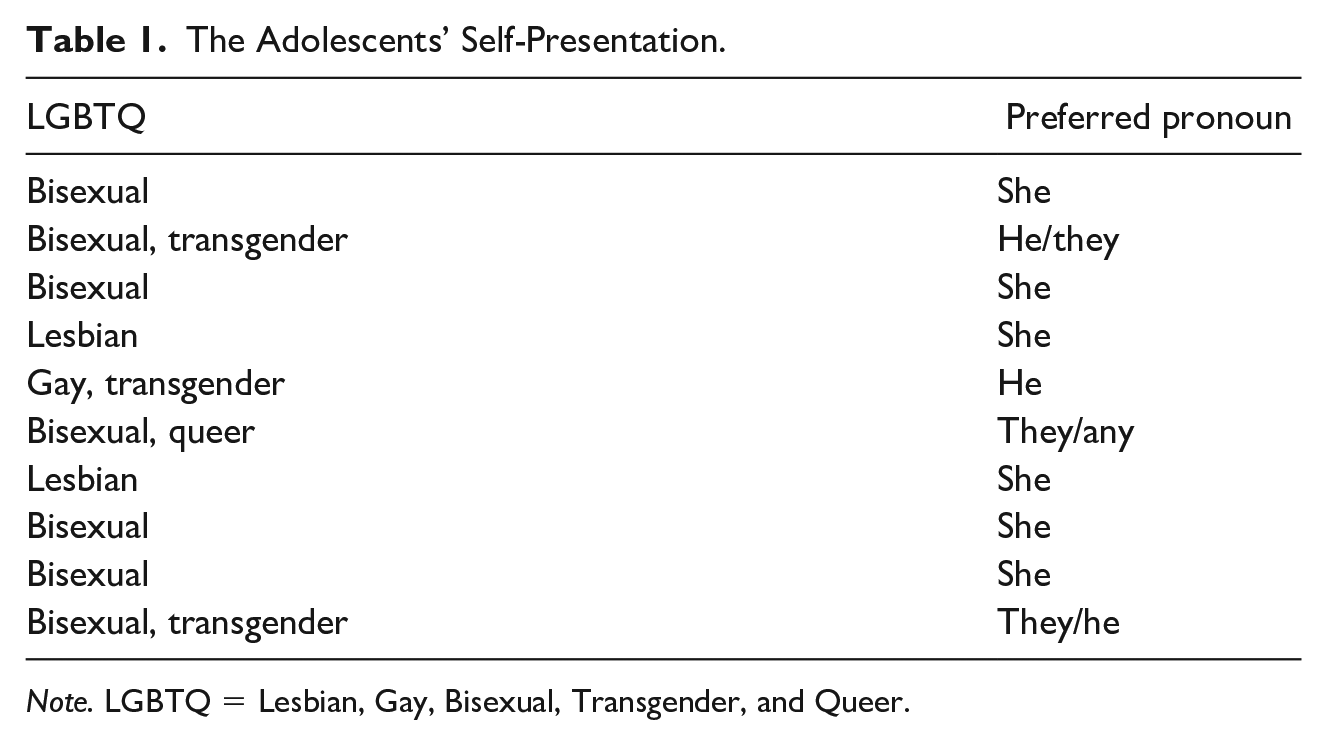
Note. LGBTQ = Lesbian, Gay, Bisexual, Transgender, and Queer.
In that way, the adolescents challenged the common norm understanding that a male person (sex) is called “he” and a female person (sex) is called “she.” They risked disturbing the order of sexual understanding in society and thereby, they risked to challenge this order in junior high school among peers and teachers. They introduced a distinctive sexual understanding with specialized patterns of sexual conduct and assumptions in a teenagers’ environment: I have been part of the LGBTQ community since I was maybe 13-14 years old. I came out first as bisexual, then as pansexual and lastly as lesbian, [laughter] it’s been a pretty long journey. (Adolescent 4)
The teenagers were in fact in the process of finding an identity and defining their own sexuality.
The adolescents knew the risk of being excluded from the group of peers in junior high school due to their sexual orientation or their gender expression. They tried to behave in ways that supported an inclusion in the group. It seemed significant to fit the heterosexual and cis norm and try to adapt to how their peers at school dressed and/or behaved. It made it difficult to stand up for what one believed in. Some adolescents stopped airing their opinions in an attempt to deflect others’ attention to the self. It was thus difficult to go against the students’ primary socialization into an internalized heterosexual norm. The adolescents found that their peers regarded them as having a different gender expression or sexuality than the majority of peers, for instance based on the clothes they chose to wear, although they did not intend to look different. The adolescents thus voiced a balance act, where they had to negotiate their way forward while considering both the environment’s actual norms and their own, perceived and developing gender identity and sexual orientation. The tension between the two could ignite a sense of exclusion, while simultaneously searching for a sense of belonging and inclusion among their peers.
It was a lot that people got shunned for, well for how they dressed, how they acted, what pronouns they wanted to use and, if you were the least bit different it became quite difficult. (Adolescent 4)
Some adolescents had been excluded from the peers’ community and bullied to such an extent that they had changed school or class as a way to actively address and change their situation. Overall, the adolescents experienced several peers’ attempts at resocialization or renormalization, which unfolded as (attempts at) bullying, both at school and on the internet.
It was noticeable that they excluded you. Sometimes it was the things they said, but the majority only said it after school, online. (Adolescent 6)
The adolescents were outsiders in the sub-universe of junior high schools. However, they did not want to give their peers the right to harass them for who they were or to use it against them.
I knew [that I am lesbian], but I didn’t want to endorse what they said about me, I didn’t want them to have anything on me that I didn’t feel comfortable with sharing with them. (Adolescent 7)
The experienced exclusion strategies made it hard for the adolescents to accept themselves for who they were. Some of them reacted with sadness, a sense of alienation and resignation, and physical and/or mental symptoms.
During eighth and ninth grade, I felt really bad. . . . There was online hatred, and looks, really obvious looks that tell that they question you. (Adolescent 6)
They withdrew from the social community in junior high school, and in that way, they supported the exclusion processes themselves. The adolescents expressed a social alienation from their peers at school. They regarded themselves as excluded from the peer group, just because they were LGBTQ persons. The adolescents’ experiences thus led to a double sense of exclusion, both from the peers and from the self, by “rejecting” their true identity or delaying its acceptance. Not adapting to the norm represented a threat in terms of exclusion from the group, while an adaptation to the norm represented a threat to the adolescents’ acceptance of their true identity.
We were just scattered parts, like a piece from a child’s jigsaw puzzle that had been placed in a puzzle of a thousand pieces where it doesn’t belong. (Adolescent 6)
The adolescents knew that they had a different sexual orientation or gender identity than other peers. They had only a few friends. However, the adolescents found that friends were important to share interests and discuss matters of importance in a nonjudgmental manner.
Through junior high I only had one friend and like, just that time, I didn’t feel like she supported me, but she did later when I talked to her about it. (Adolescent 1)
Some friends stood up for the LGBTQ adolescents. While doing this, potential latent conflicts regarding gender and sexual orientation were illuminated, which could further reinforce a sense of exclusion.
We started talking about the LGBTQ subject and he [peer] said that he was kind of neutral. He said something in the way of “I wouldn’t want to be that myself, but people can do whatever they want.” For me, it was enough. [. . .] Then comes my hetero friend, who is really an activist [. . .] and she thought that being neutral was not enough [. . .] she started making this a really big political issue that we had to discuss right there and then [. . .] which made things much worse. (Adolescent 3)
Nevertheless, even among friends, the adolescents could feel “different” because the friends also had a hard time understanding what it meant to be a LGBTQ person if they were not LGBTQ persons themselves. Yet, the adolescents demanded to be included among the insiders as an outsider, and from the premise of the outsider.
Like very very weird, like it is a joke, it was not like ‘Yuk it’s disgusting,’ but people were still like God this is strange. [when discussing homosexuality] (Adolescent 7)
Finding friends who were LGBTQ individuals themselves was expressed as the easiest way to socialize and get a feeling of belonging. Experiencing a sense of inclusion thus seemed to be dependent not only on having friends, but on having friends that could truly grasp the meaning of identifying as being LGBTQ. Similar others shared the same gendered or sexual framework of understanding and belonged to the same sub-culture in junior high school and, by extension, also in society. Friends who themselves had gone through a process of resocialization toward a non-normative identification were thus experienced as more supportive.
After being in the closet for a really long time and being really nervous and sad because of the school I came from, then I suddenly became really energetic and super enthusiastic about actually finding people who are like me. (Adolescent 3)
Having friends was a way for the adolescents to demonstrate their legitimate inclusion in the group, toward themselves, and toward the peers who sought to exclude them.
Adults in School Supported Inclusion in and Exclusion From the Group of Peers
The adolescents expected the adults at their schools to act as helpers in their inclusion process in the group. For instance, the adolescents expected the teachers to (re)act immediately when they were bullied by peers, such as when LGBTQ-related terms or degrading words were used as insults. The adolescents thus placed the responsibility for successful school days in terms of being equal and included members in the peer group on the adults in their respective schools. From the adolescents’ perspective, some teachers ignored excluding behaviors toward the LBGTQ adolescents: They [the other adolescents] could make jokes about that people were lesbian or . . . gay, but the teachers didn’t say anything, and then I said that you can’t say that, it’s really bad. (Adolescent 8) He [the principal] walked around and played guitar and stuff and that is nice, but not right when people have it tough and are harassed or bullied. (Adolescent 3)
Other teachers depreciated the students’ experiences of being bullied, and some of the teachers did not have an inclusive behavior at all, from the perspective of adolescents: It was about these anonymous messages. I raised the issue with my teacher because I noticed that people were writing during class: “what the hell are you wearing today?!.” And there was nobody else there, other than people from my class. And the reply I got [from the teacher] was that, no it is just someone who is joking with you. (Adolescent 4) We had a locker room for girls, one for boys, and one for like whomever but then some teachers commented; why should we have that? (Adolescent 1)
The adolescents expected the adults to oppose excluding behavior from fellow students and actions that the adolescents deemed as unacceptable. Lack of (re)action from school personnel was in that way associated with silent support of peers’ exclusion strategies or as an excluding strategy. At times, the adolescents even chose to remove themselves from a school environment experienced as harmful. After having witnessed adults in junior high schools that ignored unjust or nonchalant treatment of students, the adolescents stopped asking for help when experiencing exclusive behavior toward them by other peers. The adolescents apprehended the teachers as ignorant or uninterested in the LGBTQ subject, which appeared as an exclusion mechanism in itself.
There were teachers who walked by in the corridors and heard the insults [. . .] and those [students] were never reprimanded. (Adolescent 7)
According to some adolescents, other teachers brought up bullying that occurred outside the classroom. This was seen as an attempt at stopping the cultivation of exclusion strategies and at conveying acceptance, tolerance, and inclusion in the group of peers. However, it did not change how the adolescents’ peers acted, or how the adolescents experienced their peers’ actions.
The teachers had an idea that students should learn, so we saw a documentary about trans people. Peers said bluntly that [. . .] we do not think that this person has the right to define himself. [. . .] just that day, we had a substitute teacher who didn’t know if someone transgender was in the classroom or not, or did not dare to say so, but it was really a very strong signal [. . .] afterwards, the teachers took it up [in plenary] [. . .] but then everyone was like “we never said that and we do not think so.” Like “We have never said such a thing, it does not exist, it is not true.” (Adolescent 10)
However, there were also peers who resented and lamented fellow students’ actions, when considered wrongful.
So I talked to one of the teachers and then she talked to the guys that had said all that and then, the day after, one of them apologised to me. (Adolescent 1)
Some adolescents had however experienced teachers who made efforts to understand what had happened when the adolescents experienced exclusive behavior from their peers. The teachers had follow-up dialogues with these peers, which demonstrated attempts at inclusive behavior from the teachers. Experiences of a good connection with a teacher contributed to the adolescents feeling respected, recognized, and included in the wider community of junior high school. Also, school nurses could function as mediators in the process of acceptance by peers and inclusion of LGBTQ persons in the sub-universe of junior high school. An adolescent got help from the school nurse when informing the class about the forthcoming social and medical transition: I was really nervous, so I thought I’d talk to the school nurse and then we could fix it together . . . She helped a lot, she came and then we informed the class together. (Adolescent 5)
Taken together, school personnel could both reinforce a sense of exclusion or inclusion in the adolescents by choosing to (re)act, or not, on questionable behavior among the students.
Non-Heterosexuality and Non-Binary Gender Understanding as Teaching Projects in Junior High School
The adults in junior high school provided different initiatives to establish an inclusive milieu for LGBTQ adolescents by making LGBTQ a project for awareness raising. This implied that identifying a LGBTQ identity was regarded as something special, that is as something that is not “normal.” A process of resocialization of the school personnel and peers was set in motion to widen their acceptance of what they viewed as something out of the ordinary. For example, the LGBTQ subject had been brought up in association with a LGBTQ-themed day, with a lecture by a guest speaker from an LGBTQ community. At some schools, students themselves had been educational promoters by addressing the subject within art projects, school plays, or when informing the class about a forthcoming social and medical transition. Some of the adolescents appreciated how teachers and student counselors had worked with the LGBTQ subject.
The teachers are quite open to letting the students express themselves about what they do, so it was more that LGBTQ persons included themselves . . . it was mostly because the students pushed towards it, and anyways, well at my school there was a very positive LBGTQ environment. (Adolescent 2)
Others expressed that there had been too little focus on the subject and that the addressed information did not include, for them, relevant knowledge.
I remember sexual education as being inclusive in general, and we had a teacher that was really good at teaching sexuality. However, they could also have brought up trans. . . . Another thing I have thought about a lot is that one can be homosexual, but it was not discussed as if anyone in the room could possibly be [homosexual]. It was more that people in the world are [homosexual] but they could have made it more obvious that it is common and that many are [homosexual]. (Adolescent 10)
The adolescents rated the teaching on the LGBTQ subject as inadequate since it mainly consisted of short statements about the meaning of the letters LGBTQ and nothing more substantial.
They said nothing about homosexuals, or wait, they said: there are homosexuals, bisexuals and heterosexuals, or if they said bisexuals. I don’t think so. And in social sciences, they never brought up that there is oppression against the LGBTQ communities. And the school nurse never brought it up when we had the health check-up, which I think they should do. (Adolescent 8)
In addition, the contributions from invited representatives from the LGBTQ-community were rated as of little value as the adolescents could not identify with the guest speakers (for instance due to differing ages and sexual identity). The presented contents did not match the adolescents’ personal wishes, expectations, or needs. For instance, one guest speaker only talked about being gay and also said very little about gender identities in the LGBTQ communities.
We had a guest speaker coming over and he was like a crossdresser. He did not say transsexual, but said transvestite and he like, that is what I call myself and he was like 65. (Adolescent 7)
Such initiatives could be regarded as resocialization and inclusion attempts, with the aim of promoting the LGBTQ subject in the sub-universe of junior high schools by facilitating the internalization of a new normal among the peers. However, such a project started and ended, and as also expressed by some of the adolescents, it had limited effect as a stand-alone event without continuous follow-up in everyday life at school.
Well, the LGBTQ-themed day was the only thing, otherwise the teachers never brought it up. (Adolescent 8)
Nonetheless, some adolescents mentioned positive examples of focus on LGBTQ teaching during classes. For instance, some students received a book about the subject in connection with a Swedish lesson, and other teachers had used teaching time on the subject during biology classes.
When we had biology classes, the biology teacher spent three to four lessons solely addressing the LGBTQ subject when we had sexual education, and that was a lot because it was like three fourths of all the lessons we had in biology that year. (Adolescent 9)
Despite good intentions, some teachers lacked knowledge about the LGBTQ subject, from the perspective of the adolescents.
I feel that there is a big gap in what they teach regarding LGBTQ, it is lacking in the curriculum. // It is important for somebody who is LGBTQ. But overall, they were not bad towards LGBTQ adolescents. It was mostly that they were ignorant. (Adolescent 2)
According to some adolescents, certain teachers reinforced the experiences of LGBTQ persons as abnormalities by designating the LGBTQ-themed day as a waste of time.
I don’t know exactly, but some of the teachers did not have a positive attitude to the [LGBTQ-themed] days. Some thought that it was a waste of time, that there were better things to do [with the time]. So there was a mix. (Adolescent 9)
In summary, the school personnel’s attitudes, efforts, and potential continued work on the subject thus appeared to make a difference in terms of the adolescents’ experiences of a sense of inclusion or exclusion in relation to such initiatives. The adolescents’ thirst for enhanced knowledge in the school environment can be interpreted as a wish to re-socialize their peers and teachers, or at least to expand their horizons. Overall, the adolescents expressed a wish for the subject to be addressed to a higher extent in junior high school, partly to normalize LGBTQ persons, partly to include them in this sub-universe on terms equal to those of cisgender and heterosexual adolescents.
“This is homosexuality, it is nothing strange.” Think about it like that and then you can have that statement in your head when you grow up. But I never got that, not from school. (Adolescent 7)
School personnel could thus make a difference for the LGBTQ persons by actively addressing the subject and contributing to all students’ knowledge enhancement, and thereby also to a sense of inclusion and belonging rather than exclusion in the adolescents.
Discussion
The discussion will focus on three main findings, namely how the LGBTQ adolescents are placed in a web of inclusion and exclusion strategies in junior high school. This often situates them in an outsider position, enforced by others and themselves. Second, it will focus on how the overall social norms of sexuality and gender in society are habitualized in teenagers and how this affects the identity development process. Third, it will focus on how articulations and stagings of sexual and gender minorities simultaneously can create both openness and silence about LGBTQ. These points will be addressed across the findings in the following discussion.
A Web of Inclusion and Exclusion Strategies
The findings show how the LGBTQ adolescents find themselves in a web of inclusion and exclusion strategies in junior high school, through which they are often placed in an outsider position, both by others and themselves. The adolescents interpret their navigation in a school environment, where the personnel’s and the peers’ actions or lack of action affect the adolescents’ relation to the self and others. Such actions can contribute to both a sense of inclusion and exclusion in the adolescents. As seen, a sensitivity to the prevailing norms and a wish to belong can contribute to igniting or strengthening a sense of alienation while in search for a gender and/or sexual identity. Previous studies show that marginalized persons whose self-expression is hampered can find an outlet online, among similar others (Craig & McInroy, 2014). Studies show that adolescents spend a considerable amount of time with peers and their socialization by peers becomes narrower in adulthood (Mousavi et al., 2019; Šikić-Mićanović, 1997; Witt, 2000). Gender identities and sexuality are not just personal markers; they are social markers. They arise from the individuals’ relationships to other people, through primary and secondary socialization, and depend upon social interaction and social recognition (Berger & Luckmann, 1966). It means that gender identities influence how individuals understand themselves in relation to others (Zevallos, 2014). Identifying with a minority in terms of gender identity and/or sexual orientation, which does not represent the dominating norms in society, may be associated with additional challenges for adolescents. At the same time, it might challenge and/or confuse peers that are in their own process of establishing their sexuality and gender identity. In that way, it can trigger strong emotions and resistance stagings. Resistance or deviance from the norms means pushing the boundaries of one’s own and/or others’ primary and secondary socialization through the cultural family unit and surroundings in which they grew up. The findings also show that the adolescents view themselves as victims of discriminating behaviors, expecting school personnel to counteract such behaviors. Lack of action from the adults results in feelings of alienation, isolation, and resignation, increasing the adolescents’ vulnerability and possibly challenging their mental and social well-being, as also shown in other studies (McDonald, 2018; Russell & Fish, 2016). Lack of and low levels of social support have been associated with higher levels of mental health issues, risky sexual behaviors, shame, and low self-esteem (McDonald, 2018). Nevertheless, the adolescents also demonstrate a sense of agency, for instance by actively addressing situations that were experienced as challenging. The findings thus point to mechanisms of both inclusion and exclusion that were set in motion by the adolescents themselves, by school personnel and peers. The adolescents wish for inclusion from an outsider’s position and by delaying an acceptance of their true, developing sexual and gender identity, they get caught in a double-bind. Their longing for inclusion leads them to deny or negotiate their gender and/or sexual identity, without increasing their sense of inclusion. As also seen in previous studies, stereotyping, criticism, and strong reactions by friends and family can hamper such identity explorations, also representing risk factors in terms of mental well-being (Aranmolate et al., 2017). Nonetheless, social support can help buffer stressful experiences in life, including struggles with mental health issues (Stjernswärd & Östman, 2011; Takizawa et al., 2006); in LGBTQ adolescents (McDonald, 2018). While some school personnel’s and peers’ behavior contributed to a sense of exclusion, the presence of a supportive teacher or friends helped the adolescent to cope during junior high school and contributed to self-acceptance. Befriending other LGBTQ adolescents facilitated an acceptance of their LGBTQ identity and a sense of inclusion in these communities, corroborating previous research that also shows the value of expressing the true self in a community of similar others, especially in marginalized individuals (Craig & McInroy, 2014; Dym et al., 2019).
Habitualization of Norms in Society
Furthermore, the findings show that the school environment is ruled by dominant norms in society pertaining to sexual and gender identity, that is a heteronormative and cisnormative society (Foucault, 1978; Katz, 2007). It means that the overall social norms of sexuality and gender expressions in society may be habitualized in teenagers. A norm that teenagers, positively or negatively, benchmark themselves against and through which they relate their sexuality to heterosexuality, regardless of gender identity. Deviance from or resistance toward prevailing norms creates reactions in the environment, for instance from school personnel and peers. Nonetheless, the transition from current norms to an identity orientation that is not in line with the dominant norms is not free of friction (Fish & Pasley, 2015), especially if the adolescents themselves have their primary and secondary socialization rooted in heteronormativity and cisnormativity. The adolescents in the current study balance between accepting their developing LGBTQ identity and avoiding attracting attention to their identification with a sexual and gender minority as this makes them easy victims of bullying and unwanted attention (Jackman et al., 2020). Simultaneously, they do not want to appear different from their peers and thereby, they cannot fully take on a gender or sexual identity that differs from that of most of their peers. However, Stewart et al. (2019) show that many adolescents are nuanced and dynamic in how they identify and experience their developing sexuality and gender identities. Jensen et al. (2016) show that Modern societies are characterized by increasing trends toward projectification. There is ongoing pressure for each individual within a crowd to, paradoxically, “stand out” from the crowd. In this process, individuals merge their private and professional persona into a single identity, and “private” decisions such as gender identity and/or sexual orientation all become part of the development of a unique and interesting profile. In the current study, the LGBTQ adolescents strive to be accepted for who they are, which could also be regarded as a projectification of their gender identity and sexuality. The feeling of being different was hence amplified by being teenagers in their own quest for a sexual and gender identity. This projectification, driven and aided by social media, acts as a form of de-marginalization and helps with the development of an alternative profile. Therefore, the construction of meaning becomes essential for adolescents. Previous research has also shown that marginalized individuals can take on and try different roles through mediated and partly anonymous communication, thereby affecting their self-concept and increasing feelings of self-worth and acceptance (Dym et al., 2019), with social support showing associations with positive self-esteem (McDonald, 2018).
Re-Socialization Takes Time
The findings show that articulations and stagings of belonging to a sexual and gender minority simultaneously can create openness and silence about LGBTQ. The openness from the LGBTQ adolescents could be regarded as a confession. Foucault (1978) shows how confessions have become highly valued techniques for producing truth where people go about telling with the greatest precision, whatever is most difficult to tell. The LGBTQ adolescents described several initiatives, supporting their confessions, with the aim of enhancing knowledge on the LGBTQ subject, although their value was questioned. They expressed a wish for further education on the subject in school. A question is whether time limited projects, such as thematic days, contribute to increasing the sense of not belonging or if they contribute to higher degrees of inclusion and to stretching the boundaries of prevailing norms toward more accepting attitudes toward minorities. Such initiatives are deeply rooted in a knowledge-behavior (cognitive-behavioral) tradition, as there is an attempt to change behavior through knowledge and recognition of how behavior affects acceptance of heteronormativity and cisnormativity inside and outside the school environment. Apparently, this is a problematic starting point as socialization processes happen over a lifetime, in environments with more or less dominant norms (Berger & Luckmann, 1966). A process of re-socialization and re-habitualization, through which dominating views are challenged, may take time, perhaps unless they happen in times of upheaval (Wolfsfeld et al., 2013) or crises (Glasdam & Stjernswärd, 2021). Events can turn the world upside down overnight and rapidly give rise to a “forced” acceptance of a “new normal” (Glasdam & Stjernswärd, 2021). Nonetheless, inclusive school policies have been associated with a better climate for students, with less victimization and bullying for LGB youth, and higher grades for transgender youth (Day et al., 2019), indicating the value of inclusion strategies on strategic levels.
Study Limitations
Finally, the study’s methods are discussed in short. As this is a retrospective study, there might be a reconstruction and re-interpretation of the narratives over the years. The older participants more often described their feelings in relation to the school environment instead of particular events, while younger participants talked about specific events and did more rarely make a deeper analysis of how that affected them. During adolescence, a person matures cognitively and coping strategies become more evolved (Graber et al., 2010; Zimmer-Gembeck & Skinner, 2011), which in itself may alter how events are perceived in hindsight. During some of the interviews, when it became evident that the participant struggled with emotions, the investigator reminded the adolescents that participation was voluntary and that they were to freely choose what to share or not. A card with numbers to helplines was prepared in advance in case participants showed signs of needing professional help. No such signs were displayed during the interviews and no cards thus distributed.
Quotes were included to enhance transparency and facilitate alternative interpretations of data. The data proved to be rich even though the sample can be considered small. The empirical data give voice to differing opinions and experiences within the studied group. A potential limitation of this study when assessing the findings in view of credibility is that the sample is not evenly distributed in terms of gender identity and/or sexual orientation represented in the LGBTQ group. The participants represented a varied group in terms of gender identity and sexual orientation. The current study did primarily focus on the experiences of adolescents defining themselves as non heterosexual and non cisgendered. It means that the study did not focus on differences in gender identity or sexual orientation as such among the studied adolescents, but on their experiences of junior high school from the perspective of individuals who do not identify with the dominant norms on gender and/or sexual orientation. The literature nevertheless shows that there may be differences in experiences of marginalization, (self) stigmatization, and social exclusion for trans people compared with other gender identities and sexual orientations among adolescents (Hughto et al., 2015; Reisner et al., 2016; Takács, 2006), which motivates further research with larger samples to further explore these issues in more depth. The literature indicates unique biological, behavioral, social, and structural contextual factors surrounding health risks and resiliencies for transgender people, which represent areas of exclusion and marginalization of specific importance for this population (Hughto et al., 2015; Reisner et al., 2016).
The choice of Berger and Luckmann (1966) as a theoretical framework and analytical lens made it possible to minimize the potential influence of the researchers’ preconceptions on the analysis process. By moving the researcher’s pre-understandings to a theoretical perspective, it is possible to be stringent and transparent in the process of analyses with a limited disruption of the researchers’ unconscious pre-understandings. This strengthens the study’s trustworthiness. A weakness of the method is that it is based on how adolescents articulate feelings, actions, and interactions in the school. The study does not address how daily life in school is handled within the practical reality. Likewise, the study does not address the perspective of the adults and peers in the school environment, which means that it is not possible to describe all the relational understandings of the complex reality, the actions and interactions in the studied context.
Conclusion
The current findings showed that LGBTQ adolescents faced multiple challenges in their school environment, related to their own identity development, the personnel’s attitudes and behavior, and those of their peers. The adolescents found themselves in a web of inclusive and exclusive strategies, exercised by the self and others, which affected their experiences of junior high school. Furthermore, in a world dominated by heteronormativity and cisnormativity, they struggled with developing and accepting their gender identity and sexual orientation. They balanced between adapting to and resisting the norm so as to be included, and not actively excluded, from the group of peers. Like most teenagers and their fellow peers, the adolescents were in a process of identity development, including gender and sexual identity development. They were in a school environment ruled by the dominant heteronormative and cisnormative norms in society pertaining to sexual and gender identity. Deviance from or resistance toward prevailing norms creates reactions in the environment, where the LGBTQ adolescents represented a minority group. Offensive and discriminating behaviors, lack of supportive networks and of role models they could identify with risk enhancing the vulnerability and sense of alienation and isolation in LGBTQ adolescents. Opposite, the adolescents’ projectification of their gender identity and/or sexual orientation support the construction of the meaning of being an LGBTQ adolescent. This must be regarded in line with the adolescents’ wishes for more initiatives aiming at increasing the school environment’s knowledge about the LGBTQ subject, which could enhance people’s understanding of the subject and prevent discriminating behaviors. At the same time, such initiatives could reinforce a sense of not belonging, thus contrary to the primary goal of introducing the subject at school.
Implications
The findings added to the body of work on how LGBTQ adolescents perceived their time in school. Further studies are needed to enhance our knowledge and understanding of the LGBTQ adolescents’ situation in junior high school through anthropological field studies of the actions and interactions from relational perspectives.
Footnotes
Acknowledgements
The authors warmly thank all the adolescents for participating in the study and the LGBTQ venues that, through their help, facilitated participation in the current study.
Author Contributions
Catarina Cederved: conceptualization, methodology, investigation, transcription, writing—original draft preparation, writing—review & editing, project administration. Stinne Glasdam: conceptualization, methodology, writing—original draft preparation, writing—review & editing. Sigrid Stjernswärd: conceptualization, methodology, writing—original draft preparation, writing—review & editing.
Data Availability Statement
The authors elect to not share data for confidentiality reasons.
Declaration of Conflicting Interests
The author(s) declared no potential conflicts of interest with respect to the research, authorship, and/or publication of this article.
Funding
The author(s) received no financial support for the research, authorship, and/or publication of this article.
