



Abstract
The transition from high school to college is a significant milestone for students, shaping their future academic and career trajectories. However, this process presents numerous challenges, particularly for students with disabilities, who often face systemic barriers in accessing adequate support (Lombardi et al., 2018; Newman et al., 2011). While federal mandates such as the Americans with Disabilities Act (ADA) have contributed to expanding disability services in higher education, gaps in accessibility persist, especially in the areas of college counseling and application guidance (Getzel, 2014). With the increasing use of digital platforms, artificial intelligence (AI)-powered tools hold promise for bridging these gaps by offering personalized support and improving accessibility (Chiu, 2021).
Recent advancements in AI-driven advising systems have introduced a new dimension in educational counseling. ADVi (short for “advisor”), an AI-powered chatbot developed by the Texas Higher Education Coordinating Board (THECB, 2021), provides real-time guidance to students navigating the college application process. By offering timely information on deadlines, financial aid, and institutional requirements, ADVi assists students, particularly those in under-resourced schools who may have limited access to in-person college advising. Given the widespread disparities in counselor-to-student ratios across the United States, AI-powered chatbots offer a scalable and cost-effective solution to address gaps in postsecondary guidance and information access (Page & Gehlbach, 2017). Although AI-based advising tools have gained traction in supporting the general student population, there remains little research on their effectiveness in assisting students receiving special education services (Page & Gehlbach, 2017). While previous studies have explored AI’s impact on student engagement and retention (Chiu, 2021; Hsieh et al., 2020), few have examined how students with disabilities interact with these systems and whether such interventions help mitigate the challenges they face in applying to college. This study seeks to fill this gap by analyzing how students with disabilities engage with ADVi compared to their typically developing peers. Understanding whether AI interventions can effectively support students requiring specialized assistance is critical to ensuring equitable access to postsecondary opportunities (Chiu, 2021; Page & Gehlbach, 2017).
Students with disabilities encounter unique barriers when applying to and enrolling in college (Lombardi et al., 2018; Newman et al., 2011). Many of these challenges stem from a lack of individualized college counseling, with high school counselors often lacking specialized training in assisting students with disabilities (Mamiseishvili & Koch, 2011). As a result, gaps emerge in areas such as accommodations guidance, financial aid advising, and application completion support (Getzel, 2014; Madaus, 2011). In addition, students with disabilities frequently struggle to access clear and structured information on college accommodations, eligibility criteria, and the procedural steps required to secure necessary support (Cawthon & Cole, 2010). Unlike K-12 education, where schools are legally mandated to provide services under Individualized Education Programs (IEPs) and 504 Plans, higher education accommodations require students to advocate for themselves, a task that many find overwhelming (Hadley, 2007). Furthermore, students with disabilities—particularly those with autism, emotional disabilities (ED), and learning disorders (LD)—may experience difficulties with organization, planning, and communication, all of which are critical skills in completing the college application process (Hartman-Hall & Haaga, 2002). Given these challenges, AI-driven interventions offer the potential to enhance accessibility by providing structured, real-time guidance to students who may lack access to traditional support systems.
AI-powered tools have increasingly been used to improve student engagement, retention, and access to higher education (Okonkwo & Ade-Ibijola, 2021; Woolf, 2009). For example, chatbot-based systems have been shown to supplement traditional advising models by providing uninterrupted support, ensuring that students can receive immediate responses to their inquiries without long wait times (Winkler & Söllner, 2018). In addition, AI chatbots can customize guidance based on a student’s specific needs, directing them to relevant resources, including those related to disability accommodations (Holmes et al., 2019). By sending reminders about application deadlines and financial aid opportunities, these tools help students stay on track throughout the college application process, reducing the likelihood of missed opportunities (Bergman et al., 2020; Castleman & Page, 2016). AI chatbots also serve as an intermediary between students and human advisors, allowing school counselors to focus on more complex issues while AI-driven systems handle routine inquiries. This combination of automation and human intervention can create a more efficient and accessible advising ecosystem.
In this study, we utilized quantitative methods to examine the role of ADVi in supporting students with disabilities by examining differences in utilization patterns between students who received special education services versus the general education population. Our goal is to determine whether students with disabilities use ADVi at higher rates than their typically developing peers, whether certain disability categories are associated with increased chatbot engagement, and what socio-demographic and academic factors influence ADVi usage. To explore these questions, we utilized restricted-use, student-level administrative data from the Texas Education Research Center (ERC) at the University of Houston. This dataset includes longitudinal records of Texas public high school graduates from the class of 2021, providing detailed information on demographics, special education classification, academic performance, postsecondary aspirations, and high school characteristics. In addition, THECB provided ADVi engagement metrics, which measure how often students interact with the chatbot.
AI in Education: Review of Relevant Literature
With models of AI rapidly evolving, research is still emerging to understand the role and impact of these tools as it relates to educational processes, including college application and guidance, as well as helping students already enrolled in college stay engaged. Most of the early research on AI tools focused on general student populations; therefore, we have scant information on how AI tools can and do support students with disabilities. One exception comes from Chiu (2021), who conducted a systematic review of AI in education for students with disabilities and describes how AI-driven educational tools provide several key benefits to students, including personalized feedback and information, immediate feedback, and support. This review revealed the promise of AI technologies for students with disabilities since they can be specially programmed to provide customized responses based on a student’s specific needs, such as guiding a student with dyslexia toward institutions with strong assistive technology programs or helping a student with autism identify colleges with compre-hensive neurodiversity support services.
The potential impact of AI tools for enhancing college access, enrollment, and retention of students with disabilities is profound. For example, Page and Gehlbach (2017) studied the effectiveness of AI-driven chatbots in supporting students through the high school to college transition process. Their study found that a conversational AI system providing text message–based outreach throughout the summer months leading up to students’ first semester in college significantly improved their ability and inclination to complete college pre-enrollment tasks, reducing “summer melt” or the deterioration of motivation to pursue post-secondary education through the summer months. This evidence suggests that chatbot interventions have positive effects on students by providing real-time reminders for students who otherwise might lose interest and/or momentum in the final days of college registration and enrollment. Chatbot interventions could have similarly positive effects for students receiving special education services when paired with tailored supports that provide relevant information for these populations, such as responding to accessibility-related queries and facilitating connections with disability support offices (Cawthon & Cole, 2010; Getzel, 2014).
With respect to student classroom learning experience, a few studies provide insight related to how AI technologies might facilitate experiences of students with disabilities. For example, Attwood et al. (2020) explored the role of AI-driven virtual reality (VR) and chatbot technologies in assisting with classroom management. In this study, a survey was conducted with 41 participants, analyzing their views on VR, AI, and learning preferences. The results indicated significant correlations between positive perceptions of VR and AI, as well as adaptability for individual user preferences, particularly among those who had previously used VR. Their study suggested that AI chatbots could serve as adaptive learning assistants, helping students navigate complex learning environments by providing structured feedback and managing engagement. Applying this concept to the college application process, chatbots could assist students receiving special education services in maintaining motivation, tracking progress, and receiving contextualized support tailored to their needs.
Elsewhere, research by Hsieh et al. (2020) suggested that AI systems incorporating anticipatory computing could improve student motivation and engagement. The research implemented an interactive AI platform, integrated with the Attention, Relevance, Confidence, and Satisfaction (ARCS) motivation model (Keller, 1987), to assist students in classroom learning through emotional recognition and responsive interactions. A comparative experiment was conducted with two student groups, with one using traditional teaching and the other incorporating AI-assisted instruction. Results showed that students in the AI-assisted group demonstrated significantly higher motivation, engagement, and learning effectiveness compared to the control group. This research further supported the idea that AI models in chatbot systems can enhance the support experience for students with disabilities by responding dynamically to the students’ interactions and learning patterns.
Finally, AI tools that support college-going behavior could be especially beneficial for student groups who have historically been underrepresented in higher education in the U.S., based on gender, race and ethnicity, household income, or first-generation status. We know, for example, Black and Latino (Alvarado, 2021; de Brey et al., 2019; Kena et al., 2015), first-generation (Glass, 2023; Whiteside, 2021), and low-income students (Castleman et al., 2012; Ober et al., 2020) enroll in college at lower rates than their counterparts, and when they do enroll, they may be less likely to complete their degree programs. We also know we have an overrepresentation of women in college (Davis & Otto, 2016; Doherty et al., 2016). Although many reasons explain these persistent disparities, we know that among them are access to college-going information and support through the application process (e.g., Iloh, 2020; Liou et al., 2009; Robinson & Roksa, 2016). AI tools are promising for helping to address these disparities by providing more widely available and easily accessible access to college-going information that can be tailored to students’ interests, needs, and questions. Newly developed AI tools, such as a text-based chatbot, may provide a solution to help bridge these gaps.
AI education tools are still emerging and remain relatively under-researched in the context of higher education advising. However, existing studies suggest that AI supports have significant potential to help students from various backgrounds access information that might otherwise be unavailable to them. This is especially true for students with disabilities who have a range of challenges that could be overcome with the assistance of these kinds of tools. However, we still need more information on utilization habits and patterns. Thus, this study examines whether students from different backgrounds—and particularly those receiving special education services—differ in their utilization of and interaction with the AI chatbot.
In Texas, one prominent example of such an AI advising tool is ADVi, developed to support students’ college and career planning during high school. The following section provides an overview of the ADVi initiative and the policy context that shaped its development.
ADVi: The Virtual Advising Project in Texas
The Texas legislature has strategically invested in mechanisms aimed at aligning educational opportunities with the demands of the evolving and rapidly growing job market. Specifically, over the past two decades, the state legislature passed three significant bills: “Closing the Gaps by 2015,” “60x30TX,” and “Build a Talent Strong Texas” to further higher education workforce goals. Initially, these investments seemed to pay off as Texas witnessed a positive trend in college enrollment from 2015 to 2019; however, the COVID-19 pandemic brought about unprecedented challenges for college enrollment. Such significant disruptions in college education prompted urgent efforts to facilitate college applications for students during the pandemic. When the COVID-19 pandemic struck, the THECB sought innovative ways to continue supporting students in their postsecondary education efforts. One result was the Virtual Advising Project or ADVi—a free, AI-driven chatbot system that would provide encouragement and resource information to students working on college applications.
Research on chatbots has a long history, starting from narrow-based systems built on deterministic, pattern-matching scripts to more generative models that use large language models (LLMs) to generate original, contextually relevant text responses in real time (Bommasani et al., 2021). The ADVi technology fits in between narrow AI systems and more sophisticated generative AI models in terms of functionality, while operating as a retrieval-based chatbot. Specifically, the ADVi uses machine learning–based intent recognition to interpret student questions and categorize them into advising areas such as FAFSA, admissions, or scholarships. Once an intent is identified, the system retrieves an appropriate response from a curated knowledge base that contains pre-verified information from THECB, rather than generating novel text or using large language models. ADVi also manages limited conversational context, enabling it to send follow-up prompts and personalized “nudges” that keep students engaged. When a question falls outside its programmed scope or requires individual attention, the ADVi escalates the conversation to a live human advisor for personalized support (THCEB, 2021).
Before high school seniors complete college applications through the ApplyTexas website, they can opt in to receive communication from ADVi and receive on-demand support via text messages (see Supplemental Text, Section 1, within the Supplemental Materials (SM) for a description of ApplyTexas). ADVi contains a plethora of college-going information and sends students informative text messages throughout the academic year, as shown in SM Figure S1. ADVi can also receive and respond to college-going questions from students, and when ADVi is unable to answer a student’s question, the chatbot connects the student with a human advisor who continues the text conversation. Students can engage with ADVi from any device (e.g., phone, tablet, computer) that has texting capabilities. By providing timely and relevant information (e.g., application deadlines, financial aid, and college requirements), ADVi can help bridge the information gap, particularly for students who may lack access to adequate guidance. In addition, by sending reminders and alerts about important dates and deadlines, ADVi can keep students on track throughout the application process. This involvement can help minimize delays and mistakes, ensuring that students complete necessary tasks promptly.
Prior research suggests that effective transition planning requires high school counselors to work closely with college disability service officers, students, and their families to identify students’ strengths, interests, and challenges (Sarrett, 2018). However, across the nation, and especially in Texas, where this study takes place, the student-to-counselor ratio is untenable. For example, in Texas, the student-to-counselor ratio was 389:1 during the 2022–2023 academic year, which significantly limits counselors’ ability to provide individualized support (Brown & Knight, 2023). High caseloads, coupled with inadequate financial, human, and technological resources, hinder counselors from meeting the diverse academic, emotional, and social needs of students (Lancaster & Brasfield, 2023), and it could disproportionately affect students with disabilities who require specialized support. In this context, the AI chatbot can assist large numbers of students simultaneously, making it a scalable solution for schools with limited counseling resources. Specifically, with ADVi handling routine queries and providing general support, school counselors can focus on more complex issues and personalized interactions with students, improving the overall efficiency and effectiveness of counseling services. In addition, if a query exceeds the bot’s capabilities, it will connect students to a team of live professional college advisors at ADVi. The collaboration between ADVi and school counselors provides timely support that can boost students’ confidence in navigating college applications. ADVi has served over one million Texans (THECB, n.d.).
Data and Method
The goal of this study is to examine the extent to which ADVi utilization varies among students with various disabilities or impairments compared to their typically developing peers across Texas. This comparative analysis will provide insights into the use rates of AI-driven technology by students with disabilities during the college application process. In the next section, we describe the data sources, study population, and analytical method.
Data and Study Population
We used restricted-use, administrative records sourced from the Texas Education Research Center (ERC) at the University of Houston. The ERC maintains longitudinal data on students and schools from pre-kindergarten through 12th grade within Texas’s public school system, as well as postsecondary education records, which are provided by the Texas Education Agency (TEA) and THECB, respectively. Specifically, TEA data provide a rich set of socio-demographic and educational characteristics for public high school graduates, while THECB offers an identifier for students who opted into ADVi and their corresponding message counts.
We examined public high school graduates from the state’s 2021 cohort who showed an intention to pursue postsecondary education in Texas by initiating a college application through ApplyTexas. Hereafter, we refer to these students as college-aspiring students (this definition may leave out students who applied to colleges outside Texas or used other application systems, which could affect how representative our findings are. We describe this limitation in more detail in the Discussion section). The data showed that there was a total of 122,131 college-aspiring students, accounting for approximately one-third of the entire graduating student population (see Supplemental Text, Section 2). Among these, 4.1% received special education services during high school. To capture a comprehensive range of factors influencing ADVi usage, we focused on students who entered public high school in the 9th grade by retrospectively tracking students’ high school data over six years, allowing us to track their educational progress in high school. Among students receiving special education services, 15% required support related to autism, 78% for LD, 12% for ED, and 61% for speech and language impairments. In addition, 39% received special education for other disabilities or impairments. Because students might receive multiple special education services based on their needs, these categories were not mutually exclusive. Altogether, 78.3% of college-aspiring students engaged with ADVi, sending an average of 7.8 messages (see Supplemental Text, Section 3).
Selection of Variables
The dependent variable is the total number of text messages students sent to ADVi, representing their level of engagement with the chatbot. Previous studies have suggested that students’ demand for postsecondary education can be shaped by demographic characteristics, socio-economic background, academic performance, coursework, and individual motivation as well as contextual factors at the school or regional level (Altonji, 1995; Dynarski, 2003). To capture these influences, the analysis included five domains of student and school characteristics.
First, special education status was categorized into five groups—autism, LD, ED, speech/language impairments, and other disabilities/impairments—with typically developing students serving as the reference group. Second, socio-demographic characteristics included age at graduation, gender, race/ethnicity, and economic disadvantage, measured by eligibility for free or reduced-price lunch (FRPL). Third, academic readiness and high school experiences captured attendance, disciplinary incidents, participation in gifted and talented programs, and a composite measure of academic achievement based on four State of Texas Assessments of Academic Readiness (STAAR) End-of-Course (EOC) tests–Algebra I, Biology, English I, and English II–standardized and expressed as within-cohort percentiles (see Supplemental Text, Section 4). We also accounted for students’ course-taking patterns through credits earned in Advanced Placement (AP), International Baccalaureate (IB), dual credit, and career and technical education (CTE) courses, as well as other academic courses not classified as early-college or CTE. Fourth, college aspiration and application intentions differentiated students who applied exclusively to two-year colleges, exclusively to four-year colleges, or to both. Finally, school context encompassed institutional characteristics such as charter status, enrollment size, student–teacher ratio, demographic and socio-economic composition, teacher experience and education levels, and teacher salaries. Descriptions of all variables, data sources, and reference years are provided in SM, Selection of Variables, and Table S1, and corresponding descriptive statistics are reported in Table S2.
Analytic Method
To examine students’ utilization of ADVi, we adopted a modeling framework suitable for count outcomes. The dependent variable—the number of text messages each student sent to ADVi—is a nonnegative integer that reflects varying levels of engagement. A Poisson regression is commonly used for such data, as it assumes that the number of events follows a Poisson distribution where the conditional mean and variance are equal (e.g., Winkelmann, 2008). However, preliminary diagnostics indicated substantial overdispersion, with the variance (105.93) far exceeding the mean (5.42), suggesting that a Poisson specification would underestimate standard errors and inflate Type I error rates. Moreover, since students are nested within high schools and counties, engagement levels are likely correlated within these contexts. To account for this hierarchical structure and unobserved contextual influences, we employed a multilevel modeling framework that allows for variation at both the school and county levels.
Combining these considerations, we estimated a three-level negative binomial regression model (NBREG), with students (Level 1) nested in high schools (Level 2) and counties (Level 3), to capture unobserved school and regional heterogeneity. Further details of the analytic model are provided in the SM, Analytic Method.
Results
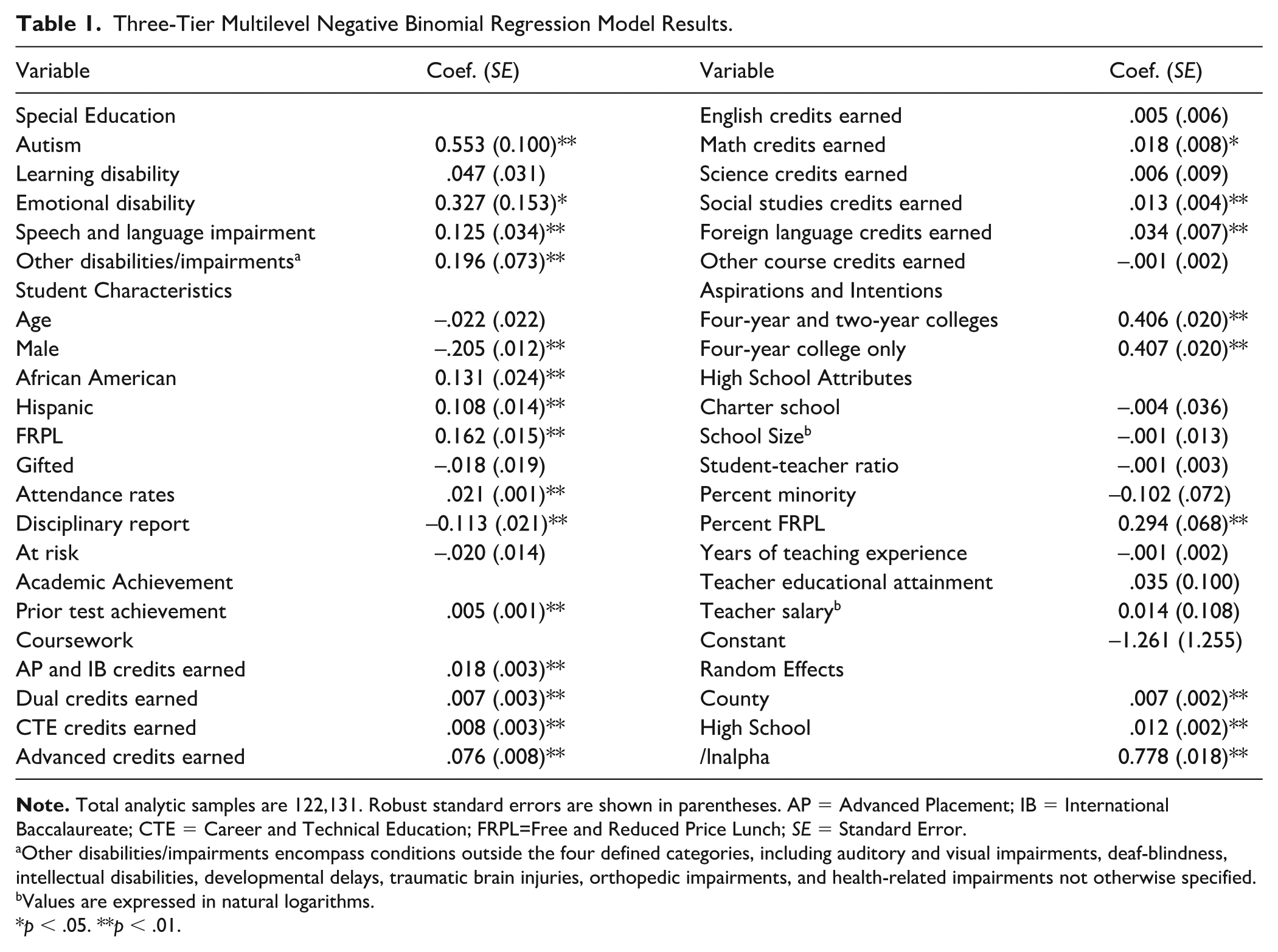
Table 1 displays the multilevel NBREG results, identifying factors that predict students’ use of ADVi during their transition to postsecondary education. This model considered the five sets of covariates mentioned earlier—including types of special education, student socio-demographic characteristics, high school experiences, college aspirations and intentions, and high school attributes—along with two levels of random effects at the school and county levels.
Three-Tier Multilevel Negative Binomial Regression Model Results.
Other disabilities/impairments encompass conditions outside the four defined categories, including auditory and visual impairments, deaf-blindness, intellectual disabilities, developmental delays, traumatic brain injuries, orthopedic impairments, and health-related impairments not otherwise specified.
Values are expressed in natural logarithms.
p < .05. **p < .01.
The results for different types of special education indicated that, overall, students receiving special education exhibited significantly higher levels of ADVi use. Specifically, students with autism were predicted to send 73.4% more text messages to the AI chatbot compared to their typically developing peers. Likewise, students with ED were estimated to send 38.7% more messages than typically developing students. Students with other types of disabilities and impairments also showed a higher ADVi engagement; however, no statistically significant difference was found between students with LD and their typically developing peers.
While percentage differences provide useful insights, it is equally important to consider the absolute level of ADVi usage among the reference group—typically developing students. This is because percentage-based comparisons can sometimes exaggerate differences when the baseline usage is low. To provide a clearer perspective, we predicted ADVi utilization based on the regression estimates in Table 1. The most significant difference was found among students with autism and ED, who sent an average of 13.1 and 7 text messages, respectively. In comparison, the typically developing students sent an average of only 5.15 messages. Students with speech and language impairments, as well as those with other types of disabilities, sent text messaging slightly more, averaging around 6.1 messages, than typically developing students. On the contrary, students with LD sent an average of 5.8 text messages to ADVi, which were not statistically different from those of typically developing students.
We also found other student and school factors that explained the variations in ADVi utilization among different groups. Specifically, gender differences in ADVi utilization were notable, as male students were 18.5% less likely to use the chatbot than female students. In addition, racial and ethnic minority students, as well as those eligible for free or reduced-price lunch, were significantly more likely to engage with ADVi, with usage rates exceeding those of their peers by 14%, 11.4%, and 17.6%, respectively. These results were particularly promising, given the persistent underrepresentation of these student groups in higher education. Patterns of academic engagement further influenced ADVi usage, with students who maintained high attendance rates using it more frequently, whereas those with disciplinary records engaged less often. In addition, prior test achievement was positively associated with ADVi utilization, as students with higher test scores were more likely to seek support through the chatbot. A similar trend was observed in overall course-taking patterns, where increased coursework correlated with greater ADVi engagement, though effect sizes varied. Students applying exclusively to two-year colleges exhibited significantly lower ADVi utilization—approximately half the rate of those applying to four-year institutions or both. This trend might stem from the relatively straightforward admissions and financial aid processes at community colleges, which require less navigation compared to the more complex systems of four-year institutions. Moreover, students from high schools with a greater proportion of students eligible for FRPL sent more text messages to ADVi; however, other characteristics at the teacher and school levels did not significantly affect ADVi usage. These findings underscore the complex and multifaceted nature of ADVi engagement, highlighting the interplay between demographic, academic, and institutional factors. Gaining a deeper understanding of these dynamics is essential for optimizing AI-driven support systems to enhance accessibility and effectiveness, particularly for students with disabilities and other historically underserved student populations.
Discussion
In this study, we examined the role of ADVi, an AI-powered chatbot, in supporting students during the college application process. Our goal was to document utilization patterns among public high school graduates in Texas who had signed up to receive AI-generated text-based messages, information, and reminders as they progressed through their college application process. The findings highlighted the significant engagement of students with disabilities, particularly those with autism and ED, in utilizing ADVi more frequently than their typically developing peers.
Previous literature suggests that students with autism often experience difficulties in social communication, executive functioning, and self-advocacy (Anderson et al., 2017; Wei et al., 2014). Given these challenges, AI-powered chatbots may provide an appealing alternative to traditional in-person advising, as they offer consistent, structured, and immediate responses without the social demands associated with human interactions. Similarly, students with emotional disabilities, who may struggle with anxiety or confidence issues when seeking college guidance (Newman et al., 2011), may find ADVi to be a low-pressure and easily accessible tool. For students receiving special education services, the heightened engagement underscores how AI-driven advising systems can provide structured and consistent guidance throughout the college application process. By delivering real-time, text-based support that is available on demand, ADVi reduces reliance on in-person interactions and mitigates anxiety that can accompany traditional counseling settings, thereby enhancing transition planning for students receiving special education services. Furthermore, the widespread use of ADVi highlights the importance of tracking utilization patterns among students with disabilities to understand who benefits most from AI interventions. This emerging evidence base can inform transition practices, guide professional development for educators, and shape policy decisions on integrating AI into the special education framework. The study also found that students from historically underrepresented backgrounds—including racial and ethnic minority groups, and students from low-income families–used ADVi at higher rates than their peers. This suggests that AI-powered advising tools may help mitigate some of the disparities in college access by providing equitable and on-demand information to students who may lack sufficient school-based counseling support. This aligns with previous research indicating that AI-driven interventions can enhance college enrollment rates among underrepresented students by improving access to crucial college application resources (Castleman & Page, 2016; Page & Gehlbach, 2017).
Limitations
We acknowledge that this study has several limitations. First, our sample consists solely of public high school graduates in Texas who indicated an intention to pursue higher education in the state by initiating a college application through ApplyTexas. Students looking exclusively at out-of-state colleges were not included in this analysis, as ADVi mainly focuses on Texas institutions. However, the degree of ADVi utilization may vary depending on students’ actual college application plans, as those exclusively considering out-of-state institutions might engage with the platform differently than peers focused on in-state options. Thus, excluding such students may introduce potential selection bias, limiting the external validity of our findings to the specific student groups analyzed in this study. To enhance the model’s predictive accuracy regarding ADVi usage, it would be beneficial to include the National Student Clearinghouse dataset, which tracks student enrollment in colleges outside Texas. However, this dataset was unavailable during our research, making it difficult to evaluate its potential effects on students’ decisions about ADVi. Future studies should seek to incorporate such datasets for a better understanding of student interactions with ADVi.
In a similar vein, our total student population represents the final analytic sample after excluding students with missing prior test achievement data. We considered using multiple imputation (MI) to address these missing values, but decided against it because the missingness was largely non-random, resulting from course-taking patterns and the timing of COVID-related test cancelations (see Supplemental Text, Section 4). Under such conditions, imputed values would likely fail to reflect students’ actual test performance and could reduce the precision and validity of the composite measure used to capture prior academic achievement. Given these concerns, we adopted a more conservative approach by retaining only complete cases when constructing the composite. Although this decision slightly reduced the sample size and external validity, it enhanced the accuracy and interpretability of our key control variable. Furthermore, not all students in our sample necessarily applied through ApplyTexas—some may have used institutions’ direct application portals. Although this group is likely small, their exclusion introduces a potential source of selection bias, as our analysis relies on ApplyTexas participation to identify college-intending students. Consequently, our study sample may not fully represent students who planned to attend Texas colleges but applied through alternative routes. Taken together, these considerations indicate that our findings should be interpreted as specific to the study population analyzed and may not generalize beyond this group.
As outlined in the variable selection section, we consolidated eight disability categories into a single label, “Other Disabilities or Impairments.” This choice was made due to the small number of students in each category during high school and even fewer who went on to pursue postsecondary education. For instance, students with deaf-blindness or intellectual disabilities are rarely enrolled in college, making it statistically unfeasible to treat these categories separately within our model. While merging these low-frequency categories helps maintain sufficient sample sizes for analysis, it does have its drawbacks. By combining different disability types, we implicitly assume that their influences on ADVi usage are comparable. If one disability type significantly increases ADVi usage while another either decreases it or has little effect, the unique patterns could be obscured, potentially resulting in an underrepresentation or misinterpretation of the actual relationships. Our study primarily focuses on general trends and does not fully investigate how specific disability types may affect engagement with AI chatbot services among students transitioning to college. Future research could profit from isolating and thoroughly investigating these various disabilities to determine whether certain impairments or combinations yield significantly different results. Such investigations would advance our understanding of how AI chatbot services can be tailored to better support students with a broader array of disabilities by enhancing their access and success in postsecondary education.
The dependent variable of this study, ADVi utilization, was measured by counting the number of text messages each student sent. Although this quantitative measure would capture levels of student engagement, it does not provide insights into the qualitative nature of these interactions. Analysis of available data revealed that the most frequently discussed topics pertained to admissions-related inquiries, including questions about application procedures, transcript submission, placement tests, and institutional contact information. The second most common category of inquiries involved academic concerns, such as registration processes, selection of academic majors, consultations with college advisors, and academic calendars. Following these, students frequently sought information about financial aid, covering areas like FAFSA applications, scholarship opportunities, student loans, financial awards, work-study positions, and eligibility criteria for various aid programs. However, due to data limitations, the present study could not explore potential differences in the content of inquiries between students with disabilities and their typically developing peers. Therefore, future research should include a systematic analysis of message content as well as evaluations of user satisfaction with ADVi services to more comprehensively understand students’ experiences.
While the current study identified a distinct pattern of AI chatbot utilization among students with disabilities relative to their typically developing peers, further research is needed to examine whether this elevated engagement translates into tangible outcomes such as increased college application completion, FAFSA submission, postsecondary enrollment, persistence, and degree attainment. The THECB data accessed through the ERC include several datasets relevant for analyzing postsecondary outcomes, such as student application and admission data (CBM00B), college enrollment records (CBM001 and CBM0C1), and degree attainment data (CBM009). THECB maintains these data across various institution types, including community colleges, public and private universities, and health-related institutions. It is worth noting, however, that certain data elements may be unavailable for some institution types. Therefore, future studies examining the impact of ADVi could draw on these datasets as sources for potential outcome measures. Examining these longer-term impacts would offer a more comprehensive understanding of how AI chatbot interventions may support students from various backgrounds in successfully navigating the transition to–and progression through–postsecondary education.
Conclusion
The implementation of ADVi services can address unique challenges faced by students with disabilities or impairments transitioning to college, as well as students from under-resourced backgrounds. By providing essential and timely guidance and support throughout the college application process, ADVi has the potential to enhance access to postsecondary education and credentials for these students. This initiative not only empowers individuals but also contributes to the creation of a more diverse and skilled talent pool for employers. This also aligns seamlessly with the mission of the THECB’s “Building a Talent Strong Texas” initiative, which aims to increase postsecondary credentials for more Texans.
Supplemental Material
sj-docx-1-rse-10.1177_07419325261422377 – Supplemental material for AI Support for Special Education Students Navigating College Pathways in Texas
Supplemental material, sj-docx-1-rse-10.1177_07419325261422377 for AI Support for Special Education Students Navigating College Pathways in Texas by Han Bum Lee, John Davis, Sharon L. Nichols and Jasmine Victor in Remedial and Special Education
Footnotes
Acknowledgements
We would like to express our profound gratitude to THECB’s ADVi team—Samantha Kimmel, Nicole Davis, and Schwausch Nathan—for their insights and detailed support in enhancing our understanding of the ADVi program. Their expertise and dedication have been instrumental in shaping this study. In addition, we extend our thanks to the Greater Texas Foundation for their passion for Texas’s education and generous funding, which have made this important research possible. The views expressed in this research are those of the authors and do not necessarily reflect the official policies of the funder, THECB, or the University of Texas at San Antonio.

Funding
The authors disclosed receipt of the following financial support for the research, authorship, and/or publication of this article: This work was supported by Greater Texas Foundation (1000003489).
Declaration of Conflicting Interests
The authors declared no potential conflicts of interest with respect to the research, authorship, and/or publication of this article.
References
Supplementary Material
Please find the following supplemental material available below.
For Open Access articles published under a Creative Commons License, all supplemental material carries the same license as the article it is associated with.
For non-Open Access articles published, all supplemental material carries a non-exclusive license, and permission requests for re-use of supplemental material or any part of supplemental material shall be sent directly to the copyright owner as specified in the copyright notice associated with the article.
