



Abstract
Preschool students’ mastery of early numeracy skills is important, so they enter kindergarten with the necessary prerequisite skills, which are predictive of achievement in later elementary grades. The purpose of this study was to examine the effects of a concrete-representational-abstract (CRA) instructional package on the foundational early numeracy skills of three preschool students. A multiple baseline across participants design was employed. Treatment sessions were 15 to 20 minutes long and held twice a week. The primary outcome variable was a measure of match quantity, and the generalization outcome variable was a measure of number sequencing. Results indicate that CRA was effective for increasing the match quantity fluency skills of two of three participants; however, the effects did not generalize to number sequencing.
Number sense, an essential early numeracy skill, is a child’s understanding of and flexibility with numbers, the understanding of what numbers mean, and the skill and ability to perform mental math and make comparisons (Gersten & Chard, 1999). Number sense skills in kindergarten are a powerful predictor of mathematics performance in the middle of first grade (Baglici et al., 2010; Jordan et al., 2007) and third grade (Jordan et al., 2010). According to Jordan et al. (2007), number sense accounted for most of the variance (66%) in first-grade mathematics achievement, which was greater than the amount accounted for by family income status, gender, age, and reading ability combined. In addition, those who made the least amount of growth between the start of kindergarten and the middle of first grade were typically from low-income families (Jordan et al., 2007). The importance of number sense to later mathematics achievement has been equated with the importance of phonemic awareness to the development of broad reading achievement (Gersten & Chard, 1999). Therefore, it is important to monitor and intervene on early numeracy skills, support the overall development of early numeracy skills, and close any identified gaps in achievement.
Number Sense Development in Preschool
Number sense typically develops in two ways. The first is informal interactions with parents, guardians, and family members before beginning kindergarten (Gersten & Chard, 1999). Informal interactions may include exposure to games that include counting, adding, and recognizing numbers, and can lead to gains in non-symbolic early numeracy knowledge (Skwarchuk et al., 2013). The second method is formal instruction. Children as young as three can be exposed to and benefit from formal instruction in early numeracy skills (Frye et al., 2013). Number sense instruction should follow a developmental progression. Students first learn subitizing, the ability to look at a collection of objects and immediately recognize the total number of objects. Next, students learn meaningful object counting, where they count objects in a one-to-one fashion and recognize that the last number used is the same as the total (the cardinality principle that develops alongside the subitizing phase; Frye et al., 2013; Throndsen et al., 2017). Finally, students learn to use the mental number line to demonstrate number-after or number-before knowledge and compare two numbers, without the use of manipulatives (Frye et al., 2013). Developing mental number line skills is important, as many students with mathematics disabilities have deficient mental number line skills (Kucian et al., 2011).
Meaningful counting and mental number line skills may be of particular importance as a focus of intervention support for young students. First, students who master counting and cardinality skills by the end of preschool are more likely to be successful in mathematics later in elementary school (Aunio & Niemivirta, 2010; Nguyen et al., 2016). Counting skills alone are more predictive of the acquisition of later arithmetic skills than age, gender, cognitive factors, and parental education level (Aunio & Niemivirta, 2010; Jordan et al., 2010). It is one the earliest stages of students’ ordinal knowledge, and the ability to count beyond 10 and understand counting strategies (e.g., counting on and counting backward) are important facilitators for the development of more advanced skills, such as the understanding of place value and the acquisition of mental number line skills (Frye et al., 2013; Nguyen et al., 2016).
Second, counting, cardinality, and mental number line skills can be monitored with multiple commonly available progress monitoring measures (e.g., AIMSweb Tests of Early Numeracy (TEN), FastBridge earlyMath, and SpringMath). For example, students’ understanding of meaningful object counting can be assessed through FastBridge’s Match Quantity measure, which asks a student to count a set of objects and select the number that represents how many are in the set. FastBridge’s Number Sequence measure can also be used to assess a student’s understanding of the mental number line.
Finally, Nelson and McMaster (2019) demonstrated that early numeracy interventions yield a moderate effect size, indicating there are options to support students’ mastery of early numeracy skills. The results of this meta-analysis indicated that while previous research indicated that a concrete-representational-abstract framework did not yield effective results, students that are identified as at risk in early numeracy skills may still benefit from components of explicit instruction, such as the use of multiple representations (concrete and representational), as well as opportunities to practice with corrective feedback (Nelson & McMaster, 2019).
The Use of Representations in Early Numeracy Instruction
Reviews of research have continuously supported the use of multiple representations and explicit and systematic instruction within effective mathematics intervention (Baker et al., 2002; Chodura et al., 2015; Codding et al., 2009). Gersten et al. (2009, p. 6) indicated that instructional materials used in supplemental interventions should support student “use of visual representations of mathematical ideas.” Within developmentally appropriate preschool mathematics instruction, students can learn mathematics concepts through mathematics games utilizing multiple types of representation, such as dots, fingers, shapes, and buttons (Stipek, 2017).
The use of visual representations is a commonly used method of instruction within preschool mathematics interventions, with 81% of early numeracy treatments using a visual, pictorial, or concrete representation and 23% using a concrete-representational-abstract (CRA) framework. CRA is one such sequence of instruction where students move through three phases. The first phase (concrete) uses three-dimensional objects to demonstrate concepts, and the students use these objects to solve problems. The second phase (representational) uses drawings or tally marks of the problems. In the final phase (abstract), the student practices solving problems using only numbers (Flores et al., 2014). The goal of CRA is to facilitate acquisition of new skills, as students develop conceptual understanding of a topic and connect this knowledge to procedural skills (Bouck et al., 2018). CRA may be particularly effective because this teaching procedure combines explicit instruction with systematic fading of concreteness.
However, Nelson and McMaster (2019) found that CRA was not a statistically significant predictor of preschool mathematics intervention effects. This may be because according to the National Association for the Education of Young Children (NAEYC), developmentally appropriate mathematics instruction at the preschool level often does not include the abstract phase, and rather includes game-based practice that includes representations (e.g., dots, fingers; Reed & Young, 2017). Therefore, rather than including an abstract phase of instruction, it may be more developmentally appropriate to replace this phase of instruction with an opportunity to practice and develop new skills through the implementation of a game.
The Great Race
The Great Race is one such game that includes representations (i.e., a visual number line), and has demonstrated evidence for improving counting skills (Siegler, 2009) while also facilitating the development of number line skills in preschool students (Ramani & Siegler, 2008). The Great Race is an evidence-based early numeracy instructional strategy that consists of a visual number line (Siegler & Ramani, 2009). In this number line game, the student spins either a one or a two, and counts up a visual number line by the number they spin. Research has demonstrated that playing The Great Race improved students’ counting, number identification, and numerical magnitude comparison skills (Siegler & Ramani, 2009). Instructing students about measurement principles, especially while incorporating early measurement models (e.g., rulers, measuring strips, or simple number lines), is also an essential instructional component for building early mathematics proficiency. The Institute of Education Science (IES) educator practice guide reported measurement instruction has preliminary “positive effects . . . in the domains of general numeracy, geometry, and basic number concepts” (Frye et al., 2013, p. 26). Using linear measurement models during instruction, such as through The Great Race, also improves preschool students’ whole number magnitude understanding, which is highly predictive of later mathematics skills (e.g., fraction proficiency; Jordan et al., 2017; Siegler & Ramani, 2009). Thus, it may also be prudent to include linear measurement models into preschool mathematics interventions.
Purpose of the Current Study
The primary purpose of this study was to examine the effects of an instructional package, which included explicit instruction using concrete and drawn representations and The Great Race, on the meaningful counting (counting and cardinality) and mental number line skills of three preschool students who were identified as being at risk for low numeracy skills. The current study employed a multiple baseline across participants design. Meaningful counting skills were assessed using the FastBridge Match Quantity measure and mental number line skills were assessed using the FastBridge Number Sequence measure. We also aimed to conduct a unique study by (a) targeting preschool students, (b) including corrective, immediate feedback to strengthen the effects of the intervention, (c) including opportunities to practice with representations, and (d) providing more descriptive information of study participants.
Does the use of multiple representations with The Great Race instructional package increase the meaningful counting skills, measured using the FastBridge Match Quantity measure, of three preschool students at risk for low numeracy skills?
Does the use of multiple representations with The Great Race instructional package increase the mental number line skills, measured using the FastBridge Number Sequence measure, of three preschool students at risk for low numeracy skills?
Method
Participants and Setting
One suburban school district in the U.S. Midwest was selected using convenience sampling, and three preschool students, Hunter, Amy, and Katy participated in the current study. The participants were enrolled in a part-time creative play preschool program which met in the morning (9:00 a.m. to 11:30 a.m.) on Monday, Wednesday, and Friday. The creative play program enrolled students ages 3 to 5 years and implemented The Creative Curriculum for Preschool (Dodge et al., 2002). The Creative Curriculum for Preschool is a research-based curriculum that emphasizes hands-on exploration and discovery. It focuses on 38 research-based objectives in several developmental areas: social-emotional, physical, language, cognitive, literacy, mathematics, science/technology, social studies, and art.
All participants were Black, and their native language was English. All participants were 3 years old when the study commenced but turned 4 years of age during the intervention. None of the students had an identified disability, and all students qualified for free or reduced-price lunch. All students met full criteria for participation in the study, which included scoring (a) within the high-risk range (below the 20th percentile) on the FastBridge earlyMath winter screening composite (Number Sequence, Match Quantity, and Number Identification; Theodore J. Christ and Colleagues [TJCC], 2015), and (b) below age-level expectations on the winter Teaching Strategies (TS) Gold Math Domain, Objective 20: Uses number concepts and operations. In addition, the general education preschool teacher confirmed appropriateness for each student’s participation, and parents provided informed consent for participation in the study.
Screening Measures
Screening for participation in the study included the Teaching Strategies (TS) Gold measure (Creative Curriculum; Dodge et al., 2002) and the FastBridge Learning earlyMath screening winter composite (TJCC, 2015). TS Gold was administered by teachers three times annually to measure students’ progress across 10 areas of development: social-emotional, physical, language, cognitive, literacy, mathematics, science and technology, social studies, the arts, and English language acquisition (Creative Curriculum; Dodge et al., 2002). The mathematics domain includes four main objectives, numbered 20 through 23: (20) Uses number concepts and operations, (21) explores and describes spatial relationships and shapes, (22) compares and measures, and (23) demonstrates knowledge of patterns. TS Gold is an observation-based assessment system that creates a developmental profile of each student across 10 developmental domains (Lambert et al., 2014). Teachers rated the students on a continuum of age-expected levels in each skill area (from Level 0 to Level 9) and provided the results of the winter screening. For the purposes of this study, the TS Gold Math Objective 20 was used, which evaluates the student’s skills in number concepts and operations. The internal consistency of the TS Gold screening measure is high (α = .98).
The recommended preschool winter composite for FastBridge Learning earlyMath included three measures: (a) Number Sequence (a measure of mental number line knowledge), (b) Match Quantity (identifying the symbol/numeral that represents a given quantity), and (c) Numeral Identification (identifying the name of the symbol that represents a number). The earlyMath winter composite took 5 min to complete with each student and the respective administration directions for each measure were followed. Total scores were entered into the online FastBridge system, which provided information on which students were within the low risk (14–22 on the earlyMath composite) or high-risk range (below 14) on the winter preschool earlyMath composite. All three students scored within the low-risk range on the Numeral Identification measure (indicating the students had written numeral knowledge), but within the high-risk range on Number Sequence and Match Quantity.
Dependent Variables
There were two dependent variables in this study: (a) the number of items correct per minute on the Match Quantity measure and (b) the number of items correct per minute on the Number Sequence measure, both of which were from the earlyMath (TJCC, 2015) suite of assessments. Match Quantity assesses counting and cardinality skills (meaningful object counting) by asking the student to correctly match a quantity of dots to a numeral. Each item includes an array of blue dots, with a matrix of four numbers. The matrix includes the correct answer and three distracters (TJCC, 2015). The interventionist did not provide feedback during or after administering the progress monitoring measure. The resulting score is the number of correct items per minute (alternate form reliability = .61; α = .80; TJCC, 2015). Based on nationally normative data, students who score less than seven items correct per minute are at high risk in the fall of kindergarten.
On the Number Sequence measure, students are asked to complete partially delivered counting sequences (e.g., “Finish counting when I stop . . . 1 . . . 2 . . . 3 . . .”) and identify numbers that come after, before and between numbers. Number Sequence is available for progress monitoring, which means that a different version was used each time. The interventionist did not provide feedback during or after administering the progress monitoring measure. The final score is the total number of items responded to correctly (alternate form reliability = .75; α = .76; TJCC, 2015). According to nationally normative data, students who score below three items correct per minute are at high risk in the fall of kindergarten.
Both Match Quantity and Number Sequence are available for progress monitoring and are administered for 1 min. Match Quantity includes 20 items and Number Sequence includes 13 items. For each progress monitoring measure, Hunter repeated Versions 1 and 2; Amy repeated Versions 1, 2, and 3; and Katy did not repeat any versions.
Materials
Intervention materials varied across the three phases of instruction. In the concrete phase, materials included unifix cubes, two-inch-by-two-inch laminated cards of the numbers zero through 20, and a cardinality chart (Jordan & Dyson, 2014). The cardinality chart is designed to support understanding of a visual number line and is made up of a 10 by 10 grid, with the numbers 1 to 10 across the bottom. Students then placed a block in the squares of the grid to represent each number (Jordan & Dyson, 2014). In the representational phase, materials included a white board, dry erase marker, and the laminated cards of the numbers zero through 20. Finally, for The Great Race, materials included copies of the game board (to 10 and to 20; Siegler & Ramani, 2009) and the accompanying spinner (Codding et al., 2017). Small stickers were used as reinforcement for on-task behavior during each session.
Independent Variable
The procedures for the sequence of instruction (concrete, representational, The Great Race) were followed according to an intervention brief found on the Evidence-Based Intervention Network (Flores, 2010; Flores et al., 2014 Powell & Seethaler, 2014; ebi.missouri.edu), with The Great Race replacing the abstract phase of instruction for CRA. Prior to beginning each phase of instruction, the interventionist introduced the student to the activities that would be conducted in each phase, as well as what the learning objectives were. Each session followed an explicit instructional approach, which included modeling, guided practice, and independent practice with the use of visuals and corrective feedback (Gersten et al., 2009). In the concrete phase, the interventionist modeled number identification using a range of numbers that were targeted for that session (1–5, 5–10, 10–15, or 15–20). For the numbers one through 10, the cardinality chart (Jordan & Dyson, 2014) was used. For numbers 11 to 20, number cards were placed in a line, in order from left to right in front of the student to illustrate the number line concept. The interventionist modeled counting out a set of unifix cubes that corresponded with each number and placed the set of cubes above the correct number. The interventionist removed her set of cubes, and the student independently counted their own set of unifix cubes and placed their set above the correct number. The interventionist provided corrective feedback when necessary, guiding the student to count the set of blocks again if an error was made in counting objects or identifying the correct number when matching the blocks. The interventionist would pause the student, model the corrective counting and/or placement of cubes on the cardinality chart, and ask the student to repeat the process on their own.
In the representational phase, a scaffolded, explicit instructional process was followed; however, rather than using unifix cubes, a whiteboard and marker were used. First, the interventionist laid number cards down in order, representing the number line. Next, the interventionist drew arrays of dots, in scattered and organized patterns, onto a white board (Powell & Seethaler, 2014). The student was then asked to count the number of dots that had been drawn and locate the number card that matched the cardinal numeral. Next, the student selected the appropriate number card and placed it on top of the whiteboard. Immediate corrective feedback was provided if the student made an error when counting the dots or locating the correct number card. The interventionist would pause the student, model the corrective counting and/or location of the correct number card, and ask the student to repeat the process on their own.
In the final phase of instruction, the student played The Great Race with the interventionist (Siegler & Ramani, 2009). The student and interventionist took turns using a spinner and would spin either a one or a two. Then, they would count up a visual number line by the number they spun. Two number lines were used, one from 1 to 10 and one from 1 to 20. The interventionist verbalized their counting strategy (e.g., “I spun a one. I am on six, so I will go up one. 6, 7. One more than 6 is 7.”) and the student also said their counting strategy during each turn. When the student landed on the board, the interventionist verbalized the sequence of the number line (e.g., “You spun a two. You are on two, and we will go up two more. 2, 3, 4. Two more than two is four.”). If the student made an error, the interventionist paused the game, modeled the correct movement, then asked the student to repeat their move in the game.
After the intervention was delivered for 15 min, the interventionist administered the Match Quantity and Number Sequence probes (5 min). At the end of each session, the student was presented with two sheets of stickers and allowed to choose a sticker as reinforcement for on-task behavior (sitting still at the table and following the interventionist’s directions).
Procedure
The interventionist was a doctoral level school psychology practicum student. The interventionist had taken multiple courses on academic intervention, assessment, and consultation, and had 2 years of experience as a practicing school psychologist, providing academic intervention and assessment services in preschool through fifth grade. All intervention sessions were conducted in-person. The interventionist met with each student individually, sitting at a small table in the alcove of the hallway outside the students’ classroom. Although the preschool program was a 3-day program, frequent student absences meant that intervention could only be implemented 2 days a week. Hunter and Amy both received 17 intervention sessions, and Katy received 11 sessions. Katy received fewer sessions due to being absent toward the end of the intervention program. Sessions occurred during the students’ free play time, so as not to interfere with whole-group instruction.
Experimental Design and Analyses
A multiple baseline across participants design was employed, because the reversal of the behavior is not possible (Gast et al., 2018). In addition, consistent with What Works Clearinghouse standards for multiple baseline design, a minimum of 4 data points were applied for baseline, and three phase repetitions, with a minimum of 5 data points per phase were included (What Works Clearinghouse, 2017).
Prior to the commencement of the study, the students were assigned a number from one through three, and a randomizer was used to assign who would begin the intervention phase first, second, and third. During baseline, students did not receive any early numeracy instruction beyond standard core instruction, which followed The Creative Curriculum and included instruction on number concepts and operations (including counting, number identified), spatial relationships and shapes (e.g., understanding positional words, and drawing/representing shaped), and comparing and measuring (e.g., exploring measurement tools). Baseline data were collected by the interventionist. During each baseline session, each student was administered a single Match Quantity and Number Sequence probe. Data were collected in a quiet hallway outside of the students’ preschool classroom, with the participant sitting at a table with the interventionist. Each baseline session took approximately 8 min to complete.
Following baseline, intervention began with the concrete phase of instruction. Students participated in a minimum of five sessions using concrete representations, a minimum of five sessions using picture-based representations, and a minimum of three sessions using The Great Race. It is recommended that students stay in each phase of CRA for a minimum of 3 days (Miller & Hudson, 2006); therefore, in this study, we aimed for there to be five sessions in each phase of instruction. However, due to Katy’s high rate of absences at this point of the intervention, only four sessions of The Great Race were provided. Arrows included in Figure 1 and Figure 2 represent when the instructional procedures changed from concrete, to representational, and then to The Great Race.
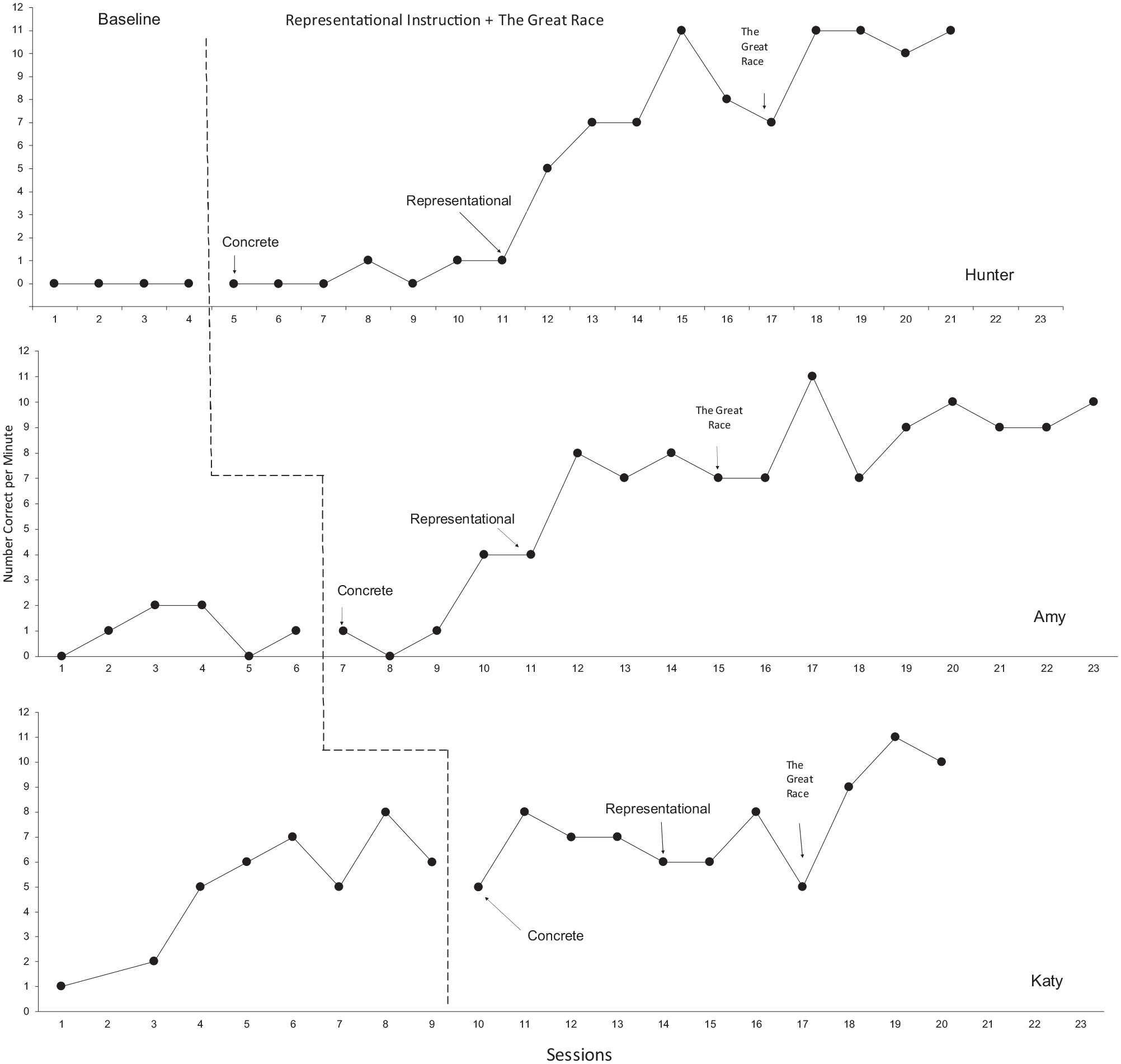
Results of the match quantity measure.
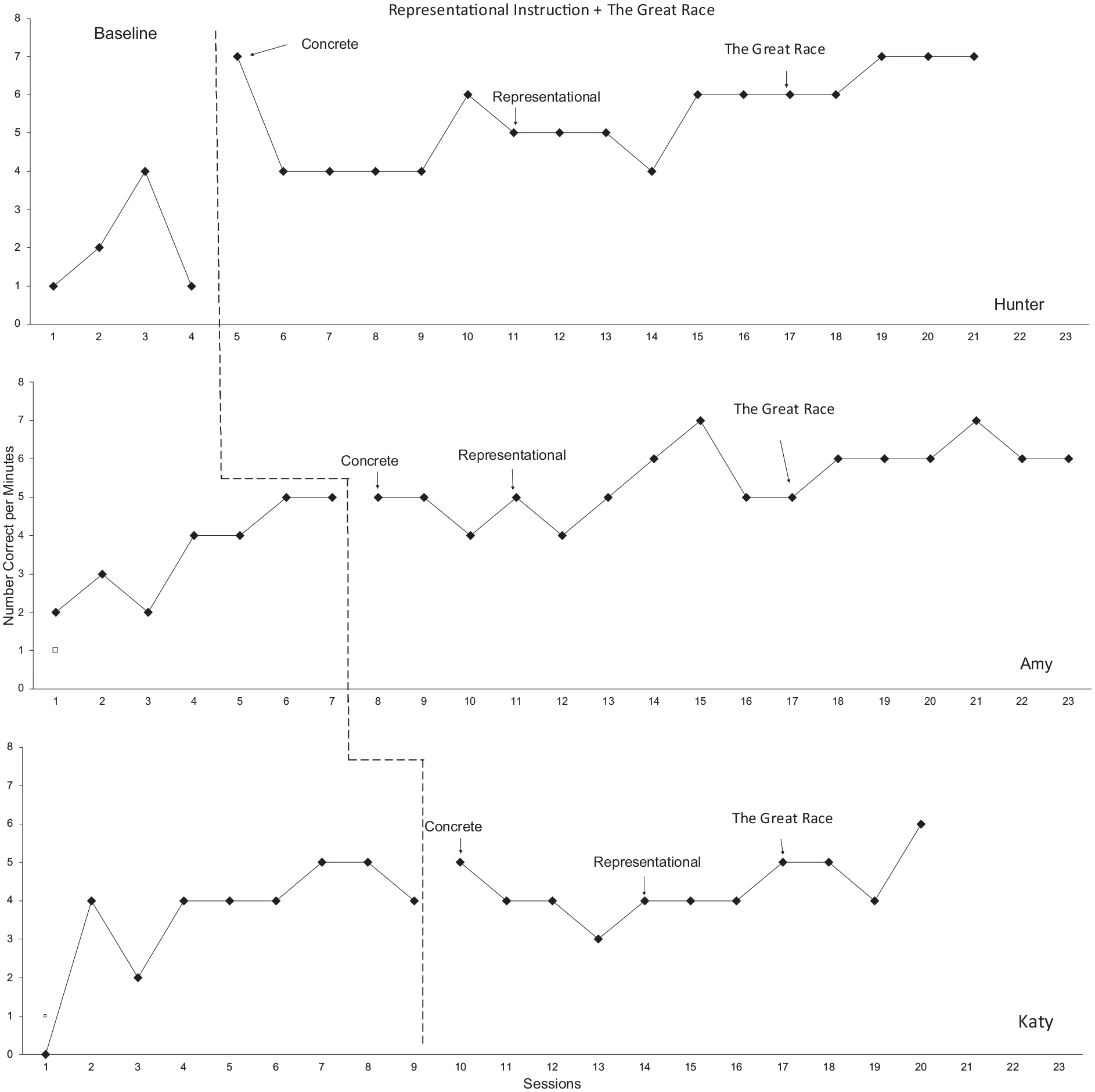
Results of the number sequence measure.
Visual analysis was employed to determine a functional relation between the intervention and students’ early numeracy skills (Barton et al., 2018). First, it was determined whether there was a level change between the baseline and the start of intervention (Barton et al., 2018). Next, the trend of the students’ intervention progress monitoring data was evaluated, to determine whether the trend increased, decreased, or remained the same, after starting intervention (Barton et al., 2018). Finally, variability in data was examined, to determine whether the pattern of intervention progress monitoring data was stable (Barton et al., 2018).
Procedural Fidelity
Two forms of procedural fidelity were conducted during the study. The first was assessment integrity of Math Quantity and Number Sequencing, which was determined using the Observation and Rating Administrator Accuracy (ORAA) tool provided by FastBridge Learning. An ORAA accompanies each measure and can be used to track standardized administration of the measures (TJCC, 2015). The ORAA form for earlyMath includes 11 steps of standardized administration. Assessment integrity was evaluated for 30% of screening, baseline and progress monitoring measures that were administered. The average integrity for screening and progress monitoring administration was 100%. Assessment integrity and treatment adherence were assessed by the interventionist’s supervisor, who was a trained school psychologist and worked full-time in the preschool program.
Treatment adherence was assessed by a training school psychologist who worked full-time in the preschool program and served as a practicum supervisor. Treatment adherence was assessed using an observation checklist that was identical to the treatment protocol. Treatment adherence was also evaluated for 30% of intervention sessions. Average treatment adherence was 97% (range: 95%–100%).
Interscorer Agreement
Interscorer agreement was assessed by having an independent rater independently score 30% of the Match Quantity and 30% of the Number Sequence probes. The independent rater was also a doctoral student in school psychology, who had completed a course in academic assessment and academic intervention and had also been trained and certified in the FastBridge system. Agreement was calculated by dividing the number of agreements by the number of agreements plus disagreements. Mean percent agreement for the Match Quantity probe was 100% and for the Number Sequence probe was 98% (range: 96%–100%).
Results
Figure 1 presents the results on the Match Quantity measure, and Figure 2 presents the results for the Number Sequencing measure.
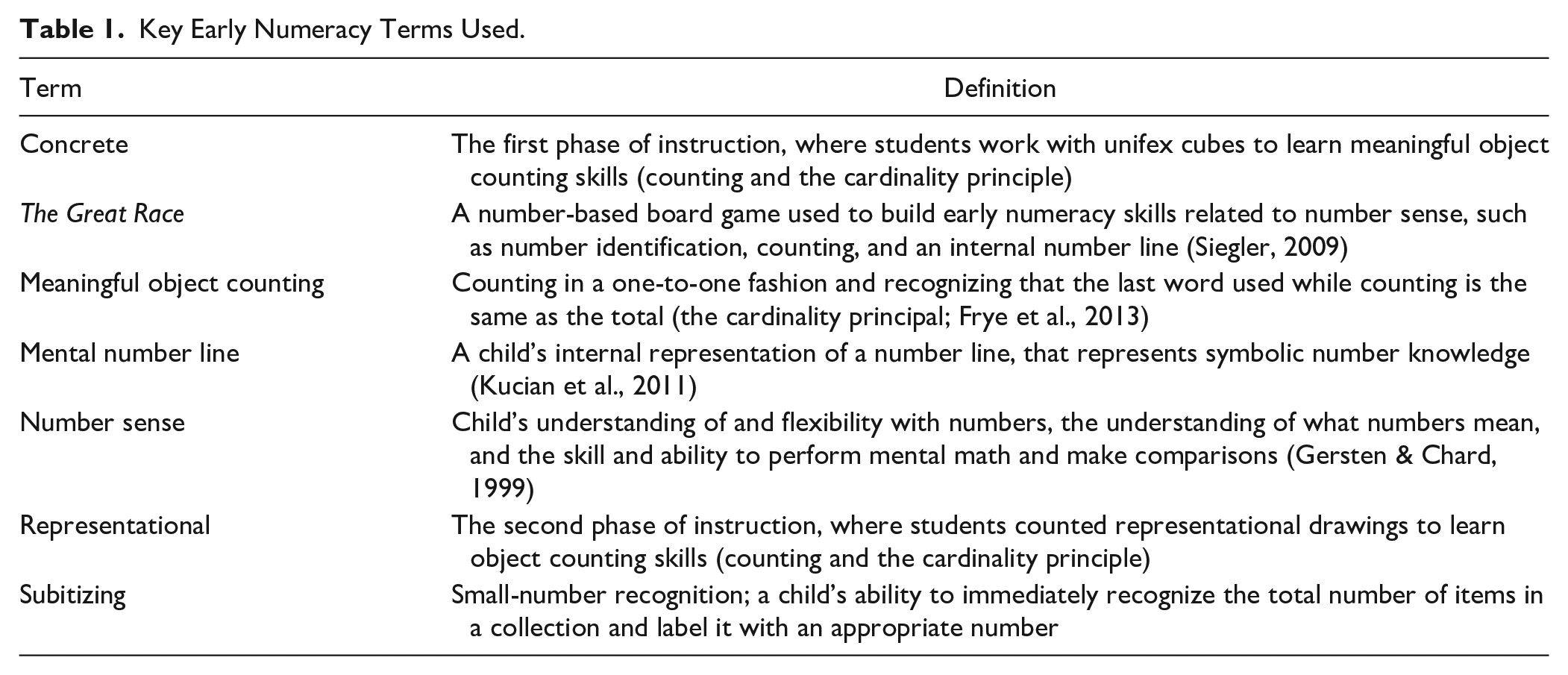
Key Early Numeracy Terms Used.
Match Quantity
During baseline, Hunter was unable to answer any items correctly. Overall, no level change was observed upon implementation of the intervention package, but a delayed effect with an increasing trend was observed. Hunter’s performance increased slightly during the concrete phase, and the trend was steeper once the representation phase was introduced. Hunter’s performance increased to 11 correct, which was maintained during the abstract phase. This level of performance at the end of the intervention phase placed Hunter in the no risk range (TJCC, 2016). These results suggest that the use of multiple representations with The Great Race instructional package did increase Hunter’s meaningful counting skills.
During baseline, Amy was able to answer between 0 and 2 items correct. Overall, no level change was observed upon implementation of the intervention package. However, a delayed effect with an increasing trend was observed throughout the concrete and representational phase with performance reaching eight correct, which was maintained through the abstract phase. This level of performance at the end of the intervention phase placed Amy in the no risk range (TJCC, 2016). These results suggest that the use of multiple representations with The Great Race instructional package did increase Amy’s meaningful counting skills.
For Katy, baseline performance was variable with an increasing trend. During baseline, Katy was able to answer between one and seven items correct. No level change was observed with implementation of the intervention package; however, an increasing trend was observed during The Great Race which constituted the last four intervention sessions. This level of performance at the end of the intervention phase also placed Katy in the no risk range (TJCC, 2016). Unfortunately, given Katy’s increase trend during baseline, we cannot conclude that there was a functional relation between the use of multiple representations with The Great Race instructional package in increasing Katy’s meaningful counting skills. Because there were only two demonstrations of an effect, this study indicated no evidence of an effect on the students’ match quantity skills (What Works Clearinghouse, 2017).
Number Sequence
For Hunter, baseline performance was variable. An immediate level change was observed followed by a decrease in performance and a slight increasing trend throughout the intervention phase. This level of performance at the end of the intervention phase placed Hunter within the no risk range (TJCC, 2016). These results suggest that the use of multiple representations with The Great Race instructional package did increase Hunter’s mental number line skills.
For Amy, an increasing trend was observed in baseline. No level change was observed when the intervention package was implemented and only a slight positive trend in performance occurred over time. This level of performance at the end of the intervention phase placed Amy within the no risk range (TJCC, 2016). Given the increasing trend in baseline and the lack of a level change, these results suggest that the use of multiple representations with The Great Race instructional package did not increase Amy’s mental number line skills.
For Katy, an increasing trend was observed in baseline. Performance was variable during the intervention phase, but level of performance was similar to baseline. This level of performance at the end of the intervention phase placed Katy within the some risk range (TJCC, 2016). Given the increasing trend in baseline, variability across both baseline and intervention, and the lack of a level change, these results suggest that the use of multiple representations with The Great Race instructional package did not increase Katy’s mental number line skills. Because there was only one demonstration of an effect, this study indicated no evidence of an effect on the students’ number sequencing skills (What Works Clearinghouse, 2017).
Discussion
Achievement gaps in early numeracy skills are identified in preschool age children before formal education begins, suggesting that remediating discrepancies in key numeracy skills, such as meaningful object counting and the understanding of the mental number line, within early childhood education settings is essential (Aunio et al., 2015; Jordan et al., 2007). The primary purpose of this study was to examine the effects of an instructional package that included concrete and representational instruction and The Great Race (Siegler & Ramani, 2009) on the meaningful object counting and mental number line skills of three preschool students who were identified as being at risk for low numeracy skills. This study extended the existing literature by examining instruction based on multiple representations and The Great Race with at risk preschool students, including corrective, immediate feedback, opportunities to practice with representations, and providing more descriptive information of study participants. Overall, results suggest that the use of multiple representations with The Great Race instructional package did improve the meaningful object counting for two of three participants and the mental number line skills for one of the three students.
Match Quantity
Match Quantity was a measure of students’ meaningful object counting skills. For Hunter and Amy, an increasing trend was observed through the concrete and representational phases, while for Katy, an increasing trend was observed through The Great Race phase. Interestingly, the representational stage produced the largest improvement for Hunter and Amy, but the The Great Race phase produced the largest improvements for Katy. At the close of intervention, all students’ performance increased to between 9 and 11 answers correct, which falls within the no risk range (TJCC, 2016). Unfortunately, given Katy’s increasing trend during baseline, a functional relation could not be determined between the instructional package and Katy’s increasing trend. However, given there was a functional relation for two out of three participants, these findings do suggest that the use of representational instruction and The Great Race may lead to improved meaningful counting skills with preschool students at risk for mathematics difficulties.
Differences in terms of gains made within phases of instruction may have occurred for several reasons. First, during baseline Katy’s match quantity skills increased, thus she started intervention with higher initial fluency than Hunter and Amy (Nelson & McMaster, 2019). The progress monitoring data suggest that the concrete and representational phases were not necessary for a student who could demonstrate better understanding of the relationship between quantities and numerals, and rather, Katy may have benefited from just receiving extended time with The Great Race. Specifically, students who performed lower (i.e., Hunter and Amy) had more room to improve in meaningful object counting during the intervention, which facilitated growth during the concrete and representational stage. For Katy, there may have been a ceiling effect on the Match Quantity measure.
In addition, it is possible that the larger increases observed in performance for Hunter and Amy during the representational stage were because instruction during this stage more closely matched the items presented within the primary outcome measure. Researchers have also found that students who participate in an early numeracy intervention performed statistically significantly better on a progress monitoring measure that is most closely aligned with the intervention, than a distal progress monitoring measure (Bryant et al., 2011; Nelson & McMaster, 2019). Therefore, the gains made during the representational phase may have been strengthened by a close match between intervention and assessment outcomes.
Overall, these findings are consistent with previous research, as students whose baseline performance was lower benefited more from the concrete and representational phases of instruction, while the student whose baseline performance was higher benefited more from playing The Great Race (Nelson & McMaster, 2019).
Number Sequence
On the Number Sequence measure, a level change and slight increasing trend was observed for Hunter. A delayed effect was observed for Amy, as during the last six sessions, Amy displayed slightly higher levels of performance. For Katy, an increasing baseline was observed; however, performance levels were similar to baseline performance. Therefore, a functional relation was only observed for Hunter. It was anticipated that because the concrete and representational phases included counting and the use of the number line, students would develop the prerequisite skills needed to benefit from playing The Great Race. However, we did not see performance levels increase upon the introduction of The Great Race either, as only Hunter displayed immediate improvements across both measures when the intervention package was delivered.
It is possible that students were unable to generalize the number line, counting and cardinality skills acquired during intervention because the Number Sequence measure required complete reliance on the student’s mental number line skills (i.e., students are read the number sequence aloud, rather than presented with mathematics models). Previous research has also shown that preschool students can develop number ordering and number line skills if they receive explicit instruction in sequential skills (e.g., what comes before and after the number 5; Xu & LeFevre, 2016). Therefore, the students might have needed more explicit instruction on this skill or a longer time playing The Great Race to see growth on the Number Sequence measure.
Another possible reason for the lack of growth on the Number Sequence measure is that students may have needed embedded mathematics vocabulary instruction to support their responding to items on the Number Sequence measure. For example, several items asked students to identify a number that came “before” a number, “after” a number, or “in between” two numbers. Research has demonstrated that children’s organization of the mental number line is also influenced by language skills (Helmreich et al., 2011). Therefore, it is essential that this explicit instruction on mental number line skills include mathematics vocabulary instruction. Mathematics vocabulary instruction can be added to early numeracy instruction in several ways, including reading stories and games that include mathematics concepts and explicit instruction on key vocabulary terms (Hassinger-Das et al., 2016; Powell & Driver, 2015).
Limitations and Future Considerations
While this study contributes to our understanding of effective instruction for using an instructional package that included explicit instruction using multiple representations and The Great Race to improve early numeracy skills, there are several limitations that require our attention. First, the intensity of the intervention was impacted by the students’ rates of attendance. While this is a practical issue related to working with preschool students who are enrolled in part-time programs, it did mean that students were absent often. Rather than receiving intervention during all 3 days they were scheduled to be in school, they received instruction 2 days a week. Future research could examine the same intervention program with a greater number of sessions per week. Second, it is possible that a threat to internal validity was maturation. Since we could not control for classroom instruction and the students were so young, it is possible that over the course of the study students benefited from the core instruction using The Creative Curriculum. This also may have explained positive trend in baseline data. Another limitation was that this intervention was implemented by the researcher, in a pullout format. Future studies may want to consider providing professional development and coaching to preschool teachers and/or educational assistants on how to implement this instructional sequence, or key elements of the sequence, such as explicit instruction and opportunities to practice, to enhance the core instructional program. This method would help future researchers determine how these instructional techniques work within the real-world context of a preschool classroom, and what, if any, accommodations are needed to do so. The final limitation is that it is possible that match quantity skills may have generalized to other early numeracy skills such as magnitude comparison; however, information on other specific early numeracy skills was not assessed. Future studies may consider examining growth in other areas, such as Numeral Identification, because of explicit instruction and opportunities to practice. In addition, more work is needed to be done to understand how early numeracy instructional level during baseline can predict outcomes within instruction. For example, given Katy’s higher level in baseline, she did not need as much time with explicit instruction to benefit from the practice opportunity of the Great Race Game. More explicit guidance on what scores/cut points can guide this instructional decision making is warranted.
Conclusion
In summary, the current study provides evidence on the use of an instruction package based on explicit instruction with multiple representations and The Great Race may be an effective instructional sequence for teaching numeracy skills to preschool students, particularly when the instructional package is aligned to the students’ baseline skill level and the outcome measure is closely aligned to the instruction. In addition, results suggest that for match quantity skills to generalize to number sequencing skills, students may need explicit number line instruction combined with mathematics vocabulary instruction, to facilitate the development of a mental number line.
Footnotes
Declaration of Conflicting Interests
The author(s) declared no potential conflicts of interest with respect to the research, authorship, and/or publication of this article.
Funding
The author(s) received no financial support for the research, authorship, and/or publication of this article.
