




Abstract
This study provides a detailed account of dilemmas experienced by community organizers arising from the tension between political and educational objectives within the community organizing social action approach. We address the way these dilemmas emerge during nonviolent direct action (NDA), and the associated organizers' valuative processes. Within the course-of-experience framework, we conducted direct field observations, video recordings, and self-confrontation interviews with French organizers promoting housing rights in working-class communities. After outlining six episodes experienced as dilemmatic by these organizers, we offer an in-depth analysis of two enacted prototypical dilemmas. Findings reveal the cruciality of the organizers’ emotions during NDAs, and that organizers tend to prioritize short-term political goals over longer-term goals of collective radical education/emancipation processes. We discuss findings through two main drivers for organizers’ training: the risk of becoming a winner-almighty organizer instead of promoting actual grassroots participation, and the impact of anger and indignation in ethical reasonings during NDAs.
Keywords
Community organizing efforts aim to address a variety of specific issues, including but not limited to decent housing, working conditions, environmental justice, access to health services, eradication of discrimination, and public education quality, in various socioeconomic, cultural, and political contexts (Beck & Purcell, 2013). Despite their limitations, these efforts are today considered as offering, especially for disadvantaged or aggrieved communities, vital political and educational arenas and opportunities. Political, such as civic engagement through participatory democratic practices aiming at the promotion of social justice (e.g., DeFilippis et al., 2010), and educational, such as the acquisition of democratic skills (e.g., public speaking, advocacy, negotiation, and leadership), the development of political subjectivity, or emancipation through empowerment processes such as organized collective action (e.g., Earl, 2018; Schutz, 2010).
Within the community organizing field, community organizers are recognized as playing a fundamental role as professional activists and educators (e.g., Petitjean, 2023). However, despite its cruciality, their role is not exempt from questioning (e.g., Fisher & DeFilippis, 2015), mainly when these efforts are carried out through the community organizing social action approach. Codified within the community-based intervention field by Alinsky (1946, 1971) and his successors (e.g., Fisher, 1994; Warren, 2011), this approach has raised multiple concerns. Authors have highlighted the significance of tensions, trade-offs, or dilemmas in organizers’ practice, underscoring the conflictual relationship between the two cornerstones of the organizing efforts: politics and education (e.g., Phulwani, 2016; Schutz, 2010).
This study examines the experiences of professional organizers within a French community-based association conducting campaigns on social housing rights in working-class communities. Following the community organizing social action approach, these organizers consider nonviolent direct action (NDA) 1 to be crucial in their campaigns from both a political and educational perspective. However, organizers often feel caught in dilemmas during NDAs where they struggle to balance these two simultaneous concerns. This study documents these dilemmas encountered in-practice during NDAs to (a) better understand the organizers’ valuative processes and (b) the relationship of the enacted dilemmas to both political and educational aims. It is hoped that this study will contribute to both the ongoing discussion about the conflict between politics and education in the community organizing social action approach, and the improvement of organizers’ initial and vocational training, potentially reducing the risks of alienating practices, and enhancing the educational and empowerment aspects of their organizing efforts.
Literature Review
Since our study stands out for the detailed examination of episodes experienced by organizers as dilemmatic during NDAs within the social action approach, the following two insights seem relevant: the questioned educational dimension within this approach and the significant role played by emotions, particularly anger, in ethical reasoning during NDAs.
The Questioned Educational Dimension Within the Social Action Approach
Many studies have established a strong connection between politics and adult education in the community organizing social action approach (e.g., DeFilippis et al., 2010; Schutz, 2010). This connection is also recognized in social movements (e.g., Kuk & Tarlau, 2020; Ollis, 2021), which are regarded (old and new) as inherently educational (Dykstra & Law, 1994). For instance, Earl (2018) explicitly considers community organizing as a transformative praxis for social justice and emancipatory learning, and Petitjean (2023), echoing the assertions of Alinsky (1946, 1971), characterizes professional organizers as political and radical educators. Similarly, Fisher (1994) posits that organizers create opportunities for a distinct and vital form of a local political agency among disadvantaged or aggrieved communities, encouraging and accompanying them to take action on their behalf. For his part, Phulwani (2016, p. 864) points out that the organizer's job is to help the powerless learn how to use and think about power for themselves ethically. In this sense, as professional activists and educators, organizers engage in critical adult education efforts. These efforts, connected to the globally expanded Freire's humanizing traditions (Mayo, 2008), are necessary for a thick version of democracy, this latter implying a cultivated civic consciousness of engagement and the recognition of social, political, and economic egalitarianism regarding opportunities in a society (Schneider, 2021). As a result, enabling the grassroots 2 to actively participate in public decision-making by acquiring an empowering rhetoric and demystifying certain aspects of power relations (e.g., Villanueva, 2022) becomes a primary objective of the organizing efforts.
Despite the current considerations among scholars and practitioners regarding the effectiveness of the social action approach (e.g., Fisher & DeFilippis, 2015; Warren, 2011), its educational dimension has also been overtly questioned in previous studies (e.g., Horton & Freire, 1991). Researchers (e.g., Fisher & DeFilippis, 2015; Shaw & Crowther, 2014) have questioned the educational dimension by highlighting inherent tensions, trade-offs, or dilemmas regarding organizing while empowering grassroots to make decisions and overcome oppression. Researchers such as Sites et al. (2007) or Talpin (2016) have mentioned the challenges and dilemmas involved in organizing sustainable organizations capable of pursuing or initiating future (new) campaigns independently of organizers. Additionally, organizers face difficulties in promoting actual emancipation due to financial and administrative constraints (Young et al., 2018) or partisan dependence (Fisher & Corciullo, 2011) influencing their campaigns. Additionally, authors have argued that dilemmas can arise from organizers’ loyalties to institutionalized power (government or private entities) (Bergeron-Gaudin, 2019) as well as from power dynamics within grassroots, among allies, or between organizers and grassroots (Breault, 2017; De Lépinay, 2019). These studies underscore the difficulty of organizing efforts to achieve the educational aim, emphasizing the importance of ethical approaches fostering active grassroots engagement and sustainable social change (e.g., Phulwani, 2016; Schutz, 2010).
The Significant Role Emotions Play in Ethical Reasoning During NDAs
Unlike other community-based models 3 focusing on resource provision or conciliation of divergent interests, the social action approach aims to rebalance power dynamics. It is characterized as grassroots-based, conflict-oriented activism toward institutionalized power (Pilisuk et al., 2010), where the experience during NDA in holding local institutional decision-makers accountable for their responsibilities is posited as crucial (Alinsky, 1946; Staples, 2012). As a formal, scripted performance (Tilly, 1995), NDA is a key piece of the puzzle in the fight for social change in society (Villanueva, 2022) and has two primary purposes representing injunctions for organizers (Alinsky, 1971). The first one, political, refers to promoting a thick version of democracy (Schneider, 2021) by offering the grassroots an effective alternative to increase political participation and improve their socioeconomic conditions. Organizers commit to promoting a direct, lively, and dynamic democracy among the voiceless through neighborhood activism (Alinsky, 1946; Staples, 2012). The second one, educational, refers to a critical and emancipatory education through the collective struggle for justice and social change (Alinsky, 1946; Freire, 1970, 1985). This education-in-action, extending beyond grassroots training on specific organizing techniques and skills, is critical because it questions injustices, looking for their fundamental causes, their deeper dynamics, and determining factors based on overcoming naive activism. It is emancipatory because it aims to liberate people from oppression (Fang et al., 2018) by fighting for power using democratic means for democratic purposes (Phulwani, 2016). During NDAs, learning and development processes are conceived as being rooted in a pragmatist conception: they occur mainly amid action (Schutz, 2010), are often tacit (Foley, 2001, p. 72), unplanned, and embedded in other activities (Ollis, 2021). Nonviolent direct action offers a powerful reflective, physical, and emotional learning experience that can foster emancipation (Alinsky, 1946; Eyerman, 2007; Freire, 1970), empowering grassroots to engage in discussions and confront institutionalized power structures. Through NDA, grassroots can gain a deeper understanding of social power dynamics (Foley, 2001; Phulwani, 2016; Schutz, 2010), where at least two significant learnings are at stake: (1) underprivileged people should not have to accept unworthy living conditions as natural, and (2) accountability from institutionalized power is a right that must be fought for through collective action as an organized community (Foley, 2001; Freire, 1985).
The importance of anger (pain from social problems) during NDAs has been highlighted by some authors, noting that anger is a powerful and moving political means to express shared grievances and discontent regarding unjust situations (e.g., Eyerman, 2007). Organizers adopt Alinsky's (1946) perspective on anger within the social action approach. Rogers (1990, p. 9) calls it “cold anger,” a self-conscious anger resulting from a deep sense of injustice and constituting guidance for political action. Nonviolent direct action is, therefore, an aggressive and addressed nonviolent means to overtly express anger and indignation about oppression, where strategy and emotions are intertwined and sustain collective action and learning (Schutz, 2010). As a radical educational process, NDA has the potential to transform shame into pride and paralysis into anger and indignation (Jasper, 2014).
From the organizers’ perspective, emotions, particularly anger, play a key role in valuative processes during episodes experienced as dilemmatic. As Nussbaum (2001, 2003) notes, emotions are integral to ethical reasoning, especially when facing dilemmas, where avoiding wrongdoing is impossible. In these situations, addressing what the author calls the tragic question allows organizers to focus on ethical complexities rather than oversimplifying professional challenges (Phulwani, 2016; Shaw, 2008; Schutz, 2010). For organizers, the ethical challenge during NDAs is enabling grassroots organizations to organize autonomously without relying on their emotions or professional idealized visions (Alinsky, 1946; Phulwani, 2016). The significant challenge lies in transforming grassroots common sense into a politically and emancipatory critical consciousness through actual political participation.
Theoretical and Methodological Framework
This study was conducted according to the course-of-experience theoretical and methodological framework (Poizat & San Martín, 2020; Poizat et al., 2023), especially well-suited for studying practice in real-world settings along with their embodied, situated, lived, and enculturated dimensions. This framework has previously effectively explored dilemmatic experiences, positioning practice as the ideal site for grasping experience and enacted dilemmas (Ria et al., 2001; Petiot & Visioli, 2017).
The course-of-experience framework is based on the core concept of activity and on two ontological assumptions: the hypothesis of enaction and prereflective consciousness. Human activity is understood as concurrently cognitive-affective, embodied-enculturated (including material culture), individual–social, autonomous-distributed (and extended), and situated-historical. Its value lies in its ability to open up the study of the whole rather than to isolated parts. Regarding the ontological hypothesis, the first one is to approach the activity as a “course of” enaction. The enaction hypothesis, developed by Varela (Varela, 1979; Varela et al., 1991) and further pursued by other authors (e.g., Stewart, Gapenne & Di Paolo, 2010), is based on core ideas such as autonomy, autopoiesis, embodiment, structural coupling, sense-making, life-mind continuity, or lived experience (Di Paolo, Rohde & De Jaegher, 2010). Under the enaction hypothesis, activity is understood as a (historical) asymmetric interaction between the actor and the environment. The second ontological hypothesis is that activity concurrently occurs with an immediate self-awareness, namely the prereflective consciousness. The concept of prereflective consciousness originates from Sartre's philosophical work (Sartre, 1943/2003) and refers to “the permanent feeling of self-awareness that emerges from structural coupling” (Poizat et al., 2023, p. 112).
Participants
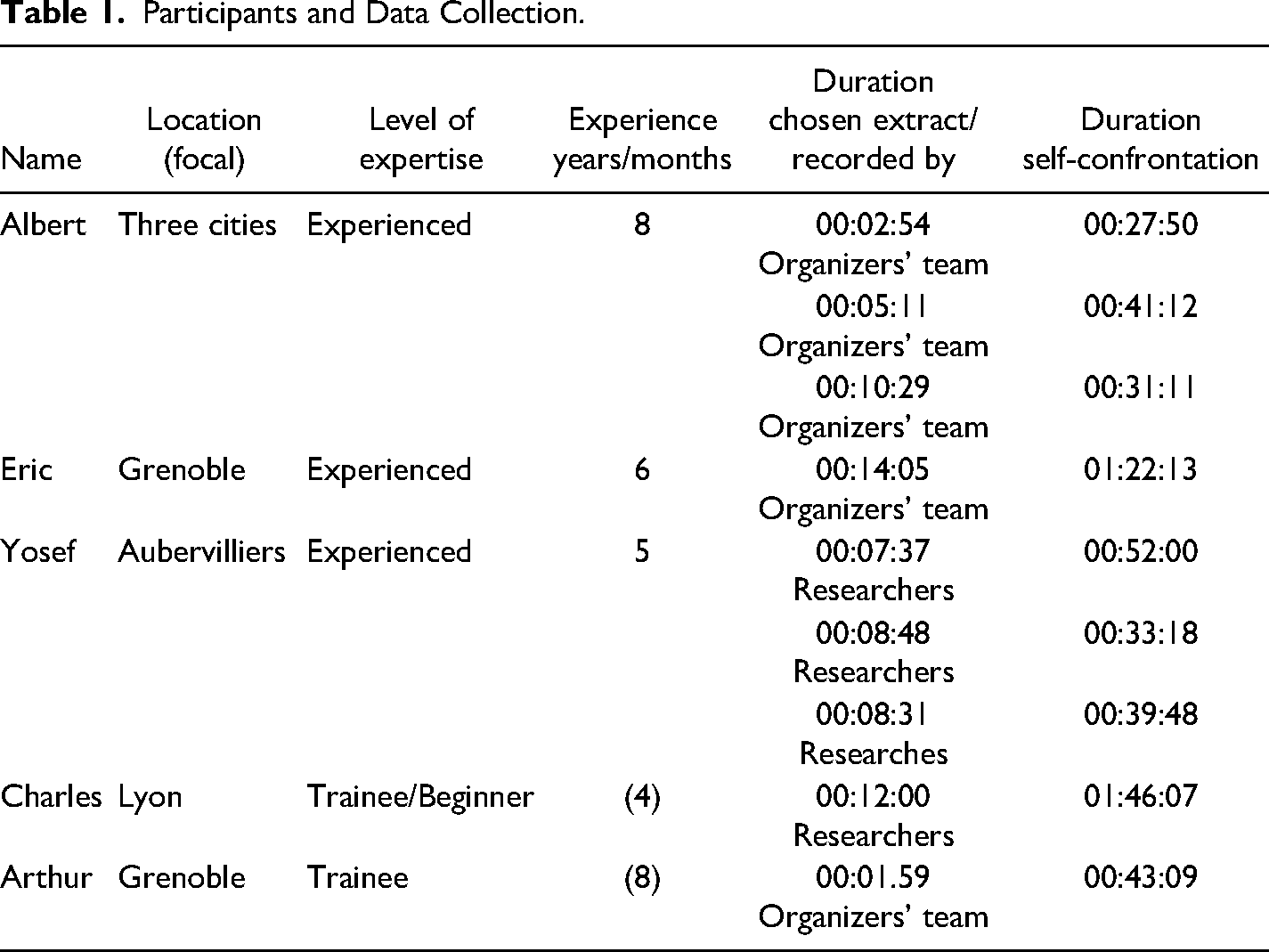
The study involved five employed professional organizers, all well-educated men, working for a French association engaged on an idealistic financial and partisan independence. At the time of data construction, participants led social housing campaigns in working-class neighborhoods of three French cities. After an official and general face-to-face presentation, they were recruited purposively and agreed to voluntarily participate and to be observed, recorded, and interviewed about their lived experience and real-world practice during one or more NDAs. Three participants were graduates or current political science students; one graduated in engineering, and the other in nonprofit management. With varying levels of expertise in community organizing, ranging from 8 years to 4 months, none had formal community organizing, adult education, or social work education. All names were changed to pseudonyms and used throughout the research to protect the participants’ anonymity (see Table 1).
Participants and Data Collection.
Over and above the conditions necessary for conducting the study (establishing with the participants a relationship of trust and conditions of sincerity), the researchers were not directly involved in the association or the campaigns.
Data Construction
Three types of data were constructed: ethnographic, audiovisual recordings, and verbalization from individual self-confrontations. Ethnographic data were collected in the three cities over an interrupted period of a year and a half during several social housing campaigns through direct observations, note taking, and informal and spontaneous interviews in the field (Olivier de Sardan, 2008). These data favored understanding organizers’ practice of historical, social, organizational, and cultural aspects and the material, social, cultural, and political context in which organizing is embedded. Eight audiovisual recordings of different NDAs were made over a year and a half, and verbalization data were gathered during nine individual self-confrontations (Dieumegard et al., 2021). Chosen extracts of the audiovisual recordings, selected with participants according to their evaluation of their criticality and typicality, constituted the essential traces of organizers’ practices used during self-confrontations. The self-confrontation method is a particular microphenomenological interview method (Poizat et al., 2023), consisting of presenting the organizers with audiovisual recordings of their real-world practice during NDAs. During self-confrontations, organizers were prompted to verbalize the course of their lived experience during the extracts, namely, encouraged to describe, demonstrate, and comment on elements that were meaningful for them at this moment without adding anything to their course-of-experience or examining it.
The self-confrontation method creates favorable conditions for an embodied speech position and a reenactment of past prereflective experience. In order to ensure the latter, the researcher uses specific prompts and helps the interviewee to give a dense description of it. These prompts include questions to find out what was meaningful for the actor in a given moment, such as sensations or emotions (“What sensations are you experiencing?”; “What emotions are you experiencing?”), perceptions (“What are you perceiving at this precise moment?”), areas of focus (“What was your attention at this moment?”), concerns (“What are you trying to do here?”), expectations (“What are you expecting at this precise moment?”), thoughts and interpretations (“What are you thinking about at this precise moment?”; “And there, what do you tell to yourself?”), and mobilized/constructed knowledge (“There, did you know that before, or do you just discover it at this moment?”). These prompts are often used while pointing to the screen.
Data Processing
The data were processed in five steps: (a) constructing a three-column table summarizing all the constructed data, (b) identifying elementary units of meaning (EUM), (c) reconstructing organizers’ course-of-experience during episodes experienced as dilemmatic, (d) identifying and labeling dilemmas regarding the conflict between politics and education, and (e) comparing the dilemmas and their outcomes.
Step 1: Constructing a Three-Column Table
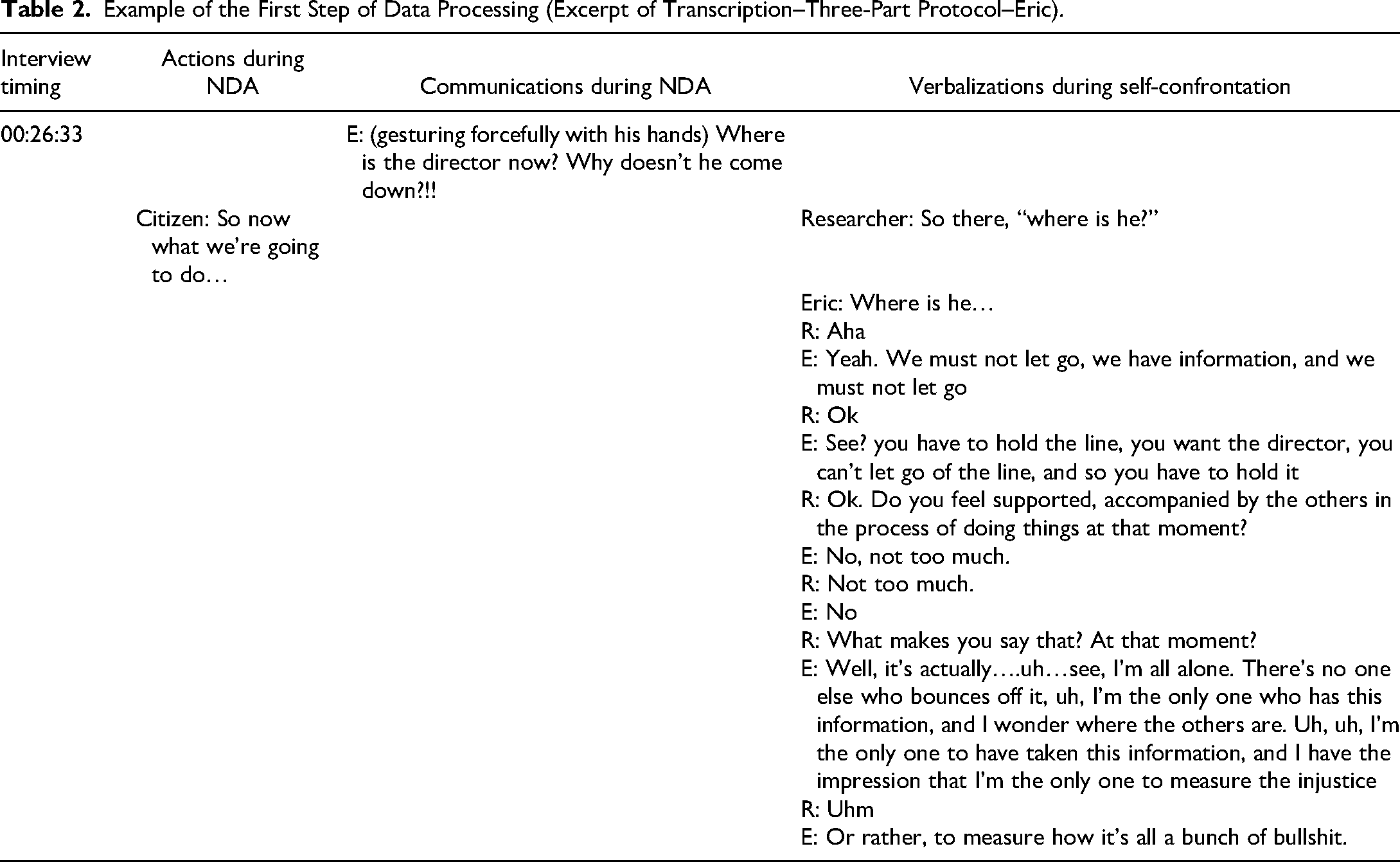
The data were presented in a timed three-column table (see Table 2 for an example of this step). This table allows us to correlate (a) the transcription of organizers’ behaviors in the audiovisual recordings of the NDAs, (b) the transcription of organizers’ speech and communications in the audiovisual recordings of the NDAs, and (c) the transcription of the organizer's verbalizations during self-confrontations.
Example of the First Step of Data Processing (Excerpt of Transcription–Three-Part Protocol–Eric).
Step 2: Identifying and Labeling of EUM
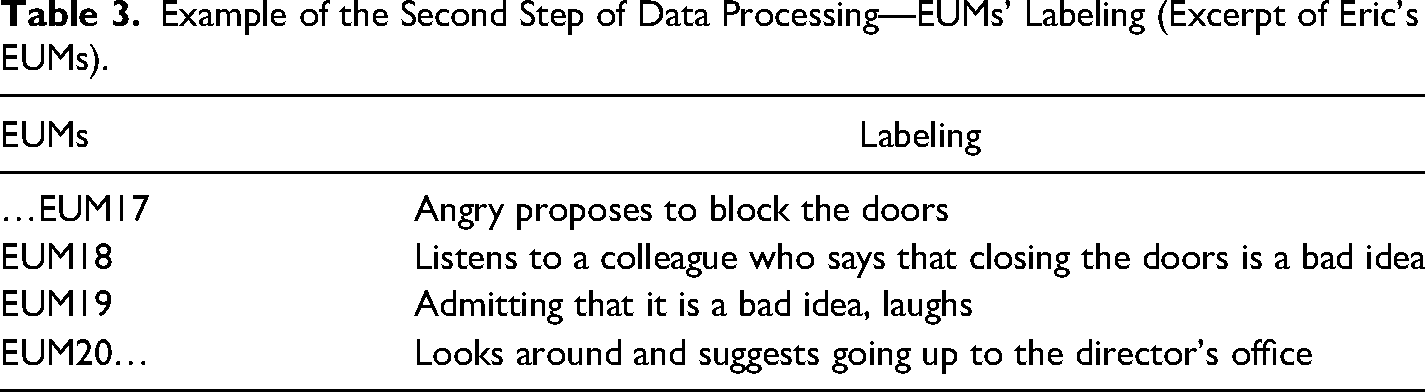
An EUM is the smallest unit of meaning for the actor at a given moment. The EUMs were labeled from verbalizations and audiovisual recordings of each organizer's behavior using an action verb followed by a direct object, an adverb, or another complement (see Table 3 for an example). The labeling reflected responses to several questions about the organizer's actions, interpretations, and feelings as they appeared in the audiovisual recordings and verbalization data, such as What are you doing now?, What are you thinking?, and What are you feeling?
Example of the Second Step of Data Processing—EUMs’ Labeling (Excerpt of Eric's EUMs).
Step 3: Reconstructing the Course-of-Experience During Episodes Experienced as Dilemmatic
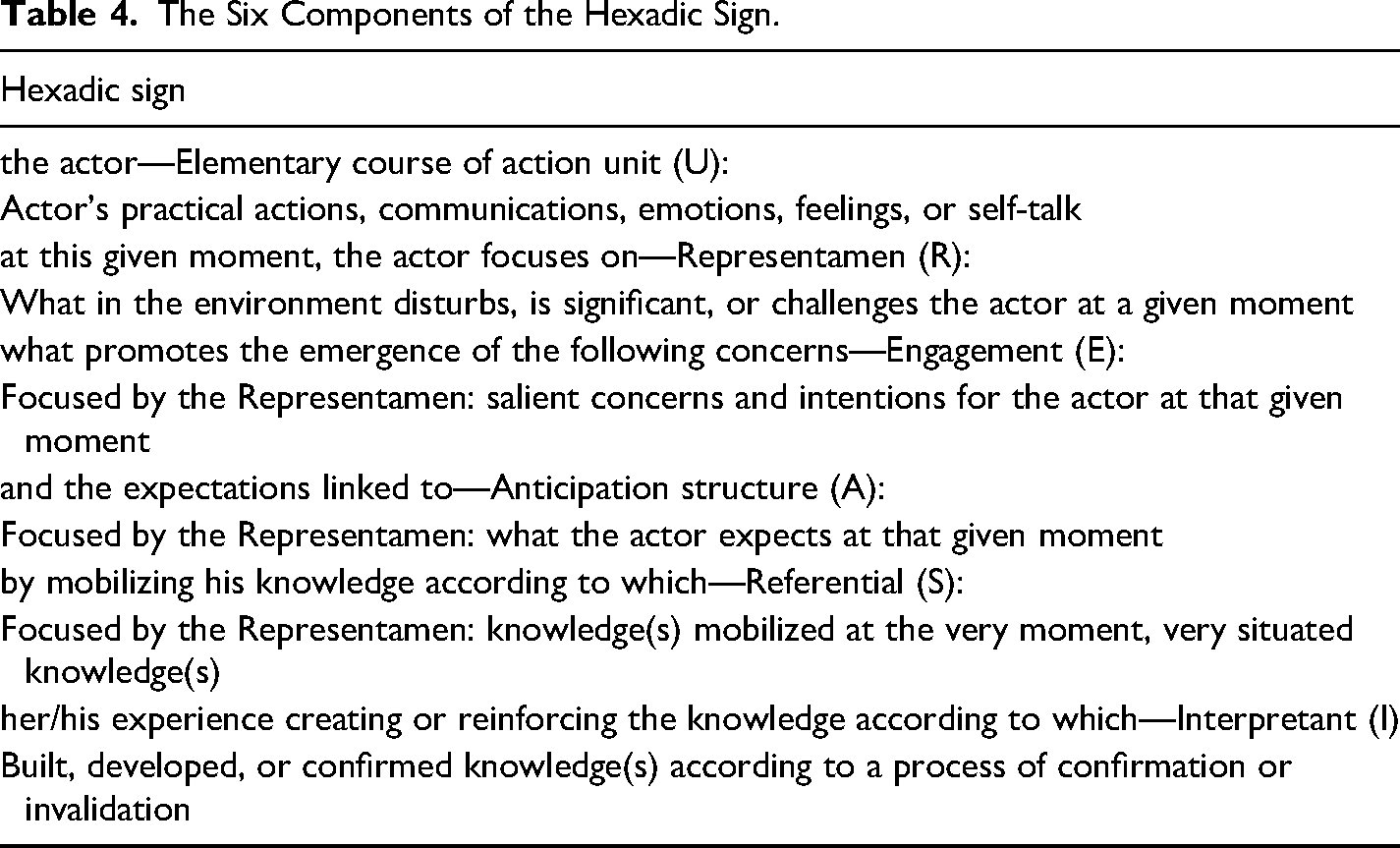
The six underlying components of each EUM were then documented step by step based on (a) the audiovisual recording, (b) the verbalization transcript, and (c) more general documentation derived from ethnographic data. The course-of-experience framework has developed for this purpose the notion of the hexadic sign, derived from Peirce's semiotics (Poizat et al., 2023), in which six components (see Table 4) are documented: Engagement (E), Anticipation structure (A), Referential (S), Representamen (R), Course-of-experience elementary unit (U), and Interpretant (I). Reconstructing the organizers’ course-of-experience involves documenting the succession of hexadic signs over a given period.
The Six Components of the Hexadic Sign.
Step 4: Identifying and Labeling Dilemmas
This step involved a thorough analysis of each course-of-experience to identify and label enacted dilemmas regarding the conflict between politics and education. We understand dilemmas as not existing a priori but enacting when conflicting concerns and/or expectations emerge. We specifically focused on (1) what is meaningful to the organizer in the environment concerning their experience, (2) their here-and-now concerns or expectations in the current situation, and (3) situational opportunities and individual/collective available resources (Ria et al., 2001). All the dilemmas are formulated by placing two poles of a continuum in opposition, even if their topics and strengths vary since the experience associated with them constantly changes over time.
Step 5: Comparing the Dilemmas and Their Outcomes
This last step involved comparing dilemmas experienced by all five organizers and their outcomes to identify potential invariants.
Findings
Findings are presented in two phases. Firstly, we succinctly present six episodes of enacted dilemmas observed throughout our entire corpus, referring to the inherent conflictual relationship between politics and education in the social action communiy organizing approach. Secondly, we present two episodes experienced as dilemmatic by one of the participants to illustrate in detail the conditions under which these dilemmas emerge and the organizer's valuative processes.
Enacted Dilemmas Referring to the Conflictuality Between Politics and Education
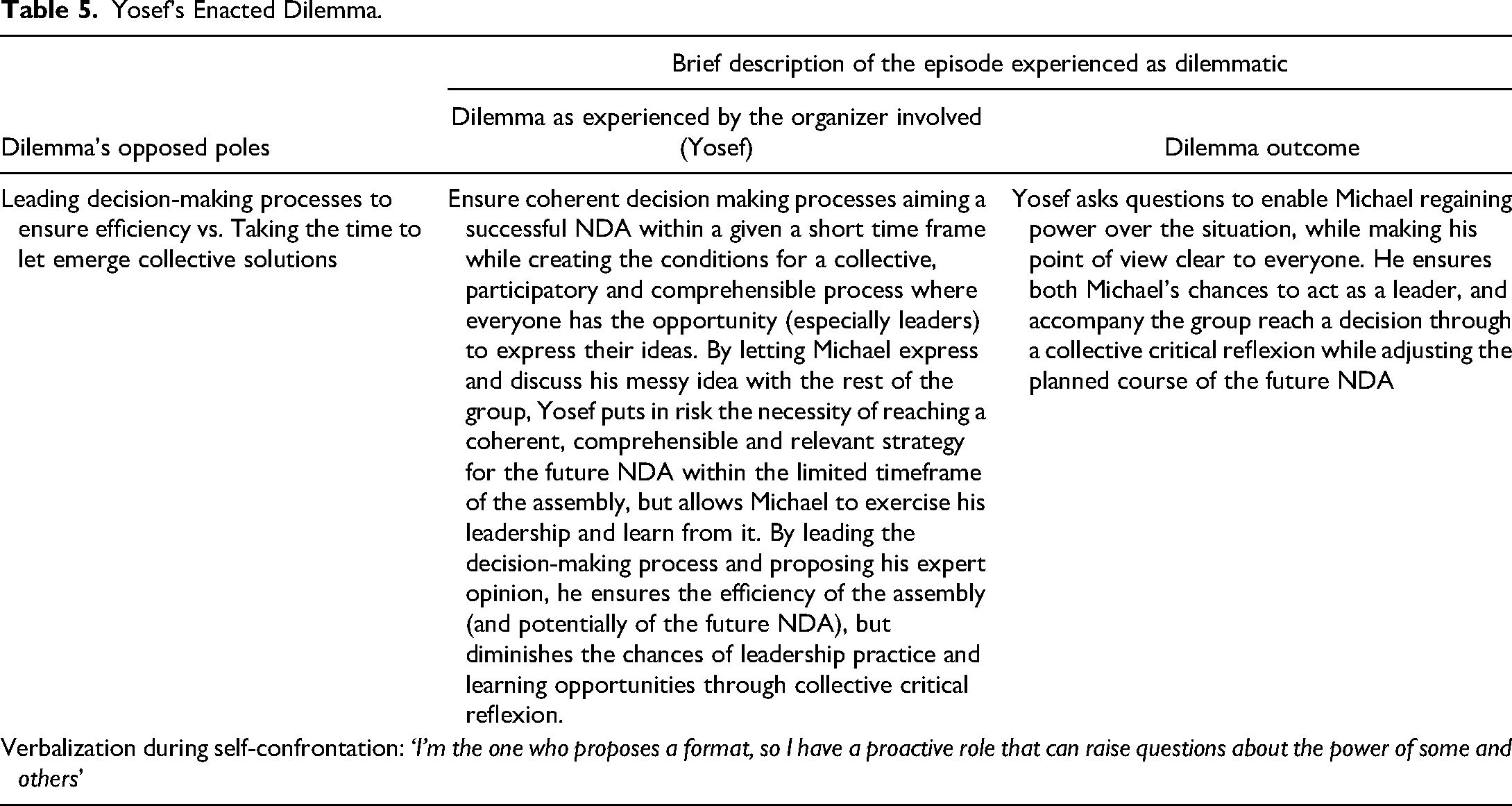
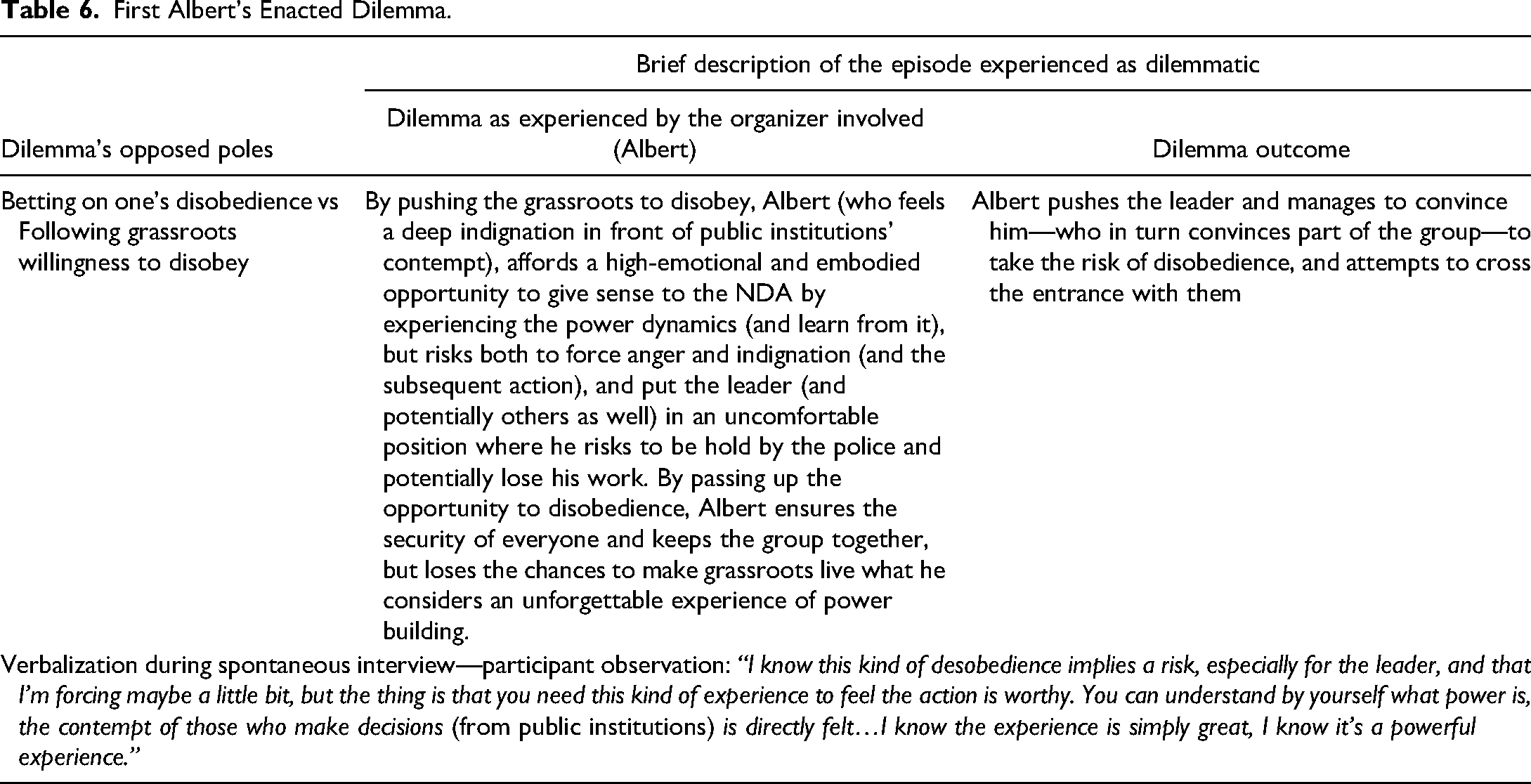
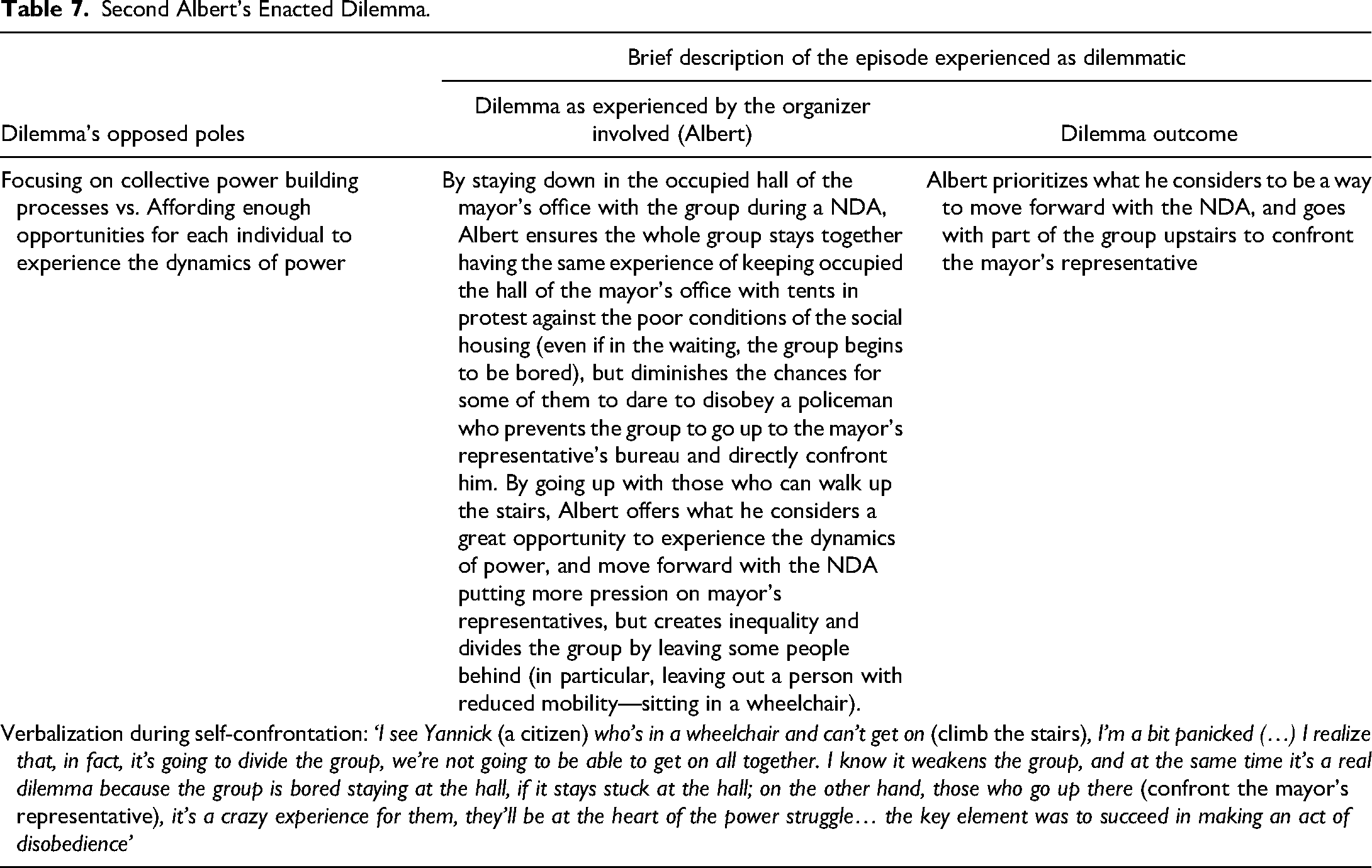
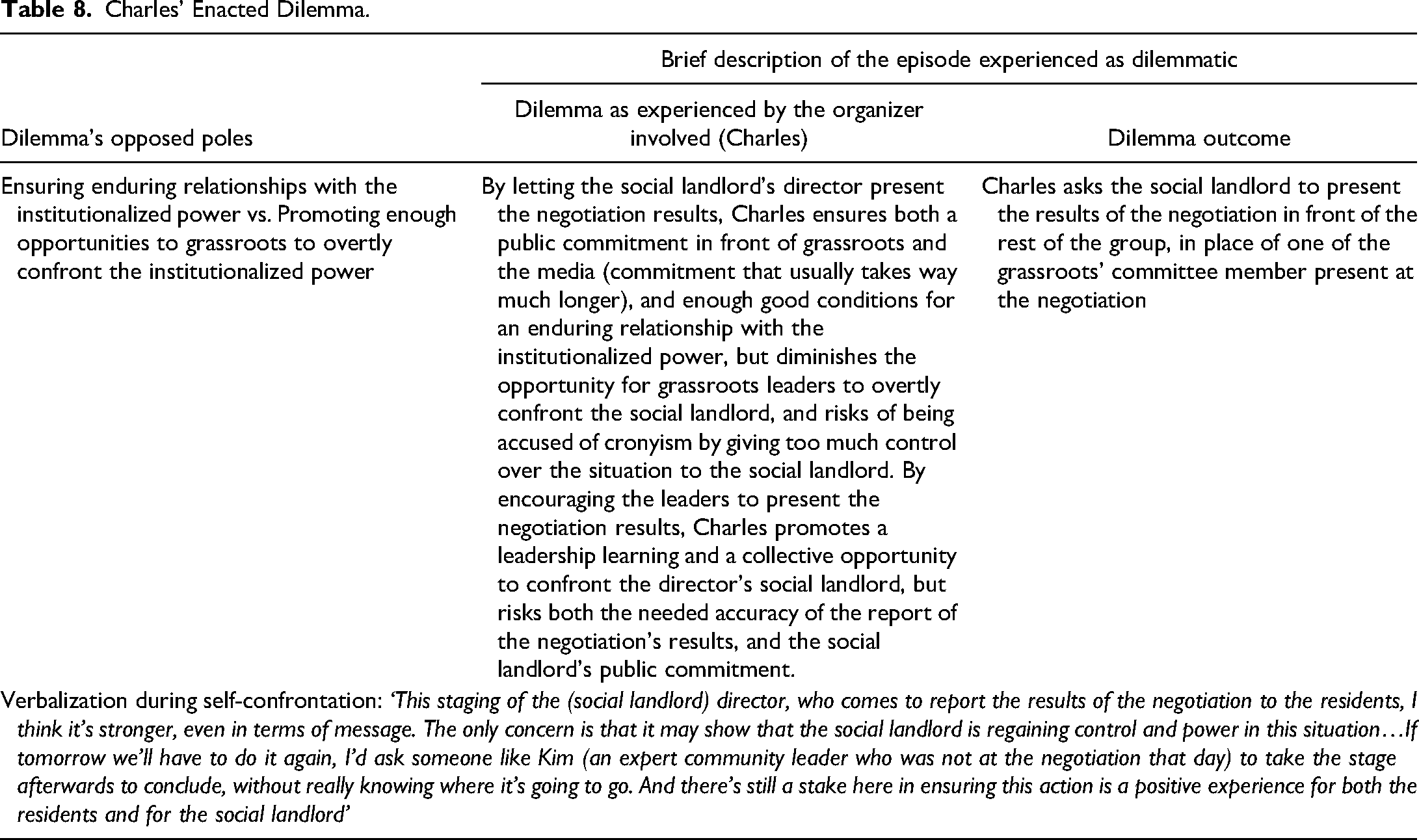
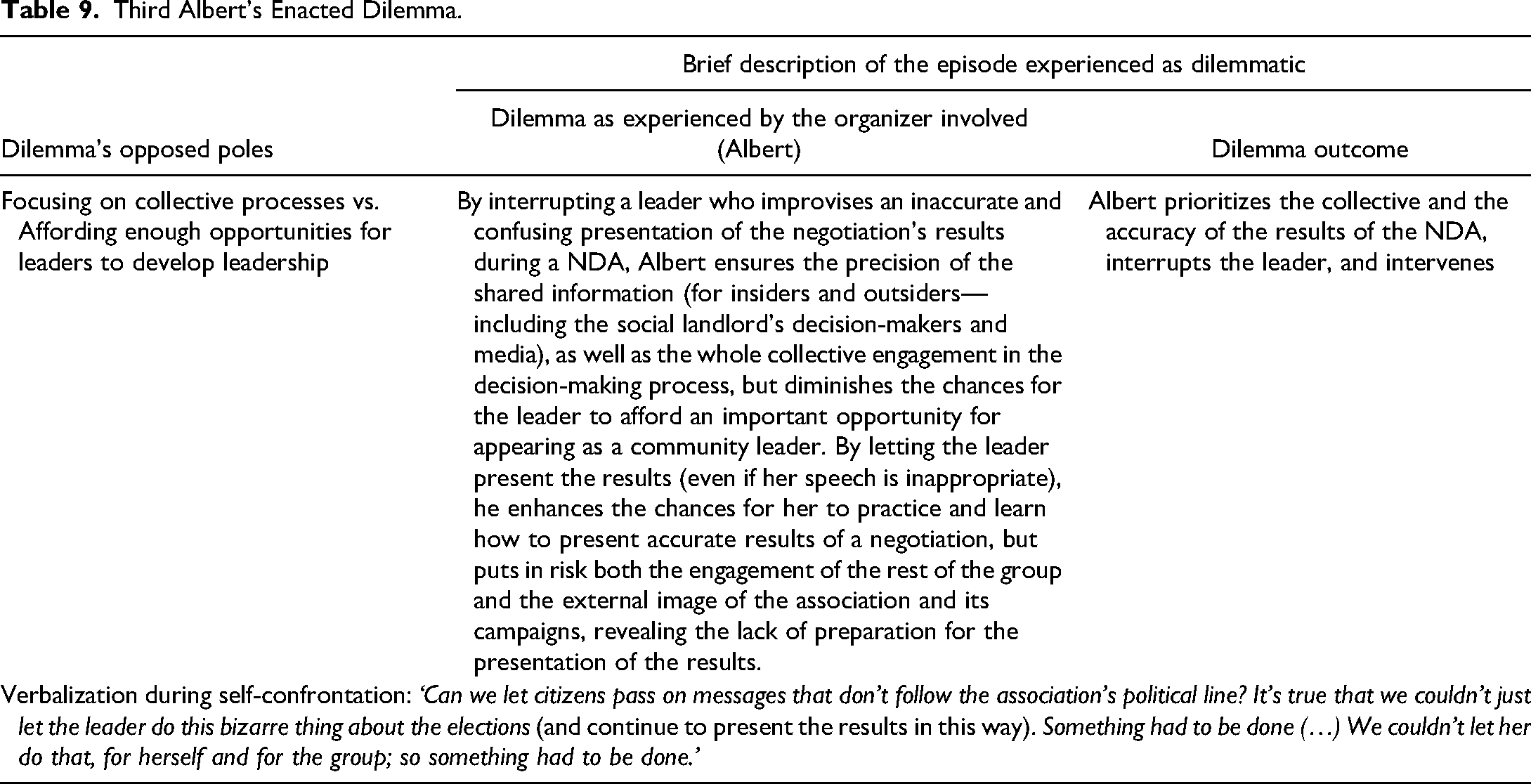
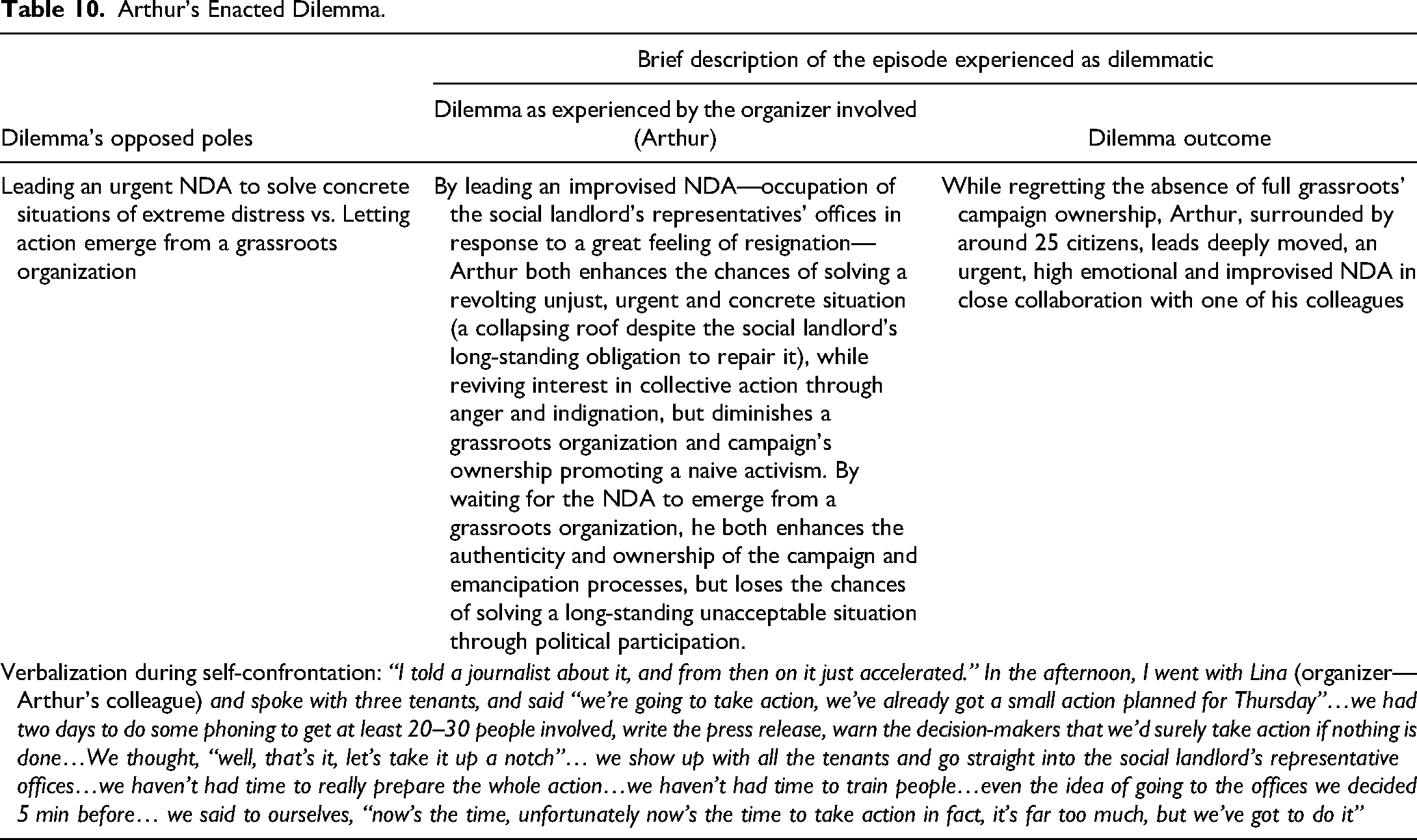
The following Tables 5–10 present in a succinct way episodes experienced as dilemmatic by our participants. All these enacted dilemmas underscore the inherent conflictual relationship between politics and education in the sociopolitical approach. They address the central issue of fostering effective organizing while enabling grassroots emancipation and oppression through collective political participation.
Yosef's Enacted Dilemma.
First Albert's Enacted Dilemma.
Second Albert's Enacted Dilemma.
Charles’ Enacted Dilemma.
Third Albert's Enacted Dilemma.
Arthur's Enacted Dilemma.
The first episode refers to Yosef's experience (Table 5). Faced with the dilemma, Yosef tipped the balance toward a here-and-now emancipatory practice. Yosef steps back and guides Michael, the community leader, to regain power over the situation, allowing enough time for the group to reach a collective decision through a critical reflection process.
In contrast, the subsequent episodes refer to dilemmatic experiences where organizers tipped the balance toward short-term efficiency political goals or individual processes over long-term collective radical education and emancipation collective processes.
In the episode presented in Table 6, first Albert's enacted dilemma, the organizer is deeply touched and angry because of the public institutions’ disregard. He pushes the community leader to disobey, despite the latter's reluctance to do so, but hoping this experience of disobedience will allow the NDA to move forward and represent, at least for some of them, an opportunity to understand power dynamics better.
The third episode, Albert's second enacted dilemma, presents a similar resolution (Table 7). Albert decides to advance with the NDA by seizing the sudden opportunity to confront a public decision-maker openly but compromising the collective and leaving part of the group behind.
The following two episodes were experienced as dilemmatic by Charles and, a third time, by Albert. In both cases, organizers ultimately intervened by tipping the balance toward the efficiency of the NDA, prioritizing it over grassroots participation or learning processes (either related to leadership development or collective emancipation). Faced with the enacted dilemmas, organizers aimed to ensure either good enough relationships with the institutionalized power (Table 8) or the accuracy of the shared information (Table 9).
In the last episode, presented in Table 10, Arthur, deeply touched, feels anger and indignation because of an extreme indignity situation. Faced with a dilemma, he plans and leads an improvised NDA without involving the concerned grassroots, hoping to regain interest in the organizing process by addressing a concrete and critical individual situation.
Detail of Two Singular and Prototypical Episodes
This section gives a thicker description of two episodes experienced as dilemmatic by Eric. The following two Eric's dilemmas (Table 11) have been chosen to be presented in detail because they are considered prototypes (Rosch, 1978) regarding the content of episodes experienced and their emergence in situ; namely, they contain different characteristics of the previously presented episodes and the enacted dilemmas that are particularly informative about the inherent conflict between education and politics. Its artificial separation allows us to describe in detail how they emerged in the real world, offering a better understanding of the organizer's valuative process.
Eric's Two Enacted Dilemmas.
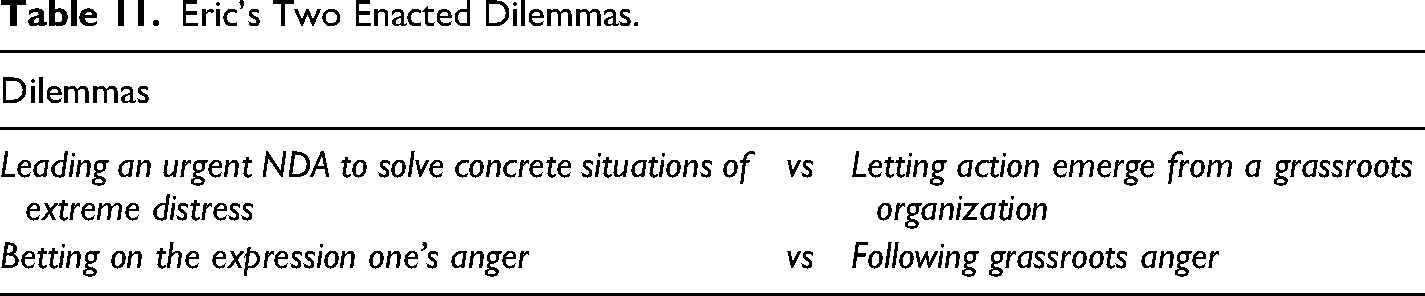
Leading an Urgent NDA to Solve Concrete Situations of Extreme Distress Versus Letting Action Emerge from a Grassroots Organization
Professional organizer Eric encounters 80-year-old Mrs. Belvedere, who lives in a low-income, rent-controlled housing 4 neighborhood in poor conditions as other residents. Despite repeated requests for repairs, the social landlord ignores her, even threatening eviction. Deeply touched by her extreme distress, Eric decides to lead an urgent NDA to demand accountability from the social landlord. This urgent NDA aims a small here-and-now victory, even if it has not arisen from an organized community's collective denaturalization (i.e., a situation experienced as natural is labeled as unjust) and politicization (i.e., an injustice is understood as a collective political matter) processes. Joined by Mrs. Belvedere's family, colleagues, and local citizens, Eric leads the group to confront the social landlord on its premises.
Forced to relinquish either of two conflicting concerns (eE), Eric feels caught in a first enacted dilemma: Leading an urgent NDA to solve concrete situations of extreme distress versus letting action emerge from a grassroots organization
By leading the NDA, Eric aims to politically address Mrs. Belvedere's urgent situation but sacrifices the development of the grassroots organization. By letting the NDA emerge from a grassroots organization, he increases immediate campaign grassroots ownership but loses the chances of political participation through solving Mrs. Belvedere's situation. Eric tips the balance by leading an urgent NDA while questioning the relevance and legitimacy of his action. He knows the high price of assuming the role of what he calls an almighty organizer depriving grassroots of self-organization: “It questions our place in the almighty organizer mode: I called her, I prepared the action with Mrs. Belvedere. There was no assembly. The thing is, it's just such a big injustice” (verbalization during self-confrontation).
Previous knowledge (S) reinforces his valuative process: (1) NDA represents a powerful space-time of political learning that also creates possibilities for starting neighborhood activism, and (2) mobilizing a community and getting it organized is an unpredictable and arduous process: “The time people take ownership of the issue, that they understand the injustice, it will be a bit of a long process” (verbalization during self-confrontation). Denaturalization and politicization processes can take months or even years, and a potentially organized collective will still be far from being in place.
Two expectations (A) guide Eric's valuative process: (1) Mrs. Belvedere's story has all the elements of flagrant injustice, with a high chance of being concrete, easily winnable battle; the landlord will therefore be forced to act on her behalf, and (2) Eric envisions this NDA as a successful and effective performance allowing to find a concrete solution to Mrs. Belvedere's situation; a whole community will be inspired and motivated to join the organization.
Betting on the Expression of One's Anger Versus Following Grassroots Anger
Wearing the association T-shirts and accompanied by media, Eric and the group occupy the social landlord's hall. Mrs. Belvedere passionately testifies about her experience of injustice while Eric underlines the request for a meeting with the director to seek concrete solutions. The front-desk officer claims the director is unavailable due to illness, suggesting a meeting with the CFO instead. However, Eric suddenly hears from a citizen in the group that the director is actually in the office. Eric approaches the counter and overtly confronts the front desk officer, demanding the director's immediate presence.
Conflicting concerns (E), appearing in a succinct lapse of time, configure a second enacted dilemma: Betting on the expression of one's anger versus following grassroots anger
Either Eric immediately reacts to the landlord's mistreatment or follows the grassroots reaction (or its lack) in front of it. The lie about the director's absence, the lack of reaction from the collective, and the rise of his anger and indignation (R) disturb the organizer and trigger the dilemma. Deeply touched by the landlord's mistreatment, Eric overtly confronts the front-desk officer. Feeling that he is the only one measuring the injustice, Eric feels impelled to speak up: “I have the impression that I’m the only one to measure how unjust this is, to measure how it's bullshit” (verbalization during self-confrontation). Nevertheless, this emotional surge questions him: “I've lost my mind there. Theoretically, I shouldn't do that. But now, for me, well, honestly, the cup is full” (verbalization during self-confrontation). At this moment, and for some seconds, his attention focuses on the officer, “The only one I’m looking at is the guy at the front desk, and I want to kick his ass” (verbalization during self-confrontation).
The following two hexadic signs (Table 12) document Eric's situated valuative process:
Two Hexadic Signs Documenting Eric's Situated Valuative Processes.
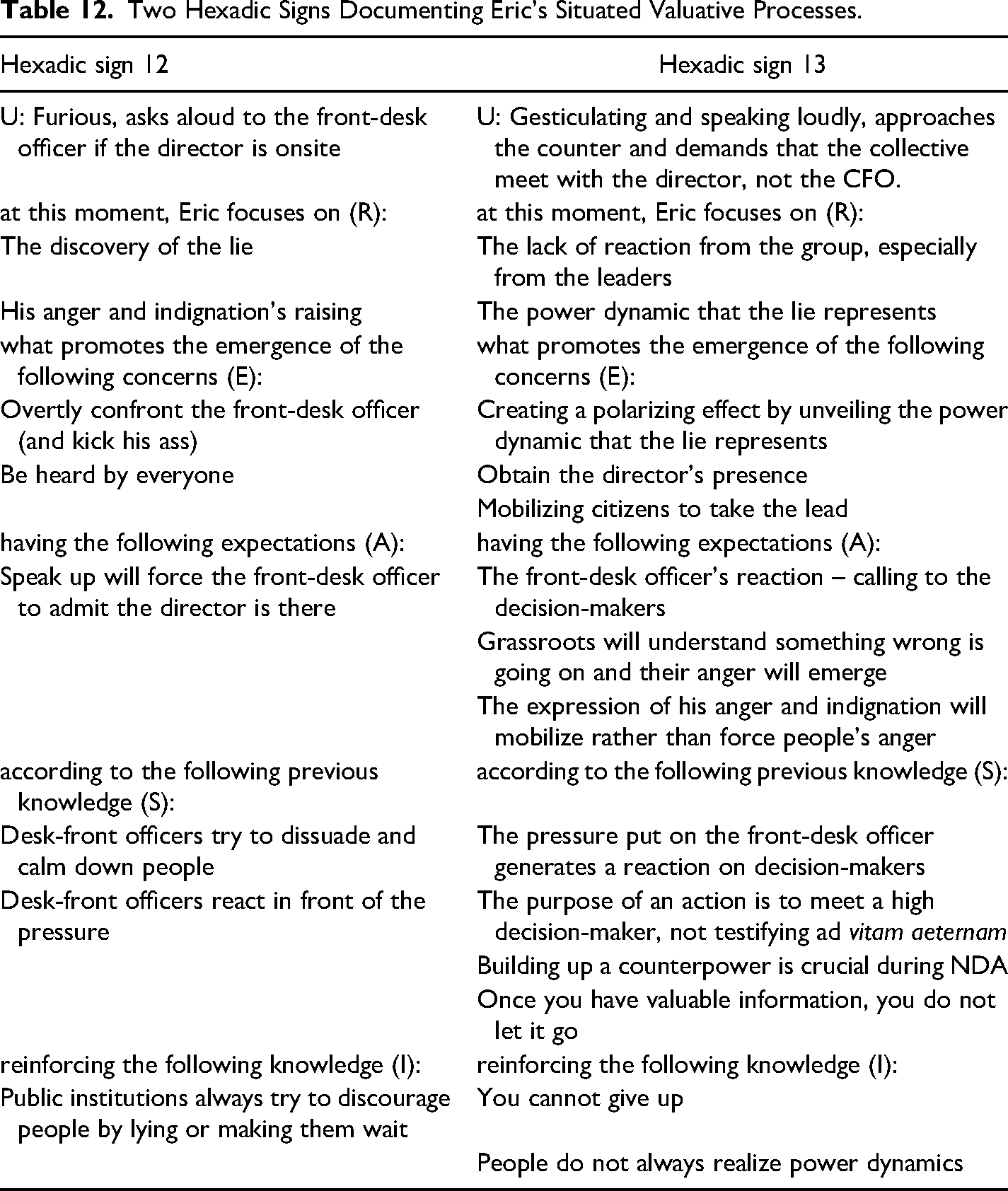
Two simultaneous expectations (A) also configure the dilemma. By speaking up, Eric expects both to ensure the NDA's success by putting pressure on the front-desk officer and the grassroots anger rising. Understanding that something wrong is going on, their anger will emerge, and they will commit to leading the NDA: “I share it loudly with everyone, so people understand what's going on.” (Verbalisation during self-confrontation). However, Eric knows what is at stake: his anger could be just his, and by expressing it, he could force it among the grassroots: “I speak up, but our role is more to be in the background, to take the members aside and tell them how to proceed” (verbalization during self-confrontation).
Previous knowledge (S) plays a vital role at this moment: (1) succeeding the NDA depends on putting pressure on whoever is at the front desk to meet with a high decision-maker, and (2) the climax of tension is an opportunity for unveiling the power dynamics and reinforcing grassroots’ power. By creating a polarizing effect (“us against them”), he wants to send a message: “To say we won't leave after ten minutes because we are not received, even if the police take us out, we stay” (verbalization during self-confrontation). Valuable information, such as the director's presence, constitutes a powerful means to achieve the above: “We lose if we have this information about the director, and we don't do anything with it […] we have to hold the line, we want the director” (verbalization during self-confrontation).
Still in anger, Eric continues to demand the director's presence as, for some minutes, he does not perceive a reaction from the group. Someone suggests blocking the doors, which Eric initially agrees with, but then quickly abandons due to a colleague's suggestion of more practical and less drastic alternatives to entering a negotiation: “I know it's fucked up as all hell to block the doors because you don't piss off the social landlord. You piss off the tenants” (verbalization during self-confrontation).
When Eric perceives his intervention as relevant, the dilemma dilutes: “I heard someone who says, 'we only have to go upstairs; there is F (a citizen) who proposes to… that had the expected effect. See? People became aware that a real, weird thing was happening at that moment” (verbalization during self-confrontation). Laughing, he calms down, continues pressuring the front-desk officer, demanding the directors’ presence, and focuses on calming the atmosphere. Eventually, the CFO appears and proposes to hear the group.
Discussion
Findings show that dilemmas primarily arise when the NDA's success (its efficiency or its collective dimension) is jeopardized or when organizers face situations of extreme indignity (necessitating urgent confrontation through disobedience). When organizers encounter dilemmas, implying difficult ethical situations, their valuative processes closely connect with the dual imperatives of political and educational aims during NDAs. One interesting finding is that driven by anger and indignation, organizers tip the balance mainly in favor of short-term political objectives. Despite the dissatisfaction this may cause, long-term educational objectives are often set aside, postponed, or even compromised. From the educational perspective, the latter can be problematic, especially because organizers can (a) assume a winner-almighty stance by promoting a symbolic, easy-to-control grassroots participation or (b) bet on their anger and indignation as a driving force.
Assuming a Winner-Almighty Stance by Promoting a Symbolic, Easy-to-Control Grassroots Participation
According to Alinsky (1971), the organizers’ role involves addressing grassroots resentments, listening to their concerns, and accompanying them to act on those concerns and gain collective power. Organizers consider the need to inspire trust as part of their valuative process, and trust can be gained by showing prior success (Alinsky, 1971; Phulwani, 2016), which, in turn, provides concrete reasons for grassroots to believe in organizers (Brady & O'Connor, 2014). Success is therefore a critical political goal which, in its most concrete dimension, means being efficient, that is, winning immediate battles (small, feasible battles), aiming for answers and solutions, usually in concrete situations or related to individual problems (Schutz & Miller, 2015). However, for this success to promote actual educational purposes, it must arise from grassroots efforts to overcome oppression through a collective fight for gaining power (Foley, 2001). A structural tension between educational and political injunctions quickly arises (Breault, 2017): both empowering grassroots to overcome oppression through critical emancipatory learning opportunities instead of naive activism (Earl, 2018; Freire, 1970) and winning immediate battles are considered as part of organizers’ valuative process.
While organizers see opportunities to address unjust situations by, for instance, leading the NDA (speaking up about their anger, confronting the institutional representatives), they often feel unsatisfied with their intervention. By temporarily stepping in for grassroots to achieve results, they understand the risk of undermining education and becoming dominant organizers focused on moving campaigns forward or winning them. Eric and his colleagues fear today, with good reason, that this striving for success can promote oppressive activism without purposeful critical reflection (Freire, 1970, 1985; Ollis, 2015), increasing the ongoing vulnerability (Sites et al., 2007). Furthermore, focusing on immediate confrontations or individual issues can imply their instrumentalization and hinder the development of collective action and democratic empowerment (René, 2009). However, as previously shown, the enacted valuative processes respond to efficiency, which is highly valued within the association. Pressure is significant, and newcomers and experts feel it since they are constantly asked to increase membership through successful urgent NDAs (De Lépinay, 2019). This focus is not politically anodyne, as effective organizing relies on the power of a large, engaged community (Brady & O'Connor, 2014).
Nevertheless, while striving for efficiency answers the shared concern of showing that organizing works (Schutz, 2010), it raises important questions about whose success is prioritized. According to Schutz (2010), organizers’ success is intimately linked to the grassroots emancipation level; the more organizers create opportunities for grassroots political participation, the more campaigns’ ownership and grassroots development occur. It is worth considering that success can be as problematic as failure (Sites et al., 2007). Winner-almighty organizers risk alienating practices, compromising grassroots learning, actual commitment, and participation (De Lépinay, 2019) despite achieving short-term success.
By overshadowing grassroots voices, organizers may promote naive activism, postpone or limit educational opportunities, constrain deliberation, impose disobedience, or obscure an accurate understanding of the problems experienced by the community. Educational processes occurring before NDAs, such as denaturalization and subsequent politicization, require public examination involving deliberation and compromise. Nevertheless, as recognized by our participants, the urgency of (sometimes improvised) NDAs often sidelines these educational opportunities. Even if organizers are supposed, as radical and critical educators, to recognize the grassroots’ capacity to address their issues collectively (Alinsky, 1971; Bergeron-Gaudin, 2019), as well as to respect and learn from grassroots to advance democracy (Phulwani, 2016), the increasingly professionalized context (Brady et al., 2014) makes too often preponderant fitting into the urgent NDAs’ mold. The shown valuative processes seem to give more importance to this political aim than to create actual opportunities for democratic participation and collective learning of collective power in democratic ways.
The preceding also undermines organizers’ legitimacy and potentially threatens a true partnership between organizers and grassroots (Breault, 2017). Regarding the above, among others, Talpin (2016) highlights a fundamental contradiction: Grassroots organizations seem to achieve emancipation when managed by professional activists. The latter creates an inherent inequality since organizers are considered experts in power dynamics and organizing techniques. Nevertheless, their “given” authority can lead to an unbalanced power structure (De Lépinay, 2019; Schutz, 2010) that undermines grassroots autonomy, as their perspectives often take precedence over those of the grassroots (Comeau, 2012). Avoiding a patronizing and controlling notion of organizing means starting from where people currently are and collaboratively exploring paths forward (Foley, 2001).
Betting on Anger as a Driving Force
According to our results, mistreatment of grassroots by the institutionalized power provokes strong emotions that significantly influence organizers’ valuative processes during NDAs. Organizers often experience feelings of injustice, anger, and indignation, especially when confronted with extreme unjust situations or institutional disregard sustained over time. While these emotions drive organizing efforts, serve as a potency to move forward throughout NDA (Eyerman, 2007; Jasper, 2014), and constitute a possible answer when aiming for social justice (Alinsky, 1971), they can also be powerful engines for either supporting or undermining the educational process.
Even though Eric and his colleagues explicitly state that their work relies on authentic anger and indignation, the centrality of these emotions in the valuative processes poses at least two risks in balancing the simultaneous political and educational aims. Firstly, organizers risk their credibility. When clouded by their anger and indignation, an emotional, confrontational approach can lead to losing control over NDAs and ultimately damage the interlocution with public institutions and grassroots (Bergeron-Gaudin, 2019). Instead of a simplistic, heated, and personalized condemnation that can come across as aggressive (Jasper, 2014), organizers can develop a disposition to adopt a more measured approach, practicing what Rogers (1990) called the Alinskian “cold anger.” What is at stake is a strategic balance—avoiding hostility to public institutions while not appearing too close to avoid grassroots accusations of cronyism. The above guarantees the twofold and necessary political and educational conditions, namely a conflictual but enduring relationship with the institutionalized power, which, according to our findings, gives rise to dilemmas. However, fostering this kind of difficult-to-find conflictual yet productive relationship with the institutionalized power increases the chances for grassroots to gain insights into the high-emotional power dynamics while representing a crucial aspect for a radical educational process: an individual and collective transformation of shame and oppression into “cold anger” and pride (Eyerman, 2007).
The latter, vital for radical education, leads to the second risk of forcing artificial indignation within the grassroots, which can distort the purpose of their mobilization. It is well-known that organizers capitalize on grassroots emotions to disrupt public order and pressure decision-makers (Alinsky, 1946). Organizers can leverage anger and indignation to achieve multiple goals, such as exposing power imbalances resulting from deception and disrespect, bolstering collective power, and prompting grassroots to engage in processes of conscientization and problematization during NDAs (Alinsky, 1946, 1971; Schutz, 2010). Organizers consider these crucial embodied and highly emotional democratic processes as potential sources of learning and development (Eyerman, 2007; Ollis, 2021). However, these processes refer to the development of a critical consciousness and the capacity to confront public institutions freely and informally (Freire, 1970). Organizers’ interventions could be understandable when anger and indignation are lacking, since they encounter people who have naturalized situations of injustice, considering them as acts of misfortune or as products of social inheritance. In these occasions, organizers intervene to get the grassroots to react to institutional indifference and find solutions through political participation. When authentic, anger can then be strategically used to build momentum, reinforce power, and demand accountability from decision-makers (Eyerman, 2007; Phulwani, 2016) while conveying two key radical educational messages: (1) grassroots are legitimate and powerful political agents (Alinsky, 1946), and (2) the struggle is meaningful and anger and indignation are justified (Eyerman, 2007; Freire, 1970; Ollis, 2021).
Conclusion
The findings highlight the educational dimension of the community organizing social action approach and the related dilemmas experienced by organizers in the messiness of real-world practice. Our participants recognize the political and educational potential of NDAs, which drives their commitment as both professional activists and radical and critical educators. However, they often struggle to balance these imperatives during episodes where dilemmas emerge, questioning grassroots autonomy, the legitimacy of their actions, and the NDAs when political concerns take precedence over educational goals.
Addressing dilemmas with a guilt-free approach during initial and vocational training can help to eschew implicit assumptions about interventions as ethically justifiable. Professional debates among beginners and experts should explore the complexities of balancing political and educational aims, moving beyond superficial or utilitarian participation to meaningfully engaging with power dynamics (Shaw & Crowther, 2014; Phulwani, 2016). Analysis should include the tragic question, embracing the organizer's activity complexity. As stated by Shaw (2008), “this means engaging with the politics of community in ways which offer the possibility of talking back to power rather than simply delivering depoliticized and demeaning versions of empowerment.” (p. 34). Preparing organizers to better empower grassroots in a contributive process (Brooks, 2019) can enhance both grassroots and organizers’ transformation (Fisher & DeFilippis, 2015; Freire, 1970), strengthening political power while fostering emancipation through empowerment and critical consciousness (Fang et al., 2018).
To better embrace their challenging role as radical and critical educators, organizers must provide, especially in contexts of structural oppression, genuine opportunities for grassroots empowerment, which may involve, perhaps, accepting the failure of some NDAs while avoiding perpetuating oppression (Freire, 1970) by systematically stepping in. In the same vein, organizers need to understand the dual nature of anger and indignation, recognizing their potential for alienation and emancipation. This approach requires a willingness to shift away from neoliberal efficiency and urgency (Brady et al., 2014) and advocating for a situated ethic during NDAs that supports justice, democratic participation, and dignity but also recognizes temporality of educational processes.
Finally, since we understand the limitations of this study, we highlight the need for supplementary research on this topic and encourage other researchers to pursue it. While previous studies have addressed the challenging duality of the political and educational aims of the social action approach, further detailed analysis of the experience of organizers working with different community-based organizations in other countries or focusing on social fields beyond social housing can inform and contribute to better understand the emergence of dilemmas and their connection to the twofold political and educational goals featuring organizing efforts.
Footnotes
Declaration of Conflicting Interests
The author(s) declared no potential conflicts of interest with respect to the research, authorship, and/or publication of this article.
Ethics & Responsibility
This study was approved by the Faculty of Psychology and sciences of education Ethical Committee of the University of Geneva on June 10, 2021. Identifying information, such as names or age, has been anonymized to ensure participants’ privacy. All names in this paper have been replaced with pseudonyms. All participants provided written informed consent prior to participating.
Funding
The author(s) received no financial support for the research, authorship, and/or publication of this article.
