




Abstract
This study investigated adult learners’ experiences with the language of their new living environment. Migrants and refugees’ personal goals for language learning in their specific life situations were captured in in-depth interviews conducted as part of ethnographically oriented field studies in Finland and Germany. Interpretative phenomenological analysis (IPA) was chosen as a structured approach to scrutinizing complex lived experiences. The process reveals common experiences among participants: language contributes to a sensation of getting closer or being pushed away and to balancing active participation in society, and it is a necessity for building personal futures. The findings indicate that language is essentially involved in subjective well-being but also, more fundamentally, in every aspect of existence itself. Therefore, the findings extend the potential implications beyond the two European research contexts.
Keywords
The study reported herein explored adult migrants and refugees’ experiences of language learning in their current life situations in Finland and Germany. As such, it contributes to the body of literature that examines the development of language education for adult migrants and refugees. To support adult education practices in which heterogeneous groups of individuals from different cultures and life circumstances meet in classrooms with the shared goal of coping with their new living environment, it is crucial that some common ground among these learners’ individual experiences related to the new language and its learning be found.
Prior research on adult migrants and refugees' language experiences has addressed both Anglophone and non-Anglophone contexts. In North American settings, studies implemented within this framework have focused on identity negotiations (Adamuti-Trache, 2013; Guo & Lei, 2020; Huang, 2022; Norton, 2013; Skilton-Sylvester, 2002; Ugurel Kamisli, 2021), social support (Alfred, 2003; Warriner, 2007), conflicts (De Fina & King, 2011; Mantou & Noels, 2019), life histories (Lee, 2013; Stewart, 2015), motivation for language learning (Kisiara, 2021), and motherhood (Omar, 2024; Zhu, 2020). Studies in the Australian context deal with digital literacy (Tour et al., 2023) and emotions (Westcott & Vazquez Maggio, 2015). One study that focused on Iraq's Kurdistan region examined the psycho-social support provided to migrants engaging in language learning (Ateek, 2022). Contributions from South Africa have investigated migrants' experiences of xenophobia (Mesthrie et al., 2022), linguistic challenges (Mutasa, 2014), and networks for skilled migrants (Hurst, 2014). A Ghanaian study investigated adult migrants' multilingualism and language practices (Amuzu et al., 2019).
The existing body of research in the European and British contexts has approached adult migrants' language experiences from the perspectives of meaningful learning (Abdulla, 2017; Ahlgren & Rydell, 2020; Kärkkäinen, 2017), identity (Court, 2017; Stella & Gawlewicz, 2021), and family integration (Farr et al. 2018; Föbker & Imani, 2017; Iikkanen, 2020; Intke-Hernández, 2020; Selleck, 2022). Studies have also focused on various aspects of communication (Jansen & Romero Gibu, 2021; Rydell, 2018; Van der Land, 2022; Zachrison, 2014) and social inclusion (Ćatibušić et al., 2021), particularly from the perspective of women (Ennser-Kananen & Pettitt, 2017; Rzepnikowska, 2017).
The gap in the literature that this study addresses is the relationship between language learning and well-being in adult migrants and refugees' experiences. The present study highlights the connection between migrants’ language learning and well-being among a heterogeneous group of migrants and refugees. Within this scope, Beier and Kroneberg (2013) demonstrated how symbolic language boundaries influenced the subjective well-being of migrants and their descendants in 20 European countries. Rodin et al. (2017) also perceived a connection between language learning and psychological well-being in their investigation of a language program for qualified migrants in Sweden. In the UK, Tip et al. (2019) underscored the role of intergroup contact as a mediator between language and well-being, and Morrice et al. (2021) highlighted refugees’ varied capacities, needs, and opportunities for learning as well as the importance of prioritizing language learning over policy goals of rapid employment.
This study fills a significant gap in the literature by offering valuable insights into a range of adult migrants’ language experiences in two European research contexts: Finland and Germany. The participants’ backgrounds varied, encompassing both highly skilled academics and individuals with limited literacy skills. The group also encompassed individuals of different ages, genders, and family structures who were participating in Finnish and German integration training and literacy courses. This study’s key strength lies in its ethnographic approach. The first author participated in the delivery of instruction and activities at two adult education institutions, which allowed her to familiarize herself with the participants’ everyday routines. The interviews were also conducted in this setting. At a later stage in the analysis, the synthesis of the two field studies facilitated a comparison across two European migration destinations from the perspectives of those relocating there from different parts of the world.
These two non-Anglophone migration destinations have not been previously investigated in tandem with respect to adult migrants’ language experiences and well-being. The research questions guiding this work are as follows: RQ1: How do participants experience learning the language of their new living environment?; RQ2: How do these experiences reflect subjective well-being?; RQ3: How do the findings vary across the two research contexts?; and RQ4: What are the implications of these findings for adult education practices?
Theoretical Standpoint: Language Affecting Well-Being in Migration
This study approaches language and its learning from the perspective of a multidimensional conception of well-being as personal and interpersonal, emotional, and action-oriented (Huppert et al., 2009), and material and immaterial (Allardt, 1976). Psychological and physical well-being advance language learning by strengthening one's emotional bond with one's living environment, which supports a sense of belonging (Kristen & Seuring, 2021).
Conversely, language can adversely affect integration and well-being (Tip et al., 2019), as insufficient language skills lead to feelings of loneliness (Castañeda & Kuusio, 2019). Opportunities for interaction are often modest, particularly when living in reception centers, where finding a common language with fellow residents is difficult (Suoranta & FitzSimmons, 2020) and traumatic experiences may challenge the ability to concentrate on learning (Alanne, 2010). Officials or language teachers may be migrants’ only frequent local contacts (Häkkinen & Mikkilä-Erdmann, 2023). This implies that language courses can significantly contribute to their well-being.
Language Education as Part of Finnish and German Integration Services
Finland and Germany share the Common European Framework of Reference for Languages (CEFR; Council of Europe [CoE], 2001) for adult migrant language education as part of integration training. This framework outlines course content and structure and sets proficiency levels. Both private institutions and public providers, such as Finland's liberal adult education or Germany's adult education center (German Volkshochschule), may offer integration training, which lasts approximately eight months. Language courses are an integral part of this training, with Finnish or Swedish as Finland's official languages and German in Germany. An additional orientation course in Germany covers topics such as the legal system, history, and culture; in Finland, this course includes social, cultural, and life-management skills, and vocational planning, including a work placement period.
Finnish integration training is based on the Act on the Promotion of Immigrant Integration (Finlex, 2010) and is the responsibility of the Finnish Ministry of Economic Affairs and Employment. Literacy training is the Ministry of Education and Culture's responsibility. Integration education is implemented as labor market training for adults who have completed compulsory education. Based on an educational needs assessment by the municipality or the Employment and Economic Development Office, and another done in collaboration with the migrant, full-time studies can entitle one to unemployment benefits if so stated in an individual integration plan.
In Germany, the Federal Office for Migration and Refugees administers a general integration course. Integration training is obligatory for migrants who received their residence permits after January 1, 2005, but cannot yet speak German understandably. Attendance is also required for receiving Unemployment Benefit II. Integration training is voluntary if residence was granted on or after January 1, 2005, if the individual lives permanently in Germany and is an employee, needs training for family reunification or humanitarian reasons, and speaks adequate German. The language courses offered varies, including courses after completion of the integration course.
Germany received 1.2 million refugees from 2015–2016 (Brücker et al., 2021), which has had a significant impact on the housing market, children's daycare services, and various service encounters. In 2015, Finland received approximately 32,500 asylum applications (Finnish Immigration Service [Migri], 2022). In 2022, Finland received approximately 43,000 applications for temporary protection due to the conflict in Ukraine (status as of November 2022; Migri, 2022), while a German estimate for refugees from Ukraine fluctuated around one million (status as of October 2022 [Deutsche Welle, 2022]). Around 50% were minors, and most adults were female, prioritizing humanitarian questions in integration (Brücker, 2022, p. 4).
Data and Methods
Ethnographically Oriented Fieldwork in Finland and Germany
The study applied cross-cultural ethnography (Gordon & Lahelma 2007, pp. 31–35), focusing on interview data that were contextualized in the daily practices of two educational organizations and followed intensively for two weeks in the summer of 2016 in Finland and for another two weeks at the end of 2017 in Germany. In Finland, a significant increase in the number of new and different participants in integration courses was only anticipated, while in Germany, the numbers had peaked. With over 40 years of experience in adult education, both organizations were large education providers in big cities: a foundation-funded organization and a limited liability company (GmbH), respectively.
On site, the researcher (the first author) observed second-language teaching, attended the organizations’ events and meetings, talked with students and staff, and photographed physical settings. During class, she sat among students and participated mostly by listening and observing. She did this at different stages, with five groups in Finland and nine groups in Germany. She also had informal discussions with students, teachers, and heads of the organizations that helped her gain insights into the participants’ daily practices formally discussed in the interviews.
Participants
Fourteen individuals attending a Finnish or German as a second language course or a professional language course (German, Berufsprachkurs) participated in the study. Five individuals were interviewed in Finland and nine in Germany. Using purposive homogeneous sampling, the aim was to recruit participants who would share meaningful experiences (Alase, 2017) about their language learning as migrants and refugees: those in Finland, as recently arrived migrants, and those in Germany, as recently arrived and settled migrants and refugees. Participants were recruited with the help of their language teachers, given their interest in and ability to converse with the researcher in Spanish, English, or German. They had arrived in Finland together with their Finnish partners/spouses, and in Germany, they had arrived for humanitarian reasons, work, or their spouse's studies. Altogether, they came from Ecuador, Argentina, Thailand, Germany, Syria, Cameroon, Kazakhstan, Ukraine, Bulgaria, Lebanon, the Democratic Republic of Congo, and Spain. The participants were all of working age (20–64 years) and represented both service and knowledge professions.
One-on-One Interviews
Interviews took place on the organizations’ premises. Oral interviews were conducted in the participants’ first languages or in the language of their choice to enable them to speak freely about their experiences and reflect on what to respond to and how (Smith & Nizza, 2022), based on common language skills with the researcher–interviewer. Table 1 illustrates transparency in terms of internal validity (Reid et al., 2005) while protecting participants’ anonymity. It also demonstrates the multilingualism of many of the participants.
Participants’ Language Skills and the Interview Language.
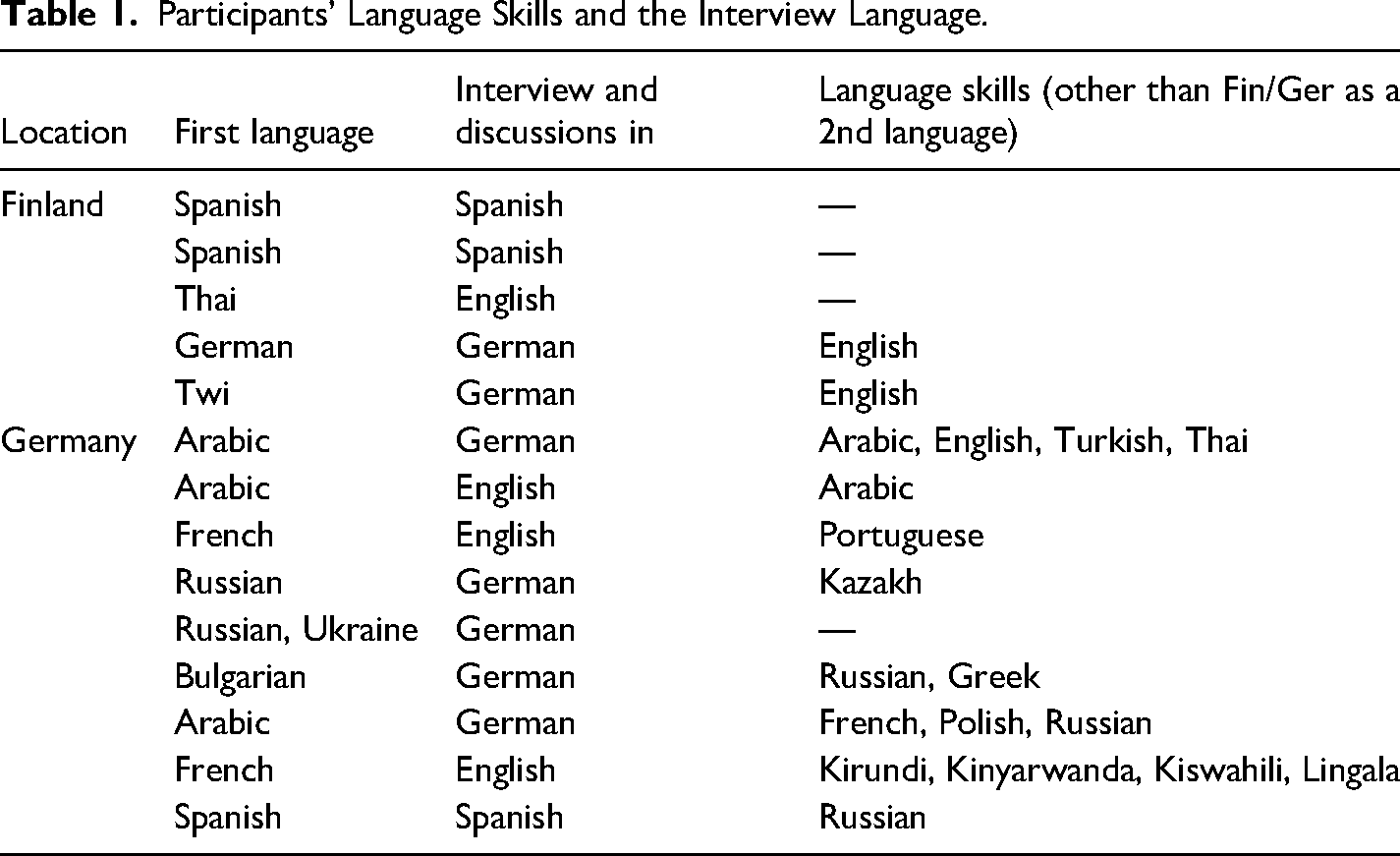
Common oral-language skills could be considered a strength for both the study and the participants, and the researcher using a language other than her first language possibly improved the researcher–interviewee power relations during the interviews (Tolonen & Palmu, 2007). Although the number and length of interviews varied by context, the interviews captured experiential insights from both geographical settings. Discussions in Finland addressed more instructional details, whereas in Germany, participants discussed their life situations and related social encounters. The German interviews did not reach full thematic saturation, but they offered rich data on experiences that were meaningful to the participants, as required by the research questions (O’Reilly & Parker, 2013).
A safe environment was guaranteed by maintaining anonymity and adapting the discussion to participants’ reactions, especially when they recounted sad experiences. The guide consisted of open-ended questions, and prompts were derived from the Finnish and German core curricula for adult migrants’ language education. Interviews were concluded by applying a future dialog method (Arnkil, 2006), in which participants were encouraged to imagine positive futures. All interviews (8 hours and 15 minutes in total) were transcribed verbatim and translated as needed. The first author was a trained translator and translated the interviews.
Researcher's Self-Reflection and Ethics
During the interviews, the first author drew upon her experiences of majority language learning as an adult migrant in Germany and her life with children in Finland. She was familiar with some participants’ cultures and first languages, which helped in interpreting their accounts; however, her experience was limited in terms of different gendered agencies or the effects of severe trauma. She was surprised not only by the personal tone of many of the accounts, which revealed the interviewees’ expectations during the discussion (see Alase, 2017) but also by the participants’ sense of safety. The researcher therefore carefully focused on the issues the participants wished to raise, even when these strayed from the interview guide. The Ethical Code of the European GPR Association Union's data policy for research was strictly followed to ensure ethical integrity. How much personal information was disclosed and discussed depended on the participant's initiative, and data excerpts were anonymized so that sensitive details would not be revealed (Tolonen & Palmu, 2007).
Analysis Strategy
The adult migrants and refugees' language learning experiences were scrutinized by applying stages of interpretative phenomenological analysis (IPA). IPA’s objective is to get as close as possible to these participants' lived experiences so that they can be examined in detail (Smith & Nizza, 2022). This method offers a rigorous structure for analyzing complex and emotionally charged experiences (Smith & Nizza, 2022).
In the present study, the use of IPA underscores the researcher’s active interpretation of the participants’ sense-making, which started in a linguistic–cultural manner, while interviewing them in different languages. Then IPA was used to investigate emotions surrounding a lived experience to perceive how the participants made sense of their experiences as part of their personal and social worlds (Smith et al., 2009). Underpinned by phenomenology, hermeneutics, and idiography, the nuances are considered beneficial in this approach as they aim to illuminate ambiguity and tensions in people's reactions to happenings in their lives when they discuss experiences that are very important to them (Smith & Nizza, 2022, pp. 4–6). The process flow is exemplified below (Figure 1), according to stages by Smith and Nizza (2022, pp. 32–56).
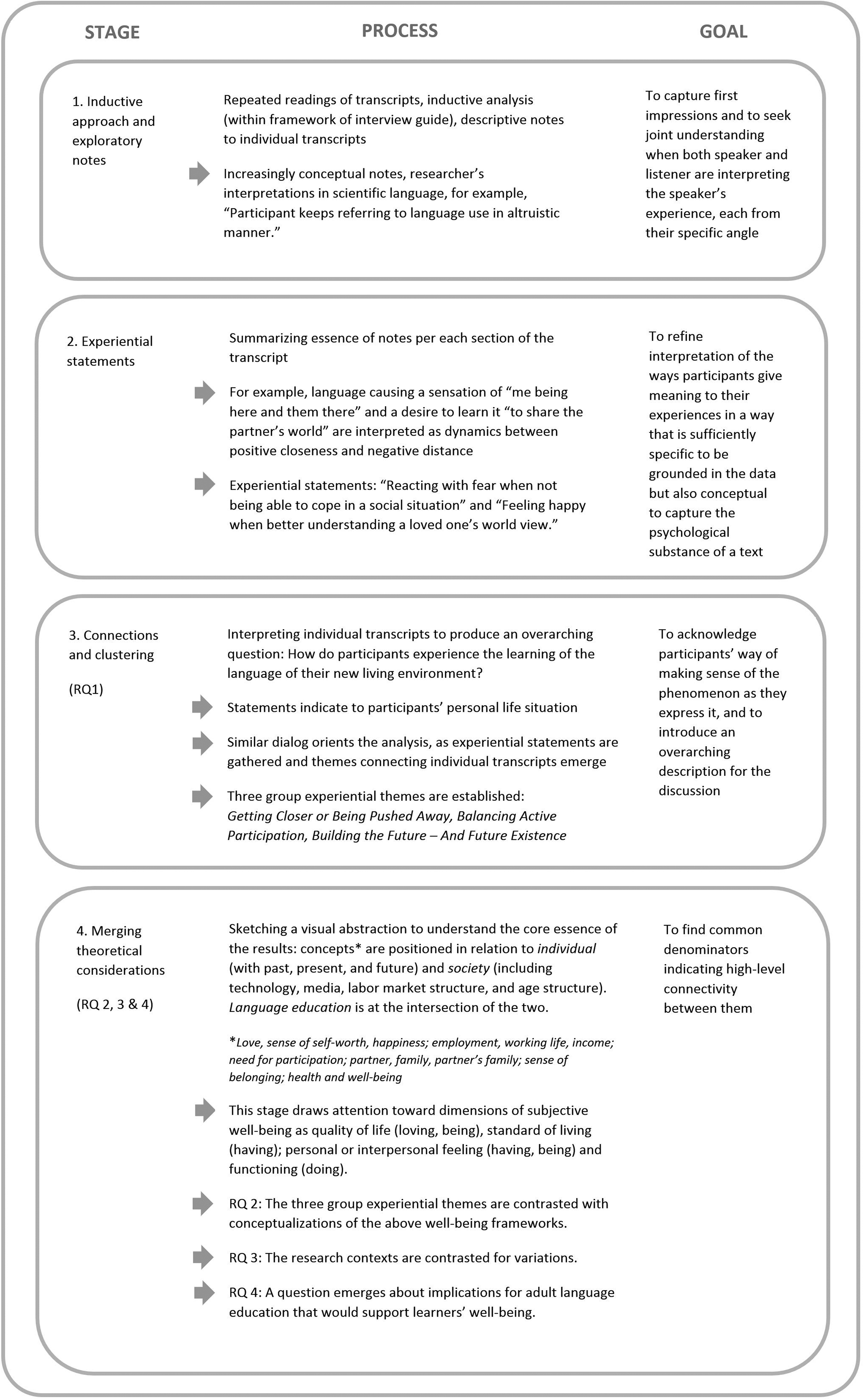
The analysis process with stages and goals.
Results
The results are presented as themes emerging from the interviews with participants (P) in Finland (F) and Germany (G) and then summarized from the perspective of subjective well-being. The themes are: Getting closer or being pushed away, Balancing active participation, and Building the future—and future existence.
Getting Closer or Being Pushed Away
For the first theme, the participants’ experiences involved the role of language in relationships with the most significant people in their current lives. Language played a central role in interactions, either directly with their partners or indirectly with their partners’ friends or their children's day care personnel. Within one's closest circle, the language experienced in the new environment presents a sensation of both closeness and distance.
Closeness
Participants described how they wanted to deepen their engagement in their relationships with their loved ones through language. They wanted to understand the other person better, their thoughts and motives, by sharing the same language and, ultimately, the world. Their goal was to make the other person feel good, and that made the participant feel good, too: Language has helped me understand him and see his world. He has seen mine. Now that I’m learning Finnish and exchanging some words with my spouse, I can see his smile, and the happiness he feels. I say something that reaches him. . . . It feels like arriving. (P1F) How different it is when you are dealing with people you love. Language becomes . . . words are no longer words, it is communication; something we expect from each other. (P3F)
Here, it was noted that when moving toward the outer world, motivation to work toward better understanding was derived from family relationships, such as being the mother of a small child and dealing with a child's daycare staff: “When a child is raised in three languages, it is important to understand ‘how we are doing.’ I want to understand what to require from the child” (P4F).
Language is required for closer out-of-home interactions that affect multilingual families. From the position of “we,” this mother pointed out how control is partly in the hands of others, and how she needed language skills to stay in charge of such relational networks.
Distance
However, a wish for proximity also reveals sensations of being separate and different from their former living environment. The experience of difference can be scary: There, everybody is like me. When meeting up with my spouse's friends here, I feel like they are all there [demonstrates with hands], and I am here. . . . It's kind of frightening when I don’t understand what others are saying. (P1F)
A similar experience, which emerged in Germany, was noted in a response to a comment by a daycare staff member. Although linguistically only addressing pronunciation, the comment impacted the mother. She said, “My daughter's name is X. Here at her daycare, they say Y [different accentuation]. They told me, ‘But we have to say it in a German way. It's correct to say Y’” (P10G). When discussing this experience in an emotional state, the participant expressed hurt and anger. The majority language and how it is used can impact an individual's private sphere in a way that may be interpreted as increasing distance rather than enhancing a sense of belonging, particularly in the participant's stressful situation at a reception center. This interaction can cause emotional distress (Jansen & Romero Gibu, 2021), potentially leading to a feeling of having lost one's voice (Rydell, 2018).
Indeed, frightening or offending situations seem to increase a sense of loneliness, and the need to express one's feelings to someone else is evident for many. One participant said, “I’m glad about this [conversation], as I sometimes feel that I need to talk with someone, to express myself” (P13G). Another participant said, “Speak, yes . . . but with whom?” (P10G).
Lack of opportunities for interaction causes frustration, potentially also feelings of non-belonging and loneliness (Abdulla, 2017). The tension between feelings of closeness and distance due to language skills has been identified in migration settings (Stella & Gawlewicz, 2021; Zachrison, 2014). Thus, it is important to identify adults’ differing resources for mental support in this context (Intke-Hernández, 2020; Kärkkäinen, 2017). A need to express oneself also entails a need for language skills to describe emotions.
Summary: Language for Loving—From Happiness to Hurt and Fear
In the first theme, the participants used symbolic expressions and abstract nuances to verbalize their experiences. They all described tensions between closeness and distance but differed when referring to their closest ones or to external others. In terms of well-being, participants’ experiences essentially involved value dimensions, such as social needs, not only in relation to family and kin but also in relation to the local community, including active patterns of friendship (Allardt, 1976). Participants noted that receiving social support was as important as the ability to give to others and to have a sense of active doing and autonomy. Often, language practice was interpersonal and reflected in functioning, such as altruism, caring, and social engagement, as well as the feeling of a sense of belonging. As personal feelings, their experiences presented not only satisfaction but also negative affects (Huppert et al., 2009).
Balancing Active Participation
The second and rather prominent theme prioritized language in social encounters as part of daily practices. The participants’ experiences seemed more pragmatic in nature, focusing more on people outside their personal sphere, which reflected a need for them to explain, reason, and defend their positions within the new societal setting. Participants not only focused on interactions in institutional settings, such as reception centers, employment offices, and language classes, but also pointed out more abstract phenomena, such as media and technology.
Official Encounters
Overall, the participants first stressed the instrumental rather than the emotional priority of the language for their current life situation. They expressed their sometimes exhausting efforts to manage obligatory interactions, in which language was critical to functioning in the service system and dealing with the pressure of coping in the majority language, with little room for negotiation: We live in a reception center. There are a lot of other people too, but not Germans—Syrians, Arabs, and—they only speak their first languages. Only security and the guard speak German, but we don’t understand them, either. Researcher: Can you use an interpreter? No, we must manage ourselves. At the offices too, they talk fast and important words, but I don’t understand. There we have to use interpreters, but it's expensive, 50 euros per hour. (P10G) When there's an official meeting, and I’ve had about 25 of those now, a few times the official has said, “You’re in Germany. You’re supposed to speak German.” And so, she has refused to interact with me. I felt so powerless. . . . When I said that I’m new here and had, therefore, not yet started language training, they would say it's not their problem. (P6G)
Because of major global mobilities, both forced and voluntary, to Germany, related services are better established there than in Finland, which could imply more routine approaches to customer service situations. The high requirement for German language understanding and low tolerance for language errors or the use of other languages in institutional interactions (Föbker & Imani, 2017) mean that adequate language skills are expected from inception, unlike, perhaps, with lesser known and spoken languages such as Finnish (see Iikkanen, 2020). Attitudes toward interactions in this context are relevant, as they affect self-confidence (Ahlgren & Rydell, 2020; Rydell, 2018) and may lead to withdrawal for fear of giving an impression of being ignorant (Van der Land, 2022), or even to experiences of verbal violence (Jansen & Romero Gibu, 2021).
The participants’ experiences echoed a sense of compromise in being able to take care of matters in daily life. However, a slightly different approach also emerged when one participant talked about his strategy of relying on school-aged children for help. For him, the situation appeared less serious, as he explained, smiling, “If I have difficulties with the offices . . . we go there together [with my children]” (P11G).
In addition to the critically instrumental needs for language skills, expressions about the participants’ emotional needs began to emerge in the interviews. Mastering the situation was a success for one, but to another, difficulties in interaction compromised his sense of identity as a capable adult. Now, I again had meeting at the employment office. I apologized that I only spoke a little German but said that I was participating in a language course now. The official then tried to speak slower and clearer, and it really helped. I finally completed the whole conversation in German and thought, wow, I made it! (P7G) It's tough on pride, really. You’ll become a child again, and yet you’re an adult who comes into a new country with responsibilities. Here, you notice that you need to be taught, taken like a dog on a leash. I don’t know if you understand. . . . It's really frustrating. (P2F)
Family Dynamics
Daily responsibilities were experienced by many as challenging from different perspectives. Language learning was intertwined with involuntary and voluntary roles, with implications for satisfaction or stress in being responsible for the family's childcare and household: As a man, one believes . . . thinks that one has got to maintain a family, gotta protect . . . take care of a wife, a child. And then the situation is quite the contrary. It's difficult for a man, really difficult. (P2F) My wife has a scholarship to a university here. I was granted a study leave from my work, and I came here solely to support my wife. (P13G)
These participants, both voluntary migrants, positioned themselves differently. While P2 suffered from a loss of control and noted unwanted changes in his social status compared with his pre-migration identity (Morrice, 2013), P13 did not express lost pride but admitted to facing learning challenges.
The children also supported their guardians, as stated from the perspectives of a mother and a father: “My children always say, Mama, you said this wrong. You have to say: ich, ich [corrected pronunciation]. And all these words, a lot of them I learn from my children” (P6G). My children are German. I speak Arabic and German with them. Sometimes, they laugh at me because I would always ask them: Did you do your homework? And now [laughs], the first question for me was: Have you done your homework? (P12G)
Formal Language Education
Besides immediate instrumental needs and different supporting roles related to language skills, participants also discussed their personal experiences from the perspective of the wider community. A feeling of competence was considered important for mental health, thus creating strong expectations for language education, as stated by one participant: I’m getting tools to defend myself. I’m in a way starting to relax mentally, you know? Researcher: In the group or society? Society. We live in a new era with new ways to communicate. Technology, the social form has been shaped. Pedagogy should be revised, so that we would learn how to express ourselves in the new society. If the society's language is completely different than what's taught in the course, it's frustrating, as it feels as if you hadn’t learned anything. (P2F)
On commencing the asylum application, another participant realized how much he needed the language and started studying independently using YouTube videos and smartphone applications, but he soon began missing more structured learning and regular social interactions: “That someone else is in your head, like teacher. So, the school is the best way, even if we have this technological revolution and all” (P7G). This participant stressed human contact in language learning. Regardless of the skills he gained in higher education, he did not wish to learn alone but rather in a learning community involving personal relationships.
Access to language education, however, has not been self-evident for all. Fluent oral skills have also not been sufficient to provide independence in managing official matters, as the Latin alphabet remained too difficult to read or write, even after years of living in the country: I spoke German already within a year but couldn’t read or write. Now this learning . . . it's really difficult for me. Thirteen years ago, there was nothing [language education], but now new asylum seekers have to go to school or they don’t prolong the residence permit. I fought for a year with the employment agency, but I was told that you speak such good German that you won’t need the teaching. I said, but I don’t know how to read or write! (P12G)
While discussing language education, the role of the media was raised. Participants criticized heroic individual stories: Those who succeed are taken into television: “Hey, look at him who speaks really well.” But he's only one. One should go to some of those hundreds who don’t progress at all, rather than the one who's doing well. We must understand what we are, who we are, who sit in the same classroom. We’re quite the same, not local, don’t speak the language . . . and yes, in any case we are all here. (P5F)
Summary: Language Practice Exposed—Sudden Encounters and Inner Reflections
In the second theme, the participants also focused on interactions in institutional settings, such as migration services and formal education. While sharing a societal approach, both themes varied in their reference to individual participation and to different family constellations and their involvement in daily activities, as well as insights into language education. In terms of well-being, participants dealt with their material and impersonal needs, such as income, housing conditions, employment, education, and health (see Allardt, 1976), as well as balanced personal feelings, sense of self-worth, and negative affect. These emerged from official encounters and had implications for their sense of belonging, social support and recognition, and feeling that they were making societal progress. Furthermore, the participants conveyed a wish for autonomy and competence and expressed an interest in learning (Huppert et al., 2009).
Building the Future—and Future Existence
For the third theme, the majority language was expressed as essential to participants’ hopes for the future. Their experiences revealed strong introspection and underscored the significance of language learning as an indispensable part of an individual's life story.
Employment
All participants mentioned the role of language skills in relation to being and becoming employed, but for this theme specifically, the future was discussed more explicitly. One of the perspectives was the ability to secure income and well-being for the family: Now I would like to learn German, because I live in this country and without the language, nothing works. […] I don’t have any big goal, just that my family lives well. If I complete this course successfully, I hope that I’ll get a good job with a good pay, some proper earnings, and that's it for me. (P6G) At first, I worked in a pizzeria here. The people there were not Germans, although born here, but Arabic. Yet, for them, it was better to speak German rather than Arabic, so they all spoke German there. For me, it was great, as this way I could learn German. (P6G)
Although the participant could speak German, he was now studying German in a language course for professional purposes so that he could later apply for a study program to become a bus or taxi driver. For him, adult education—first a language course, then a vocational program—would turn his migration trajectory into an opportunity after the financial crisis he had experienced (Kowzan, 2020).
Linked to the theme of language, but from a broader perspective, the external conditions for employment, such as the current age structure and geographical variation within the labor market, were discussed by a participant in Finland: In workplaces here, people don’t speak English. There are so many elderly people in Finland. You can’t assume that your boss is younger than yourself. When I started working as a carpenter at a construction site, there was an old Finnish man with a hammer in his hand, and he spoke only little English. It's a problem because we’re not in the capital area. If you don’t master the language, how can you ask? (P5F)
All-Encompassing Well-Being
For the last sub-theme, the concept of pressure emerged as a significant factor. Among experiences focusing on future visions, one particular interview stood out because language skill was involved in a goal that appeared more fundamental than in any other discussion. When discussing language learning in the participants’ everyday lives, one of them said: It's difficult in our situation. When you’re seeking asylum, you only do things under stress, because you’re alone in your situation, all the time. Still, I believe that . . . when you know what you want, you can make it. I’ve been stressed about my situation, or that I don’t have any situation; no documents, can’t get a job. I’ve lost so much time. If I would’ve been concentrating only on school, I could speak German now, maybe, and could have gotten better opportunities… I’ve had problems because of too much stress; thinking about my life, what can I do. I’ve got a doctor who gives me a tablet every time for that . . . But I guess if I believe that everything will be okay, then… [Sighs]. (P13G) Germany is my last option. I haven’t managed to succeed anywhere else. . . . I am looking for a better life, and Germany is the only country where I have a chance to start my life again. I have no child, no wife, so I think I have all the possibilities to concentrate and to make it. So, I’m going to make it. I really want to make it. (P13G)
For this participant, who was facing a very challenging life situation, language education contributed to a broader goal of “making it” in life (Ahlgren & Rydell, 2020), beyond even the goal of employment (Morrice et al., 2021). He had gained a sense of community through joining hobby groups, such as the church choir and the gym, but due to modest interactions, he still had insufficient language practice. Based on his many experiences of starting over, he felt that efficient language learning was urgent. Although he also smiled throughout the conversation, the seriousness of his dedication was obvious.
Summary: Language for Envisioning Material Well-Being and Existence
This theme involved material aspects of well-being but also immaterial resources, such as social relations and personal fulfillment (Allardt, 1976), and—for one participant—even deep foundational questions of human existence. Participants discussed language in “doings,” but from a less immediate perspective and with reference to the future. Their main focus was on personal functioning, goal orientation, sense of purpose, and resilience (Huppert et al., 2009). In its most abstract sense, their language was linked to well-being as a need for personal growth (Allardt, 1976). The depth of this final stage of analysis underscored the potential and risk that language learning had in these individual life stories, affecting their well-being, with important but complex implications for their adult education.
Discussion and Implications
This study investigated adult migrants and refugees’ experiences of the majority language and learning it in their current life situations. The first section of this article discussed participants’ experiences of learning the language of their new living environment (RQ1) and its reflections on subjective well-being (RQ2). Next, the findings were scrutinized from the perspective of their contextual variations (RQ3), and were then associated with adult education practices (RQ4), which will be discussed next.
Variation in Research Contexts and Practices for Supporting Well-Being
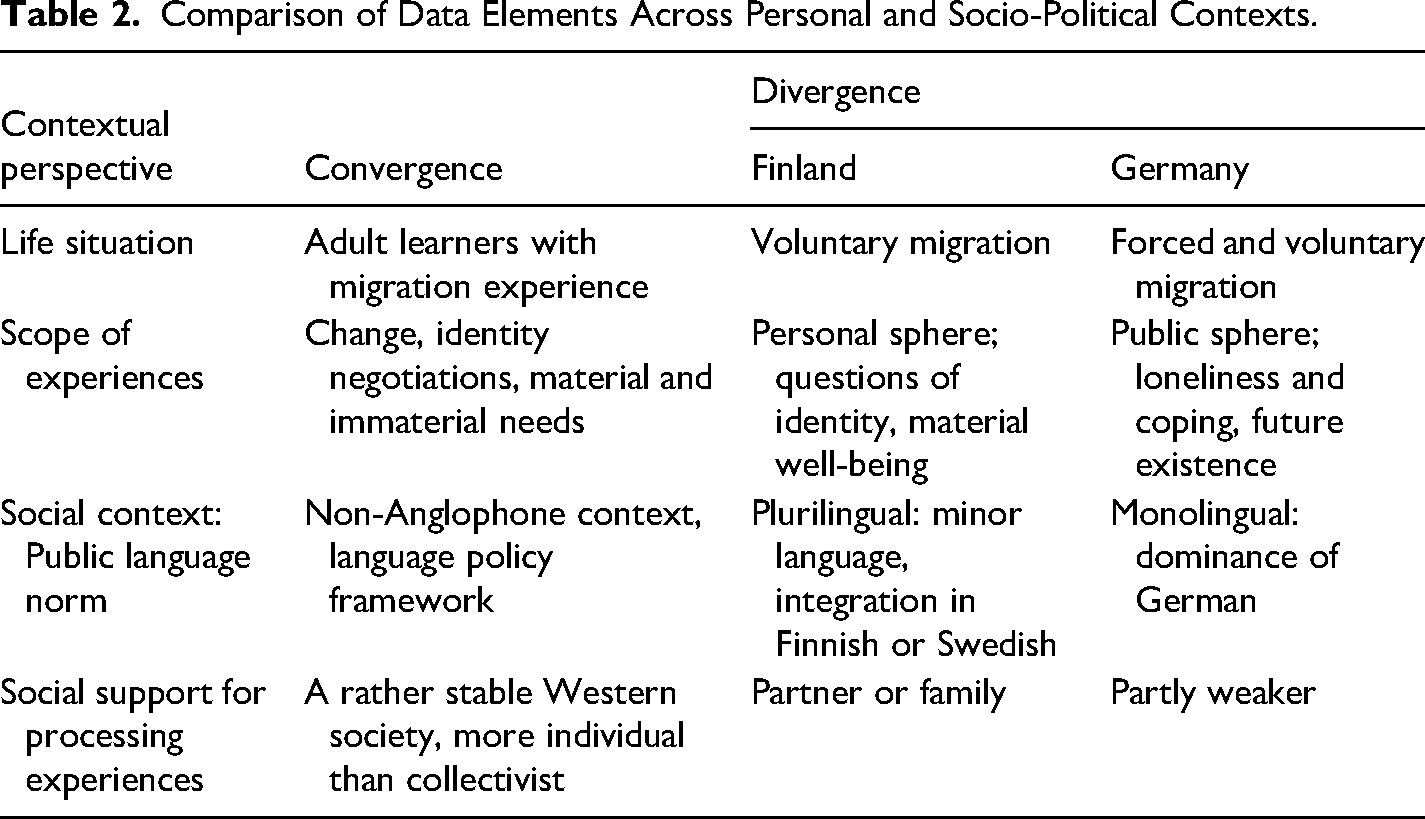
Comparison of Data Elements Across Personal and Socio-Political Contexts.
Societal Approaches
Communicating in a new language affects adult learners’ well-being, and interlocutors’ empathy is required to create positive experiences. While attitudes count in social integration after migration (Aksoy et al., 2020), benefitting from existing skills (Table 1) could help in public language encounters; not necessarily the use of English (alone), but, rather, a flexible use of all possible languages and means of communication (CoE, 2001). Formal qualifications require strong majority language skills, and specialized courses also seem important for settled migrants. Yet, solid basic language skills are needed for well-being. From a social policy perspective, loneliness and lack of social relationships are difficult matters that fall between public and individual responsibility (Saari, 2016). However, adult language education offers social networks and daily interactions when contact with locals is limited (Fejes & Dahlstedt, 2020; Morrice, 2013). Contact teaching, particularly those delivered in physical gatherings, creates opportunities for spontaneous interaction. Educators and course planners should acknowledge these opportunities by ensuring that time for extracurricular discussions is incorporated into the teaching sessions (Häkkinen & Mikkilä-Erdmann, 2023).
Practice for Risk-Taking
Outside the classroom, learners need to be persistent and take risks in interactions where the power lies with the one who speaks the language better (CoE, 2001, p. 161). The language classroom could offer a forum for preparing learners for such risk-taking. By acknowledging the power-relations in language use, the educator could challenge the learners, for example, by encouraging them to reorient to future language encounters by imagining positive outcomes for these (see Alanne, 2010; Arnkil, 2006). However, in their choice of approach, educators must be sensitive about the learners’ well-being, especially when working with traumatized individuals. One way to help to work on clarifying misunderstandings in interactions could be to contrast the more static with the more dynamic approaches to interactions of speakers of different languages (Strømnes, 2006), which is important, especially in technological environments with compromised human interaction.
Introducing Emotional Vocabulary
Learners must be able to describe emotional states and reactions in the majority language instead of depending on interpreting services, for example, in healthcare or children's education. Though abstract and thus recommended for more advanced stages (in CEFR, Levels B2 and C1), emotional vocabulary is a challenge worth tackling in less advanced stages as well. Both methods and existing corpora derived from research on available lexicons could offer helpful structures. One method could involve learners producing emotional lexicons based on free association; a more sensitive method would use existing lexicons that could be discussed in class.
Communicating Well-Being
This study's interviews revealed a depth of conversation that can occur between new and rather incidental acquaintances, even with only developing language skills. Encouragingly, concepts such as home, father, mother, school, work, family, and child offer common ground for establishing communication; they constitute our worldviews with unique meanings, and, yet, are recognizable also to others (Rauhala, 2014). Language use influences us beyond rational reasoning, delicately balancing well-being with implications for a sense of belonging.
Theoretical Implications
These findings align with previous research confirming that experiences of language in migration influence identity negotiations (Court, 2017; Morrice, 2013; Stella & Gawlewicz, 2021), needs for psycho-social support in institutional settings (Ateek, 2022; Jansen & Romero Gibu, 2021), and desires for autonomy in private sphere (Intke-Hernández, 2020; Zhu, 2020). Further, while human interaction influences subjective well-being across linguistic, cultural and geo-political boundaries (see Beier & Kroneberg, 2013), adult learner's experience from the multidimensional perspective of well-being is an important emerging field to explore (see Talbot, 2021).
Limitations of the Study and Recommendations for Future Research
The shortcomings of this study relate to methodological issues, such as the sample size and the length of the interviews, particularly when comparing the two data sets. A wider multi-sited ethnography would broaden perspectives for contextual comparisons, for example, between rural and urban environments. Future projects could also benefit from large-scale comparative data, measuring public attitudes and behaviors and their development over time in different European countries (European Social Survey, 2023). Complementing in-depth qualitative research, this Pan-European approach could contribute to our understanding of societal living conditions, where adult migrants and refugees experience language with implications for their well-being.
Footnotes
Declaration of Conflicting Interests
The authors declared no potential conflicts of interest with respect to the research, authorship, and/or publication of this article.
Funding
The authors disclosed receipt of the following financial support for the research, authorship, and/or publication of this article: Data collection in Germany was funded by Emil Öhmann Foundation of the Finnish Academy of Science and Letters (personal travel grant). Data analysis and writing of the manuscript were funded by Finnish Cultural Foundation (three personal grants).
