




Abstract
Western governments propose adult education and training (AET) as a prerequisite for all employees to solve current challenges related to globalization, climate change, automation and the ageing workforce. This study examines the trend in Norwegian employees’ intention to participate in AET from 2010 to 2022. Building on the comprehensive lifelong learning participation model (CLLPM), we conduct logistic regression analyses of 10 waves of a nationally representative cross-sectional survey (N = 26,588). We find a declining trend in the intention to participate in AET. The results show that the trend cannot be explained by socio-demographic workforce changes, as it is present in all age categories and levels of education. Motivational factors such as job insecurity, employability, wage satisfaction and desire for more challenges only explain some of the decline. We discuss the findings considering the CLLPM and contribute to the current academic debate on lifelong learning in the employability regime.
Keywords
Adult education and training (AET) is one of the proposed solutions to challenges related to globalization, climate change, automation, and the ageing workforce. The importance of AET is discussed by international organizations such as UNESCO 1 and OECD (OECD, 2022). The European Union's new skills agenda for sustainable competitiveness, social fairness and resilience seeks to help individuals and businesses develop more and better skills and put them to use. Although not a member, Norway has a close relationship with the European Union (EU) through the European Economic Area (EEA) agreement and shares similar values. A national manifestation of the international focus on education and learning is the Norwegian government's skills reform “Lifelong Learning” from 2020. The reform seeks to develop the competencies of the population through AET, thus increasing the employability of individuals and the competitiveness of businesses, improving social services, and achieving inclusion in society. 2
While adult education and training refers to education and an institutional phenomenon offering learning opportunities, the term lifelong learning emphasizes learning and an individual process of acquiring knowledge and skills. The two terms have distinct meanings but are often used interchangeably. For instance, EU policy documents treat learning as if it were institutionalized education (Jarvis, 2014). Nevertheless, both the EU and Norwegian reforms emphasize individuals’ responsibility to maintain their own employability (Fejes, 2010; Madsen et al., 2021; Rubenson, 2006). In this paper, we use the term adult education and training (AET) to refer to the designated learning activities in which individuals might participate and the term lifelong learning (LLL) to refer to any policy using the term or to any scholarly debate dealing with the concept.
UNESCO, OECD and the EU all collect data on education and learning, though covering different aspects and using different measures. The data sources are therefore complementary and not necessarily directly comparable. Despite AET being a priority on the policy agenda in Europe since the 1990s (Eurofound, 2017), the level of participation in AET is still well below the objectives set by the EU, and the social divide is pronounced (OECD, 2022). The EU objectives concentrate on participation in organized learning, measuring the share of all adults, low-qualified adults and unemployed adults participating in formal or non-formal learning. 3 The EU indicators exclude informal learning, such as any other learning taking place during the workday (Dæhlen & Ure, 2009). This study examines the trend in Norwegian employees’ intention to participate in work-related AET from 2010 to 2022 and whether the trend is associated with aggregate changes in demographic or motivational factors.
OECD data show that participation in AET is mainly work related and employer sponsored (OECD, 2019). For Norway, the Labour Force Survey (LFS) shows that most learning by adults is work related, both informal and formal, and that, excluding students, employed adults participate far more than non-employed adults in both formal and non-formal education. 4 By international standards, the Norwegian population is highly educated. Participation in AET in Norway is also high in an OECD comparison (OECD, 2019), though lower than in other Nordic countries (Boeren, 2016; Rubenson, 2006). Some sources, however, indicate a decline in participation in AET in Norway. The Labour Force Survey shows a decline in yearly participation in formal education from 18% in 2008 to 17% in 2021 and in participation in non-formal education from 54% to 42%. 5 According to Eurostat, participation in formal and non-formal AET in the past 4 weeks fell from 21% in 2013 to 19% in 2019. From its lowest in 2020 (16%), it rose to 20% in 2021. 6
In Esping-Andersen's (1990) typology of the three worlds of welfare capitalism, Norway belongs to the Nordic social-democratic welfare regime. Rubenson (2006) argues that the institutional arrangements behind the Nordic welfare regime constitute a distinct approach to AET, creating conditions whereby lifelong learning is accessible for all. Initial education for children up to and including secondary level is a statutory right and is cost-free for citizens. Tertiary education is also cost-free, and students can apply for loans and scholarships to cover living expenses. Statutory rights to AET have been strengthened in previous decades through interactions between the social partners (unions, employer's organizations and the government) (Martínez Lucio et al., 2007). The competence reform of 1998 allowed all adults statutory rights to primary and secondary education, statutory rights to unpaid leave from work for education, and increased access to loans from the Norwegian Educational Loan Fund (Payne, 2006). Employers in Norway are obliged to provide employees with the training required to carry out their job. However, providing general education or AET that is primarily in the interest of the individual is not considered the employers’ responsibility. Although some local unions negotiate for the right to employer-funded general education, it is not a dominant union strategy (Underthun & Drange, 2019).
Social inequality in education is also pronounced in Norway (OECD, 2022). A major challenge is reaching the “hard-to-reach” categories of low-skilled employees in service sector jobs (Payne, 2006). Some AET takes place in the public education system, but much of it is organized by employers and other organizations (Skule et al., 2002). Despite the political focus on AET and lifelong learning over two decades, the challenges highlighted by Skule et al. (2002) remain unresolved. First, non-traditional learners and workers without tertiary education do not participate in AET to the same extent as employees with higher education. Second, there is a lack of correspondence between the educational systems’ focus on generalized theory and the concrete skills and knowledge needed in working life. Third, the issue of covering living expenses during educational leave is unresolved. Most employees cover the income loss themselves, and it is now up to employers to decide whether to cover some of it. Considering employees’ responsibility for covering the main share of indirect costs of the investment in AET, individual motivation to participate in AET is also central in a welfare state like Norway.
This study examines the trend in Norwegian employees’ intention to participate in AET from 2010 to 2022. We use logistic regression to analyze an annual representative survey and investigate to what extent the trend can be explained by the socio-demographic changes in the workforce and factors related to employees’ motivation. Moreover, we investigate whether the change in intention varies among employees in different age categories and with varying levels of formal education. We discuss the findings considering the comprehensive lifelong learning participation model (CLLPM), a prominent theoretical model claiming that the intention to participate in AET is formed by the characteristics of the individual, educational institutions and country-level factors (Boeren, 2016). Furthermore, we discuss research pointing to the ideological underpinnings of the lifelong learning discourse and question whether the approach to AET as a personal choice and obligation places responsibility in the wrong place. This study contributes to the quantitative research on AET (Boeren, 2018) with data from a social-democratic welfare state.
Intention to Participate in Adult Education and Training
Human capital theory (HCT) (Becker, 1964/1993) and the comprehensive lifelong learning participation model (CLLPM) (Boeren, 2016) are two influential theories relevant to our study. Becker's influential HCT understands an individual's choice of participation in AET as a rational cost–benefit calculation. At the core of HCT is the assumption that the job-relevant skills individuals acquire through education make them more productive and thus reward them with higher wages (Becker, 1964/1993). Becker (1964/1993) highlights education as the most important source of human capital, but he also emphasizes the importance of skills developed outside educational institutions, particularly non-formal and informal training in the workplace. Although Fuller and Unwin (2003) illustrate that specific and general skills can indeed overlap; schematically, skills acquired through education are usually seen as general skills, while skills developed in the workplace are considered specific skills (Bills, 2003). While general skills acquired through education are easy to transfer from one employer to another, specific skills developed in the workplace are less transferable. Becker ([1964] 1993) argues that it is not rational for an employer to invest in general skill enhancement that makes the employee more attractive to other employers. Instead, employers are motivated to invest in and pay for job-specific education that increases productivity in their own organization but that has low transfer value to other employers. Because general education mainly benefits the individual, employees typically take responsibility for and cover the cost of such education themselves (Becker, 1964/1993). As mentioned in the introduction, this thinking is apparent in the Norwegian parties’ negotiations over covering the costs of AET.
Where HCT emphasizes rational calculations on an individual level, another strand of theories emphasizes the contribution of societal factors. Fishbein and Ajzen's theory on reasoned action is widely used to explain actors’ intentions to participate in AET (Becker & Gibson, 1998). While behavior can be predicted from behavioral intentions, both personal attitudes and social norms influence these intentions. Fishbein and Ajzen's theory is pivotal in Baert et al.'s (2006, p. 104) definition of the “learning climate” as “the way in which learning is perceived in society in general and in specific social groups in particular.” According to Baert et al. (2006), an individual's decision to participate in learning activities originates in a need for change or improvement. The intention to participate is then formed by the characteristics of the individual and the social context. Most importantly, an individual's reasoning must be understood to intersect with the macro and institution-level structures that constrain and enable participation (Rubenson & Desjardins, 2009).
Building upon earlier theories and research, Boeren, Nicaise and Baert defined the CLLPM (Boeren, 2016). It considers factors on three levels: the individual level, the educational institutional level, and the country level. The three levels interact with each other. For example, an individual's motivation for AET is contingent on the context of the country, and participation is dependent on which courses the institutions offer.
Factors Potentially Driving the Change in Intention to Participate
Earlier research shows consistently that older employees, adults with weak socio-economic background or in low-skilled jobs are less likely to participate in educational activities (Desjardins et al., 2006; Ioannidou & Parma, 2022; OECD, 2022). The causes of the social disparities in AET participation can be attributed to factors on the institutional and macro levels and differences in individual reasoning and motives, which in turn are influenced by the macro and institutional levels.
As older employees are less inclined to re-enter formal education (Desjardins et al., 2006; Ioannidou & Parma, 2022), the ageing population would likely lead to a declining interest in formal AET. The main explanations evolve around cost–benefit calculations made by both employers and employees. In line with human capital theory (Becker, 1964/1993), the time left in the labor market is shorter for older employees, leaving less time to reap returns on the investment that AET represents. Other explanations focus on generally less motivation and readiness to learn among older employees and on less perceived need to learn new skills with maturing age. A limited supply of relevant learning opportunities that meet the demands and qualifications of older employees forms the third type of explanations (Desjardins et al., 2006).
Another trend changing the composition of the workforce is the increasing level of formal education of those entering. In OECD countries, the share of adults between 25 and 34 years old with completed tertiary education increased from 27% in 2000 to 48% in 2021; in Norway, the corresponding share increased from 35% to 55% (OECD, 2022, p. 37). Earlier research consistently shows a social divide in participation in AET, where employees with permanent positions, higher education, and higher income participate more often than their counterparts (Cincinnato et al., 2016; Desjardins et al., 2006; Ioannidou & Parma, 2022). As employees with higher education participate more in all learning activities than employees with lower education, the increase in educational attainment in the workforce should lead to increasing intention to participate in formal education. The increasing level of education in the workforce is a trend that could counteract any negative effect of the ageing workforce on this intention.
In addition to compositional factors, changes in individuals’ motivational factors might also contribute to a change in the intention to participate in AET. According to HCT, investment in human capital through AET might change the employee's perception of job security. Once an employer has chosen to invest in training for a worker, the motivation to keep the employee in the organization increases (Becker, 1964/1993; Drange et al., 2018). Productivity in the workplace, the opportunity for promotion, the opportunity for obtaining a higher salary or successful application for a new job have been listed as positive outcomes of lifelong learning (Boeren et al., 2010). Baert et al. (2006) posit that the decision to participate in AET originates from a need for change or improvement experienced by the individual. If employees do not see the need for expanding their own qualifications, it is likely that the interest in AET will decline. Chesters et al. (2020) draw on bounded agency theory to investigate the importance of intrinsic and extrinsic motivation and on personal and institutional barriers to non-engagement with further education. Intrinsic motivators originate in a desire for learning, such as broadening horizons, satisfying personal interest, exploring more possibilities, and enriching oneself. The extrinsic motivators originate in labor market demands to change careers, gain promotion or remain competitive at work. The authors found that re-engaging with formal education was primarily extrinsically motivated. The desire to make progress in a current career or to gain access to new job opportunities was the main driver for re-entering formal education during adulthood (Chesters et al., 2020).
Have sources of employees’ intrinsic and extrinsic motivation for AET changed over the past decade? Changing demands in the labor market might involve increased job insecurity, lower employability or a need to acquire new skills in order to remain competitive in the labor market; all examples of extrinsic motivators for participating in AET (Chesters et al., 2020). After the great recession in 2008, the Norwegian economy has seen relatively low unemployment rates, varying between 2.1% and 3.7%, the latter during the oil price crisis in 2015 and 2016. Although the social isolation measures associated with the COVID-19 pandemic put a damper on economic activity, the effect was relatively mild in Norway, and in 2022 unemployment was at its lowest since 2007. 7 It is unlikely that the objective risk of unemployment is the main motivation for Norwegian employees to participate in AET. However, the rhetoric of lifelong learning is linked to the concept of individual employability (Fejes, 2010). Employability refers to the ability of an individual to find and sustain employment (Green, 2011). As described earlier, the lifelong learning rhetoric has remained strong in the Norwegian public sphere over the past 10 years. Together with digitalization and an increasing awareness that new technology will continuously change working life, the need for reskilling is a frequent topic in public debate and scholarly publications (Ioannidou & Parma, 2022). Consequently, employees might increasingly feel the need to acquire new skills to do their job successfully.
Another reason to be interested in attending AET is a wish for higher wages. According to human capital theory (Becker, 1964/1993), investment in human capital will increase productivity and thus be rewarded by employers through higher wages. Hence, employees’ who are less satisfied with their wage might have a stronger motivation for participating in AET.
As Chesters et al. (2020) point out, there is no clear distinction between intrinsic and extrinsic motivation. The motivators might overlap, and the intrinsic wish might be extrinsically motivated. Nonetheless, the desire to evolve as a human being, to learn new things and broaden one's horizons, are considered intrinsic motivators. Several scholars have pointed out the increasing focus on self-realization in current society (Honneth, 2004; Madsen & Oatley, 2021). The desire to evolve as a human being might result in a desire for more challenges at work, thus increasing the intention to attend AET. If the quest for self-realization is strengthened as scholars suggest, we might see an increase in the intention to participate in AET.
Research Questions
This study contributes to the quantitative research on the intention to participate in AET by investigating the following research questions:
Method
Data Description
The data comprise 10 waves (2010–2022) of the YS Employment Outlook Survey (EOS), a nationally representative cross-sectional survey of Norwegian employees (18–68 years). Table 1 displays descriptive characteristics of the sample. The waves from 2012, 2014 and 2015 are excluded because of missing data (see Measures). The data are collected using computer assisted self-interviews (CAWI). The sample consists of employees who define paid work as their main activity, thus excluding those whose primary activity is education and training.
Descriptive analysis of sample characteristics.
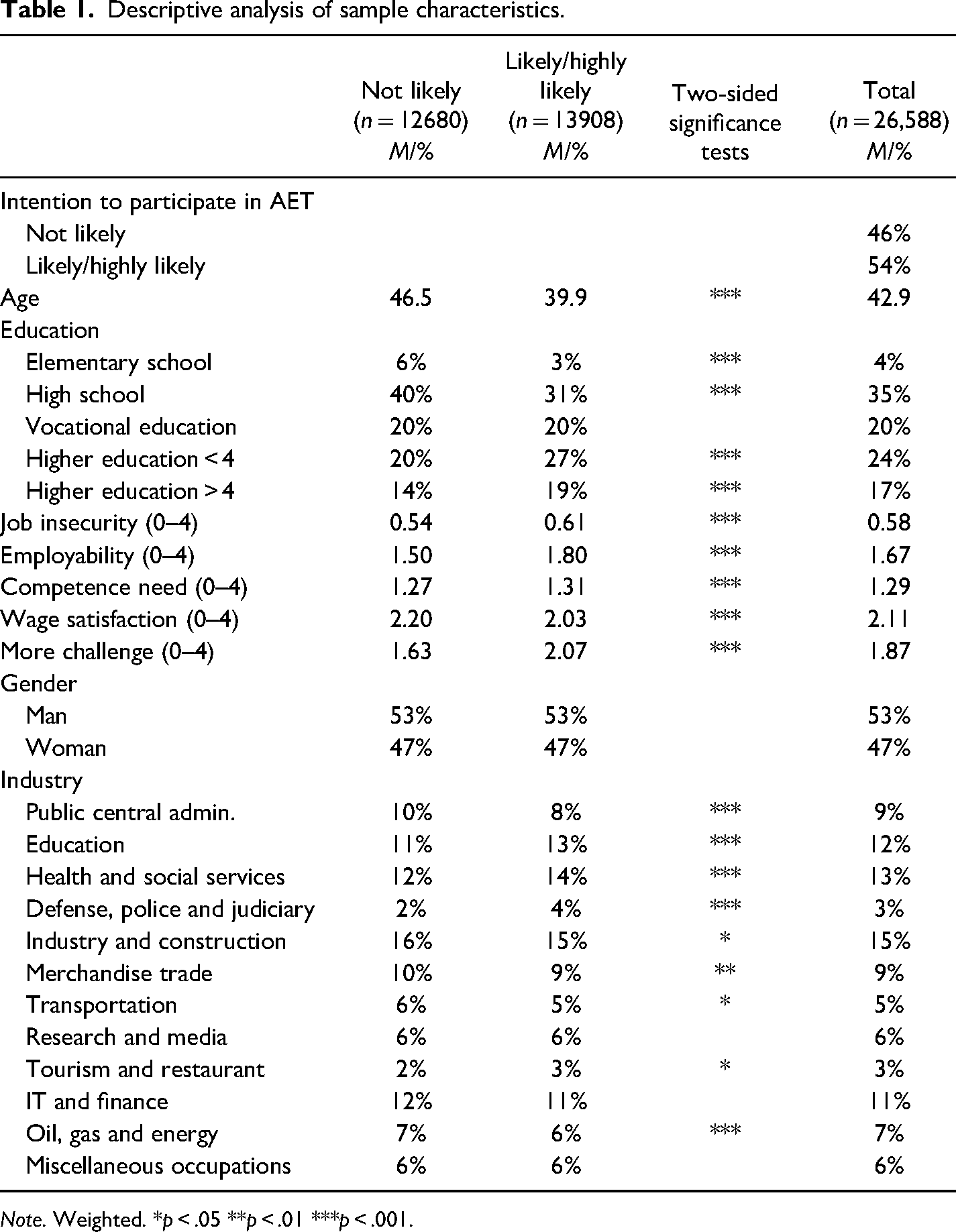
Note. Weighted. *p < .05 **p < .01 ***p < .001.
The sampling procedure stratifies the respondents according to gender, age and education to ensure the representativeness of the gross sample. A survey weight constructed to equalize biases in the sample regarding the stratification variables is applied in the descriptive statistics and in Models 1 and 2 in Tables 2 and 3. Models 3, 3b and 4 include gender, education and age as independent variables, removing the need to include the survey weight in addition (Reiter et al., 2005).
Logistic Regression Models of Intent to Participate in AET.
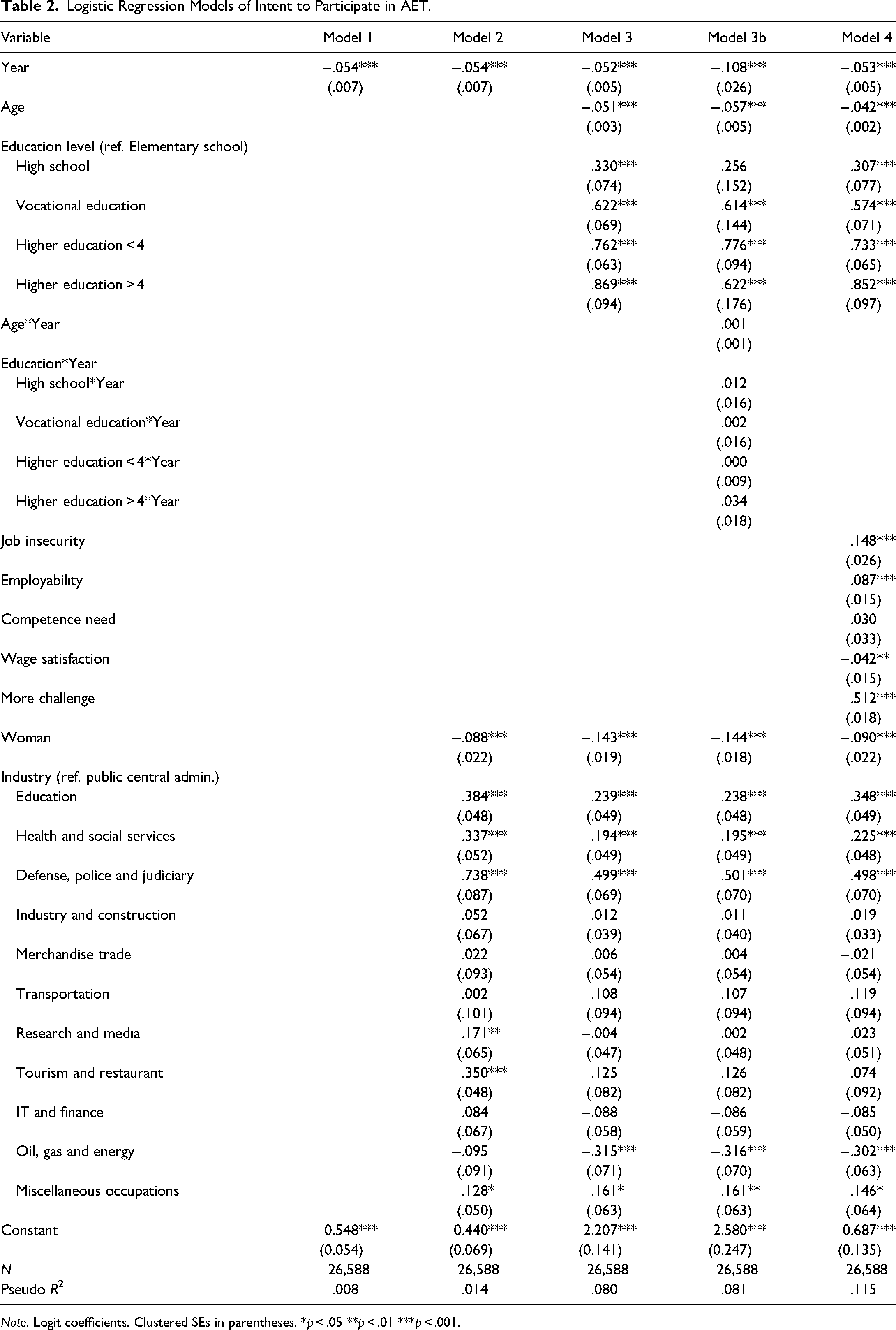
Note. Logit coefficients. Clustered SEs in parentheses. *p < .05 **p < .01 ***p < .001.
Average marginal effects (AMEs) based on logit models of intent to participate in AET.
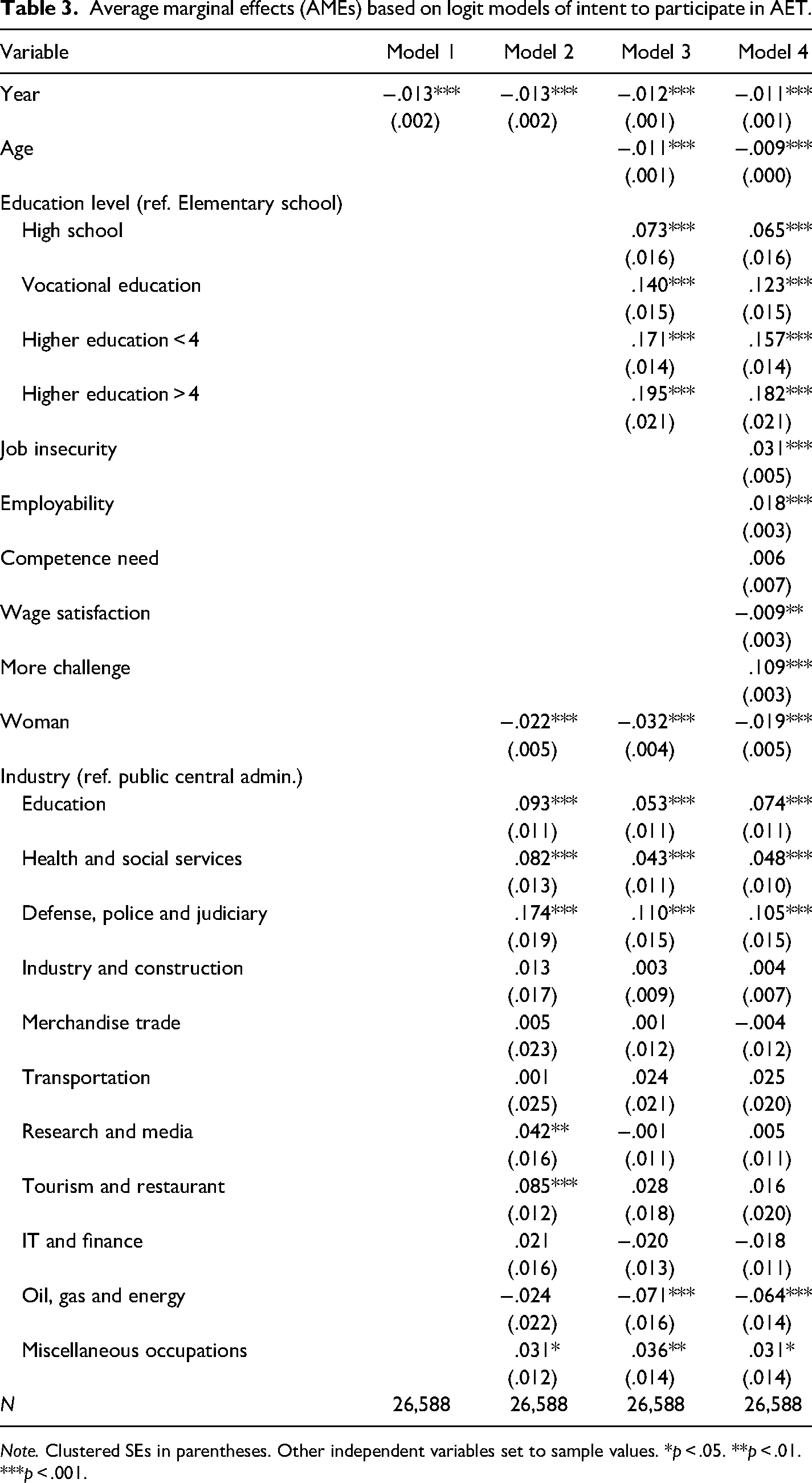
Note. Clustered SEs in parentheses. Other independent variables set to sample values. *p < .05. **p < .01. ***p < .001.
Measures
The dependent variable,
The analyses include five motivational factors:
Analytical Strategy
We estimated five logistic regression models to investigate the trend in intention to participate in AET from 2010 to 2022. Model 1 includes only the year as the independent variable. Model 2 adds the control variables of gender and industry. These models test RQ1. In Model 3, we added the variables age and education to test RQ2. To investigate whether the trend in intention to participate in AET varies across age and/or education level, we estimated Model 3b including interaction terms between year and each of the variables for age and education. In Model 4 (full model) the interaction terms were removed and the motivational factors were included to test RQ3.
A drawback of logistic regression is that coefficients cannot be compared across models due to unobserved heterogeneity (Mize et al., 2019; Mood, 2010). Therefore, we present the results as average marginal effects (AMEs) in addition to logits. AMEs show the average change in the probability of being interested in AET when the variable (e.g., year) increases by one unit and the other independent variables are held at their sample value. To test whether the AMEs for the variable year changes significantly between models, we used the Stata command mlincom (Long & Freese, 2014). Since Stata does not calculate AMEs for interaction terms, Model 3b is only included in the logit table (Table 2).
Because we used data from several years, we applied cluster robust standard errors in the analyses. The goodness of fit test showed that the full model (Model 4) had a good approximation of a logistic curve (p > .05). Moreover, the models’ ability to predict 0 and 1 values correctly (receiver–operator curve (ROC) area = .72) was within the acceptable range of .7–.8 (Hosmer et al., 2013).
Results
Descriptive Statistics
Figure 1 shows the proportion of employees who stated that they were likely or highly likely to participate in AET from 2010 to 2022. The trend in intention to participate in AET declined from 65% in 2010 to 45% in 2022.
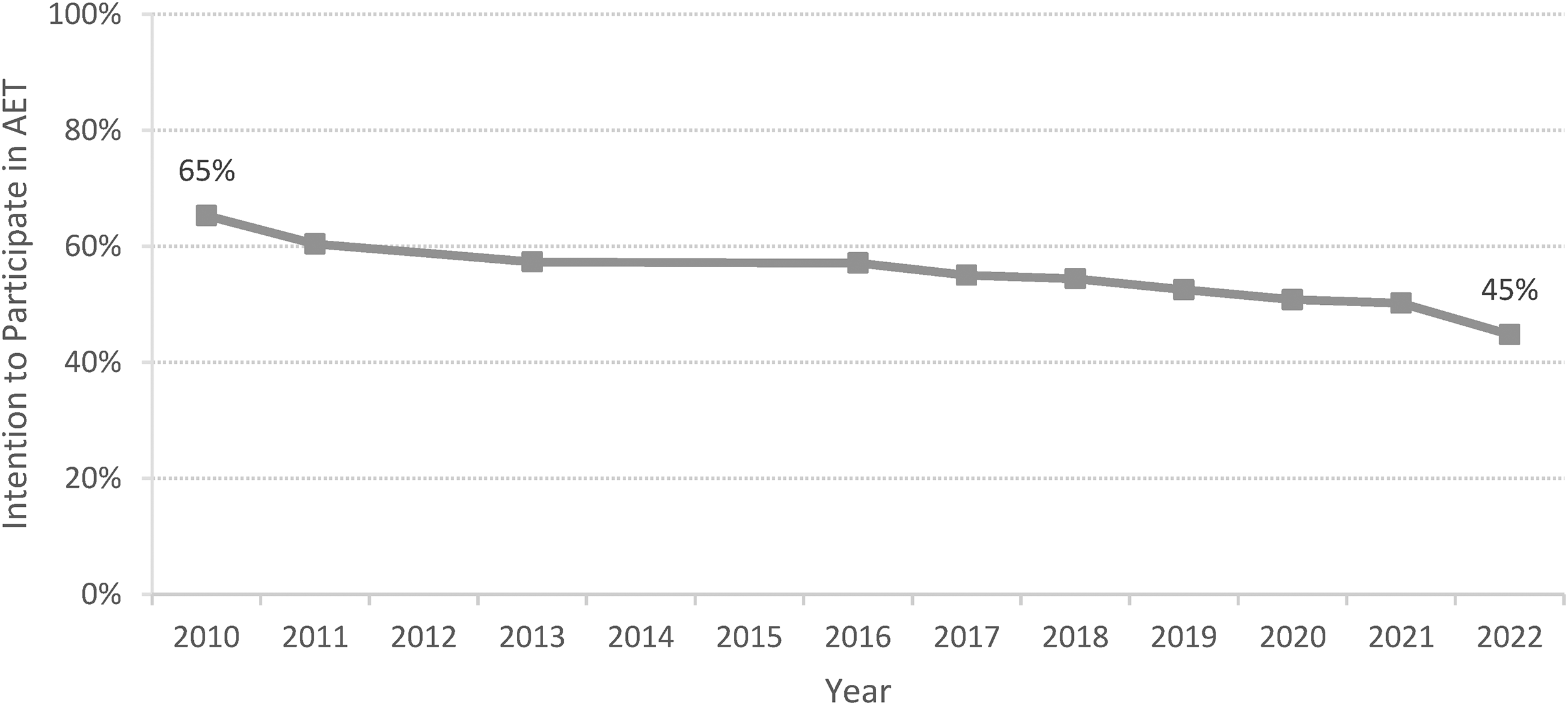
Intention to participate in AET 2010-2022 (N = 26,588). Proportion “Likely/highly likely”. Weighted .
Table 1 shows that, across all years, 54% of the employees intended to participate in AET. Compared to those who did not intend to participate, the interested employees more often had completed tertiary education and were younger on average. They also gave a higher average score on the motivational variables job insecurity, employability, competence need and wanting more challenges than those who were not interested. Their average score on wage satisfaction was lower.
Logistic Regression
Table 2 presents the results from five logistic regression models. Table 3 displays AMEs for the corresponding models. Models 1 and 2 answer RQ1 and show a declining trend in the intention to participate in AET from 2010 to 2022. The AME for year is the same in both models. Model 3 tests RQ2. It shows that older employees were less intent on participating in AET than younger employees. The intention to participate in AET increased with each education level. Employees in all the other education groups were significantly more interested in AET than employees with elementary school. The AME of year changed from −.013 to −.012 when we included age and education level in Model 3. However, this change is not significantly larger than 0. Thus, the declining intention to participate in AET over the years cannot be explained by socio-demographic changes in the composition of the workforce.
None of the interaction terms in Model 3b are statistically significant. This suggests that the decline in intention to participate in AET is the same for employees of different ages and education levels. Figure 2 shows the predicted probabilities of intending to participate in AET for different ages over time. The predicted probabilities of intent to participate in AET for each educational category over time is presented in Figure 3. As the figures show, the declining trend is present in all age and education categories.
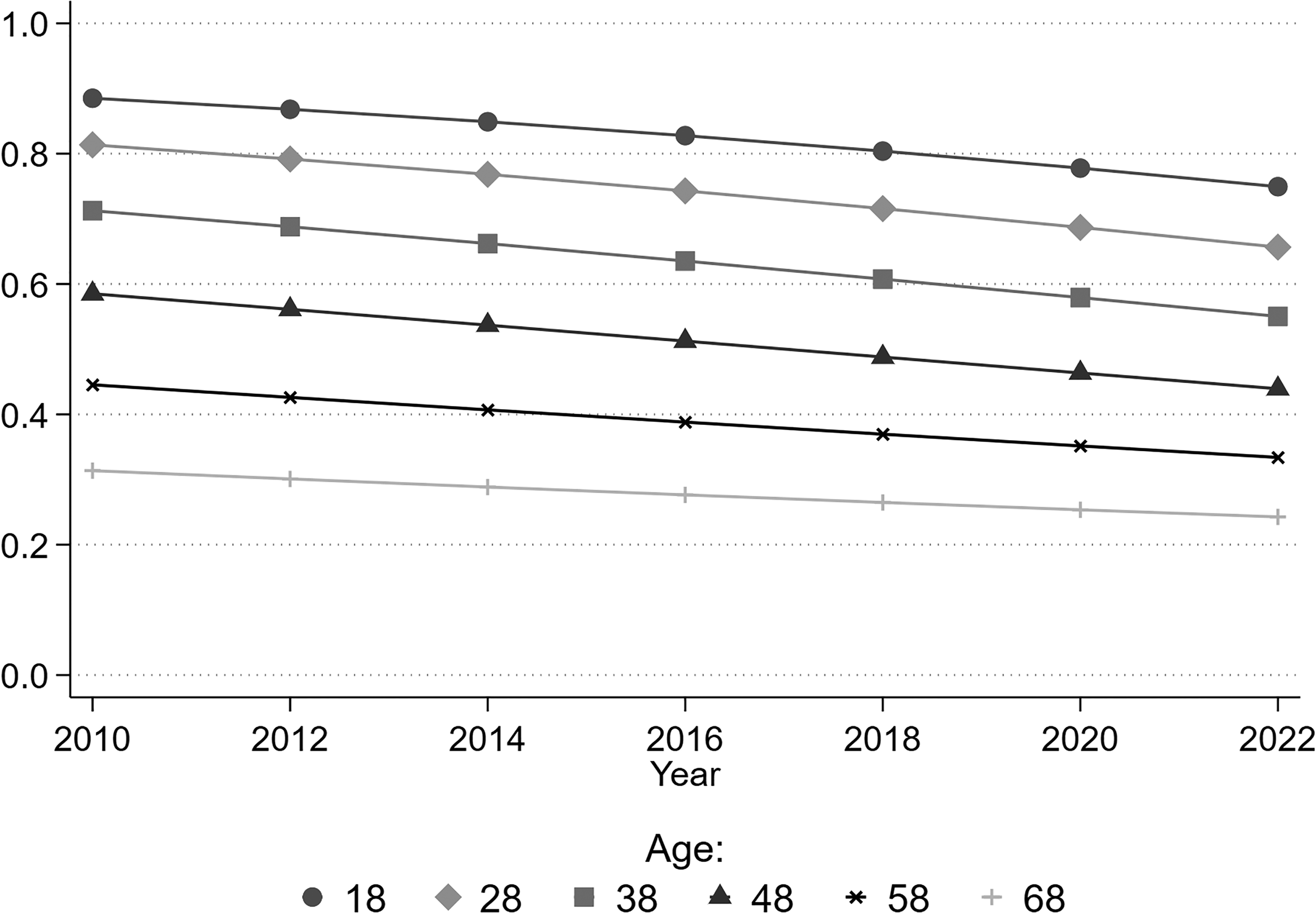
Predicted probability of intention to participate in AET across age categories. Conditional on year, age and the interaction between these. Sample values for all other values in model 3b.
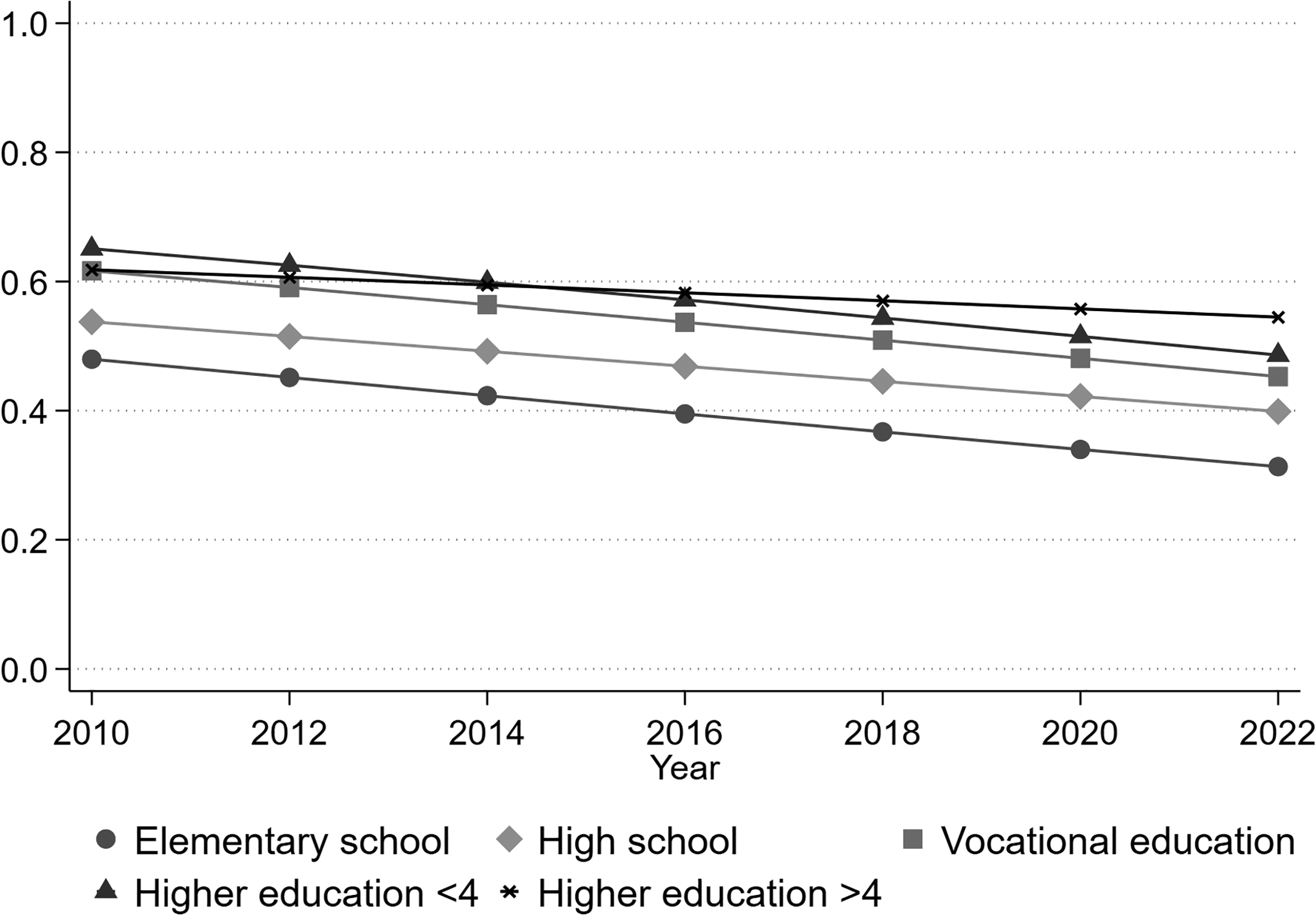
Predicted probability of intention to participate in AET across education levels. Conditional on year, education and the interaction between these. Sample values for all other values in Model 3b.
Model 4 tests RQ3 by including the motivational factors. Employees who perceived that they had higher employability were more likely to be interested in AET, but this relationship is quite weak. Employees with higher job insecurity were more likely to be interested in AET. We also find that employees who wanted more challenges were more likely to be interested in AET participation. Wage satisfaction is negatively associated with interest in AET, but quite weakly so. We do not find a significant association between competence need and intention to participate in AET. The AME of year changed from −.012 in Model 3 to −.011 in Model 4. This change is small, but statistically significant at p < .05. It suggests that the motivational factors explain some of the trend in intention to participate in AET.
Although there were no gender differences between interested and not interested in the descriptive data (Table 1), in the regression analyses we find that women were less likely to be interested in AET participation than men after controlling for age, education level and industry. We also find some differences between industries. Employees in education, health and social services, defense, police and judiciary and miscellaneous occupations were more likely to be interested in AET than employees in the reference group (public central administration) after we included controls for gender and education. Correspondingly, employees working in the oil, gas and energy industry were less likely to be interested in AET than employees in the reference group. More females have higher education than men in Norway, and females more often work in industries where interest in participation is higher. Our results suggest that it is education level and other aspects of the industries, rather than the gender of the employees, that drive the differences in interest to participate.
The relatively small pseudo R2 in all the regression models means that there is still considerable variance in the dependent variable to be explained even when year, age, education and motivational factors are accounted for.
Discussion
The motivation for this article was the sustained political focus on lifelong learning and AET, combined with stable or somewhat declining participation rates in official statistics. For RQ1, we examined the trend in intention to participate in AET from 2010 to 2022 among Norwegian employees. Our results show that the intention to participate in AET is declining. We are not aware of other data measuring this trend. However, official statistics from LFS and Eurostat show a slight decline in AET participation in Norway during the same period. RQ2 and RQ3 asked to what extent changes in socio-demographic and motivational factors were related to this trend. The declining trend persists even when we adjust for an ageing population and the rising education level of employees. As Figures 2 and 3 show, interest in AET participation is declining in all age and educational categories. Changes in motivational factors explain some of the declining interest in AET, but most of the decline over time remains unexplained by our models.
The results are in line with previous research on social disparities in AET participation (Cincinnato et al., 2016; Desjardins et al., 2006; Ioannidou & Parma, 2022). From our own data and other statistics (OECD, 2022, p. 37), we know that the education level in the workforce has increased. This could have led to increased intention to participate in AET, but instead we found a decline among employees at all education levels. The negative association between age and intent to participate corresponds with previous research (Desjardins et al., 2006; Ioannidou & Parma, 2022). However, the ageing of the workforce cannot explain the decline in intention to participate in AET, since our results show a decline in all age categories.
We find positive associations between intention to participate in AET and each of the motivational factors job insecurity, employability, and wanting more challenges and a negative association with wage satisfaction. This suggests that interest in AET is both extrinsically and intrinsically motivated, which corresponds well with earlier research. Employees who are afraid of losing their job or who want to improve their wage or career prospects have a higher intention to participate in AET (Chesters et al., 2020; Dæhlen & Ure, 2009). Contrary to expectations, the association with employability is positive. Employees who are sure they could find a job that is better than or just as good as the one they have more often intend to participate in AET than do employees who do not think they could find such a new job. This contrasts with the expectation that employees who need to increase their employability will be more likely to attend AET. One explanation for this finding is that employability is not the opposite of job insecurity (Bernstrøm et al., 2019). Our analysis includes a control for job insecurity, so employability here is more likely to measure employees’ perceptions of their own career prospects. Employees who feel that they are labor market mobile might be more inclined to participate in AET in order to realize this mobility, and vice versa (Drange et al., 2018). As expected, employees who want more challenges in their job have a higher intention to participate in AET. We find no association between need for more competence and intention to participate in AET when we take account of the other motivational factors.
RQ3 asked to what extent changes in motivational factors were associated with the change in intention to participate in AET. Our analyses show that changes in motivational factors explain only a small part of the decline. The main part of the decline in intention to participate remains unexplained by the socio-demographic and motivational factors we tested.
The researchers behind the CLLPM criticize earlier research for placing too much weight on individual-level factors and argue that the individual's decision to participate in AET is dependent on successful interaction between individual and organizational factors (Boeren, 2016). The results of this study support this claim and suggest that researchers and policy makers should focus more on organizational and macro factors rather than on individuals’ interest in participation. Are there barriers to participation in Norway that have intensified during the past decade? The government introduced a new competence reform in 2019/2020 to better incentives for employees to attend formal education, such as better access to student loans for older employees and funding to educational institutions to provide more flexible AET. This reform should have lowered the situational barriers to participation. Continued digitalization has consequences for both labor and education, most likely increasing the need for AET participation (Ioannidou & Parma, 2022). Digitalization also increases access to e-learning courses, lowering the cost of participation. This may lower employees’ perceived need for AET, since they can access new skills without attending formalized AET. On the other hand, the increasing availability of digitalized education and learning may also lead to increased awareness of the need for AET.
Scholars posing critical questions about the lifelong learning discourse claim that this focus places responsibility with those employees who have the lowest education and who are the least interested in pursuing further education (Ahl, 2006; Fejes, 2010; Madsen et al., 2021). Ahl (2006) instead asks whether the problems sought to be solved by low-skilled workers increasing their qualifications (e.g., climate change, globalization, ageing workforce) could really be solved this way. She posits that framing these problems as a problem of lack of motivation to pursue further education in fact reframes the low-skilled workers who are not motivated for AET as the problem. This shifts the focus away from solving the real problems at hand.
Analyses of official Norwegian policy documents regarding the most recent competence reform show how governments’ construction of the ideal citizen as “the competent citizen” and “the employed citizen” also constructs “the maladjusted citizen” (Madsen et al., 2021). The political emphasis on education and AET as a way for individuals to increase their employability places responsibility for attaining the right competence on the individuals themselves (Fejes, 2010). Thus, individual workers are made responsible for society's need for increased competence. These authors argue that the pressure for lifelong learning, mainly through formal education, is not equally viable for all citizens.
Even though the Norwegian welfare state assumes the direct cost of formal general education, indirect costs can be a barrier to participation. Payne (2006) shows that employers’ objection to fully fund adult education and unresolved issues regarding who should fund the time spent on educational leave poses an institutional barrier to AET participation. Payne concludes that Norway has reached the end of a cycle of policy making and academic thinking concerned mainly with increasing skills and knowledge through the educational system and is now turning its attention to how organizations can make more use of developing their existing stock of competence. Our analyses of the dependent variable indicate that employees think mostly of formal AET when they answer the question about interest. Since most adult learning is job related and informal or non-formal, the declining interest in participation does not necessarily imply a decline in employees’ interest in learning. Non-formal and informal learning happens at work during the workday. On-the-job learning has increased in Norway over the past two decades, but as with formal learning, learning-intensive jobs are more often held by employees with high formal education (Ulstein, 2019).
The data utilized in our study have the advantage of comprising a considerable and representative sample of employees. The data are collected using the same questions each year, which lends high reliability to any changes observed over the period. However, we cannot be sure that perception of the term “further education and training” has not changed in the population during the study period. One possible explanation for the decline in intention to participate in AET may be that more employees’ now tend to associate AET with formal education than they did only a decade ago. The focus on formal education in the public debate about the competence reforms may have contributed to this change. Further research should combine qualitative and quantitative methods to investigate how employees think about AET and whether any lack of motivation is associated with attending formal AET or even with informal and non-formal learning.
A shortcoming of the data is that they only comprise employees. Non-employed individuals participate less in learning than do employed, and it would be interesting to investigate how their intention to participate has evolved over time. Although the cross-sectional data allow for analyses of aggregate changes over time, panel data that follow each respondent over time could provide information about changes in interest in AET among individual employees and how they evolve over the life course. Additionally, qualitative interviews could tell us more about employees’ perception of the term AET and their considerations of motives and barriers, especially in relation to interplay with institutional and macro-level factors.
Conclusion
The study shows that Norwegian employees’ intention to participate in AET has declined from 2010 to 2022 in all age categories and with all levels of completed education. Changes in individual motivational factors cannot fully explain the declining interest in AET. We argue that the focus on formal education in AET policy making does not seem to increase individuals’ motivation to attend AET. Furthermore, current policy places an unduly heavy burden on individuals to take responsibility for society's competence needs. The results of this study suggest that researchers and policy makers should focus more on organizational and macro factors to increase learning among employees.
Footnotes
Acknowledgements
The authors would like to thank colleagues at the Work Research Institute and the anonymous reviewers for their valuable comments on an earlier version of this draft.
Declaration of Conflicting Interests
The authors declared no potential conflicts of interest with respect to the research, authorship, and/or publication of this article.
Funding
The author received financial support for the research, authorship and/or publication of this article: The data collection was funded by the Confederation of Vocational Unions (YS).
