



Abstract
This empirical study investigated the relationship between the learning climate and training participation in Dutch organizations and how subsidies and the sharing of investments in time and costs between employers and employees affect this relationship. Our analyses are based on a survey of a representative sample of 512 organizations with at least five employees in a Dutch region. Respondents replied to five statements to measure the learning climate, while training was measured through participation and intensity. We found that an organization’s learning climate is positively related to participation and intensity of training in terms of hours. However, we observe that the effect of learning climate on the number of hours of training decreases when the employer pays the costs for the training and when the training takes place during working hours. When organizations can use government subsidies, participation in training increases, and the number of hours per participant increases.
Keywords
Introduction 1
The speed of digital and technological developments in the labour market requires workers to continuously adjust and improve their skills and constantly acquire new knowledge (Koster & Brunori, 2021). Policymakers stress the importance of this continuous development of the workforce – particularly by providing training programs – under the name of Lifelong Learning (LLL) (De Grip, 2021; Regmi, 2016). While encouraging LLL, policymakers often acknowledge the importance of organizational culture in continuous learning (OECD, 2021). Policymakers argue that the normalization of learning in organizations is conditional on increasing participation in learning across the workforce (OECD, 2021). Research shows that lifelong learning is also crucial for organizations as organizations where learning is essential have employees with more up-to-date knowledge and skills (Egan et al., 2004). Furthermore, this increases productivity, increasing profits (Lomineishvilli, 2021).
An environment supportive of learning consists not only of norms and values but also of concrete training opportunities for employees. However, these opportunities come at a cost for the employer, which can be an obstacle in providing training. This paper investigates the relationship between a positive learning environment, defined as learning climate, training participation, and organizations’ financial considerations to prepare organizations and their employees for the future. We observe the obstacles through financial incentives and wonder how they interact with the relationship between training and learning climate.
The following questions guided our research: Is there a relationship between the learning climate in an organization and its employees’ training? How do subsidies and the sharing of time and costs between employers and employees affect this relationship? We reviewed the literature and used a survey among 512 firms in the Northern provinces of the Netherlands to collect data on the learning climate and training in organizations of different sizes. We conclude this paper with our main findings and the associated policy implications.
Theoretical background and state of research
Learning climate
In this study, we adopt Örtenblad’s (2002, 2018) definition of the learning climate to represent the norms and values about learning in an organization: a learning climate ‘implies that an organization offers tools and opportunities for learning to individuals and groups within it’ (2018, p. 152). Örtenblad (2002) clarified this definition by citing Pedler and Aspinwall (1998, p. 43): ‘Some organizations create better conditions for […] learning than others. They make learning a value at the heart of the enterprise, they encourage people to talk to each other, they simply have a better “learning climate”’. This indicates that the opportunities and tools Örtenblad refers to imply not only a presence of concrete training opportunities but also a norms and value system that must support learning. An organization must internalize the attitude that learning is a strategic element in the organization, which positively affects participation in the training of individual workers (see also Dirani, 2009; Marsick & Watkins, 2003). Incorporating learning in the heart of an organization is what makes a learning climate. Next, integrating what employees have learned into the organization’s systems is also a crucial part of the learning climate (Tracey & Tews, 2005). Örtenblad’s tools thus also include the systems in place to support integrating learning activities and their results into the organization (Marsick & Watkins, 2003).
Learning climate and training
There is a relationship between this learning climate, the norms and values, and the concrete training opportunities. Initiating training activities can normalize learning in an organization and improve its learning climate (Manuti et al., 2015). Simultaneously, we expect more eagerness to participate in training in an organization with a better learning climate. When new skills are necessary, learning will be encouraged and managers are more likely to accept training requests from employees, and employees are more encouraged to pursue training opportunities themselves. This reinforces our expectations of a positive relationship between learning climate and training, but there is no certainty on the direction or duality of the causal relationship.
Furthermore, studies have shown a positive relationship between training and on-the-job learning (Manuti et al., 2015; Van der Heijden et al., 2009) and a positive relationship between on-the-job learning and learning climate; see (Uhunoma et al., 2021) and Noe et al. (2014). As both relationships have a positive sign, the sign of the relationship between training and learning climate is expected to be positive as well.
To operationalize training, we define training in this paper as participation in courses and study programs with a preset goal, with or without a diploma or certificate.
Financial factors affecting training
In addition to norms and values, and opportunities for training, financial constraints are the third aspect we consider. Financial constraints may affect the training opportunities offered to people. If an organization has no budget for training, people will have less training. Similarly, if workers are necessary for production, they cannot simply be absent for a training course.
In other words, even when everyone is aware of the importance of learning and training, people and organizations have budget and time constraints. Learning and training resources are scarce, requiring people and organizations to choose which activities to undertake. Hovdhaugen and Opheim (2018) have shown that constraints in costs and time are barriers to individual participation. Therefore, when we investigate the relationship between learning climate and training participation, we also consider the financial constraints of organizations. In the model, we include the effects of organizations’ total investments rather than the investments in or by specific individuals like Desjardins et al. (2006) because we only have information at the organizational level. The financial constraints were measured as direct costs, time investment of the organization, and the use of government subsidies.
First, direct costs – for example, study costs, cost of books, and travel costs—increase with the length of the training course. Usually, employers pay most of the costs as training improves productivity. In the Netherlands, Künn-Nelen et al. (2022) found that employers pay 84% of the direct costs, and based on the same data, Poulissen et al. (2021) concluded that direct costs are a factor in the decision of employers.
Second, training takes time: time spent on the course and for self-study. Künn-Nelen et al. (2022) found for the Netherlands that training takes place during both working hours and in employees’ own time. This means organizations need to find a replacement for the worker. Both organizations and employees invest in training, and the time spent on a training course is a factor in employers deciding to offer a training course (Pischke, 2001).
Third, government subsidies can offset some of the costs organizations and employees incur. By providing subsidies, the government can increase the rate of return on private investment and thereby increase training uptake. In the Netherlands, subsidies offset financial barriers for both organizations and employees (Ministry of Social Affairs and Employment Ministry of Education, Culture and Science; Ministry of Education, Culture and Science, 2022), although Shah (2017) found that the availability of subsidies had no effect. We investigated the actual use of subsidies at the organizational level rather than their availability, and we expected people working in organizations that use subsidies to train more.
Control variables
In addition to the norms and values, and the financial considerations, the organizations’ and employees’ characteristics affect training participation. We include these factors as controls to ensure that we find the effects of learning climate and not the effects of specific characteristics of organizations. Research on the organizational level has shown that participation in training varies between industries and sectors (Hu, 2023; Karger et al., 2022). In some sectors, it is mandatory to continuously be in training to maintain a license, for instance, in health care. Furthermore, Smith and Smith (2023) concluded that training varies between organizations of different sizes; they found that employees of larger organizations undertake more training. Research has shown that there is a relationship with individual characteristics in addition to these organizational characteristics. Age, gender, and education level are the best predictors of participation. Studies have indicated a difference in men’s and women’s participation (Punksungka et al., 2022). Furthermore, older workers (over 50) have a lower participation rate, while people with a university degree are more likely to participate (Kalenda et al., 2020, 2023). The training participation in organizations is likely to vary with the differences in their labour force composition. We, therefore, incorporated gender, education level, and age into our model.
Materials and methods
Study design
To analyze the relationship between learning climate and training in organizations, we surveyed organizations with at least five employees in the provinces of Groningen and Drenthe, the Netherlands. 2 The survey, addressed to the owner and/or HR manager, was sent out in December 2021. Two reminders were sent in December 2021 and January 2022 to organizations that still needed to complete their survey responses.
We used the branch registry of the municipality of Groningen and the provinces of Drenthe and Groningen to reach the organizations. This registry contains records of all the region’s organizations. Since some organizations can have multiple branches in our study region, for example, supermarket chains with several locations, the records were bundled by organization. Organizations with fewer than five employees were not included. The final data included all the organizations (both public and private) with at least five employees in the provinces of Groningen and Drenthe. Because of financial considerations, we emailed the survey to the smaller organizations (<100 employees, n = 9401). There was a known email address for 5959 (63%) organizations. All the large organizations (≥100 employees, n = 563) were sent a letter and, if an email address was known, an email. In total, 6522 of the 9964 (65%) organizations were sent the survey.
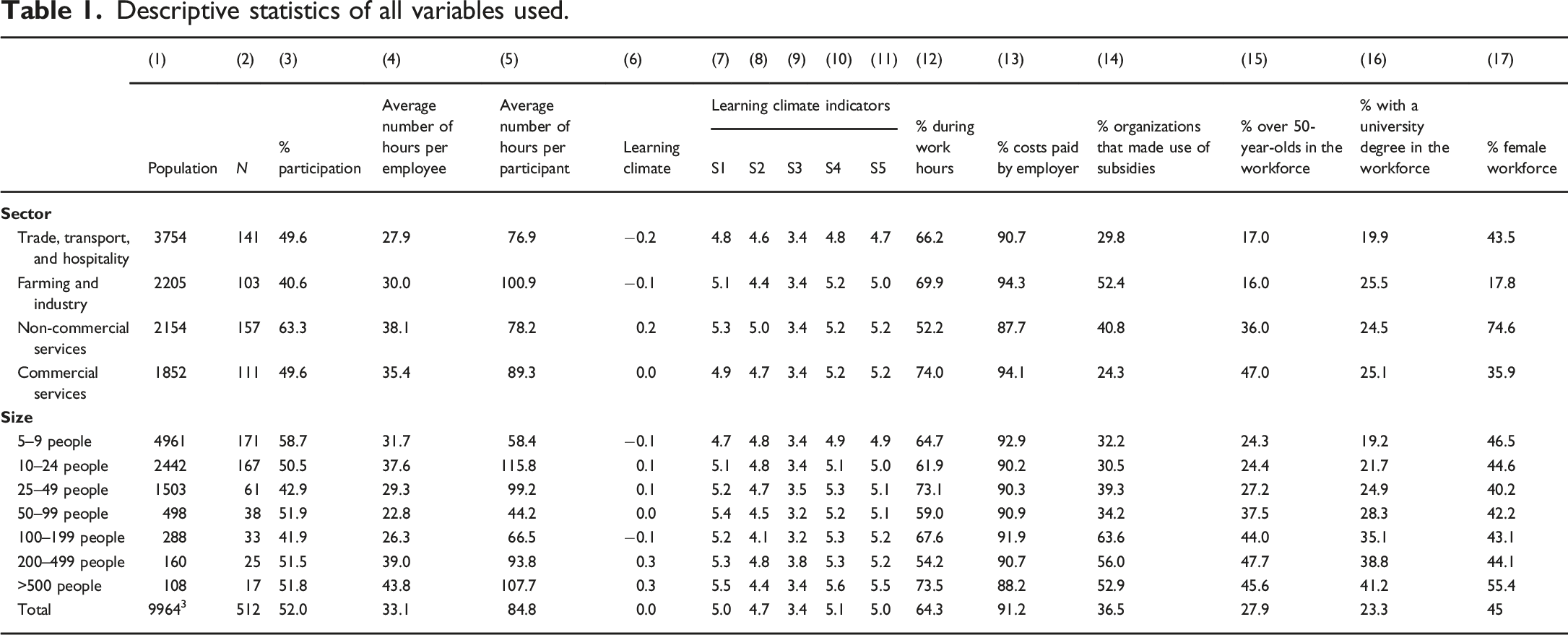
Descriptive statistics of all variables used.
Learning climate
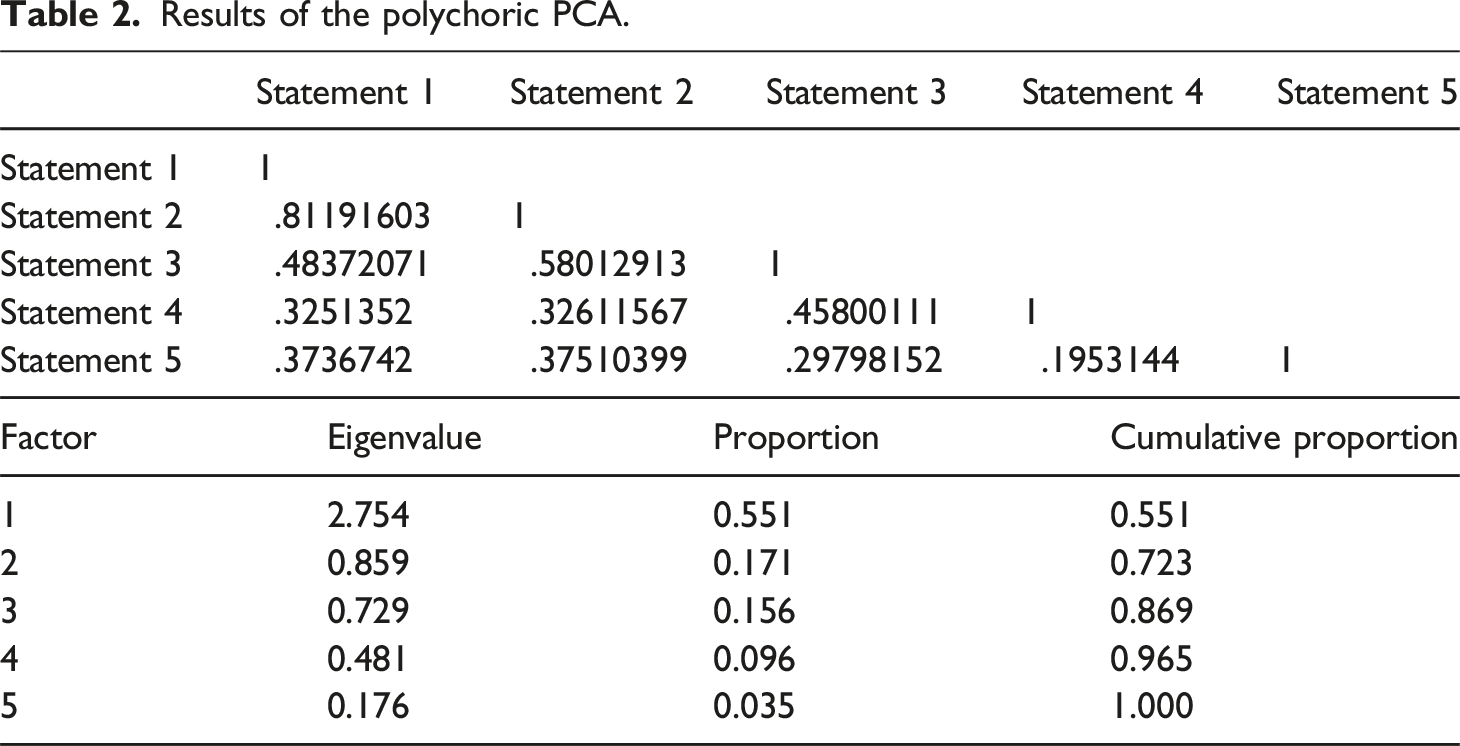
To assess the learning climate, we used the responses to five statements (S1–S5) relating to the learning climate in organizations. The responses were on a Likert scale from 1 (completely disagree) to 6 (completely agree). The Dimensions of a Learning Organization Questionnaire (DLOQ) (Marsick & Watkins, 2003) inspired the statements we used (see below); we conducted the survey in Dutch. Organizations with a higher score have a stronger and more positive learning climate. Dirani (2009), Marsick (2013), Watkins and Dirani (2013), and others used the DLOQ, and it focuses not on whether training is important but on other aspects like feedback and the integration of learning into the organization’s formal and informal systems. As a major part of the DLOQ focuses on the intangible parts of the culture in an organization, we think those aspects fit best with the learning climate definition of the learning organization. Therefore, we use them as inspiration for our study. The shortest version of the DLOQ uses one statement per dimension. We limited the number of dimensions to five, those that fit best with the learning climate: continuous learning (1), inquiry and dialogue (2), creation of learning systems (3), empowering people (4), and strategic leadership (5). Other instruments to measure learning climate specifically, like LCS (Nikolova et al., 2014) and D-RECT (Boor et al., 2011), were not suitable for our study as they focus on residency and the culture in learning environments, like universities, or they focus solely on the individuals working in the organization and could not be translated for a survey on the organizational level. The DLOQ was a more suitable inspiration as it focuses on organizations specifically. We created five statements, one for each of the dimensions (numbers correspond with the dimensions): (1) In my organization, we think it is important to offer learning places and internships for students. (2) Feedback and reflections are part of all routines. (3) The effect of time and money spent on development is measured. (4) Learning is seen as essential for improving the organization. (5) Learning is part of the organization’s short- and long-term goals.
Results of the polychoric PCA.
Training
Our definition of training in this survey was ‘participation in courses with preset clear learning goals’. We specified that organizations answer the questions about training in the last 12 months. However, the intensity of training can differ according to our definition. Many short courses during a series of years can have the same effect on the total learned as one big intensive module in a shorter period. We need to incorporate these effects when talking about participation. Therefore, measuring participation in training as a binary variable would neglect the different intensities of training and the associated different outcomes. Nonetheless, a binary variable on whether employees participate at all sheds light on the average training in an organization, and a single outlier within an organization does not affect a binary variable as a measure of training intensity is affected. Therefore, we adopted the use of both a binary variable and a measure of the training intensity to measure the average training undertaken in an organization.
We operationalized training in three different ways accordingly: (1) training participation as the proportion of employees who participated in training, (2) training intensity per employee as the average number of hours that employees in an organization undertook training (including those who participated and those who did not participate), and (3) training intensity per participant as the average number of hours of training for the people who participated in the training within an organization.
To determine these three measures of training, we asked two questions: ‘What is the proportion of employees that participated in training activities in the last 12 months?’ and ‘What is the average number of hours participants undertook training?’ These resulted in our first two variables: participation rate and hours per participant. To determine our third variable – hours of training per employee in the organization – we multiplied the answers to these two questions.
Financial considerations
We asked the following questions about three financial considerations: (1) ‘Can you indicate what proportion of the costs of courses and study programs are paid for by the employer? (These costs include, for example, registration fees, travel costs, and costs for books and other materials)’; (2) ‘Can you indicate what proportion of courses and study programs take place during work hours?’; and (3) ‘Have you used subsidies, for example, from the national or regional government, in offering courses and study programs?’
Other factors
We considered six organizational characteristics, two of which came from the survey: the proportion of employees older than 50 years and the proportion of employees with a university degree. The other four characteristics come from the registry data: the organization’s size, the gender mix, the sector they are active in, and their location. If an organization is active in multiple sectors, we allocate it to the sector with the most employees. 4 We include a dummy for the urbanized regions to measure the effect of location. This dummy takes the value 1 for organizations located in municipalities with a higher address density than 1500 addresses per square kilometre and 0 for municipalities with a lower density.
Statistical model
We estimated three models using the three independent variables: participation, intensity per employee, and intensity per participant. To check the robustness of the results, we estimate three versions of each model with the following specifications:


Because the data are censored, we cannot use simple OLS to estimate the models. Therefore, we use a TOBIT model to estimate these models. A TOBIT model can handle data for which the dependent variable is censored (Austin et al., 2000). For participation, the value proportion of participants had to be between 1% and 100%. If it is 0%, there is no training, and we cannot measure the impact of financial incentives. By definition, when there is no training, there are also no financial incentives. Furthermore, we cannot observe the effect of financial incentives for organizations where everyone already trains. Therefore, there is censoring at 100 as well. The value had to be higher than 0 for the hours of training because if employees train, the minimum is 1 hour. Again, we do not observe the organizations that do not train, so the data is censored. There is no right censoring for the number of hours as the maximum number of hours is not limited because, in practice, it seems unrealistic that workers spend close to the maximum of 1850 annual working hours on training.
Appendix B shows a correlation matrix of the continuous variables. No variables correlate highly except for hours per employee and hours per participant. This might be because training hours per employee are constructed based on reported hours per participant.
Results
Descriptive statistics
Table 1 presents the descriptive statistics of all variables. We combined the 18 sectors defined by Statistics Netherlands (CBS, 2019) into four main sectors to keep it presentable in Table 1. Detailed statistics for all sectors can be found in Online Appendix A. Column 3 shows that employers indicate that, on average, 52% (ranging from 41% to 63% over sectors and sizes) of their employees had some form of training in the past 12 months; this is comparable to other findings in the Netherlands like De Grip (2021) and Künn-Nelen et al. (2022). On average, participants undertook 85 (range 58–116) hours of training, and for all employees, this worked out to 33 (range 23–44) hours (columns 4 and 5). The learning climate (column 6) is best in the public sector and large organizations, although differences are minor.
Regarding the financial considerations (columns 12–14), we observed only minor differences between the different sectors. The costs paid by employers varied between 88% and 94% (average 91%). Furthermore, a large part of the training was undertaken during working hours (64%, ranging from 52% to 74%), similar to the findings of Künn-Nelen et al. (2022). Notably, only 37% (24–64%) of organizations responded that they used subsidies.
The characteristics of the workforce differ between organizations’ size and sector (Table 1, columns 15 and 16), suggesting a need to control for these factors. People with a university degree are overrepresented in larger organizations. The trade, transport, and hospitality sector has the fewest people with a university degree. Older employees work more often in larger organizations and the service industries (public and private). Furthermore, women are overrepresented in public services, including health care.
Descriptive statistics of the dependent variables.
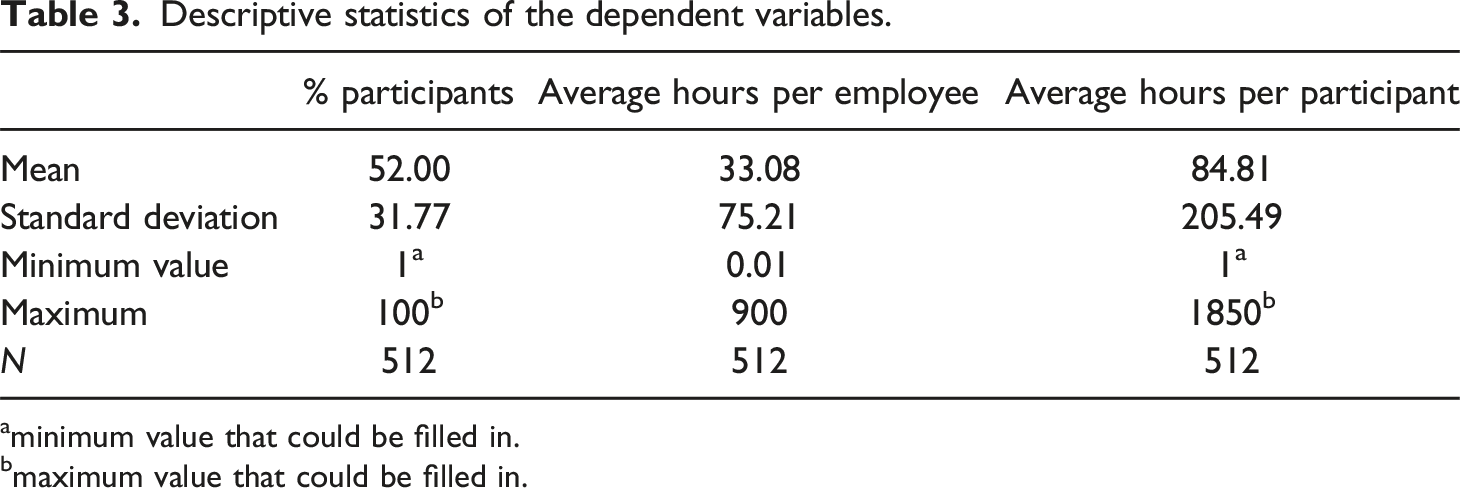
aminimum value that could be filled in.
bmaximum value that could be filled in.
Econometric results: Participation in training and learning climate
Results of the TOBIT regression with a share of participants as the dependent variable.
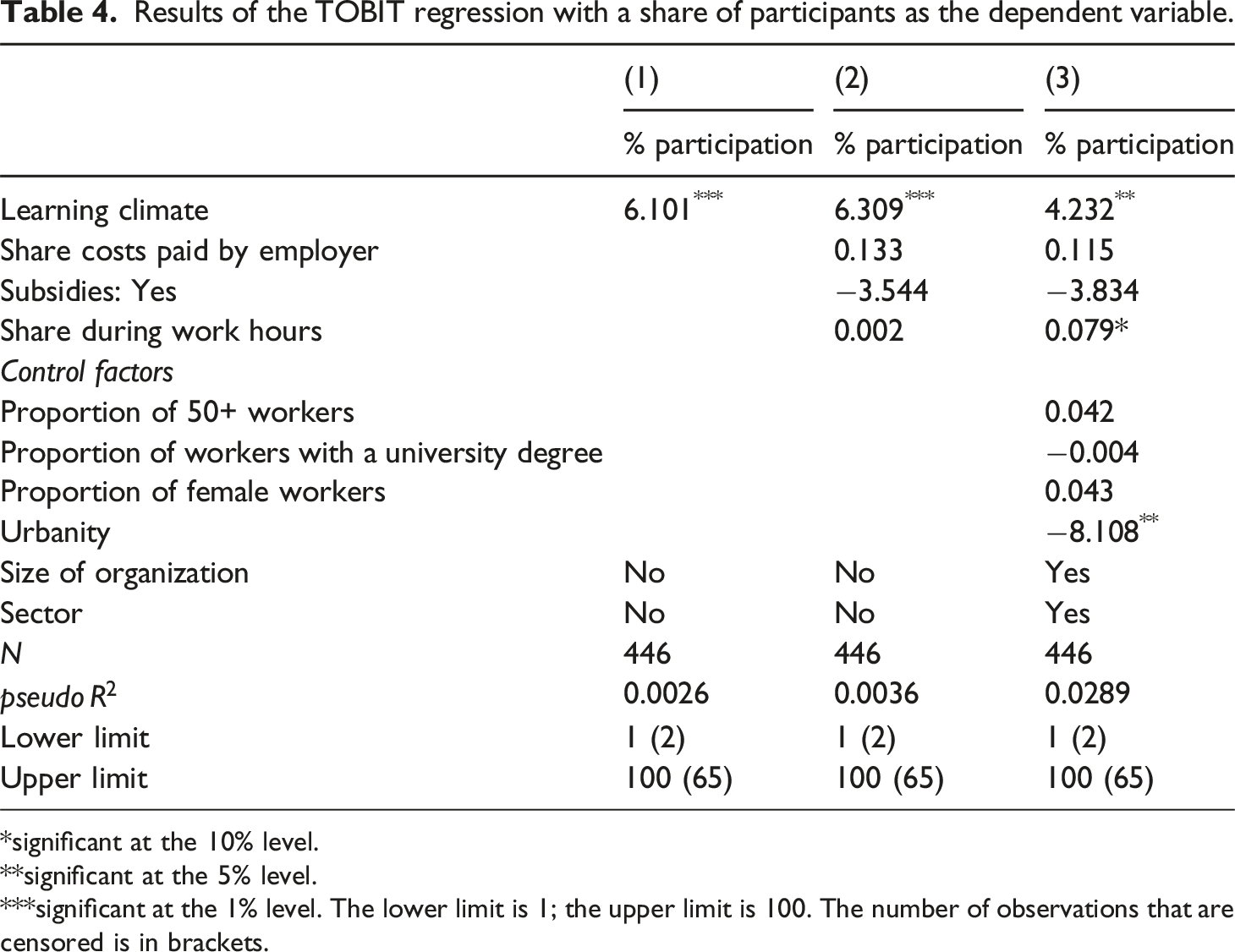
*significant at the 10% level.
**significant at the 5% level.
***significant at the 1% level. The lower limit is 1; the upper limit is 100. The number of observations that are censored is in brackets.
Intensity of training and learning climate
Results of the TOBIT regression with the measures for intensity as the dependent variable.
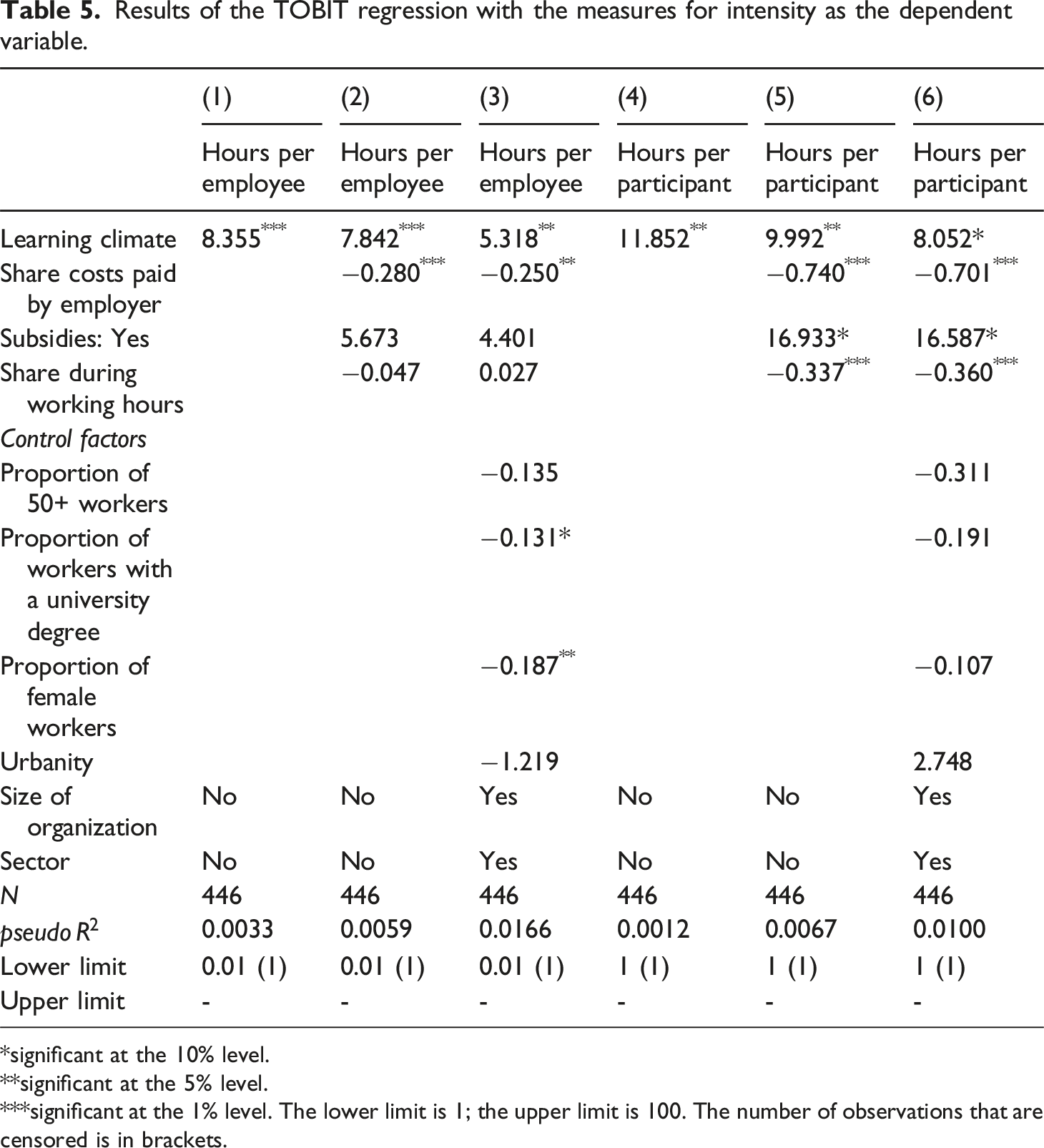
*significant at the 10% level.
**significant at the 5% level.
***significant at the 1% level. The lower limit is 1; the upper limit is 100. The number of observations that are censored is in brackets.
While for participation, in Table 4, only share during work hours is a significant determinant, for the intensity, we find that more financial considerations are significant. Table 5, column 3 shows that only the share of costs paid by the employer has a significant negative effect on the number of hours employees spend on training, indicating that a higher share of costs results in fewer hours of training per employee. When looking at the hours per participant, the effect of financial considerations becomes even more prominent: all three variables are significant. In line with the results for participation in Table 4, the positive and significant coefficient for share during work hours shows that organizations need people to do the work and struggle to find time for training. Training during working hours is insignificant in determining the hours per employee, but it is a significant factor in determining the hours per participant. However, the effects can be offset by subsidies. The use of subsidies increases the intensity of training.
In conclusion, employers invest in training people who participate for a small number of hours, and a learning climate is important to increase that participation. However, employers are less willing to invest in more extended training. The results for hours spent on training show that for the intensity of training, learning climate becomes less important, and employers consider the financial aspect in terms of cost and time, which has a negative effect on training hours. At the same time, the use of subsidies increases training hours.
Robustness
To test the robustness of our results, we estimated various specifications by adding more (control) variables to our model for each of the three dependent variables. The results show that the signs and significance levels for the variables learning climate and the financial considerations were stable over the three specifications, with only minor effects on the magnitude of the coefficients. Although there are slight differences in significance and magnitude, the overall conclusion that learning climate positively affects learning is robust for all specifications. Although the results show some variation for the three different types of operationalization of the dependent training variable, financial considerations also play a significant role.
Discussion
Our results confirm several studies, and we find some notable differences. A positive relationship between learning climate and training is expected based on the positive correlation between informal learning and learning climate (Crans et al., 2021) and between informal learning and training (Manuti et al., 2015). Our study indeed confirmed this positive impact of learning climate on training. However, we also found that employers’ financial considerations are important in training intensity. The importance of financial considerations is in line with the findings of Poulissen et al. (2021).
The finding that financial considerations are important also indicates that employers endorse the human capital theory of Becker (1964). The negative correlation between financial considerations, both direct costs and time in work hours, and training intensity shows how employers view investments in training. Becker (1964) concluded that general training, which is usually more intensive, requires investment by the employee, whereas the employer typically pays for work-related training. Our findings show that employers endorse this view and are less willing to invest in more extended training. However, we also find that employers are applying for government subsidies in the case of more extended training. This indicates that a part of the costs does not necessarily have to move from the employer to the employee but might be covered by the government. These government investments decrease the required private investment and thus reduce the risk of the employer that an investment in training a worker has benefits for other firms if the employee changes employer. Subsidies increase participation in more intense training. This is a contrasting finding to Shah (2017), who finds that the availability of government subsidies generally does not affect the employer’s decision to provide training. Lastly, unlike much of the literature (e.g. Kalenda et al., 2020; Kalenda et al., 2023), we do not find that organizations with younger and higher-educated workers or a different gender mix invest more in training. This raises the issue if those differences might be sorting effects, viz. people choosing the sector or choosing an organization that has a better learning climate. Such sorting effects require further research.
Based on our findings, we have several recommendations for organizations and governments to increase lifelong learning both in the Netherlands and internationally. First, an organization’s investment in a learning climate, in money and effort, is important to increase training participation, but investment in a learning climate alone is not enough. The positive relation between training and learning climate shows its importance, but more than just a positive learning climate is required for training with higher intensity. Our study shows that investments must come from employers, employees, and governments. Employers are unwilling to cover all the costs. They invest time and money but expect employees to invest time as well when taking more extended training programs. An implication for the government is the provision of subsidies; subsidies can (partially) offset high costs, and we found them to increase the intensity of training. Only 36% of employers use such subsidies, so many more can benefit from them. Therefore, governments need not only to focus on the subsidy amount but also on increasing awareness of the need for lifelong learning. In this way, governments can increase the total training undertaken by the working population. Government investments can be justified because a better-trained workforce is beneficial for an individual organization and society as a whole.
One of our study’s limitations is that employers are at risk of being over-optimistic in their response of their learning climate. We tried to minimize this risk by making simple and clear statements in our survey questions. Additionally, as with any voluntary survey, there will be some self-selection. Lastly, we have only considered the view of employers. As we know from Le et al. (2023), there might be differences in the experiences of learning climate by employees, but this needs further investigation.
Additionally, we suggest that further research should investigate the causality of the relation between learning climate and training. This study has shown the existence of such a relationship, but the next step is to determine its direction. Furthermore, we recommend further research on the effects of learning climate and training, individually and combined, on organizational performance. Lomineishvilli (2021) already established a positive effect of training participation on organizational performance, and Plasman and Thompson (2023) have shown the effect of informal learning on wages. The next step is to find how learning climate affects this relationship. Lastly, further investigation into government subsidies is recommended. In the Netherlands, there is a plethora of different subsidies depending on sector, size, organizational structure, and participants. As a result, this study could not incorporate concrete measures. However, further study into which subsidies can enhance learning culture is recommended.
Conclusion
Technological changes like automation and computerization mean people must continuously adopt new knowledge and update skills. A positive learning climate in an organization can positively contribute to people’s lifelong learning. To study the relationship between learning climate and training in organizations, we analyzed data obtained from a survey among 512 organizations with at least five employees in the northern Netherlands. We operationalized participation in training in three ways: through the proportion of employees that participated and through course intensity, measured by the average number of hours per employee and the average number of hours per participant. We find a significant positive relationship between learning climate and training. A more positive learning climate goes hand-in-hand with a higher percentage of employees participating in training and with longer training. However, we also find that financial considerations, like the costs and the time spent on training and the use of government subsidies, are important when determining the hours of training.
Supplemental Material
Supplemental Material - Learning climate and financial incentives: A study on training participation in Dutch organizations
Supplemental Material for Learning climate and financial incentives: A study on training participation in Dutch organizations by Björn Johannes de Kruijf, Arjen Edzes, Jouke van Dijk, and Sietske Waslander in Journal of Adult and Continuing Education
Footnotes
Declaration of conflicting interests
The author(s) declared no potential conflicts of interest with respect to the research, authorship, and/or publication of this article.
Funding
The author(s) disclosed receipt of the following financial support for the research, authorship, and/or publication of this article: This work was supported by the Regio Groningen Assen, Gemeente Groningen.

Supplemental Material
Supplemental material for this article is available online.
Notes
References
Supplementary Material
Please find the following supplemental material available below.
For Open Access articles published under a Creative Commons License, all supplemental material carries the same license as the article it is associated with.
For non-Open Access articles published, all supplemental material carries a non-exclusive license, and permission requests for re-use of supplemental material or any part of supplemental material shall be sent directly to the copyright owner as specified in the copyright notice associated with the article.
