




Abstract
Despite communities of practice (COPs) literature asserting the importance of attending to power dynamics within these learning contexts, research has largely ignored the process of racialization within COPs and, in particular, the role anti-racist pedagogies play within these spaces. In response, I present findings from an instrumental case study to address the following research question: how do participants in an experimental music community conceptualize anti-racist pedagogies within their COP? Building on Kenny’s notion of communities of musical practice, my analysis shows that the board members and employees of the experimental music venue at the center of this study recognize opportunities to challenge white supremacy and build critical understandings of racialization across all three of Wenger’s dimensions of COPs: mutual engagement, joint enterprise, and shared repertoire. This study therefore provides a potential framework for future studies into anti-racist pedagogies within informal adult education.
Keywords
Introduction
Since its conception by Lave and Wenger (1991), the notion of communities of practice (COPs) has gone on to influence countless subfields within educational research. Defined as “groups of people who share a concern or a passion for something they do and learn how to do it better as they interact regularly” (Wenger, 2011, p. 1), COP research “conceptualizes learning as a social process rooted in participation in a community, rather than as an individual's uptake of content” (Curnow, 2022, p. 2). Due to this sociocultural framing, scholars exploring COPs regularly foreground the role of power dynamics in shaping processes of learning (Lave & Wenger, 1991; Wenger, 1998) including multiple examples in adult education literature (French et al., 2021; Merriam et al., 2003; O’Donnell & Tobbell, 2007). Yet despite the emphasis on power dynamics, Curnow (2022) argues that COP research has rarely examined the role of racialization, or the construction and reinscription of race as a systemic force through its application to certain bodies and populations (Ng et al., 1995), within the learning processes of these communities. Representing one approach to investigating the connection between race and learning, adult education researchers have routinely highlighted the value of analyzing anti-racist pedagogies in this work (Bohonos & Duff, 2020; Boyd, 2020; Brookfield, 2014; Holst, 2020). Briefly defined as “a paradigm located within Critical Theory utilized to explain and counteract the persistence and impact of racism using praxis as its focus” (Blakeney, 2005, p. 119), anti-racist pedagogy challenges broader racist formations and white supremacy in particular through educational processes. Reexamining COPs through the lens of anti-racist pedagogy can therefore provide a means to both unveil and attend to the overlooked role of racialization within these learning ecologies.
In response to this oversight, I present findings from an instrumental case study into an experimental music venue's recent diversity, equity, and inclusion (DEI) initiative. As defined by Stake (1995), an instrumental case study explicitly focuses on investigating broader issues embodied by the case as opposed to an intrinsic case study which centers the case itself. To further explore manifestations of anti-racist pedagogies within informal adult music education, I address the following research question: how do participants in an experimental music community conceptualize anti-racist pedagogies within their COP? I have chosen to focus on the COP surrounding experimental music, or the emergent collection of new musical forms created outside of the tenets of traditional Western music (melody, rhythm, repetitive structure, etc.) (Gilmore, 2014), because of this musical tradition's conflicted past with racialization and, in particular, whiteness. Relying on Twine and Gallagher's (2008) survey of critical whiteness studies, I position whiteness as an ever changing yet always privileged racial categorization that both larger societies and localized communities, including experimental music's COP, discursively reproduce by imbuing certain racialized bodies with resources and agency while objecting minoritized bodies from this privileged space within a racialized hierarchy. White supremacy, then, serves as the system of cultural norms and institutional laws or regulations that uphold whiteness as the dominant and privileged status quo.
While experimental music has historically been associated with Black radical movements via the Black avant-garde (Fischlin et al., 2013; Moten, 2003), it also has a deep history of reproducing whiteness and, by extension, white supremacy through the construction and maintenance of white racialized social contexts (Basu, 2014; Biareishyk, 2012; Lewis, 1996). This tension then provides a fruitful space to explore how participants within COPs can reimagine these communal formations to disrupt problematic racializing practices, challenging notions of white supremacy to achieve the liberatory potential forwarded by extant experimental music scholarship. Moreover, the board members and staff of the venue who appear in this study all identify as White, providing further opportunity to investigate how white participants conceptualize their role within anti-racist initiatives aimed explicitly at combatting whiteness and white supremacy. In this study, I focus on issues related to race and whiteness in particular as opposed to other intertwined/overlapping categories that exist within racialization, such as ethnicity (Grosfoguel, 2004), that contribute to and influence this process. This study therefore provides insight into how both researchers and practitioners can engage anti-racist pedagogies within informal adult learning contexts and COPs more generally.
Theoretical Framework
To frame this research, I use this section to describe theorizations of communities of musical practice (CoMPs) (Kenny, 2016) and anti-racist pedagogy. By placing these bodies of literature in conversation, I produce a means toward recognizing and combatting white supremacy within informal adult music education contexts.
Communities of Musical Practice
In the broadest sense of the term, learning within a COP involves individuals becoming more deeply embedded within a community and thus constructing a body of situated knowledges, skills, and meaning that reciprocally shapes that community (Lave & Wenger, 1991). Building on this foundation, Kenny (2016) draws on theorizations of COPs to define certain music-making communities or music scenes as CoMPs. According to the author, CoMPs form around three foundational dimensions of COPs defined by Wenger (1998): mutual engagement, “the music-making group interactions such as rehearsals, workshops and performances”; joint enterprise, “stated and negotiated aims of the music communities”; and shared repertoire, “practices or built-up communal resources that distinctly belong to each musical community” (Kenny, 2016, p. 18). These intertwined elements of making music and building community produce a unique and evolving body of knowledge across all three dimensions.
Applying this theory to a wide range of informal adult music education spaces, previous research has positioned individual artistic development and communal identity formation within an orchestra (Gaunt & Dobson, 2014), constructing a working understanding of media sharing technologies via participation in a banjo enthusiast online community (Waldron, 2011), and the ongoing negotiation of roles and organizational structures within rock bands (Malm, 2020) as manifestations of learning within CoMPs. Of particular importance for this paper, extant studies have defined experimental music scenes as CoMPs (P. J. Woods, 2019, 2022). According to Perry (2011), individuals within these music scenes start as legitimate peripheral participants by contributing to their local music scene as fans and audience members. As time passes, they become more involved by running venues, organizing concerts, or performing themselves, thus reproducing the community and shaping the musical and sociocultural knowledge within those scenes. Importantly, this does not just occur at the level of music-making practices (shared repertoire) but involves shaping the sociocultural/artistic goals of the community (joint enterprise) and producing spaces where individuals create and share music (mutual engagement). This situated body of knowledge, both musical and socioemotional, sits at the core of experimental music's CoMP. However, research into CoMPs have largely overlooked the role of race and racialization within these community-based learning contexts, replicating Curnow's (2022) critique of COP research. I therefore turn toward research into anti-racist pedagogies as one possible body of literature to facilitate this work.
Anti-Racist Pedagogy
In thinking through the frame of CoMPs, scholars and practitioners can begin to imagine how anti-racist pedagogies thread themselves within informal arts education and adult learning processes. As Kishimoto (2018) explains in her study of higher education praxes, anti-racist pedagogy “has three components: (1) incorporating the topics of race and inequality into course content, (2) teaching from an anti-racist pedagogical approach, and (3) anti-racist organizing within the campus and linking our efforts to the surrounding community” (p. 541). Aligning Kishmoto's components to the work of CoMPs, practitioners can adopt the tenets of anti-racist pedagogies by including musical works that focus on race, embracing anti-racist action in interpersonal and pedagogical interactions, organizing community efforts to challenge white supremacy, and other practices that attend the subjective and objective nature of race (Holst, 2020) within and outside of music communities. All of this could produce a context steeped in anti-racist thought by going beyond multi-cultural education and challenging issues of power within racial formations (Blakeney, 2005), thus addressing the lack of research into race within COPs.
Beyond solely focusing on race, anti-racist pedagogy scholars have also acknowledged the importance of considering racialization through an intersectional lens (Crenshaw, 2017). Here, intersectionality refers to the process through which multiple social institutions (race, gender, class, etc.) act simultaneously within discriminatory or oppressive processes (Crenshaw, 1989). Crenshaw (1989) and others’ original formations of intersectionality centered Black women in this theorization but later expanded to consider other overlapping identity groups. But Carbado (2013) also argues that intersectional theory often takes on an overly narrow approach by overemphasizing its Black feminist roots. In doing so, theorists ignore issues related to colorblindness and masculinity while sidestepping critiques of white male identity formations, thus reinscribing white supremacy by assuming white masculinity as the status quo (Dyer, 1997). Within the context of Black feminism's ongoing intellectual history, this occurs as the largely white field of women's studies coopts intersectionality and undermines the liberatory potential of this concept through tokenization (Nash, 2018). Rodriguez and Freeman (2016) also argue that intersectionality has been used to shift focus away from a structural understanding of race and center individual difference within contemporary discourse. Educators must therefore attend to intersectionality at the systemic level within anti-racist pedagogies (including those of experimental music CoMPs) while still centering critiques of racialization that include further theorizations of white masculinity in practice to achieve the liberatory potential first proposed by Black feminist scholars.
Background Literature
To further this exploration of CoMPs and anti-racist pedagogies, I now consider research into experimental music education and DEI initiatives because the participants in this study frame their educational praxes within both processes. These research bodies also provide further insight into racialization within adult music education.
Toward an Anti-Racist Pedagogy Within Experimental Music's CoMP
While some research into the curricula and pedagogies of experimental music education centers on learning traditional music knowledges and skills, most literature in this field focuses on the sociocultural benefits of learning within and through this musical tradition (Hickey, 2015). By foregrounding the exploration of sound over traditional performance or composition techniques, the tenets of experimental music produce a distributed approach to knowledge construction and pedagogy that invites participants of all backgrounds and skill levels to meaningfully contribute to music-making practices (Kanellopoulos, 2021). Engaging with experimental music therefore not only creates an opportunity to develop musical skills but also serves as a means for building equitable social spaces and embodying human rights through artistic expression (Fischlin et al., 2013; Kanellopoulos, 2011; Wright, 2019). The benefits and outcomes of experimental music education therefore hold significant overlap with extant research into the role of music within adult education praxes. For example, this research shows that music represents a powerful tool in expressing and further developing one's own identity and worldview, especially when that identity is othered or suppressed (Guy, 2004, 2007; Lutomia et al., 2022). This occurs despite the structures of formal music education reproducing racial oppression (McCall, 2017, 2021). Music as a site of public pedagogy also provides an opportunity for adult learners to explore, develop, and eventually enact conceptions of social justice (Bohonos et al., 2019; Haycock, 2015). Collaborative music making facilitates the imagination and embodiment of alternate worlds for adult learners (Fenwick & Albergato-Muterspaw, 2008), thus providing another site for engaging in social justice-oriented adult education that mirrors the utopian pedagogies of experimental music (Wright, 2019).
Furthermore, experimental music provides a particularly valuable site for research into the anti-racist pedagogies of CoMPs because experimental musicians already conceptualize teaching in part as a practice of shaping the community itself (P. J. Woods, 2019). However, participants in CoMPs often fall short of their own ideological aims in practice (P. J Woods, 2017). Experimental music traditions in particular have relied on a positioning of this musical tradition as othered while also masking processes of appropriation from marginalized communities (Biareishyk, 2012; Lewis, 1996). Practitioners manifest this process by defining the music made by racially minoritized participants as outside of experimental music despite a clear musical and cultural alignment (Basu, 2014). Returning to the notion of intersectionality, this reinscription of whiteness intertwines itself with a process of gender marginalization, thus reinforcing white masculinity as the default identity within experimental music (Piekut, 2011; Rodgers, 2015; P. J. Woods, 2023). To this end, research needs to respond to Curnow's (2022) call by investigating how experimental music CoMPs grapple with anti-racist practices in productive ways. This study explicitly attends to this oversight in the literature by investigating how one CoMP conceptualizes their own anti-racist approach to community formation as they engage a DEI initiative.
DEI Initiatives
Thinking beyond the educational framing of anti-racist pedagogies, many organizations (including the venue at the center of this study) have made attempts in recent years to address issues of racialization and white supremacy through DEI initiatives (Beeman, 2021). At their core, DEI initiatives involve focused efforts to restructure organizations to more closely resemble the cultural identity of the surrounding community by welcoming and supporting normally othered populations (Kim, 2022). However, critical research also shows that many DEI initiatives result in acknowledging white supremacy without affecting organizational structures, thus producing a false narrative of equitable transformation while undermining efforts of marginalized individuals to make meaningful change (Goez, 2021; Kaiser et al., 2013; Thomas & Ashbern-Nardo, 2020). Additionally, DEI initiatives regularly fail because of their inability to address broader manifestations of systemic oppression, thus shielding the organization from critique and reinforcing a culture of white supremacy (Beeman, 2021; Kaiser et al., 2022; Kim, 2022). To successfully move beyond these problematic processes, “adult educators must charge beyond the oftentimes performative nature of [DEI] initiatives and rhetoric that primarily soothe the consciousness of Whites—to a stance of relentless refusal and rejection of White supremacist manifestation in adult education spaces” (Martin & Apugo, 2021, p. 126). This assertion aligns the work of DEI initiatives with the foundations of anti-racist pedagogy, challenging educators and researchers to not just reveal the workings of white supremacy but to challenge those forces within the immediate context and beyond. Understanding how organizations reimagine DEI initiatives to achieve this end can then inform anti-racist education research and especially investigations of COPs.
Methodology
To further consider how practitioners conceptualize anti-racist pedagogies within the CoMPs of experimental music, I present findings from an instrumental case study (Stake, 1995) situated within one music organization's DEI initiative. Rather than frame the case as typical or generalizable, instrumental case study methodology highlights the unique affordances of a singular case to develop theory. This approach to case study research therefore tightly aligns with this study: while an organization-wide DEI initiative represents a highly unusual occurrence within experimental music venues, it provides an opportunity to consider how race as a social institution interacts with experimental music and its surrounding communities. I therefore use this study to investigate this interaction and further develop an understanding of racialization and anti-racist pedagogies within CoMPs.
Study Context and Participants
The experimental music organization centered in this study is located in a predominately white neighborhood (∼55% white) within a large, predominantly minoritized midwestern city in the United States (∼35% white). The organization includes an archive, recording studio, and performance space that caters to multiple offshoots of experimental music (e.g., free improvisation, electro-acoustic, noise). The full-time employees and volunteers that comprise the venue's board began a DEI initiative in response to public comments from community members about the lack of diversity in the organization and its programming as well as the internal recognition of the organization's whiteness: every member of the board is white, with the exception of one member who does not appear in this study. The ongoing call for racial justice within music communities following the protests related to George Floyd's death also provided inspiration. While the venue had already taken steps to diversify the organization by expanding the board, this expansion had not yet occurred at the time of this study and the group also wanted to examine structural issues that may reproduce white supremacy.
All board members were invited to participate in the study, with all three full-time employees and four additional volunteer members agreeing to be interviewed while two declined. I specifically decided on this research population because the board represented the only participants in the DEI initiative at the time of the study. The first step of the initiative involved the board working with an outside facilitator to create a shared but intentionally open ended understanding of both processes of racialization within experimental music and the issues faced by the venue before inviting outside stakeholders to iterate on this initial understanding and propose actionable steps. As noted in the previous paragraph, all of the board members and organization staff who appear in this study self-identified as white. While experience with experimental music and its associated scenes varied between participants, they all directly participate in this CoMP in different capacities, ranging from the legitimate peripheral participation of newly initiated fans to more core involvement within the musical community as veteran musicians (Kenny, 2016; Lave & Wenger, 1991). Additionally, everyone joined the organization out of a desire to make the genre, musical resources, and music-making practices more accessible to city residents, thus indicating a shared liberal or progressive political ideology from the participants.
Data Collection and Analysis
Data for this study came from semi-structured interviews that I conducted after all board members participated in two initial DEI workshops. These events provided an opportunity to explore how participants conceptualized whiteness and white supremacy within experimental music's CoMP along with the processes through which they hope to address those issues. To produce my interview protocol, I followed Seidman's (2012) phenomenological interview structure and focused my questions on four large categories: history within and relationship to experimental music, understandings of racialization in experimental music, involvement with the venue, and expectations for the DEI initiative. By asking open ended questions such as “What about experimental music interests you?” and “What needs to change for experimental music to become a more empowering space?,” the semi-structured interview provided an opportunity for participants to describe how they understood the sociocultural context that emerges through experimental music. Additionally, questions such as “What connection do you see between race and experimental music, if any?” and “How do you see this connection playing out in your involvement with experimental music?” focused these conversations on the influence and process of racialization within both experimental music and the venue itself. Each of the seven participants participated in one interview that lasted roughly one hour.
To analyze the interviews, I employed an open and iterative approach to descriptive coding techniques (Saldaña, 2015), organizing the data into emergent categories that covered the breadth of topics discussed by the participants and uncovering shared themes related to race in experimental music. I then engaged a second round of coding using pattern coding techniques (Miles et al., 2020). Due to an emergent alignment with extant literature discovered during this iterative process, I organized my initial codes through the components of CoMPs (Kenny, 2016; Wenger, 1998): mutual engagement/music-making practices, joint enterprise/goals or aims of a specific music community, and shared repertoire/musical practices or built-up communal resources of the music scene. Pattern coding in this context thus involved combining emergent themes with these established aspects of CoMPs that existed within the venue. In doing so, I produce a theorization of how participants both conceive of racialization and anti-racist pedagogies within experimental music communities.
Positionality Statement
I come to this study both as an education researcher interested in experimental music scenes and a participant within these communities. For nearly two decades, I have contributed to experimental music scenes as a musician, venue organizer, festival curator, label head, and avid fan. Although I have been familiar with the venue in this study for most of that time, I have not been involved with this organization up until this point. Additionally, I conduct this research from a point of privilege as a cis-gender white man, thus embedding myself within the white masculinity of experimental music this DEI initiative hoped to challenge. Although my identity shapes my perspective in ways both seen and unseen, I also take care to foreground both criticality and the voices of others in my work as a researcher, musician, and musical organizer (P. J. Woods, 2017, 2019, 2023). I therefore approach this particular study with a recognition of my own position within the broader discourse around experimental music's relationship to white masculinity, years of lived experience in this CoMP, and an invested interest in learning how to counteract white supremacy alongside my study participants.
Findings
In discussing the ways that race intersects with experimental music and the organization itself, the participants in this study produced important resonances with mutual engagement, joint enterprise, and shared repertoire, what Wenger (1998) and Kenny (2016) describe as the three components of COPs and CoMPs, respectively. Additionally, the themes constructed through my analysis largely fell into two related framings: critical understandings of the current situation and ways of addressing white supremacy moving forward (see Figure 1). By acknowledging a deepening understanding of racialization within experimental music and producing tangible ways of challenging that process, my analysis aligns the work being done by the participants with the foundations of anti-racist pedagogy (Blakeney, 2005; Boyd, 2020). These findings therefore respond to my initial research question by revealing how participants conceptualize (but not necessarily enact) anti-racist praxes within all aspects of their CoMP. I discuss each of these findings in detail below.
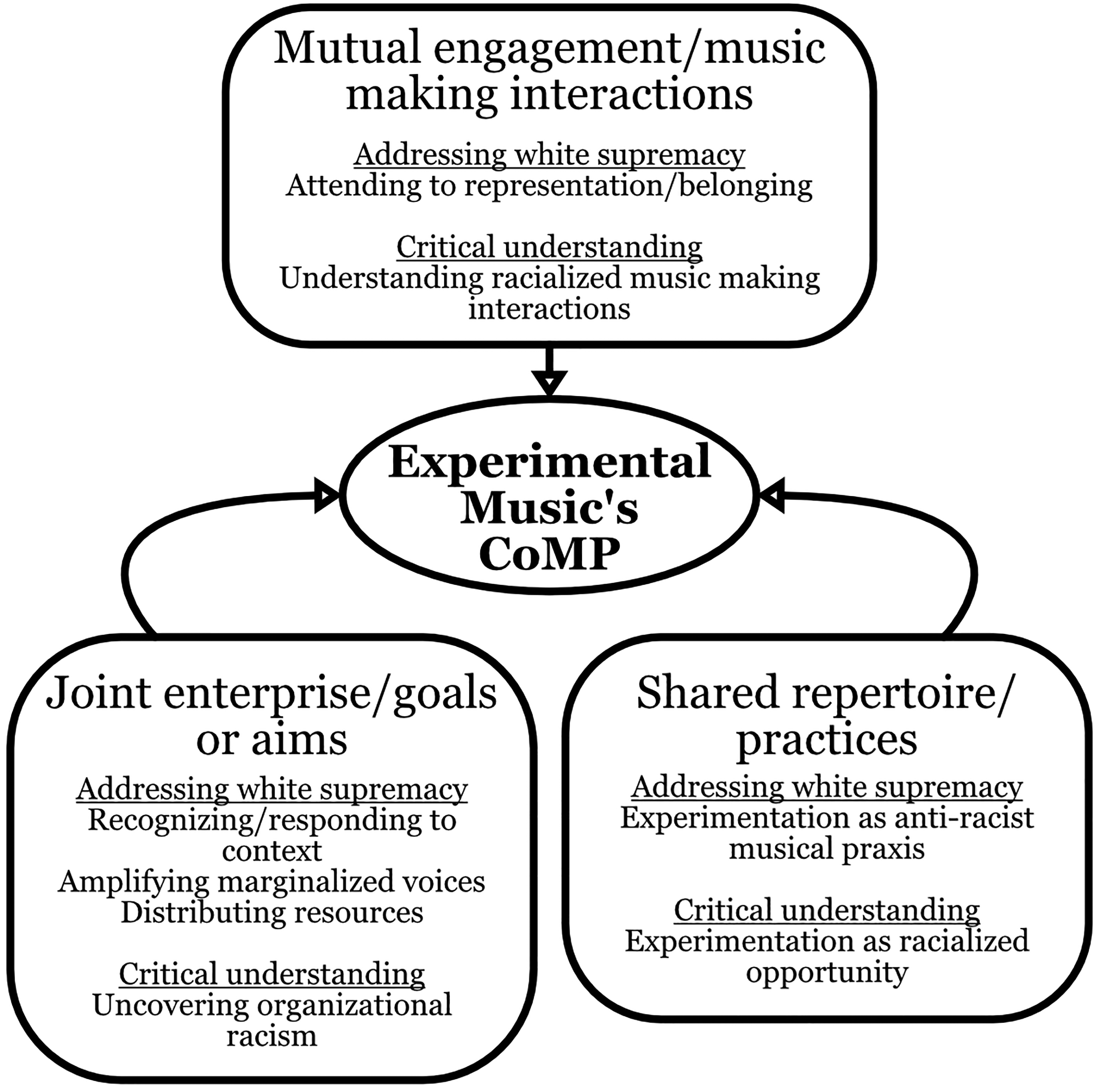
Engaging anti-racist pedagogies within experimental music's CoMP.
Mutual Engagement/Music-Making Interactions
Beginning with the music-making interactions of mutual engagement, the participants theorized anti-racist pedagogies in two ways. First, they considered attending to issues of representation or belonging as one means for addressing white supremacy. In this theme, participants discussed the role of representation in music-making interactions (e.g., whether participants in a concert or workshop include people of multiple identities) and how that relates to artists and audience members’ feelings of belonging. For Andrew, this involved inviting artists of color into their various programs: The more we program people of color to be the focus of a program, workshop, or event, the more diversity [we have in] attendances too. So that’s definitely a correlation. I think it has to do with how we present ourselves as an organization and how inclusive and inviting we seem to folks who maybe have a feeling that they belong someplace, but maybe don’t belong in some other place.
In booking artists of color, Andrew not only sees the benefit for the organization and the artists themselves but recognizes that audiences, as participants in this interaction, feel welcomed and valued within this potentially uninviting space.
Second, in terms of developing a critical understanding of the role race currently plays in the CoMP's mutual engagement, the participants centered their focus on developing an understanding of racialized experiences within music-making interactions. In particular, interviewees discussed the need to understand how people of color experience these moments. According to Erin, I think we really need to listen. I think there have to be times when we get together and people of color tell us about their experience. What is your experience going to rehearsal typically? What was it like when you were in music school or starting your bands? Tell us about it. Tell us about the worst, tell us about the best. Because then we can know in our own hearts who we are and where we fit in, where we made those mistakes. I want to hear: what’s it like playing in a racist society?
Although helpful in understanding racialization within musical contexts, Erin's response also reveals the potential issues that come from this well-meaning praxis. While this quote shows the importance Erin placed on understanding how race factors into the experiences of artists of color, this process could replicate the harm of DEI initiatives by putting the burden of emotional labor on to people of color (Beeman, 2021). This produces another tension. In learning about the influence of whiteness within music-making encounters, the organizers at the venue can more effectively undertake anti-racist work. But if this process tokenizes or inflicts emotional labor onto musicians of color, the organization will undermine those efforts.
Joint Enterprise/Goals or Aims
Representing the most diverse set of considerations within one given category, this analysis produced three separate themes related to addressing white supremacy (recognizing/responding to context, amplifying marginalized voices, and distributing resources) and one related to developing a critical understanding (uncovering organizational racism) within the joint enterprise or negotiated aims of the CoMP. For starters, the participants considered the broader social context when discussing how the organization could respond to existing within a racist society. Allen exemplifies this notion when he says, Everything we do is big picture, so we have to understand how the world was created and how systems were set up and how inequities were built. Many of us didn’t understand it until recently. I respond and accept it and work with it and make the best out of that situation.
In stating that he wants to “make the best out of that situation,” Allen recognizes that the venue should use its resources to respond to and, in part, counteract systemic racism. Additionally, this quote alludes to the ongoing need of the organization to acknowledge white supremacy at the societal level and further examine how that translates into their organizational practice. Running the venue does not occur within a bubble but instead within and in relation to the broader social context.
This growing understanding of how to most effectively position the space to respond to white supremacy serves as the foundation for the other themes in this category. For instance, the participants discussed the need to amplify and create space for traditionally marginalized voices. According to Allen, this means recognizing that the community is made up of individuals and everyone has different [worldviews]. The idea is welcoming all those different ideas and having a place for all voices to be heard. I think if you’re in any kind of position of power, you have to make sure that all those avenues are wide open for whatever happens and for whatever type of person is bringing that to you. But everything should be done with heart and authentically. [Its] not about tokenism [or] checking a box.
The goal of this CoMP and the venue specifically then shifts away from creating a space just to share music and toward creating an egalitarian and welcoming space for all.
Additionally, the board members nominated resource distribution as a specific goal of the venue. Dan states this succinctly when he says, It is our goal and our mission to make our resources and to make our spaces available as broadly as possible. That kind of is the job at hand, right? And being aware of anything that's creating barriers to that, whether that's conscious or unconscious, is central to our mission.
Drawing a parallel between this theme and the theme of responding to a racist society, multiple participants recognized transportation as a barrier to accessing resources. According to Claire, “it falls more into geography than anything else because the city is so completely segregated. So you deal with a lot of issues of commuting and transit based on race and inequity.” The aim of the venue therefore once again expands beyond providing a space to make music as board members consider ways of attending to issues of transit that prevent the distribution of their resources, a consideration that directly aligns with the emphasis on the geospatial nature of racialization that shapes both adult education Bohonos and Duff's (2020) and music scene formation (M. Woods, 2022) found in previous literature.
Beyond developing an understanding of how to address white supremacy within their joint enterprise, the participants also intentionally considered ways of developing a critical understanding of whiteness at the organizational level to better align the venue's work with anti-racist practices. According to Andrew, It’s about not really knowing what the right techniques are or the right way to be successful in this. Because we are working in experimental music, and [the venue] specifically has a huge history of being almost completely white. And not inclusive. And also very male, too. We’ve had moments of being publicly called out on it and it's been a really interesting thing to navigate. But I think there is the sense of being careful or treading lightly because we really want to do the right thing.
Here, the participants not only focus their efforts on actively challenging white supremacy and, from an intersectional perspective, white masculinity but they also emphasize an ongoing practice of learning more about those issues. In a sense, the participants take a stance of recognizing that they can never know how to fully attend to white supremacy within their organization and society at large but will instead continuously develop this understanding over time.
Shared Repertoire/Practices
Finally, the participants also located a means toward addressing and understanding white supremacy within the practices and built-up resources of their CoMP. In doing so, the organizers positioned experimentation as a music-making practice that defines experimental music and how this practice might contribute to an anti-racist approach to building their CoMP. In terms of addressing white supremacy, the participants build on Bohonos et al.'s (2019) positioning of music as a tool for social justice-oriented adult learning by framing musical experimentation as a means to expand the borders of their CoMP. According to Dan, “there's obviously unlimited opportunity. It’s always an opportunity to learn and cross-pollinate and expand exposures to various kinds of cultures in experimental music. Because it’s not as dogmatic, theoretically, as other musical and artistic idioms.” In this sense, the experimentation at the heart of experimental music creates an opportunity to challenge the CoMP as a white, racialized space. By tapping into the cross-pollination and expansion that experimental music can produce, the participants saw an embedded means of creating a racially and artistically diverse community.
However, the participants also saw the barriers associated with this kind of experimentation. In developing a more critical understanding of race within their CoMP, the participants recognized that the ability to engage experimental music-making practices had been racialized and that the capacity, but not necessarily the ability, to experiment artistically had racial implications. As Claire explains, You have the privilege as a white man to go out and do certain things and be able to pursue different avenues. And at the same time, that's also who is documenting and writing and providing that history. So even though I think there are really great figures of different races and genders that have been in experimental music, we have a very saturated amount of just straight, white men.
In alignment with Carbado's (2013) use of the term, Claire highlights the intersectional nature of this work by pointing to a very specific tension that has existed throughout the history of experimental music: the genre has always drawn from the Black avant-garde but is largely positioned as a musical genre built on white masculinity as the status quo. Claire recognizes this as coming from white privilege and white supremacy, since white male artists have the capacity to explore new music-making practices while receiving attention and credit for doing so. This process then racializes experimental music as a white musical tradition and understanding that process of racialization can help those within this CoMP address that issue.
Discussion
Following Blakeney's (2005) contention that anti-racist pedagogies involve both developing an understanding of and counteracting racism, the findings from my analysis show that the participants in this study have begun to conceptualize the work of shaping their CoMP through this lens. Across all three of the dimensions of COPs described by Wenger (1998) that Kenny (2016) applies to CoMPs, the board members interviewed in this project have conceptualized ways developing a critical understanding of racism within this community while also forwarding actionable steps the organization can take to address the persistence of white supremacy (i.e., further resource distribution, diversifying concert programming, amplifying decolonial approaches to musical experimentation). But because this initial theorization of their work as an organization does not yet represent actionable steps taken by the board members to address issues of white supremacy, the initiative still holds the potential to replicate the issues described by critical research into DEI initiatives: furthering racialization, reinscribing white supremacy, and absolving organizations of their continued involvement in both (Beeman, 2021; Kim, 2022; Thomas & Albern-Nardo, 2020). For instance, the decision to expand the board rather than having volunteers step down so racially marginalized community members can occupy leadership roles raises questions of whether the board will move beyond performative acts that often comprise DEI initiatives and primarily serve the purpose of soothing white consciences (Martin & Apugo, 2021) to truly reimagine the mutual engagement, joint enterprise, and shared repertoire of experimental music in a way that counteracts the tenets of white supremacy. In turn, the findings in this study raise questions of whether DEI initiatives such as these can respond to the critiques raised within the literature and attend to the Blakeney's (2005) assertion that anti-racist pedagogies must materially challenge white supremacy. Still, the focus on efforts to counteract experimental music's white masculine foundations indicates an intention on the part of the board members to further develop these plans as the DEI initiative continues. Whether these actions (or results) materialize, however, remains to be seen.
Additionally, the conceptualization of white supremacy and racialization within the CoMP described by participants also attends to all three aspects of anti-racist pedagogy described by Kishimoto (2018). First, the participants showed an interest in including the topic of race into the “content” of their CoMP by amplifying and creating space for marginalized voices, a crucial part of employing arts-based approaches to social justice-oriented adult education (Stadler, 2020), while simultaneously relying on experimentation as a music-making practice to generate opportunities for race as a theme to exist within this context. Second, the participants forward a practice of teaching from an anti-racist position within a broader conception of pedagogy held by experimental musicians. In particular, if experimental musicians conceptualize adult education in part as a process of shaping the CoMP (P. J. Woods, 2019), then their work in shaping their CoMP also exists as an anti-racist pedagogy itself. Third, the participants recognized the importance of organizing both within the venue and with the surrounding community to address issues of white supremacy. This not only involves recognizing and addressing racializing practices within the organization but also using their resources to counteract broader issues of racism or white supremacy (i.e., infrastructure and transportation issues), a common practice within social justice-oriented adult education (Bohonos & Duff, 2020; Guy, 2004; Lutomia et al., 2022). Taken together, it then follows that the organization has conceptualized their (upcoming and ongoing) work within this DEI initiative as a process of reimagining their CoMP through the lens of anti-racist pedagogy. This study then contributes to the work being done within adult education research that focuses on reimagining adult teaching and learning practices through an anti-racist lens (Boyd, 2020; Brookfield, 2014; Holst, 2020) by instilling the framework of COPs developed by Wenger (1998) with anti-racist practices and aims.
Beyond reimagining the pedagogical implications of CoMPs, the findings from this study also extend previous research into experimental music education by framing experimental music-making practices as anti-racist pedagogies in themselves. Looking at musical experimentation specifically, multiple scholars have framed this approach to simultaneously making and learning about music as a critical and liberatory educational praxis because of experimental music's reliance on democratic pedagogies (Fischlin et al., 2013; Kanellopoulos, 2021; Wright, 2019). The findings in this study reaffirm this assertion while also reasserting the importance of attending to the social context within which these pedagogies occur (McCall, 2017, 2021), a challenge that the participants in this study take up when they intentionally consider who has access to their space and who is in the room making and listening to their music. In doing so, the organizers behind this venue address the persistent issue of CoMPs creating supposedly open or welcoming environments without actually addressing why those spaces are primarily populated by white men, thereby reproducing these musical contexts as white racialized environments (P. J. Woods, 2017). Considering the role of CoMPs in developing musical and sociocultural knowledge for adult musicians (Gaunt & Dobson, 2014; Kenny, 2016; Waldron, 2011), this becomes a crucial consideration in arts-based adult education as well. But by addressing the structural issues that keep people of color from accessing or using their resources, the participants align their work with Guy's (2004) framing of musical culture as an adult learning context and offer a potential avenue for further exploration in addressing the reproduction of white supremacy. In doing so, the organizers hope to engage the emergent knowledges that sit at the heart of experimentation as a music-making practice (Fischlin et al., 2013).
Conclusion
While the findings in this study merely represent an initial, exploratory analysis of how experimental music practitioners and organizers conceptualize anti-racist pedagogies in their CoMPs, this study still respond's to Curnow's (2022) call to deeply engage research into situated learning's reliance on racialization by revealing a means through which adult education scholars and practitioners can approach COP research and maintenance through this lens. In examining how white supremacy influences the mutual engagement, joint enterprise, and shared repertoire of this CoMP, my analysis provides a framework for investigating anti-racist pedagogies in COPs. Still, this work only represents a starting point. Although I strongly agree with Curnow's (2022) assertion that “understanding how processes of racialization… actively construct communities of practice through their epistemologies and ontologies is a critical area for theorization” (p. 5), this process fails to address the critiques of attempted anti-racist action that fail to extend beyond calling out white supremacy or materially challenge systemic, intersectional forms of oppression (Boyd, 2020; Rodriguez & Freeman, 2016; Thomas & Ashburn-Nardo, 2020). To this end, future research should continue to explore how this framework can position anti-racist pedagogies within informal adult education contexts and expand on this foundation by more closely analyzing the forms of cultural production and community engagement that result from this framing. In doing so, anti-racist scholars and educators can further develop their understanding of how to effectively challenge white supremacy, both within and beyond COPs.
Footnotes
Declaration of Conflicting Interests
The author declared no potential conflicts of interest with respect to the research, authorship, and/or publication of this article.
Funding
The author received no financial support for the research, authorship, and/or publication of this article
