




Abstract
Increasingly, nontraditional students (over age 25, employed, parenting) are enrolling in universities offering online options. Online programs appeal to those needing flexible educational options, yet attrition remains high for adult learners and students enrolled in online education. Building on previous research, this study examines relationships between social location, role identity, social connectedness, and academic perseverance among online adult learners. Survey results from students (n = 254) enrolled in online programs were analyzed, examining relationships between social connectedness and self-reported academic outcomes. Results showed that participants were confident in their ability to navigate school and competing priorities but recognized peer connection's value in supporting better academic outcomes; as perceptions about social connection's value increased, so too did the perception that connection fostered better academic outcomes. Implications for fostering nontraditional student social connectedness in online learning are discussed.
Keywords
Online education's flexibility is attractive to nontraditional students (i.e., older, working, and parenting), also known as adult learners, whose needs are different from their traditional peers (Ellis, 2019; MacDonald, 2018). Retaining nontraditional students is challenging and online programs experience greater attrition than traditional modalities (Bohl et al., 2017; Collins et al., 2019; Markle, 2015; Slagter van Tryon & Bishop, 2009). Due to increasing nontraditional student enrollment and online postsecondary program growth, universities are focusing greater attention on nontraditional and online student retention (Collins et al., 2019; MacDonald, 2018; National Center for Educations Statistics [NCES], 2016; Seaman et al., 2018).
Social connection, defined as a sense of belonging and community, affects academic motivation and success (Altermatt, 2019). Postsecondary students who relate to their peers and are connected with their school communities have better academic outcomes, and the degree of student connectedness can predict student mental health and well-being outcomes (Lee, 2018; Strayhorn, 2013; Suhlmann et al., 2018; Vungkhanching et al., 2017); yet few models exist addressing nontraditional students’ specific needs (Cochran et al., 2014). Social location refers to the groups to which we belong based on identities, such as race, gender, and gender identity (Hulko, 2009). Social location influences the roles students occupy as well as the societal expectations of those roles. Understanding role identity's influence on the student level of connectedness enhances educators’ ability to foster greater online adult learner (OAL) retention.
A sense of belonging is thought to be crucial in countering high online attrition (Angelino et al., 2007). Still, questions remain if connection alone is sufficient to significantly counteract other influences on attrition (i.e., the stress associated with competing priorities such as working and parenting/caretaking). To examine this phenomenon, a point-in-time survey was administered to adult learners enrolled in fully online postsecondary programs at a small, Midwestern private university. The purpose of this study, which was influenced by role conflict theory and the Community of Inquiry (CoI) framework, was threefold. The first was to examine the relationship between social connectedness and OAL academic success in, and satisfaction with, online programs. The second was to explore the extent to which social connection is related to stressors faced by OALs. The third was to examine the relationship between social connections and continued enrollment, that is, academic perseverance, potentially leading to increased program completion. Understanding the relationship between social connection and academic perseverance is essential for developing strategies promoting greater OAL retention.
Literature Review
To better understand the connections between social location, social connection, and academic perseverance, it is necessary to understand the changing environment in which students are learning as well as how the post-secondary student body is changing and evolving over time. To conceptualize influences on academic perseverance for adult learners and nontraditional students, educators should recognize who students are, how post-secondary institutions are serving them, the roles they occupy, and the stress they experience related to competing roles. This literature review explores these issues, as well as implications of that stress on academic perseverance, that is, retention, student loan debt, and loan default rates.
Nontraditional students include those who hold one or more of the following identities: (a) age 25 and older, (b) employed, (c) caretaker/parent, (d) returning to school after time away, (e) first-generation, (f) commuter, (g) differently abled, (h) financially self-sufficient, and/or (i) military veteran (MacDonald, 2018; Russell, 2019). For the purposes of this study, the term adult learner refers to a student within the broader nontraditional student category who is older, employed for wages, and/or a parent/caregiver. Due to occupying multiple roles, this student population seeks flexibility, and online programs meet that need for those seeking a postsecondary education (Cummings et al., 2019). Once recruited, however, institutions and OALs encounter numerous retention challenges, as changing student demographics and stress influence retention (Benner & Curl, 2018; Burke, 2019; Simmons et al., 2018).
Retaining students is important for positive programmatic outcomes, reflecting a university's commitment to ensuring student success. Students and universities lose when students do not graduate as both experience financial losses; students who do not graduate are at risk for experiencing diminished long-term career and financial outcomes (Jackson & Reynolds, 2013; Looney & Yannelis, 2015; Pyne & Grodsky, 2020; Stoessel et al., 2015). Connection and belonging are thought to be instrumental in retaining online students (Angelino et al., 2007). Role conflict theory explores relationship conflicts between work and nonwork commitments (Creed et al., 2015) and CoI emphasizes the instrumental component community formation occupies in online learning (Garrison, 2013); therefore, both are useful in examining this phenomenon. The latter focuses on the learning environment, while the former focuses on factors influencing interactions within the learning environment.
Higher Education's Changing Landscape
Even before the start of the worldwide pandemic in 2020, in-person enrollment was declining. By 2016, universities experienced online programmatic growth for 12 years while overall post-secondary enrollment had declined for four consecutive years (Seaman et al., 2018). Online programs attract diverse students, and the post-secondary enrollment of nontraditional students is increasing (Cummings et al., 2019; Ellis, 2019; MacDonald, 2018; Russell, 2019; Stone & O'Shea, 2019). Online education increases attractive options for adult learners balancing school with other commitments (Lee, 2018; MacDonald, 2018; Seaman et al., 2018). However, balancing multiple responsibilities, such as work and family, jeopardizes program completion (Benner & Curl, 2018; Lee, 2018).
Demographics, Competing Priorities, and Related Stress
Nontraditional students have significantly lower program completion rates than traditional students (Markle, 2015). Nontraditional student characteristics, social location, and role identity can lead to increased student stress levels, jeopardizing academic perseverance (Benner & Curl, 2018; Burke, 2019; MacDonald, 2018; Phirangee, 2016; Simmons et al., 2018; Vladimischi, 2013). Student demographics (e.g., being older, female, African American or Latino, first generation) and having less parental financial support are associated with increased student stress levels, thus affecting the ability to successfully navigate school (Benner & Curl, 2018; Lee, 2018; Liao et al., 2016; Lisnyj et al., 2021; Simmons et al., 2018). Previous research found that students who identify as female and who are employed full-time have a higher risk of withdrawing from distance education classes than students who did not identify as female or who were not employed (Stoessel et al., 2015). Holding a full-time job outside of school creates barriers to academic success by increasing stress levels and jeopardizing working students’ ability to remain enrolled. This stress can be partially attributed to students experiencing employee versus student role conflict (Benner & Curl, 2018).
Parenting students also experience role conflicts, which can lead to decreased academic perseverance. Burke (2019) found that female students were more likely to report having withdrawn from courses due to family and parenting responsibilities, as well as to working while studying. Conversely, Stoessel et al. (2015) found that parenting students were at less risk for withdrawing than students who were not parenting, though their study also indicated that women were more likely to report feeling less satisfied with online courses and lacked social support while in school than male students. It is important to note that students have intersecting and overlapping identities; therefore, developing comprehensive retention strategies addressing needs associated with intersecting identities can strengthen university efforts in stemming attrition. Nontraditional students have lower completion rates than traditional students, and isolation can compound retention risks for online students (Ali & Smith, 2015; Markle, 2015). Attrition disproportionately impacts subpopulations within the larger nontraditional student population, leading to disparate long-term outcomes.
Implications of Attrition
Attrition negatively affects students and universities, representing lost revenue for institutions, and affecting resources available to students (Stoessel et al., 2015). There are long-term financial repercussions associated with program incompletion. Different communities experience different loan default rates, and racial disparities in loan default are more pronounced when students do not obtain degrees. Jackson and Reynolds (2013) found that almost a third of African American borrowers who did not complete their degrees defaulted on student loans, compared to 9% of white borrowers who did not complete their programs. Disparate outcomes point to the need to develop strategies enhancing diverse students’ academic outcomes. Enhancing connection is one promising strategy for boosting retention.
Social Connection and Academic Success
Poor retention is more prevalent in online modalities, with social isolation and lack of connection thought to contribute to attrition, especially for graduate students (Ali & Smith, 2015; Muljana & Luo, 2019; Putulowski & Crosby, 2019). Tenuous connections exist between universities and adult learners, especially those enrolled in online programs who may experience little direct peer-to-peer contact. The importance of feeling connected for part-time and distance education students cannot be overemphasized. When universities intentionally foster a sense of belonging, students report experiencing higher rates of belonging, decreased intent to withdraw, and increased academic motivation and intent to remain enrolled (Fernandes et al., 2017; Suhlmann et al., 2018). Notably, connections between students sharing similar demographics and experiences can serve as a protective factor for students experiencing microaggressions and racism-related stress (Liao et al., 2016).
Peer connection affects students’ social and emotional well-being, helping mitigate stress’ harmful effects (Vungkhanching et al., 2017); its absence can be used as a predictor of student depression (Suhlmann et al., 2018). Students experiencing frequent peer interactions feel an increased sense of community compared to those experiencing infrequent interactions (Berry, 2017). While social connectedness is associated with academic outcomes and retention, additional research is needed to examine the extent to which social connection reduces attrition for adult learners balancing competing priorities.
Though postsecondary programs are offering more flexible options that can attract adult learners, previous research notes greater risks to program completion for some populations of students. The changing demographics of students, particularly the increase of those identified as nontraditional, bring new challenges for educators on how to best serve this population. Adult learners occupying multiple roles may experience increased stress, which can lead to lower completion rates. Social connection affects academic success and satisfaction, yet educators have much to learn regarding the extent to which social connection provides sufficient support to counteract stress resulting from competing roles. Building on previous research, the author sought to address gaps in understanding OAL needs by examining relationships between role identity, social location, social connection, and retention.
Theoretical Framework
The theoretical framework for this research is based on CoI and role conflict theory. Students are individuals with lived experiences, learning within the educational environment, and subject to external and internal forces influencing interactions within the environment. For these reasons, both role conflict theory and CoI are beneficial to understanding OAL retention; CoI is useful in examining online learning environments, and role conflict theory is useful in examining adult learners’ ability to navigate competing priorities while enrolled in online learning.
Community is central to learning in CoI; the framework's originators contend that high levels of group cohesion enable students to collaborate, fostering knowledge construction within the online learning environment (Garrison, 2013). CoI empathizes three categories of presence in the online environment—social, teacher, and cognitive—focusing on interactions between individuals (peer-to-peer and instructor-to-student) that foster learning (Garrison et al., 2010). While CoI is useful in examining the environment, role conflict theory aids in contextualizing the relationship between role identity and academic perseverance.
Role identity can be thought of as the value ascribed to different roles individuals occupy in relation to others’ “counter-roles” (Brenner et al., 2018, p. 58). Discord between overlapping roles and with others’ counter-roles can lead to increased stress; in an educational environment, this can lead to diminished academic success. Therefore, role conflict theory is useful in examining the effect of competing roles on academic stability. Stress associated with filling multiple roles affects student engagement, academic performance, and student well-being (Creed et al., 2015). Applying this theory provides mechanisms for understanding role identity's influence on OAL ability to balance being a student with different roles and responsibilities.
Utilizing both CoI and role conflict theory illuminates how the external environment as well as internalized pressure and social connection influences educational outcomes. OALs cannot be separated from the environments or experiences that have shaped them and continue to influence daily interactions. Therefore, incorporating both CoI and role conflict theory into this theoretical framework provides focus on the external environment as well as potential harmony and/or discord with that environment that can impact academic perseverance.
Method
The purpose of the study was to examine the relationships between social connectedness and academic perseverance (i.e., retention, intent to graduate) for adult learners enrolled in fully online postsecondary programs. Three main research questions guided the study's design.
To what extent is social connectedness, i.e., interacting with peers and communicating about coursework and life outside of school, associated with adult learner academic success in, and satisfaction with, online education? To what extent is social connection related to stressors, i.e., the stress associated with occupying multiple roles and fulfilling role expectations, faced by OALs? How is social connectedness related to OAL academic perseverance, i.e., intent to graduate and active participation in courses?
Study Design and Data Collection
This cross-sectional study was based on a nonprobabilistic convenience sample of OALs, including online bachelor's and master's students enrolled in a Midwestern, private Catholic university. While the undergraduate campus focuses on traditional students, the graduate campus, located in a metropolitan area, caters to adult learners. The university offers bachelor's completion, master's, and doctoral programs with flexible options (e.g., weekend, evening, hybrid, and online programs). The majority of bachelor’s completion and graduate students would be categorized as nontraditional students. This study was approved by the university's Institutional Review Board (IRB) where the author was employed, and where students were recruited to participate in the study. Study recruitment emails included information on IRB approval, the right to refuse participation free from repercussions, and the voluntary nature of participation. To preserve participant anonymity and confidentiality, names and emails were not collected with the survey.
In Spring 2021, a request was sent to the university's registrar for a list of students enrolled in 18 programs (13 master's level and five bachelor's completion) identified as delivering 100% of coursework online. The registrar provided a list of 1,249 students meeting the criteria. Students enrolled in at least their second full semester in one of 18 online programs were eligible to participate. Students enrolled in the first semester of an online program, programs offering remote learning due to the COVID-19 pandemic, or hybrid programs were excluded. Exclusion criteria were developed to focus recruitment on students having at least one full semester during which to interact with peers in an online learning environment. An initial email was sent in April 2021 to 1,249 students meeting the study's criteria explaining the study's purpose and inviting students to participate in an anonymous survey. Two follow-up emails were sent during the six-week duration when the survey was available. Participants were asked to respond to questions about demographics, peer connection, and academic perseverance.
Data Collection Tool
Developing the data collection tool began by building a theoretical model, focused on answering two questions: (1) what do educators need to know about this population and (2) what are the gaps in research? An extensive literature review was conducted to determine gaps in research. Survey questions were developed to collect data on those identified gaps. Initially, 50 questions were developed. The author worked with two colleagues to streamline and eliminate unnecessary questions. Once 50% of the questions were eliminated, the tool was tested. The survey was pilot-tested twice, and several questions were again modified or eliminated, including some related to nontraditional student subpopulations (e.g., veterans’ status, first-generation status, nationality, and disability service utilization). This was done to capture the salient constructs of focus and to make the instrument more user-friendly. Results from peer-testing indicated an acceptable level for face validity. Cronbach's alpha calculated for the scale was .626, which was deemed to be within an acceptable range.
The study's survey was designed in and administered via Qualtrics. Potential study participants received the survey link in an initial requirement email and two subsequent follow-up emails. The final survey consisted of 25 questions divided into four sections: (a) introduction/consent (e.g., restating the study's purpose, consent to participate), (b) eligibility to participate and educational status (e.g., enrolled in a fully online program, full time/part-time status, and educational discipline/major), (c) demographics (e.g., age, gender/gender identity, dependents, marital status, race/ethnicity, and employment), and (d) questions about social connection and academic performance. This last section consisted of three subsections associated with the study's variables: (a) role identity-related stress, (b) social/peer connection, and (c) academic perseverance. The subsections consisted of 12 items using a 5-point Likert scale ranging from 1 (strongly disagree) to 5 (strongly agree). An open-ended question asking for additional comments was included. Participants were asked about their ability to balance competing priorities, household and caretaking responsibilities, worry about the impact of competing priorities on their academic performance, peer interactions, and intent to graduate.
Analysis
The survey closed after six weeks. Data were downloaded into Excel and later uploaded to the Statistical Package for the Social Sciences (SPSS) 19.0 for analysis. Descriptive statistics were calculated for demographics. Bivariate analyses were utilized in examining relationships between the key variables; specifically, Spearman correlation analyses were conducted to test for relationships between variables. Additionally, responses to an open-ended question were analyzed for themes. Results were compared to previous research findings.
Findings
The study population included online students (N = 1,249), with 20% (n = 254) participating in the survey. Gender, enrollment status, and employment status were consistent with nontraditional student demographics found in the literature. Seventy-five percent (n = 189) identified as cis-gender females. Most respondents (63%) reported attending school part-time, defined for this study as enrolling in two or fewer classes each semester. Of those who completed the survey, 85% (n = 214) reported being employed for wages at 32 hours or more each week and 6% (n = 15) reported being employed for wages fewer than 32 hours each week. Working and parenting students are two nontraditional student subpopulations consistently discussed in the literature. In this study, 91% of the participants (n = 239) reported being employed, with an additional 6% indicating that they were seeking employment, and 45% of the respondents (n = 115) reported caring for dependents under the age of 18. Additionally, almost 13% (n = 32) reported providing care for another person in their household who was not a dependent minor. The growing diversity of the nontraditional student body is frequently discussed in the literature, but the most frequently observed category of race and ethnicity in this study was White/Caucasian (n = 211, 83%). Less than 7% (n = 16) reported that they were African American, less than 2% (n = 3) reported that they were Asian American, and 6% (n = 16) reported being Hispanic/Latino.
Perceived Connection and Ability to Balance Priorities
Participants responded to statements about role identity-related stress, social connection, and academic perseverance. Table 1 contains summary statistics.
Summary Statistics for Interval and Ratio Statistics.
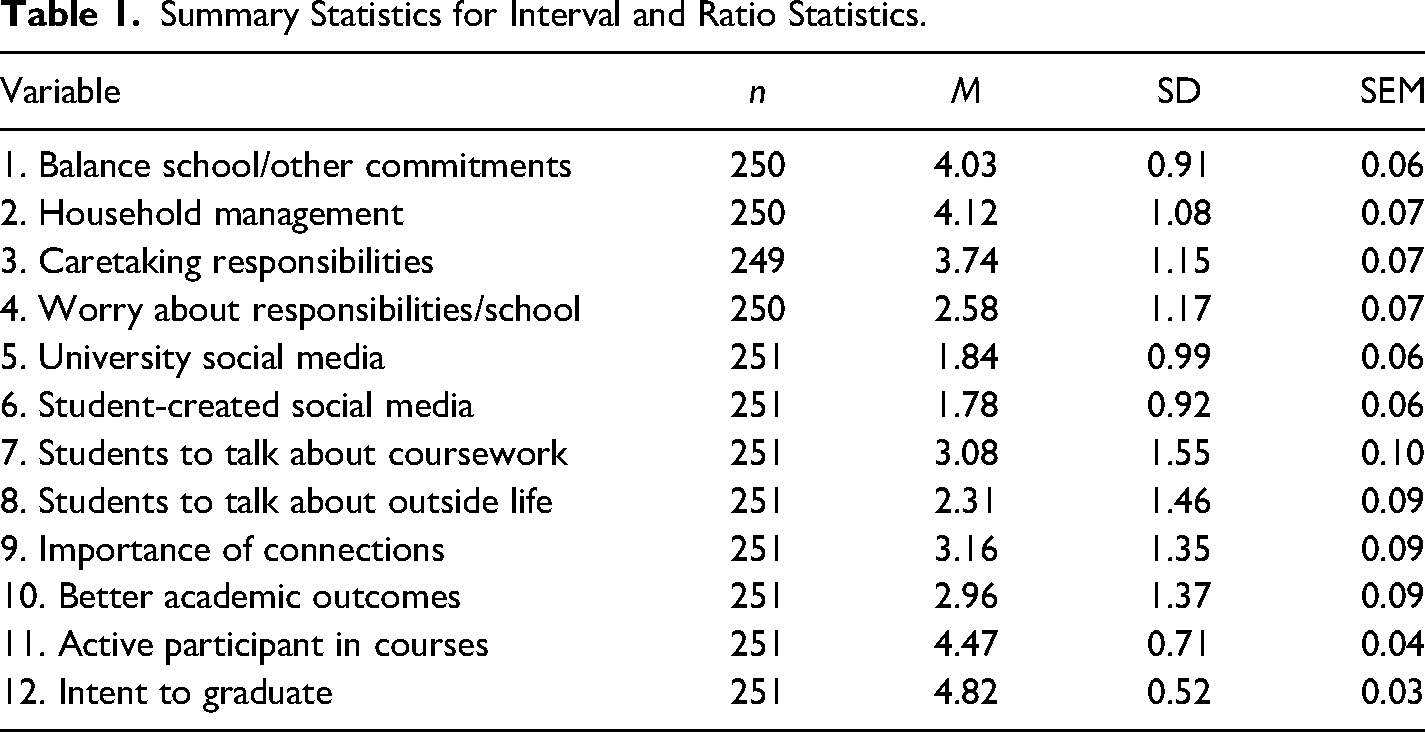
A higher level of agreement was observed for statements regarding the ability to balance school with other commitments (M = 4.03, SD = 0.91, SEM = 0.06) and having responsibility for most household management tasks (M = 4.12, SD = 1.08, SEM = 0.07). Observations for questions related to community participation indicate that participants were not engaging in university-sanctioned social media (M = 1.84, SD = 0.99, SEM = 0.06) or student-created social media (M = 1.78, SD = 0.92, SEM = 251) at high rates. Observations for questions associated with informal community indicate variance in how respondents view the importance of peer connections. For example, the mean was 2.31 (SD = 1.46, SEM = 0.09) for the statement about communicating with at least one program peer about life outside of school.
Correlation Analyses
Spearman correlation analyses were conducted to determine relationships between variables. Cohen's standard was used to evaluate the strength of those relationships, and the results of correlations were examined using Holm corrections to adjust for multiple comparisons based on an alpha value of 0.05. Though small to moderate effect sizes were observed for relationships between several variables, large effect sizes were observed between variables for perceptions of having done better academically due to having peer connections and having a peer with whom to discuss coursework and life outside of school. Results indicate that students with peer connections recognized the value of peer relationships and their effect on academic performance. Results are detailed in Table 2.
Spearman Correlation of Study Variables.
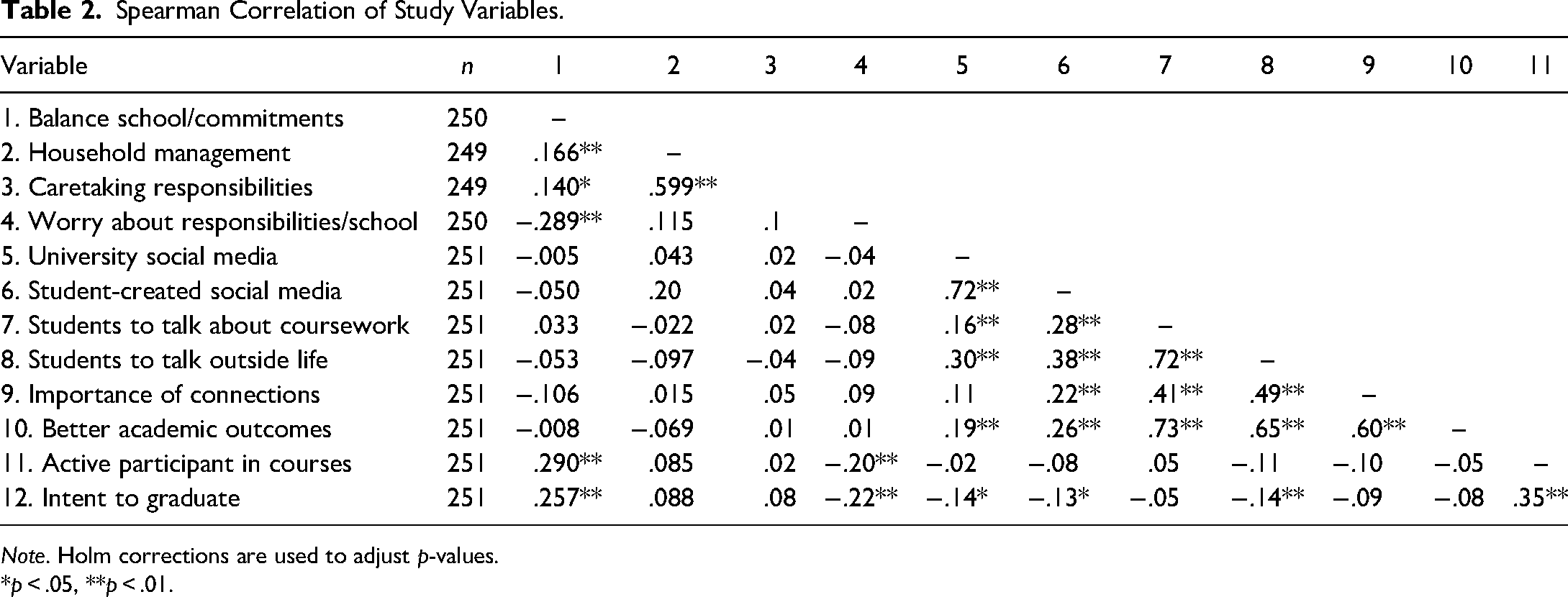
Note. Holm corrections are used to adjust p-values.
*p < .05, **p < .01.
Role Identity, Social Connections, and Academic Perseverance
As previously mentioned, there was a higher level of agreement for statements regarding the ability to balance competing priorities as well as intent to graduate. Spearman correlation analyses appear to confirm that while participants indicated they were responsible for household management, they felt that they could manage these responsibilities. There were few statistically significant relationships between variables related to competing priorities and intent to graduate. However, statistically significant relationships were observed between variables related to social connection and academic outcomes, especially around perceptions about the importance to and influence of those relationships on academic outcomes.
Perceptions of the Value of Connections
A significant positive correlation was observed between having a peer with whom to discuss coursework and having a peer with whom to discuss life outside of school (rs = 0.72, p < .001, 95% CI [0.66, 0.78]). The correlation coefficient indicates a large effect size and a strong linear relationship. This appears to indicate that as connecting with a peer about coursework increases, so too does connecting with a peer about life outside of school.
A significant positive relationship was observed between the belief in having done better academically due to having at least one other student with whom to talk and having at least one other program peer with whom to communicate about coursework (rs = 0.73, p < .001, 95% CI [0.66, 0.78]). The correlation coefficient indicates a large effect size. As student perceptions about the effect of peer connections on academic outcomes increase, talking to other students about coursework increases as well. Additionally, a significant positive correlation was observed between belief in having done better academically and having at least one other student with whom to talk about life outside of school (rs = 0.65, p < .001, 95% CI [0.57, 0.72]). The correlation coefficient indicates a large effect size.
This corresponds with observations regarding the relationship between better academic outcomes and valuing peer connections; a significant positive correlation was observed between valuing having a peer with whom to discuss school and other responsibilities (family, work) and doing better academically due to having a peer with whom to talk (r = 0.60, p < .001, 95% CI [0.51, 0.67]). The correlation coefficient indicates a large effect size and a strong linear relationship; as perception about the importance of peer connection increases, perceptions about social connection's influence on academic outcomes also increase.
A significant positive correlation was observed between participating in student-created social media and participating in university-sanctioned social media groups (rs = 0.72, p < .001, 95% CI [0.65, 0.77]), with the correlation coefficient indicating a large effect size.
Exploratory Thematic Analysis
One hundred and three participants provided responses to an open-ended question asking participants if they had additional comments. This study was not designed as a mixed-methods study. However, coupling statements with the data offers insight into how this group of online learners viewed social connection and various factors influencing program experiences. Therefore, an exploratory thematic analysis was conducted, and several themes were identified, including (a) recognition of the importance of peer relationships in providing support to manage stress and focus on school, (b) a desire for peer connections, and (c) a lack of opportunities to connect with peers in the online environments.
Respondents noted the difficulty in balancing competing priorities and the stress’ effect on mental health, but participants who had connected with peers noted the benefits of these connections in counteracting stress. One stated, “I feel that my personal relationships with other students has [sic] greatly supported my finishing of my online program. I appreciated having someone to discuss personal and educational struggles and successes with. The relationship provided support and validation.” Another respondent stated, “If I didn’t have the relationships that I do with peers I would have struggled emotionally.” The importance of social connection's ability to mitigate nontraditional student stress is reflected in this participant's statement when they said, “These connections ground me and let me know I’m not alone when I’m feeling stressed out and overwhelmed or combating feelings of imposter syndrome. We motivate each other to keep going.”
While some students were socially connected with peers, others noted their frustration in not having those connections, which could indicate less satisfaction with their academic programs. Several noted limited opportunities to connect with peers, reflected in this participant's statement, “I feel like there's no opportunities to connect outside of an online course to make these relationships happen.” Another participant stated, “I would have liked to gain more relationships … but it was not created that way … I did well, but I would have gotten so much more if there were more opportunities to work together.”
Discussion
The study's purpose was to explore the relationship between role identity (e.g., having caretaking and work responsibilities), social connection (e.g., communicating with peers about school and life outside of school), and OAL academic perseverance (e.g., course participation, intent to graduate). Additionally, the study explored the relationship between formal and informal engagement in the community with adult learner stress and intent to graduate, as well as satisfaction with their academic programs. Results from the study suggest that peer connection is positively correlated with academic outcomes. Participants reported having the ability to navigate school and competing priorities (e.g., work and family), with many indicating that they actively participate in classes and intended to graduate. Spearman correlation analysis provided additional insight. Results indicate that participants valued connections with peers and believed that those connections influenced academic outcomes. Results indicate that as the belief that peer support positively influences academic outcomes increased, so did having communicated with a peer about school and life outside of school. Additionally, having a peer with whom to discuss coursework was positively associated with having a peer with whom to discuss life outside of school. However, exploratory thematic analysis of participant responses to an open-ended question revealed that many wanted more connection and desired an opportunity to form connections with peers.
Social Beings, Social Students
Previous research indicates that student connection and sense of belonging positively impact academic perseverance, enhancing retention. However, there has been little research that has focused on the needs of OALS, specifically seeking to understand the connections between students’ social location, their connection to peers, and how this influences academic perseverance. Participant responses revealed the value that students place on peer connections, as many indicated that they viewed having peer connections as positively influencing their ability to balance competing priorities and remain enrolled. Results appear to indicate student confidence in the ability to balance competing priorities. However, responses to the open-ended question asking participants if they had additional comments provide insight into the stress some were experiencing. Almost 41% of study participants provided additional comments, with several noting the difficulty associated with balancing competing priorities. Those who shared being connected with peers noted the benefits of these connections in providing support to help mitigate stress and motivate students to continue in school. Participants who reported connecting with peers about school also reported connecting about life outside of school. These observations correspond with previous studies that have found that a positive relationship exists between peer connections and student perceptions of academic performance and perseverance (Altermatt, 2019). In this current study, responses to an open-ended question revealed that participants with peer connections recognize the positive influence on their ability to navigate school and competing priorities.
Previous research shows the negative effects of balancing multiple responsibilities on nontraditional students’ academic performance and engagement (Benner & Curl, 2018; Lee, 2018). While the observations from this study did not show strong linear relationships between balancing multiple priorities and academic performance, participant comments indicate that respondents recognize the value of peer connections in counteracting stress. Participant comments related to the desire to engage in community and the difficulties of balancing school with other priorities appear to reinforce findings from previous studies. Prior research has found that having competing priorities impacts nontraditional student academic perseverance.
Social Location, Role Expectations, and Program Satisfaction
Most study participants were cis-gender females, and most indicated that they worked for wages. Almost half of respondents reported caring for children under 18, and almost 13% reported providing care for others who were not minor dependents. These respondents also reported having responsibility for household tasks. Previous research has indicated that female-identifying students are overrepresented in the nontraditional student body (Hussar et al., 2020), are more likely to have reported withdrawing from courses due to family and parenting commitments (Burke, 2019), and are more likely to report dissatisfaction with online courses and feel they lack social support while in school than their male-identifying peers (Stoessel et al., 2015).
This study sought to address gaps in research, mainly gaps related to student social location, and the link between social location and connection. Previous research has established the relationship between social connection and academic perseverance; however, the absence of research on online nontraditional students balancing multiple roles and competing priorities puts educators seeking to serve this student group at a disadvantage. The students participating in this study were mostly female and were balancing multiple roles. Though they indicated confidence in their ability to navigate competing priorities, comments regarding associated stress align with previous research indicating a desire for more social support and connection within the realm of online learning. With the high numbers of female students enrolling in post-secondary education, attending to social needs to support academic perseverance is warranted. This should also be a reminder to educators that while students can navigate school, and though some can withstand the challenges and weather the stress, more can be done to provide support and alleviate that stress to foster better outcomes.
While study participants indicated a desire to form connections, several noted limited opportunities for forming peer connections. Coupling responses with the data offers insight into factors influencing program experiences. The asynchronous and transactional nature of online education is often cited as contributing to students feeling socially isolated (Collins et al., 2019; Putulowski & Crosby, 2019). Participants reported engaging in course discussions and group projects but did not view this as fostering peer connections, consistent with previous studies examining online student views of asynchronous online activities (Gering et al., 2018). Results from this current study appear to indicate that once students form peer connections, those connections encompass both school and life outside of school, but that more needs to be done by universities to foster online student community and connections.
Implications for Educational Practice
Study results and participant responses indicate that there is a relationship between peer support and academic perseverance, or that at least the perception of peer connection positively influences academic outcomes. Previous research has found social connection mitigates the effects of stress on students (Suhlmann et al., 2018; Vungkhanching et al., 2017), demonstrating the need for enhanced opportunities for online student social connection (Angelino et al., 2007). Creed et al. (2015) note that educational policymakers are increasingly focused on role conflict experienced by students with family or work commitments. Nontraditional student enrollment and the availability of online options both continue to increase, yet enrollment and availability do not translate into increased OAL graduation rates. Increased attrition risk has been noted by Stoessel et al. (2015), Burke (2019), and Benner & Curl (2018) for subpopulations associated with the nontraditional student population. Educators seeking to enhance program completion rates can engage in intentional strategies to foster engagement in online programs to mitigate the increased stress resulting from that conflict.
In describing the underlying philosophies guiding CoI, Garrison (2013) notes that “learning in an educational context is a social enterprise” (p. 2). CoI is predicated on the belief that community formation is instrumental in creating an online learning environment for students to construct knowledge. Study results and previous research align with this belief. Creating both formal and informal avenues for social connection, such as peer mentoring and including low-stakes group work are some methods to increase group affiliation, student connection with the program, and peer-to-peer connection (Schuman et al., 2021; Woodley et al., 2017). To increase retention educators can explore methods to foster greater peer connection.
Limitations and Implications for Future Research
This was an exploratory study utilizing an online survey tool. While study results indicate that social connection correlates with academic perseverance, or at least that the perception of social connection positively influences academic perseverance, it is important to consider study limitations. As noted previously, the small sample size, overrepresentation of some populations (e.g., cis-gender white women), and study tool design limit the generalizability of study results. Additionally, the study was conducted with students attending a small, private Catholic institution. While the institution caters to nontraditional students in a metropolitan area, it is important to note how conducting the study at one institution limits the applicability of the results to other environments.
This study relied on self-reported measures of social connection and academic perseverance. Though students indicated an intent to graduate, the study's design does not support tracking long-term outcomes. Further research is needed to examine social connection's role in fostering OALs’ ability to navigate competing priorities leading to greater postsecondary retention. It is also of note that the survey was administered during a global pandemic, a time when many felt isolated and overwhelmed, affecting student stress and faculty engagement. High teacher presence and classroom leadership are both instrumental in fostering online student group cohesion (Garrison, 2013; Garrison et al., 2010). Replicating this study in the post-pandemic future may provide different results.
Conclusion
With adult learners’ continued enrollment in postsecondary programs and greater online and hybrid program availability, understanding the factors contributing to attrition and methods to foster a greater sense of belonging is needed. This study's results align with previous research indicating that a relationship exists between social connection and academic perseverance. The complexities of occupying multiple roles and juggling numerous responsibilities for adult learners and the nature of online education can compound feelings of isolation. Developing methods to foster greater peer-to-peer relationships and social connections for this population is one strategy for enhancing program completion rates and ensuring better long-term academic, financial, and career outcomes for OALs.
Footnotes
Declaration of Conflicting Interests
The author(s) declared no potential conflicts of interest with respect to the research, authorship, and/or publication of this article.
Funding
The author(s) received no financial support for the research, authorship, and/or publication of this article.
