




Abstract
Participation in adult learning and education requires the availability of, and accessibility to, learning opportunities provided by educational institutions. One fundamental element is time. Adult learning and education participation can only be realized by successfully matching individual time-availabilities with the temporal organization of provided courses. To address this required matching process, this study contributes to research literature as one of the first studies that investigates the impact of timing and course duration on participation counts (longitudinally). For this, we use organizational data from public adult education centers (Volkshochschulen—VHS; the main adult education providers in Germany) from 2007 to 2017. Methodologically, random- and fixed-effects models are applied. We find significant positive effects on participation counts between increasing program breadth in terms of temporal formats and increasing average course duration.
Current research on participation in adult learning and education (ALE) points to complex interactions between individual learners, learning opportunities and the broader societal and policy contexts framing both individuals and educational institutions (Boeren, 2017; Rubenson & Desjardins, 2009). Sociostatistical research explains ALE participation with individual sociodemographic, economic and cultural characteristics (e.g., Kalenda et al., 2019). These characteristics include, for example, the individuals’ age, gender, family background, migration background, employment and occupational status, or level of educational attainment. Although such characteristics can, to some extent, explain societal inequalities and selectivity in ALE participation (Walter & Müller, 2014), literature still lacks a reflection of factors at the institutional level and the broader societal and policy context influencing participation (Boeren et al., 2010). In addition, explaining ALE participation is a central subject in international comparative research on participation patterns (e.g., Støren & Børing, 2018). While academia is currently discussing the importance of individual characteristics and the national state for ALE participation, Boeren (2017) points out that there is still little evidence on the interactions between (potential) participants and the learning opportunities provided by educational institutions. That work follows on from an earlier call for further study, where Boeren et al. (2010) argued that achieving ALE participation requires a successful match between the demand of (potential) participants and the supply provided by educational institutions. However, the research base investigating this matching process is sparse, raising questions on the contexts and conditions of successful matching.
A fundamental prerequisite for the matching process as characterized by Boeren et al. (2010) is the availability of, and accessibility to, a supply of course offerings. Thus, course offerings represent the necessary condition for the possibility of ALE participation. One structural element of this necessary condition is time, in terms of the temporal organization of course offerings. Whereas ALE participation requires the availability (and subsequently the investment) of temporal resources at the individual level, it fundamentally also requires the temporal availability of, and accessibility to, course offerings on the supply-side. Accordingly, Schmidt-Lauff (2008) argued that ALE participation can only be realized by successfully matching individual time-availabilities with temporal factors on the institutional level. Thus, the temporal organization of course offerings is the deciding factor for matching supply and demand, and whether individuals participate. However, despite the universally accepted importance of time for ALE (e.g., Schmidt-Lauff & Bergamini, 2017), an operationalization of the matching process remains a research gap (Boeren, 2017).
Hence, our study addresses this research gap by operationalizing time as a structural element of the necessary condition for the possibility of ALE participation. In a longitudinal design, we investigate the effects of temporal factors of course offerings such as timing and duration on participation counts. Thus, we focus on organizational level changes in the temporal organization of course offerings, distinguishing temporal formats, and course durations within educational programs. For this, we use data from German VHS statistics that addresses public adult education centers (Volkshochschulen—VHS) between 2007 and 2017. Methodologically, we employ random- and fixed-effects models, aiming at causal inferences.
Educational Mandate of VHS in Germany
VHS are the main public providers of adult education in Germany. Their objective is the promotion of lifelong learning that supports active participation in society, culture, and employment and that fosters social integration and social cohesion (DVV, 2019). The educational programs offered are based on courses covering topics from politics, culture, art, health-related, and environmental subjects to languages and basic education. VHS define education as a public and societal good, and aim for their services to answer public and societal interests in education. Thus, VHS operate in a norm-rational way (Schrader, 2011), providing universally accessible and attractive education for all citizens. In contrast, organizations in the open market context act in a profit-orientated way providing services for economic purposes. VHS can receive mixed funding from the local municipality, the individual federal state, job centers, the nation state, the European Union and from public and private enterprises for course fees and special contracts for inhouse courses. In 2018, VHS offered 552,000 courses with a total of 17.0 million teaching hours and 6.1 million participations (Reichart et al., 2019).
Conceptual Framework—ALE Participation as an Interaction Between Participants and Educational Institutions
Academia currently argues for approaching ALE participation as the result of interactions between an individual decision and “a broader context that limits possible choices and makes participation less or more attractive, accessible and advantageous” (Lavrijsen & Nicaise, 2017, p. 178). To describe these interactions, Boeren et al. (2010) introduced a comprehensive lifelong-learning participation model. The model distinguishes between a demand-side (micro-level), a supply-side (meso-level) and a broader social and policy context (macro-level). On the demand-side is the individual and their perception of learning opportunities and subsequent decision to participate. The individual is influenced by socioeconomic, cultural, and psychological factors, as well as by relevant others such as family, friends, or employer. The supply-side constitutes educational institutions, characterized by organizational factors such as the educational program, accessibility or staffing. Both sides are embedded in a broader social context based on rules, laws, rights, and duties.
For the theorized interactions between supply and demand, the educational program on the supply-side is the central medium of the matching process. On one hand, educational programs include general information and access preconditions (e.g., content, qualification, location, duration, and fees). On the other, educational programs operationalize concepts resulting from the demands, expectations, and needs of potential participants (Nolda, 2018). Simultaneously, serving the public with universally accessible course offerings requires educational institutions to react flexibly and in accordance with current societal developments when planning educational programs (Gieseke & von Hippel, 2019). Kowalski (1988) argued that a static program design may eventually become outdated and may then fail to attract potential participants.
Time as a Central Condition of the Matching Process
There are two research perspectives on time as a central condition of the matching process. A first perspective focusses on the individual level. In this perspective, participants need to raise time as a resource and element of indirect costs (Bellmann & Leber, 2019). The Adult Education Survey (AES; BMBF, 2019) investigates participation rates and the time volumes invested in nonformal education in Germany for different periods from 2007 to 2018. Overall, the participation rate increased from 44% (2007) to 54% (2018). Simultaneously, the average number of educational activities decreased from 1.9 to 1.7 per participant and the average volume of invested time decreased from 85 hours to 79 hours. For 2018, this resulted in an average of 43 hours per person within the entire population of 18- to 64-year-olds in Germany, which is spent on an average of 0.9 activities. In comparison, the average time spent per person within the population for educational activities decreased from 42 (2012) to 36 hours (2016). The increase from 2016 to 2018 is assumed to be the result of increased immigration to Germany in 2015/2016 (BMBF, 2019).
In addition, invested time volumes vary with the content of educational activities. The AES distinguishes three segments of nonformal education. Employer-sponsored education constituted 72% of all educational activities in 2018 (2012: 69%) but only covered 45% of the time volume in 2018 (2012: 51%). By comparison, the share of job-related non-formal education was lower (2012: 13%; 2018: 10%), but the share of time was significantly higher at 33% in 2018 (2012: 25%). The same applies to the segment of non-job-related non-formal education. The share was 18% in 2018 (2012: 18%), but the time volume covered 21% in 2018 (2012: 24%).
Although the AES provides first insights into trends of participation rates and time volumes, the variable time remains an observable outcome. Underlying decision-making processes and the causal effects of individual time-availabilities on participation rates remain unexplained. Regarding the participation decision, scholars define time as a scarce resource affecting individual decision-making processes Rüter et al. (2020). Schmidt-Lauff and Bergamini (2017) argue for an understanding of time in a societal context characterized by complexity, ambivalence, and paradoxes. In their work, time is characterized by change, resulting in heterogeneous effects on ALE participation. Accordingly, time availabilities result from multilayered backgrounds and vary depending on life situations, positions in the employment system, age and gender. Other factors include different life phases such as career entry or advancement, starting a family, or retirement (Schmidt-Lauff, 2008).
In addition to factors on the individual level, individual time-availabilities are related to societal and organizational levels. These levels refer to, for example, the level of educational governance or the employer and respectively refer to measures such as laws on educational leave or employer offered leave of work, which intend to foster and support ALE participation by providing a specific timeframe. However, research and causal evidence on the effects of such measures is still scarce. Most recently, Rüter et al. (2020) investigated the causal effects of implementing a law on educational leave in Germany on individual participation in ALE. The research applied a difference-in-differences estimation strategy with propensity score matching and instrumental variable and found no positive treatment effect on individual participation behavior of eligible employees.
Due to the scarce nature of temporal resources, the opportunity costs of activity participation increase (Klein, 2007). This also affects ALE as the required time to participate rivals with other time commitments in adults’ private and professional lives (Schmidt-Lauff & Bergamini, 2017).
In a second perspective, time provides opportunities for ALE participation at the institutional level (Kuper, 2001). These opportunities are represented within educational programs, which define the temporal conditions of course access by sequencing teaching–learning interactions. The temporal structure of educational programs constitutes different temporal formats (e.g., courses held once or several times a week) and course durations. With regard to structural components of educational institutions, a study by Schuetze and Slowey (2002) identified specific factors that influence participation in higher education. The results highlight that flexible access to the curriculum attracts adult learners and might influence individual participation decisions. This flexibility can be achieved by introducing and/or expanding methods of instruction, learning independent of place, or time, or other restrictions, by alternative modes of study or by financial support.
Employing qualitative interviews and analyzing educational programs, the study by Nahrstedt et al. (1998) focused on changes on the supply-side of VHS courses from 1995 to 1997. The results revealed that educational programs were increasingly oriented toward the time availability of potential participants and that the temporal structures within educational programs were becoming more diverse and complex. Compact formats on weekends, or courses with many short lessons spread over a long duration have gained increasing relevance (Brinkmann, 2000).
In addition, scholars investigated ALE participation differentiated by course content, timing, and duration. Although the AES does not directly include information on the educational institution framing ALE participation itself, the results provide information regarding trends of temporal formats and course durations in nonformal education from 2007 to 2018 (BMBF, 2017, 2019). Noteworthy is the increasing relevance of activities lasting several hours from 17% to 29%. At the same time, the share of activities lasting several days (2007: 34% and 2018: 27%) and several months (2007: 15% and 2018: 12%) decreased. Single-day activities and formats covering several weeks vary in their relevance but are relatively constant at 21% (1-day) and 7% (several weeks). Referring to Käpplinger (2018), there is a general trend toward shorter temporal formats in adult education.
Empirical findings of recent studies, meanwhile, both confirm and contradict this trend. Denninger et al. (2020) argue that participants prioritize shorter courses over time-intensive courses because their private and professional lives are less affected. Furthermore, increasing learning times are assumed to cause increasing time rivalries between the educational activity and time spent at work, with family or on recreation (Lobe, 2015). In this context, the study by Richter et al. (2020) investigated the effects of the timing and duration on participation rates in continuing vocational education and training for teachers in the German federal state of Brandenburg. The study examined courses with a duration of 1 day (one-shot courses) or several days. The results revealed that the duration significantly predicts participation rates. Furthermore, teachers less frequently attended one-shot courses that were shorter than 2 hours or longer than 8 hours. However, participation rates increased as course duration increased within the 2 to 8 hours sweet-spot. Opposing the hypothesis that teachers might prioritize shorter courses because they are easier to match with high working hours, the results also indicate that there is a higher demand for courses lasting several days. One possible explanation formulated by Richter et al. (2020) refers to expectancy-value theory (Wigfield & Eccles, 2000), arguing that teachers expect no returns from participating in one-shot courses.
Those findings indicate that, in addition to the matching logic of increasing the likelihood of a successful match by decreasing the course duration, there is another mechanism to consider and to control in our study. Generally, expectancy-value approaches predict individual motivation and behavior based on high expectations, a high-perceived value and low costs (Gorges, 2016). This rationale includes (temporal) resources that need to be invested in order to participate and the expected returns from ALE. In this perspective, course offerings with high opportunity costs and low expected monetary or non-monetary returns are only likely to enable ALE participation when the course duration is short. This primarily relates to the segment of non-job-related nonformal education. In comparison, courses in job-related nonformal education that last longer are associated with higher costs, but also with higher expected returns.
However, the key condition for such rational decisions on ALE participation is the availability of, and accessibility to, learning opportunities. This remains a research gap because the existence of learning opportunities as the necessary conditions for the possibility of ALE participation is considered a given fact in present action-theoretical approaches. Ahl (2006) argued that theories that put their main emphasis on individuals “risk to blame individuals for not participating” (Boeren et al., 2010, p. 56). This issue is followed up in our study by operationalizing the matching process on the supply-side and by investigating how the temporal organization of courses affects participation counts longitudinally.
The Present Research
Although contemporary academia argues for a fundamental relationship between temporal factors on the supply-side and the likelihood of participation, empirical and longitudinal studies aiming at causal inferences are still rare. Due to the scarce knowledge available, it is not possible to formulate generally valid conclusions on the impact of timing and duration on ALE participation. Hence, we argue that the scope of the discussion needs to be broadened by evidence-based and longitudinal research.
In our study, we hypothesize two central mechanisms of time on the matching process and participation counts that need to be estimated. The first mechanism is related to the assumption that a wider and more flexible range of course offerings is an effective and efficient strategy to enable and widen ALE participation by overcoming institutional barriers (Cross, 1992). The more broadly educational programs are structured in terms of different temporal formats, the more likely it is that these temporal conditions of accessing any course will match with the time availabilities of potential participants. Based on this assumption, our first hypothesis is as follows:
The second mechanism regards the course duration. We hypothesize that shorter course durations are easier to match to individual time-availabilities. Thus, shorter courses increase the likelihood of successful matching. Based on this assumption, our second hypothesis is as follows:
Data Description
To investigate our hypotheses, we use longitudinal data from the German VHS statistics (Reichart et al., 2019). This annual survey initiated in 1962 by the German Institute for Adult Education—Leibniz-Centre for Lifelong Learning provides a near full sample of VHS in Germany. We selected data from the survey years 2007 to 2017. In 2007, 958 VHS participated in the survey and, in 2017, 883 VHS. Throughout the whole observation period, 864 VHS consistently took part. The set of variables provides information on staff, financial means and expenditures, course counts, participation counts, cooperation with other institutions and activities such as study tours or exhibitions. While the entire observation period covers 11 years, the inclusion of lagged variables in our models shrinks our factual observation period to 10 years from 2008 to 2017 (for details: see analytical strategy).
Based on our hypotheses, the variables of interest include course counts, participation counts as well as temporal formats and course durations. The VHS statistics include the required information recorded in 86 subject areas, nested in six program areas for each VHS and year (Figure 1).
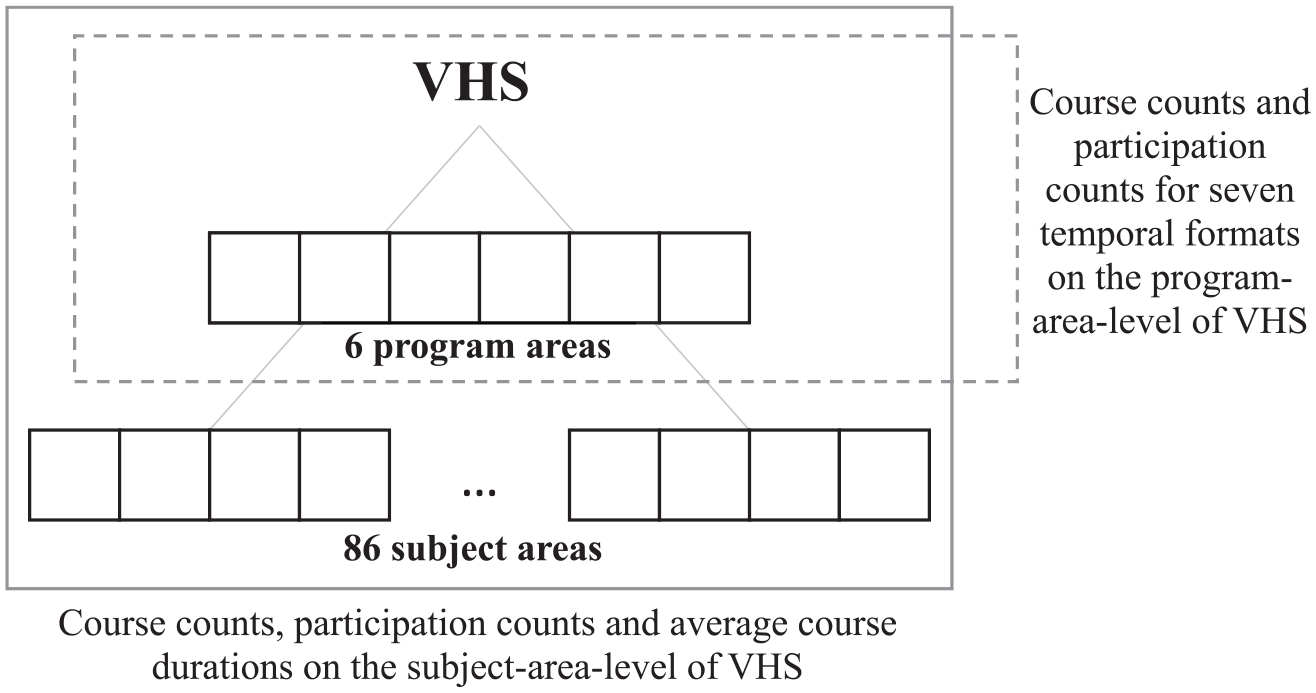
VHS (Volkshochschulen) statistics—Data structure.
However, the VHS statistics only distinguish temporal formats at the program-area-level: (1) once a week evening course; (2) once a week day course; (3) several times a week evening course; (4) several times a week day course; (5) day course; (6) weekend course; (7) week-long course. Therefore, we investigated Hypothesis 1 at the VHS-level.
In 2018, 89% of all course offerings could be assigned to one temporal format (Reichart et al., 2019). Due to a different statistical reporting strategy by VHS in the federal state of Bavaria, no information on temporal formats there is included. In addition, the VHS statistics include information regarding the time volume of course offerings in hours at the subject-area-level. Therefore, we investigated Hypothesis 2 on the subject-area-level. This process allowed us to control for the course content and to control for assumed heterogeneous effects of the course duration on participation counts. However, we could not identify individual course durations. Instead, we could only calculate the average course duration based on the reported course counts and the total time volume of course offerings for each subject area. Furthermore, we used regional context data from the German Federal Statistical Office and the Federal Institute for Research on Building, Urban Affairs, and Spatial Development. The first source supplied us with data regarding the population on the municipality-level and the latter with data regarding the settlement types of municipalities. Since the regional context data from one municipality was sadly not consistently available between 2007 and 2011, we excluded the corresponding VHS from our models for this period.
Samples
Although the VHS statistics allow the creation of a balanced panel of VHS participating for the whole observation period, the variables of interest are not equally consistent. For some variables, there are several runs of consecutive observations separated by gaps in the panel data. These gaps cause missing observations within each VHS (Hypothesis 1) and within each subject area (Hypothesis 2) that may bias the results of our analysis. In the following, we describe the process of creating our analytical samples.
Relevant for Hypothesis 1 is that, although the VHS statistics include the total number of course offerings for every VHS and year and distinguish course counts for the seven temporal formats, for some observations, the total number of course offerings of a VHS and the number of course offerings that could be assigned to temporal formats are mismatched. This mismatch results from either item-nonresponse or temporal formats not covered by the VHS statistics (e.g., courses at nonregular intervals such as courses held every 2 weeks). To cope with this mismatch, we created two VHS subsamples. The idea of the wide sample is to include a new variable labeled “other temporal format” (course counts that could not be assigned to one of the seven temporal formats). The wide sample includes VHS with the latest sequence of at least three consecutive observations, summing up n = 727 VHS and N = 6,803 observations in the factual observation period. In contrast, the restrictive sample includes observations with complete and consistent information, with the latest sequence of at least three consecutive observations per VHS. Here, we excluded course counts that could not be assigned to a temporal format from the analysis. The restrictive sample sums up n = 694 VHS and N = 5,571 observations in the factual observation period.
Regarding Hypothesis 2, participation counts and average course durations at the subject-area level shape the basis of our analysis. However, there are gaps separating runs of consecutive observations of subject areas where no courses took place. These gaps could impede our analysis because of an observed average course duration of zero hours for a given year. Therefore, we created a sample that included observations within the latest sequence of at least three consecutive observations of course offerings per subject area with actual course counts. The sample sums up n = 33,639 unique subject areas and N = 242,805 observations in the factual observation period.
Variables
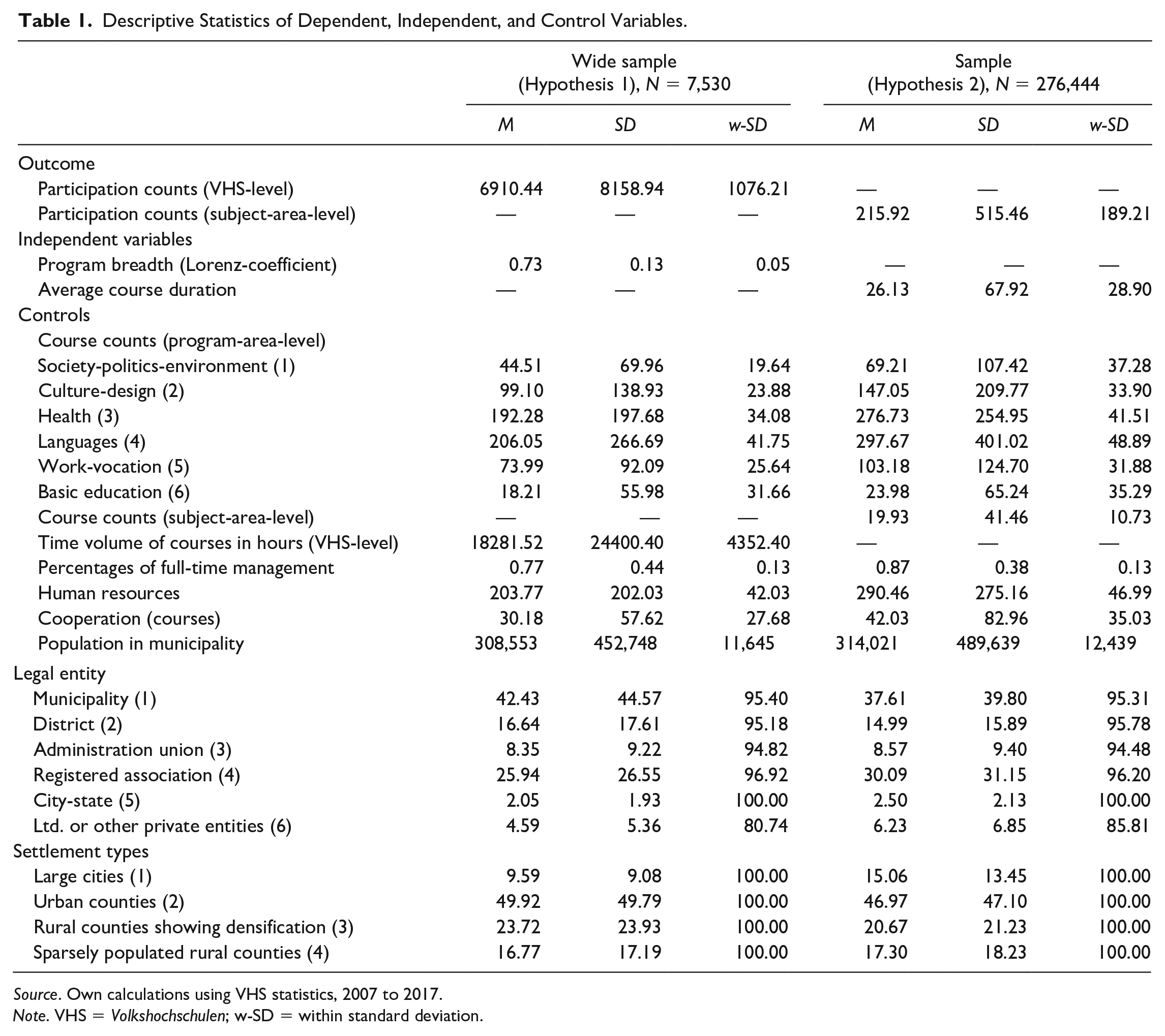
Our hypotheses target potential effects of the timing and duration of course offerings on participation counts. Accordingly, participation counts form our dependent variable at the VHS-level (Hypothesis 1) and the subject-area-level (Hypothesis 2). Within current ALE participation research, participation counts are suitable performance indicators (Widany et al., 2020). The main independent variables are the program breadth described by temporal formats at the VHS-level (Hypothesis 1) and average course durations at the subject-area-level (Hypothesis 2). To control for the most important factors that confound both outcome and predictors, we included further variables. At the VHS-level, we included the number of course offerings on the program-area-level for every VHS and year, percentages of full-time management, human resources, courses in cooperation with other institutions and the form of legal entity the VHS in question is designated as. To control potential influences of municipality-specific factors, we matched a variable covering the municipality population for every VHS and year, as well as a variable covering the settlement type of the municipality to our dataset. Table 1 shows the descriptive statistics of all model-specific variables from 2007 to 2017. Regarding Hypothesis 1, we only report descriptive statistics for the wide sample because it best describes the distribution of characteristics in the population and because the restrictive sample is a subsample of the wide sample. In addition, we created an online appendix on OSF (https://osf.io/by9wc/?view_only=4fec6d89cce949cda5300bd3343beebe) covering descriptive statistics for both samples.
Descriptive Statistics of Dependent, Independent, and Control Variables.
Source. Own calculations using VHS statistics, 2007 to 2017.
Note. VHS = Volkshochschulen; w-SD = within standard deviation.
On average, VHS in the wide sample conducted 634 courses per year, serving 6,910 participants. The highest course counts are in the program areas Health (3) and Languages (4). However, the descriptive statistics reveal high standard deviations, indicating substantial differences within and between VHS.
Analytical Strategy
Measurement of Program Breadth—Lorenz-Coefficient
To measure the program breadth regarding temporal formats, we use the Lorenz-coefficient (Hartung et al., 2009). We estimated the Lorenz-coefficient for every VHS and year for both the wide and restrictive sample. The Lorenz-coefficient is standardized to values between 0 and 1, with 0 describing an equal distribution of courses across all temporal formats within an educational program and 1 describing a complete concentration of courses on a single temporal format. It is worth mentioning that once-a-week evening courses and day courses represent the majority (65.1%) of all courses (Reichart et al., 2019). Figure 2 displays the development of the Lorenz-coefficient.
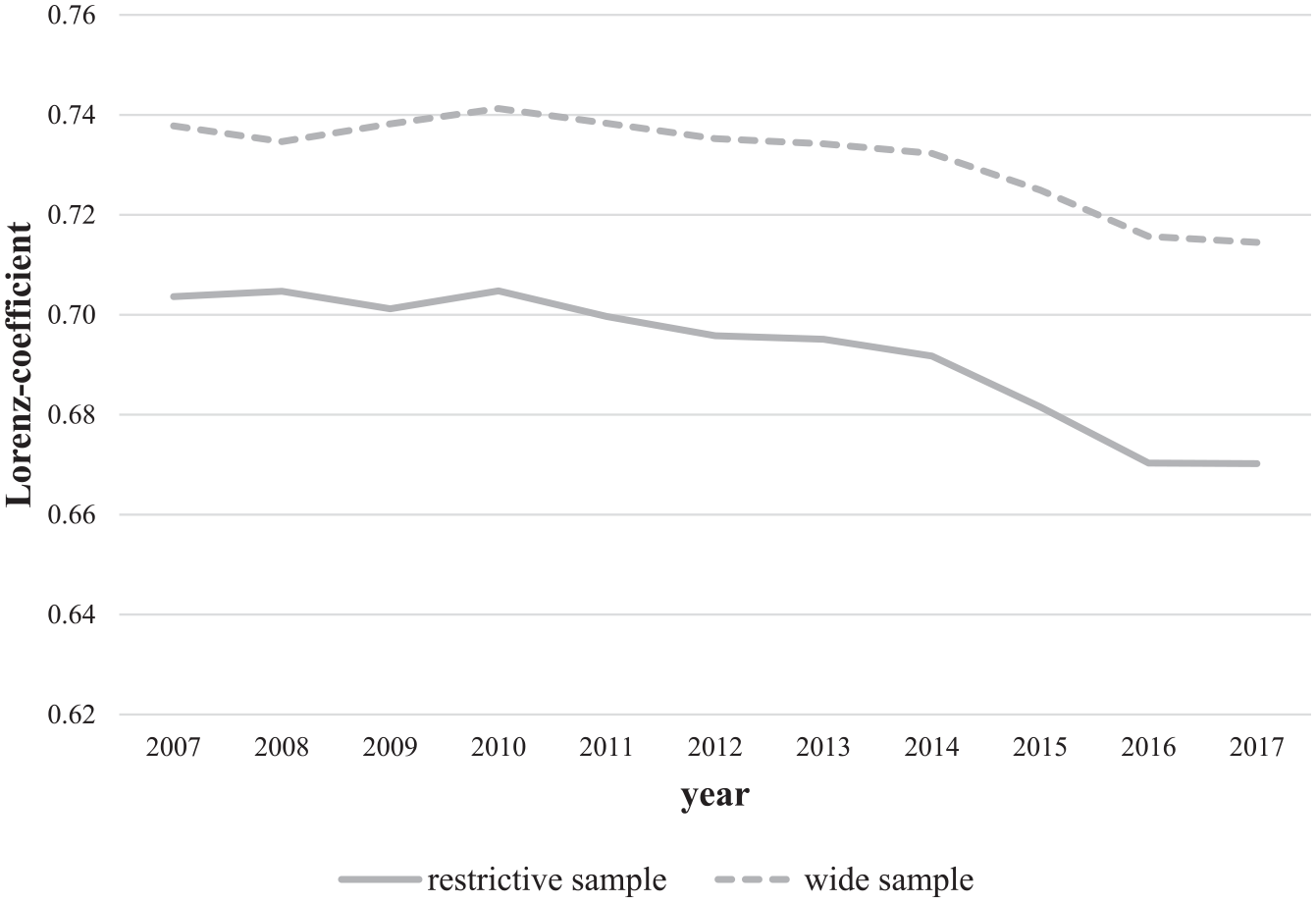
Lorenz-coefficient.
The results reveal a general trend toward an increasing program breadth of temporal formats on the supply-side of VHS. How this affects participation counts is examined with regard to Hypothesis 1.
Measurement of Average Course Duration
We calculated the average course durations of every subject area and year. We excluded the subject area entitled German as a foreign language because the demand for integration courses develops along continuing migration movements and is not affected by the supply-structure provided by VHS. Figure 3 displays the trajectories of the average course duration within six program areas. For ease of viewing, we present descriptive results on the program-area-level instead of results for all 85 subject areas.
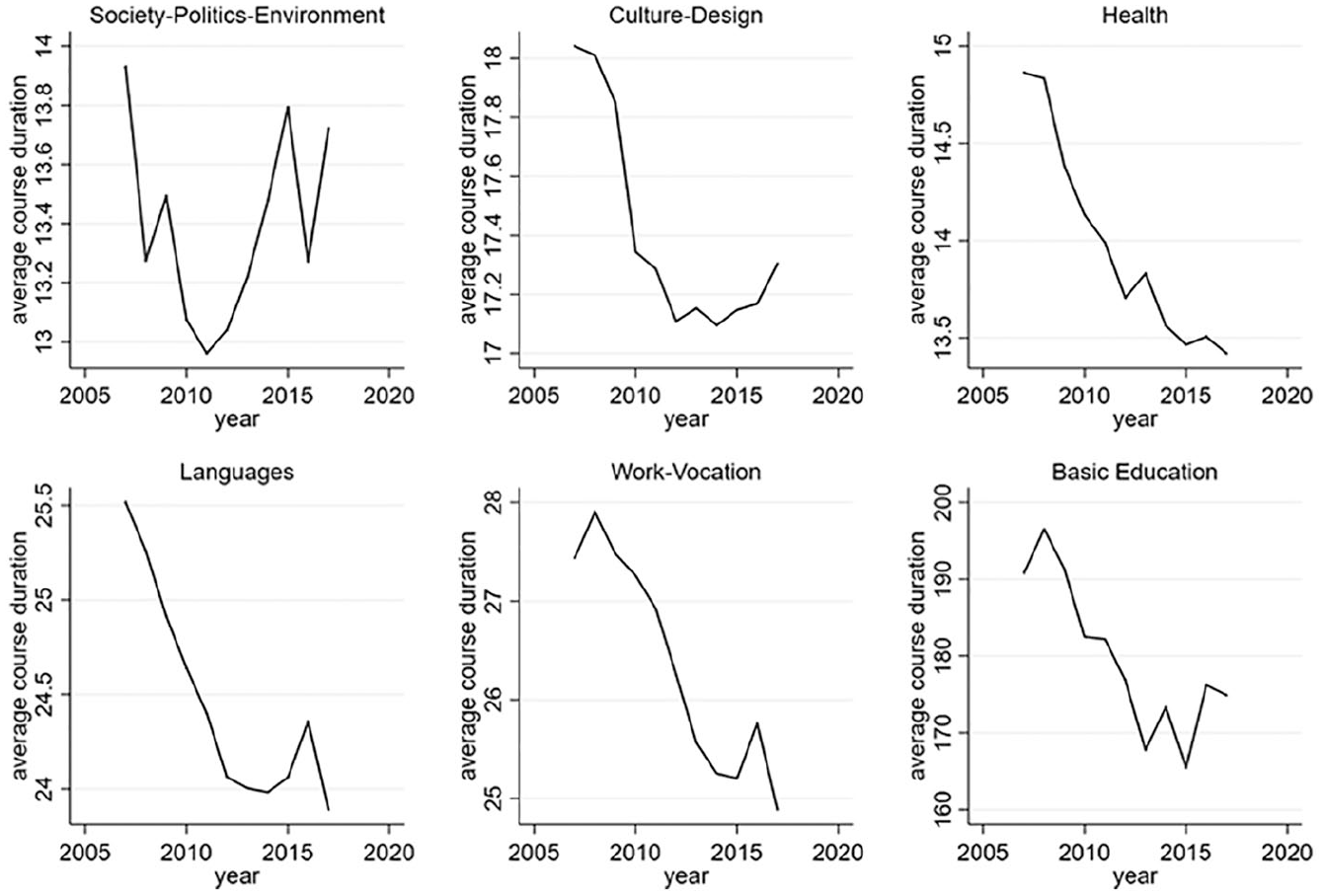
Average course duration within program areas.
The plotted trends support the observation by Käpplinger (2018) of a general trend toward shorter temporal formats. The average course duration decreased among all program areas. How this affects participation counts is examined with regard to Hypothesis 2.
Estimation Strategy
To target our hypotheses, we apply statistical methods that account for high heterogeneity of VHS and control unobservable variables. We employ RE-models as the conventional model and starting point in our panel analysis. However, unobserved time-invariant variables can confound the estimation. Therefore, RE-estimations are likely to be biased by the time-invariant unobserved heterogeneity of VHS. To address this issue, we further employ FE-models that provide estimates that are unbiased by between effects and that focus on a within comparison.
Regarding Hypothesis 1, we specify the RE-model as follows:

Here,
We specify the FE-model as follows:

Instead of a constant and an intercept error term, a VHS-specific constant
Regarding Hypothesis 2, we specify the RE-model as follows:

Here,
To estimate assumed heterogeneous effects across program areas, we included an interaction of a variable covering the program areas

We specify the FE-model as follows:

Here, a subject-area-specific constant
All statistical analyses were performed with “stata” software. The corresponding do-file can be found on OSF (https://osf.io/by9wc/?view_only=4fec6d89cce949cda5300bd3343beebe).
Results
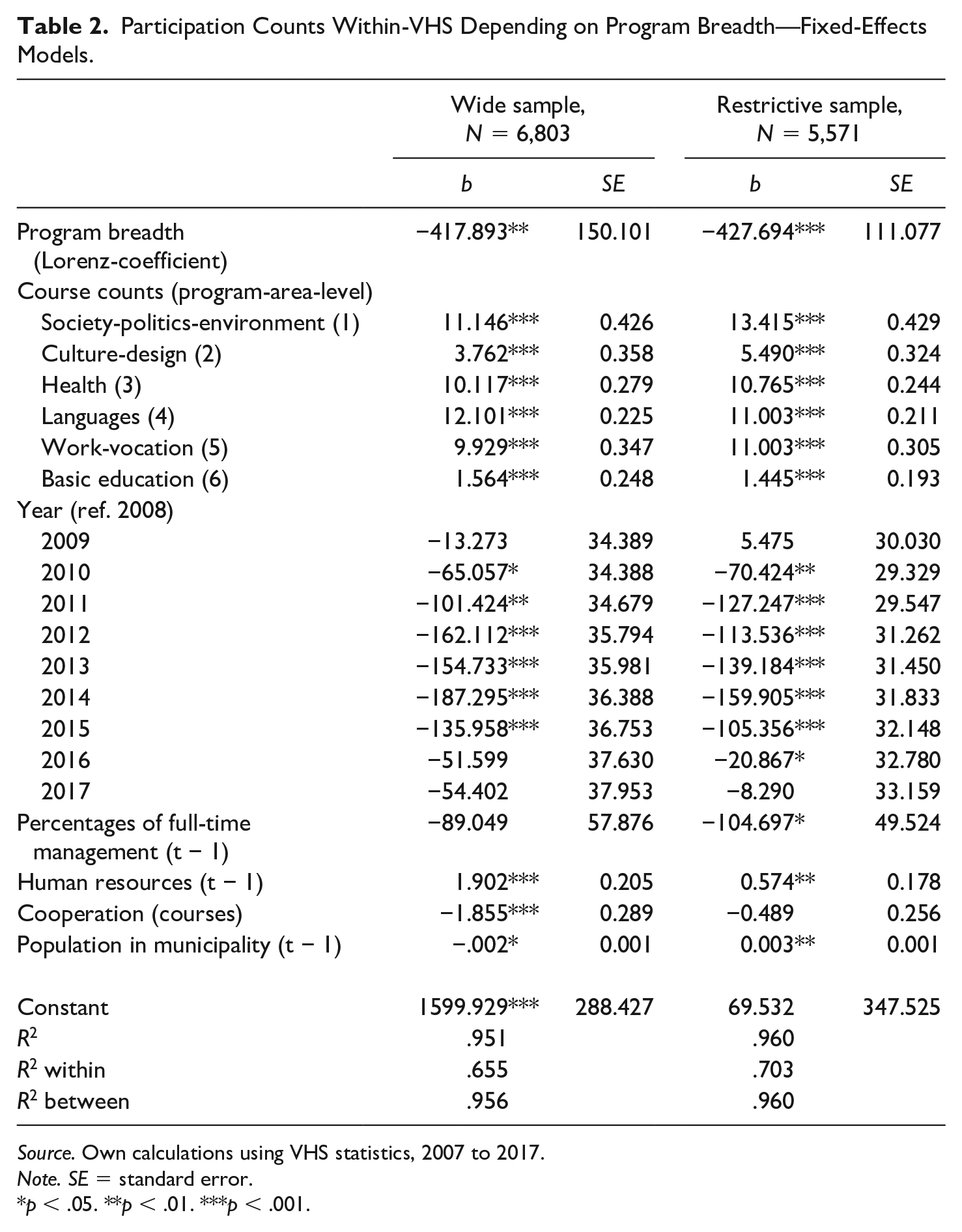
Regarding Hypothesis 1, we tested whether a wider access to educational programs (in terms of temporal formats) is an effective and efficient strategy to increase participation counts. We estimated the effect of program breadth on participation counts by employing random and fixed estimations based on both the wide and restrictive sample. The Hausman test shows that the FE-model is preferable to the RE-model (wide sample: χ² = 368.85; degrees of freedom [df] = 19; p < .001; restrictive sample: χ² = 211.21; df = 19, p < .001). Therefore, we only report the results of the FE-model.
The results displayed in Table 2 reveal that a change of the Lorenz-coefficient from zero to one significantly decreases participation counts by respectively 417.893 participants (p < .01; wide sample) or 427.694 participants (p < .001; restrictive sample). Based on the results, we can confirm Hypothesis 1.
Participation Counts Within-VHS Depending on Program Breadth—Fixed-Effects Models.
Source. Own calculations using VHS statistics, 2007 to 2017.
Note. SE = standard error.
p < .05. **p < .01. ***p < .001.
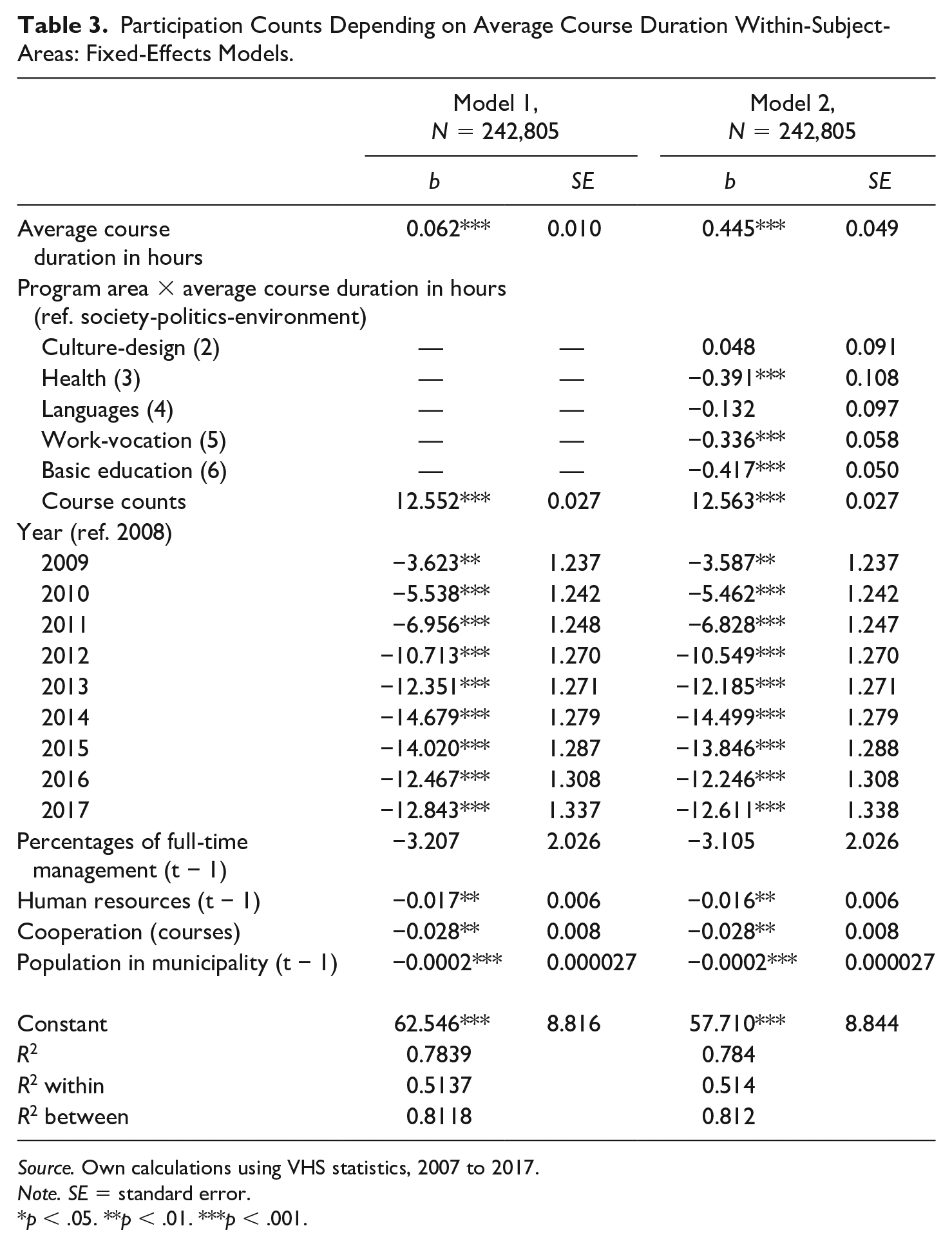
Regarding Hypothesis 2, we tested whether participation counts on the subject-area-level increase with decreasing average course duration. Because we assume heterogeneous effects across the program-area-level, we first estimate the models without an interaction of program area and average course duration (Table 3, Model 1) and in a second step include an interaction (Table 3, Model 2). The Hausman test showed that the FE-model was preferable to the RE-model (Model 1: χ2 = 1938.53; df = 14, p < .001; Model 2: χ2 = 2046.21; df = 19, p < .001). Therefore, we only report the results of the FE-model.
Participation Counts Depending on Average Course Duration Within-Subject-Areas: Fixed-Effects Models.
Source. Own calculations using VHS statistics, 2007 to 2017.
Note. SE = standard error.
p < .05. **p < .01. ***p < .001.
The results displayed in Table 3 reveal that an increase of 1 hour in the average course duration significantly increases participation counts on the subject-area-level by 0.062 (Model 1) or 0.445 (Model 2). Contrary to the hypothesis that participants prioritize shorter course offerings because they are easier to match with rival individual time-availabilities, the results reveal that the opposite holds true. Based on the results, we cannot support Hypothesis 2.
Discussion
Understanding the system of ALE as a multilevel system (e.g., Boeren et al., 2010; Schrader, 2011) challenges scholars to integrate multi-layered perspectives into new research designs. Scholars have argued that a lack of integration prevents research “from generating full insight in the complexity of lifelong learning participation” (Boeren, 2017, p. 162). In our study, we develop the idea of layered thinking in ALE participation research by operationalizing time as a structural element of the necessary condition for the possibility of ALE participation and the required successful match between demand and institutionalized supply.
Our analyses provide two main conclusions. First, we found a significant effect of increasing program breadth at the VHS-level on participation counts. However, the effect size is rather small since a decrease of the Lorenz-coefficient from 1 (complete concentration of all course offerings on one temporal format) to 0 (equal distribution of course offerings across all temporal formats) increases participation counts at the VHS-level by 417.893 (wide sample) or 427.694 (restrictive sample) participants. In comparison, VHS within our observation period served an average of 6,910 participants per year. The results reveal, however, that VHS have not only widened educational programs in terms of temporal formats but that this increasing flexibility significantly increased participation counts. Although we use data from the German VHS statistics in our study, the results are not only valid on a national level in Germany. Based on the universal logic of a required successful match between supply and demand to achieve ALE participation, the estimation results of Hypothesis 1 provide generic knowledge on the matching process as theorized by Boeren et al. (2010).
Second, we found a significant association between increasing average course duration at the subject-area-level and participation counts. In fact, the effect size is rather small since participation counts only increased by 0.062 (Model 1) when the average course duration increases by 1 hour. However, the results in Model 2 reveal heterogeneous effects on participation counts by introducing the interaction of program area and average course duration to the estimation. Here, participation counts increase by 0.445 when the average course duration increases by 1 hour.
Including an interaction allowed us to estimate specific effects on the program-area-level. The results reveal significant negative interaction effects of the program areas Health (3), Work-Vocation (5) and Basic Education (6) on participation counts. Varying the average course duration in these program areas has no effect on respective participation counts. One possible explanation for these results is that the program areas for which we found a significant negative interaction effect primarily include course offerings with the option to get a certificate or a degree. In these cases, the duration to complete a course and to get a certificate or degree is often standardized. Thus, the individual participation decision is not affected by the duration but rather by the fact that a certain certificate or degree can be achieved. Thus, the variation of the effect of the average course duration on participation counts between program areas can be explained by the variation in acquiring certificates or degrees.
The results further reveal that program planners can increase participation counts in program areas Society-Politics-Environment (1) and 2 Culture-Design (2) by increasing the average course duration. However, only the interaction effect of program area 1 is significant.
The first descriptive analysis (Figure 3) highlighted a trend toward shorter durations in every program area. However, the multivariate analyses revealed that shorter course durations do not have a positive effect on participation counts. For the program areas Society-Politics-Environment (1) and Culture-Design (2), the opposite holds true and participation counts increase with increasing course duration. In those cases, the individual participation decision may be more affected by the course, its content or duration than by the fact that a certain certificate or degree can be achieved. Schmidt-Lauff and Bergamini (2017) argued that such learning time “is then subjectively perceived as a special time quality, a time oasis and ‘time well-being’” (Schmidt-Lauff & Bergamini, 2017, p. 157). The results of Hypothesis 2 reveal heterogeneous effects on participation counts when including an interaction of program area and average course duration to the estimation. This finding raises a need for further research into whether this heterogeneity is replicable internationally and in other educational institutions in other reproduction contexts.
We based our study on the assumption that ALE participation requires the availability of, and accessibility, to learning opportunities on the institutional level as a necessary condition for the possibility of participation as well as a successful match of institutionalized supply with individual demand. The results of our study reveal that program planners can significantly influence the matching process by introducing a greater program breadth in terms of temporal formats of course offerings. Introducing those changes means that opportunities for successful matching and participation counts significantly increase.
Limitations and Conclusion
Although ours is one of the first studies that investigates the impact of timing and duration on ALE participation longitudinally, it has certain limitations.
First, the VHS statistics only include course counts of realized courses. Therefore, it is possible that various VHS initially offered courses that in the end did not take place due to a lack of demand. Courses that did not take place could change the observed temporal structure of educational programs or average course durations and could therefore change the analyses and estimation results. Based on the VHS statistics, we can only observe courses offerings that actually took place. Thus, we cannot estimate any effects for the entire educational program including those courses offerings that were cancelled due to lacking demand. Nevertheless, the VHS statistics is the best available proxy for the actual educational program of VHS.
Second, our analyses are based on organizational data that identifies participation counts but not individual participants. Therefore, we are not able to investigate cross-level interaction effects of timing and duration on the underlying decision-making processes of individual participation behavior. Vice versa, we cannot formulate statements as to how individual demand affects the temporal organization of course offerings on the supply-side. Consequently, we are not able to operationalize the whole matching process and interactions between supply and demand as theorized by Boeren et al. (2010). Such an operationalization requires an action-theoretical explanation of individual participation decisions and data linkages of meso-data and micro-data. In Germany, this issue could be addressed in future research by linking meso-data from the VHS statistics with micro-data from the “Mikrozensus.” A dataset including longitudinal data of participants nested in educational institutions is currently not available.
However, our study takes a first step toward exploring interactions between demand and supply. The findings highlight the significant effects of both timing and duration on participation counts. However, more research efforts are needed to explore such effects in terms of the theorized interactions between supply and demand. These efforts should also include investigating the rationale of program planners. First, it would be of particular interest to compare the effects of timing and duration on participation counts within the context of VHS to other reproduction contexts (e.g., organizations in the market context, Schrader, 2011). Second, we assume that the planning staff focuses on the availabilities of temporal resources of potential participants within different individual and societal circumstances while planning educational programs. In this regard, Schmidt-Lauff (2008) pointed out that research on the professional action of program planning regarding timing and duration is largely lacking. However, current research addresses this call for further research. The study by Robak et al. (2015) analyzed temporal aspects of program planning when researching the revision of a law on educational leave in the German federal state of Bremen in 2010.
Footnotes
Declaration of Conflicting Interests
The author(s) declared no potential conflicts of interest with respect to the research, authorship, and/or publication of this article.
Funding
The author(s) received no financial support for the research, authorship, and/or publication of this article.
