




Abstract
The aim of this study was to advance understanding of how to foster media literacy among older people. A systematic review was conducted of 40 empirical studies published between January 2005 and April 2019. The literature review provided information and practical implications for researchers, designers, and providers of media-literacy education for older people. Based on the review, it can be concluded that interventions aimed at fostering media literacy in older people need further development and creative enrichment in terms of aims, content, providers, recipients, and pedagogical approaches.
The purpose of this literature review is to advance the understanding of how to foster media literacy among older people. Media literacy has traditionally been referred to as the ability to use, understand, and create media content in a variety of contexts (Aufderheide, 1993; Ofcom, 2015, 2019a, 2019b). However, there exists no consensus on its’ exact definition (Koltay, 2016; Livingstone et al., 2012; Palsa & Ruokamo, 2015). For example, not all definitions of media literacy include the dimensions of production and creation of media content (Koltay, 2016). Recently, media-literacy researchers emphasized the importance of the following dimensions of media literacy: participation in society (Hobbs, 2010; Livingstone et al., 2012), and creative and playful content production (Cannon et al., 2018).
Media literacy is an umbrella concept embracing subsets such as news literacy and health media literacy. Traditionally, media literacy has been associated with the critical analysis of news, advertising, and mass media entertainment, whereas health media literacy has been associated with making positive choices related to, for example, nutrition, exercise, and substance abuse (Hobbs, 2010). In terms of older people’s media-literacy needs, the importance of health media literacy has been underlined (e.g., Xie, 2011a) because older people are a major potential consumer group of different health technologies, information, and services (Jin et al., 2019).
Media literacy is conceived as a core competence for citizens of all ages living in today’s mediatized and digitalized societies (Abad Alcalá, 2019; Livingstone et al., 2012; Petranova, 2013). The academic literature identifies the following three key areas to which media literacy contributes: (a) democracy, participation, and active citizenship; (b) choice, competitiveness, and the knowledge economy; and (c) lifelong learning, cultural expression, and personal fulfilment (Livingstone et al., 2005). Of these areas, “choice, competitiveness and the knowledge society” is most clearly connected to the market economy and job market.
In the context of older people’s use of and attitudes toward digital media, older people are commonly defined as being 65 years and older (e.g., Anderson & Perrin, 2017; Ofcom, 2019a). However, a broader classification of older people as being 60 years of age or older (e.g., Peace et al., 2007) has been used in the present literature review to to gain a broad research data and understanding of how to foster media literacy among older people.
In Europe and beyond, there is no comprehensive research on the level of media literacy of older people (Petranova, 2013; Rasi et al., 2019). The majority of studies have focused on older people’s access and use of digital technologies and media, while the creation of media content has been researched the least within the traditional dimensions of media literacy (Koltay, 2016; Livingstone et al., 2005; Rasi & Kilpeläinen, 2015). The studies have concluded that while older people exhibit a variety of digital media practices, they typically use digital technologies and media less and somewhat differently than younger age groups (e.g., Anderson & Perrin, 2017; Ofcom, 2019a, 2019b). For example, there are significantly more Internet nonusers among older people than among younger generations (see Rasi, 2018). Furthermore, some existing research points to older people’s lack of ability to understand, analyze, and evaluate media content (e.g., Ofcom, 2015), including for the trustworthiness of online news (Guess et al., 2019) and health information presented in the media (Eronen et al., 2019).
Promoting media literacy is the core of the interdisciplinary and multidisciplinary fields of media education and media-literacy education (e.g., Hobbs, 2010). However, there is scant research literature on effective and meaningful instructional methods for promoting media literacy in older people (Rasi et al., 2019). From the existing research, we can glean that the learning content should always be based on older people’s subjective media-literacy needs and interests (Vroman et al., 2015). The importance of fostering older people’s self-efficacy as users of media and digital technologies has been underlined (e.g., Lam & Lee, 2007; Livingstone et al., 2005; Vroman et al., 2015). In addition, social support networks have proved crucial for older people’s learning in general (Barnard et al., 2013; Jin et al., 2019; Lin et al., 2012).
The focus of our literature review is on studies reporting on practical media-literacy interventions. Media literacy is considered here as the ability to use, understand, and create media content in a variety of contexts (Aufderheide, 1993; Ofcom, 2015, 2019a, 2019b). Therefore, the literature on interventions addresses quite different topics. By reviewing relevant studies, we sought to answer the following questions: (a) What dimension of media literacy (use, understand, create) did the media-literacy interventions target? (b) What kind of pedagogical approaches were used to foster media literacy in older people? (c) What kind of media-literacy intervention outcomes were reported? and (d) What kind of practical implications for media education were reported?
Method
Systematic literature review was selected because we followed strict predetermined criteria for material selection and strived for meticulous and transparent reporting (Gough & Thomas, 2016). The aim was to identify “what is known and not known about an issue considered from a particular perspective at one particular point in history” (Gough & Thomas, 2016, p. 91). This section will outline the review process, which consisted of searches, selection, and analytical strategies.
Search and Selection
The research data were collected in three separate stages, the first in August 2016 by the first two authors. During the first stage, the following international online databases were selected for the literature search: ScienceDirect (Elsevier), SAGE Journals, ERIC—Education Collection (ProQuest), and Academic Search Elite (Ebsco). The second stage was needed because there was a delay in the process due to changes in the first and second authors’ opportunities to continue with the review. The second stage was conducted in the spring of 2019 by the third author and it involved expanding the time frame of the literature until April 2019. The third, complementary stage was performed in March–June 2019 collaboratively by the authors to broaden the list of search phrases. The second and third stages were performed using the same databases as the first stage but with the addition of the AgeLine database.
Relevant articles were found using the following search phrases and combinations thereof: older adult, senior citizen, senior, elderly people, older people, aged people, senior people, information and communication technology (ICT), computer, technology, media, digital, digital literacy, digital competence, media literacy, digital skill, media competence, Internet, competence, computer training, ICT training, computer instruction, ICT instruction, technology instruction, technology training, computer skill, learning, teaching, pedagogy, instruction, skill, training, and intergenerational learning. The information specialist at the authors’ university library was consulted while creating the search phrases and choosing the relevant databases.
Articles that met the following criteria were accepted in the literature review: (a) appeared in a peer-reviewed journal, (b) were written in English, (c) were published between 2005 and April 2019, and (d) reported an empirical study aimed at promoting, through a practical intervention, some dimension of older people’s media literacy as defined in this study. The start date of 2005 was chosen because older people’s media literacy started to gain interest in research literature at that time (Rasi et al., 2019). The first two stages of the data collection yielded 1,804 articles. In the initial screening, all articles were reviewed in terms of whether their titles, abstracts, and keywords matched our inclusion criteria. Duplicates and mistakes were manually removed. Through the initial screening, 45 articles were identified as relevant to this review, and the authors performed a preliminary coding of the selected articles. Through the coding process, 14 articles were identified as not meeting the inclusion criteria. Thus, the first two stages resulted in 31 articles. The third, complementary stage was performed using the term “literacy” in combination with the same search phrases referring to older people as in the previous stages. This search yielded 534 articles of which nine were identified as relevant to this review. In sum, the data collection resulted in 40 articles (see Supplemental Material available online).
Analytical Strategies
The authors divided the selected articles among themselves, and each author performed a preliminary analysis of the articles allocated to her. In this preliminary analysis, the authors used a coding table that included the following categories: bibliographical information; organizer of the media education intervention and country from which it came; number, gender, and age of participants; area of media literacy; goals and outcomes of the intervention; and pedagogical approach. The final analysis of the selected articles (n = 40) was conducted by using NVivo 12 analysis software. The articles were coded according to the categories used in the preliminary analysis. The authors performed the analysis collaboratively during a 4-day workshop. This process resulted in a more nuanced and trustworthy analysis, as the authors collaboratively coded the data through discussing their individual classifications and reached a shared understanding. The analysis was mainly deductic, as the categories were based on previous research literature. In the following section, we will present our results according to our research questions.
Findings
Of the 40 empirical articles, 18 were quantitative, 11 were qualitative, and 11 used mixed methods. The articles were published in 28 different journals, which represented multidisciplinary research. Due to the ways the media-literacy intervention providers had selected their participants, we were not able to strictly target people over 60 years of age. Either the mean age or the age range of the older people participating in the interventions was defined in 36 of 40 articles. In most of these 36 articles, either the minimum age (n = 10) or the mean age (n = 11) of the participants was older than 60 years. However, in 15 articles, some of the youngest participants were in their 50s or, in two articles, their 40s, while the majority were older than 60 years.
In all of the interventions, the majority of participants were female. The interventions were organized in the following 17 countries: The United States (n = 15), Spain (n = 6), the United Kingdom (n = 4), Italy (n = 2), Canada (n = 2), Taiwan (n = 2), China (n = 1), Czech Republic (n =1), Estonia (n = 1), Finland (n = 1), Hong Kong (n = 1), Israel (n = 1), Malaysia (n = 1), Portugal (n = 1), Slovenia (n = 1), South Korea (n = 1), and Thailand (n = 1). The media-literacy interventions were organized by collaborative project (n = 16), university (n = 12), community college (n = 2), senior club or center (n = 2), research institute (n = 2), project (n = 2), elderly home (n = 1), and social services (n = 1). In two studies, the organizers were not identified.
Dimensions of Media Literacy: Use, Understand, and Create
Our first research question focused on what dimension of media literacy did the media-literacy interventions target. It was answered by categorizing the articles according to the dimensions of media literacy in older people that the reported interventions targeted: use, understand, and create. These categories were derived from previous research in which media literacy was most often defined as the ability to access, use, understand, analyze, evaluate, and create media content and communications in a variety of contexts (Aufderheide, 1993; Ofcom, 2015, 2019a, 2019b).
Use
Indeed, 35 of 40 articles reported on an intervention targeting older people’s use of digital technologies and media, including devices, software, applications, web browsers, search engines, and operating systems. In addition, the articles reported on interventions that targeted older people’s abilities to use various online environments and services, including social media and peer-to-peer networks. Communications via e-mail, videoconferencing, and online chat were also targeted. There were several purposes for which the applications and environments could be used, such as news, travel, health, banking, learning, entertainment, and social interaction.
Understand
Eleven articles reported on an intervention that targeted older people’s abilities to understand and evaluate online information and digital media. Almost all (n = 9) of these articles focused on e-Health literacy: finding, understanding, evaluating, and applying online health information to health problems (e.g., Lee & Kim, 2018; Manafò & Wong, 2013; Xie, 2011a; Young et al., 2012). For example, one intervention focused on learning to recognize and locate 1. reliable health information websites, 2. the sponsor of a health website, 3. the purpose of a health website, 4. the authors of the health information, 5. the reviewers of the health information, 6. the most recent update of the health information, 7. the privacy policy of a health website, and 8. clues about the accuracy of a website’s health information. (Xie, 2012, p. 66). Only one article (Esteller-Curto & Escuder-Mollon, 2012) coded in this category focused on fostering older people’s critical media-literacy skills through dealing with topics such as digital journalism.
Create
Seven articles were coded in the category “create.” Even though some of these articles also included coding in the “use” category, their emphasis was on participants’ creative content-production processes, and the use of digital tools was only secondary to that aim. These articles reported on interventions in which older people created their life histories in various formats, such as in a Word file (Gamliel, 2016), a film (Manchester & Facer, 2015), or on DVD and via photo exhibition (Del Prete et al., 2011). One article (Heydon, 2011) reported on an intervention where participants created multimodal presentations of special things and places. In one intervention (Strong et al., 2012), participants were assisted in creating personal health profiles to share medical information with health care providers.
The Pedagogical Approaches Used in Older People’s Media Education
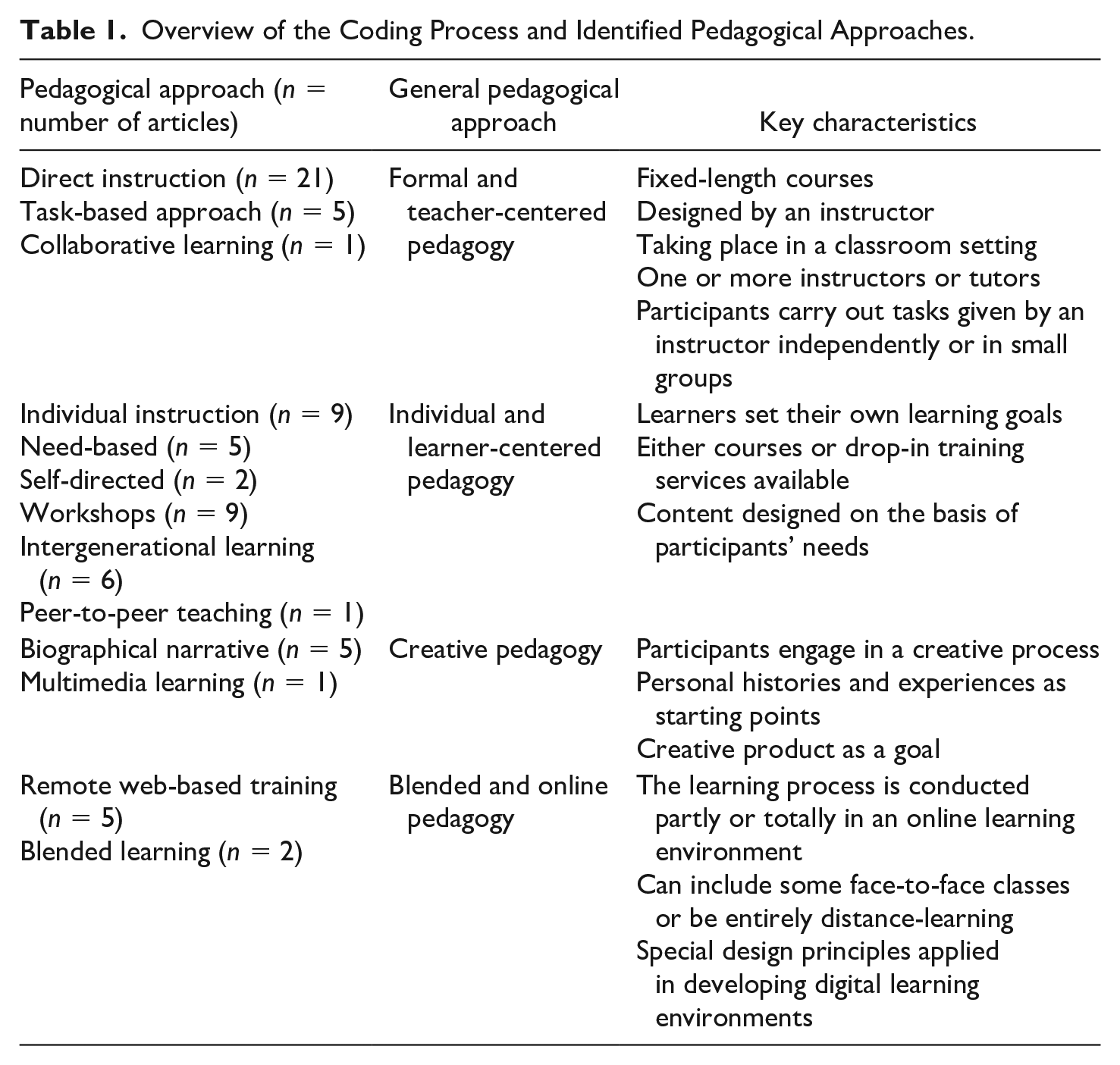
Our second research question focused on what kind of pedagogical approaches were used to foster media literacy in older people. The data analysis process yielded several categories of pedagogical approaches that we clustered into four upper-level categories: (a) formal and teacher-centered pedagogy, (b) individual and learner-centered pedagogy, (c) creative pedagogy, and (d) blended and online pedagogy (Table 1). Even though the pedagogical approaches are presented here as separate, it needs to be noted that, in individual articles, the learning interventions could include features from or a combination of several approaches.
Overview of the Coding Process and Identified Pedagogical Approaches.
Formal and Teacher-Centered Pedagogy
More often than not, the learning interventions were designed around formal and teacher-centered approaches to pedagogy. The articles included in this category typically reported a fixed-length course (e.g., Berkowsky et al., 2013; Castilla et al., 2018; Chiu et al., 2016; Xie, 2011b), the content and aims of which were usually preset by the instructor (Blažun et al., 2012; González et al., 2015; Laganà et al., 2011). There were also some articles that reported the possibility of adding content according to participants’ wishes (Aspinall et al., 2012; Strong et al., 2012).
The group sizes in these learning interventions were small, typically 8 to 9 persons per group (Gagliardi et al., 2008; Turner et al., 2007; Xie, 2011b), and in some cases, the instruction was delivered through one-on-one teaching (Laganà et al., 2011). The courses were delivered in classroom-like settings that were on some occasions adjusted to meet the special ergonomic criteria of the elderly (Berkowsky et al., 2013; Xie, 2011b). The instructors were graduate students (Berkowsky et al., 2013; Xie & Bugg, 2009), professionals from seniors’ centers (Castilla et al., 2018), ICT instructors (Kim & Merriam, 2010), or librarians (Strong et al., 2012; Young et al., 2012). Often, instructors were accompanied by assistants (Chiu et al., 2016; Gagliardi et al., 2008; Kim & Merriam, 2010).
The courses were designed so that the pace of instruction suited the participants’ needs. There was not an excessive amount of information provided at once (Laganà et al., 2011; Strong et al., 2012), and the participants were given enough time to complete their tasks and exercises (Xie & Bugg, 2009). The pedagogical designs also included support for peer-to-peer learning through, for example, collaborative tasks and reflection (Xie, 2011b). Some interventions included homework (Strong et al., 2012; Vaportzis et al., 2017; Xie, 2012), and there were assessments after the interventions to test participants’ knowledge and skills (Gagliardi et al., 2008; Laganà et al., 2011). A special feature characterizing teaching to the elderly seems to be the use of printed training manuals (Berkowsky et al., 2013; Chiu et al., 2016; González et al., 2015; Strong et al., 2012; Xie, 2012; Xie & Bugg, 2009).
Individual and Learner-Centered Pedagogy
The second category includes studies that often used one-on-one tutoring as the pedagogical approach (e.g., Brown & Strommen, 2018; Lee & Kim, 2018; Tambaum, 2017). The main characteristic of this category and its main difference with the previous one is that the content and the aims of training were based on the participants’ own learning goals (Lee & Kim, 2018), experiences, needs, characteristics, abilities (Patrício & Osório, 2016; Tambaum, 2017), tested level of Internet anxiety (Zhou et al., 2007), or existing habits of using technology and devices (Lee & Kim, 2018). On the basis of these, the training consisted of individualized lessons (Brown & Strommen, 2018) or short introductory tutorials on how to use an application or device (Nor et al., 2011; Tambaum, 2017).
This category also includes the studies that applied intergenerational pedagogical approaches in which senior learners were tutored by significantly younger tutors, such as volunteer teenagers (Brown & Strommen, 2018; Gall, 2014; Lee & Kim, 2018; Tambaum, 2017) or children attending the same course as the elderly (Gamliel, 2016). The aims of the intergenerational learning interventions included, for example, support, communication, understanding, promotion of social inclusion, and solidarity between generations (Gamliel, 2016; Patrício & Osório, 2016; Sayago et al., 2013).
Creative Pedagogy
Pedagogical approaches based on participants’ creative processes were rare in the reviewed articles. In general, this pedagogical approach is individual and learner-centered in its orientation, but the creative process is a special characteristic included in the training (Del Prete et al., 2011; Manchester & Facer, 2015). Furthermore, the main objective of the exercise was not necessarily to learn how to use computers and networks per se. Rather, that was secondary to, for example, expressing personal experiences and life histories (Del Prete et al., 2011; Heydon, 2011; Manchester & Facer, 2015), empowering participants in their lives, promoting active participation and the creation of an information society (Del Prete et al., 2011), and restoring information vital to maintaining cultural heritage (Manchester & Facer, 2015). The technologies used in the creative processes (see Table 1) varied considerably depending on the type of a creative product desired (Del Prete et al., 2011; Heydon, 2011; Manchester & Facer, 2015).
Blended and Online Pedagogy
In this category, the learning interventions were carried out partly (Zhou et al., 2007) or totally (Manafò & Wong, 2013) in an online environment. To be coded in this category, the intervention had to include some practical activities in an online environment, not simply watching videos or webinars. In studies applying a blended learning approach, online activities were prioritized over face-to-face activities. The learning interventions in these studies were aimed at the acquisition of basic computer skills (Taha et al., 2016), basic Internet skills, such as using search engines and understanding their logic, and more advanced Internet skills, such as creating a webpage (Artis & Kleiner, 2006). Online training was also used to teach seniors how to use a telemedicine system (Lai et al., 2009; Manafò & Wong, 2013).
Studies that focused on online courses had a strong orientation toward developing age-sensitive e-learning systems (Lai et al., 2009; Taha et al., 2016; Zhou et al., 2007) that could be used with minimal or no previous computer skills (Lai et al., 2009; Zhou et al., 2007). The pedagogical design principles included providing learners with interaction with the tutor, the opportunity to control the pace of instruction, increasing their feelings of motivation, creating interesting tasks, presenting material in an organized way, reducing the amount of terminology used, and offering rapid feedback (Taha et al., 2016). The written instructions were at times accompanied by how-to videos (Artis & Kleiner, 2006; Taha et al., 2016).
The meaning of social support was, in fact, perceived as critical for the success of all four pedagogical approaches. The roles of tutors, peers, instructors, professionals, volunteers, and younger generations were considered important for the overall success of the learning intervention. It seems that the elderly learners benefited from one-on-one support (Gall, 2014) and small groups in which they could observe how peers worked or how teachers taught the peers (Kim & Merriam, 2010). Furthermore, social support from peers proved beneficial for both the provider and the receiver (Kim & Merriam, 2010; Sayago et al., 2013; Strong et al., 2012). However, two studies reported problems related to intergenerational teaching approaches. These studies reported that the teaching strategies of the young tutors were inadequate (Gamliel, 2016; Tambaum, 2017) and some of the participating tutors were unsatisfied with their tasks and wanted to quit before the end of the intergenerational program (Gamliel, 2016).
Reported Outcomes of Media-Literacy Interventions for Older People
Our third research question focused on what kind of media-literacy intervention outcomes were reported. The outcomes of media-literacy interventions for older people were categorized according to the following key areas to which media literacy contributes: (a) democracy, participation, and active citizenship; (b) choice, competitiveness, and the knowledge economy; and (c) lifelong learning, cultural expression, and personal fulfilment (Livingstone et al., 2005). The category “choice, competitiveness, and the knowledge economy” received no coding, reflecting the fact that in the studied interventions older people were not primarily identified as workers in the labor market or consumers in the market economy.
In addition, we found outcomes in only four papers that could be coded into the category “democracy, participation, and active citizenship.” These studies reported that the intervention triggered experiences of alienation from the contemporary technological world (Turner et al., 2007) and heightened the participants’ “awareness that being unfamiliar with ICT would result in marginalization and exclusion from the society” (Wong et al., 2014, p. 158). On the other hand, two studies reported that the intervention made the participants feel they were less marginalized from the current society (Kim & Merriam, 2010) and that the intervention reduced inequality between urban and rural areas (Castilla et al., 2018).
The following reported outcomes of older people’s media-literacy interventions were coded into the category “lifelong learning, cultural expression, and personal fulfilment”: changes in attitudes (n = 27), increased ICT skills (n = 22), changes in everyday life (n = 5), reduced loneliness and social isolation (n = 5), e-Health literacy (n = 4), and other outcomes (n = 6). The reported changes in attitudes were mostly positive, as only two articles reported negative attitudes as outcomes of the intervention. Negative attitudes could reflect participants’ feelings of frustration with Internet coverage (Nor et al., 2011), technology anxiety, and alienation from contemporary society (Turner et al., 2007). Most of the articles (n = 26) reported positive attitude changes, such as increased self-efficacy (e.g., Bertera, 2014; Castilla et al., 2018; Kim & Merriam, 2010; Laganà et al., 2011), confidence (e.g., Berkowsky et al., 2013; González et al., 2012, 2015) and self-esteem (González et al., 2015; Kim & Merriam, 2010; Patrício & Osório, 2016).
A large number of articles (n = 22) reported increased ICT skills among senior citizens (e.g., Berkowsky et al., 2013; Blažun et al., 2012; Del Prete et al., 2011). Furthermore, it was argued that increased ICT skills could increase older people’s happiness, self-esteem, optimism in life (Patrício & Osório, 2016); their social networking activities (Vaportzis et al., 2017); and the quality of their lives (Blažun et al., 2012; Gall, 2014; Patrício & Osório, 2016). On the other hand, some articles (n = 4) reported no changes in ICT skills (e.g., Berkowsky et al., 2013; Gagliardi et al., 2008).
Reported changes in everyday life focused especially on changes in older people’s health-related behaviors, such as playing a more active role in their own health care (Xie, 2011b, 2012; Xie & Bugg, 2009). Some articles reported that the study participants felt that learning about computers made them closer to their families by enabling interactions (e.g., Kim & Merriam, 2010). Five papers (e.g., Blažun et al., 2012; Lee & Kim, 2018) presented reduced loneliness and social isolation as the outcome of the intervention, as did four papers (Aspinall et al., 2012; Lee & Kim, 2018; Manafò & Wong, 2013; Xie, 2011a) regarding enhanced e-Health literacy. In six papers, the following other outcomes were reported: digital literacy, lifelong learning, active ageing, intergenerational solidarity, improvement in cognitive ability, and stimulation of collective memories.
Implications for Future
Finally, to answer the fourth research question, the selected articles were coded according to the key implications for practice they concluded with. All in all, 64 practical implications were coded in 32 articles. The implications were classified according to which of the following questions they addressed: (a) to whom should media-literacy interventions be offered? (b) which dimensions of media literacy should be targeted? (c) what kind of pedagogical approaches should be implemented? and (d) who should provide support and training for older people?
To Whom Should Media Literacy Interventions Be Offered?
According to the articles, interventions should be offered also to people not participating in the presented interventions, such as seniors with health problems (Xie, 2011b), seniors over 76 years of age, older people with less experience with technology, and minority populations with low health literacy skills who live in different countries (Bertera, 2014; Lee & Kim, 2018; Vaportzis et al., 2017). Furthermore, it was argued that interventions and services should also be provided for homebound seniors who are at great risk of social isolation (Lee & Kim, 2018).
Which Dimensions of Media Literacy Should Be Targeted?
Besides offering training for older people in the use of digital technologies and media (e.g., González et al., 2015; Taha et al., 2016; Xie & Bugg, 2009), the articles discussed the need to develop more strategies to improve older people’s confidence and self-efficacy in mastering Internet activities (Chu & Chu, 2010). Pertaining to the media literacy dimension of “understand,” some articles concluded that media-literacy interventions should target older people’s health media literacy and e-health literacy (Manafò & Wong, 2013; Xie, 2012; Young et al., 2012). Only one article examined the practical implications of dealing with older people’s abilities to create media content, in particular the need to pay attention to older people’s ability to tell personal and public stories about their lives to challenge the mainstream representation of their demographic (Manchester & Facer, 2015).
What Kind of Pedagogical Approaches Should Be Implemented?
The articles suggested several pedagogical approaches or practices that future media-literacy interventions should make use of, including peer-to-peer teaching (Castilla et al., 2018), intergenerational approaches (Gall, 2014; Tambaum, 2017; Young et al., 2012), compassionate and experienced teachers (Kim & Merriam, 2010; Vacek & Rybenská, 2016), collaborative and informal learning environments (Sayago et al., 2013), a supportive, friendly, and respectful learning atmosphere (Chiu et al., 2016; Kim & Merriam, 2010), and holistic teaching approaches tailored toward the needs and lives of older people (Berkowsky et al., 2013; Gagliardi et al., 2008; Sayago et al., 2013; Turner et al., 2007). The following approaches should also be applied: providing an ample number of learning sessions spread out over a long period of time (Taha et al., 2016) and offering a slowed pace of instruction, printed handouts, and sufficient repetition (Strong et al., 2012).
Who Should Provide Support for Older People?
The articles suggested seniors’ centers, public libraries (Lee & Kim, 2018; Xie & Bugg, 2009), and other community-based settings as providers of computer and Internet access and support. In terms of older people’s health media literacy, public libraries, caregivers, and schools (with computer savvy students) were suggested as relevant providers of support (Young et al., 2012). Furthermore, professionals who work directly with older adults (González et al., 2015) and adult educators (Chu & Chu, 2010) were identified as providers of support for seniors.
Discussion
To advance understanding of how to foster media literacy among older people, we conducted a systematic review (Gough & Thomas, 2016) of 40 empirical studies published between 2005 and April 2019. The aim was to gain an understanding of what dimensions of media literacy (use, understand, and create) the interventions targeted, what pedagogical approaches were used to foster media literacy in older people, and what kinds of results and implications the reported interventions yielded for the future.
First and most clearly, the majority of articles reported on media-literacy interventions that targeted older people’s competencies in using digital devices, technologies, and media for various purposes such as news, travel, health, learning, banking, entertainment, and social interactions and events (e.g., Abad Alcalá, 2019). Older people’s abilities to understand and create media content, especially as citizens, received less attention despite media-literacy researchers’ emphasis on individuals’ participation in society (Hobbs, 2010; Livingstone et al., 2012) and creative and playful media-content production (e.g., Cannon et al., 2018). When interpreted in light of recent research highlighting older people’s lack of health and digital news literacy (Eronen et al., 2019; Guess et al., 2019), this finding clearly indicates a gap in the research on media-literacy interventions. Interestingly, the media-literacy interventions that specifically targeted older people’s abilities to understand and create media content addressed older people from a somewhat limited perspective: as users of e-Health services and as people sharing and reminiscing about their life histories.
Second, most of the reported outcomes of older people’s media-literacy interventions were dealing with older people’s lifelong learning, cultural expression, and personal fulfilment, and less were concerned with democracy, participation, and active citizenship and choice, competitiveness, and the knowledge economy (Livingstone et al., 2005). The reported outcomes identified older people as needing to improve their ICT skills and self-efficacy, change their attitudes toward modern technologies, learn how to use e-Health services, and fight loneliness and social isolation. Older people were not for the most part addressed as citizens “participating as a member of a community at local, regional, national and international levels” (Hobbs, 2010, p. 19) but rather as agents in the spheres of their personal lives and within their families. Thus, we propose that media-literacy interventions and research targets older people in their multiple life roles, such as citizens, students, consumers, leaders, experts, caretakers, workers, partners, spouses, parents, retirees, grandparents, and leisure-users (e.g., Peace et al., 2007; Reed, 2013). However, it must be kept in mind that the studies included in the present review do not indicate that there is a lack of media-literacy interventions which target older people’s abilities to understand and create media content. Instead, our results indicate that there is limited research on the aforementioned dimensions of media literacy.
In terms of the pedagogical approaches suitable for fostering media literacy in older people, our results are in line with existing research emphasizing the importance of using a needs-based approach (e.g., Vroman et al., 2015), fostering older people’s self-efficacy as the users of digital technologies and media (e.g., Lam & Lee, 2007; Livingstone et al., 2005; Vroman et al., 2015), and providing social support for learning (Barnard et al., 2013). Our results highlight the affordances of peer-to-peer teaching and intergenerational approaches in media-literacy interventions for older people, and we suggest that future research and practice further explore these approaches. However, pedagogical approaches based on participants’ creative media-production processes were rare in the reviewed articles. It is therefore suggested to try out and study the numerous possibilities of applying, for example, creative processes of producing a movie or a photo exhibition (Del Prete et al., 2011; Manchester & Facer, 2015) to foster empowerment, liberation (Del Prete et al., 2011), and older people’s active presence and role in a society (Findsen, 2007).
Our review has limitations. We did not evaluate the quality of the studies that we reviewed. Rather than being a critical review of the state of the research methodologies and results, the aim of the review is more to describe and discuss the topics and approaches used in media-literacy education for older people. While our review was systematic (Gough & Thomas, 2016), it did not represent the diversity of older people in various contexts (e.g., Peace et al., 2007). In all of the interventions included in our review, the majority of the participants were female, which may result from the larger number of women among the older population (United Nations, 2019) and their willingness to participate in education in general. Even though the interventions were organized in 17 countries, the U.S. context dominated (n = 15). Furthermore, even though we did not look at the connections between pedagogical approaches and their reported outcomes, these should be explored in future research. Finally, the relationships between different positionalities (e.g., education, income, class, racial and ethnic background, gender, past professional experience, health status, and disabilities) and media literacy merit further research.
Conclusion
This literature review provided important and comprehensive information and practical implications for researchers, designers, and providers of media-literacy education for older people. Based on our review, we can conclude that interventions aimed at fostering media literacy in older people need further development and creative enrichment in terms of aims, content, providers, recipients, and pedagogical approaches.
Supplemental Material
Appendix_Summary_of_studies – Supplemental material for Promoting Media Literacy Among Older People: A Systematic Review
Supplemental material, Appendix_Summary_of_studies for Promoting Media Literacy Among Older People: A Systematic Review by Päivi Rasi, Hanna Vuojärvi and Susanna Rivinen in Adult Education Quarterly
Footnotes
Declaration of Conflicting Interests
The author(s) declared no potential conflicts of interest with respect to the research, authorship, and/or publication of this article.
Funding
The author(s) disclosed receipt of the following financial support for the research, authorship, and/or publication of this article: This study has been partly performed in the Developing Teacher Education of Adult Educators—Targeting Older People’s Media Education project, which is funded by the Teacher Education Development Programme of the Finnish Ministry of Education and Culture.

Supplemental Material
Supplemental material for this article is available online.
Author Biographies
References
Supplementary Material
Please find the following supplemental material available below.
For Open Access articles published under a Creative Commons License, all supplemental material carries the same license as the article it is associated with.
For non-Open Access articles published, all supplemental material carries a non-exclusive license, and permission requests for re-use of supplemental material or any part of supplemental material shall be sent directly to the copyright owner as specified in the copyright notice associated with the article.
