



Abstract
Writing and digital technologies have always been enmeshed with one another. Currently, the use of virtual reality (VR) systems and applications continues to grow across both professional and popular venues, leading to a number of questions researchers have yet to ask about how we might use these technologies for writing and writing classrooms. Based on a process-focused research approach encompassing headset recordings that captured over a year of various writing tasks in VR, this study reveals some of the ways virtual reality may be used specifically by researchers in writing and communication studies, especially in terms of invention and collaborative practices. Theories of virtual reality animate findings in three areas—invention, collaboration, and friction—and the findings raise questions about researching VR in writing-based classrooms.
Likely because of access and affordability, the roles and applications of virtual reality (VR) remain burgeoning areas of writing studies research. In broad terms, VR refers to the combination of headset displays, headphones, microphones, motion trackers, and computer programs and/or applications that create multidimensional objects and spaces for users utilizing such hardware and software. While communications scholars have positioned their field as essential to understanding VR outside of prescriptive and technology-based theories since the inception of VR (Steuer, 1992), we still do not have solid theories or understandings of how VR might influence various aspects of writing and writing processes. However, as writing processes are consistently enmeshed with new and emerging digital technologies and environments used to produce it, questions of how and what we write with VR technologies and environments warrant more attention. These technologies and environments become more integrated with various industries and educational ventures. A very timely example is the 2024 release of the Apple Vision Pro, which aims to blend physical and virtual displays for everyday tasks, such as text messaging and navigation. Devices like this may permeate social and professional realms of communication.
This article, then, explores how VR might influence not only what is probable, but possible to write (Brown, 2015) in virtual and hybrid spaces. Furthermore, many of the key areas of study within VR theory itself, such as presence, embodiment, and flow, are terms that are familiar to writing studies researchers (Clayson, 2018; Jiang & Tham, 2022; Lockridge & Van Ittersum, 2020; Tham et al., 2018). Thus, VR opens a myriad of possibilities for writers, and as more people turn to these virtual and hybrid spaces in order to create and collaborate, it is essential that we as writing studies scholars understand how such virtual environments intersect with our current understandings of writing theory and practice. While there will always be new frictions when utilizing new technologies, there will also be new affordances, and as writing processes and related technologies continues to progress, it is vital that we remain knowledgeable as to how we as writing and communications scholars might best use these new affordances to our advantage.
Writing Studies and Virtual Reality Exigencies
Studies of VR and writing have relevance to the broad field of writing studies and join a long history of researching the effects of then-new technologies and material spaces on writers and writing (Ching, 2018; Lockridge & Van Ittersum, 2020; Prior & Shipka, 2003). As demonstrated in many pages of Written Communication, researchers have sought to understand writing in relation to computer keyboards, instant messaging (IM), and even museums (Noy, 2015; Pigg et al., 2014; Van der Steen et al., 2017). New tools warrant new studies about writing possibilities. As Ching (2018) writes in a study of distraction-free tools, “the point here is not to declare one approach better than the other, but rather to acknowledge that different digital writing tools may align more or less with an individual writer’s preferences” (p. 371). In short, researchers have routinely questioned how writers contend with then-new technologies, conceding that writing is imbricated with the digital. We call attention to Written Communication’s publications in the 1990s, a watershed decade in which scholars were exploring the effects of the computer and word processing on writers. For instance, in 1991, Murray asked, “How is the composing process affected when both process and product are mediated interactively via the computer terminal and the product is semi permanent?” (p. 36). Researching online exchanges between writers, Murray’s study encompassed hundreds of computer-mediated conversations and thousands of messages. That same year, Wilkins studied the effects of an electronic forum on participants not in physical proximity. As Wilkins points out, “in sending and receiving messages, the participants could not use eye contact and intonation to control the flow of the conversation. They could not yield the floor by a lower final tone or ask for it by looking at the speaker” (1991, p. 61). Clearly, writing processes have always been entwined with the tools that make writing possible, so as researchers, we must continue to explore how emerging tools continue to influence writing processes.
Written Communication and specialized journals demonstrate that the field has kept up with observing computer-mediated interactions and collaborations between writers in remote and public contexts rendered by digital platforms (Lee, 2007; Lindgren, 2021; Nissi & Lehtinen, 2022; Pigg, 2014b; Ranker, 2008; Swarts, 2016). Yet even as more recent studies in this area have centered on wearable and mobile composing (Jiang & Tham, 2022; Pigg, 2014b; Swarts, 2016; Tham, 2017; Tinnell, 2017), VR remains understudied apart from maps of initial trends. Mills et al. (2022) examined elementary students’ multimodal composing processes when using the VR software known as Google TiltBrush to better understand how embodied and immersive virtual environments influenced the meaning-making process in such compositions. In addition, previous studies have also examined how VR can help students learn to write. Huang et al. (2019) examined how Chinese high school students showed an increase in creativity and self-efficacy when utilizing spherical video-based virtual reality (SVVR) hardware as part of their writing process for a descriptive writing assignment. Similarly, a subsequent study focused on Chinese elementary school students also illustrated an increase in students’ writing self-efficacy when using SVVR as part of their writing process for descriptive writing tasks (Yang et al., 2021). Such studies demonstrate that VR technology has already made its way into multiple classrooms across the globe and also that including such technology as part of various writing processes provides students with beneficial effects, both creatively and otherwise. Further, these studies have begun to illustrate some of the ways VR influences various parts of the writing process, in terms of both writers’ personal attitudes toward different writing tasks and variations in the writing process.
These studies foreshadow that VR might permeate classrooms, especially if the technology powering it continues becoming more affordable or accessible to educators (Stechyson, 2023). This technology is entering some classrooms, whether we understand the implications of it or not. Collectively, these studies suggest that we can provide our students with experiences they may not otherwise have access to through such technologies, and subsequently they can write effectively about such experiences once the VR headsets are taken off. Whether we intend to bring VR writing into our own classrooms, it is clear that even writers not intending to work with VR will still need a basic understanding of how VR influences or otherwise impacts various writing processes when used as a writing tool (Shivener & Tham, 2025). In addition, because of VR’s technical capabilities, these virtual spaces allow for all five modes of multimodal writing as defined by the New London Group: linguistic, visual, aural, spatial, and gestural (1996). As such, VR technology is especially apt for multimodal and other forms of digital writing in educational contexts. Pedagogically and theoretically, it is also useful for experimenting with and comparing the spaces student and professional writers occupy and turn to for invention and productivity. With cameras and participant drawings, Prior and Shipka’s (2003) study of writers traced and visualized their material spaces, emphasizing that writers deploy “environment-selecting and -structuring practices” when working. More than 20 years after Prior and Shipka’s study, we position VR as “a tool that helps us to sketch the contours of literate activity” (p. 186) that occurs in material and virtual spaces. However, as illustrated above, our field’s knowledge of how VR influences writing processes is limited to the kinds of writing an individual performs after, rather than during, their VR experience. Prior and Shipka acknowledge that their retrospective study of writers “does not provide the kind of grounded detail available through close observation of in situ practices” (p. 186).
Stressing the “grounded detail” through participant observation, this present study explored the act of actually writing in virtual reality, both individually and collaboratively. It examined the kinds of embodied meaning and frictions that come with such processes and the key areas of VR theory that intersect with other key areas of writing studies theory and practice. Though this piece focuses on the experiences of the two researchers, the themes and ideas here begin to shape how larger studies may be crafted in the future.
Theoretical Framework for Understanding the Intersections of VR and Writing Studies
This next section presents key theories of presence, coextensive space, and friction in both VR and writing studies that intersect with existing work in and around various writing processes and that shaped the current study.
Presence
A frequent area of discussion in the interdisciplinary scholarship on VR is its potential to open up many meaningful experiences for users. VR instills a sense of presence, or, put more simply, the sensation of being there, when individuals engage with this particular medium. The role of presence in virtual reality is quite pivotal, with numerous studies showing how this sense of presence influences or otherwise affects individual users. Psychologists have examined how a sense of presence in VR can be used to help reduce anxiety or encourage feelings of well-being (Alsina-Jurtet et al., 2010; Brivio et al., 2021), marketing firms have explored how one’s sense of presence can influence purchasing decisions (Flavián et al., 2020), and other studies have shown how one’s sense of presence can help increase or otherwise boost creativity and/or imagination (Yang et al., 2021). Presence is a powerful means of providing subjective experiences that can deeply influence the individual having such experiences. Some studies have even shown that these influences persist long after the user leaves the virtual world, such as when Reinhard et al. (2019) found that an individual’s walking speeds changed based on whether they were represented by an older or younger avatar in a VR study.
Currently, most theories of presence in VR are based on theories from cognitive psychology and neuroscience to explain how and why we feel present in these virtual experiences. Furthermore, our understandings of presence in VR also align with current post-Cartesian theories of embodied and distributed cognition, which hold that cognition is distributed throughout the body (see Mills et al., 2022, for an extensive discussion). In addition, while some studies in neuropsychology have found places in the brain that react when individuals experience presence (Jäncke et al., 2009; Slater et al., 2008), there is not yet a reliable means of measuring these brain scans or being able to fully interpret these data in a meaningful way. Furthermore, individual accounts of presence are also difficult to measure, as perception of both temporal and memory biases may influence reports of presence after the fact, and asking questions during the actual experience of presence in VR often breaks the individual’s sense of presence in the process.
Forwarding the definition of presence, Riva et al. (2014) position presence in digital mediums as the “feeling of being inside the mediated world” (p. 1). Despite offering such a straightforward and concise description of presence, the authors also note the difficulty of obtaining a consensus definition of presence, even in human-computer interaction studies. In contrast, they offer a definition of both what presence is not, and what kinds of potentials presence offers for the human experience: Presence is not the degree of technological immersion; it is not the same thing as emotional engagement. It is not about absorption or attention or action, but all of these have a potential role in understanding the experience of presence in interaction—the experience of interacting with presence [emphasis in original]. The feeling of presence is a crucial aspect of many recent and developing interactive technologies. The illusion of being present is the key ingredient that gives interactive media the power to affect people profoundly, to change them.
This understanding of what presence is not pushes against previous understandings of presence as the “perceptual illusion of non-mediation” (Lombard & Ditton, 1997). Rather, presence is felt when the environment being interacted with is no longer within the conscious perception of the individual. However, more recent studies of presence in VR have called this previous understanding of presence into question, aligning presence more with the practice of interaction (or lack thereof) in these environments (Riva et al., 2014). Layers of interaction, both in what is permitted and prohibited, are also key factors for being able to use these virtual environments as writing spaces, as discussed in more detail below.
Coextensive Space
An understanding of the spatial elements of VR is essential to fully experiencing VR as a movement through three dimensions; when using, for example, a VR headset to watch a movie, a user is still simultaneously existing in a three-dimensional space, even when they remain relatively still in this space. This emphasis on dimensionality rather than spatiality is further accentuated by the current push for understanding the physical-digital space created by virtual reality experiences as its own particular three-dimensional space, one defined by Saker and Frith (2020) as coextensive space. According to them, “the visual incorporation of concrete reality within the space of VR effectively transforms the physical setting into a digital representation that is then aesthetically incorporated into the physical-digital assemblage of the technology” (p. 1438). Here, they’re talking about some of the ways newer VR technology has begun to overlay physical and digital spaces with one another: the Valve Index “Chaperone,” a visual overlay of the spatial boundaries players set as their virtual play space, is a modern example of such a coextensive space (Valve, n.d., “SteamVR Chaperone FAQ”). In the case of the Chaperone, players use the controller to virtually trace their play area during the initial headset set up, and then while playing VR, if the player moves too close to those boundaries, a virtual visual of either a wall or the floor tracing will appear to let the player know not to go beyond said space.
Even in this small-scale example, we can see how coextensive space works when navigating the overlaid physical and virtual spaces simultaneously. In this way, the current theories of presence and coextension and current iterations of VR create an exigence for better understanding how these spaces can be used for written communication. These theories also enliven writing studies’ occupations with materiality, cultural historical activity theory, and actor network theory (Micciche, 2017; Rule, 2018; Prior & Shipka, 2003). Once again channeling Prior and Shipka (2003), we suggest that “[VR] writing . . . emerges as complex dispersed activity that is, across time and space, both intensely private and intensely social and collaborative” (p. 206). Theories of presence and coextensive space only amplify our attention toward writing activity.
Friction
Turning back to VR’s relevance to writing studies, we end this section with a theory of friction, one that is still rather new in the studies of writing processes and workflows. While many writing studies researchers have explored the various barriers and tumultuous conditions that writers navigate (Banks, 2010; Byrd, 2020; Tate & Warschauer, 2022; Wojahn et al., 2010), Lockridge and Van Ittersum’s (2020) keyword of friction under their theory of “writing workflows” is useful for understanding how writers contend with digital writing tools, including VR headsets, controllers, and platforms. In Writing Workflows, Lockridge and Van Ittersum define friction as “a moment when the writer wants to accomplish a particular task with a particular method but the chosen tool obstructs that process.” Writers address such friction by adopting or amending tools and practices, and, as the authors point out, “a writer might purposefully and productively introduce friction into her process” (“Introduction” para. 12). Lockridge and Van Ittersum’s research focuses on three professional writers whose workflows encompass Apple devices and publications, ending with a call for more writers to map and document their workflows to produce “a rich description of the problem solved and the technologies and practices that were used in doing so” (Chapter 6).
Along with presence and coextensive, friction is a useful key term for understanding and building on Mill et al.’s (2022) study of elementary students who created multimodal works with VR systems and the software Google TiltBrush. In their study, Mills et al. demonstrated that students, through full-body composing within the software (i.e., arms, hands, feet, eyes), composed rich three-dimensional representations of emotions (p. 357). The authors acknowledge some constraints and moments of friction encountered by students. Some students “would come into contact with unseen walls or occasionally swipe [emphasis ours]” and “untangle the power cords [emphasis ours] of the headset that they could feel draped over their shoulders and legs at times” (p. 361). The instances of friction encountered by students are minor discussion points among the researchers’ important findings about multimodal and compositional possibilities in VR. For writing researchers interested in replicating or participating in such studies, however, we seek to expand on their scenes by diving deeper into our own frictions when trying to write textually in VR. As we discuss later in this article, friction can also entail computer glitches, tracking failures, typos, and software conflicts. Friction is another way of acknowledging that “composing with digital tools can be fraught with distractions, both from other applications and from the tools themselves” (Ching, 2018, p. 359). And because we focus on the friction of writing in VR as opposed to painting or writing with digital tools in classrooms, we offer new insights into the frictions wrought by this technology.
Context and Methods
This study emerged from a problem we faced as frequent collaborators separated by the COVID-19 pandemic and residential distance in late 2020 through 2022. 1 Our primary research question concerned how writing in VR impacts various parts of the writing process and tasks within it. This study was the final strand of our larger study analyzing remote communication practices among game developers and technical communicators (IRB certificate #e2021-076). While this question is quite broad, our study is exploratory, and we used it as a means of contextualizing some of the key concerns as to how writing in VR is both similar and different to more traditional forms of writing (either via pen and paper or via a word processor) and what writing in VR may allow or not allow when compared to other means of collaborative writing (i.e., collaborating in VR vs. body-doubling via Zoom). We were in lockdown but wanted to write together synchronously to complete a research article. We had explored writing collaboratively on Zoom, but webcams and screen-sharing on that platform had become exhausting, especially because our classes and departmental meetings had also been relegated to the Zoom platform. As a result of this exhaustion, we explored the possibilities of VR as a tool for enriching and enhancing collaborative writing.
Data Collection
Data collection centered on capturing our primary writing tasks for composing a research article: talking out arguments, typing out sentences, reading scholarship reading our respective passages (that we often pass back and forth), and revising passages. These tasks were not prearranged before we started collecting data. We worked recursively on these tasks during the collection period (noted below). Through this emergent process, secondary research questions spontaneously surfaced. What happens to writing when the body is negotiating two spaces, the virtual and the concrete? What does writing look like in virtual worlds, and how do these spaces impact such processes?
Addressing such questions, our data collection methods for understanding writing tasks in VR were grounded and qualitative. We met synchronously in VR for more than 40 hours, committing to biweekly meetings (every other Friday) over a 1.5-year period. Each meeting lasted a maximum of 2 hours to anticipate general body and “eye fatigue” that accompanies prolonged use of a headset (Fan et al., 2023). We used the following VR equipment:
An HTC Vive Pro 2 headset, wired to a desktop PC and connected to room sensors
A Valve Index headset, wired to a desktop PC and connected to room sensors
For a research assistant: A Meta Quest 2, wireless and complete with internal sensors, with the option to connect the headset to a PC
With this equipment at our disposal, after trying a handful of applications, we settled on meeting in the VR application Bigscreen Beta, despite its own frictions (as noted in our findings below). In the space rendered by the application, we shared our computer screens and collaborative documents in real time; Bigscreen Beta allowed for us to view both our screens simultaneously within the shared space, either by using the “personal screen” (whose size and placement was adjustable anywhere within the virtual space) or by projecting the screen onto a larger flat area in the center of the virtual space (the key feature for the titular “big screen” capabilities). We also used Bigscreen Beta’s in-app tools for marking or otherwise interacting with these screens, including pens, highlighters, and other novelty items, making the big screen feature similar to a dry-erase or physical smart board.
Once settled in Bigscreen Beta, we then used the free Open Broadcasting Software (OBS) to record our writing sessions, capturing the “VR View” as projected and transmitted to our headsets. OBS allows users to record in-application audio as well as internal/external microphones (i.e., audio input) used in the application, so both visuals and audio were recorded throughout this process. Figure 1 presents an example of the application’s settings. The result of using OBS to capture writing sessions was that we captured first-person perspectives of such writing and their accompanying embodied actions. In a way, this method of recording was an experimental approach building on writing studies’ long-held methods of recording screens and in-situ protocols to make sense of writing processes (Pigg, 2014a; Ranker, 2008; Rule, 2018; Smith & Neff, 2018; Swarts, 2016). Echoing the work of Mills et al. (2022), these captures were supplemented with additional recordings of our physical spaces and writing actions.
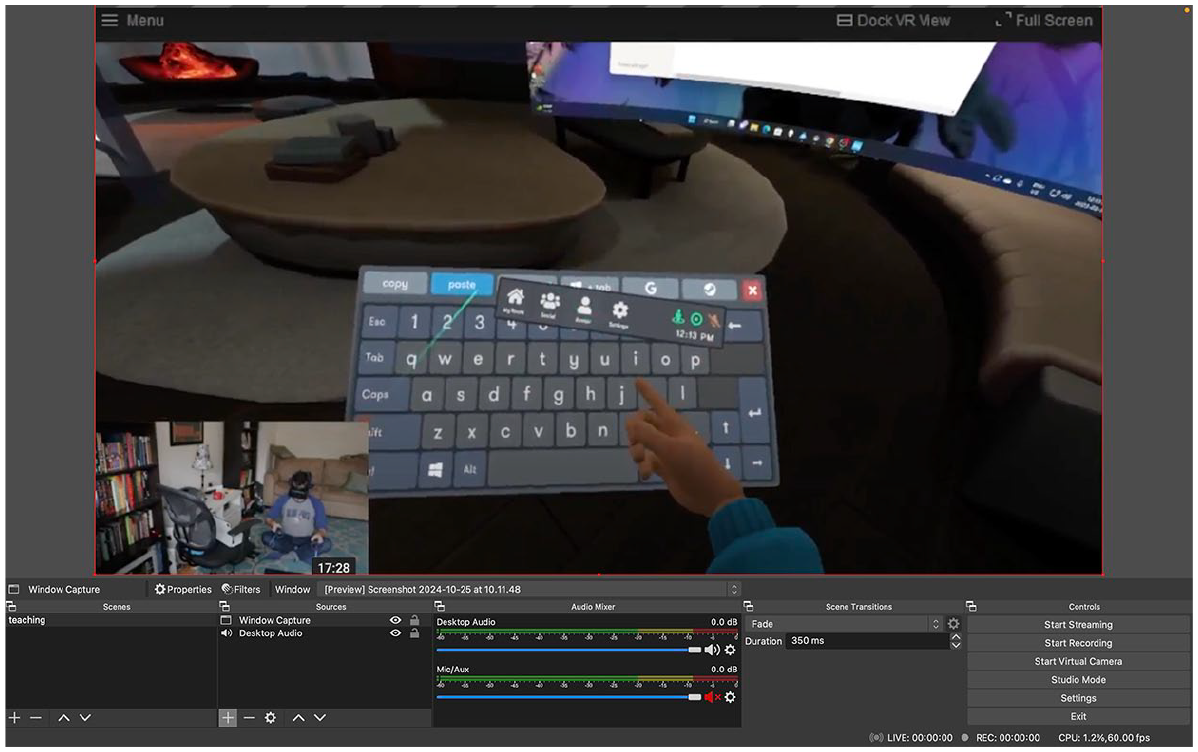
A screenshot of Open Broadcasting Software settings.
Finally, in conjunction with the video recordings, a collaborative research journal (Google Docs) and chat channel (Discord) were kept to summarize the work of each session and prepare for future sessions. We reviewed video sessions collaboratively, paying attention to our workflows, and moved “across a number of composing spaces and technologies” (Lockridge & Van Ittersum, 2020, “Mapping Workflows”). As one might do in minor ways with manuscript acknowledgments, we needed to document our work to convey and heighten our own “consciousness of relationships, places, feelings, and a wide array of activities relevant to writing [in VR]” (Micciche, 2017, p. 112). Discussed in more detail below, we purposefully resisted interpreting our writing sessions until we had finished our writing sessions because we simply did not know what we would find. Later, to provide additional critical distance and interpretation, a research assistant, Stefan, was hired through grant funds to create video excerpts of our work sessions and help organize them by our theoretical framework and any emerging themes (e.g., invention, technical difficulties, process, and pedagogy) after approximately 1 year of completed writing sessions.
Data Analysis
Data were coded in two stages relying on a grounded-theory approach, one in which we began by “noting thematic segments that seemed relevant for answering this study’s research questions” (Ching, 2018, p. 353). Channeling Charmaz’s (2006) recommendations, our Discord chat log and review sessions helped us constantly compare sessions in order “to elaborate processes, assumptions, and actions covered by [our] codes or categories” (p. 82). As mentioned above, we purposefully avoided categorizing our recorded experiences while still collecting data on writing sessions in VR, as we first wanted to see what repeated themes occurred naturally throughout the process.
To help expedite the process of reviewing the video recordings, we also had the audio from each session transcribed using the web application Otter.ai. We then independently reviewed both the transcripts and recordings, separately noting any repeated themes or concepts that appeared. From this initial exploratory process, we discovered seven categories, though some categories were collapsed together into the main themes discussed throughout the rest of this piece (i.e., technical difficulties was originally its own category, and was later collapsed into the “frictions” category upon conferring with both researchers). Once we compiled our initial lists, we met to discuss our findings. This discussion involved defining what each of us meant by each uncovered theme, as well as providing at least one example from the initial data set of what such a category looked like in practice. Through this discussion process, we eventually agreed upon the four discrete categories discussed throughout the rest of this piece, with each category connecting to a larger theoretical framework within VR studies: invention, collaboration, friction, and pedagogy.
Once the initial data sweep occurred and we agreed on the key themes that arose from this initial exploratory process, the review process for the recordings became more formalized. While we were still open to additional categories emerging from these sessions, the focus of analysis shifted to finding and marking instances of each category throughout each session. To begin this process, we first agreed on the following defining criteria for each theme, provided below. To give a sense of how often each theme manifested, their frequencies are provided below, though it should be noted that often these themes overlapped and that the frequencies noted do not necessarily reflect the duration of time a given theme was covered. A manifestation of invention, for example, could occur over a 40- to 60-minute period if the researchers were writing new content, and various forms of collaboration could surface throughout that time period. Still, the frequencies are provided for a sense of quick reference.
Invention: Moments of invention were noted whenever we partook in creating new content, such as active writing and drafting sessions, creating new pieces during the session itself, such as when we designed the cover page for a white paper, or when we would brainstorm new ideas (either verbally or via writing) within the virtual space. In total, this theme surfaced 19 times over the full 40+ hours.
Collaboration: Instances of collaboration were defined as either visual, physical, or verbal instances during a writing session where we worked with one another across various writing tasks. Such instances might include us verbally brainstorming with one another, providing revision feedback (both visually, as with Bigscreen Beta’s marking tools, or verbally via discussion) on a displayed document, or working simultaneously on a shared document while in the virtual space. This theme surfaced a total of 24 times over the full 40+ hours.
Friction: Moments of friction were defined as anything that disrupted our respective writing processes within the coexistent space. Technical difficulties with the software were the most common causes of friction throughout these sessions, such as audio dropping or visual glitches that prevented the writing process. Because of the role of coexistent space in VR, some frictions also occurred due to the physical world, such as when a pet or family member would block a camera in either of our physical spaces, or when other outside distractions would force one of us to temporarily remove our headset or otherwise step away from the virtual space. Here, the key elements of friction were concrete rather than abstract—struggling to generate content or other mental blocks preventing a writing session from moving forward were not found in the data, so they were not included in this category, surfacing a total of 13 times over the 40+ hours.
Pedagogy: As we did not use these writing sessions for teaching, moments of pedagogy were defined as the moments when researchers would verbally discuss how various VR processes might be used within a classroom setting. While instances of pedagogy did increase once the undergraduate research assistant joined some of the later sessions, they still remained speculative and/or reflective in nature, focusing more on abstract ideas of how VR could be used in various teaching methodologies rather than putting such discussions into practice within an actual classroom. Reflecting the more fleeting nature of this theme, it only surfaced 5 times over the 40+ hours.
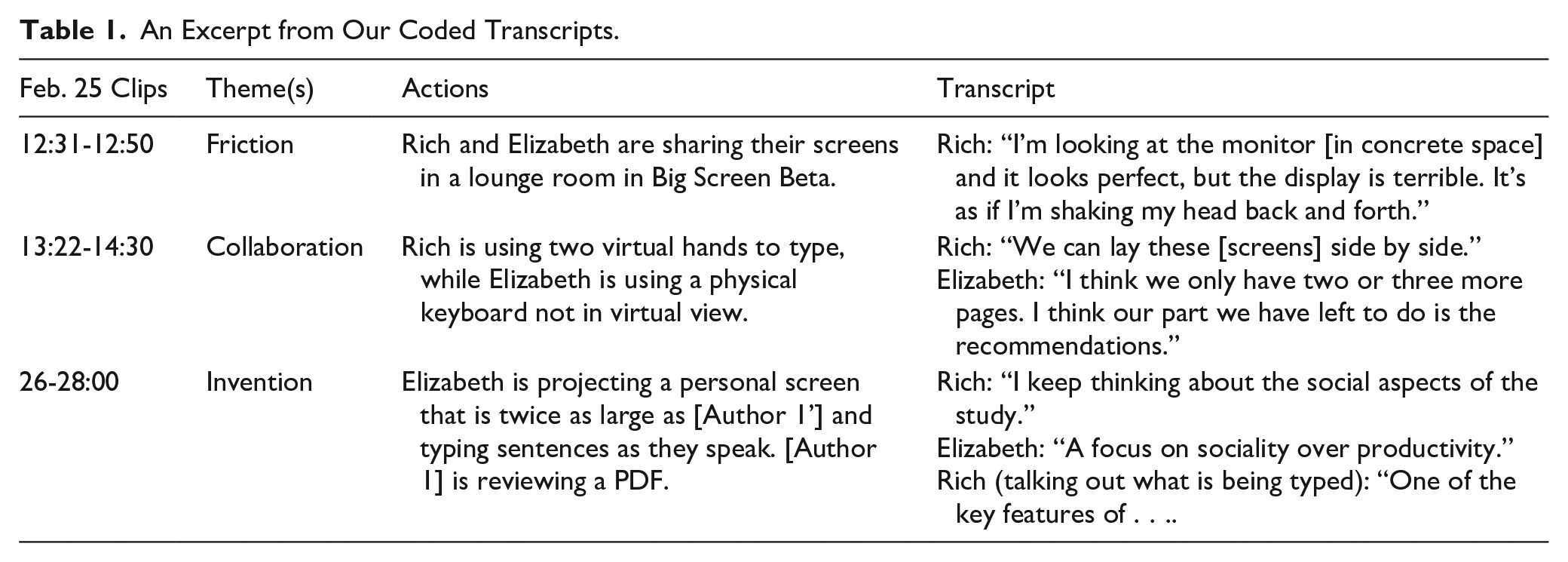
Once each theme’s criteria were defined, we then went through the recordings and transcripts to timestamp instances of each experience. To validate this process, Stefan also reviewed and marked the dataset according to these four themes. This marking was then discussed between us and the research assistant to address any variance between assessments, of which there was little. As noted above, though we did quantify the number of times each theme occurred, these data were then used to examine similarities and differences between various instances within the same categories. Finally, we would like to reiterate that while these categories offer discrete writing activities captured throughout these sessions, the categories themselves are not discrete. The above example of us relying on invention to design a white paper cover page, for example, was also noted as an instance of collaboration. Similarly, moments of friction often occurred (and sometimes even disrupted) both moments of invention and collaboration. Table 1 provides a brief depiction of how the moments were coded upon reviewing the videos and transcripts. To visualize how these moments were often connected and recursive, the subsequent Figure 2 features a modified version of Lockridge and Van Ittersum’s workflow mapping illustrations. Unlike their workflow mapping illustrations, ours substitute lines for arrows to further indicate their interconnectedness.
An Excerpt from Our Coded Transcripts.
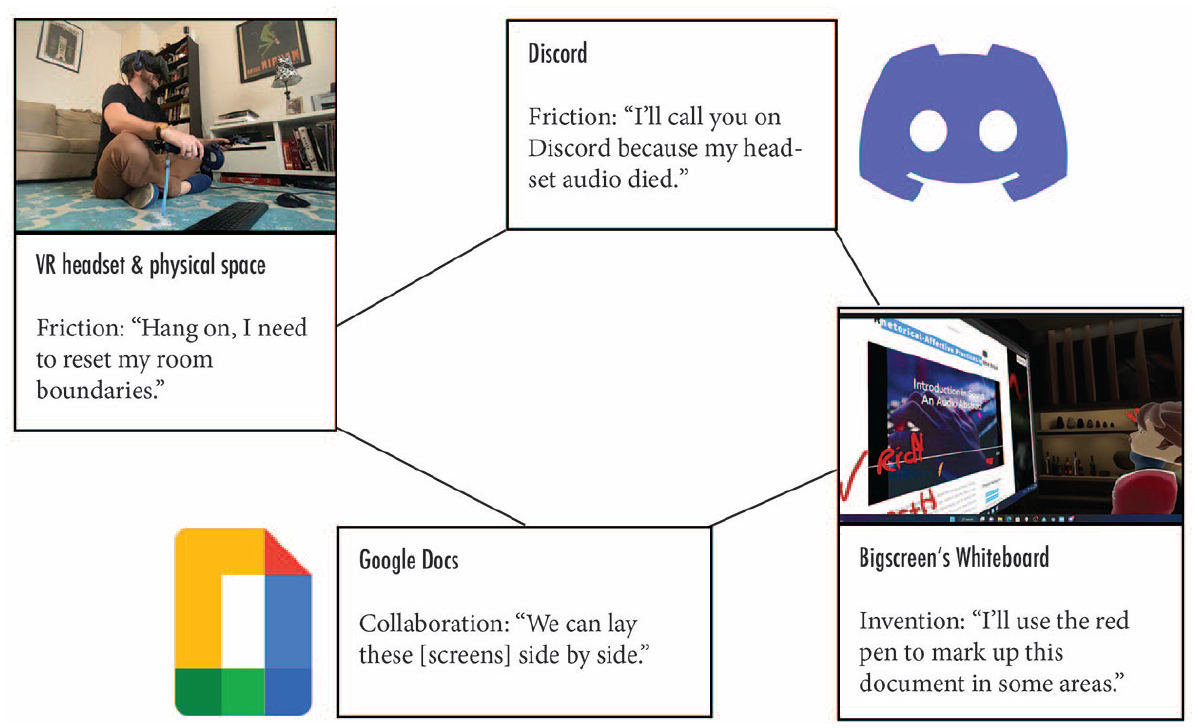
The authors’ typical workflow of collaborative writing in VR.
Findings and Intersections: Presence and Invention, Coexistent Collaboration, and Navigating Various Frictions
In all, we met for and recorded more than 40 hours of collaborative work in VR through all stages of the writing process, from initial brainstorming, drafting, revising, and even some design work with a multimodal piece. Upon reviewing this footage, we noted four key themes that emerged at various intersections of writing and VR studies that mapped onto the Collaboration happened the most often but were usually of a shorter duration (a few minutes each time). Invention happened less frequently than collaboration, but was for long stretches of time (20-60 minutes). Friction happened more often at the beginning of the 40 hours and less at the end but often took 5-10 minutes to resolve; and Pedagogy was not only mentioned the least but also generally had the shortest duration, as it was usually mentioned in passing.
Regarding these overlaps more broadly, if the invention process was going smoothly, it often also included elements of effective collaboration, whereas if there were stutters in the invention process, usually other elements of friction were also present. Some instances of footage also revealed all three themes at once, such as one example when the researchers were successfully collaborating during a period of fluid invention, suddenly cut short by a technical difficulty with either hardware. As such, rather than reporting the amount of time for each category, 2 we discuss each of the above categories as they map onto our larger discussions of presence, coextensive space and friction. As we note in our final section, the processes found in our writing sessions can better inform how we might begin conceptualizing the affordances of writing in VR.
Presence and Invention
As noted above, we spent time recording our explorations and writing sessions in VR applications. For us as well as many other users and researchers, part of the appeal of a VR application is that it instills a sense of presence, the kind that reimagines physical environments (e.g., a lounge, a cinema) through creative use of three-dimensional visuals and sound to help differentiate the virtual world from the physical (Mills et al., 2022). As rendered in 40 hours of writing sessions, exploring VR applications to understand presence was an embodied invention practice itself, as it required us to download applications, enter and manipulate the applications’ environments, and try writing in them. To varying extents, the applications we discuss in this section instilled a sense of presence yet required significant customization for the purposes of writing. In these environments, customization was an act of invention because it required exploring and manipulating the available spaces and tools before writing. Like many writers who carefully construct their physical spaces (Rule, 2018; Prior & Shipka, 2003), we needed to do some worldbuilding with the spaces and resources available to coconstruct and “inhabit a digital space distinct from our physical environment” (Saker & Frith, 2020, p. 1428). In other words, writing in VR is not a readymade activity. It takes time and care to arrange, as if learning a new tool and reconfiguring one to accomplish a writing task (Lockridge & Van Ittersum, 2020).
Following this line of thinking, we began this project by writing (or at least attempting to) in spaces rendered by applications such as (the now-defunct) AltSpaceVR, a free, social application that features personal and private rooms for affinity groups and myriad avatar options; and Rec Room, an application designed for gaming and creativity. Although both of these applications are effective in cultivating presence through immersive worldbuilding, our invention work revealed their shortcomings for writers. At the time of working in these applications in 2022, both programs lacked screen-sharing options and in-application virtual keyboards for typing on screens and options for marking up documents, whiteboards, walls, and more. As such, in these spaces, invention was largely restricted to verbal communication. 3 Conversely, the VR application Immersed, available only on Meta Quest devices, allowed for such invention by allowing screen sharing and remediating some physical keyboards (e.g., Apple’s Magic Keyboard) and physical objects (e.g., a couch) for virtual spaces (noted in Figure 3). However, Immersed’s device limitation meant we could not work across our VR devices, and also had to abide by Immersed’s more limited hardware integrations due to such device constraints. Invoking the words of Nissi and Lehtinen (2022), our workplace collaborative writing wasn’t ideal in AltSpaceVR and Immersed. Testing such applications by writing within them was the initial means to convey their limitations for invention and collaboration, especially when we considered future researchers and pedagogical applications of VR in writing studies.
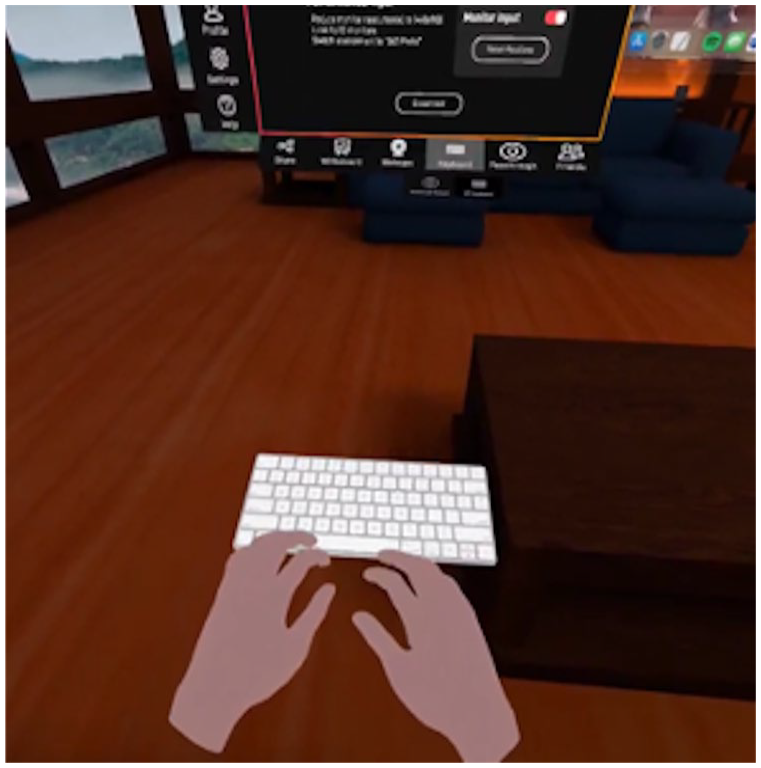
A screenshot from the virtual reality application Immersed.
In exploring these applications, we came to realize that some applications present more barriers—what Lockridge and Van Ittersum deem points of friction—than inroads to writing. Outside of the software constraints noted here, hardware constraints, such as headsets and/or the ability to connect to a computer (and the very means of materializing writing in a virtual space), were also implicated. It became clear that much like for traditional writing, space plays an integral role in the writing process; one is not able to simply pop on a VR headset and get to work without having already established a workable space in which to write (both in the physical and virtual, or coexistent, spaces involved).
For more robust invention, Bigscreen Beta was found to be an ideal application because it was compatible across our three devices (HTC Vive Pro 2; Steam Index, and Meta Quest 2), it was free, and it featured several options befit for writers: virtual pens, simultaneous screen-sharing options, and a range of rooms decorated with objects and furniture (e.g., the lounge, the classroom). Standing or sitting in front of a theater-size screen for the majority of our writing sessions, we typed up outlines for articles and took red markers to problem areas, talking aloud while, for example, a fire pit’s embers crackled behind us or a robotic vacuum zoomed around the room. We also made occasional use of the application’s “toys,” such as popcorn and the selfie camera, which allowed us to configure our avatars as we saw fit: our tools were aplenty. This space was a nexus of virtual materiality and embodied invention, indeed “inextricably linked, after all—bodies use tools and artifacts to write, and artifacts and tools must be used by bodies for writing to occur” (Clayson, 2018, p. 224).
None of the applications noted above were made with writers in mind. We found that certain software lent itself more readily to writing activities or was otherwise more malleable to the needs of writers in these spaces. Bigscreen Beta’s malleability for invention supports a key finding when it comes to the kinds of considerations that must be made when using VR as a tool for writing: certain spaces and software will be more or less useful to particular writers and their specific writing situations. Moreover, this finding highlights the role of presence when it comes to invention when writing in VR. When presence is broken, either by software or hardware limitations, or even by the kinds of environments offered by a given application, invention becomes inhibited. Thus, writers electing to use VR need to consider how various applications influence their sense of presence within these virtual spaces.
Coextensive Collaboration
Related to the above findings on presence and invention, another key factor that made itself frequently apparent through various writing sessions we recorded in VR was the importance and influence of coextensive space. Rather than thinking of VR as being a solely virtual space, especially with its current hardware capabilities, we viewed writing in VR as a hybrid space between concrete and virtual realities. Current VR technology no longer tries to conceal a user’s concrete realities (Saker and Frith, 2020, p. 1434). Try as we might, we simply could not block out or ignore our concrete realities. As Elizabeth said in a session on July 29, 2022, “Sorry, there are weird noises in the real world. Hang on, I gotta look quick. Yeah. Okay, it started raining. And the noise through my headset was confusing.” In this way, the experience of collaborative writing in VR accounted for the realities both inside and outside of the headset, especially when considering our key themes that emerged during the current study. For example, the differences in our coextensive spaces greatly influenced our individual abilities as collaborators inventing ideas and writing on shared documents. Rich’s space for writing was a rectangular room that tripled as an office, family room, and exercise space, meaning that the space was at times limited and busy with family members and a cat passing by. Conversely, Elizabeth’s space was dedicated specifically to the VR hardware, with its physical constraints taken into consideration as well as the need for free, open space with few interruptions. In addition, as mentioned above, we had different auxiliary hardware available to us during the present study, with Rich relying solely on the in-software keyboard and Vive controllers for typing, and Elizabeth able to utilize a standard computer keyboard and mouse. Furthermore, despite the variances in physical spaces, we encountered multiple instances of interruption outside our shared virtual spaces, from family members having ambient conversations to various pets blocking cameras or otherwise wandering into the VR space. As such, these spaces and their transient inhabitants constituted “a radical withness” of writing in VR (Micciche, 2017, p. 112), as the researchers always had to contend with the realities of coexistent space to varying degrees across their experiences.
As noted, Elizabeth had both the hardware access and skill to compose on a traditional keyboard in the physical space while simultaneously in the virtual space, but Rich did not and thus was required to use the point-and-click keyboard function within Bigscreen Beta. As one could imagine, this difference in available hardware meant that Elizabeth was much more easily able to type when writing in VR, leading to a smoother and more efficient creation and revision of new texts during this part of the collaborative writing process. Within this context and specific conditions, Elizabeth remarked in a writing session on May 6, 2022, that writing in VR allows for a kind of 360-degree writing: I use the actual keyboard that’s right here. I can also just look to the right real quick and write down a note literally in the air next to me . . . whereas normally if I was writing at my desk, I have to turn away from the laptop screen and find a pencil and wherever my nearest piece of paper is. I can surround myself with all of my ideas all at once.
Conversely, Rich’s reliance on the in-app keyboard meant he was also able to participate verbally during various invention and revision portions of the writing process, though not at quite the same pace as Elizabeth. This difference in our utilizations of coextensive space influenced many of our collaborative processes, where Elizabeth would quickly edit any spelling errors left by Rich due to the point-and-click method with the in-app keyboard. This difference also left us to consider these limitations across various points of the writing process, so that we could contribute to the best of our physical capabilities within the given hardware restrictions and skills. In other words, coextensive space was a key element of the creation of the rhetorical situation for each instance of collaborative writing, especially when such instances were related to invention.
Reflecting our desire for presence, our routine of meeting every other Friday meant that we could adjust our physical spaces to support better collaboration, whether that meant reconfiguring one of our rooms or practicing typing without seeing a physical keyboard. Collaborative writing revealed opportunities for reinventing our approaches to writing in VR as well as our physical obstacles to performing it. As we suggest further in the next section, collaboration revealed “friction [that] can be inventive and productive,” and we addressed “work in new ways. It [was] purposeful friction” (Lockridge & Van Ittersum, 2020, “From Process to Workflow”).
Navigating Various Frictions
In addition to influencing various parts of the collaborative writing process, coextensive space also played a large role in our experiences with technical difficulties, which we later coded as friction. Friction entails identifying and eliminating moments of technical difficulty when tools and software get in the way of a process (Lockridge & Van Ittersum, 2020, “From Process to Workflow”). While a number of technical difficulties found throughout this study were software-based, others were also related to hardware or even interference with technology from the concrete reality outside of the VR experience. For example, one such technical difficulty occurred when Rich’s handheld controls died during a writing session on March 11, 2022: “Whoa! My hand just went up in outer space.” In this instance, the writing session was paused for roughly 2 minutes so that Rich could temporarily dismount their headset and plug the afflicted controller in to charge. This controller issue also meant that they were left with only one controller throughout the rest of the session, something that greatly impacted their ability to fully experience presence in this particular session because of the limitations of the coextensive space. In another example, this time on May 6, 2022, Elizabeth’s cat interrupted the writing session by blocking one of the cameras required for the VR system to register input: “Wait, it can’t see me. Hang on. Adora! Get outta here! . . . Sorry, my cat decided that was where she wanted to sleep.” Here, Elizabeth’s outside surroundings resulted in a technical difficulty that disrupted the writing process, though this instance was more quickly resolved than the loss of one of the controllers. Such interruptions could also occur simply from collaborating within a physical space as well, as with the well-documented stories of cats climbing or sleeping on keyboards and figuring into writing processes (Micciche, 2017, p. 102). However, while such disruptions in physical space inhibit workflow, in virtual settings, such disruptions also have the capacity to disrupt one’s sense of presence or the otherwise embodied experience that takes place within these spaces, meaning even simple or quickly resolved frictions such as these can lead to more substantial breaks in progress or longer recovery times than they might in physical spaces alone.
As noted previously, a number of instances of our coded themes—invention, collaboration, and friction—were found to overlap with one another. The last two examples provided as a means of discussing coextensive space are also suggestive of friction as it manifests within VR during various writing sessions. Building on those examples, we note that friction encompassed many other instances of technical difficulties. In at least 15 writing sessions (approximately one-third of our sessions) at least one of our headsets and VR software yielded errors; a headset’s display would “tear,” or present a stuttering display; Bigscreen Beta and the VR system software would restart, kicking us out of the host’s room; microphone or audio outputs would cut out or fail altogether, such as when someone’s entire virtual body would freeze. Technical difficulties indeed created friction and thus new instances of invention in the form of problem-solving. Because of the audio failures, for example, we later turned off audio in Bigscreen Beta, moving it to voice chat on Discord while still working within our virtual space. Friction-as-technical-difficulty meant we adopted additional tools so that we could anticipate errors and streamline our invention and collaboration in Bigscreen Beta. Figure 4 depicts Bigscreen Beta before we adopted additional tools, and Figure 5 depicts our new setup.
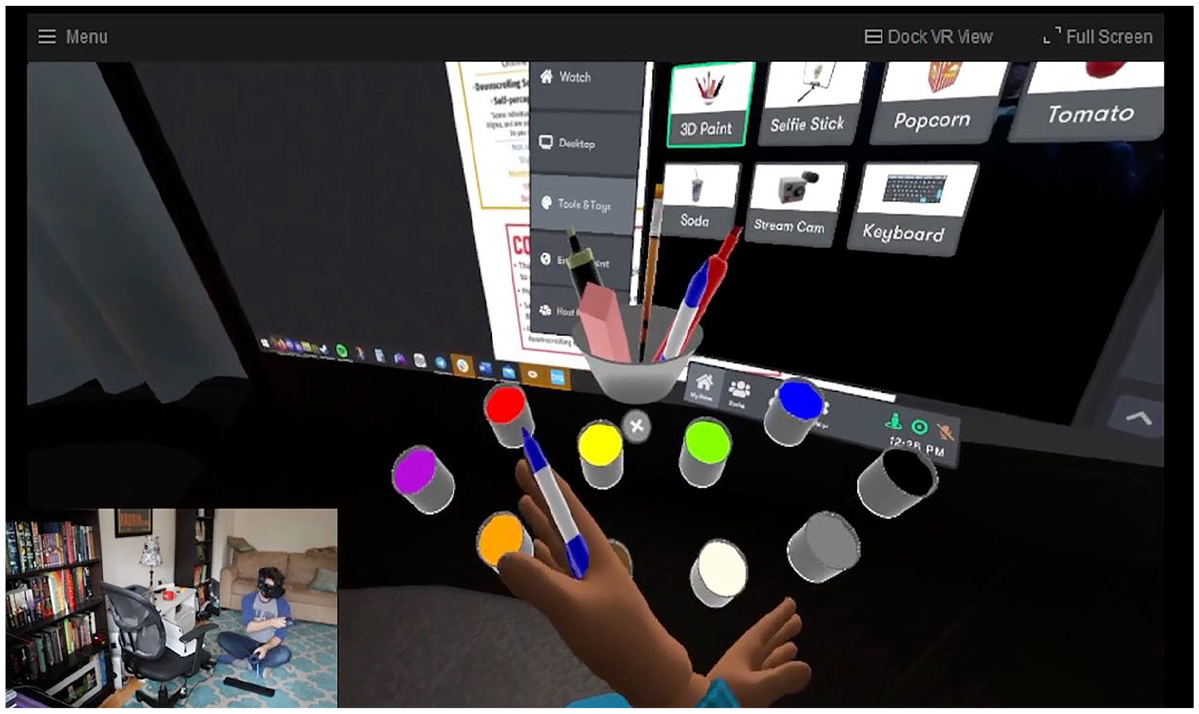
A screenshot from our footage of writing in Bigscreen Beta.
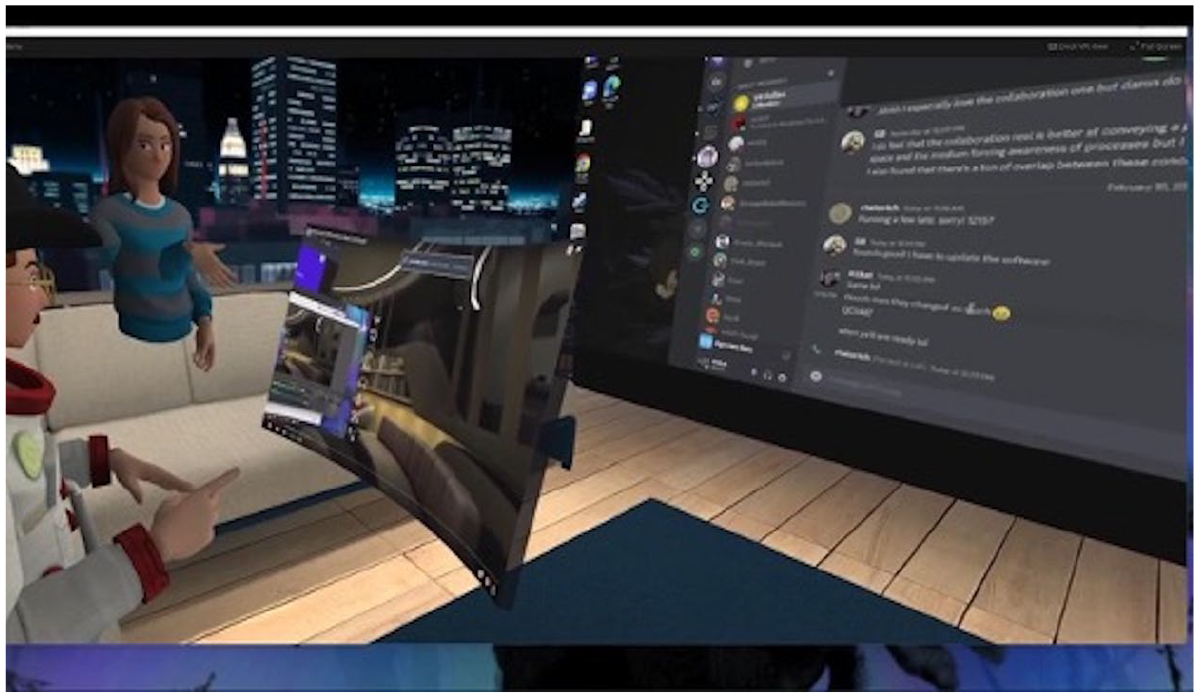
A screenshot from footage of writing in Bigscreen Beta.
Once again, while our study traces how these themes map to our larger discussions about the intersections of VR and writing theory, it is important to note that none of these occurrences are mutually exclusive. While friction was often most notable in various instances of hardware or software technical difficulties, such frictions also occurred when invention and collaboration were uninterrupted by technology, as they would in a traditional writing setting. Friction played a huge role in maintaining or inhibiting presence during the invention and collaboration process. Outside of technical difficulties, an inability or difficulty during a brainstorming or drafting session, for instance, can be just as presence-breaking as the software crashing or a cat blocking part of the VR hardware, and thus created their own instances of friction. As Elizabeth stated during a writing session on July 28, 2022, “Lit reviews are legitimately my weakest writing ability. . . . It’s definitely a thing I would want somebody else to come in and look at afterwards.” For that reason, we valued reviewing each other’s work while in VR. The same could be said for collaboration as well—were we not able to overcome some of the rhetorical situations as created by the particular contexts of each of their separate coextensive spaces, many of these writing sessions would have stalled out or been otherwise made ineffective. Rather, much like with writing in concrete space, frictions must be dealt with as they arise in order to help minimize their inhibitions of various stages of the writing process.
Key Takeaways and Recommendations
As Mills et al. (2022) acknowledge, VR research and writing can augment our understanding of multisensory and multimodal composing possibilities writ large. Instead of initiating a study of students composing in VR, we expanded on Mills et al.’s work by focusing more on conventional writing processes rendered in a virtual environment. Our findings on invention, collaboration, and friction conveyed the experiences of writing in VR outside of a pedagogical context, focusing primarily on our experiences with Bigscreen Beta. This section begins with a discussion of the advantages of writing in VR, and then offers recommendations for integrating VR into future research.
Writing in VR has Advantages
Although much of this article detailed the challenges of writing in VR, we encourage writers to experiment with its possibilities. It is difficult to convey in words, but there were many moments of uninterrupted flow and ideation in the three-dimensional, multisensory rooms wrought by Bigscreen Beta. Moments of laughing and throwing virtual tomatoes and popcorn at each other and the walls. Moments of feeling once again like the communities of writers who gather at coffee shops and classrooms, physical spaces that were closed for many months. Moments of watching words come alive on screens larger than any we could afford or fit in our homes. Writing in VR combated the screen-based flatness that accompanies meeting over digital communication platforms like Zoom and Microsoft Teams. These platforms have so-called immersive features (Zoom, 2023, “Using Immersive View in meetings and webinars”), but they do not replicate the dimensionality of writing together in VR. To emphasize these points, we narrate the session in which we reviewed research assistant Stefan’s undergraduate thesis poster. The poster was displayed on a wall, which appeared to scale more than 10 feet high and 15 feet wide, in our Bigscreen Beta room and marked up in red, and it was later set side-by-side with another poster for a visual comparison. As demonstrated in Figure 6, this session reframed, literally, the writing-classroom tradition of offering feedback on a two-dimensional document displayed by a projector or desktop screen.
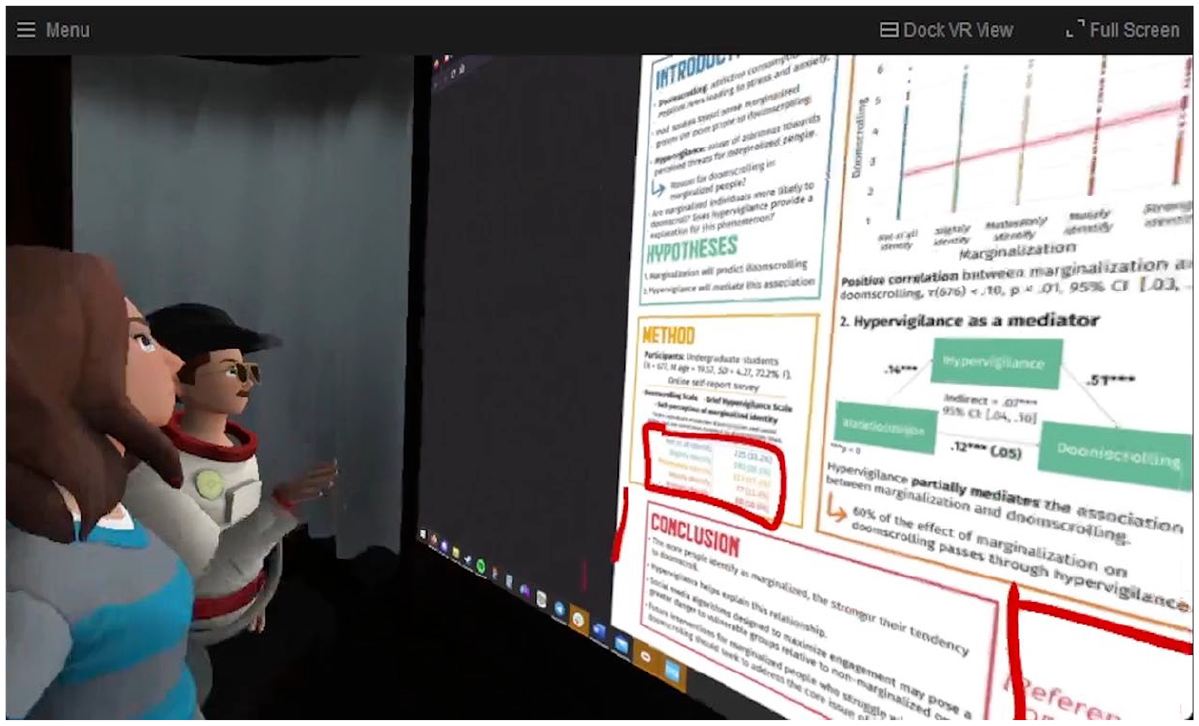
A screenshot of two researchers discussing an undergraduate poster for a thesis project.
We were able to move around and view the poster in a larger scale and mark it directly, as well as make additional recommendations as the undergraduate researcher made updates in real time. Potentially due to VR’s ability to instill a sense of presence, Stefan reported being more engaged in this feedback process than if we had provided the same feedback via other digital tools (such as sharing a screen on Zoom) or if we had met in person.
Recommending Pedagogy, Friction, and Accessibility Research
Especially as VR becomes more ubiquitous in some classroom spaces, pedagogy is an important topic to explore to develop best practices and awareness of its affordances and constraints. Based on our findings, researchers might invite fellow instructors to offer feedback on student papers through the lens of VR. This focus on exploratory feedback would align with that of writing researchers who have studied the impact of feedback via screencasting and wearable technologies (Anson et al., 2016; Cheng & Li, 2020; Özkul & Ortactepe, 2017; Tham, 2017). With environments, document scaling, and 3D avatars, VR is another means of breaking the conventions of marking up and returning physical papers. How instructors and students respond to such change remains to be explored.
We are hopeful that pedagogy research can take shape in a virtual space shared by an instructor and students, much like a writing center appointment (or our above example with our research assistant). However, we acknowledge that access to VR technology can vary by institution. As mentioned in the opening paragraph of this article, the Apple Vision Pro is rather new on the consumer market. At the time of writing and revising this article, it costs more than US$3,000, more than twice the cost of a Meta Quest headset. There are cheaper options and alternatives, and more headsets and haptics (e.g., gloves) are emerging on the consumer market, once again creating new possibilities for “understanding, interpreting, and researching new forms of three-dimensional multimodal representation in virtual simulations, classrooms, and written communication contexts” (Mills et al., 2022, p. 364). It is, of course, unknown what future headsets and software will do for writers, but we can speculate that this technology will promote more opportunities for writing (on documents) in VR.
Beyond studying feedback, researchers might also turn to the spaces apt (or not) for VR writing. As St. Amant (2017) notes in an essay on infrastructures and frictions related to online learning, “hardware encompasses the physical technologies essential to accessing and participating in online learning environments, and it is thus a major friction point in terms of hard infrastructure related to online education” (p. 6). In light of our study, St. Amant’s insight is an exigence for researching physical learning spaces suitable for VR activities. Among participants, what is the ideal physical space for using VR effectively? How might a participant’s workflow map of writing an essay with physical tools compare to a map of writing an essay in VR? These research questions make room for analyzing inevitable frictions that occur both within and outside of the VR software. We are beginning to address these questions in our own pedagogical contexts. For example, Rich’s digital authoring practicum (PRWR 4001) featured a week of software review writing and editing in the form of video essays. Three students reviewed Immersed with a Meta Quest 2 headset, and while the Quest 2 did not require room trackers or a computer with which to connect, the students had little concrete space to move around the virtual space of Immersed. Chairs, desktop computers, and peers became unintended obstacles, prompting the students to take their playthrough to the hall outside the classroom. Later, the students’ first-person footage of Immersed, as captured by the Quest 2, was difficult to export over WiFi and when connected via USB-C to our class’s Apple desktops. These obstacles resulted in a friction-heavy experience for students and instructors alike.
Nevertheless, we suggest that the aim of researching friction is to present solutions for resolving it. As Lockridge and Van Ittersum stress in Writing Workflows, friction leads to adaptive workflows and those workflows may or may not be replicable. With friction as the focal point of a research project, we can productively compare VR to other digital tools, including who can access it and what they need to do so. The experience of encountering friction parlays into writing about that friction and developing learning activities about it.
Finally, friction also raises questions about accessibility in VR across contexts. Researchers of VR hardware and applications have addressed how such systems can be accessible to a wider range of users, such as those who are unable to participate because of limited mobility, low vision, and more (Mado et al., 2022; Mott et al., 2020; Zhao et al., 2019). The fact remains that VR is largely an able-bodied endeavor, even implicating our findings on invention and collaborative scenes of writing (Stoner, 2022). We are researchers who have a full range of motion and can hear and see with our headsets. As such, we acknowledge that our present study risks further reifying ableist concerns about VR technology (Mills et al., 2022). Thus, we encourage future research that seeks to address presence, coexistence, and friction in relation to writers unlike us, as both previous research and our present study are productive invitations to address unanswered questions about the body, technology, and virtual worlds for writers. Through our recording process, it became clear that the act of using VR as a digital writing tool further illuminates key areas of the writing process already being studied within the field. As accessibility in VR grows, then, it seems likely that this enmeshment between emerging technologies like virtual reality and writing will continue across both academia and industry. It is vital, then, to continue this kind of research to better understand how VR influences the writing process and how writers can shape these technologies and theories for their own means, whether such applications are made to cater specifically to them or not.
Footnotes
Declaration of Conflicting Interests
The authors declared no potential conflicts of interest with respect to the research, authorship, and/or publication of this article.
Funding
The authors received no financial support for the research, authorship, and/or publication of this article.
