



Abstract
Developing academic writers must continually position themselves discursively as they negotiate institutional, programmatic, and disciplinary contexts. The inextricable relationship of writing and identities raises questions of access to social identities in schools, a particularly salient issue when considering the complexities and challenges of the high school to college transition for students from historically marginalized groups. This study focuses on Jain, a first-generation Latino college student, as he positions himself as a writer over 18 months in response to a range of school-based writing tasks. My analysis finds that Jain’s identity negotiations are influenced by a history of social positioning in schools, as his stance-making patterns and sense of self as a writer reflect resources and opportunities he encounters. This study adds to research demonstrating the role teachers and institutions can play in (in)validating certain aspects of students’ identities and influencing belonging in school spaces, indicating a need for educators and researchers across K-12 and college contexts to continue to challenge the standardization of school writing and the prevalence of assessments that limit curricula and constrain identities.
In an interview toward the end of his first semester of college, Jain explained to me his use of the word furthermore in his school writing. 1 Jain, a first-generation-to-college Latino student, told me he learned to use furthermore in middle school as a strategy to connect paragraphs, but he did not see the word as part of his personal discourse, saying, “I wouldn’t want to talk like that.” When Jain says he “wouldn’t want to talk like that,” he creates distance between the Jain writing in school and the Jain who exists outside of school, exemplifying an understanding of identity as multiple and dynamic and offering insight into the ways Jain sought to position himself through his writing in school contexts (Gee, 2000; Moje & Luke, 2009; Wenger, 1998). Echoing Gee’s (2008) discussion of discourse as an “identity kit,” Jain seemed aware of the ways he could use language to enact different social identities in an effort to be recognized in distinct contexts.
The use of furthermore as part of Jain’s discoursal negotiation is typical of how student writers navigate institutional and disciplinary contexts. As Dyson (2018) writes, transitioning across school contexts requires “navigating complex configurations of practices—value-laden, recurrent activities within which [students] learn social roles, expected actions, and the kinds of knowledges most valued” (p. 239). Student writers like Jain must determine whether and how their discursive choices reflect (or reject) desired social roles or valued knowledges as they negotiate new writing contexts, while at the same time being positioned by their readers and by the discourses they are exposed to in academic spaces (Hungerford-Kresser, 2010; Kane, 2012; Lammers & Marsh, 2018). The inextricable relationship of writing and identities raises questions of access to social identities in schools and calls attention to the ways identities are produced in and through activity and social interaction (Falconer, 2019; Holland & Leander, 2004; Lewis Ellison et al., 2020; Moje & Luke, 2009; Tardy, 2009).
Attention to access is particularly salient when considering the complexities and challenges of high school to college writing transitions. For example, students in the decentralized U.S. education system must navigate incoherence and discontinuity in curricula and expectations across programs and institutions (Foster & Russell, 2002; Gilliland, 2016; Ruecker, 2015) and institutional policies and barriers (Saidy, 2018), all while adjusting to the rhetorical and cultural demands of college writing (Harklau, 2001). These challenges are magnified for students from historically marginalized groups, like Jain, who are less likely to feel they belong on a college campus (Gonzalez et al., 2021; Hungerford-Kresser & Vetter, 2012). 2 Research has shown that U.S. public education structures like test prep pedagogies, English-only policies, and autonomous models of literacy can lead minoritized youth to believe they are not capable of academic success (Caraballo, 2011; Gonzalez et al., 2021; Irizarry, 2011; Valenzuela, 1999).
Jain was one such student alienated by public education structures. He often described his historically underfunded, predominantly Latinx/a/o-serving high school as underperforming, and he worried he would not be prepared for college writing after attending a “bad high school.” Jain told me he was “not a good writer” because he earned only “average” scores on state assessments and college entrance exams. However, as I discussed writing with Jain in monthly interviews, I noticed a rhetorical sensitivity that belied his “not a good writer” self-identification. I hoped a textual analysis of Jain’s writing would make his rhetorical abilities visible while offering insights into his school writing experiences.
In what follows, I draw from a range of data collected over an 18-month period from Jain’s final semester of high school through the end of his first year of college to offer a contextualized study of Jain’s efforts to negotiate the transition to college writing through a lens of social positioning and writerly identities. This inquiry is guided by the question: How does Jain position himself as a writer across his high school to college transition? I use discourse analysis methods to identify specific writing strategies Jain utilized across institutional and disciplinary contexts, and interviews with Jain offer insight into his negotiation of discoursal identities. With the acknowledgment that identities are social, contextual, and reliant upon recognition by others, the article’s focus on writerly identity asks us to consider not only how Jain positioned himself, but also how he was positioned by instructors and institutions. My findings point to tension in the discursive positionings and rhetorical opportunities afforded to Jain in his first semesters of U.S. higher education, and raise questions about how attention to social positioning can better support student writers as they negotiate literacies and identities through their college transitions.
Writing and Identities in Academic Writing Development
This study is interested in the ways Jain negotiated discoursal identities across his high school to college writing transition. Writing studies scholars have argued that the negotiation of discoursal identity—the identity constructed in the act of writing—lies at the heart of academic writing development (Ivanič, 1998; Tardy, 2009). As Gee (2000) explains, identity is about being recognized as a certain “kind of person” in a given context; this social conception recognizes identity as ongoing performances—the clothes we wear, the ways we speak and write, the people we hang out with personally and professionally—rather than an indicator of a static internal identity. For example, when Jain said he “wouldn’t want to talk like that,” he was recognizing the different performances of identity in his life. From this perspective, learning is not only the acquisition of skills, knowledge, and habits but the ongoing negotiation of identity in communities (Wenger, 1998). Learning to write is about learning how to “talk like” or write like a certain kind of person as much as learning content or conventions of a particular text type or genre.
Authority and Stance in Academic Writing
Van Langenhove and Harré (1999) suggest that positioning oneself as an authority—as someone with the right to speak and as deserving of the trust of readers—is an important aspect of entering academic conversations. Their analysis of scientific publishing highlighted the ways in which an author positions themselves as authoritative through rhetorical devices like the use of “we” and the presentation of data as rational and logical (see also Hyland, 2004). The ways writers construct authority using self-mention (“we”) and qualify their claims demonstrate how a discursive stance contributes to identity work; they are language choices that help to create a socially defined persona (Hyland 2005). Stance strategies like hedging—qualifying a statement or assertion with words like possible or might—and boosting—expressing certainty with words like clearly or obviously—can indicate how a writer identifies within a disciplinary community or social position and how they position themselves as an authority in academic conversation (Hyland, 2004, 2005; Street, 2009; Van Langenhove & Harré, 1999).
Stance markers like hedges, boosters, and self-mention have been the foci of recent research comparing the discourse choices of lower-division and more advanced undergraduate student writers in attempts to better understand writing development, disciplinary socialization, and access to learning. Studies comparing first-year to more advanced undergraduate writing have found that first-year students tended to underuse hedges and overuse boosters, leaving an impression that their writing is overly general or the writer is unaware of other views (Aull, 2018; Aull and Lancaster, 2014; Lancaster, 2014). Somewhat paradoxically, the caution and openness to other ideas rhetorically instantiated with hedges actually indicates the complexity that academic readers (and instructors) tend to value. In other words, positioning oneself discursively as curious and open to alternative interpretations is an important part of academic identity work and creating the authoritative positioning expected in academic writing. Research on stance and identity among undergraduate students has largely focused on comparisons between the writing of first-year students and more advanced undergraduate writers (Aull, 2018; Aull & Lancaster, 2014; Gere, 2018; Lancaster, 2014), and there remains a need for more understanding of available positions and opportunities for students making the critical transition from high school to college writing, including whether and how contextual shifts in genre, discipline, or other factors may affect language-level choices (Aull, 2018).
Power, Social Positioning, and Intersectional Identities
Examining how shifts in writing opportunities—different genres, disciplines, etc.—may affect language-level choices is important because the discoursal self that writers construct, the impression conveyed through the performance of the text (Ivanič, 1998), is often dependent upon power relations and the social positionings afforded by powerful bodies in a given context (Falconer, 2019; Moje & Luke, 2009). Because the discoursal self is a co-constructed identity enacted between the writer and their reader(s), whether and how student writers are provided opportunities to enact identities can affect not only their writing development but their sense of self as a writer and student. The processes of identity negotiation are thus sites of opportunity and struggle as students locate and identify themselves in institutional contexts (Lammers & Marsh, 2018; Lee & Anderson, 2009; Lewis Ellison et al., 2020).
Positioning theory is a generative framework for examining the relationships of language, literacy, and power in school contexts. Developed in social psychology, positioning theory is a discourse-based approach to understanding social interaction, identity formation, and power relations and aims “to understand how rights, duties, and obligations are distributed among interlocutors and how they shape social structures while being shaped by them” (Kayi-Aydar, 2019, p. 1). Attending to “rights, duties, and obligations” is particularly apt for writing studies research because such an approach attends to the processes of affording opportunities to speak or write like a certain kind of person and for addressing how these rights may be extended or denied. According to Davies and Harré (1990), positioning is a discursive process through which a given speaker positions oneself (reflective positioning) and others (interactive positioning) within a given cultural story line. The meanings ascribed to certain self- and other-positionings (i.e., “not a good writer,” English language learner, and so on) implicitly limit “what is logically possible for a given person to say and do” and “bounds the content of the repertoire of socially possible actions” (Harré and Moghaddam, 2003, p. 5). Positioning research in education has illuminated the social processes of learning and drawn attention to the consequences of positioning for access to learning opportunities. For example, positioning theory has been used in education research to examine how teachers position students through asset or deficit frames (Katz & DaSilva Iddings, 2009; Seltzer, 2022) and how teacher or mentor positioning influences student access to academic and disciplinary identities (Falconer, 2019; Hazari et al., 2015; Kane, 2012; Vetter, 2010).
Recognizing the ways in which self- and other-positions interact and/or overlap with each other, writing studies scholars have looked to a range of intersectional identity markers when examining the ways in which people of color and members of other marginalized groups negotiate academic and professional contexts and discourses (Falconer, 2019; Lewis Ellison et al., 2020; Seltzer, 2022). Intersectionality, as introduced by Crenshaw (1991), emerged as a framework for articulating the interactions of racism, sexism, and other power-laden structures. Intersectional analysis recognizes the interrelation of social identities and attends to the ways in which a person or group’s marginalized identities overlap or intersect and the relationships of these identities to power. Falconer’s (2019) recent case study of an undergraduate science writer serves as an example of intersectional analysis in writing studies. Anne, a first-generation-to-college African American woman studying science, initially felt like scientific discourse was something that “belonged to others” as she navigated the raced-gendered space of scientific laboratories (p. 19). Through explicit instruction, active mentorship from advisors, and efforts to make connections across her intersectional identities, Anne was not only able to see the ways in which her desired identity as a scientist could be represented rhetorically but also how her background and experience could itself be a source of power in her work in medicine (p. 31).
This article presents Jain’s negotiation of discoursal identities and self-positioning as a writer across his high school to college transition in the context of his intersectional identities and relationships to writing and power. While his strained relationship with school writing seemed to calcify his self-identity as “not a good writer,” Jain demonstrated rhetorical dexterity and positioned himself discursively as an authority when presented with writing opportunities that encouraged him to position himself as a contributor of knowledge.
Research Methods
As summarized by Merriam (2009), case study research can be valuable because it is concrete and contextual. Even if case study research cannot claim to be generalizable because of its specificity, the reader brings their own interpretations and experiences that can extend to reference populations (pp. 44–45). Case study research can also present an opportunity to understand and examine how individual students, particularly those from historically marginalized populations, experience school curricula and programming (Caraballo, 2011; Saidy, 2018). For this research, a case study approach afforded me an opportunity to trace how Jain positioned himself discursively and how he was positioned by others across courses and institutional contexts. In this way, case study research can be complementary to large-scale studies of student writing development by illuminating the individual complexities of transitions. I focus on Jain in this article because the dissonance between his “not a good writer” self-positioning and his demonstrated rhetorical sensitivity seemed representative of broader issues around writing, identities, and school-based learning opportunities.
Research Participant
I first met Jain at the beginning of his final semester of high school. I had worked with Jain’s English Language Arts (ELA) teacher as part of a high school–college writing partnership, and after a few semesters of collaboration I began an institutional review board–approved research project focusing on high school to college transitions. Like many “generation 1.5” students who share characteristics with both first- and second-generation immigrants of prior eras, Jain navigated cultures and languages throughout his life, speaking and writing in English throughout his U.S. schooling while speaking primarily Spanish at home. Jain told me he personally identified as Mexican because he felt it represented the language and culture of his home and community.
Jain was the first in his extended family to graduate from high school and attend college, and seemed to be highly motivated by ganas, a desire to achieve in school fueled by an acknowledgment of family sacrifice and a desire to create a more stable financial footing for himself and his family (Easley et al., 2012). When I first asked in a questionnaire why he wanted to attend college, Jain wrote, “I need to go to college in order to not only make my family proud but in order to better my financial situation for my family, we have a long generation of family members who are stuck in the financial position they are in due to the lack of higher education.” Jain’s attention to the “long generation of family members” points to the ways his family’s socioeconomic status informs his goals, and his use of the word “need” in the first part of his response indicated Jain’s sense of responsibility and motivation as the eldest child in his family. Jain entered college intending to major in engineering, which he imagined would provide future financial stability and be a good fit for his hands-on learning style.
Research Context
More than 90% of students at Jain’s high school self-identified as Hispanic/Latino or American Indian/Alaska Native, according to school district demographic data. Even though the local 4-year university where Jain enrolled was only a 15-minute drive from his high school, Jain would be navigating a much different social environment. Of the more than 30,000 undergraduates enrolled at the time of the research, over 50% self-identified as White and slightly more than 25% self-identified as Hispanic or Latino.
While the university was at the time working toward Hispanic-Serving Institution (HSI) status and has since been designated as such, an HSI designation does not in itself indicate a culture or structure that supports the development of Latinx/a/o students (Garcia, 2019). In fact, Jain’s intersecting identities as a first-generation-to-college, Latino, commuter student who needed to work off campus to support himself and his family would pose numerous challenges integrating into the cultural world of a diverse university. For example, Jain struggled to find affordable parking near campus, sometimes relying upon questionably legal spots he would use just long enough to attend a class before running back to move his car. Working in the library late into the night meant walking half a mile to his car before driving to his family’s home where other responsibilities awaited him. Jain also struggled to integrate fully into the social life of the university because of his weekend work schedule, as he was unable to attend affinity group meetings or athletic or social events in which he had expressed interest. Reflecting at the end of his second semester on how his college experience aligned with his prior expectations, Jain said, “I like coming here. But when I come, I think of just work. It’s just work work work.”
Writing in high school and college
I began working with Jain as new writing-related policies were implemented in his school. Jain’s high school ELA career was shaped by a mass-marketed curriculum and textbook all teachers in his district were mandated to follow. The majority of senior English writing assignments asked students to analyze literary texts in tasks framed as arguments, reflecting the writing students were expected to perform on state standardized tests (Jacobson, 2015). According to Jain, most writing outside of ELA consisted of short answers on quizzes and tests, a self-report consistent with large-scale research on writing in secondary schools (Applebee & Langer, 2011).
Jain’s college writing was also shaped by newly implemented policy. The first-year writing (FYW) curriculum was transitioning from a literary analysis approach similar to Jain’s high school curriculum toward an outcomes-oriented, rhetorical framework more aligned with current trends in composition. In addition, this research project began during the implementation of a campus-wide general education writing policy, which required all general education instructors to assign at least 10 pages or 2500 words of writing over the course of the semester, with one assignment of at least 750 words and the opportunity to revise at least one assignment based on feedback. It’s fair to say that due to local and national policy Jain was writing more than he would have had he entered university even just a few years earlier.
Data Collection
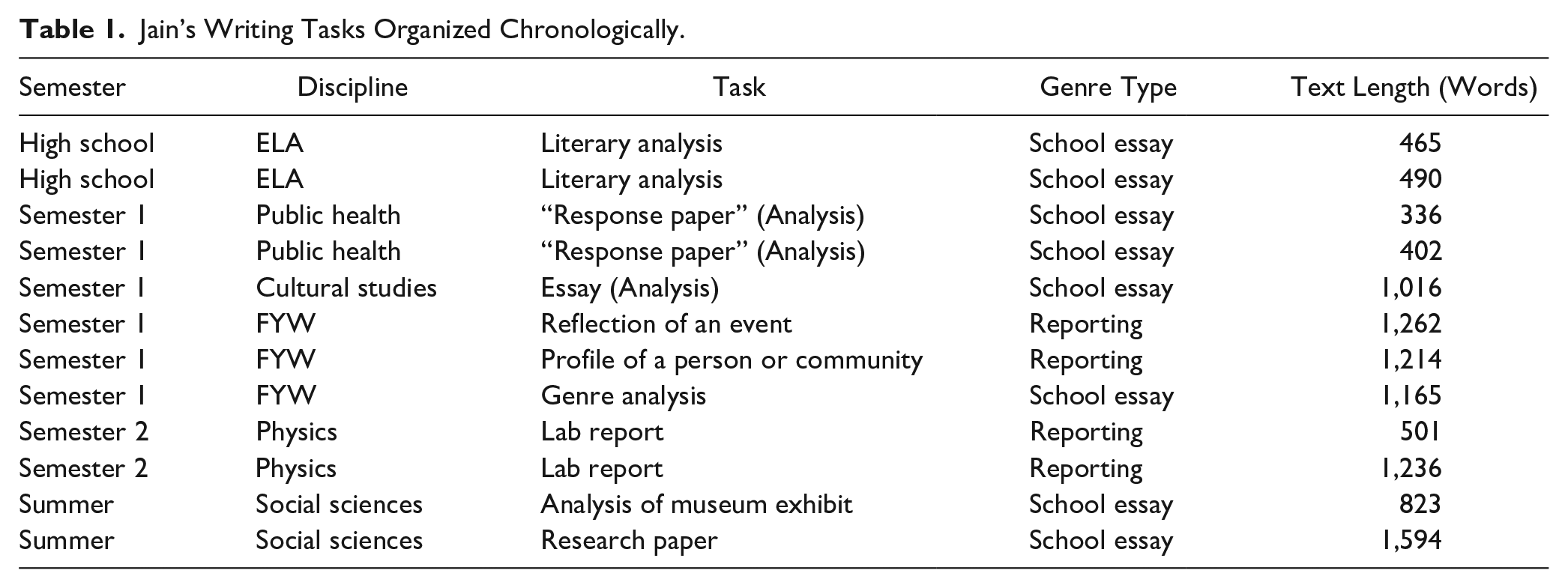
Jain shared with me writing he completed from his senior year of high school through a summer course following his first year of college and joined me for monthly semistructured interviews over that time. The data were limited by what Jain chose to share with me, but I was able to gather texts from seven courses for this study: two ELA sections from high school, one FYW course, three general education courses, and one lab-based, introductory physics course (see Table 1). For the courses with repeated assignments, I followed Donahue and Foster-Johnson (2018) and selected one text from early and one from the end of the course. The FYW course was the only course in which there were three distinct text types assigned, so I included each of Jain’s FYW texts in the corpus. The final data set consisted of 12 texts totaling 10,504 words.
Jain’s Writing Tasks Organized Chronologically.
Text types and opportunities
The types of writing assigned are central to understanding writing opportunities because different assignments lead to different student writing and, concurrently, a range of values, expectations, and participation structures (Aull, 2020; Cornelius & Herrenkohl, 2004). Jain was assigned to write a range of text types during the study that fit generally within two genre families: school essays and reporting texts (see Table 1). Three-quarters of Jain’s texts (8 of 12) were what I call here the “school essay,” also known as the academic essay, the college essay, the argument essay, or, simply, an essay or paper in U.S. education contexts. This typified form of writing is characterized by a thesis in the opening paragraph that introduces the writer’s main claim or idea followed by support for this thesis in succeeding paragraphs before ending with a conclusion that restates the thesis and sometimes extends the thesis or seeks to introduce new questions or connections (Geisler, 1995). The school essay is defined more by its form (often a 5-paragraph essay) and conventions than its communicative purpose (Caplan, 2019; Soliday, 2011; Tardy, 2019). For example, Jain was asked to write an “essay” or “paper” when analyzing a novel in English Language Arts (ELA), evaluating a museum exhibit in a general education social sciences course, and arguing for or against needle-sharing programs in a general education public health course, among other applications of the form. The other four tasks, lab reports in a physics course and journalistic FYW tasks, can be classified as “reporting genres” (Bhatia, 2002). As Bhatia (2002) explains, there are constellations of related and overlapping genres that are used within and often across discourse communities. Even as some elements of the structure and style are distinct because of the disciplinary contexts, both the lab reports and the journalistic FYW tasks can be considered reporting genres that positioned the writer as someone with unique knowledge of personally collected and analyzed data.
Interviews
Monthly interviews were conducted to gain a sense of Jain’s experience and perspective and to illuminate the individual complexities of academic writing development and discursive positioning identified in corpus studies of student writing. Semi-structured interview questions were written in a nonspecific way to allow for flexibility depending upon the time in the semester, the availability of writing to examine and discuss, and any other factors. This interview protocol also allowed me to build questions based off prior interviews. Jain participated in 11 interviews in this time frame, with each interview lasting approximately 30 to 60 minutes for a total of 519 interview minutes.
As I gathered initial impressions of Jain’s written texts, I was able to ask Discourse-Based Interview (DBI) questions during our meetings. In a DBI, the interviewer asks about specific features of the text after looking at variations among samples to understand a writer’s tacit knowledge about writing (Odell et al., 1983). The interviewer presents the text (or texts) with different options, and offers the writer choices, such as, “Here you do X. In other pieces of writing, you do Y or Z. In this passage, would you be willing to do Y or Z rather than X? What basis do you have for preferring one alternative to the other?” (p. 223). For example, after noticing a variety of stance-related discourse markers in Jain’s writing, I presented him with choices and asked which he preferred, and why (see Figure 1).
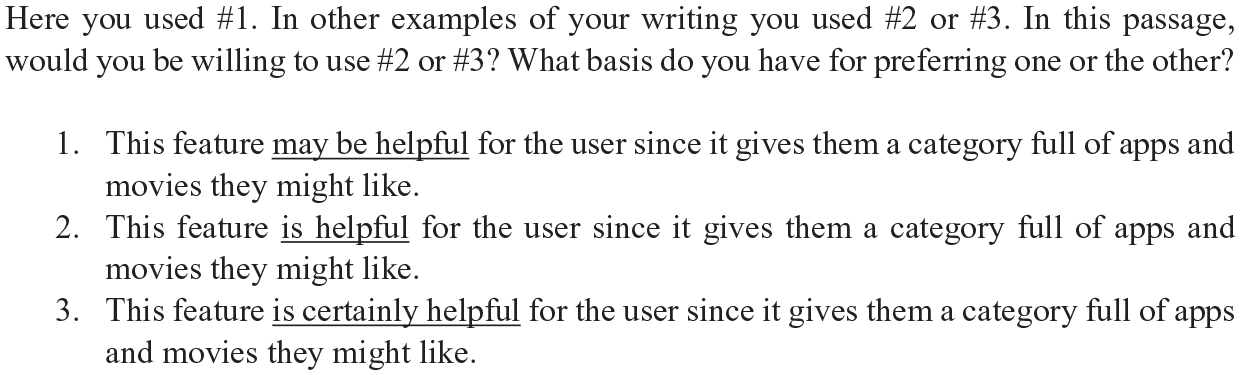
Sample DBI question based on discourse markers.
Data Analysis
The analysis process was informed by my research questions and readings in positioning theory and discoursal identity. In positioning theory, discourse is understood as ways of being in the world (Kayi-Aydar, 2019), the ways of behaving, interacting, thinking, speaking, and writing that make up socially situated identities (Gee, 2008). Positioning analysis focuses on the ways a speaker positions themselves or is assigned positions by others in discourse.
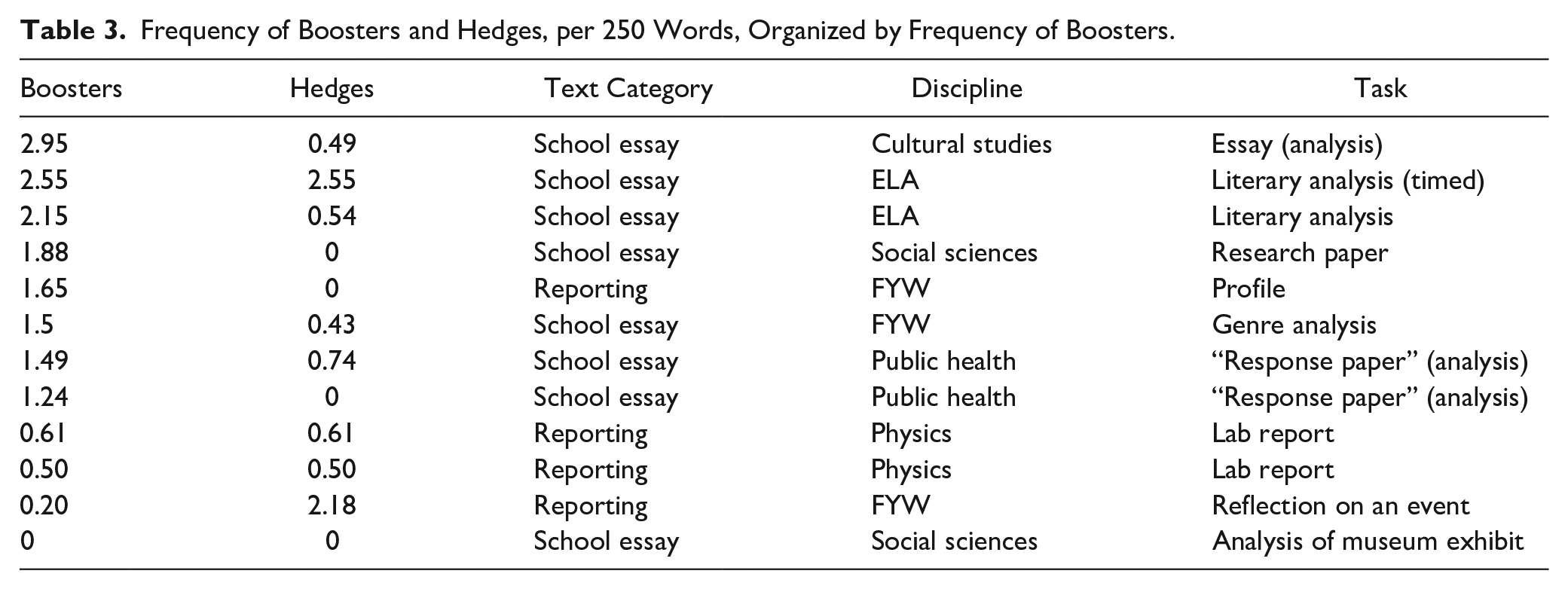
Textual artifacts were annotated for developmentally meaningful features such as authorial intervention, thesis placement, stance strategies (i.e., hedges, boosters), and engagement strategies like directives (Imagine if . . .) that indicate a writer-reader relationship. Particular focus on stance in Jain’s written texts emerged from my discussions with Jain and from the extant literature suggesting that stance strategies are subtle markers of authorial identity and positioning in academic writing (Hyland, 2005; Street, 2009; Van Langenhove & Harré, 1999). As stance strategies emerged as important in the data, I iteratively read each text and tracked hedges, boosters, and self-mention, using Aull and Lancaster (2014) and Hyland (2004) as references. To capture consistency in coding decisions, I was careful to read each instance in context to make sure it was being used for a stance-related purpose (i.e., the author effectively argued) and not as part of a quoted phrase or other usage like an adjective phrase (i.e., in hopes of effectively convincing the user). After counting the instances of hedges, boosters, and self-mention in each text, I normalized the data by dividing the total number of words in the text by the number of discourse feature uses and multiplied by 250. For example, Jain’s earliest high school ELA text contained 4 boosters in 465 words, or a normalized usage of 2.15 boosters per 250 words (4/465 × 250). Normalizing this data allowed me to compare Jain’s use of stance-related discourse markers across different text lengths and text types.
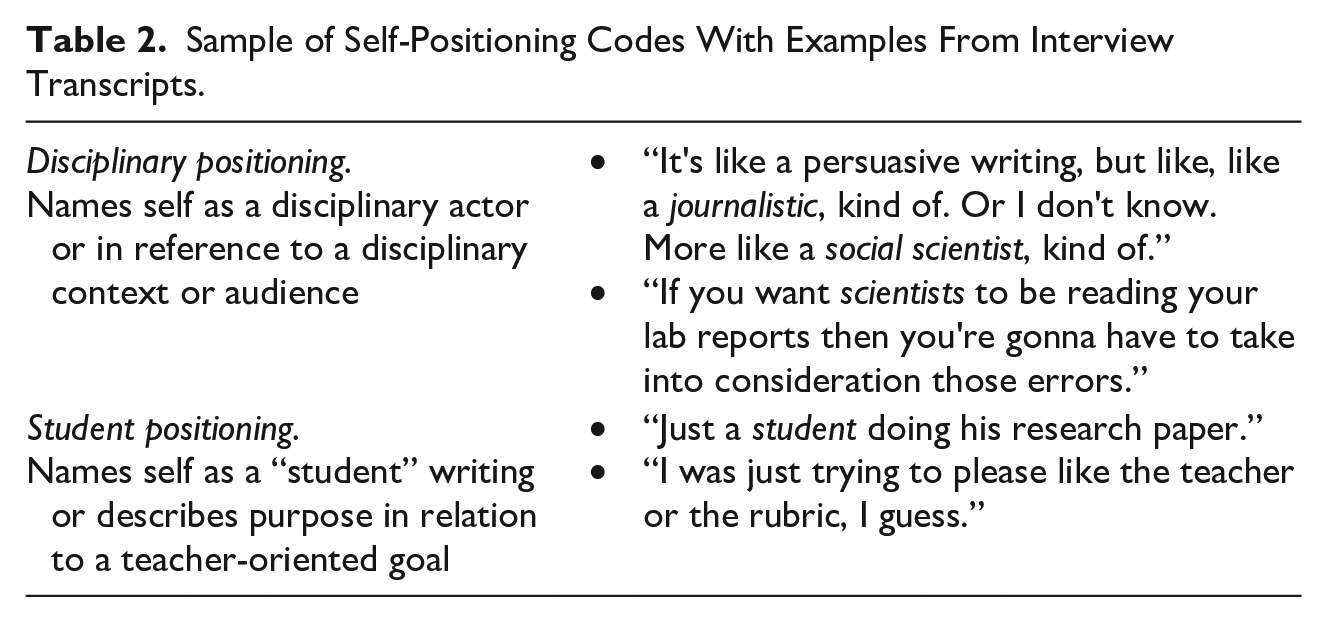
Interviews were transcribed shortly following each recorded discussion, and I utilized an iterative coding process (Merriam, 2009; Saldaña, 2016) to identify emergent themes and patterns in interview responses around the ways Jain described himself, his writing, and his writerly identities (see Table 2). As I returned to the transcripts, I focused on moments of self-positioning in discussion of his writing choices, particularly when responding to discourse-based questions. This attention to Jain’s storytelling around his writing highlights his identity work and offers important complexity to findings from the textual analysis. For example, when Jain and I discussed his use of the personal pronoun we in a social science course, Jain told me he used that phrasing purposefully to engage with his reader and include his reader in the discussion, positioning himself as a writer deserving of the trust and respect of an academic audience.
Sample of Self-Positioning Codes With Examples From Interview Transcripts.
Trustworthiness and Positionality
I recognize my interpretation of Jain’s discourse choices and his social positioning is only one version of its meaning (Wood & Kroger, 2000). Steps I have taken to ensure trustworthiness include providing examples from Jain’s writing and excerpts from interview transcripts in my discussion of the findings and discussing my interpretations with Jain throughout the data analysis process (Harré & Moghaddam, 2003; Kayi-Aydar, 2019). I also bring to the analysis my own understandings of the context, my experiences in Jain’s classrooms, discussions with Jain and his teachers away from recording devices, and my experience as a teacher and teacher educator.
While I have made efforts to check my biases and assumptions, my identities—White, heterosexual, male, native English speaking, middle class, writing instructor—all influence my perception of reality and my interpretation of the data. Positioning theory also guides me in acknowledging that the interview itself is a co-constructed storyline, and that Jain may have positioned himself differently in other contexts with other people (Van Langenhove & Harré, 1999). For example, Jain may have held back or responded differently because my identities often read as powerful or authoritative. The fact that Jain raised topics of race, class, and language in our discussions, often unprompted, seems to indicate that my efforts to build a relationship of care throughout the research process (Jacobson & Rifenburg, 2023; Paris, 2011) was successful, even if I cannot say for sure.
I also recognize the ways in which the dominant institutional and pedagogical structures that continue to support me do not necessarily support Jain and many of the students enrolled where I teach and conduct research. My own development as a teacher and researcher is ongoing. Intellectual engagement with critical theories of discourse, literacies, and identities alongside work with Jain and his classmates has helped me to become a better teacher and researcher through attention to the circulation of rights and opportunities in school contexts.
Jain’s Writing Opportunities Across His Transition to College
Jain’s stance-related discourse choices indicate rhetorical sensitivity and ability to adapt to new writing situations. However, opportunities to adapt or make specific choices were constrained by the ways Jain was positioned by many of his instructors and who he was allowed to be in his writing. This other-positioning seemed to interact with Jain’s social identities and history of school literacy experiences to reinforce his “not a good writer” self-positioning. In what follows, I discuss discursive aspects of Jain’s identity performances across two categories of text types, typified school essays and reporting texts, along with interview and observation data that shed light on the processes of social positioning.
Writing School Essays: Boosters and Authorial Invisibility
Boosters
When comparing text types and task descriptions Jain encountered, the school essay tasks elicited more certainty in Jain’s claims as evidenced by his use of boosters (see Table 3). In one example from high school ELA, Jain was asked to determine which three of the theoretical perspectives discussed in his course would be most effective to interpret a short story. In the final sentence of his essay, Jain wrote, “With the [story] we use a historical, cultural, and feminist lens since they are the
Frequency of Boosters and Hedges, per 250 Words, Organized by Frequency of Boosters.
When I asked Jain in a DBI about his choice to qualify some claims and compared these with more boosted claims he made in other texts, he told me that he “probably just was more confident on [his] observations” and indicated a preference for boosted claims over hedges. Here I understand Jain to be considering his choices in alignment with a desired positioning as a “confident” writer. Like many early undergraduate writers, Jain seemed to think more certain, boosted claims would better position him as an authority (Aull, 2018; Aull & Lancaster, 2014), even though published academic authors tend to privilege caution and hedge their claims (Hyland, 2005). While at this level of analysis we cannot know the quality or depth of Jain’s analysis, or how accurately he used sources, I can share that Jain earned mostly A and B grades on his writing tasks. This tacit approval along with an overall lack of explicit feedback seems to indicate that Jain’s discoursal positioning met his reader’s expectations.
Authorial invisibility
In addition to a preference for boosted claims to project “confidence,” the discoursal identity Jain constructed in school essay tasks included a reluctance to incorporate himself discursively in the text, a phenomenon Hyland (2002) has called “authorial invisibility.” While authorial pronouns like I and we can be used to help to foreground important information and help the writer control the social interaction in the text, among other effects, student writers often prefer strategies of author invisibility to “disguise the writer’s role” (pp. 1103–1105). In the thesis statements presented in Figure 2, Jain uses agentless passives—“the most effective way . . . is looking”; “it is seen how”— to disguise his role in the interpretation of the texts.

Examples of authorial invisibility in Jain’s texts (emphasis added).
Hyland (2002) has suggested several possible reasons for the prevalence of authorial invisibility in student-written texts, many of which were characteristic of Jain’s experiences, including the unequal writer-reader relationships of school-based writing, uncertainties about disciplinary conventions, and conflicting teacher advice. In one case representing these tensions, Jain told me he tried to write “like a social scientist” in a general education writing task. In his thesis statement, Jain used the pronoun we to set up a dialogue with the reader and the frame marker will examine to clearly announce his goal: “Using Tom Holms’ ‘Peoplehood Matrix’
The invalidating feedback from the social science instructor likely reinforced messages Jain had previously received in school contexts, adding layers to Jain’s laminated identity position as “not a good writer.” In a conversation about another instructor’s suggestions for using transition words and phrases, Jain told me he was not surprised when he received negative feedback and appeared to refract this feedback through other identity markers. He said, “Now I know I should study [transitions] more. I know I’m not fluent in English, so I always use bad grammar.” Jain was fully educated in English in U.S. schools and served as a translator for his parents, when needed, but still positioned himself as someone “not fluent in English” who uses “bad grammar” when engaged in school-based writing. The intersections of Jain’s identities as a language-minoritized, first-generation-to-college student and his perceived relation to dominant discourses seemed to further entrench hierarchical power relationships he had desired to transcend when he attempted to write “like a social scientist.”
Writing in Reporting Texts: Authorial Intervention and Hedging
Authorial intervention
Writing in reporting genres seemed to present Jain opportunities to invest himself differently in and through the text. For his first major writing assignment in FYW, Jain was tasked with visiting a public event and writing a reflective essay. In an interview discussion, Jain explained his understanding of the task as follows:
The assignment was to go to an event, and I chose a drag race here. We could choose whatever event we wanted and just look at it, like observe everything . . . like focus on the people instead of the event. . . . For my example, instead of the race look at the people and like what kind of people were they, who they were, like, just observe them . . . [then] in the essay try to use my observations to explain the event in a critical perspective.
In this description of the writing task, Jain touches on his goal (“explain the event in a critical perspective”) and his research process (“observe everything”). Reflecting on this task later, Jain said, “I was gathering information from an actual event, actual people and stuff. It felt like being a journalist.” He told me he could imagine an essay like this appearing in a magazine, like an article by David Foster Wallace assigned in class as a sample text. With this prior knowledge, Jain took a situated view of the assignment: he considered the kind of person the writing task asked him to be (“like being a journalist’’) and where such a text might circulate (a magazine), and he made choices about his research process, the content, and writing style accordingly.
On multiple occasions Jain talked about specific activities from this FYW class that benefited the project, like observing the classroom and a public outdoor space to practice paying attention to detail and making inferences. Jain saw these activities as helpful to “open my mind a little bit more and think of things more critically,” and to change his “mindset” when he attended the event. Here Jain seemed to be responding to “structural cues” provided by his teacher, pedagogical choices that offer opportunities for teachers and students to take on different roles and open possibilities for identification (Hazari et al., 2015). Guided by the activities, Jain took on a mode of observation and analysis associated with “being a journalist.” He was identifying himself as participating in a recognizable practice that led him to imagine this writing task as part of a broader writing ecosystem, instead of writing for “just the teacher,” as he did in the social science course. He said:
My previous essays [in high school] I wouldn’t be able to put it into a magazine, you know what I mean? Like the essays were just analyzing a book and, you know, just criticizing the book, but [the teachers] give us what to criticize, you know? They give us a prompt. But for this essay it was more like there was really no prompt.
In this comparison, Jain notes a difference between a teacher-oriented prompt and a more self-directed task. I read Jain’s use of the adverb just—“just analyzing a book”; “just criticizing the book”—as a potential indicator of his investment, or lack thereof, in the more teacher-driven, read-and-respond tasks that had characterized his prior writing experiences.
Jain’s investment in the project also seemed related to the opportunity to connect with his prior knowledge and experience. Jain grew up in a home where cars were essential to the household income—Jain’s father refurbished cars bought at auction for private sale—and he drew from these “funds of knowledge” (Moll et al., 2013) as he wrote fluidly about horsepower and flatbed haulers. After observing racers choosing to “burn out” before the start of the race, Jain wrote, “
Hedging
Lab reports in physics were other writing opportunities in which Jain used discourse strategies to position himself as a member of a knowledge community. With the help of a sample lab report shared by his professor and participation in laboratory activities, Jain seemed to take on the discoursal identity expectations and values of scientific writing. Jain’s use of stance markers, especially his frequent use of self-mention, was heavily influenced by the sample lab reports. In fact, Jain used specific phrases he saw in the model as he wrote his own report (see Table 4). Tardy (2009) has argued that textual borrowing can be an important learning strategy for writers, especially in a relatively stable genre like the school lab report. In this case, Jain borrowed self-mention (“we”) and hedging strategies (“may be due”) from the sample report. Jain did not receive specific feedback for his use of these stance strategies, but high scores indicated tacit approval.
Examples of Textual Borrowing (Bold) and Discursive Borrowing (Italicized) in Jain’s Lab Reports. Note the Use of Personal Pronoun We Throughout (Underlined).
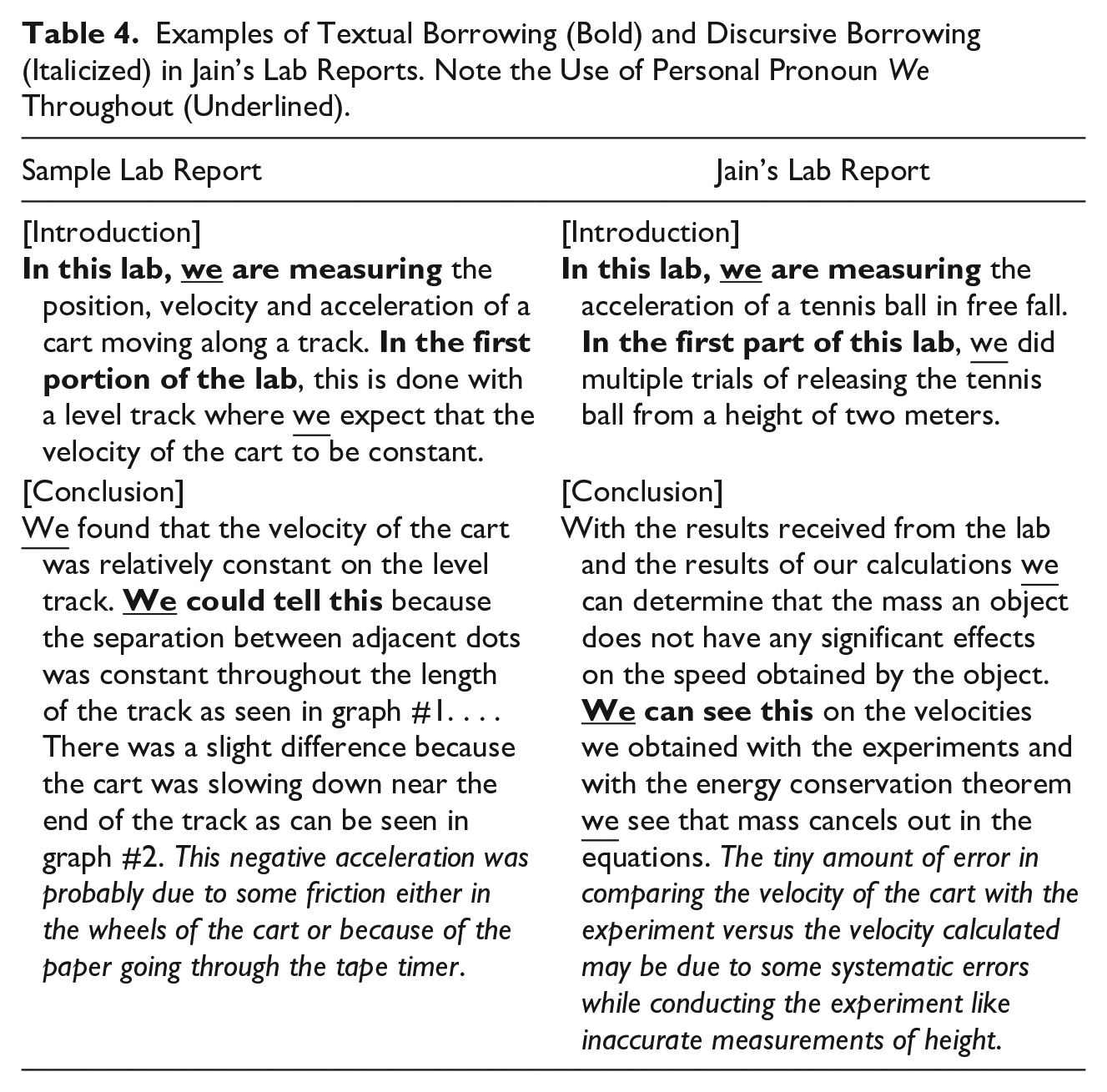
Jain seemed to recognize a connection between his discourse choices and his self-positioning as a scientist. When I asked Jain about the importance of the “error analysis” section in the lab report, he explained, “[Y]our credibility counts on it. Like if I were a scientist, I would want to look at a lab report that has the smallest errors.” In another interview, he explained that the lab report has to be written in a “monotonic” tone so “it doesn’t change pitch or anything.” He continued, “You have to write formally and professionally. . . ’cause it’s what science wants.” Here Jain is indicating the “subtle social knowledge writers need to speak confidently to readers” (Soliday, 2011, p. 36), identifying elements of the lab report structure and style that help him to communicate in the ways “science wants.”
Discussion and Implications
Jain’s stance-making choices appeared to reflect attention to shifts in genre and disciplinary context, offering evidence of the importance of available writing opportunities that complement developmental rationales often associated with stance-related research (Aull, 2018; Aull & Lancaster, 2014; Gere, 2018; Lancaster, 2014). This attention to stance-making positions and writing opportunities is important for understanding the values and identities associated with Jain’s high school to college writing transition. In the reporting tasks, Jain was afforded opportunities to insert himself into his writing using personal pronouns, making clear that he was the interpreter in the drag race reflection or the agent conducting the experiment in a lab report. He increased his use of qualifying phrases and demonstrated his authority through a more cautious positioning, typically expected of more advanced academic writers. He wrote “like a journalist” and made discourse choices based on what “science wants” in these tasks, indicating a recognition of the ways writerly choices can establish association with a particular group or community. When Jain intervened discursively in texts by using personal pronouns, he also seemed to identify as the kind of person doing that work. In these cases, the “pass to discourse” really did seem like a “pass to identity” (Falconer, 2019).
At the same time, the predominance of boosted claims and authorial invisibility in Jain’s texts served as evidence of the limited opportunity structures of the dominant school essay. It is worth considering how Jain’s discourse choices and desired self-positioning as a “confident” writer that influenced his boosted claims may have been refracted through school literacy experiences and internalized deficit perspectives about his school and his preparation for college study (Hungerford-Kresser, 2010). In other words, Jain’s discourse choices seemed not only developmental—choices “typical” first-year students make—but a reflection of available writing and learning opportunities and his responsiveness to social positioning across time and through space (Lammers & Marsh, 2018). For example, correctness-focused teacher responses like the “don’t use I” feedback discussed above seemed to contribute to a laminated identity position as “not a good writer” and a desire to project confidence from a passive, less powerful, and, arguably, racialized positioning.
Specific examples demonstrating how Jain’s unique social context and school literacy experiences influenced his ongoing negotiation of discoursal identity show the benefit of supplementing corpus studies of student discourse choices with individual studies of individual writers who may or may not experience transitions in predictable ways. In Jain’s case, his high school teachers consistently sent messages to Jain and his predominantly Latinx/a/o classmates that they needed to improve their writing if they wanted to succeed in college, a suggestion premised largely on formulaic concerns. These well-meaning teachers—and the administrators and policy makers who influence their decision making—may have unwittingly contributed to Jain’s perception that to succeed as a writer in college he was going to have to be “perfect” and error-free to meet an academic standard of correctness. Jain often compared himself to other students in his college classes and appeared to internalize negative social discourses about his high school. Jain told me, “I don’t know, most high schools . . . probably do prepare their students. But looking back at my high school, they didn’t prepare us at all for college. So it’s kind of a big jump . . . just to go from a bad high school to the intense university.” Jain’s prior experience with school writing and standardized tests, as well as stereotypes about his high school and academic potential as a first-generation Mexican American student, seemed to lead Jain to understand harsh feedback based on formal issues as real and constructive, but feedback from a social practice perspective, like that offered by his FYW instructor, as “lenient.” Jain’s self-perception as “not a good writer” seemed to have congealed, layer upon layer, such that he found it challenging to fit positive feedback with his writerly self-identity.
This study thus adds to research demonstrating the power teachers and institutions hold to (in)validate certain aspects of students’ identities and influence belonging in school spaces (Tait-McCutcheon & Loveridge, 2016; Turner et al., 2013; Vetter, 2010), indicating a need for educators and researchers across K-12 and college contexts to continue to challenge the standardization of school writing and the prevalence of assessments that limit curricula and constrain identities (Au, 2009; Caplan and Johns, 2019). In Jain’s case, the tension between his rhetorical abilities to adapt to different rhetorical situations and the ways he was positioned as “not a good writer” through school essay writing opportunities and assessments implies the potential value of more varied writing learning opportunities. It also highlights the need for explicit discussion of the relationship between language and identities in teacher preparation, classroom instruction, and assessment. Without opportunities to write in a range of genres and position themselves in ways beyond a student writing for an instructor, multilingual and other minoritized students, like Jain, may become “hesitant to engage in more rhetorically complex writing situations” (Ortmeier-Hooper, 2019, p. 103). The opportunity for Jain to build from his funds of knowledge and invest himself discursively in his FYW task also serves as an example of why courses with small class sizes like FYW have been identified as potential sites of validation for Latinx/a/o and other minoritized students (Baca et al., 2019; Hungerford-Kresser and Vetter, 2012). Beyond FYW, attention to teacher assessment epistemologies across institutional and disciplinary contexts must continue to be examined with a focus on the relationships of literacies, identities, and power in teaching and learning (Ascenzi-Moreno & Seltzer, 2021; Newell et al., 2014).
This study also points to potential benefits of case study research for student participants. In addition to offering an “instructional complement” and opportunity to learn more about academic writing (Saidy, 2018), Jain’s participation in this research seemed to serve a validating function in his transition to the university. In the final interview of this research project, Jain told me he “enjoy[ed] the feeling of getting acknowledged for some advanced rhetorical move that I pulled subconsciously.” Referencing our discussions about the analysis for this article, Jain continued:
I remember sometimes you go to point out like, “These are things only an academic writer does.” You know, like use transition words, or how you portrayed this, or using “we” or whatever. It’s only stuff that professionals use. It was just kind of neat to be acknowledged for something that you never really . . . You’re being called smart when you weren’t trying to be so smart.
Here Jain seemed to accept an other-positioning as “smart” through our discussion of interactive discourse and his use of the inclusive we in academic writing. I recognize that my seemingly powerful positionings may have shaped Jain’s response, as could the relationship we had built over months of interviews, but it is important to note that when Jain received positive feedback from his FYW instructor—another White, male, writing instructor—he dismissed the feedback as “lenient” grading rather than acknowledgment of his rhetorical abilities. I have come to see this anecdote as a reminder of the potential for language awareness approaches to facilitate validating opportunity structures in research and teaching. During our conversation, I shared Hyland’s (2004) Disciplinary Discourses with Jain so he could see that my assessments of his writerly choices and self-positioning through stance markers was supported by data, emphasizing his belonging in academic space. With more frequent conversation across courses and response tasks, Jain might begin to see his discoursal moves and authorial intervention as part of his own writerly identity, not something only for “professionals.”
Over the course of his high school to college writing transition, Jain was able to meet teacher expectations and earn high grades, which was undoubtedly important for his road toward graduation. However, performing the school essay is not the same as access to social identities and writing opportunities. In order to be validated as writers and contributors of knowledge, students need access to the literacies they desire, and to be positioned as the kinds of people who are able to utilize them.
Footnotes
Declaration of Conflicting Interests
The author declared no potential conflicts of interest with respect to the research, authorship, and/or publication of this article.
Funding
The author(s) disclosed receipt of the following financial support for the research, authorship, and/or publication of this article: This project was supported with grants from the University of Arizona Graduate and Professional Student Council.
