



Abstract
This essay takes as its focus the everyday writing that people compose: the self-sponsored, nonobligatory texts that people write mainly outside of work and school. Through analysis of 713 survey responses and 27 interviews with accompanying writing samples, this study provides a panoramic view of the functions of self-sponsored writing and rhetorical activity for U.S. adults, ages 18 to 65+ years, from a range of geographic, cultural, and professional backgrounds. The Taxonomy of Life Writing presented in this essay demonstrates the range of ways that writing functions in people’s daily lives. It includes 19 key functions of life writing, organized into six metafunctions: Creativity and Expression, Identity and Relationships, Organization and Coordination, Preservation and Memory, Reflection and Emotion, and Teaching and Learning. Based on our findings, we affirm the important and diverse functions that life writing serves and propose expanding the threshold concepts of writing to include greater focus on nonobligatory, self-sponsored writing activity.
Introduction
Research on writing that people elect to do—what researchers have variously called “self-sponsored writing,” “everyday writing,” and “voluntary writing”—has affirmed the value of this writing in its own right as well as in conversation with obligatory writing (Brandt, 2001, 2015; Gere, 1994; Lindenman & Rosinski, 2020; Naftzinger, 2018; Roozen, 2010, 2012; Rosinski, 2016; Shepherd, 2018). The fields of community writing, literacy studies, and the rhetoric of health and medicine are among those that have examined the power of writing that people compose beyond work and school. Yet compared with studies of writing in academic and workplace contexts, studies of self-sponsored writing or writing “in the wild” comprise but a small fraction of research, where professional, educational, and, to a lesser extent, public writing topics predominate in journals. For instance, as of May 2023, in the last 17 issues, Written Communication has published 91 articles, addressing educational contexts (63.7%), professional/workplace contexts (13.2%), methodological or theoretical issues (13.2%), public rhetoric (6.5%), and self-sponsored writing (4.3%). These articles focused on self-sponsored writing include advocacy writing (Walsh, 2019), writing with aphasia (Miller, 2019), and religious literate activity (Ware, 2021). The Meaningful Writing Project (Eodice et al., 2016) likewise calls attention to the blind spot in researchers’ view when it comes to university contexts: “What counts as literate activity [in higher education] is so narrow that we miss much, perhaps most, of what makes composing in our students’ literacy lives (in all our lives) so rich, so full, and so meaningful” (p. 134). If attention is paid to self-sponsored writing in education, that attention tends to hinge on how self-sponsored writing ties to either professional writing that has economic currency or academic writing that earns its writer grades and course credits. In fact, when we consider the life writing that people compose beyond their professional or academic obligations, it is possible that the majority of the writing that people compose has been largely absent from our research on written communication.
This article responds to this absence by centering and analyzing the nonobligatory writing, or “life writing,” that people compose across all facets of their lives. We use the term “life writing” to emphasize the pervasiveness and relevance of the nonobligatory writing people compose. In literary studies, “life writing” is used differently, to refer to genres of writing that represent personal life experiences, such as biography, autobiography, oral history, testimonio, diary, and memoir, as well as associated interpretive practices (Howes, 2020; Kadar, 1992). Historically the study of life writing in literary scholarship was motivated, at least in part, by a move to acknowledge and honor writing not previously considered worthy of literary study, especially women’s writings, including diaries and correspondence (Kadar, 1992). Life writing as defined by literary scholars was briefly taken up by writing studies research in the 1990s but has otherwise largely been absent from discussions in the field. In this project, we use life writing not to refer to a set of personal narrative genres or interpretive practices but instead to illuminate the writing that people compose in all areas of their lives and the functions these acts of writing serve.
Our work follows Melzer’s (2014) approach to studying writing across the curriculum by offering a “panoramic view” of, in our case, self-sponsored writing. Drawing upon an exploration of 27 interviews and 713 surveys with diverse adult participants from many walks of life, we present a taxonomy of life writing that takes into account the functions that this writing serves for a broad range of individuals across ages, races, genders, professional backgrounds, and geographical locations within the United States. The taxonomy contributes to the field of writing studies by offering a comprehensive view of an understudied area and a framework for future research. Based on our findings, we argue for expanding the field’s threshold concepts of writing (Adler-Kassner & Wardle, 2015) to include three functions that life writing serves: “writing supports emotional engagement and release,” “writing sets the terms of engagement,” and “writing preserves and externalizes memory.” These three threshold concepts of life writing come from the 19 primary functions we identify and group into six metafunction categories that span people’s life writing: Creativity and Expression, Identity and Relationships, Organization and Coordination, Preservation and Memory, Reflection and Emotion, and Teaching and Learning.
Background and Significance
In Naming What We Know (Adler-Kassner & Wardle, 2015), Adler-Kassner and Wardle, with experts from across writing studies, present 37 key concepts that offer “final-for-now definitions” of what the field of writing studies knows to be true about writing and its practice (p. 4). The authors acknowledge that their collection does not, and could not, represent every possible threshold concept of writing and, given the “contingent changing nature of knowledge,” they invite readers to continue the project beyond the scope of the book (Adler-Kassner & Wardle, 2015, p. 8). Their follow-up work, (Re)Considering What We Know (Adler-Kassner & Wardle, 2020), begins to do so by calling attention to specific concepts or approaches to writing that are not included in the original project. Hesse and O’Neill (2020), in that collection, note that “ideas about writing from creative writing and journalism” (p. 77) are largely not included in the threshold concepts umbrella and urge writing studies scholars to “not inadvertently ignore” (p. 86) more expansive ways of understanding writing practices and purposes. In the same collection, and with the goal of “conceptualiz[ing] writing more capaciously,” Yancey (2020) examines “everyday writing” with drawing in particular (p. 130). She likewise urges readers to consider the limits of threshold concepts derived largely from a school-centered paradigm of writing purpose, quality, and development, and she raises questions that guide our work here: “How well do these [existing] threshold concepts describe the texts of everyday writing? Might an exploration of everyday writing lead to revision of some threshold concepts, and if so, how?” (p. 130).
Here we take up that call: the goal of this project is to bring into focus for writing studies scholars the “everyday writing” or life writing that people compose and the functions it serves. When people write for themselves—to connect with friends and family, to maintain sobriety, to develop their interests, to maintain a sense of order, to create art that inspires others, and so on—this life writing performs vital functions for the writer and the people they reach. We embark on this project from the same premise as Adler-Kassner and Wardle (2020), that “naming matters”: the concepts we name or do not name when we craft our encyclopedias of writing studies “have consequences” for those who write, teach writing, and decide how and what about writing is worth paying attention to (p. 14). If we do not systematically study the writing that people elect to compose, it will remain a matter of lore and the domain of self-declared experts. To make central this category of writing, we offer a taxonomy of life writing, naming its functions and their value.
While we are the first to propose a stable-for-now set of categories to acknowledge and elevate the writing that individuals compose outside of their professional obligations and academic undertakings, we are not the first to articulate the value of this type of writing in people’s lives. Gere’s (1994) study of the “extracurriculum” of writing groups focuses on adults’ self-motivated writing activities and argues for the importance of seeing the “extracurriculum” as a “legitimate and autonomous cultural formation that undertakes its own projects” (p. 86) rather than as a “way-station on the route” to academic or professional success (p. 79). Studies of “everyday writing” in particular orient attention to people’s daily and often mundane writing practices and the value of writing in accomplishing the tasks of everyday life (Cohen et al., 2011; Naftzinger, 2018; White-Farnham, 2014). In the same spirit, and in order to provide attention to writing composed beyond academic and workplace settings, the online Museum of Everyday Writing, n.d. 1 exhibits writing artifacts that are “typically unseen or unacknowledged” by researchers.
Ethnographic studies on the elective rhetorical activities of specific groups provide insights into the valuable functions that writing has played for particular communities. For example, Takayoshi’s (2020) study of memoirs written by women who were incarcerated in American asylums between 1842 and 1890 found that these memoirs functioned to empower the women to take agency of their experiences. Similarly, Schell’s (2013) profile of three veteran writing groups demonstrated that participants’ writing “provid[ed] a space for veterans to engage in defining and representing their military experience for themselves and various publics” (Common Purpose section). These close studies of specific groups confirm the vital role that self-sponsored and voluntary writing play in people’s lives, but their goal is not to be comprehensive nor to offer a broad overview of life writing across circumstances.
Our project, in contrast, spans a wide array of individuals and situations. We distinguish our project by its scope: rather than focus on a targeted group or individual case studies, our taxonomy offers a more comprehensive view. In that way, our approach parallels Selfe and Hawisher’s (2004) research on digital literacies, but with a targeted emphasis on self-sponsored and nonobligatory writing. Other research that has informed our questions and methods include the ongoing Lifespan Writing project, which offers various methods for what studying the “writing caught up in all facets of our lives” might entail (Dippre & Phillips, 2020, p. 4); Naftzinger’s (2018) study of the everyday writing practices of five individuals; and Brandt’s (2015) The Rise of Writing. Among the writers Brandt profiles are 30 young adult authors who write outside of school contexts, for whom writing serves functions of self-improvement, managing emotions, communicating with others, connecting to spiritual life, and working to improve the world (pp. 128-130). This list anticipates functions that emerged in our study as well.
While we believe there is research value in distinguishing life writing as a category, we also acknowledge the persistent challenge of definition and boundaries when categorizing individuals’ writing experiences that may have multiple sources of motivation, including simultaneous personal and professional or academic motivations. Much of the existing literature defines self-sponsored writing by what it is not: it is not required by an employer or educational institution; it is not writing “for pay”; it is not writing in exchange for academic credentials. Phrases such as “everyday writing” (Naftzinger, 2018) and “voluntary writing” (Yi & Hirvela, 2010) offer useful alternatives for naming the concept but do not entirely escape this definitional challenge. Naftzinger (2018), for instance, defines everyday writing, along with Yancey, Cirio, and Workman, as “the ubiquitous self-sponsored writing typically operating outside the regulation and oversight of an institution or representative of an institution” (p. 89, italics ours). Brandt (2015) and Findlay (2019) starkly contrast workplace and elective writing, showing how workplace writing pushes some people to practice “strategic (dis)connection” (Findlay, 2019, p. 434), or performative detachment, to reconcile the conflict between professional writing requirements and individual writerly identity. While this conflict does exist for some writers and in certain circumstances, in other situations, professional and self-motivated writing can be quite aligned and mutually informing. Take, for example, Roozen’s (2010) case study of Lindsey, which shows that her self-sponsored and school-sponsored writing activities are “deeply intertwined” (p. 328), and the examples of writers in Naftzinger’s study who included work-related texts in their definition of “everyday writing” (p. 91). Yi and Hirvela (2010) also note that the divide between self- and other-sponsored is not always clear: their focal participant, Elizabeth, composes “semi self-sponsored writing” that is motivated by her mother, for instance (p. 99). Scholarship with an eye toward transfer notes the potential value of self-sponsored writing for school-based and professional writing (Cleary, 2013; Fishman et al., 2005; Lindenman, 2015; Lindenman & Rosinski, 2020; Roozen, 2010, 2012; Schultz, 2002; Shepherd, 2018), implying that categorizing writing by its source of motivation or sphere of activity is limiting indeed (see also Alexander et al., 2020b, who problematize the divide as well as the “in the wild” metaphor, pp. 111-113). By prompting writers to discuss “meaningful self-sponsored writing,” and allowing them to select what they submit to our project, we somewhat—but do not entirely—mitigate against the concern that we are reifying imperfect or even inaccurate distinctions at the level of motivation. That said, although we do not thoroughly account for writing motivated by multiple simultaneous sources, our approach enables us to study and name a sphere of writing that has thus far largely been occluded and might otherwise remain obscured in research on writing.
A question these prior studies raise—and one taken up in our present work—is the extent to which ephemera matters and to which “meaningful” writing, or writing that has had a significant impact on the writer, ought to be central to a study of “self-sponsored” rhetorical activity (Alexander et al., 2020a; Eodice et al., 2016). Existing studies that address everyday writing define their range based in part on what their participants share: some thus focus on a range of daily writing tasks (Cohen et al., 2011), others on “mundane writing” (White-Farnham, 2014, p. 209), and others yet on higher-stakes writing (Brandt, 2015; Schultz, 2002), “including poems, letters, journals, fiction, and prose” (Schultz, 2002, p. 358). In our study, we chose to centralize the self-sponsored writing that, in the words of our email script to interview participants, “is meaningful to you in some way, is related to your interests and activities, or is important to who you are.” In our focus on soliciting meaningful life writing, we follow Eodice et al. (2016) as well as Yi and Hirvela (2010) in paying attention to the writing that made lasting impressions on its writers, or that was otherwise important in participants’ memories. Like Yi and Hirvela (2010), we sought to research the version of self-sponsored writing that “the self believes has purpose and meaning” (p. 97). Our study included all types of writing, because participants defined for us what is meaningful to them. Importantly, and following Lifespan Writing research, our work sought to “disrupt the writing normativities that proliferate” in scholarship focusing on writing development (Dippre & Phillips, 2020, p. 7, italics ours). In other words, how people learn to write or develop as writers is not the focus of our study, either, and we too place value in “investigating writing lives—period” (Dippre & Phillips, 2020, p. 7). Our study thus offers a comprehensive view of the functions of life writing and details the functions that writing serves for people of various ages, cultures, races, genders, educational statuses, professional backgrounds, and geographic locations. We take a systematic approach to researching the functions of writing for adults across many walks of life and show the value that life writing has for adults as they make meaning and manage their worlds. In doing so, our goal is to capture our informants’ tacit sense of the writing they elect to do in order to reshape our field’s understanding of what writing does and can be.
Methods
The purpose of this study was to explore the question “What are the functions of self-sponsored writing and rhetorical activity?” and to construct a taxonomy of those functions. Our larger data set employs surveys (n = 713), interviews (n = 27), and associated texts to explore the functions of the writing people do in their lives. The taxonomy we present in this article is based on an in-depth exploration of 27 interviews that discussed 78 self-sponsored texts submitted by interview participants. In examining our surveys and interview data, the surveys were useful for telling us the kinds of self-sponsored writing that our participants engaged in, but it was the interviews that helped us understand how our participants viewed the functions of that writing, to see how they articulated what that writing did. Thus, this article focuses on our analysis of the data we gathered from our 27 interview participants.
Participants, Recruitment, and Sampling
After gaining IRB approval, 2 we distributed our survey as widely as possible. Because we wanted to include both students and nonstudents, all five research team members used professional and personal networks and social media for recruitment. We used a snowball sampling technique and asked our participants to share and distribute the survey. This led to 713 completed surveys. In the survey, we asked participants to indicate if they would be willing to participate in a follow-up interview of 30 to 60 minutes where they discussed aspects of their life writing in greater depth; 44% of participants agreed to participate in follow-up interviews.
Interview participants were purposefully sampled (Ritchie et al., 2013) from the survey. In terms of purposeful sampling, we selected a wide range of participants that specifically allowed us to represent key groups (e.g., undergraduate students, working professionals in a range of fields, retirees, stay-at-home parents, unemployed, etc.) and to explore a wide range of self-sponsored writing. We grouped participants into three kinds: undergraduate students, graduate students, and nonstudents, with an original goal of interviewing 10 students (5 graduate and 5 undergraduate) and 20 nonstudents. Participants from within these categories were selected based on a variety of criteria: the kinds of life writing they did (ensuring variety); whether they viewed themselves as writers; and to achieve diverse ethnic and gender representation. Because we were intent on including individuals who did not self-identify as writers, we recruited multiple participants who disagreed with the survey statement, “I consider myself a writer,” alongside those who viewed themselves as writers as well as those who responded “were unsure“ to the statement “I consider myself a writer.”
Interview participants were contacted by one of the five coauthors and semistructured interviews took place via Zoom, Skype, or phone in early 2020. Participants were asked to share two to three samples of “meaningful” life writing prior to the interview. Interviews focused on discussing the functions of several pieces of participants’ writing from different genres, as well as discussing aspects of their identity, their relationship with writing, and the role of writing in their lives. We collected most of our planned 30 interviews by the time the global pandemic impacted daily life in the United States; we decided to stop data collection in March 2020 (at 27 interviews) to avoid mixing data gathered before and during Covid.
Participant Demographics
Our interviews included 5 graduate students (all of whom also work part- or full-time), 6 undergraduate students, and 16 nonstudents. Of the nonstudents, 10 were full-time employees in a variety of industries, 2 were part-time employees, and 4 were retired. Interview participants were 19 females (70.4%) and 8 males (29.6%) and had a range of ages, as follows: 18-24 (8), 25-35 (5), 35-44 (4), 45-54 (4), 55-64 (1), and 65+ years (5). All participants (except one residing in Canada) came from the United States, distributed regionally in the Mid-Atlantic (5), Midwest (7), Northeast (3), South (6), and West (5). Participants had a range of educational attainment: high school diploma (2), associate degree (1), some college (4), bachelor’s degree (8), master’s degree (10), and professional degree (JD/MD) (2).
To the question of whether they considered themselves a writer, interview participants strongly agreed (11), agreed (7), were unsure (3), disagreed (5), or strongly disagreed (1). Survey participant data on the same question mirrors this, with 64.5% (325) agreeing or strongly agreeing, 19.4% (98) feeling neutral, and 16.1% (81) disagreeing or strongly disagreeing.
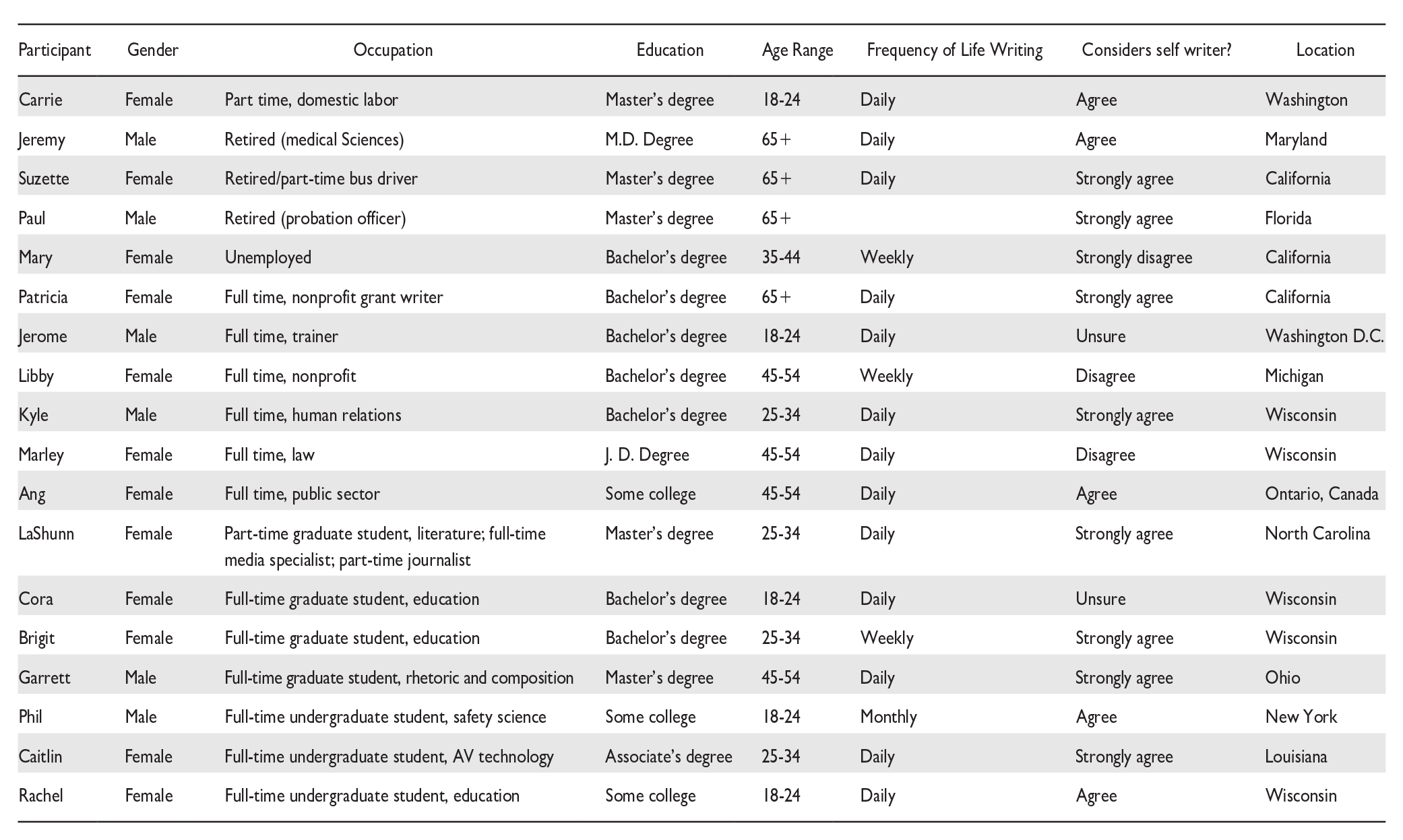
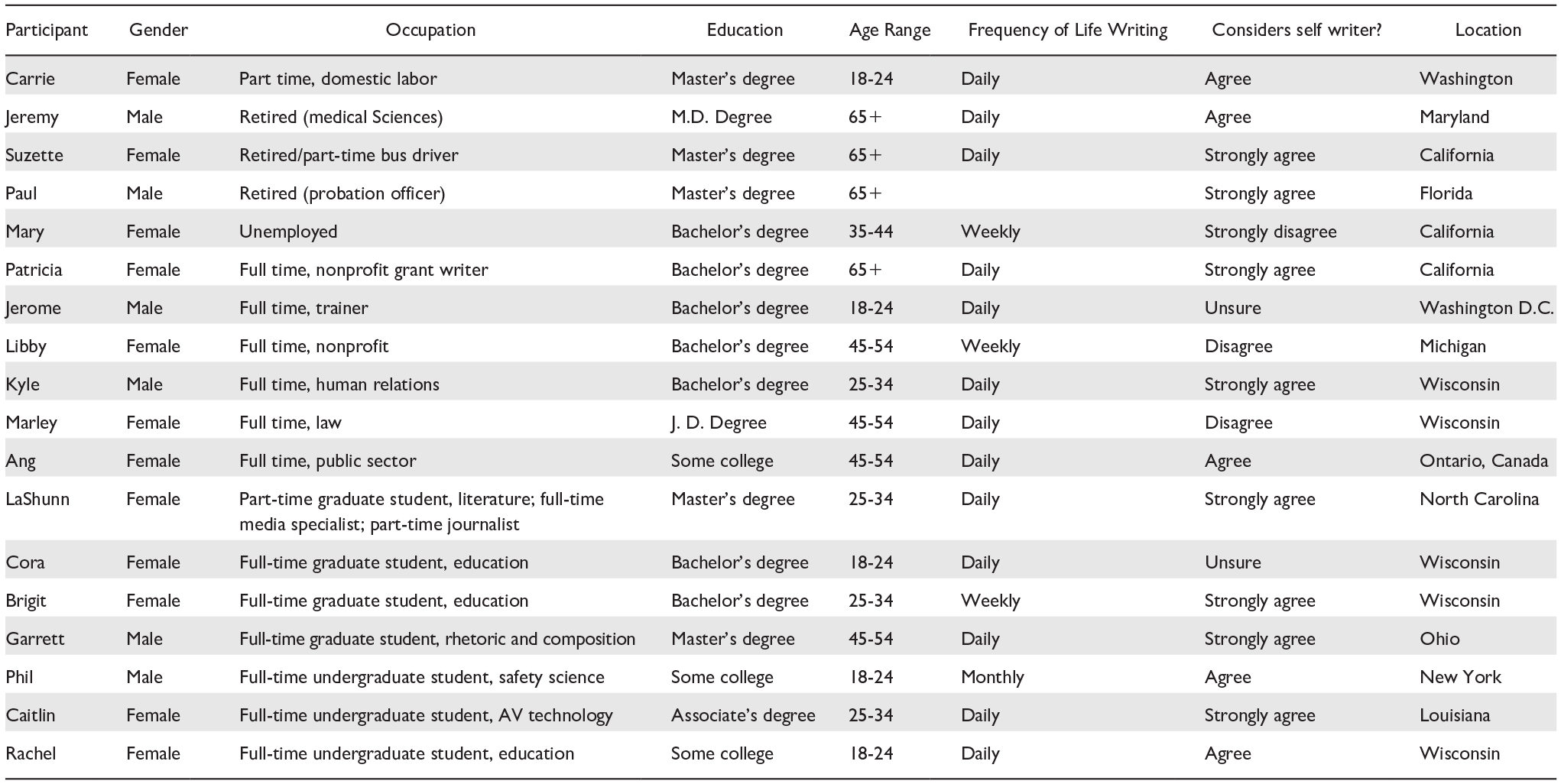
Eighteen interview participants indicated they wrote daily for work or school, while 2 indicated weekly, 2 infrequently, and 5 did not respond. Survey participants indicated that they wrote for school or their job daily (85.9%, 403) or weekly (11.3%, 53). In terms of self-sponsored writing, 55.7% (379) of survey participants indicated that they wrote daily, 23.6% (161) weekly, and 20.7% (141) monthly or less. The writing that participants discussed was wide ranging and included scrapbooks, travelogues, tweets, obituaries, poems, novels, speeches, lesson plans, blogs, personal communication, journals, testimonies, reminders, websites, and more. Appendix A provides participant data for the 18 individuals discussed in this article.
Analysis
All interviews were transcribed by a professional transcriptionist. For our taxonomy development, we employed Smagorinsky’s (2008) collaborative coding strategy which creates 100% coder agreement. To answer our key research question, the research team began by reading and open coding three interviews (1 graduate student, 1 undergraduate student, and 1 nonstudent) with the goal of identifying participants’ self-reported functions of writing. We purposefully allowed for multiple codes to apply to a single segment to help demonstrate how one piece of writing can serve a range of functions for participants. After independently coding the three interviews, the team met to discuss their codes. Through this discussion, we completed an initial coding glossary of the functions of writing, and then team members were assigned in pairs to the remaining interviews. We rotated the pairs so all team members had a chance to work together, ensuring systematic coding across all interviews. Each time the pairs coded five more interviews, the team of five authors met again and reexamined the taxonomy, at times revising both the taxonomy and the codes applied earlier in the process. As we continued to collaboratively code, we recognized the need to create a hierarchy of functions, which entailed subdividing our primary functions (19) into secondary functions (21 in total) that more precisely reflected our participants’ experiences. This large number of primary and secondary functions, though valuable in its specificity, proved unwieldy as a framework for analysis. Thus, and in a nod to Carter’s (2007) concept of metagenres, we grouped the 19 primary functions into what we called “metafunctions.” To develop categories of metafunctions, the team met and discussed how the functions related to and differed from each other and how they co-occurred. The six metafunctions that emerged helped us meaningfully organize the taxonomy and represent the larger ways in which people use self-sponsored writing.
Limitations
While we had a large pool of survey participants from different walks of life and diverse backgrounds, our sampling strategy was based on our own networks. Thus, our participants were not representative of the larger population of the United States, particularly with regard to educational attainment and diverse ethnicities (e.g., while our survey included Latinx participants, our interviews did not).
Results
Overview of Self-Sponsored Writers and Writing Activity
In order to contextualize the taxonomy and findings, we first briefly offer an overview of life writing as described by survey participants. Participants in our survey indicated a wide range of life writing, as described in Figure 1, which shows the 10 most common types of life writing that survey participants report composing. The most frequently reported types of life writing included texting (587), email and letter correspondence (576), to-do lists and reminders (526), social media (506), journaling (318), and creative writing (272). By quantity, participants indicated that the most meaningful writing to them was correspondence (351), texting (281), journaling (239), to-do lists (237), creative writing (229), and social media (206). Figure 1 presents the number of participants who reported a type of life writing most meaningful (green), compared with how often participants reported composing it (white): the types of life writing most likely to be meaningful to participants appear closest to the y axis (e.g., creative writing), and those less likely to be meaningful, farthest from the y axis (e.g., application materials). The percentages in each bar indicate the ratio of meaningful writing to the total writing composed in each category; for example, 85% of survey participants who composed creative writing considered it to be meaningful to them, whereas only 40% of participants who wrote application materials considered that writing to be meaningful.
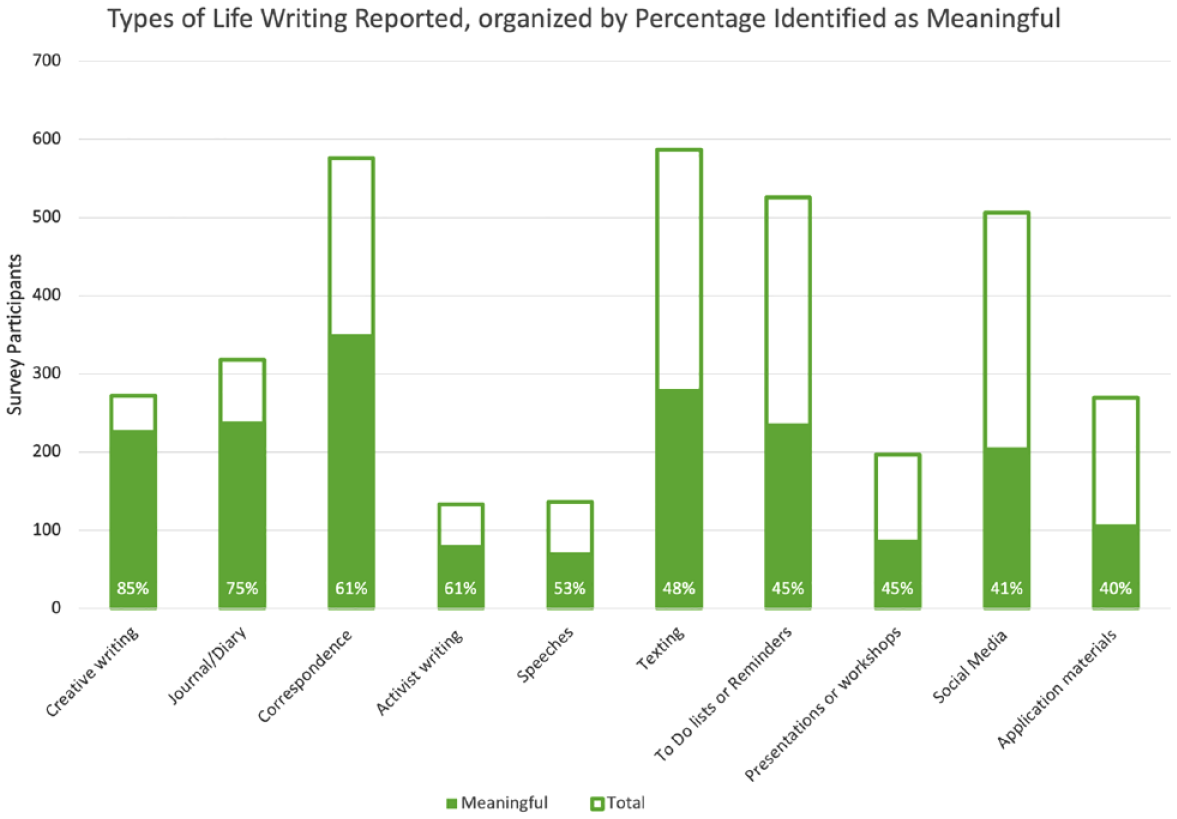
Most common types of life writing indicated by survey participants (n = 713), organized from most to least meaningful, by ratio of meaningful to total composed.
We asked our interview participants to select three texts to discuss at their interviews with the following prompt, “Choose writing that is meaningful to you in some way, is related to your interests and activities, or is important to who you are” (see Appendix B for complete Email Script #3, where this request was made). Participants presented 78 texts in 18 different genres including creative writing (14), diary or journal entries (13), journalism (7), social media (6), and speeches (6). By naming and defining “meaningful writing” as we did, the recruitment emails encouraged individuals to submit writing that met our criteria for “meaningful” rather than ephemera or more mundane, coordinating texts. Based on Figure 1, types of writing most frequently submitted by interview participants largely mapped on to writing most frequently indicated as meaningful by survey participants.
It is important to note that, in the below findings and discussion, we present participants’ perceptions of their writing and its functions in ways that mirror their own constructs about writing: in other words, our findings are a collection of the uses of elective writing according to the felt sense of people who compose it. For that reason, our taxonomy might seem to codify a not unpredictable set of commonplaces about what writing is and does. We argue, however, that the apparent commonness of these uses of writing, as yet unarticulated in a systematic way, is the very reason to call attention to them.
The Functions of Life Writing Taxonomy
We now present the taxonomy, organized by meta-function, of how life writing functions for our participants. Table 1 presents an overview of the functions of writing as reflected in our interview data. Our taxonomy offers several key contributions: it demonstrates the landscape of meaningful self-sponsored writing, identifies key areas for how participants used this writing to support and build identities (including marginalized ones), and uncovers functions of life writing not previously discussed by the field, such as to set the terms of engagement. Our taxonomy has three levels of increasing specificity. The six metafunctions on the left of the table describe overarching uses of life writing. The primary functions (19) represent specific or primary ways that life writing functions for individuals, and the secondary functions distinguish among subcategories within primary functions. Not all primary functions have secondary functions. For example, under the “Reflection and Emotion” metafunction, there are two primary functions: to manage emotions and to introspect. To manage emotions can be broken down in two ways: to heal and to escape (writing to heal and writing to escape are two specific ways that study participants used writing to manage emotions), while to introspect does not have any secondary functions. In Table 1, the single and double asterisks indicate the prevalence of these functions within our data. We also note that many functions overlap—thus, a person who is writing to create or to express oneself may also be writing to remember or reflect. After the primary table below, we explore each metafunction in detail, including representative samples from participants. We selected samples that were (a) representative of the functions—they provided central, rather than peripheral, examples of the functions in our data—and (b) prioritized diverse voices.
Taxonomy of Life Writing.
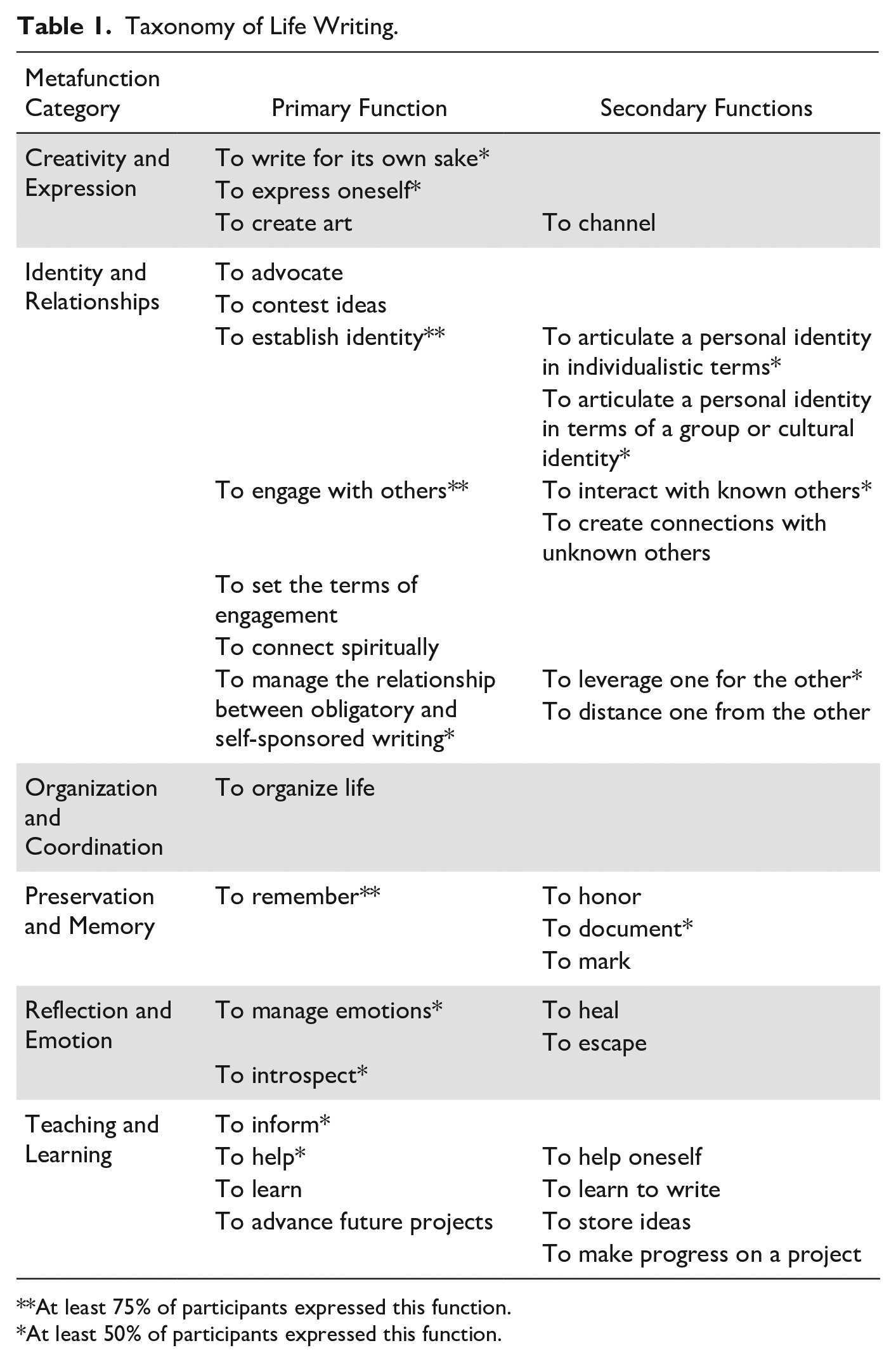
At least 75% of participants expressed this function.
At least 50% of participants expressed this function.
Creativity and Expression
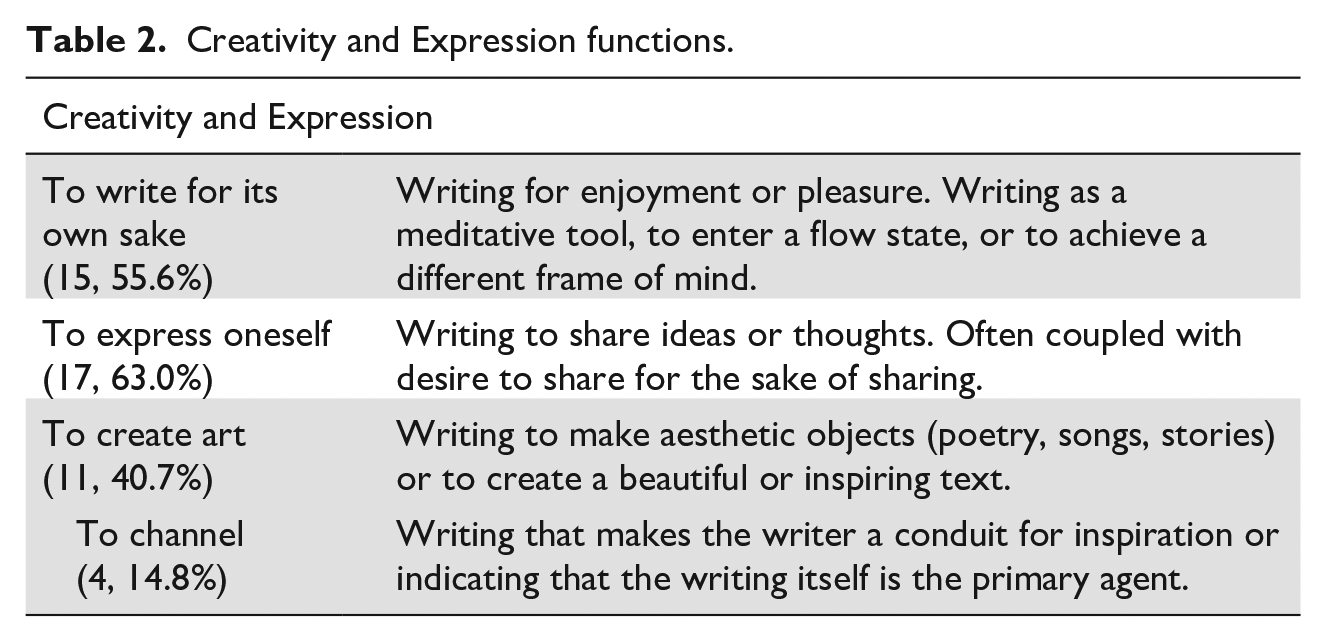
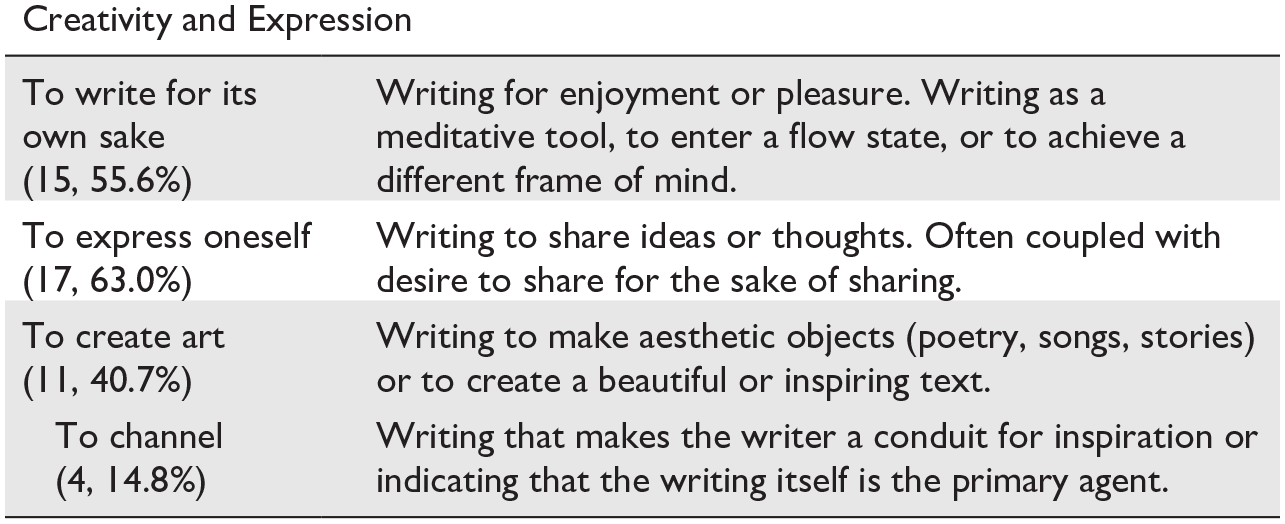
Creativity and Expression (Table 2) is writing for the purposes of self-expression, joy, or to create art. Writing for creation is focused on making art or a text that can be shared to provoke thought or feelings in others.
Creativity and Expression functions.
To Write for Its Own Sake
Writers who write “for its own sake” (15, 55.6%) discussed writing for pleasure, as a meditative tool, or in some cases, to achieve a flow state or different frame of mind. In one example, Carrie, who recently relocated from Denmark to Seattle, reported that she set aside 30-40 minutes each morning to write on her blog. She described the purpose of this time as “having that moment to myself. . . It’s a time where I’m not having to rush. . .it gives me a moment to just be at peace with myself.” For Carrie, the daily practice of writing for its own sake was about the calm and pleasure that writing itself brings. As in other cases where writing serves multiple functions, in addition to providing a source of comfort and constancy, writing for Carrie also provided a way to manage emotions.
To Express Oneself
Sixty-three percent of study participants (17) reported using writing for self-expression, or to share for the sake of sharing. In one example, Cora, a graduate student in the Midwest, described writing for self-expression on Facebook. In winter 2020, Cora posted on Facebook about the unfolding coronavirus situation, and explained that social media provided her with “a place where I can express my thoughts and feelings personally around this.” In her interview, Cora explained that this writing “was just a way to self-reflect and be self-aware and also just be honest and open and vulnerable with other people.” In addition to functioning for self-expression, Cora’s social media writing was coded as “to engage with others.” She used this writing both for sharing and openly revising her perspectives in a largely public space.
To Create Art
Forty-one percent of our participants (11) reported writing to create art, including fiction, poetry, and multimedia creative texts. Caitlin, an undergraduate English major, reported that she “write[s] fairy tale retellings in [her] spare time,” and wrote three novels, one of which she self-published. She described writing her self-published novel as “almost a child, you raise it, you write it, you edit it, it becomes so much of you,” and explained that, at age 20, the process of writing this novel was what encouraged her to pursue a college degree. When composing and revising her creative work, she reported, “you change it but it changes you too and I think art is supposed to change you. That’s how we grow.”
Identity and Relationships
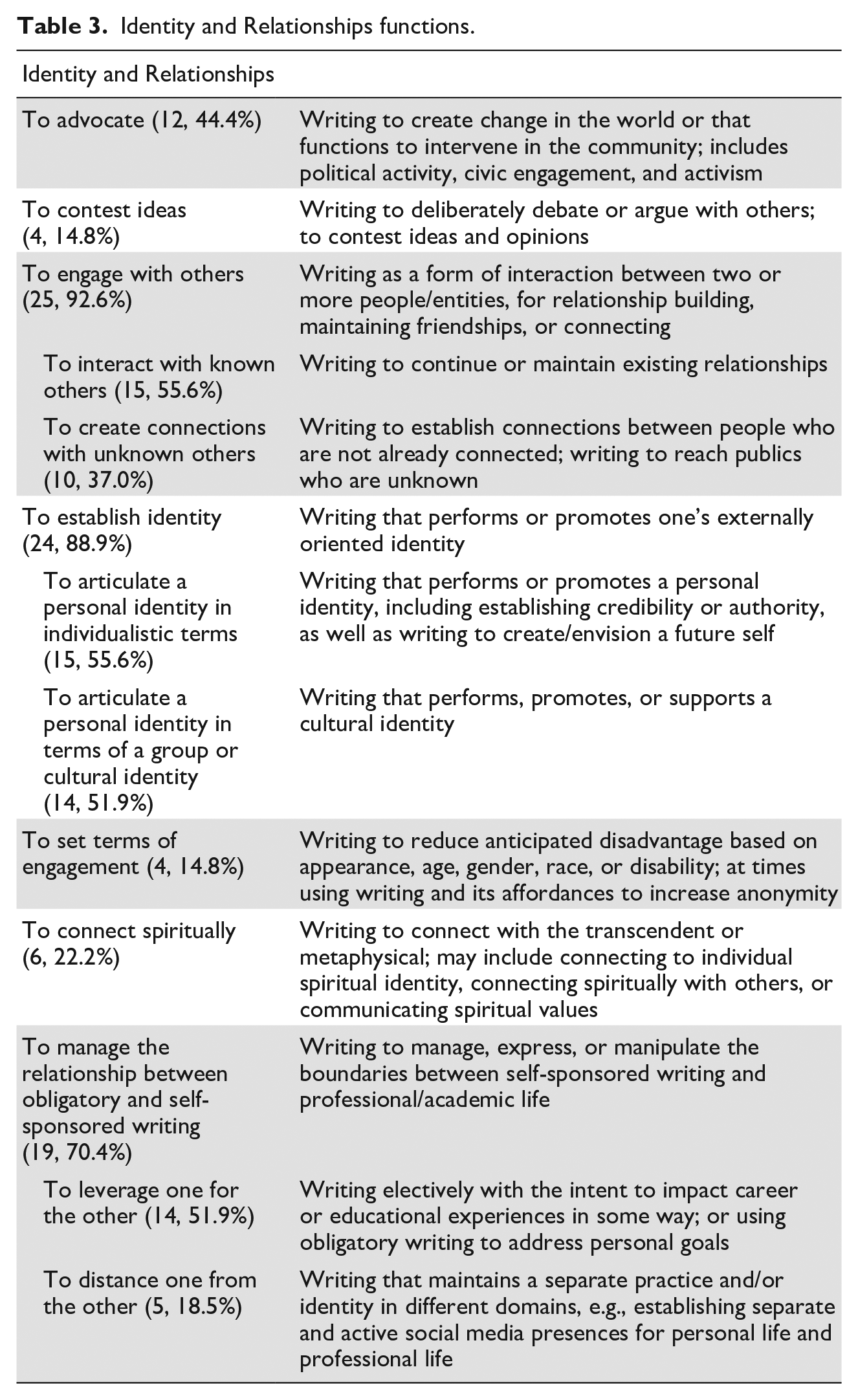
Our second metafunction describes individuals’ use of writing to articulate, shape, or present a particular identity, how they use writing to engage in relationships with others, and how they leverage writing to navigate multiple identities in personal and professional life (Table 3).
Identity and Relationships functions.
To Establish Identity
Writing to establish one’s identity, in both individualistic and cultural terms, was a prevalent finding in our dataset (24, 88.9%). One undergraduate student, Phil, explained in his interview that spending time with family was “a big part of [his]my identity,” and writing a eulogy for his grandfather reflected this identity; eulogizing served several functions for Phil, including solidifying his role in his family structure.
Participants who wrote to establish their identities in terms of group or cultural affiliation spoke from a wide variety of identities, as members of a particular gender, race, or spiritual group; as someone living with a disability, mental health challenges, or addiction; as someone who is a parent, child, student, etc. The writings participants composed that articulated these identities also often served concurrent functions, such as to advocate or to introspect. One participant who described ways her work served the dual functions of advocating and articulating a cultural identity was LaShunn, a graduate student who covered hip-hop for a local publication. She explained that she “wasn’t satisfied” with the way a local newspaper was “covering the local hip-hop scene,” so she took on the role herself: I saw my participation with writing for the [newspaper] as an opportunity to serve as a voice for anything related to Black culture, whether it’s music, whether it’s a film festival, whether it’s highlighting new businesses that have [been] opened by a person of color, particularly one from the African diaspora.
At times, LaShunn described her use of writing to articulate a cultural identity in a way that worked hand-in-hand with advocacy. For example, she explained noticing that Black-produced and directed films were being critiqued irresponsibly, without knowledge of the cultural context or nuance, and approaching her editor to ask that she be given Black-directed films to review herself. She explained that, for her, this action came down to how “a part of me wants to protect and honor these cultural products that are created within what we define as Black culture.”
To Engage With Others
Nearly every participant in our study reported using writing to engage with others (25, 92.6%); participants did so through various texts, such as emails, texts, social media, and letters. Brigit, a graduate student working on her master’s degree in education, used writing to reconnect with a friend. Brigit wrote the friend a letter to “attempt to start a conversation that’s more as if we were talking in person.” She described this letter as “a reintroduction of myself. . .also an opening of the door.” To Brigit, the written word (as opposed to a face-to-face meeting) carried particular weight in helping her reach out and connect. She wrote in her letter to her friend, “I feel a lot more creative in this floating window than I do standing in front of another human being.”
Participants who used writing to create connections with unknown others typically did so via more public-facing types of communication, such as blog posts, public speaking, and other forms of online writing. One recent college graduate, Jerome, shared ways that he used speeches to create connections with audiences. He discussed being hired as a motivational speaker who provides encouragement to Black youth and families. In one speech he shared, he connected with audience members at a scholarship gala by telling stories about his own youth, including challenges related to the fact that his excellent grades and school success obscured other aspects of his identity. In his interview, he described the ways he connected with others in his speeches: “I always try to see how I can hit home, touch on some emotion, and leave something . . . at the very root level, I can plant those micro-seeds.” Jerome urged the audience to be curious about the young people they meet and talk with, to look beyond their labels of “at risk,” and to learn their stories.
To Manage the Relationship Between Obligatory and Self-Sponsored Writing
In managing multiple kinds of identities, some writing blurred the distinction between required and life writing: 70% of interview participants (19) talked about ways their obligatory and nonobligatory writing overlap and connect. Many participants in our study discussed obligatory and life writing within the same sentence, showing that their interests, careers, and educations informed one another.
For LaShunn, hip-hop was both a personal interest and an area of academic study. In her interview, she described the way she tried to connect her academic writing self with her personal identity: Academia is a stiff place and I’m trying to be my authentic self in that stiff place. . . I was this little ghetto girl from Queens, New York who happened to be in academia and who happened to write academic writings but I also care about hip-hop. I think my personal identity matters more to me than what’s professional. So, I’m really trying to make the personal professional. The ability to just show up as is and not to have to feel like you have to turn one side off to turn the other side on.
In LaShunn’s case, the prolific writing she does about hip-hop for popular audiences informed and was informed by her academic work. By drawing her life writing into her academic work, LaShunn does not alter the “obligatory” nature of her academic writing, but she can and does constructively challenge and expand what counts as credential-imparting work.
Nonstudents also leveraged their life writing for their obligatory writing (and vice versa) as well. Jerome, mentioned above, explained that returning to his own personal writing enabled him to develop a deeper understanding of the website content he was writing for his job. He toggles between the personal and professional writing he does; he says the words he composes in one space, such as his poetry, often “help [him] formulate . . . and really see” his ideas in another. The distinction between obligatory and life writing can be blurry to say the least, particularly when the work that people do for their paid careers is work that resonates with their personal passions. Indeed, this category of “managing the relationship” represents our group’s shorthand and, therefore, necessarily inadequate approach to account for the extent to which all the writing composed by an individual interweaves strands of their many activities, identities, values, and engagements.
To Advocate
The participants in our study who reported using writing to create political, cultural, or community change (12, 44%) advocate on behalf of many groups and causes: educational equity, the right to paid leave, animal rights, mental health, civil rights, and environmental action, to name a few. One participant, Kyle, a 27-year-old aspiring politician, described giving speeches that advocated for policies to help others. In his interview, he explained that one of his speeches argued how “every child deserves a quality education, families shouldn’t be struggling to put food on the table like my mother did.” He ran for a state senate seat with these as his stated goals. Though he did not win the election, he was energized and motivated to keep working toward these objectives. He also explained how his advocacy work connects with his sense of privilege as a self-identified “cisgender white heterosexual male,” explaining that for him, writing is about “how you take that privilege and use it to advocate and expand access to those who don’t have it.”
To Contest Ideas
Four survey participants reported writing to contest ideas or deliberately engage in debate. One graduate student in our study, Garrett, explained that he posts online in contentious forums where people write about topics like creationism and climate change denial. His writing counteracts these posts by taking a defensive stance, something like (in his words), “Let’s go over the corner and beat each other up.” He explained in his interview that he does not see this response as constructive but also finds it hard to step away, as people’s “anti-science” posts online make him angry.
To Set Terms of Engagement
While only four writers in our study describe using writing to set terms of engagement, we saw this function as worthy of inclusion because it offered a new understanding of how the affordances of writing were particularly valuable means by which participants could reduce what they anticipated would be a disadvantage in another medium, such as face-to-face or phone. Patricia, for instance, explained that she “[has] a speech impairment. I don’t say my Rs correctly. . . . So I prefer writing. . . . It is my favored form of communication.” Patricia appreciated the way that writing puts her in control of the communicative situation and gives her time and space to articulate her ideas without prejudgment.
To Connect Spiritually
Twenty-two percent of study participants (6) reported using writing to connect spiritually, whether with a religion or the transcendent. Jeremy, a retired doctor and cancer researcher, reported writing poetry about photographs he took because doing so offered “the rekindling of a sense of soulfulness shared with other people.” He described the experience of writing poetry about the photographs, all taken of the natural world, as “a connection to the transcendent” and as a way to process and share his commitments to his Jewish faith.
Organization and Coordination
While our survey revealed that 78% of participants used writing to organize life (Table 4), only 22% of interview participants (6) discussed this writing, likely because of their interpretation of our interest in “meaningful” writing.
Organization and Coordination functions.
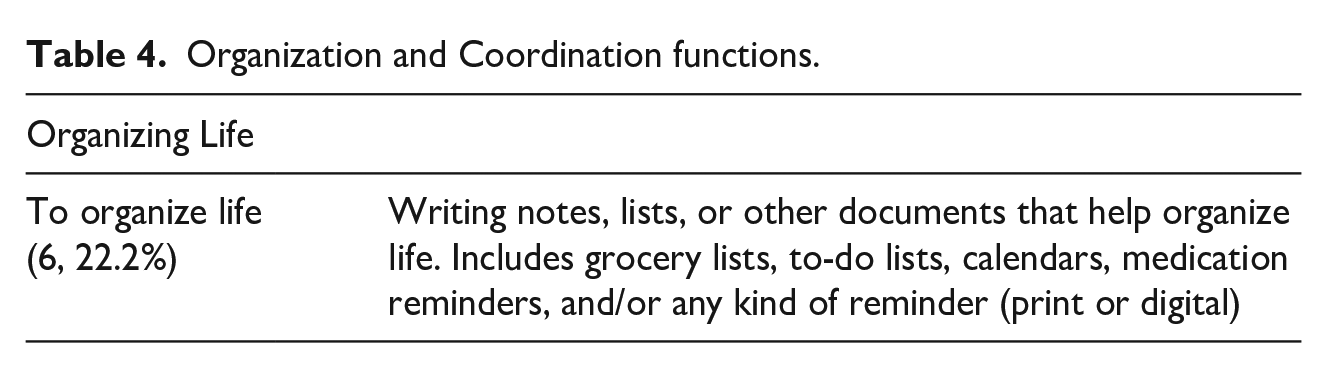
Writing to organize life was common among students in our study, several of whom share ways they use writing to keep track of their responsibilities. One explained, “I keep a pretty extensive planner with notes for myself, meeting reminders. Everything is color-coordinated.” Another explained using a “reminder list” to keep track of adult responsibilities now that he is in college. Writing to organize happens in collaboration between people too: one mother, for instance, said she would text her teenage son to help him stay on top of things—“don’t forget your doctor’s appointment,” for instance.
Preservation
Participants used writing to preserve or remember (Table 5), including honoring others who have died, creating a written record of past events, or holding things in their memory.
Preservation Functions.
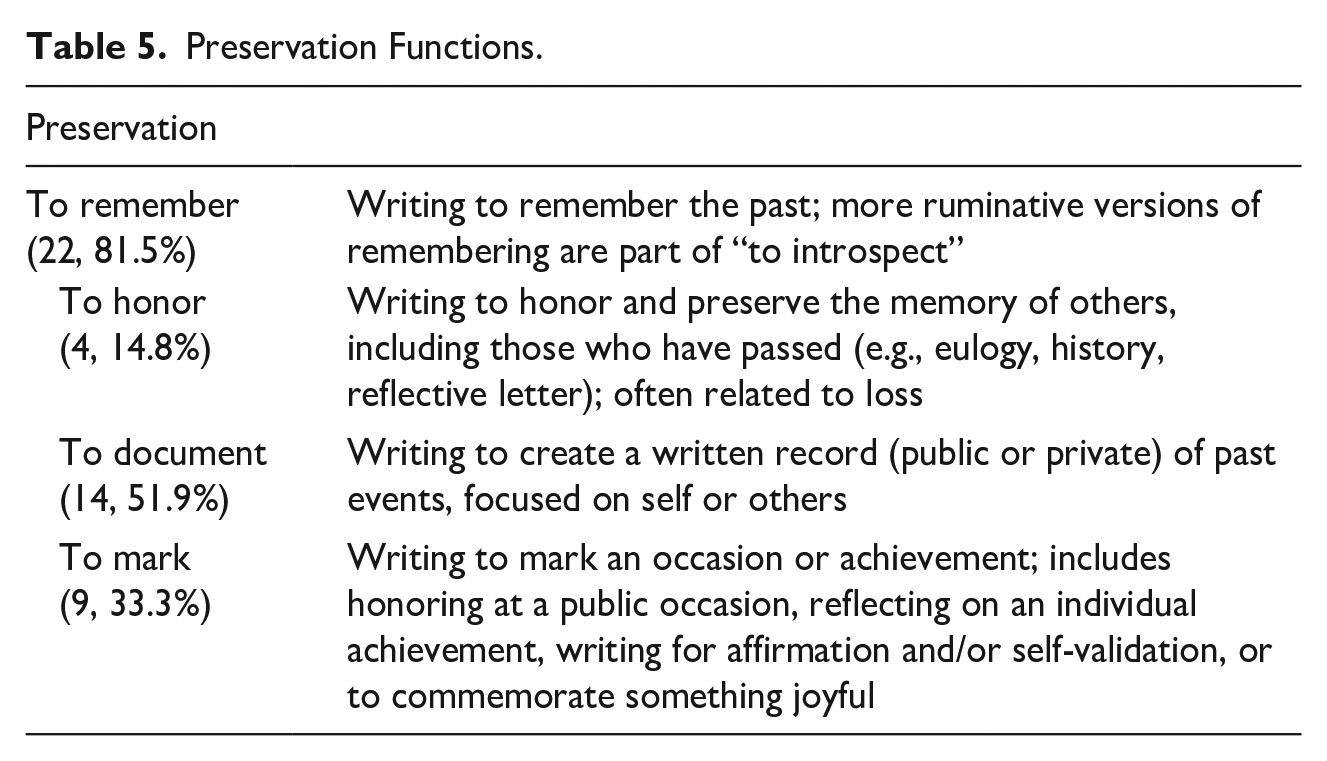
Participants use writing “to remember” in various ways ranging from relatively mundane to deeply meaningful. Libby used writing to document her daily life, which included her family’s six-day sailing trip around Drummond Island in Lake Huron. Most posts include notes about weather, food, and other details from their vacation. These daily posts, Libby explained, were not about “feelings about things”; they were for documenting the “details, the when, the where, the what,” so that she could recall the vacation later; the purpose of the writing was to evoke specific memories that might otherwise be lost.
Participants who used writing to honor did so to preserve the memory of others, usually loved ones who had died. Marley, an attorney, shared a short story and photograph she published in the New York Times Magazine that relayed her mom’s lifelong sense of humor. She explained the value of this writing for herself and to share her mom with others: “If I need to find this,” Marley said, “I can Google New York Times and there she is . . . it’s a concrete way to keep her presence.”
Other participants used writing to mark momentous occasions. Patricia, who retired from the nonprofit sector, wrote an article documenting the herculean effort of hundreds of community members to save books from the fire-damaged LA Central Library in 1986. Patricia was coordinating the volunteer effort and saw her writing as a tribute to the residents who came to help. She explained, “we literally worked 60 hours straight and we got out three million books, we saved three million, we lost a million, and it’s in the Library of Congress as the most successful library salvage in history.” She explained how moved she was by the heroism of the volunteers: “Nobody asked for lunch. Nobody asked for a break. Nobody asked for anything. They just showed up and stayed until it was done.” She felt compelled to write this story, to mark this momentous coming together of people for a greater cause: “I wanted people to know that it wasn’t Target, it wasn’t Kohl’s. . . . It was people, people who did this and who saved three million books. That to me was the extraordinary part of the story.” After our interview, the LA Times published a version of the story that Patricia wrote in 2019.
Reflection and Emotion
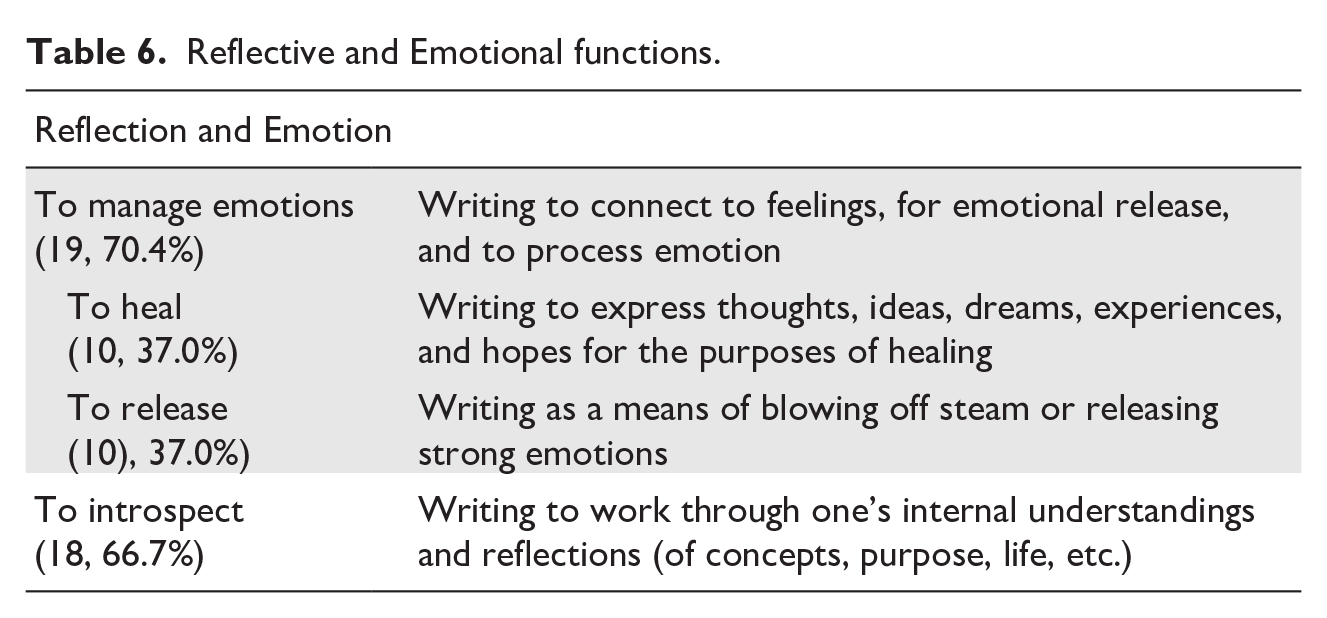
Life writing also focused on engaging with, managing, processing, and exploring the range of human emotions (Table 6).
Reflective and Emotional functions.
To Manage Emotions
Seventy percent of participants (19) reported using writing to manage emotions, whether to heal, to release, or to otherwise process their lives. One participant, Ang, lost her baby, Andrew, two days after his birth. She has spent many years grieving his loss, including processing through writing. She explained, “I have a journal full of the first two years without Andrew.” The work she shared with us included a hand-drawn image of a pregnant woman’s belly filled with words and touched with watercolor accents. The words are written directly to the baby boy, telling him of his mother’s love for him, assuring him he will be safe and always remembered. During her interview, Ang reflected on the process of composing and how her experience rereading her journal has changed over time: “I don’t feel that intense sadness anymore and I don’t feel that intense desolation and depression and I think because I was brave enough to write this stuff out, I’m able to look at it without falling apart every time. I didn’t keep it bottled up.” The process of writing the journal is part of the healing process that Ang continues to undergo. At the time of this tragedy, Ang said, it was the process of “putting it down in words” that gave her some comfort.
To Introspect
Mary uses writing to introspect and heal, specifically to maintain her sobriety. One type of writing she practices is a gratitude list, she calls “a tool to help reverse negative thinking.” Another document she shared, also part of her Alcoholics Anonymous (AA) stepwork, included a long list of “character defects” accompanied by her own reflections on “the opposite of the defect,” which enable self-compassion. Mary explained, “This is really about an internal investigation, it’s about peeling away layers of an onion and understanding what’s really underneath everything inside . . . we call it rigorous self honesty.” This type of writing functions simultaneously for Mary as a tool to get to know oneself and to improve oneself. She named this dual function explicitly in her interview: “The role of writing in my life now is to help me get out feelings on paper, help me to see things that are happening more clearly, to understand myself better.”
Teaching and Learning
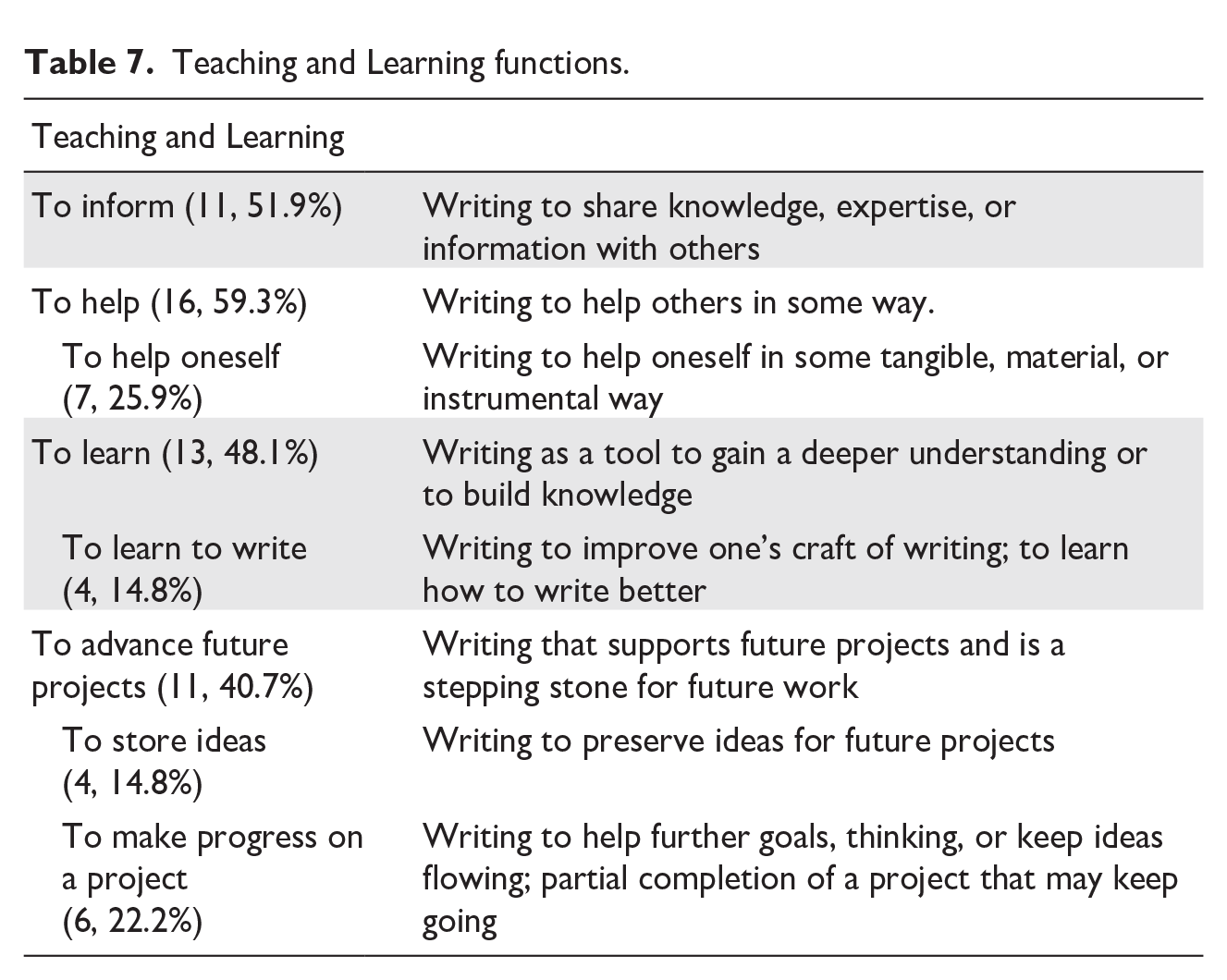
Teaching and learning functions (Table 7) were those that worked to bring knowledge to others, to help others, or to help oneself learn in some way.
Teaching and Learning functions.
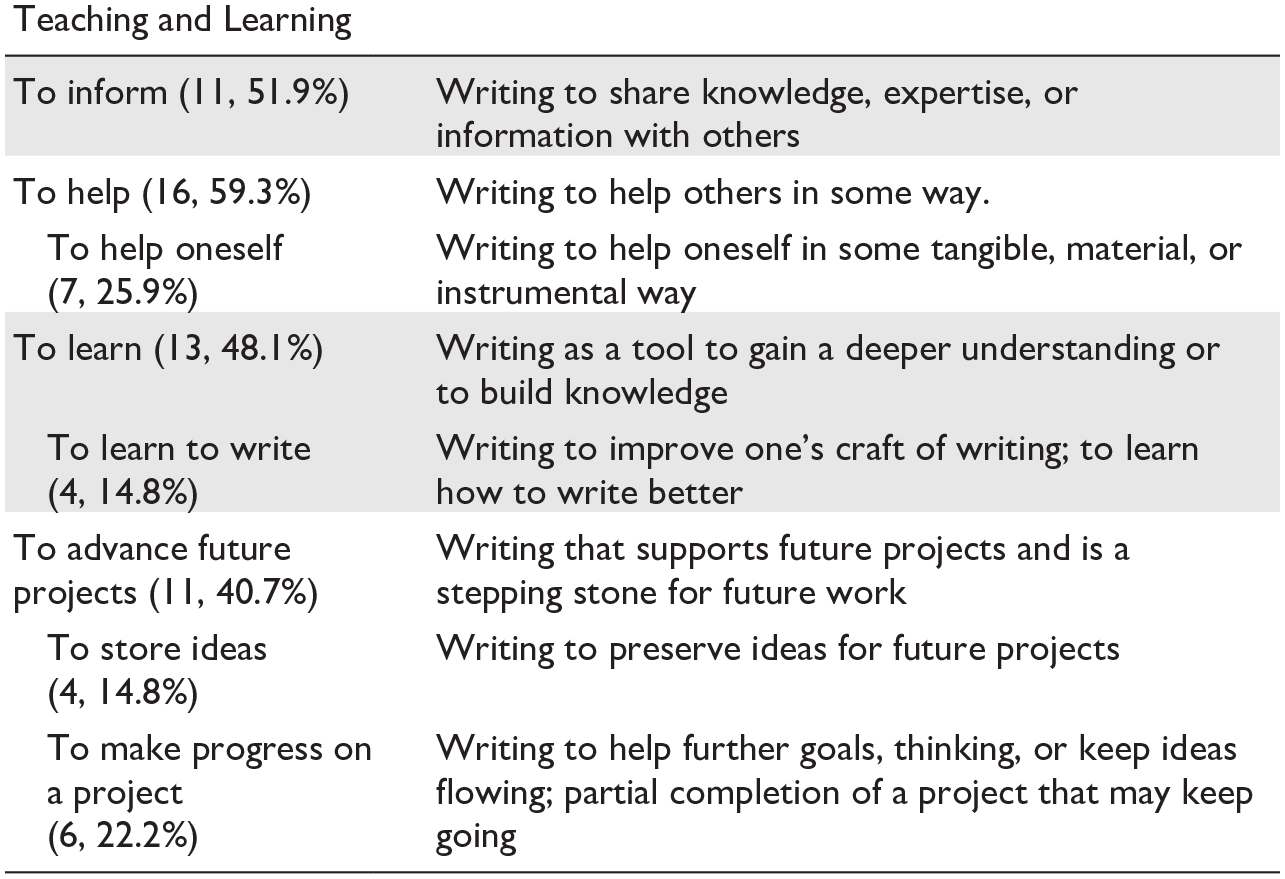
To Inform
Participants who wrote to inform (11, 52%) did so to share knowledge with others. Paul, a retired probation officer in Florida, wrote to inform his neighbors about processes related to obtaining permits for mangrove maintenance in his community. He shared excerpts from the newsletter he writes twice a year for members of his Homeowners Association, which offer information specific to mangrove trimming. In his interview, he explained that “the mangroves are essential” and serve important functions including “provid[ing] a buffer during storms.” Trimming mangroves is crucial but “cumbersome,” Paul said. By providing information about permitting in the neighborhood newsletter, he explained, he has helped people follow regulations and avoid fines.
To Help
Study participants use writing to help others (16, 59%) in a wide range of ways: with transitions, with grief, with mental health, with human connection. One undergraduate student, Rachel, submitted an Ignite speech she gave to incoming first-year students at her university about transitioning to college, where she talked specifically about her faith. The speech focused on how “keeping God in your life during college” is a way to ensure that “nothing I face will ever be faced alone.” She described the speech as having several functions, such as providing a means of introspection, but “I think it was mostly for others,” Rachel said. The speech is “not just sharing my experience but also here’s what I recommend doing,” and offered Rachel’s insights to first-year students about ways to manage the transition period.
To Learn
Writing to learn (13, 48%) enabled participants in our study to gain knowledge about topics of interest as well as about themselves. There is a good deal of overlap between writing to introspect and writing to learn, which shows up in cases where the learning is about oneself. Suzette, who is retired and drives buses part-time, reported learning through the articles she writes and posts online. One article she discussed focused on parrots in California. She reflected on her learning and writing process for this article in the interview: “Would we call them an invasive species or not? Then I went out and asked myself, what is an invasive species? I started doing a lot of research. . . . I put [it] all together into an article, answering my own questions as they arose.” The writing process gave her a chance to learn about parrots and invasive species, more broadly.
Discussion
Our life writing taxonomy offers researchers and practitioners a powerful tool for researching, understanding, and exploring self-sponsored writing by providing a classification system of six metafunctions and 19 key functions. We see our work as similar to Melzer’s (2014) national census of assignments across the curriculum, in that we provide a taxonomy that researchers can use to explore the specific functions of and approaches to life writing created in a variety of contexts and by a range of people. Our taxonomy provides information about how commonly people write beyond the obligatory writing they compose for their education and employment. It also shows why people feel compelled to write and continue to write in these spaces. Our taxonomy enables researchers to explore important questions: What does writing do for us? What functions does writing serve in people’s worlds and lives?
We find it worth noting the prevalence in our data of writing for social connection, emotional well-being, creativity, and memory curation. In identifying writing that was meaningful to them, nearly all of our participants discussed writing to engage with others. This included a good deal of social media writing, which participants perceived as important to them, and which they discussed as variously serving private and public ends, sometimes simultaneously. In a forthcoming project, we devote more attention to the complex interplay of self-declared “private” or “personal” writing that participants intentionally circulate in public spaces. Here, we note the extent to which our findings about writing to engage with others underscore one theme of the Meaningful Writing Project, that meaningful writing projects “recognize writing as a social act” (Eodice et al., 2016, pp. 58-59, p. 133). Additionally, we note the immense value our participants ascribed to the affective aspects of life writing, whether to heal, release pain, celebrate, come to terms, or reflect. Indeed, our participants’ reports suggest that the most salient aspects of life writing for them relate neither to the argumentative nor information-conveying uses of writing but rather to the emotional, reflective, and interpersonal functions it serves. This finding echoes Goldblatt’s (2017b) CCCC presentation, where he named “playing,” “commiserating,” “expressing anger or other emotions,” and “revealing your longings or disappointments” as among the expansive and often intimate purposes of writing. The uses of writing to engage emotions overlap with participants’ relatively frequent writing for creative ends that, like writing to introspect, steps outside the transactional model, as participants rely on writing to do work unrelated to credentialing or seeking material ends. Finally, participants rely on writing as a tool to preserve, curate, and safeguard memories and the past. They do this in a variety of genres, ranging from newspaper articles to eulogies to Facebook posts to journals. The work writing does for our participants to curate memories and preserve aspects of the past interacts with its importance to them, they report, as an emotional support and tool for externalizing and validating private experiences. Participants of all ages, genders, walks of life, and professional backgrounds use writing to connect with others, engage emotions, create art, and document histories and memories.
The field of writing studies has historically, though not always explicitly, made central the writing associated with school and professional activity, which is likely due to the field’s origins in the undergraduate teaching of academic and workplace composition. How might this study reorient the field’s research questions and focus? We urge scholars to ask more questions about the writing people compose beyond their education and paid work—to take seriously as relevant and interesting the writing that people elect to do. How do people use writing to make meaning? To regroup? To celebrate? What can writing tell us about how people manage in hard times? How different groups of people—such as retired folks, adolescents, adults in middle age—connect with one another, their communities, or the transcendent? Studies of elective writing among children and adolescents, mainly the domain of literacy studies, argue that elective writing supports youth well-being and social connection (Clark et al., 2023). But what about adults and elders? Moving forward, our taxonomy provides a starting point for the field to address these questions, and more. Since our study was based in the United States, future studies might add international perspectives, gathering data on how elective writing functions for adults in other cultural circumstances. Future research might also test the degree to which thinking of oneself as a writer enables the range of functionalities that life writing affords. The complex relationships between life writing and obligatory writing, which we were unable to explore with depth here, is worthy of more critical attention. Teachers might share our taxonomy with students not as an imperative or assignment, but as a reminder that their school writing is always partial, merely addressing a small slice of what writing does for people and in the world.
Naming What We Know About Life Writing: Expanding Threshold Concepts of Writing Studies
To return to our opening discussion about the need for researchers in writing studies to more fully embrace life writing, we may consider what the Life Writing Taxonomy offers to our understanding of threshold concepts in writing studies. As Adler-Kassner and Wardle (2020) acknowledge in their introduction to (Re)considering What We Know, “the threshold concepts framework itself creates certain boundaries that include and exclude particular ideas,” and this is itself worthy of discussion (p. 14). Our work enters that discussion by expanding the threshold concepts of writing that our field ought to consider central, and we argue that the functions of life writing—the work of processing, creating, reflecting, preserving, learning, and more—are important not just to acknowledge, but to incorporate into our schema.
Many threshold concepts, in their current articulation, effectively evoke the functions of life writing as revealed in our study. Take for instance “Writing addresses, invokes, and/or creates audiences,” “Writing is a social and rhetorical activity,” and “Writing is linked to identity”: these concepts in particular address key aspects of our study, including the ways writing establishes group and cultural identities and how people use writing to engage with others. Some other threshold concepts go out of their way to acknowledge the variety of contexts where people write; as Yancey puts it in threshold concept 3.2, “we are reminded that school is merely one historical context; there are many” (p. 53). “Writing is Performative” explains how “writing acts,” such as in the case of a petition that changes a policy or writing that raises funds for a cause (Lunsford, p. 44). In alignment with our study, the threshold concept collection gestures throughout toward the power of writing across contexts and reiterates the importance of writing as an actor and agent in the world.
That said, the threshold concepts presented in Naming What We Know are missing essential functions of the writing that people compose in their lives for nonacademic and nonworkplace reasons. Upon review of the functions we outline in our study, we propose that—in addition to the overall shift toward considering the vital role that life writing plays for many—the following specific threshold concepts are essential additions.
Writing Supports Emotional Engagement and Release
Writing has the potential to support emotional management and well-being in various forms; participants use writing to heal and release emotional turmoil. Participants write as a form of therapy, to process grief, to mourn, and to let go of unproductive emotions. Likewise, participants share examples of writing for joy, and of offering emotionally vulnerable writing to others to share or release a burden they carry.
Although research in writing studies has engaged with the therapeutic value of and affective dimensions of writing (Alexander et al., 2020a; Batzer, 2016), and the bibliotherapy and therapeutic writing movements are gaining traction outside the field, it remains the case that many in writing studies shy away from the more intimately emotional ways writing can act on its writers. For certain, many (reasonably) see emotional engagement as beyond the purview of most writing instruction; teachers of writing are not therapists, and acknowledging how writing can be and is used as a tool for emotional engagement seems risky. That said, in his discussion of the tacit influence of expressivism on writing studies, Goldblatt (2017a) challenges the field’s inhospitableness when it comes to the emotional aspects of writing, pointing out that writing studies’ detached, professional approach to theory and pedagogy effectively erases the very motivations that move many writers to begin with (p. 442).
We do recognize that, as in Alexander et al.’s (2020a) Affect and Wayfinding study, our research captures mostly positive emotional impacts of writing, while negative and even harmful emotional impacts of writing are largely missing (p. 588). Even so, individuals in our study report using writing to support their own emotional well-being, and we see it as vital to acknowledge this and identify it as an area worthy of attention.
Writing Can be Used to Set the Terms of Engagement
Although only four interview participants in our study discuss this function of writing, we see it as noteworthy and deserving of further study, insofar as writing itself is, for some, a powerful adaptive technology. With this concept, we move beyond stating that “writing is a technology through which writers create and recreate meaning” (Brooke & Grabill, 2015, p. 32) to note that the technology of writing is especially well suited to serve as a tool that can reduce a disadvantage that individuals might perceive when communicating via another medium, such as face-to-face. In addition to the participant we profile above who uses writing to circumvent a speech impediment, other participants in our study describe the value of writing as a way to present one’s words without the distraction of their physical appearance or to use a learning disability to their advantage. We see in this pattern echoes of research in disability studies that demonstrates the use value of diverse modalities of communication, such as in Osorio’s (2022) analysis of the 504 Sit-in of 1977. In that case, the protestors “exploited the ignorance of the FBI” by using “the visual-spatial modality” of American Sign Language “to communicate through the windows of the building” (p. 255), thereby leveraging the advantages of a strategic discursive approach to facilitate and maintain a highly successful protest. Writing in our study likewise serves to advantage the individuals who use it to practice strategic engagement.
Writing Preserves and Externalizes Memory
Memory is particularly important in our study of life writing. In total, 22 or 81.5% of interview participants report using writing to remember in some way, whether to honor others who have passed, create a written record, or preserve memory. Frequently the code “to remember” co-occurs in our data with “to engage with others,” demonstrating that writing promotes both personal and collective memory; the power of writing is such that it enables individuals to share their memories with others. Indeed, rhetorical scholarship into objects of collective memory is based on the argument that “preserving or archiving the past” for collective reinterpretation can be a “potentially ameliorating, nourishing, or even healing force” (Vivian, 2018, p. 294). In a work-in-progress, we examine the different ways that writing to preserve supports participants in both collective and private ways. It may be the case that these uses of writing are so central to what writing is and does that the collection did not feel the need to specify it as a unique threshold concept, but we see it emerge in various forms that are so meaningful to our participants that it seems crucial to identify memory work as a major attribute of what writing does.
Writing as Agentive
While not a threshold concept per se, as the concept of writing-as-agent is woven throughout the threshold concepts collection, our study findings strongly affirm and call attention to the agentive power of writing, as an “intra-active behavior” in which “writers always change in writing” (Cooper, 2019, p. 233). From our study, it is clear that for certain participants and certain functions, writing has a powerful effect on its writers—it is not just an instrument or tool that they deploy for their own purposes but is also an agent that acts upon them. If we take seriously as researchers that people experience writing in this way, we can ask questions that help us more fully understand how writing impacts individuals, including what situations and genres prompt this experience. Writing as an agent appeared across the functions we observed, and was especially prevalent in writing to establish identity, to manage emotions, to remember, to channel, and to learn. “To Channel” is the most direct of the agentive themes—participants who spoke of their writing experience as “channeling” something else implicitly affirmed that writing is not a neutral tool detached from societal pressures. They discussed writing as a force in its own right, even explaining how they felt moved by its power to change them, particularly in the case of creative and introspective writing. This perspective of writing “having a will of its own” is found in the creative writing community in blogs, interviews, and how-to-write guides (Ramey, 2009). For writers who report reaching a “flow state,” whether in their poetry or writing for advocacy, the relationship between writer and writing is more complex than an actor leveraging a tool. If writing studies researchers take seriously everyday writers’ accounts of writing as an agent, we can better honor its effects and more precisely research its dynamics.
The agency of writing is a premise of postcomposition, ecologies of composition, and new materialist theories, which view writing as a complex web or network of interactions between many agents, including the writer and their writing as well as the natural world. Early scholarship into ecologies of composition suggests that composing is “enactive” and that “we are shaped by the texts we create as surely as we shape them” (Syverson, 1999, pp. 17-18), and Cooper’s (2019) work in new materialism affirms our study’s repeated finding that writers and their writing co-emerge, mutually constituting each other. In what ways do writers experience themselves and their life writing as sharing agency, emerging alongside one another? How and when do writers surrender to or find themselves moved by the agency of their writing (as those in the creative writing community suggest [Ramey, 2009])? Is it a function of how writing works for certain genres or situations? This is worth further consideration.
Conclusion
This project demonstrates that writing functions for our participants in all kinds of ways, more than we can capture here. Writing helps people maintain themselves, but also change; it helps them to navigate the complexities of the world and renegotiate the terms of their own lives. Participants report that the writing they do often operates beyond the limits of their own control. Life writing functions beyond the realms of education and work by helping participants address human needs like connection, self-understanding, healing, the cultivation of a creative or spiritual practice, and remembering.
While we stand with others in the belief that academia should not colonize life writing for its own purposes (Gere, 1994; Lindenman & Rosinski, 2020) this study might nonetheless influence how nonobligatory writing is valued, discussed, researched, and included (or not included) in pedagogy. What, after all, is writing for? We know from Melzer (2014) that the vast majority of writing in university settings is to inform, with only 0.4% of writing being poetic and 3% of writing being expressive (p. 104). When many of our respondents attested to the value of writing to remember, to engage emotions, and to negotiate identity, we cannot help but note how these functions of writing remain largely invisible in our institutions and research. When educational institutions value writing as a tool to inform so highly (and particularly to inform the teacher-as-examiner), they are excluding many of the functions writing has the potential to serve. How can writing programs in institutional spaces set up their participants for lifelong writing—not just in terms of skill and conceptual transferability, but in terms of the whole range of functions writing can play in a person’s life trajectory? How can researchers of writing more richly embrace and portray the functions that life writing serves? These questions scratch the surface of our study’s conclusions, which call for writing studies as a field to expand our attention beyond writing that people compose for professional and academic purposes. By expanding the scope of what counts as writing worthy of our attention, researchers have the potential to better understand the functions writing serves for people outside of their academic undertakings and workplace activities: functions that address questions of meaning and purpose, assist in learning and relationship building, and help people grapple with who they are, how they manage, and what to make of the worlds in which they live.
Footnotes
Appendix A. Participant Table (includes the 18 interview participants named in this article)
|
Appendix B: Interview Recruitment Email No. 3
Dear [name],
I have you scheduled for an interview via PHONE/ZOOM/SKYPE on DATE, TIME, TIME ZONE.
Please send along your phone number [Skype username] so I have those ready to go.
Prior to [DATE, 2 days before interview], please send along
The interview will be recorded. Before we conduct the interview, you will be asked to give your verbal consent, and if you do not give your consent, we will not conduct the interview. Here is some information about interview participation criteria:
You will be compensated for your time with a $20 Amazon gift card. You may choose to be identified by your name or a pseudonym in any presentations or publications about this study.
Please be in touch with any questions, and thank you again.
Sincerely,
Name, on behalf of research team
Dana Driscoll, Indiana University of Pennsylvania
Andrea Efthymiou, Hofstra University
Heather Lindenman, Elon University
Matthew Pavesich, Georgetown University
Jennifer Reid, Marquette University
Acknowledgements
We want to express our gratitude to the Center for Engaged Learning at Elon University, which brought our group together and helped us get started. Special thanks to WC co-editor Dylan Dryer for helping us think through every aspect of this piece.
Declaration of Conflicting Interests
The authors declared no potential conflicts of interest with respect to the research, authorship, and/or publication of this article.
Funding
The authors received no financial support for the research, authorship, and/or publication of this article.
