



Abstract
Many of our ideas about workplaces have been inherited from 20th-century corporations, in which the elements of the workplace have been packaged in a highly typified configuration: work is done by people belonging to an organization, for some clear reason, at a specific place and time, using specific processes. This configuration is increasingly at odds with work practice, and thus workplace writing researchers must reconsider what is meant by the “workplace.” This article argues for treating the workplace as a conceptual decision: a bounded case that researchers construct to enable systematic comparisons. After reviewing how cases are bounded in methodology and practice, the article ends with concrete principles and guidance for bounding such case studies.
Suppose that, like many researchers before you, you have decided to conduct a genre study of workplace writing. The task seems straightforward enough as you begin designing your study. But the more that you think about the task, the harder it is to figure out how to draw bounds around what you’re investigating. You have to make decisions such as: Who should or should not count as a study participant? Where will you collect your data, and what data counts as workplace writing vs. other forms of writing? When do you visit the workplace and collect data?
More succinctly: What is a workplace?
At first blush, the answer seems simple. A workplace seems like an independent fact existing out there in the world: a place where people do work. Specific people organize (or are organized) to work together for a particular purpose, at a specific time and place, following a specific process.
But that answer is hardly adequate, something that was forcefully brought home to me as I conducted a case study at a telecommunications company 20 years ago. One data entry worker I was shadowing, Susan, answered the phone and began a conversation about accounting software. I was intrigued: no one had told me that there was a connection between Data Entry and Accounting! And I was also surprised because, although Susan had just been hired at this company, she confidently instructed the caller in how to use the software. What was happening? I began to imagine complex connections within the company. But the answer was far simpler: The caller was the person who had taken over Susan’s previous job and was still calling her with questions two weeks later (Spinuzzi, 2008, p. 169). Although she was at a new job, Susan was still being roped into providing unpaid labor for her old job!
Most of us who have conducted case studies in workplaces have seen similar things, and they happen more frequently than they did in the past: work activities have become more porous due to increased use of information and communication technologies (Castells, 2003) and a consequent shift to cross-functional work and project-based work (e.g., Barley & Kunda, 2001; Grabher, 2004; B. S. Lauren, 2015; Spinuzzi, 2015). People sometimes solve work problems by reaching out to their personal contacts, using the expertise and labor of their friends, family, and acquaintances—and former coworkers, like Susan. They sometimes work outside designated working hours and do personal tasks during working hours, and sometimes they do not even distinguish between working and nonworking hours at all. Work happens outside of specific locations, and specific locations do not always host work. Yes, people work in stereotypical office workplaces, but they also work in cars, ambulances, coffee shops, and hotel lobbies (for the latter two, I’m referring to both patrons and staff). And during the 2020 pandemic, many of us found ourselves working in makeshift home offices, where work was and is interleaved with nonwork tasks and existence.
In short, work is done within blurred boundaries, and those boundaries have become dramatically more blurred since the beginning of the 20th century. This blurring has been difficult to reconcile with preconceived ideas about the workplace that have been inherited from 20th-century corporations, ideas in which the elements of the workplace have been packaged in a highly typified configuration: work is done by people belonging to an organization, for some clear reason, at a specific place and time, using specific processes. What constitutes a workplace seems clear—until one attempts to articulate the boundaries of a workplace, something we (as workplace writing researchers) must do if we are to systematically study a workplace.
What is a workplace? For the purposes of workplace writing research, I argue that we should consider workplaces not as things existing independently in the world, but as conceptual decisions. We can more productively understand workplaces construed through examining the dynamic internal relationships among foci of inquiry on observable data. Those foci might involve roles, organizational affiliation, locations, times, work objects, and other factors that can bound the workplace, separating it from other aspects that fall outside of the conceptual decision.
Qualitative researchers have long used the term “case” to denote such boundaries (e.g., Creswell, 2006; Säljö, 2009; Yin, 2003). In this article, I argue that a workplace is a case, a conceptual decision that one uses to denote boundaries to one’s inquiry. It is vital to define that case in order to design and conduct a principled workplace writing study—to understand the boundaries within which one recruits and samples participants, collects and samples data, and analyzes those data. Witte (2005, p. 140) described this boundary problem as “how to focus a given study or help me to decide when a given study should begin or end.” Without explicitly defining a case, researchers may find themselves basing an investigation’s boundaries on stereotypes of work or arbitrary distinctions. And such poorly drawn case boundaries have consequences:
Bounding the case is thus critical for workplace writing studies and has been for at least 40 years (beginning with Odell & Goswami’s landmark 1985 collection), but it is rarely discussed in methodological detail. And I think it needs to be, since work conditions have changed substantially during those 40 years. In this article, I draw inspiration from Peter Smagorinsky’s landmark article “The Method Section as Conceptual Epicenter in Constructing Social Science Research Reports” (2008) which clearly lays out principles for designing empirical methodology and writing it for readers to follow. I discuss principles for bounding the case of the workplace, as well as the issues with mistaking a case (a conceptual decision) with the observable facts that it represents, specifically describing recent changes in work that confound easy definitions of the workplace (inherited from 20th-century corporations) and illustrating how these changes require workplace writing researchers to define their cases more explicitly. (I draw mainly from case studies focused on genre, but these lessons can be applied to other case studies as well.) Finally, I’ll present a heuristic for developing principled case boundaries for workplace writing studies.
Bounding the Case in Case Study Research
What is a case? In this section, I first overview units of analysis, then discuss cases as a specific type of unit of analysis. Next, I identify four specific principles for drawing case boundaries in workplace writing studies (organizational boundary or extra-organizational project, common work object, physical location, routinized work process). These principles, although separate, have been amalgamated through historical changes in work, and these changes have been so pervasive that the principles often appear to coincide in any given workplace. (To take the example I mentioned at the beginning of this article, Susan’s behavior surprised me because I naively thought that she was bounded by her location and work hours in Customer Care’s office, her role in her current company, the work object her team had been given, and the processes delineated in her job description.) Bureaucratic assumptions of work have thus come to be sedimented into the theories and methodologies of workplace writing studies.
What is a Unit of Analysis?
Säljö (2009) defines a unit of analysis as “the choice of a conceptualization of a phenomenon that corresponds to a theoretical perspective or framework” (p. 206). Following Säljö, we must consider questions such as these when selecting a unit of analysis:
What research question is the researcher trying to answer?
What are they trying to study, and how is it operationally defined?
What unit of analysis is appropriate for the field in which the research is being conducted?
Common units of analysis in qualitative research include individuals, groups, organizations, locations, and aggregations of these. But the unit of analysis is a conceptualization: not something “out there” in the world, but a reduced conceptual frame meant to make systematic analysis possible. Social scientists seek units of analysis that are necessarily conceptual decisions representing composite relationships. That conceptual decision then drives researchers’ decisions about the samples they collect in order to understand the dynamic internal relationships within that unit of analysis.
This difference makes it crucial to differentiate between the unit of analysis and the unit of observation, that is, what the researcher actually observes, measures, or collects in order to learn something about the unit of analysis. In most cases in the social sciences, it is impossible to observe or collect the unit of analysis: For example, political scientists may aggregate survey data at the country level by estimating the mean score on an item measuring political participation, assigning that same score to the country to identify how patterns of participation differ crossnationally. In this case, the unit of observation is the individual survey respondent, but the unit of analysis is the country. Likewise, achievements of students are often aggregated to allow schools to be compared. It is the country and the school about which the analyst generalizes, not the citizens or students. (K. J. Long, 2004, p. 1158)
In using Long’s argument, I disagree with Witte (2005, p. 142), who, following Vygotsky, expects the unit of analysis to be the same as the unit of observation. Vygotsky insisted that the unit of analysis had to be “real” and “objective” (Vygotsky, 1997, pp. 66-67). rather than a conceptual decision. Yet this insistence is inadequate for writing studies researchers who work at large levels of scope and must seek units of analysis that are necessarily conceptual decisions representing composite relationships. When a writing researcher (or other social scientist) studies a community, an organization, a geographical region, or a nation—or, more to our point, a workplace—they are not collecting an entire workplace, community, etc. as a piece of data. Rather, they are sampling data that can help them understand the internal relationships within that unit of analysis as a conceptual decision. For this reason, contra Vygotsky and Witte, contemporary texts on qualitative research methodology take the unit of analysis specifically as analysis, not the thing to be studied. The unit of analysis is recognized as a conceptual decision driven by the research question rather than an observable fact existing in the world or objective reality, a map rather than a territory (Matusov, 2007).
What is a Case?
In case study research—which constitutes the bulk of qualitative research our field has produced on workplace writing—the case functions as the unit of analysis (Miles et al., 2014, p. 24). This unit both guides research design and makes its results compatible with other research studies using the same unit. Bernard says that “in a case study, there is exactly one unit of analysis—the village, the school, the hospital, the organization” (Bernard, 2002, p. 39; cf. Gillham, 2003, p. 1). Similarly, Yin argues, “As a general guide, your tentative definition of the unit of analysis (and therefore of the case) is related to the way you have defined your initial research questions” (2003, p. 23). Yin adds that for comparing cases with those in previous and subsequent research, “each case study and unit of analysis either should be similar to those previously studied by others or should innovate in clear, operationally defined ways” (p. 26). That is, a case can be understood as “an instance of a class of events” (George & Bennett, 2005, p. 17). Merriam and Tisdell (2015) argue that “the unit of analysis, not the topic of investigation, characterizes a case study” and suggest either a bounded system or a specific instance such as a carefully selected individual (pp. 38-39, their emphasis). Finally, Creswell argues that Case study research is a qualitative approach in which the investigator explores a real-life, contemporary bounded system (a case) or multiple bounded systems (cases) over time, through detailed, in-depth data collection involving multiple sources of information (e.g., observations, interviews, audiovisual material, and documents or reports), and reports a case description and case themes. The unit of analysis in the case study might be multiple cases (a multisite study) or a single case (a within-site study). (2006, p. 97, his emphasis)
and cautions that “The key here is to define a case that can be bounded or described within certain parameters, such as a specific place or time” (p. 98).
As Creswell suggests, case studies share these characteristics:
According to these criteria, many workplace writing studies are de facto case studies, even if they do not self-identify as cases or cite case study literature. For instance, workplace writing studies based on activity theory tend to bound the workplace as an activity system, use multiple data sources, and compare the activity system to others (e.g., Opel & Hart-Davidson, 2019). Genre studies of work similarly tend to be bound by workplace or profession, to collect different genre instances and interviews about them, and to compare genre use in one workplace or profession with those of others (e.g., Devitt, 1991). And older studies of workplace writing, although not directly drawing from the case study literature, often still fit these criteria (e.g., Paradis et al., 1985).
Of these criteria, the first is most relevant for this article. How is a case bounded? What conceptual decisions do we make when bounding it? These questions are critical because, as we saw above, bounding is a tricky decision—and that bounding decision has implications for comparisons:
So how do we effectively bound case studies of workplace writing?
How Do We Effectively Bound Case Studies of Workplace Writing?
In workplace writing studies, cases are typically bounded and defined by principles such as an organizational boundary or extra-organizational project, a common work object, a physical location, or a routinized work process. These common boundaries can be characterized as answering questions such as:
Other principles are on offer as well—for instance, Marcus (1995) categorizes ethnographies 1 whose objects of study are defined through following people, things, metaphors, plots, biographies, or conflicts, while Latour counsels us to “follow the [human and nonhuman] actors” (1996, p. 204) and Engeström instead says to “follow the objects” (2004, p. 18). We can conceivably add still other principles, such as work pace, power, and codification. Furthermore, these principles are not indivisible atoms but analytical foci, since we can break them down further (e.g., separate “when” from “where”), or combine them in different ways. But for this discussion, we’ll consider how the four principles above have been bound together in our expectations for the workplace. These four principles, in theory, could lead to radically different boundaries: different data collection and analysis, answering different questions, leading to different findings and conclusions (Miles et al., 2014).
So it’s remarkable that, throughout roughly the first two-thirds of the twentieth century, the answers to these questions were largely similar, and that fact made it seem as if all four questions led to aspects of the same observable fact. Much work—certainly much office work, which has been a special focus for workplace writing research 2 —involved people working along with others who belonged to the same organization, department, and team (who), in the same location (where and when). They collectively transformed a common work object (what and why) by participating in the same processes (how) involving the same texts and tools. Metaphorically speaking, these different aspects were amalgamated into a relatively coherent whole, co-constituting what we called a “workplace.” Thus it made eminent sense to ask the journalist’s questions who, what, when, where, why, how? (Yates & Orlikowski, 2002) because the answers all led to a relatively coherent, bounded case: a workplace bound across these dimensions. For instance,
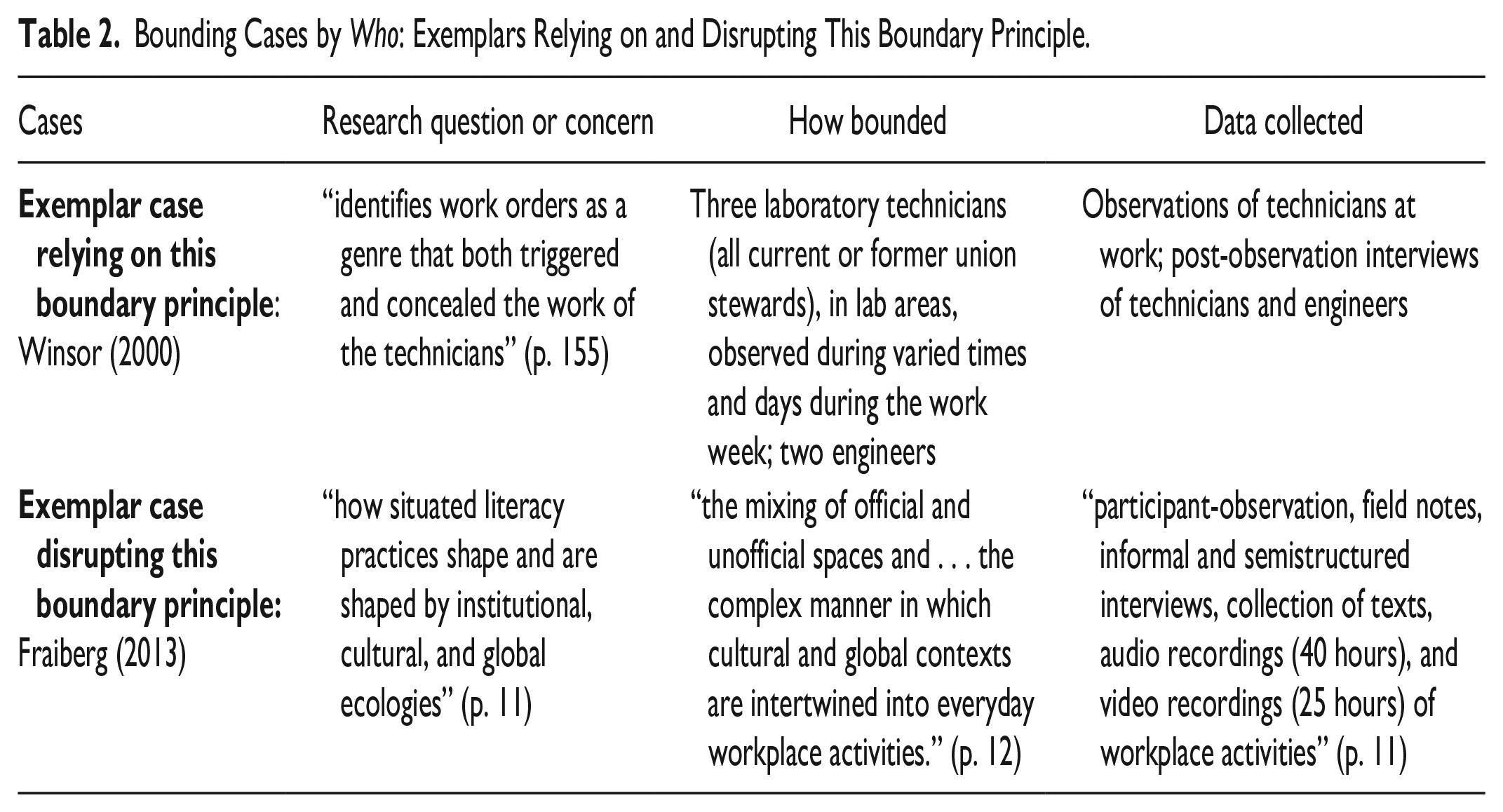
Studying a test lab (where and when) entailed studying the blue-collar workers who worked there (who) as they received test orders (what) and used their tacit knowledge to interpret these orders and perform the work (how) and to what end (why) (Winsor, 2000). —
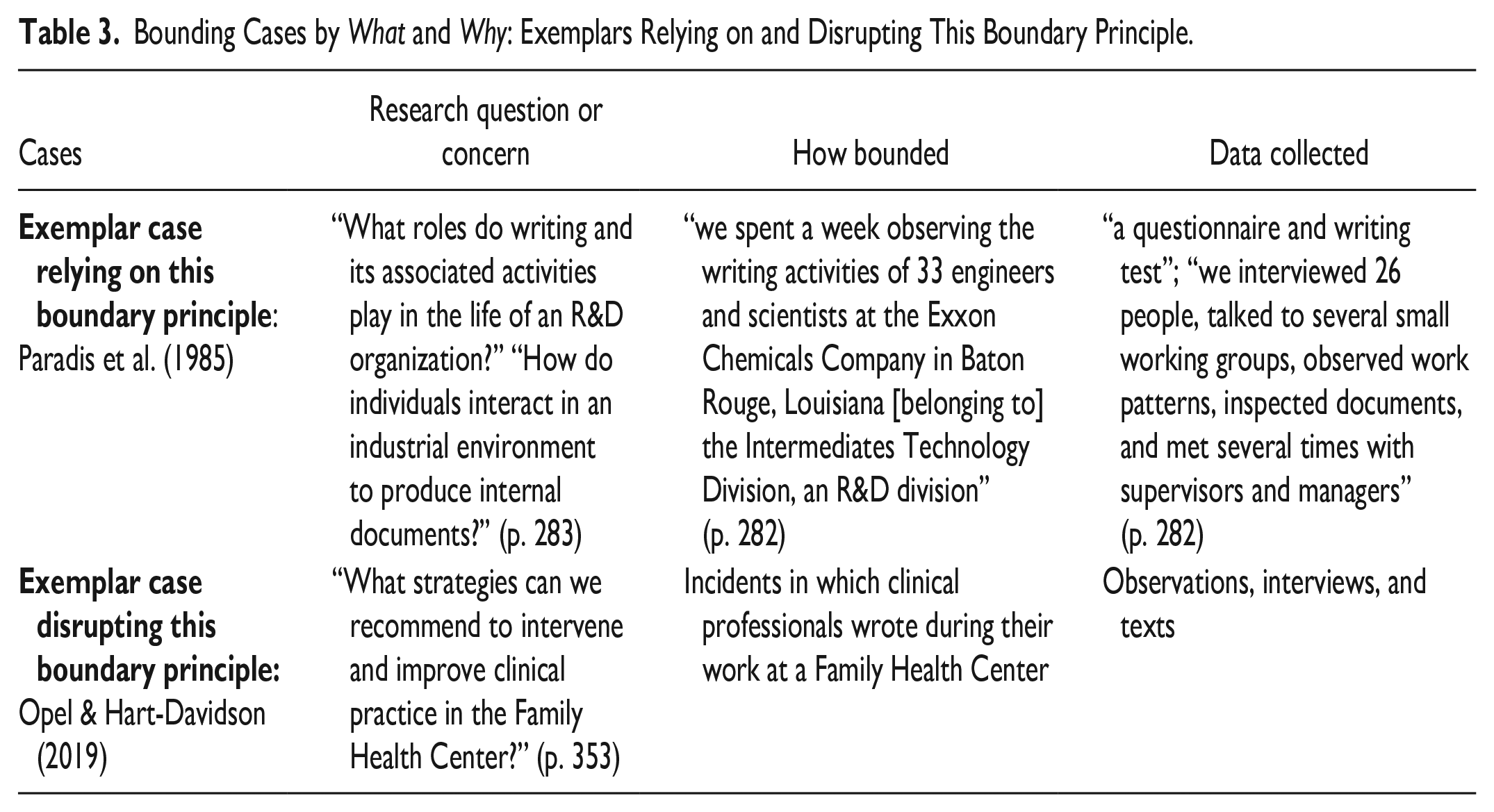
Studying R&D employees at Exxon (who) entailed examining their documents (what) written at the location of their division during the work week (where and when), understanding their document cycling practices (how), and exploring why they took these up (why) (Paradis et al., 1985).
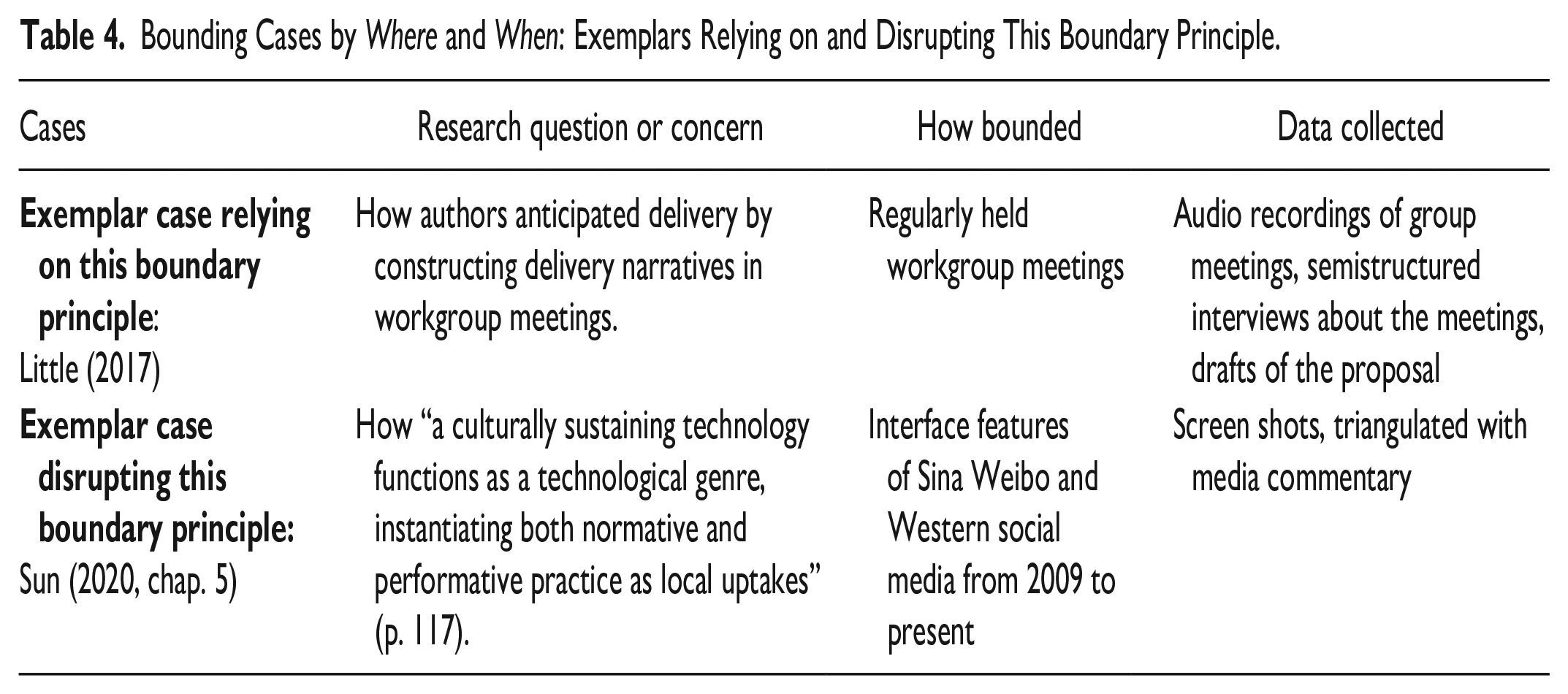
Studying a working group (who) that advocates for LGBT policy (what and why) entails observing and recording a series of meetings (where and when) to understand how members formulate wording by anticipating delivery (how) (Little, 2017).
Studying the processes involved in generating tax returns (how) entailed examining tax documents (what) that were written at major accounting firms (where) by individual accountants (who) (Devitt, 1991).
Up to a point, the grouping seemed natural because it reflected the bureaucratic hierarchies that dominated so much office work throughout the 20th century.
The Construction of the 20th-Century Workplace
I mentioned earlier that most of our preconceived ideas about the workplace come from 20th-century corporations, which packaged or amalgamated the elements of the workplace in a highly typified configuration: work is done by people belonging to an organization, for some clear reason, at a specific place and time, using specific processes. This amalgamation is not universal, since plenty of work happened and still happens outside these bounds. But the amalgamation has shaped how we understand, characterize, and study workplaces – not just within offices but beyond them as well. Below, I discuss how the 20th-century workplace emerged from bureaucratic hierarchies and how those bureaucratic assumptions are reflected in workplace writing studies and theory.
The Characteristics of 20th-Century Bureaucratic Hierarchies
As Bazerman (2022) argues, early writing in both Mesopotamian and Chinese settings (the earliest settings in which writing emerged) functioned to sustain hierarchical organization and strengthen hierarchical power (p. 61). This relationship between literacy and control is well established, although taking new forms as groups of people address new ventures. For instance, in his examination of Portuguese trade expansion in the 15th and 16th centuries, Law (1986) argues that Portuguese sailing ships of the period created a new “bubble” in which the Portuguese could prevail: “Their whole effort depended, from top to bottom, on the capacity to extract compliance” (p. 8), compliance extracted through a system with three interlinked elements: documents, devices, and drilled people.
These three elements became extremely important during the rise of industrial society. Zuboff (1988) particularly focuses on how early industrial workers were drilled to extract compliance. Compliance was a real challenge for industrialists, since in 18th-century Britain, “work patterns were irregular, alternating between intense effort and idleness. Most work activities emanated from the home, and the distractions of the family, the taverns, and the social web of the community limited any undivided commitment to work” (p. 31). That is, workers were focused on subsistence and often declined to work once that need was satisfied (p. 31). Industrialists found that “only the pressure of immediate supervision was able to induce a greater level and consistency of effort from workers,” and it “was the driving force behind the establishment of the early factories and workshops” (p. 31), locations separate from home, locations that (like the Portuguese ships) could create “bubbles” (Law, 1986) in which the industrialists could prevail. Even after these “bubbles” were established, workers regularly skipped work after receiving their paychecks, well into the 19th century (Zuboff, 1988, p. 32). Zuboff adds: “The spontaneous, instinctually gratifying behavior of the new industrial worker had to be suppressed, and that energy channeled into the controlled behavior demanded by the intensification of production,” so “the factory became a pedagogic institution” for teaching “‘labor discipline’” (p. 33). Industrialists in the United States faced similar problems, including annual turnover rates of over 100%. There, noncompliance led to severe fines against offending workers. Eventually, with the advent of the steam engine, employers began dismissing workers, and those who remained had to conform the pace and quality of their work to the machines that had become an integral part of industrial work (p. 34).
These new work conditions shaped our 20th-century idea of a workplace: a group of drilled people, laboring on a focused task to serve an organizational reason, gathering at a specific location at a specific time and duration, following specific processes. The industrial society required a workplace in which who, what, why, where, when, and how were tightly held together.
This amalgamation was achieved partially through the development of management. In her study of the development of American management and its business communication practices from 1850 to 1920, Yates (1989) describes how “internal communication came to serve as a mechanism for managerial coordination and control of organizations” (p. xv) via new technologies (such as typewriters and vertical files) and new genres (such as reports and memoranda) (p. xv). Railroads led the way in new management techniques because of factors such as
Large capital requirements, requiring the separation of management from stockholders, which in turn required regular reporting
Close coordination, so trains wouldn’t smash into each other
Geographic dispersal, meaning that oral communication was not enough, requiring written timetables, circulated rules, and operating information (pp. 4-5)
Following the railroads in adopting the new management techniques were other industrial enterprises, as Yates chronicles. Industrial workplaces required clear hierarchies with “clear channels of authority and communication” downward and combinable, superimposable information sent upward (p. 5; cf. Latour, 1986, on how inscriptions’ recombinable and superimposable qualities position them well to produce facts). That workplace hierarchy was sustained in part through the same elements Law mentioned: devices (such as communication technologies: Yates, 1989, chap. 2), documents (such as new genres of business correspondence, chap. 3), and drilled people (who could produce these documents and use these devices in standardized ways and with regulated processes).
The industrial workplace set the template, not for all work in the 20th century (we also had traveling salespeople, consultants, beat reporters, and cottage industries), but for much work, including industrial and managerial work. The documents and devices of control pioneered in large corporations such as railroads made their way to smaller offices and even homes (Gregg, 2018). Meanwhile, the drilled people were turned out by our schools, which teach children from an early age to come to the school location by a specific time, sit still, mind the clock, and consume and produce paperwork. Throughout the 20th century, management grew as a field of study, identifying processes for organizations to follow as they grew: organizational growth required a balance between division of labor and coordination in the workplaces (Mintzberg, 1979).
Thus, throughout roughly the first two-thirds of the 20th century, hierarchically organized work was deliberately arranged so that organizational divisions, work objects, locations, and routines were amalgamated together—as we can see on assembly lines, in co-located departments, and on organization charts. This arrangement has several advantages, including dramatically lowering the costs of communication (Castells, 2003; Mueller, 2010) and facilitating mutual adjustment (Mintzberg, 1979). And because these aspects of work were arranged to occur together, analytical boundaries often overlapped as well, sometimes creating the illusion that the boundaries of a case study are natural, “out there,” making the workplace seem like an observable fact rather than an analytical choice. Rather than being seen as co-incident strata, these organizational divisions, work objects, locations, and routines seemed like a single coherent thing.
I emphasize the word seemed. Such workplaces are a temporary, loose affiliation of qualities, held together with constant but usually unconscious effort. And without that effort, they begin to come apart.
Bureaucratic Assumptions Are Reflected in Workplace Writing Studies and Theory
Earlier, we saw how studies by Winsor (2000), Paradis et al. (1985), Little (2017), and Devitt (1991) implicitly drew case boundaries by treating their workplaces as being bounded through multiple foci that were taken to be aspects of the same independently existing fact. These exemplary studies are joined by many, many others that similarly amalgamate these foci. In such cases, a given location contains people in specific organizational roles, and those people use the same basic texts in the same basic processes to do the same basic things.
If we make these easy assumptions about the bureaucratic workplace, we find neatly segmented “natural” cases that we can easily access. Furthermore, we are encouraged to do so through our institutional review board (IRB) procedures: when we write an IRB proposal to study a workplace, we are typically expected to provide a site letter signed by a workplace authority, giving us permission to conduct the study at that workplace—and often specifying organizational divisions, work objects, locations, and routines that count as workplace research.
These case bounds are reflected in how we use theory to describe them. For instance, in North American genre theory, a tool-in-use (Fraiberg, 2017) is stabilized-for-now (Schryer, 1993) within a workplace community (Yates & Orlikowski, 2002), responding to a rhetorical situation (Little, 2017). Foci, workplace elements, and theoretical constructs are amalgamated into a “workplace,” a collectively and historically enacted set of coproduced work conditions. Enacting one condition entails enacting the others—and thus, asking who, what, when, where, why, or how leads us to the same workplace (Table 1).
Focus, Workplace Elements, and Theoretical Constructs That Are Amalgamated Into a Corporate Definition of “the Workplace.”
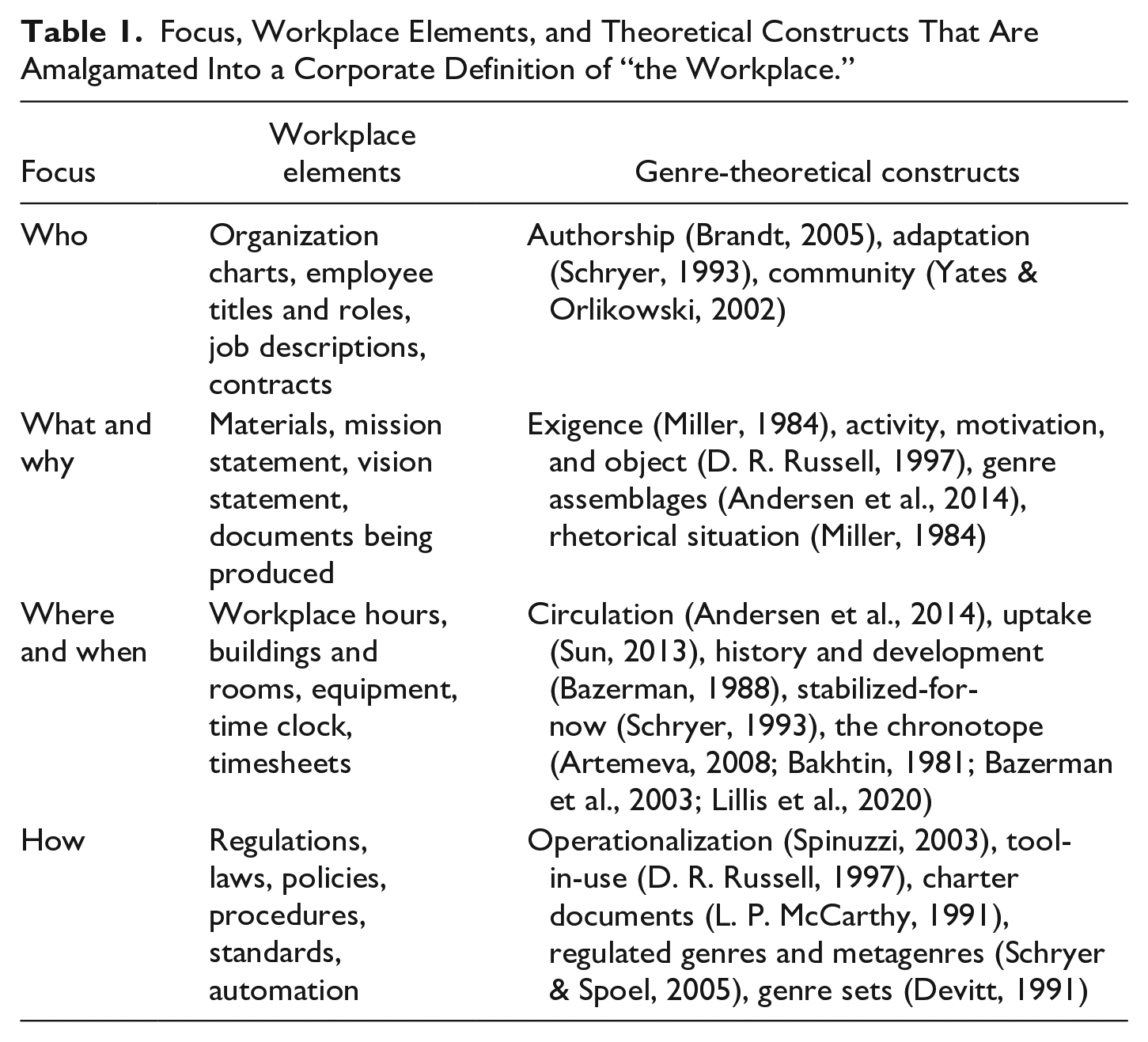
It’s typically easier for everyone (employers, employees, clients, customers—and workplace writing researchers) to understand the workplace as a whole. As rhetorical genre theory developed in the late 20th and early 21st centuries to make sense of workplace communication (see Table 1, right column), it echoed and perhaps reinforced that amalgamation in its own theoretical constructs. And vice versa: These theoretical constructs helped to enact the amalgamated workplace.
The Workplace Begins to Fall Apart
So, to a degree, the strata of the workplace have been held together. But they must be held together with continuous effort. For evidence of these efforts, we can look again at the workplace elements listed in Table 1. Those efforts are not uniform: for instance, throughout the 20th century, traveling salespeople did not work in specific locations during specific hours; family businesses overlapped work and family roles; cottage industries involved overlapping one’s living space and workspace; domestic servants worked at a home. Nor are these workplace elements continuous: the conditions that enacted this amalgamated workplace are changing, and the strata are no longer held together so consistently. By the early 2020s, it had become apparent to even casual observers that these strata were falling apart, with even late-night comedy shows lampooning mishaps associated with Zoom meetings. We can see the effects in labor statistics as well. One measure is that of nonemployer firms (self-employed individuals or partnerships with no permanent employees; cf. Spinuzzi, 2015). Such firms often work out of homes, coworking spaces, or temporary offices rather than in more traditional settings. According to the U.S. Small Business Association, “The number of nonemployer firms has risen 58 percent since 1997” in the United States (2018). Meanwhile, virtual work is continuing to rise. For instance, Census.gov reported that in the United States, “the number of people primarily working from home tripled from 5.7% (roughly 9 million people) to 17.9% (27.6 million people) from 2019 to 2021” (United States Census Bureau, 2022).
Such changes confound the expectations of amalgamated workplaces. To take just the question of where and when: when the COVID pandemic hit in March 2020, many people began working from home; their workplaces were suddenly located in their living spaces, not in the defined shared space of the office. Distance workers found themselves setting up home offices, tending their children during nominal work hours, and working during their nominal free time. This sharp change led Bay and Sullivan (2021) to ask how we might need to “reconsider the research methods we use to understand emerging work-from-home processes” (p. 168). But even before COVID (as Bay and Sullivan acknowledge), people had already begun taking work and work equipment home, doing work on the road, collaborating in virtual teams, and officing in hotels, coffee shops, and coworking spaces. Work’s location had begun to separate from other strata long before March 2020. Temporal and spatial location, although still a way to bound the case, is no longer a way to reliably get at the other strata.
These other strata are similarly separating, making the set of conceptual decisions in Table 1 unsustainable. At least four specific changes have increasingly threatened the coherence of some workplaces: changes typically discussed under the heading of knowledge work. These changes include
Who: Reorganizing work across rather than within organizational boundaries
What and Why: Transforming representations along with workplace elements
Where and When: Circulating those representations beyond traditional spatial and temporal bounds
How: Separating automatable processes from those that cannot yet be automated
Each of these changes has consequences for understanding workplace writing, and each impacts how researchers bound workplace cases. The gap between observable work elements and conceptual decisions constituting the workplace has become more obvious, and the problem of bounding the case has become more obviously complicated.
As mentioned earlier, these strata are not atomic concepts: they can be decomposed further. For instance, Who could be decomposed in terms of identity, positionality, agency, and affect; What and why could be decomposed into single questions (and then decomposed even further) or conceived differently (for instance, Why could be conceived in terms of overlapping orders of worth; see Boltanski & Thévenot, 2006). But for simplicity, and for coherence with analytical concepts used in writing studies, let’s stick with these four strata—with the proviso that this approach to exploring case boundaries can be expanded to different strata. I’m more interested in how the strata make up a coherent-seeming workplace.
So, below, I explore changes in these four strata—changes to work’s organization (who), work object (what and why), location (where and when), and processes (how)—and discuss examples of how these changes have required researchers to mindfully select principles for bounding their cases. Although I focus on these specific principles, the case studies I discuss do not always draw those boundaries cleanly.
After this review, I discuss the implications for the question: What is a workplace? That is, when genre researchers study workplace writing, what do we actually study, how do we bound it, and how should we guide our methodological choices accordingly?
Who? Work’s Organization 3
Cases are often bounded and defined by an employer, organization, team, or role. In fact, this is perhaps the most common boundary principle in case studies. Using this principle, investigators start with the collective, investigate those who fit within this boundary (usually documented by organizational charts, pay stubs, or other markers of belonging), and treat those outside the boundary (customers, external partners) as relevant only insofar as their interactions affect those within the boundary. Such studies ask questions such as: Who works, and how do they relate to each other? Who takes up, learns, uses, and produces a genre? How are genres learned through a particular workplace community?
Such case boundaries are common in genre-focused studies. In addition to Winsor’s (2000) study of test reports, Smart (2006) studied the Bank of Canada, Jones (2016) studied an activist organization, and C. B. Teston (2009) studied a hospital’s recurring Tumor Board meeting. Others have studied suborganization units via more restricted boundaries: emergency medical technicians (Angeli, 2015), Scrum teams (Friess, 2019), high-tech initiatives (Fraiberg, 2021), and worker cooperatives (Edenfield, 2017). And still other studies examine specific roles within and across institutions, including custodians (Marotta, 2021), Black entrepreneurs (Jones, 2017), international entrepreneurs (Williams et al., 2016), professional writers (Brandt, 2005), and social workers (Lillis et al., 2020).
Yet historically recent changes in work have complicated this principle. Since knowledge work focuses on representations, which can circulate broadly, and since these representations require a considerable degree of self-direction (see “How?” below), work that was once organized bureaucratically is now often organized post-bureaucratically (Barley & Kunda, 2001), in ways that cross bureaucracies, organizations, hierarchies, and disciplines. In such work, it is difficult or impossible to tightly regularize or regulate how work is accomplished. Disciplinary specialists lead on phases or sections of interdisciplinary projects that are relevant to their expertise, then yield leadership in other phases.
One example comes from Joanne Yates, whose work on 20th-century management we discussed earlier. She and her colleagues explored postbureaucratic work in a firm that “crafted custom-built, Web-based, interactive marketing solutions for its clients” (Kellogg et al., 2006, p. 25). In this study, they illustrated salient differences in community groups at this firm, including identity, expertise, interests, activities, and artifacts (p. 25). These groups had to coordinate constantly: “these work conditions required Adweb project members to regularly access and attend to changing information from multiple sources, and to do so rapidly so as to deal with compressed temporal expectations,” even as team composition changed during projects (p. 28). As they sum up, “existing perspectives on knowledge sharing and coordination do not adequately explain the cross-boundary coordination practices that we observed” (p. 38).
Bureaucracies are still with us, of course. But what characterizes postbureaucratic work is that it is projectified, reorganized around projects rather than bureaucratic divisions, and thus it is interprofessional (Midler, 1995; cf. Adler & Heckscher, 2007). Such projects tend to involve a weakly defined division of labor, teams of specialists crossing organizational boundaries, rotating leadership among those specialists, and centralized command with distributed control (Spinuzzi, 2015, pp. 34-35). Grabher (2004) additionally argues that projectification is central to new industries that design work around projects and emergent objects: software, digital media, and business consulting (p. 104). In such industries, labor is represented as data, allowing ICTs to circulate representations quickly and cheaply. Consequently, people are frequently able to collaborate across organizational boundaries on temporary projects. Recent examples in workplace writing include studies of subcontractor networks (B. Lauren & Pigg, 2016), audiences developed by indie rock musicians (Carradini, 2018), and communities of nonprofit stakeholders (Carlson, 2023), as well as Internet communities crystallizing around a shared concern (Gallagher, 2015), text (Morgan & Zachry, 2010), or open-source software product (Swarts, 2019).
Thus using who to bound the workplace has its pitfalls. When addressing the question of who, genre researchers have used conceptual decisions predicated on stable sets of interlocutors working within stable organizational boundaries and roles. These constructs include community (including discourse communities), authorship, and adaptation (when studying how an individual author adapts a genre). Yet as the workplace has changed, researchers have increasingly had to bound workplaces by identifying looser and less durable affiliations (Table 2). This trend has led to less distinct case boundaries. That is, who no longer leads to a coherent workplace that also answers what, why, where, when, or how.
Bounding Cases by Who: Exemplars Relying on and Disrupting This Boundary Principle.
What and Why? Work’s Object
Alternatively, many genre researchers in professional communication have bounded and defined their cases by focusing on the work object. This approach has been most obvious in studies grounded in activity theory (see D. R. Russell, 2009, for a review), since an activity system is understood as being anchored in the work object and outcome 4 , that is, the what and why. The other components of the activity (actors, community, tools, rules, and division of labor) are defined by their relationship to the object and outcome. For much work in rhetorical genre studies (RGS; see Artemeva & Freedman 2007) or writing, activity, and genre research (WAGR; see D. R. Russell, 2009), a genre is taken to be the work object. For instance, Propen and Schuster (2010; Schuster & Propen, 2011) study the emergence of the Victim Impact Statement; Yates and Orlikowski (2002) study a set of genres that support collaborative authoring; and Schryer et al. (2009) study the genre of forensic letters. In each of these cases, the work object is a genre instance, a cyclically repeated social action, and the other aspects of the case are defined in terms of how they relate to this repeated social action. Such studies ask: What does a workplace labor to produce, and why?
Traditionally, activity theory has not exclusively focused on texts: in other fields, objects of activity have included computer interfaces (Bødker, 1991), medical appointments and court appearances (Engeström, 1992), and blacksmithing (Keller & Keller, 1996). But even in other fields, researchers have begun to focus more explicitly on written texts and the agreements they represent (e.g., Engeström, 2022). Part of the reason may be that activity theory has recently tended to focus on larger social systems, meaning that the activity’s object must be representational in order to capture a work object broad enough to circumscribe that social system (Spinuzzi, 2011). But it is also true that in a world of rising literacy rates 5 (in North America, from 80% in 1870 to over 99% at present; in the world, from 12% in 1820 to 85% in 2010), work has increasingly taken representations as its object. As Hart-Davidson argues, “Even in the manufacture of traditional goods, it is often the information produced about and along with a product that is its most valuable commodity” (2013, p. 57).
Beyond activity theory, studies that are based in Vygotskian theory, actor-network theory, distributed cognition, and other sociotechnical frameworks also examine how work centers around the regular transformation of texts (e.g., Bracewell & Witte, 2003; McNely, 2017; Read, 2016; Read & Swarts, 2015). Those texts are often transformed via relating chains of representations in which each text represented aspects or combinations of other texts; these chains have been studied under headings such as “document cycles” (Paradis et al., 1985), chains of re-representations (Latour, 1999), “tool ecologies” (Hutchins, 1995), and genre assemblages (Andersen et al., 2014).
Such representations allow us to address concrete aspects of work through abstractions—a critical ability that has become increasingly important as capitalism develops (e.g., Moulier Boutang, 2011). This historical shift in work objects means that more work takes up a dual focus: both representations and the things they represent: “the information produced about and along with a product” (Hart-Davidson, 2013, p. 57), the city water system and the maps that represent it (Haas, 1999), the health medical records and the health events they describe (Opel & Hart-Davidson, 2019), the Victim Impact Statement and the victim’s experience (Propen & Schuster, 2010). These texts are often boundary objects, functioning differently in different, historically separate domains, yet tying those domains together (Oakey & Russell, 2014; Star & Griesemer, 1989). These contradictions sometimes create disorientations that are directly related to the separating strata of the workplace, as when healthcare workers find that work boundaries both exceed and fall short of their expectations (Opel et al., 2018).
This strand of research has also been the focus of methodological consideration. For instance, Alisa Russell (2022) and Sarah Read (2016) have separately discussed the implications of drawing case study boundaries by following genres. They separately make good arguments for this principle for bounding a case—yet the principle of the work object has become increasingly separated from other strata that we have traditionally seen as part of the workplace. In particular, when a work object can function as a boundary object, it by definition does not bound a specific workplace! Instead, it brings together different activities in a sometimes-contentious space: health and insurance (Opel & Hart-Davidson, 2019), justice and advocacy (Propen & Schuster, 2010), and corporations and education (Gygi & Zachry, 2010). And such work objects are proliferating as work becomes more interconnected and work objects become easier and cheaper to circulate across organizations.
Consequently, this approach to case boundaries also has its pitfalls. Like others who use activity theory, genre researchers studying workplace writing have increasingly selected work objects that are transformed by larger and larger aggregates (Spinuzzi, 2011). This trend has led to larger research scope as well as less distinct case boundaries. Conceptual decisions such as exigence, activity, object, and even genre assemblage are less likely to firm up these boundaries. That is, what and why no longer lead to a coherent workplace that also answers who, where, when, or how (Table 3).
Bounding Cases by What and Why: Exemplars Relying on and Disrupting This Boundary Principle.
Where and When? Work’s Temporal and Spatial Location
Still other professional communication case studies of genre are bounded temporally and spatially: literally, the workplace, which might include its location (a workbench, an office, a building, an address) and its operating hours. (Like what and why, where and when could be decomposed further, but are often lumped together (Creswell, 2006, pp. 36-37) and are theoretically tied together in Bakhtin’s concept of the chronotope (e.g., Artemeva, 2008). Let’s keep them together with the proviso that they can be further divided.) It’s easy to imagine “a relatively fixed chronotopic scene” and to instantiate it in one’s research designs: Prior (2015, p. 189) notes having done this in his past work, to his dissatisfaction. Similarly, workplace writing researchers have studied sites of work that coincide with organizations (see “Who?” above), but they have also studied sites that are not associated with the participants’ organizations, such as coffee shops (Pigg, 2020), coworking spaces (Spinuzzi, 2015), entrepreneurial incubators (Belinsky & Gogan, 2016), and home offices (Geisler, 2001). Such studies ask: Where and when do genres circulate? To what spatial and temporal locations are they circulated?
Yet, since much work takes representations as its object, and since representations have become easier and cheaper to circulate as they have been increasingly digitized, textually mediated work has become more distributed across time and space (e.g., Pigg, 2014; Spinuzzi, 2015). Those changes have been cemented to the point that when COVID led to calls to stay home, many people were able to take their laptops home and continue working—although this process was certainly not painless. As we saw earlier, Bay and Sullivan (2021) bring up the methodological question of how to study work during COVID, when it has been suddenly relocated from the office to the home. Twenty years earlier, Geisler (2001) conducted a self-study of her work at home, noting how textual objects were stabilized through material and social arrangements, extending work motivations into the home.
This separation of spatial and temporal location from the workplace has been the subject of much workplace writing scholarship: In some ways, especially after COVID, it is the easiest separation to identify. (And currently many managers are frantically working to counteract this separation, demanding that their workers come back to the physical office.) For instance, teleworking and virtual teams have been the subject of many studies (B. S. Lauren, 2015; Z. Long et al., 2013; Ruppel et al., 2013), including studies that examine cross-cultural communication across teams that are distributed globally. Beyond virtual teams, workplace writing case studies have studied mobile work (e.g., Swarts, 2016) and work distributed across moments in time (McNely, 2017). Orlikowski and Yates (2002) go farther by examining how actors use temporal structuring to enact the time in organizations.
Professional communicators have also conducted studies across cultural and linguistic boundaries (e.g., Dura et al., 2019; Evia & Patriarca, 2012; Fraiberg, 2021; Walton, 2013; Walton et al., 2015), foregrounding the question of cultural interpretation. Although knowledge work does involve re-representing diverse things within symbolic systems, and although that re-representation can support algorithmic labor including total automation, such representations are not self-contained packets. In fact, post-bureaucratic labor requires partners who reinterpret representations within their own expertise. Since those representations can be circulated broadly and inexpensively through information and communication technologies, the expertise that they require can be geographically dispersed. Consequently, cultural differences across those locations often require more cultural sensitivity and localization.
For instance, Sun (2020) draws on rhetoric, practice theory, social justice theory, and decolonialist methodology to analyze how social media design has been taken up differently in North America and Asia, attending to the ideological and discursive affordances required by different users in different positionalities, situations, and cultures. Beyond helping us to understand cross-cultural social media use, Sun argues for better designing and localizing social media by sensitively attending to the ideological and discursive affordances required by different users in different positionalities, situations and cultures. To address these issues, Sun moves away from activity theory (and its focus on work objects) in favor of dialogism (p. 52), heteroglossia (p. 71), and epistemic diversity (p. 72).
Since textually mediated work has become more distributed globally and its products are offered globally, it currently functions within globalization, “a process that seeks to establish a global interconnected and interdependent economic, political, and cultural system” (McMillin, 2007, quoted in Sun, 2020, p. 20). Yet these representations are always interpreted in local practice. Thus, broad distribution exposes problems of localization, the need to transform representations to better match specific cultures and activities, and begets glocalization, “the mixing of the global forces with local elements” (Sun 2020, p. 97). As Sun argues, although glocalization is sometimes understood as a new phase after cultural imperialism and cultural globalization, “colonial relationships still persist,” with power being transferred “from old colonial states to transnational corporations as a new form of colonial domination” in which “the public and political discourse of local development is often deeply entangled, with its only exit pointed to a Western version of modernity” (p. 97).
Thus in case studies of genre, a location in time and space—where and when the worker sits—is no longer adequate as a boundary principle for much text-mediated work. (Even a tollbooth attendant relies on a faraway bank to approve or decline a driver’s credit card.) Workplace writing researchers have increasingly examined work that is carried out across rather than inside temporal and spatial locations, and as they have done so, conceptual decisions attuned to spatial and temporal location—such as genre circulation, uptake, history, development, and even stabilized-for-now—no longer do the bounding work as reliably as they have done it before. That is, where and when no longer lead to a coherent workplace that also answers who, what, why, or how (Table 4).
Bounding Cases by Where and When: Exemplars Relying on and Disrupting This Boundary Principle.
How? Work’s Process
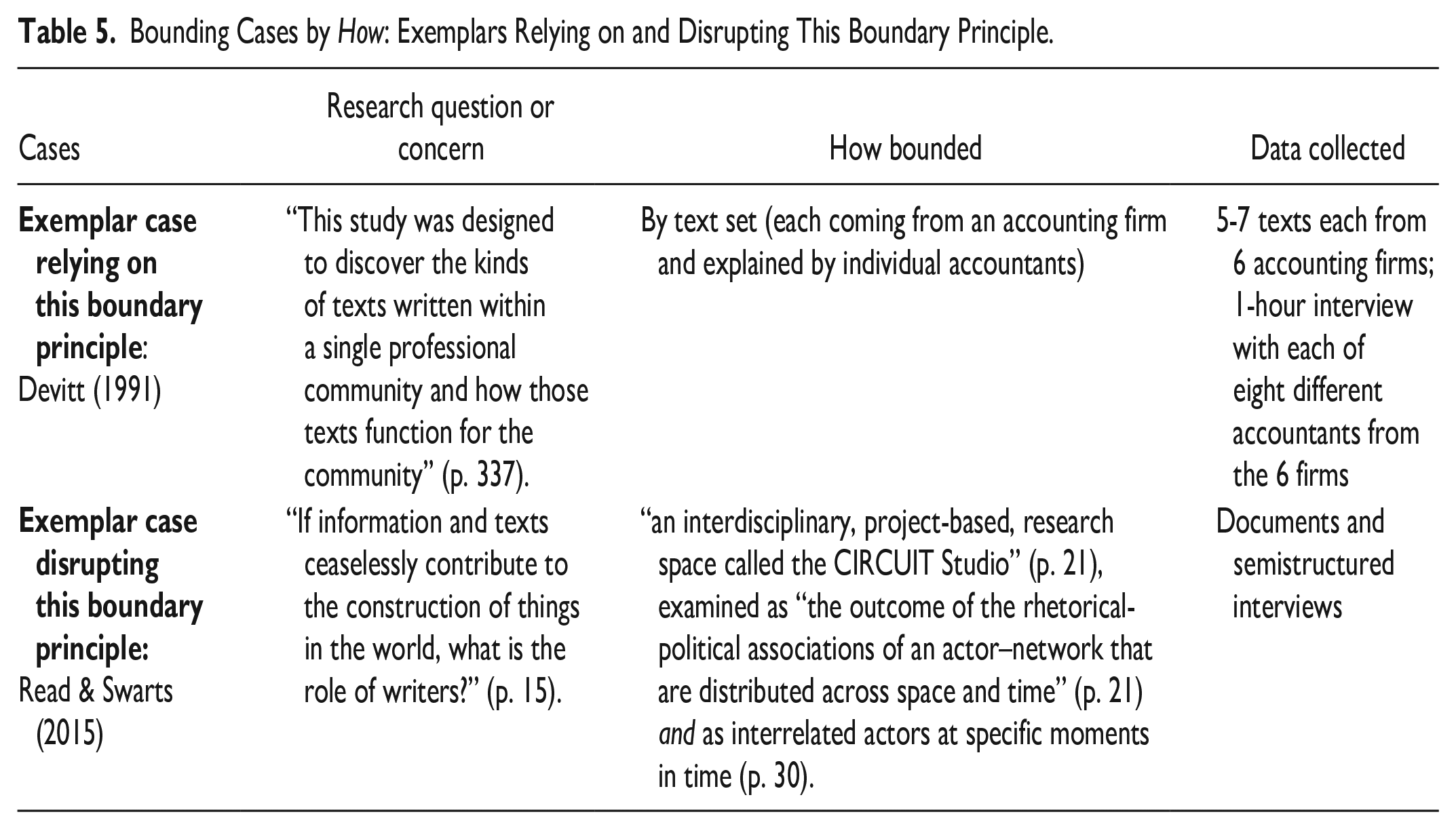
A final way to bound cases is by studying a routine process, either as it exists now or as it is in the process of being established and stabilized. How are representations such as genres regularly produced, and how does their production change over time? Here, the focus is not on a specific text as a center of gravity for a workplace (as in “What and why” above), but rather the process that regularly yields genre instances. We have already seen how work has increasingly focused on representations. In re-representing things, representation systems often establish routine processes to make those things routinizable, tractable to algorithmic approaches. When this happens, it allows actors to redistribute the labor of cyclically transforming these representations—sometimes to other people, sometimes to nonhumans (e.g., Latour, 1992; Read, 2016; Read & Swarts, 2015; Swarts, 2016; C. Teston, 2016).
Such cases are common in workplace writing studies of genre. In terms of relating genres serially, Paradis et al. (1985) and Kleimann (1993) examined document cycling at professional workspaces, while Devitt (1991) examined genre sets in accounting. Such genres are sometimes formalized and constrained to both guide and restrict the process, as in forms (Balzhiser et al., 2019; Pimentel & Balzhiser, 2012; Popham, 2005) and templates (Gallagher, 2015). Sometimes they are related through an inventional process such as Design Thinking (e.g., Pellegrini, 2022). And often they are partially automated, as in databases (e.g., Mirel, 1996) and content management systems (e.g., Batova, 2018; Lewis, 2016; J. E. McCarthy et al., 2011)—or they respond to that partial automation (Killoran, 2009).
In many of these cases, especially in the cases of automation, work processes are stabilized by simplifying and constraining some aspect of the process, redistributing it from actors with higher discretion to those of lower discretion (such as algorithms or human beings who must follow restricted decisions). That is, some labor can become generic, while other labor remains self-programmable, that is, addressable only by a trained human being, and requiring creativity and autonomy (Castells, 2009, p. 30). For instance, studies of processes often focus on how some aspects of work processes are simplified, automated, or delegated to lower-wage workers, while other nonroutinized aspects of the process remain in the domain of the self-programmable labor force, which were perceived to have more experience, judgment, and problem-solving latitude. The process can be increasingly routinized over subsequent cycles, redistributing labor in each cycle. It often involves underestimating the invisible labor (e.g., Nardi & Engeström, 1999) performed by “unskilled” or “semi-skilled” workers (e.g., Karlsson, 2009; Marotta, 2021; Winsor, 2000). And it can be spread across not just organizational and professional but also national and cultural boundaries (Leonard, 2015; Oakey & Russell, 2014).
That is, the process and its division of labor are not fixed; in processes that are relatively new, or undergoing significant change, or under pressure from intersecting work activities that themselves are undergoing change, the division of labor might shift rapidly and often. That is especially true in knowledge work, which primarily involves analyzing and processing information. As Castells argues, “The e-conomy cannot function without workers able to navigate, both technically and in terms of content, this deep sea of information, organizing it, focusing it, and transforming it into specific knowledge, appropriate for the task and purpose of the work process” (2003, p. 90). Such labor “must be able to reprogram itself, in skills, knowledge, and thinking to change tasks in an evolving business environment” (pp. 90-91)—and, as we have seen, to offload generic labor. We have seen this trend accelerating over the past few decades (e.g., Spinuzzi, 2015), distributing these functions to other organizations, to independent contractors, and increasingly to contractors in digital labor markets (e.g., Seppänen et al., 2021). We have also seen increasing criticism of these processes, which have historically built political and racist biases into such generic procedures (e.g., Jones & Williams, 2018).
As we have seen above, much genre research in workplace writing has taken the process as a boundary principle for case studies in workplaces. Once again, such processes exceed the spatial, temporal, and organizational bounds we have traditionally associated with workplaces.
Thus in these case studies of genre, the workplace can no longer be bounded by defined processes. Workplace writing researchers have increasingly examined work that is in flux as parts of processes are redistributed across human and nonhuman actors, a development that threatens theoretical constructs such as operationalization, charter documents and charter graphics, tool-in-use, and genre set. That is, how no longer leads to a coherent workplace that also answers who, what, when, where, or why (Table 5).
Bounding Cases by How: Exemplars Relying on and Disrupting This Boundary Principle.
From Independent Facts to Conceptual Decisions: Implications for Constructing Deliberate Case Boundaries in Workplace Writing Studies
How does it practically affect research if researchers treat a workplace as a case, a conceptual decision, rather than as an independent fact existing in the world? In this final section, I contrast the uncertainty that comes from treating the workplace as an independent fact versus the certainty of constructing the workplace through conceptual decisions.
The Uncertainty of Treating the Workplace as an Independent Fact: “I Hope the Workplace Is Revealed to Me”
Let’s consider a final example of a workplace study: John Law’s (1994) ethnography (not case study) of order and ordering at the Daresbury Laboratory. This ethnography is also an introspection of the role and limits of the ethnographer in such a study, and Law’s angst throughout the project is due to becoming acutely aware that his own ordering practices—what data he collects, what he chooses to analyze and write, how he presents the results—are as artificial and partial as those he observes at the site. This realization is often crippling, and Law writes of having to retreat from the site to his car to have lunch, of constantly worrying that the real action was always happening elsewhere, and of fearing the power and status of his participants. Like any researcher seeking to contextualize their observations, Law finds that the horizon of context is ever-receding—unbounded.
Law describes concerns that naturally occur as a researcher approaches a workplace site as existing independently, “out there” in the world. As researchers, we know that we cannot witness everything, at every moment, catching every nuance, and understanding all of the context we need in order to fully experience the workplace to the same extent as a participant who is thoroughly immersed in that workplace. We may hope that the workplace is revealed to us as a fact in the world, but we also know that it can never be revealed in its entirety. This is true even for ethnographers who spend years in a culture, and much more so for case study researchers, who spend much less time at their sites. Thus, like Law, we may suspect that the real action is always elsewhere. We may feel uncertainty, because we know we have always missed something; we may feel like supplicants, asking our participants what we missed, knowing that they themselves cannot always articulate their tacit knowledge—and knowing that even they do not have a God’s-eye view of the site.
Under such conditions, every claim one makes about the workplace is necessarily tentative, and researchers run the risk of describing a workplace that is too unique to compare to others. That is a grave problem for case studies! As established earlier, case studies
are bounded
involve multiple data sources
are comparative
And these three characteristics must be related to present a productive case. If boundaries are not drawn—making a conceptual decision—the researcher cannot effectively compare it to others or articulate its implications. As established earlier:
These undesirable outcomes flow from the uncertainty of treating the workplace as an independent fact, leading researchers to attempt to discover the workplace’s boundaries. But if the researcher treats the workplace as a conceptual decision, as something that they themselves construct, that uncertainty is dramatically reduced.
Constructing the Workplace as a Conceptual Decision: “I Have Made a Claim; Let’s Test It”
So instead, let’s treat the workplace as a conceptual decision that yields a testable claim—a claim in which the case boundaries and data collection methods function as qualifiers.
We know how to construct claims (disputable statements) and how to limit those claims with qualifiers (conditions under which those claims are true). Here’s a trivial example, with claims in bold and qualifiers in italics:
And so forth. We can imagine starting with the first statement, the claim by itself, and hanging on additional qualifiers as we conduct dialogue with an argumentative interlocutor. Latour and colleagues (1992) apply this approach to scientific controversies, noting how “a succession of sentences may be defined either because they add new meaningful units to a sentence (AND) or because they substitute new alternative words (OR) to one or several units within a sentence” (p. 35). Reading across a single sentence (the AND/ “syntagmic” dimension), we may add qualifiers to further narrow and defend the claim; reading across successive sentences (the OR/ “paradigmatic” dimension), we may substitute claims and/or qualifiers to examine how the sentence must change under different circumstances.
While Latour et al. apply this approach to scientific controversies, we can apply it to case studies, which are unique but also inherently comparative (cf. Dumez, 2015). In case studies, the claim emerges through the study: the researcher doesn’t know what they will find about the workplace. But the qualifiers can be known and explicit, allowing the researcher to reduce uncertainty by identifying relevant similarities and differences, thus driving comparisons with other cases. Under these conditions, the researcher can make this claim and compare it to these cases with similar conditions. Consider this mini literature review of three similar case studies and how it might guide the design of a new case (Table 6).
Comparing Three Cases as Qualified Claims; Designing a Comparable Case Study (Last Row).
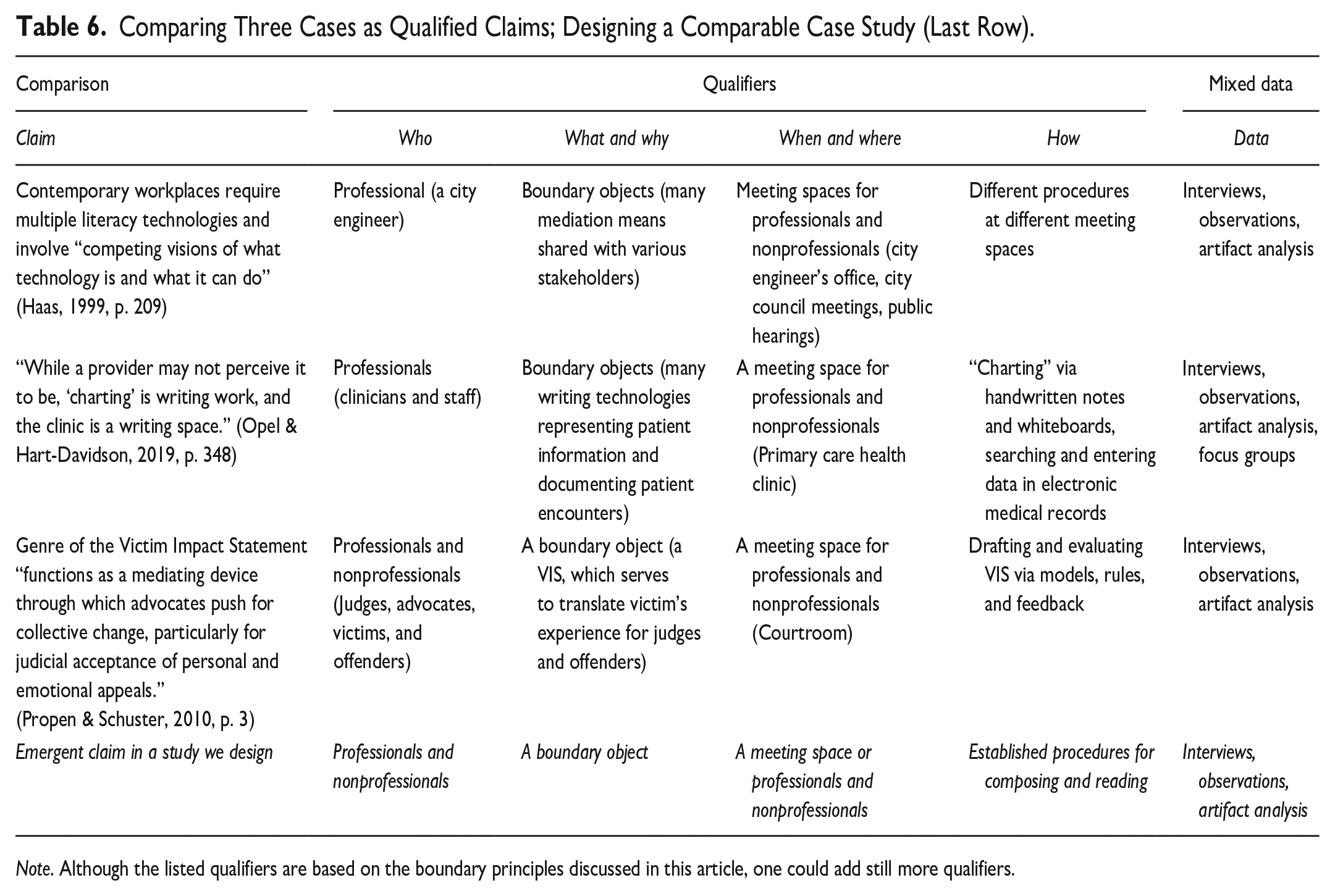
Note. Although the listed qualifiers are based on the boundary principles discussed in this article, one could add still more qualifiers.
By examining these articles in terms of their claims, qualified by various case boundaries and by data collection, a researcher can generate more generalizable, testable claims across cases. In Table 6, for instance, we see three very different cases, but with similarities in
Through the syntagmic (AND) dimension, a researcher can establish similarities across cases. Like sociotechnical graphs, this table leads them to build out different qualifiers within each statement (reading horizontally). Each qualifier tightens the boundaries of the case, making it specific and unique. For several cases sharing the same qualifiers, the researcher can establish tight similarities, yielding a unique set of cases to compare.
But every case is different, which is both the blessing and the drawback of qualitative work. Through the paradigmatic (OR) dimension, the researcher can examine differences across similar statements as well, identifying differences across similar statements (reading vertically). Specifically, the researcher can ask: How many differences can these cases have across their qualifiers before similar claims no longer hold true? That is, which qualifiers are most important to examine for understanding those differences? In Table 6, for instance, Propen and Schuster (2010) focus on just one genre and their claim is more narrowly centered around that one genre, in contrast to the other case studies. With a larger table, additional differences could become evident across qualifiers and claims. One can systematically identify these differences and theorize relationships that can be tested via other methods.
This approach can also identify claims—such as “Specialized genres mediate professional work”—that are now established in our field and therefore not especially interesting to study. Such claims, like “the sky is blue,” are not going to be interesting in themselves, but could become interesting if they were narrowed in claim or qualifiers.
Finally, this approach can be useful for designing case studies, bridging between the literature review and the case to be designed. As researchers design their own case studies, they can similarly build them out, systematically identifying shared qualifiers in previous case studies and choosing qualifiers to match or differentiate the new case. See the final row of Table 6.
These qualifiers have consequences, interacting with design decisions about the research question, the boundary principle(s), the workplace elements used to operationalize that boundary, the theoretical constructs employed, and the vocabulary used to describe the resulting case. Table 7 lists these decisions.
Strata of Decisions in Bounding Workplace Cases.
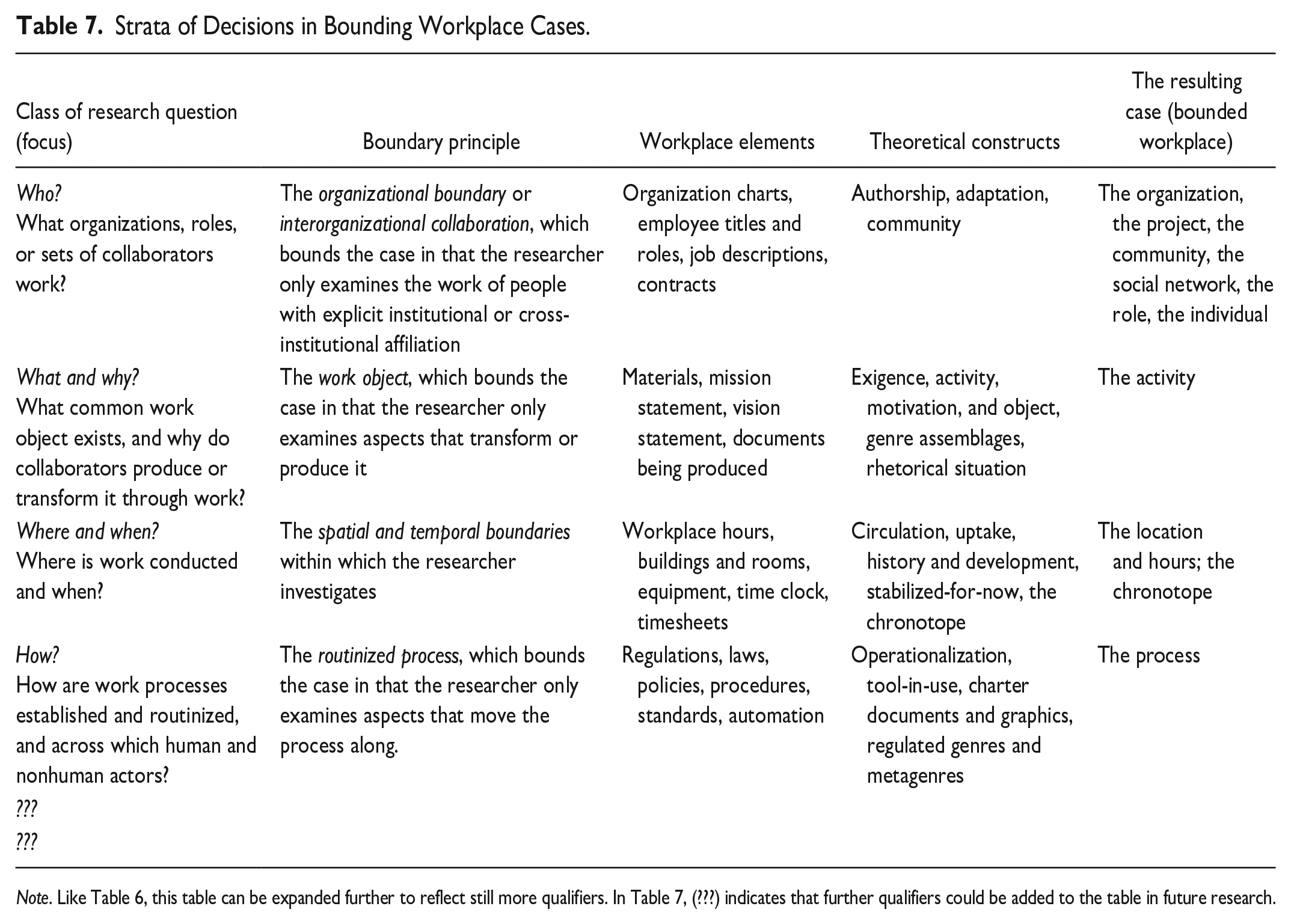
Note. Like Table 6, this table can be expanded further to reflect still more qualifiers. In Table 7, (???) indicates that further qualifiers could be added to the table in future research.
As Smagorinsky cautions us, “Explicitly stated research questions need to be answerable through the methods employed in the research” (2008, p. 408)—and, we can add, through the case boundaries we draw. In Tables 6 and 7, I provide a systematic approach for cataloging the bounding principles at work in a case and methodically relating them to other cases, yielding well-formed claims that we can articulate. In this way, by treating workplace cases as conceptual decisions that yield testable claims rather than as independently existing facts to be discovered, researchers can systematically develop and explore workplace cases that are both uniquely bounded and comparative.
Footnotes
Acknowledgements
Thanks to William Hart-Davidson for commenting on an early version of this manuscript, as well as two anonymous reviewers for constructive, in-depth comments. Special thanks to WC co-editor Dylan Dryer for his unflagging efforts and wise advice as I responded to reviewer concerns.
Declaration of Conflicting Interests
The author declared no potential conflicts of interest with respect to the research, authorship, and/or publication of this article.
Funding
The author received no financial support for the research, authorship, and/or publication of this article.
