



Abstract
This article explores the mobile and material dimensions of a writing practice we call pocket writing. Emergent in our 6-year ethnographic fieldwork at a public high school, this practice involved adolescents composing and carrying their self-sponsored writing close to their bodies. We consider the pocket both a physical artifact—the place from which writing emerged at the right moment—and a metaphor describing how youth created small, portable boundaries around their writing to facilitate its invisibility and mobility. Using a transliteracies lens, we worked alongside youth to trace the circulatory pathways such writing took relative to the official institution of school. These high school students made agentive rhetorical choices, sometimes deliberately disconnecting their writing from school as an everyday resistance practice—an effort to keep school in its place. In theorizing pocket writing as a mobile and embodied extension of writing (for) the self, we argue its “pocketed” nature is key to its transformative power.
The two of us were standing in the school hallway as other students streamed around us to get to their next class—Alonso, 1 a 16-year-old high school sophomore, and me (Amy), a middle-aged researcher who was in the sixth year of an ethnographic partnership at the high school. Having worked together for more than a year, Alonso and I knew each other well and were just stopping to have a quick chat about plans for the next day. When I casually asked how his Wattpad 2 story was coming along, Alonso swung his backpack around and quickly unzipped the top pocket, pulling out an artist’s sketchbook. He rifled through the pages to find one of the characters he had drawn in colorful and meticulous detail, with notes about the character’s motivations, likes, and characteristics jotted around the edges of the page. Putting the notebook in my hand, he enthusiastically told me plans for a new story about the character before quickly stuffing it back in his bag as he rushed off to his next class.
This fleeting and potentially unremarkable moment in a high school hallway illustrates a phenomenon we (Amy and Bethany) noted frequently over the years we collaborated with students and teachers at the urban public school—young people pulling out their poems, stories, drawings, and lyrics from concealed places: tucked in backpacks, scribbled in notebooks or scraps of paper, stored as notes on their phones. These bits of writing often emerged during conversations about their literacy practices, sometimes invited but oftentimes unbidden, as we talked in hallways, lunchrooms, and stairwells about things that mattered to them. We watched as this practice of sharing one’s private writing was negotiated between peers too, as teens would hand their writing to a friend or read part aloud to a group, sometimes including teachers, support staff, or other trusted adults in that sharing process.
We began to think of this ever-present yet often-hidden composing as “pocket writing”—carried close and kept ready to hand. Pocket writing is private but present, hidden but quickly surfaced for the right person in the right circumstance. It often circulates invisibly in relation to institutions, not just at this high school but in other times and places we witnessed and in the margins of our own lives. This kind of private writing that people engage in—separate from, and often invisible in relation to, the official, sanctioned, and public writing people do for school, workplace, religious, governmental, or other institutions—traverses networks that are less established and more concealed than the official pathways writing travels in its more public capacities, often moving with people’s bodies on portable digital devices, in notebooks, or on scraps of paper. The “pocket” of pocket writing functions both as physical artifact—the place on clothes or bags from which writing emerges at the right moment—and as metaphor, describing how people create small and portable boundaries around their self-sponsored writing (Brandt, 1998) in ways that facilitate both its invisibility and mobility.
In this article, we explore this embodied phenomenon of pocket writing in one high school to illuminate the circulatory pathways such writing took relative to the official institution of school. While writing researchers have sought to connect youth’s personal interests to the academic sphere (Ito et al., 2013) and “to harness the transformative power of writing in mainstream schooling” (Yagelski, 2009, p. 189), we were interested in how and why youth’s self-sponsored writing might be deliberately “disconnected” from school. We wondered about the ways pocket writing operated under the surface of school: Where and how did it move? Under what circumstances and for what purposes was this writing composed and shared, for/with whom, and to what effect? In addition to exploring what made self-sponsored writing powerful for young people, we wanted to dive into tensions engendered by such writing as it traveled through underground networks—tensions about the riskiness and uncertainty of sharing private writing in public or institutional contexts, the material consequences of different modes of composing and traversing spaces, and the possibilities of adults co-opting, surveilling, or infringing on students’ personal territory when pocket writing emerges at school.
We found that pocket writing served as a central way for the young people we worked with to keep school in its place. Even when school may welcome creative, interest-driven, and reflective writing, as this high school did with its dynamic teachers and culturally relevant pedagogy connecting students’ interests and identities to the curriculum, it remains an institution that has served a regulatory function in relation to literacy, marking some writing as official, purposeful, and public and some writers as “good.” In its institutional capacity, schooling has historically served to regulate, co-opt, surveil, judge, or change student voices, especially targeting students of color and youth with marginalized identities whose creative pocket writing practices threaten the status quo (Haddix & Sealey-Ruiz, 2012). In our study, the young people we worked with, who all identified as Black, Latinx, Native American, and/or outside the bounds of cis/heteronormative genders and sexual orientations, worked to maintain autonomy from school’s regulative function by exercising their right to choose when, where, and with whom they would share their words/worlds.
In this article, we draw on a transliteracies lens (Stornaiuolo et al., 2017) to understand and honor young people’s writing practices on the move in and across multiple spaces—and how youth might protect these spaces through acts of silence, resistance, or refusal. As we traced the circulation of students’ pocket writing across student-built, under-the-radar networks in an urban public school over multiple years, we worked alongside youth to engage in humanizing research (Paris & Winn, 2013; Winn, 2019) that understands them as agentive and deliberate in their rhetorical choices regarding the writing they keep within and pull from their pockets. Such understanding about youth rhetors, we argue, complicates how “connected writing” (Ito et al., 2013) might not always be as straightforward (or generative) as educators imagine.
Historicizing Pocket Writing
While we noticed and named the emergence of pocket writing in our research site, the phenomenon of young people writing and circulating small-scale, private texts via notebooks and other mobile media is not new. For decades scholars have traced how multiply marginalized youth engage in rich writing practices outside of school spaces to make sense of themselves and their lives (e.g., Haddix et al., 2015; Jocson, 2005, 2006; Johnson, 2017; Kirkland, 2013; Muhammad, 2015a; Winn, 2015). Mahiri and Sablo (1996), for example, traced the authentic purposes for which young people composed poetry, novels, stories, and lyrics in notebooks they carried with them even as they were cautious with whom they shared such intimate representations, especially in school settings. Such scholarship is rooted in what Gutiérrez (2008) identifies as sociocritical literacy, which historicizes and humanizes young people’s literacy practices in their everyday lives, particularly for youth from nondominant communities who draw on culturally relevant writing practices with long community histories.
A number of literacy scholars have sought to contextualize and historicize youth’s writing practices by tracing the history and influence of Black literary movements, from poems published on “broadsides” that could be tucked into pockets and purses to efforts of Black publishers to make creative writing by African American authors accessible to everyday people (e.g., Fisher, 2004; 2009; McHenry & Heath, 1994; Muhammad, 2020). In an important historicizing study, McHenry and Heath (1994) traced how African American writers drew across literary texts, their own writing, and oral performances in gatherings of African American literary societies from the 1830s through the Harlem Renaissance, arguing for a more complex and accurate portrait of African American literary contributions based in historical evidence of how these literary practices flourished and circulated through literary societies, the Black press, and literary journals. Fisher (2004) extended such historicizing from the Black Arts movements of the 1960s to contemporary youth literary performances, demonstrating a historical continuum of Black literary movements that supported people’s composing practices across modes and spaces. As McHenry and Heath (1994) and Fisher (2004, 2009) illustrated in this historicizing research, multiple generations of African American writers have inspired people to action through creative efforts to share and circulate writing outside of formal institutions. We draw upon these and other historicizing works (e.g., Gilyard, 1999; Gutiérrez et al., 2019; Muhammad, 2015b; Tatum, 2013) to center youth’s experiences and voices in relation to those that have come before—and to push back against essentializing or deficitizing discourses about youth’s literacy traditions (see Winn, 2015).
Writing as Praxis: Youth Agency and Writing (for) the Self
Literacy scholars have long been interested in young people’s agency as writers, studying how youth 3 write to exert autonomy, choice, and control over their lives (e.g., Dyson, 1999; Hull & Katz, 2006; Lewis Ellison, 2017). Whether drawing on more sociopsychological (e.g., Bruner, 1991), sociocultural (Holland et al., 1998), or sociopolitical (e.g., Freire, 2005) understandings of agency, literacy scholars have framed agency as fundamentally intertwined with identity, a process of self-formation that Lewis et al. (2007) helpfully defined as the “strategic making and remaking of selves, identities, activities, relationships, cultural tools and resources, and histories as embedded within relations of power” (p. 18).
Researchers have sought to explore young people’s agentive writing practices by highlighting how they write for their own myriad, intersecting purposes—whether as a sociopolitical tool, a means to make sense of themselves or the world around them, or an opportunity to protest inequities or counternarrate deficit perspectives (e.g., de los Ríos, 2020; Jocson, 2006; Lammers & Marsh, 2018; Muhammad, 2015a; Winn, 2019; Wynhoff Olsen & VanDerHeide, 2020). Young people, in other words, are already writing for themselves and their own purposes in their self-sponsored writing (Brandt, 1998). We refer to this practice as writing for the self—that is, the writing that adolescents engage in “without adult intervention and beyond school walls” (Haddix et al., 2015, p. 265) for their self-determined purposes.
Understanding this self-directed writing by youth requires a theoretical expansion beyond conceptions of writing as a set of skills, a communicative medium, a means of taking action in the world, or a tool for thinking—important as those purposes for writing might be. Rather, we might consider how writing for the self highlights the experience of writing, apart from whatever text may be produced. Such an ontological understanding of writing, Yagelski (2009, 2012) has argued, highlights the act and experience of writing in the moment, through which writers become more acutely aware of their existence and their connection to the world around them. Essentially, in this formulation, writing functions as a way of being, in which “the purpose of writing is simply to live more fully” (Yagelski, 2012, p. 190). In her work with Black queer youth, Johnson (2017) theorizes such an ontological approach to writing “as collective and collaborative inquiry, where students name, question, make sense of, and reflect on their experiences in the world” in order “to define themselves on their own terms” (p. 170). We refer to this practice as writing the self, or as Thomas and Stornaiuolo (2016), following Rooks (1989), describe, “narrating the self into existence” through their multimodal composing practices (p. 317).
An expanded focus on the experience of writing, as overviewed here, highlights the intertwined practice of both writing for the self and writing the self—what we refer to throughout this article as writing (for) the self. Following Freire (2005), we are interested in how such writing (for) the self can serve as praxis, the transformation of the self and the world through reflection and action. As Freire argues, such transformative praxis must be cultivated by and alongside those for whom social transformation is most necessary, such as—in this case—students whose writing may be discredited, misrecognized, or unwelcomed by the current structures of school. In this study, we were interested in working with youth to explore their pocket writing within school as praxis, curious especially about its agentive and transformative potentials: how might young people agentively writing for themselves, and simultaneously writing themselves into existence, transform both themselves and the world?
Writing (for) the self is never accomplished alone, an idea articulated in social practice theories of writing. As a social practice, writing is always embedded “within an ecology of relations” (Vossoughi et al., 2021, p. 200), saturated with and inflected by the words of others (Bakhtin, 1981; Freedman et al., 2016), embodied and distributed across space and time (P. Prior, 2018), and situated in relation to histories, institutions, and systems that shape its practice (Brandt & Clinton, 2002; Canagarajah, 2019; Kynard, 2018). Such an understanding of writing as a way of being/becoming that is mediated by semiotic and material tools (Micciche 2014; P. A. Prior & Hengst, 2010) expands the experience of writing beyond the moment that pen meets paper or fingers meet keyboard to include what has come before and after, always relational in the sense that individual and world are inevitably intertwined (Freire, 2005).
In considering pocket writing as both praxis and a socially and materially situated practice, both the precarious and transformative dimensions of writing (for) the self are illuminated. Writing (for) the self is precarious “because one’s writing is closely tied to one’s thinking and being, and situated in a world that readily nourishes the being and becoming of some over others” (Vossoughi et al., 2021, p. 203). In a world that has historically dehumanized and oppressed Black, Indigenous, and other People of Color (BIPOC), schooling has been a central mechanism for “settler colonial logics and hegemonic norms” (Eagle Shield et al., 2021, p. 39) that perpetuate entrenched inequities and render BIPOC voices illegible/invisible (Warren et al., 2022). Any accounting of youth writing must consider how young people navigate these “historically powered relations” that make it challenging to inscribe oneself into existence in systems and institutions that have silenced or co-opted nondominant perspectives and privileged the humanity of some over others (Bang & Vossoughi, 2016, p. 184).
Despite the challenges of learning and writing within an inequitable educational landscape, youth writers have often pushed back on normative hierarchies and power relations through their writing, engaged in what scholars have called transformative (Bang & Vossoughi, 2016) or collective (Campano et al., 2020) agency. Characterized as change-oriented action people engage in with other actors to transform the world and disrupt deficit narratives and unjust systems (Bertrand et al., 2017; Filipiak & Caraballo, 2019; cf. Gutiérrez et al., 2019), transformative agency has provided researchers and practitioners with a generative lens for understanding agency’s collective and distributed dimensions. For example, even as youth are engaged in private or individual composing practices in their pocket writing, they may be working to disrupt oppressive conditions alongside and in solidarity with others. These everyday practices are always historically rooted, often building upon community efforts toward collective action (Winn, 2015).
We find particularly salient for our purposes the assertion by Bang and Vossoughi (2016) that hidden or subversive practices on the margins can open productive spaces for people to assert transformative agency as they operate out of view of (or under the notice of) dominant institutions and power structures. As Gutiérrez et al. (2019) have argued, it is through “the everyday as a site of powerful learning and development”—the often marginal, seemingly mundane or unimportant practices—“where novel and socially oriented forms of agency can emerge” (p. 292). We are particularly interested in the potential for such transformative agency to emerge in the liminal spaces where pocket writing flourishes.
Critical educators have long recognized and affirmed the power of everyday youth literacy practices through frameworks that help to address, disrupt, and transform the inequitable and oppressive structures of contemporary schooling (e.g., Gutiérrez et al., 2019; Muhammad, 2020; Paris & Alim, 2014). One framework with resonance for educators, developed by Ito et al. (2013) and expanded by myriad researchers and educators (Garcia et al., 2014), has been connected learning, which theorizes how young people individually and collaboratively link their personally meaningful interests to academic, work, or civic spheres. The connected learning framework has been widely demonstrated to offer powerful pedagogical affordances for helping youth writers link their self-sponsored and academic composing practices (see Lohnes Watulak et al., 2018, for an overview). However, some scholars have begun to wonder whether too much connection between academic curriculum and students’ personal and often extracurricular interests might not always serve all young people, some of whom may at times prefer to keep academic and personal pursuits separate and to be “disconnected by design” (Livingstone & Blum-Ross, 2020). We explore this question of why youth might choose to disconnect their self-sponsored writing from school, turning now to consider theories of mobility, materiality, and power that helped us trace how youth’s pocket writing circulated and flourished in the marginal spaces Bang and Vossoughi (2016) describe as potentially productive openings for transformative agency to flourish.
Pocket Writing in Circulation: Transliteracies and the Material Mediation of Textual Traffic
Understanding youth’s purposes for—and the consequences of—pocket writing necessitates a deeper consideration of where, how, and under what conditions such writing emerges. As writing and literacies scholars have turned toward studying writing’s “ability to travel, integrate, and endure” (Brandt & Clinton, 2002, p. 338), they have explored writing’s mobile and material dimensions, which has allowed deeper inquiry into how power mediates the circulation and uptake of writing across place, time, and tools (e.g., Canagarajah, 2019; Leonard, 2013; Vieira, 2019; Winn, 2015). Leonard (2013), for example, has explored how power conditions the mobile writing practices of multilingual, immigrant writers, paradoxically enabling the flow of texts and people across national borders for some while simultaneously screening and restricting the movement of others. Kell (2011) has theorized that these paradoxical power relations are often mediated through the “small scale traffic of texts” (p. 607), as these often-unremarked textual artifacts circulate across everyday life in ways that connect activities and gain durability and power in relationship to wider social processes that are differentially embodied and unequally distributed.
To consider these relations between mobility, materiality, and power in the small-scale traffic of pocket writing, we turn to the transliteracies framework (Stornaiuolo et al., 2017), which theorizes mobile literacy practices as contingent, unstable, and paradoxical—shaped by deeply rooted inequities and asymmetries, including racism, ableism, and heteronormativity, that disproportionately affect young people with historically marginalized identities. A transliteracies approach to studying writing on the move offers helpful conceptual tools for researchers to “move with” participants in reflexive fashion, tracing the mutually constitutive role of materials and people as they interact in everyday activity. We have been particularly interested in the conceptual tool of emergence—or the felt, embodied ways “that meaning bubbles up in interaction between people, texts, and things” (Stornaiuolo et al., 2017, p. 77)—as a key concept for considering pocket writing. Drawing on Deleuze (1988), Stornaiuolo et al. (2017) describe emergence as “the process by which unprecedented, unimaginable ideas and events come to be in the world” (p. 77), a description that evokes the ontological nature of writing as action, artifact, and experience.
To this framing of emergence, we would add the synergistic rhetorical concept of kairos, which invokes not only the temporal aspects of emergence—“the right or opportune moment to do something” (Kinneavy, 1986, p. 80)—but the entanglement of time, activity, and situation as central to shaping what emerges. As Rickert (2004) has described, the kairotic involves not just humans as rational, deliberate agents making choices about appropriateness, timing, and fit but the delicate and complex interplay of being and doing that intertwines the self, material objects, and the world: “it is the moment of the moment of complexity that we come to be as we are, that we come to do as we do—for it is in the uncanny moment of the moment of complexity, the emergent, kairotic moment, that we abide” (p. 921). In considering the kairotic moment of pocket writing as a way of being/doing in relation with the world, we are interested in tracing how youth’s mobile, self-sponsored composing practices are conditioned by historical and material inequities—shaping what, when, and under what conditions youth engage in hidden, subversive, or private writing experiences and how the emergence and circulation of these small-scale traffic of texts operate specifically in relation to the institution of schooling.
The material and social structures of schooling are often designed to regulate and restrict the mobility of students’ bodies and, consequently, their embodied literacy practices (Siegel, 2016), often with the goal of constraining the movement and expressions of BIPOC students’ bodies within the boundaries of whiteness (Dernikos, 2020; Yuan, 2017). Within the disciplined design of schools’ material and social structures, students consistently seek and carve out spaces for subversion and unsanctioned mobility; liminal spaces (libraries, hallways, cafeterias) become rich sites of resistance (Dickar, 2008) as well as literacy and identity development (Rumberger, 2018). Within these marginal spaces, students often blur the lines between sanctioned/unsanctioned activities and write (for) themselves and for transformation (Kelly, 2018; Maybin, 2007), whether furtively passing a note under a desk or sending a text message across a classroom. These liminal literacies are materialized in the margins of schooling, attached to but just beyond the boundaries of school’s purview. They are also the conduits through which students mobilize their pocket writing.
The material conduits of students’ private writing are not only the hallways and the stairwells where it moves through school buildings but also the physical carriers of such writing that mobilize it in tandem with their bodies: the pockets and backpacks where writing is concealed. Writing is an inherently embodied act, and its mobility and affect are entangled with the embodied acts of its inscription and emergence (Ehret & Hollett, 2014; Wargo, 2015). From an artifactual literacies perspective (Pahl & Rowsell, 2010), the material design of literal pockets (understood here to encompass the pockets of clothing and bags) invites writing to become a portable extension of the body—phones are designed to fit into pockets; backpacks are designed to hold notebooks to backs—allowing writing to be tucked away out of the public eye and carried near bodies as it travels across contexts. Such spaces also keep composition within arm’s reach: ready to be pulled out at any time to write or reread on the bus, under desks, in bedrooms. These pockets also keep writing on the move independently of school’s regulations of physical and temporal boundaries.
However, even liminal spaces—such as students’ pockets and the hallways they traverse—are subject to surveillance, regulation, and monitoring in and outside schools. This is especially true for youth from nondominant communities, who face surveillance, policing, and discipline at rates far higher than their white peers (Blad & Harwin, 2017). Backpacks are put through x-ray machines each day or are required to be made of transparent materials; pockets are checked during stop-and-frisk-like procedures; phones are regularly taken away by administrators; and students’ access to and mobility within hallways, restrooms, cafeterias, and libraries are strictly regulated. For these reasons, pocket writing should not be seen as a wholly liberated or liberatory act, but a practice that exists within existing hegemonic, white-supremacist structures, even as it sometimes subverts and resists them.
Methods
Our inquiry into students’ pocket writing emerged during a long-term ethnographic engagement with a public high school in a large Northeastern U.S. city. The design-based school founded on principles of innovation, collaboration, and agency featured teachers and administrators who expressed a strong commitment to racial equity and social justice. Amy, as the principal investigator for the project, initiated the research partnership in 2014 when the school opened, and Bethany joined the work three years later. (This project received institutional IRB approval [#820845], with consent/assent collected from all participants). As two university-affiliated researchers who present as straight, cis, white, adult women, we regularly negotiated our identities in the space and with other participants, aware of our positionality in a high school composed primarily of BIPOC youth from neighborhoods across the city. We regularly interrogated how our positionality shaped the participatory study over time, including our decision making around how we collected, analyzed, and represented data. Throughout the partnership, we worked to center broader goals of fostering humanizing, reciprocal relationships (Paris & Winn, 2013) in support of and alignment with teachers’, administrators’, and students’ collective visioning of equity-oriented, antiracist literacy education.
At the heart of the school are several “makerspaces”—focused on media-making, civic engagement, and literacy—and we conducted most of our research within these spaces, specifically the Literacy Lab, which we codesigned and built in partnership with students (see Stornaiuolo et al., 2018). In this space, we enacted multiple and hybrid roles as informal mentors, teachers, and researchers, working with students to determine the focus of our activities and inquiry, which shifted with our own and the students’ emerging goals and interests over time as we facilitated a peer tutoring program, a mural painting project, and the creation of literary arts magazine, among other student-directed activities. This Literacy Lab functioned as a liminal space in the school, primarily organized by students and outside the purview of any official class or curriculum. Characterized by an ongoing flow of students in and out of the space, the Literacy Lab became a key site for inquiring into students’ pocket writing practices.
Elsewhere, along with colleagues and student collaborators, we have described our research approach in the Literacy Lab as participatory ethnography, which we characterized as “a co-constructed process of research-practice that emerges and evolves over a period of sustained co-inquiry” into areas of mutual concern (Plummer et al., 2019, p. 1). Our 6-year participatory ethnography involved multiple visits to the school each week as participant observers and an iterative process of collaborative and coconstructed explorations; we negotiated our own goals with those of students, teachers, and staff and prioritized relationship building and care in our participant observations, interviews, and interactions. As our relationships with students deepened, particularly as we spent significant time together in the Literacy Lab, students shared their pocket writing with us, often without being explicitly asked or invited to do so. In this way, the emergence of our concept of pocket writing—like the physical instantiations of this writing itself—bubbled up within a liminal, community-oriented space and was rooted in relational trust developed over years of sustained engagement with and investment in the lives and learning of students at this school.
Data Collection and Analysis
As we noticed the frequency with which students pulled writing out of their pockets to share with us, we began a more sustained inquiry into the phenomenon we were starting to conceptualize as pocket writing. We took detailed notes on these instances in our ethnographic field notes from 2018 to 2019 (Emerson et al., 1995). After reviewing these notes and rereading prior fieldnotes, we identified eight focal students who engaged in and shared their pocket writing with us regularly and were frequent participants in the Literacy Lab (see Table 1). We conducted multiple group and individual interviews with them ranging from 20 to 60 minutes, asking them about their motivations and processes for engaging in pocket writing as well as their insight on the concept.
Focal Student Participants.
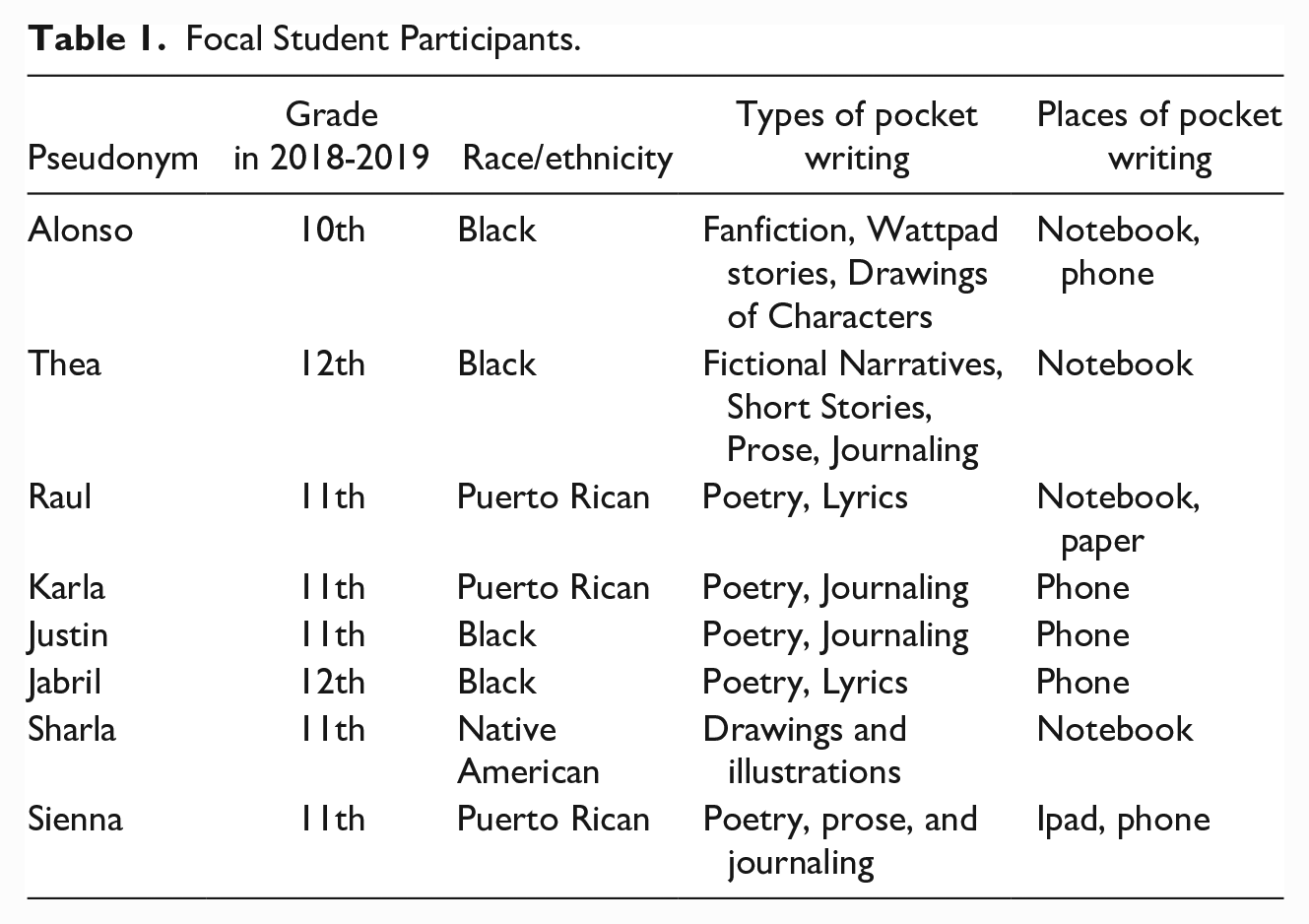
We transcribed interviews and conducted a thematic analysis (Braun & Clarke, 2006), which involved us first developing descriptive codes involving how young people talked about writing (Saldaña, 2012). We then grouped the descriptive codes into categories (e.g., writing to heal, writing to cope), which we then collapsed into themes (e.g., purposes for writing). We identified themes revolving around intimacy (including tensions between public and private writing), purpose (including healing, coping), materiality (including material artifacts like apps, phones, notebooks), and circulation (including paths across school, home, transportation). Following Saldaña (2012), we found the themes emerged as “an outcome of coding, categorization, or analytic reflection” (p. 14), which was helpful to reducing the data to see patterns.
We also sought to expand data to understand emergence and to center students’ experiences of the phenomenon. To that end, we turned to P. Prior’s (2018) methodological approach to studying complex, mobile data: integrative analysis, which considers historical trajectories of activity and becoming across time and space by documenting narratives of distributed action. Our process first involved reading through all related fieldnotes and interview transcripts again and then choosing key moments and ideas to represent in a common frame to enhance visibility and connectivity. By creating a visual chart of these key moments, we sought to “see” the different pathways such writing took. While we did this visual charting using physical materials like colored pens, sticky notes, and whiteboards, we offer an example of our visual representation in Figure 1. This figure illustrates Alonso’s trajectory, as we traced how his writer’s notebook and some of the stories that appeared there emerged in other times and spaces.
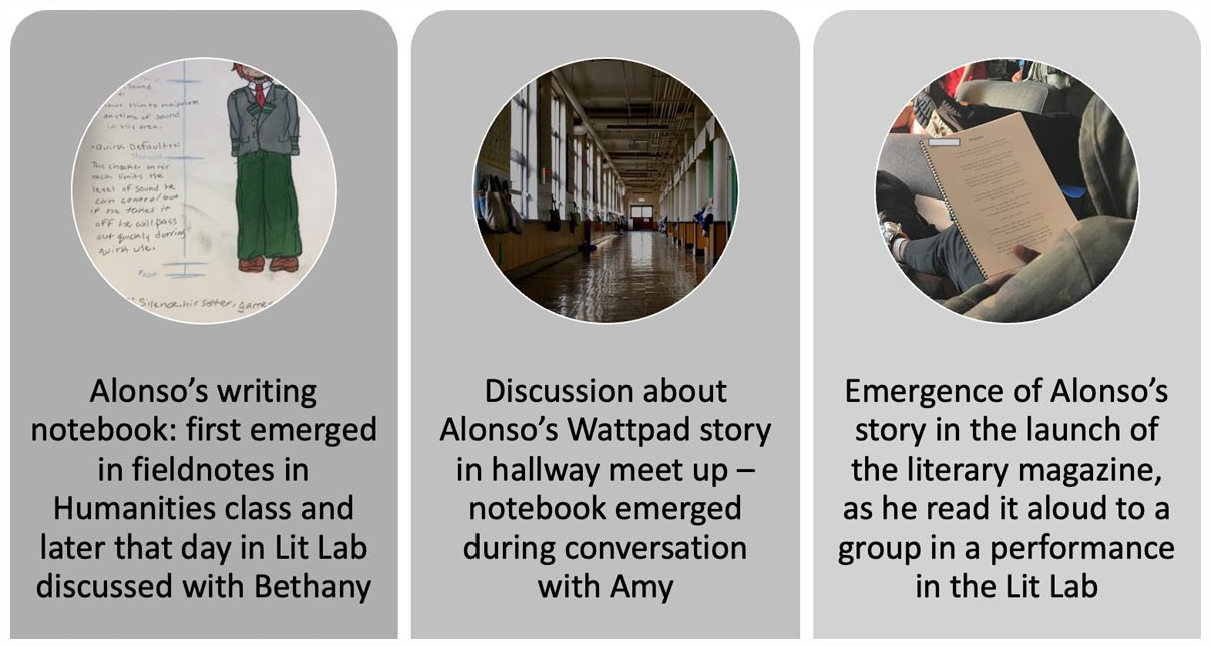
Visual chart of one student’s pocket writing trajectory.
We then wrote narratives of the various trajectories we traced in our visual chart, including describing where and how pocket writing emerged at school and the tensions that students negotiated in their process of writing and sharing this writing. For example, the first trajectory we identified involved practice of writing in notebooks over time and across spaces, which was notable in this digitally oriented, 1:1 school that did not involve much handwritten material (such as in Alonso’s trajectory illustrated above). We wrote about the ways these notebooks appeared: sometimes as tiny notebooks filled with jottings that slipped easily into a jeans pocket, sometimes as school composition books with pages of handwritten text that lived in a backpack and looked like other school subject notebooks, and sometimes as an artist’s sketchbook that included illustrations and text woven together. We identified the different ways youth used those notebooks—for recording or documenting ideas, lyrics, memorable experiences, powerful words—and described the moments when they emerged from pockets and backpacks and what students described (or we witnessed) as happening in that moment (and of course, when they did not emerge at all).
Through the combination of our thematic and integrative analyses, we identified two dimensions of pocket writing’s material, mobile nature central to its practice across the trajectories we identified—its privacy and its durability. We defined privacy as a dimension of pocket writing that allowed students to control who could see what they wrote, an important consideration as they wanted to keep writing to themselves or be free from other people’s input, observation, or reaction to their writing. We defined durability as a dimension of pocket writing that allowed students’ writing to persist across different times and spaces, sometimes more easily than others depending on a variety of material circumstances. We explore how these two dimensions mediate students’ agentic and transformative circulation of their self-sponsored writing in the findings section.
In what follows, we discuss our analysis of students’ pocket writing practices rather than the writing itself; to that end, we do not analyze or share examples of students’ pocket writing. We withhold public access to these students’ writing to preserve their individual control in determining exactly how this writing is circulated and where and with whom it is shared. We take inspiration in this approach from a photovoice project with undocumented youth in which Del Vecchio et al. (2017) explained the importance of building indigenous principles of refusal (Simpson, 2007, 2014) into the research design process, discussing the ethical implications of repackaging and re-presenting participants’ work in contexts far removed from the creators’ original context, purpose, and intentions. Like de los Ríos (2020), we are interested in centering the vantage point of students, especially as they navigate “the racialized gaze of the world” (p. 8), while leaving it to the students themselves to determine when and where they share their pocket writing with broader audiences.
Pocket Writing’s Circulation and Emergence as Material and Mobile Writing (for) the Self
We learned that students’ pocket writing practices were entangled with the material and social locations across which their writing emerged and circulated, guided by youths’ felt rationale for how their personal writing was produced within, moved among, and (sometimes) drawn from their pockets in relation to school. In short, we came to understand the “pocketed” nature of such writing as a key component of its transformative power for youth and in the sections that follow explore the two key dimensions that characterized pocket writing for students: its privacy and durability.
Navigating Pocket Writing’s Dimensions of Privacy: Youth’s Boundary-Making Practices
Students’ self-sponsored pocket writing was at its heart a private enterprise in the lives of the youth we worked with. The material affordances of its various forms—whether written on notebooks, scraps of paper, backs of hands, or phones—offered tangible boundaries (e.g., a phone’s lock screen, notebook covers) for students to keep their writing to themselves. Karla explained that she often wrote her poetry on her phone “because I got a passcode—nobody can read it.” Karla went on to explain that she needed such boundaries because even personal spaces like bedrooms and notebooks were not always secure from the prying eyes of family members, “so my phone is the safe place to write.” Karla’s description of a “safe place” for writing suggested that privacy for her was both emotional and physical, with her phone’s portable size and password protection offering material and conceptual affordances for controlling who had access to her writing—she could pick up and move rooms whenever she needed privacy to compose, and her locked phone ensured that only she could see what she had written.
The pockets of students’ clothes and bags also served as a material boundary to protect their self-sponsored writing, allowing them to tuck away such writing from public view while providing quick and easy access. Indeed, it was the “small scale” (Kell, 2011) nature of students’ pocket writing that facilitated its movement around school and across spaces as a private entity held close to the body, ready to be jotted down in a quick moment during other activities in snippets, fragments, and sketches before being tucked away again. Raul, like many of the other focal students, kept a small notebook in his backpack specifically for his writing. As a songwriter and poet, he would regularly pull it out to write down a potential new lyric or interesting turn of phrase, often just a few words or sentences scribbled quickly as he was talking or listening to others. While his teachers often thought he was taking notes for class, he described this practice as a way to capture ideas in the moment, as inspiration struck, without calling too much attention to what he was writing. For others like Karla, Alonso, and Sienna, their phones served such purposes, allowing them to compose out of the public eye and in quick bursts, unlike their school-issued laptops, which permitted others to look over shoulders and surveil or comment on what they were writing. Since composing on phones proved to be a challenge during class time, many students turned to scraps of paper and notebooks (and sometimes hands and arms) to record fleeting thoughts under the radar of teachers.
Students used the affordances of these small-scale texts to revisit their writing at opportune times, often for personal reasons that allowed them access to private ideas and emotions even when physically surrounded by others. Karla, for example, liked to reread her poetry at school, even when she was “sitting in that class right there and I’m all alone, I just go through my notes again. And I read it. Just do it there.” She also explained that she also reread her writing “on the couch in the living room with my parents—I do it there too.” The pocketed nature of Karla’s self-sponsored writing allowed her to choose when to revisit it, keeping it close to hand for when she needed to hear her own voice. This portable, close-to-the-body nature of students’ small-scale writing allowed students to access it privately when needed—whether to compose in the moment or revisit past writing.
A key reason students sought control over the spaces for writing, including when and how it might emerge in school, was the often-personal nature of what they were writing about and the desire to keep those issues private. Students described their turn toward pocket writing practices as a way of coping with challenging emotions, circumstances, and traumas, such as breakups with romantic partners, strained familial and peer relationships, and deaths of loved ones. All the students we interviewed narrated the importance of writing for their mental health, highlighting that it was the experience of writing that helped them process their emotions and thoughts (sometimes prompted by counselors’ recommendations). Alonso, for example, often drew inspiration from his own life in writing stories, describing in one instance how he wrestled with coming out to his religious mother and grandmother as bisexual by writing a story with a young woman struggling with her own coming out process with her family. Alonso’s protagonist was surprised at the warm reception by the mother and explored what that kind of support looked and felt like before he worked up the courage to come out to her. Over time, Alonso took his pocket writing more public, polishing this and other similar stories for others to read on Wattpad and in class assignments. His pocket writing facilitated the movement of his private processes of exploring and understanding personal experiences into and out of public spaces, helping him retain control over his own emergent narrative.
All the students we interviewed described how they exerted agency over the emergence of their private pocket writing at school. They drew boundaries to separate their personal and academic lives by materially concealing this writing in their pockets, even in a school where students were often encouraged to compose creatively as part of the official curriculum. Karla revealed that she kept her more personally relevant and meaningful writing to herself: “I feel like the [pieces] that we share [with teachers or in school], doesn’t really . . . [have] the same meaning as we have in the ones we save. Like the one we save could probably mean like, really like important to us and like really deep.” In other words, for Karla the private dimension of pocket writing was central to its meaning, so she remained in control over the circumstances of its revelation.
Exerting material control over pocket writing’s emergence at school ensured that the writing served youth’s own purposes and was not co-opted for someone else’s. Two students, Sharla and Sienna, who often used writing and drawing to process difficult circumstances and emotions, explained to Bethany how they made strategic decisions about keeping this writing under the surface of their academic lives, recognizing how its emergence might put them at risk of surveillance or unwanted interventions by a school counselor or authority figure. When Bethany asked them how they would feel about sharing some of their more intimate, therapeutic writings with a teacher or as part of a school assignment, Sharla replied that she “could not do that” and Sienna rejoined that especially if such writing reflected her feelings at their “very very top frustrated points” she might not share it with anyone because they might wonder if she was okay. For Sienna and Sharla, the intimate nature of pocket writing was central to its healing power, and such personally relevant and powerful writing often needed to be hidden. Indeed, the agentive act of protecting such writing seemed bound up in its transformational power—youth used their pockets as material boundaries to regulate what could be shared, with whom, under what circumstances, and to what ends.
Navigating Pocket Writing’s Dimensions of Durability: Youth’s Kairotic Practices
The second dimension of pocket writing we explore is its durability, and, at times, its lack thereof, as young people in our study leveraged its capacity to anchor, transport, connect, and displace in different measure. At some moments, pocket writing offered a portable, enduring record that allowed young people to carry it close to them and (re)turn to it when needed, as Karla did in rereading her poetry during school. At other times, pocket writing was fleeting—its compact, diminutive nature contributed to its precarity, with notes overwritten, washed off hands, thrown away, or misplaced. These different dimensions of durability were deeply tied to the how, when, and where of pocket writing, as the entangled interplay of time, space, materials, and desires influenced how and why it emerged at school. In other words, youth’s pocket writing practices were kairotic, as youth navigated the experience of composing (kairos as embodied presence in the moment) in response to the material, temporal, and contextual aspects of their experience at school (kairos as attunement to the “right” time and space). In short, we found that pocket writing’s capacity for durability was a key part of young people’s kairotic writing practices in relation to school.
For all the students we talked to, the promise of pocket writing’s durability was a central consideration guiding their composing practices, as they chose tools for composing that would make their writing accessible later. Dustin, for example, explained that he used to write in notebooks, but when he lost one, it involved “losing a lot of memories.” Consequently, he shifted to writing on his phone, to which he had more consistent access over time. Sienna also preferred to write in the Notes app on her phone, not only because it would sync with her other devices but because her phone would fit in her bag, which she changed every day to match her outfit. Justin got in the habit of texting himself so that if his phone lost service or was replaced (a frequent occurrence), he could still access his texts later. For these young people, pocket writing offered a means of anchoring them across moments—to capture a thought or emotion in the exact time and location as they were embodying and experiencing it—and then have access to that experience later via that writing’s re-emergence. Dustin explained that re-engaging with his previously written poems helped him to cope with situations and emotions that emerged in the present: “If I’m feeling a way that, like, I knew, I wrote something about this before, I will go back to it and re-go through how I’m feeling.” This rereading helped Dustin not only understand and process his feelings in the moment but also find a path through trying situations since it provided him with “motivation to say that I can get through this because I have before.” Dustin’s specific desires, needs, and circumstances in the present were linked to his past experiences via his writing, a connection facilitated by cloud-based composing tools at his fingertips. In short, students’ ability to resurface their own pocket writing at the “right” moment was dependent upon having embodied, material access to their writing, emphasizing the entanglement of pocket writing’s durability with its transformative power in students’ lives.
Even though the durability of pocket writing was important to students, it was also precarious—students often described writing that was lost, misplaced, or temporary. Students’ ability to reaccess their own writing was often facilitated or constrained by the material presence or absence of the notebooks and devices where they wrote for themselves; its reemergence was often precluded by the precarity of the tools with which it was produced, such as a lost notebook or a replaced cell phone. Thea, for example, once lost a leatherbound notebook dedicated to writing and outlining her short stories and novels for almost a year in her own bedroom, severely impeding the development of her narratives and creative writing practice. Such losses are often emotional experiences, amplifying the precarity and vulnerability of pocket writing. It follows that when pocket writing is materially lost, students may not only feel a loss of control over who might find and circulate their writing, but also that the loss of opportunities to revisit their own writing (for) the self can feel like losing pieces of oneself.
Pocket writing’s (potential) durability helped youth to exercise control over when it emerged at school, with its ready availability shaping their decisions about how and when to share. Many students we worked with pulled out notebooks and phones as we were talking about other topics, and we witnessed dozens of instances of youth pulling writing from their pockets to share with peers or teachers, often in the in-between spaces of school (e.g., bathrooms, hallways, classroom doorways, the lab). Such decisions were dependent on how they felt in the moment, often grounded in a desire to build or maintain intimacy and trust with others. Students described a kind of kairotic instinct that guided their decision to share, such as feeling “moved” to share when it “felt like the right time” or “with the right person.” Jabril described that he would make these decisions in the moment depending on how vulnerable he was feeling: “As far as your writing and lyrics, it’s like, you’re putting out a piece of yourself. Like it makes you feel really vulnerable.” Jabril assessed a constellation of factors to determine whether he wanted to share “a piece of [himself]” with others, a risky proposition and one that the youth weighed seriously. Jabril said he often felt comfortable enough in school to share when asked directly, such as when his teacher invited him to perform a poem for the school assembly. He felt in control because he could determine which poem to share and refuse if he wanted, though most of the other youth participants described feeling more ambivalent about when their writing surfaced in relation to more official school events.
Students’ ambivalence in their decisions to share in the more official circuits of school involved the uncertainty about how their writing might travel, which may lead them to lose control of their texts’ trajectories. Thea was one student who navigated these tensions over what and when to share at school, describing an instance when a privately motivated piece of pocket writing went public in ways that she resisted and regretted. In general, Thea described being comfortable sharing what she wrote in her journals and that “people can ask me about stuff in my journals . . . I’m fine with that,” but that there was “some personal stuff” in her notebook and “certain stuff I’m not trying to share because it really requires a certain person to grasp it.” One specific piece she wrote about asexuality, for example, was something she felt pressured to share by the teachers at school, against her own desires: And then there’s like, the whole topic of like, asexuality like not, first of all, not a lot of people even get that. Yeah. And second of all, it’s like, even though it was just like an assignment for school or whatever, it was still kind of personal to me, because I still like, I’m trying to figure out like the whole thing of asexuality. . . . And so I used that piece to understand. And I feel like for a piece like that, I didn’t really want to share it, because it’s more like a personal, like, explanation for me. And it’s also something that a lot of people wouldn’t be for, like really understand. But all because every teacher is like, [Thea] you should totally share your piece, I felt like I can’t refuse.
Thea was a student with a reputation among her teachers and peers as being an accomplished and dedicated writer, who made no secret of her pocket writing and was usually open to sharing passages from her notebook whenever someone asked. However, Thea illustrated how even students who sometimes presented their personal writing as an “open book” desired to retain control over the circulation of their writing, especially pieces written for the purposes of self-discovery or exploration.
While her teachers may have believed that Thea, who is often shy, needed encouragement to share her writing and that other students might benefit from hearing it, in this instance, Thea’s experience was not one of empowerment but of exposure. In fact, she elected not to be in the room while her piece was read aloud because she did not want to witness its public emergence, and later she explained that she wished she had retained more control over when and with whom it was shared, admitting: “I still feel like I wish I hadn’t shared it. . . . I wish I hadn’t said it at all. Because it’s not like a piece I really want to share unless I’ve found the right person to share that with.” Thea wanted to share her piece about asexuality with “the right person” under the right conditions, suggesting that the intimacy involved in such sharing was stripped away when she felt pressured to “go public.” These decisions about when and where young people’s pocket writing should emerge over time was a fraught process that involved students assessing the risks about writing’s durability in relation to school—once writing was shared with teachers or in other, more official capacities, students sometimes felt that they lost control over its future trajectories as school had a way of co-opting students’ writing in ways they might not have imagined. These decisions about how to circulate their private writing in school, given the relative durability of sharing personal details publicly, were important to understanding the transformative agency of pocket writing (for) the self.
Discussion
This study explored a literacy practice we refer to as pocket writing, self-sponsored writing that the youth we worked with kept close to their bodies in the pockets of backpacks, sweatshirts, and jeans until the right moment for it to emerge. We focused on two aspects of this writing practice—its privacy and durability—to understand writing’s ontological dimensions, especially how the experience of writing helped young people “name, question, make sense of, and reflect on their experiences in the world” (Johnson, 2017, p. 170). This kind of writing (for) the self is valuable for its own sake and not only as a communicative tool or instrument used to achieve some broader purpose. Such a spotlight on the experience of writing foregrounds writing as an end in itself, not tied to future goals or outcomes but as “a way of being” in the “practice of living” (Yagelski, 2012, p. 202). As a form of praxis, this writing practice involves youth’s emergent sense making that is deeply intertwined with their identities and movements through their social and material worlds. In other words, pocket writing represents an act of worldmaking (Stornaiuolo, 2015), as youth use the resources at hand (e.g., their words, bodies, pockets, devices, spaces, experiences) to simultaneously construct the world and inscribe themselves into it (especially in relation to broader systems that have excluded them)—whether or not that writing ever emerges into the world publicly. It is the experience of constructing and inscribing themselves into the world that matters.
We were particularly drawn to the literal and metaphorical affordances of “pockets” for understanding how youth drew boundaries around their writing. Literally, pockets functioned as material, bounded places separating students’ writing from the gaze of others, allowing the small-scale texts to be kept on or near their bodies for easy access over time while remaining contained and private. Metaphorically, the concept of pockets illuminated the material, emplaced nature (Micciche, 2014; Pigg, 2014) of youth’s writing, simultaneously located in a particular moment in time and space and portable across time and space. In the high school where this study was located, we witnessed how youth’s agency was extended in and through writing’s material forms, as young people used pockets to literally and metaphorically create boundaries about who could access their writing and when. Creating such boundaries for the circulation and emergence of their writing (for) the self is a transformative and agentic act within the context of school, where writing’s function and form is often mandated by others and used to assess and even constrain youth’s chosen forms of expression.
Such agentive and strategic actions by youth represented small yet powerful forms of resistance to the oppressive elements of schooling. By operating along the margins of school—in hallways, at lunch, on scraps of paper tucked into notebooks—young people could work to control the institutional gaze that monitored their literacy practices. These “everyday resistance practices” were examples of what Lizárraga and Gutiérrez (2018) identify as the “ingenuity and inventiveness” of nondominant youth who live in borderland, liminal spaces, developing syncretic literacies as they must navigate linguistic and cultural pluralities in their everyday activities (p. 45). Decisions about when and how to practice and share this writing (and parts of themselves) emerged in complex relationship to the spaces, materials, and other actors in any given moment, influenced by both individual and collective histories with the institution of schooling that guided individuals’ felt sense of what seemed “right.” As young people from nondominant communities who were attuned to living with inequities and injustices, the youth in our study had developed a highly attuned kairotic awareness not just of the “right or opportune time” to practice and share their writing but how to navigate the precarity of making themselves vulnerable within systems that have marginalized, oppressed, and silenced them in the past.
We see pocket writing as a possible avenue for youth to practice transformative agency, transforming both themselves and the world through the act of writing themselves into existence on their own terms. For example, when Alonso and Thea shared writing about sexual identity, they used fiction to demonstrate how their characters grappled with challenges related to a lack of understanding, discrimination, bullying, and violence faced by youth in a deeply heteronormative culture. Such writing helped them navigate their own process of becoming but was also an act of asserting the importance of such stories in a world that tried to silence those experiences. Such writing placed them in relationship to—and solidarity with—other writers who historically have pushed back against dominant narratives (and policies) that attempt to silence youth perspectives on gender and sexual identity.
Gutiérrez et al. (2019) have explored such youth agency in terms of their roles as historical actors, who understand themselves in relation to broader systems and infuse everyday activities with new meanings. For the young people we worked with, strategically navigating the privacy and durability of their self-sponsored writing at school represented everyday resistance practices that allowed them to control who had access to their intimate thoughts and experiences. It also allowed them to carve out space for being wholly themselves, without thought to who might later read their words or how those words could impact others in the world. Surely, young people’s writing did have broader impact—on us, on peers, on their teachers, on online audiences on Wattpad and other digital forums, and on the local communities with whom they shared such work at times—but such impact was a byproduct of the powerful experience of writing the self/writing for the self.
Conclusion
This study examined how young people’s self-sponsored, private writing—what we called pocket writing, or writing (for) the self—emerged and moved with their bodies around and in relation to school. The young people we worked with found power in the immediate, felt experience of this writing—its embodied immediacy, cathartic release, and private means of inward reflection—and often wanted to keep such experiences private. These intimate moments could then be accessed, remembered, relived, and brought forth into the present through rereading and sharing with the right person at the right time. Indeed, a key part of its transformative power involved youth’s agency in deciding how and when that writing emerged, with whom it was shared, and how it could travel.
In exploring how and why young people might want to deliberately disconnect their pocket writing from school, we sought to understand what educators and scholars interested in connected learning (Ito et al., 2013) might learn from youth. We see two immediate implications. The first echoes Haddix’s (2018) assertion that “simply put, youth are writers” (p. 8). While such a proclamation may seem self-evident, Haddix argues that such a stance is a radical act in the face of dominant narratives about young people’s writing “deficits,” particularly for urban youth. It is radical, she argues, for educators not only to recognize and affirm all youth as writers with valuable stories to tell but also to presume their competence as writers—a historically rooted recognition that is particularly salient for African American youth whose literacy histories are often questioned or framed narrowly through stereotypes about Black oral traditions (see Fisher, 2004, 2009; McHenry & Heath, 1994). We argue here that an important part of affirming youth as not only competent but transformative writers involves recognizing their agency as writers—which includes their right (and capacity) to make decisions about how to circulate and when to protect their writing from institutions like school. Part of this recognition work involves understanding youth’s rhetorical decisions about when to disconnect and/or disclose their writing as everyday forms of resistance to the reproductive and oppressive dimensions of schooling. It also involves educators presuming youth to be writers even if they do not witness youth writing in official channels and forms.
A second implication of our study involves the ways that educators might expand opportunities for youth to exert agency as writers in schools. Certainly, one well-established way to do so includes creating pathways for youth to connect their self-sponsored writing practices with academic writing, such as by employing the kinds of interest-driven, socially embedded educational practices articulated by proponents of “connected learning” (Garcia et al., 2014). Yet educators could also create opportunities for disconnection to flourish, learning from the writers in our study about how to support pocket writing’s circulation and emergence in school along unofficial circuits. For example, creating alternate spaces for youth to engage in self-sponsored writing (e.g., places like the Literacy Lab) might be one way for educators to walk what Hull (2003) called a tightrope, neither romanticizing nor domesticating youth culture but expanding spaces for youth to engage in agentive, semiotically rich forms of self-representation. Another could be creating time/space during the school day for pocket writing to bubble up without becoming part of the official curriculum, being linked with academic writing, or leading to some organized public showing or outcome (e.g., one ELA teacher began each period with a private 10-minute journaling activity). Finally, educators might transform their approach to teaching writing by focusing on what makes youth’s experiences with self-sponsored writing powerful—the experience of writing for the pleasure and insight it brings, not necessarily with a goal, outcome, form, or audience in mind, and the opportunity to exercise agency and control over its circulation and emergence.
Footnotes
Acknowledgements
We want to express our gratitude for the openness and participation of the students and teachers at the school where this research was conducted as well as the careful and thoughtful feedback by the journal’s editors and reviewers
Author’s Note
Bethany Monea is also affiliated to English Department, George Mason University, Fairfax, VA, USA.
Declaration of Conflicting Interests
The authors declared no potential conflicts of interest with respect to the research, authorship, and/or publication of this article.
Funding
The authors disclosed receipt of the following financial support for the research, authorship, and/or publication of this article: We acknowledge funding support from the National Academy/Spencer Foundation and the University of Pennsylvania.
