




Abstract
Drawing on a three-year ethnographically oriented study exploring contemporary professional social work writing, this article focuses on a key concern: the amount of time taken up with writing, or “paperwork.” We explore the relationship between time and professional social work writing in three key ways: (a) as a discrete, measurable phenomenon—how much time is spent on writing? (b) as a textual dimension to social work writing—how do institutional documents drive particular entextualizations of time and how do social worker texts entextualize time? (c) as a particular timespace configuration of lived experience—how is time experienced by professional social workers? Findings indicate that a dominant institutional chronotope is governing social work textual practice underpinned by an ideology of writing that is at odds with social workers’ desired practice and professional goals. Methodologically, this article illustrates the value of combining a range of data and analytic tools, using textual and contextual data as well as qualitative and quantitative frames of analysis.
Keywords
Introduction
Why Focus on Social Work Writing?
Writing studies has long been concerned with the specific problematics of professional writing: 1 work includes a substantial number of studies on medical/health care settings (e.g., Berkenkotter & Hanganu-Bresch, 2011; Bezemer & Kress, 2017; Candlin & Candlin, 2003; Papen, 2010; see also the writing and medicine special issue of Written Communication, 2009, vol. 26, no. 3); veterinary science and practice (e.g., Schryer, 1993); business and technical communication (e.g., Bargiela-Chiappini & Nickerson, 1999; Bhatia, 1993); law and policing (e.g., Freedman et al., 1994; Rock, 2017); professional academic writing (e.g., Canagarajah, 2002; Lillis & Curry, 2010); journalism (e.g., Van Hout & Burger, 2016); engineering (e.g., Durst, 2019; Haas & Witte, 2001) (for example overviews of work on professional and work-based discourse, see Barton & Papen, 2010; Bazerman & Paradis, 1991; Borzeix & Fraenkel, 2001; Gunnarsson, 2009).
Studies in the field can be characterized as being driven by three, interrelated imperatives: academic—to generate empirical data and theorizations of what it means to write in different professional domains, with some studies orienting more specifically to characterizing texts (e.g., Bhatia, 1993), some practices (e.g., Bezemer & Kress, 2017), and some explicitly seeking to theorize the relationship between both (e.g., Berkenkotter & Hanganu-Bresch, 2011); pedagogic/interventionist—to build accounts of literacy practices based on empirical data and literacy theory to inform the design of professionally oriented courses or training programs or to resolve literacy-related problems in professional practice (signaled explicitly in some studies, e.g., Freedman et al., 1994); professional—to explore clusters of literacy-related issues in response to explicit professional requests (e.g., Lillis, 2017; Schryer, 2002). While varying in scale, scope and approach, what the studies share is a commitment to bringing to bear methodologies and theories from literacy/writing studies to the articulation of literacy-related phenomena and problematics in professional domains.
The research on which this article is based focuses on writing in an underresearched professional domain, social work, in one specific national context, the (U.K.), and is driven by all three imperatives. The academic imperative is to contribute to the field of professional writing studies internationally by generating data sets and theoretical insights about the nature and significance of writing in this particular professional domain. Much existing research internationally centers on student, rather than professional, social work writing (e.g., Horton & Diaz, 2011; Rai, 2004; Waller, 2000; Wehbi, 2009). The pedagogic/interventionist imperative involves exploring ways of drawing on empirical research to close the gap between the writing required of students in social work education and the writing demands of professional practice, a gap identified as problematic in some studies (notably Paré, 2002; Paré & Le Maistre, 2006) and in earlier stages of this research project (Lillis & Rai, 2012; Rai & Lillis, 2012). The professional imperative, as is discussed in more detail below, underpins the very existence of the research on which this article is based: the research began in response to social worker management concerns about the “quality” of certain aspects of professional social work writing.
The contribution of this article, and writing studies more generally, lies in the potential to open up more comprehensive articulations of the nature of professional writing and to challenge the often prevailing default deficit orientations to language and literacy in workplace and professional domains. Such work is an important way of giving legitimacy and urgency to aspects of practice that are of concern to professionals and are highly consequential for both professionals and the people they seek to support (see Opel & Hart-Davidson, 2019; Roberts & Sarangi, 2003; Schryer, 2002).
Why Focus on Time in Social Work Writing?
In official reports and inspections of professional social work in the U.K., concerns about writing are frequently expressed through references to “poor recording” (e.g., Department for Children, Schools and Families, and Department of Health, 2009; Department of Education, 2011; Health and Care Professions Council [HCPC], 2018; Social Work Reform Board, 2010) or “poor assessments of people’s needs and records management” (e.g., Care Quality Commission [CQC], 2017, p. 35, 41). Such criticisms of social work writing (often under the label of “recording” and, more broadly, “communication”) are frequently central to public enquiries, usually known as “serious case reviews,” which hit headline news when severe injury or death occurs (for discussion, see Balkow & Lillis, 2019).
Time often figures explicitly in concerns and criticisms about writing. Inspection reports, for example, refer to “issues with record keeping, including timeliness” (CQC, 2017): in this framing, concerns about time center on social workers being “late.” In contrast, professional and union-based reports emphasize social worker concerns about the amount of time spent on “case recording and other administrative tasks at the expense of other activities” (Moriarty et al., 2015, p. 13; see also British Association of Social Work [BASW], 2012). Time therefore often figures as a key dimension in discussions of professional practice but from different frames of reference. Little research has been carried out that seeks to explore the material and discoursal significance of time in professional social work writing, and how these feed into different frames of reference. 2
This article begins by giving an overview of the use of ethnography in the study of writing and the “ethnographically oriented” approach adopted for the specific study on which this article is based. This is followed by the rationale for focusing on time and the specific research questions and data sets analyzed in this article. The main part of this article focuses on three questions. (a) How much time is spent on writing? (b) How is time entextualized in writing? (c) How do social workers experience time and writing? This article draws on a wide range of data from the WiSP project “Writing in Professional Social Work Practice in a Changing Communicative Landscape” (www.writinginsocialwork.com) in order to identify patterns emerging across data sets as a whole, as well as focusing in detail on three specific cases in order to offer a rich description of everyday social work textual practice. This article concludes by drawing on the notion of “chronotope” (Bakhtin, 1935/1981) to articulate the dominant institutional orientation to time governing professional writing in this context and to consider the extent to which this aligns with social workers’ desired professional goals.
Researching Social Work Writing: An Ethnographic Orientation
Ethnography in Researching Writing Practices
The epistemological appeal of ethnography to writing and literacy researchers lies in its privileging of context, which reflects the principle that the meanings of any cultural practice, including language, cannot be understood if treated as autonomous from social life (see, e.g., Blommaert, 2018; Prior, 1998; Street, 1984). Exploring dimensions to context, including who is involved, what exactly constitutes “writing,” when writing occurs, how (under what material conditions and using which technologies), and why (the purposes and functions of writing) is considered crucial to understanding the significance and meaning of writing in a particular social domain. However, it is important to note that since “bringing ethnography home”—a phrase used by Rampton (2007, p. 298, after Hymes, 1996) to signal researchers turning their gaze away from the study of assumed distant (and often exoticized) “others” to researching contexts and practices closer to researchers’ own contexts (whether at the level of nation, institution, or everyday local practices)—the precise nature of what characterizes an “ethnographic study” is of ongoing debate.
Several points of particular relevance to the use of ethnography in writing and literacy studies—and in locating the approach set out in this article—are useful here. In terms of scope or focus, empirical research in writing/literacy studies can be characterized as being “topic-oriented” (Snell et al., 2015, p. 7, after Hymes, 1996), that is, as exploring a particular dimension to a sociocultural practice rather than claiming to explore a “culture” or “society” in its entirety, for example, by focusing on a particular domain (e.g., writing in educational institutions—school, college, university, etc., a key preoccupation of writing studies). This can often involve focusing on one specific textual practice within a particular domain (e.g., Wickman’s 2010 study of laboratory notebooks in chemical physics; Noy’s 2015 study of visitor books in museums) or a micro-textual (linguistic or rhetorical) practice (e.g., Schryer et al.’s 2011 study of citations in forensic letters).
In terms of researcher engagement in a site or domain, some studies align with more traditional approaches to ethnography and involve periods of sustained consecutive engagement in one particular site, ranging from months to years (e.g., Bezemer & Kress, 2017; LeBlanc, 2015; Prior, 1998; Spack, 1997), while others involve repeated visits over many years to specific sites (e.g., Curry & Lillis, 2004, 2014; Lillis, 2012; Lillis & Curry, 2006, 2010, 2015, 2018) or revisiting sites for comparative purposes at different points in time (e.g., Maybin, 2006). Reasons for different types of engagement vary. These include practical resource issues: it is difficult for most academic researchers to take lengthy periods of time out of everyday pedagogic and/or academic work, so shorter or repeated periods of engagement in a particular domain are often adopted (see Shaw et al., 2015, pp. 7–8). But the rationale for different types of engagement may also relate to the precise analytic purpose of the study. For example, if a key goal is to carry out detailed micro analysis of a particular semiotic practice, a researcher may decide to immerse herself in a context for shorter and/or intense periods of time. If, in contrast, the goal is to understand textual practices over a life span, a longer, less intense type of engagement (including data collection and analysis) may be adopted. Exactly what constitutes meaningful sustained engagement or “observation” is of course complex, and varies not least in relation to a researcher’s familiarity (or lack of) with a particular area of practice at the outset of the study, the particular researcher relations with participants that develop in the course of the study, and the ways in which a researcher harnesses critical reflexivity to deepen their understanding. 3
In terms of the specific methodologies adopted in ethnographic writing/literacy studies, there is considerable variation, but they typically involve a combination of a number of methods of data collection—key ones being observation, interviews, collection of texts, audio, video, and screen recording—and data analysis, for example content, thematic, and narrative analysis as well as a range of rhetorical, sociolinguistic, and linguistic approaches (for overviews, see Barton & Papen, 2010; Bazerman & Prior, 2004; Blommaert & Dong, 2010; Lillis, 2008; Snell et al., 2015). There is also variation at the level of epistemology, including what can be described as the epistemological weighting attached to contextual as compared with textual data, its description and analysis (and indeed how the relationship between text and context is construed), and the extent to which positivist or interpretivist approaches are adopted in the representation of accounts and findings (for useful discussion of the latter, see Paltridge et al., 2016, chap. 1).
In summary, while studies co-opting the descriptor “ethnography/ic” share a commitment to the imperative of building context-rich understandings of writing and literacy, there is considerable variation at the level of how this is enacted, and the range of descriptors in use signal that this is a productive, albeit contested, research space. These include “ethnographic methods” (e.g., Buell, 2004), “ethnographic approach” (e.g., Tuck, 2018), “ethnographic perspective,” “using ethnographic tools” (e.g., Green & Bloome, 1997), and “text-oriented ethnography” (Lillis & Curry, 2010). What is intended by each descriptor varies across studies, with each specific study offering a definition of its co-option of the term “ethno-.” The term used in the study on which this article is based is “ethnographic orientation,” the brief rationale and enactment of which is outlined below (see also Paltridge et al., 2016, chap. 7, for its use as an overarching descriptor).
An Ethnographic Orientation to Researching Social Work Writing
We use the phrase “ethnographic orientation” to characterize our overarching epistemology on writing, which is that writing—and language more generally—can never be “context-less”: There is no way in which language can be “context-less” in this anthropological tradition in ethnography. To language, there is always a particular function, a concrete shape, a specific mode of operation, and an identifiable set of relations between singular acts of language and wider patterns of resources and their functions. (Blommaert, 2006, p. 4)
Given the potential enormity of “context” (e.g., immediate as well as distant histories of people, institutions, practices, texts and intertextual influences), engagement involving “thick participation” (Sarangi, 2006) and “thick description” (Geertz, 1973) helps the researcher move toward an understanding of what is significant to writers from their specific sociohistorical perspectives at any one moment in time. This epistemological position does not negate the importance of an etic-researcher perspective or the analytical legitimacy of focusing on particular data sets as discrete phenomena (e.g., texts, interviews, observation notes) but signals that the overall aim is to build a context-rich account of a particular literacy practice (Lillis, 2008).
As with most literacy-focused work, the ethnographic orientation here can be further described as “topic-oriented,” in that it is aiming to explore the nature and meanings of writing practices involved in professional social work, rather than, for example, seeking to understand the totality of a social worker’s (literacy-textual) life. The methodology involves a cluster of methods of data collection and analysis typically associated with ethnographic studies, key ones being observation, interviews, collection of texts, with analysis involving content and thematic analysis as well as a range of rhetorical, sociolinguistic, and linguistic approaches. The research also includes a method not typically associated with ethnography—that of corpus linguistics (for overview of corpus linguistics, see Baker, 2006). All methods are considered potentially useful as long as they are anchored to the overarching epistemological position of building a context-rich account even if this can cause some disciplinary or paradigmatic “discomfort” (Rampton et al., 2015, p. 36).
As stated above, thick participation is seen as crucial to engaging meaningfully in the specific domain of practice. In relation to this research, it is useful to distinguish between researcher participation in a domain and/or with a particular site(s). The principal investigator (PI) has been researching the domain of social work writing since 2009, involving projects on professional social workers’ perspectives on the value of academic writing to professional writing (Lillis & Rai, 2012; Rai & Lillis, 2012) and a collaborative project at the request of one local authority concerned about the “quality” of social worker case notes in adult care (Lillis, 2017). Both projects were discrete to the extent that they had specific goals for specific stakeholders but also constituted the beginnings of “long conversations” (Lillis, 2008; Maybin, 1994) between researchers, social work agencies, and social workers about the significance of writing in contemporary social work. The research findings and ongoing conversations over 10 years underpin the specific study on which this article is based in a number of ways: several local authorities and social workers have been involved in all stages of the research; existing relationships with social workers and agencies established the legitimacy and trustworthiness of the research team, essential for involving additional agencies; ongoing collaboration between researchers, social workers, and agencies has not only ensured access to highly sensitive situations and texts, but proved to be central to understanding processes and practices surrounding text production and identifying key themes, such as the focus in this article, time (see Clarke, 2005, for the theoretical importance of the researcher being welcomed by participants).
The principle of working with multiple types of data in order to shed light on a particular phenomenon is well rehearsed in ethnographic studies (see, e.g., Blommaert, 2018; Snell et al., 2015) and is adopted in this research. Such data are explored using both realist and interpretive lenses (Lillis, 2008; see Lather, 1991), a key interpretive lens used in the discussion in this article being the notion of “chronotope” (Bakhtin, 1935/1981).
The Study on Which This Article Is Based
The specific research project, WiSP, on which this article is based, building on the previous research, is a 3-year U.K.-based study funded by the national research funding agency ESRC (Economic and Social Research Council). The study involves five local authorities in the U.K., exploring both the range of written texts produced and the writing practices of social workers. 4 The research centers on the three main domains of social work—children’s care, adults’ care (generic), and adults’ mental health care—and seeks to characterize the nature of contemporary social work writing, by documenting the institutional writing demands and requirements, tracking everyday social worker practices, and exploring the perspectives of professional social workers. Core data sets include 81 transcribed interviews with 71 social workers, detailed researcher field notes based on 10 weeks of observations, 483 days of social worker writing activity logs, and 4,608 texts that also constitute a 1-million-word corpus. 5 In addition, a range of different kinds of contact was maintained over the 3-year project period between researchers and social workers, some of which built on existing “long conversations,” involving individual researcher-social worker conversations relating to specific areas of professional and personal interest and concern (e.g., issues relating to ongoing “cases,” changes in ICT [information and communications technology] systems, concerns about legal practices, changing personal and professional circumstances); individual and group (researchers with social workers) discussion about developing appropriate methodologies for researching writing in a highly sensitive domain; 6 collaborative development of materials drawn from the study as well as collaborative writing about the problematics of social work writing; and formal discussion through the constitution of an Advisory Committee (see www.writinginsocialwork.com).
Before the start of the formal study, workshops with participating social workers in each site were held to explore the focus of the project, agree on ethical practices and begin to build shared meanings about what was meant by “writing”: in many social domains, people tend to recognize only the most institutionally legitimized texts as “writing” (e.g., in academia essays and articles; in social work Case Notes and Assessments Reports inscribed into ICT systems). 7 Therefore in workshops and in subsequent researcher-social worker discussions, definitions of “writing” were repeatedly revisited to clarify that our interest in writing included all forms of inscription practices, ranging from the most apparently ephemeral texts, such as Post-it notes, to brief emails, text messages, and extended Assessment Reports.
A core aim of the WiSP study is to generate a substantial data set from which the research team and other interested researchers and social work professionals can describe and characterize the textual world of professional social work (details of the project and data archives can be accessed at the U.K. Data Service ReShare repository). To date, a baseline characterization of the texts involved in everyday practice has been generated: 341 institutionally labeled text types were found to constitute everyday social work written discourse and practice, ranging from two-word emails to a 14,000-word Child Permanence Report. The production of texts is mediated by a range of writing technologies, from conventional pen and paper (in notebooks and Post-it notes) to digital technologies, such as the use of large ICT systems and texting via mobile phones. The baseline characterization evidences the sheer amount and range of writing/texts constituting social work practice, signaling that social work writing is de facto a “writing-intensive” profession (Lillis et al., 2017/2020, after Brandt, 2005). The key focus in this article is an exploration of time in relation to such writing intensiveness.
The Research Questions and Data Sets
The specific research questions this article seeks to address and the range of data used are set out in Table 1. The questions reflect an approach to time as a material (socioculturally) measurable phenomenon of social life (a), a discursive dimension to textual practice (b), and as lived experience, in terms of both daily enactment of time and social workers’ perspectives on time spent on writing in relation to their desired goals for their profession (c).
Exploring Time in Professional Writing: Data Sets Used.
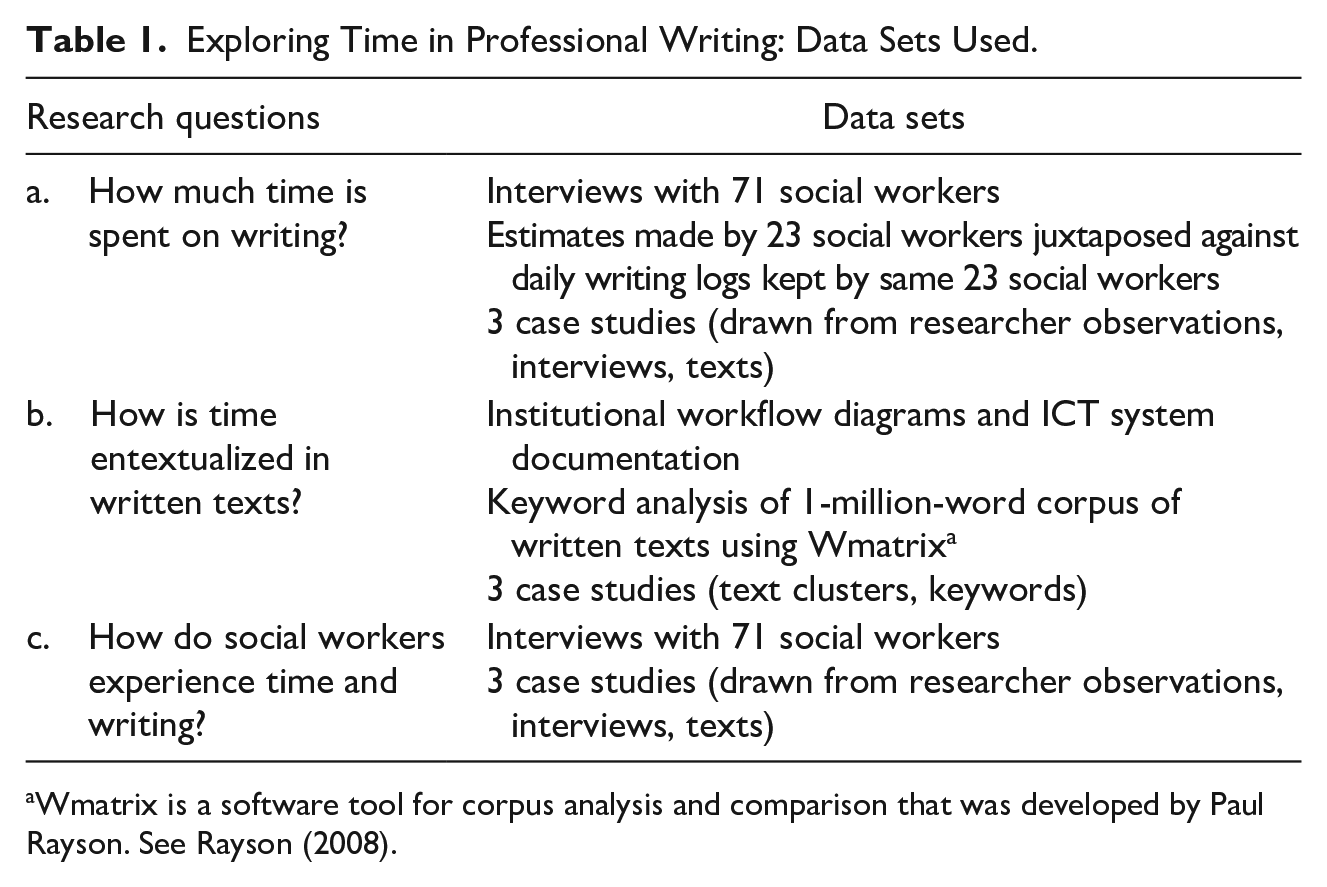
Wmatrix is a software tool for corpus analysis and comparison that was developed by Paul Rayson. See Rayson (2008).
Analysis involved an iterative engagement with the different types of data, both as distinct data sets and as data that together provide insights into the phenomenon of time. With regard to interviews, researcher observations, and logs, three researchers carried out separate initial memoing about time (Barton & Hamilton, 1998, p. 71), treating time both as a transparent category and as a feature of discourse. One researcher then coded time in the data sets using ATLAS.ti with codings refined following reexamination and discussion with a second researcher.
8
With regard to the corpus linguistic analysis, one researcher identified time as a key semantic area in the corpus, using Wmatrix software (Rayson, 2008) when compared with the reference corpus British English 2006 (Baker, 2009), a 1-million-word corpus of published general written British English.
9
Two researchers extracted all key items (single words and multiword units) relating to the concept of
The data were analyzed along four interrelated dimensions: vertical—focusing on individual social workers and the individual “cases,” that is people or groups of people they were working with; horizontal—identifying patterns and themes across data sets as a whole (Barton & Hamilton, 1998, p. 70); textual—focusing on texts, as documents and as keywords in written discourse; and contextual—exploring the contextual dimensions of writing, paying attention to the material conditions of and for writing, including available resources and technologies as well as participants’ perspectives. The analysis in this article aims to represent aspects of all four dimensions.
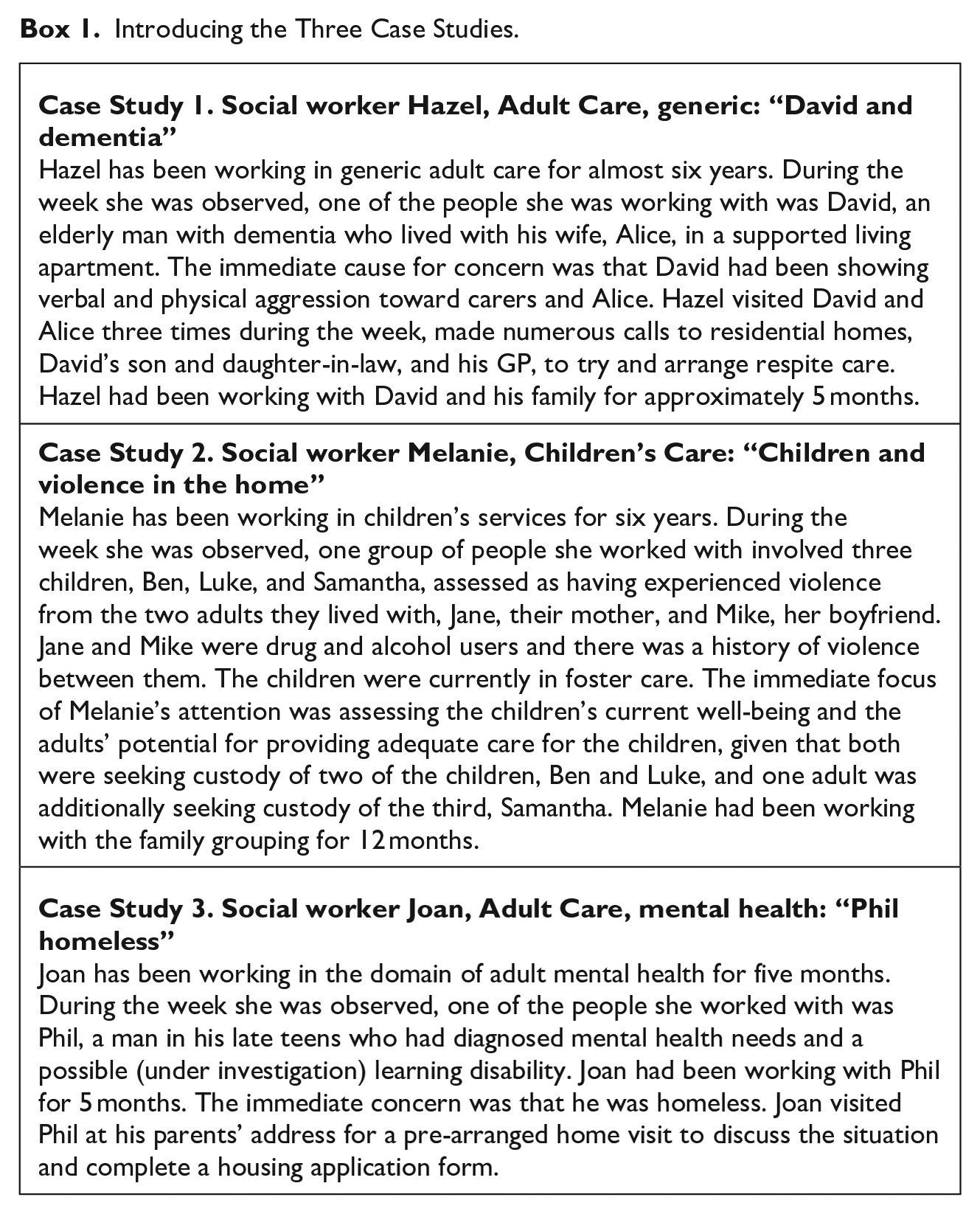
Representing findings from ethnographically oriented research involving both quantitative and qualitative data in the limited space and expected genre of a journal article is challenging. In order to attempt to do justice to the range of data and the ways these contribute to building a picture of the significance of time in professional social work writing, the findings are presented in the following way. The overarching structure of the findings in this article is that of horizontal analysis—identifying patterns from qualitative and quantitative data across the data sets. We also include three specific case studies, boxed off from the main text, as an important means of grounding the broader discussions about time in actual practice and holding up descriptions and accounts of everyday practice for analysis and interpretation, as a way of “making the familiar strange” (see Headland et al., 1990). In this article, each case study is constituted by one social worker and one of the “cases” (that is, a specific person/social grouping such as a family) they were working with during the research period. The issues illustrated in each of the three cases are typical of those that social workers routinely deal with across the three main domains of work, children’s care, adult care (generic), adult care (mental health): assessing and organizing care for elderly people with dementia; assessing the physical and emotional risks to children’s well-being and organizing immediate and longer term care; assessing the needs of adults with mental health problems and organizing support with respect to specific needs at any one time, for example, being homeless. Brief details of the three social workers and the single case from each are provided in Box 1. We return to these throughout this article.
Introducing the Three Case Studies.
Time Spent on Writing
The officially contracted time for a full-time social worker is 7.5 hours a day (37.5 a week) involving a range of activities all of which are expected to be completed within that time frame. Activities that were found to be core in all social workers’ routine practices (based on interview and observations) were as follows: reading and writing a range of texts using the institution-wide ICT system; visiting individuals, families, and other social groupings in their homes; attending official meetings—at schools, hospitals; traveling between offices other institutions and homes; meeting individuals and groups in the social workers’ building or office; making phone calls to service users and a range of other professionals; working from home, such as making and receiving calls and/or writing a range of texts.
Identifying the discrete amount of time on writing as part of all these activities is not straightforward, as is discussed below, but three data sources were used: social workers’ accounts of time on writing (as reported in formal interviews); social workers’ logging of time spent on writing (using a templated log); researchers’ observation of social worker time spent on writing (see Appendices A and B for interview schedules, log templates, and guidance). 10
In interviews, 57 of the 60 social workers who gave an estimate of the proportion of their working days spent on writing indicated this to be 50% or more (Figure 1). Regardless of the amount estimated (e.g., 98% in one case as compared with over 50% in 54 cases) 11 or whether it was felt to be too variable to give a precise figure (the 11 social workers who did not provide an estimate and are therefore not included in Figure 1), the overriding feeling among social workers was that too much time is being spent on writing.
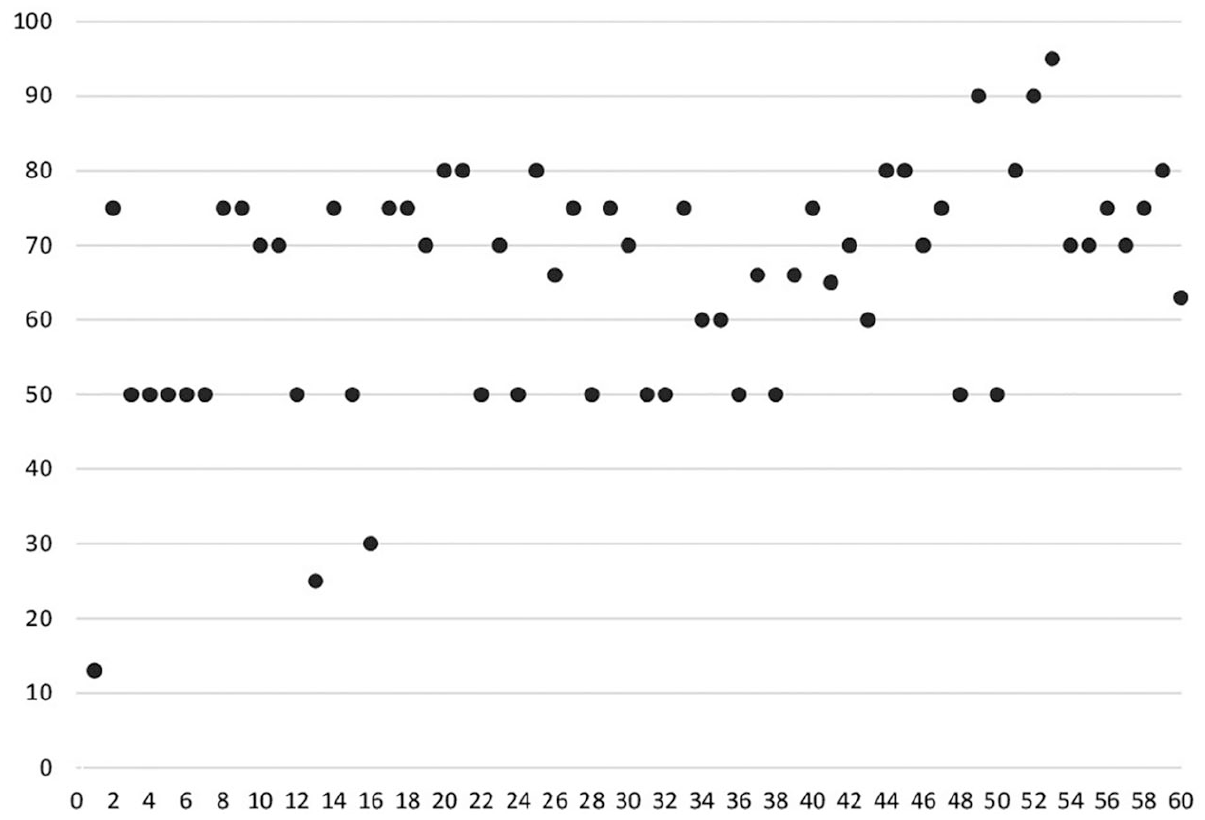
Estimates of percentage of time spent on writing based on interviews (n = 60).
However, the actual amount of time spent on writing is likely to be more than that reported in interview, as is indicated by a second data set—logs kept by social workers of their time spent on writing activities. The daily logs of writing kept by 23 social workers over a period of on average 16 days were mapped against times estimated in interviews with the same social workers (Figure 2).
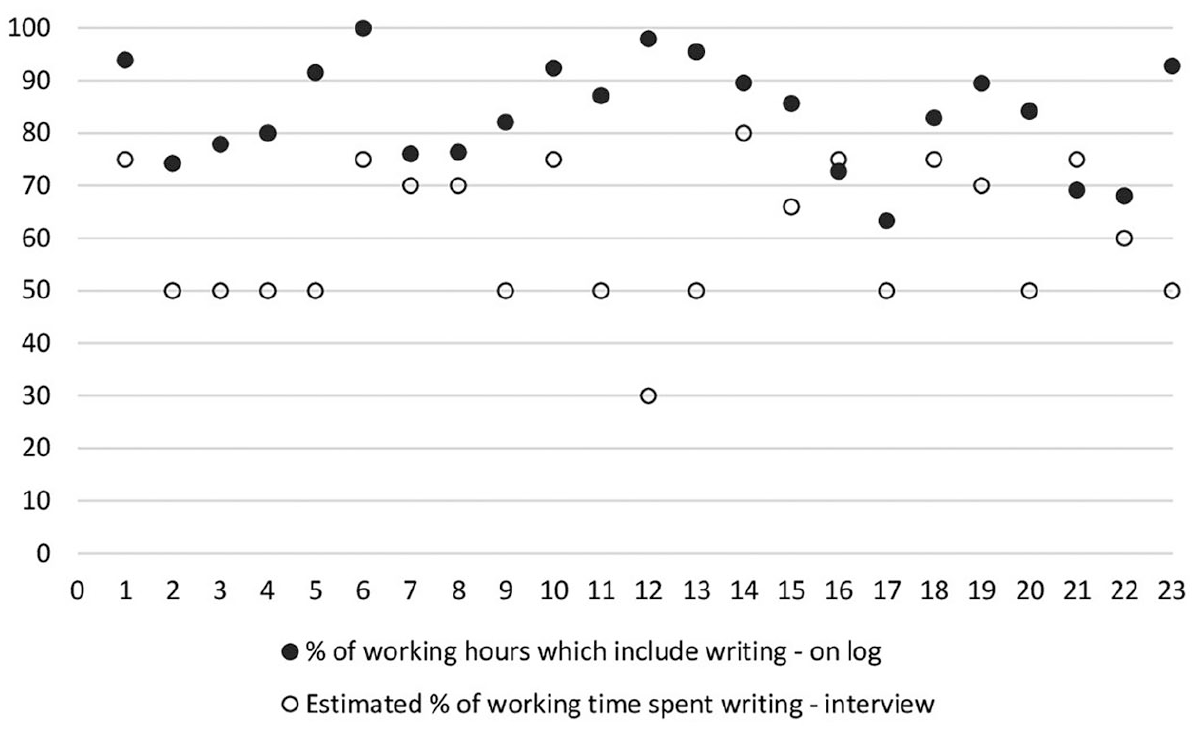
Estimates of percentage of time spent on writing as compared with actual time logged (n = 23).
The difference between time reported and time logged varied considerably from 10% to 68%. Such differences may in part be accounted for by a cluster of contextual factors, including different understandings of what constituted “writing” (even though we worked hard throughout the research to develop a shared understanding in workshops and conversations, as discussed above); the specific conditions under which logging was taking place (in very pressured moments social workers may have been more or less accurate in their logging); differences in logging because of specific practices by social workers. 12 However, the key point we take from the comparative graph is that social workers may in fact be spending more time on writing than they themselves estimate: all but two participants seemingly underestimated (based on interview) the amount of actual time spent on writing (based on logs) and the two social workers who seemingly overestimated the amount of time spent on writing as compared with time spent did so by quite a small margin (2% and 6%).
Calculating precisely how much time is spent on writing is complex because much writing takes place in coordination with other activities, for example, while talking on the phone or while reading on screen. Therefore, another way of exploring how much time is spent on writing is to not treat it as a discrete phenomenon but to track it in the way it most frequently occurs, as a “nested activity,” that is as taking place alongside / at the same time / in the middle of other activity, throughout the day. 13 Calculating writing as a nested activity involved taking each working hour as the basic unit of analysis and identifying whether writing occurred during that hour. This analysis was possible using a third data set, researcher observations of daily social work practice (which included but was not solely focused on time) and is shown in Box 2, in relation to the three specific case studies discussed in this article.
Calculating Nested Time on Writing Across the Working Week.
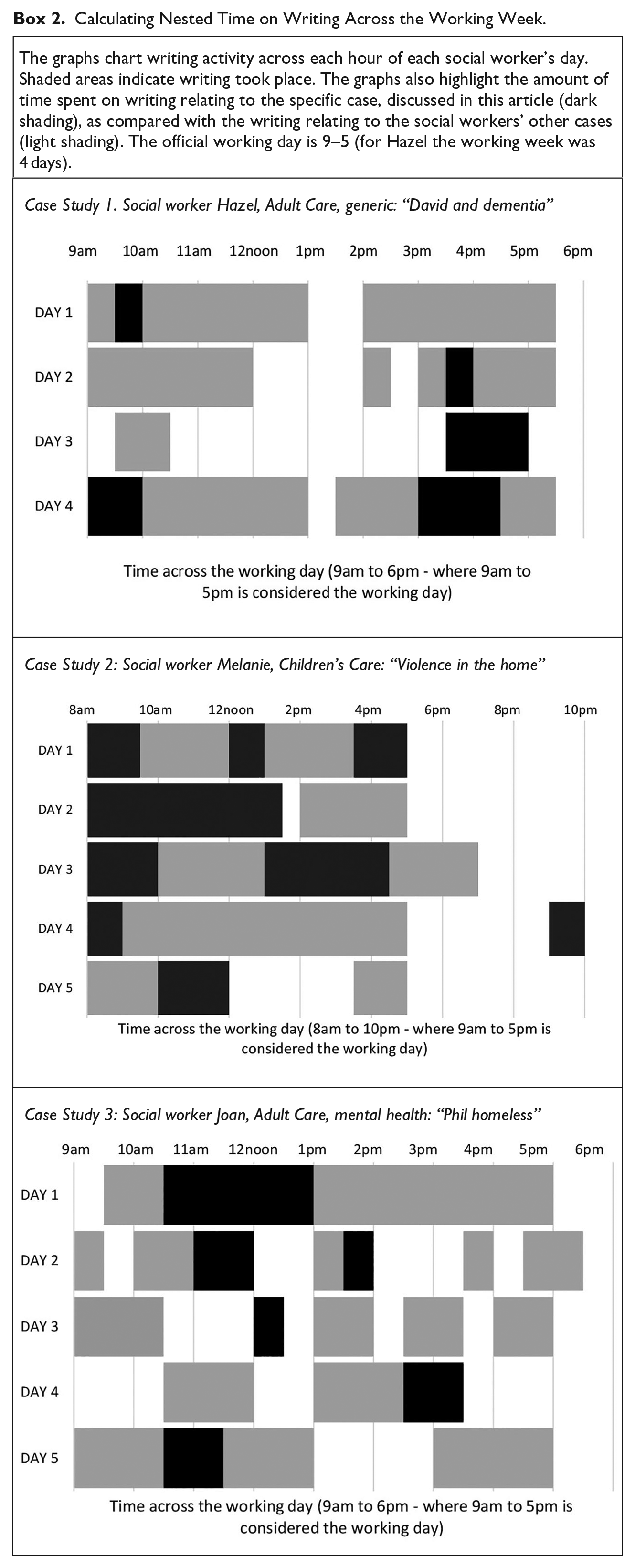
Notwithstanding individual social worker discrepancies in identifying and logging “writing,” three key findings can be highlighted about time spent on writing, based on the different data sources in this section: (a) Writing is a key part of the social work day amounting to more than 50% (based on social worker logging of time) and between 68% and 95% of the official working week (based on researcher observation). Writing often extends beyond the “working day” (as illustrated in all three case studies but is particularly pronounced in Case Study 2). (b) Writing not only takes up a lot of time but is nested within other activities, spread across every day and week, across many working hours. (c) While social workers report spending too much time on writing, they are likely to be spending even more than estimated.
Time and Entextualization
The previous section focused on time on writing as a measurable phenomenon of individual social worker activity. In this section we turn to consider time in relation to texts, drawing on the notion of “entextualization,” which can be defined, in broad terms, as “the encoding of some aspect of human experience and the cultural marking of this representation as a text—spoken, written, multimodal” (Maybin, 2017, p. 416, after Barber, 2007; Bauman & Briggs, 1990). In this section we focus on two dimensions to time in relation to entextualization: how texts as institutional documents drive particular entextualizations of time and action in social worker texts and how social worker texts as written discourse entextualize time, as traced through a focus on keywords.
Time in Institutional Documents: Driving Particular Entextualizations of Time
Social workers work within tightly regulated institutional management systems constituted by workflow structures that, increasingly since the mid-2000s, are mediated by ICT systems. Organizational workflow diagrams set out the required sequencing of action and specific timescales, including regulations around the production of texts. Such regulations are fixed when related to “statutory” requirements, that is governed by law: for example, in the U.K., the 1989 Children’s Act provides a legal definition of a “child in need” and charts the role of local authorities with respect to meeting needs. Regulations are more flexible when designed by local authorities to meet policy requirements; for example, all local authorities require case recording and set out guidelines on required content and schedules for completion. To illustrate the nature of these regulations, consider Extract 1 from “A policy, procedures and workflow” text from one U.K. local authority on the sequence of action and deadlines relating to “children in need” (CIN).
A Children in need must be seen by their allocated social worker CIN review meetings to review and
Extract 1 explicitly refers to some of the documentation, that is, the written texts, that social workers are required to produce at each stage of action (i.e., a plan, an assessment). It also indexes other written texts that social workers will need to produce (i.e., their wishes and feelings recorded, [records of] review meetings and updates to plans).
The institutionally required documentation is designed into the ICT systems in use across all social work agencies in the U.K.: several specific ICT systems are in use in the U.K., all underpinned by the same design principles (for useful history, see White at al., 2010). An extract of guidance from within a widely used ICT system in U.K. social services, Mosaic, about the documentation workflow that social workers must follow with regard to children in need is provided in Extract 2
Complete child and family assessment step
Request manager to review the assessment
Select NEXT ACTION of “develop or update child & family plan”
Complete CHILD AND FAMILY PLAN step
Request manager to review the Child and family plan
Select: NEXT ACTIONS of CHILD IN NEED VISITS AND REVIEW CHILD & FAMILY PLAN
Complete the child in need visits
Complete the child in need review step
Request Case Closure (Reading Borough Council, 2017, p. 32: lower and uppercase as in original; numbers added to enable cross-referral)
The point we wish to emphasize from Extract 2 is that it shows how the workflow is fundamentally text-driven in two ways: (a) All the actions listed involve institutionally required “text work,” that is writing and inscription practices, most of which are indexed rather than explicitly stated. Thus, for example, Step 1 involves not only a face-to-face visit and assessment but a written version of that visit and assessment that the manager will read and review in Step 2. (b) Engaging with the ICT system is itself text work, involving the social worker reading, navigating, and clicking back and forth through the system.
Together, Extracts 1 and 2 briefly illustrate the textual world which social workers inhabit and enact. It is constituted by many written texts, whether explicitly mentioned (as in plan) or implicitly indexed (as in complete assessment step). Such texts are often referred to, both within the design of the ICT systems and by social workers, as “documents,” that is, texts with a specifically institutionally (and ICT-mediated) designated name. These “documents” constitute a particular institutional “textual time” (Smith, 2005, p. 91) involving a prescribed sequence and a specific timescale (e.g., in Extract 1, “within 5 days”). In addition to the text work implicitly and explicitly signaled in Extracts 1 and 2, social workers are required to do a considerable amount of other text work every day. One obvious example is Case Notes, which are accounts of all actions, events, interactions, and correspondence relating to a person using services and written into the organization’s ICT system. Social workers are expected to keep these up to date, and they are used to warrant other documentation and all decision making (Lillis, 2017).
The range and amount of text work that social workers are required to carry out is illustrated in Box 3, which shows the text work relating to each specific “case” central to each case study. 15 While there is overlap, the texts have different imperatives from the perspective of social workers: Most texts listed are institutionally required (either by law or institutional regulation), while some can be described as professionally essential (that is writing considered by the social worker as essential to getting work done but not institutionally visible, e.g., handwritten notes in a notebook). 16
Text Work.
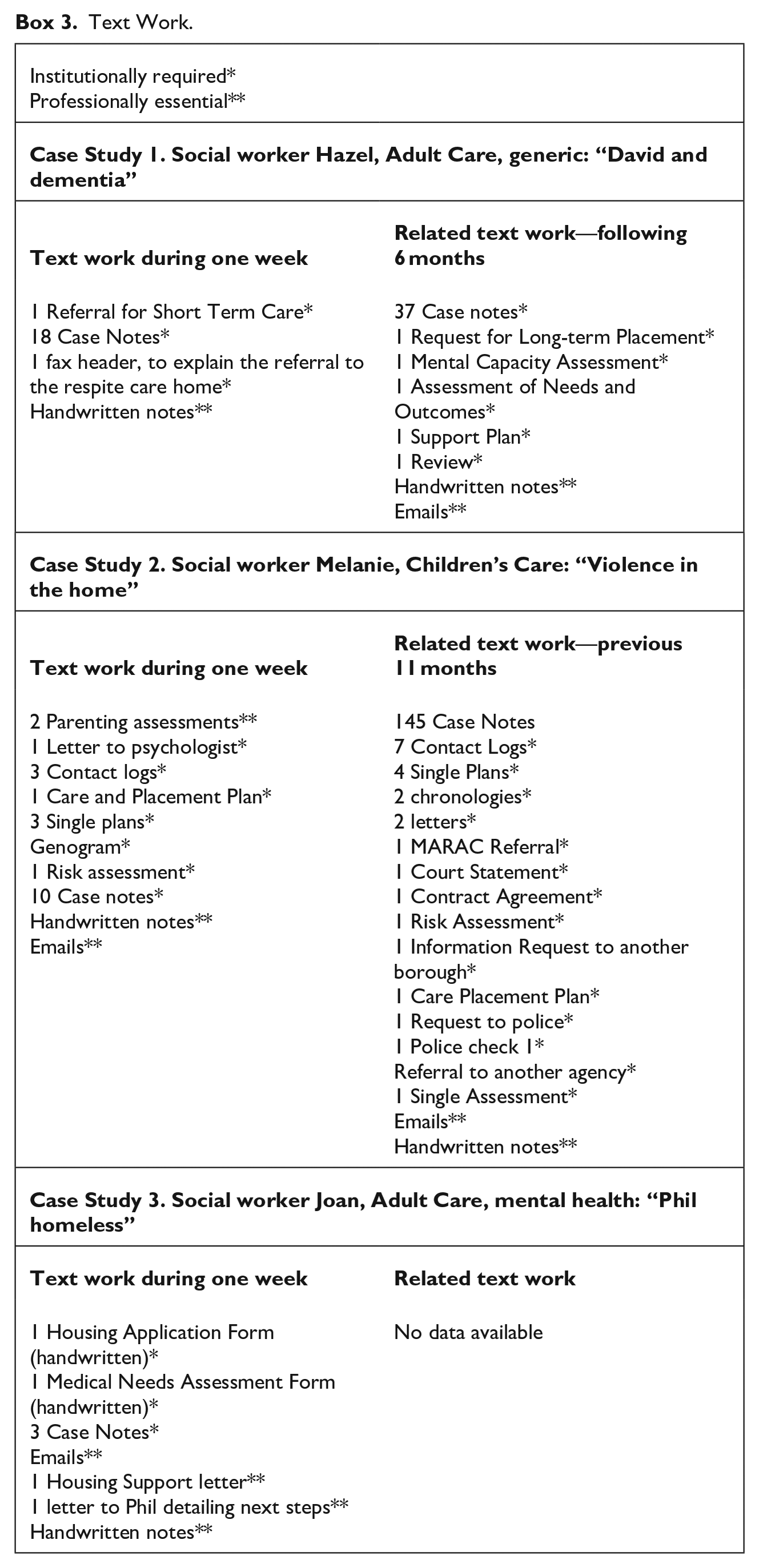
The case studies illustrate the sheer number of texts relating to a specific person/group, but they also show that texts are produced with different levels of prescription and imperatives—legal/institutional and professional. Text clusters—that is, the texts related to a specific person/group—in Case Studies 1 and 2 involve legally or institutionally required sequences and deadlines. They also include writing that is not required but is clearly essential to social workers’ professional practice, such as handwritten notes. Case Study 3 illustrates a further strand of text work that social workers often carry out, in this case relating to housing. Such text work has an institutionally contested position as it is outside of the social work ICT system and not required, legally or institutionally, but is clearly considered an essential dimension to social work practice (for another example, see Lillis et al., 2017/2020, pp. 42–44).
Time in Social Work Written Texts: Discourses of Time Entextualized
The aim of this section is to consider how time is entextualized in social worker written discourse, as traced through a focus on keywords. Keyword analysis enables the identification of lexical items (e.g., appointment, next week) that are more frequently used in a particular corpus, in this case the 1-million-word WiSP corpus of written texts, when compared to a reference corpus, taking into account any differences in size of the two data sets (for details of corpus see above; for access to corpus see the U.K. Data Service ReShare repository).
Wmatrix corpus software (Rayson, 2008) was used to extract key items (both single words and multiword units) from the WiSP corpus using British English 2006 (Baker, 2006), a 1-million-word corpus of published general written British English, as a reference corpus. The difference between the two corpora was established using keyword analysis: in this study, keyness was calculated using an effect size metric, based on the size of the difference in the occurrence of items in two corpora (Gabrielatos, 2018). 17
The keyword analysis found that
Key Items of Written Discourse in Thematic Categories Around time.
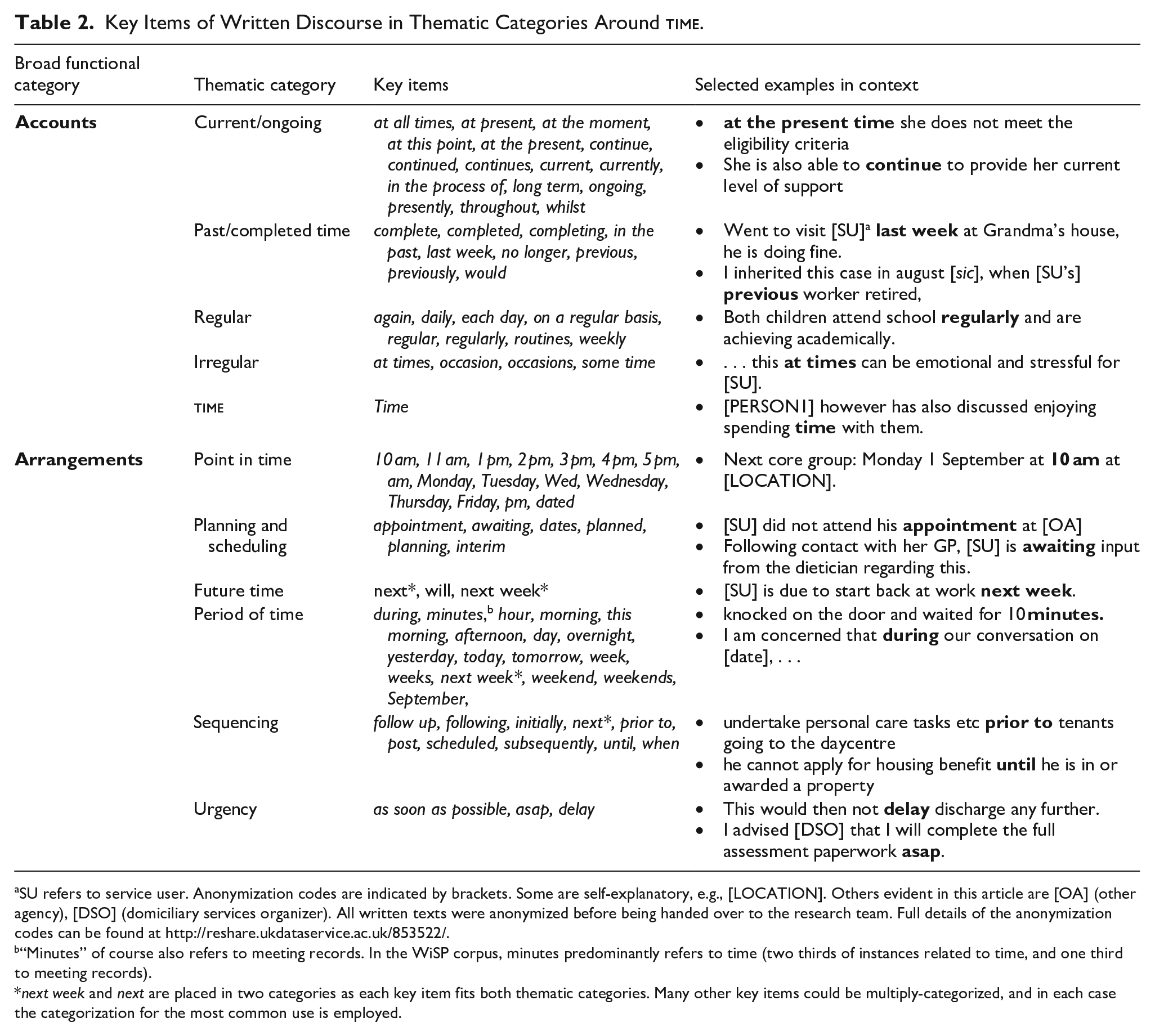
SU refers to service user. Anonymization codes are indicated by brackets. Some are self-explanatory, e.g., [LOCATION]. Others evident in this article are [OA] (other agency), [DSO] (domiciliary services organizer). All written texts were anonymized before being handed over to the research team. Full details of the anonymization codes can be found at http://reshare.ukdataservice.ac.uk/853522/.
“Minutes” of course also refers to meeting records. In the WiSP corpus, minutes predominantly refers to time (two thirds of instances related to time, and one third to meeting records).
next week and next are placed in two categories as each key item fits both thematic categories. Many other key items could be multiply-categorized, and in each case the categorization for the most common use is employed.
The prevalence of keywords around time indicates that time is a major “preoccupation” (Baker, 2010, p. 26) of social worker written discourse, with different key semantic areas of time signaled through the two overarching thematic categories in Table 2: Accounts and Arrangements. The time category of
The second broad
The subgrouping of lexis around “urgency” shows the pace of social work in general including pressures to meet writing deadlines (e.g., “I advised [DSO] that I will complete the full assessment paperwork
While clear patterns of time discourse emerge from across the WiSP corpus as a whole, variation is evident in specific clusters of texts depending on the specific person/event, as illustrated in Box 4. Following corpus linguistic conventions, each set of concordance lines contains a sample of keywords in the thematic subcategory. Lines should be read vertically, rather than horizontally; each line has a keyword in the center showing the immediate cotext that occurs to the left and right. In Case Studies 1 and 2 the importance of the thematic subcategory of regularity (Accounts) is evident in the discourse used. The sample concordance lines in Box 4 illustrate how documenting recurring events, behaviors, and activities is an important dimension to social work written discourse. In Case Study 1, regularity is signaled in reference to David’s routine in residential care (shower each day, regular meals, family visits, lines 5, 6, 7, 8, 10) as well as the regular updating of records (line 4); in Case Study 2 emphasis is on documenting stable, recurring events in a child’s life (regular school attendance, regular contact with parents, routines in care placement, lines 4, 5, 7, 9, 10), as well as behaviors perceived as less desirable/positive by the child (questioning the teacher’s actions lines, crying during contact as an attention-seeking measure, lines 6, 8). In contrast, in Case Study 3, a marked thematic subcategory is future time (in Arrangements) as action is oriented to what will need to be done in order for Phil to be housed (completing and submitting paperwork, lines 4–9).
Keywords in Text Clusters of the Three Case Studies.
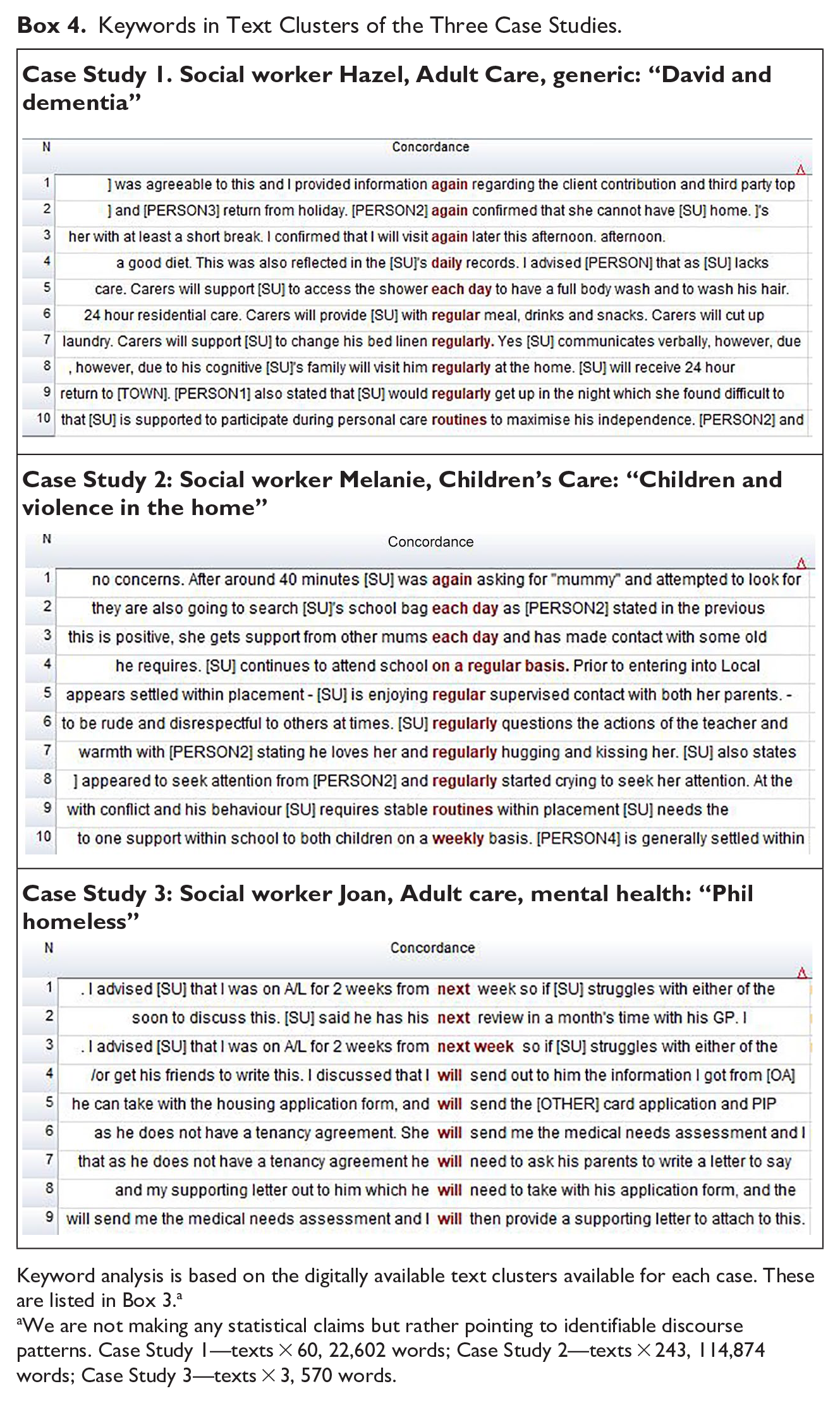
Keyword analysis is based on the digitally available text clusters available for each case. These are listed in Box 3.a
We are not making any statistical claims but rather pointing to identifiable discourse patterns. Case Study 1—texts × 60, 22,602 words; Case Study 2—texts × 243, 114,874 words; Case Study 3—texts × 3, 570 words.
Focusing on text clusters, with differential status—institutionally required and professionally required—and discourse (here through keyword analysis) adds a further dimension to understanding the relationship between time and writing in social work: the former throws light on the centrality of text work involving institutionally prescribed sequencing and timescales; the latter provides insights into how time is predominantly configured in social work written discourse, that is, to document accounts of events, people, and situations and to make arrangements for action.
Time as Lived Experience
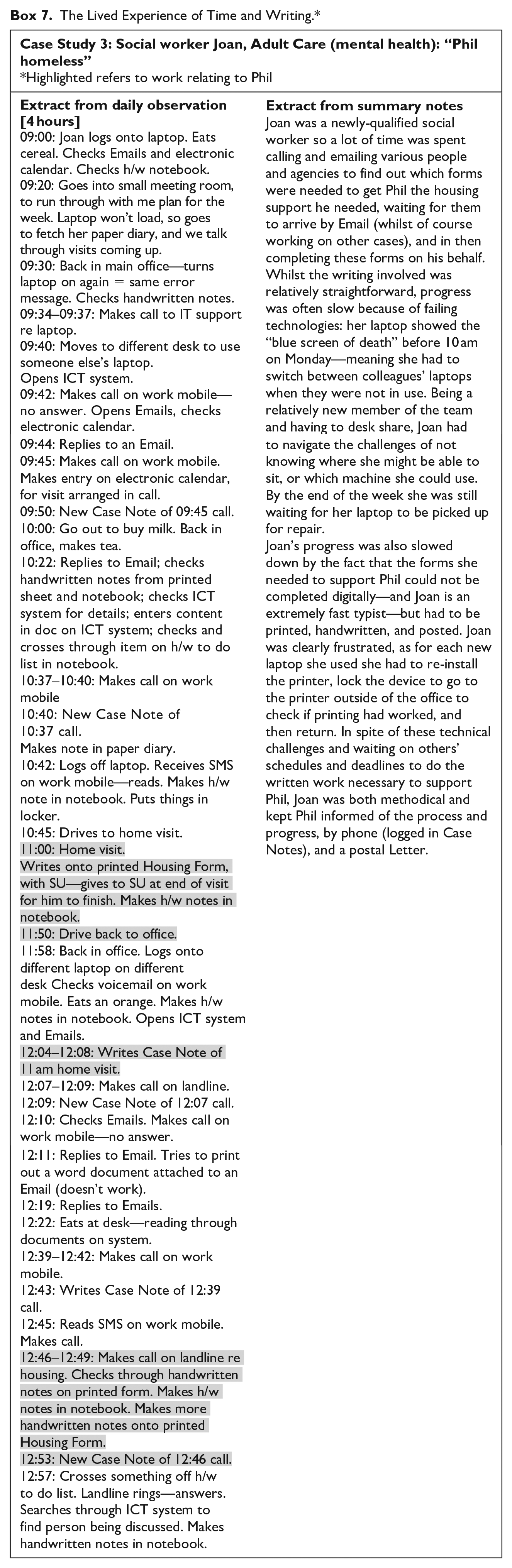
This final section of this article focuses on time on writing as lived experience, highlighting key themes emerging from interviews with 71 social workers and drawing on researcher observation and summary notes relating to the three case studies illustrated throughout this article. This section is structured around four key themes—not enough time, timescales and “real” time, interrupted time, desires for other timespaces—with boxed inserts relating to the three cases illustrating aspects of how time on writing is enacted.
Not Enough Time
A key theme to emerge from interviews was that of there simply not being enough time. This was expressed in relation to writing in general: Biggest challenge is the time element. (SW46)
18
It [writing] dominates my work and all different forms, you know. If I’m not writing emails I should be writing case notes, I might not get the time to, but I know I need to. (SW33)
Concerns about insufficient time were also expressed in relation to specific types of writing, particularly Case Notes. For example, one participant said the only challenge she faced with regard to writing Case Notes was “time” (SW40): I feel like I need more time. (SW51)
a point repeatedly echoed by others.
Some social workers underlined the lack of time available to do their work in general, signaling writing as one of two key dimensions to the “labour intensive” nature of the work: It is an incredibly labour-intensive job, both in terms of the hours spent face to face with people on assessments but also in terms of the report writing. It’s an incredibly labour-intensive job. (SW10)
The dichotomy signaled here between “face-to-face” work and “writing” is echoed throughout interviews, as for example below where the contrast is made between “visits” and “recording”: We do fall into the sort of, trap, if you like that we go out and we make sure that the visits are done because seeing the children and the families is paramount. But recording it, we don’t always have enough time to do that, so that means working over or working beyond expected hours. (SW61)
The nature of this “trap” in which social workers are caught, between “going out” and “recording,” mentioned by the above social worker, is echoed by other social workers, for example between writing “case notes” and dealing with “a child with an injury”: And what’s more important? Case notes are really, really important, but then if you’ve got a child with an injury that you’ve got to go out and go and do a medical on, that’s more important than writing up your case note. (SW59)
Writing in the office is often explicitly or implicitly contrasted with “going out,” or being “out and about”: [Writing] is just a horrendously long aspect of the job, that takes up so much time, when you would think as a social worker you’d be spending most of your time out and about---I always say to people, this job is a nine to five office job and then you’re expected to do fieldwork, and it’s like you’ve got another job. So you’ve got another job nine to five in the office doing paperwork---You’ve then got a part-time job, which is going around and seeing families, and then evidencing that in your nine to five office job. (SW04) I don’t think people realise how much time is spent in the office. (SW50)
The Lived Experience of Time and Writing.
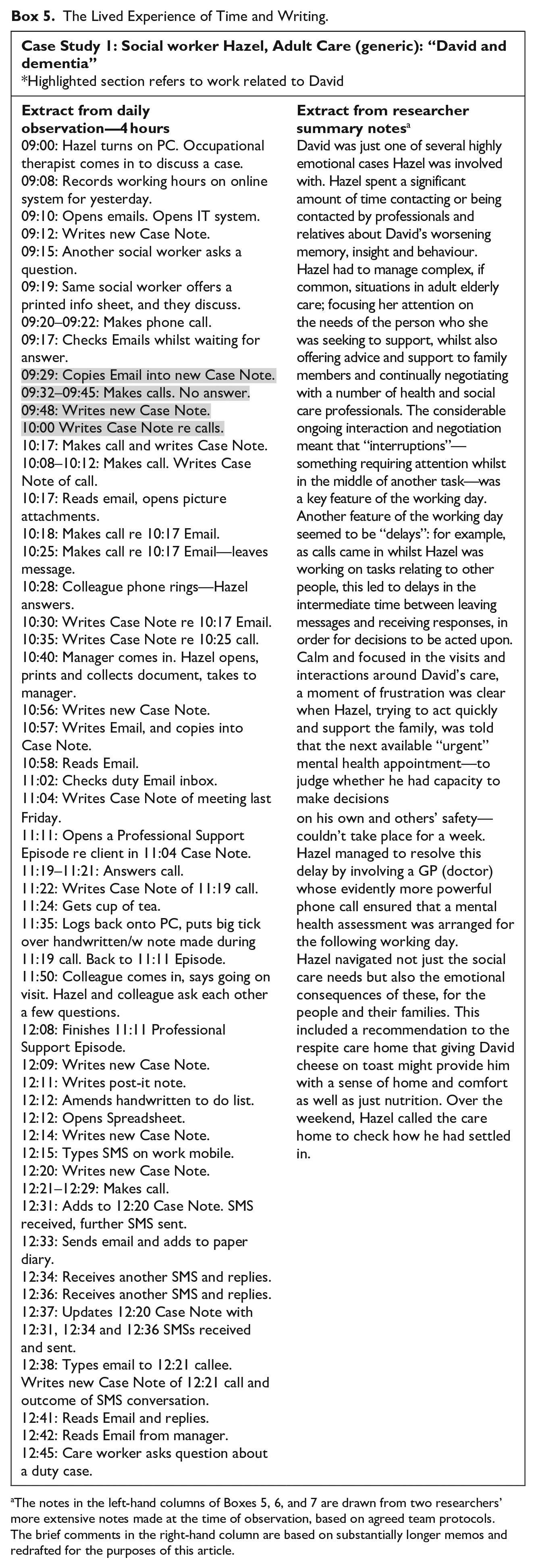
The notes in the left-hand columns of Boxes 5, 6, and 7 are drawn from two researchers’ more extensive notes made at the time of observation, based on agreed team protocols. The brief comments in the right-hand column are based on substantially longer memos and redrafted for the purposes of this article.
Time on writing is often explicitly configured as being measured against time spent with people, with deep concerns about the emphasis on the former: I don’t think the balance is right because I feel like half the time, we’re writing up when we could actually be doing something with the family. So we’re writing up about what needs to be done, but we’re not doing it because we haven’t got time because we’ve got to write it up, instead of actually having the time. (SW26)
Here, having to “write it up” is contrasted with “actually having the time,” the latter signaling control over time to do something that the social worker thinks would be valuable. Writing is often presented as an obstacle: [Writing] limits the amount of time we actually have to go and see people. (SW46)
All the social workers interviewed recognized the importance of “recording” but questioned the way this led to a reduction in time for working with people to resolve problems: So I do understand why we have to do it [write]. But I could be going out and seeing that kid once a week for an hour and doing a session on CSE [child sexual exploitation] with them in the timescales. So say it’s 40 days for the whole assessment. And then instead of keeping them open on a child in need plan, I could then redo it, see how much work we’ve done for an hour a week because that’s quite a long time. And then that would save them [the child] going on a child in need plan, it would save further intervention being needed because I’ve been able to do the intervention myself---I could have had it all done, during the assessment period. And it could have all gone really smooth, but we just don’t have the time to do that. (SW65)
Time here seems to be configured in such a way as to disable rather than enable the social worker to carry out meaningful work with the young person; ironically, and problematically, the institutionally predetermined timescale set around documentation practices seems to prevent the social worker from carrying out the actual “intervention” the paperwork is intended to facilitate.
Timescales and “Real” Time
While social workers recognized the importance of responding quickly to needs, the overwhelming sense was of timescales imposed on writing in order to audit their work: You get scrutinised very quickly on timescales with those [“looked after children” documents]. (SW02) It’s this kind of like managerialism culture, isn’t it? You know, visits have to be in ten days. So the managers have a weekly spreadsheet where they get emailed all the visits in their team, what’s been done, what hasn’t, and they’ll come round and say, you know, “this hasn’t . . . why?” Their aim is to get them all in timescale. (SW06)
Several social workers talked of systems of scrutiny. One social worker described a “names and shames” system in operation in a neighboring authority whereby the names of social workers late with deadlines are listed on a notice board. One social worker said that in her authority this public shaming doesn’t take place but that individuals are “red flagged,” that is, identified on the ICT system (for purposes of management auditing), if they are “out of timescales”: I’ve got until Wednesday and I’m seriously red flagged. I am seriously, seriously looking at some dead serious trouble there, but I’m, I’m past caring because I worked the whole weekend on some of the other stuff that had [to be done], you have to prioritise. (SW03)
Monitoring and surveillance of this kind relate to the institutionally required ICT-mediated texts (see Box 3).
Social workers talked about the timescales as being unrealistic and that “keeping up to date” with recording was a greater cause of stress than working with people: Social workers have always been under huge pressure because they’ve always had too many cases. And given the amount of writing up and forms you have to fill out, referrals, reports, all the documentation you have to do, and the timescales are totally unrealistic, the amount of writing particularly that you have to do, and that’s the pressure that social workers are under. ---That’s the part of the social work I don’t like. (SW27)
What feels like unrealistic timescales means that many social workers expressed the view that they can never actually be “on time” in institutional terms: And you’re always behind. So I’m always, particularly with typing up assessments and support plans, and purchase orders. You know, that bureaucratic documentation, I’m always behind. (SW56)
Phrases such as “always behind,” trying to “keep on top” of the paperwork, and “playing catch-up” are used throughout discussions. Even when social workers consider that they are keeping to deadlines and “things are running smoothly,” there is often insufficient time to complete the work to deadlines within official working hours: If you’ve got your caseload and it’s, you know, running very smoothly and things are going to plan, then probably, you’re always going to have to do a late visit because children are at school. They don’t finish until half four, you know, they don’t get home until half four, you’re not going to see them for half an hour and then finish your day. You know, you’re always going to have to do visits outside of working hours. But yeah I do tend to do quite a bit at home. For instance, I’ve had lots of court work going on, so literally I’ve got a set of proceedings and in those proceedings there’s been a lot of assessments come out of that. So that has meant really that I’ve had to spend quite a few Saturdays writing things up, making sure they’re done. (SW63)
Here the social worker indicates a common way in which time and space get reconfigured in order for written work to be completed—she works outside of working hours and at home.
In general, “home” is often set in contrast with the “office” as a space for doing writing work.
You tend to spend more time in the office than seeing young people. And if you do see young people more, it’s at your expense because you either get behind, or do it [writing] at home, when you’re not at work. (SW64)
The Lived Experience of Time and Writing.*
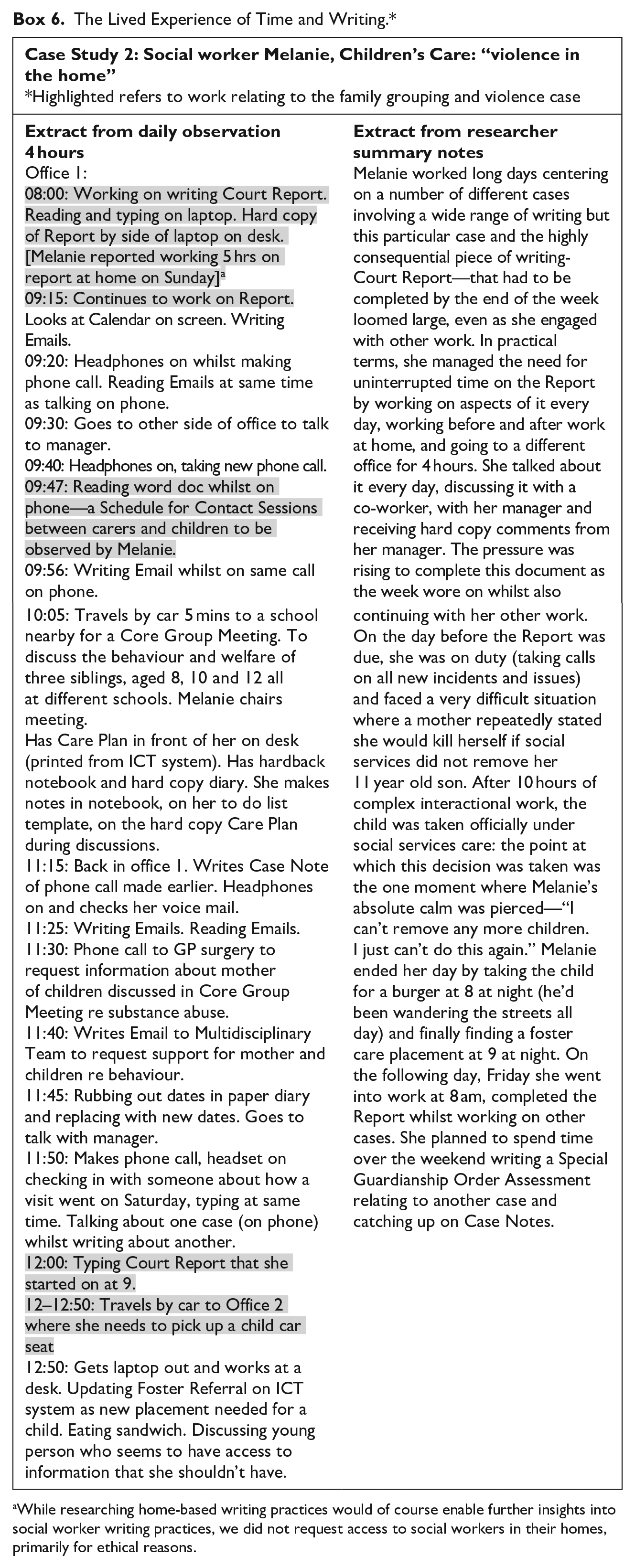
While researching home-based writing practices would of course enable further insights into social worker writing practices, we did not request access to social workers in their homes, primarily for ethical reasons.
Interrupted Time
Social workers often work at home outside of official hours because they cannot complete the required written work during the working day. But they also do this to try and secure time and space, which is of a different quality than that available in often very busy and noisy offices: If you’ve got the time to sit and write a really thorough case note then that’s great, but we don’t have that time and a lot of the time you’ll be writing a case note, you’ll get a phone call about something else or you’ll have to go out in an emergency, and you haven’t got time to finish that case note and yeah it’s time. If we had more time I think the case notes would all be brilliant. (SW59)
Here “sit and write” signals having sufficient time and space for writing descriptions and analysis of aspects of people’s lives that may be quite complex, what the social worker considers to be a “thorough case note.” However, the interrupted time evident in this extract is highlighted by many social workers as a daily challenge when writing: You know you start recording and then the phone rings and then you come back and you do a bit more and then someone turns up and then you do a bit more. (SW56)
One social worker commented on how the act of logging her daily writing (for the WiSP project) made her “realise how much I was sort of dibbing in and out of things” (SW46). The extent to which such “dibbing in and out” of writing is viewed as a meaningful nested activity, for example, writing while making a phone call, or amounts to a troublesome interruption, depends on the nature of the writing being carried out and the extent to which the writing is directly related to the other activity. Even what might be considered relatively straightforward writing—for example documenting a brief phone call—can become difficult to “keep on top of” in the context of multiple activities: So you do try and do those [case notes] as absolutely immediately as possible. In an ideal world, we can put the telephone down and case note that. Unfortunately sometimes you’ll put the telephone down and it’ll ring immediately again, and you can end up with sort of a perhaps a few pages of written notes where you’ve logged your telephone calls and not yet had the time to transfer them on to your electronic case notes. (SW58)
However, for the main part, social workers underlined the challenges caused by constant interruption to more complex writing, such as Assessments, Court Reports, and those Case Notes that aim to document and analyze complicated events, relationships, and problems: And there has been times where I’ve got an important document that needs to be done in a very short amount of time, actually, I’ve worked from home ---Because when you’re in the office environment there’s always going to be interruptions from, from, you know, phone calls, emails, other colleagues asking for things. (SW62)
One of the five agencies in the WiSP study provided some quiet spaces within offices and two allowed or encouraged some time for writing at home. However, “writing at home” mostly signaled writing outside of contractual working hours, as illustrated in the following comments: [Social workers] would be so busy they’d just be doing visits from nine until whatever, and have to then catch up on record writing at home, out of hours which isn’t ideal but it has to be done. (SW16)
The Lived Experience of Time and Writing.*
Desires for Other Times and Spaces
Social workers indicated how they would like to have more time for “careful” writing: I should spend more time being careful. I should spend more time over my writing to check its accuracy whereas you know, obviously, in a busy day you get to the point where you think, “I’ve got to just bang down that case note,” bang bang bang. And then you have to dash off and do something else when really you would’ve liked more time to make sure that it was, it was, you know, to read over it and make sure it’s correct. (SW56)
In general there is little time for drafting: You write well with drafting and redrafting. But, sadly, this job doesn’t allow for a lot of drafting and redrafting. (SW02)
Some social workers pointed explicitly to wanting more control over the writing designs and structures: If I had the time, I would produce my own template. (SW03)
The main desire, however, expressed by most social workers was for more time to spend with people: You’d like to do preventative work but there’s no space. (SW33)
One social worker articulates an example of how time “not writing” is, and could be, spent: I’m completing the assessment on there [computer] [long pause]. I spend too much time on there though. I’d really, you know, I love it when I can go into the community and talk to people. I went and sat and spoke to someone the other day and she said to me, “It’s so nice to have an intelligent conversation--- nobody has got time for me and it’s just nice to sit and talk.” We just talked about her ornaments and her jewellery and what she likes to do. ---All of a sudden somebody cares or somebody’s listening. You might not be able to do anything about it but at least “You’re listening to me. I’m getting it off my chest.” I can’t do enough of that. There’s not enough time. (SW52)
The contrast between the dominant and the desired configurations of timespace is brought into relief through mention of place but also through the reference to different material conditions and semiotic artefacts. Being “on there”—the computer, with the social worker sitting in an office, facing a screen and keying in text—is contrasted with being in “the community,” and being physically close to someone—“sat and spoke.” Talking about artifacts related to people’s lives, “ornaments and jewellery” contrasts strongly with the artefacts of the office space (for artifacts as a semiotic and literacy resource, see Van Leeuwen, 2004).
This desire for being with people, often referred to as “direct work,” was repeatedly expressed: I would like to be able to actually focus on the direct work which is the reason I came into social work, and not you know walk away because I can’t give you the quality that I want ---And it’s within that scenario I really would like to know you ---There’s too many limitations because, you know, I’ve got to also get this written up. (SW33)
Discussion
The aim in this article has been to draw on a range of data to engage with a key professional concern: time, writing and the professional goals of social work. We think it is useful to draw together findings about the relationship between time and writing in two principal ways: through a realist lens, focusing on time as a discrete measurable phenomenon, and through an interpretive lens, focusing on time as a constellation of particular chronotopes, foregrounding in particular the tensions between institutionally dominant and professionally desired chronotopes of practice.
Time as a Discrete Measurable Phenomenon
Given the profound professional concerns about time spent on writing in social work, focusing on time as a measurable phenomenon is an important aspect of practice to explore. Findings from the study indicate that a considerable amount of officially contracted work time is being spent on writing: social workers are spending more than 50% of their time (based on interviews and logs) or between 68% and 95% of the official working week (based on case studies) on writing of many different types. In addition, they are frequently writing in noncontracted time, that is, working outside of the official working day either in the office or at home. The study therefore provides empirical support for concerns and questions raised in other fora, such as professional social worker associations, service user groups, unions and inspection agencies (see, e.g., UNISON/Community Care, 2014).
Quantifying exactly how much time is spent on writing, however, is complex methodologically; what gets counted as “writing”—even where shared definitions are actively negotiated as in this study—and what gets noticed as “writing” by social workers in busy working lives vary. Perhaps more importantly, it is difficult (for both social workers and researchers) to quantify discrete time spent on writing because it is threaded through daily activities; either as directly related to an activity, such as the social worker hand writing notes or keying notes into the ICT system about a phone call while involved in that call, or as unrelated to an ongoing activity, such as the social worker writing case notes about one child while at the same time talking over a desk with a colleague about another child.
While writing is acknowledged to be a necessary aspect to practice, much writing is experienced as imposed (by legal and institutional requirements) rather than reflecting professional exigencies. Writing is often experienced as a burden, literally outweighing core activities, in particular the time that social workers wish to spend in direct interaction with people using/requiring services of different kinds. Of course, what counts as a “considerable amount” or “too much time” on writing depends on the professional imaginary (Castoriadis, 1987), that is, the specific ways in which social workers imagine or desire their professional work to be. Writing and producing written texts (unlike some other professions, e.g., journalism) is not a professional goal of social workers (a point underlined by a national U.K. inquiry into child protection, Department of Education, 2011); rather writing (as a process of coming to understand a situation and as a product toward driving action) is seen as one means (among many) of meeting the professional goal of securing care and services for vulnerable children and adults. 19 In order to more fully understand the problematics of time and writing in professional social work and the potential consequences for social work as a profession and their service to the public, it is useful to draw on the notion of chronotope in order to articulate time in relation to space, contexts, participants and human agency.
The Chronotopes Constituting Social Work Professional Practice
Bakhtin (1935/1981), developed the notion of “chronotope” to articulate the specific timespace configurations in literary texts. For example, he characterizes the 19th-century Western novel as being driven by “real historical time” (events unfolding sequentially over time) which in turn is linked to specific dimensions of place and space, such as the particular places in which events take place involving specific types of participants (for overview, Bemong et al., 2010). As Schryer (2002) points out, Bakhtin’s notion of chronotopes helps make visible the existence of different timespace configurations and related patterns of character agency in literary genres, but also the different opportunities for human agency more generally: she compares the constraints placed upon agency by the chronotope governing Greek adventure romances with the affordances for agency in the chronotope governing metamorphosis stories (pp. 84–85).
The notion of chronotope has been taken up by rhetorical genre theorists in some analyses of nonliterary writing, most obviously of student and education-based writing (e.g., Bloome & Katz, 1997; Prior, 1998) and to a lesser degree of work-based and professional writing (e.g., Schryer, 2002 on negative letter writing in insurance companies; Prior & Shipka, 2003 includes professional academics’ writing). Such studies explore chronotopes of literate (rather than literary) practice involving analysis of texts and textual genres (closely following Bakhtin) as situated and embodied. This situated or social practice orientation toward chronotopes has more recently been taken up in critical sociolinguistics by Blommaert (2018) who has argued for the importance of chronotope in exploring everyday discursive practice, as a way of delving into and adding nuance to the ethnographic interest in “context.” The specific discourse used by rhetorical genre theorists and sociolinguists to apply chronotropic dimensions to empirical research differs—genre theorists tending to use literary-inflected terms such as “scenes” and “characters,” albeit framed with specific sociocultural theories, such as cultural historical activity theory (e.g., Prior, 1998; Prior & Shipka, 2003) whereas sociolinguists use a marked sociolinguistic discourse, such as “social situations” and “people” (e.g., Blommaert, 2018) . There is nevertheless agreement on the value of using the notion of chronotopes to articulate timespace configurations of language and literacy practices in daily lives. The use of chronotope as an embodied textual or literacy practice can be seen as one productive way of “closing the conceptual gap between text and context in writing studies” (Lillis, 2008; see also Witte, 1992).
It is possible to identify the existence of a number of core chronotopes of literacy practices that constitute the social worker day, each involving particular technologies, lived spaces, and relationships, and constituting particular ways of being a social worker: sitting at a desk in a noisy office keying text into the ICT system via a laptop, with the social worker orienting both to immediate time (e.g., accounts and analysis of a particular situation) and more distant time (e.g., predesigned legal and institutional criteria, deadlines and schedules); traveling between offices (some social workers worked across four office sites) and between offices and other spaces including people’s homes, schools, hospitals, and secure centers, by car or by public transport, alone or with others (colleagues, other professionals, service users), drafting notes on paper or screen while traveling; sitting in institutional meetings such as in schools and hospitals, writing in a notebook or on a laptop while at the same time as interacting with teachers, doctors, psychologists; sitting on a floor in someone’s home, playing a game with a child, and writing handwritten notes in a note book at the same time or later while sitting in a car after a visit. Chronotopes of literacy practices involve particular ways of being, with the social workers at various points enacting different literacy-mediated personae. These include an authoritative scribe (most obvious when the social worker is in the office writing into templated documents on the ICT system); a literacy and resources broker (most obvious when the social worker is literally traveling with texts—completed or in process—back and forth between people and places); a sense maker of people’s lives (most obvious when the social worker sits in her car or on a bus, drafting in handwritten notes or on a laptop an account and analysis of a situation/person).
A Dominant Chronotope Governing Literacy Practices
While there are multiple chronotopes constituting social worker practice, overlapping and seeping into each other (e.g., writing notes in a car after visiting a family then are part of a trajectory which leads to Case Notes, Assessment Reports, Court Reports), findings from the study indicate that there is an institutionally dominant or meta-chronotope governing social work practice, three dimensions of which are outlined below (for examples of other studies articulating chronotopes at differing levels, “main” and “subsidiary/minor,” see Jack, 2006; Marková & Novaes, 2020).
The first and most obvious dimension to what we refer to here as the institutional chronotope is the treatment of time as a material, bounded, sufficient resource. Within this chronotope social workers are deemed to have particular activities to carry out, including writing tasks to particular deadlines, in particular places, using particular technologies. This meta-chronotope is institutionally determined but is co-opted by social workers to some extent in their own discourse about writing: most obviously the idea that time is a bounded, adequate resource (e.g., a social worker assuming that they should be able to be complete writing within demarcated contracted time, and if not it is their responsibility to write at home), that time is a stable resource against which action is evaluated (e.g., social workers describing themselves as being “late” or “slow”), and that time is something that is individually owned and controlled (e.g., a social worker talking about “having too little time”). Not completing writing tasks within institutionally demarcated time can be experienced as individual fault or failure—e.g., “not good enough” or “not fast enough” at writing—and anxiety over meeting deadlines for “paperwork” is evident in both social worker accounts in interviews and in their written texts, where concerns about meeting deadlines are routinely expressed.
The second dimension to this institutionally dominant chronotope centers more specifically on a particular ideology of writing and time. Institutionally, writing occupies a paradoxical position: writing-as-texts (inscribed and stored via the ICT system) is highly visible (and missing or late texts are quickly noted); writing-as-labor (the processes, time and space necessary for producing texts) remains largely invisible. This paradox at the heart of the institutional orientation to writing may account for the troubled way in which social workers experience writing as an interrupted activity: writing is often interrupted (e.g., having to answer a phone call while in the middle of drafting a Case Note), but writing interrupts or even prevents other meaningful activity (e.g., the fact of having to write a Case Note rather than visit a family). This paradoxical orientation to writing reflects an ideology of writing common in public discourse (see Lillis, 2013), that (a) writing is a transparent medium (to “write down” what the social worker knows) and therefore relatively straightforward to carry out, evidenced not least by the lack of time for drafting what are often complex texts; (b) writing has primarily a transactional purpose (to get things done). This last is evidenced by the corpus analysis showing “Accounts” and “Arrangements” to be key semantic areas in written social work discourse. While the transactional dimension to social work is not surprising—a key aim is to secure services for people—social workers question whether the amount of “paperwork” currently required is actually necessary to secure such action.
A third dimension to the institutional chronotope is what can be described as the ideology of “textual time” (Smith, 2005, p. 91). This captures the dominance of the bureaucratic function of writing which is premised on the idea that everything (action, situation, comment, perspective) has to be recorded, via the ICT system, and which many social workers see as instantiating a managerialist culture of practice. But we also use “textual time” to signal here that the written text itself is literally becoming the measure of everything that is done. There is some evidence to indicate that texts are acting as proxies for real time, such that action is literally measured by the amount of written text produced rather than actual time spent: if a manager is ever looking at your productivity or whatever, obviously
Here the social worker indicates that in fact the opposite is true: if a social worker is more active in “direct work” with people, there are likely to be fewer or shorter written texts.
It is not only some managers who are using textual space as a proxy for actual work timespace, but also social workers. Researcher observation documents two social workers discussing their work with both expressing surprise at the shortness of several Case Notes as compared with the actions and events the Case Notes seek to document. They felt that the Case Notes did not reflect the actual time spent and that perhaps the notes themselves needed to be longer so that the length of the text might more accurately reflect the length of time spent working with people. This evaluation is problematic because it may be leading to social workers doing even more writing in an attempt to make the space taken up by a text literally to reflect the space and time taken up in action, thus providing an account of their professional practice that is legitimized by managers and institutions. The dominance of textual time in professional practice has potentially profound consequences for the nature of contemporary social work as a profession and in terms of services offered.
Desired Chronotopes
The importance of articulating the particular timespace configuration in social work is to remove its taken-for-grantedness and hold it up for critical consideration. Chronotopes are not “neutral” or “nonrandom” but rather enact specific modes of social action leading to specific social effects (Blommaert, 2018, p. 4), and, in so doing, exclude others. The obvious immediate social consequence underlined by social workers is a reduction in time to work directly with people. While many chronotopes constitute daily social work practice, the dominant or meta institutional chronotope is experienced by many social workers as problematic, even though the same ideology underpinning the dominant ideology is echoed in some social worker discourse.
Within this dominant chronotope, social worker agency with regard to writing is clearly evident, in the multitude of meso-level decisions: about which text to write, when, for which specific purposes and including which specific details, constantly juggled and reordered throughout changing pressures of the day. 21 And social workers are clearly striving to maintain control over what they consider to be meaningful chronotopic dimensions of literacy practices. This includes decisions made around the use of specific technologies of writing: while institutional working spaces (e.g., the office, schools, homes visited) are officially designated as “paperless” (the only legitimate inscription practices being via the ICT system), social workers continue to use handwritten inscription practices, on odd pieces of paper as well as in hardcopy notebooks (the latter kept by all participants in the study, with different archiving practices of such writing in different agencies.). A key reason given by all but one social worker in the study for not using laptops, or iPads, when interacting with service users—adults, children and their families—was the importance of direct human contact, without the obstructions of electronic devices.
Struggle for agency and control is also evident in social workers’ decisions to write outside of contracted hours, either early/late in the office or at home. While unhappy that writing tasks cannot be completed within contracted time, the decision to work at home can be seen as the social worker seeking to create a different timespace relationship with writing, and in the process endeavoring to create a different relationship with the people they are working with. The chronotope of writing at home is characterized by a slower, calmer time, using multiple technologies, as well as indexing a space that enables more careful thinking and writing, in contrast to writing in fast, noisy timespaces, such as offices or when in transit in cars and buses.
Conclusion
This article seeks to contribute to understandings about time and writing in the contemporary workplace by providing empirical data on a specific underresearched domain, professional social work. The principal focus has been on time, conceptualized as a discrete measurable phenomenon, as a textual dimension to social work written discourse, and as a configuration of lived experience. The notion of chronotope was used to capture some of the deeper problematics of the significance of time and writing for professional social workers. This article provides insights into the nature and consequences of what has been described as the “textualisation of the workplace” (e.g., Iedema & Scheeres, 2003; Karlsson & Nikolaidou, 2016). It also provides further empirical support for what Brandt (2015), in the title of her book describes as “the rise of writing” across all domains of practice in western societies. However, rather than problematizing a shift in balance toward writing away from reading, this article foregrounds the consequences in one professional domain of a shift toward writing away from direct human encounter with people.
In the context of a growing political crisis over social care in the U.K. and globally in terms of funding, organization and quality (International Labour Organisation [ILO], 2018) and significant debate internationally about social work in the 21st century (Ferguson et al., 2018), there is an urgent need to critically examine all aspects of current social work practice. It is hoped that findings articulating the relationship between time and professional social work writing will make a contribution to such an important (but underresearched) public debate, by engaging with the three imperatives driving much work on professional writing, referred to in the introduction: academic—by providing data sets, findings and insights relating to writing in a previously underresearched professional domain; pedagogic-interventionist—by working with social workers and social work educators to build resources that illuminate the nature of everyday professional writing while highlighting writing as a contested dimension to practice; 22 professional—by continuing to engage with key stakeholders and regulators to open up debate about the challenges, constraints, and affordances of writing as a key semiotic practice in professional social work. 23
Footnotes
Appendices
Acknowledgements
We would like to offer our deep appreciation to the local authorities and all the social workers who so generously took part in the WiSP project but who have to remain anonymous for confidentiality reasons.
Declaration of Conflicting Interests
The author(s) declared no potential conflicts of interest with respect to the research, authorship, and/or publication of this article.
Funding
The author(s) disclosed receipt of the following financial support for the research, authorship, and/or publication of this article: The WiSP research project was funded by the Economic and Social Research Council ES/M008703/1 and The Open University, UK. The research was carried out by Theresa Lillis (Principal Investigator), Maria Leedham (Co-Investigator), and Alison Twiner (Research Associate). We would like to thank Dana Therova for her support in carrying out keyword analysis and the anonymous reviewers and WC editor for their critical and creative comments on earlier drafts of this article.