




Abstract
Latino Day Laborers (LDL) experience high rates of occupational injury while navigating worksite hazards without adequate safety equipment or training. As such, LDL implement simple safety behaviors which may not reflect standardized labor safety practices. This study aims to demonstrate the validity of a scale measuring LDL safety practices. A 22-item scale was developed through qualitative analysis of interviews with LDL. We first validated our scale in a cross-sectional study with 149 LDL. After conducting exploratory and confirmatory factor analysis, a final 15-item safety practices scale emerged. Lastly, we cross-validated our scale with a second sample of 318 LDL. The EFA resulted in three distinct dimensions of safety practices: preparation safety, harm mitigation, and proactive communication. The CFA results from both samples supported a three-factor model. Our study provided evidence for a valid and reliable scale to measure the safety practices of LDL.
Introduction
Latinos contribute a rapidly growing share of the United States labor force, which has nearly doubled from 12.1 million workers in 2011 to 18.3 million in 2021 (US Bureau of Labor Statistics [BLS], 2022). Fatal occupational injuries are consistently higher for Latinos than for their white, non-Hispanic counterparts (Dong & Platner, 2004; Quandt & Arcury, 2020). While the overall rate of fatal workplace injury remained the same, 3.5 per 100,000 from 2018 to 2019, the rate of workplace fatality for Latino workers rose from 4.2 to 4.5 during the same period. Foreign-born Latinos are at increased risk of serious workplace injuries and death and routinely experience a disparate share of workplace fatalities. While Latinos account for about half of the foreign-born workforce in the United States, there were twice as many fatal occupational injuries among foreign born Latinos workers compared to native born Latino workers in 2018 (Bucknor, 2016; CPWR – The Center for Construction Research and Training, 2018). Foreign born Latino workers are significantly more likely to be employed at workplaces with increased risk of work-related injury and disability where they typically encounter multiple exposures to a variety of hazards (Fernández-Esquer et al., 2015; Seabury et al., 2017). In 2018, the construction industry represented the labor sector with the highest number of foreign-born Latino worker fatalities compared to all other industry sectors, and is one of the most common and most dangerous sources of employment for foreign-born Latinos (American Federation of Labor and Congress Industrial Organizations [AFL-CIO], 2020; BLS, 2021; CPWR – The Center for Construction Research and Training, 2018).
LDL are a growing subgroup of immigrant Latino men that wait for work at public sites commonly referred to as “corners” or “esquinas” and are often hired to perform construction work and other forms of manual labor. They are self-employed and work on short term assignments based on informal and unregulated verbal agreements with employers who seek them out at these locations. LDL are at increased risk for occupational injuries and illnesses due to the nature of the work they perform, their lack of formal safety training, and their reluctance to decline or report unsafe work conditions (Pransky et al., 2002; Sheehan et al., 2016; Valenzuela et al., 2006; Walter et al., 2002). In 2015, about 27% of Latino workers employed in the construction industry were day laborers, the construction trade with the highest number of fatalities between 2011 and 2015, 988 (CPWR – The Center for Construction Research and Training, 2018). While there are no nationally representative studies of Latino workers in construction that distinguishes the day labor from the non-day labor sector, most LDL report that most of their work involves a job in construction (Fernández-Esquer et al., 2015; Valenzuela et al., 2006).
Workplace safety for construction industry workers has been named a top priority in the United States (US) but continues to be a major challenge. Fundamentally, construction work is a hazardous occupation which inherently carries some degree of risk, requiring special consideration for employee safety. However, research indicates that individual worker behavior (i.e., human error) accounts for up to 94% of reported accidents in the construction industry (Li et al., 2020; Salminen & Tallberg, 1996). These findings suggest that many or most of the reported construction accidents resulted from unsafe worker practices which may have been prevented. Studies have found that interventions promoting safe workplace behaviors can help workers mitigate some of their occupational risks (Van der Molen et al., 2012). As such, careful investigation of workers’ individual behaviors is critical step toward understanding and preventing occupational accidents on construction sites.
Previous efforts to measure occupational safety have focused on safety performance which is defined as “actions or behaviors exhibited by individuals in all jobs to promote the health and safety of workers, clients, the public, and the environment” (Burke et al., 2002). In recent years, researchers have advocated for the use of multi-dimensional frameworks for standardizing and measuring construction workers’ safety behavior, which should reflect specific material conditions of worksites as well as workers’ social and personal characteristics (Burke et al., 2002; DeArmond et al., 2011; Griffin & Neal, 2000; Hofmann et al., 2003). However, such measures of safety performance are typically conceived by analyzing rigorous and complete sets of data and incident reports of accidents taking place in closely monitored and regulated settings (Eskandari et al., 2021). Such safety performance scales often align with standard safety recommendations and include lagging indicators such as number of near miss incidents, lost workdays, and injury frequency and severity.
However, these scales are better suited for application within organizational environments as a record of the organization’s compliance with safety standards, and will have limited applicability on the small, unregulated, and precarious worksites where LDL often find work. There are few studies that focus on understanding safety practices for LDL and, no practical tools have been proposed for measuring their safety behaviors at work. Recent research has illuminated the severe precarity LDL encounter while informally employed to work construction. The various hazards they frequently encounter in their workplaces often result in severe and non-severe injuries that can lead to temporary or permanent incapacitation (Fernández-Esquer et al., 2015, 2021). LDL often endure these exposures while employed with small construction companies or private contractors that exercise minimal oversight and that discourage LDL from demanding safer work conditions (Flynn et al., 2015; Welton et al., 2020). Factors such as discrimination, undocumented status, and labor exploitation contribute to the structural vulnerability of LDL (Fernández-Esquer et al., 2021; Negi et al., 2020; Valenzuela et al., 2006).
Although the incidence of occupational injuries among LDL are inextricably tied to the conditions of the workplace and workers’ own socioeconomic adversities, their ability and willingness to implement simple safety practices can prevent some occupational accidents from occurring. These strategies are the result of practices that have emerged over time from their own individual and collective experiences. While the range of safety practices that they might be able to implement is limited given their precarious work conditions, inadequate training, and lack of equipment and oversight, it is vitally important to develop instruments capable of measuring performance of such safety behaviors. Such a measure is necessary to recognize the utility of LDL’s lay safety strategies, to contextualize the incidence of occupational injuries among LDL, and to recognize opportunities for interventions to help LDL stay safe in spite of the numerous structural vulnerability they encounter while working.
The purpose of this study is to report the creation and validation of a safety practices scale which was systematically derived using language taken directly from LDL’s description of safety behaviors undertaken while working in hazardous environments.
Methods
Measure Development
The instrument was derived through systematic qualitative inquiry of interview data collected from LDL “in situ” on the street corners where they seek employment. Twenty-five interviews were conducted in Houston, Texas while pilot testing a Brief Motivational Interview (BMI) intervention promoting workplace safety among LDL. See Fernández-Esquer et al. (2022) for more information regarding the pilot study. Motivational interviewing is an intervention technique through which a trained expert leads a discussion to promote the participant’s self-efficacy to perform a health behavior which is realistic and meaningful for their own socioeconomic and cultural context (Miller & Rose, 2009; Romo et al., 2009). Brief motivational interventions have been effective when used in community settings and they have shown high feasibility and acceptability among Spanish-monolingual Latino immigrant men (Lee et al., 2013; Ornelas et al., 2019; Serrano et al., 2018).
We followed a three-step process involving sequential rounds of qualitative inquiry to establish a non-redundant and exhaustive list of safety behaviors reported by LDL as performed to reduce the risk of injury while working. An initial set of behaviors was coded in Spanish based on responses to two prompts at the end of the motivational interview: first, “¿Que hará usted para disminuir los peligros en su lugar de trabajo, a pesar de los obstaculos?” (“What will you do to reduce the dangers in your workplace, despite obstacles”), second, “Desde hoy en adelante, esta es la promesa que me hago a mi mismo. . .” (“From this day forward, this is the promise that I will make for myself. . .”). We subsequently compared our initial codes against interviews collected during the BMI’s pilot, at baseline, and at 2-weeks follow-up to add additional codes before revising the list of behaviors and their operational definitions.
To assess inter reliability (IRR), two researchers independently coded 25 LDL’s responses to prompts recorded during the follow-up interviews with the BMI participants of the pilot study. A table was designed to facilitate comparison of each raters’ scoring of the same dataset, with columns corresponding to each interview prompt and rows for each participant’s transcribed response (1–2 sentences each). Raters used empty cells adjacent to each section of the transcribed interview to code the specific behavior or behaviors mentioned by LDL in their response. Both a total score count and a score agreement count were assessed cell-by-cell for all 25 participants’ responses. Total score count was the sum count of codes (behaviors) identified by either rater across all cells while score agreement was the sum count of codes (behaviors) that both raters identified in common for each specific cell. In all, researchers identified a total of 145 behaviors mentioned by LDL in the interview transcripts, and researchers agreed on 103 of these codes, resulting in an interrater reliability of 0.71.
Our approach was founded on the assumption that academic researchers have limited familiarity with the sociocultural factors impacting workplace safety for LDL, and that LDL are experts in this regard. The final codebook of safety behaviors and our procedure for deriving it were presented to an LDL Community Advisory Board and were determined to have good face validity. This approach resulted in the creation of the first version of the safety practices scale, which contained 22-items, and comprised the set of safety behaviors LDL reported implementing at work to reduce risk of injury.
Study Location and Recruitment
The scale was tested during a rapid need assessment (RNA) survey conducted from November 20, 2019, to December 7, 2019 among 149 LDL recruited from 15 locations where they seek employment or “corners” in Houston, Texas. Some of the corners were located in the parking lots of home improvement stores and convenience stores, shopping plazas, and street intersections. Prior to completing the survey, all participants were assessed for eligibility and provided informed consent. The inclusion criteria to participate in the study were: (a) age 18 years old or older, (b) Latino origin, (c) currently looking for work at the corners, and (d) previously hired at least once as a day laborer. Study protocols were reviewed and were granted approval by the University of Texas—Health Science Center at Houston Committee for the Protection of Human Subjects.
A list of previously identified corners where LDL congregate to wait for work was utilized and corner locations were randomly selected from that list. The field team visited the corners in the order in which they were chosen and appeared on the corner schedule list. Although Spanish fluency was not an inclusion criterion, all of the interviews were conducted in Spanish, by trained interviewers who approached LDL as they were waiting for work at the corners. The interviewers explained the purpose of the study, obtained consent, and then read each question out load to the participants and captured their responses electronically, using Qualtrics installed on iPad tablets. After successfully completing the survey, LDL were compensated for their time with a $30 visa gift card. On average, it took participants 57 min to complete the RNA survey.
For the cross-validation analysis, a second sample of LDL recruited to participate in a cluster randomized clinical trial (CRT) was utilized. These participants were recruited using the same methodology and procedures as the RNA. A total sample of 318 LDL were recruited from 32 corners across Houston, Texas between May 2021 and September 2021.
Measures and Data Analyses
Participant characteristics recorded included age, years in the US, years on the corner, and years of school completed. Means and standard deviations were computed for these continuous measures. We also recorded spoken language and country of origin. Percentages were computed for these categorical measures.
The initial safety practices scale consisted of 22 items (Table 1) prefaced by the stem, “When you worked as a day laborer in the last month, how often did you. . .?.” A sample item was, “Stop working when you felt physical pain.” A four-point response scale was used with 1 = Never; 2 = Sometimes; 3 = Many Time; 4 = All the Time. Respondents could also respond that a given item did not apply to their situation or refuse to answer any item. Items were reversed scored as necessary so that higher scores indicated safer practices.
Original Safety Practices Items.
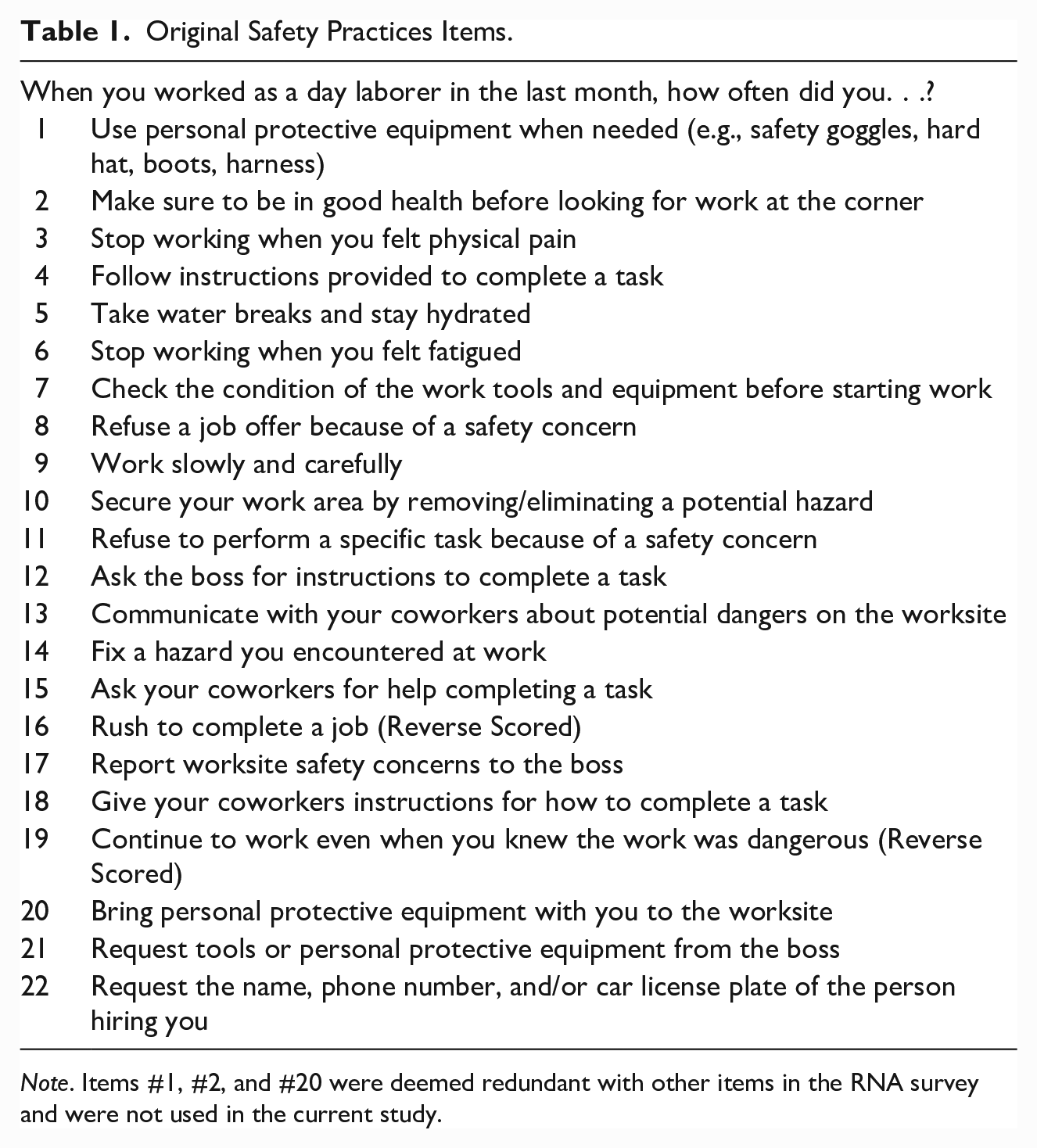
Note. Items #1, #2, and #20 were deemed redundant with other items in the RNA survey and were not used in the current study.
An exploratory factor analysis (EFA) using principal components extraction and varimax rotation was conducted to characterize the relationships among the items in the scale.
Following the EFA, we sought to confirm the scale structure using a confirmatory factor analysis (CFA) with the same data. Items were constrained to load on only the primary factor identified in the EFA and factors were allowed to correlate. In essence, the CFA model imposed a strict definition of “simple structure” onto the model and tested it for fit (are the patterns of responses found in the data consistent with the hypothesized mode?). The fit of the CFA was assessed with the comparative fit index (CFI) and the root mean square error of approximation (RMSEA). CFI values between 0.90 and 0.95 are considered an acceptable fit, and CFI values >0.95 are considered a good fit. RMSEA values between .05 and .08 are considered a reasonable fit, and values ≤.05 are considered a close fit (Browne & Cudeck, 1993; Hu & Bentler, 1995). To assess the stability of the model, we then conducted a second CFA with an independent sample of 318 LDL in Houston, surveyed as part of a field trial between May and September 2021. Analyses were conducted using SPSS version 28 and Mplus version 8.7.
Results
Characteristics of the two study samples are shown in Table 2. On average, participants were in their mid-40s, had been in the US approximately 15 years and had been looking for work on the corners 5 to 6 years, and had completed 7 to 8 years of school. The majority of participants in each sample spoke only Spanish. The majority of participants in each sample were from Central America while over one-third were from Mexico. Twenty percent (20.1%) of participants in the initial sample were from Guatemala compared to 10.7% in the second sample. Six percent (6.0%) of participants in the initial sample were from Cuba compared to 13.8% of participants in the second sample.
Sample Characteristics.
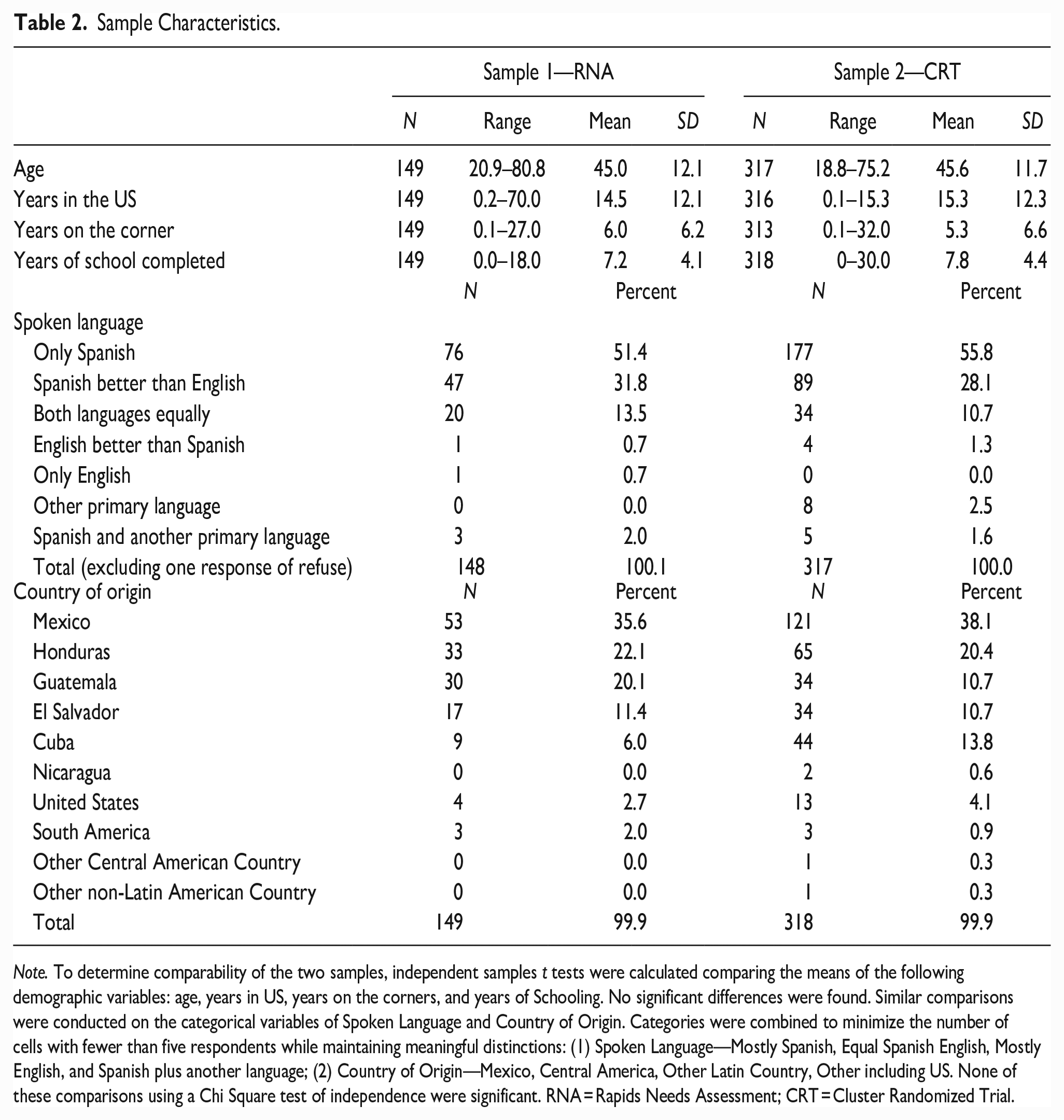
Note. To determine comparability of the two samples, independent samples t tests were calculated comparing the means of the following demographic variables: age, years in US, years on the corners, and years of Schooling. No significant differences were found. Similar comparisons were conducted on the categorical variables of Spoken Language and Country of Origin. Categories were combined to minimize the number of cells with fewer than five respondents while maintaining meaningful distinctions: (1) Spoken Language—Mostly Spanish, Equal Spanish English, Mostly English, and Spanish plus another language; (2) Country of Origin—Mexico, Central America, Other Latin Country, Other including US. None of these comparisons using a Chi Square test of independence were significant. RNA = Rapids Needs Assessment; CRT = Cluster Randomized Trial.
Items #1, #2, and #20 in Table 1 were eliminated from the scale due to redundancy with other items in the instrument. The analysis was conducted with the remaining 19 items describing activities implemented by LDL to reduce work dangers. From the EFA, we identified items with loadings ≥0.525. Two items, #11 and #21 did not load on any of the three factors and although the two reverse scored items, #16 and #19, loaded on factor 3, they had negative signs, and results indicated Cronbach’s alpha would be increased if these items were omitted. Thus, they were excluded.
As shown in Table 3 below, the results of the exploratory factor analysis suggested three distinct factors: (1) preparation safety, (2) harm mitigation, and (3) proactive communication. The total variance explained by each factor was 35.9%, 11.2%, and 7.3%, respectively. Factor 1, preparation safety, contained eight items with a loading ≥0.525 and included behaviors more likely to be implemented before starting work such as following instructions, checking the conditions of the tools and equipment, and securing their work area (Table 3). These behaviors are likely to be implemented in preparation for starting work in order to make the worksite less conducive to accidents. Factor 2, Harm Mitigation, contained four items and included behaviors performed in anticipation of potential hazards and to prevent personal harm. These behaviors represent self-preservation actions done by the worker with the explicit intent of keeping themselves safe. Lastly, Factor 3, Proactive Communication, initially contained five items, but after eliminating the two reverse coded items, resulted in a three-items subscale. It included communication behaviors initiated by the worker to keep themselves and those around him safe. The resulting items in factor 3 represent an exchange of safety information, between the worker and either his co-workers or boss. Although the content of the messages is not known, the simple act of sharing information about potential hazards at work, can, by itself, contribute to increasing worksite safety. Cronbach’s α for the three factors identified were .85, .75, and .77 respectively.
Results From the EFA and CFA.
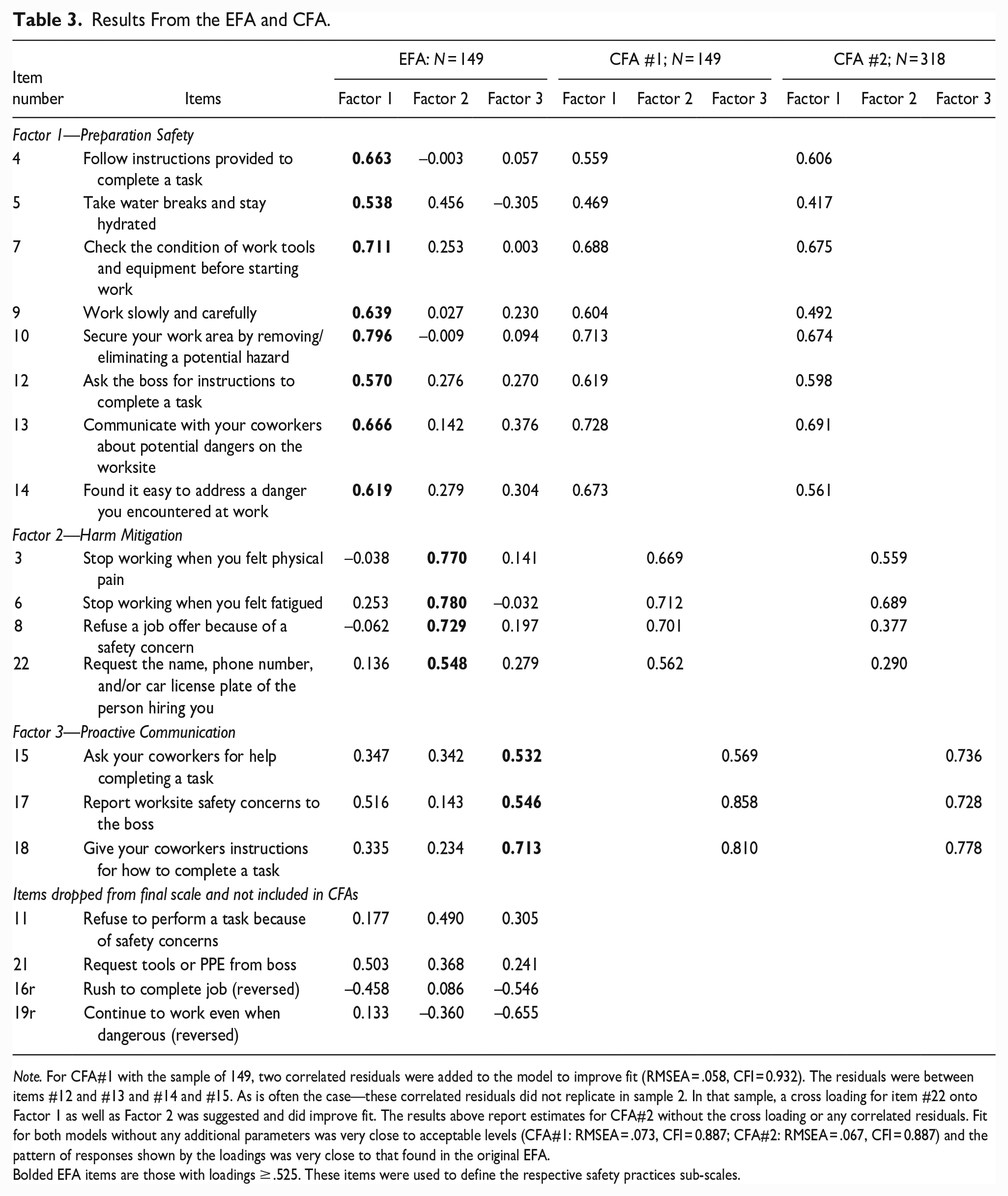
Note. For CFA#1 with the sample of 149, two correlated residuals were added to the model to improve fit (RMSEA = .058, CFI = 0.932). The residuals were between items #12 and #13 and #14 and #15. As is often the case—these correlated residuals did not replicate in sample 2. In that sample, a cross loading for item #22 onto Factor 1 as well as Factor 2 was suggested and did improve fit. The results above report estimates for CFA#2 without the cross loading or any correlated residuals. Fit for both models without any additional parameters was very close to acceptable levels (CFA#1: RMSEA = .073, CFI = 0.887; CFA#2: RMSEA = .067, CFI = 0.887) and the pattern of responses shown by the loadings was very close to that found in the original EFA.
Bolded EFA items are those with loadings ≥ .525. These items were used to define the respective safety practices sub-scales.
Confirmatory Factor Analysis
Results of the confirmatory factor analysis using the initial sample are shown in Table 3. Loadings for each item were significant. The root means square error of approximation (RMSEA) for this model was .06 with a 90% confidence interval of [0.04, 0.08]. CFI for the model was 0.93. χ2 was 126.88 with df = 85 (p = .002).
Cross-Validation
Results of the CFA conducted with the second sample are also shown in Table 3. Again, all loadings were significant. RMSEA for this model was .07 with a 90% confidence interval of [0.06, 0.08]. CFI for the model was 0.88. χ2 was 212.23 with df = 87 (p < .00001). These results provide further evidence of the stability of this factor structure measuring three constructs: preparation safety, harm mitigation, and proactive communication. The Cronbach α for the 15-item scale with this second sample was .84. The reliability coefficients for the three factors were 0.81, 0.50, and 0.79, respectively.
Discussion
This study demonstrates the validity of measure of LDL safety practices that emerged from LDL laborers’ own experience and language, thereby reflecting the context of their work. This measure was developed through systematic qualitative analysis of open-ended interview responses communicated by LDL during motivational interviewing sessions aimed at increasing their safety commitment. We subsequently assessed the measures’ validity and psychometric properties using two independent samples of LDL.
Exploratory and confirmatory factor analysis identified unique and distinct dimensions of LDL safety practices dimensions. Three safety practices dimensions emerged: preparation safety, harm mitigation, and proactive communication. The results from the CFA and the cross-validation analysis confirmed the three-factor structure of the safety practices scale among LD. The items in our sub-scales resemble the types of discretionary behaviors that have been identified in previous studies regarding safety compliance and safety participation scales (Burke et al., 2002; Hofmann et al., 2003). In addition, some of the behaviors captured in our scale have been identified as important factors influencing the safety of construction projects. In their meta-analysis study, Mohammadi et al. found attitudes and behaviors to be key safety factors. Furthermore, workers’ behavior specially when combined with unsafe work conditions are often at the center of occupational accidents (Mohammadi et al., 2018). These findings provide evidence for the importance of documenting and promoting the implementation of safety practices by LDL. Although simple, these behaviors have the power to keep them safe at work and minimize their risk of occupational accidents. Furthermore, our scale was determined to have good internal consistency.
Overall, our safety practices scale demonstrated acceptable properties in all the analyses conducted. Therefore, it is suitable to be used as a valid and reliable measure of LDL’s safety performance. Our study findings suggest that despite their limited safety training, LDL report implementing three types of safety behaviors to avoid accidents at work. Although these practices might not perfectly align with standard safety recommendations, it is important to recognize the value of these lay strategies reported by LDL, and captured in our scale, in keeping them safe at work.
To our knowledge, this study represents the first attempt at developing and validating a safety practices scale based on the experience of LDL. Hence, the results from our analysis make important contributions to the occupational safety literature by filling an existing gap and systematically characterizing the safety practices of LDL. Our findings could inform culturally appropriate safety training programs for LDL and other workers who might be exposed to similar hazardous work conditions. Future research should focus on validating our scale with different types of workers and larger samples. Finally, additional studies should examine the relationship between our scale and occupational fatalities to determine the predictive value of our safety practices scale.
Practical Implications
The safety practices scale that was tested and validated in our study provides a practical way to measure LDL safety performance. This 15-item instrument is easy to use and reflects the dynamic and informal work environment experienced by LDL. Our initial results provide useful insights for occupational safety practitioners who can use the behaviors captured in our scale to identify training gaps and develop programs to promote them and prevent future occupational injuries. Developing practical scales to measure LDL’s safety practices that reflect their work context, can expand our knowledge of safety behaviors, and inform our understanding of how and why occupational accidents occur.
Limitations
Although our study makes important contributions to the occupation safety literature, it is not without limitations. First, the development of the scale was based on self-report data collected at one point in time. As such, these types of data can be vulnerable to social desirability bias and recall bias. It is possible that LDL could have overestimated the extent to which they implemented the practices that they reported in our study. In addition, since our data comes exclusively from LDL in Houston, Texas, caution must be exercised when generalizing the use of our scale with other populations. While our overall results indicated good fitting models and stability across studies, this was not uniformly the case. The CFI for the second confirmatory analysis was 88, less than the standard of 0.90, and loadings for some items were inconsistent across study samples. Loadings for items #8 and #22 were lower in the CFA for the second study than in the EFA or CGA for the first. These were different samples collected at different times. However, whether there was a substantive reason for these findings is not known. Finally, the universe of corners is constantly evolving so our initial list might not have captured the totality of LDL corners in Houston, Texas.
Footnotes
Acknowledgements
We would like to extend our sincere gratitude to the Latino Day laborers who participated in our study and to the members of our Community Advisory Board for their guidance and insights.
Declaration of Conflicting Interests
The author(s) declared no potential conflicts of interest with respect to the research, authorship, and/or publication of this article.
Funding
The author(s) disclosed receipt of the following financial support for the research, authorship, and/or publication of this article: This work was supported by the National Institutes of Health (1R01MD012928; PI Fernandez-Esquer). The content of this paper is solely the responsibility of the authors and does not necessarily represent the official views of the National Institutes of Health.
