




Abstract
This study investigated the role of media as a context for ethnic socialization in Mexican-heritage families. We studied whether and how Mexican-heritage parents used the Disney film Coco as a springboard to talk with their children about important cultural traditions, values, and practices. Participants included 23 parent-child dyads. Children were in kindergarten through fifth grade. Parents and children completed quantitative ethnic identity surveys individually, watched the movie together, and were interviewed individually about their experiences with and conversations about the film. Results showed that ethnic identity, ethnic socialization, and orientation toward Mexican or American media were associated with parent-child conversations and experiences with Coco. Participants’ who scored high on ethnic identity and socialization scales discussed nuanced ways in which the cultural representation in Coco related to their own cultural practices and experiences.
During his first week in office, President Trump signed an executive order redefining the priorities of the U.S. Immigration and Customs Enforcement (ICE) agency. This action set the stage for hundreds of home raids that resulted in deportation, isolation, and persistent trauma for undocumented immigrants (Lind, 2017). In 2019, ICE raids began to focus more on Mexican immigrants and migrant families (Hesson & Daniel, 2019), affecting children and their families’ psychological well-being, family ties, as well as children’s school performance and peer relationships (Capps et al., 2007). These policies and raids were particularly damaging because in the U.S., many immigrant children struggle with feelings of belonging and experiences with prejudice and discrimination (Ayón, 2015; Chavez-Dueñas et al., 2019). Repeatedly viewing negative stereotypes and prejudicial representations of Latinx groups and people in media are also negatively associated with psychological well-being (Hall, 2018; Sui & Paul, 2017), particularly in the current anti-immigrant climate of the COVID-19 pandemic (Cholera et al., 2020).
Mexican-heritage children and families have historically faced racist and stereotypical representation not only in news media and propaganda, but also in entertainment media, which tends to portray Latinx characters as one-dimensional and stereotypical (Monk-Turner et al., 2010). These media representations may socialize Latinx children toward negative stereotypes about their in-group and limit the role of media in helping parents socialize their children toward a positive ethnic identity (Bussey & Bandura, 1999; Ward & Aubrey, 2017).
Stereotypes may also affect parents’ media socialization practices intended to teach children the cultural practices, values, beliefs, and goals that foster their ethnic identity development (Bussey & Bandura, 1999; Gerbner, 1998; Umaña-Taylor et al., 2014). Ethnic minority (i.e., non-White) and immigrant parents and families use media (e.g., films, television, music, etc.) as one way to socialize children to their cultural and ethnic identities (Aldoney et al., 2018; Ayón et al. 2018; Cross et al., 2020; Genner & Süss, 2017). Media allows parents to foster a sense of identity and ingroup belonging (Aldoney et al., 2018) and to remain connected to their natal cultures and communities. Some groups may be especially likely to use media as an ethnic socialization tool. For example, Mexican and more broadly, Latinx families are more likely to practice co-viewing, watching television and media together, than are European and Asian immigrant populations (Aierbe et al., 2014; Zhao & Phillips, 2013).
Recent attempts to create positive and culturally relevant Mexican representations, such as those found in Disney’s mainstream film Coco, may enrich parents’ and families’ media and ethnic socialization experiences. This study uses a developmental psychology framework to explore the ways in which Mexican-heritage families experienced and discussed Disney’s Coco as it related to their ethnic identity socialization in the context of media.
Media as a Context for Ethnic Socialization
Parental mediation, a key way in which parents help children interpret media messages, involves the use of strategies to control, supervise, and help children interpret and make sense of media content messages (Ward & Grower, 2020; Zaman et al., 2016). Parents may engage in different mediation strategies based on their beliefs, perceptions, and goals (e.g., ethnic socialization) around children’s media (Nikken & Schols, 2015; Valkenburg et al., 1999; Warren et al., 2002). For example, co-viewing practices and active mediation (e.g., discussion of media content) tend to be strongly intertwined (Zaman et al., 2016).
Learning about social groups from the media is rarely a passive experience. We talk with friends, families, and online communities about what we have watched and how it relates to our sense of self (Oh, 2013). The meaning-making around media and identity development often happens within social and community contexts. Many minority families engage in co-viewing as a way to spend time together and socialize children toward their ingroup memberships, especially around educational and child-directed television content (Zhao & Phillips, 2013). Research has shown that Mexican-heritage and, more broadly, Latinx families in the US are especially likely to engage in this kind of co-viewing together (Aierbe et al., 2014; Zhao & Phillips, 2013). As a result, ethnic media may allow Mexican-heritage parents and their children to connect with each other and their home culture and to construct narratives about themselves, their families, and their values and goals (Matsaganis et al., 2010).
Much of the previous research on the role of media in Latinx parents’ ethnic socialization practices has focused on transnational media, such as the role of telenovelas (soap operas), in Mexican-heritage households. This research posits that media is a way for Mexican Americans to access cultural proximity to people and places in the absence of physical proximity (Georgiou, 2012). U.S.-born teenagers who watch telenovelas and other transnational media forge intergenerational bonds within their families and develop their Spanish language skills as a result of family discussions (Gonzalez & Katz, 2016; Mayer, 2003). These interactions also provide models to children (e.g., Dora the Explorer) about values, beliefs, and practices, bilingualism, and foster media and technology interactions with their families (Katz et al., 2018). Young children may take on different roles within the family regarding these media socialization practices (e.g., helping their monolingual Spanish-speaking parents understand English-only programming), illustrating bidirectional influences in parent-child socialization.
Much research has focused on the role of cultural identity development during adolescence. Shared talk around transnational media also provides children and teenagers a way to process their culture and identities (Oh, 2013). “For adolescents, media and popular culture offer social discourses that play a key role in identity construction” (Durham, 2004, p. 141). However, media socialization’s role in ethnic identity development is especially important throughout middle childhood, when children develop a more complex understanding of race and ethnicity which includes values, practices, and goals (Derlan et al., 2016) As noted by Ward and Grower (2020), research is needed to identify the role of media socialization in ethnic identity development during childhood. This study aimed to help fill this gap in the literature by focusing on middle childhood, an important time for Mexican-heritage families’ cultural socialization.
Stereotypical Ethnic Representations and Their Impact
Children learn about racial and ethnic groups, including their own, from the media they watch (Bussey & Bandura, 1999). They integrate these representations into their cognitive schemas and use them to develop their beliefs about what is appropriate behavior for members of different ethnic groups (Oyserman et al., 2003). Below, we present a brief review of research on stereotypical representations of Mexican, Latinx, and Hispanic characters in the media. Note that we use the terms Mexican, Latinx, and Hispanic as they are used in previous literature.
Historically, nuanced representations of Latinx communities have been lacking in mainstream media, even when Latinx characters are included. Only 6.2% of speaking characters in popular media have been Hispanic/Latinx, with little or no attention to country of origin. This underrepresentation has not changed in over a decade even though currently, 17.8% of the US population is of Hispanic/Latinx descent (Smith et al., 2018). Moreover, television shows and films have depicted Mexicans and Mexican Americans in ways that rely on negative portrayals and deficit models, such as Spanish-speaking caricatures who are inarticulate or uneducated (Hall, 2018; Mastro & Behm-Morawitz, 2005; Monk-Turner et al., 2010; Yosso, 2002). These groups also tend to be underrepresented and portrayed stereotypically in television specifically designed for children (Ward & Aubrey, 2017). For example, Jones (2011) found that ethnic and racial stereotypes were prevalent in children’s Saturday morning cartoons (e.g., Speedy Gonzales, who appeared on The Looney Tunes Show). Moreover, these characters, their practices, and lived experiences are often depicted with little to no presentation of their culture or history (Leon-Boys & Valdivia, 2021).
Historically, Disney has also relied on stereotypical and often racist depictions of Mexican characters (Delgado & Stefancic, 1998). For example, the construction of family in Disney films has been depicted in limited ways. Usually, the focus is on an only child from a home with divorced or deceased parents (Balraj & Gopal, 2013), which is unrepresentative of the many different family configurations in Hispanic/Latinx homes. Disney has also been guilty of flattening the difference for many Latinx characters to focus on broad appeal to many groups. This includes diluting cultural representation to the point where outside of a few signifiers (e.g., a Quinceañera), characters are indistinguishable as Mexican or Latinx (Leon-Boys & Valdivia, 2021).
Research demonstrates that the internalization of negative and stereotyped portrayals of Latinx people and characters leads to negative outcomes. For example, Mexican-heritage children who consume stereotypical representations of their ingroup struggle with developing positive self-esteem (Hall, 2018; Martins & Harrison, 2012). Less is known, however, about the potential impacts and outcomes of positive, culturally relevant, or nuanced representations of Mexican characters and cultural practices, and how these impacts may be facilitated by co-viewing and discussing media.
The Present Study
This study investigated whether and how Mexican-heritage families’ perceptions of and experiences with the Disney film Coco provided a context for ethnic socialization, considering their own ethnic identity and familial practices. In contrast to previous depictions of Mexican and Latinx characters by Disney, Coco provided viewers with a culturally relevant departure from these traditional Disney depictions of family (Attig, 2019; Ugwu, 2017). The director of Coco, Lee Unkrich, recognized his racial positionality as a White filmmaker and researched both in the US and Mexico for 3 years to prepare for this film (Ugwu, 2017). Co-director, Adrian Molina, is cited as saying they had a creative responsibility to get the representation in Coco right (Cavna, 2017). To do so, they enlisted dozens of creative and cultural consultants who aided with decisions for the film (Attig, 2019) so that the film did not “lapse into cliché or stereotype” (Ugwu, 2017). Unkrich and Molina credit this team of consultants for the decision to include Spanish in the English version of the film, the representations of a multigenerational family, and the integration of family as part of the depiction Día de los Muertos (Cavna, 2017; Ugwu, 2017). Although Coco relies on some tropes (e.g., focusing on Día de los Muertos) and is not immune to cultural criticism, this film set out as an intentional departure from previous depictions, avoided exaggerated caricatures of Mexican characters, and was well-received as representative of people’s lived experiences (Ceron, 2017; Ruiz, 2017).
Coco focuses on Miguel, a young boy living in a fictional Mexican village. Both of his parents are alive, and he and his siblings live in a multigenerational family context. This film makes visible familism traits (i.e., respect for elders and support for family) that are culturally relevant for Mexican-heritage families (Calzada et al., 2014; Umaña-Taylor et al., 2013) in the context of learning the significance of traditions associated with Día de los Muertos, and important cultural and family tradition for some Mexican-heritage families.
Most research has focused on Latinx familial media practices, rather than on the interplay between identity, culture, and media socialization. This study aimed to address this gap. Additionally, much previous work examining media socialization has relied solely on either parent or child self-reports (Kulish et al., 2019). To get a more complete picture of the co-constructive nature of socialization, the role of identity and cultural practices, and to examine the opportunities for discussion presented by media, we interviewed a parent and a focal child in each participating family. Parents and children were interviewed separately to assess their perceptions of whether and how Coco provided opportunities to discuss their cultural practices, values, and goals.
To explore the relations between participants’ ethnic identity and ethnic socialization and their meaning-making around Coco, we administered ethnic identity questionnaires to one parent and one child in each Mexican-heritage family and interviewed them directly after they watched the film together. We coded parent and child interviews for emergent cultural themes. Then, we conducted correlational analyses to assess whether parents’ and children’s scores on quantitative measures were associated with their qualitative discussions of the film. By utilizing this mixed method approach we were able to examine how participants’ identity and broad media experience, as measured by quantitative scales, was related to their experiences that emerged from the qualitative semi-structured interview.
The current study focused on two issues:
(1) How Mexican-heritage parents and children interpreted and constructed cultural meaning after watching the film Coco?
(2) If and how these interpretations and cultural constructions related to identity varied based on participants’ self-reported ethnic identity measures?
Method
Participants
A total of 23 Mexican-heritage parent-child dyads participated in this study. Parents self-identified their family as Mexican or Mexican American. One parent per family (n = 17 mothers and n = 6 fathers) was interviewed for each target child in the specified grade level. All six of the fathers who participated were born in Mexico. Of the mothers who participated, 12 were born in Mexico, 4 were born in the United States, and 1 declined to answer. Children were in kindergarten through fifth grade (M = 7.72 years old, SD = 1.71). Parents reported children’s birthplace and generational status. Of the children who participated, 17 of were born in the United States, 3 were born in Mexico, and 3 parents declined to provide their child’s place of birth. Parents also reported their highest level of education. Seven of the parents had completed less than high school education, seven had completed high school, three had completed some college, and six had completed at least a bachelor’s degree. Most participants were bilingual and were interviewed in Spanish or English based on their preferences. Most parents chose to be interviewed in Spanish and almost all the children elected to be interviewed in English. Participants were recruited through schools and community groups in Northern California through email lists, flyers, and community volunteers. Participants were trained on each rating scale before completing the scales. Each parent-child dyad was given a $10 Safeway or Amazon gift card for participating.
Measures
Bicultural Involvement
Parents and children were assessed using four subscales of the Bicultural Involvement Questionnaire (BIQ; Szapocznik et al., 1980). Szapocznik et al. (1980) group the subscales into Hispanicism and Americanism. We found that their Hispanicism (α = .93) and Americanism scales (α = .89) exhibited similar reliability for our sample (α = .90). These scales are composed of two subscales. The Comfort Speaking Spanish and the Comfort Speaking English subscales included items about comfort speaking each language in different contexts, such as “How comfortable are you speaking Spanish/English at home?” To make this scale relevant to the child participants, children were not asked about their comfort speaking either language in the work context. Participants indicated their responses on a rating scale from 1 = not at all comfortable to 5 = very comfortable. The Enjoyment of Mexican Activities and Enjoyment of American Activities subscales included items such as “How much do you enjoy Mexican/American music?” These items were rated from 1 = not at all to 5 = very much. To maintain understanding of survey items considering the developmental stage of young children in their own ethnic identity development in this sample, the final subscale, asking participants how much they would like to be fully American or fully Mexican, was not included in the current study.
Ethnic Identity
Parents and children answered items from the Multigroup Ethnic Inventory Measure (MEIM; Phinney, 1992). Parents completed 12 items from MEIM-R (α = .81) and children completed 7 items from MEIM-R. Researchers selected items for the abbreviated MEIM-R based on relevance to young children. This decision was based on the researchers’ expectations for children’s attention and understanding, especially for younger children. For example, “I am active in organizations or social groups that include mostly members of my own ethnic group,” was among the items excluded for child participants. Items evaluated the participants’ ethnic identification and sense of belonging to their ethnic group, such as “I have a lot of pride in being Mexican” and were scored from 1 = strongly disagree to 5 = strongly agree. To ensure young children’s understanding of each item, the word “ethnic” was replaced with the word “Mexican.” This decision was made based on the understanding that young children were likely more familiar with the term “Mexican,” given that all participants in the study self-identified as Mexican. We confirmed that these scales were reliable for parents (α = .74) and children in our sample (α = .73).
Ethnic Socialization
Parents and children completed the Familial Ethnic Socialization Scale (FES; Umana-Taylor & Fine, 2004). This scale consists of 12 items (α = .82). We confirmed that this scale was reliable for our sample (α = .84). For the same reasons described above, the word “ethnic” was replaced with the word “Mexican” for the items in this scale. Items were worded either for parents (e.g., “I teach my child about our Mexican cultural background”) or for children (e.g., “My parents teach me about our Mexican cultural background”). Items were rated from 1 = not at all to 5 = very much.
Demographic Information
Parents answered questions about the place of birth for themselves, the target child, and each of the target child’s grandparents. They also answered questions about their level of education, the ethnic diversity of their neighborhood, their ethnic identification, and how many times they had seen the movie Coco. Children answered questions about their age, grade, ethnic identification, and how many times they had seen the movie Coco.
Interview
Directly after watching the film, each participant was interviewed independently in the language of their choice using a semi-structured interview technique. They were asked to discuss their general impressions of the movie as well as specific things they liked, or thought could be improved. They also provided opinions about how the movie represented Mexican people and culture. These interviews were audio-recorded and later transcribed verbatim for further thematic coding.
Researchers utilized a grounded and thematic approach to code the transcripts (Braun & Clark, 2006; Charmaz, 2006). First, the authors independently performed a first pass to identify the broad themes across interviews. They then conducted a second reading of each transcript looking for deeper and more meaningful themes that emerged across multiple participants. Themes were included in the final analysis when brought up by at least 20% of the respondents. Reliability was attained using eight randomly chosen parent interviews and eight randomly chosen child interviews. After attaining minimum reliability (Intraclass correlation coefficient = .80) with the authors, a Spanish-speaking Latinx research assistant coded the remaining transcripts. Some participants mentioned specific content from the film, while some provided descriptions of their own lives and experiences. Most participants provided a discussion of the film in context of their own cultural experiences, or naturally moved between themes directly represented in the film and those outside of it. Therefore, the qualitative themes are presented holistically.
Procedure
Participants were interviewed in their homes at their convenience or at community movie night events sponsored by the research team. Parents and children were interviewed separately in their chosen language by Latinx research assistants who were fluent in both English and Spanish. Each participant completed the questionnaires with a research assistant individually and then watched the movie Coco together with other family members or as part of a community event. Coco was played in English with Spanish subtitles. Parents and children were then interviewed separately, directly after watching the film, using the semi-structured interview questions. When they finished their interviews, families were thanked and compensated with a gift card.
Results
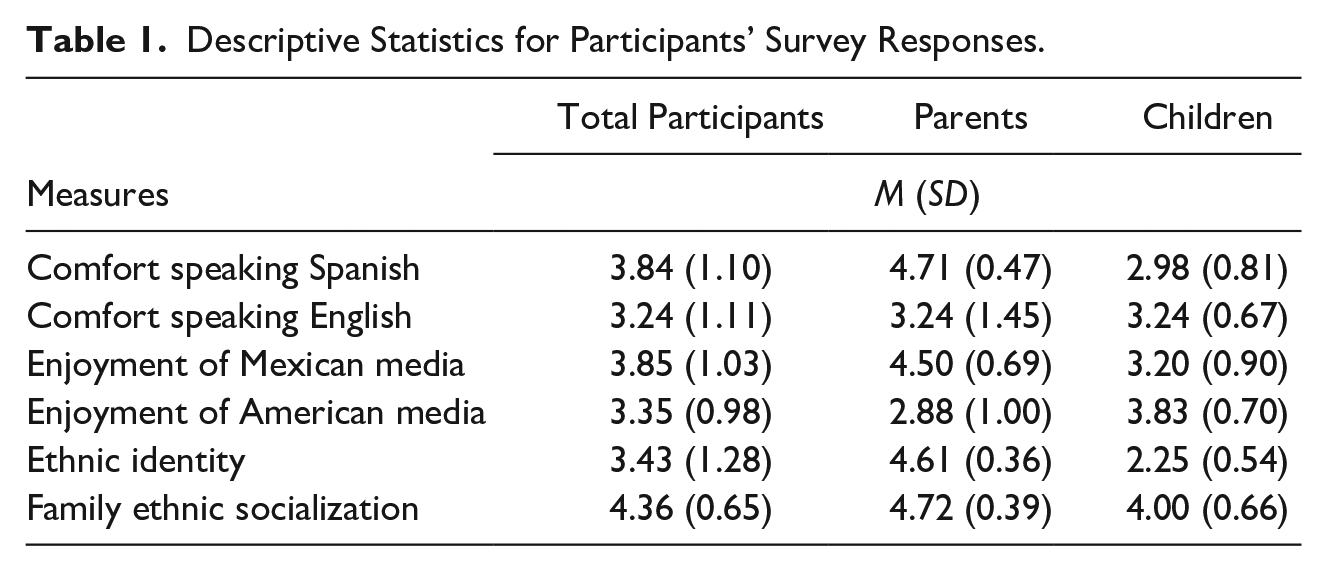
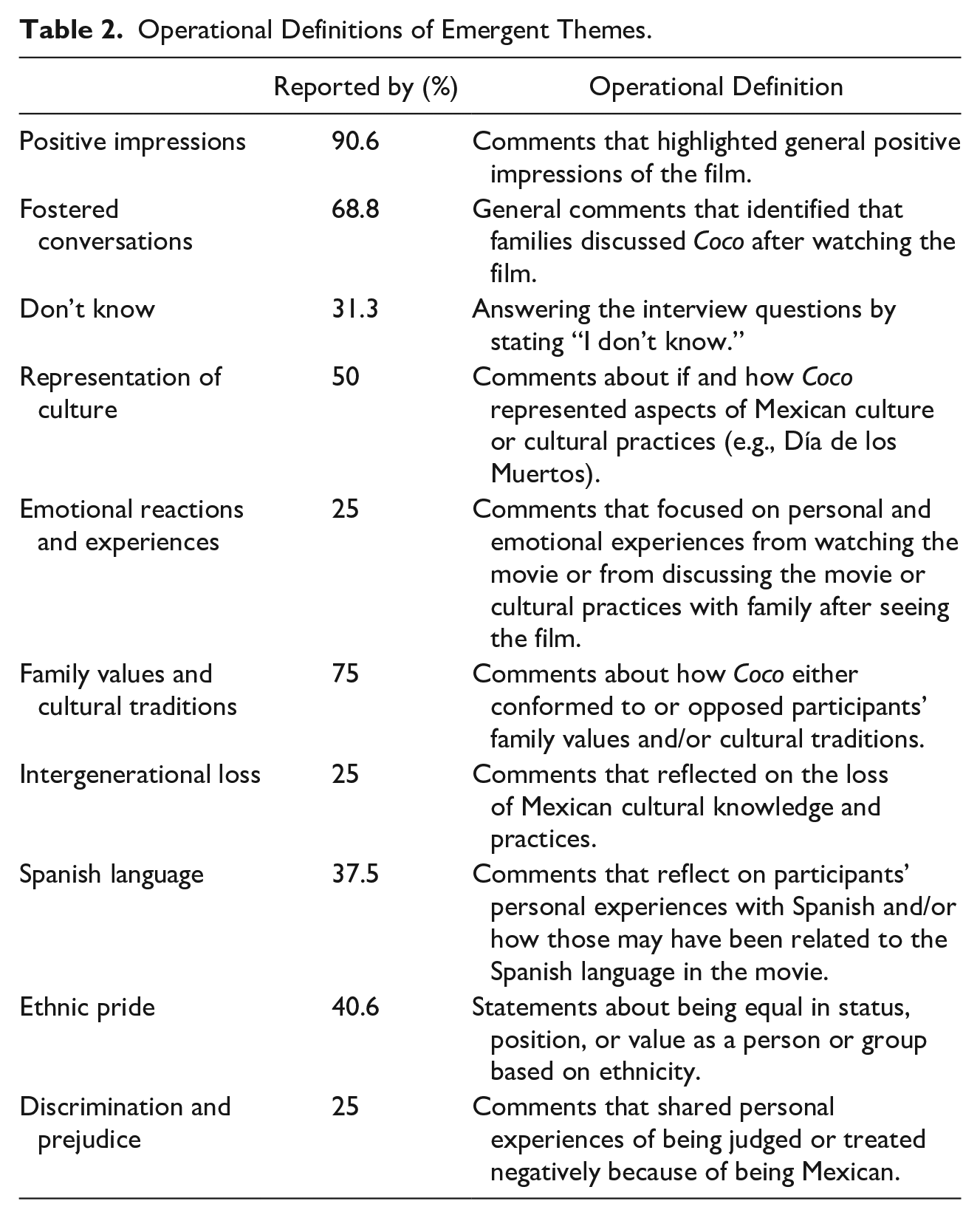
Descriptive statistics for parents and children’s responses to the quantitative survey subscales appear in Table 1. These descriptive differences do not represent statistically significant differences and are intended to paint a more nuanced picture of our participants given the small sample size. Several themes emerged from the interviews with parents and children. The themes and operational definitions are presented in Table 2. These themes are described below with accompanying examples. Correlational analyses were conducted comparing the quantitative scores on ethnic identity and cultural practice scales with the themes that emerged from participant interview data. This mixed-method approach was employed to examine the variation in experience, interpretation, and cultural discussion of the film Coco, based on participants’ ethnic identity and cultural practices. The correlations between the subscales of the quantitative surveys and the emergent themes identified in the interviews appear in Tables 3 to 5.
Descriptive Statistics for Participants’ Survey Responses.
Operational Definitions of Emergent Themes.
Correlations Between Participants’ Scale Responses and Emergent Themes.
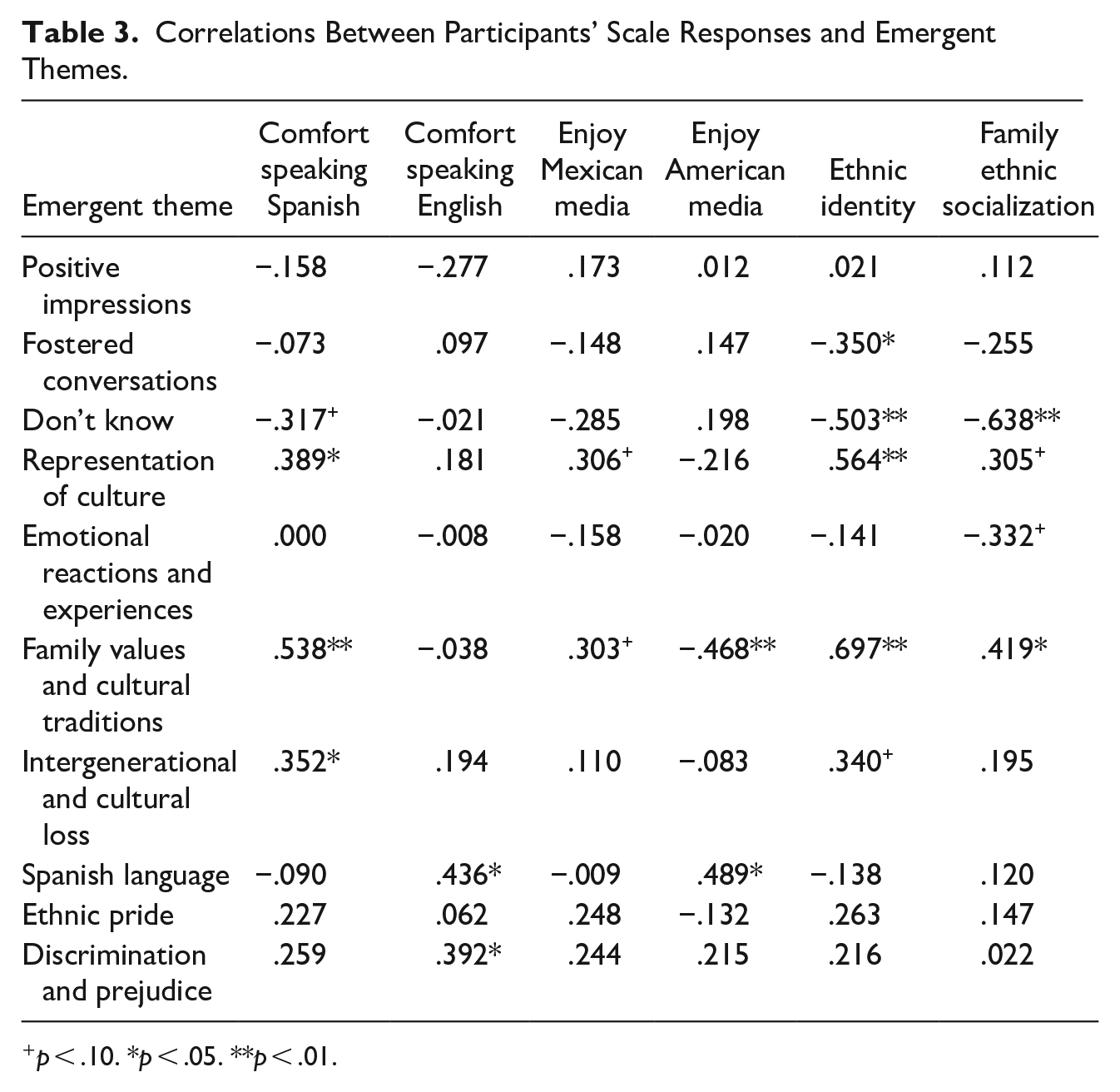
p < .10. *p < .05. **p < .01.
Correlations Between Parents’ Scale Responses and Emergent Themes.
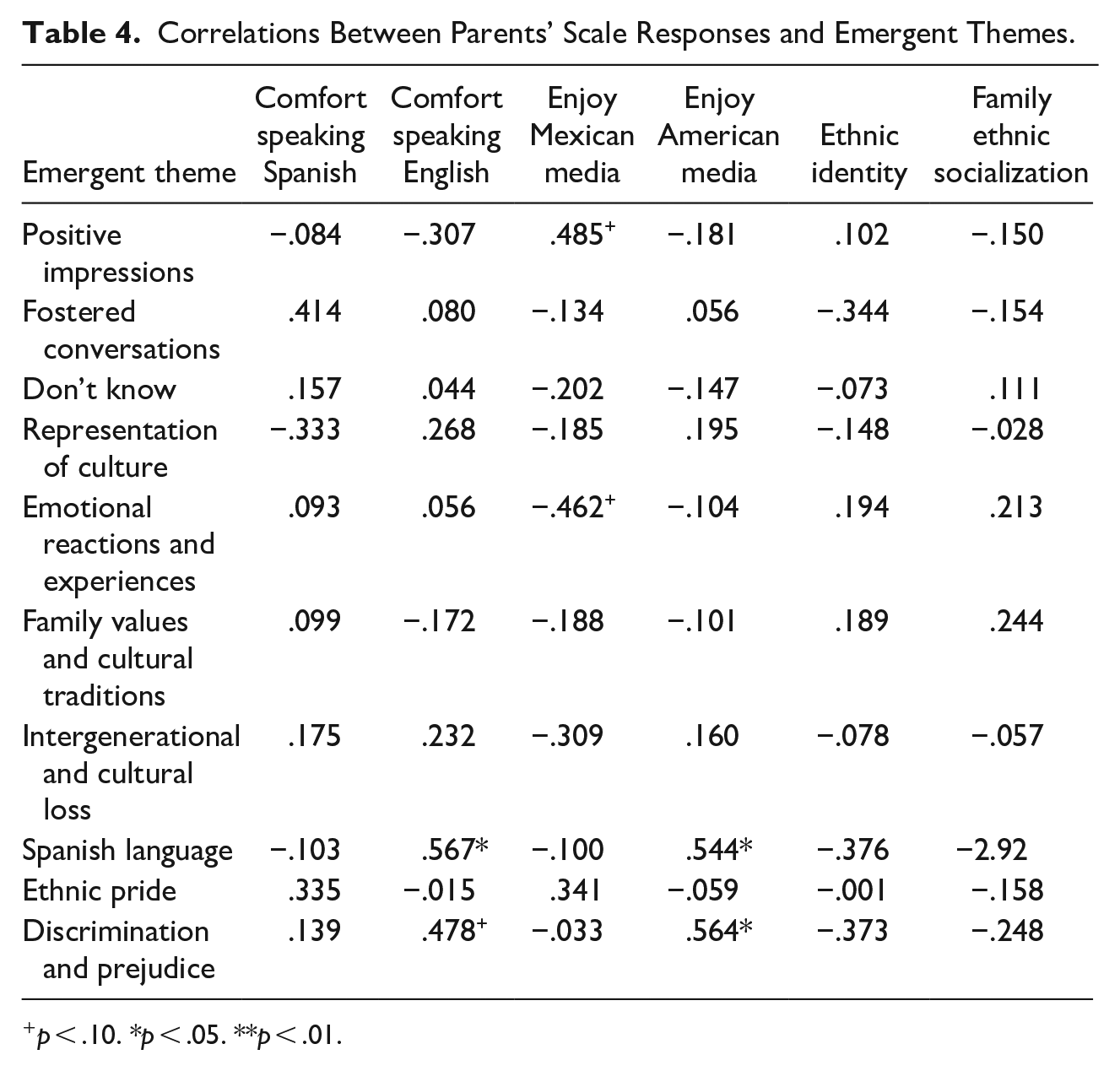
p < .10. *p < .05. **p < .01.
Correlations Between Children’s Scale Responses and Emergent Themes.
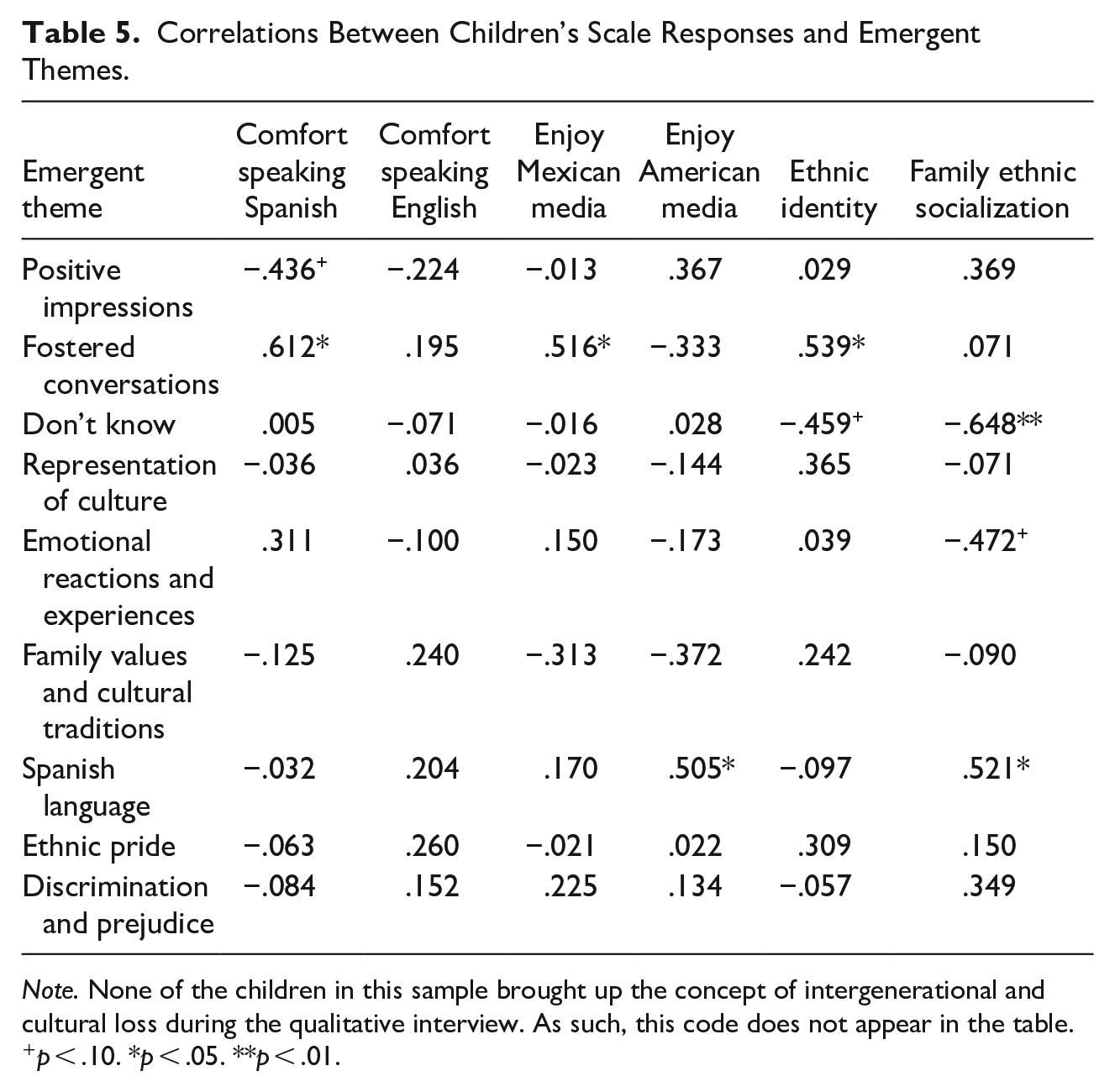
Note. None of the children in this sample brought up the concept of intergenerational and cultural loss during the qualitative interview. As such, this code does not appear in the table.
p < .10. *p < .05. **p < .01.
Interview Themes
We identified several themes in the interview narratives, with parents and older children producing more specific narratives about how the film related to Mexican culture and the importance of maintaining cultural values, practices, and intergenerational relationships. Each theme is identified and defined in Table 2. The results section provides quotes to illustrate the meaning-making participants were experiencing in discussing the film Coco.
Broad Themes
This first set of themes did not provide many details and were especially common in the youngest children. These themes were not discussed in depth, even when followed with prompting from the interviewer. Though not as specific or developed as other themes that emerged from interviews with older children and parents, they provide important insights about participants’ perceptions of the movie and their conversations about it.
Positive impressions
Positive impressions of the film included comments that highlighted something positive about the movie or participant’s experience watching the movie (e.g., “I liked it!”). Most of the participants had positive impressions of the movie.
Fostered conversations
Most of the participants mentioned that watching Coco fostered conversations about culture within their family. These conversations included discussion of the film, culture, or cultural practices with their families after watching the film (e.g., “Yes, we talked about the movie together”).
Don’t know
Nearly a third of participants responded that they were unsure or did not know an answer to a question. It is worth noting that these comments were most often made by younger children, which may represent age-related differences in children’s understanding.
Though lacking in descriptive detail, these broad themes do illustrate important findings. First, most of the participants generally liked the movie. It is important to note these positive impressions in combination with any criticisms that emerged from more descriptive responses. Second, watching Coco helped facilitate conversations for most of the participants. These conversations varied in content and depth across families and allowed parents and children a forum through which to discuss themes around ethnic identity and cultural practices. Third, not surprisingly, younger children may have had more difficulty or discomfort with the interview protocol than older child participants.
Representation of Culture
Half of the participants made comments related to Coco’s representation of culture. Many of the participants spoke about the inclusion of specific symbols in the film, and their personal relevance.
We talked about, family. . .she likes to know a lot of questions about the plot, she’s really interested in Día de los Muertos, a lot of the cempasuchils and alebrijes. [Parent, family 701]
Participants also discussed potential variations in cultural practices. They remarked that there are cultural, familial, or regional variations in cultural practices around Día de los Muertos that may not have been represented in the film.
. . .like, how, sometimes like in some parts of Mexico they do celebrations where they take food to the graves and stuff. . .and she would like talk to me that her family wouldn’t do that. . .cause it was only in one part of Mexico. . .and we just talked about that. . .yeah cause like I don’t really know a lot of history of our family and stuff so I was just asking her about those things. [Child, family 803]
Some participants stated that Coco represented a singular aspect of Mexican culture, emphasized within-cultural diversity, and shared that they did not want out-group audiences to believe that all of Mexican culture or heritage was absorbed by this one celebration or holiday.
. . .uh well, it talks a little bit about one aspect of Mexican heritage like a typical family from this particular place, and these particular circumstances, and it’s not like our family. It’s not like my husband’s family’s experiences. They were different. They didn’t make a movie about you know, migrant farm workers. . .from Tamaulipas to travel to California to pick grapes and you know that would be a different movie. So this is about one aspect of Mexican culture. [Parent, family 701] I don’t know it doesn’t say a whole lot about Mexican heritage. I felt like it focuses on one tradition more than like the whole heritage itself. . .so I mean it just gives a good idea of what Día de los Muertos is. [Parent, family 916]
Emotional Reactions and Experiences
Some participants brought up emotional reactions and experiences about the film. They shared personal reflections and expressed the sentiment of the experience of seeing cultural practices, artifacts, and hearing Mexican music in the film.
It was pretty emotional. . .I really like it. I mean I think I did feel a connection [to] a couple of the scenes just because, you know, some of these customs are. . .what my parents talked about. [Parent, family 203] . . .so like I really like music and if other family of mine were to be like oh I don’t like music and they would always turn it off when I was hearing it I would get sad because if there was Mexican music I really like Mexican music and I would like get emotional cause I really love Mexican music and it’s part of my culture. [Child, family 821]
Family Values and Cultural Traditions
Most participants talked about how Coco conformed to family values and cultural traditions. These responses also included information on the content of some of those conversations that were prompted or initiated from watching the film.
. . .family, I think we have a completely different (sigh) understanding of what family is and um. . .not that we love each other more but I think that we’re just more closely knit you know. I have a twenty-year-old that’s in college and she’s like OMG mom, you know, cause I’m constantly checking on her, but I mean I just can’t go on with my day without knowing she’s okay. . .but taking care of family, taking care of my parents who live down the street. . .I have the same expectations of my children to help with their grandparents, help their uncles, help their cousins, so we’re all one big family. [Parent, family 807] That you just like you work hard, respect each other, and keep honoring your family traditions. [Child, family 601]
Intergenerational and Cultural Loss
Some parents focused specifically on the struggle of Mexican-heritage families to maintain knowledge, information, and cultural practices in the U.S.
I mean even my grandmother at the age of 94, she’s forgetting a lot of the stuff and so you know she’s like she’s the oral history of everything so if she can’t remember then you know that that history, that knowledge is lost. [Parent, family 203] I mean it just gives a good idea of what Día de los Muertos is cause honestly like when you’re born here after several generations you don’t really know what the meaning behind it is and you don’t know what the tradition is really unless you’re taught it by a family member or something. [Parent, family 916]
In sum, parents discussed recognizing intergenerational and cultural loss in their own personal lives after observing this theme in the movie. They made a personal connection between what was happening both to the Rivera family in the film and to those forgotten in the film and what they had experienced in their own lives.
Spanish Language
Many participants reflected on personal experiences with Spanish and their relation to the use of Spanish language in the film.
I don’t know if it’s about being Mexican or really just being any other race but it’s being accepted by other races and being accepted. . .I feel like if you don’t know Spanish that well and you go like to Mexico I feel like you’re judged because you don’t know the language perfectly. . .and then also because if you’re like raised in the United States and you know Spanish and then in your English you have like an accent because you speak both languages you get judged for that too. [Child, family 916]
Some participants also commented on how good it felt to see Spanish in a mainstream movie. However, others went further, commenting that the movie could have benefitted in different ways from the inclusion of more Spanish.
. . .in the English version I think that the songs should be sung in Spanish . . .because the music in the Spanish version is so much better and it’s more authentic and I think that. . .I know why the dialogue has to be in English but I thought that there could be more actual Spanish in the movie even in the English version for sure because it takes place in Mexico. . .it would be my complaint about any movie that took place in another country that you don’t hear at least some. . . [Parent, family 701]
These participants brought up the importance of Spanish and how it relates to their culture, lived experiences, and being Mexican. Additionally, participants discussed their own experiences with Spanish and speaking Spanish. These comments reflected participants’ relation with culture and language, and how their personal interpretation of the importance of Spanish language was and was not represented in the film Coco.
Ethnic Pride
More than a third of participants made comments about being proud of being Mexican or Mexican American.
I feel like as Mexicans we should never let anybody think that we are lower than them because everyone is equal, and we should be able to do what everybody else can. It’s not like we are the people that only could like clean or take out trashes we should be able to do everything they are able to do. [Parent, family 917] Being Mexican is so fun. . .because it’s awesome. . . [Child, family 701]
Discrimination and Prejudice
Some participants reported on experiences of discrimination and prejudice, remarking on people judging them or looking down on them simply for being Mexican.
. . .like a lot of people will stereotype us Mexicans and say that we’re only there to work as janitors or sending us out to the field to work the fields because that’s what we’re meant to be doing. [Parent, family 917] Yeah. . . we’re still like tagged I guess as less than, less educated, less, so there’s a little bit of discrimination I think. [Parent, family 807] Sometimes people don’t like you because you’re like part Mexican and they judge you because you’re Mexican. [Child, family 822]
Although these themes of ethnic pride and discrimination and prejudice were not explicitly presented in the film, watching Coco clearly evoked participants’ ethnic identities and lived experiences. They then made personal connections extending beyond the obvious themes in Coco that may be relevant for themselves and their families.
Associations Between the Questionnaire Responses and Interview Themes
After identifying and coding frequencies for the emergent themes from participant interviews, we computed correlations to assess whether participants’ responses on the quantitative questionnaires were related to the qualitative themes in the open-ended semi-structured interviews. These analyses were conducted at two levels. First, correlations were calculated for all participants (see Table 3). Second, correlations were calculated separately for parents (see Table 4) and children (see Table 5). Correlational analyses revealed significant associations between participants’ quantitative survey scores and their open-ended qualitative interview data. Because of the large number of correlations and to avoid redundancy in the text, the discussion section will address the overall patterns observed.
Discussion
This study employed a mixed-method design to assess the relation between family ethnic socialization, media socialization, and children’s ethnic identity. Rather than providing an analysis of the content of the film, we examined the ways in which family used the film as a springboard for discussion and made meaning out of thematic representation in the context of their own lived experiences. Parent-child dyads were surveyed using quantitative scales about their bicultural involvement, family ethnic socialization, and ethnic identity directly before and after watching the film. After watching Coco, parents and children were also interviewed about their perceptions of and experiences with the film. Correlational analyses revealed significant associations between participants’ quantitative survey scores assessing their ethnic identity and the emergent themes from semi-structured qualitative interview data.
The participants in this study communicated overwhelmingly positive feelings about Coco. This finding replicates popular media discourse and academic work that has highlighted the mass appeal and broad positive reception Coco was given by Mexican-heritage viewers of the film (Attig, 2019; Ceron, 2017; Ruiz, 2017). These responses reflect the power of seeing oneself and one’s culture reflected in a popular box office hit. Other broad responses speak to potential developmental differences among the children in this sample. For example, many of the younger children responded with “I don’t know” or with more simplistic answers than did the older children in the study, who often provided elaborate answers about their perceptions of the characters and cultural practices portrayed in the film. This finding underscores the importance of studying ethnic identity development in middle childhood and not privileging adolescence and young adulthood in research.
Cultural Identity and Meaning-Making
During the interview portion of the study, participants were given the opportunity to discuss their interpretation of the film’s content and themes and how those interpretations were related to their own sense of self and ethnic identity. The interview led to participants’ active construction of meaning, media interpretations, and real time processing of this relation to their sense of self. This process also shed light on the way that co-viewing can lead to deep conversations among families about cultural values and practices. Participants’ responses in the pre- and post-film quantitative scales shed further light on these processes. For the purposes of this discussion, high scores on these scales are related to a strong sense of cultural heritage and ethnic identity. Correlational analyses (see Tables 3 –5) revealed positive relationships between these scales and participants’ perceptions of how Coco represented their culture, conformed to or was in opposition with family values and cultural traditions, and reflected on intergenerational loss. Rather than summarize each significant correlation, we will organize and discuss the relationship between participants’ ethnic identity and their media socialization meaning making.
Participants with a strong sense of their ethnic heritage and of how their ethnicity is related to their identity may have a deeper understanding of their culture and apply a cultural lens to media representations of cultural practices, values, and beliefs. In our study, the positive associations between parents and children’s scores on the quantitative measures and their interview responses suggest that they were able to view Coco in a way that reflected deeply on their cultural lives and lived experiences (Bernal et al., 1990; Quintana & Vera, 1999; Vera & Quintana, 2004). For example, parents with high quantitative scores on ethnic identity measures were more likely to discuss themes about how cultural knowledge is passed down across generations and how it might change or be lost in future generations and to relate that cultural loss to events depicted in Coco. However, participants with a strong ethnic identity may not have felt as strong a need to discuss the movie together because these themes were common in their everyday conversations or present in practice. That is, parents who scored high on these scales may have been more likely to use Coco to supplement the socialization that was likely already occurring in the home.
Correlational analyses (see Table 5) also identified relations between children’s scores on cultural and ethnic identity scales and themes in their interviews. Children with strong ethnic identities were more likely to report conversations with parents and families about Coco and were more forthcoming about the benefits of speaking Spanish. They also stated that they felt more comfortable speaking with their parents about culture, which may be why they had more conversations about the film with their parents and families. The use of Spanish in the English version of the film helps to establish the Mexican setting, while also affirming the lived reality of Mexican American families and communities (Attig, 2019). These children may have been more attuned to some of the cultural humor references and been more likely to pick up on and later comment on them with their parents and family.
Although the discussion on the use of Spanish language started by discussing explicit instances in the film, parents and children typically expanded their responses beyond the film. In this way, Coco prompted participants to talk about personal experiences and perspectives with Spanish, including the benefits of being bilingual and the assumptions people make about those who speak Spanish. These results support previous qualitative research with bilingual college students who reported both positive and negative experiences with Spanish language and bilingualism (Lopéz et al., 2019). The expansion on themes depicted in the film did not end with a discussion of Spanish. Participants talked about their ethnic pride and experiences with discrimination after watching the film. Therefore, as anticipated, Coco acted to affirm a sense of cultural and ethnic pride and provide a broader context for participants to contemplate and discuss the role of ethnicity in their positionalities and experiences with power in the U.S. It may seem that these discussions were separate, apart from the content of the film. However, Coco depicted multiple subtle themes around U.S. immigration, politics, and policy (Attig, 2019). Research has noted that bicultural positionality can serve as a protective factor against some of the negative effects of discrimination and stress for Latinx immigrant families (Whitehead et al., 2020). This film offered Mexican-heritage participants a rich cultural representation with which to identify, critique, appreciate, and discuss how they see themselves, not only in the direct content of the film, but within these larger sociopolitical contexts.
Previous research has observed that Mexican and Latinx families use shared talk about transnational media (e.g., telenovelas) to socialize their children toward their cultural and ethnic identity (Durham, 2004; Oh, 2013). Participants in this study illustrated similar discussion and socialization processes after watching Coco. Parents and children both reported talking with each other about cultural practices and traditions after the film had ended. These data demonstrate that participants were engaging in outside shared talk about media and utilizing this film to socialize themselves and each other toward cultural discussion and discourse.
Limitations
Despite promising results, the current study has limitations. First, the sample was small. During recruitment and data collection there were external sociopolitical factors, including ICE raids in the Mexican communities where data were collected (cf. Hesson & Daniel, 2019). This very real and traumatic experience may have contributed to Mexican families’ hesitation to participate in this research project. Due to the small sample size, we were unable to conduct some potentially interesting and illuminating correlational analyses. For example, it could have been useful to analyze the role of parents’ education and generation of immigration status, but we did not have the statistical power to do so. It is also important to interpret statistically significant correlations with caution based on the small sample size. However, despite having a small sample size, these significant associations are meaningful and should not be dismissed. The small sample size may have also prevented us from detecting some of the associations between the scales and the interview themes. Second, we were unable to statistically control for the number of times participants had previously seen the movie. This may have affected the patterns of associations. Despite this potential limitation, there was low variability in how many times the participants had seen this movie. Most parents had not seen the movie before and most children had seen the movie only once before the interview, so it is unlikely that children’s initial impressions of the movie impacted the patterns of associations discussed in the paper. That most children had seen the movie before their parents also suggests that some of the conversations parents and children reported on during our interviews had occurred prior to our data collection session, and that possibly, co-viewing the movie allowed for further elaboration and application of a cultural lens to Coco. Lastly, the interviews were conducted directly after viewing the movie as a family. Although we observed rich and interesting conversations it is not possible to draw conclusions about the long-term effects of watching this film as a family from this study. Future research should examine the extended effects of family media socialization in Mexican-heritage families specifically and Latinx families more broadly throughout middle childhood.
Conclusions and Future Directions
The Mexican-heritage families who participated in our study generally expressed positive impressions of and experiences with the movie Coco. However, parents and children also brought up different nuanced perspectives on the film. Participants discussed their experiences with and interpretations of the movie Coco in different ways depending on their age, own ethnic identity, and experience with cultural practices. Families with strong ethnic identities were more likely to make meaning out of Coco in terms of their culture and ethnic identity. For these families, Coco served as a springboard for parents to use the movie as a tool for ethnic media socialization with their children and families.
Taken together, our findings provide evidence that media can be a strong socializing agent for children that parents can use in coordination with their other ethnic and cultural socialization practices. Future work should continue to investigate the role of media as a context for parent ethnic socialization. Importantly, this study also points at middle childhood as a key developmental period for parental ethnic socialization and conversations as bidirectional contexts wherein parents and children co-construct cultural knowledge. Future work should focus on this time in childhood and identify mechanisms that support children’s meaning making around their ethnicity and ethnic identity. Although we were unable to examine the role of parents’ education or generational status in the relation between ethnic identity cultural socialization, and Coco, these key sources of within-culture variability are important directions for future research. In sum, our study contributes to the growing literature on how parents incorporate media into their ethnic socialization practices and how children integrate their Mexican heritage with their American experience.
Footnotes
Acknowledgements
Additionally, we thank the Senderos program for their help with data collection and continued support throughout the project.
Declaration of Conflicting Interests
The author(s) declared no potential conflicts of interest with respect to the research, authorship, and/or publication of this article.
Funding
The author(s) disclosed receipt of the following financial support for the research, authorship, and/or publication of this article: This research was supported by a UC MEXUS Small Grant awarded to the first author. Special thanks to Esmeralda Reynaga for her help with data collection, transcription, translation, and coding. Erica Claros, Jerry Hernandez, Brenda Lopez Romo, Carolina Luna, Alejandra Luquin, Yoselin Machado, Catherine Molina, Jocelyn Morales, Tomas Perez, and Jennifer Perez Lopez were instrumental for participant recruitment and data collection.
