




Abstract
Drawing on immigrant adaptation and life course perspectives, this study explores reasons for differences in the timing of young adults’ departure from the parental home. We extend existing research by examining: (a) associations between home-leaving, and immigrant generation and parental region of origin, and (b) the role of parental language use in the home as a moderator of these associations. Using data from the National Longitudinal Survey of Youth 1997 (N = 5,994), we used Cox proportional hazard regressions to estimate the risk of home-leaving. Results revealed that 3+ generation immigrants are most likely to leave home, followed by second, 1.75, and 1.5 generation. Youth whose parents were from Latin America were least likely to leave compared with those with parents from other regions. Parental language spoken at home is a moderator such that, net of controls, youth with Latin American parents are less likely to leave the parental home than those with U.S.-born parents when their parents speak a language other than English at home. Findings contribute to the immigration literature by examining nuanced differences among immigrants of different generations and origins, and pointing to multiple factors that contribute to differences in the timing of the transition out of the parental home.
Keywords
Introduction
A substantial proportion of children in the United States today are part of immigrant families, having immigrated with their parents or having been born in the United States to immigrant parents. Being part of an immigrant family influences many aspects of the transition to adulthood, including the age at which youth leave their parents’ home. A common finding in the literature is that children in immigrant families live in the parental home longer than U.S.-born youth (Hardie & Seltzer, 2016). For example, nearly 60% of 25-year-old immigrant men who arrived in the United States as children—the 1.5 generation—co-reside with their parents, compared with approximately 50% of U.S.-born men of the same age (Treas & Batalova, 2011).
Researchers continue to debate the reasons for this difference and emphasize a number of economic, structural, and social factors. In the past decade, the rate and number of young adults residing in their parents’ homes has risen to near-record levels, and the period of parent-child co-residence has become protracted (DeSilver, 2016). Immigrants and their descendants are projected to account for the majority of U.S. population growth over the next 50 years (López et al., 2018), making it important to understand the factors contributing to differences in the timing of leaving the parental home between immigrant generations.
Several gaps remain in the literature on immigration and home-leaving. First, the bulk of the literature has focused on testing cultural preferences versus economic need to explain the nativity difference in parent-child co-residence, yet some have argued that research must move beyond these two explanations (Van Hook & Glick, 2007). One potential factor that has been understudied in parental co-residence is language use. Language use may influence co-residence in numerous ways, falling somewhere between the traditional poles of the culture-versus-economics debate characterizing much of the literature on this topic. Previous research finds that immigrant youth often serve as language-brokers by translating for their parents (Villanueva & Buriel, 2010) because they tend to learn English faster than their parents (Portes & Rumbaut, 2006). Youth in immigrant families may remain in the parental home longer than third-generation youth because, for example, their parents rely on them to help navigate U.S. society by speaking, listening, reading, and writing for them, opening the family’s access to resources (Orellana et al., 2014) and facilitating incorporation into U.S. society.
A second gap is that while prior studies underscore racial or ethnic differences in the association between immigrant generation and young adults’ transition to residential independence (Lei & South, 2016; Treas & Batalova, 2011), few have examined immigrants’ specific region of origin. Region of origin may be associated with timing of home-leaving because different immigrant groups in the United States encounter different structural conditions and contexts of reception (Bostean & Gillespie, 2018; Portes & Zhou, 1993), leading to divergent adaptation trajectories and, potentially, different needs for parent-child co-residence.
This study extends the family and immigration literatures by examining new reasons for differences in the timing of young adults’ departure from the parental home in immigrant households. We address three major limitations of previous research. First, we build on existing literature by examining differences within immigrant generations by life stage at arrival. We distinguish between the 1.5-, 1.75-, second-, and third-generation immigrants, based on evidence from the immigration literature that suggests the experiences of the 1.75 generation are more similar to the second than the first generation. No studies to date have examined timing of home-leaving across these nuanced groups. Second, few studies have been able to account for the full range of potential factors that may explain differences in the timing of youth’s home-leaving by immigrant generation and by parents’ region of origin. Drawing primarily on two theoretical perspectives, the life course perspective and the immigrant adaptation model, we explore the extent to which life course transitions, structural factors, and immigrant adaptation (specifically, parental language use in the home) influence differences in home-leaving.
Third, we utilize nationally representative panel data from the National Longitudinal Survey of Youth 1997 (NLSY97), spanning nearly two decades, which allows us to assess how structural, life course, and parental language use influence the timing of youths’ home-leaving differentially across immigrant generations and parental region of origin. This sample is particularly suited to address this question because it focuses on the age group most likely to serve as cultural/linguistic brokers for parents, and provides information on language use, parental region of origin for immigrants, parent-child relationships, and other factors that can influence the length of parent-child co-residence. Our use of this data set is a contribution considering that, as others have noted, one of the biggest barriers that researchers face in studying immigrant families is the availability of longitudinal data (Clark et al., 2009).
Prior Research and Theory
The overarching framework guiding this research is the life course perspective, a major theoretical paradigm influencing research on housing careers and residential pathways. This framework takes an integrative theoretical approach considering the interactions between human agency and social structure (Elder, 1998; Elder et al., 2003), highlighting the fact that individuals’ actions are often constrained by their social statuses and social context. The two main concepts from the life course framework that inform the current study are the concepts of “linked lives” and “variability.”
In studying the transition to adulthood, the concept of linked lives emphasizes how individual lives are intertwined and “typically embedded in social relationships with kin and friends across the life span” (Elder, 1994, p. 6). As such, the timing of leaving the parental home is affected by the interdependent relationships between parents and their children (Coulter et al., 2015; Hopkins & Pain, 2007). The concept of variability highlights how pathways to home-leaving may vary at the level of the individual; for example, lived experiences of foreign-born young adults can lead to different residential pathways than those of their U.S.-born counterparts. Variability also emphasizes other sources of interindividual variation, particularly the uneven distribution of social statuses, resources, and social roles (Shanahan, 2000), which influence when young adults leave home. This study draws on these constructs to explore heterogeneity in the timing of the initial departure from the parental home for foreign-born and U.S.-born young adults.
A second framework guiding this research is the immigrant adaptation model, which highlights “the mutual interaction of individuals and collectivities and their response to particular physical and social environments” (Goldlust & Richmond, 1974, p. 195). Studies generally report that immigrant youth and children of immigrants, specifically the 1.5 and second generations, leave the parental home later than third-generation youth (Rumbaut & Komaie, 2010); however, evidence is mixed in some cases. A recent U.S. study using the Panel Study of Income Dynamics found no significant difference between native-born and immigrant youth’s departure from the parental home in their fully adjusted regression models (Lei & South, 2016). Yet, other studies find higher co-residence among 1.5- and second-generation youth compared with third and higher generations, with the highest co-residence among Latino youth across all immigrant generations (Hardie & Seltzer, 2016). However, there may be exceptions to the pattern of later departure among immigrants, for example, between different ethnic groups. In a study of U.S. immigrant gateway cities, 1.5-generation Latino youth were more likely than U.S.-born youth to leave the parental home, while the opposite was true for immigrant youth from other racial/ethnic backgrounds (Treas & Batalova, 2011). However, this study focused only on gateway cities (Los Angeles and New York), which may not be generalizable to the national level.
Research also suggests that the immigrant adaptation process varies across, and even within, immigrant generations. Age at arrival is associated with immigrant incorporation with substantial differences in the experiences of children who arrived in the United States in early childhood (ages 0–5), called the 1.75 generation, versus middle childhood (ages 6–12), called the 1.5 generation. Research has found that the outcomes of the 1.75 generation are more similar to those of the second generation than the first generation (Rumbaut, 2004). Yet, it remains unknown whether such nuanced generational differences exist in timing of home-leaving.
A large portion of the immigrant family literature has focused on testing whether cultural factors are more salient than economic factors in patterning immigrant departures from the parental home, with the assumption that immigrants come from cultures in which family solidarity, which scholars often assume is reflected by co-residence, is more highly valued over independence. One study comparing children of immigrants and the native-born in France found that, although there are not very large nativity differences in leaving home, children of immigrants (i.e., second-generation immigrants) remain in the parental home significantly longer than 3+ generation youth, partly because their parents come from societies characterized by strong family ties, and partly because they have greater difficulties in becoming economically self-sufficient (Ferrari & Pailhé, 2017). However, much of this literature has oversimplified the processes leading to divergent pathways to residential independence among immigrants and the U.S.-born by focusing on this “structure vs. culture” theoretical approach (Van Hook & Glick, 2007).
We build on this literature by assessing the factors explaining the immigrant generational gap in home-leaving, including the major domains known to influence the initial departure from the parental home, as well as an underexplored immigrant adaptation factor—language use.
Factors contributing to young adults’ initial departure from the parental home
Immigrant young adults—specifically, 1.5- and 1.75-generation immigrants—may differ from second- and third-generation U.S.-born youths along many lines known to contribute to residential independence. Thus, a wide range of factors must be accounted for in order to understand their relative contributions to immigrant generational differences in the age of youths’ departure from the parental home.
Control factors
From a young adult’s standpoint, decisions to move out of the parental home are based on a variety of individual, household, contextual, and life course factors. At the individual level, for example, men are more likely than women to live with parents for a longer period of time due to their older average age at marriage; however, the percentage of women ages 18 to 34 living with parents or relatives is at a high not seen since 1940 (Fry, 2015). Latinos have the highest rates of co-residence (i.e., leave the home later) of U.S. racial groups (Britton, 2013; Hardie & Seltzer, 2016).
Young adults who experience emotional distress leave the parental home earlier (Sandberg-Thoma et al., 2015). Resource availability and/or constraints can either tie individuals to their parental households as youth have a “feathered nest” (van den Berg et al., 2018), especially during times of personal economic hardships or large-scale recession, or they may serve as resources enabling youth to leave home (South & Lei, 2015; Warner & Houle, 2018).
At the household level, factors such as family structure (Cooney & Mortimer, 1999) and parent-child interactions and parenting style (Seiffge-Krenke, 2006) may also play a role in the timing of leaving the parental home. To the extent that, for instance, authoritarian parenting style is associated with more conflictual parent-child relationships, it may contribute to an earlier departure, or it may be that more supportive parenting styles are associated with an easier transition out of the parental home (Gillespie, 2020).
Finally, life course transitions such as education, entering the labor market, marriage, and parenthood are also associated with timing of leaving the parental home (Sandberg-Thoma et al., 2015). These transitions are associated with an increased likelihood of leaving home (Goldscheider et al., 2014).
Language use in the home
Although a long line of previous research has studied parent-child co-residence using longitudinal data (e.g., Hardie & Seltzer, 2016), we build on these studies by examining the role of parental language use in explaining immigrant generational differences. In particular, we examine whether parental language use in the home is associated with timing of youths’ initial departure from the parents’ home, by serving either as an explanatory factor in timing differences across immigrant generation and origin or as a moderator of the association (i.e., language use is associated with timing of home-leaving only for certain immigrant generations or origin groups).
Language use is an important issue in immigrant families, associated with both cultural and structural factors affecting family dynamics and intergenerational relationships (Portes & Rumbaut, 2006), as well as other aspects of incorporation. Language use may be associated with leaving the home for several reasons.
First, parents who use a language other than English in the home may be less proficient in English. In terms of immigrant adaptation, migrants who arrive in the United States at later ages (e.g., immigrant parents) often acquire English more slowly than their children (Portes & Rumbaut, 2006). For this reason, children in immigrant families may contribute to the household by serving as language-brokers for their parents; indeed, studies find this is a major responsibility among Latino immigrant youth (Orellana et al., 2014). Considering that children are more likely to co-reside or live near parents when their parents need support (Smits et al., 2010), parental use of a non-English language could be associated with later home-leaving among immigrant youth if children are helping parents navigate U.S. society and language.
Second, immigrant parents may speak their native language in their home as a form of cultural maintenance, an indication that they retain an orientation toward their origin cultures. To the extent that extended co-residence is normative in immigrants’ origin cultures, this may affect the timing of when youth leave the parental home. Supporting this possibility, previous studies find higher levels of familism among immigrant families in the United States compared with U.S.-born families (Bostean, 2010; Chang et al., 2013; Sabogal et al., 1987), which may suggest that families in which parents speak their native language at home may have longer periods of parent-child co-residence.
Yet, very limited research has included parental language as a potential explanatory factor in immigrant generational differences in parental co-residence. One exception is a study that found that foreign language use was associated with lower odds of premarital “residential independence” among parents and children in the United States (Goldscheider & Goldscheider, 1989). Therefore, we expect that youth whose parents speak a language other than English at home will be at lower risk of leaving the parental home than those whose parents speak primarily English.
Based on evidence that Hispanics have distinct home-leaving patterns from other racial or ethnic groups (Treas & Batalova, 2011), we propose that children of Latin American–origin immigrant parents will be less likely to leave the parental home compared with children whose parents originate from other regions. Both linguistic incorporation and cultural norms vary by immigrant origin (Bean & Stevens, 2003) such that Latin-origin immigrant parents are among the least likely to be English proficient, and therefore may be more likely to rely on their children for linguistic brokering. In the United States, approximately 30% of Spanish-speaking foreign-born are English proficient (speak it “well or very well”), compared with nearly 50% among those who speak a language other than Spanish at home (U.S. Census Bureau, 2017). Furthermore, immigrants originating from Latin American countries are among the most likely to speak a language other than English at home (Portes & Rumbaut, 2006).
Considering these differences in linguistic incorporation between Latin American–origin immigrants and others, parental language use in the home may be associated with risk of home-leaving in several ways. First, parental language use may explain differences in risk of home-leaving by immigrant generation and parental region of origin; that is, risk of home-leaving may not differ significantly by immigrant generation or parental region of origin once we account for the fact that lower immigrant generations (e.g., 1.5, 1.75, 2) are more likely to have parents speaking a language other than English in the home compared with the 3+ immigrant generation. On the contrary, parental language use may be a moderator of the association between the risk of home-leaving, and immigrant generation and parental region of origin. In other words, risk of home-leaving may be associated with generation or region only for immigrants who speak a language other than English in the home.
Hypotheses
This study builds on prior research by examining differences in the timing of departure from the parental home by immigrant generation and parents’ region of origin. Specifically, we assess differences in initial departure from the parental home by (a) immigrant generation (1.5, 1.75, second, 3+ generation) and (b) parental region of origin, comparing youth with Latin American parents to those with non-Latin American parents. We test hypotheses derived from the immigrant adaptation literature.
Hypothesis 1 (H1): Youth of later generations will be at higher risk of home-leaving than those of earlier generations.
Hypothesis 2 (H2): Children of Latin American–origin parents will be at lower risk of home-leaving than children of parents from other regions.
Hypothesis 3 (H3): Parents’ use of a language other than English at home will moderate the effects of generation and parental region of origin on youths’ home-leaving.
Method
Data and Sample
Analyses are based on the NLSY97 (Bureau of Labor Statistics, & U.S. Department of Labor, 2018). The full sample of 8,984 adolescents were age 12 to 17 in the initial 1997 wave (born between 1980 and 1984)—this includes an oversample of 2,236 Hispanic or Latino and Black youth. The rich time-series data capture adolescents’ life events prior to and through the transition to adulthood. Collected from 1997–2015, the panel data allow analyses of factors in adolescence that predict the timing of departure from the parental home in the years that follow. As of 2015, there have been 17 rounds of data collection, which started when the birth cohort was 12 to 18 years old and were 30 to 36 in 2015. The first wave (1997) included measures for youth characteristics and parent-/household-level measures. Additional data collected in subsequent waves provide time-varying information about leaving the parental home and contemporaneous independent variables. Given the complex design, a custom longitudinal weight ensured that the sample was nationally representative. Because the study is based on publicly available data, it was exempted from ethical review and approval.
Sample Characteristics
From the full sample (N = 8,984), we removed all youth who reported leaving prior to age 16 (n = 147) and an additional 54 respondents who moved out of the parental home prior to the first survey wave (1997). Of those in the final sample (N = 8,733), 87% (n = 7,644) left the parental home between 1997 and 2015, starting at age 16 and ending at age 35. Owing to missing information across survey waves, the analytic sample is N = 5,994. The average age for leaving the parental home was 20.8 (median = 20).
Measures
Dependent variable: Initial departure from the parental home
Young adults’ initial departure from the parental home is based on residential history data collected at each wave of the NLSY97, starting in 2003 and ending in 2015, the last currently available wave of data. Respondents who left the parental home prior to 2003 reported retrospectively on the date they left starting in 2003. The information was then updated at each wave to capture departures that occurred between subsequent waves.
Key independent variables
A categorical measure marked the youth’s immigrant generation as 1.5 generation (migrating between ages 6 and 17); 1.75 generation (migrating between birth and age 5); second generation, with one or both parents having been born outside the United States; and third generation and higher, which we refer to interchangeably as third or 3+ generation (category omitted for reference). A dichotomous variable indicated whether or not a parent reported speaking a language other than English in the home (= 1, else = 0). A categorical measure specified parents’ region of origin. This measure indicated whether (a) both parents were born in the United States (reference category), (b) one or both parents were foreign-born in a Latin American country, or (c) both parents were born in another country. We follow previous studies in coding Latin American–origin parents versus all others (Balistreri, 2010), because the origin groups are not mutually exclusive, as children were able to report the region of origin of multiple parents.
Control variables
Individual characteristics
Respondent’s age and gender (female = 1, male = 0) were included. Based on NLSY97 measurement, race/ethnic dummy variables include mixed race/other, Black, Hispanic, or the omitted reference “non-Black and non-Hispanic” (hereafter referred to as “White”). Respondents’ education is a time-varying measure of highest grade completed. Respondent overall health is assessed with a time-varying self-reported ordered scale with options for (1) poor, (2) fair, (3) good, (4) very good, (5) excellent. An additional time-varying measure has information on the young adult’s personal income in a given year, presented in thousands to facilitate interpretation.
Parent and household characteristics
Household structure in adolescence is a categorical variable distinguishing living with two biological parents (omitted reference), a biological parent and step-parent, a single parent, or other. The “other” category includes those residing with foster parents, adoptive parents, grandparents, other relatives, or other persons in 1997. Household size is a time-varying measure of the number of individuals living in the respondent’s household in a given year. To tap into potential crowding, number of siblings is a continuous measure taken during the first wave in 1997.
Parent education is a dichotomous variable signaling whether at least one parent had a college degree. A measure is included for mother’s age at the birth of the respondent. Parent religiosity is based on six questions that describe how the responding parent felt about religion and religious practices in 1997. The items are summed to produce a scale ranging from 0 (not religious) to 6 (very religious) (α = .60). Parental housing tenure was assessed in the first wave, with the parent reporting being an owner, a renter, or having some other living arrangement. Additional parent-level resources are measured with parent’s household income level in 1997 (logged). Intergenerational instrumental support is a time-varying measure indicating whether or not the youth’s parents gave them money during the previous year. The report includes gifts in the form of cash or a check but does not include an allowance or loans from parents. The question was not asked in 2013 and 2015 and so the values for 2011 were carried forward for those years.
Parenting style is based on two dimensions of parenting—demandingness, the demands that parents make on children and the control that they have over their children; and parental responsiveness, parental efforts to support their children and instill individuality. When these dimensions are jointly considered, parenting style can be classified according to a prominent fourfold typology (Baumrind, 1966; Maccoby & Martin, 1983) that is widely used in parenting research.
A categorical measure of parenting style, high in both construct and predictive validity (Center for Human Resource Research, 2003), assessed the interactive effect between each parent’s demandingness and supportiveness (Bronte-Tinkew et al., 2010; Maccoby & Martin, 1983). Young adults responded to an item about whether or not they considered their mother and father “very supportive, somewhat supportive, or not very supportive” and a separate item asked whether they considered each parent “permissive or strict about making sure you did what you were supposed to do.” For responsiveness, “very supportive” responses are coded 1, else 0. For demandingness, “demanding” responses are coded 1, else 0. Combined, the variables create a two-by-two typology of parenting style: authoritative (demanding and supportive); authoritarian (demanding and not very supportive); permissive (nondemanding and very supportive); and uninvolved (nondemanding and not supportive). We model mothers’ and fathers’ parenting style in 1997 since no young adults in the sample had moved out of the parental home by then.
Geographic and temporal context
Urban residence was a time-varying covariate indicating whether the adolescent lived in an urban or suburban area (= 1) as opposed to a rural area (= 0). Region consists of four classifications for U.S. region: (1) Northeast, (2) Midwest, (3) South, and (4) West. To tap into temporal context, a variable also flagged whether or not a given survey year occurred between 2007 and 2009, the peak years of the Great Recession.
Life course transitions
Marital status change indicated whether there was (0) no marital change, the reference category, or the respondent (1) entered cohabitation, (2) got married, or (3) became unmarried. Change in parental status marked whether (0) no parental change occurred or (1) the respondent became a parent between waves. A time-varying measure captures changes in the respondent’s school enrollment status as (0) no enrollment change (omitted category), (1) left K–12, (2) enrolled in college or postgraduate study, and (3) left college or postgraduate study. Change in employment status indicates whether (0) no change in employment occurred (reference category), (1) the youth became employed, or (2) unemployed between survey waves.
Analytic strategy
Following recent research on exiting the parental home using the NLSY97 (Sandberg-Thoma et al., 2015; Warner & Houle, 2018), the dependent variable—initial departure from the parental home—was modeled with Cox proportional hazard models. The models express the “hazard ratio” (HR; also called relative risk) of moving from the parental home when assumptions about proportional hazards have been violated. The hazard represents the rate that a departure occurs at time t given that it had not yet occurred in prior waves. Youth enter the “risk set” in 1997, the first year of NLSY97 interviews. They remain in the risk set until the final wave and are censored unless they move out of the parental home.
Model diagnostics
For all multivariate analyses, variance inflation factors indicated there was no severe multicollinearity in the models. Analysis of the correlation matrix (not shown) indicated that none of the observed relationships between the independent variables in the models were very strong. All results were weighted and corrected for the complex NLSY survey sampling design.
Model presentation
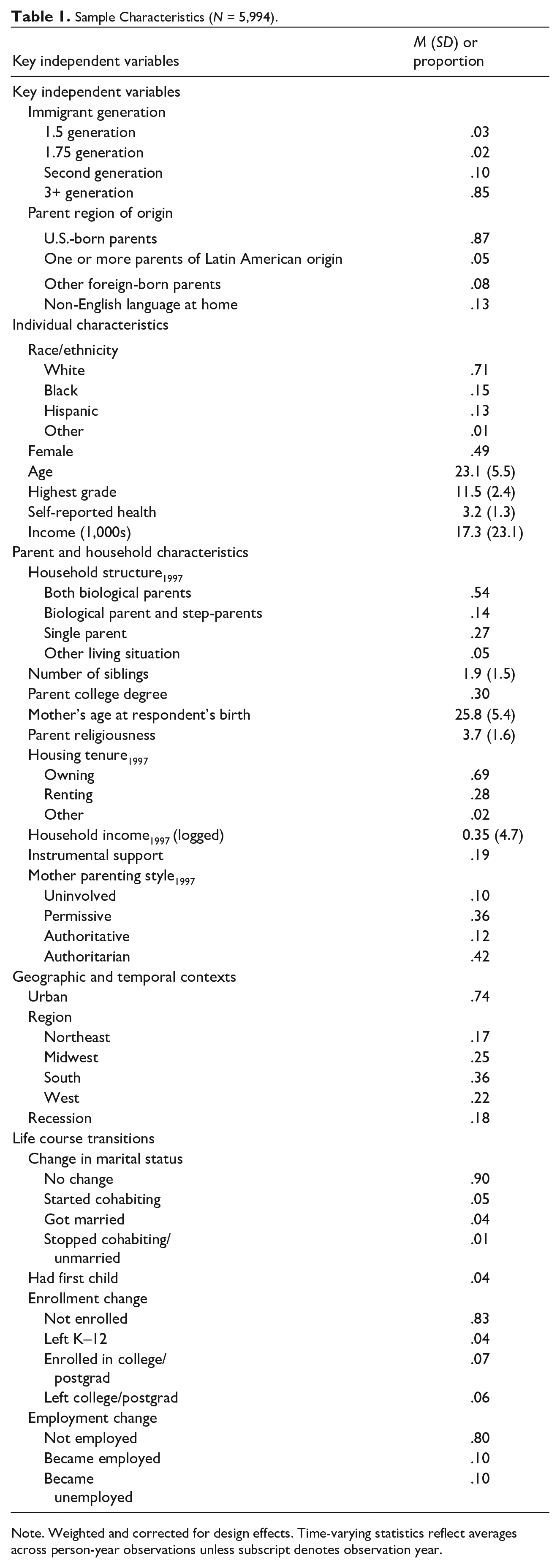
Table 1 presents descriptive statistics, weighted and corrected for design effects. Table 2 presents results from Cox proportional hazard regressions for the effect of immigrant generation and parents’ country of origin on departures from the parental home. Model 1.1 is a baseline model for the effect of immigrant generation. Model 1.2 includes the series of controls for individual-level characteristics, parent-/household-level characteristics, geographic and temporal context, life course transitions, and whether one of both parents speak a language other than English in the home. Model 1.3 includes an interaction term between language at home and immigrant generation. Similarly, Model 2.1 is a baseline model for the effect of parental country of origin, Model 2.2 includes controls, and Model 2.3 includes an interaction term between parent origin and language use at home.
Sample Characteristics (N = 5,994).
Note. Weighted and corrected for design effects. Time-varying statistics reflect averages across person-year observations unless subscript denotes observation year.
Cox Proportional Hazard Models for Immigrant Youth Home-Leaving (N = 5,994).
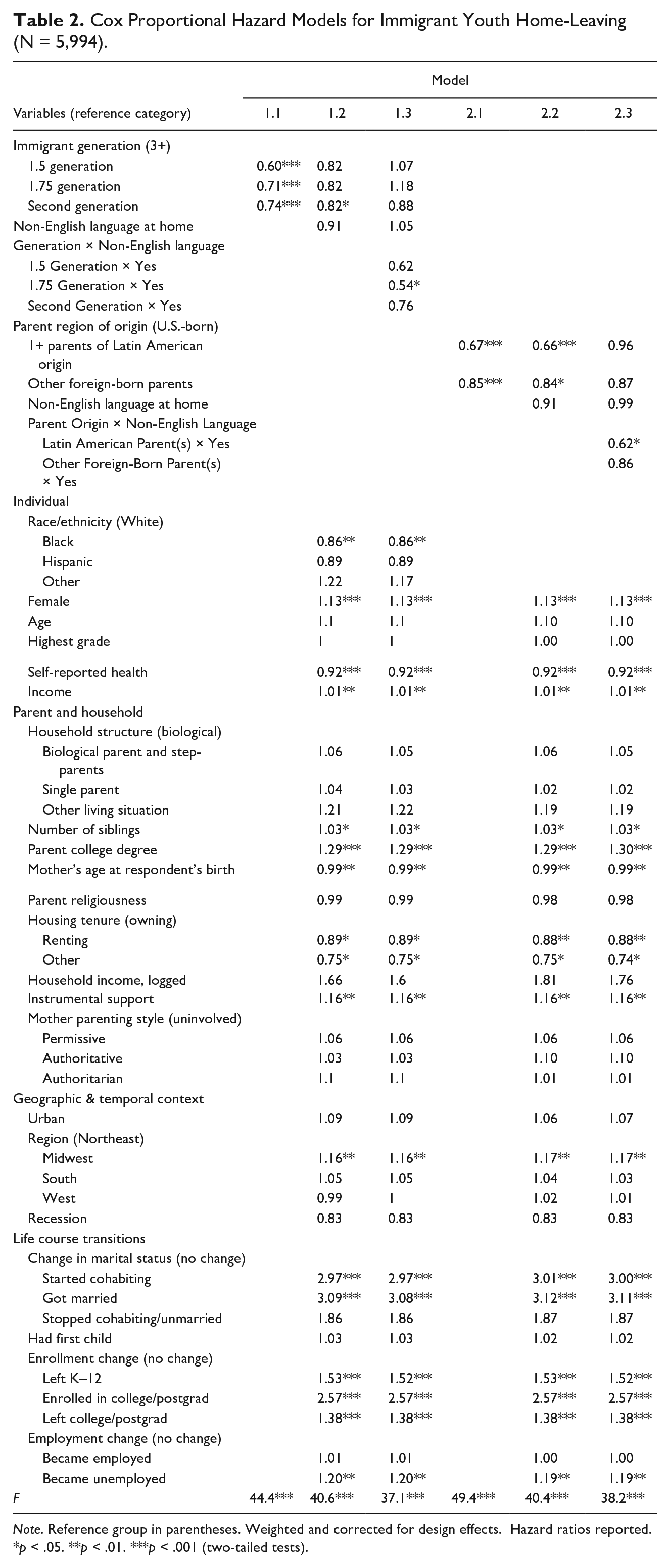
Note. Reference group in parentheses. Weighted and corrected for design effects. Hazard ratios reported.
p < .05. **p < .01. ***p < .001 (two-tailed tests).
Results
Overall, the sample comprised primarily third-generation youth (85%), followed by second generation (10%) and small percentages of 1.5 (3%) and 1.75 (2%) generation; correspondingly, most youth had U.S.-born parents (87%). The sample was mostly White (71%), and the average age across person-years was 23.1. The majority of young adults in the sample reported departing from the parental home at some point between 1997 and 2015 (87%). Additional sample characteristics are presented in Table 1.
At a baseline level, there appear to be differences in the timing of leaving the parental home by immigrant generation (see Figure 1, Panel A) and, more markedly, by immigrants’ parental region of origin (Panel B). At age 25, for example, only 64% of 1.5-generation youth left the parental home, compared with 74% of the 1.75 generation (and 73% of second generation), and 85% of 3+ generation (Panel A). By age 30, 90% of 3+ generation youth left home, compared with less than three quarters (73.3%) of 1.5-generation youth, and approximately 82% of 1.75% and 81% of second-generation youth.
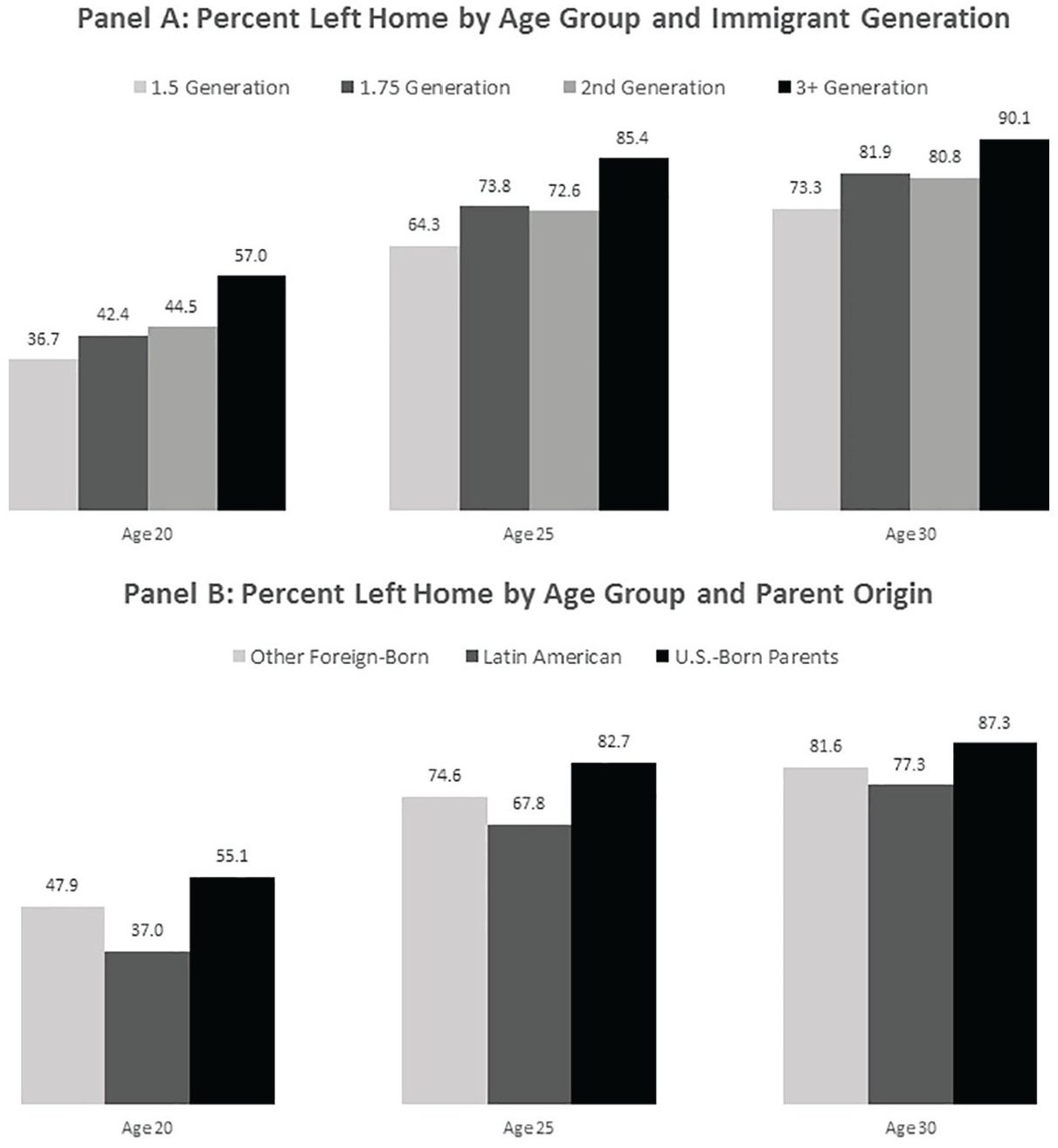
Home-leaving by generation and parent origin.
To explore whether this immigrant generational difference is driven by immigrant region of origin, we also compared home-leaving by parental region of origin (Panel B) and found that at age 25, youth with Latin American–origin parents were less likely to leave the parental home (68%) compared with youth with U.S.-born parents (83%) or parents from other regions (75%). By age 30, nearly 88% of youth with U.S.-born parents left home, compared with 77% of youth with Latin American–origin parents and 82% of those with parents born elsewhere.
Table 2 presents regressions examining the factors contributing to these immigrant generational and parental origin differences in timing of leaving the parental home. The results from Model 1.1 provide support for our first hypothesis, with a significant bivariate association between immigrant generation and leaving home. Foreign-born (1.5 and 1.75 generation) and second-generation young adults have significantly lower relative risk of leaving the parental home than their 3+ generation counterparts (all ps < .001).
After controlling for individual and parent-/household-level characteristics, geographic and temporal context, life course transitions, and parental language use in Model 1.2, only second-generation immigrants—those with at least one immigrant parent—are still significantly less likely to depart the parental home than 3+ generation immigrants (HR = 0.82, p < .05). Although only the difference between second and 3+ generation is statistically significant, the coefficients for all three immigrant generation categories are the same (HR = 0.82), which may suggest that the greatest difference is between the 3+ generation and others.
Parental language use (HR = 0.91, p > .10) has no main effect on risk of home-leaving in Model 1.2. However, Model 1.3 lends support to our third hypothesis, given the significant interaction between parental language use and 1.75 immigrant generation (HR = 0.54, p < .05). While there are no significant differences between immigrant generations among those whose parents speak English in the home, the risk of home-leaving is significantly lower for 1.75 generation versus 3+ generation immigrants when youth’s parents speak a language other than English at home. Specifically, among those whose parents speak a non-English language at home, the 1.75 generation have 62% lower risk of home-leaving (calculated using the log hazards) compared with 3+ generation youth.
Model 2.1 provides broad support for our second hypothesis, that young adults’ risk of departure from the parental home is associated with their parents’ origin country. The baseline model points to a lower risk of leaving among youth with foreign-born parents, particularly among those from Latin America, as compared to youth with U.S.-born parents (ps < .001). These results hold in the main effects Model 2.2, which adjusts for contemporaneous individual and parent and household characteristics, geographic and temporal context, life course transitions, and parental language use in the home. Young adults with U.S.-born parents are significantly more likely to leave the parental home than those with parents originating from Latin American countries (p < .001), and to a lesser extent those from other foreign countries (p < .05).
Parental language use is not associated with risk of home-leaving in Model 2.2 (HR = 0.91, p > .10). However, in the final Model 2.3, the interaction term between language spoken at home and parents’ country of origin is statistically significant (HR = 0.62, p < .05), providing evidence again in support of our third hypothesis, that those with a parent or parents born in a Latin American country whose parents spoke a non-English language at home were significantly less likely to transition to residential independence (p < .05). Specifically, among those who speak English at home, having a Latin American parent is not significantly associated with risk of home-leaving (p > .10), while among those who speak a non-English language at home, having a Latin American parent is associated with a lower risk of leaving compared with those who have U.S.-born parents (HR = 0.64, p <.05).
Although not a primary focus of our study, findings for the control variables speak to the importance of additional individual, family, household, and other contextual factors in the timing of leaving the parental home. The effects of the control variables are consistent across Table 2 models. Consistent with previous research (Lei & South, 2016), Hispanic and Black youth are significantly less likely than Whites to leave the parental home (p < .05), as are females (p < .001). Young adults reporting better overall health have a lower risk of leaving (p < .001). Those with higher income are significantly more likely to move out (p < .01), suggesting that financial resources can facilitate the transition to residential independence.
Regarding parent- and household-level characteristics, number of siblings is associated with leaving (p < .05). Parent education, linked to financial and human capital, is linked to an increased risk of departure (p < .001). At the same time, there is no evidence of a relationship between parent household income, measured in 1997, and leaving the parental home. Young adults with older mothers are less likely to move out (p < .01), as are those with rental or other living arrangements when compared to those with homeowner parents (ps < .05).
As expected, instrumental support—specifically downward intergenerational financial support—is significantly associated with leaving (p < .01). U.S. region, particularly residing in the Midwest, is associated with a higher risk of leaving the parental home when compared with youth residing in the Northeast. In terms of life course factors, when compared with those reporting no change in marital or cohabitation status, those entering into marriage or cohabitation arrangements are significantly and substantially more likely to leave the parental home (ps < .001). Transitions out of and into school are also associated with a higher risk of departure when compared with those who did not experience school transitions (ps < .001). When compared with youth who made no employment-related transitions, those who became unemployed were more likely to leave the parental home (p < .01).
Discussion
This study examined differences in the timing of departure from the parental home by immigrant generation and parental region of origin using nationally representative longitudinal data from the United States. Our findings support and contribute greater nuance to the discussion of differences in immigrant home-leaving pathways by showing that 1.5-generation immigrants were least likely to leave home, followed by 1.75- and second-generation immigrants, and third-generation immigrants most likely to leave the parental home. Differences in timing of home-leaving were even larger when comparing youth with Latin American–origin parents to youth whose parents were born in other regions, and to those with U.S.-born parents (the group most likely to leave home).
Generational differences in home-leaving were largely explained by differences in individual, household, and life course factors, while differences by parental region of origin were not explained by these factors. Importantly, our study provides evidence of the role of parental language use in the home as a moderator of the association between timing of departure from the parental home, and immigrant generation and parental region of origin. These findings contribute substantive insights to the immigrant adaptation literature and the family literature on home-leaving, which we discuss below.
One of our main findings was that 1.5-, 1.75-, and second-generation youth were less likely to leave the parental home compared with 3+ generation youth, and these findings were driven by youth with Latin America–origin parents. Using national data, we found that by age 30, the vast majority of 3+ generation youth have left the parental home, while only two thirds of 1.5-generation youth have done so. These findings are notable for at least two reasons.
First, these findings stand in contrast to those of Treas and Batalova (2011), who found that among Latinos, the 1.5 generation were more likely to leave the parental home compared with second- and third-generation Latinos. However, their study used American Community Survey data from two immigrant gateway cities (Los Angeles and New York). This contrast may indicate that Latino immigrant parents living in areas with dense co-ethnics have less need for their children to serve as linguistic brokers, while for immigrant families living outside immigrant gateways, where there are fewer co-ethnic bilinguals, it may be more difficult for limited English proficiency parents to navigate without the language-brokering help of their children, extending co-residence.
Second, our findings contribute to immigration literature, supporting prior evidence that the outcomes of 1.75-generation immigrants—those who arrived in early childhood—are more similar to those of the second generation (Rumbaut, 2004) than the 1.5 generation (those who arrived in later childhood). We find that the percent of youth who have left home by a certain age is nearly the same for the 1.75 and second generation, but there is a marked difference between these groups and 1.5-generation youth. These findings confirm the need for immigration research to distinguish these groups. Yet, most studies aggregate the 1.5 and 1.75 generations into a “first generation” category, which may obscure the extent to which the 1.5 generation is distinct.
Another major finding, and a main contribution of this study, is that parental language use in the home is a moderator of parent-child co-residence for youth with Latin American–origin immigrant parents, with said youth experiencing a lower risk of home-leaving when their parents speak a language other than English at home. We found support for our third hypothesis, which was that parental language use serves as a moderator of the association between risk of home-leaving and immigrant generation, and, to an even greater extent, home-leaving and parental region of origin. However, the language parents spoke at home was not independently associated with the risk of home-leaving, nor did it explain away immigrant generational or parental region of origin differences in risk of home-leaving.
A third major finding was that parental region of origin was significantly associated with departures from home, with youth with Latin American–origin parents being less likely to leave home compared with other regions of origin. This is consistent with evidence that Latino youth have distinct home-leaving patterns from other groups. One plausible explanation for why immigrants with Latin American parents are less likely to leave home has to do with language use. Latin American–origin immigrants are among the least likely to speak English only at home (Portes & Rumbaut, 2006); thus, children of Spanish-speaking Latin American parents may be driving parent-child co-residence.
One limitation of this data set is that we cannot separate Brazilians from the other Latin American parents; therefore, we cannot be certain that language is the only driver of this association. Similarly, the NLSY does not include a measure of parental English proficiency; therefore, we cannot know whether parents are speaking a language other than English in the home because of low English proficiency or for other reasons such as a desire for cultural maintenance; however, on average, approximately 40% of those who speak a language other than English in the home have limited English proficiency (Batalova & Zong, 2016). Future research should explore in further depth why parental language spoken at home is such an important moderator, perhaps beginning by examining whether language-brokering is a contributing factor for youth with Latin American parents.
These results should be interpreted with the following additional limitations in mind. First, we do not have data on the average timing of departure from the parental home in immigrants’ origin countries, so future research may be interested in comparing home-leaving by immigrant youth in the United States with that by their counterparts in various countries of origin. As Clark et al. (2009) note in their review on immigrant families, origin data are key in understanding the extent to which patterns among immigrants in the United States are attributable to immigration-based factors versus cultural preferences. We were also unable to assess the extent to which children contribute to the household income, although there is mixed evidence for this being a contributing factor in prolonged parent-child co-residence (Glick & Van Hook, 2002; Zorlu & Mulder, 2011).
Overall, this study provides evidence that immigrant generation and, particularly, the region from which young adults’ parents originate are important correlates of the timing of departure from the parental home. Furthermore, findings contribute substantive insights to the immigrant adaptation literature and the family literature on home-leaving by highlighting the particularly important role of parental language use in the home in influencing timing of home-leaving for youth with Latin American parents. The decision to leave the parental home is a complex one, affected by a range of individual, household, and broader contextual factors.
Just as recent literature on home-leaving is beginning to acknowledge the increasing variability and complexity of youths’ transitions to adulthood and residential independence, the findings of this study highlight the increasingly complex picture of home-leaving among children of immigrant families in the United States and the need for further research on this understudied phenomenon.
Footnotes
Acknowledgements
The authors would like to thank Steve McClaskie for his helpful advice with the data. This study was conducted in collaboration with the FamilyTies project at the University of Groningen.
Declaration of Conflicting Interests
The author(s) declared no potential conflicts of interest with respect to the research, authorship, and/or publication of this article.
Funding
The author(s) disclosed receipt of the following financial support for the research, authorship, and/or publication of this article: The project operates under funding from the European Research Council (ERC) under the European Union’s Horizon 2020 Research and Innovation Programme (Grant Agreement No. 74011).