



Abstract
Organizational and leader-specific components are used to characterize newspaper executives’ positioning toward social media. From an online survey (n=159), Norwegian newspaper executives report on the efficacy of social media, organizational culture, and work-related role stressors. Employing principal components analysis and clustering methods, we identify four leadership types and find wide variation in social media attitudes and usage reflecting organizational strategic needs and capabilities, social media-related frustrations, culture, and competencies and tradition of the newspaper executives.
Introduction
Recent years have been rich in change as newspapers have reorganized their news production and distribution around digital and social media technologies (Angelou et al., 2020; Hendrickx & Picone, 2020) for their relevance and economic survival (Ekdale et al., 2015; García-Avilés et al., 2018). Despite well over a decade of newspaper experimentation with various models of social media usage (Krumsvik, 2018), continual variation in underlying algorithms, changing patterns of audience use, and the rise and persistence of false news are just some elements that ensure social media remains an ongoing source of contestation and strategic positioning within newspapers. Social media, broadly defined as “internet-based applications that build on the ideological and technological foundations of web 2.0 and allow the creation and exchange of user-generated content” (Kaplan & Haenlein, 2010, p. 61), thus represents an ongoing leadership issue for editors, managing directors, executives, and publishers, herein collectively referred to as “newspaper executives” (Westlund et al., 2021).
In the context of opportunities and challenges afforded by technologies such as social media, newspaper executives play a key role as change agents, just as they are able to act as change inhibitors (García-Avilés et al., 2018; Sylvie & Gade, 2009). Surprisingly then, media management of technology-based change has been relatively overlooked in literature (Duffy, 2021). As argued by Lucy Küng (2007, 2017), due to the multifaceted nature of media management theories, there has been surprisingly little research on internal firm dynamics and how these impinge on performance outcomes (Küng, 2007). Reflecting limited media management focus in relation to technology-based change, Belair-Gagnon and Steinke (2020, p. 1725) argue, “scholars have used organizational and personal factors as a proxy to discuss the difficulty for journalism to adopt emerging information technologies.”
While several leadership roles have been identified based on perceived organization needs (see Barland & Vaagan, 2015; Bass & Riggio, 2006; Küng, 2017), these characteristics tend to reflect newspaper leadership styles across the full spectrum of newspaper activities, including their response to technology. More indirectly, management of technology-based change has been addressed through studies covering themes such as how technology is changing the role of editors (Andersson & Wiik, 2014; Perreault & Ferrucci, 2020; Waldenström et al., 2019), leadership in the context of technology-induced conflict (Hendrickx & Picone, 2020; Min & Fink, 2021), and the criticality of cultural awareness for leadership of newsroom innovation (Groves & Brown, 2015).
Largely absent from this literature are studies that directly explore the range of newspaper executives’ attitudes and behaviors toward social media-based technologies that have a critical impact in facilitating or hindering change (García-Avilés et al., 2018). By mapping newspaper executives’ attitudes and behavior toward social media, and exploring how these are related to the newspaper, its current and near-term strategy, and the background of the leader, this study aims to identify important newspaper executive positionings with respect to social media. Furthermore, by including theory from management literature on organizational and role-based factors impacting readiness and unreadiness to change (Armenakis et al., 1993; Porcu, 2020), we aim to explore the impact of role stressors (role ambiguity, role conflict, and role overload) on newspaper executives’ change readiness. As these issues have not been explored previously, this study adds to the conceptual framework for studying change management in the field of media management. Shifts in the external environment require change within an organization—in strategies, mindsets, and practice. The article then provides media managers with relevant concepts to guide their sensemaking of ongoing changes, responses to technologies, and impediments to change.
Literature Review and Theoretical Framing
Newspaper Executives’ Readiness and Unreadiness Toward Social Media
A common approach to understanding change in news media is through the lens of the personal characteristics and backgrounds of change agents (Schultz & Sheffer, 2009). To broaden this perspective, we apply the concept of readiness for change, comprised of both psychological and structural factors. According to readiness to change literature, acceptance, and adoption of organizational change are pre-staged by the concept of readiness, “the cognitive precursor to the behaviors of either resistance to, or support for, a change effort” (Armenakis et al., 1993, p. 682). For Holt et al. (2007), readiness to change is determined by a mixture of social and innovation-specific attributes, namely change-specific efficacy; perceived appropriateness of change (or organizational benefit); management support; and personal benefit.
Resistance (Armenakis et al., 1993) or “unreadiness factors” (Cinite et al., 2009) are also strongly related to the social processes that impact change processes. Rizzo et al. (1970) identify role conflict—incompatibility and incongruence in the requirement of a role leading to conflict—and role ambiguity—lack of predictability of outcomes from one’s behavior and lack of predictability of behavioral requirements—as negatively related to change readiness. Work overload or the stress from workloads and practice is highlighted as a third important organizational-related unreadiness factor impacting change processes, particularly in relation to information and communication technology (ICT) innovation (Cinite et al., 2009; Firth et al., 2004).
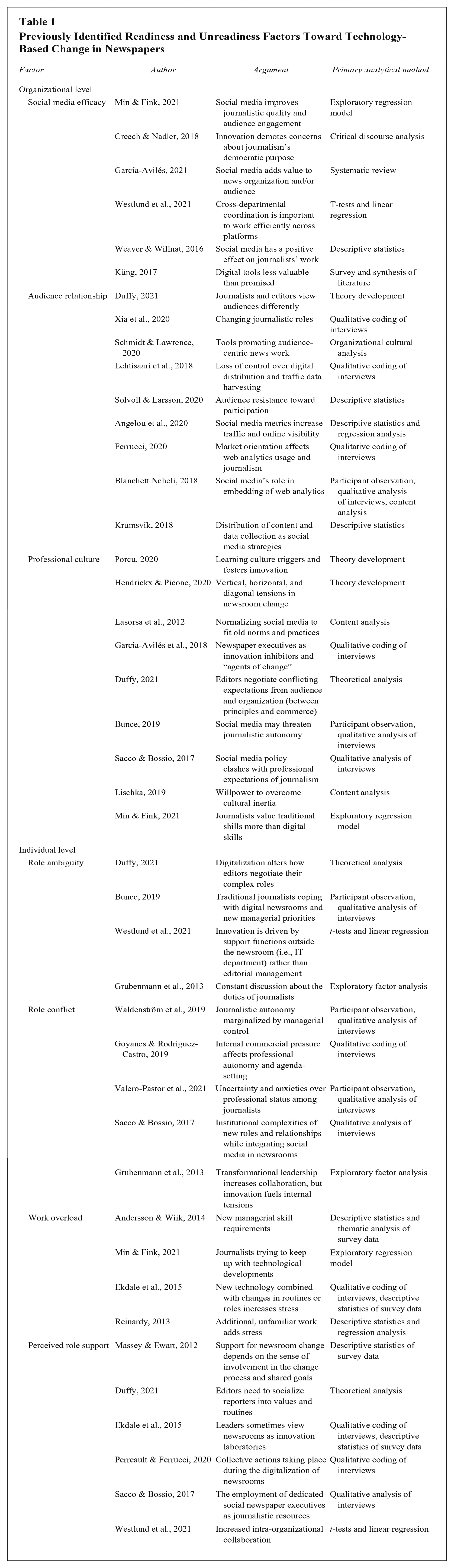
Moving from the broader field of management studies to factors influencing newspaper executives’ attitude toward and use of social media, the literature is insufficiently developed to specify the exact nature and number of readiness and unreadiness to change factors (see “Primary method” in Table 1). Nevertheless, we identify seven key themes associated with newspaper executives’ readiness or unreadiness toward social media-based change in studies of newspaper innovation and technology adoption. These are presented in Table 1 and subsequently discussed.
Previously Identified Readiness and Unreadiness Factors Toward Technology-Based Change in Newspapers
Social Media’s Efficacy as Technology in Use
The efficacy of social media concerns perceptions of how it increases productivity and generates value, whether it allows an organization to focus efforts in the right area (Westlund et al., 2021), or how it motivates journalists to add value for both audiences (Weaver & Willnat, 2016) and the media organization (García-Avilés, 2021). The efficacy of social media is not a given, with Creech and Nadler (2018, p. 194) arguing a “focus on innovation obscures the structural, historical, and cultural conditions exerting pressure on journalism” that may marginalize or erode values such as the democratic purpose of journalism. Evidence of slow digital transformation in newsrooms may be explained by various efficacy-related factors: speed of change and high level of uncertainty (Sylvie & Gade, 2009), complexity that implies a significant cost of keeping up with technologies (Ekdale et al., 2015; Min & Fink, 2021), and journalists’ lived experience of tools as having less value than otherwise promised (Küng, 2017; Schultz & Sheffer, 2009).
Audience Relationship
The ways newspapers use social media networks to engage audiences have changed considerably in the last 15 years, including changes in journalistic roles (Xia et al., 2020), tools for engaged journalism (Schmidt & Lawrence, 2020), and news production routines (Hendrickx & Picone, 2020). Resistance to social media may arise from a perceived risk that, in sharing news articles on a third-party platform, news media might lose control of digital distribution and traffic data harvesting possibilities (Lehtisaari et al., 2018). Countering this are potential benefits including the utilization of social audiences for the distribution of news content (Angelou et al., 2020; Krumsvik, 2018), audience participation in news making and news gathering (Solvoll & Larsson, 2020), and social media’s role in embedding of web analytics in the newsroom for a stronger audience focus (Blanchett Neheli, 2018; Ferrucci, 2020).
Organizational Culture
Organizational culture, including social and professional norms, can promote and advance technology adoption (Küng, 2007), just as it can lead to perceptions and normative behaviors that resist or dismiss technologies (Porcu, 2020). Several studies identify a degree of newsroom lethargy toward the adoption of new technologies (Hendrickx & Picone, 2020; Lehtisaari et al., 2018) stemming from a professional culture that resists change (Lischka, 2019; Sacco & Bossio, 2017). On the other hand, journalists are often willing to change practices to meet employer needs and their approval (Bunce, 2019), and are motivated to use new technology even if traditional skills are rated as more important than technology-related skills (Min & Fink, 2021). Often setting the tone of organization culture, news executives may play a crucial role as “agents of change” (García-Avilés et al., 2018) through their access to a range of strategies to incentive, socialize, or discipline their journalists (Bunce, 2019; Duffy, 2021).
Role Conflict
Rizzo et al. (1970) define role conflict as conflicting organizational expectations and demands that affect a person’s role performance. There is potential for role conflict between editors and managing directors, and between editors-in-chief and journalists about efficient and quality production of news content (Andersson & Wiik, 2014; Goyanes & Rodríguez-Castro, 2019; Hendrickx & Picone, 2020). Managerial roles and relationships are not without institutional complexities, particularly when related to traditional journalistic cultures, traditional journalistic roles, and autonomy, and so technologies can be a source of role conflict (Grubenmann et al., 2013; Waldenström et al., 2019). Similarly, new technologies that facilitate greater multitasking can generate role conflict and risks of undermining professional standards (Schultz & Sheffer, 2009; Valero-Pastor et al., 2021).
Role Ambiguity
Role ambiguity for newspaper executives may arise from both internal and external expectations in relation to audiences and the organization (Bunce, 2019; Duffy, 2021) that create uncertainty regarding behavioral requirements. Where culture permits, editors are increasingly expected to adopt a “new media business mind-set,” which is to say having the “convergent skills” of being more consumer-oriented, having skills in content production, multiplatform and technology, being more market-orientated and entrepreneurial, and utilizing analytics in editorial decisions (Andersson & Wiik, 2014; Ferrucci, 2020; Waldenström et al., 2019). These more “managerial” roles have the potential to conflict with traditional editorial functions. Role ambiguity can also arise where actors outside of the newsroom, such as the IT department, drive important media innovation while the management and journalists show only moderate interest in media innovations. In such instances, core operational functions of the business and/or editorial are effectively outsourced (Westlund et al., 2021).
Work Overload
In relation to technology-related work overload, research is predominately framed from a journalist’s rather than a newspaper executive’s perspective. For example, Reinardy (2013) finds that a combination of staff cuts and raised multimedia expectations cause depleted trust, morale, and job satisfaction among journalists, leading to burnout and poor job performance. Particularly in organizations with higher technology ambitions, there is evidence that journalists experience stress in keeping up with technology and that keeping up comes at the cost of “traditional” journalistic skills (Min & Fink, 2021). When the use of new technology is required, changes in routines, expectations, and job roles increase newsroom stress (Ekdale et al., 2015). For newspaper executives, the demands of having “convergent skills” (i.e., skills in consumer orientation, content production, multiplatforming and technology, entrepreneurship, and business) (Andersson & Wiik, 2014) raise the requirements of newspaper leadership and increase the specter of leadership experiencing work overload.
Perceived Role Support
Perceived role support captures employee beliefs that the organization values their contributions and cares about their welfare (Eisenberger et al., 1986). Previous studies have shown journalistic support for newsroom change depends on journalists’ sense of involvement in the process and their agreement with the goals for change (Massey & Ewart, 2012; Schultz & Sheffer, 2009). Newspaper executives sometimes view newsrooms as innovation laboratories where experiments occur (Ekdale et al., 2015), which may lead to an “innovation fatigue” (Westlund et al., 2021) reflective of thinly spread role support. For change processes to succeed, shared newsroom values and inter-organizational collaboration between journalists, editors, and “social media managers” are required (Duffy, 2021; Sacco & Bossio, 2017; Westlund et al., 2021).
In arguing the relevance of these seven readiness and unreadiness factors in characterizing different attitudes toward social media among newspaper executives, our study responds to the following research questions:
How can we characterize and typologize newspaper executives’ attitudes, behaviors, and intentions toward distributing and generating content on social media?
How are these attitudinal, behavioral, and intentional groupings related to the newspaper, its organizational culture, and the background of its leader?
Research Setting and Method
Sample, Questionnaire, and Data
Our study is conducted in Norway, a digitally advanced country with the second-highest density of paid-for newspapers in Europe and generous governmental subsidies. Operating in a democratic-corporatist media system, Norwegian newspapers and digital news media hold strong positions in terms of reach and usage. Ownership concentration is moderate to high, and newspaper markets are predominantly monopolistic. Norway represents a prime case for analysis of news and current affairs industries in liberal-democratic countries. Hence, the results from an empirical analysis based on a survey of Norwegian newspaper executives should hold wider significance for understanding digital innovation in news media more broadly, particularly in mature media markets where print is in decline and digital is on the rise (Westlund & Krumsvik, 2014). On the other hand, our empirical data articulates the perceptions of newspaper executives at a specific time and place. These limitations need to be taken into consideration when building further on our contribution to the scholarly conversation on the effects of social media.
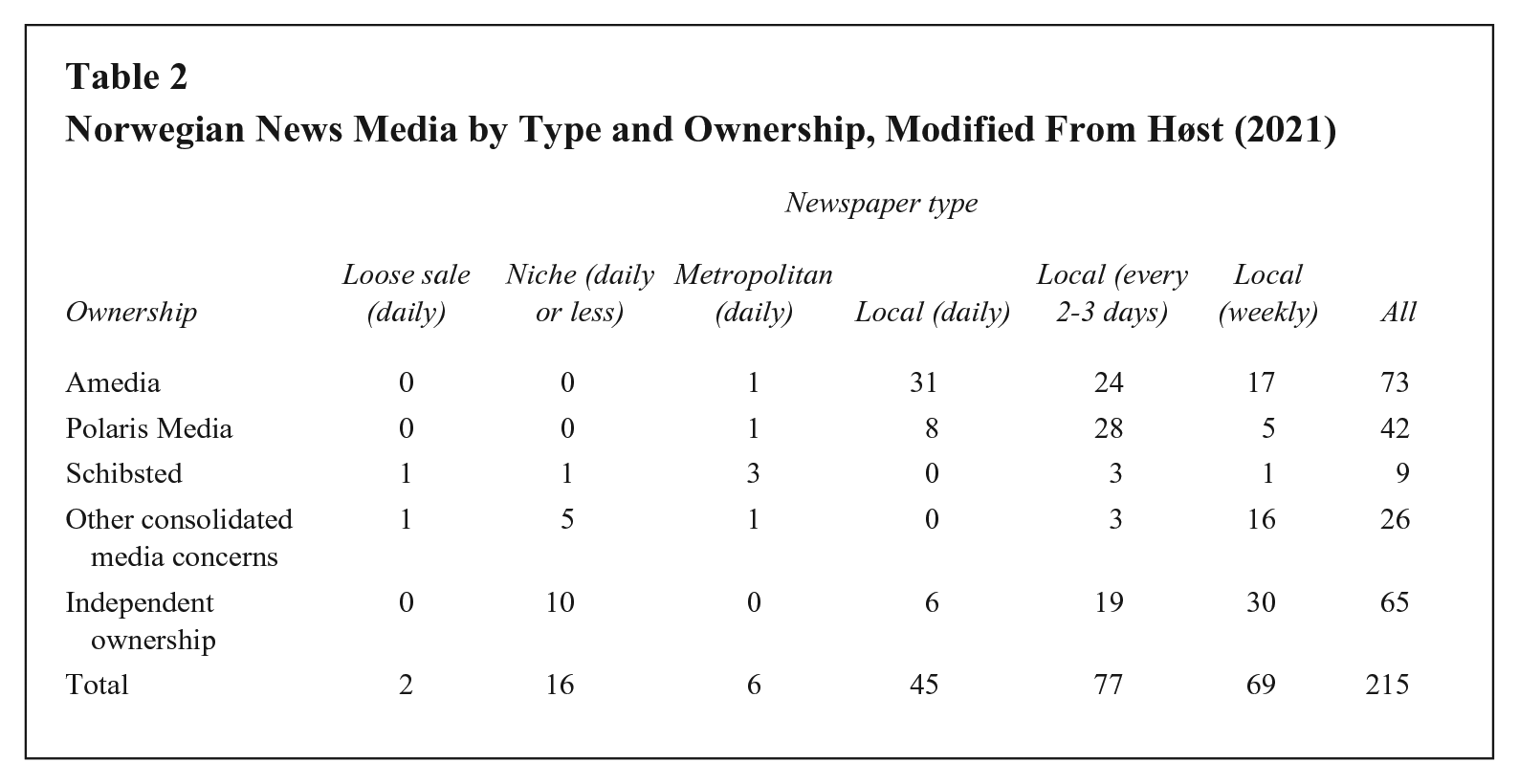
Norway is divided into 356 municipalities, many of them with a local newspaper, financed in part by national press subsidies. In 2020, 215 newspapers were published on paper with a paid-for subscription model, also for the online version of the newspaper (see Table 2; Høst, 2021). The dual management model of an Editor-in-Chief and a Managing Director is the standard model in Norway. The Editor-in-Chief is then responsible for the editorial department and the Managing Director for sales and marketing, with both reporting to the board of directors as joint chief executives. In some newspapers the same person fills both roles, functioning as a publisher, according to this media system (Westlund & Krumsvik, 2014).
Norwegian News Media by Type and Ownership, Modified From Høst (2021)
Data for this study was derived from an online survey sent by email to 349 executives (Editor-in-Chief, Managing Director, and Publisher) of Norwegian newspapers between April and May 2020. Email addresses were provided by the Norwegian Media Businesses’ Association (MBL) and the National Association of Local Newspapers (LLA). Following the removal of non-executive-answered surveys, as well as incomplete surveys, the sample resulted in data from 159 leaders of Norwegian news media organizations representing an effective response rate of 46%.
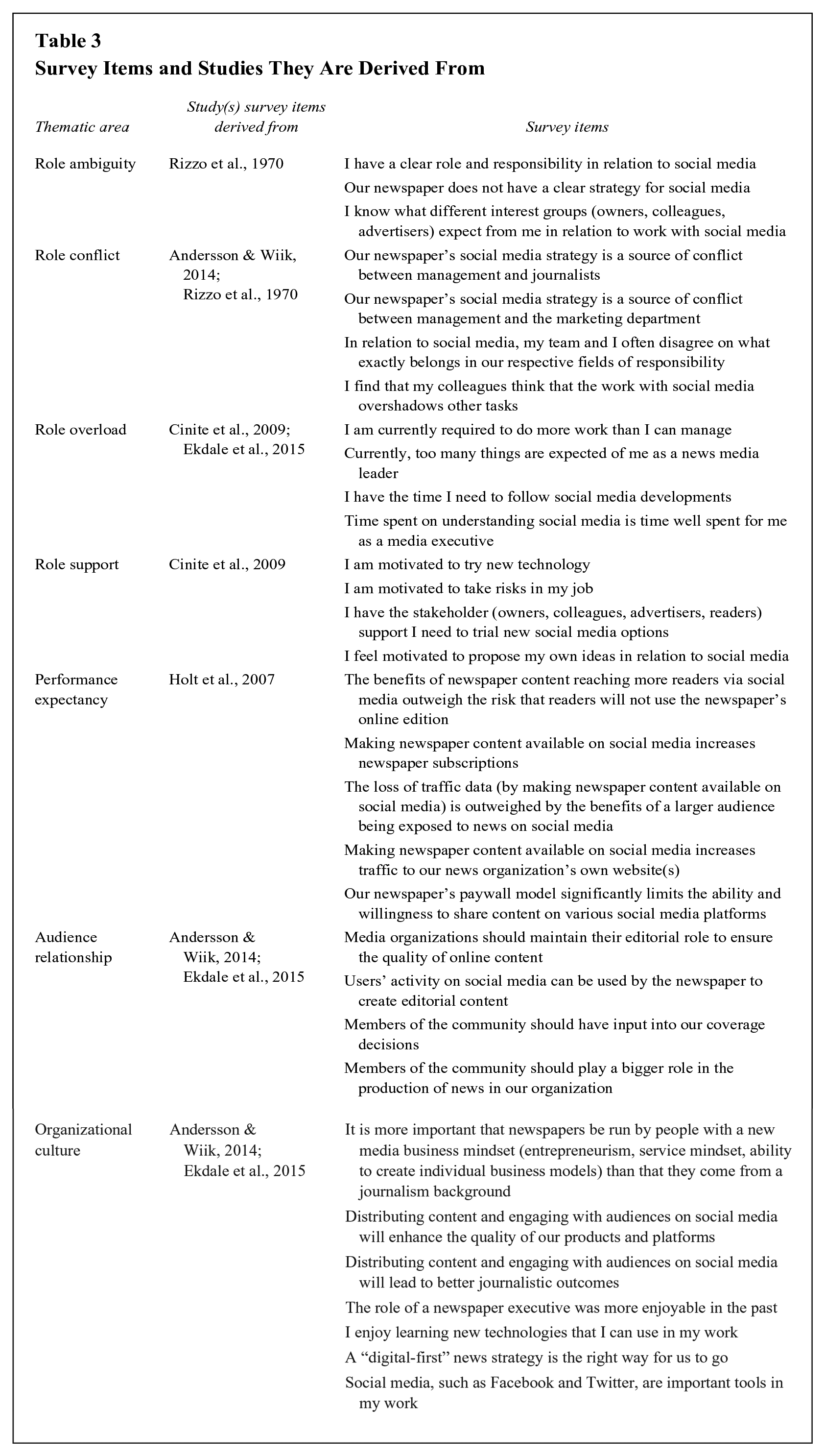
Measurement items were derived from previous literature and modified for the context of this study (see Table 3). The survey asked 31 Likert-type-scale questions, all using a six-point scale: 1 = completely disagree through 6 = completely agree. An additional seven questions covered background variables concerning the newspaper executives and their news organization (age, gender, position, length in position, educational attainment, newspaper circulation, newspaper ownership form), and a further eight questions captured qualitative information on use and strategy in relation to the newspaper’s use of social media (social media platforms currently used by newspaper, nature of journalistic content posted on social media, paywall intentions).
Survey Items and Studies They Are Derived From
Method
We used principal component analysis (PCA) followed by cluster analysis methods and statistical tests of association. PCA is a commonly used statistical technique for grouping highly correlated items and reducing a subset of items to a small set of principal components or “factors” (Fabrigar & Wegener, 2011). PCA is deemed appropriate given the current uncertainty regarding the number and makeup of relevant readiness and unreadiness components in relation to our study, and that at an exploratory stage, we are reducing the number of potentially relevant survey items to a subset for additional analysis (Fabrigar & Wegener, 2011). Components were extracted using the principal components method and adopting Varimax rotation with Kaiser Normalization. To determine the maximum number of components to extract, we applied the scree test, or natural bend point in the graph of the eigenvalues (Costello & Osbourne, 2005). This method identified a maximum of six components to be extracted, and after examining several different component solutions, we identified six components to be most representative and parsimonious (Hair et al., 2014).
Following PCA, hierarchical cluster analysis was used to combine individual component scores into groups that display within-cluster homogeneity. Due to missing data, clustering was based on component scores for 133 newspaper executives. A four-cluster solution was chosen with the support of a dendrogram, examining decreases in cluster heterogeneity as the number of clusters increased, and validation against relevant background variables. Following clustering, an analysis of the association between the clusters and background variables relating to the newspaper executive was performed using analysis of variance (ANOVA), Chi-square tests of association or Fisher’s Exact test (where required due to low expected cell counts), and Z-test for difference in proportions.
The final stage of analysis provides an indicative assessment of the newspaper executive clusters. This analytical step reflects our argument that newspaper executives’ attitudes toward social media as a function of the characteristics of individual actors, attributes of organizational change, and characteristics of the social system that facilitate or restrict the cluster.
Validity and Limitations
Rather than relying on one or more intuition-based “rules of thumb” such as minimum sample size or ratio of items to expected components for good recovery of population factors in exploratory methods such as PCA, MacCallum et al. (1999) note that several factors including sample size and communalities of the measured items to be key determinants of the quality of factor solutions, with communality being the most critical. When communalities are at least 0.6 and the mean value of communalities exceeds 0.7, the influence of sample size on the quality of solutions declines such that good recovery of population factors can be achieved with sample sizes of 100 or less (MacCallum et al., 1999). This is important to our methodological approach given this study draws from a modest population of newspaper executives in Norway.
To ensure validity of our PCA, we initially checked the sampling adequacy using Bartlett’s test of sphericity and the Kaiser-Meier-Olkin (KMO) statistic. Bartlett’s test of sphericity was highly significant at p < .001, indicating significant correlations among some of the items as is required for factor analysis (Hair et al., 2014). Adopting MacCallum et al.’s (1999) approach for validating factor analysis in small samples, we dropped items with the smallest communality until all communalities were over .60 and the mean of all communalities was over .70. This process excluded seven items. Further, we excluded an item with the lowest loading to ensure that the component model explained at least 60% of the total variance (Hair et al., 2014). An item that displayed “cross-loading” (Costello & Osbourne, 2005) was also removed, meaning the final PCA was run on 22 items. The internal consistency of the components was checked by computing a Cronbach’s alpha value. Hair et al. (2014) argue a Cronbach’s alpha (α) value of .6 or greater is an acceptable measure of internal consistency in exploratory research, while Nunnally and Bernstein (1994) suggest a value around .7 is acceptable in the early stages of research. While α > .7 for four components, α lies between .6 and .7 for two components. We then recognize some uncertainty in the internal consistency of these components which will benefit from future confirmatory research.
The survey achieved a good response rate of 46% and we do not consider the survey data to be strongly biased by its online format or socially desirable responding. However, a limitation of our study has been the need to combine the different leadership roles (Editor-in-Chief, Managing Director, and Publisher) to maximize the sample size for performing PCA and clustering. While we consider the extent to which leader types and their concerns vary across different leadership roles, our chosen method may also obscure further subtleties across newspaper executives.
Findings
Attitude to Social Media Components
Running PCA on data from the 22 Likert-type-scale items, attitudinal variables were reduced to six components broadly covering five of the seven themes identified in our literature review (see Table 4).
Social Media Attitude Component Loadings After Rotation
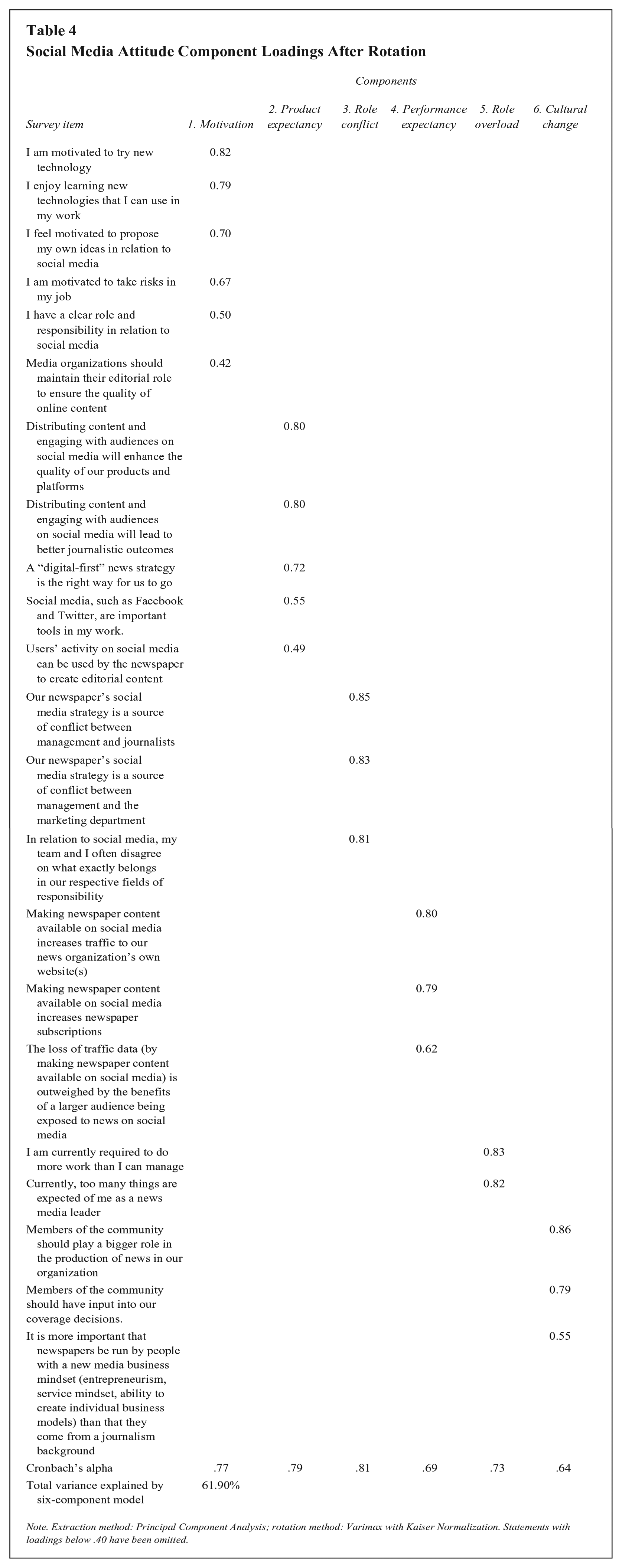
Note. Extraction method: Principal Component Analysis; rotation method: Varimax with Kaiser Normalization. Statements with loadings below .40 have been omitted.
Component 1, labeled technological openness and support incorporates items associated with “role support” (Cinite et al., 2009) and an item associated with an orientation toward “technological change” (Ekdale et al., 2015). It is interpreted as predominately capturing the willingness to try and take risk with technology and social media in the workplace. While component 2 draws from items associated with an orientation toward organizational culture (Andersson & Wiik, 2014; Ekdale et al., 2015), we label this component product expectancy to more precisely capture orientation toward the belief that distributing content and engaging with audiences via social media offers journalistic and product benefits. Component 3 is labeled role conflict to reflect its lineage with the unreadiness factor identified by Rizzo et al. (1970). Role conflict captures social media strategy as a source of conflict between management, journalists, and the marketing department in addition to conflict arising from lack of clarity related to social media roles and responsibilities. Derived from the readiness factor identified by Holt et al. (2007), we label component 4, performance expectancy. The component captures the perceived benefit of social media in terms of own website traffic, newspaper subscriptions, and larger audience exposure to the newspaper’s content.
Component 5, role overload captures the general stress associated with the volume and range of tasks expected of the newspaper executive. While we find only two items with loading at or above 0.4 on this component, both items loading were in excess of 0.8, the two items have low correlation with other items, and Cronbach’s alphas indicates very good internal consistency. Because of these properties, and because role overload has been identified as an important unreadiness factor in other contexts, we retain this component with a degree of reservation. Finally, cultural change measures the belief that audiences should play a greater co-productive role in news content and coverage decisions. It also captures favorability toward newspapers being run by people with an entrepreneurial “new media mind-set” rather than a traditional journalism background. Where audience participation partly fulfills an economic function for newspapers, cultural change broadly captures cultural differences arising from varying levels of managerial ideology and influence in the newsroom (Andersson & Wiik, 2014).
Initial Typology of Newspaper Executives’ Attitudes to Social Media
Newspaper executives are clustered according to their score for each of the six components extracted in the first stage of the analysis. Because of some important attitudinal and demographic differences between clusters 1 and 4 (see Table 5) which are not observable in a three-cluster solution, we opted for a four-cluster solution despite the small size of cluster 4.
Clusters of Newspaper Executives by Attitude Toward Social Media (N = 133)
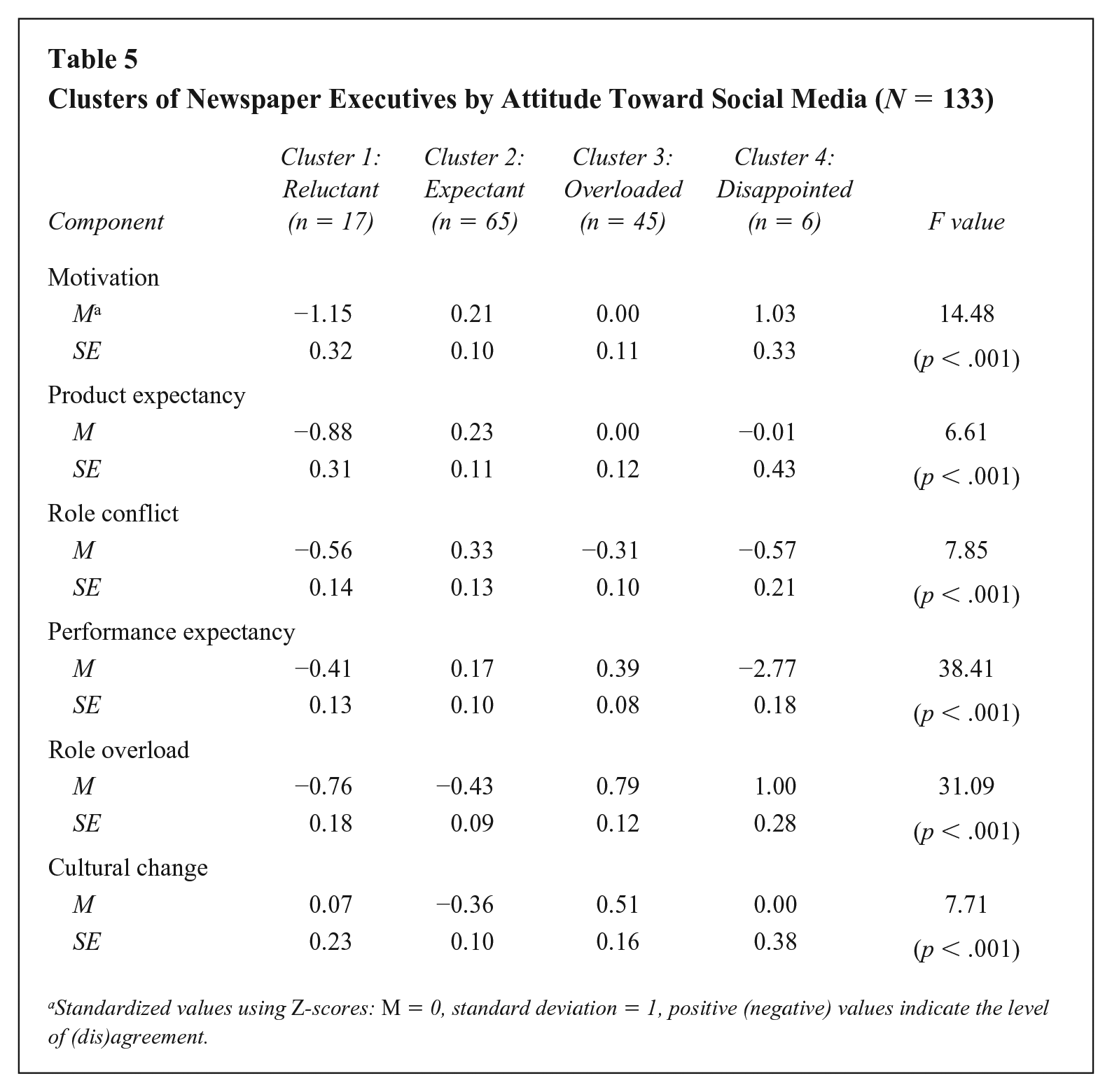
Standardized values using Z-scores: M = 0, standard deviation = 1, positive (negative) values indicate the level of (dis)agreement.
Association between each cluster and qualitative data relating to current use and strategy in relation to the newspaper’s use of social media, as well as background information relating to the newspaper executive and their organization, is presented in Table 6.
Association Between Newspaper Executive Clusters, Background Variables, and Social Media Strategy (N = 133)
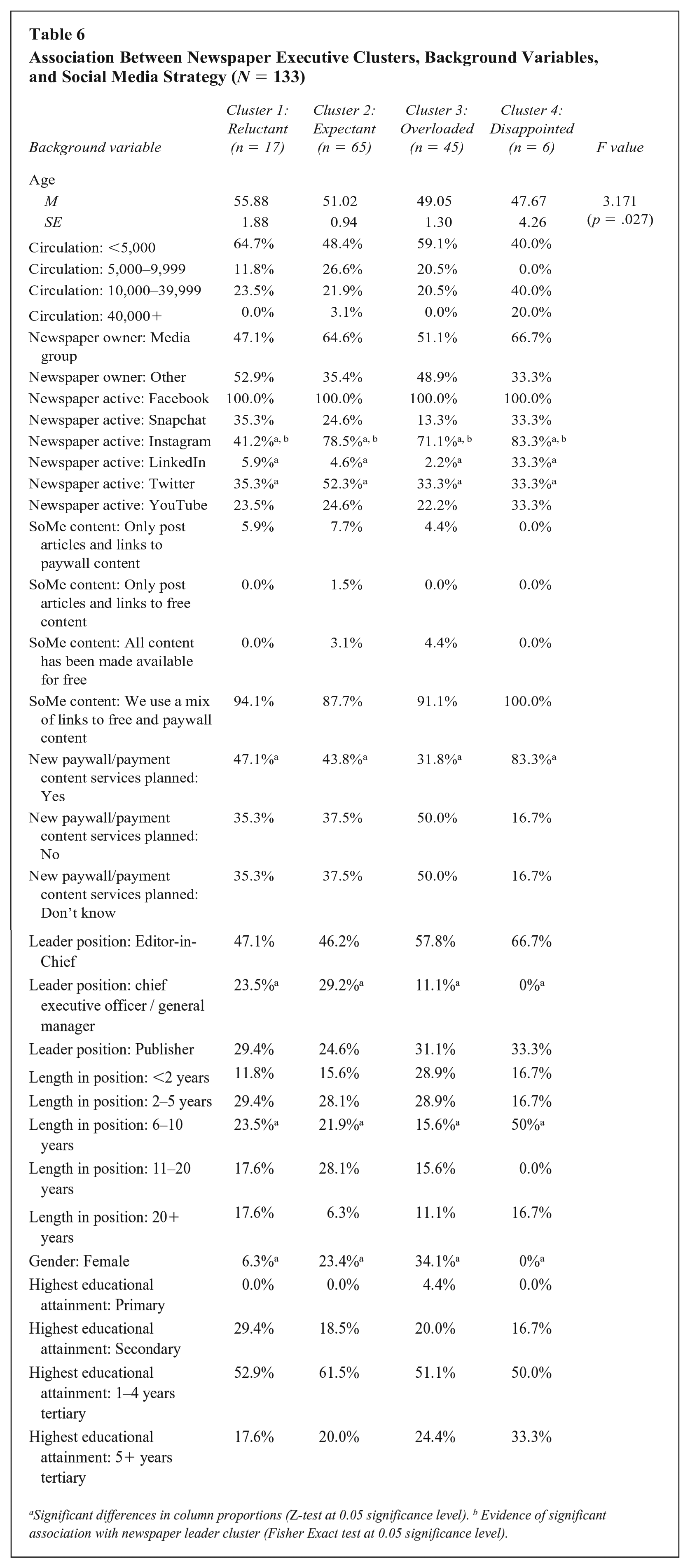
Significant differences in column proportions (Z-test at 0.05 significance level). b Evidence of significant association with newspaper leader cluster (Fisher Exact test at 0.05 significance level).
Having mapped how newspaper executives cluster based on their attitudes toward social media, as well as strategic and background variables associated with each cluster type, we are now able to describe the four newspaper executive clusters.
Cluster 1: Reluctant
The Reluctant leaders are the group with the lowest willingness to engage in the use of social media technology. They score lowest on both Motivation and Product expectancy. Neither Role overload nor Role conflicts hold them back, as they score very low on these components as well. They just don’t believe in the usefulness of social media for their newspaper. These leaders tend not to be users of social media themselves. You will find them in small and independent newspapers, and leaders with more than 20 years in their current role are overrepresented. They also tend to be male and less educated.
Cluster 2: Expectant
The Expectant leaders are more than average motivated to use social media, and they also have more than average expectations for both Product and Performance. Role overload and Cultural components are not holding them back; however, they score highest on the issue of Role conflict. These leaders tend to be Twitter users themselves, and CEOs of medium-sized and large newspapers are in majority.
Cluster 3: Overloaded
The Overloaded leaders are expecting performance from the use of social media, but their highest score is on the problems of actually doing it. High scores on Role overload and the need for Cultural change indicate that social media strategies are not currently on top of their agenda. Motivation and Product expectancy are on average. These leaders have the highest proportion of females, are characterized by higher levels of education, and are more often editors than managers. They are not frequent users of social media themselves, and they tend to be leading small and mid-size newspapers.
Cluster 4: Disappointed
These leaders have the highest motivation and the lowest expectations. The cluster is overrepresented by organizations owned by media groups and large newspapers, hence with access to relevant resources for experimentation with new forms of media and distribution. In this group, we only find male editors, and they have probably tried and failed in the use of social media. They are still motivated but have not yet cracked the code.
Discussion
Our findings can be summarized in a few points: Most media leaders are positive toward the strategic priority of social media although they struggle with how to make social media work best for them. Newspaper leaders experience different types of frustration in exploiting social media, including conflict, pressure, and underwhelming business or journalist outcomes from using social media. None of the media leaders emphatically indicate a need for organizational change associated with social media, but organizational (i.e., circulation, ownership, and leader positions) and personal characteristics (i.e., age, gender, education) are nevertheless key to a leader’s motivation for being a change agent and to use social media in new ways. In the following, we will elaborate on these findings.
Newspaper Executive Types and Their Approaches to Managing Social Media
Albeit not universal, our broad finding that newspaper executives take a positive positioning toward the strategic priority of social media contrasts with studies suggesting a weakening of the initial enthusiasm for social media usage in newspapers (Solvoll & Larsson, 2020; Weaver & Willnat, 2016). Specifically, we find all but one leader type to be positive toward the strategic priority of social media, as measured by perceptions of product expectancy, performance expectancy, or the motivation to trial new ways of working with social media. Even newspaper executives struggling with low expectations of social media’s performance benefits (i.e., Disappointed), work overload (i.e., Overloaded), or social media as sources of role conflict (i.e., Expectant) perceive benefits of social media usage in terms of both media product and performance, or are simply motivated to use social media in new ways.
Conflict Frustration
Our data detects varying sites of frustration that reflect newspapers not having “cracked the code” despite many years of trying to take advantage of social media features. The leader type most affirmative toward social media, the Expectant, experiences social media as a source of organizational role conflict, and this is an issue noted by several earlier studies (Goyanes & Rodríguez-Castro, 2019; Grubenmann et al., 2013; Sacco & Bossio, 2017; Valero-Pastor et al., 2021; Waldenström et al., 2019). We speculate that conflict-related frustration is likely aggravated by the constantly changing nature of social media behavior and algorithms that demand a perpetual “beta” quality of newspaper social media strategy, with the trade-off that specific roles and responsibilities may not be well defined and delineated. Massey and Ewart’s (2012) finding that role conflict arises from changed situations accompanied by a lack of goal agreement, behavioral support, and professional involvement among the employees, offers a further explanation. As the most affirmative toward social media usage, the Expectant leader may be contributing their own role conflict by presiding over a social media strategy that isn’t yet fully supported by internal processes and structures.
Role conflict is not limited to Expectant leaders, and across all leaders (see Table 7) we find it rises with newspaper size and is higher among leaders in a CEO / general manager position, male leaders, those who’ve been in their position for a medium period, the oldest leaders, and those with the lowest level of educational attainment. Although not neatly aligning with elements identified by Massey and Ewart (2012), we can more simply conclude that leaders who are expected to do more with social media and those at a greater organizational or demographic distance from core journalistic activities are more susceptible to experiencing role conflict. This suggests there is scope to mitigate social media-related role conflict through leadership hiring choices and clearer designation of the CEO /general manager’s roles and responsibilities.
Average Standardized Component Score by Background Variables (N = 133)
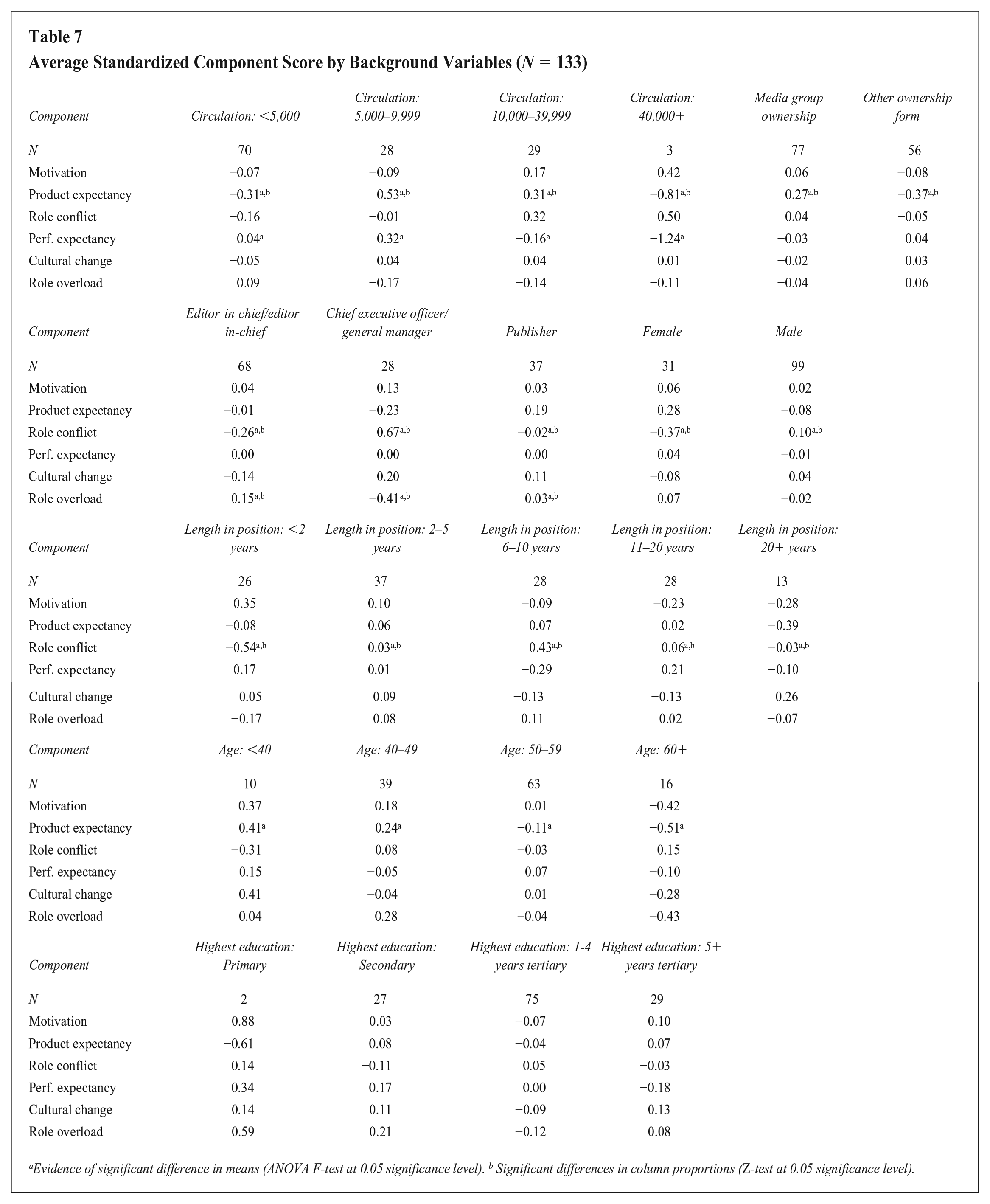
Evidence of significant difference in means (ANOVA F-test at 0.05 significance level). b Significant differences in column proportions (Z-test at 0.05 significance level).
Pressure Frustration
Social media usage is plagued by another frustration, role overload. Across all leader types, role overload is most prominent among leaders with arguably the most to prove (40-49 years, female in a male-dominated industry), leaders most oriented to journalistic activities (i.e., Editors-in-Chief), as well as those with the least resources. Partly reflecting these properties are the Overloaded (proportionally more female, younger, more likely Editor-in-Chief) and the Disappointed leader (younger, more likely Editor-in-Chief), both of whom indicate disproportionately higher role overload. Beyond the direct impact of resource limitations, smaller newspapers are more likely to be further impacted by an attitudinal resistance to change connected to the leader’s experience of role overload. These findings also point to a weakness in the standard dual-leadership model in which the Editor-in-Chief disproportionately experiences excessive demands in their role.
Performance Frustration
Skepticism toward the organizational performance benefits of social media remains a third major frustration for newspaper leaders. Across all leader types, performance expectancy is notably lower among leaders of larger newspapers, leaders with the highest level of education, and among the oldest leaders. Indicative of the Disappointed and Reluctant leader, the frustration of underwhelming performance expectancy is primarily split between those who’ve had the resources and tried and another group of leaders of smaller newspapers who’ve made much more modest attempts but nevertheless remain unconvinced. This places a much larger majority in the middle, yet to exhaust strategies and still hopeful. That these have not been swayed by the experiences of the largest newspapers is again reflective of the general positivism we observe, where the non-exhaustion of social media strategies plus an ever-changing social media landscape collectively hold out hope for future material benefits. As large newspapers have access to resources for experimenting and innovation, they have previously acted as first movers in technological processes, such as digitalization and online subscriptions (Krumsvik et al., 2013). However, as noted in the introduction, with changes in audience use, underlying algorithms, and the rise of false news, newspapers might be reluctant to use social media to spread news and engage with the audience.
No Need for Organizational Change?
While previous studies have highlighted the importance of organizational culture in how newspapers embrace or reject technology-based change (e.g., Bunce, 2019; Min & Fink, 2021), none of the four leader types indicate a clear relationship between perceived need for organizational change (around the participatory and business potential of social media) and leaders’ motivation to use social media in new ways. For example, the Overloaded indicates a strong need for cultural change in the newspaper. At the same time, this type of leader expresses high role overload. This may have a negative impact on motivation to act upon the need for cultural change, as the overloaded leader feels only average motivation to use social media in new ways. We also observe considerable variability in perceived need for cultural change across the four leader types. Rather than reflecting organizational differences, these appear to be driven more by personal leader factors. Across all leaders, perceived need for cultural change is strongest among the youngest leaders, the least and most educated, those longest in their position, and among those in more business-oriented positions. Collectively, this suggests that in a Norwegian context, the various usages of social media are still far from a normalized and conflict-free practice in the newsroom, as discussed already in the literature 10 years ago (Lasorsa et al., 2012).
Partly aligning with García-Avilés et al.’s (2018) assertion that the legacy of traditional business models and stagnation among senior news management limits newsroom innovation, we observe only one leader type, and a small group at that (Disappointed), spearhead social media-based change. Across all leaders and news media organizations, we find technological openness and willingness to experiment to be associated with both personal and organization-specific variables (newspaper size, newspaper ownership, age, and length in position). Collectively, this suggests that both cultural and personal factors are key to a leader’s openness and willingness to use social media in new ways.
Concluding Remarks
Placed in a Norwegian context, our study points to problematics with a “one size fits all” approach to understanding social media use in the newsroom that ignores variation in strategic aims, stress factors, characteristics of the news leaders, and the culture of the news organization. In contrast to recent studies exploring the changing nature of newspaper leadership in Scandinavia that observe growing pressure on newspaper executives to develop “convergent skills” (Andersson & Wiik, 2014; Waldenström et al., 2019), we observe a more nuanced picture of the imperatives of newspaper executives. We find wide variation in the attitude toward and usage of social media that is generally reflective of the news organization’s strategic needs and capabilities, social media-related frustrations, its culture, as well as the competencies and tradition of the newspaper executive.
In the context of the contemporary economic pressures faced by news organizations, particularly smaller circulation papers, one might expect greater technology-based risk-taking by news organizations and their leaders. While social media and other technologies may not hold the answer to achieving an equilibrium between economic and social value creation by news media, technology-based change appears essential to customer value creation for media organizations of all sizes. Whether this can be translated to economic viability for media organizations in a diverse media landscape remains to be seen. While this article articulates the perceptions of newspaper executives, our study is limited by the number of news executives’ perceptions captured and is limited by the type of data upon which our analysis has been conducted. Therefore, there is potential for further research to investigate these issues from other perspectives (e.g., other national markets, analysis by news executive types and other media roles), using a wider variety of methodological approaches, to gain a deeper understanding of the efficacy of social media, organizational culture, and work-related role stressors in media organizations. Future research directions are many, but two key questions emerging from this study deserve future attention: “What is the impact of concentration of media landscape in news executive positioning toward social media?,” and second, “What might ‘cracking the code’ of social media features look like and what are the leader and organizational factors that facilitate this success?.”
