




Abstract
The indices for the classification of newspapers have often focused on agenda-setting roles, economic position and size of newspapers, among others. Concerning newspapers in Africa, Moehler and Singh (2011) and Hasty (2005) assert that the only index for the classification of newspapers is ownership. The study, therefore, focuses on the patterns of the attributive mode of the transitivity system of Systemic Functional Grammar to propose a linguistic alternative index for classifying newspapers. The findings indicate that the patterns of attributions that occur are significant and viable enough to classify newspapers.
Introduction
The use of the term “media” often refers to not only a wide range of communication channels like electronic media, televisual media, print media and oral media, among others but also to various genres of technologies, formats and products (Spitulnik, 2000). In these varying forms, language is an essential tool that aids the media in communicating its news. Language and media share a symbiotic relationship. Language has the potential to determine which media a communicator can use for communicating his or her ideas. On the contrary, the choice of media can determine the nature of language to use for communication. This may include interrogating assumptions like should grammatical rules be observed, should language be formal or informal, should the semantic implication of the linguistic choices be considered, or should language be multimodal, among others. Thus, the media has the potential to induce certain linguistic items just as certain linguistic items and features can influence the selection of media for communication. Moschonas (2014) suggests that the media is capable of not only inducing some linguistic items but also changing the nature of linguistic features in the larger society. For instance, users of social media often tend to be creative, especially in word-formation processes (Appiah, 2016) and the creativity is instigated by the demands of the new media. The impact of media plays an important role in relation to language use and preservation by serving as a reservoir of language. Thus, a cursory examination of the language of the media can reveal the grammatical, semantic and discourse features of a language. To Spitulnik (1997), the media serves as a reference for circulations of words, phrases and discourse styles including the appropriate context of the usage of language.
Arguing on the complex relationship between language and media, Conboy (2010) suggests that the two can be differentiated by the roles each plays in the presentation of activities: Language is thoroughly a social activity and media extends that activity. In other words, meanings, ideals and social constructs are reflected in language while the media serves as the vessel by which the meanings and constructs are communicated. Perhaps, the difference lies in the concept of materiality (Gershon & Manning, 2014). Gershon and Manning (2014) explain that “language is materialized in only one medium or channel” called the “media” (p. 139). It can, therefore, be considered that although language and media can be independently studied, they mark each other. In essence, the construct and the characteristic of language can be a particular feature of a particular media.
According to Conboy (2010), “the language of newspapers has always encapsulated what would sell to audiences and how information could best be packaged and presented to achieve this commercial end at any particular time” (p. 1). This conceptualization of the language of the newspaper suggests that editors and writers of newspapers are goal-driven and the language of newspapers is specially couched to achieve certain purposes. Although Conboy (2010) views the language of newspapers as more economically driven, other scholars like van Dijk (1995) have suggested that the language of newspapers is more ideologically driven. What seems to be asserted in these alternative views is that the language of newspapers is audience-centered and, therefore, may be presented uniquely to mark a particular newspaper or groups of newspapers as distinct from others. In other words, the language of newspapers, when carefully examined linguistically, varies and may serve as unique markers of a particular group of newspapers. It is in this light that this research explores some distinct linguistic features of state and private newspapers with the view of providing yardsticks that can serve as classification tools for the group of newspapers under study.
Literature Review
Classifying Newspapers
Indeed, the agenda of classifying newspapers has been pursued from several non-linguistic perspectives by scholars. These varying perspectives of classification seem to occur because scholars argue that the media systems across continents generally differ (Tirosh et al., 2022) although some thread of similarities and influences may exist (Mohammed & Mccombs, 2021). Using framing perspectives, Carpenter (2007), for instance, classifies newspapers into elite and non-elite newspapers. Elite newspapers have greater quality in content and often serve as agenda-setters for non-elite newspapers (Carpenter, 2007, p. 761). Non-elite newspapers, on the other hand, do not often report on international news coverage like elite newspapers do because of differences in sourcing news information. They often resort to the elite newspapers that take the responsibility of leading the frame-building process. The elite newspapers, therefore, are the “opinion-leading newspapers considered to provide orientation for other news media” (Tirosh et al., 2022, p. 52). Wu (2021) affirms that the essential yardstick for identifying elite newspapers is agenda-setting. Elite newspapers perform the role of intermedia agenda setters for non-elite newspapers (Raza & Khan, 2022; Wu, 2021) although this may occur in the international sphere too (Mohammed & Mccombs, 2021).
Other scholars like Lehman-Wilzig and Seletzky (2012) suggest that the difference between elite and non-elite newspapers can be accounted for using five indices including design, journalistic ethics, target audience, paper format and content. These five indices serve to underline the characteristics of elite newspapers to not only publish hard news as the social conscience of the society but also serve as watchdogs of democracy (Lehman-Wilzig & Seletzky, 2012). Magin (2019) expands the indices into six: (a) target groups, audience and societal influence; (b) format; (c) content, layout and journalistic style; (d) reputation and ethics; (e) channel of distribution and financing; and (f) democratic function. In all these indices prescribed, elite newspapers perform the best of the roles and have the best features. For instance, elite newspapers often target the more formally educated readers, have better reputations, have a comprehensive network of distribution that makes them more nationalistic, dictate the content and style of journalism in their countries and observe greater standards of journalistic professionalism and ethical responsibility (Ali et al., 2019; Graham & de Bell, 2021; Stanley, 2012; Tirosh et al., 2022). The roles elite newspapers perform cannot be associated with non-elite newspapers that typically take an interest in publishing soft news related to sex, gossip and infotainment, among others. Hence, non-elite newspapers are colorful in their reportage and do not assume social responsibilities.
The growth of elite and non-elite newspapers, in the case of the United States of America, has been associated with the process of “narrowcasting” where newspaper organizations target a more specific readership away from the masses. Wu (2021) notes that narrowcasting has been an important view of distinguishing between the two groups of newspapers. Narrowcasting, influenced by social networking, advancement in technology, an increase in literacy rate and newspaper professionalism over a period of time has shaped elite newspapers to establish themselves as the national agenda setters, and also represent the views of social elites. Vessey (2021) highlights that elite newspapers in Britain are more associated with the views and concerns of social elites, and as is the case in America, Britain’s elite newspapers are the agenda-setters of news discourse in the country. However, in the United Kingdom, it is possible to classify newspapers by their sizes. This classification often leads to the use of the terms broadsheets and tabloids (Richardson & Stanyer, 2011). The broadsheets, also known as “quality press,” have larger sizes and often report foreign news, while the tabloids, also known as “popular press,” have smaller sheets and often focus more on celebrity coverage and other human-interest stories than political reporting or foreign news.
Although the classification of newspapers as elite and non-elite or populist exists in Asia, the index of classification is more often economics-related. For example, in China, the commercial viability of newspapers influences their status as elite (Wu, 2021). Commercial newspapers that have a broad market base and which offer alternate daily news are regarded as elitist over traditional agenda-setters. Essentially, commercial newspapers are elite newspapers, while official or state newspapers are regarded as non-elite because they lack commercial power. Raza and Khan (2022) assert this claim by insisting that it is the abundance of resources of elite newspapers makes them more commercial. Elite newspapers in Asia, therefore, have more coverage, a larger audience, greater societal influence and a better reputation (Siddiqua et al., 2021).
In the case of Africa, classifying newspapers into elite and non-elite newspapers seems inappropriate. Indeed, for most African countries, ownership is the only index used to classify newspapers (Frimpong, 2015; Hasty, 2005; Moehler & Singh, 2011). In view of this, almost all countries in Africa classify their newspapers into state/public newspapers and private newspapers. Comparing the means of classification of newspapers in Ghana and Britain, Frimpong (2015) remarks that while British newspapers are classified based on content, Ghanaian newspapers are classified only based on ownership. Beam (2008) reports that studies that have focused on providing an alternative index to characterize newspapers in Africa without emphasizing ownership have been carried out from two perspectives: economics and organizational sociology. Those carried out from sociological perspectives explore the role organizational structure and content point to the differences between state and private newspapers. From an economic perspective, the goal of profit-making by the newspaper organization has served as a reliable index to distinguish between newspapers with private newspapers considered to be more profit-driven than state newspapers (Beam, 2008).
It can be asserted that the consideration for linguistic indices has not been given much attention in the literature despite the significant role language plays in news communication. Especially in the case of Ghanaian newspapers, the classification of the two groups of newspapers has only been based on the ownership. However, attention to other indices like means of sourcing information, policies of the newspaper organization and the practices engaged by the newspaper organizations have been suggested for probing (Hasty, 2005; Shardow, 2015). Nevertheless, there is the general assumption that there exist some linguistic differences between private newspapers and state newspapers which may be related to the sensationalism of private newspapers (Frimpong, 2015; Hasty, 2005). However, this assumption has not been significantly verified.
Newspapers as the Focus of Language Studies
The focus of language studies on newspaper discourse is borne out of the considerable mass consumption and relative discursive areas of linguistic applications that newspapers offer writers. Van Hout and Cotter (2014) describe this as the omnipresence and accessibility of the media including newspapers. The language and/or discourse of newspapers can be regarded as reflective of the public and institutional presentation and representation of social experiences and a means to construe ideologies. Hence, earlier studies into newspaper language often focused on examining ideological representations in the discourse. The initial and often preoccupied ideological studies focused on lexical choices, information positioning and rhetorical structures that characterize the publications (Cotter, 2001; Matheson, 2005). Although several aspects of newspaper publications have received linguistic attention, the editorial has often been the focus of many scholars because of the editorials’ productive accounts of ideologies and also their representativeness of the institutions that publish the newspapers.
The editorial is embedded with institutional ideologies that are presented in the disguise of educative opinions (Corner, 2016; Firmstone, 2019; van Dijk, 1989, 1995). In fact, the editorial has been considered as the formulation place of ideologies that greatly influence the structure of the text (Firmstone, 2019; Frimpong, 2017; van Dijk, 1989). As noted by Farrokhi and Nazemi (2015), the ideological inclinations of newspapers impact the rhetorical structuring of editorials; hence, the syntactic and semantic structuring of the texts in the newspaper, especially the editorials, are ideologically affected. This implies that newspapers may vary because of their ideological positions which are manifested in the texts of the newspapers. In essence, linguistic variations among newspapers are highly probable because of the various ideological positions of newspapers.
Biber and Conrad (2009) underscore this assumption by tying in linguistic variations within texts of newspapers to the functional relevance of the individual texts that are presented in the newspapers. For example, they note that functional, ideologically inclined texts such as the editorials use nouns and nominal groups distinctly to further the communicative purposes of persuasion and ideological presentations. In news reporting, however, stories or texts in newspapers are more likely to present the verb in the present tense and the past tense only. Also, Bonyadi’s (2011) focus on modality in newspapers reveals that modality is an essential linguistic tool to indicate a writer’s favorable or unfavorable bias toward a particular subject and thereby manipulate the reader’s opinions. Bonyadi (2011) notes that predictive auxiliary modals such as will or would are often preferred by writers and editors to write persuasively to push their stance. In a related study on modality, Frimpong (2007) mentions that the linguistic tool of modality is used by writers and editors not only to reveal their attitude toward a subject but also to underlie the editor’s emotions.
These researches underlie the important fact that linguistic features or units are peculiar and may characterize newspapers. In fact, Cotter (2001) asserts that the discourse features including linguistic elements are uniquely distributed in media discourse or texts. These unique features are, therefore, significant enough to mark or characterize newspapers and it is the linguistic feature of attribution that is explored in this article.
Research Questions
The study is conducted to examine the differences in the attributive processes in the editorials of state and private newspapers to determine if they are significant enough to serve as basis for classifying the newspapers. This is carried out by addressing the following research questions:
Research Question 1:
Are the attributive patterns utilized in the linguistic systems of state and private newspapers similar or different?
Research Question 2:
Are the differences in the linguistic systems of state and private newspapers significant enough to classify them into separate groups using attributive patterns as yardsticks?
Method
The research employed the mixed methods approach in observing and commenting on the patterns of the Attribution of the Relational Process in the newspapers. The adoption of the mixed method allowed the complementing of qualitative and quantitative analysis of the patterns to strengthen observations that were made. Thus, the researcher leveraged both methods for a comprehensive understanding of the phenomenon observed in the data as many scholars have suggested (Cresswell, 2009, 2014; Frimpong, 2015).
The data for the study included editorials of four leading newspapers in Ghana. The newspapers were purposively sampled based on prominence, circulation and academic interests. Elliott (2018) reports in a survey that Ghana’s newspaper landscape has the Daily Graphic and Ghanaian Times (state-owned) and the Daily Guide and The Ghanaian Chronicle (privately owned) as the most popular and widely circulated newspapers. These newspapers have also received significant academic interest (Fosu, 2014; Frimpong, 2015; Hasty, 2005; Shardow, 2015) due to their quality and position as the standard of good newspapers in the country. The selection of the editorials for the research was made because of their representativeness. Newspaper editorials are considered as always expressing the official position of newspaper institutions on the topics discussed in editorials (Wiredu, 2012). In all, a total of 96 political newspaper editorials published in 2016 were purposively sampled for the study. They include two publications of each of the four newspapers in each month of the year. The editorials were all election-related political editorials of the 2016 general elections in Ghana. Political editorials were selected because politics forms the frequent theme of most editorials in Ghana.
The analysis of the data involved a functional grammatical analysis method of identifying the clauses, including the primary and embedded clauses, in the text. The clauses were then coded to reflect each of the processes being examined. The data were then sent into AntConc, a quantitative program, for analysis to generate the frequencies and context of each identified process under consideration. The graphs, charts and tables of frequencies and percentages for each category utilized in the analysis were likewise created using Microsoft Excel. Despite the fact that this study is qualitatively oriented, the researcher used the Chi-square test to measure the attested frequencies of variables across the four newspapers from the two ownership contexts to confirm or refute the similarities and differences between the two groups of newspapers. The researcher used Pearson’s critical value of 0.05 to determine the statistical significance of variations in the frequency of variables, as this value is regarded as a standard for studies (Frimpong, 2015, 2017) that offer comparative insights into language realizations in newspapers.
Theoretical Perspective
The research adopts the Attributive Process of the Relational Process of Systemic Functional Grammar’s (SFG) ideational metafunction to understand the patterns of characterization in the newspapers. SFG holds that the language of a text is an organized network of systems and involves deliberate choices from a describable set of options for meaning-making (Halliday & Matthiessen, 2014). The choices made in this system are functional in nature and, thus, perform some intended purposes. These metafunctions, which construe different aspects of the world, are classified into three, namely, the ideational, the interpersonal and the textual. The Attributive mode of the Relational process, which is selected for this work, belongs to the transitivity system of the ideational metafunction which views the grammar at the level of the clause as a representation of the natural world including the consciousness through which we represent the world to ourselves and others, with which we reflect our experience of the world and with which we construct ideas about the world (Eggins, 1994).
The relational process or grammar serves in discourse as a means of characterization and identification. The Attributive mode is an aspect of the relational process that reflects the grammatical representation of “being” which writers or editors use to project to readers their representation of characters or ideas. The Attributive clauses are used by editorials to characterize participants in texts. The process enables the construing of hypothetical relationships of class membership between two Be-ers Halliday & Matthiessen, 2004, 2014). As a result, through this process, a participant (Carrier) is given an Attribute that describes it. Characterization has a key role in how readers are introduced to characters or participants in newspapers. The Attributive system is selected for this study because of its extensive use by editors in their provision of descriptions and characterizations of persons, things and ideas and also in the presentation of their stance in the editorials even unconsciously. Hence, the deliberate patterning of this representation in newspapers subtly construes how the newspapers want readers to understand the nature of persons or ideas discussed in the editorials. This grammatical pattern is explored in this study to project the differentiation between state and private newspapers.
Results
The Attributive clauses were observed in the data. According to SFG, the Attributive process is expressed in three forms of the relational process: Intensive, Circumstantial and Possessive. These three forms were examined in the data and the findings are presented in Table 1.
Distribution of Types of Attributive Processes Across Newspapers
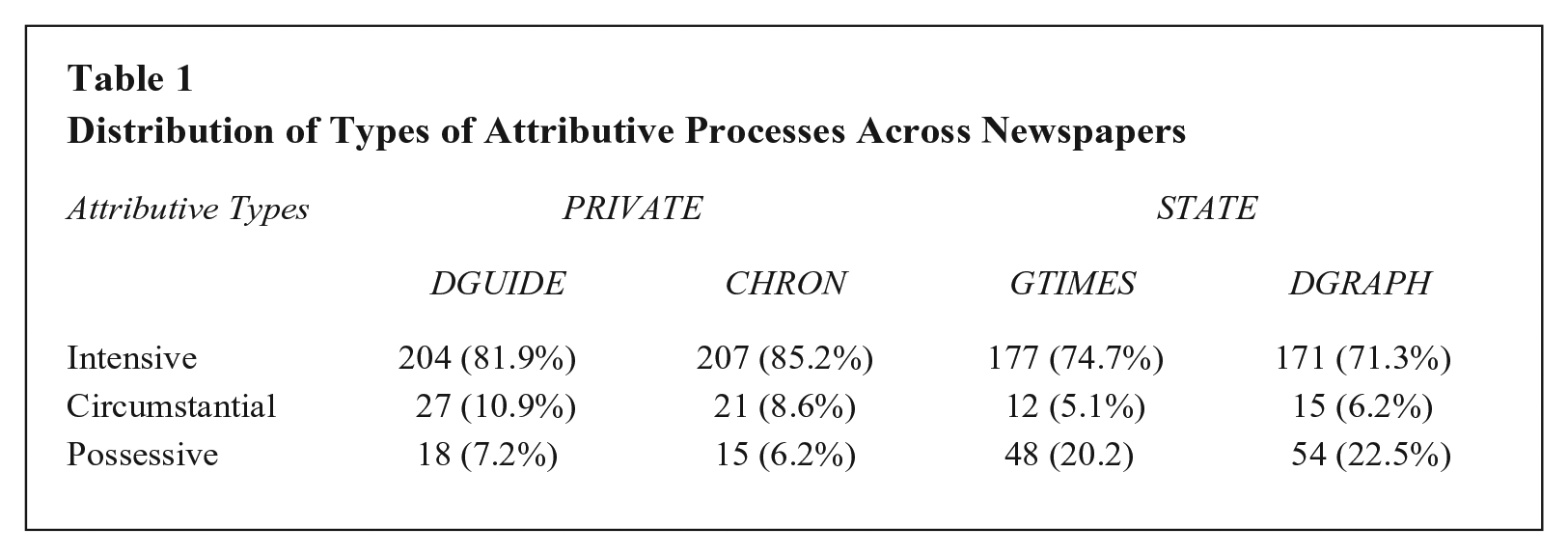
Table 1 indicates that there are variations in the kinds of Attributive Relational processes used across the two groups of newspapers. In all the Attributive Relational processes of the newspapers, the Intensive forms the majority of the various kinds examined. The Intensive Attributive process forms over 80.0% of the Attributive process in private newspapers and over 70% of the Attributive process in state newspapers. However, what functions as the second most frequent kind of Attributive clause varies according to the kind of newspaper. In private newspapers, the Circumstantial functions as the second preferred kind, and in state newspapers, the Possessive functions as the second preferred kind. Intensive attribution constitutes 83.5% (411) of the Attributive process in the private newspapers which is higher than 72.9% (348) of that of the state newspapers. Also, the Possessive constitutes 21.4% (102) of the state newspapers which is very high when compared with the 6.7% (33) of the private newspapers. The Circumstantial constitutes 9.8% (48) of the private newspapers which is also higher than 5.7% (27) of the state newspapers.
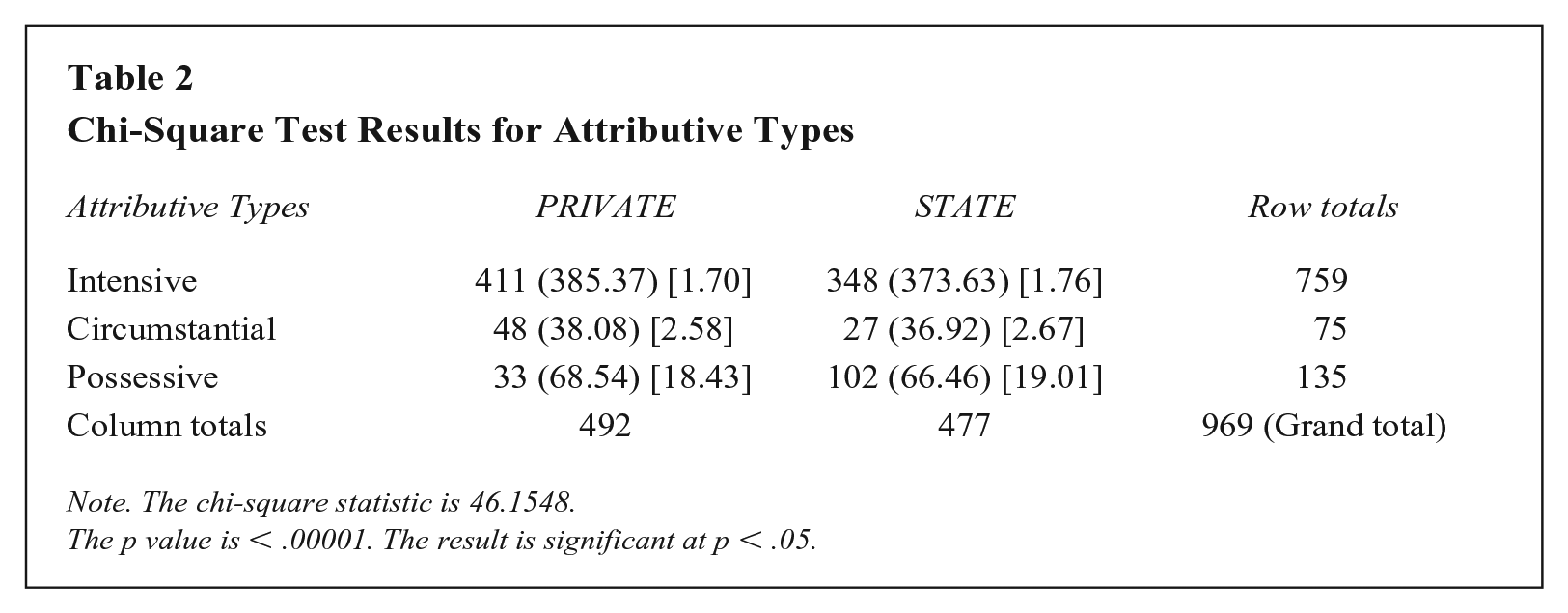
To confirm the significance of the variation that was observed, a chi-square test of independence was conducted. The results are presented in Table 2.
Chi-Square Test Results for Attributive Types
Note. The chi-square statistic is 46.1548.
The p value is < .00001. The result is significant at p < .05.
The results in Table 2 indicate that there is a significant variation in the use of the kinds of Attributive processes in the groups of newspapers, (χ2 = 46.1548, p = .00001). This confirmation makes it safe to conclude that there are significant variations in the form of attributions engaged by the newspapers to proffer descriptions or characterizations of participants.
Intensive Attributive
According to Halliday and Matthiessen (2014), the Intensive attributive functions ascribe a specifying attribute to a participant described as the Carrier. Thus, the Attribute is used to refer to the class that specifies the Carrier and also provides a way to assess the Carrier by analyzing the Carrier’s attribute. According to Downing and Locke (2006), to say “the Carrier is in some way the Attribute” is to make an intensive attribution between a Carrier and an attribute (p. 145).
Three main types of Intensive Attribution exist: Membership Specification, Phase Attribution and Domain of Attribution. These different kinds reflect the different ways attributes are assigned to the Carriers and also indicate how the groups of newspapers engage in character ascriptions. The attestations of these kinds of intensive attribution are presented in Table 3.
Distribution of Types of Intensive Attributive Processes Across Newspapers
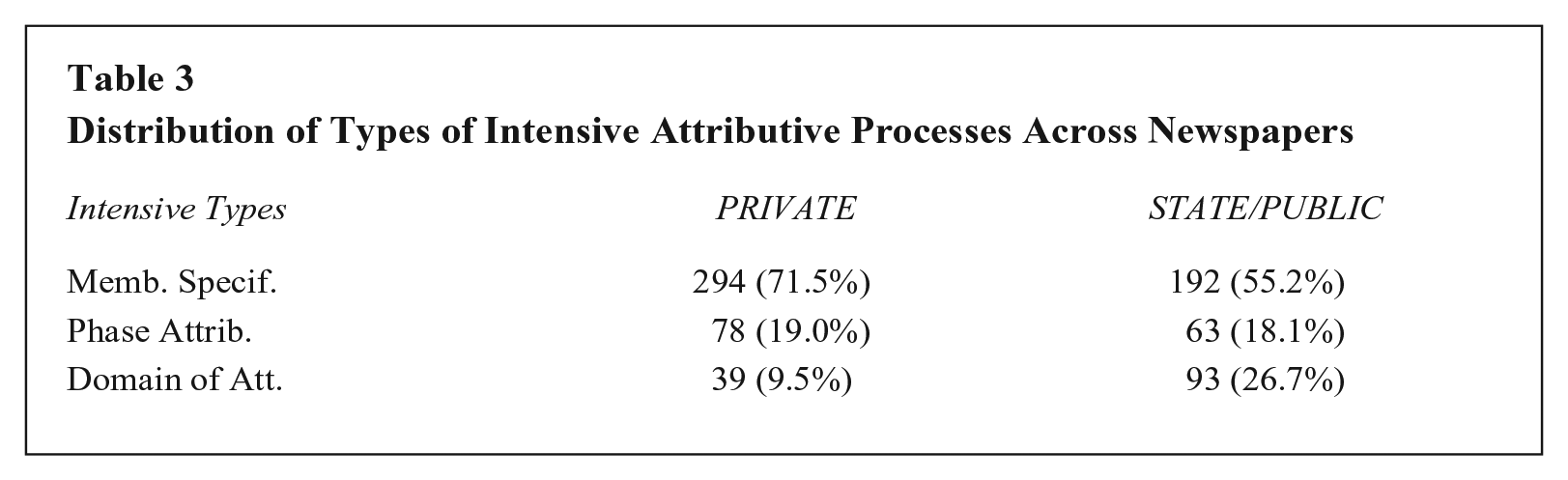
Table 3 indicates that there are consistent variations in the realizations of the kinds of Intensive Attributive processes used in the groups of newspapers. Collectively, the Membership Specification constitutes 71.5% of the Intensive Attributive processes in the private newspapers; this is higher than 55.2% of that of the state newspapers. Also, Phase Attribution constitutes 19.0% of the private newspapers and 18.1% of the state newspapers. The Domain of Attribution constitutes 9.5% of the private newspapers which is lesser than 26.7% of the state newspapers. These findings extend the observation of patterning differences in the attribution processes in the state and private newspapers. A chi-square test of independence was conducted to verify the significance of the differences realized in the patterns. The results are presented in Table 3.
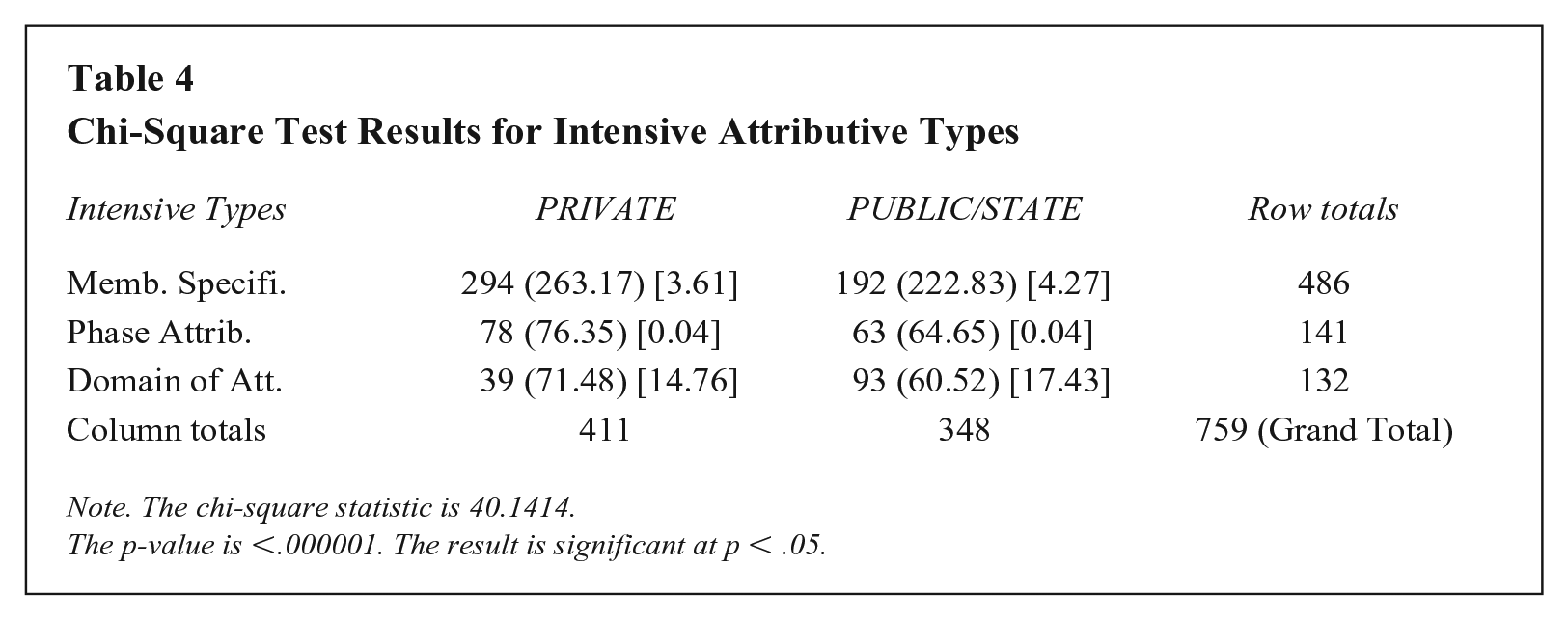
As indicated in Table 4, the results verify that the differences that are observed in the patterning of the Intensive Attribution process were very significant, (χ2 = 40.1414, p = .000001). This finding further extends the assumption that, at least, in terms of the use of the Intensive Attributive process, the newspapers can be classified.
Chi-Square Test Results for Intensive Attributive Types
Note. The chi-square statistic is 40.1414.
The p-value is <.000001. The result is significant at p < .05.
Membership Specification
The Intensive process of Membership Specification refers to the system of specifying a class of a Carrier “by naming the class itself by reference to the entity that constitutes the class . . . or by naming a criterion for class-membership by reference to a quality or qualities of the entity that constitutes the class” (Halliday & Matthiessen, 2004, p. 220). Thus, writers specify the class membership of a participant through this process of attribution. This is achieved by using a noun or a noun phrase to specify an entity of the Carrier or by the use of adjectives, adjectival phrases or Epithets to specify the quality of the Carrier. The focus here is the specification of the entity or the quality of a participant in a clause.
The data suggest that state newspapers are more likely to specify the quality of a participant (Carrier) other than specifying the entity of the Carrier. They engaged the adjective and adjectival phrases 144 times (75.0%) in performing the Membership Specification of participants referred to in the editorials. In other words, state newspapers are is inclined toward ascribing qualities to Carriers that are used in the Attributive clauses. This is exemplified below.
The police in particular (CARRIER) must be (REL-IntenAttrib) more proactive in averting electoral violence such as occurred near the residence of the NPP flag bearer (ATTRIBUTE)
the current four-year term (CARRIER) is not (REL-IntenAttrib) enough (ATTRIBUTE)
the fees (CARRIER) are (REL-IntenAttrib) excessively high (ATTRIBUTE)
the EC (CARRIER) is (REL-IntenAttrib) justified (ATTRIBUTE)
Unlike state-owned newspapers, private newspapers mainly engage in Membership Specification by specifying an entity of the Carrier rather than the quality of the Carrier. The data indicate that the private newspapers used the noun phrase, in its varying structures, 183 times (62.2%) times to specify the entity of the Carrier. For example:
Every election (CARRIER) should be (REL-IntenAttrib) an improvement on the previous ones (ATTRIBUTE)
Charlotte (CARRIER) is (REL-IntenAttrib) a good woman with Ghana’s interest at heart (ATTRIBUTE)
he or she (CARRIER) cannot be (REL-IntenAttrib) a serious contender to the presidency (ATTRIBUTE)
Aspiring to lead Ghana as president (CARRIER) is (REL-IntenAttrib) a serious business (ATTRIBUTE)
Essentially, the identifiable distinction between the private newspapers and the state newspapers in terms of Membership Specification is the preferred grammatical structure used in denoting the Carriers’ attribution. State newspapers prefer to use adjectives, while private newspapers mainly use noun phrases in the performance of the function of Membership Specification.
Phase Attribution
Phase Attribution represents an intense attribution of a Carrier or Participant by describing attributes of time, appearance or sense perception (Halliday & Matthiessen, 2014). Whether it is the Time phase or the Reality phase, the attribution provided in both cases develops with time (Halliday & Matthiessen, 2014). According to the data, the Reality phase appears to be the most common type of phase attribution in both groups of publications: 80% of the Phase Attributions realized in the private newspapers and 71.4% of those in the state newspapers. However, the state and the private newspapers varied in the quality of the Reality phase that is employed in the attribution process.
The Reality phase provides attributes to Carriers in relation to Perceptive outcomes, Apparent outcomes and Realized outcomes. In other words, the Carrier is depicted as being an outcome that may be perceived, realized or apparent. The findings suggest that the state newspapers often preferred to provide the Realized outcomes of an unfolding Reality phase attribution process. In other words, the state newspapers, in their performance of Phase Attribution, often choose to ascribe a realized outcome of what participants become over a period of time. This is exemplified in the excerpts below.
Article 21 (1) (f) (CARRIER) also affirms (REL-IntenAttrib) the principle (ATTTRIBUTE)
Although that (CARRIER) may sound (REL-IntenAttrib) absurd (ATTRIBUTE)
the members to serve (REL-IntenAttrib) as a deterrent (CirElaboratRoleGuise)
early this month (CirEnhaLocatiTime), it (CARRIER) looks (REL-IntenAttrib) certain (ATTRIBUTE)
Similarly, the Reality phase attributions in private newspapers are overwhelmingly inclined toward the Realized outcomes of an unfolding process. Thus, the apparent nature and the perceived nature of participants are not the primary attributes ascribed by the newspapers as much attention is given to how participants are realized. This is exemplified below.
they (CARRIER) are proven (REL-IntenAttrib) wrong (ATTRIBUTE)
Nima (CARRIER) unfortunately (CirEnhaMannerQuality) evokes (REL-IntenAttrib) the thought of the unfortunate hooliganism (ATTRIBUTE)
This “we saw it, we like it” attitude (CARRIER) cannot augur (REL-IntenAttrib) well {ATTRIBUTE} for successful elections (CirEnhaCausPurpose)
Domain of Attribution
Domain Attribution encompasses the attribution of the Carrier’s inner and outward experiences. These could be realized as semiotic or material attributions. According to Halliday and Matthiessen (2004), the Domain Attribution, in its semiotic sense, construes the variety of attributions “in which the Attribute denotes a quality of sensing equivalent to the Process of a ‘mental’ clause” (p. 223). Thus, sensing is included in the property given to the Carrier. This sensing may depict Emotion, Cognition or Desideration.
The data inform that there are significant variations in the preference of the kind of Domain of Attribution used in both groups of newspapers. While the Desideration is the highest kind used in the state newspapers (47.1%), the Emotion is the highest used in the private newspapers (72.2%). In other words, the state newspapers in expressing the Domain of Attribution often emphasize the Desiderations of participants other than their Emotions. For instance, state newspapers emphasize positive desiderations of the elections in the following examples.
the outcome of the elections (CARRIER) is (REL-IntenAttrib) acceptable (ATTRIBUTE)
it (CARRIER) is (REL-IntenAttrib) important for the security services (ATTRIBUTE)
it (CARRIER) is (REL-IntenAttrib) important for the nation (ATTRIBUTE)
the EC (CARRIER) is (REL-IntenAttrib) justified (ATTRIBUTE)
The private newspapers, on the contrary, choose to emphasize the Emotion form of attribution in the Domains of Attribution. Thus, it is more likely to find participants mentioned in private newspapers ascribed with the Emotion attributes in the examination of the Domains of Attribution. For example,
Ghanaians (CARRIER) are (REL-IntenAttrib) worried (ATTRIBUTE)
Most security personnel (CARRIER) were (REL-IntenAttrib) so incensed (ATTRIBUTE) about their looming disenfranchisement (CirProjectMatter)
The Chronicle (CARRIER) is (REL-IntenAttrib) happy (ATTRIBUTE)
public office which (CARRIER) is (REL-IntenAttrib) good (ATTRIBUTE) for the development of our democracy (CirEnhaCausReason)
The evidence noted so far indicates that not only quantitatively but also qualitatively, there are significant variations in the use of the Domain of Attribution in the state newspapers and the private newspapers in Ghana.
Circumstantial Attribution
Circumstantial forms of attribution relate to the contextual characterization of participants in a text.
Here, in characterizing an individual, the contextual features of time, place, manner, cause, accompaniment, role, matter or angle in the instance of the unfolding process are used. As a result, the participant or Carrier is given a characteristic based on circumstantial evidence (Halliday & Matthiessen, 2004). This may be achieved by presenting the circumstance as an attribute or the circumstance as a process. While circumstantial as a process entails using a lexical verb to convey the circumstantial relation, circumstantial as an attribute involves the use of prepositional phrases or adverbial groups as attributes.
The findings indicate that there are significant variations in what interests the groups of newspapers in the performance of this kind of attribution. The majority of the Circumstantial Attributions that were realized in the state newspapers were the circumstances of location, including time and place. Thus, the state newspapers, in their choice of circumstantial attributions preferred to ascribe time and place characteristics to participants of interest or the unfolding processes the participants undertake. Examples:
the country’s security (CARRIER) is (REL-CircumAttrib) under threat (ATTRIBUTE)
we (CARRIER) are (REL-CircumAttribu) in the home stretch of this year’s elections (CirEnhaLocatiTime)
it (CARRIER) is (REL-CircumAttrib) on the right path (CirEnhaLocatiPlace)
The private newspapers, however, emphasized the circumstance of matter in the performance of this attribution process. In other words, private newspapers will choose to characterize a participant with an issue other than the time or place of the participant. In this way, the reader readily associates participants of identified individuals with issues. Examples
It (CARRIER) is (REL-CircumAttrib) against this background (ATTRIBUTE)
It (CARRIER) is (REL-CircumAttrib) about macro-economics (CirProjectMatter)
This (CARRIER) is not (REL-CircumAttrib) about releasing pigeons at the Independence Square, which refused to fly in protest anyway (CirProjectMatter)
The findings suggest that there are qualitative differences in relation to the preference of attribution of Circumstantial as Attribute in the state newspapers and the private newspapers. While private newspapers mostly use the circumstance of matter in their attribution, the state newspapers use the circumstance of location to perform the attribution function.
Possessive Attribution
The possessive attributive system is utilized when describing the ownership relationship between a Carrier and an Attribute. The possessive relationship, according to Halliday and Matthiessen (2014), may represent a sense of extension in which one entity is construed as extended by another. Hence, the attribute expands a Carrier’s properties through an ownership relationship. In procedures involving Possessive Attribution, what is owned defines what owns.
The findings in the data indicate that the possessive attribute is the second most frequent form of attribution that occurs in the state newspapers. Perhaps, this is because the possessive attribute allows them to provide an attribute to a Carrier without necessarily stating their opinions; that is, it allows for an objective attribution of a character by highlighting what the character owns. Indeed, the state newspapers used the process to provide favorable attributes to Carriers, like politicians, the citizens, the media, the Electoral Commission and the country. Some instances of the use of Possessive as Attribute in the data are highlighted in the clauses below.
the media (CARRIER) would have (REL-PossesAttrib) a Herculean task covering all the 17 presidential aspirants in the run-up to the December 7 elections (ATTRIBUTE)
Ghana (CARRIER) has (REL-PossesAttrib) an enviable record of organising successful elections over the years (ATTRIBUTE)
We (CARRIER) have (REL-PossesAttrib) barely four months to the general elections (ATTRIBUTE)
The EC (CARRIER) might have (REL-PossesAttrib) reasons for increasing the fee (ATTRIBUTE)
The private newspapers found the possessive attribute as the least useful form of attribution. This is perhaps because of the relatively objective form of this kind of attribution as the editors do not usually have the option of expressing their opinion. However, in the few instances of its occurrence in private newspapers, the process is used to construct attributes of individuals and the nation. For example:
he (CARRIER) has (REL-PossesAttrib) a golden opportunity to make himself relevant to the faltering campaign of his boss (ATTRIBUTE)
everyone, irrespective of his or her status in society {CARRIER}, has (REL-PosesAttrib) a right to vote and be voted for {ATTRIBUTE}
the failed candidates (CARRIER) have (REL-PosesAttrib) a mountain to climb (ATTRIBUTE)
Charlotte (CARRIER) has (REL-PossesAttrib) an opportunity to change the impression about herself (ATTRIBUTE)
Discussion and Conclusion
The results above provide defining linguistic features of attribution that mark the groups of newspapers. It is established that the two groups of newspapers showed quantitative and qualitative differences in the performance of several of the attribution forms. For example, the state newspapers in the performance of Intensive attribution lean toward providing descriptions or epithets and avoid making specifying attributes, while the private newspapers specify membership by emphasizing the entity that constitutes the class through the process of equating the attributes to the Carriers of the attributes using nominal groups. Again, state newspapers emphasize the obligations of participants by preferring the Desiderations in domains of attributions, while private newspapers give preference to the attitudes of participants by highlighting the Emotions of the domains of attribution. Circumstantially, the state newspapers often attribute participants with locations, while private newspapers provide circumstantial attributions using the matters that participants are known to have engaged in or are involved. The chi-square tests conducted indicate that the variations in the observations are significant enough to mark each group of newspapers with the linguistic characteristics observed.
These differentiations have significant implications. First, the patterns observed point to notable ideological positionings. Hasty (2005) reports that editors of state newspapers in Ghana “frequently insist that their paper is completely objective and free from state bias” (p. 35). Objectivity is regarded as a sign of professionalism and even-handedness in journalism (Hampton, 2008) and state-owned newspapers strive to project themselves as such. The attribution patterns, as observed, highlight the extent to which state newspapers distinguish themselves from private newspapers even in opinion texts such as editorials that require editors to express their stance on matters of interest (Firmstone, 2019). Thus, state-owned newspapers, in their performance of attribution, engage systemic choices that allow readers to perceive the newspapers as objective in their reportage. The functional systemic choices in the language of attribution that the state newspapers engage in allow the readers to make their determination of their perception of participants in texts without necessarily being influenced by the opinions of editors. For example, the choice of providing descriptions or epithets in the performance of Intensive attribution by state newspapers allows the newspapers to avoid making specific or specifying attributes to participants. Thus, they avoid claiming that the attribute is in some way the carrier which would have provided the readers with defining attributes to associate participants. Furthermore, the use of locations in providing circumstantial attributions allows state newspapers to avoid making more direct attributions of the character of participants. The private newspapers, on the contrary, engage systemic patterns that allow them to project overt biases in their editorials. For example, using attributions intensively to equate the attributes to the carriers and also emphasizing the emotions of the Carriers make the private newspapers less objective. Hasty (2005, p. 18) describes this as a self-abnegating pretense of journalistic objectivity in private newspapers. The systemic patterns of attributions often make private newspapers sensational in their characterizations.
Second, the patterns of differentiation also suggest that linguistic classification of newspapers is viable. The position of classifying the newspapers in Africa based on ownership may suffice for an index but the linguistic features are equally viable as an alternative index for classification. However, the notion of classifying newspapers in Africa with the generally Western, Asian and American descriptions of “Elite” and “Non-elite” is indeed untenable. Although one may argue that the sensationalism of private newspapers can be likened to that of non-elite newspapers and the objectivity of state newspapers may be likened to that of elite newspapers, there are no other forms of similarities in the characteristics of elite and non-elite newspapers as provided by scholars that are similar to the two groups of newspapers that were studied. The characteristics of elite newspapers as argued by scholars like Carpenter (2007), Vessey (2021) and Wu (2021) to be the agenda-setters are not shared by any of the two groups of newspapers studied.
In conclusion, while previous studies about classifying newspapers have argued that ownership is the only yardstick for classifying newspapers in Africa, this article has sought to provide significant linguistic features that could be an alternative to classifying newspapers in Africa. It sought to answer whether distinctive linguistic patterns in the attributive system characterize state and private newspapers. Using data from editorials of four leading newspapers in Ghana, the research’s findings indicate that the patterns of attributions that occur are significant and viable enough to classify newspapers. The overwhelming instances of differences in the patterning of the intensive and circumstantial characterizations highlight the idea that the linguistic patterns observed in newspapers are tenable to distinguish between newspapers. Thus, newspapers can be classified by examining the systematic choice of descriptions and characterizations they engage in their texts.
The research grants impetus to future research works into the discussion of newspaper classification with linguistics indices. Future research can focus on linguistic indices like the other systems of transitivity like the mental, material and verbal features of newspapers as the tools of classification. Examining other grammatical elements like phrase and clause complexities may significantly contribute to the discussion. Perhaps, a diachronic study of this and other linguistic systems will enhance the observations made by the study.