




Abstract
We know that journalists accommodate green interest groups’ voices in the reporting of climate change. Argument continues, nevertheless, over the extent of groups’ contributions to coverage. The study on which this article is based traces groups’ presence during a rapid politicization of the issue (2000–2010). Its analysis of U.K. newspaper coverage shows that groups appear alongside a growing number of political messages “to tackle” climate change and act there as a critical foil to these performances and to explain climate consequences.
This article explores the extent to which U.K. journalism accommodates the voices of green interest groups in its reporting of climate change. It uses the term “accommodate” purposefully to situate this study within wider discussions of news media framing of the climate change issue. The fact that news media recognize climate change as an ongoing issue is now widely acknowledged (Shehata & Hopmann, 2012). But research shows that news media interest in the issue, at such times, appears to be contingent on political comments over, and actions on, climate-related events rather than notions of the general importance of climate change (Anderson, 2017). Simultaneously, news media have been negotiating a growing politicizing of the climate change issue (Pepermans & Maeseele, 2016). Subsequent news media framing, it is argued, reflects those decisions that journalists take over the relative importance of various different stakeholders, their views, counter-definitions and challenges to others’ positions on climate change (see Pinto et al., 2019). Against this context, the presence of green interest groups’ voices and views, among others, in reporting has become a point of continued interest for academic work (Newell, 2000).
Speaking directly to this academic interest, this article seeks to contribute to our knowledge of the reporting of green interest groups. Groups have sought to find ways to alter, and to enter, the news agenda (Lester & Hutchins, 2009), including producing newsworthy events, pervasive rhetoric and frames in addition to offering information subsidies of scientific information. Despite some successes over time (Cox, 2013), groups, many suggest, continue to experience barriers to participation, including journalists delimiting the available space to express their voices and editing groups’ commentaries to fit within preferred frames (DeLuca et al., 2012; Hansen, 2000). That notwithstanding, observers of climate change reporting appear to suggest a shift in the above characterization (Doyle, 2010) and one that requires further investigation. Thus, formed on the basis of the above observations, this article reports on a framing-oriented study of U.K. reporting of climate change across 2000–2010.
Framing, Climate Change and Green Interest Groups
To grasp the performance of green interest groups, research must explore news media content as the context in which those groups gain access to raise concerns and enter discussions. A framing approach to studying journalism shows that journalists frame news issues in their reporting and engage in a process to “select some aspects of a perceived reality and make them more salient in a communicating text” (Entman, 1993, p. 52). Reese et al. (1993) specifically showed how media frames are “organising principles . . . that work symbolically to meaningfully structure the social world” (p. 11). Much framing scholarship focuses primarily on identifying these prominent aspects within coverage. Nevertheless, in the absence of a unified approach to news media framing, research practices tend to diverge between what de Vreese (2005) calls the study of “issue specific” frames and “general” frames. The distinction between researching frames that reproduce the politicization of an issue or those that reproduce cultural archetypes reflects, to some degree, studies’ understanding of the frame building process.
Thus, some framing studies relate framing activity solely to the agency and activities of particular journalists involved. Such work unwittingly bestows journalists with the capacity for framing news media content at the expense of the part played by wider organizational, political and societal influences (Vliegenthart & van Zoonen, 2011, p. 107). Hence, in explaining frame building, other scholars explain that frames are not sets of structures that journalists reproduce but “politicalised partial accounts from which journalists select” (see Van Gorp, 2007). Important to the selection process are the contexts surrounding journalists’ decision-making, including the immediate context of their work routines and constraints in addition to the wider culture, politics and economics of their news organizations (see Gitlin, 1980, for an early introduction to such sociology of news) and the news sources from which they draw (Paterson, 2001). In terms of political issues, framing can reveal the contest to shape news media reporting of an issue. In literally making visible those views or actors, any reproduced frames represent an “imprint of power” (Entman, 1993, p. 55). This imprint of power has been marked in reporting the climate change issue. At the same time, few studies that adopt a framing approach look beyond the reproduced claims makers and their framing. Missing, therefore, are accounts of frames as enhancing, or detracting from, the performance of other voices within framed coverage, such as interest groups.
This is the case with climate change. Its coverage reflects an “imprint of power” or, in other words, a visible measure of the dominant actors in the politicization of the climate change issue. Trumbo’s early longitudinal study (1996) explained how the issue was framed in terms of science definitions and political solutions in the 1980s and 1990s. Apart from providing some sensationalist framing of the consequences of climate change (see Anderson, 2009; Weingart et al., 2000), science-based framing has decreased subsequently and social-political frames have taken their place (Schäfer & O’Neill, 2017). Set against this defined view of coverage, later research showed media framing as changing to reflect observed fluctuations in the politicization of climate change (Pepermans & Maeseele, 2016). Following evidence of skeptical political voices gaining some political traction in the late 1990s (specifically in the United States—see Antilla, 2005), news coverage appeared to include both a questioning of the legitimacy of climate science and alternative skeptical voices (Painter & Ashe, 2012) as part of reporting based around “scientific uncertainty” (McCright & Dunlap, 2011). This framing is often linked to covert activities of the fossil fuel industries (see Monbiot, 2007) and assisted by early journalists’ efforts to balance perspectives and voices in what they assumed were “controversial stories” (see Boykoff & Boykoff, 2007). Nonetheless, industry has framed climate change more explicitly in terms of a market opportunity (Carvalho & Burgess, 2005; Zehar, 2010) and as an issue in which to demonstrate forms of its “industrial leadership” (Ihlen, 2009). Sometimes connected to industry frames are others focused on “benefits” of climate change (Stecula & Merkley, 2019) that appear alongside frames that outline “the losses” or negative repercussions of climate change (Hulme, 2008).
Similarly, media frames chart conflict and agreement in a marked period of international political summits from 2000s onward (Christensen & Wormbs, 2017; Lockwood, 2010). Religious leaders also have featured at this time to express moral commitments to tackle climate change (Nisbet, 2009) while other advocates have sought to outline the global health consequences of the issue (Maibach et al., 2010). In terms of country based variations, news reporting in the United Kingdom and parts of Europe, and their related national politics, has been less explicitly skeptical of anthropogenic (i.e., human produced) climate change than that in the United States (see Boykoff & Rayan, 2007). Still, a prominent feature of framed coverage in all national contexts is that institutional political actors, scientists and industry representatives appear to dominate news media discussions (see Hansen & Cox, 2015; Nisbet et al., 2009).
Given so much research on the prominence of these contributions, it is perhaps unsurprising to find few news framing studies investigating the performance of green interest groups in coverage. Thus, we must look elsewhere to understand the impact of the “imprint of power” in reporting on such voices. Research on interest groups widens our view and recognizes the potential for groups to add to news media coverage. Following earlier studies into their organizations, research has explored groups’ efforts to mobilize and counter-mobilize ideas and meanings (Benford & Snow, 2000, p. 613) through the process of framing. Pursuing aims to instigate “collective action” around issues, groups became entrepreneurs in the process to construct and amplify messages that diagnose problems, and offer solutions alongside key motivations for action (Snow, 2013). Produced frames draw on a cultural stock of symbols and themes, some borrowed from previous interest groups in previous times and even dominant groups (Williams, 2007). Frames’ visibility in news media results from their purposefully reflecting “cultural compatibility, consistency and relevance” with prevailing ideas (Johnson & Noakes, 2005). Indeed, news media can raise awareness of issues and reproduce interest groups’ formulations of symbols and rhetoric (Andsager, 2000). Success normally coincides with the ability of resource rich groups, over others, to sustain the communication of these messages to journalists over time (Thrall, 2006). Such success also requires groups to avoid mentioning structural explanations and motivational “calls for action” when communicating with news media as both of these are judged as largely irrelevant, by journalists, to their “event focused” and objective and impartial stories (Gamson & Modigliani, 1989). As a consequence, many interest groups outline these specific features online (Whitesell 2019).
Research on green interest groups or ENGOs (environmental nongovernmental organizations) reflects this pattern. In addition to developing an online presence to explain their campaigns and ethos, groups’ goals of mobilizing public opinion remain focused on the news media (Hestres, 2017). Practically, this involves intervening in the normal cycle of news, getting counter-frames recognized by journalists and gaining opportunities to introduce, explain and evaluate ideas (Hansen, 2010). The preferred outcome is to achieve legitimacy for their views rather than simply “commanding attention” for them in the news (Cracknell, 1993).
In reality, news media awareness about environmental issues, apart from the “newsworthiness” of natural disasters or pollution events, relates directly to the claims-making activities of various stakeholders. Thus, commanding news media attention through creating newsworthy events or protests has been useful for resource-poor green interest groups. Often, however, these events produce “controversial” news stories that exclude opportunities for groups to speak about related issues (Wagner, 2008). At other times, groups receive some success in aligning their messages to news media outlets (Lester, 2011) and in the timing of press releases to intervene in the ongoing reporting of issues (Hansen, 2010). In practice, these messages are designed to include metaphors and narratives (Anderson, 2017) that will interrupt and/or replace those identified common to journalistic story lines. Combined with the information subsidies on issues that groups have developed, these strategies have allowed them to exert some control over news media attention (Nisbet & Huge, 2006). Nevertheless, these efforts must battle against constraints from the cycle of news, popular news narratives, reports that are antagonistic to, or critical of, groups’ positions in addition to the general competition for news media attention from other stakeholders (Cox & Schwarze, 2015). Often alluding the grasp of green interest groups in this situation are then opportunities to define, and lead the discussion of, issues (DeLuca et al., 2012) alongside those to “influence or control the way [their] claims are framed and inflected” by journalists (Hansen, 2000, p. 71). Nevertheless, increased reporting of the climate change issue appears to alter the situation. Here then are greater opportunities to shape coverage, it is suggested (Doyle, 2010), to which green interest groups are perfectly poised to take advantage.
Hence, climate change provides the impetus for further research. For example, in contrast to news media reporting of relatively short-lived environment issues that form the basis of previous research on green interest groups, the issue has received a greater level of sustained attention in news media. Thus, some suggest that this sustained reporting provides greater space for green interest groups’ views and voices (Doyle, 2010)—a point requiring investigation. In addition to greater opportunities provided within greater coverage, specifics of the developing climate change coverage also stimulate research interest. Up to this point, studies suggest that political, science and industry voices dominate coverage of environmental issues (Sovacool, 2008). A consequence of the reporting of such views (i.e., their challenges, defense or actions in the face of environmental events) is to reduce space in reporting for green interest groups and to produce subsequently difficult discursive environments for groups to negotiate (DeLuca et al., 2012). Surrounding the climate change issue, by contrast, is evidence of a positive political elite engagement with the U.K. Labour government’s “constructive” policy announcements and implementation in the 2000s. From 2006 onward specifically, it engaged “in a radical transformation of climate policy,” including the Climate Change Act, Low Carbon Transition Plan and other “progressive policy measures on renewable energy, carbon capture and storage, infrastructure planning, domestic energy efficiency and support for a renaissance of nuclear power” (Carter, 2018). Such political developments provide an interesting context in which to explore U.K. news media discussions of climate change. In reporting politicians who are taking the climate change issue seriously, news media potentially open their coverage to the voices of green interest groups in new ways—a suggestion that requires supporting evidence. Thus, this study posed the following questions:
Studying Frames and Voices
This article tracks the performance of green interest groups in a developing U.K. coverage of the climate change issue. Climate change has become one of the most pressing issues of the age (Giddens, 2009). How then this issue is reported and the relative openness of the subsequent reporting to various stakeholders, especially those who have been traditionally less advantaged in this respect, is a relevant and growing research concern. To address such concern and the posed questions, the study examined elite U.K. newspapers’ (“broadsheets”) coverage. U.K. broadsheets were selected specifically, over those of lower market newspapers, for their reporting of serious issues. Similarly, and in contrast to elite broadcast news, these newspapers were selected for the greater speaking opportunities they provide for voices in comparison to those observed in the tighter confines of U.K. elite news broadcasting. The research selected the Times, Telegraph, Guardian and Independent and their Sunday equivalents. Each newspaper has a small but relatively stable readership in the context of recent declining newspaper sells and these reflect different political opinions to the right (i.e., Times and Telegraph) and left (i.e., Guardian and Independent) of the political center ground in their editorials and in the levels of interest these show for certain issues (see Carvalho & Burgess, 2005).
Following the choice of newspapers, the study selected a time period noticeable for including both a growth in the politicization of, and in the related news media coverage of, the climate change issue. The period of January 1, 2000, to December 31, 2010, was selected to capture the continuities and differences in the reporting of climate change over this time and to avoid the later decline in its reporting that followed the change of government in 2010. The researcher collected stories using the Lexis-Nexis database for the search terms (a) “climate change” and/or “global warming” as (b) appearing in the headline and/or the main body of relevant stories. From the overall population of collected stories, every tenth story was selected. This process helped to produce a manageable representative sample of news content as has been practiced elsewhere (e.g., Boykoff & Boykoff, 2007). After cleaning the selected stories for duplicates and nonrelevant stories, 1,379 stories were taken forward for analysis.
First, the news presentations of the climate change issue were studied. The intention here was to explore the compatibility between the issue framing observed in the reporting and the activities of green interest groups as issue entrepreneurs on the climate change issue. A search was conducted for (issue-based) frames (see de Vreese, 2005) using an inductive search approach. It was reasoned that this choice would accurately capture reproduced claims making about climate change in the United Kingdom, including those of green interest groups—something that would not emerge from deductively applying frames outlined in other framing studies.
Furthermore, framing studies often stress a need to observe repetition of the frame content in the story when they explain the process of frame analysis (see D’Angelo & Kuypers, 2010; Tankard, 2001). This was observed here. In particular, the study borrowed an inductive research technique from linguistics—specifically the analysis of relationships between language (see Baker & McEnery, 2005)—to ascertain the routine framing of the climate change issue. The process involved first locating the words “climate change” or equivalent in the headline and/or the main story before recording the patterns between these terms and other proximate words. All the observed language patterns were analyzed for continuity before each combination was placed into a devised frame category that reflected the patterning. At the end of the process, eight frame categories emerged inductively, including (a) climate change as an issue to combat; (b) present threat/risks of climate change; (c) future effects/predictions of climate change; (d) climate change as a scientific process; (e) skepticism of climate change; (f) talk/debate about climate change; (g) action on climate change; and (h) inaction on climate change.
Second, having now charted the framing of climate change in coverage, the study moved to explore the performance of green interest groups in relation to other voices. The purpose here was to assess the efforts of green interest groups’ to successfully gain legitimacy for their views, rather than simply commanding news media attention. The process involved locating their voices among others in the sampled coverage (3,772 voices in total). Each voice was listed alongside any identifiers of its professional/personal status or organizational identity. Using knowledge of the voices observed in other studies of climate change coverage and web searches, the research grouped individual voices into seven identified groupings to assist with their analysis, including (a) scientists, (b) international politicians, (c) domestic politicians, (d) industry/business, (e) representatives from public institutions, (f) individuals and (g) green interest groups. Among these voices, green interest groups, or environmental nongovernmental organizations (ENGOs) were identified from insights found in previous studies and internet searches. These public interest groups that share concerns about, and actively campaign for, environmental issues included the following examples: Greenpeace, Friends of the Earth, World Wild Fund for Nature, Green Alliance, Campaign to Protect Rural England, the U.K. Wildlife Trusts and others. They appeared in 557 instances and each one received further analysis.
Finally, this study examined the position that the voices of green interest groups occupied within particular frames. The purpose was to develop our knowledge of groups’ spoken contributions on the issue and those positioned in response to other stakeholders. Also of interest was mapping the agency of, and constraints on, groups’ contributions in context of the story frames and narratives in which these appear. Specifically, the process involved analyzing the spoken roles that the voices performed in stories. Influenced by Cottle’s (2000) discussion of the forms of news access in environment news, the analysis used the categories it outlined to record the performances of voices in the coverage. In practice, the analysis recorded their voices as (a) providing “reactions” in addition to the more legitimate news roles of (b) providing “statements,” (c) providing “explanations,” (d) providing “evaluations” and (e) providing “recommendations.” When compared across frames, these roles allowed for the production of a detail account of groups’ performances in specific coverage. What follows then discusses the study’s findings on the relationship between framing of climate change and the related discursive opportunities that green interest groups receive in the newspaper coverage.
How Do the Newspapers Frame the Climate Change Issue Over the Period of 2000–2010?
As we have said, exploring the reporting context can help us grasp the general performance of green interest groups in the news. In this case, Figure 1 provides an outline of amounts and types of reporting produced by the four elite newspapers. The results reveal small variations and significant similarities in the reporting. A simple comparison of the individual coverage demonstrates that U.K. elite newspapers exhibit different individual levels of interest in the climate change issue as has been explained elsewhere (see Carvalho & Burgess, 2005, p. 1458). Moreover, a more significant insight comes from observing the peaks and troughs in the reporting: These newspapers share similar characteristics in terms of what they report. Following our understanding of the process of frame building, we see that their reporting is following the U.K. politicization of the climate change issue. As part of the process, newspapers direct their attention to the significant events of climate change conferences (e.g., those in 2007 and 2009) and controversies (see Shehata & Hopmann, 2012). But, in addition to these significant “events,” everyday reporting will be responding to dominant stakeholders’ announcements about climate change. Looking closer at this coverage helps to explore the role of stakeholders in shaping what is reported.
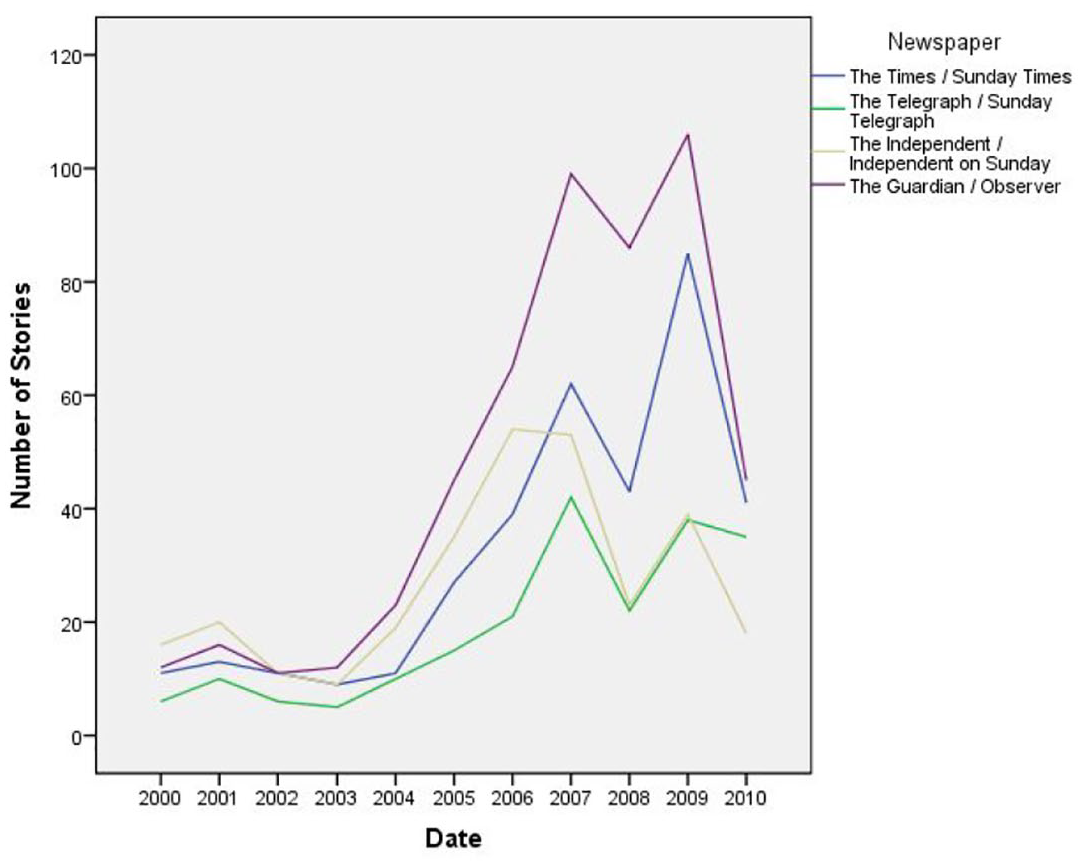
Number of Stories by Newspaper by Date
Important are the numbers of frames reproduced here and the politicized context from which these emerge (see Figure 2). As Boykoff and Rajan (2007) remind us, U.K. newspapers report the issue differently than newspapers studied elsewhere, specifically the United States. Such differences emerge from the practice of these newspapers to engage with stakeholders’ claims making in the U.K. national political process. Figure 3 shows how the reproduced stakeholders’ claims-making marks the boundaries of climate change discussion in the United Kingdom during the 2000–2010 period.
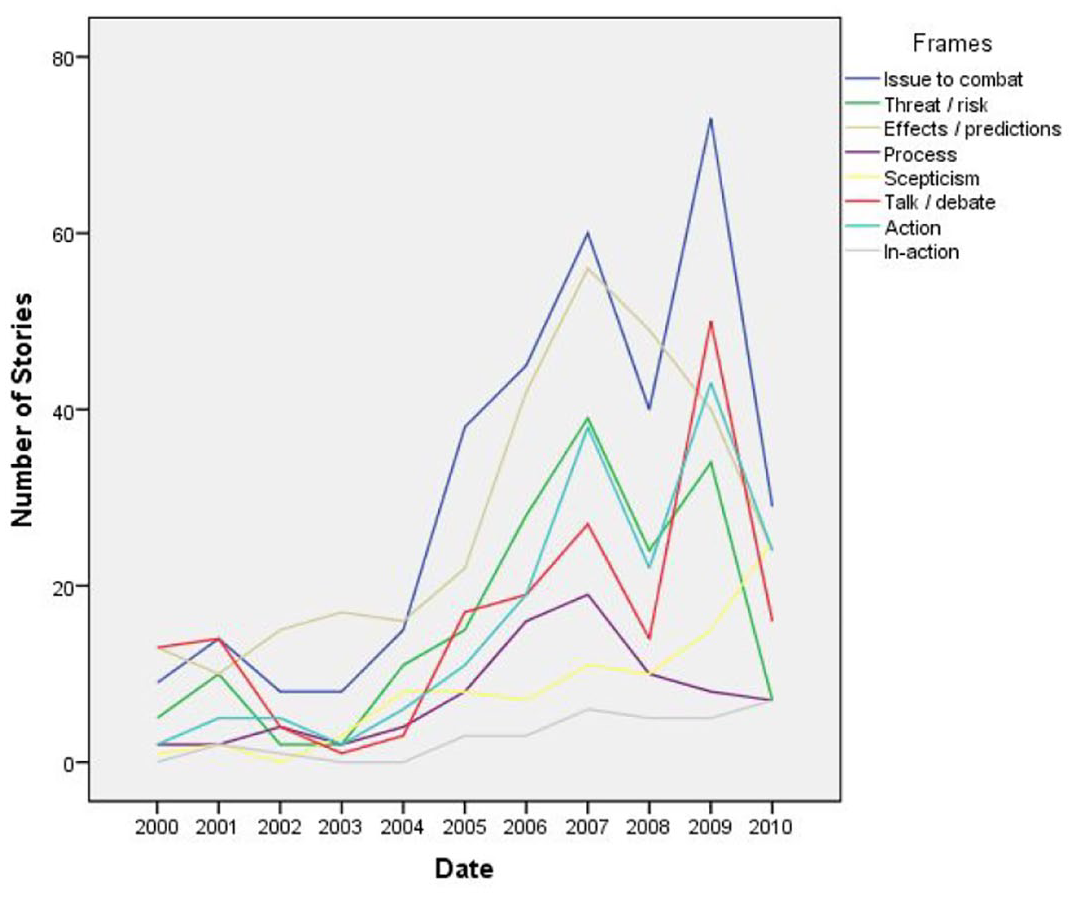
Number of Stories by Frame
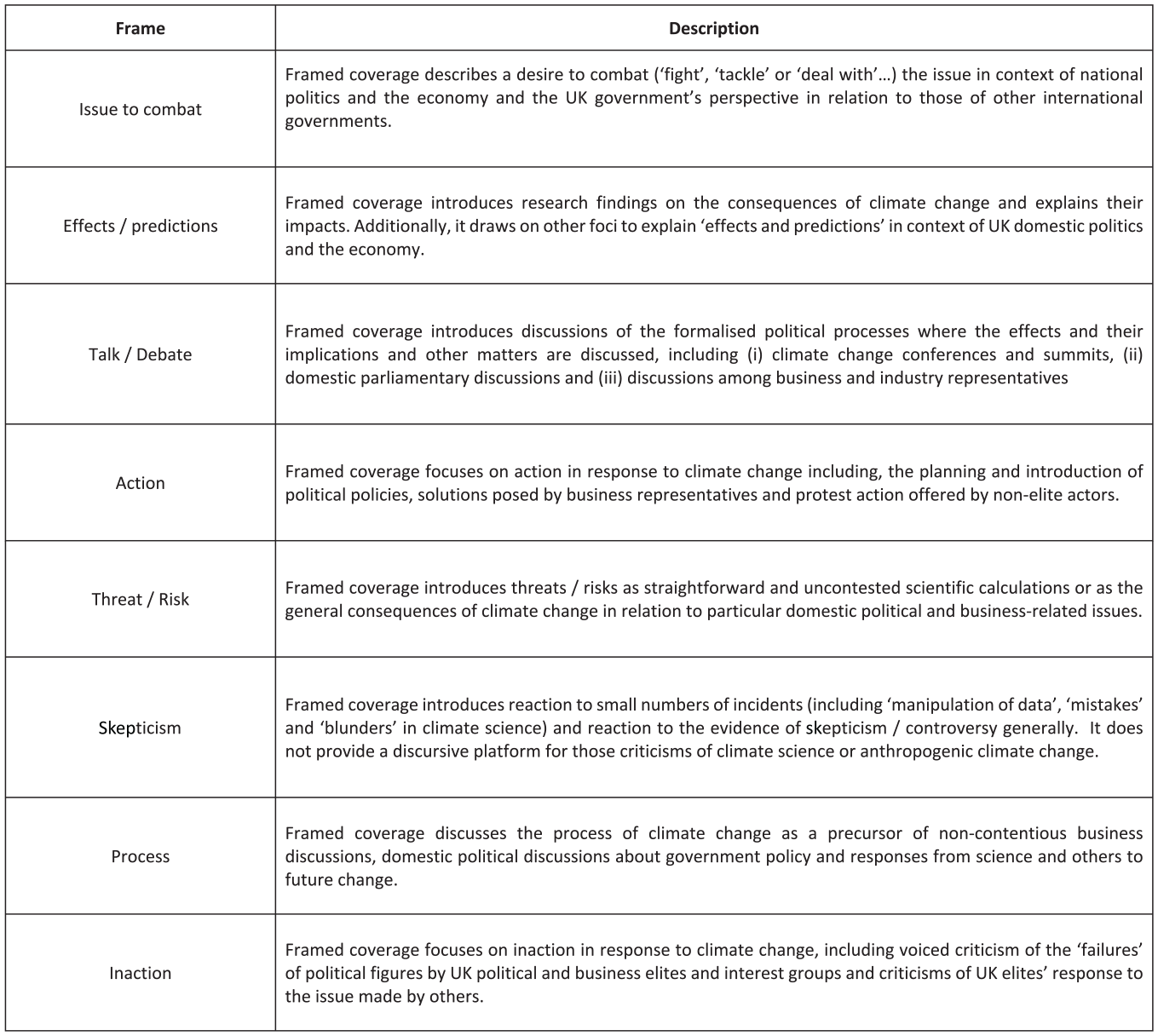
Frame Descriptors
Moreover, Figure 3 highlights the meanings and actors involved in the shaping of the climate change coverage and introduces a sense of the differences between these and the previous findings on framing. The “issue to combat” news frame signals the general direction of this coverage. Its increase across the sampled period signifies the frames’ significance in terms of the overall content of reporting. Similar to the Trumbo (1996) study, the observed prominence represents the efforts of politicians’ voices to frame their preferred public relations responses to an increasingly important issue. Yet, the U.K. context appears to be informing a particular focus in these frames (i.e., combating the issue). The “effects / predications” frame, which grows rapidly up to 2007 and maintains a significant presence overall, appears similar. This is an important frame in the overall coverage also, but one, in this case, that reflects the claims making work of scientists mostly (as has been observed previously—see Tosse, 2013).
Shown in Figure 3 is the reporting of the “threats/risk” frame, and this also refers to the additional claims-making activities of scientists. Of importance here, nonetheless, is growing evidence of the efforts of green interest groups and others in assisting this frame’s visibility. Still, despite these efforts, discussion of current threats and risks appear less prominently than do scientific predications of potential future threats (i.e., the effect /predications frame). The action frame is similar to the amount and distribution of the framing of present “threats/risks.” This frame reflects political discussion (including green interest groups) around the appropriate response to climate change and, as representative of the U.K. context, shows greater prominence when compared with framing offered on “inaction.” Important within this period of analysis also (and as is found previously—see Lockwood, 2010) is the framing of climate change as the subject of political discussions (talk/debate frame)—whether those featuring in international or domestic policy arenas. And finally, coverage framed around the discussion of the science of climate change (the process frame) and discussion of skepticism to science (skepticism frame—though this frame is different than that in Antilla, 2005) remain small but additional features of the coverage. In sum, this overview provides evidence that green interest groups are experiencing some forms of success in the competition to frame the climate change issue in the sampled reporting. In addition, their contribution fits within a wider set of frames that appear favorable, rather than antagonistic, to groups’ general claims making and open to their contributions.
What Opportunities Do Green Interest Groups’ Voices Receive?
This section explores the presence of voices of green interest groups in the news reporting and, in the process, it will include some tentative reflections on green interest groups’ relative success. As we have heard, optimistic accounts describe groups’ increasing presence within a growing reporting of climate change (in contrast to previous research suggesting that groups struggle to alter and change news agendas in contrast to the voices of politicians, scientists and industry representatives). The positions that groups occupy in the overall hierarchy of accessed speakers in the coverage help us to reflect on these previous findings (see Table 1).
Frequency of News Actors
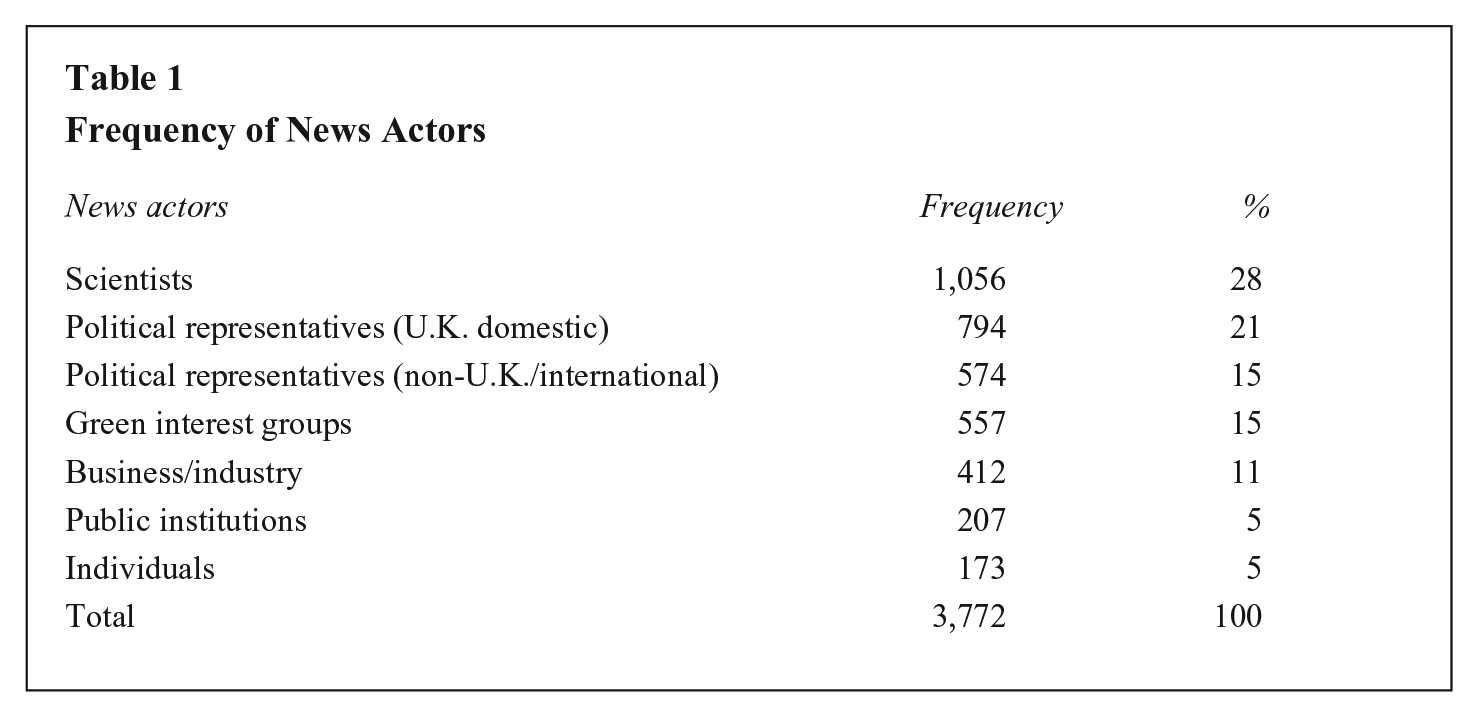
From a general overview of the voices accessed in coverage, we observe that green interest groups receive opportunities to appear (see Table 1). Indeed, the recorded number of their appearances in reporting (n = 557) demonstrate the increased opportunities they gain, including contributing to general discussions of climate change (Doyle, 2010). Groups, it seems, in following behind international political actors (n = 574) and in appearing more frequently than the voices of business (n = 412) and public institutions (n = 207) are being encouraged to participate in a variety of stories. In addition to outlining groups’ basic participation, these results reveal groups’ successful negotiation with political, scientific and industry discourses—the dominant presence of which has acted traditionally as barriers to their participation (see DeLuca et al., 2012; Sovacool, 2008). This overview of voices may also provide insights into the reasons for groups’ selection and general presence. No doubt the growth in the amount of reporting provides greater space for groups to participate. But then again, the frequency of scientists’ voices is a notable and important potential explanation for their presence. The reporting of the science of anthropogenic climate change that accompanies these scientific voices will likely shape news discussions and provide therein fertile ground for including the views and concerns of green interest groups—a point we can now examine.
What Discursive Roles Do Green Interest Groups’ Voices Play in News Stories of Climate Change and to Which Voices Are They Observed to Engage?
As has been established, green interest groups receive more opportunities to appear than some other voices do (i.e., industry). Exploring the roles that groups play in the sampled coverage therefore can help us to further grasp the precise nature of their contributions to the sampled news discussions on the climate change issue. Their performed roles, in this case, include those to “introduce,” “explain” and to “evaluate” aspects of the climate change issue (see Table 2).
Interest Group by Role
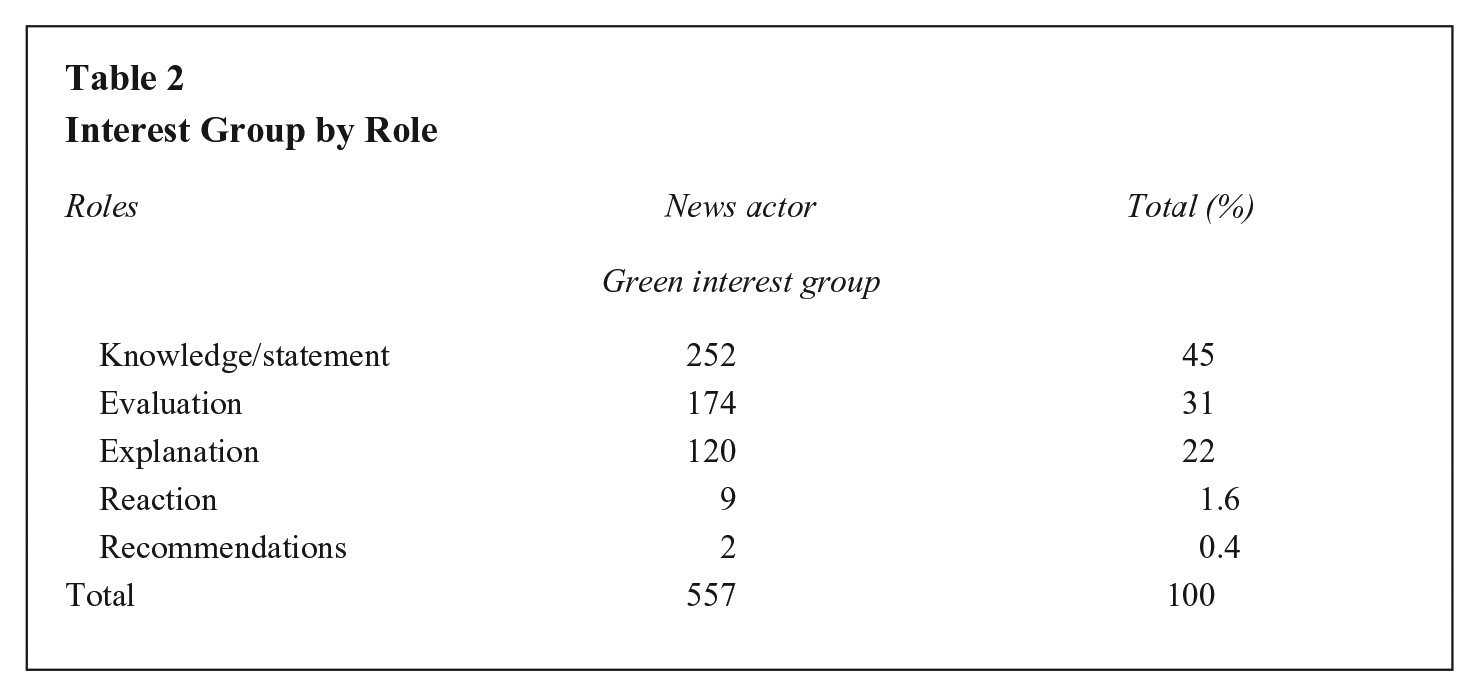
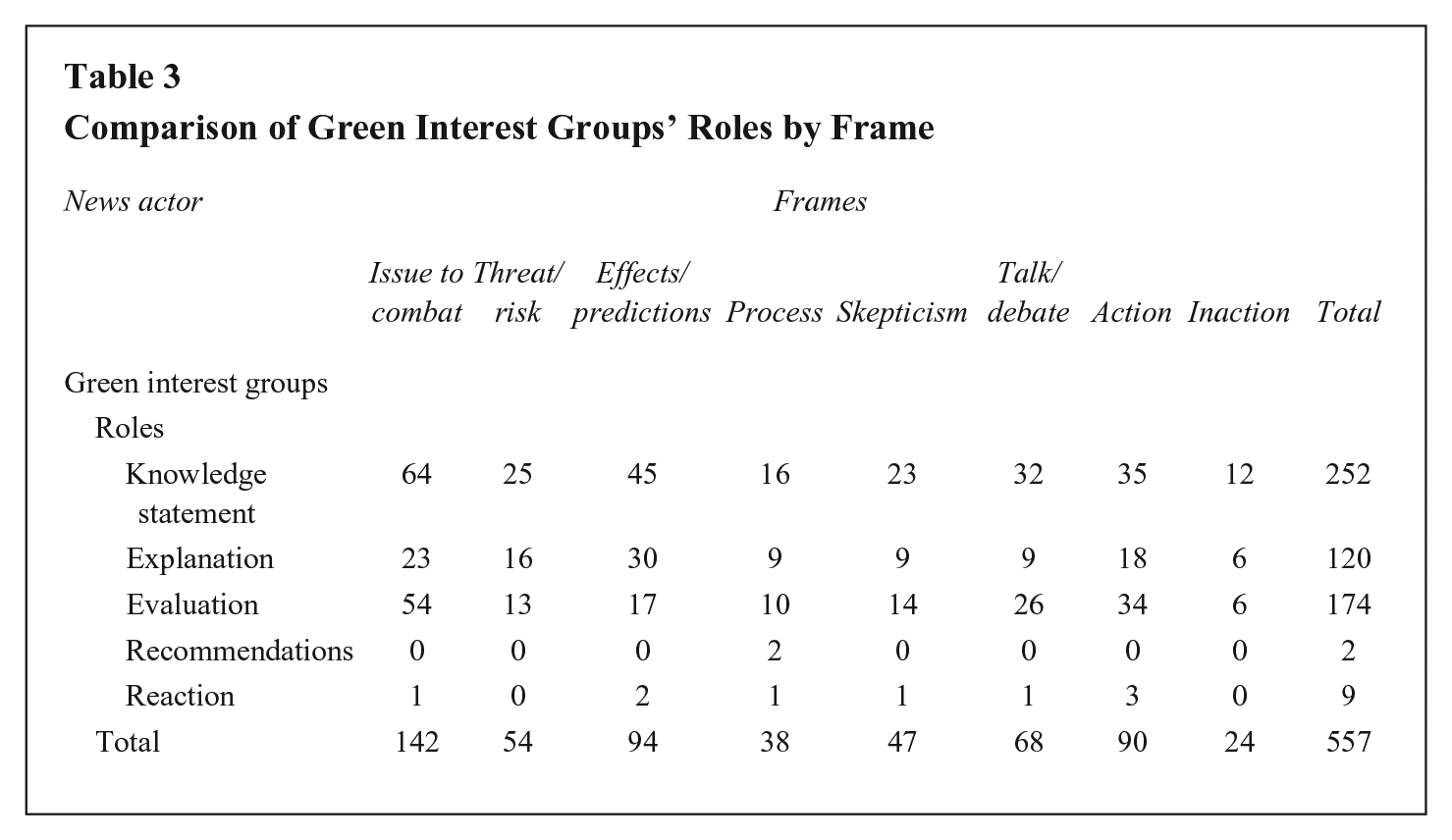
The evidence shows that groups perform different roles within the climate change coverage (Table 2). What this means is that, first, the overall number of these recorded contributions reinforce their status as commentators on the issue. Second, it is the variety of these performances (e.g., statements n = 252; evaluations n = 174; explanations n = 120) that reveal the character and gravity of groups’ collective contributions in the sampled reporting. Gaining an understanding of groups’ numerous and diverse performances invites us to explore, and reflect on, the roles that groups play alongside other voices in the framed coverage (see Table 3). Let us begin by analyzing the performance of their knowledge statements.
Comparison of Green Interest Groups’ Roles by Frame
Knowledge as Performed Presence
We now can examine green interest groups’ performances in the sampled coverage. Analyzing individual stories shows that the knowledge statements of green interest groups introduce specific news topics and enhance specific aspects of news discussions. Demonstrated also is the extent to which these groups meet their aim to appear as legitimate speakers on this issue rather than those who direct media interest to it.
On one level, groups offer stories that reflect their concerns, and gain, it follows, opportunities to develop discussions of the wider issue. On another, they obtain space and authority to express views and reactions in response to dialogue with others on climate change. In terms of groups’ importance for story content, we can find evidence of them appearing in what can be described as uncontested stories (see Painter & Gavin, 2016). For example, this uncontested role is performed on 59 occasions (out of 557) and groups discuss here the (a) impacts of climate change and (b) the suggested responses to them (effects/predictions frame, n = 45 and threats/risk frame, n = 25). This opportunity to discuss the consequences of climate change is demonstrated in the following WWF claims (formerly the Worldwide Fund for Nature) placed at the start of a story: “global warming is likely to destroy more than half the earth’s colder habitats by the end of the century, causing the extinction of species which cannot adapt or move quickly enough to reach new homes” (The Guardian, August 31, 2000). In addition, the growing importance of groups’ voices to these news discussions is shown in the decisions to let them lead in reported stories. In this case, groups lead stories on protest action (in the place of police and industry, previously—see DeLuca et al. 2012) and speak on the policy responses to, and the perceived inaction on, climate change by both government and business representatives (action frame, n = 35). As such, groups’ commentary forms the basis of the reporting at these times.
As noted above, green interest groups secure additional space and authority in stories that include other voices. In future “effects/predictions” (n = 45) and present “threats/ risks” (n = 25) framed stories, groups appear alongside scientists to provide research findings on climate effects and their perspective on the wider consequences (specifically on those stories when scientific voices do not comment explicitly). Occupying a prime position in a story on the effects of migrating birds, Mark Avery of the RSPB suggests, for instance, “The precise reasons for the decline of each species vary, but a common theme appears to be climate change” (The Times, August 17, 2007). These types of examples reveal the positions that groups maintain in the coverage. Here, groups provide specific descriptions of the effects of climate change and therein speak about observed changes to animal habitat and behavior of butterflies, frogs, fish and polar bears among others. Elsewhere, green interest groups appear alongside politicians to explain what should be addressed in terms of climate policy (issue to combat frame, n = 64). In these positions, they comment on the importance of climate talks (talk/debate frame, n = 32) and express views on the appropriate political action to take (action frame, n = 35). Although groups speak about the inaction (inaction, n = 12 / skepticism frames, n = 23) in the coverage, their voicing of the consequences of climate change is performed most often. These performances appear then emblematic of their role to offer an alternative perspective to that of politicians and industry representatives. The general character of the U.K. news reporting on climate change shapes these opportunities as is also observed of those opportunities the groups receive to evaluative the views of others.
Evaluation as Performed Counterbalance
Green interest groups’ contributions to reporting are varied and include evaluative statements. Their evaluative statements reflect the objectives of groups to reconstitute or interpret the dominant frames and discourses that appear in reporting (Cox & Schwarze, 2015). In fact, the evolving coverage shows that newspapers use their voices to counterbalance other claims making about policies and actions, for instance. Moreover, these instances appear relatively frequently (i.e., 174 out of 557). Within these, newspaper journalists view some story contexts as contested (Boykoff & Boykoff, 2007) and, in turn, approach them with an intention to counterbalance the dominance of, and direction pursued within, others’ commentary on climate change. It follows that green interest groups appear here to evaluate positions and ideas (issue to combat, n = 54; talk debate frames, n = 26, etc.) and in other stories that configure the evolving newspaper coverage of climate change. At these times, journalists introduce green interest groups’ voices as verbal foils to political and industry speakers and use their views, in these positions, to challenge elite assertions about climate change. The developing geographical dimension to the contest over climate change explains these actions in part. Domestic political stories (reflected in those “issue to combat,” n = 54 and “action,” n = 34 frames most readily) are shaped to interrogate those claims to address the climate change issue voiced by the national political and governmental actors afforded with responsibility on these matters. Subsequently, green interest groups appear as part of these newspapers’ critical performance in the position of challenging such views, for example—“the Government’s policy on climate change is now in ‘disarray,’ that is found within a representative story on ‘emission targets’” (The Independent, May 7, 2004). Groups are used then to evaluate policies and actions that are devised to meet wider climate change targets and they feature routinely in discussions of airport development and alternative energy streams, including nuclear and “green” energies. Take, for instance, the following example of the use of Stephen Tindale, then Director of Greenpeace UK, to say, “The Government’s policy on emissions is completely pathetic” (The Telegraph, February 15, 2005). These examples of criticism are used to challenge political actors and their positions within stories with an international focus and those situated in the “talk/debate” frame (n = 26). Allowed to reflect on the outcomes of the climate conferences, Tony Juniper, the then Director of Friends of the Earth, emerges, for instance, to explain the failure to agree firm targets and appears before Paula Dobriansky (the then U.S. Undersecretary of State) and Hilary Benn (the then British Environment Secretary). These failures, he comments, are “very disappointing [. . .]” and will allow “the world’s biggest carbon emitters, including America, Japan and Canada, to be free to carry on expanding such emissions” (The Times, December 16, 2007).
In addition, spokespeople for green interest groups evaluate the performance of these political actors in context of the outcomes of climate change talks. Sometimes they even pre-empt them as is found here: “Green groups were already saying last night they were disappointed by the leaks of Gordon Brown’s final Budget today for failing to rise to the challenge of climate change” (The Independent, March 2, 2007). Equally, groups feature in coverage to evaluate the efforts of business actors to tackle pollution in addition to openly criticizing any who are skeptical of anthropogenic climate change and its supporting climate science. Providing an illustrative example is the following story that forms around claims of the ecology organization, Platform, which state that “the British company (BP) has positioned itself at the centre of EU energy policy, building high-level contacts and persuading commissioners, officials and government ministers of a ‘shared agenda’ in working together” (The Telegraph, February 1, 2009). Alternatively, take for example another case where the then Friends of the Earth Policy Director, Tony Juniper, is introduced as criticizing the insurance industry for not taking an ethical stance. He says, “We found that most major insurers are investing in the very firms that we and others have been campaigning against because of their particularly bad environmental performance” (The Guardian, January 2, 2000). In sum, groups’ function to evaluate the politicians and industry representatives’ perspectives and actions on climate change positions them in the role of a prominent, legitimate and permanent critic within this newspaper reporting.
Explanation as Performed Authority
Among groups’ newfound roles in coverage, it is their explanations that provide greater insights into their performed authority. These opportunities meet the wider aims of these groups to secure a legitimate space in stories within which to provide some background context to their announcements and thoughts on the climate change issue. Appearing as 22% of groups’ overall contribution (see Table 2), these explanations follow from the opportunities that groups take to define the consequences of climate change in uncontested stories. Most often, groups’ explanations outline their own policies or actions. Indeed, the location of groups’ voices in the framed coverage offers clues as to their performed function (e.g., action frame, n = 18). These comments explain the impacts of climate change within stories framed around present “threat/risks” (n = 16) or future “effects and predictions,” for instance (n = 30). An example of the latter opportunity is how these environmental campaigners call for “. . . three species of Arctic seal to be listed as endangered amid mounting concern about the impact on wildlife of the melting of sea ice caused by global warming” (The Times, May 3, 2008). These instances appear often in sequence behind groups’ voiced statements (see above) and this combination demonstrates the greater control that groups now obtain over the presentation of their views in the coverage.
Furthermore, green interest groups offer commentaries in addition to those explaining their statements on the consequences of climate change. These commentaries appear to respond to politicians and industry representatives’ voices in positions across the framed coverage. Following an article’s opening comment on the highest levels of carbon dioxide in the atmosphere for 20 million years, for example, is the voice of Roger Higman, a climate-change campaigner with Friends of the Earth, that explains how: “(The report) suggests massive changes in the world’s climate are likely and that the action governments have taken to date is derisory” (The Independent, August 17, 2000). Positioned within domestic and international political stories (issue to combat frame, n = 23), these commentaries explain groups’ positions on policies, political talks and the appropriate action to take. Often then groups introduce in their own stark terms the need for significant action, such as is expressed here: “the last realistic chance for mankind to get to grips with the problem of climate change” (The Guardian, September 1, 2009). In other places in coverage, groups offer explanations on energy and other climate change policies and policy initiatives alongside industry representatives.
In addition, groups secure opportunities to explain instances of environmental protest. These opportunities are experienced infrequently and in contrast to groups’ more common experience of being silenced in reporting of these events (see Wagner, 2008). Their commentaries appear in the context of the established voices of affected industry, science and law enforcement agencies (action frame, n = 18). In the story, “Police arrest 11 on final day of climate-change protest,” Peter McDonnel, a campaigner, is introduced to explain, “People are ecstatic. We did what we said we would -we carried off a string of high-impact actions” (The Times, August 21, 2007). While they appear to reflect on their activities at these times, groups emerge to also explain the protest and others’ reactions. In one account, Greenpeace argues that, under the Criminal Damage Act 1971, its activists “had a ‘lawful excuse’ to cause the damage because they were seeking to prevent even greater damage being caused to property—such as flooding from rising sea levels and damage to species caused by climate change” (The Independent, September 4, 2008). In sum, these explanations hold a significant place in the coverage and one that is interweaved with domestic and international political and industry discussions on climate change. Groups’ explanation of the issue appears almost an indispensable aspect of modern news discussions of climate change.
Conclusion
This study has explored the outcomes of the news media framing of climate change on the performance of green interest groups in news reporting. It is positioned alongside other academic work that acknowledges how issue-specific frames reproduce the politicization of this issue. In the process, the study reaffirms Entman’s (1993) view of the reproduced frames as providing a recognizable “imprint of power” on this issue. In this case, developments in claims making and in the general character of the issue appear within its increased reporting. In answer to the first of the posed research questions about issue framing, we can observe the impacts of the claims making of a pro-climate change UK government. At this time, the U.K. government makes claims about the combating of climate change—however tokenistic these may appear. Such claims emerge alongside science claims making focused on current risks and, as supported by the framing activities of green interest groups, claims about future predictions alongside other political claims about the United Kingdom’s position in contrast to other international political discussion. Thus combined, this framing produces a particularized reporting of climate change and one that offers fertile ground for green interest groups to both shape and speak within reporting. On this basis, we come to the view that the fit between frames and claims in coverage is an important aspect, but not the only one to observe. Of equal importance, then, is the potential impact of the “imprint of power” that news frames leave on reporting and on the relative presence or absence of green interest groups. This process involves recognizing the importance of framed news content for its ability to shape the discursive environments of related news stories.
Hence, this particular interest has shaped the desire to explore the discursive environment and wider possibilities that news media frames create. We already understand that green interest groups are providing a small contribution to media framing. Of interest, therefore, is whether the more general framing allows greater participation for them than that which has been observed previously. On the basis of the study’s findings, we can reflect on two remaining research questions and the related finding that greater opportunities for groups do follow from the growth in coverage and this type of framing (see Cox, 2013; Doyle, 2010). In response to the previously stated arguments that political and business voices dominate coverage, this study provides examples of groups speaking on the current and future consequences of climate change as uncontested in some stories that reflect their news framing activities. In addition to the production of these unique spaces, the framed news coverage has also allowed for groups to perform various discursive roles. For example, the positioning of groups in contested issues over policy and action appears to expand the remit of their traditional role in news coverage as previously outlined (see DeLuca et al., 2012; Hansen, 2010). Equally, groups offer evaluative comments that act to counterbalance claims making on policy and actions from politicians and industry representatives, whether focused on the national or the international stage. It is journalists’ practice to balance arguments and voices, although observed previously to underpin the reporting of skepticism over climate science (see Boykoff & Boykoff, 2007), and their views of groups as important parts of these discussions that benefit green interest groups in the context of the framed coverage. Furthermore, although witnessed in a lesser amount to other voices, green interest groups are being afforded greater opportunities to explain their positions and to cement their authority as commentators on this aspect of climate change.
In sum, the study has begun a process of problematizing the assumed straightforward connections between frames and voices in coverage, by drawing from the perspective of the study of framing news content and that from the perspective of the activities of news sources. To develop on these insights further, research should use them to inform observations of the process of frame building within the news production domain. Capturing journalists’ understandings and practices in this way would help to reaffirm and offer greater understanding of the outlined findings that certain frames, and combination of frames, are important for the reporting of green interest groups’ voices and their place in the discussions with other voices at other times.
