



Abstract
Climate change is central to planning education and impacts many students personally. However, little research assesses whether planning students who experience climate trauma learn and respond to climate curricula differently. Based on a survey at the University of California, Irvine, this paper finds that climate-traumatized planning students did not report lower climate literacy, but did experience more climate anxiety and derived no special benefit from climate curricula in terms of coping skills. Trauma-informed climate pedagogy is therefore needed to empower future planners with both the climate knowledge and the emotional literacy needed to envision a better future.
Introduction
Climate change has become a central component of urban planning curricula in higher education (Infield et al. 2023). At the same time, growing number of young people report feeling worried or anxious about climate change (Hickman et al. 2021). As climate impacts intensify (IPCC 2022), more students are likely to experience negative impacts, as well as the stress and trauma that accompany them (Engstrom and Krings 2025; Grennan et al. 2023; Hrabok, Delorme, and Agyapong 2020; Nan et al. 2025; Silveira et al. 2021; Woodbury 2019). It is well documented that stress and trauma can negatively impact students’ mental health, learning, and academic progress (Anders, Frazier, and Shallcross 2012; Duncan 2000; Read et al. 2011; Turner and Butler 2003). Trauma-informed pedagogy has emerged as a potential framework for approaching stressful curricula, as well as for supporting students who have experienced trauma outside the classroom (Carello and Thompson 2021; Hurless and Kong 2025; Thompson and Carello 2022). However, there is still little research specifically examining planning students’ emotional and cognitive reactions to the climate crisis or assessing the need for trauma-informed climate pedagogy in planning education.
To fill this gap, this paper investigates how experiencing a climate-related disaster impacts how planning students learn and respond to climate curricula, based on a survey conducted in undergraduate planning courses in the winter and spring quarters of 2024 and the winter quarter of 2025 at the University of California, Irvine (UCI). This time span coincided with a number of climate-related disasters in the region, such as flooding, extreme heat, and wildfires. Because these disasters occurred in Southern California, it is reasonable to assume that they would have impacted a number of students personally. In fact, forty-one students (21% of the total survey sample of 194) reported that they experienced a climate-related disaster that impacted their participation or performance during the course. Through factor analysis and multivariate regression, survey responses are analyzed to address the following questions: Do students who experience a climate-related disaster experience more climate anxiety and does their learning suffer relative to their peers? To what extent do these students perceive the course as increasing their climate anxiety, assisting them in coping with it, and providing overall educational value? By extension, is there evidence of a need for trauma-informed climate pedagogy in planning education?
Literature Review
Climate Disasters, Trauma, and Anxiety
Climate-related disasters are traumatic events that produce acute stress; survivors often experience higher rates of mental health diagnoses (Hrabok, Delorme, and Agyapong 2020). For instance, individuals exposed to the 2018 Camp Fire (at the time, California’s deadliest wildfire) were found to have significantly greater symptoms of post-traumatic stress disorder, anxiety, and depression, as well as significant cognitive deficits (Grennan et al. 2023; Nan et al. 2025; Silveira et al. 2021). Consequently, psychology scholars have called for defining a new type of psychological trauma, “climate trauma,” that is specifically related to climate change, both in terms of isolated traumatic events like wildfires and the ever-present threat posed by the climate crisis (Engstrom and Krings 2025; Woodbury 2019). Currently there is no standard tool for diagnosing and measuring climate trauma. Most existing studies have relied on self-reported measures of exposure to climate disasters as well as standard diagnostic tools for generalized anxiety disorder, such as the GAD7 scale (Grennan et al. 2023; Nan et al. 2025; Silveira et al. 2021).
There is also a growing body of research on climate anxiety, and particularly on its increasing prevalence among young people. An international study of 10,000 adults aged sixteen to twenty-five years old found that 59 percent were very or extremely worried about climate change (46% for the U.S. sample) and 45 percent reported that climate anxiety negatively impacted their daily functioning (26% for the U.S. sample) (Hickman et al. 2021). Although there is no single agreed-upon definition of climate anxiety, it is typically defined in terms of cognitive-emotional response to the subject of climate change and associated physiological symptoms (e.g., insomnia, loss of concentration) (Clayton and Karazsia 2020; Hickman et al. 2021).
Measures of climate anxiety are typically derived from diagnostic tools for general anxiety. However, while general anxiety is considered a psychological disorder that may require treatment (Spitzer et al. 2006), psychologists and scholars increasingly regard climate anxiety as a rational and healthy response to the climate crisis (Hickman et al. 2021; Pikhala 2020; Verplanken and Roy 2013). General anxiety is diagnosed via an index score based on questions in which patients report the frequency with which they experience distressing emotions and thoughts and related impacts on functioning (Spitzer et al. 2006). Climate anxiety is typically measured in a similar fashion, with diagnostic questions tailored to climate change (Ballew et al. 2024; Hickman et al. 2021; Li and Monroe 2017a, 2017b; Verplanken and Roy 2013; Verplanken, Marks, and Dobromir 2020). Additional questions may be added to assess experience of being ignored or dismissed when talking about climate change (Hickman et al. 2021) and perceived risk of harm to themself, their community, plant and animal species, other people in the United States, people in developing countries, and future generations (Leiserowitz et al. 2020, 2024). Some studies, however, assess climate anxiety via a single question asking respondents to rate how anxious they feel about climate change using a sliding or Likert-type scale (Stanley et al. 2021).
In this study, we combined two approaches from this literature. We assessed students’ climate anxiety via a series of survey questions on cognitive-emotional responses to climate change, associated physiological symptoms, and impacts on work and relationships. In addition, we assessed students’ experience of climate trauma via a single Likert-type-scale survey question asking them to self-report the degree to which their class participation or performance was impacted by personally experiencing a climate-related disaster such as a wildfire or flood.
Trauma-Informed Pedagogy
Trauma-informed pedagogy has its roots in trauma-informed care, which originated in behavioral health systems (Thompson and Carello 2022). It is distinct from trauma-specific services, which are interventions that treat trauma-related symptoms directly (Thompson and Carello 2022). In contrast, being trauma-informed means changing standard operating procedures so that care providers are aware of and do not unknowingly replicate the dynamics of abusive relationships (Thompson and Carello 2022). Over the past two decades, trauma-informed care has expanded to other fields, such as child welfare and education (Hurless and Kong 2025; Thompson and Carello 2022). In particular, trauma-informed pedagogy has become essential for educators in fields where “difficult knowledge” is central to the curricular content itself, such as gender studies, ethnic studies, social work, and history (Ray and Atkinson 2024).
Many students in higher education have experienced trauma (Anders, Frazier, and Shallcross 2012; Read et al. 2011). The COVID-19 pandemic catalyzed renewed efforts to develop and disseminate trauma-informed approaches to teaching and learning in higher education (Carello and Thompson 2021; Thompson and Carello 2022). However, while the pandemic represented a new source of traumatic stress, it also underscored the reality that instructors routinely work with students experiencing many forms of trauma, including injury, illness, bereavement, violence, housing insecurity, food insecurity, and – increasingly – climate disasters (Thompson and Carello 2022).
Trauma puts students at greater risk of physical and mental health problems such as post-traumatic stress, depression, and substance use disorders (Anders, Frazier, and Shallcross 2012; Read et al. 2011; Turner and Butler 2003). To the authors’ knowledge, there is no research specifically assessing the impact of climate trauma on climate literacy or planning education. However, there is research demonstrating that students who have experienced traumatic events receive lower grades on average and are more likely to drop out of school (Duncan 2000), making it reasonable to assume that climate trauma might negatively affect students’ learning about planning strategies for addressing climate change. Trauma-informed pedagogy seeks to respond to student distress with empathy and support, remove barriers to learning, and address the social injustices that create the conditions for trauma to occur in the first place (Thompson and Carello 2022). Being trauma-informed as educators also requires interrogating educational practices that may inadvertently perpetuate abuse and oppression (Thompson and Carello 2022).
A small but growing body of research aims to define and disseminate “best practices” for trauma-informed pedagogy in climate education. Such practices acknowledge the role of emotions in shaping student learning, as well as their ability to respond to what they are learning in effective, meaningful, and emotionally healthy ways (Atkinson and Ray 2024; Bryan 2020). While this trauma-informed pedagogy is still evolving (Carello and Thompson 2021; Thompson and Carello 2022), such best practices typically begin with directly acknowledging climate trauma and its unequal impacts by making them part of the curriculum (Atkinson and Ray 2024). Instructors can also support students in interrogating their own complicated role as “implicated subjects” who contribute to and are constrained by the social and economic systems that drive the climate crisis (Bryan 2020). Because such conversations are emotionally fraught, instructors are encouraged to support students’ engagement with this kind of “difficult knowledge” by creating a classroom environment conducive to sharing personal experiences and emotional responses, as well as activities and assignments that guide students in articulating and processing emotions and envisioning alternative futures through creative expression, discussion, and community-building (Atkinson and Ray 2024). Such approaches provide not only climate knowledge but also the “emotional competence” that students need to absorb that knowledge and use it to envision and plan preferred futures (Ojala 2016).
Within planning pedagogy, specifically, emotions and compassion can be centered as a transformative practice for learning about climate change and climate action (Lyles et al. 2021). Students are often drawn to planning classes on climate change and sustainability because of their emotional engagement with such topics, yet feel pressured to minimize the emotional dimensions of both learning and planning practice to conform to the field’s conventional rational-objective approaches and professional norms (Lyles et al. 2021). Through guided reflection activities, students learn to acknowledge and manage their own emotional reactions to climate change, building their capacity for sustained engagement with climate action (Lyles et al. 2021; McSorley et al. 2025). Such activities can not only help planning students work through challenging emotions, but can also validate those emotions as meaningful and relevant to practice and create space for productive conversations about professional responsibility and individual contributions to social change (McSorley et al. 2025). But while a growing literature proposes “best practices” for centering emotion and compassion in planning classrooms, little research specifically assesses planning students’ need for trauma-informed climate pedagogy or the degree to which current planning education is meeting that need.
Trauma-Informed Planning
Anxiety can impede planning by distorting information processing, blocking group dialogue, and engendering inaction (Tate et al. 2023). Moreover, when planning discussions evoke past individual or collective trauma, they risk re-traumatizing participants (Tate et al. 2023). New approaches are therefore needed to engage productively with anxiety and trauma in planning practice (Tate et al. 2023). Trauma-informed pedagogy in planning education can prepare students for trauma-informed planning practice. Centering care and compassion in the curriculum educates students not only on the technical aspects of climate planning but also the emotional dimensions of working with communities to address the historical roots of the current climate crisis (Lyles et al. 2021).
Just as the “communicative turn” in planning challenged the dominant model of rational planning through greater attention to procedures and collaboration, the “emotional turn” in planning calls for acknowledging the role of emotion in planning and creating space to consider it alongside other forms of information in decision-making (Baum 2015). Not only does the rational model of planning prioritize “objective” analysis over emotional experience, but Western “Enlightenment” culture more broadly views emotions as a threat to reason (Baum 2015). Consequently, planners are typically trained to control or avoid emotions in their work, even though many are motivated by their emotional engagement with communities, and despite the ways in which emotions like compassion may complement core planning concepts like social justice and sustainability (Baum 2015; Lyles et al. 2018; Lyles and White 2019). Professional standards, codes of ethics, and best practices from the American Planning Association and American Institute of Certified Planners largely ignore the emotional dimensions of planning and offer planners little guidance on how to engage with their own emotions or those of stakeholders (Lyles and White 2019). In addition, professional norms and implicit biases discourage displays of emotion in planning practice and penalize women and people of color in particular for “being emotional” (Osborne and Grant-Smith 2015). Similarly, planning research has largely ignored the role of emotions, even as other fields in the social sciences – such as sociology, geography, and economics – have begun examining how emotional thinking influences social relations, the use of space, and decision-making (Baum 2015). The denial of planning’s emotional dimensions makes it more challenging for planners not only to manage their own emotions, but to respond to the public’s strong emotions, especially when addressing present and past traumas (Lyles and White 2019).
While the field is still evolving, several models for “trauma-informed planning” have been proposed. Exploratory case studies have examined the potential to use emotionally engaged “therapeutic planning” practices that foster trust and facilitate conversations in which constituents can work through collective traumas, reconstruct meaning, and build community (Erfan 2017; Knapp, Poe, and Forester 2022). Planners may benefit from practicing “mindfulness,” that is, being aware of their own emotions, accepting them with curiosity and without judgment, and choosing which emotions (and associated thoughts and actions) to facilitate (Ferreira 2013).
In short, trauma-informed pedagogy has the potential to not only help planning students process their own climate anxiety and trauma but also provide them with the skills to assist communities in navigating the emotionally fraught terrain of the climate crisis. However, in order to design effective trauma-informed curricula for future planning practitioners, planning instructors need to understand how experiencing a climate-related disaster impacts how planning students learn and respond to climate curricula.
Methods
A survey was conducted in undergraduate urban planning courses at the University of California, Irvine, a large R1 university located in Southern California. Survey collection occurred during the last week of class in March 2024, June 2024, and March 2025. While the surveyed courses were taught in different academic quarters (per department scheduling needs), all survey responses were treated as a single sample on the grounds that all represent students’ reactions at the end of the sampled courses.
Survey collection occurred at the same time that Southern California experienced a variety of climate-related disasters. In February 2024, an atmospheric river produced storms and flooding, resulting in the governor declaring a state of emergency across the region (Los Angeles Times 2024). In early June 2024, an early summer heatwave broke temperature records across the Southwest (National Aeronautics and Space Administration (NASA) Earth Observatory 2024a, 2024b; State of California 2024). In January 2025, the Eaton Fire and Palisades Fire in Los Angeles County (north of Irvine) became the second and fourth most destructive fires in California history (CalFire 2025a, 2025b; CNN 2025).
The survey was distributed to students enrolled in four undergraduate courses offered by the Department of Urban Planning and Public Policy that engage with environmental and climate-related topics in urban planning: “Introduction to Urban Planning and Policy,” “Environmental Analysis and Design,” “Sustainability,” and “Cities and Climate Change” (the latter taught by one of the authors). Each instructor rated their courses’ engagement with climate-related topics on a five-point Likert-type scale of “not at all/not applicable” (1), “not very” (2), “moderately” (3), “very” (4), or “extremely” (5). They also rated their use of pedagogical strategies on a five-point Likert-type scale of “never/not applicable” (1), “rarely” (2), “sometimes” (3), “often” (4), or “almost always” (5). These ratings were corroborated by a review of the course syllabi. When a course was taught by two different instructors in two different offerings, the table gives the mean rating, rounded to the nearest whole number.
Based on course curricula review and instructor course engagement and pedagogical ratings, all courses in the study sample covered both climate change problems (e.g., carbon emissions, harm to communities/ecosystems, systemic inequality in exposure/sensitivity to climate impacts and adaptive capacity) and climate change solutions (e.g., planning and policy responses, emissions mitigation/sequestration, adaptation, resilience) to at least a moderate degree (Table 1). On average, the courses were “very” engaged with both climate change problems and solutions. On average, the courses were “not very” engaged with climate anxiety or climate trauma, and none were “very” engaged with the topic. On average, the courses were only “moderately” engaged with climate hope. Only two courses engaged with mental health and emotional literacy to any degree. This aligns with past calls for an “emotional turn” in planning, which critiques both planning practice and planning education for emphasizing the technical aspects of planning over its emotional dimensions (Baum 2015; Lyles et al. 2018; Lyles and White 2019; Osborne and Grant-Smith 2015).
Mean Instructor Engagement and Pedagogical Course Ratings of Sampled Courses of Sampled.

Rating Scale: “not at all/not applicable” (1), “not very” (2), “moderately” (3), “very” (4), or “extremely” (5).
Rating Scale: “never/not applicable” (1), “rarely” (2), “sometimes” (3), “often” (4), or “almost always” (5).
The survey assessed students’ experiences of and responses to the climate crisis. It was conducted during the final week of each class to ensure students had completed each course’s curriculum. Students were recruited through an email announcement and an in-class presentation. Participation was voluntary and nonparticipation did not impact students’ grades. The survey was approved as an exempt research project (Protocol #4038) by the UCI Institutional Research Board. Out of a total of 2,528 students enrolled in these courses, 230 (9%) responded. Because some students were enrolled in more than one course, duplicate responses were removed, resulting in a sample of 194 surveys.
Survey respondent demographics were reasonably comparable to the characteristics of UCI undergraduates (University of California, Irvine Institutional Research, Assessment, and Planning [IRAP] 2025) (Table 2). The percentages of students who reported different racial and ethnic identities were similar to those of the larger student population, although Asian American and Pacific Islanders were somewhat overrepresented (46% in the sample vs. 37% of overall undergraduates), as were whites (32% vs. 13%). However, while the survey allowed students to select multiple racial or Hispanic categories, IRAP classified students with a single category. Female students were overrepresented in the sample (64% vs. 54%); however, this is likely due to the sample being drawn primarily from courses in the School of Social Ecology in which nearly three-quarter of students identified as female (IRAP 2025).
Characteristics of the Undergraduate Population and the Survey Sample.

Academic Year 2024–2025 total student enrollment, three-term average (UCI IRAP 2025).
While the survey allowed students to select multiple racial or ethnic categories, UCI IRAP did not.
Survey questions were designed to capture current or recent experience of a variety of potential sources of stress and trauma that impacted students’ performance in the course in which they were currently enrolled. Additional questions assessed climate literacy and course experience. Responses were structured as a five-point Likert-type scale and required students to rank their agreement from “strongly disagree” (1) to “strongly agree” (5), rank the frequency of actions or experiences from “never” (1) to “almost always” (5), or to rank how various stressors impacted class participation or performance from “not at all” (1) to “extremely” (5).
Students rated the degree to which the following sources of stress and trauma impacted their participation or performance in the course in which they were currently enrolled: climate-related disaster (e.g., wildfire, smoke from wildfires, flood), family obligations, health concerns (physical and/or mental), financial concerns, and domestic/intimate partner violence. Students who answered “moderately,” “very,” or “extremely” were defined as having experienced that particular type of stress/trauma. The demographics of students who did and did not experience each type were compared using descriptive statistics, as well as two-tailed t tests for independent samples with unequal variances.
While the climate stress/trauma variable captured direct, personal, and current or recent experience of a climate-related disaster, the survey also assessed climate anxiety more broadly in terms of students’ reactions to the climate crisis. Questions covered the following topics: cognitive-emotional responses to climate change; associated physiological symptoms (e.g., difficulty sleeping or concentrating) and impacts to work and relationships; and beliefs about potential pathways to climate solutions and the ability to pursue them.
Climate literacy generally refers to “an understanding of how the climate system works, how human actions influence the climate, and how the climate influences people and other parts of the Earth system” (National Oceanic and Atmospheric Administration [NOAA] 2024). The survey relied on students’ self-assessment of the degree to which they felt well informed about climate science, climate policy, and climate action, as well as the degree to which they felt they had the knowledge and skills to address climate change.
Class experience was assessed via a series of questions asking students to rate their enjoyment of and benefit from the class. These included questions specifically asking whether students felt that the class increased their anxiety or hope about climate change and helped them cope with climate anxiety.
Climate anxiety was low, with only 4 to 20 percent of students answering associated survey questions with “often” or “almost always” (Table 3). These results contrast with previous surveys of young people that found high levels of climate anxiety (e.g., Clayton and Karazsia 2020). Self-rated climate literacy (56-68%) and class value (73-91%) were high. This is unsurprising, though, given that the survey sample consists entirely of students who chose to enroll in planning courses on climate change. Roughly a quarter of students felt the class itself induced climate anxiety: 25 percent felt that the course increased their anxiety about climate change and 21 percent felt more worried and overwhelmed about the climate crisis after the class. However, roughly half of respondents credited the course with helping them navigate these feelings: 41 percent said the course helped them cope with climate anxiety, 43 percent said interacting with classmates reduced their climate anxiety, and 56 percent said interacting with classmates increased their climate hope. Students rated the overall value of the courses highly, with a majority of respondents reporting that they enjoyed the course, learned a lot, and were engaged in the course curriculum.
Students Answering “Often” or “Almost Always” to Survey Items Included in Factors (n = 194).

Survey items were reduced into composite variables (i.e., factors) via exploratory factor analysis. Oblique rotation clarified patterns while creating factors that would be correlated, making it possible to analyze their relationships to each other. Factor analysis was conducted iteratively, removing questions as needed to create clearly defined factors consisting of thematically linked items with factor loadings for individual items greater than 0.5 and a Cronbach’s α for each factor greater than 0.7. While potential sources of stress/trauma, including climate-related disaster, would have loaded onto a factor together, these variables were deliberately kept separate to enable analysis of their individual correlations with other factors. Exploratory factor analysis produced five composite variables (Appendix, Table A1). Two of these were thematically linked to students’ emotional responses and learning: climate change anxiety and climate change literacy. Three additional factors related to students’ perceptions of how the class benefited or impacted them: class-induced anxiety, class-inspired coping, and overall class value.
Multivariate regression was used to assess the influence of experiencing stress/trauma due to a climate-related disaster on factors capturing climate anxiety, climate literacy, and course experience while controlling for prior environmental education, gender, and race, as well as sources of stress/trauma other than climate-related disasters. A binary variable indicates whether a student has taken an environmental course previously. For gender identity, students were given the option of selecting female, male, or nonbinary. However, only 1 percent of respondents chose the latter (Table 2). Gender identity is therefore represented by the binary variable “Female.” Students were given the option of identifying with multiple racial or ethnic categories. However, because many categories contained so few respondents, race was coded in the analysis as the binary variable “White.” Two regression models were reported for each dependent variable, including one model with climate-related disaster stress/trauma as the only independent variable and a second model with additional independent variables representing other sources of stress/trauma, in order to assess the relative influence of climate-related disaster stress/trauma. For all regression models, the variance inflation factor (VIF) was less than 2, indicating no multicollinearity.
Because all courses were offered by the same urban planning department and were catered to students in the urban studies major, thirty-three surveyed students (17% of the sample) were enrolled in more than one course simultaneously. One of the courses, “Introduction to Urban Planning and Policy,” was required for the urban studies major, while “Sustainability” was among seven upper division courses from which urban studies majors must complete three in order to graduate. A high degree of overlap in enrollment was therefore to be expected. Therefore, instructor ratings of each course’s engagement with different climate-related topics and pedagogical approaches were not included as control variables.
Results
Student Experiences of Potential Sources of Stress and Trauma
Of the 194 students who completed the survey, about one-fifth (21%) reported experiencing a climate-related disaster currently or recently, that is, answered “moderately,” “very,” or “extremely” when asked to indicate the degree to which a climate-related disaster impacted their performance or participation in the current class this quarter (Table 4). More students reported experiencing other potential sources of stress/trauma that impacted their class performance: two-fifths (40%) reported that family obligations impacted their class participation or performance, while nearly half (48%) cited health concerns, and over a third (36%) cited financial concerns. One out of every ten students reported domestic or intimate partner violence.
Students’ Sources of Stress/Trauma (n = 194).

Experience of climate-related disaster stress/trauma frequently overlapped with experience of another type of stress/trauma: thirty-three students (17%) reported their participation or performance in the current class was impacted by both a climate-related disaster and family obligations; thirty-two (16%) reported being impacted by both a climate-related disaster and health concerns; twenty-nine (15%) reported being impacted by both a climate-related disaster and financial concerns; and eighteen (9%) reported being impacted by both a climate-related disaster and domestic/intimate partner violence.
While not equal in number, students who experienced climate-related disaster stress/trauma were reasonably comparable to those who did not in terms of demographic characteristics. The proportion of white students who reported climate-related disaster stress/trauma (22%) was similar to the proportion of students in the overall sample. T-tests indicated that the difference between white and students of color was not statistically significant. This lack of significance is surprising, given the considerable evidence that climate impacts have fallen – and continue to fall – hardest on marginalized populations like people of color (IPCC 2022; Morello-Frosch et al. 2009; Shonkoff et al. 2011). However, not all climate impacts follow this pattern. For instance, the wildland-adjacent neighborhoods most impacted by wildfires in Southern California typically have higher housing values and are whiter and more affluent compared to the region as a whole (Garrison and Huxman 2020). There were, however, significant differences in gender identity. The percentage of male students who reported experiencing climate-related disaster stress/trauma (30%) was nearly double the percentage for female students (18%). In addition, a t test indicated that this difference was statistically significant (p = .10). It is unclear why male students were more likely to report experiencing a climate disaster. One possible explanation is that male students who self-selected into planning courses with pro-environment themes may have been seeking to reject American conservatism’s “petro-masculinity,” which associates masculinity with fossil fuel consumption and climate denial (Daggett 2018). However, more detailed data on students’ attitudes toward climate change and gender identity would be necessary to establish such a link here.
Association of Climate Trauma with Climate Anxiety, Learning, and Class Experience
Experiencing climate-related disaster stress/trauma was significantly associated with increased climate anxiety (Table 5, Model 1). However, the association ceased to be significant once other sources of stress/trauma were added as controls (Model 2). Of these, stress/trauma due to financial concerns and domestic/intimate partner violence were significantly associated with increased climate anxiety. This suggests that climate-related disasters are part of a broader landscape of stressors and traumas that students are navigating. As discussed above, 15 percent of students reported being impacted by both a climate-related disaster and financial concerns, while 9 percent reported being impacted by both a climate-related disaster and domestic/intimate partner violence. It is reasonable to assume that climate stress/trauma might overlap with other sources of stress/trauma: evacuating during a wildfire necessitates finding temporary alternative housing on short notice and could exacerbate students’ financial struggles, while conversely, sheltering in place to avoid smoke in downwind neighborhoods could increase students’ exposure to violence in an abusive household. These findings echo the literature on trauma-informed pedagogy, which suggests that students are often experiencing and trying to navigate multiple forms of trauma concurrently, of which climate disasters are only one (Thompson and Carello 2022).
Coefficient Estimates for OLS Regression of Climate Anxiety and Climate Literacy (n = 194).

Note: Standard errors are reported in parentheses.
Significance: *p < .10. **p < .05. ***p < .01.
Having previously completed an environmental course was significantly and positively associated with climate anxiety (Table 5, Models 1 and 2), suggesting that there is a cumulative effect: students who have studied climate change in multiple classes experience more climate anxiety.
Despite previous research showing that trauma negatively impacts learning (Duncan 2000), none of variables representing sources of stress/trauma, including climate-related disaster, were significantly associated with climate literacy (Table 5, Models 3 and 4). Moreover, each of these models explained less than 6 percent of the variation in climate literacy, suggesting that learning about climate change is shaped by many other factors. However, climate literacy is not a specific outcome of a single course. Students likely build it over time and across multiple courses, especially in the field of urban planning, where the topic of climate change is increasingly relevant. Consequently, trauma experienced during a single course could be expected to have relatively minor impact on a students’ overall climate literacy. White students reported significantly higher climate literacy, even after controlling for all sources of stress/trauma (Models 3 and 4).
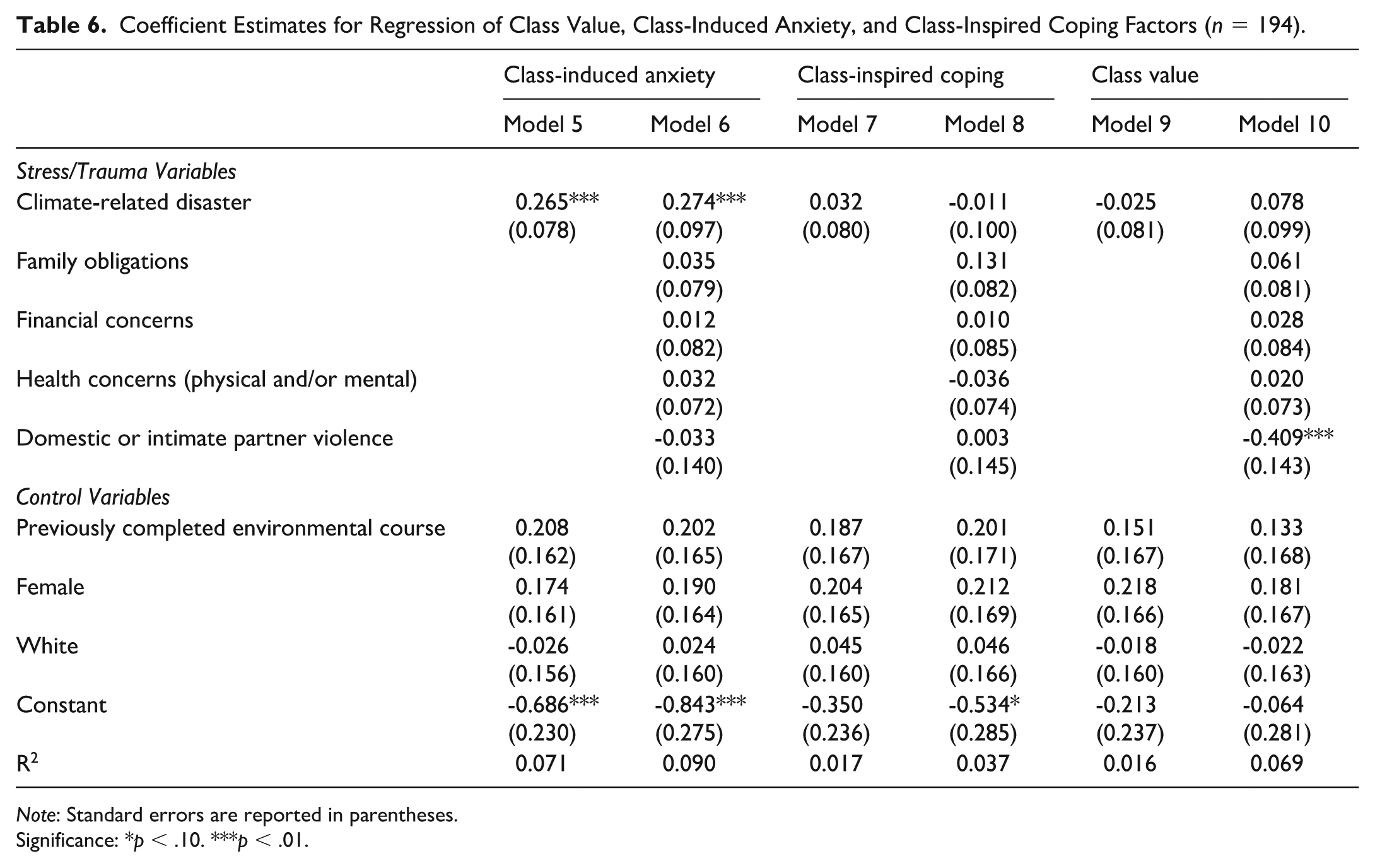
Students who experienced climate-related disaster stress/trauma attributed increased anxiety to the class in which they were currently enrolled (Table 6, Model 5), even after controlling for other sources of stress/trauma (Model 6). In fact, climate-related disaster was the only stressor to be significantly associated with this outcome. These results suggest that climate-traumatized students themselves perceive climate education to be more emotionally challenging.
Coefficient Estimates for Regression of Class Value, Class-Induced Anxiety, and Class-Inspired Coping Factors (n = 194).
Note: Standard errors are reported in parentheses.
Significance: *p < .10. ***p < .01.
Experiencing climate-related disaster stress/trauma was not significantly associated with attributing increased coping skills to the course (Table 6, Models 7 and 8). None of the other stressors were significantly associated with this outcome, either. Moreover, these models account for less than 4 percent of variation in this particular outcome. These results indicate that climate-traumatized students derive no special benefit from these courses in terms of gaining coping skills. This is unsurprising, given that three of the surveyed courses did not engage with mental health and emotional literacy to any degree, while the remaining two were “not very” engaged with these topics (Table 1). This result also resonates with other critiques of planning practice and planning education’s emphasis on the technical aspects of planning and their deemphasis of its emotional dimensions (Baum 2015; Lyles et al. 2018; Lyles and White 2019; Osborne and Grant-Smith 2015).
Similarly, experiencing climate-related disaster stress/trauma was not significantly associated with overall perceived class value (Table 6, Models 9 and 10). Of the potential sources of stress/trauma, only domestic/intimate partner violence was significantly – and negatively - associated with perceived class value. These models account for less than 7 percent of variation, indicating that these variables are only a small part of what shapes students’ perceptions of class value. In other words, climate-traumatized students do not derive any particular value from these climate courses compared to their classmates, suggesting a missed opportunity to support students for whom climate disasters are personal.
Discussion and Conclusion
Among all surveyed students, climate anxiety was generally low, while climate literacy was high. Only a quarter of surveyed students reported that taking an urban planning course that engaged with environmental and climate-related topics increased their anxiety about climate change, while nearly half credited the course with helping them cope with climate anxiety.
However, this relatively rosy picture looked dramatically different when the experiences of students directly impacted by a climate-related disaster were examined. Study findings show a clear and urgent need for trauma-informed climate pedagogy in planning education to meet the needs of climate-traumatized students. Climate-related disaster stress/trauma was significantly associated with increased climate anxiety. While the association ceased to be significant once other stressors were added as controls, it is likely that climate trauma overlapped with or even amplified other traumas such as financial strain and domestic/intimate partner violence, both of which were significantly associated with climate anxiety. For instance, having to evacuate during a wildfire and find temporary alternative housing could exacerbate students’ financial struggles. Conversely, if students were experiencing violence at home, having to shelter in place to avoid smoke in downwind neighborhoods could place them in even greater danger.
Experiencing stress/trauma due to a climate-related disaster was also significantly associated with attributing increased anxiety to the course itself, but was not significantly correlated with reporting that the course contributed to increased coping skills or with perceived class value. In other words, climate-traumatized students experienced significantly more emotional distress than their classmates when engaging in climate-related coursework and derived no particular assistance from that coursework in terms of coping skills or course value. This indicates an unmet need for trauma-informed pedagogical strategies to provide these students with the emotional literacy skills to navigate an anxiety-inducing topic like climate change.
The planning courses sampled here – and perhaps planning education more broadly – are not currently meeting climate-traumatized students’ emotional needs. Among the courses sampled here, three did not engage with mental health and emotional literacy at all, while two were “not very” engaged with these topics. This is consistent with the literature on trauma-informed pedagogy, which reminds educators that many students experience multiple forms of trauma and calls for new approaches to teaching that acknowledge the role of emotion in learning, extend empathy and support to students in distress, remove barriers to learning, and address the social injustices that create the conditions for trauma to occur (Anders, Frazier, and Shallcross 2012; Atkinson and Ray 2024; Bryan 2020; Read et al. 2011; Thompson and Carello 2022). The lack of focus on emotional literacy in the sampled planning courses also resonates with recent calls for an “emotional turn” in planning, which critique planning education and practice for focusing on the technical aspects of planning while neglecting its emotional dimensions (Baum 2015; Lyles et al. 2018; Lyles and White 2019; Osborne and Grant-Smith 2015).
These findings are particularly significant because increasing numbers of young people are affected personally by climate impacts and climate anxiety (Engstrom and Krings 2025; Grennan et al. 2023; Hickman et al. 2021; Hrabok, Delorme, and Agyapong 2020; IPCC 2022; Nan et al. 2025; Silveira et al. 2021; Woodbury 2019). Climate trauma is a newly defined psychological condition (Engstrom and Krings 2025; Woodbury 2019). Yet it is likely to become an increasingly prevalent one, adding to the list of stressors and traumas already experienced by many students in higher education (Anders, Frazier, and Shallcross 2012; Read et al. 2011; Thompson and Carello 2022). Nevertheless, additional research is needed to assess the generalizability of our findings across a variety of educational settings, including graduate planning programs and universities in other regions experiencing different climate impacts.
Future research should also evaluate different trauma-informed pedagogical strategies for their effectiveness in planning education. While trauma-informed climate pedagogy is still evolving as a field, there are a number of proposed “best practices” offered by recent work in this area. These include acknowledging the unequal impacts of climate trauma (Atkinson and Ray 2024), guiding students in interrogating how they are both constrained by and implicated in the systems that drive climate change (Bryan 2020), encouraging the sharing of personal experiences and emotional responses in the classroom (Atkinson and Ray 2024), and guiding students in processing emotions, envisioning alternative futures, and building community through creative assignments (Atkinson and Ray 2024). Specific pedagogical activities might include guided reflections, journaling, and contemplative practices in which students connect their emotions, values, and behaviors with their learning, experiences, and social positions within larger systems and structures (Lyles et al. 2021; McSorley et al. 2025). Such approaches and activities can build climate literacy and emotional literacy simultaneously so that students can absorb “difficult knowledge” in emotionally healthy ways, building their capacity to learn about and engage with climate action despite its distressing nature (Lyles et al. 2021; McSorley et al. 2025; Ojala 2016). Because this kind of “transformative learning” is an extended process that typically requires more than the timespan of a single course, planning educators must design learning activities to support the early stages of this process and build paths to continued learning after the course has concluded (McSorley et al. 2025). While beyond the scope of the current study, future research can contribute to the development of effective trauma-informed climate pedagogy by evaluating the effectiveness of such pedagogical strategies in helping students build both climate literacy and emotional literacy.
In short, we found that students who experienced a climate-related disaster experienced significantly more climate anxiety than their classmates. It remains unclear, however, whether their increased anxiety caused their learning to suffer relative to their peers. Experiencing climate trauma during the course was not significantly associated with climate literacy. However, because climate-related knowledge is accumulated over time and across many courses, trauma experienced during a single course would be unlikely to immediately impact a students’ overall climate literacy. Climate-traumatized students were more likely to perceive their class as increasing their climate anxiety, but no more likely than their classmates to feel the class helped them cope or provided overall educational value. Therefore, there is a clear and unmet need for trauma-informed climate pedagogy in planning education. New pedagogical approaches can not only support climate-traumatized students but also prepare and empower future planners to create a better future for themselves and their communities.
Footnotes
Appendix
Exploratory Factor Analysis of Survey Items (n = 194).

| Factor | Cronbach’s α | Survey item | Factor loading |
|---|---|---|---|
| Climate change anxiety | 0.9249 | Rate how often the following statements are true of you: | |
| Thinking about climate change makes it difficult for me to concentrate. a | 0.7280 | ||
| Thinking about climate change makes it difficult for me to sleep. a | 0.8091 | ||
| I have nightmares about climate change. a | 0.7846 | ||
| I find myself crying because of climate change. a | 0.8005 | ||
| I think, “why can’t I handle climate change better?” a | 0.6372 | ||
| I go away by myself and think about why I feel this way about climate change. a | 0.7362 | ||
| I write down my thoughts about climate change and analyze them. a | 0.6775 | ||
| I think, “why do I react to climate change this way?” a | 0.6478 | ||
| My concerns about climate change make it hard for me to have fun with my family or friends. a | 0.7753 | ||
| I have problems balancing my concerns about sustainability with the needs of my family. a | 0.5851 | ||
| My concerns about climate change interfere with my ability to get work or school assignments done. a | 0.7718 | ||
| My concerns about climate change undermine my ability to work to my potential. a | 0.8022 | ||
| My friends say I think about climate change too much. a | 0.6979 | ||
| Climate change literacy (self-rated) | 0.8851 | Please indicate your level of agreement with the following statements: | |
| I feel well informed about the science of climate change. b | 0.8672 | ||
| I feel well informed about climate policy. b | 0.8543 | ||
| I feel well informed about strategies to address climate change. b | 0.9069 | ||
| I have the knowledge and skills I need to take action to address climate change. b | 0.8152 | ||
| Class-induced anxiety | 0.8155 | Please indicate your level of agreement with the following statements: | |
| This course increased my anxiety about climate change. | 0.8620 | ||
| After this course, I am feeling more worried and overwhelmed about climate change. | 0.9111 | ||
| Class-inspired coping | 0.8841 | Please indicate your level of agreement with the following statements: | |
| This course helped me cope with anxiety about climate change. | 0.7688 | ||
| This course increased my hope about addressing climate change. | 0.7815 | ||
| Interacting with other students in groups or class discussion in this course reduced my anxiety about climate change. | 0.8911 | ||
| Interacting with other students in groups or class discussion in this course increased my hope about addressing climate change. | 0.9129 | ||
| Class value | 0.9301 | Please indicate your level of agreement with the following statements: | |
| I enjoyed this class overall. | 0.8586 | ||
| I learned a lot during this class. | 0.8644 | ||
| I felt the class was engaging. | 0.9337 | ||
| I felt encouraged during class to be creative and innovative. | 0.7240 | ||
| I felt encouraged during class to think critically. | 0.8837 | ||
| The class exercises and format advanced my understanding. | 0.8573 |
Acknowledgements
The authors express their gratitude to the anonymous reviewers and the editor for their thoughtful feedback. The authors also thank the colleagues who invited them into their classrooms to introduce the survey to their students or provided valuable suggestions on the survey design and implementation, including David Feldman, Kim Fortun, Jae Hong Kim, Richard Matthew, Michael Méndez, Walter Nicholls, Lorne Platt, Jessica Pratt, María G. Rendón, Alejandra Reyes, Michael Robinson-Dorn, Margaret Tebbe, Nicola Ulibarri, and Karna Wong. Finally, the authors are grateful to the students in the sampled courses for completing the survey and for helping us better understand how to support them as future planners confronting the climate crisis.

Funding
The authors received no financial support for the research, authorship, and/or publication of this article.
Declaration of Conflicting Interests
The authors declared no potential conflicts of interest with respect to the research, authorship, and/or publication of this article.