




Abstract
Low-income households commonly lack access to quality and affordable transportation options, impeding their access to opportunities. Low-income households with children face additional challenges. We draw on data from thirty-nine in-depth interviews to examine the effect of children on the travel behavior and experience of low-income adults. We find that low-income households with children experience increased financial and temporal burdens related to travel. These unique and complex challenges result in fewer socioeconomic opportunities and financial resources and reduced time for non-travel activities. The findings underscore the importance of programs and policies to develop a multimodal, affordable transportation safety net.
Keywords
Introduction
Low-income households struggle to make ends meet and to cover their needed expenses, including those for transportation (Klein 2024). The inability to pay for transportation expenses, such as the purchase of vehicles or transit fares, can constrain overall travel. Consequently, households may experience limited access to jobs, education, and other opportunities that contribute to a high quality of life. Efforts to address transportation affordability tend to focus on public transit (e.g., providing free or reduced transit fares) or the creation and protection of affordable housing in transit-rich neighborhoods (Blumenberg and Agrawal 2014; King, Smart, and Manville 2019). Low-income households often experience additional transportation challenges based on their residential location in high-poverty neighborhoods, which tend to suffer from long-standing disinvestment in the built environment, wide high-speed arterial streets, lack of shade, elevated levels of crime, racially-biased policing, and police violence (Barajas 2021; Singleton et al. 2023). Combined, these conditions create unsafe and hostile transportation experiences (Lowe and Mosby 2016), which may depress travel.
The presence of children in the household greatly complicates and creates “messy” adult travel behavior where travel is prioritized for children and their schedules. Kent and Mulley (2023) define “messy” travel as having two main characteristics. First, it is “spatially and temporally complex in a way that disrupts conventional planning’s prioritisation of consistent peaks and flows” (Kent and Mulley 2023). Second, “messy” travel is “emotionally or physically laden” and “defined by the need to carry a load or care for another” (Kent and Mulley 2023). This “messy” travel leaves caregivers with limited time for their own transportation and can make car ownership or use feel necessary (Kent 2022). “Messy” travel is complex travel, particularly among low-income caregivers who lack the resources necessary to buy a private vehicle or pay for other support that could help with the time constraints they face in their daily lives.
To better understand these issues, we drew on interview data from thirty-nine low-income adults selected to participate in the Los Angeles Mobility Wallet pilot program in South Los Angeles before they received any funding. We used thematic analysis to examine the travel patterns and challenges of low-income households with and without children and across differing levels of automobile access. We investigated how being low-income and having children affects the travel behavior and decision-making of caregivers. The interviews confirmed that the presence of children in the household complicates the travel behavior of caregivers and, in so doing, compounds the barriers that they face as low-income travelers living in high-poverty neighborhoods. This complex travel has significant implications for mobility, accessibility, and other life outcomes. Despite having constrained financial resources, low-income travelers with caregiving responsibilities have difficulty relying on public transit or other shared modes, ultimately concluding that a more expensive personal vehicle is often an unavoidable necessity. Transportation planners and policymakers must better understand the challenges faced by low-income households with children to provide equitable mobility and accessibility options. Specifically, the findings from our study suggest the need for affordable, multimodal transportation that addresses the diverse travel needs of low-income adults with children.
Transportation, Children, and Low-Income Households
Numerous scholars from diverse fields have written about the life-changing effects associated with the transition to parenthood (Andersen 1984; Buhr and Huinink 2014; Chakrabarti and Joh 2019). Having a child is often associated with shifting roles and responsibilities both within and outside of the household. Despite significant increases in female labor force participation, women are more likely than men to reduce their employment particularly when children are young; they also remain more likely to assume more of the unpaid labor associated with family caregiving (Bianchi, Robinson, and Milke 2006). Studies also highlight the effect of parenthood on the attitudes and well-being of parents—rewards such as joy and personal growth offset by feelings of stress, exhaustion, time pressure, and interpersonal conflict (Nomaguchi and Milkie 2020). A growing culture of intensive parenting—broad expectations that parents increase their time, financial, and emotional investments in child rearing—magnified these effects among both higher- and lower-income families, albeit in different ways (Nomaguchi and Milkie 2020).
These shifting roles, responsibilities, and attitudes have significant implications for travel behavior and the travel experience. Children greatly increase the complexity of household travel, providing parents with a strong motivation to purchase and use automobiles (McLaren 2018). They also elevate parents’ concerns about safety and, therefore, the risks associated with travel by certain modes, at particular times of the day, and in some neighborhoods (Chakrabarti and Joh 2019). These issues are compounded in low-income families who often do not have the resources to manage their travel needs and are more likely than higher-income families to live in neighborhoods where safety is a concern.
Children and the Travel Behavior of their Parents
Parenthood is a major life event that changes mobility (Kent 2022). “After entering parenthood, care-related journeys become a significant part of everyday mobility in the household” (Yang et al. 2023, 317). Parents must coordinate school drop-offs, commutes, and other household-serving trips, creating fragmented trip chains that often are not well aligned with traditional transit systems (schedules and their routes) and active transportation modes (e.g., walking, biking). Studies find that the birth of a child is associated with both the acquisition (Klein and Smart 2019; McCarthy et al. 2020; Oakil et al. 2014) and use of private vehicles (Chakrabarti and Joh 2019; Gao et al. 2023; Janke, Thigpen, and Handy 2021; McCarthy et al. 2021). Kent (2025) describes becoming a parent as the beginning of an unyielding bond with private car ownership.
Cars allow parents to reach multiple destinations efficiently while transporting children, groceries, and other household goods (Berg and Henriksson 2020; Kent 2022). However, while cars can be convenient, they are expensive. In 2023, households with at least one vehicle spent on average about $14,000 per year on transportation, compared to less than $3,500 per year among households without vehicles (“Transportation Cost Burden,” n.d.). Moreover, adults who drive with child passengers report experiencing significant anxiety associated with protecting the safety of children in their vehicle. These anxieties include elevated concerns about traffic crashes, potential dangers on the road, and the ability to concentrate on driving while also meeting the—at times demanding—needs of child passengers (Taubman-Ben-Ari and Noy 2011).
In some situations, the birth or presence of children in the household may not be associated with greater car use. Despite having children, there is no greater car use when childbirth imposes significant economic hardship. For example, when one parent—typically the woman—reduces their labor force participation, shifting use of the household vehicle to the working partner, or among parents who had previously used more sustainable modes of transportation (Lanzendorf 2010; McCarthy et al. 2019, 2021). Moreover, the effect of childbirth on automobile ownership may be waning over time, as additional families with young children shift toward more sustainable modes of transportation (McCarthy et al. 2020).
Until children are sixteen—the age at which many are eligible to drive—they make most trips accompanied by a parent (McDonald 2006). Numerous studies show a significant decline in children’s independent mobility due largely to increased reliance on automobiles coupled with growing distances to destinations, particularly schools (McDonald et al. 2011; Vincent, Maves, and Thomson 2022). Other factors, such as safety concerns related to pedestrian deaths and injuries, fear of strangers, and convenience (e.g., parents accompanying children to a growing number of after-school activities) have contributed to this trend (Mackett 2013; McLaren and Parusel 2012; Mitra 2013).
Researchers have studied the decline in children’s independent mobility and its negative effect on children such as increased rates of obesity and other health problems (McDonald 2006) and poor social, cognitive, and personal development (Riazi and Faulkner 2018). A smaller but growing body of scholarship explores the relationship between children and the travel behavior of their parents. Much of this research draws on the concept of mobility of care, which highlights the role of household caregiving responsibilities in shaping the frequency and complexity of adult trip-making (Madariaga 2013). Care trips—trips to take children to childcare centers and schools, medical appointments, play dates—tend to be frequent, short distance, and for working parents, often undertaken on the way to and from work (Lanzendorf 2010; McGuckin and Murakami 1999; Ravensbergen, Fournier, and El-Geneidy 2023).
Most, but not all, studies found that the presence of children in the household has a larger positive effect on women’s car use than on men’s, likely due to women’s disproportionate responsibility for child- and other household-serving travel (Boarnet and Hsu 2015; Oakley 2016; Scheiner and Holz-Rau 2012). Children also contribute to explaining other sex differences in travel behavior. For example, in households with children, women are more likely than men to trip chain, link trips on the way to and from work (Wang 2015), and to make trips solely on behalf of their children (Rosenbloom 1987). Additionally, most studies find that the presence of children in the household helps to explain sex differences in commute distance. On average, women still commute shorter distances than men (Crane 2007; Kwon and Akar 2022). While there are multiple explanations for this disparity (MacDonald 1999), the presence of children in the household is one of them, particularly in two-worker households (Hu 2021). Women may choose jobs closer to home to better manage their dual responsibilities for paid work and childcare. Women also have different safety concerns when traveling and thus are often more risk-averse than men when making travel decisions (Shirgaokar 2019).
Transportation Challenges of Low-Income Families
Low-income families face additional transportation challenges. For one, they have less access to private transportation than higher-income households, leading to a greater reliance on public transit and walking (Blumenberg, Brown, and Schouten 2020; Klein 2024). Beyond transit and walking, shared mobility options may expand options for low-income travelers without cars. “Shared mobility services have the potential to expand automobility” while increasing reliability, lowering costs, and providing “on-demand, point to point transportation” to those without easy access to cars, at lower cost and with greater reliability (Brown and Taylor 2018, 139–40). A study in our target area, South Los Angeles, found that a subsidized carsharing program (BlueLA) resulted in positive quality of life improvements and mitigated many of the disadvantages of car ownership (e.g., financial costs, limited parking) (Paul et al. 2024). Additionally, Paul et al. (2024) contend that the subsidized nature of the shared mobility program made it particularly beneficial to low-income travelers who face a multitude of financial constraints and challenges.
To manage without a car, low-income families are more likely than other families to live in dense, transit-rich neighborhoods located near downtown job centers (Glaeser, Kahn, and Rappaport 2008). However, travel times on transit and on foot can be long, potentially limiting the amount of time that parents have available to spend with their children (Bostock 2001). Moreover, outside of the very densest urban areas (Smart and Klein 2020), the lack of a vehicle poses serious challenges, limiting parents’ employment opportunities (Baum 2009; Blumenberg and Pierce 2014; Gurley and Bruce 2005), constraining their ability to access health care for their children (Pesata, Pallija, and Webb 1999; Yang et al. 2006) or to move to higher-quality neighborhoods (Jeon, Dawkins, and Pendall 2018), and negatively affecting long-term outcomes—education, employment, and earnings—of their children (Ralph 2022).
Given the many benefits of automobiles, most low-income families have at least one household vehicle. Data from the 2023 American Community Survey show that 84 percent of poor families in the U.S. have at least one household vehicle (Ruggles et al. 2023). However, as we note above, automobile ownership is expensive; research shows that it imposes a higher financial burden on lower-income households than other households (Brown 2017; Klein and Smart 2017, 2019). Moreover, adults in low-income families with cars still may not have reliable access to vehicles. Low-income households tend to have fewer cars than drivers (Brown 2017); they also often own old, unreliable vehicles that may or may not be consistently operational (Bhat, Sen, and Eluru 2009; Linkov 2015). These challenges can constrain household travel (Blumenberg and Agrawal 2014).
Children and the Travel of Low-Income Adults
As we review above, there is a body of scholarship on women, travel, and children. A second body of scholarship analyzes the travel behavior and constraints of low-income families. However, research at the intersection of these two areas—the subject matter of this research—is limited. One exception is the effect of living in low-income neighborhoods on parents’ decisions about their children’s travel, findings with implications for parents’ own travel behavior. Due to the central locations of their neighborhoods, residents of low-income areas often have relatively high levels of access to most destinations (Shen 2001; Shin 2020). But in making those trips, families in high-poverty neighborhoods—particularly low-income, communities of color—experience significant safety hazards, including disproportionate numbers of crashes (car, pedestrian, bicycle) and increased police contact (Barajas 2021; Haddad et al. 2023; Roll and McNeil 2022).
Consequently, parents living in urban neighborhoods tend to express far more anxiety about neighborhood safety and the safety of their children than those in suburban areas (Weir, Etelson, and Brand 2006). In response, parents who can tend to adapt their parenting strategies to minimize potential harms (Luster and Okagaki 2006). After traffic, concerns about safety hazards and crime are among the most salient parental worries; parents mitigate these risks by limiting when and where children can independently travel (Alparone and Pacilli 2012). Safety concerns also influence mode choice. Many parents do not allow their children to walk or bicycle because of traffic and other safety concerns (Nyström et al. 2023).
Methods
In this paper, we do not report findings related to the Mobility Wallet experiment itself; rather, we examine the baseline conditions facing a sample of participants prior to receiving funds to better understand the unique transportation challenges facing low-income travelers with children. To do this, we conducted a qualitative study relying on interview data and thematic analysis. We recruited research participants from those selected for the Los Angeles Mobility Wallet pilot program in South Los Angeles. The program provided 1,000 residents in South Los Angeles with a prepaid debit card of $150 per month for one year to spend on select shared transportation modes: public transit, car and bike share, Uber/Lyft/Taxi, Greyhound/Amtrak, and local bike shops. Applicants had to be eighteen years or older, live in the project area, and have annual incomes under $41,400 for a one-person household, with income limits that increased by household size to a maximum threshold of $68,600 for a household of six or larger. 1
The South Los Angeles Mobility Wallet Project Area, which is home to over 370,000 people, is a predominantly low-income community of color, about two-thirds Hispanic or Latino and about one-quarter Black or African American. This community has long-faced economic challenges and was at the center of racial uprisings including the 1965 Watts Riots, the 1968 Chicano Blowout, and the 1992 Civil Unrest (Basu 2019; Gamal 2016; Garth 2021). The subsequent McCone and Kerner Commission reports expressed the role of structural racism as a root cause for the events of the 1960s and the need to improve the physical mobility of residents in South Los Angeles (South LA) as a mechanism for increased access to opportunity (Comandon and Ong 2020; McCone and Christopher 1965; U.S. National Advisory Commission on Civil Disorders 1968).
While its central location (Figure 1) affords proximity to jobs in Downtown Los Angeles and access to a robust transit network, its residents nonetheless continue to face economic and mobility challenges. In the South LA Project Area, 29 percent of households live below poverty, and 19 percent receive Supplemental Nutrition Assistance Program (SNAP) benefits (or food stamps). Moreover, 6 percent of households have no vehicle, and 30 percent have only one—and so, it makes sense that nearly 7 percent of workers commute by walking or biking, and over 14 percent commute by transit (Luster and Okagaki 2006). 2
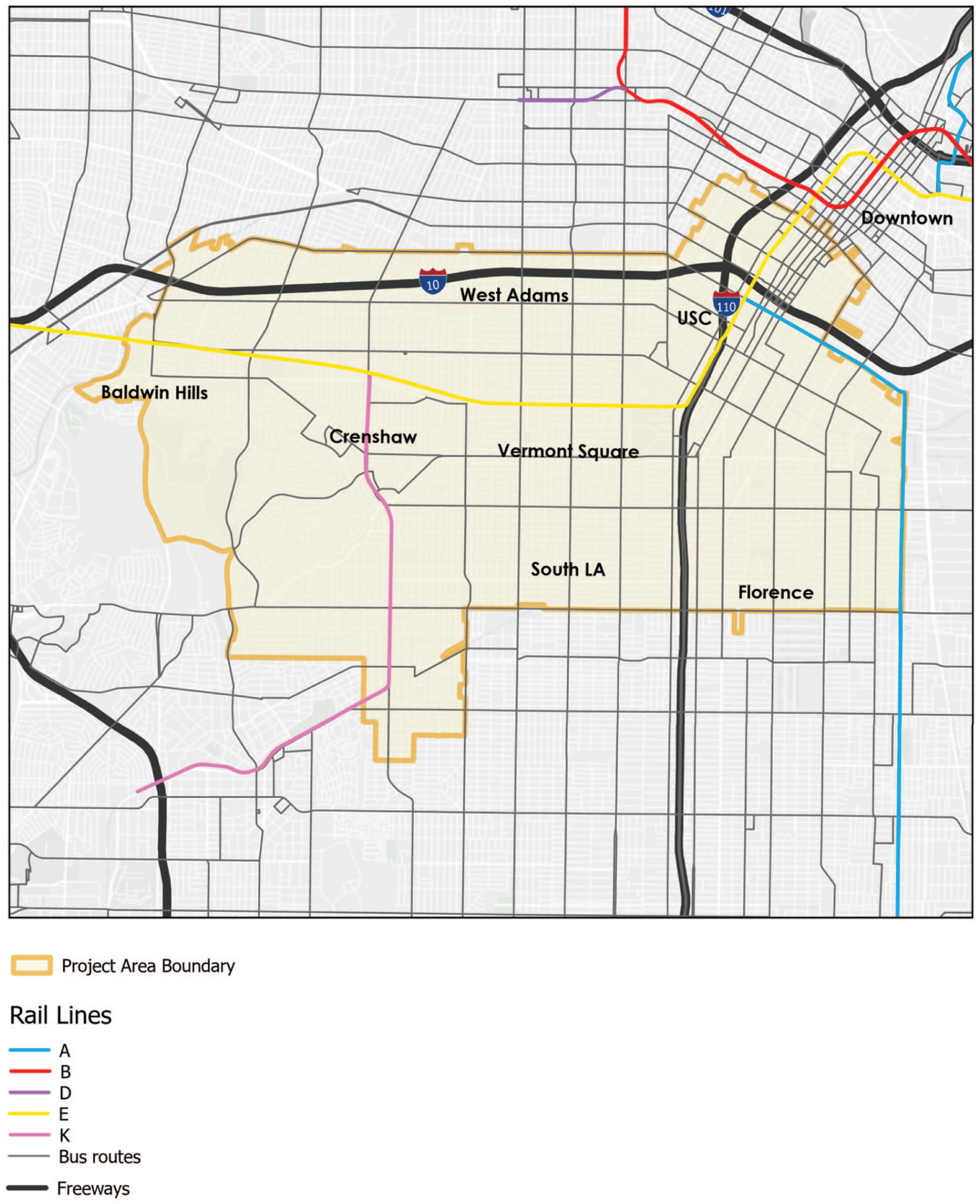
South Los Angeles project area.
Drawing from the existing travel behavior literature, we stratified the respondents who opted into the study based on their gender identity, level of car access (defined later), and the presence of children under eighteen in the household. Using stratified random sampling (among those who signed up to participate in the Mobility Wallet pilot), we assembled a sample of thirty-nine interviewees, contacting each selected participant twice—by phone, text, and email—before replacing them with another person within the same strata if we were unsuccessful in reaching them. We conducted the interviews in the six-week period before interviewees received their Mobility Wallet card or within the first month of receiving their funds (i.e., April and May 2023). Interviewees had the option to complete the interview in English or Spanish; all but one interview was conducted in English. Our sample size is consistent with—and in many cases, substantially larger than—sample sizes in other qualitative transportation research and, based on our findings, resulted in saturation (Klein 2024; Lowe, Barajas, and Coren 2023).
It is often difficult to recruit participants from hard-to-reach or vulnerable social groups, such as low-income households, since traditional sampling methods tend to be ineffective (Ellard-Gray et al. 2015). The Mobility Wallet program provided an opportunity to recruit low-income study participants to better understand the motivations behind their travel behavior prior to analyzing the effects of the intervention itself. We developed a semi-structured interview instrument that covered participants’ current travel patterns/behavior, transportation challenges, reliance on other people for travel needs, and thoughts about cars and household and transportation budgeting (see Appendix A in the Online Supplementary Material for the interview instrument). These questions allowed interviewees to describe their transportation experiences and how these experiences made them feel—topics difficult to assess using traditional travel survey data. We tested the interview instrument with multiple people before deployment and prior to translating the instrument into Spanish. Two research team members conducted each of the interviews by phone and, with the consent of the interviewee, recorded them for transcription. The interviews lasted approximately thirty-five minutes, and interviewees received a $50 gift card for their participation.
We analyzed our data drawing on the thematic analysis methodology developed by Braun and Clarke (2006, 2021). We generated a codebook through a data immersion process involving careful review of the interview instrument and memos from debriefs conducted by researchers directly following each interview. After we coded a sample of interviews, we iterated the codes to produce a final codebook of nine larger, more-encompassing codes (i.e., codes) and fifty-three sub-codes that fall under a parent code (i.e., sub-codes). We then used the software Nvivo 14 to conduct systematic open coding; two research team members coded each transcript for robust coverage and reliable interpretations of the data.
We then sorted the codes to observe and identify patterns and develop an initial set of themes; reviewed these themes in relation to the coded excerpts; and iterated themes to arrive at a final set of seven themes (in descending order of number of associated excerpts): mode choice/use, affordability, transit service and use, safety, transportation benefits, automobility, and stress (see Appendix B in the Online Supplementary Material for the coding tree). Next, we ran queries to produce cross-tabulations containing interview excerpts by theme and by the presence of children in the household—the primary basis of comparison in this study. Because automobile access plays such an important role in enhancing mobility—and so can potentially mitigate the transportation challenges associated with being low-income and caring for children—we also cross tabulated the interview data by car access, specifically, whether the person lives in a car-deficient household (i.e., ratio of adults to cars <1) or a fully-equipped household (i.e., ratio of adults to cars ≥1). These cross-tabulations enabled us to systematically review interview excerpts within each relevant theme by those living in car-deficit households with children (twelve interviewees), those living in fully-equipped households with children (eight), those living in car-deficit households without children (ten), and those living in fully-equipped households without children (nine). To illustrate key findings, we include twenty-two direct quotes from sixteen distinct interviewees across the four strata.
Table 1 includes the characteristics of the interviewees. 3 About two-thirds of our interviewees are Latino, aligned with the racial/ethnic composition of the project area, and about three quarters live in extremely low-income households. The income thresholds vary by household size, but for reference, the extremely low-income threshold for a two-person household was $28,600. For interviewees living in households with children aged eighteen or younger (sixteen), nine interviewees were not parents (e.g., living with younger siblings or relatives with children). Households with children tended to be larger with an average of three children per household. Our sample is almost entirely low-income people of color, part of hard-to-reach populations who are under-sampled and understudied in transportation research (Lubitow et al. 2021).
Interviewee Characteristics.
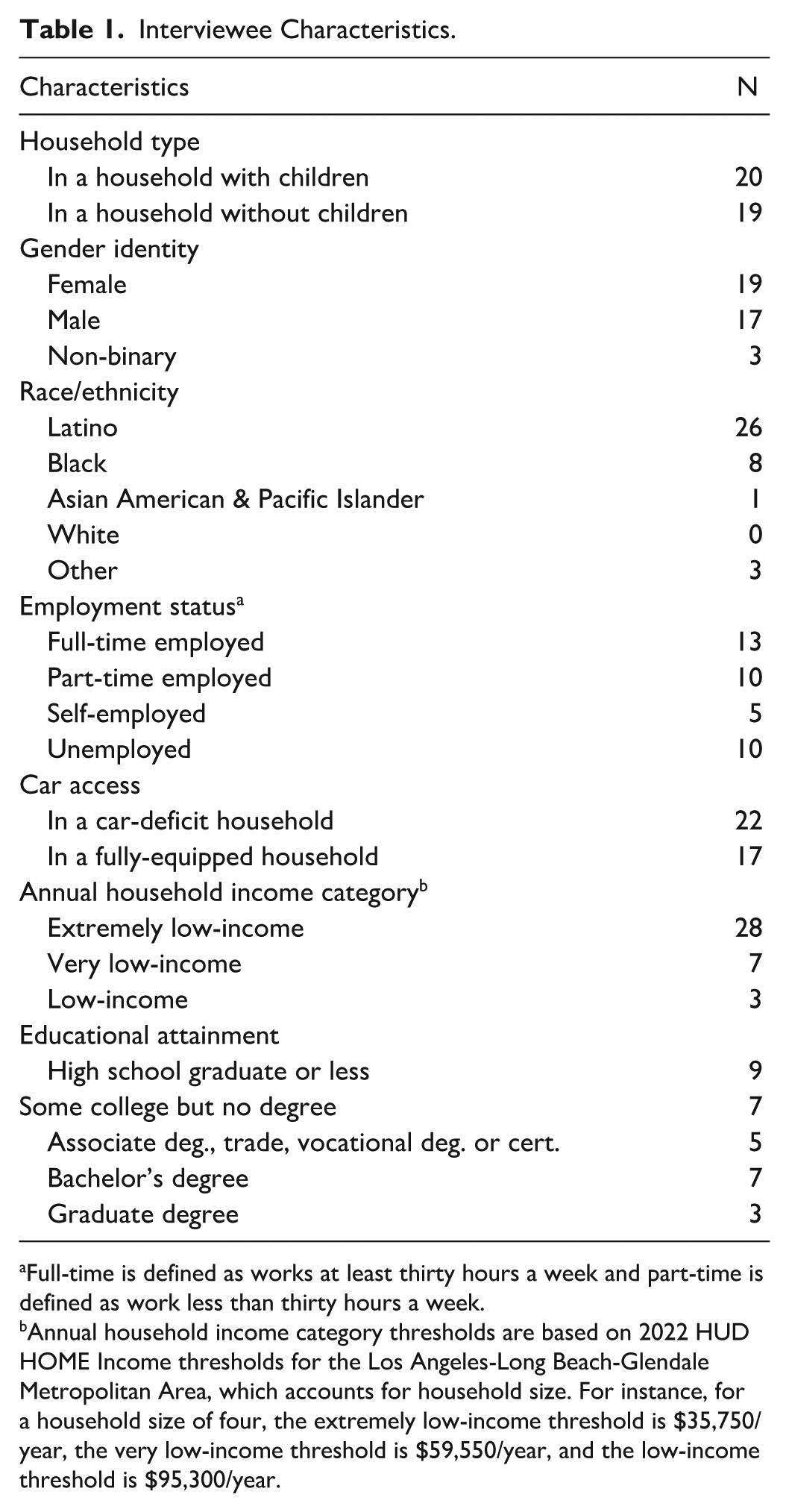
Full-time is defined as works at least thirty hours a week and part-time is defined as work less than thirty hours a week.
Annual household income category thresholds are based on 2022 HUD HOME Income thresholds for the Los Angeles-Long Beach-Glendale Metropolitan Area, which accounts for household size. For instance, for a household size of four, the extremely low-income threshold is $35,750/year, the very low-income threshold is $59,550/year, and the low-income threshold is $95,300/year.
Qualitative research provides a nuanced understanding of the transportation experiences of low-income households but has some limitations. The sample is not random nor is it intended to be representative of the project area. One of the limitations is that participants who were motivated to apply for the Mobility Wallet program may not represent all low-income travelers. They may have experienced acute financial constraints or transportation barriers not necessarily experienced by non-applicants. Additionally, program enrollees received a financial incentive for their participation in the research, also potentially skewing the data toward interviewees with greater need for financial assistance. Finally, the data suggest that the interviewees use public transportation more than others in South Los Angeles, perhaps because many heard about the Mobility Wallet program via Los Angeles Metro, the major transit agency in the region and one of the program sponsors.
Findings
In this section, we examine the challenges of low-income interviewees living in households with children. As we note above, the caretaking of children is not exclusively the responsibility of parents but also includes other household members such as cousins or siblings. Overall, the interviews highlight the many issues that arise when managing household travel on a limited budget, the difficult choices that low-income caregivers make in balancing the time and out-of-pocket costs of travel. We explore these challenges in the context of fixity constraints, the patching together of multiple modes of transportation, and the use of shared transportation services. We conclude this section by discussing the role of private vehicles.
Fixity Constraints
One of our key findings is that travel with children is made more complicated and difficult by the fixed nature of many household trips. Caregivers described a lack of independent travel by children requiring additional trips, many of them (e.g., to school/childcare, health care) fixed in time and space resulting in less flexibility and greater complexity. Among interviewees living in households with children, accompanying children to and from school comprised a large proportion of their trips. School trips, which are beholden to school schedules, add fixed time constraints to daily travel patterns of parents and other caregivers—including school pickups, drop-offs, or afternoon dismissals. The problem is further compounded if children in the household attend schools at different locations. School buses are a rarity across California, leaving caregivers and public transit responsible for school travel (Speroni et al. 2025).
Interviewees spoke about the convenience of cars when faced with fixity challenges. For parents and other caregivers, automobiles enabled travel between multiple schools and other childcare-related locations in a relatively short amount of time. They also allowed them to manage diverse travel demands including escorting children to and from school, running errands like grocery shopping while also commuting. We found that because of the benefits of automobiles to households with children—on which we elaborate in the next section—many interviewees with household vehicles acquired or kept them “because of [the] kids.”
Furthermore, in car-deficit households, some interviewees described dropping off and picking up children as a priority use of the household vehicle. Many stated that trip-making, particularly for those in households with children, is difficult on transit. One interviewee explained that between dropping his son off at school in the morning, going to work, picking his son up from school at 2:45 pm, dropping his son off at home, then going to community meetings, “I’m probably on 8 to 12 buses a day.”
Involuntary Multimodal Travel
Transportation affordability played a critical role in determining how our interviewees traveled. Many of them were highly multimodal, carefully juggling the use of varied modes of transportation to both meet their travel needs but also manage their costs. For example, even among those who owned cars, many interviewees opted to use transit for much of their daily travel as they perceived fares as more affordable than gas. As one parent explained: I do have a minivan, but I try not to use it much because of the gas, so I take the Metro . . . My kids take the bus in the morning for school and when they come back . . ..
At the same time, although ridesharing services came with added expense, some, but not all, interviewees with children used these services—albeit sparingly—as part of their transportation options. Interviewees would occasionally use ridehail for times or places where transit did not run early enough or to visit family in other neighborhoods that would be hard to reach in a reasonable time by transit. These services were also useful at times when people did not feel comfortable with their children taking transit. As one interviewee who would sometimes use ridesharing to assist his younger siblings in getting home from school or after-school activities explained: Getting an Uber here and there for my siblings from school to home and stuff like that . . ... One of my siblings does stay in an afterschool program . . .. So sometimes it is a little late for her to just take the bus . . .. So I just get her an Uber from there to our house.
Multimodal travel was a recurring theme among our interviewees. The ability to choose the best mode of transportation for any given situation was often noted as an anticipated benefit of the mobility wallet. Additional transportation options allowed for greater flexibility for our caregiving participants who reported the constant struggle of having to balance limited financial resources and time with their many caregiving demands.
Challenges of Using Shared Modes with Children
However, our interviewees highlighted the many difficulties of using shared modes, particularly with children in tow. In addition to their high costs, ridesharing can be extremely difficult to use with young children. One parent in a car-deficit household explained: “I have to bring two booster seats, or two car seats, because you can’t get in an Uber without the car seat.” He described the extra needs as “kind of inconvenient.”
Many of our interviewees also highlighted the difficulties of traveling with children on public transit. For parents with more than one child, taking multiple children on a bus or train can be particularly difficult, especially if there was limited seating due to crowded conditions—something interviewees described as common in South Los Angeles. As another interviewee explained: “During school hours, [the bus is] pretty packed with students, parents taking their kids to school.” Not only can traveling with multiple children on transit be cumbersome and stressful, but taking multiple children on transit is also expensive, since each child is required to pay a fare, which adds up quickly and can render transit yet another unaffordable option. 4 One interviewee from a car-deficit household with children even suggested that the cost of multiple transit passes would feel “equal” to just paying for a second vehicle.
Interviewees also expressed safety concerns about using transit and waiting at transit stops lacking protective infrastructure; indeed, safety was the most frequently mentioned transportation challenge among interviewees. They expressed fears about taking transit in the evening, but we also heard that safety concerns are elevated in the early morning hours. As one interviewee with children said: “You can’t really comfortably just stand there and wait because there’s just some people laying around there, and you kind of don’t know what’s going to happen.”
Many of the interviewees shared their perception that people utilize transit for shelter or while experiencing mental health struggles. Interviewees repeatedly expressed a belief that there are growing numbers of unhoused people riding and living around public transportation. Most interviewees articulated an understanding of the nuanced circumstances surrounding the unhoused crisis in Los Angeles and expressed compassion for people experiencing homelessness. Indeed, some of our interviewees were experiencing housing precarity themselves, including one living in transitional housing and another experiencing homelessness. Nonetheless, interviewees were concerned that the growing unhoused population affected the cleanliness and level of crime on the train, elevating their worries about safety. As one interviewee stated: “There seems to be an overabundance of homeless people just getting on the train and just sleeping there and . . .. I feel for them, but it’s scary at the same time.” Of course, we cannot say if the people who our interviewees described were experiencing homelessness and using the system for shelter or travel—rather, that was their perception.
Transit-related safety concerns were particularly pronounced for caregivers—parents and siblings—traveling with children. Some interviewees with children even expressed worry that the presence of children with them on transit made them particularly vulnerable. As one parent stated: I’m a single female and I try not to draw too much attention to myself, especially when I have my kids . . .. And so that’s why there’s a certain time up to 4:00 PM, I’m okay with the Metro, but after 4 or 4:30, that’s it, I won’t.
Another interviewee reinforced this idea by stating that traveling with children makes them more likely to be a victim of crime on transit: “We pretty much get robbed, or they pretty much hit us since we’re a mom with kids. And people like to take advantage of that.”
Parents also noted that the transit experience can be unpredictable in ways that made them feel unsafe while traveling with their children: “Transportation is kind of somewhat dangerous. Especially when you’re traveling with your kids, you never know who’s going to get on, doing what, or how they’re feeling that day.” Many parents expressed safety concerns about their children being exposed to inappropriate behaviors on transit, again related to the unpredictability of other travelers and transit trips.
Finally, for interviewees who opted to utilize transit, bus stops were a common target of criticism. Interviewees spoke about the danger they felt when trying to wait for a bus in the middle of a freeway, 5 in the dark without adequate lighting, without places to sit, and without any shade to protect riders in extreme heat or rain. They felt that the lack of lighting made them particularly vulnerable at night.
Because of these conditions, interviewees articulated a desire for more bus shelters and lighting at stops. Despite their feelings regarding safety, many participants continued to use public transit since they had limited options; either they could not afford to purchase a vehicle or had to manage their use of automobiles. However, interviewees who were regular transit riders made different decisions about taking a bus or train if they traveled with children. One interviewee captured this sentiment by stating: It’s just, as much as I want to take it . . . the safety is always the number one concern. Especially because my siblings, I take them with me, so, there was a time period where I had to stop taking the train and I had to recommend my siblings to stop taking [it].
Because of these safety and infrastructure concerns, low-income parents and caregivers without a car often felt obligated to accompany children on transit. This decision resulted in having less time for other activities as explained by one mother who escorted her children (ages four, eight, eleven, and fifteen) to and from school and explained: “it’s more time consuming and I’m not able to do multiple things in one day. I’m more like one or two rather than three, four things in a day.”
The Benefits and Costs of Cars for Caregivers
In light of these challenges, our interviewees were quick to express their need for a personal vehicle, citing several important benefits. First, they perceived car access as essential to getting to their jobs as well as being punctual to work. Since traveling longer distances is cumbersome without a car, many interviewees shared that a lack of car access limited the types and quality of jobs they could seek. As one interviewee explained: I’m always trying to find a job that’s really close to my house. Because I don’t want to have to deal with taking two buses or a long train ride to where I need to work . . . if I had a car, then I’d be able to work at places that are a little more farther and I wouldn’t risk being late.
The benefits of car travel were particularly salient for time-sensitive trips combined with errands (including those made for child-serving purposes). One interviewee with car access described these types of trips as feeling impossible to do on the bus due to wait times and transfers: . . . if you had to be somewhere at a certain time, to pick up your kids, and you have to get to work. And when we want to go pick up some groceries? Do all of that on the bus? You wouldn’t be able to.
Finally, interviewees emphasized the importance of car access “in case of emergencies.” In particular, interviewees with travel dependent children stressed the importance of having the use of car when plans change, children need immediate support, or emergencies arise.
Consequently, multiple interviewees stated that having children was the impetus for acquiring a car in the first place. As one interviewee explained regarding car ownership: “For me it’s very necessary when you have kids. I need to get them. And that’s the main reason why I got a vehicle is because of them, my kids.” Another interviewee added: “. . . at one point, [a car] was more of a luxury. But now, having to commute [to] work . . .. or just to pick up kids . . . I feel like it’s more of a necessity.” Yet another interviewee stated that having kids was the reason for keeping their car that they might otherwise have gotten rid of because of the high costs of car ownership: “If it wasn’t for my kids, that car would’ve been gone a long time ago.”
Despite the benefits of car ownership (or access), interviewees shared similar sentiments about the principal drawback—cost. Interviewees discussed the cost burden of car ownership, including gas, insurance, planned maintenance and unexpected repairs, and other car-related fees (like annual registration). One interviewee in a car-deficit household with children stated that car-related bills and payments “[take] up half my paycheck.” Costs associated with both driving household vehicles and using ridesharing services also suppressed travel itself. As one parent in a car-deficit household described, “This weekend, we didn’t leave nowhere . . . trying to manage how much we use the vehicle because of the gas.” Such a finding suggests that interviewees may have more demand for travel than they are able to accomplish due to the lack of transportation affordability.
Discussion
Low-income people face many travel challenges. The cost of buying and owning a vehicle (Brown 2017; Klein and Smart 2017, 2019); the unreliability and inconvenience of public transit (Lowe and Mosby 2016; Ward and Walsh 2023); and the frequent need to rely on others (Blumenberg and Agrawal 2014). These topics have been raised in previous studies and are ones that were also frequently mentioned by our interviewees. However, as our analysis shows, low-income travelers with children face further challenges—additional trips fixed in time and space, the difficulty of using shared modes with young children, and elevated concerns that arise from individual safety fears compounded by anxieties associated with protecting the safety of young—and are often more vulnerable—travelers. For most of our interviewees, these challenges were unavoidable since many were hesitant to allow children in their households to travel unaccompanied due to safety concerns, a finding that aligns with those of other studies (Alparone and Pacilli 2012; Pinkster and Fortuijn 2009). To mitigate these concerns, some of our interviewees minimized their travel; others turned to personal automobiles.
The financial constraints of our interviewees meant that they had to continually balance the travel time costs associated with the use of lower-cost modes (such as public transit) with the out-of-pocket expenses of automobility. Among transportation modes, personal vehicles tend to be fastest since most automobile trips do not require out-of-vehicle time (e.g., waiting for vehicles to arrive) or intermediate stops. However, car ownership is expensive and can place a heavy financial burden on low-income households (Brown 2017; Klein and Smart 2019). With respect to ridehail, on average, total travel time tends to be significantly shorter than that on public transit; however, unless subsidized, ridehail trips are more expensive than equivalent transit trips (Cats et al. 2022). For single travelers, travel time costs (calculated as the local value-of-time) are larger than time difference costs; however, the attractiveness of ridehailing increases when there is more than one traveler (Cats et al. 2022), as was the case with many trips among our interviewees responsible for children. Moreover, the data suggest that some population groups, such as women, are more likely than men to substitute ridehail for transit (Dong 2020), potentially indicating the importance of non-monetary benefits such as safety. Public transit tends to work best for the commute, connecting workers to concentrated job locations. However, most destinations—work and non-work—are dispersed and difficult to serve by public transit. Brown et al. (2022) find that lower-income travelers without cars use ridehail more often than those with cars to overcome spatial and temporal gaps in transit service and to access destinations—such as non-work trips for medical care and grocery shopping—trips frequently taken with and for children.
Balancing these competing costs—time and money—is highly stressful. This stress, lack of time, and lack of financial resources can often result in missed opportunities. Similar to the findings of Ward and Walsh (2023), our interviewees sometimes skipped trips altogether and described feeling socially isolated due to the complicated nature of traveling with children.
I had a trip planned for my kids . . . and we couldn’t do it because we kind of had to sit down and talk about the cost of us going and coming. And I decided not to go forward with it, because if we go, I’ll spend more money on transportation versus me buying them something to eat. . ..
In sum, our findings demonstrate that for low-income households with children, the increased financial and temporal burdens associated with meeting the travel needs driven by child duties negatively affect their socioeconomic opportunities, constrain household spending, and paradoxically, decrease quality of life by reducing the time that people have available to spend with their families.
Conclusion
Our findings highlight the importance of interventions that make it easier for households to travel with children and, therefore, to access the destinations. Outside of highly dense urban areas, research suggests that cars are essential to reaching most destinations (Allen and Farber 2021; Maharjan, Tilahun, and Ermagun 2022). We find that cars play a particularly important role for households with children, helping them manage complex travel patterns that include a need to balance competing demands of commuting and school trips, fragmented trip chains, heightened concern for safety, and even a need to carry car seats (Pan, Deakin, and Shaheen 2023). Therefore, policies to help offset the costs of buying and operating automobiles can be particularly beneficial to low-income travelers with children. California agencies already offer some of these policies such as low-income subsidies to purchase clean-fuel vehicles, make smog-related vehicle repairs (required to register a vehicle), and reduce the cost of automobile insurance (Bureau of Automotive Repair 2025; California Air Resources Board 2024; California Department of Insurance, n.d.).
Even with available subsidies, automobile ownership can tax household resources and produce emissions that degrade the environmental quality of many of the heavily-trafficked neighborhoods where our interviewees lived. Low-income households, therefore, would benefit from programs to offset the costs, not only of automobile ownership but also of automobile access. Public transit and other modes such as walking work well for some trips (e.g., trips directly to and from work or to the corner store), but not for others. Consequently, most of our interviewees were multimodal—largely reliant on public transit given its low out-of-pocket costs but occasionally making ridehail trips. Given the costs of trips on shared automobile services, such as Uber and Lyft, our interviewees made judicious use of these services (Dowling 2015). Agencies can help support low-income families with children by subsidizing the use of these services through low-income rates such as those available through some carsharing programs (Paul et al. 2024; Yusuf, Brozen, and Blumenberg 2022).
Agencies also can use mobility wallets—demand-side subsidies—to offset the costs of these services. Recently, several cities—including Los Angeles, Portland, Pittsburg, and Stockton—have implemented mobility wallet pilot programs, which provide low-income travelers with debit cards to pay for shared transportation (e.g., transit, ridehail, micromobility services) (Rodier et al. 2024). Many participants spend their wallets on public transit. If they already are regular transit users, the wallet allows them to shift household resources from transportation to other purposes. However, many participants use their wallet to pay for ridehail trips. For example, in the first phase of Los Angeles Metro’s Mobility Wallet pilot program, 56 percent of all mobility wallet trips were used on transit, and 42 percent were via door-to-door services (i.e., ridehail, taxi, paratransit) (Los Angeles Department of Transportation, n.d.). Given higher fares, the door-to-door services clearly comprised a larger percentage of total expenditures.
In addition to offsetting costs, shared transportation providers need to better accommodate travel for and with children. A handful of shared car services allow children of a certain age to travel independently. Some of these services—such as HopSkipDrive—also contract with school districts to provide school transportation to children who are experiencing homelessness, in foster care, and have special needs. Adults traveling with young children may have difficulty finding carshare services that provide car seats (McCarthy et al. 2019). There are a few exceptions. For example, services such as KidCar and Kidmoto specifically serve the travel needs of families, including providing for properly installed car seats; however, they do not offer subsidized rates (Kid Car 2025; Kidmoto n.d.). In some cities, Uber offers Uber Car Seat, allowing riders to reserve a vehicle with a car seat; these rides include a $10.00 surcharge, further raising costs to users (Uber 2019).
Transit agencies can also better serve travelers with children. One approach is through changes in fare policy that allow young children to travel for free. In response to a Los Angeles Metro study, Understanding How Women Travel (Los Angeles Metro 2019), the agency expanded its fare policy to include free trips for all children under age six with a fare-paying adult (Los Angeles Metro 2022). Moreover, family-friendly infrastructure investments include improved seating, restroom and elevator availability, vehicles that accommodate strollers, and more frequent service that enables travelers to exit quickly should they have to quickly respond to a child-related issue (e.g., a diaper change).
Our interviewees also raised transit safety concerns related to people experiencing homelessness and mental health crises; these clearly require interventions outside of the transportation sector. Nonetheless, additional research is needed to better understand how the transportation sector is best suited to respond. Increasingly, transit agencies have adopted a set of punitive approaches such as more intense policing, ordinances prohibiting individuals from sleeping in public spaces such as bus stops and station platforms, and hostile architecture to make sitting or lying uncomfortable (Ding, Loukaitou-Sideris, and Wasserman 2022). In contrast, some transit agencies have pursued more positive interventions, implementing outreach measures to provide assistance or resources to those in need (Ding, Loukaitou-Sideris, and Wasserman 2022). The compassion expressed by most of our interviewees toward those experiencing homeless and/or mental health problems suggest the adoption of a care- and trauma-centered approach, one that avoids increased criminalization of such populations while saving lives, increasing feelings of safety, and increasing ridership for all travelers, including those with children (ACT-LA, n.d.; Loukaitou et al. 2023; Song and Mizrahi 2023; Wasserman et al. 2022).
Our research sheds light on the calculus of caregiving, transportation (in)affordability, and travel that people are forced to make in their daily lives. The challenges faced by low-income households with children underscore the need for affordable and multimodal transportation options. Access to a range of transportation options is essential to creating a robust transportation “safety net,” one that serves complex travel needs. Much like other social service safety nets, a transportation safety net would provide government resources and transportation services to protect low-income households from adverse outcomes associated transportation precarity. The findings of this study suggest that the safety net must include multiple transportation services, accommodations for travelers with special requirements (such as children), and the resources that allow individuals and families to select the modes that best meet their travel needs. While there has been extensive research on other safety net programs, additional research is needed to identify how to best construct a robust transportation safety net, one that addresses diverse transportation needs that vary by traveler—as we show here—but also across neighborhoods. Finally, as we note previously, the results of our qualitative analysis are not generalizable and, as such, do not represent the experiences of all travelers with children. However, an understanding of the lived knowledge and experience of the most vulnerable travelers provides insights—such as those that we present here—that are essential to effective planning that serves their transportation needs.
Supplemental Material
sj-docx-1-jpe-10.1177_0739456X261420396 – Supplemental material for Transportation Challenges of Low-Income Households with Children: A Case Study in South Los Angeles
Supplemental material, sj-docx-1-jpe-10.1177_0739456X261420396 for Transportation Challenges of Low-Income Households with Children: A Case Study in South Los Angeles by Tamika L. Butler, Madeline Wander, Madeline Brozen and Evelyn Blumenberg in Journal of Planning Education and Research
Supplemental Material
sj-docx-2-jpe-10.1177_0739456X261420396 – Supplemental material for Transportation Challenges of Low-Income Households with Children: A Case Study in South Los Angeles
Supplemental material, sj-docx-2-jpe-10.1177_0739456X261420396 for Transportation Challenges of Low-Income Households with Children: A Case Study in South Los Angeles by Tamika L. Butler, Madeline Wander, Madeline Brozen and Evelyn Blumenberg in Journal of Planning Education and Research
Footnotes
Acknowledgements
We thank our project partners at the Los Angeles Department of Transportation and LA Metro and our colleagues at UC Davis, Caroline Rodier and Brian Harold. Our heartfelt thanks to our research assistants, Alejandra Rios Guiterrez and Yesenia Becerra, and our research participants.
Declaration of Conflicting Interests
The authors declared no potential conflicts of interest with respect to the research, authorship, and/or publication of this article.
Funding
The authors disclosed receipt of the following financial support for the research, authorship, and/or publication of this article: This study was made possible with funding received by the University of California Institute of Transportation Studies through the Road Repair and Accountability Act of 2017 (Senate Bill 1). This document is disseminated under the sponsorship of the State of California in the interest of information exchange and does not necessarily reflect the official views or policies of the State of California. Additional research funding for participant incentives was provided by LADOT and LA Metro.

Supplemental Material
Supplemental material for this article is available online.
Notes
Author Biographies
References
Supplementary Material
Please find the following supplemental material available below.
For Open Access articles published under a Creative Commons License, all supplemental material carries the same license as the article it is associated with.
For non-Open Access articles published, all supplemental material carries a non-exclusive license, and permission requests for re-use of supplemental material or any part of supplemental material shall be sent directly to the copyright owner as specified in the copyright notice associated with the article.
