



Abstract
Increasing housing burdens among low- and middle-income earners urgently calls for affordable housing development in transit-oriented development (TOD) areas. We use the District NoHo Project in California as a case to explore challenges in planning for affordable housing in TOD projects. We employ thematic analysis of secondary documents and data from interviews with key players. We find that, changing visions of the transit agency in terms of affordable housing, limited administrative support from the city council, insufficient funding sources, and different expectations of community organizations contribute to the failure to meet the original affordable housing goals of this project.
Keywords
Introduction
Housing affordability has declined dramatically for low-income earners and even middle-income earners in the past decade in the Global North, and the United States is not an exception (Lee, Kemp, and Reina 2022). For example, in 2022, 41 percent of U.S. renters earning between $45,000 and $75,000 (in U.S. dollars) annually felt financially burdened owing to rental costs, and this share has risen 5 percent since 2019 (Cahill and Whitney 2024). Moreover, nearly one-third of U.S. households (i.e., 42 million) spent one-third or more of their household income on housing (Whitney 2024).
Scholars have given increased attention to transit-rich areas owing to their potential for creating affordable housing units for transit-dependent individuals. Land use development near transit stations is usually known as transit-oriented development (TOD), a planning and design strategy to create mixed use, compact, and pedestrian-friendly developments and communities near transit stations so that individuals can work, live, and recreate in the transit station precincts—usually defined as a radius within a quarter to a half mile from a transit station (Calthorpe 1993; Cervero, Ferrell, and Murphy 2002; Jamme et al. 2019). In theory, TOD that offers affordable housing units is a potential strategy to reduce travel and housing expenditures for those who do not have vehicles or who have difficulties driving (Jamme et al. 2019; Noland et al. 2017).
Since 2015, several pioneering transit agencies and states have implemented guidelines and statutes to accelerate the delivery of affordable housing within newly built TOD projects. For instance, Los Angeles County Metropolitan Transportation Authority (Metro) (Los Angeles County Metropolitan Transportation Authority 2015b) and the Bay Area Rapid Transit (BART) system in California (Bay Area Transit Authority 2017), as well as the Regional Transportation District in Denver, Colorado (Regional Transportation District 2021), have all adopted policies requiring that 35 percent of housing units in TOD projects be affordable to low-income residents. Washington State has even launched legislation that mandates transit agencies financially support TOD plans that include affordable housing units. Additionally, that state requires agencies to transfer surplus property to developers who commit to ensuring that at least 80 percent of the resulting housing units are affordable (Transit-Oriented Development Strategy System Plan 2015).
However, TODs usually come with an affordability paradox (Renne et al. 2016): although it has potential for increasing affordability, it can actually raise housing prices and reduce housing affordability for residents living in station areas (Bartholomew and Ewing 2011; Duncan 2011). The impact of a TOD project’s amenity improvements on housing prices in nearby areas can also contribute to gentrification and displacement of residents (Padeiro, Louro, and da Costa 2019; Revington 2015; Zuk et al. 2018). Admittedly, scholars have explored the intersection of TOD and affordable housing (Ibraeva et al. 2020; Jamme et al. 2019; Padeiro, Louro, and da Costa 2019) and provided valuable insights. However, few investigations of affordable housing planning, approval processes, and outcomes in TOD areas exist (Garde et al. 2024; Lung-Amam, Pendall, and Knaap 2019; Sandoval 2016). In particular, minimal work has examined how different players—such as transit agencies, local governments, and non-profit organizations—interact to influence the number of affordable housing units in approved projects (Garde et al. 2024).
The goal of this study is to demonstrate the complexity of the affordable housing planning and approval processes in TOD projects. We use the District NoHo Project (DNP), the largest approved but unbuilt joint development project in the history of Metro—Los Angeles County’s transit agency (Los Angeles County Metropolitan Transportation Authority 2024), as an example. Specifically, we examine how the affordable housing goals of this particular project have evolved, as well as why the original goals set in 2015 were not realized in its approved plan. The DNP serves as a demonstration initiative for Metro (Los Angeles County Metropolitan Transportation Authority 2015b). The DNP is part of its broader Transit-Oriented Communities (TOC) program, a Metro-led initiative aimed at promoting transit ridership, expanding affordable housing units near transit stations, and fostering community and economic development in these neighborhoods (Los Angeles County Metropolitan Transportation Authority 2015b). The original plan released in 2015 sought to make 35 percent of newly built housing units in the project affordable to those earning up to 60 percent of the Area Median Income (AMI) (defined as low-income) (Los Angeles County Metropolitan Transportation Authority 2015a). However, the final approved affordable housing units in 2023 reserved only around 25 percent of units for low-income and moderate-income households (Los Angeles County Metropolitan Transportation Authority 2023b). Although it would be the largest joint development project in Los Angeles, its failure to meet the original affordable housing goal of 35 percent raises key concerns about its effectiveness in delivering affordable housing.
Joining a small number of studies examining interactions of stakeholders in affordable housing development in TOD projects and related outcomes (Garde et al. 2024; Lung-Amam, Pendall, and Knaap 2019; Sandoval 2016), we contribute to knowledge from a historical perspective, tracing how the affordable housing component evolved in the approval process of the DNP. Accordingly, we reveal how its original affordable housing goals were compromised in response to regional housing affordability challenges. While focusing on a single, unbuilt project, we provide valuable lessons for policymakers, transit agencies, real estate developers, planners, and community organizations seeking to promote affordable housing units in TODs.
In the remainder of the paper, we first review current literature regarding TOD and housing affordability, as well as challenges related to affordable housing delivery near transit stations. Then, we introduce the case context of the DNP. Subsequently, we describe the data collection and analytical approaches. We then present the results of this undertaking’s qualitative analysis. We conclude with a discussion of implications for planning research and policies directed at affordable housing in TOD areas in California and similar areas confronting increasing housing unaffordability.
Literature Review
We overview two domains of literature that motivate the current study in this section. We first focus on the relationship between TOD and housing affordability, as well as community changes that often accompany TOD. Building on the equity implications of this area of research, we then discuss studies that examine the roles of various players—including governments, developers, and community organizations—in facilitating affordable housing around TODs, including challenges in the development process.
TOD and Housing Affordability
TOD areas—where neighborhoods are more mixed in land use and pedestrian-friendly than those further away from transit stations—tend to have housing price premiums because of the value of the commercial mix and improved walkability (Bartholomew and Ewing 2011; Duncan 2011; Ibraeva et al. 2020). Nonetheless, some scholars have found that housing price premiums might be offset through savings on transportation expenditures, thus leading to a reduction in total housing and transportation (H+T) costs (Dong 2021; Makarewicz, Dantzler, and Adkins 2020; Renne et al. 2016). In addition, some transportation scholars have focused on California cities and regions and revealed that high-income people who moved to TOD areas decreased their vehicle travel more than low-income people moving to TOD areas (Boarnet et al. 2020; Chatman et al. 2019). However, Smart and Klein (2018), using a longitudinal national survey, obtained little evidence that people who moved to more walkable and transit-friendly communities reduced their transportation costs, thus challenging the argument about TOD’s cost savings on transportation.
Despite the aforementioned mixed results about TOD and affordability, gentrification and displacement in transit-rich areas have been witnessed in recent decades (Padeiro, Louro, and da Costa 2019; Zuk et al. 2018). Traditional measures of gentrification in the context of TOD include rising housing rents, as well as the increasing number of higher income, more highly educated, and white residents. For instance, a national study discerned that census block groups located near transit stations experienced significantly greater increases in both rents and median household incomes (Pollack, Bluestone, and Billingham 2010). Other studies have documented rising proportions of college-educated residents (Brown 2016; Feinstein and Allen 2011) and white residents (Hess 2020) in areas near transit stations, as well as increases in household income levels in such neighborhoods (Bardaka et al. 2018). More recent research has determined that transit-related gentrification often mirrored broader citywide gentrification patterns, and, in some cases, such processes began even before new transit lines became operational (Chava and Renne 2022).
However, other studies have ascertained that the relationship between TOD and gentrification is not universal, showing either no significant relationship or highly context-dependent outcomes. For example, two longitudinal studies found no significant increases in housing rents within TOD areas (Deka 2017; Dong 2017). Another work revealed that low-income residents were not significantly more likely to move out of TOD areas compared to non-TOD areas (Delmelle and Nilsson 2020).
Some research has emphasized that the impact of transit investments on gentrification varied by neighborhood type. For instance, Kahn (2007) observed that “Walk-and-Ride” TOD stations experienced greater increases in the share of college-educated residents than “Park-and-Ride” stations. Nilsson and Delmelle (2018) noted that gentrification was more common in economically disadvantaged communities. Some national- and city-level comparative studies also demonstrated regional differences in such relationships. For example, Baker and Lee (2019) determined that, though cities such as San Francisco exhibited clear signs of transit-induced gentrification, cities such as Portland exhibited the opposite trend. Delmelle, Nilsson, and Bryant (2021) concluded that only one in four U.S. cities manifested a positive and significant relationship between transit development and eviction rates.
Affordable Housing Development in TODs
A key funding source for affordable housing in TOD areas is the Low Income Housing Tax Credits (LIHTC), though it is not exclusive to TOD areas (Dawkins and Moeckel 2016). Forty U.S. states have either prioritized or been awarded extra points for LIHTC projects located near transit stations, but demand far exceeds supply (Quigley 2010). Additionally, Garde et al. (2024) found that in California, federal and state support for mixed-use development—such as through LIHTC—has declined over time.
In response to declining funding for affordable housing, many U.S. cities have adopted local land use and housing incentives to promote affordable housing near transit areas without the use of subsidies. These tools have included allowing development with higher densities (i.e., density bonuses), relaxed parking requirements, and mixed-use zoning that makes diverse land use development possible (Garde et al. 2024; Kaniewska et al. 2024; Quigley 2010). Empirical evidence has revealed that these incentives can attract developers to affordable housing projects in TOD areas (Guthrie and Fan 2016; Talen 2013). However, such projects have usually faced lengthy hearings and community pushback (Garde et al. 2024). As a result, community planners often overlook affordable housing and instead prioritize economic development, sustainability, and health outcomes in TOD plans (Garde et al. 2024).
Challenges in preserving and building affordable housing units in TOD areas also differ by developer type. Non-profit developers, including community development corporations (CDCs), often lack access to private financing, though acquisition funds sometimes help them compete with for-profit developers (Quigley 2010). For-profit developers, in the absence of sufficient subsidies, often favor market-rate housing and commercial projects, especially given the demand for walkability among young and educated professionals (Guthrie and Fan 2016; Noland et al. 2017; Talen 2013; van Lierop, Maat, and El-Geneidy 2017). However, both types of developers face zoning and parking requirements, which complicate development near transit stations (Guthrie and Fan 2016; Levine and Inam 2004; Talen 2013). In fact, in California, mixed-use TOD projects with retail uses are particularly challenging owing to zoning barriers and financial difficulties, as banks usually are skeptical about the profitability of such projects (Garde et al. 2024). As Levine and Inam (2004) argued, the failure of delivering affordable housing in smart growth projects (including TODs) lies not in the reluctance of developers but in restrictive land use policies.
Community engagement plays a vital role in advancing affordable TODs. In California, for instance, local nonprofits and activists helped secure affordable housing for Hispanic residents through pressuring governments to choose culturally aware developers (Sandoval 2016). In Maryland, advocacy coalitions successfully introduced affordable housing into local planning agendas and addressed issues such as housing quality (Lung-Amam, Pendall, and Knaap 2019). However, such community organizations often face funding shortages and concerns about community representation, thereby limiting their long-term impact (Lung-Amam, Pendall, and Knaap 2019).
Research Gaps
Despite growing attention to the affordability challenges in TODs and the roles of various stakeholders in housing development, research specifically focused on affordable housing development—rather than general housing—in TOD projects remains limited (Garde et al. 2024; Kaniewska et al. 2024; Lung-Amam, Pendall, and Knaap 2019; Quigley 2010; Sandoval 2016). Existing studies have often examined the influence of individual actors, such as developers (Guthrie and Fan 2016; Noland et al. 2017) or community organizations (Garde et al. 2024; Lung-Amam, Pendall, and Knaap 2019), but few have explored how interactions among multiple players—including local governments and transit agencies—shape affordable housing outcomes in TODs. Moreover, although the literature reviewed above indicates that housing affordability concerns have shaped local land use and housing policies, how these policies influence the planning and implementation of TOD projects remains unclear. Understanding the alignment—or misalignment—between stated affordability goals and practical outcomes in TOD development remains a critical area for research.
DNP: From Vision to Unmet Reality
We examined the DNP, a four-parcel joint development project surrounding the North Hollywood Rail Station (Figure 1A) that Metro and Trammell Crow Company (TCC) jointly developed. Metro, which owns the land, issued a Request for Proposal (RFP) in 2015, inviting developers to reimagine this area (Los Angeles County Metropolitan Transportation Authority 2015a). 1 The DNP is a demonstration project of TOC.
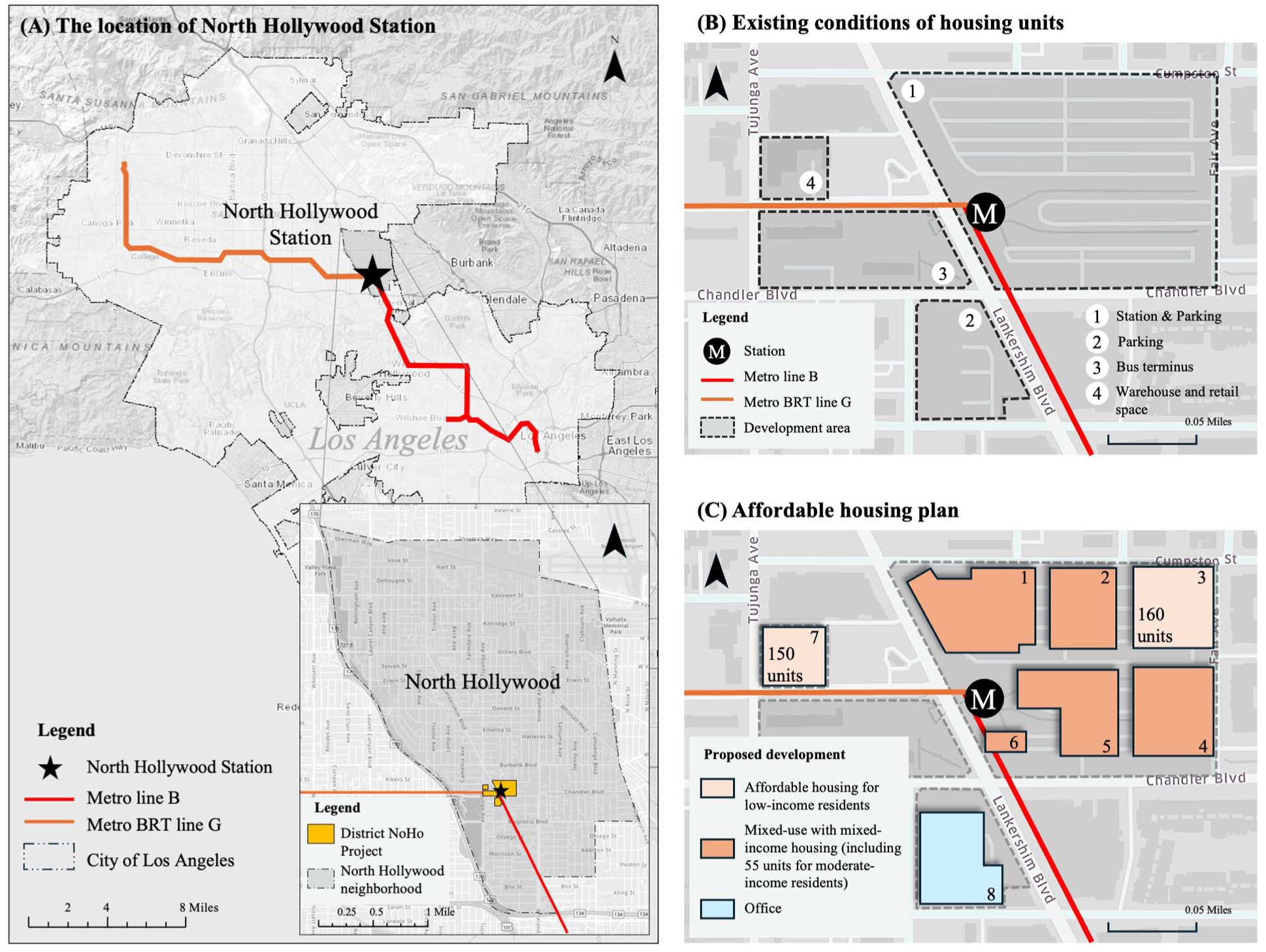
Location of the North Hollywood Station and existing and development plans of DNP. (A) The location of North Hollywood Station. (B) Existing conditions of housing units. (C) Affordable housing plan.
The DNP covers approximately fifteen acres surrounding North Hollywood Station, a major multimodal hub in the northwestern part of Los Angeles for the Metro B (Red) Line and the G (Orange Bus Rapid Transit (BRT) Line serving the San Fernando Valley (Figure 1A). As of 2024, the station ranked third in Metro’s systemwide ridership, with an average of 6,951 daily rail boardings and another 3,303 BRT boardings (Linton 2024).
Despite being close to the arts district, the current site is underdeveloped (Figure 1B). It comprises only 49,111 square feet of industrial and warehouse space and 1,725 square feet of retail and restaurant use. The proposed mixed-use project (Figure 1C) includes 103,400 square feet of retail and restaurants, over 1.5 million square feet of housing space (1,527 units), and another 580,373 square feet of office space (Los Angeles Department of City Planning 2019).
Historically, the surrounding area, the North Hollywood neighborhood (Figure 1A), has been a working-class Hispanic neighborhood. From 2010 to 2019, the North Hollywood neighborhood experienced dramatic demographic and socioeconomic changes, including increasing percentages of whites, Asians, and those with college degrees, rising housing rents, and declining percentages of Hispanics—all of which were used as proxies of gentrification and community changes in this study (Supplemental Appendix A).
Affordable housing was a key evaluation criterion in the RFP. Community benefits, which include affordable housing, comprised 20 percent of RFP evaluation criteria. In the RFP, Metro recommended that 35 percent of developed housing units should be affordable to those earning at or below 60 percent of AMI area (Los Angeles County Metropolitan Transportation Authority 2015a). Based on TOC guidelines, Metro offered incentives, such as land lease discounts, based on affordable housing shares—up to 30 percent if 100 percent of housing units were affordable, and up to 20 percent if 20 percent of housing units were affordable—and residential density and height incentives allowing a maximum of 65 units per acre (Los Angeles County Metropolitan Transportation Authority 2015a). However, the criteria stated in the RFP extended beyond housing affordability. Metro also prioritized a developer’s ability to build a multimodal transportation hub, integrate with the nearby arts district, possess financial feasibility for the project, and provide parking management. These criteria reflected community input that Metro acquired in community workshops (Los Angeles County Metropolitan Transportation Authority 2015a).
However, the affordable housing commitment of this project has evolved over time. In particular, in DNP’s revised plan in 2017, there were 311 affordable housing units for those earning at or below 60 percent of AMI, consisting of around 20 percent of the housing stock in the project (Los Angeles Department of City Planning 2019). In the final approved plan in 2024, TCC contributed to an addition of fifty-five income-restricted housing units for those with incomes below 120 percent of AMI, along with the 311 housing units in the 2017 plan (Los Angeles County Metropolitan Transportation Authority 2023b).
Methods
We adopted a single case study approach to conduct an in-depth examination of the evolution of affordable housing visions and delivery in the DNP. As with extant case studies of affordable housing in TOD projects (Lung-Amam, Pendall, and Knaap 2019; Sandoval 2016), we traced the evolution of affordable housing visions and the changing goals of affordable housing from the inception of this project in 2015 to the final approval of the project plan in 2024. We also explored the role of developers, local governments, planners, and community advocacy groups in this project. Below, we describe the data collection effort and then the data analytic strategies.
Materials for the Case
The primary source of data came from the plans, documents, and reports about the North Hollywood Rail Station and the DNP that Metro and the City of Los Angeles released. Because TOC and joint development policies were the core of the DNP, we also collected policies related to TOC and joint development from 2015—the inception of TOC—to 2024—when the city approved the DNP. In addition, we collected news articles about the DNP that discussed affordable housing. These articles provided further information about the dynamics of affordable housing—such as the social movement initiative to fight for affordable housing—that was unavailable in official Metro reports. Because our focus was on affordable housing, for analysis we selected sentences and paragraphs revolving around “affordable housing” in the documents shown in Supplemental Appendix B. We began selecting content using words such as “housing” and “affordable housing,” and continued to identify other words that we had missed in the initial round—such as “housing unit(s)” and “restricted-income”—to expand our search until no new words were found.
We also interviewed players involved in affordable housing delivery in this project from October to December 2023 to supplement the foregoing secondary data. Based on the aforementioned documents, we identified potential players and then emailed all of them. We ultimately secured nine participants and conducted five interviews. The nine had various roles in the development process: two staff members were from Metro, which was the landowner and joint developer of the DNP plus the leader of TOC; one city planner was from the City of Los Angeles, who was involved in all planning and approval processes of the DNP; five participants were from two different non-profit organizations and were advocates of affordable housing but had different views toward the DNP; and one interviewee was a journalist who reported about the DNP from the RFP to its approval. 2
The first and third authors conducted interviews on Zoom; the interview duration was between thirty-one and sixty-two minutes. Interviews were semi-structured and addressed four questions about different players’ roles in affordable housing development in the DNP, as well as their perceptions about the project. Interviewees initially briefly described their roles in the DNP. Then, they discussed their own visions about the affordable housing in the project, as well as the opportunities and challenges to achieving its vision. Subsequently, interviewees presented their observations about changes in affordable housing in the DNP. Interviews concluded with interviewees offering their reflections on how the DNP informs affordable housing development in future TOC projects. Shown in Supplemental Appendix C is the interview guide used. University of Oregon’s Institutional Review Board reviewed the interview protocol and determined that it was exempt from full review.
Analytical Strategies
We followed Braun and Clarke’s (2006) six-step thematic analysis to analyze text from selected sentences in documents and news, as well as the interview text detailed in the section Materials for the Case. We first familiarized ourselves with the data and then generated initial codes by grouping segments of data relevant to affordable housing development in TOCs and the DNP. Such groups of segments included codes such as “decreasing housing affordability” and “percentages or total number of affordable housing units.” Third, we organized similar codes into broader themes. For instance, we combined codes labeled “an uncertain economic environment” and “rising construction costs” into a theme called “context change.” Fourth, we deleted themes with fewer than five segments. Fifth, we named every theme. Sixth, we selected illustrative interviewee and document quotations to report the results. In this final step, we balanced quotations from documents and interviewees to highlight materials related to the DNP and to supplement perspectives not garnered from the interviews. We used NVivo 15 to organize data from multiple sources and analyze text data. Presented in Supplemental Appendix D is our coding tree.
Results
Analysis of the interviews and documents revealed the following four interrelated factors related to the outcomes of affordable housing approval in DNP: (1) evolving affordable housing visions in Los Angeles and TOCs, as well as the role of the DNP in these visions; (2) limited administrative support and even obstacles for Metro; (3) difficulties of securing funding for developers for development of affordable housing; and (4) different voices from communities and the public. We elucidate these four below.
Unaffordable Housing and Changing Visions for Affordable Housing
Documents in the past decade have revealed that the affordable housing commitment of the DNP has evolved markedly over time. At the initial proposal stage in 2016, TCC and Greenland USA won the bid with a mixed-use project proposal that included offices, retail space, and a mobility hub. They committed to constructing 262 affordable housing units for those earning at or below 60 percent of AMI, as well as an additional 487 market-rate housing units. Thus, 35 percent of housing units were affordable, thereby meeting the RFP requirements (Khouri 2016). However, Greenland USA exited the project owing to the U.S.-China relationship, leading to the revised plan between TCC and Metro in 2017. Metro pushed TCC to increase the number of housing units in this project, resulting in 1,216 market-rate units and 311 affordable housing units (Los Angeles Department of City Planning 2019). Despite the increased number of affordable housing units, the proportion declined to only 20 percent. In response, community groups began advocating for a higher percentage of affordable housing, especially for displaced and unhoused residents (Scauzillo 2022). Those efforts finally persuaded the developer to add fifty-five income-restricted housing units for those with incomes below 120 percent of AMI on top of 311 affordable housing units in the 2017 plan (Los Angeles County Metropolitan Transportation Authority 2023b).
The failure to meet the 35 percent affordable housing target set in 2015 reflected a broader shift in Metro’s goals in affordable housing—from percentage-based targets to maximizing the total number of units. In an updated joint development policy statement, Metro stated that it had eliminated use of the percentage-based target, “as it may distract from the core need of delivering as many affordable housing units as possible, as quickly as possible” (Los Angeles County Metropolitan Transportation Authority 2021). It emphasized that developers and Metro should focus on “projects’ ability to maximize the number of affordable units near transit” rather than attaining a certain percentage (Los Angeles County Metropolitan Transportation Authority 2021). Indeed, when discussing the decline in the percentage of affordable housing in the DNP, one Metro staff member interviewee averred: We have been trying to work towards the total number of units . . . 50% of a hundred is a smaller number than 25% of a thousand.
The foregoing transformation aligned with housing affordability issues affecting people at all income levels in Los Angeles County. As Metro acknowledged in 2021, “The issue of housing undersupply, affordability and homelessness have only worsened in LA County” (Los Angeles County Metropolitan Transportation Authority 2021). Recognizing housing affordability for moderate-income people and even the middle class, Metro introduced greater flexibility in AMI thresholds in affordable housing in TOCs: “The LA region is short on housing at all income levels. Building more homes makes housing more affordable for everyone” (Los Angeles County Metropolitan Transportation Authority 2023a). This change accorded with the introduction of the 10 K strategy, one of the joint development strategies in 2023. The 10 K strategy sought to accelerate housing production in TOD areas and highlighted the importance of increasing the total number of housing units to 10,000 in TOCs by 2031. In recognition of the growing housing burden moderate-income earners faced, the strategy also extended affordable housing eligibility in TOD areas to those under 120 percent of AMI (Los Angeles County Metropolitan Transportation Authority 2023a).
The above reframing of affordable housing goals explains why the final approved plan in 2024 (Los Angeles County Metropolitan Transportation Authority 2024) only added fifty-five units for those earning up to 120 percent of AMI. One Metro staff interviewee noted that 60 percent of AMI for affordable housing is “a little limiting.” The final approved DNP plan showed that Metro approached the project as an opportunity to expand overall housing production in TOD areas, rather than focusing solely on housing for households earning below 60 percent of AMI: The District NoHo Development would be the largest joint development in Metro’s history, including more affordable homes than any other joint development, more total units than any other joint development, and would provide nearly 15% of the homes in Metro’s 10,000 home goal.
Limited Administrative Support for Metro
Another theme was the lack of administrative support and even obstacles for Metro, especially from the Los Angeles City Council. Metro’s 2020 TOC Implementation Plan acknowledged that affordable housing implementation relies on partnerships, as Metro lacks authority over land use, affordable housing policies, and the regional grant-making process (Los Angeles County Metropolitan Transportation Authority 2020).
All interviewees mentioned that all actions that facilitate affordable housing development—such as zoning changes for affordable housing and density bonuses—required approval from the city council. For example, a planner from the City of Los Angeles mentioned the dominant role of the city council in this case: It’s still essentially a political decision because it’s a legislative action. We make those changes to the ordinance. It’s really up to the elected officials.
Both the foregoing city planner and the DNP’s developer noted legislative barriers in this case. For example, Measure JJJ is housing legislation that mandates that developers provide affordable housing in their projects—especially for projects located near transit stations—through governmental easing of zoning changes in the General Plan and providing density bonuses (City of Los Angeles 2016). TOC’s requirement, especially the 35 percent requirement in 2015 (Los Angeles County Metropolitan Transportation Authority 2015b), was not supported by Measure JJJ, though. As a result, as the above planner stated, in the DNP, policies such as Measure JJJ “preclude developers from being able to use any of those density bonus programs on top of the general plan amendment,” and Metro “was kind of boxed in in terms of what they wanted to do by virtue of those rules.”
Difficulties of Securing Funding for Affordable Housing Projects
Interviewees consistently noted that funding was the biggest barrier to achieving DNP’s affordable housing goals. Documents and interviews with Metro staff demonstrated that rising construction costs and interest rates, as well as “increasingly uncertain capital sources to fund the Project,” complicated financing the DNP (Los Angeles County Metropolitan Transportation Authority 2023b, 2024).
Obtaining public funding from state and federal governments posed a further challenge, as doing so required additional effort and cooperation from all parties involved. Interviewees also expressed that, like many other affordable housing projects, the DNP faced a complex and time-consuming funding application process. It entailed collecting information about affordable housing funding, applying for funding, and receiving funding approval—all which are arduous. The lengthy process of securing funding could barely keep pace with the city’s need to expedite the increase in the housing supply. The problems of obtaining federal and state funding, as well as the challenge of securing developers to add to the housing stock, prevented the city from requiring funding sources when approving new construction that involved affordable housing projects. As one interviewee, a planner from the City of Los Angeles, espoused, the city does not require proof of funding when approving projects: We don’t ask for any type of information on funding. We routinely have projects that come in that are very large and have a very large budget. And we don’t ask if it could get built.
One non-profit organization interviewee expressed her skepticism about relying on private investment in affordable housing. As she asserted, “This is a private developer and sometimes private development; they’re not supposed to build affordable housing.” Despite affordable housing units included in developers’ plans, TCC has had to allocate a share of income-restricted and market-rate housing units to ensure profitability, especially in an uncertain real estate market.
Reflecting on the case of the DNP, interviewees suggested pathways for securing funding. Metro staff and a city planner interviewee highlighted the importance of securing further funding from the state and federal levels, which would require more advocacy work from the local level. A non-profit organization interviewee emphasized the potential for incorporating innovative approaches, such as the community land trust, but she acknowledged that the affordable housing players in Southern California have not formed such coalitions yet.
Different Voices from Communities and the Public
Not surprisingly, the unfulfilled vision of the DNP—falling short of its 35 percent affordable housing goal—has disappointed low-income residents living in the nearby area, along with advocates and community partners working for affordable housing in the North Hollywood region. Organizations, including Noho Home Alliance and the Los Angeles city neighborhood councils, argued that in the 2017 revised plan—which documented an allocation of 80 percent housing units of DNP to market-rate housing and only 20 percent to affordable housing—demonstrated a missed opportunity to address affordable housing needs for low-income residents living in the San Fernando Valley (Scauzillo 2022). In one news article, an advocate highlighted that 60 percent of riders on the two lines serving the North Hollywood Station earned less than $25,000, thus creating difficulties for them to live in the 80 percent market-rate housing units (Scauzillo 2022). One North Hollywood resident even described this project as a failure “on every level” (Petrow-Cohen 2023). In our interviews, an interviewee from a non-profit organization averred that moving the project in the current direction was not what the neighborhood had expected: Why should we in a public project have any high-cost luxury homes? I’m not talking about all subsidized homes necessarily, but shouldn’t the working people who live in this neighborhood be able to afford the housing that the government is building?
However, some other affordable housing advocates from another non-profit organization endorsed the achievements of the DNP with respect to its increase in the number of housing units in the area. Because the project focused on the total number of housing units via densifying the site and transforming a parking lot into space for housing, these advocates considered that the project was already a success. As one of them explained, It’s also part of a development that’s going to replace an empty parking lot, which is also located in a transit-oriented community development. It kind of functions as infill development, and so we feel that this project, it’s very aligned with our values.
Unlike those that advocated for the interests of the most socioeconomically disadvantaged groups that the DNP influenced, supporters of affordable housing in the approved DNP plan in 2024 applauded housing development regardless of affordability level. They further believed that adding to the total housing stock was the ultimate key to increasing affordable housing units and thus encouraged any inclusion of an affordable housing feature in the project. One supporter said: “We advocate for all the types of projects that include affordable housing, 10%, 20%, a hundred percent.”
Despite their contrasting values, both supporters and opponents of affordable housing in revised plans in DNP influenced the scale of affordable housing in the approved project. Interviewed supporters articulated that they provided support for Metro and TCC for the current plan through writing letters of support, but that the pressure from opponents pushed the developer to add another fifty-five units for moderate-income households. Although the outcome was not ideal for opponents, it demonstrated how community voices can influence affordable housing planning in projects such as the DNP.
Discussion
This case study examined how and why the DNP failed to achieve its original goal of 35 percent affordable housing units. Results of this study have implications for literature in affordable housing in TOD locales. They also offer several policy implications for future planning practice in California and other places experiencing challenges in providing affordable housing units for different socioeconomic groups in TOD areas.
First, we demonstrated that decreasing housing affordability might further squeeze affordable housing planning for those with extremely low incomes. Interviews and affordable housing goals of Metro from 2015 to 2023 revealed that housing affordability is an issue not only for low-income households but also for moderate- and even middle-income households. Thus, augmenting the overall housing stock to deliver more affordable housing units (detailed in the 10K plan) has become a crucial option for Metro. Our findings align with a survey on housing development in other TOD projects in Southern California that prioritize housing supply rather than affordable housing (Garde et al. 2024). We also advanced current TOD and housing literature (Guthrie and Fan 2016; Lung-Amam, Pendall, and Knaap 2019; Noland et al. 2017; Sandoval 2016) by highlighting how the increasing lack of housing affordability influences transit agencies’ expectations about housing production in TOD areas.
Second, we found that increasing the housing supply does not equate to augmenting the housing stock for low-income people. Despite the vision of delivering 366 income-restricted units with density and height bonuses that the city council had approved, the DNP still fell short of the percentage goal in its original affordable housing plan. Based on the literature (Garde et al. 2024; Kaniewska et al. 2024; Quigley 2010) and findings from the current study, relaxing zoning requirements in TOD areas might facilitate raising the housing supply without receiving any support from federal and state affordable housing grants. However, as Cahill and Whitney (2024) have argued, such housing supply approaches that focus on elevating the total housing supply might further reduce the number of newly developed housing units available to those with low and extremely low incomes. Although Metro initially mandated a percentage requirement for TOCs, our analysis of the DNP suggested that such requirements did not have legal power and were subject to change if additional sources of funding for affordable housing were unavailable.
From the policy perspective, state and local housing policies should consider affordable housing requirements in future legislative efforts. For example, Washington State has mandated that all transit agencies in the state transfer their TOD land parcels to developers who can support affordable housing (Transit-Oriented Development Strategy System Plan 2015). Such efforts are a prerequisite for local governments to achieve higher goals of affordable housing vis-a-vis the number of units for individuals with low incomes.
Third, this study demonstrated that one critical obstacle to delivering more affordable housing units is the difficulty of securing funding from different government levels, as well as the lengthy procedures required to gain funding approval. These findings align with barriers identified in previous studies (Garde et al. 2024; Guthrie and Fan 2016; Padeiro, Louro, and da Costa 2019). Therefore, players in TOCs should undertake action to move beyond extant requirements regarding affordable housing and expand their capacity through funding approval. For example, the Bay Area Housing Finance Authority has become a leader in affordable housing allocation and finance (Digital Democracy Calmatters 2023). Such endeavors require the leadership of cities to advance affordable housing in a collaborative way. They also necessitate developing innovative ways to secure diverse funding sources for affordable housing. As some of our interviewees suggested, land trusts and other approaches involving private sources might foster development of future projects of affordable housing.
Finally, we demonstrated the conflicting voices of the DNP vis-à-vis its affordable housing element, which has implications for including community voices in affordable housing development in TOD areas. Previous investigations have found that community organizations leverage community capital to advocate for affordable housing for disadvantaged groups (Lung-Amam, Pendall, and Knaap 2019; Sandoval 2016). In our undertaking, though, housing advocates held different visions concerning the future of the community. To some extent, these conflicting voices have pushed the project in different directions. Further collaboration and coordination of community partners to form stronger coalitions for advocating for the needs of a neighborhood’s residents might facilitate future TOC affordable housing planning.
Conclusion
Using the DNP as a case study, we revealed the challenges confronting a newly approved transit-oriented, mixed-use housing development to achieve its original goals for affordable housing development. Using thematic analysis of interviews and documents, we found that the evolving affordable housing goals of Metro from 2015 to 2023, limited administrative support, legislative challenges for developing mixed-use projects and affordable housing, difficulties of applying and securing funding, and conflicting expectations from community organizations contributed to the lower percentage of approved affordable housing units compared to the DNP’s original plan.
Our study had three limitations that are suggestive of future research. First, we did not interview residents who had left the area or that the DNP had influenced, nor did we include some key players—such as city council members and developers—though documents and our interviews suggested their key role in the DNP. Subsequent research can provide a more complete picture of the power dynamics of affordable housing approval in the DNP, should such data be available. Second, we focused solely on a one-decade history of affordable housing planning and approval for an unbuilt project, thus failing to consider the construction and delivery of the DNP. Future scholars can, therefore, pursue a richer analysis of affordable housing development in the life cycle of the DNP. Third, we used a single case study, thus constricting the picture of TOC development in Los Angeles. Consequently, comparative work can further explore how policies in Los Angeles influence various TOC projects differently and why, as well as how, policies in various cities affect their affordable housing projects near transit stations.
Supplemental Material
sj-docx-1-jpe-10.1177_0739456X261416036 – Supplemental material for From Vision to Unbuilt Reality: Affordable Housing in Transit-Oriented Development in the District Noho Project, California
Supplemental material, sj-docx-1-jpe-10.1177_0739456X261416036 for From Vision to Unbuilt Reality: Affordable Housing in Transit-Oriented Development in the District Noho Project, California by Shengxiao (Alex) Li, Yufei Wang and Anthony Roman in Journal of Planning Education and Research
Footnotes
Acknowledgements
The authors would thank four anonymous reviewers, whose constructive comments significantly improved this paper.
Declaration of Conflicting Interests
The authors declared no potential conflicts of interest with respect to the research, authorship, and/or publication of this article.
Funding
The authors disclosed receipt of the following financial support for the research, authorship, and/or publication of this article: This study received support from a start-up grant from the National University of Singapore. Many thanks go to Barbara Mortz, Elaine Loring, Desmond Faison, Wells Lawson, Marie Sullivan, Jaime Del Rio, Cynthia Clemons, Jason McCrea, and Steven Sharp for their research support. This paper is developed based on a teaching case awarded by the Lincoln Institute of Land Policy. We thank the comments from Ge Vue and Bill Ellet on the teaching case. Authors acknowledged that they have used ChatGPT and hired a professional editor for language and proofreading.

Supplemental Material
Supplemental material for this article is available online.
Notes
Author Biographies
References
Supplementary Material
Please find the following supplemental material available below.
For Open Access articles published under a Creative Commons License, all supplemental material carries the same license as the article it is associated with.
For non-Open Access articles published, all supplemental material carries a non-exclusive license, and permission requests for re-use of supplemental material or any part of supplemental material shall be sent directly to the copyright owner as specified in the copyright notice associated with the article.
