



Abstract
This paper reports the first large-scale survey of planning students that focuses on their motivations for studying planning and their hopes for future practice. It reveals planning students as highly intrinsically motivated with clear desires to achieve change especially in the environmental domain. This appears to represent a shift as compared to earlier work on planners’ motivations, in which public service and issues of social justice predominate. These findings are significant for planning pedagogy in terms of nurturing motivation through curriculum design, and for practice in relation to the implications of this diminished emphasis on public service for planning outcomes.
Introduction
Advocates for the profession depict planning as offering a stimulating career with the potential to respond proactively to climate change, and to deliver the infrastructure that society needs, creating “lasting material legacies to everyday lives of people” (Jon 2021, 321). Yet at the same time, planning’s core purpose is under-attack for its regulatory restrictions on development, “re-fashioned” to focus on growth rather than place making and social justice (Raco and Savini 2019, 4). One Member of Parliament in the United Kingdom (UK) described planning as “THE major obstacle to growth in the UK” (Clarke 2023). A lack of trust in both planning and planners is frequently reported (Parker and Street 2019) and negative caricatures of planners themselves as rule focused bureaucrats also abound (Donnelly 2020). Such mistrust and criticism, together with the reported lack of progression opportunities and low pay as compared to allied built-environment professions (The Planner 2023), all act as potential detractors to a career in planning or could lead to disappointment and frustration in planning practice.
Against that backdrop, a natural question arising is, “why does anyone want to become a planner?” Yet in the UK and the Republic of Ireland (ROI) alone, the aggregate number of students commencing professionally accredited planning courses has been consistent over the last five years, with a significant uptake in degree apprenticeship programs (Royal Town Planning Institute (RTPI), 2023). In Australia, there was a significant increase in the number of both undergraduate and postgraduate students studying planning between the years 2015 to 2020 (Planning Institute Australia 2023, 105). There is also evidence of a growing interest in planning education internationally, with universities in the global south decolonizing urban planning curricula to align with local contexts and challenges (see Carolini 2020; Maged, Robert, and Abdel-Moneim 2024; Mukhopadhyay et al. 2021; Wesely and Allen 2019). This suggests that planning continues to offer an attractive course of study despite the above challenges.
There is extensive scholarship on planning education and pedagogy, covering the nature of professional education and its evolution (e.g., Anacker 2023; Watson and Nancy 2012), how students learn (Freestone, Susan, and Peter 2006; Terzano and Morckel 2017), planning syllabi, and predictors of attainment and outcomes (see for example Alterman 1992; Moore 2024; Pezzoli and Howe 2001). However, the voices and experiences of planning students themselves rarely feature in this body of work. Direct reference to students is either a subsidiary discussion about professional awareness challenges and the pipeline of future planners (see Palazzo, Leah, and Kofi 2021), forms part of work focused on the profile and distribution of planning students (see Osiyi and Jiburum 2023; Todes and Harrison 2004) or is about preparing students for future practice (see Dalton and William 1993). Even Baum’s engaging piece “What do students think about planning,” draws on their own experience as an educator rather than any systematic study of students themselves (Baum 1997). The exception to this is an important body of work in North America on how students perceive and experience teaching related to racial/ethnic diversity and the overall treatment of diversity in their planning education (see García et al. 2021; Greenlee et al. 2022; Jackson et al. 2018). However, students’ initial motivations for studying planning and their hopes for future practice are almost entirely absent from literature.
There is inherent interest in seeking to fill this “empty vessel of empirical work on young planners” experiences’ (Taşan-Kok and Oranje [2017] 2018, 17), and as educators we should be committed to understanding our students, but knowledge about planning students has wider value. Some recent accounts report an increasing mismatch between an “ideal of planning” (Sanchez 2020) and the realities of day-to-day practices (Taşan-Kok and Oranje [2017] 2018), reflecting the negative discourse cited above. Disillusion in young practitioners is being reported, inducing them to abandon the ethos of planning initially taught and even to reject planning as a career early on (Taşan-Kok and Oranje [2017] 2018). These reports expose vulnerabilities within the profession (Hickman, McClymont, and Sheppard 2019), concerns that demand attention in many parts of the globe with the growing internationalization of the profession and the important role of planners’ in tackling global challenges (see Perić, Alraouf, and Cilliers 2022). However, our claim is that to make sense of disillusionment in early practice requires a thorough understanding of initial motivations to pursue a career as a planner in the first place.
This paper fills this “empty vessel,” by reporting the first large-scale (n = 500) study of the motivations and expectations of planning students conducted on commencement of their student journey as part of their induction program. Conducted with students on accredited courses at all UK-ROI planning schools, the aims of the study were to explore: (1) students’ motivations for studying planning; (2) their ideas about planning values; and (3) their belief in planning’s ability to affect positive change. It specifically sought participants who were about to commence their planning education rather than those already engaged in study to try to isolate initial motivation without the influence of education or professional codes. The study presented here therefore offers a significant and novel contribution to our understanding of planning students.
The paper is structured in three parts: first, it explores relevant literature about motivation; second, it explains why the UK and ROI is a pertinent focus for research on motivation and outlines the study methodology, before then presenting the findings; finally, it draws out the significance of the findings for both planning educators and practitioners, in particular the primacy of environmental motivations among students and the relative subordinancy of public interest, public service motivations (PSM).
Understanding Motivation
Here, the paper sets out a review of key ideas around motivation and work and then motivation in planning. It then situates motivation in the context of planning education as a foundation for the empirical work with students that follows.
Work-Based Motivation
There is a substantial, cross-disciplinary literature, focused on exploring and understanding work based / career motivations and job satisfaction. Within this, the complexity of motivation is evident, particularly the balance between intrinsic and extrinsic motivations reflected in Ryan and Deci’s (2020) self-determination theory (SDT). This posits that satisfying the three psychological needs of autonomy, competence and relatedness, leads to improved intrinsic motivation, with intrinsic motivation seen as having much greater sway over employee motivation, performance and job satisfaction (Sachau 2007). Intrinsic motivations are seen as internal factors derived from autonomous enjoyment or interest in the activity itself, linked in an employment/work-based context to purpose and alignment with personal values, and extrinsic factors being external factors in terms of the outcome of the work undertaken such as pay and bonuses. Much of the recent work in this area has focused on exposing the balance between intrinsic and extrinsic factors in professionals’ decisions to stay or leave certain professions (Omar et al. 2018) and in burn-out (Kim 2018). Overall, the former is more important in explaining dissatisfaction: if basic (financial) factors are met, motivation generally derives from intrinsic factors and alignment with personal values and goals rather than financial gain, autonomy clearly being necessary to achieving this.
Work by Buelens and van den Broeck (2007) and Wright (2001), develops this further by exploring the differences in work-based motivation between public and private-sector organizations. Both studies reveal public-sector employees to be less extrinsically motivated, drawing on the work of Perry and Wise on PSM in their explanation of differences. Perry and Wise (1990, 368) define PSM “as an individual’s predisposition to respond to motives grounded primarily or uniquely in public institutions,” making public service psychology unique. This is seen as comprising four dimensions: “attraction to public policy making, commitment to the public interest, compassion, and self-sacrifice” (Perry and Wise 1990, 20). These ideas are relevant because, although there have been shifts in relation to the distribution of planners across the public and private sector over the last twenty years (Clifford et al. 2024), planning in most contexts is still largely understood as a state led activity (Inch, Matthew, and Malcolm 2023) and the image of planners as “publicly employed expert bureaucrats” (Davies 1972, 3) lingers. Furthermore, the public interest is the “pivot around which debates about the nature of planning and its purposes turn” (Campbell and Marshall 1998, 181) and remains encapsulated in professional codes (see Canadian Institute of Planners 2016; RTPI 2020).
Motivation and Planning
There is only limited coverage on the motivations of professional planners within existing literature. Within this, three factors are reported. The first is a long-standing set of generic ideas about making a difference or achieving some level of social improvement (Knox and Masilola 1990). The second is rather loosely defined as “environmentally inspired motivations” (Murtagh, Odeleye, and Maidment 2019). The third, and most predominant factor, is focused on the public interest, with PSM seen as the determining factor in encouraging planners into the profession (Fox-Rogers and Murphy 2016). These factors indicate some of the intrinsic motivations for planners but, importantly, are cited as part of work on job role perception, rather than empirical work on motivation.
Significantly, there is conflation in the literature of working in the public sector and assumed PSM. Here, it is important to acknowledge the growing body of work on the increasing proportion of planners employed in private practice (See Inch, Matthew, and Malcolm 2023; Linovski 2019) as well as the trend toward hybridization (Steele 2009). This shift raises important questions about the motivations of private-sector planners. Relevant here is the work of Sturzaker and Hickman (2024b) in which they explore the value of PSM as an analytical tool in understanding planners’ motivations in private practice, suggesting—contrary to many of the prior characterizations of these planners as being motivated largely by profit, and acting as “agents of private capital” (Dear 1989, cited in Linovski 2019, 1674)—that many private-sector planners perceive themselves just as motivated by the public interest as their public-sector counterparts and even having more agency to affect positive change. Critically, however, it is also worth positing the idea that planners in all sectors could be intrinsically motivated without an assumed public service ethos, valuing elements of a planning job (around design, or housing market enabling, or environmental assessment, for example) in and of themselves irrespective of their association with “serving the public interest” or public institutions.
Situating Motivation in the Context of Planning Education
There is considerable scholarship in the field of education applying Ryan and Deci’s (2020) SDT to support students’ experiences (see, for example, Pohan 2024). This work explores engendering self-determined motivation: doing something for its inherent interest, as well as engaging in a task because it aligns with one’s values or goals. This is seen as important in education because the more students’ motivations are autonomous, “the better their academic performance, the longer they persist, the better they learn, the greater their satisfaction” (Guay 2022). As the most positive predictor of self-determined motivation (Bureau et al. 2022), this scholarship is weighted toward how education best supports “competence.” Nevertheless, several within discipline studies explore how all three of SDT’s psychological needs can be fostered in their pedagogy. Notable here is the emphasis on enabling students to explore their own areas of interest within a discipline to support autonomy.
Significantly, this aligns with wider work in psychology on the notion of interest: the person assigns a personal value to the object of interest (i.e. Whatever they think “planning” might be) and feels positive emotions triggered by the sum of the object-related actions (learning about planning) when dealing with the object. (Wild 2023, 2)
This suggests that if a student becomes curious about the object of interest, they develop self-motivation to explore it more deeply, going beyond the situational interest of information being presented in class. As Quinlan and Renninger (2022, 865) state “To ensure graduate satisfaction with their careers, HE educators need to understand how students think about the connection between degree subjects, their interests and their careers.”
Given this backdrop, the lack of explicit reference to, or study of SDT or to ideas around motivation within planning pedagogy is surprising. Perhaps even more surprising, however, is the paucity of empirical work that focuses directly on students themselves and their interests and motivations, both in general and in relation to specific disciplines. This paucity is true not only of built-environment professions but more broadly, with little or no published work on student motivation and the professions of law, teaching, or medicine. 1 Motivations seem to be assumed rather than evidenced.
However, understanding further the psychology of student motivation is clearly of value for both planning pedagogy, in relation to student experience and attainment, and planning practice, in relation to career aspiration and retention. In so doing, attention needs to be given to the utility of existing conceptual frameworks for motivation in the context of planning education. Turning to self-determined motivation, if this is key to educational outcomes, then understanding how autonomy, competence and relatedness are fostered in planning education is important, but they need to be understood in the context of the “undisciplined discipline of planning” (Pinson 2004) that bridges the social, environmental and economic domains.
To foster autonomous motivation, educators need to understand what the “object of interest”—planning—means for students as a foundation for inspiring that curiosity. This is of particular importance in thinking about a multi-disciplinary subject such as planning where “objects” may be multiple, harder to define or not as readily apparent as in some subjects. Relevant here is work from Australia that reports students as struggling to define planning, holding “very idealistic notions of planning” (Dredge and Coiacetto 2006, 33), rather than having a clearly defined “object of interest.” This may reflect the fact that students rarely come to planning courses having studied planning as a subject previously, differentiating it from cognate areas such as geography or politics. This, in combination with planning’s multi-disciplinary nature, may pose challenges for maintaining and fostering a student’s interest, particularly with defined—and potentially constraining—curriculum requirements from professional bodies. The lack of existing research in this area may mean educators are relying on dated or preconceived notions of what may underlie the motivations of students.
Specifically, framing this debate in light of SDT’s insights also raises important questions about the assumed PSM for planners, particularly about whether PSM aligns with student’s own ideas about planning, its goals, and importantly their own values. If PSM is not foremost in their own ideas, and yet education continues to inculcate this value, this could impact levels of autonomous motivation. We posit that this may be particularly relevant to students more interested in future private-sector employment. Similarly, if students lose sight of their object of interest in planning through education, their onward route into professional practice may shift or be framed by more extrinsic factors of pay, prestige or job security, or lay the foundations for future career disappointment if interests and values become misaligned.
Both SDT and PSM are important conceptual frameworks for understanding motivation and of significant value to planning scholarship. Yet neither appear to align neatly as a framework for understanding planning students, because of the increasing range of public- and private-sector roles and planning’s broad scope. We return to the need for a new or renewed framing of motivation in planning following our empirical work to which we now turn.
Research Context
The empirical data presented in this paper is drawn from students studying on accredited planning courses in a university from across the four nations of the UK (England, Northern-Ireland, Scotland, and Wales), and the ROI.
These students offer a particularly interesting case for two reasons. Firstly, the UK and ROI, alongside North America and Australia, are recognized for the professionalized nature of planning. The RTPI, the professional body for planning in the UK and ROI, provides a rigorous process for the accreditation of planning degrees and for the approval of chartered status for a planner following their demonstration of experience and competence via an Assessment of Professional Competence to ensure the high standards required for chartered membership (see RTPI 2024). Studying on an accredited planning degree in the UK and ROI thus has a clear professional practice pathway. The professional status of planning in the UK is also globally recognized, resulting in many international students choosing this as a destination to study. Elsewhere, the extent to which planning is recognized as a distinct profession with associated planning education varies widely, with many nations in both the global North and South without accrediting bodies or clear pathways to practice (see Alterman 2017; Mieg and Oevermann 2021).
Secondly, while the UK and ROI are by no means unique, recent writing on planning practice implies these nations as being at the apex of neo-liberalized planning practice, severely impacted by austerity (see Onyango et al. 2023). In combination, these two factors have the potential to heighten the possibility for disappointment among these planners when reaching practice—they may find their intentions and actions both politically and financially constrained—and thus, understanding their initial motivations as students is an important foundation for both furthering understanding of the causes of disappointment and, critically, routes to addressing it.
Research Design and Nature of Respondents
Over the three-year period 2019–2021, a survey was shared with new undergraduate and postgraduate planning students on commencement of their planning course, as part of a student induction program or in the first few weeks. It asked questions about why they had chosen to study planning, their ideas about planning values, and their expectations and hopes for future practice. The survey was intentionally not about teaching methods, curriculum content or how students learn. The timing of the survey distribution shortly after enrolment was critical. We wanted students to share their ideas relatively unfettered by the knowledge and experience they would rapidly accrue in education. The survey was hosted online, using the data platform Qualtrics and distributed via the UK-and ROI Heads of Planning Schools forum with the potential to reach students on planning programs across twenty-seven universities. In total, 527 students participated from across twenty planning schools, with all the four nations of the UK and ROI represented. 2 This represents the largest known study of the motivations of planning students, with previous cited work on students, both in planning and broader disciplines, involving much smaller cohorts (see Marchlinska et al. 2023 with N = 53 undergraduate UK students). Critically, as 40 percent of survey participants were from “overseas,” both from inside (14%) and outside the European Union (EU), (26%), this gives the data international significance. 3
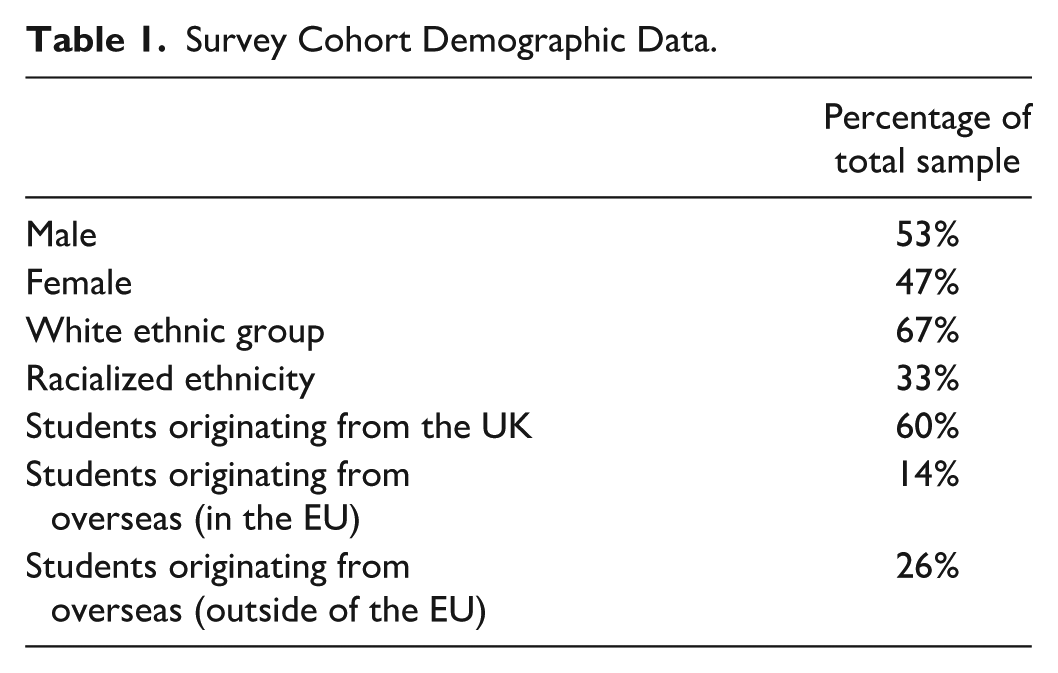
It was important to understand the nature of students represented in the data and consider whether location of origin, or personal characteristics of gender, race, as well as key inter-sectional identities, might shape expectations and ideas. For example, would some characteristics result in a particular desire to address issues such as access to housing or environmental justice? This profile of students is broadly typical of the reported profile of all students studying architecture, building, and planning in the UK (the unit of subject analysis used by the Higher Education Statistics Agency in the UK) including in relation to numbers of overseas students over the period covered by the survey (see Higher Education Statistics Authority [HESA] 2023). Demographic data on types of students aggregated across the three years is shown in Table 1.
Survey Cohort Demographic Data.
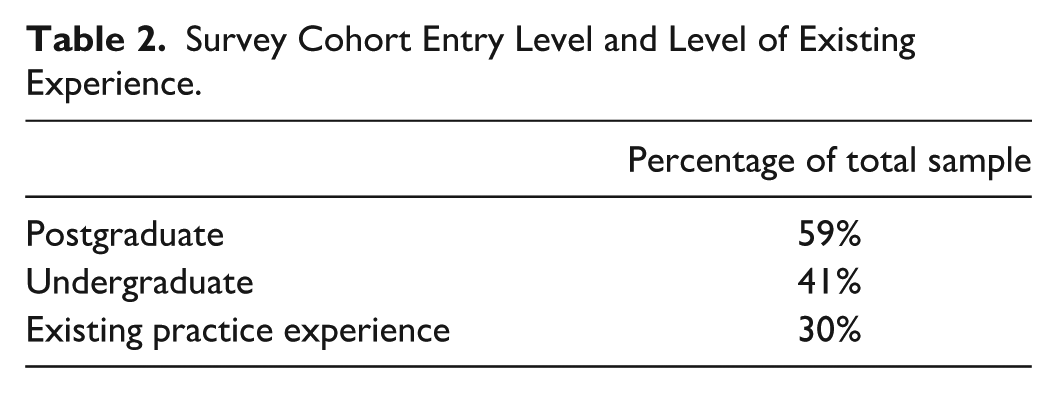
In addition, we hypothesized that postgraduate or undergraduate status or existing planning practice experience might also influence student’s early ideas, with postgraduate students more likely to have been exposed to planning ideas, especially those having undertaken a prior cognate degree. The proportion of these students is shown in Table 2.
Survey Cohort Entry Level and Level of Existing Experience.
The survey contained twenty questions and was a mix of both open and closed questions with initial piloting with two UK planning schools indicating an average completion time of fifteen minutes. 4 As an intentionally qualitative survey tool, the aim of the open questions was to gain insights into the way students express their own values and motivations rather than relying only on preset categories, to draw “inferences . . . not generating a sample that achieves statistical representatives and allows simple claims of generalisability” (Braun et al. 2021, 643). Sixty-two percent of students completed the survey in full, with partial completions normally involving open questions being unanswered.
Closed questions were examined first by each year cohort, then for the whole dataset, and are presented in Figures 1–4. The overall patterns were alike in each year demonstrating strong consistency across the cohort of respondents. We sought to assess the data for patterns in relation to types of students, analyzing each closed question according to the student demographic as noted in Tables 1 and 2. The open-ended questions were inductively coded by the authors in the first year using the qualitative analysis software NVivo, for its features that enable consistent thematic analysis of open-ended data, with the data from subsequent years analyzed by a mix of deductive and inductive codes. Responses were assessed to see if they fitted the codes developed in the first year. The authors were aware of the potential for additional codes should new themes arise, but this proved not to be the case. For example, we hypothesized that “planning for health” might emerge as a motivation for studying planning in the second and third years of the study, due to the impact of the COVID-19 pandemic, but it did not.
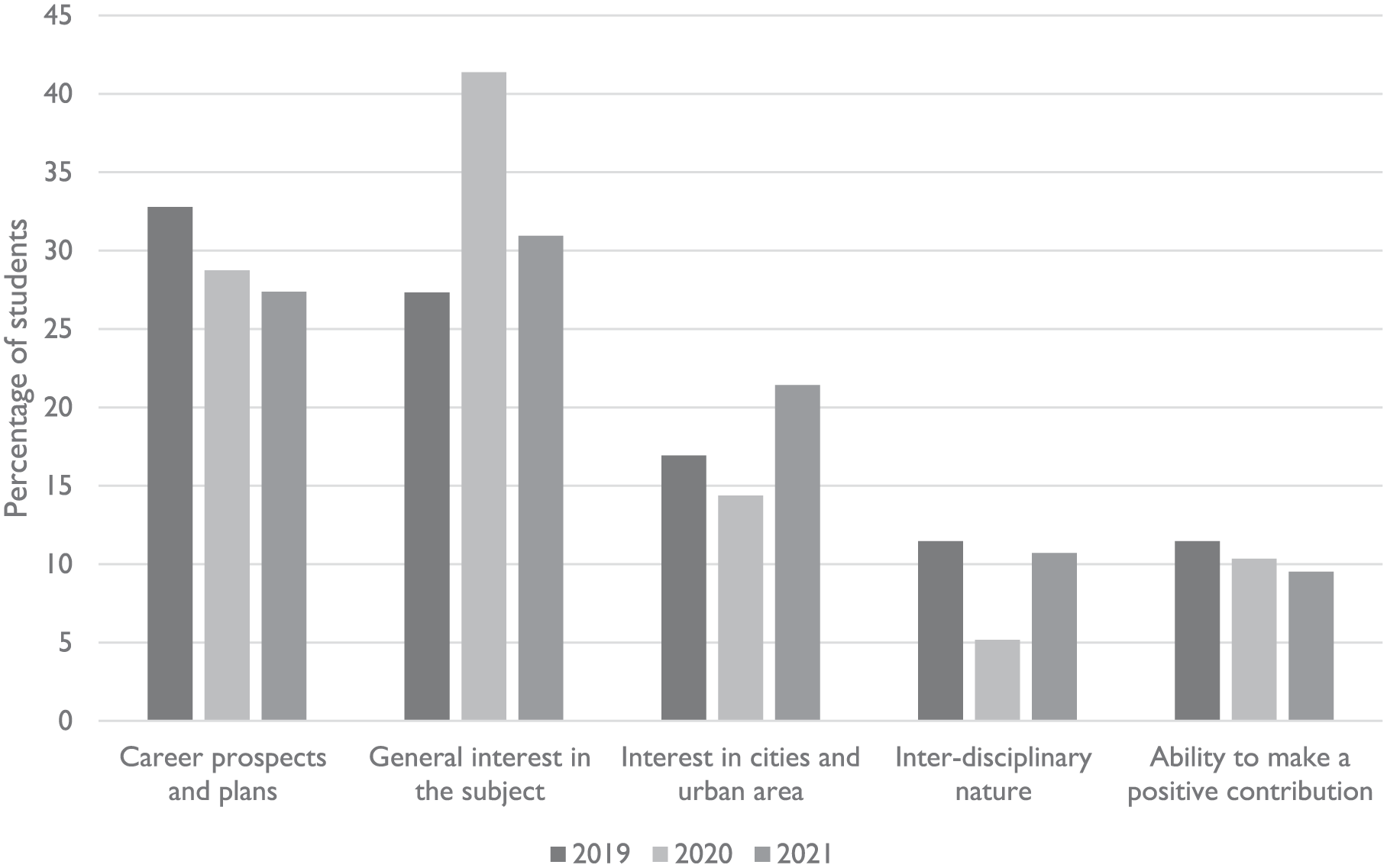
Overarching reasons for studying planning.
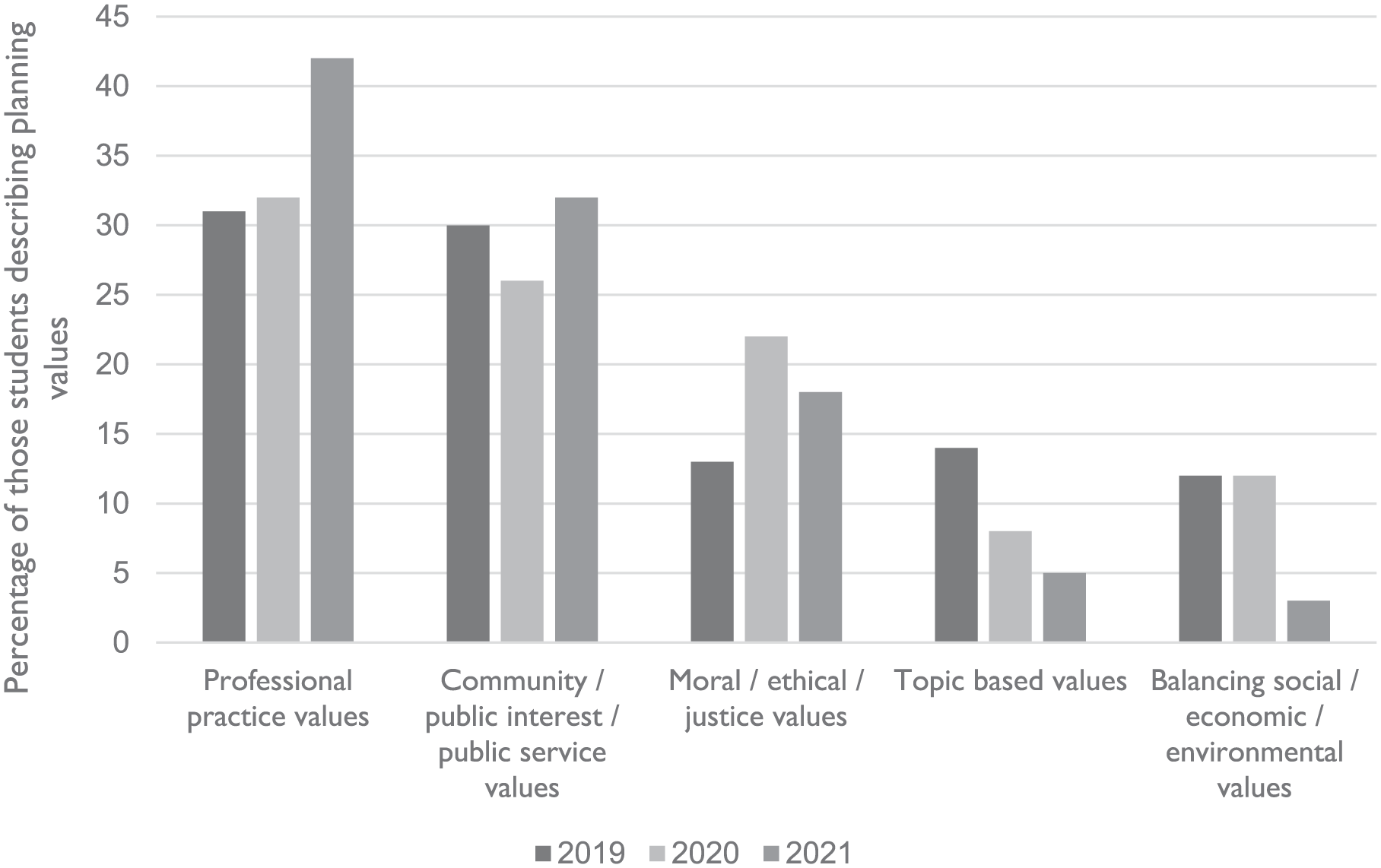
Ideas about planning values.
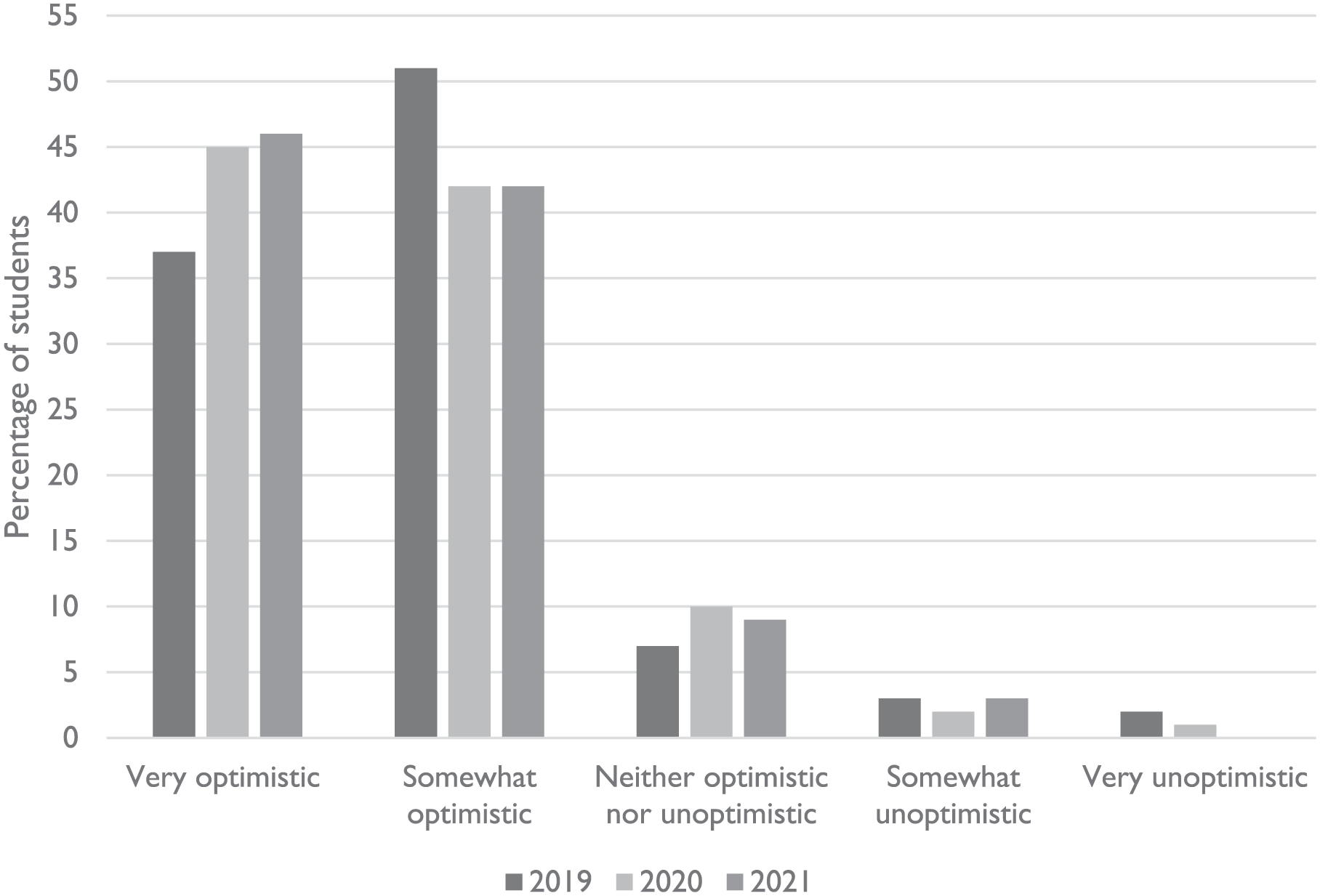
Levels of optimism in planning.
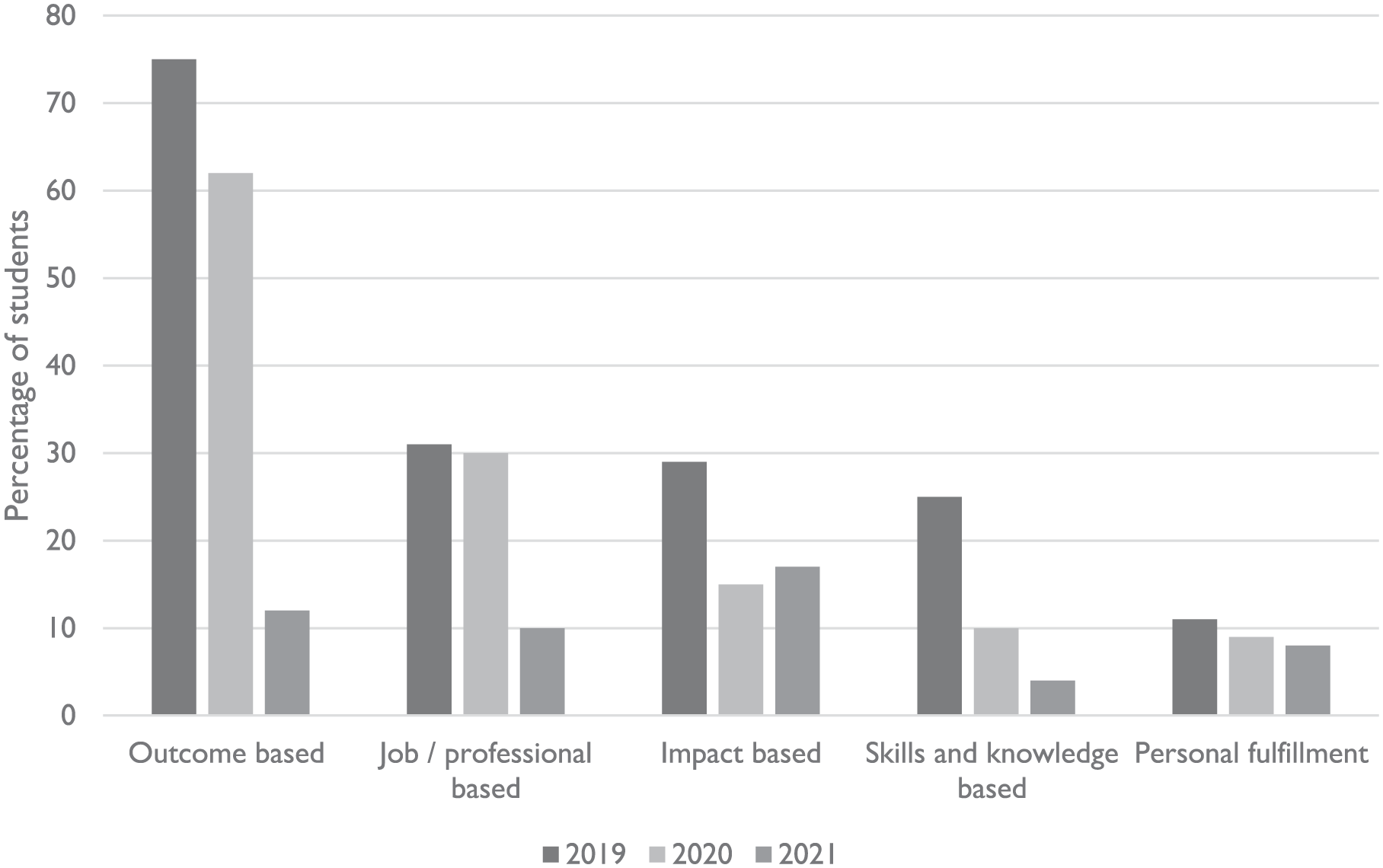
Hopes for future practice.
Importantly, once material had been coded, this was cross tabulated with data on student type to assess for patterns once again. It was surprising to find very few patterns in relation to personal characteristics, level of study (although postgraduates were more expansive in their open-ended responses), or practice experience, although we note minor variations where they occur. We also looked to identify any differences in motivations between students originating from the UK and the 40 percent of students from overseas studying in the UK. Again, we were surprised to find no marked differences. We return in our conclusion to the need for future work on student motivation which includes more in-depth exploration of the influence of personal characteristics, including on socio-economic background 5 and call for engagement with planning scholars across the globe to further understanding of how motivations differ across geographies.
Following Braun et al. (2021, 650), we do not summarize responses after each question, “as this typically results in an impoverished and underdeveloped qualitative analysis” and instead present analytic patterns across the entire dataset, using the headings: why students choose to study planning, planning values, desires for change, levels of optimism and hopes for practice, combining the quantitative data picture with the depth insights from the qualitative analysis.
Research Findings
Why Students Choose to Study Planning?
The survey began with the open-ended question, “why did you decide to study planning?” Figure 1 shows the five broad themes that emerged consistently following coding, allowing for multiple responses to be recorded if a student identified several factors. “Career prospects and plans” (meaning that studying planning has a clear route to employment with opportunities for progression) and “general interest in the subject” were consistently the top ranked factors.
Beyond the headlines in Figure 1, observations on career prospects varied from the brief, “I’m interested in planning jobs” (Undergraduate, UK), to the more extensive, “I would like to further my career in a discipline I find very interesting . . . I would like to get a deeper understanding of the subject with the view to becoming a Planning Officer” (Postgraduate, UK). Notable was the number of respondents who referred to the requirements of either current or future employers as their study motivation, such as “I require a masters for job progression in my organisation” (Postgraduate, UK), or “I need an RTPI accredited degree in order to progress” (Undergraduate, UK). There was, therefore, a strong sense of the need for an accredited degree to achieve necessary professional qualification/standing, whether at undergraduate or postgraduate, to enable career progression: “I wanted to go into planning professionally. For this I would be at a disadvantage by not having studied it at postgraduate or undergraduate level and being without an accredited degree” (Postgraduate, UK).
Students indicating their “general interest” tended to provide brief statements such as: “planning is interesting and affecting our daily lives” (Postgraduate, Overseas—Non-EU), and “because it seemed like an interesting and versatile course to study” (Undergraduate, Overseas—EU). In contrast, students stating their decision to study planning being about the “ability to make a positive contribution,” tended to provide the most emphatic (and often expansive) responses: “I felt that planning was the subject that would allow me to have the greatest positive impact on the livelihood of people,” (Postgraduate—Overseas—Non-EU) and “I would like to increase provision and improve quality of affordable housing, improve access to green spaces within cities, help change the places we live with a bottom up approach to involve local communities.” (Undergraduate, UK). Students from overseas (outside of the EU) more frequently expressed a desire to study planning to improve the quality of life in their home country focused on addressing inequality, whereas UK and ROI undergraduate students were more likely to mention career prospects and plans as their study motivation. We note the slight increase in the third year of the study to interest in cities and urban areas as a reason for studying planning and suggest that this may reflect increased attention to the urban environment following experience of the city during the COVID-19 pandemic, but this would need further investigation to verify and the numbers are not large enough to highlight as a significant trend.
Planning Values
Students were asked if they saw planners as ascribing to particular values, and if so, what they were. Answers to this open question were extremely varied. Twenty-five percent of answers were tentative and uncertain, with students suggesting variously they were “unsure” and “that they would wait and see as their studies progressed.” Nine percent of students simply stated “no,” they did not associate planners with signing up to a particular set of values, concluding that values would be highly individual or even that “it is impossible for all planners to sign up to the same set of values” (Postgraduate, UK). Sixteen percent of students saw values as highly dependent on role and position—“Yes and no, I think it really depends on what role you have within planning as to what values you have” (Postgraduate, Overseas—EU). Some students suggested that the values of public- and private-sector planners might differ: “I think it depends where the planner’s funding is coming from (public or private sectors) . . . economic concerns will be more pressing in the private sector” (Undergraduate, Overseas—EU).
However, almost 50 percent were affirmative, and these responses are recorded in Figure 2.
Professional practice values were marginally most expressed (36% of students). Here planning values were less (if at all) about planning outcomes, but more about the values associated with professional employment described by respondents as: expertise, impartiality, integrity, competence, diligence, and conscientiousness. Here, some references were made to professional codes of conduct. It is important to note the small number of students (2% of the cohort) using words such as “empathy” and stating that “Planners should practice compassion” (Postgraduate, Overseas—Non-EU), suggesting character traits associated with planning that go beyond codified notions of professionalism, but echo some recent debates in the literature (see Forester 2021; Lyles, White, and Lavelle 2018).
Community/public interest/public service values were expressed in three ways: the first as a statement such as “to be public spirited” (Postgraduate, UK), “to act in the best interests of the citizens” (Undergraduate, UK), or “people oriented” (Undergraduate, UK); the second was to focus on public service delivery, “to deliver a service that will directly impact the community” (Postgraduate, UK), and the third was to focus more overtly on the idea of people before profit, “aiming to work toward the common good, rather than following certain vested interests” (Postgraduate, Overseas—EU). Striking was the simple observation, “Planners are society’s humanisers” (Postgraduate, Overseas—Non-EU) encapsulating an aspiration for planning which encompasses personal relations and values.
The third thematic group related to moral, ethical, and justice-based values. Notably, these values became marginally more evident in student responses during the second and third years of the study. As already detailed, there might be an assumed overlap here with the characteristics of planners expressed in relation to professional practice values, but here we noted a distinctively separate theme variously expressed as “ethical based decision making,” and the idea that planners are “morally strong” (Postgraduate, UK), have “a moral compass” (Undergraduate, UK), and need to “pay attention to the disadvantaged groups in the allocation of public resources” (Postgraduate, Overseas—Non-EU).
Finally, some students used this question around values to reference topics (9%)—such as the need for more affordable housing or increasing green space—or suggested that planning’s value was in the ability to balance different objectives (also 9%).
Desires for Change
Students were asked the open-ended question, “what sort of change, would you like to see?” and given the prompts, “e.g. environmental, societal, economic.” Of those students that simply selected one, two, or three of the prompt words in the question (a quarter of all responses), “environmental change” was the stand-out choice (52%), with “environmental and societal” (30%) following, with “economic” rarely featuring, and only in combination with other factors. This pattern was consistent across the 3 years of the study.
Those students providing a more detailed response, or choosing different words to describe the change they would like to see, still had an overwhelming focus on environmental change, ranging from climate change to local environmental quality, with the latter having a distinct urban focus, as reflected in this comment: I would firstly like to see an environmental change in the city. I think a greener and slower city is healthier and has a huge positive impact on human well-being. Then it would help the societal change to a more egalitarian city. (Postgraduate, Overseas—EU)
Some additional themes were also identified, such as “striving for balance,” “addressing housing need” (articulated in a wide variety of ways), and “widening mobility.” Important, however, is to acknowledge the use of multi-layered answers, where students indicated one area of priority, but noted its influence on others, as represented in the above quote and in the following: Environmental change is top my list as it has a chain reaction on the economy and society at large. (Postgraduate, Overseas—EU)
Primarily I would like to see the social wellbeing of a population improved through planning but recognise that this single goal would not be achievable without contributions to other areas such as improving infrastructure, addressing climate change or improving the local economy. (Postgraduate, UK)
Another striking element in the longer form responses was the sense of responsibility that students highlighted and their evident motivation to be part of change, using active verbs to indicate their commitment: I believe planning has the power to change all those factors, environmental, societal, and economic. I want to play a role in shaping this change. (Postgraduate, UK)
I would like to help communities develop plans that respond to the climate crisis and put people before profit. (Postgraduate UK)
Levels of Optimism
Students were asked a closed question about their levels of optimism in planners’ and planning’s ability to affect positive change. This was an important question to ask because of the narrative of disappointment alluded to earlier in this paper. We wanted to assess student planners’ levels of optimism, which might then lead to disappointment when facing the realities of practice.
Figure 3 above demonstrates high levels of optimism in this cohort overall. It is notable, however, that in the first year of the study, the proportion of “somewhat” (51%) was significantly higher than “very” (37%) and aggregated over the three years a similar proportion of students selected “somewhat optimistic” to “very” which suggests that optimism is tempered with some circumspection. Those relatively small numbers of students selecting “neither optimistic nor unoptimistic,” “somewhat unoptimistic,” or “very unoptimistic” were able to qualify their answer. Here, those choosing to provide further insight were all from the UK and ROI, and highlighted the politicization of planning, the power of private developers, and resource challenges of local authorities: It feels as if the Government and big businesses ultimately have more power. (Postgraduate, UK) Planning and local authorities don’t hold large amounts of money and I think it is the developers who have control over what happens and what is planned. (Undergraduate, UK) Planning practice is driven by planning policy and politics. Planners in Local Government do not get a chance to effect positive change, even with major developments. (Postgraduate, UK)
Despite these students still choosing to study planning—seeing interest in it—the above observations suggest awareness of the private sector’s influence on planning and concern over the ability of planners to have positive influence. This is salient in the context of SDT, and the importance of autonomy in particular, and poses a challenge for educators to consider how to respond to this concern about the reality of planners’ abilities to make a difference. This is further complicated by high numbers of students likely to seek future private-sector employment (see below) and suggests an urgency for planning pedagogy to consider how to teach planning values and planning’s value in a privatizing context. We return to this in discussion below.
Hopes for Practice
Finally, students were asked about their intended career destination and their hopes for future practice. In relation to future career destinations, students were able to select up to two options from a list of types of potential employers. A consistent 15 percent of students across the three years selected “I haven’t reached a view yet.” Nevertheless, the marginal preference was the combined choice of “private sector—consultancy” with “private sector—developer,” closely followed by “public-sector local authority” in combination with “private-sector consultancy.” An entirely public-sector view of future practice, the combination of “public sector—local authority” and “public-sector—other” was selected by less than 10 percent of students across each of the three years.
In relation to their hopes for future practice, Figure 4 summarizes the results of this open-ended question following coding.
In aggregate, the most common response here was a desire to achieve defined planning outcomes. These responses can be sub-divided into three: those students, notably students from outside of the UK, ROI, and EU, who were specific about wanting to use their studies to enable future change in particular places that they chose to name (often cities in the Global South), those students who expressed planning outcomes using broad terms such as “more balanced development,” “more sustainable environments”; and the very small number of students who expressed a desire to achieve more specific outcomes, such as “a focus on smart city development,” or “provision of affordable housing.” These responses were different to the “impact based” answers, where students expressed a more individualized desire to be part of something, expressed in terms of making a positive change, “I want to have a positive impact, that may go unnoticed, and promotes values such as inclusivity, accessibility” (Undergraduate, UK).
Job-based answers were expressed in terms of students’ aspirations for job roles, such as “to run my own consultancy” (Undergraduate, UK) or “to become a planning barrister” (Postgraduate, UK). Those students expressing skills and knowledge-based hopes, articulated a desire to learn new skills or acquire specialist knowledge to become an effective practitioner, but rarely was this expressed as something specific. Finally, a relatively modest number of students (9%) expressed the desire for personal fulfillment in their work, articulated in terms of “hoping to be fulfilled by day-to-day tasks” (Postgraduate, Overseas—EU), “happy in my work” (Undergraduate, UK), and the desire to have “an exciting and engaging job” (Postgraduate, UK). One student stated emphatically: “I’d like to work on interesting projects, achieve some measure of recognition, and maybe even make the world a slightly better place—or at least arrest its decline (!)” (Postgraduate, UK).
Discussion
The above findings give a picture of a highly motivated cohort of students entering planning education with a range of ideas about planning’s value and hopes for practice. Here we reflect upon the data as a whole and in so doing identify four distinct themes that contribute significantly to knowledge about planning students’ motivations and raise significant considerations for planning educators internationally. These are as follows: the balance between intrinsic and extrinsic factors influencing self-determination; the predominance of ideas around the environment as an intrinsic motivator, or an “object of interest”; the relatively limited focus on public interest values; and levels of optimism about future practice which question ideas of autonomy and competence. We consider each of these in turn.
Intrinsic and Extrinsic Motivations
Planning students articulated compelling intrinsic motivations, variously articulated in relation to their generalized interest in the subject, and their view of planning as offering an opportunity to achieve change and make a difference. This confirms the wider applicability of previous research on planning practitioners which strongly articulates the relevance of intrinsic motivations in career choices (Knox and Masilola 1990) to the student population. However, care should be taken to avoid overclaiming the role of these motivations in planning students, given the significant number of students who articulated career plans, prospects and progression opportunities as reasons for studying planning—factors that would be considered as extrinsic motivators in Ryan and Deci’s (2020) SDT. As Pink (2011) states, intrinsic factors become more important when extrinsic factors are taken off the table. For students, the direct link between planning education and future employment may act as a more important motivator than intrinsic interest, at least initially. This does not diminish the relevance of intrinsic factors but tells us is that intrinsic and extrinsic factors need to be understood in combination, particularly in the student cohort: while intrinsic motivations are reflected in the choice to study planning rather than other, more highly remunerated future careers, extrinsic motivations are reflected in the choice to study planning as a direct to route to a career and potential job security, over subjects without clear employment pathways. This may be particularly relevant given work on student debt and study choice in the USA (Paulsen 2023) and emerging evidence from the UK following the introduction of higher education tuition fees in England and Wales (see Requena 2016). Significant, however, is that no respondents mentioned future salary or expected financial rewards as an explicit motivating factor. The findings in this area thus indicate the complex balance between intrinsic and extrinsic motivations which reflect the vocational nature of planning both as a professional discipline and as an educational choice.
The Environment as the Key Intrinsic Motivator
The predominant theme within the data was that for many students, their “object of interest” in studying planning is about the environment with planning’s potential to have a positive impact on environmental change underpinning much of the intrinsic motivation to study planning. To some degree, this is not surprising and affirms the work of Murtagh, Odeleye, and Maidment (2019) on planner’s identities cited earlier. From its inception, planning has been a career associated with environmental preservation, conservation, and balancing the need for and impact of development on the environment (Murdoch and Abram [2002] 2017). However, there are two elements within the data that offer significant insights. Firstly, repeated reference by students to planning’s role in responding to climate change suggests a shift in the perception of the role of planning in relation to the environment as compared to past more conservation-focused narratives. This reflects wider evidence about young people’s increased career preferences around tackling climate change (Lashbrook 2021) with such careers being seen as a moral choice (MacAskill 2014) and a potential by-product of climate change education in school (Rousell and Cutter-Mackenzie-Knowles 2020). Secondly, our data suggests environment motivations as the principal interest for many students. The lack of comparable prior work on planning students challenges our ability to be conclusive here, but our sense is that climate and environmental concerns are stronger motivations for students as compared to previous cohorts, where social and economic concerns, and ideas around justice as the “subject and objective of planning” (Lake 2016) may have been inferred. On the one hand, this data tentatively provides some initial evidence that urban planners “finding justice in the city” (Marcuse et al. 2009) are shifting from an anthropocentric to an anthropogenic perspective, considering humans and their needs as central, to making them accountable for their actions toward the environment. On the other hand, the data also saw desires for environmental change expressed in combination with other socio-economic elements, acknowledging the inter-relationship between factors, with a small number of students observing tackling environmental issues as closely, or even directly correlated, with addressing issues of social justice and inequality. 6 Notwithstanding that, we suggest, that the predominance of environmental motivations runs counter to previous narratives about PSM as being the determining factor in encouraging planners into the profession (Fox-Rogers and Murphy 2016), a matter to which we turn below.
Public Service and Public Interest Values
Planning values, or values in planning, remain important debate in planning practice and academia (Campbell 2002; Sturzaker and Hickman 2024a). Understanding what role values have in students’ thinking—especially before they have undertaken any formal classes on planning theory—is important in understanding the motivations of emerging practitioners but is also important in relation to understanding students’ sense of planning and their aspirations for it.
We earlier outlined the potential value of PSM theories in understanding planner’s motivations. In stark contrast to the environment, ideas around the public interest and public service were rarely expressed in the survey. When asked directly about planners’ values, public interest and public service values were not mentioned by 85 percent of students. While the remaining 15 percent mentioned the public interest in some form this is a smaller percentage of students than might be expected given prior work. Here, it is relevant to acknowledge the students referring to “empathy” and “compassion” as character traits of planners, but these traits would need further investigation to understand the degree of association—if any—these students have between empathy and compassion and public service in the way Perry and Wise theorized.
Exploring the data on “intended career destinations” has the potential to offer further insight into public service as a motivating factor for students. It might be assumed that those students open to public-sector employment opportunities are motivated by public service even if this is not explicitly articulated. This might be especially true for those (albeit limited) number of students reporting a sole interest in future public-sector employment. But, again, this is potentially too deductive. It might be the specific nature of planning tasks within public-sector employment that is the draw, rather than public service per se. Equal care needs to be applied in assuming that students expressing a marginal preference for future private-sector employment are not motivated by public service, perhaps perceiving the private sector as offering more agency to achieve positive outcomes in the public interest, in the way some private-sector planners have already articulated (Sturzaker and Hickman 2024b) and pointing to the idea that public service psychology may no longer be solely—and uniquely—connected to public institutions in the way Perry and Wise theorized—a matter further complicated by the era of out-sourcing (Clifford et al. 2024). Critically, students, at such early stages in their education, let alone career, may not have the relevant knowledge to make judgments on the differences between public- and private-sector practices. Against that backdrop, perhaps it is unsurprising that when asked about planning values it was “professional practice values” that emerged most strongly, indicating a strong sense of the values associated with being a professional rather than anything distinctive about planning, or indeed the public or private sector.
Nevertheless, it seems reasonable to conclude, when viewing elements of the data in combination, that PSM is not of foremost significance in understanding student motivation. While there is limited scope within this paper to consider the breadth of work in the field of public administration, it is important to acknowledge here a wider questioning of a decline in public service ethos resulting from public-sector modernization, new public management and the privatizing state (Bryson, Crosby, and Bloomberg 2014; Carr 1999; Mulgan 2021). This suggests that the lack of prominence of public service values in planning students has parallels, if not antecedents in wider public administration discourse, although as noted more work would be needed to understand the causes.
Given recent shifts toward privatization in planning with many young planners choosing to start their careers in private practice, bypassing the public sector completely, exploring motivation further in relation to alternative career routes is important. Understanding preferences for private-sector employment has the potential to be revealing about the interplay between different kinds of motivation, including extrinsic factors such as pay in the influence over future sector choice, but also raises questions of “autonomy,” “competence,” and “relatedness,” including where students feel their interests in planning align with planning tasks, and where they feel they have the ability to achieve their desired aims. More broadly, planning scholarship should expand its extensive engagement with the private-sector turn in planning (see Clifford et al. 2024) by examining the educational implications of students’ increasing preference for private-sector employment—a dimension of this “turn” that has been hitherto overlooked. This expansion should critically assess how shifting career aspirations affect student interests and values, while interrogating the role of planning pedagogy—particularly SDT’s influence on attainment and experience—within this transforming practice landscape. This work could usefully parallel renewed consideration of how existing pedagogical frameworks cultivate public service values, alongside engagement with fundamental questions about planning educators’ responsibilities in this context. This gains urgency as planning graduates increasingly enter private practice, challenging traditional assumptions about sustained public-sector ethos within the profession.
Hopefulness for the Future
There was a heartening sense of optimism among students, with over 40 percent of students purportedly “very optimistic” about planning’s ability to affect positive change. Of course, it may be hoped, assumed even, that students choosing to study planning would be optimistic about its ability to effect change, or else why would they study a subject if they felt it could not bring about the changes to the world they hoped for.
Nevertheless, there is some evident circumspection, with an almost equal number of students choosing “somewhat optimistic” over “very optimistic.” Follow-up, specifically qualitative and in-depth, research is needed to further understand the “somewhat” in detail. It may simply reflect a general caution against expressing strong opinions in surveys. However, the insight from those limited numbers reporting a lack of optimism is important. Within the first year of the cohort, those “neither optimistic, nor unoptimistic” were largely from the overseas, outside of the EU. This might say as much (if not more) about the nature and extent of challenges faced in their country of origin and the ability of planning to address them, as it does about planning itself. Alternatively, it might reflect that this question was hard to answer as they were thinking about multiple geographic contexts which may have varied abilities to bring about change. In the second two years of the study, we saw UK students articulating fears about the power of the private sector and the neo-liberal turn in planning, the politicized nature of planning, and the impact of austerity on the public sector. This is not entirely unexpected, given the overt critique of planning we referred to in the introduction, and the coverage of some of these factors in recent literature (see in particular Grange and Winkler 2023; Tulumello, Giuseppe, and Florian 2020). However, any evidence of a lack of optimism within the student cohort at the outset of their careers should be of concern to educators and the profession.
Conclusion
This study has provided a valuable and in-depth record of the motivations and expectations of a large cohort of planning students about to start their education. It is of importance to planning educators and practitioners internationally. For educators, understanding better the motivations and values of our students is important for learning methods, curriculum development, and quality standards—helping us to inspire curiosity and fostering autonomous motivation. The study also raises important questions about what role educators can or should have in emboldening optimism in their students while also being honest about the challenges and constraints of contemporary practice. For practitioners, nurturing the interests and values of early career planners, whether in a private- or public-sector setting, can lead to better retention and a more motivated workforce.
Consideration of the value of SDT and PSM as frameworks for thinking about planning students’ motivations has also been enabled by this study. Planning students are clearly intrinsically motivated, but SDT has helped expose the complexity of motivation in planning. This is because of the “undisciplined discipline of planning” (Pinson 2004) with its multifarious objects of interest. In so doing, it has drawn out the potential challenge of achieving autonomous motivation in planning students, even—and perhaps somewhat provocatively—highlighting that this may only be achievable for a minority of students for whom the inter-disciplinary nature of planning is their interest (see Figure 1). For those students whose interests appear to lie primarily in the environmental domain, achieving autonomy of interests via curriculum design and future practice, may be challenging because of planning’s role in balancing often competing interests, including economic interests in which students’ pronounced lack of interest was striking. Perhaps even more striking, however, was the subordinate reference by students to the public interest, public service value of planning. This suggests that PSM as a framework for understanding planning students’ motivations is at best incomplete, and at worst highly problematic. This points to the need for a new theorizing of motivation in planning, in the context of shifting society and practice that embraces this strong environmental motivation but also for wider debate that tackles the paucity of work in relation to PSM and climate action. This might lean toward ideas we term as “collective stewardship motivation,” or “civic-ecological motivation,” that would encompass motivation to serve both communities and the environments they inhabit. Moreover, the significance of this study also lies in helping us to understand and articulate the role and purpose of planning and see where there may be dissonance within the version we teach and research vis-à-vis the expectations and later experiences of students. For planning educators, this debate resonates with what the “object of interest” is for their students. Without a shared sense of what planning “is” (Campbell 2002), it is hard for educators to help cultivate students’ interests in the subject, and to do so in a way which can be meaningfully carried into and developed in intrinsic career motivations.
Consequently, and while not the specific focus of this paper, there are clear pedagogical implications from this work. It points to the need for planning educators to consider how education best supports autonomy, competence and relatedness in the context of students’ expressed interests and current practice. An effective start would be regular early engagement with students to understand their interests and motivations and some flexibility to respond in program design through co-production. Insights from critical pedagogy scholarship drawing on the work of Freire could be useful here; as Natarajan and Short (2025, 11, emphasis added) state “(c)ritical pedagogies were then a means to liberating individuals and empowering them to change society.” Teaching practice which brings this together with community engagement could offer practical insights into planning’s role in bringing about social and environmental change relevant to students’ objects of interest. This could be developed by applied projects tailored to motivational profiles, and fostering of connections between students, staff members and practice mentors on shared interests.
More widely, it points to the need for renewed discussion in planning education about if, and how, educators should be explaining and encouraging a commitment to “the public interest” to students. This study specifically foregrounds the potential benefit of focusing in the curriculum on the connections between environmental motivations and social equity and justice (see Elmallah 2025; Westman et al. 2023), concomitantly bringing together critical pedagogies with debates on the purpose of planning. This would demonstrate the interdisciplinary nature of planning, while also fostering students’ intrinsic interests in the environment and climate action. However, perhaps more importantly this study suggests that more attention is needed to the framing and promotion of planning as this truly interdisciplinary field, with the potential for a tangible wide-ranging impact on the economy, society and environment which can be seen through engagement with real life projects. This might broaden the appeal of planning to a wider cohort and enable autonomy of motivation on the basis of the celebration of pluralism (Davy, Meike, and Franziska 2023), rather than more singular objects of interest.
Critically, these findings have broader international relevance. First, 40 percent of participating students were international students choosing to study in the UK, bringing diverse global perspectives to the sample. Second, the absence of significant geographical differences in responses suggests shared views across this internationally diverse cohort. However, caution is needed in generalizing these findings globally. Students who choose to study planning abroad—particularly in anglophone countries—may have different motivations and perspectives than those studying in their home countries, especially in the global South or non-anglophone contexts. Here, it is important to acknowledge those authors making strong arguments for the reconsideration of planning ideas in relation to non-white, non-anglophone contexts (see Legacy 2021; Pojani [2022] 2023). With the majority of the existing work on both PSM and motivation in planning emanating from the global North and Europe, we argue for the value of extending this reconsideration to thinking about motivation and call for engagement of planning scholars widely to further our understanding of how different cultural or national contexts may influence the relative emphasis placed on environmental versus PSM. Seeing this task in parallel with decolonizing the curriculum seems highly apposite.
At the opening of this paper, we shared our motivation for this study as the concern we felt about the narrative of disappointment in early career planners reported by Taşan-Kok and Oranje ([2017] 2018). A disillusioned young planner is at the very least a less enthusiastic practitioner—less motivated to hang onto remnants of, or work toward, achieving that “planning ideal.” At the very most, there is a risk of losing that young planner to other disciplines, raising serious questions about the profession’s future sustainability. Building on the platform provided by this research, further work is needed to explore important themes, such as whether those motivated by the career and job prospects of planning are more or less likely to be disappointed in practice than those with more idealistic motivations, whether early ideas about planning’s value endure or change through the passage of study and into work and, critically, whether ideas of public service and public interest are further inculcated via study or work. Importantly, in the context of the international significance of this work, engaging with students outside of the UK/ROI will be important to assess how their ideas of planning are unfolding in practice and how this is shaped by their educational experiences either in the UK or elsewhere. It is, however, only by understanding this whole journey—from new student to practicing planner—that can we seek to ensure that intrinsic motivations can be nurtured and endure into the changing and challenging circumstances of contemporary planning practice, so that planning as work of hope remains.
Footnotes
Declaration of Conflicting Interests
The authors declared no potential conflicts of interest with respect to the research, authorship, and/or publication of this article.
Funding
The authors received no financial support for the research, authorship, and/or publication of this article.
