



Abstract
As climate policy develops a stronger focus on resilience, governments must ensure that communities facing oppression are not left vulnerable. Working with Indigenous Nations in ways that uphold their self-determination is key to climate action. This study examines the extent to which Canadian municipalities with populations over twenty-thousand people consider Indigenous rights in climate planning, based on a document analysis of their climate plans. While nearly half mention Indigenous Peoples, there is little evidence of working relationships in most cases. Collaborating on tangible projects and building governance relationships that respect Indigenous self-determination will help municipal climate planners advance climate resilience.
Keywords
Introduction
Major climate-related weather events have recently made headlines around the world. While the human toll of climate change is evident in each disaster, solutions that center resilience for all people are only slowly gaining traction in settler colonial contexts such as Canada. Planning for resilience necessitates a focus on justice to ensure that communities experiencing other forms of oppression are not left more vulnerable to climate impacts (Gonzalez 2020; Stephens 2022). Climate resilience requires policy to change the distribution of resources and power, including the return of Indigenous land and resources to Indigenous control (Pasternak and King 2019; Pulido and De Lara 2018; Reed et al. 2021). As governments develop climate change adaptation and mitigation plans, learning to work with Indigenous Peoples through decolonial collaborations that uphold Indigenous rights and self-determination will be vital to the success of those climate plans.
While all levels of settler government have a responsibility to work with Indigenous Peoples in climate planning (Reed et al. 2021), this study focuses on the role of municipalities. City-level climate policy includes diverse approaches and can be a place to develop and test innovative solutions (C40 Cities 2022; CDP 2021). In Canada, some municipalities are also building relationships with local Indigenous Nations through formal agreements to coordinate service provision or consultation processes (Anderson and Flynn 2021; Nelles and Alcantara 2011). Although the legal frameworks for relationships between municipalities and Indigenous Peoples vary between jurisdictions, the need to establish better working relationships is pertinent around the world (McLeod et al. 2017; Porter and Barry 2016).
This paper presents an analysis of every mention of Indigenous Peoples in climate action plans (CAPs) from Canadian municipalities of over twenty-thousand people. We found that while about half of CAPs mention Indigenous Peoples, very few CAPs show serious consideration of decolonial collaboration with Indigenous Peoples. The trends that emerge from this analysis can help inform ways to move forward in Canada while offering lessons and a basis for comparison for other settler colonial contexts such as the United States, Australia, Aotearoa/New Zealand, and elsewhere. The first two parts of this paper introduce municipal-Indigenous relationships and climate justice. The third covers the methods for this study. The fourth section presents findings about where Indigenous Peoples are mentioned, performative recognition, approaches to Indigenous knowledges, and trends in working relationships. The paper concludes with recommendations for climate planners.
Municipal-Indigenous Relationships
Settler governments limit Indigenous authority in “official” city planning processes, due to the settler colonial myth that urban spaces are settler spaces (Dorries 2023; Dorries et al. 2019; Porter and Barry 2016). However, cities continue to be significant sites of Indigenous presence and resurgence, as Indigenous Peoples have long resisted laws designed to restrict their presence in urban areas (Blansett, Cahill, and Needham 2022; Furlan 2017; Nejad, Walker, and Newhouse 2020; Peters and Andersen 2013b; Porter 2020; Tomiak 2010, 2023). In Canada, over half of Indigenous people live in cities, and numbers are closer to 75 and 85 percent in the United States and Aotearoa/New Zealand, respectively (Gagné and Trépied 2016).
Tension between active Indigenous presence and attempted Indigenous erasure in urban areas shapes relationships between cities and Indigenous Peoples (Dorries et al. 2019; Peters and Andersen 2013a). In Canada, interactions between municipalities and Indigenous Peoples can be fraught or more respectful. Some planning decisions have sparked controversies; for example, the months-long militarized standoff in 1990 when the Town of Oka, Quebec, planned to build a golf course and townhouses over a Kanesatake Mohawk burial ground (Marshall 2020). Elsewhere, there is precedent for collaboration: for example, ninety-three agreements were formalized between British Columbia municipalities and First Nations between 1990 and 2009, mostly to establish relationships or negotiate jurisdiction and service provision (Nelles and Alcantara 2011).
Recognition of municipalities’ responsibilities toward Indigenous Peoples is evolving. Although municipalities have no constitutional standing of their own, recent Canadian legal scholarship holds that they are implicated in the Crown’s “duty to consult” with First Nations, Inuit, and Métis Peoples whose rights or land title may be impacted by a decision, just as federal and provincial governments are (Anderson and Flynn 2021; Hoehn and Stevens 2018; Pysklywec et al. 2022). In Saskatchewan, provincial policy directs municipalities to consult with First Nations and Métis communities about decisions impacting their land rights (Anderson and Flynn 2021), and there is a call for Ontario to create a similar mandate and guidance (Pysklywec et al. 2022). While consultation is better than nothing, the duty to consult has been critiqued for its ability to be undertaken in a shallow, tick-box fashion which elides the complexities of representation and side-steps Indigenous decision-making authority (Austin 2023; Gray 2016).
Many provisions in the United Nations Declaration on the Rights of Indigenous Peoples (UNDRIP) are relevant to municipal jurisdiction, including Indigenous rights to participate in decisions that affect them or their lands (Anderson and Flynn 2024). Article 3 of UNDRIP highlights Indigenous Peoples’ right to self-determination, and notes that “by virtue of that right they freely determine their political status and freely pursue their economic, social and cultural development” (United Nations 2007, 8). In 2021, Canada passed the United Nations Declaration on the Rights of Indigenous Peoples Act, which states that Canada must “take all measures necessary to ensure that the laws of Canada are consistent with the Declaration” (Government of Canada 2021). Implications of implementation of the Act and how it will apply to provinces and municipalities are still uncertain (Bridges, Doherty-Fox, and Zacharuk 2023). However, many major Canadian cities including Toronto, Vancouver, Calgary, Winnipeg, and Montréal have independently supported UNDRIP adoption (Anderson and Flynn 2024).
In accordance with UNDRIP, settler municipalities seeking to work in good ways with Indigenous Peoples need to think beyond the duty to consult and instead develop ways of working that uphold Indigenous self-determination and rights and center Indigenous resurgence. Indigenous Peoples have interests in every issue that municipal policymakers deal with, including housing, healthcare, education, land use, and many others, so municipalities must uphold Urban Indigenous, First Nations, Inuit and Métis Peoples’ governing authority across spatial, political, or topical boundaries (Anderson and Flynn 2021; Dorries, Peters, and Stinson 2020; Porter and Barry 2016; United Nations 2007). Indigenous resurgence movements focus on reaffirming Indigenous cultures and social structures, and Indigenous planning supports resurgence by emphasizing accountability to Indigenous communities and worldviews rather than to settler purposes (Corntassel 2012; Harjo 2019; Jojola 2013; Matunga 2013; Simpson 2017). For municipal policymakers, understanding Indigenous self-determination and resurgence is foundational to co-creation of policy and co-production of futurities with Indigenous Peoples (Barry and Agyeman 2020; Pysklywec et al. 2022).
This paper refers to ways of working that center Indigenous self-determination and resurgence as decolonial collaborations. Every collaboration is an opportunity to enact governance methods that restore Indigenous control over land, water, social structures, financial resources, and futures (Pasternak and King 2019), and these opportunities must be taken seriously, in keeping with the reminder that decolonization is not a metaphor (Tuck and Yang 2012). Collaboration goes far deeper than consultation or engagement. It is well-established in planning theory that different projects may enable different levels of involvement and influence from the public: gathering input is less meaningful than sharing control (Arnstein 1969). Sometimes input and engagement are appropriate for the general public; however, for municipalities working with Indigenous Nations, sharing control is a necessary part of respecting Indigenous governance (Anderson and Flynn 2021; Porter and Barry 2016; Pysklywec et al. 2022). Collaborations enable municipalities and Indigenous Peoples to leapfrog ahead of the limited framework provided by the duty to consult and to develop the processes and relationships necessary for re-centering Indigenous authority.
Toward Climate Justice
Climate impacts—from fire, flood, drought, and extreme weather—cause serious challenges for many communities including disruption of food systems, forcible displacement, and injury or death (Intergovernmental Panel on Climate Change 2022). Communities that face oppression due to racism, capitalism, and colonialism are often on the frontlines of these climate impacts and experience compounding challenges (Brubacher et al. 2024; Gonzalez 2020; Pulido and De Lara 2018; Reed et al. 2024). Climate-related challenges parallel some of the experiences that Indigenous Peoples have already faced due to settler colonialism (Reed et al. 2024; Whyte 2017). Climate “solutions” that replicate settler colonial patterns—for example, by taking Indigenous land for renewable energy projects without Indigenous involvement and benefit—will not prevent, for Indigenous Peoples, the loss and upheaval that make climate change threatening (Pasternak and King 2019).
Some municipalities are working to integrate social justice concerns into their climate planning, but climate urbanism overall has yet to fully take up justice issues or consider Indigenous perspectives, focusing instead on management of greenhouse gas emissions and the protection of urban economies (Long and Rice 2019; Nursey-Bray, Parsons, and Gienger 2022). As municipal climate action continues to become more robust, strategies must incorporate a stronger focus on justice and participatory planning rather than isolating climate change as a technical problem (Shahani, Pineda-Pinto, and Frantzeskaki 2022; Stephens 2022). Climate strategies must protect Indigenous foodways, knowledges, and relationships with land, and respect and resource Indigenous self-determination and decision-making throughout processes of climate action (Alook et al. 2023; Gunn 2021; Indigenous Climate Action 2021).
Collaborating with Indigenous Peoples and learning from their examples will strengthen municipal climate policy (Gillis 2023). Indigenous Peoples are often leaders in adopting renewable energy systems, resisting fossil fuel expansion, protecting ecosystems, and transitioning (back) to non-extractive economies (Artelle et al. 2019; Goldtooth et al. 2021; LaDuke and Cowen 2020). However, Indigenous knowledge about living sustainably with the land is not automatically accessible to settler government partners: as Max Liboiron (2021, 53) writes, “attempts to ‘incorporate’ (use, assimilate, ingest, nom nom nom) Indigenous knowledges are often another form of colonialism that extends the reach of colonial and settler goals by acquiring more types of data.” Sharing traditional knowledge requires proper protocol and consent from knowledge holders, and those knowledge holders must continue to control decision-making about how the knowledge will be used, lest knowledge turn into another opportunity for colonial processes of extraction (McGregor 2013). Respecting Indigenous self-determination and authority in climate decisions upholds Indigenous rights and inherently contributes to climate resilience for Indigenous Peoples (Gunn 2021; Reed et al. 2024).
Municipal climate policy provides an arena to build new processes for decolonial collaborations that respect Indigenous self-determination and contribute to the healing of the relationship between humans and non-human nature. Both Indigenous and settler governments are already urgently working on climate action, and both would benefit from increased collaboration. Decolonial collaboration is not a replacement for more formal land repatriation or recognition of self-determination from the federal government, but it is crucial to climate solutions that build resilience for all people and actualizing new ways of working together.
Methods
This research examines Canadian municipalities’ progress toward supporting decolonization in climate planning. The purpose of this study is to summarize the current state of collaborative climate action and develop recommendations for next steps. We acknowledge that living and working in the territory of the Anishinaabe, Cree, and Dakota Peoples and on the homeland of the Red River Métis Nation has sharpened our awareness of our obligations as settler scholars to contribute to decolonial and anti-colonial work.
We analyzed the extent of Canadian municipalities’ climate-focused relationships with Indigenous Peoples through a content analysis of municipal CAPs. There are strong precedents for using document analysis to examine settler governments’ framings of their relationships with Indigenous Peoples (Dorries, Peters, and Stinson 2020; McLeod et al. 2015, 2017; Nelles and Alcantara 2011; Pysklywec et al. 2022; Tembo 2018). The relevance of policy documents to studies of settler-Indigenous relationships is fully explicated by Barry and Porter (2011), who argue that policy texts can shape institutional action and establish roles and responsibilities in Indigenous Peoples’ interactions with settler governments.
The documents analyzed here include all 1 CAPs from Canadian municipalities with a population of at least twenty thousand in 2021 and from metro-region organizations that overlapped with Census Metropolitan Areas (see the list of municipalities and organizations in Supplemental Appendix 1). For the purposes of this study, a CAP is defined as a document covering climate mitigation and/or adaptation policies for the whole community (not just local government operations). Of the 234 municipalities meeting the inclusion criteria, 130 had some form of CAP (56%), and of the fourteen metro-region organizations, 2 nine had some form of CAP (64%). Of these, twenty-four had separate adaptation and mitigation plans, giving a total of 163 documents. There were twenty-eight documents in French and the remaining 135 were in English. Search terms were translated into French to analyze the French plans.
Once all the documents were collected, the next step was to identify all instances of search terms related to Indigenous Peoples, using NVivo. The initial list of terms came from the literature, especially Dorries et al. (2020) and McLeod et al. (2017). Codes evolved throughout the process based on the data (Hsieh and Shannon 2005; Cope 2010). The final list of terms for manifest content coding included First Nations, Métis, and Inuit, along with many general terms for Indigenous, and phrases referring to land, rights, and knowledges (see Supplemental Appendix 2 for the full coding framework). This manifest content coding enabled us to count and set aside CAPs with no mention of Indigenous Peoples. The first part of the analysis looked at potential connections between whether a municipality’s CAP mentioned Indigenous Peoples and other attributes of the municipality (including the province or territory, size of population in the 2021 census, percentage of the population that is Indigenous, kilometers to nearest reserve, 3 year(s) of CAP publication, and participation in municipal climate commitment programs). Statistical tests supported the determination of whether relationships were significant: chi-square tests for distributions across categories and t-tests for differences in numerical averages (Hayes 2022a, 2022b), using the cut-off of α = .10 to determine significance. 4
Latent content analysis served to draw out themes from the text, focusing on passages that were flagged in the manifest content coding, with the codes and categories emerging from the data (Hsieh and Shannon 2005; Cope 2010). The final latent coding framework is summarized in Figure 1 (see Supplemental Appendix 3 for the full latent coding framework). The second part of the analysis focused on municipal recognition of Indigenous Peoples: mentions that did not clearly indicate that the municipality was involving them in climate planning. Qualitative analysis enabled the identification of themes in how CAPs recognize Indigenous contexts. References to Indigenous knowledges emerged as an area that merited further analysis within this study. The third part of the analysis dealt with municipalities’ working relationships with Indigenous Peoples for climate planning. Qualitative methods again supported the identification of trends and suggestions for better practice.
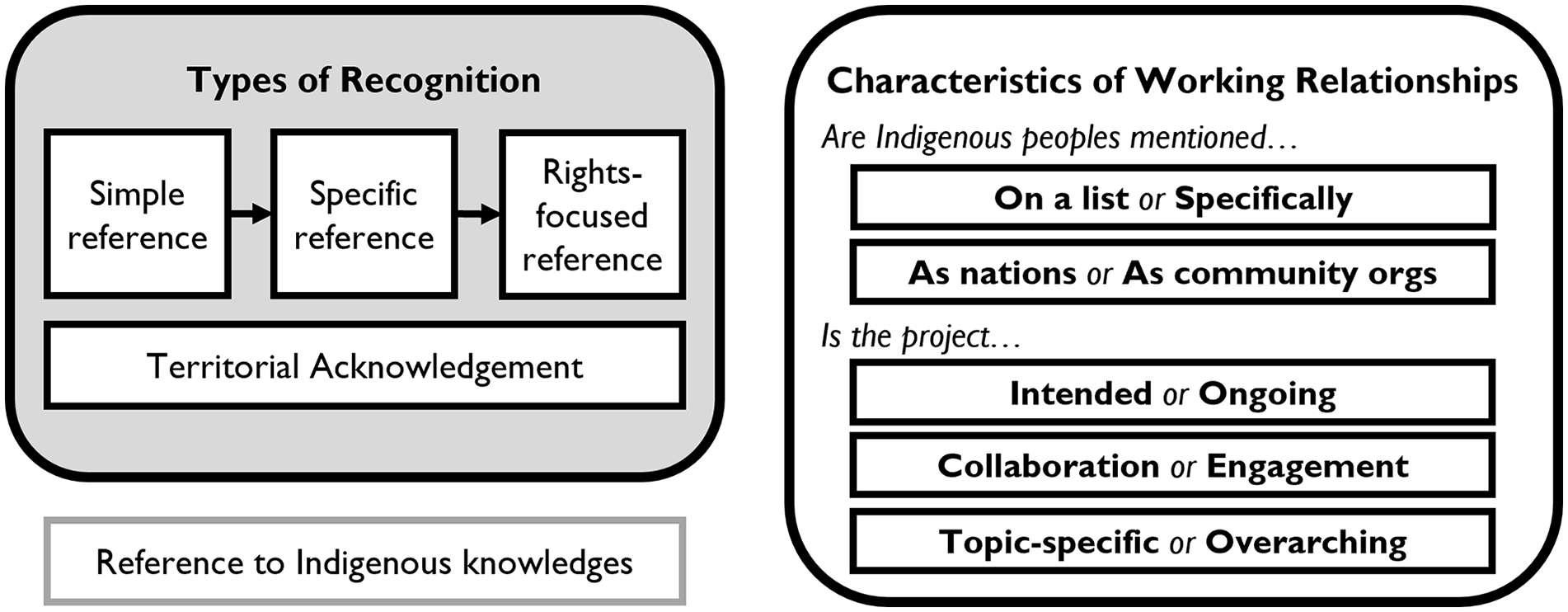
Overview of codes used for latent content analysis.
Limitations
This study has two primary limitations. First, since this is a document analysis, it is out of scope to determine whether municipalities are following through on the plans that they outline in their CAPs, or whether Indigenous Peoples are open to municipal attempts to work with them. Implementation and reception of the projects described in CAPs will have a substantial impact on the actual state of municipal-Indigenous relations. Second, this study focuses on larger municipalities in Canada, leaving out smaller municipalities and those in other countries. It is possible that municipalities outside this project’s selection criteria are developing innovative partnerships with Indigenous Peoples.
Discussion: The State of Indigenous Involvement in Canadian Municipal Climate Planning
The data from the CAPs showed that while many municipalities have started to think about Indigenous rights in the context of climate action, much work remains to build decolonial collaborations. The first part of the analysis found that half of Canadian municipal CAPs mentioned Indigenous Peoples, with population size, climate-focused elected officials, and Indigenous presence in or near the city having slight influences on if and how mentions occurred. The second part of the analysis looked at how plans recognized Indigenous Peoples, using four types of recognition: simple references, specific references, rights-focused references, and territorial acknowledgment, and an additional code for references to Indigenous knowledges (see Figure 1). We found that recognition did not reliably connect to any steps toward working relationships and that CAPs showed signs of extractive attitudes toward Indigenous knowledges. The third part of the analysis examined references to working relationships and found that Indigenous decision-making authority was rarely recognized, despite a few promising projects. This section discusses each of these findings.
Building Capacity for Conversation
Most Canadian municipalities are not conducting climate planning through working relationships with Indigenous Peoples. Of the 139 municipalities with CAPs, sixty-nine (49.6%) mention Indigenous Peoples within those documents (see Figure 2). Fifty-five mention First Nations, forty-five mention “Indigenous,” seventeen mention Métis, and eleven mention Inuit, with most using more than one of these terms. Of the sixty-nine, 30 (21.6% of the total) have ongoing working relationships and twenty-four more (17.3% of the total) state intentions to build working relationships. These numbers should not be taken to indicate that one-fifth of municipalities are doing well, as there is variation in working relationships that will be discussed in later sections.
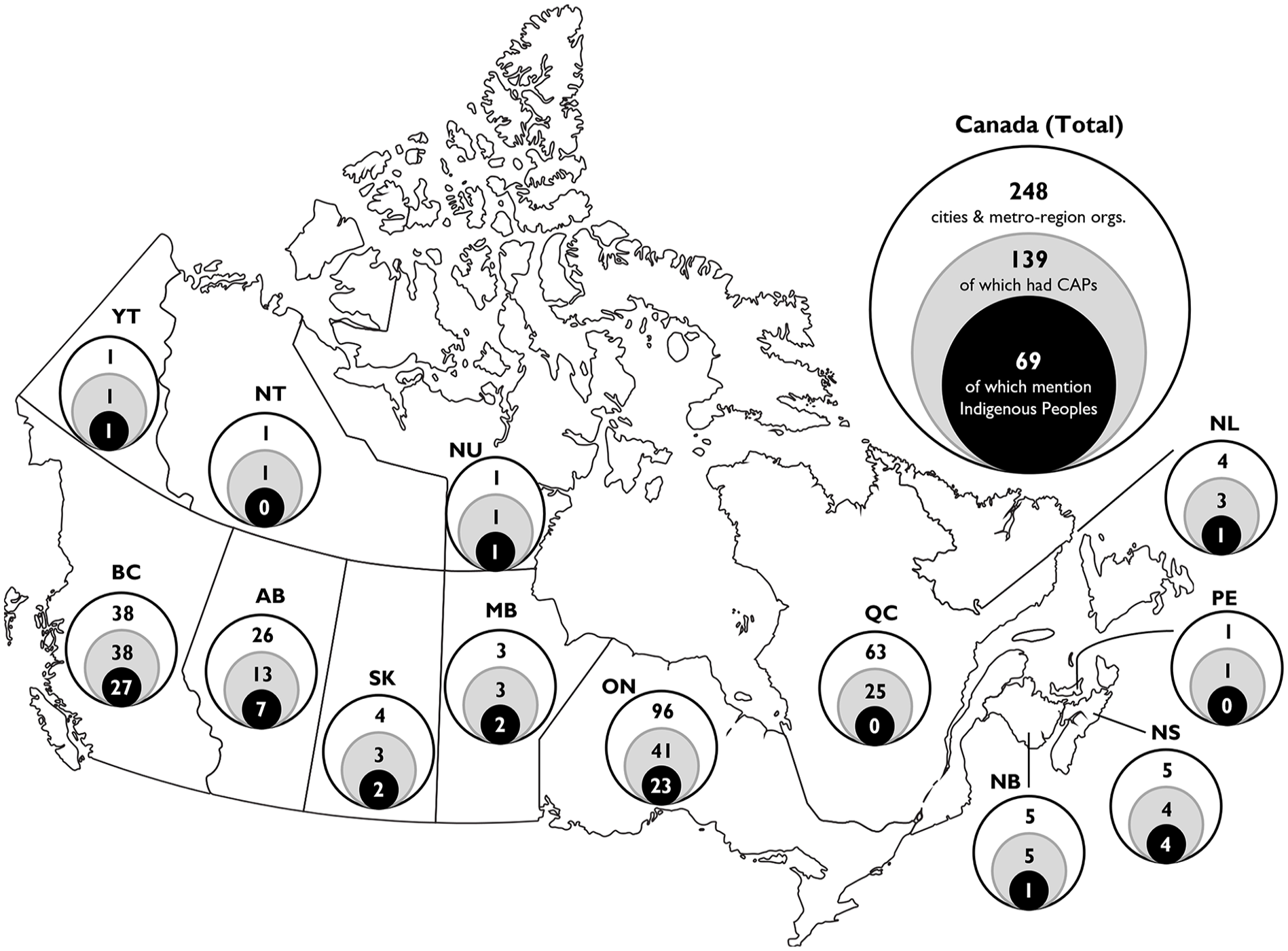
Map showing the number of municipalities and metro-region organizations included in the study, the number of those which had CAPs, and the number that mentioned Indigenous Peoples in those CAPs, with a breakdown by province and territory.
The percentage of municipalities that mention Indigenous Peoples in their CAP does not vary significantly by province, except for Quebec. None of the 25 CAPs from Quebec municipalities include any of the key words in English or French. Chi-square tests confirmed that there is a significant difference between provinces and territories (p = .053) that goes away when Quebec is excluded (p = .929). Quebec municipalities’ lack of mention of Indigenous Peoples suggests that either municipal-Indigenous relationships are not developing as they are elsewhere, or that approaches to climate planning remain more siloed from other areas of government. Quebec’s provincial level climate policies are strong and it has been actively negotiating its relationships with Indigenous Peoples (Cyr, Wyatt and Hébert 2022; Dusyk et al. 2021). Societal conversations about climate action in Quebec show nascent awareness of Indigenous rights, although proposals still fall far from fully respecting self-determination (Reed et al. 2021). Further study is required to determine why no Quebec municipalities mention Indigenous Peoples in their CAPs.
For non-Quebec municipalities, two capacity-related factors had small, isolated connections to whether or how Indigenous Peoples were mentioned. The population of the municipality was significantly different (p = .031) between those that mention Indigenous Peoples in their CAPs and those that do not, with larger jurisdictions more likely to use any of the search terms. Among the fifty-four municipalities that mention working relationships with Indigenous Peoples, those with a municipal elected official in the Climate Caucus network 5 were more likely to have ongoing projects, rather than just intentions (p = .034). Larger jurisdictions typically have more staffing and resources, and Climate Caucus membership indicates that decision-makers are supportive of climate action. These relationships suggest that municipal capacity contributes to the likelihood that a municipality considers Indigenous rights and interests in climate planning. However, relationships were not consistent—for example, population only correlated with whether search terms appeared, not with whether there were references to working relationships or whether projects were already ongoing—so the explanatory power is not strong.
Similarly, factors related to Indigenous presence had some minor effects on whether or how CAPs mentioned Indigenous Peoples. The distance to the nearest reserve was significantly different (p = .029) between those with and without mentions, with municipalities that are closer being more likely to include any of the search terms. However, 75 percent of the municipalities with CAPs are less than thirty-five kilometers from the nearest reserve, so the variation between groups is small. Among the sixty-nine municipalities that mention Indigenous Peoples, the percentage of their population that is Indigenous tends to be higher (p = .022) in the fifty-four cases where ongoing or intended working relationships are referenced. As with the capacity factors, these relationships are not consistent. Being close to a reserve or having a larger Urban Indigenous community may make it easier for municipalities to know who to work with and Indigenous leaders may be pushing for a larger role, but it is not a guarantee that collaborative work is happening.
Bolstering both municipal and Indigenous capacity for climate planning could support greater progress with collaborations. Since municipal capacity has some influence, increasing funding and providing training for staff about the importance of Indigenous rights in climate action could enable municipalities to work toward building relationships. Providing additional resources to Indigenous Peoples will not only support their own self-determined climate policies and projects, but also their ability to advocate for a bigger role in municipal processes, amplifying factors related to Indigenous presence. Within Canada, extra attention should be paid to Quebec to enable municipalities to start having conversations that are already happening in other provinces and territories. While increasing the rates at which Indigenous Peoples are mentioned in municipal CAPs will not fully address the need for decolonial collaboration in climate planning, it is a necessary first step to mainstream the work and foster more space for collaboration and innovation.
Recognition is Not Enough
Of the sixty-nine municipalities that mention Indigenous Peoples in their CAPs, fifty-seven included one or more of the four types of recognition shown in Figure 1, aside from any mention of working relationships. Most plans mentioned First Nations or Indigenous Peoples in general terms; where Métis or Inuit were mentioned, their specific contexts were rarely considered.
6
There were twenty-seven CAPs that had simple references to Indigenous existence, such as “Often those that are most affected by climate change are the ones who lack resources and are most vulnerable, such as Indigenous communities, young people and seniors, and people with low incomes” (Town of Halton Hills 2020, 11). Twenty-one CAPs had more specific references to distinct Indigenous contexts, such as this explanation from Kings, Nova Scotia: Those who live on First Nations reserves within the county may be particularly affected by catastrophic events associated with climate change — not only will they experience the impacts, but they are within physical boundaries which may restrict their ability to relocate to avoid flooding, for example. (Kings County 2013, 27)
These excerpts frame Indigenous Peoples quite differently: the first treats Indigeneity as a broad category of vulnerability like age or income, while the second addresses First Nations’ distinct local historical and political context. While both these excerpts address vulnerability, our analysis found other simple and specific references related to diversity more generally.
There were twenty-three CAPs with a rights-focused reference, such as “The Kwanlin Dün First Nation and the Ta’an Kwäch’än Council have Final and Self Government Agreements” (City of Whitehorse 2015, 7) for local context or “Actions support Indigenous-led climate solutions that are grounded in Indigenous self-determination” (Capital Region District 2021, 3) as a framing principle. It is not always clear how the recognition of rights is implemented. However, in some cases, CAPs draw direct connections between Indigenous rights, colonialism, and municipal desire to work together. For example, Campbell River, British Columbia, links ongoing partnerships to First Nations’ sovereignty: Additional dialogue should take place between the City of Campbell River (2020, 28) and the local Nations (Homalco, We Wai Kai, Wei Wai Kum, Tlowitsis) to carry out an action planning process and determine how the City can best support action implementation in a way that honours Indigenous sovereignty and autonomy.
These rights-focused references are distinct from other simple or specific references because they explicitly recognize the nation-to-nation relationship between Indigenous Peoples and Canada.
Thirty-two CAPs had territorial acknowledgements such as “The City of Victoria is located on the traditional territories of the Songhees and Esquimalt Nations” (City of Victoria 2018, 2), usually at the beginning of the document. Territorial acknowledgements were sometimes quite lengthy, including information about the history of treaties or unceded lands. However, territorial acknowledgements are always set aside, with no direct connection to other work detailed in the CAP. Notably, of the thirty-two CAPs with territorial acknowledgements, five have no other mention of Indigenous Peoples in their plans. For example, Okotoks, Alberta, has a territorial acknowledgment that ends by stating that “The Town remains committed to respecting Indigenous culture and reconciliation, and promoting the awareness and recognition of Indigenous people” (City of Okotoks 2021, v), but has no other mention of Indigenous Peoples in its CAP.
A chi-square test found no correlation between which of the four types of recognition was present in a CAP and whether that CAP mentioned an intended working relationship with Indigenous Peoples, mentioned an ongoing working relationship, or had no mention of a working relationship at all (p = .410). Some CAPs, such as that of Cape Breton, Nova Scotia (2014), have both recognition and mentions of working relationships without explicitly connecting them; and still others such as those from Peterborough, Ontario (2016), Edmonton, Alberta (2018), and Greater Sudbury, Ontario (2019), acknowledge Indigenous participation in the plan’s development but do not use any of the four types of recognition described above. There are sixteen CAPs from fifteen municipalities that do not describe any working relationship, some of which show each type of recognition.
A good deal of recognition in CAPs is likely performative, with no connection to action, but the line between performativity and action is not always clear. For example, Toronto, Ontario, has a substantial section on Indigenous worldviews in its City of Toronto (2021, 24), but notes its own “lack of meaningful engagement and co-development” (City of Toronto 2021, 84) as short timelines hindered its efforts. The City has a stated commitment to working with Indigenous Advisory Circles on CAP implementation and updates (City of Toronto 2021, 85). Toronto’s intention to translate recognition into meaningful work seems sincere, but the words in the CAP will remain performative if the City fails to fulfill its commitments.
While language around Indigenous rights can make CAPs seem more progressive, it does not directly accomplish anything. Justice buzzwords and explanations of context are unimportant compared with building relationships that support collaboration. Stated commitments to decolonization in CAPs are not necessary for the initiation of meaningful collaboration: for example, Nanaimo, British Columbia, is actively working with Snuneymuxw First Nation on estuary management (City of Nanaimo 2020, 33) but does not discuss Indigenous self-determination or include any of the four types of recognition anywhere in its CAP. Advancing projects with tangible impacts is key for avoiding performativity.
Extractive Attitudes toward Indigenous Knowledges
The analysis identified nineteen CAPs that reference Indigenous knowledges. These references demonstrate varying depths of understanding of Indigenous knowledges and often problematic approaches, meriting further analysis. All 19 CAPs that reference Indigenous knowledges mention working relationships with Indigenous Peoples, resulting in a significant correlation (p = .023). However, within each CAP, Indigenous knowledges and working relationships are not always discussed together. Five of these CAPs reference Indigenous knowledges as important for informing climate policy without explicitly connecting those knowledges to the municipality’s work with Indigenous Peoples. For example, Waterloo Region, Ontario, has a “Spotlight on Climate Justice” box that starts by stating that “Indigenous knowledge and cultural practices are crucial to addressing climate change” (Region of Waterloo 2020, 60), several pages away from their section on relationship-building.
The remaining fourteen CAPs discuss Indigenous knowledges in direct connection with municipal-Indigenous working relationships. However, framings often suggest that increasing municipal understanding of Indigenous knowledges is the purpose of the relationship. For example, Windsor, Ontario, writes that it will “Continue to consult and engage local First Nations to further climate action based on traditional knowledge, insights and experience” (City of Windsor 2020, 34). In these cases, it seems municipalities are not building relationships to support Indigenous self-determination and develop decolonial collaborations, but instead hoping to extract Indigenous knowledge to enhance their own climate policies.
While many Indigenous Nations and communities are innovating and leading on climate action, that does not make their knowledges automatically available for settler benefit. Seeking to learn from Indigenous knowledges without making space for Indigenous knowledge keepers to hold decision-making power is a colonial practice. Indigenous scholars emphasize that Indigenous knowledges are inherently connected to worldviews and lifeways: they are not data for intellectual consumption (Liboiron 2021; McGregor 2013). True solutions to climate change that preserve life and increase resilience cannot be based on colonial extraction of knowledge (or other resources)—they must respect Indigenous rights, leadership, and self-determination (Alook et al. 2023; Indigenous Climate Action 2021).
Only three CAPs have in-depth discussion of Indigenous knowledges. Courtenay, British Columbia, worked with K’ómoks First Nation to include excerpts from the K’ómoks Comprehensive Community Plan and K’ómoks Marine Use Plan in their CAP. Courtenay’s CAP cites K’ómoks values and teachings such as “Protocol as a foundational cultural tool to manage resources throughout KFN territories. Protocol includes acknowledging which Nation’s territory one is in, asking permission to use resources, and sharing in benefits” (City of Courtenay 2022, 29). Iqaluit, Nunavut, engaged with Inuit Elders to develop a plan based in Inuit Qaujimajatuqangit 7 and lists important values in Inuktitut at the beginning of the CAP. Iqaluit’s CAP states, “we have taken every opportunity to embrace both Inuit and Qallunaat (non-Inuit) perspectives, while ensuring that Iqaluit retains Inuit values at heart” (City of Iqaluit 2014, 4). Toronto, Ontario, also has a detailed section devoted to asking how the CAP can “honour the land, water and all our relations . . . [and] embody seven generation thinking” (City of Toronto 2021, 24). The contrast between these three CAPs and the others suggests that the other municipalities may not have a firm understanding of what Indigenous knowledges are, even as they covet those knowledges as a potential resource for climate planning.
Challenges in Existing Working Relationships
Among the fifty-four CAPs that mention working relationships with Indigenous Peoples, there is not much evidence that those relationships are strong. Most CAPs’ references to Indigenous Peoples suggest only a shallow understanding of self-determination. While forty-one use terms such as “local First Nations” or specific names rather than “Indigenous groups,” most CAPs do not specify processes for collaboration that align with Indigenous rights. Indigenous Nations are often included on lists of partners alongside governments and community organizations or represented on stakeholder committees, suggesting that they are perceived as stakeholders rather than rightsholders. Among those working with First Nations, only Courtenay, British Columbia, specifies that it is working with Chief and Council and “engag[ing] specifically and separately with the K’ómoks First Nation in government-to-government ideas exchanges” (City of Courtenay 2022, 12)—in all other CAPs, representatives are unspecified or listed only by name in acknowledgements of committee members. The lack of detail around processes for government-to-government relationships hinders municipalities’ ability to uphold Indigenous rights and self-determination.
Connecting to appropriate representatives of Indigenous Peoples in a landscape of self-determination can be complex, especially in urban areas, and most municipalities do not explore this complexity in their CAPs. London, Ontario, Toronto, Ontario, and Winnipeg, Manitoba, are the only municipalities that specifically mention working with Urban Indigenous communities. 8 Even in these three CAPs, there is no discussion of whether the municipalities are considering self-determination in urban contexts or how they are connecting with representatives of these communities. Self-determination and resurgence are innate to Indigenous people, not vested only in recognized governments (Harjo 2019; Simpson 2017). Since nearly half of Indigenous people in Canada live in large urban centers (Statistics Canada 2022) and many have formed new pan-Indigenous identities and community leadership structures (MacKinnon and Mallett 2023; Tomiak 2010), figuring out how to respect and collaborate with these communities in governance is increasingly important. Since respecting Indigenous self-determination is key to increasing climate resilience, where municipalities do not have existing relationships with Urban Indigenous community representatives or Inuit, Métis, and First Nations leaders, municipal climate planners have a role to play in initiating these conversations.
Our analysis also examined differences between intended and ongoing working relationships and differences between collaboration and engagement, as shown in Figure 3. Chi-squared analysis shows that intended projects are significantly more likely to be framed as collaboration rather than engagement (p = .001). These intended projects can appear to be quite meaningful. For example, Vancouver, British Columbia, describes an intention to form an overarching partnership with local First Nations: “seek to collaborate with the xʷməθkʷəy̓ əm (Musqueam), Sḵwx̱wú7mesh (Squamish), and Sel̓íl̓witulh (Tsleil-Waututh) First Nations on the development and implementation of climate plans” (City of Vancouver 2020, 4). However, there are many reasons why the intentions stated in CAPs may not become reality: municipalities may lack the political will or capacity to work with Indigenous Peoples in ways that support self-determination, there may not be sufficient resources for in-depth collaboration, or there may be knowledge gaps that prevent municipalities from building respectful partnerships.
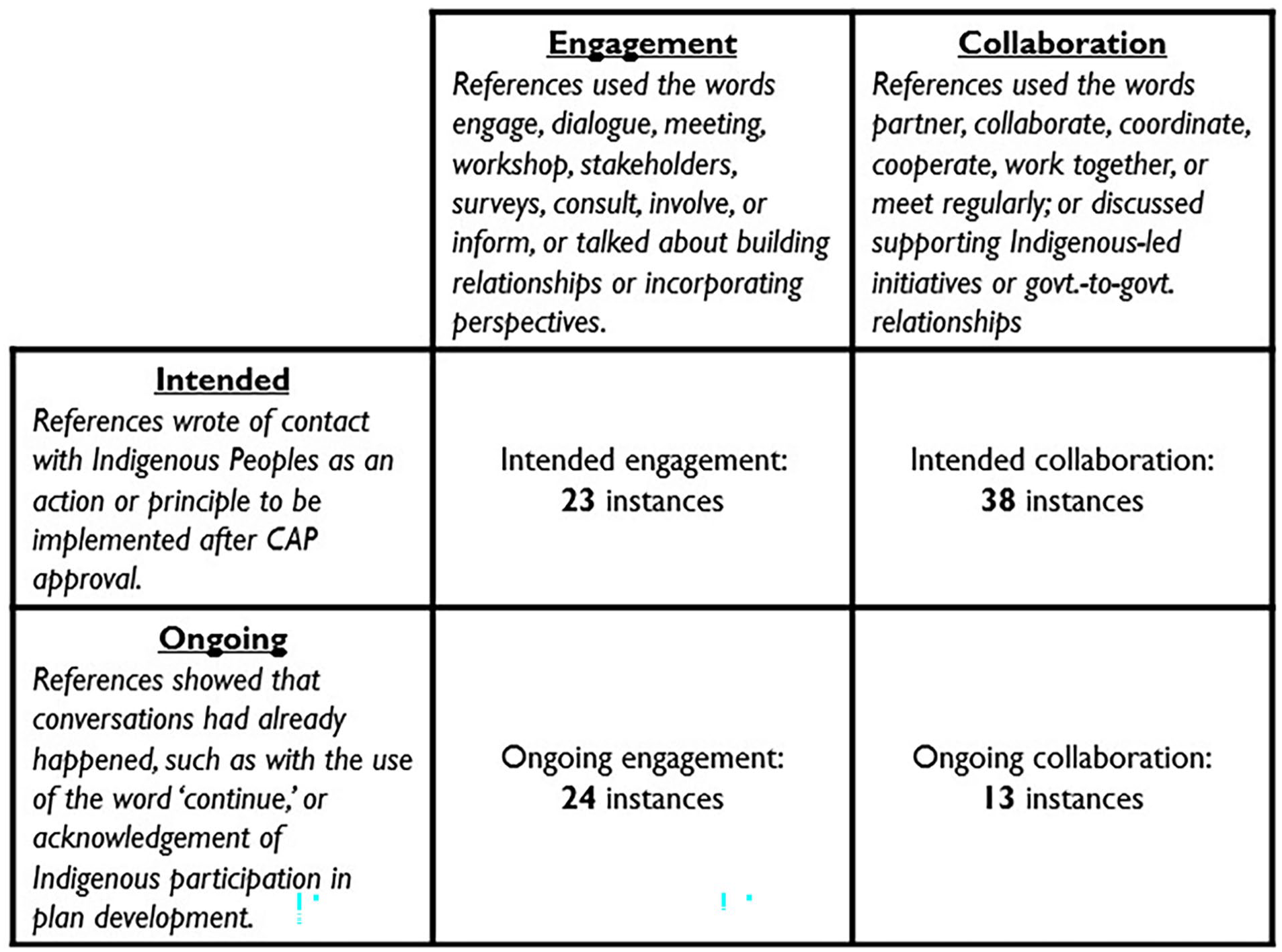
Representation of working relationships in CAPs categorized by intended/ongoing and engagement/collaboration.
Many ongoing collaborations only address one or two topics related to climate planning, often in natural resource management. For example, Coquitlam, British Columbia, and kʷikʷəƛ̓əm First Nation are part of a salmon restoration program (City of Coquitlam 2022, 57); Nanaimo, British Columbia, and Snuneymuxw First Nation are on an estuary management committee (City of Nanaimo 2020, 33); and St. Albert, Alberta, is in a watershed management group with Alexis 133 and Alexander 134 First Nations reserves (City of St. Albert 2014, 34). These topic-specific collaborations can be useful for relationship-building and may be paired with collaborations on other topics outside the scope of a CAP and therefore outside this study. While even a handful of topic-specific projects do not equate to recognizing the full scope of Indigenous jurisdiction, they can be useful building blocks for broader collaboration based in established relationships. The strongest examples of ongoing collaboration, such as the Greater Peterborough Area Climate Change Action Plan, describe joint decision-making structures, projects that were previously completed together, and specific contributions from each partner (City of Peterborough 2016).
Engagement is less meaningful than collaboration because it treats Indigenous Peoples as “stakeholders” to survey rather than partners with decision-making power. Findings from CAPs show how engagement falls short. Results from engagement are rarely evident in CAPs—one exception is Campbell River, British Columbia, which lists climate risks for Homalco, We Wai Kai, and Wei Wai Kum First Nations (City of Campbell River 2020, 28). Furthermore, ongoing engagement does not make CAPs more likely to have ongoing collaboration (p = .400) and CAPs without ongoing engagement are more likely to have intentions to collaborate (p = .071), so gathering input is not a reliable first step toward collaboration. In some contexts, engagement processes could become a box-ticking exercise. Including Indigenous community members in survey processes or inviting a representative of a First Nation to sit on a committee may support relationship-building, but municipalities need to be willing to go further and make space for Indigenous Peoples to exercise authority. It is important to be clear from the outset that the intention is to build decolonial collaboration and follow Indigenous leadership, rather than getting sidetracked establishing pathways that constrain Indigenous roles and keep ultimate decision-making power with the municipality.
Conclusion
This research shows that most Canadian municipalities are missing an important opportunity to build decolonial collaboration through climate planning. Only half of municipal CAPs mention Indigenous Peoples, and only one in five describe any ongoing working relationship with Indigenous Peoples. Municipal capacity for climate planning, as represented by population size and support from elected officials, and Indigenous presence, in terms of proximity to reserves and percent of the municipal population, contribute to the likelihood that a municipality has included Indigenous Peoples in their climate planning processes. However, municipalities have not built true government-to-government relationships that encompass all elements of climate planning. The recognition present in CAPs is often performative and incomplete, and desire to benefit from Indigenous knowledges may be a driving factor in some cases. Substantial work remains to be done to establish climate planning collaborations between Canadian municipalities and Indigenous Peoples.
Climate planning is a crucial site to begin governing collaboratively with Indigenous Peoples because a key goal of climate planning should be to improve resilience for all communities. Many climate impacts are similar to challenges that Indigenous Peoples have already endured due to settler colonialism (Whyte 2017), so supporting resilience will be ineffective without respect for Indigenous self-determination. Decolonial collaborations go beyond the limited input made possible through consultation or engagement, instead building relationships that center Indigenous governance. At present, the steps for building relationships and developing joint decision-making structures that respect Indigenous self-determination are not made clear in CAPs, and existing relationships in other policy areas are rarely mentioned. Municipalities would likely benefit from guidance on how to move toward decolonial collaborations. General guidance could be jointly developed by diverse Indigenous leadership, municipality-serving organizations, and higher levels of government. However, the preferences of the Nations that a municipality is directly working with should take precedence over the general guidance.
Recommendations for Planning Practice
Four recommendations for municipal climate planners emerge from this study. First,
Areas for Further Research
There are five specific issues remaining after this study that could spark further research. First, there may be differences between what is written into CAPs and what is being implemented, so it would be beneficial to gather direct input from municipal climate planners and Indigenous leaders about how they might work together. Second, additional research could look for useful models from municipalities with populations smaller than twenty-thousand people, as collaboration with Indigenous Peoples is often more advanced outside of major urban areas (Porter and Barry 2016). Third, similar research could be undertaken in other settler colonial contexts such as the United States, Australia, Aotearoa/New Zealand, or other countries to compare progress. Fourth, additional follow-up research in Canada could analyze why no CAPs from Quebec mention Indigenous Peoples. Finally, since very few CAPs mention working specifically with Urban Indigenous communities, future research could examine how Urban Indigenous communities are addressed in other municipal policy documents. Our hope is that the findings of this study provide a useful jumping-off point for the development of collaborative climate governance.
Supplemental Material
sj-docx-1-jpe-10.1177_0739456X251357251 – Supplemental material for Municipal-Indigenous Collaboration in Canadian Climate Action Plans
Supplemental material, sj-docx-1-jpe-10.1177_0739456X251357251 for Municipal-Indigenous Collaboration in Canadian Climate Action Plans by Lila Asher and Sarah Cooper in Journal of Planning Education and Research
Footnotes
Acknowledgements
This paper emerged from Lila’s thesis work, supervised by Sarah. We would like to thank Janice Barry and Iain Davidson-Hunt for serving as committee members and providing feedback as the study developed, as well as Andrée Forest for help with French translations. Lila is also grateful for graduate funding from the University of Manitoba Graduate Fellowship.
Declaration of Conflicting Interests
The author(s) declared no potential conflicts of interest with respect to the research, authorship, and/or publication of this article.
Funding
The author(s) received no financial support for the research, authorship, and/or publication of this article.

Supplemental Material
Supplemental material for this article is available online.
Notes
Author Biographies
References
Supplementary Material
Please find the following supplemental material available below.
For Open Access articles published under a Creative Commons License, all supplemental material carries the same license as the article it is associated with.
For non-Open Access articles published, all supplemental material carries a non-exclusive license, and permission requests for re-use of supplemental material or any part of supplemental material shall be sent directly to the copyright owner as specified in the copyright notice associated with the article.
