




Abstract
Already climate-related hazards are impacting sanitation systems in Indonesia and elsewhere, and climate models indicate these hazards are likely to increase in frequency and intensity. Without due attention, to maintain existing progress on Sustainable Development Goal 6’s target 6.2 and to increase it to meet ambitions for 2030 will be difficult. City governments need new forms of evidence to respond, as well as approaches to enable them to consider sufficient breadth of strategies to adapt effectively. This paper describes a co-production research process which engaged local governments in four cities in Indonesia experiencing different climate hazards. Local government engagement took place across three stages of (i) inception and design, (ii) participation as key informants and (iii) joint analysis and engagement on the findings. We adapted and simplified a risk prioritisation process based on current literature and employed a novel framework of a ‘climate resilient sanitation system’ to prompt articulation of current and proposed climate change adaptation response actions. In contrast to many current framings of climate resilience in sanitation that focus narrowly on technical responses, the results paint a rich picture of efforts needed by city governments across all domains, including planning, institutions, financing, infrastructure and management options, user awareness, water cycle management and monitoring and evaluation. Local government commitment and improved comprehension on the implications of climate change for sanitation service delivery were key outcomes arising from the co-production process. With strengthened policy and capacity building initiatives from national level, this foundation can be supported, and Indonesian city governments will be equipped to move forward with adaptation actions that protect on-going access to sanitation services, public health and the environment.
Introduction
Evidence of the potential consequences of climate change for sanitation is emerging, but yet to translate to substantive government commitments to action in low- and middle-income countries. Recent review papers outline the many ways climate hazards disrupt sanitation services (Howard et al., 2016; Mills et al., 2020). The threat of climate change has led to calls to build sanitation resilience to ensure sanitation SDG targets are met (Howard, 2021; De Albuquerque, 2021). However, the sector is chronically under-funded (Perard, 2018) and little climate financing is allocated to sanitation access or wastewater management due in part to a lack of attention given to sanitation issues in national sanitation and climate policies (Dickin et al., 2020).
Efforts to address climate change and sanitation to date have taken a primarily technical focus (Howard et al., 2016; WHO, 2019). Yet climate resilience requires broader considerations to be brought into view, as has been noted more recently (Gordon and Hueso, 2021). Specifically, the IPCC (2021) defines resilience as: ‘The capacity of interconnected social, economic and ecological systems to cope with a hazardous event, trend or disturbance, responding or reorganising in ways that maintain their essential function, identity and structure. Resilience is a positive attribute when it maintains capacity for adaptation, learning and/or transformation’. Resilience requires the ability of sanitation services to respond and reorganise when faced with worsening climate hazards and continue to protect human and environmental health. The people governing and managing sanitation systems must also develop capacity to learn about changes in the environment and capacity to adapt or transform the broader sanitation system (ISF-UTS and SNV, 2019), in line with a systems strengthening approach (Moriarty and Huston, 2018). However, to date there are few studies that focus on adaptation responses (Clemenz et al., 2020; Muradas et al., 2021), and none to date that adopt a systems-wide perspective such as that proposed in this paper and aligned with citywide inclusive sanitation (CWIS), described further below.
Approaches to urban sanitation have evolved over the last decades, with the current iteration coalescing around the concept of CWIS (Lüthi et al., 2020). Historically, the sector has been somewhat divided between actors engaged in master-planning and large-scale sewerage systems such as the development banks, those addressing non-sewered sanitation and faecal sludge management (FSM) associated with onsite household sanitation systems and others promoting semi-centralised or decentralised wastewater systems (Reymond et al., 2020; Willetts et al., 2020). CWIS is variously interpreted but builds on principles agreed to in 2017, namely, sanitation as a human right, covering the whole sanitation chain, working in partnership with urban authorities and contributing to urban economies (BMGF et al., 2017). The concept has been applied by sector actors in different ways. For instance, one interpretation focuses on institutional mandates and arrangements (Schrecongost et al., 2020), another on a mix of technologies (Lüthi and Narayan, 2018) and another on diversity of technological solutions combined with the right incentives, political will, and managerial and technical expertise and leadership (Gambrill et al., 2020). A common feature is that services must be extended to all. To date, there is no literature or studies that draw on the CWIS concept in relation to climate resilience.
Achieving CWIS in low- and middle-income countries is a challenge, as is the case in Indonesia, the country of focus in this paper. Whilst climate change is likely to exacerbate the situation, it is yet to be acknowledged in key Indonesian policy documents. In terms of sanitation status, in Indonesia there is still 6% of the population practicing open defecation (World Bank, 2020) and the current estimate of access to safely managed sanitation is only 7% (SUSENAS, 2020). The national government development plan (2020-2024) targets 0% open defecation and 15% safely managed sanitation, including both on- and off-site solutions, by 2024. Governance of sanitation is distributed both between ministries (health and public works) and across levels, which on the one hand clarifies scope, but on the other hand can lead to fragmentation. Central government is responsible for policy development, standard setting and capacity building, while local governments are responsible for planning and management of sanitation services (WaterAid, 2016). Sanitation does not feature in national climate plans or policies other than brief mention in the waste management emission target of the Nationally Determined Contributions (NDCs). Climate is also not included in sanitation policies; however, the widely implemented city sanitation strategy approach (Chong et al., 2016) includes development of environmental health risk (EHRA) maps that consider flood-prone areas and areas with poor sanitation. Given this situation, improved evidence concerning climate risks and adaptation responses in sanitation are critically needed.
Existing tools for climate adaptation in sanitation often follow a risk assessment process that involves identification and prioritisation of climate risks; however, these approaches are complex and require high levels of technical expertise. For example, the Global Water Partnership (GWP)/UNICEF propose identifying risks from documented and tacit knowledge, then quantitatively scoring and ranking them based on characteristics of present climate hazards, the degree to which people or sanitation systems are exposed to the hazard and the underlying vulnerability and capacity of the exposed population (GWP and UNICEF, 2017). Meanwhile, USAID proposes quantitatively scoring the likelihood that a risk occurs and the severity of consequences each on a Likert Scale, then calculating an overall risk score (USAID, 2015). In addition, the World Health Organisation’s Sanitation Safety Planning risk assessment process was recently updated to take account for climate resilience, building on a recent WHO paper on sanitation, climate change and health (WHO, 2019). Rather than adopt these existing tools for risk prioritisation or adaptation ‘off the shelf’, this research applied a collaborative, simplified risk prioritisation approach suitable for working with local governments.
Addressing a gap in knowledge and practice on systems-wide adaptation response to climate change impacts on sanitation in cities, and fit-for-purpose approaches to prioritising risks, this paper shares a co-production process followed with four city governments in Indonesia. It presents both the process and outcomes of a simplified risk prioritisation and adaptation response identification approach. The response identification was underpinned by a framework for a climate resilient sanitation system aligned with CWIS and that extends beyond technical solutions to support action across the wider institutional system that enables sanitation service delivery. City governments were placed at the centre of the research process since they are the duty-bearers for sanitation with responsibility to act.
Methods
The overall methodology was informed by transdisciplinarity and co-production. Transdisciplinary research emphasises stakeholder engagement in the research process and drawing on diverse disciplinary knowledge to solve a societal issue (Thompson Klein, 2004). Co-production was adopted to support local government staff to digest evidence of challenges faced in their city and bring their knowledge to bear in formulating solutions.
Co-production is a rapidly emerging approach to research in the fields of sustainability (Mauser et al., 2013; West et al., 2020; Norstrom et al., 2020; Chambers et al., 2021) and transdisciplinarity (Schneider et al., 2019). Co-production is seen to provide a ‘framework to integrate diverse perspectives and knowledge into decision making and action’ (Wyborn et al., 2019), and according to Norstrom et al. (2020), to follow four main principles, namely that processes should be: (1) context-based, such that they are situated in a particular context or place; (2) pluralistic in recognising multiple ways of knowing and doing; (3) goal-oriented by having meaningful shared goals related to the challenge at hand and (4) interactive, allowing for on-going learning among actors and their active engagement. Co-production has specifically been raised as an important approach in addressing climate change (Vincent et al., 2020), since there is a need to digest and grasp scientific information in a local context.
The broader research project collected evidence on impacts of weather events on sanitation in four case study cities (see Priadi et al., forthcoming), including more than 400 household surveys, 6 community FGDs, 8 community interviews and 12 service provider interviews. The overall process to engage local government is described in Figure 1. The four cities were Bekasi (frequent flooding and occasional drought; land-locked city; population 3.08 million, 12,085 people per km2), Makassar (frequent flooding and storms, anticipated sea-level rise; coastal city; population 1.4 million, 228,231 people per km2), Lombok Timur (frequent drought and anticipated sea-level rise; coastal city; population 1.3 million, 825 people per km2) and Palu (frequent flooding, anticipated sea-level rise and also recent tsunami; coastal city; population 370,000, 945 people per km2), selected to cover variation in size and experience of different weather-related hazards (see Supp Fig 1 for further information on the cities). Research process and points of engagement with local government.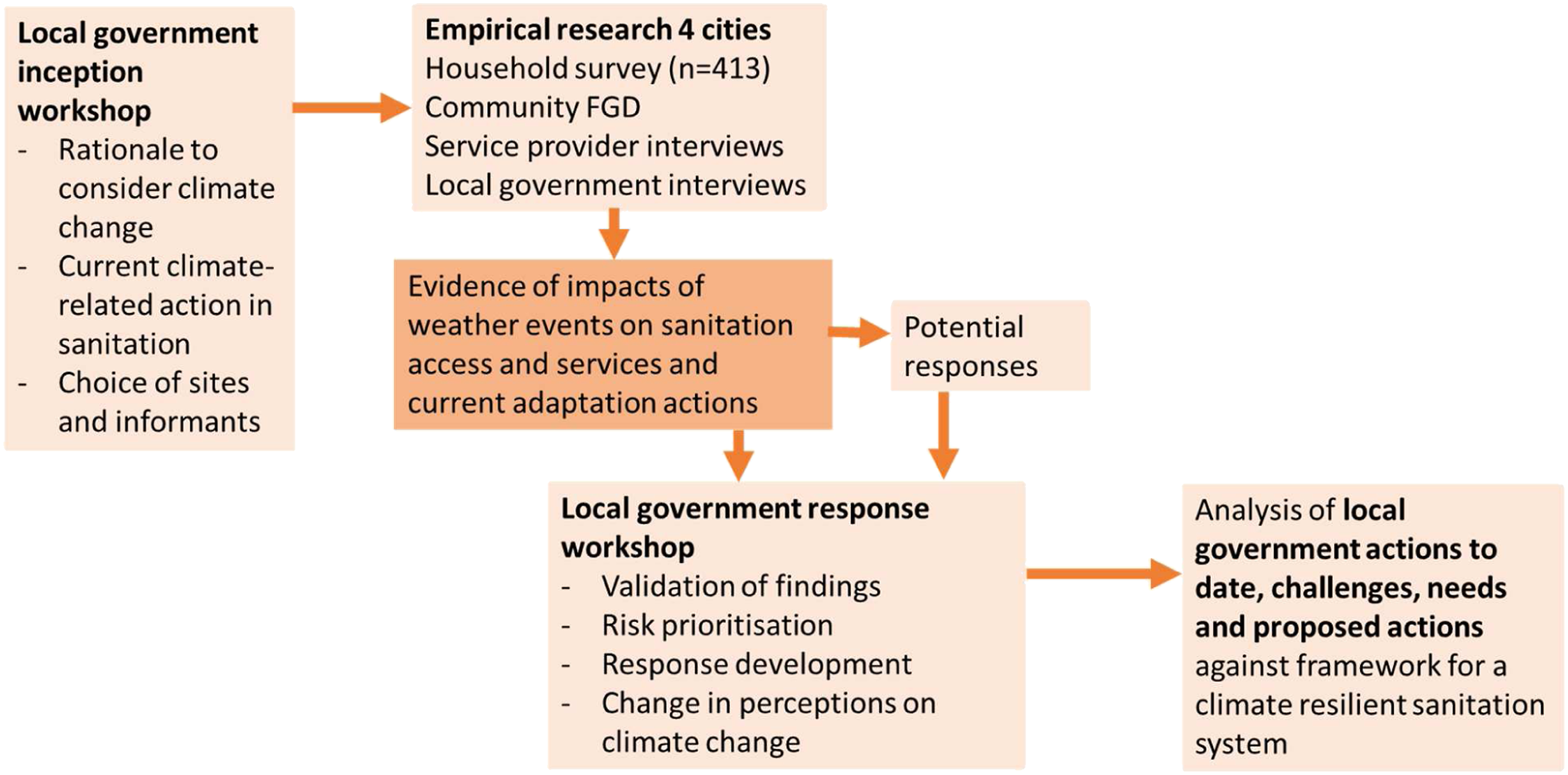
There were three points of engagement with local government: (i) a multi-agency inception workshop, (ii) semi-structured interviews and (iii) a multi-agency climate response workshop. The inception workshop focused on the rationale for the importance of climate change for sanitation and discussed the sampling approach for the broader study. The inception workshops involved 62 local government participants with 8–23 participants per city.
Local government semi-structured interviews (23 participants) focused on impacts of weather events on sanitation infrastructure, facilities and services, staff access to data, current adaptation responses, the policy context and personal perspectives on climate change and sanitation. Participants included planning (Bappeda), environmental, health, public housing and public works agencies, the sanitation technical implementing unit (UPTD) as well as climate working groups and sanitation working groups.
The response workshop (10–14 participants per city) included four methods. First, we validated the empirical research findings. Second, a simplified risk prioritisation approach, based on evidence for each relevant city, is described further in the findings section. Third, an activity to collectively identify existing and future response actions was undertaken, based on prompts given by the research team and organisational responses by the different agencies. We employed a framework for climate resilient sanitation, drawn from previous research (UTS-ISF and SNV, 2019) as the basis to structure the breadth of responses considered. This framework is aligned to the dimensions and principles of CWIS described earlier. Lastly, we conducted a brief activity to assess changed perceptions and knowledge needs.
Analysis conducted to produce this paper included qualitative analysis of inception and response workshop transcripts and meeting notes, drawing out the perceptions of local government staff. All quotes included in this paper are from the response workshops. Workshops also included menti-meter responses, which are included for the risk prioritisation process, and which also provided some of the quotes documented in this paper.
Key limitations of the research approach were that most workshops adopted an online workshop format due to COVID restrictions. This limited local government engagement in the inception workshop, and we had only limited success in engaging staff in selecting sampling locations on maps due to technology challenges and their need to consult specific data sources. The response workshops were more effective, but at times participants were occasionally called away to other duties. Lastly, the co-production process was only able to partially account for power differentials, a risk noted by others (Wyborn et al., 2019), and it is likely that this has affected the views captured in this paper. Such power differentials relate to differential actual or perceived knowledge and expertise about climate change between local government staff and the researchers, and differences in status between different government agencies. Nonetheless, across the four cities and the diverse areas of discussion, a relatively holistic picture was able to be developed.
Findings
The findings are presented in three main sections, firstly covering four local governments’ awareness, expertise and commitment to address climate change, followed by their prioritisation of risks based on the empirical study evidence for their city. The third section describes the challenges, as well as existing and proposed response actions for local government, categorised against our framework of seven areas of a climate resilient sanitation system.
Local government awareness, expertise and commitment to address climate change
Most local government staff participating in the research process were aware of climate change, and a small number could articulate in detail its influence on sanitation. In particular, staff within the planning agencies (Bappeda) aptly described the connections between climate change, the water cycle and sanitation, and of the four cities, in Makassar, we observed the highest level of awareness.
Between the inception and final workshops, the researchers observed a change in local government understanding of climate change and sanitation, confirmed by a self-assessment poll by participants. At inception, many local government staff noted they had not yet considered climate impacts on sanitation. By contrast, in the final workshop, the majority of participating local government officials reflected on and validated the study findings and described in detail how households, services providers and infrastructure were typically affected by extreme weather events. In addition, local government officials asserted the importance of the issue and the need to act, including beyond technical responses, for example:
‘As a planner in Bekasi City, this meeting is an important input given that the current conditions are leading to an extreme and increasingly massive disaster. This is a common thought for both government stakeholders and the community on how to adapt or adjust from various aspects in terms of funds, institutions, and others’.
In general, local government staff described gaps in their expertise and skills to address climate change and sanitation. Makassar was the only city with staff with climate and sanitation expertise, acquired as part of a current climate resilient slum upgrading (KOTAKU). Government staff in other cities mentioned that expertise existed in one part of the agency (e.g. climate or environment division) but was not shared across departments. Local government staff also described the expertise they would like to gain, most commonly reported as appropriate technical and financial solutions. Other areas noted were climate predictions, how to detect and convey weather changes to the public, how to influence people’s mindset to take climate change as an urgent issue, climate mitigation training and spatial planning for flood-prone areas.
Local government staff noted the absence of national policies or programs on climate change and sanitation and saw this as a key gap. From a local government perspective, such policies and programs were important to prioritise budget allocation. That said, one local government official from Makassar made links between the existing national plans and saw them and the research results as the basis for action in the city’s corresponding upcoming plans: ‘Through the National Medium Term Development Plan/RPJMN 2020 - 2024, the Government of Indonesia targets 90% access to proper sanitation including 15% access to safe sanitation, as well as increasing disaster resilience and climate change. …[…]… it is hoped that this meeting will provide greater benefits to Makassar City and become a guideline for further planning. Especially at this time Bappeda is preparing the Makassar City Regional Medium Term Development Plan/RPJMD for the next 5 years.’
And another official from Makassar suggested how the findings could be incorporated into local regulations:
‘Many people don't know that climate change has an impact on sanitation. With the results of this research, it is hoped that in relation to the local regulations on wastewater management, we can add to our insights to incorporate these results into regulations in Makassar City so that they can be implemented in the community’
These findings point to the need to strengthen the enabling environment to address climate adaptation in the sanitation sector, and also demonstrate how research data on the conditions in the respective cities was able to build awareness and commitment among local government officials.
Local government risk prioritisation of impacts
This section presents the simplified risk assessment approach and the ways local government staff prioritised different climate change risks for sanitation. In a workshop setting, the key findings of the empirical research were shared (see Table S1) and formed the basis for the participatory activity. Firstly, staff validated findings, and in all four cities these were endorsed as reflective of the realities they observed. For example, in Bekasi, an official noted: ‘The conditions in the field are more or less in accordance with the results of this study.’ Staff then added their own insights and in-depth observations of challenges faced in containment, emptying and treatment processes.
As indicated earlier, the approach to prioritisation was simplified as compared with proposed methods in the literature. However, the approach adhered to the key tenets of risk assessment, namely, to consider severity, likelihood and exposure (see Supp Fig 2). Rather than rank each of these separately, participants considered all three dimensions concurrently to prioritise a list of impacts documented through the research process in their city context.
Risks as prioritised in four cities.
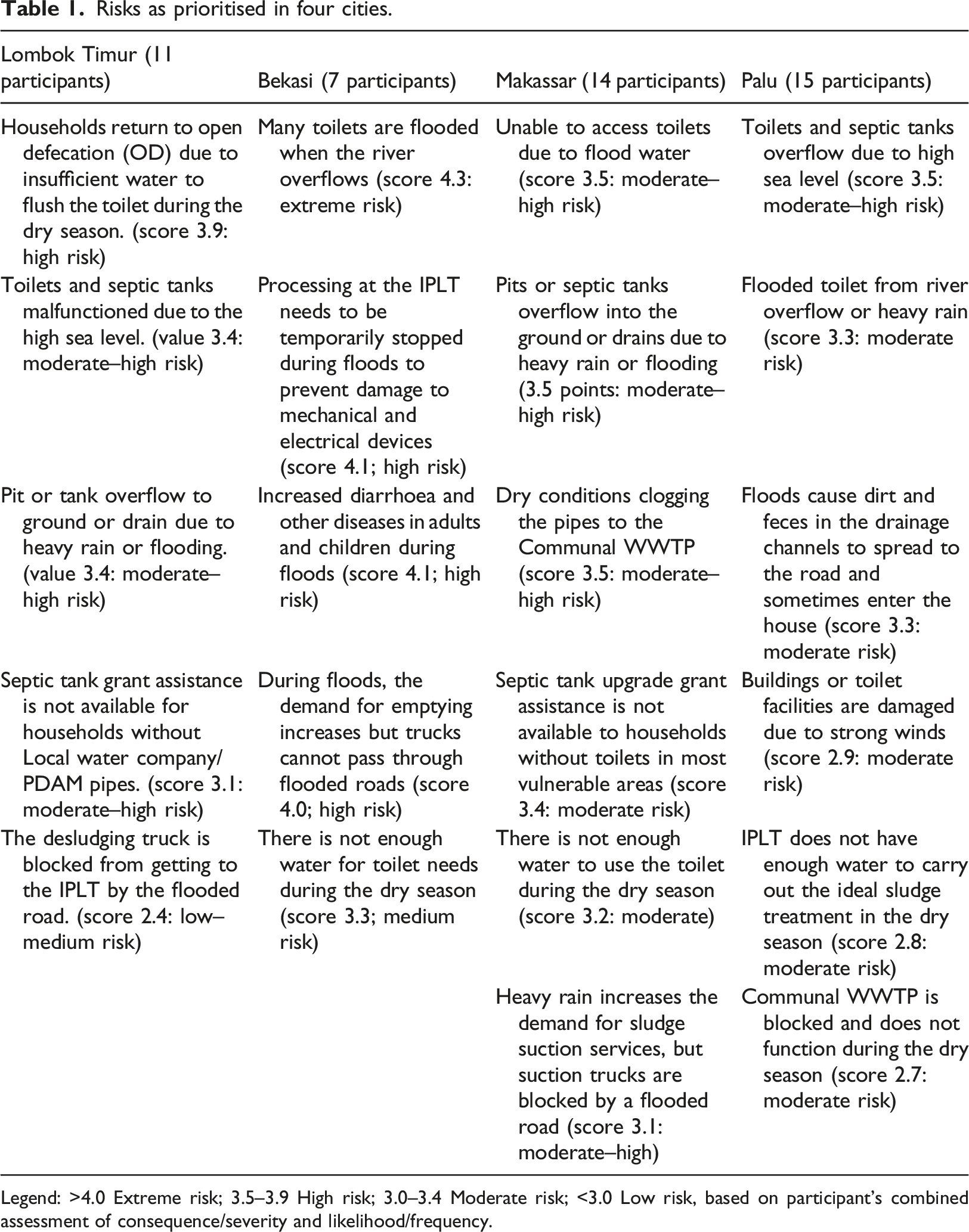
Legend: >4.0 Extreme risk; 3.5–3.9 High risk; 3.0–3.4 Moderate risk; <3.0 Low risk, based on participant’s combined assessment of consequence/severity and likelihood/frequency.
The purpose of the ranking was not necessarily to reach a conclusive decision on the most important risks, but rather, to prompt critical reflection amongst government staff on the complex issues at hand. As noted in the literature on co-production, developing competencies in this area is paramount to building local capacity to address complex sustainability issues (Kueffer et al., 2019).
The discussions following the ranking exercise demonstrated such critical reflection by local government staff. In Lombok Timur, discussion following the voting centred on the combined result of ‘open defecation’ as representing the highest risk. Staff argued that this ranking was appropriate, because in the dry season open defecation indeed occurred, whereas malfunctioning septic tanks was seen to only affect some people, and still allowed those households to use an alternative toilet. Although overflowing septic tanks were ranked third, one government official raised this for question, noting that it ‘is very dangerous, if the septic tank overflows so that sludge everywhere can cause extraordinary disease.’ These comments demonstrated a genuine engagement with the issues at hand, and the challenge of deciding where to prioritise efforts.
The discussion in Makassar also reflected a high level of engagement and critical reflection, as government officials debated the findings. For instance, the staff member from the planning agency noted that the average score of ‘moderate risk’ ascribed by participants may have been insufficient, and linked many of the risks to health and environmental impacts:
‘From the results of the risk assessment, we can see the average value is moderate. Even though if you look at the risk, it is deeper, it can have a high risk, for example: Not enough water is available for toilet needs, so the cleanliness of the toilet cannot be maintained and has an impact on health. Unable to access toilets due to flooding results in unable to defecate, which is a basic necessity. The septic tank hole overflows to the ground will cause environmental pollution and have an impact on health.’
A staff member from the health department agreed:
‘Of the six risk assessments, the average value should be extreme and high because the impacts will affect health. If water is not available, the community can practice defecation, causing pollution, and having an impact on health.’
However, in taking into account exposure, rather than just severity, another official argued that ascribing moderate risk overall was appropriate:
‘Do not consider this risk as high, it should be strengthened by its existence in locations that can represent the population and area of Makassar. However, if it is only in one location such as on the coast or on an island, then it cannot be concluded that the city of Makassar is entirely [affected]. There are certain places where this is not the case. Perhaps the severity is high but from the point of view of exposure it is not too big, so the risk is moderate.’
These findings suggest that a participatory risk assessment process supported reflection on how climate impacts relate to existing city priorities and provided a space for debate between participants from different departments to share their differing perspectives. In addition, while we did not apply a standard comprehensive risk ranking framework, it was clear that participants considered the different angles of exposure, likelihood and hazard through the simplified qualitative approach and practiced skills in comparing and prioritising risks which will be valuable for ongoing management of service with climate change.
Framework for responses
Local government staff described the challenges faced in responding to hazards, as well as current and proposed responses to the climate impacts on sanitation services identified in the empirical research. These are presented below against a framework for a climate resilient sanitation system (CR-SS) adapted from ISF-UTS and SNV (2019). The emphasis was on the entire service system and enabling environment that supports resilience across the sanitation chain, and in relation to its many actors: • Risk- and vulnerability-informed planning and decision-making • Clear institutional responsibilities and flexible service delivery arrangements • Sustainable and responsive financing for both adaptive measures and disaster response • Creative, strengths-based user engagement and awareness • Robust or repairable infrastructure options • Integrated action on the whole water cycle to protect services, environment and public health • Maintaining capacity for continual adaptation through monitoring, evaluation and learning.
Risk- and vulnerability-informed planning and decision-making
The importance of risk- and vulnerability-informed planning was identified by some government staff, who demonstrated awareness, both from this research and their own experiences, of the unequal effects of climate change sanitation impacts for different segments of the population. As noted in Makassar:
‘In several locations that are below sea level, it [climate change] must be very influential in terms of sanitation management, especially in slum settlements. Slum areas occupy areas prone to the widest impact, both on the coast which is affected by high tide or is prone to flooding.’
However, this view was not equally shared. Other staff also mentioned they were not familiar with the concept of risk and vulnerability or how to use them to inform planning.
Staff identified availability of consolidated data as a key challenge in developing risk- and vulnerability-informed planning and decision-making. Available data sets and climate relevant information (for instance, flood maps, drought or rainfall data, air quality, disaster response plans) was spread across different agencies and not known to or accessible to all.
Government staff requested detailed climate predictions for their city, rather than national estimates, to enable integration of climate considerations into planning, for instance, data on future sea or flood levels or maps showing flood and drought-prone areas. However, due to uncertainties in future climate modelling at local scales, it is difficult to develop these maps (Cooney, 2012), particularly in Indonesia which faces multiple hazards.
Instead of maps that show precisely where future hazards will occur, it was discussed that existing data could be made available to staff in different agencies, and maps indicating potential hazards developed based on historical data, such as flood and high tide levels. Consideration of likely climate scenarios alongside such hazard mapping could guide assessments of priority climate risk areas. Local government also suggested that data from surveys of households and service providers (similar to those conducted in this research) would be valuable to inform prioritisation of investment.
In this vein, government staff described ways to collect and analyse data to inform their planning. For instance, staff in Lombok Timur had mapped drought-prone areas towards a program to build deep community wells, and there was intent to conduct further surveys to identify alternative water sources during dry periods for problematic dry areas. In Bekasi, local government staff from the office of water resources suggested conducting a survey of households without septic tanks such that these households could be followed up as a first priority.
Local government staff noted three main types of plans into which climate risk assessments should be incorporated, namely sanitation plans, climate adaptation plans and spatial plans. First, government staff from all cities suggested updating city strategic sanitation plans (SSK) and environmental health risk assessments (EHRA) with climate hazards and risks to determine policies and budgeting. In Palu, it was also suggested to incorporate disaster planning into the SSK. Second, staff in Makassar and Lombok Timur intended to bring sanitation into climate adaptation planning, through their Local Provincial Plans for Climate Change Adaptation (RAD-API). Third, a priority in Palu was to adjust spatial planning to better consider disaster risk reduction and disaster-prone coastal areas, with adjusted zoning and specific requirements for such areas, including for sanitation.
Clear institutional responsibilities and flexible management and service delivery arrangements
Institutional roles and coordination
A key challenge noted in all four cities was unclear responsibility for climate resilient sanitation. First, it was not apparent whether climate change or sanitation-related agencies were responsible. Climate change working groups in Makassar and Lombok Timur did not see sanitation as their agenda, instead focused on agriculture and other areas. Equally, agencies responsible for sanitation did not feel responsible for climate change. Second, there was a gap between responsibility for disaster response and longer-term repairs. For example, it was not clear whether repair of a damaged treatment system from an extreme event would be managed and financed by disaster response units or form part of a different agency’s annual budget. Third, even without climate change, the sanitation sector suffered from low priority and unclear institutional responsibilities. For instance, in Palu, onsite system planning responsibilities were allocated to the Housing and Settlements Agency, but they were not responsible for service delivery such as emptying. However, there were promising moves to consolidate responsibilities, including placing infrastructure planning and management of the IPLT within a single agency.
Based on these challenges, several suggestions were made to improve coordination. In Bekasi and Palu, disaster response units were seen by staff to be an important foundation to build resilience as they coordinated other agencies. Equally, in Bekasi, staff noted that they intended to form a special unit in the Housing and Settlement Agency to address cross-city community needs for sanitation during disasters. Respondents in Lombok Timur noted the need to increase coordination between central, provincial and regional levels on climate issues.
Flexible management and service delivery arrangements and capacity
There are three stages of the sanitation chain that require flexible management arrangements: namely (i) the household facility, (ii) emptying of containment units and transport and (iii) treatment. In addition, a related and crucial area was also drainage management and solid waste management. Local government staff provided many ideas about such flexible arrangements, described below, and also requested additional training and capacity building to support such practices.
For households that lose access to their sanitation facilities during weather events, in both Bekasi and Lombok Timur, staff suggested alternative facilities be provided. In Bekasi, this would constitute portable toilets for use during floods, and Lombok Timur respondents proposed to install public toilets with large water tanks that could be reliably used during periods of water shortages.
The Bekasi government has previously undertaken pre-emptive emptying for households in high-risk areas. They proposed that such desludging be offered for free, and that contact details for both private and public desludging services be made widely available to households. In Lombok Timur, staff suggested to start such scheduled emptying at the beginning of the wet season given increased containment issues and higher demand for emptying, and the need to build relevant capacity of sanitation workers.
In terms of treatment plants, the flexible operation of both IPLTs and community-scale IPALs was raised. In Bekasi, at the time of this research, the system was unable to cope during times of heavy rain and flooding, leading to its shut-down at a vital time, and inability for truck to dispose of sludge:
So, in one day the Faecal Sludge Treatment Plant/IPLT can accommodate [sludge from] a minimum of 60 houses, [and so] if it does not operate for 6 days, the impact is that almost 360 houses cannot be served. In fact, during the rainy season there is a large demand for emptying. Private trucks will queue up but cannot dispose their sludge.
Under worse weather conditions, such as prolonged flooding, it was suggested that it would be closed even longer, resulting in even more unserved households, and hence the need for upgrades to cope as well as skilled operators to handle varying conditions.
Sustainable and responsive financing for both preventive measures and disaster response
Finance was the most reported barrier to achieving a climate resilient sanitation system. Making sanitation climate resilient was perceived to be an additional step beyond existing work and as sanitation services were already allocated insufficient funding, investing in climate change was a low priority. That said, there was recognition in all cities of the need for additional financing, from both government budgets and other sources.
There were five main purposes for which additional funding was identified: disaster response, user awareness, direct support to vulnerable households, preventive desludging and infrastructure upgrades. Disaster response funds were needed to repair household and community infrastructure. Budget for user awareness about climate change was noted in all four cities, for example, in Lombok Timur to extend existing ODF socialisation to include climate change and in Makassar to keep drains clear. Government staff noted funds required to directly support vulnerable households, with a need to modify existing funding approaches. In Lombok Timur, national sanitation grants excluded households without water supply, and in Makassar, it was unclear whether slum upgrading funding could directly support sanitation for vulnerable households. Budget support for pre-emptive emptying was identified in Bekasi, and in Makassar for additional community IPAL and public toilets in dense urban areas. Beyond these, one area missing from local government suggestions was recognition of the potential for increased operation and maintenance needs of wastewater and sludge treatment systems.
To fund the needs described above, staff described several funding sources: households, local government and village budgets, corporate social responsibility (CSR) funds and zakat (Muslim charity) funds. Since containment is the responsibility of households, local government discussed the need to increase household willingness to invest and to better understand household willingness to invest.
Local government budgets that could be mobilised included the public works budget for infrastructure, health agencies budgets for socialisation and disaster response funding. To increase such budgets, local government staff pointed to the need for national government policy on climate change and sanitation. In Lombok Timur, staff also noted the importance of survey data to establish the budget needs. Staff reported that disaster response funds were available in all four cities, but that these budgets were difficult to estimate and given multiple extreme events, were typically insufficient. Instead, when disasters occurred, budgets were reallocated from elsewhere to cover expenses and response was limited to minor repairs, as major repairs required requests in the following years’ budget or support from national level.
Village budgets were mentioned as a potential funding source in Lombok Timur and were used to support standardised septic tanks. In Makassar, CSR was raised as a further source in industry-based areas where industries also used to support standardised septic tanks. Zakat funds were another source that could be mobilised to support preparation for and response to weather events.
Creative, strengths-based user and societal engagement and awareness
Local government staff described low community awareness of climate change, as well as low awareness about water, sanitation and health more generally, also reflected in household survey results (Priadi et al., forthcoming), attributed in Lombok Timur and Makassar to low levels of education. In some locations such as Bekasi, while disaster preparedness socialisation was occurring, such efforts did not include a sanitation focus. There was significant scope to increase user engagement on sanitation and climate change across all cities, on both preparedness and response.
The messaging approach in socialisation is critical for behaviour change to occur. Recognising this, local government staff suggested to build on existing sanitation sector approaches, for instance, in Makassar and Palu, staff suggested to focus on health aspects of sanitation – threat of disease, epidemics and dangers of open defecation. Beyond this, staff also suggested using creative means to build on community strengths, such as in Lombok Timur. In Bekasi, there was also recognition of the need for new communication approaches:
‘The most important thing is how stakeholders realize that climate change is already happening and if it is not handled seriously it will have a very bad impact…[…]… … it is necessary to think about how to raise or package the issue in a more creative way and be followed by immediate action so that the public mindset is open to understanding climate change.’
Local government staff noted two key areas for communication to users, namely improvements to containment quality and disaster preparedness. Makassar, Lombok Timur and Palu suggested a need to increase awareness of and interest in better quality water-tight containment. To be better prepared for droughts, in Makassar, staff suggested encouraging communities to prepare water storage tanks, and in Lombok Timur, to socialise water conservation. For flooding preparedness, in Bekasi, staff stressed the importance of messages to reduce garbage thrown into the river which exacerbated flooding, as well as to socialise the emptying services contact details, an action also suggested in Palu.
Local government staff also proposed various further communications to users. These included the provision of early warning about extreme weather, facilitating residents to work together (gotong royong, a common practice of collective support in Indonesia) and training on climate change to community sanitation facilitators.
Robust or repairable sanitation infrastructure options
Local government staff were heavily focused on technical solutions to avoid loss of service access or health and environmental consequences due to their malfunction. Adaptation actions suggested included technological advances, regulatory enforcement processes, modifications to community IPAL systems, elevating toilet or treatment facilities, and provision of alternative solutions during weather events.
Technological advances put forward by government for flooding included biofilter tanks in Palu, use of submersible pumps and prefabricated tanks in Makassar. In Palu, biofilter tanks allowed for re-use of wastewater for garden watering and included an outlet that could be closed during flooding.
Enforcement of design standards and other regulations were seen as critical. In Palu, this also included stormwater and wastewater drainage construction standards, with which households commonly did not comply, and thus were susceptible to flood damage. Introduction of certification schemes was also proposed for both households and community systems. In another example in Makassar, staff proposed that post-disaster, the presence of a toilet should be stipulated to enable a house to be classified as habitable.
Simple modifications were reported to improve resilience. The commonly employed community-scale IPAL for 30–50 households needed adaptation for use in dense urban areas that experienced flooding. Experiences in Makassar and Palu demonstrated that these systems were problematic in times of flooding due to salt-water intrusion but could be modified with non-return valves. Elevated positioning of toilets, septic tanks and treatment plants was also a solution suggested by local government staff for flooding and sea-level rise in Makassar, Lombok Timur and Palu.
Repairable infrastructure options were not mentioned by government staff as the main emphasis was on withstanding climate impacts, rather than purposefully building cheaper systems which could then be repaired. However, they did describe provision of alternative public facilities during weather events, including portable facilities for emergencies and integrated action on the whole water cycle to protect services, the environment and public health.
A key challenge raised by government staff was interactions between sanitation and water supply, and sanitation and drainage systems. The urban water cycle is inevitably interconnected, and local government staff observed that these interconnections were even more pronounced during climate hazards, requiring greater attention as part of integrated planning efforts.
In Makassar and Palu, households commonly used shallow wells as their primary drinking water source, which were perceived to suffer additional contamination in the rainy season and during heavy rainfall events. Local government staff from Makassar noted: ‘Most people use septic that is not watertight ..[…].., and [these] affect the availability and quality of groundwater which is consumed by the community every day. …[…]…In the long term, if standard sanitation is not made, groundwater can be polluted, especially in the rainy season.’
In Palu, similarly, contamination was reported:
‘water sampling in residential areas stated that the value of E. coli was high, [and] one of the causes was the manufacture of individual septic tanks.’ In Palu, there was a call for joint regulations from different departments to mandate household greywater and blackwater disposal in a biofilter system and reuse the water, avoiding pollution to the surrounding environment and waterways, which was more pronounced during heavy rainfall. Staff suggested increased water quality monitoring of potential contamination from sanitation systems could also support awareness and potential reduction of health risks associated with climate hazards.
Another interaction between water supply and sanitation is when drought and water shortages render toilets unusable. In Makassar and Lombok Timur, provision of large storage tanks was suggested to address this point of connection in the water cycle. In Makassar, it was also suggested to plant trees to support groundwater recharge.
Further interactions were related to blocked drains and waterways, which increases inundation of sanitation systems during heavy rainfall. In Makassar, Palu and Bekasi, it was suggested that improved cleaning of drains to remove solid waste, availability of pumps for use during heavy rainfall and periodic dredging of rivers could reduce the impact of weather events on sanitation systems.
Maintaining capacity for continual adaptation through monitoring evaluation and learning
A key aspect of successful adaptation is that it is an on-going process, not one-off actions (Wise et al., 2014). Uncertainty associated with changing weather patterns means that continued adaptation may be necessary. As such, monitoring and evaluating the impacts of climate on sanitation as well as the effectiveness of current adaptation actions is likely to be needed. Government staff’s observations concerning existing monitoring systems, including early warning systems and environmental and health monitoring revealed large gaps that require attention. In addition, they noted the need to better share monitoring information and data across agencies. In Bekasi, it was suggested that since climate change was a cross-cutting issue, information about climate impacts on sanitation should be shared beyond the usual core group focused on sanitation to include other sectors.
Suggestions made by local government staff included establishment of early warning systems for service providers and households. Conducting reviews of sanitation infrastructure and facilities (e.g. IPLT and community-IPAL) especially directly post-disaster. Palu also mentioned the absence of post-disaster monitoring of sanitation facilities and that this was needed by the local government. Makassar noted the lack of data on disaster hazard and exposure directly post-disaster and thus quick disaster response was difficult for them. Other actions were also deemed possible, but were likely longer-term actions in this domain, including development of a database of on-site sanitation facilities to identify priority on-site improvement in high-risk locations and facilitate pro-active or preventative emptying and to evaluate the effectiveness and cost efficiency of new interventions to strengthen climate resilience in the sanitation sector. Some evidence of post-disaster learning from Bekasi and Palu are found. Bekasi organised a meeting post-flood 2020 to evaluate and plan to prevent further flooding. Palu developed a zoning map based on disaster risk. However, this learning did not include sanitation-related data and recommendations.
Discussion
The discussion focuses on three areas. First, we situate our findings against those reported in the literature. Second, we discuss how CWIS might evolve to take account of the findings. Lastly, we discuss the potential value of co-production to explore and address climate change and sanitation in low- and middle-income contexts.
The literature focuses dominantly on technical adaptation options such as those noted in our findings on infrastructure options. In both our study and others, options to raise latrines were proposed to address flooding (Charles et al., 2009). However, in response to drought, other studies suggested decreasing dependency on water using composting toilets and ecosan (Howard et al., 2010), while this study proposed adding redundancy by increasing water access and storage. Other approaches mentioned in the literature included developing onsite systems or decentralised systems in place of sewers for drought (Sherpa et al., 2014) and mixing technologies to diversify risk in the face of different hazards (Charles et al., 2009; Luh et al., 2017; ISF-UTS and SNV, 2019).
Both this study and the literature highlight the importance to plan based on vulnerability and risk. In this study, local government staff noted the differentiated impacts on vulnerable groups, particularly informal settlements and those living close to waterways, and given limited funds, planning needs to take into account climate vulnerability and risk. Looking to the literature, Howard et al. (2016) propose that technological options should be assessed against context specific threats based on local conditions. This aligns with the planning adaptation actions described in this paper, as well as the methods employed with local governments to assess and prioritise local risks based on expected severity, frequency, exposure and consequence, noting that for some government staff, this area was new. Others have also implemented related approaches, for example, a rapid climate adaptation assessment was carried out in Accra (Clemenz et al., 2020). More elaborate approaches stress test options under different climate scenarios, to support decisions and trade-offs between robustness, cost, safety margins, flexibility and regret (Hallegatte et al., 2019). A key consideration is to ensure, as was done in our study, that attention is focused on those people most likely to be exposed to climate impacts, and who may have lower ability to cope and adapt (Levy et al., 2018; Højgaard Borg et al., 2021).
Our study suggested the need for attention to management practices, including management arrangements that respond to different weather conditions. For instance, preventive action to conduct desludging ahead of the rainy season and systems to manage water storage in the dry season. These ideas are also reflected in the literature with one study suggesting also desludging ahead of the wet season (Oates et al., 2014) and another study emphasised the importance of preventative maintenance, system monitoring and warning mechanisms (Mills et al., 2020). In the literature, early warning systems were also seen as critical to mainstreaming climate change adaptation into water, sanitation and hygiene (WASH) development planning in Ghana (Alhassan and Hadwen, 2017). A study in Accra recommended many similar management actions to our study, such as avoiding release of faecal matter into the urban environment, cleaning drains and improving urban drainage as adaptive measures (Clemenz et al., 2020).
Local government participants in our study emphasised financing, and inadequacy of financing, as a key barrier. Other studies point to the high costs to adapt sanitation infrastructure and wider service changes (Sherpa et al., 2014; World Bank, 2018). Recent studies have suggested the need to place benefits alongside the costs, such that these can be more carefully balanced (Dasgupta et al., 2020) and in a similar vein, others have proposed the importance of value-for-money assessments (Oates et al., 2014). It has also been suggested that legislation could be used as a tool to mandate funding for climate change adaptation in the WASH sector (Alhassan and Hadwen, 2017).
Elements of a climate resilient sanitation system and related adaptation actions.
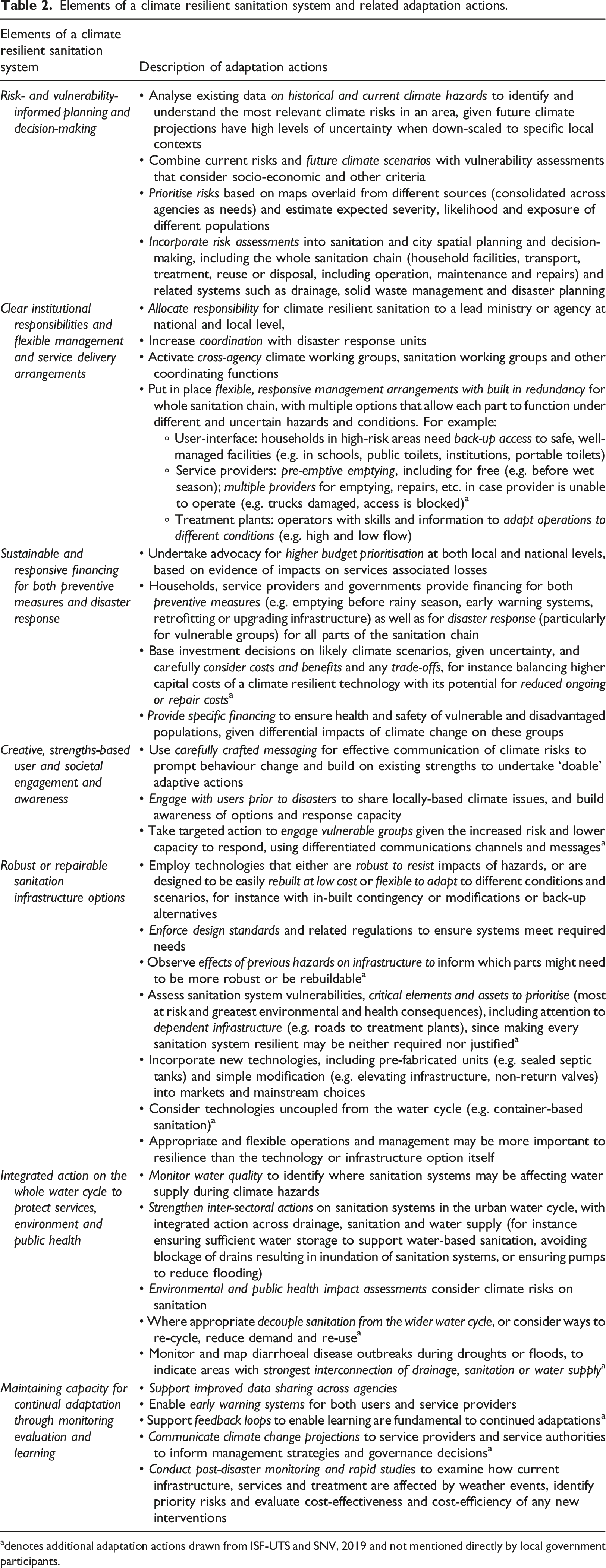
adenotes additional adaptation actions drawn from ISF-UTS and SNV, 2019 and not mentioned directly by local government participants.
Given the paucity of evidence of effectiveness of adaptation actions, continued co-production and action research is likely to be important looking forward. Literature on climate change resilience prioritises continual monitoring, learning and adaptation (Tschakert and Dietrich, 2010; Ensor and Harvey, 2015). Manipulating processes and structures, and monitoring and comparing the outcomes, can be an effective approach to learning what changes can enhance resilience (Biggs et al., 2012). This is most effectively done in a context of social learning in which stakeholders develop a collective understanding of a problem, share their perspectives and are facilitated to reflect on the available tools for achieving desired change (Ensor and Harvey, 2015). Co-production offers a means to support research and practice to work closely together to both build an evidence base and to act. As described by Schneider et al. (2019), there are three types of knowledge that are needed: (i) systems knowledge, to understand the current situation and its causes and consequences; (ii) target knowledge that helps define the norms, visions, indicators and thresholds for the desired future state, and; (iii) transformation knowledge, which clarifies how to move from the current to the desired state. All three are needed, and this knowledge must not rest in academia, but be available and embedded in the practice of local government staff to support them to address the issues they face in their cities.
Conclusion
This paper described a co-production approach adopted in Indonesia between researchers and local government staff in four cities. The findings demonstrate the potential for simplified risk assessment approaches to support local government to engage with the complexity of climate change and urban sanitation issues. The areas of perceived highest risk were prioritised, namely overflowing containment systems in floods and return to open defecation during droughts. A wide range of adaptation actions were identified by local government staff, including both current and proposed actions. These actions were both prompted by and organised against seven categories that comprise a framework for climate resilient citywide inclusive sanitation. The framework covers planning, institutions and management of service delivery, financing, user engagement, infrastructure options, water cycle integration and monitoring and learning. The co-production process yielded both concrete do-able pragmatic actions and supported constructive iteration and elaboration of the framework to provide an evidence-based summary that could provide the basis for future studies and plans. Looking forward in Indonesia, national policies could provide incentives to enable budget allocation at local level, and guide actions against these key areas.
Further efforts to use co-production to test and evaluate adaptation actions will support continued learning and adaptation in the urban sanitation sector, both in Indonesia and elsewhere. Given that society is already experiencing impacts of climate change in Indonesia and globally, there is urgency to explore actions that are practicable in the near- and long-term for city governments to offset such impacts. Without this, it will be challenging to maintain current gains in sanitation in the face of a changing climate.
Supplemental Material
Supplemental Material - Co-developing evidence-informed adaptation actions for resilient citywide sanitation: Local government response to climate change in Indonesia
Supplemental Material for Co-developing evidence-informed adaptation actions for resilient citywide sanitation: Local government response to climate change in Indonesia by Juliet Willetts, Cindy Priadi, Osha Ombasta, Dwica Wulandari, Inas Imtiyaz, Ni Nyoman Sri Natih Sudhiastiningsih, Jeremy Kohlitz, Freya Mills, and Maraita Listyasari in Environment and Planning B: Urban Analytics and City Science
Footnotes
Acknowledgements
Local government participants in all four cities are gratefully thanked for their participation in this research and we hope are benefiting from this research. In addition, UNICEF staff that supported this research in each city are gratefully acknowledged. Ethical approval was obtained by the Human Research Ethics Committee, University of Technology Sydney, (approval number ETH216538) prior to data collection, and informed consent was obtained from all respondents prior to their participation.
Declaration of Conflicting Interests
The author(s) declared no potential conflicts of interest with respect to the research, authorship, and/or publication of this article.
Funding
The author(s) disclosed receipt of the following financial support for the research, authorship, and/or publication of this article: This study was supported by UNICEF Indonesia [LRPS-2019-9153605].

Supplemental Material
Supplemental material for this article is available online.
References
Supplementary Material
Please find the following supplemental material available below.
For Open Access articles published under a Creative Commons License, all supplemental material carries the same license as the article it is associated with.
For non-Open Access articles published, all supplemental material carries a non-exclusive license, and permission requests for re-use of supplemental material or any part of supplemental material shall be sent directly to the copyright owner as specified in the copyright notice associated with the article.
