




Abstract
California’s current housing planning system is comprised of a complex housing target allocation mechanism and enforcement mechanisms to ensure that local governments effectively accommodate the development of the allocated housing units. This study illustrates the complexity in California’s planning requirements and discusses the implications for implementation. Drawing on interview data and observations of public events, this study also reveals implementation challenges perceived by front-line workers. This study contributes to the planning and policy implementation literature by addressing the implementation of complex rules in the context of top-down planning.
Keywords
Introduction
The lack of affordable and quality housing has long been a topic of concern in many economically vibrant regions in the United States. Restrictive local land use regulations over decades have contributed to a host of issues including rising housing costs, exacerbated income segregation, and reduced social mobility (Acolin and Wachter 2017; Ganong and Shoag 2017; Gyourko and Molloy 2015; Lens and Monkkonen 2016). Many states have exercised their legal power to adopt planning statutes that require local jurisdictions (e.g., cities and counties) to address regional housing needs, especially (but not exclusively) for people of low and moderate income (Ramsey-Musolf 2017). The implementation of state-led land use planning and development regulation, however, remains subject to political controversy and persistent opposition at the local level (Fischel 1992, 2001; Ihlanfeldt 2004; Infranca 2019).
This study is motivated by California’s recent efforts to strengthen its housing planning system, which involves implementing a complex array of prescriptive and technical rules. These rules primarily seek to address local regulatory constraints and compel local governments to facilitate housing development through planning and zoning. The complexity of California’s housing planning system contrasts with the approach adopted by some northeastern states. For example, Massachusetts establishes local housing targets using simple, straightforward rules—namely, that 10 percent of existing housing stock must qualify as affordable housing as defined by the state—in contrast to California’s complex process of housing needs assessment and allocation, as explained below. Prior research demonstrates the potential efficacy of the Massachusetts approach, particularly in facilitating the development and preservation of below-market-rate housing (Marantz and Zheng 2020). In contrast, the efficacy of California’s system has yet to be determined. Specifically, complex rules can create implementation challenges, such as increasing administrative burdens and causing delays in compliance.
This study seeks to understand how complex rules influence the implementation of California’s housing planning system. It employs various data sources to corroborate findings on the complexity and implementation challenges of California’s housing planning system. The analysis includes a review of the decision letters issued by the California Department of Housing and Community Development (HCD) to assess how HCD is fulfilling its enforcement responsibilities in light of the complex planning requirements. In addition, data are collected from semi-structured interviews with key informants and observations of public events related to local housing element update. This study focuses on two large coastal counties in Southern California (Los Angeles and Orange), where many jobs-rich, transit-rich communities have received the lion’s share of housing targets allocated to the region.
This study contributes to the existing debate on top-down planning and policy implementation by addressing the implications of complex rules for implementation performance. Through examining a sample of HCD’s decision letters, I highlight the complexity features of the rules and show that the prescriptive planning requirements appeared to have given HCD more influence over local planning practice. However, as reflected in data collected from interviews and observations of public events, HCD has limited ability to ensure that local governments plan and zone for the housing targets appropriately. Other implementation challenges revealed include increased administrative burdens and concerns over uncertainty in implementation. Moreover, while many of the planning rules seek to address differences in local context, the complex system could exacerbate the challenges of land use politics rather than make local governments feel more inclusive in the planning process. Simplifying the rules will not necessarily fully address these implementation challenges; nonetheless, a lengthy, complex implementation process is likely more susceptible to political wrangling, which is already a major concern in land use regulation and housing development.
The rest of this article proceeds as follows: First, I present a background on California’s housing shortage and provide an overview of the historical context and current development of the state’s housing planning system. Second, I summarize the literature addressing rule complexity and implementation in the context of urban planning. Third, I describe the data sources and research approach. Finally, I present the findings in two key aspects: rule complexity in achieving local housing element compliance and challenges in front-line implementation. This study concludes by discussing the implications for the future of housing planning in California.
Background
Housing Shortage in California
California’s housing market is one of the most expensive in the nation. In March 2022, California’s median home price reached a new record high at over $840,000—an 11.9-percent increase from a year earlier. This rise in median home price is the highest pace of increase since March 2013 (California Association of Realtors 2022). The median rent in California significantly exceeds national figures, with a two-bedroom apartment costing approximately $2,800 per month (Zillow 2024). According to the California Housing Partnership (2022), renters need to earn 2.8 times the state minimum wage to afford the average asking rent for a two-bedroom unit.
Extensive empirical research suggests that more housing supply is necessary to moderate price increases in many of California’s metropolitan areas. Using a variety of methods, researchers have estimated California’s current housing shortfall to be between 1.1 million and 3.4 million homes (Elmendorf, Marantz, and Monkkonen 2022). Figure 1 compares annual permitting in California over time (from 2002 to 2022) with the rest of the United States as a percentage of housing units in the year 2000, disaggregated by single-family units, middle housing units (i.e., units in duplexes, triplexes, and quadplexes), and multifamily units (i.e., units in structures with at least five units). Figure 1 reveals that multifamily development in California has been stagnating since 2018, particularly when compared with the rest of the United States, and the development of middle housing is stagnating nationwide. This stagnation occurred during a period when the California legislature adopted over 100 laws intended to promote infill development (Fulton et al. 2023). However, multifamily development often confronts neighborhood opposition due to various concerns, such as fears of demographic change and congestion of resources, making it challenging for infill development. As illustrated in Figure 1, at its current rate of housing production, California would need a decade to reach the low end of the housing shortage estimates and at least three decades to attain the high end.
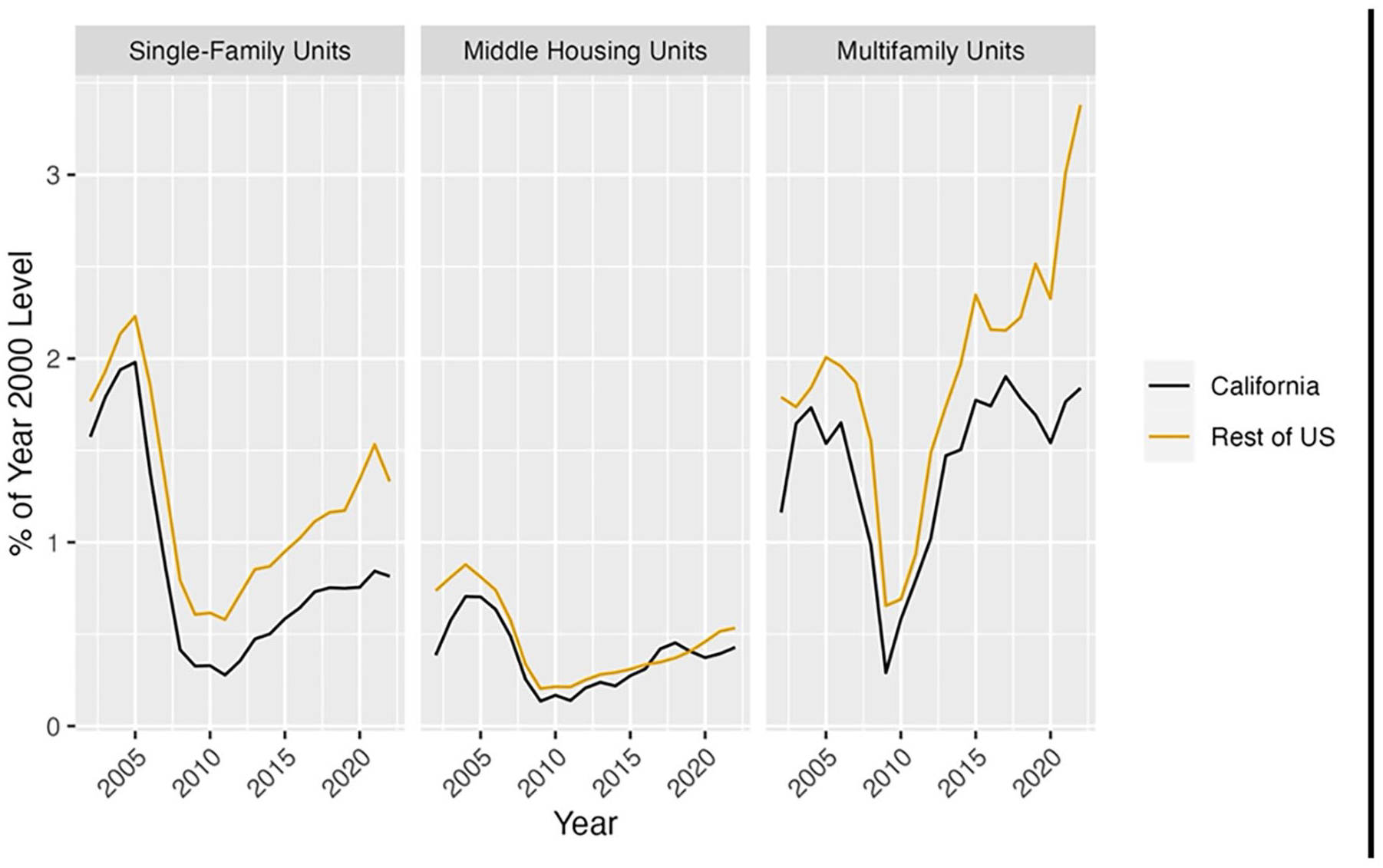
Housing units permitted in California and the rest of the US, 2002–2022.
Historical Development of California’s Housing Planning System
California has engaged in decades of state-led housing planning. Since 1969, the state legislature has passed laws requiring that all cities and counties adequately plan to meet the housing needs of people of all income levels in the community. The law, commonly known as the housing element law, mandates that housing be included as an element of each jurisdiction’s general plan, which serves as a blueprint for meeting the community’s long-term vision for the future. As policies and procedures evolved over time, debates about how prescriptive should the state be in instructing planning at the local level have continued to the present day.
The complex planning system emerged from a series of negotiated agreements between contending interest groups (Baer 1988). Following the passage of the housing element law, disputes arose over whether HCD’s guidelines were deemed advisory or mandatory (Baer 1988; Lewis 2003; Rawson 1980). As legislators sought to strike a compromise among various interest groups in the early 1980s, the basis of the present-day housing planning system took shape. This compromise inevitably introduced complexity to the system. The system recognized HCD’s leadership by mandating regular updates and submissions of housing elements for HCD review, yet in exchange for local government support, HCD’s guidelines were made advisory. To gain the support of housing advocates, the system included a housing needs assessment process to allocate fair shares of housing needs to local governments, but such allocations would be made by a council of governments (COGs) in consultation with local governments. Furthermore, the planning system met developers’ interests by setting targets for both below-market-rate and market-rate housing. Throughout the 1980s and 1990s, the state refined the processes and institutional responsibilities central to the housing element mandate.
Entering the 2000s, legislative efforts to coordinate housing planning with other regional goals, such as reducing greenhouse gas emissions, further contributed to the complexity of the housing element process (Baer 2008). These legislative efforts in part sought to address the conflicts between housing needs estimates and COGs’ other regional planning efforts such as transportation planning. Procedures to implement the housing element requirements became increasingly intricate in practice. For example, COGs must account for additional factors, such as jobs-housing balance and opportunities to increase the use of public transit, while allocating the regional housing needs to local jurisdictions. As the state’s housing problem persisted, legislative action since 2017 has focused on strengthening enforcement and giving HCD enforcement capabilities, introducing a complex array of planning requirements.
The legislative developments since 2017 will impact the sixth cycle of California’s housing planning process, as detailed below. In the prior fifth cycle, progress made by local governments toward meeting state-assigned housing targets, particularly for below-market-rate units, was minimal. Local governments permitted 44.3 percent of the total housing targets determined by the state. Specifically, only 9.4 percent of very-low-income and 13.8 percent of low-income housing targets were met. These outcomes align with extensive research that highlights a host of regulatory barriers to housing used by California cities, such as single-family zoning, burdensome multifamily development review processes, and high impact fees (Mawhorter, Garcia, and Raetz 2018; Monkkonen, Lens, and Manville 2020; Raetz, Garcia, and Decker 2019).
Current Structure of California’s Housing Planning System
The basic structure of California’s current housing planning system is illustrated in Figure 2. A key component of the state’s housing planning framework is the regional housing need assessment (RHNA) process, which determines existing and projected housing needs for every local jurisdiction in California over a typically eight-year planning period. Most local jurisdictions are currently in the sixth cycle of the RHNA process.
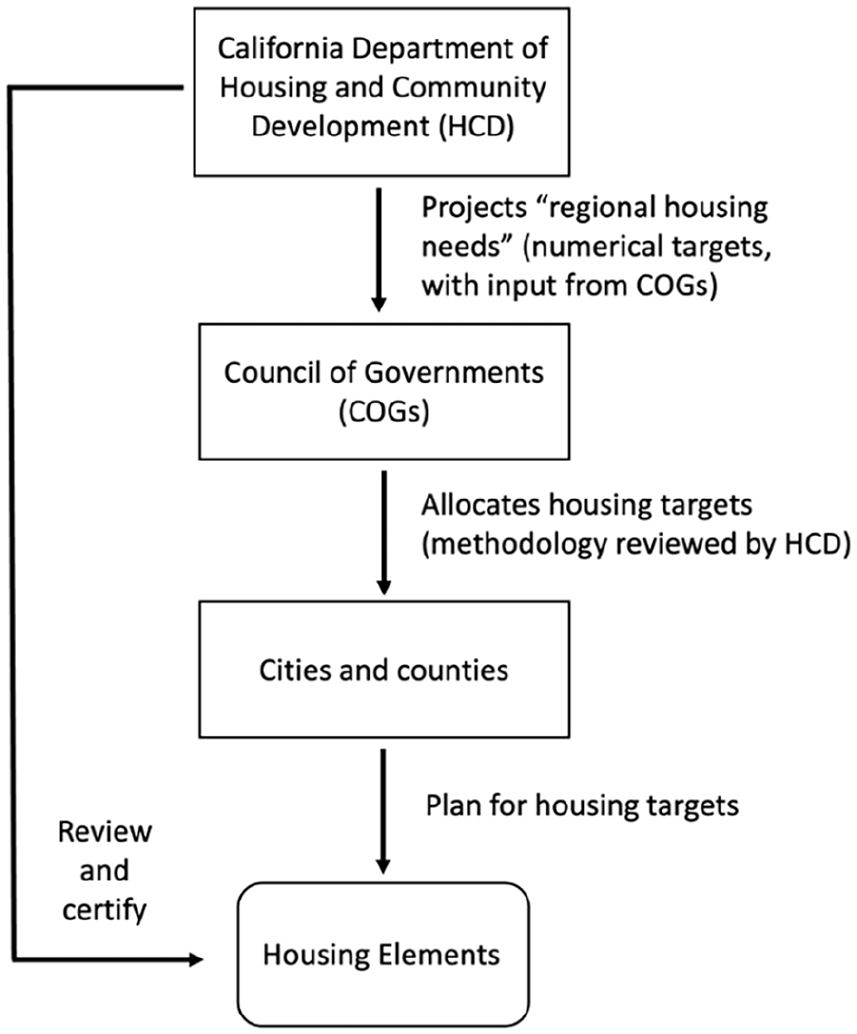
Process of housing planning in California.
The RHNA process begins with HCD providing each COGs with a regional housing needs determination. For the sixth RHNA cycle, HCD determines the regional housing needs based on factors including existing and projected households, vacancy rates, overcrowding, and cost-burden rates. While HCD typically collaborates with COGs to assess regional needs, it ultimately exercises discretion over the final determination. For instance, the Southern California Association of Governments (SCAG) formally objected to HCD’s RHNA determination for the region (over 1.3 million) and proposed the RHNA to be between 823,808 and 920,772 units. However, HCD decided not to revise its RHNA approach based on SCAG’s objection (SCAG 2019).
Upon receiving the regional determination from HCD, each COG is tasked with developing a methodology to distribute the regional need to individual jurisdictions. The allocation methodology must incorporate a list of factors outlined in state law, including, among others, local jobs-housing relationships, overcrowding, cost-burden rates, and opportunities to increase the use of public transit (Cal. Gov. Code. §65584.04[e]). The allocation methodology also distributes the regional housing needs in four income categories defined by HCD (very low, low, moderate, and above moderate). 1 After receiving the RHNA allocations, local governments must update the housing elements in their general plans to demonstrate land use capacity and strategies for accommodating the allocated housing needs.
To demonstrate their ability to accommodate the allocated targets, local governments must provide detailed analyses on a variety of housing-related topics. These include local demographic and socioeconomic characteristics, existing and future housing needs, constraints to housing preservation and development, as well as existing and prospective policies and programs. The identification of an inventory of sites to provide adequate capacity to meet the allocated housing targets comprises the most complex and technical aspect of this process. To determine whether a site can be included in the inventory, local planners must assess zoned capacity, infrastructure availability, and environmental constraints. Planners must also differentiate among various types of sites—for instance, vacant versus nonvacant, or residentially zoned versus non-residentially zoned—and apply appropriate criteria to each. Local governments must also promote the statutory objective of affirmatively furthering fair housing (AFFH) by facilitating the development of lower-income housing units outside low-resourced, high-poverty, or segregated areas. To meet this requirement, local governments must include an AFFH analysis in the housing element by evaluating the spatial distribution of the site inventory with respect to socioeconomic patterns (HCD 2021).
Lastly, local housing elements must be reviewed and certified by HCD for compliance with state law. A jurisdiction without a certified housing element faces several potentially significant consequences, such as the risk of litigation from housing advocacy groups and housing developers and a loss of eligibility for critical state and federal funding for infrastructure improvements and public amenities. Courts can impose financial penalties and a moratorium on all development and on local land use authority until the housing element is brought into compliance. Furthermore, local governments without certified housing elements are subject to the “Builder’s Remedy,” which allows developers to bypass local zoning or general plan standards and proceed with housing projects provided that at least 20 percent of the units are developed for low-income household, or all units are for moderate-income households (Elmendorf 2024).
Throughout the planning period, HCD must engage in continuous monitoring of the implementation of the policies and programs described in local housing elements. To do this, HCD promulgates “standards, forms, and definitions” that local governments must follow in preparing their annual progress reports on the implementation of the housing elements (Cal. Gov. Code §65400). HCD has the authority to decertify a housing element during the planning period if it finds that the local government fails to implement the program actions from its housing element, such as rezoning before the specified deadline. Recent legislation also expands HCD’s enforcement authority to refer noncompliant jurisdictions to the State Attorney General’s Office for potential litigation.
In summary, the latest cycle of California’s housing planning process greatly differs from previous cycles. First, the RHNA numbers from HCD are markedly higher for some regions. For example, the SCAG region received a total RHNA of over 1.3 million, which is more than tripling the number from the previous cycle. Second, HCD now possesses enforcement authority, moving beyond simply issuing advisory guidelines. Scholars and housing advocates suggest that, with stronger state leadership and strengthened enforcement mechanisms, state housing administrators, housing advocates, and city officials could better leverage state planning standards and requirements to spur housing development (Elmendorf et al. 2020a, 2020b). Recent research has shown mixed results for the efficacy of California’s strengthened housing planning system (Zillow 2024). Monkkonen et al. (2023) analyzed rezoning commitments in 209 municipalities in southern California and found that higher housing targets are associated with more rezoning; however, cities with more expensive housing and non-Hispanic white residents continued to receive lower allocation targets relative to existing stock. In a later study, Monkkonen et al. (2024) examined the zoning and housing elements in three cities that vary in income diversity—one in Orange County and two in Los Angeles County—and found exacerbated patterns of economic segregation.
Literature
Conceptualization of Rule Complexity
The efficacy of rules in part depends on how the rules are communicated. Legal scholars have suggested that simplicity is one important attribute of well-crafted rules (Diver 1983). Schuck (1992) suggests that complexity in rules can be discerned through four attributes: density, technicality, indeterminacy, and institutional differentiation. The first three attributes focus on the characteristics of rules, while the last feature pertains to the rulemaking process. Complex rules are dense, often characterized by their sheer volume and specificity, seeking to control many different implementation activities and processes (Mahoney and Sanchirico 2005). Specific rules, as opposed to general ones, may be designed to account for and govern each step in the implementation process and establish requirements to address different scenarios. Complex rules are often technical, requiring expertise to understand and implement. One common source of technical rules is the attempt to pursue rules tailored to specific context, demanding tasks that involve intensive data collection and analysis (Kaplow 1995; Mahoney and Sanchirico 2005). Complex rules also tend to be indeterminate (i.e., difficult to apply unambiguously) and thus create uncertainty in the implementation process. Finally, complex rules can be institutionally differentiated as a result of the rulemaking process. Schuck (1992, 4) define that such rules “draw upon different sources of legitimacy, possess different kinds of organizational intelligence, and employ different decision processes for creating, elaborating, and applying the rules.”
Drivers of Rule Complexity
Rules may become complex due to two primary reasons: (1) In certain cases, complexity is necessary as rules become denser and more technical to address specific issues, and (2) a certain level of complexity can be beneficial, offering advantages that simpler rules might not provide. The evolution of California’s housing planning system illustrates the first point. The system’s intricacies stem from legislative efforts to reconcile the needs of diverse stakeholders, along with attempts to address poor implementation outcomes over time. As described earlier, the lack of enforcement mechanisms in California’s previous planning cycles has led to low attainment of the RHNA targets. As a result, legislative amendments since 2017 aimed to strengthen the system, introducing an array of rigid and technical rules.
Second, rules tailored to individual contexts tend to be more complex (Kaplow 1995; Mahoney and Sanchirico 2005). For example, in optimizing tax incentives and improving the targeting efficiency in need-based aid programs, complexity arises from the need to improve the precision of rules, such as in measuring taxpayers’ ability to pay and in targeting groups that are truly in need (Abeler and Jäger 2015; Dynarski and Scott-Clayton 2006; Kleven and Kopczuk 2011). In the context of state-led planning, tailoring rules to address local variations can potentially make the planning process more inclusive of local governments. In California, while the state maintains control over determining regional housing needs and assessing the adequacy of locally prepared housing plans, there are also efforts to incorporate local government input. This is reflected in authorizing COGs to develop the methodologies for allocating housing targets—which are subject to a vote by the local jurisdictions within the region—and in enabling local governments to identify sites suitable for future housing growth and devise local programs to facilitate housing development. However, it is important to note that complexity alone does not ensure a more inclusive planning process. As previously mentioned, excessively complex rules may be difficult for local governments to navigate.
Implementation of Complex Rules
Although complex rules may be necessary or beneficial, they could hinder implementation, diminishing the efficiency and stability of a top-down system (Buitelaar and Sorel 2010; Ha et al. 2020; Leyden et al. 2017; May and Jochim 2013; Moulton and Sandfort 2017; Provan and Kenis 2008). The housing planning system adopted by California has a centralized structure in which state housing agency centralizes key operations and decisions, including the determination of the number of housing units to plan for and the assessment of whether locally prepared housing plans adequately address the allocated housing needs. Literature on network governance suggests that, compared to a decentralized structure, a centralized structure could provide greater administrative efficiency (i.e., achieving a desired outcome with minimal administrative burdens) and stability, which is crucial for reducing uncertainty and developing consistent responses to stakeholders (Provan and Kenis 2008).
Complex rules could undermine administrative efficiency and stability (Moroni et al. 2018; Schuck 1992). As discussed in the study by Schuck (1992), it is generally more difficult to gain agreement upon complex rules. Furthermore, myriads of standards and requirements could give rise to legal uncertainty (Buitelaar and Sorel 2010). Complex rules also risk losing their intelligibility to stakeholders and the public. Studies of public assistance programs find that the use of detailed eligibility criteria and rigorous documentation often leads to complexity and administrative hassles that may reduce program participation among intended recipients (Dynarski and Scott-Clayton 2006; Kleven and Kopczuk 2011). Simple rules, on the other hand, are easier for the target group to understand to realize how to achieve compliance and for those charged with enforcement to detect violations (Epstein 1995; Schuck 1992; Sutter 1998). Such simplicity reduces uncertainty with respect to implementation processes (Buitelaar and Sorel 2010; Christiansen and Kerber 2006).
Research Approach
Study Area
The assessment of early implementation outcomes focuses on two large coastal counties (Los Angeles and Orange) in the SCAG region. SCAG is the largest Metropolitan Planning Organization (MPO) in the United States and represents six counties and 191 cities. 2 HCD assigned the region over 1.34 million units for the upcoming 2021 to 2029 planning period—a regional target more than three times the one previously assigned. In March 2020, SCAG adopted its final allocation methodology. In the past, the lion’s share of the housing targets was allocated to communities in inland counties with relatively limited access to jobs and transit. For the 2021 to 2029 planning period, SCAG distributes the housing targets primarily based on projected household growth, job accessibility, and transit accessibility. 3 As a result, SCAG allocates much higher housing targets to the region’s two coastal counties—Los Angeles and Orange—where many jobs-rich, transit-rich communities are located.
Data
This study draws on various sources of data to corroborate findings on the complexity and implementation challenges of California’s housing planning system, including interviews, observations of public events, and HCD’s comments on submitted draft housing elements. This section organizes the data into two sets and provides a description of each. The first set includes data collected from interviews and observations, as summarized in Table 1. The second set consists of HCD’s decision letters for a sample of local jurisdictions in the study area that had their housing elements certified as of August 2022, as described in Table 2. (Note that the local jurisdictions listed in Table 2 are not necessarily the same ones that were interviewed, as the identity of interviewees is to be kept confidential.)
Agency Sample for Interviews and Observations of Public Events.

Note: Table shows the number of jurisdictions that author interviewed or observed in public events. In some instances, author attended multiple public meetings for the same jurisdiction.
Local Jurisdictions with Housing Elements Certified as of August 2022.

Source: Southern California Association of Governments (n.d.). Total population comes from 2020 Census Demographic and Housing Characteristics File.
Table 1 provides a summary of the sample that I interviewed and observed in public events. Between September 2020 and August 2022, I collected data through a total of twenty-four semi-structured interviews with key informants. I conducted eighteen interviews with local planning staff from eleven jurisdictions in Los Angeles County and seven jurisdictions in Orange County, all of which had begun the housing element update process at the time of the study. 4 The rest of the interviews include: one with staff from HCD, one with staff from SCAG, and four with housing advocacy organizations. All interviewees from public agencies serve as the staff lead for tasks related to the housing element process.
During interviews, I asked interviewees questions pertaining to their understanding and thoughts about the allocation methodology and how they think the new state requirements would affect the implementation process within their jurisdiction (or advocacy strategies in the case of housing advocates). Interviews lasted anywhere between 45 and 120 minutes and were recorded with permission.
In addition, I collected data through observing public events. 5 I attended forty-six public meetings in thirty-two local jurisdictions, all hearings on local jurisdictions’ appeals to SCAG challenging the RHNA numbers, and three SCAG public meetings on Stakeholder Input on RHNA Reform. Local jurisdiction can file an appeal to challenge the housing targets allocated to itself or to another jurisdiction, and the appeals are heard within each region. Local jurisdictions must follow a standard administrative procedure to file their appeals. 6 Such appeals can be filed based on three categories of reasoning: application of the RHNA methodology (but not the methodology itself), local planning factors and information related to AFFH (e.g., sewer or water infrastructure constraints, overcrowding rates, etc.), and changed circumstances. In the previous planning cycle, only fourteen cities in the SCAG region filed appeals challenging the housing allocations, and none was approved. In this cycle, a total of fifty-two appeals from forty-nine jurisdictions were filed with SCAG. 7 Within the study area, eighteen out of thirty-four cities in Orange County and twenty-four out of eighty-eight cities in Los Angeles County had appealed. None of the appeals from Orange County prevailed, and one appeal from Los Angeles County was partially granted. 8
The sample of local jurisdictions from which the data are drawn from is likely to have an overrepresentation of jurisdictions that are aware and vocal about the state planning requirements. As described in Table 1, compared to the study area (Los Angeles and Orange Counties), the interviewed sample has a higher share of jurisdictions in Orange County and of jurisdictions with total RHNA numbers above 10,000 housing units. The composition of the sample is in part due to the time frame of the study, during which less than half of the local jurisdictions had begun the housing element update process. Jurisdictions that were resistant to the targets or anticipated substantial changes to local land use were likely to begin the housing element process early and engage in the appeals process.
Lastly, for local jurisdictions of Orange and Los Angeles Counties that have their housing elements certified as of August 2022, I examined HCD’s decision letters they received as well as their housing element drafts and revisions. For each housing element submission, HCD’s decision letter details the components of the housing elements that deemed inadequate. As of August 2022, which is almost ten months after the initial statutory deadline for the SCAG region (October 2021), only 21 out of 197 local jurisdictions have their housing elements certified by HCD. Of these twenty-one jurisdictions, two are from Orange Counties, and nine are from Los Angeles County. As shown in Table 2, these jurisdictions vary in their RHNA allocations and their responses to the allocations (e.g., decision on filing an appeal). The housing target allocations for these jurisdictions range from 142 to 456,643 units. Three cities (Irvine, Yorba Linda, and San Gabriel) had filed an appeal requesting a reduction on the allocated targets. Each jurisdiction revised the housing element at least two times in order to obtain certification from HCD.
Coding of Data
Data drawn from all sources were reviewed through an iterative process (Denzin and Lincoln 2011). To understand how HCD interprets and applies state planning requirements, I first coded HCD’s decision letters along the topics deemed inadequately addressed by HCD (e.g., housing needs, resources, and constraints). HCD follows a checklist of topics outlined in state law 9 to scrutinize local housing elements. This coding stage reveals that in many instances, HCD indeed researched and raised issues that are unique to local conditions. The coding results also highlight two complexity features of the planning rules: rule density and technicality.
Data collected from interviews and observations of public events reveal implementation challenges on the ground. I first coded the data along general categories, including the perceived rationales for the new allocation methods and state requirements, the current and anticipated challenges and opportunities, and the tasks and strategies deployed and underway. In later iterative reviews of the data, I linked the implementation experience and perspectives to different aspects of implementation performance (e.g., administrative efficiency). This analysis is not to identify implementation challenges caused by rule complexity per se but to understand how complex rules promote or undermine various aspects of implementation performance.
Findings on Rule Complexity in Housing Element Compliance
An important aspect of implementing California’s housing planning system is HCD’s review and certification of local housing elements. HCD’s decision letters illustrate the complexity of the planning rules and provide a better understanding of whether such complexity has given HCD more influence over local planning practice.
Dense and Technical Rules
The two complexity features that stand out are the density and technicality of the planning rules. State law provides a large volume of planning rules that cover a wide range of local planning activities, many of which require technical analysis. In all initial review letters to the eleven jurisdictions, HCD made detailed comments on local jurisdictions’ analysis of housing needs and constraints to development, methodology for determining the realistic capacity for future housing development, sites identified as suitable to accommodate new housing, and program actions to address housing needs and facilitate housing development.
HCD rigorously examines the housing elements submitted by local jurisdictions, focusing particularly on their AFFH analysis, site inventories, assessments of constraints on housing availability and affordability, as well as metrics and actions specified in their housing programs. Many of the state requirements are specific and prescriptive. Specifically, for each jurisdiction in the sample, HCD identifies the types of missing data and evidence needed for justifying the suitability of sites and the realistic capacity assumptions. To adequately address HCD’s comments, planners must go beyond estimating development capacity based on historical trends; they must include a detailed listing of previous developments with similar density and affordability levels and examine variables that might influence current trends. HCD does not merely reference statutory requirements related to the utilization of different types of sites (e.g., nonvacant sites, large sites, etc.). It carefully reviews the sites listed by local governments and calls out sites that have not been convincingly shown to possess adequate capacity for development. Furthermore, HCD verifies local jurisdictions’ assumptions on accessory dwelling unit development against its own records of past development trends. If discrepancies occur, HCD requires local governments to reconcile the figures.
For each of the eleven jurisdictions, HCD also raises issues that are unique to local context based on either the housing element or HCD’s own research. These issues, to name a few, include the spatial distribution of the identified site inventory, the utilization of existing faculty and student housing toward RHNA progress, and the protection of affordable housing in coastal zones. Overall, these letters illustrate a complex array of state requirements. Moreover, many of these requirements are data-intensive and involve technical analysis. In practice, only a small number of local jurisdictions in Los Angeles and Orange Counties have their housing elements certified by HCD by the statutory deadline.
State Influence over Local Planning Practice
The housing element certification process illustrates that HCD has transitioned from an advisory function to a role with greater impact on local planning practices. In response to HCD’s evaluations, three out of the eleven jurisdictions in the study have implemented changes to increase the capacity of their site inventories: One jurisdiction added new sites, one reduced the number of projected accessory dwelling units (ADU), and one removed over 4,000 units that were initially credited toward its RHNA progress. For each jurisdiction, HCD also assesses the housing programs outlined in the housing element based on its findings on AFFH analysis, site inventory, constraints on housing supply, and affordability. If these evaluations reveal potential obstacles to housing development, HCD requests that local governments incorporate programs to address the barriers. Furthermore, HCD identifies programs that lack specific language and requires revisions to include explicit timelines and concrete actions.
Some of the complex rules have the potential to bring positive changes to local planning processes. For example, HCD’s demand for credible calculations of realistic site capacity for housing development—although technical and data-intensive—can help prevent local jurisdictions from designating sites that are unlikely to be redeveloped as suitable for new housing. Similarly, challenging the ADU development assumptions could prevent local jurisdictions from overstating their ADU numbers, which can be credited toward the RHNA targets. Amid the myriads of rules, certain straightforward “safe harbor” provisions exist to help local jurisdictions comply with specific aspects of state laws. For instance, the default densities provided in state laws are widely used by the analyzed local jurisdictions. The default densities ensure that sites designated as suitable for the development of below-market-rate housing allow a reasonably high density, while lowering the administrative and analytic burdens on HCD and local jurisdictions.
The data also suggest that the state’s top-down planning system seeks to ensure that local input is incorporated. HCD instructs local jurisdictions to analyze demographic and housing conditions unique to local context. In addition, HCD evaluates the extent of the local governments’ outreach to all community segments. However, local jurisdictions address HCD’s comments largely by providing detailed accounts of prior public engagement, such as detailing the language and culturally inclusive approaches used, explaining the integration of public input into the housing elements, and ensuring that revisions are accessible to the public. Often, these engagement efforts (e.g., study sessions and community workshops) occurred prior to the initial submission of the draft housing element. Consequently, HCD’s examination of local outreach does not necessarily result in a marked expansion of public engagement at the local level.
Following the certification of housing elements, HCD and local governments continue to face uncertainty in the implementation process. In each certification letter, HCD highlights a list of program actions included in the housing element, serving as a reminder that local governments are obliged to monitor and report on these policy outcomes. HCD can revoke housing element compliance if local government actions are found to be non-compliant with state law. Therefore, obtaining housing element compliance is just the beginning of the local planning process. The capability of local jurisdictions to execute programs and policies within the established timelines remains in question. Losing the compliance status during the planning cycle might create setbacks in addressing housing needs. Indeed, state lawmakers already came to conclude that certain actions such as rezoning are time-consuming processes. Initially, local governments that failed to have their housing elements certified by HCD by February 11 of 2022 must complete the needed rezoning by October 15, 2022. Numerous cities said it would be impossible for them to complete the rezoning process, which includes public hearings and environmental reviews under the California Environmental Quality Act. In response, state lawmakers approved a three-year rezoning extension in June 2022, applicable to jurisdictions in the SCAG, San Diego, and Sacramento regions.
Findings on Challenges in Front-Line Implementation
Interviews with key informants and observations of public events further reveal implementation challenges related to administrative efficiency, addressing local context, and legal uncertainty perceived by different stakeholders. These challenges are expressed as current and ongoing implementation experiences, as well as concerns and uncertainty about further changes to the system. These challenges are also reflected in the discussions and debates taking place in different types of public events such as public hearings, city council and planning commission meetings, and housing advocacy meetings.
Administrative Burdens on HCD and COGs
The literature suggests that centralizing key operations and decisions can potentially benefit from administrative efficiency. However, the complexity of rules may significantly increase administrative burdens. Such predicament is reflected in the data.
The increased administrative burdens due to complex requirements in state law are reflected in two responsibilities of HCD: (1) evaluating and certifying local housing elements, and (2) monitoring the progress and actions of local jurisdictions in implementing the policies and programs stated in their housing elements. A state official described the process of certifying housing elements as “progressive discipline,” in which HCD’s involvement begins long before the submission of housing elements. Specifically, HCD staff need to provide technical assistance for updating housing elements, engage in problem-solving with local governments on difficulties surfaced in the update process, issue letters of violations if local jurisdictions fail to adequately address the planning requirements, and finally, make a decision on certification. The lengthy administrative process is needed because a housing element is a complex and technical document, for which local officials must navigate myriads of planning rules. HCD must provide local governments with timely clarification and an analytical review for a completed housing element.
HCD also faces challenges in its ongoing monitoring of whether local actions (e.g., rezoning) are consistent with the housing elements. The data reveal that HCD’s action in monitoring local compliance has primarily been reactive and complaint-driven, and that it relies on inputs from stakeholders such as housing developers and advocates. An interviewee from HCD mentioned several supplemental strategies such as keeping track of jurisdictions with a conditionally approved housing element and utilizing the annual progress reports to identify jurisdictions that have failed to implement the identified programs to meet housing targets. However, HCD has limited capacity to ensure that local governments plan and zone for the housing targets appropriately. As described by the interviewee, “because we cannot ground-truth everything in the housing element, we rely very strongly on stakeholders to tell us what’s up.”
COGs that developed a complex, multiple-criteria allocation method also face a moderate level of administrative burdens. As an interviewee from SCAG noted:
I think we do have the capacity and staff, just because we have the modeling staff, data analysis staff, [and] research staff, and because we already do our transportation planning . . . But this time, [with] the more complicated formula, [the challenge is] explaining it to the decision-makers and getting them comfortable enough to vote on it. That’s beyond just staff work to develop it.
Therefore, at least in the case of a larger COG, the administrative burdens stem less from issues of capacity and staff competency but more from the challenge of ensuring that all member jurisdictions understand the methodology.
These findings suggest that both HCD and COGs face increased administrative costs associated with the complex rules established in state law. In particular, the presumed administrative efficiency from a centralized approach in California’s housing planning system is considerably compromised. HCD must invest considerable efforts to ensure that local governments produce meaningful housing plans, but these efforts do not guarantee that more housing will be built. These findings are also consistent with the expectation that regional planning agencies are suited to tasks requiring high levels of competency and expertise. Nevertheless, larger COGs—such as SCAG—will likely confront challenges related to stakeholder engagement. Consistent with the study by Barbour, Newmark, and Deakin (2011) on California’s experience in determining regional targets for greenhouse gas emission reductions, the present analysis suggests that technical target-setting processes often present a high bar for stakeholder scrutiny because the data and methods are complex and not easily interpreted.
Limited Effectiveness in Addressing Local Context
California’s housing planning system instructs local governments to develop their own housing plans and requires COGs to incorporate local input into the development of allocation methodologies, providing opportunity for addressing local context. While these efforts may complicate the rules, the added complexity could be warranted if the top-down planning process becomes more inclusive of local communities. Despite this intention, the data reveal mixed views on whether inclusive decision-making is promoted in California’s housing planning process. Inclusive decision-making, in this context, means that state and regional policies and requirements reasonably account for local governments’ circumstances and ability to meet the requirements (e.g., within a feasible timeline), or that state planning requirements promote public outreach and engagement at the local level.
The data reveal mixed views on whether the top-down requirements, particularly those within the RHNA process, can reasonably account for local context. During interviews and public events such as SCAG’s Stakeholder Input on RHNA Reform workshops, some local government participants spoke of SCAG’s efforts in incorporating a wide range of factors in developing a housing allocation methodology for the region. Nevertheless, due to state-assigned regional targets for the upcoming planning period being significantly higher than those in the past, many local governments expressed that these targets present a considerable challenge. Moreover, with new enforcement mechanisms that have been instituted by state laws, the housing targets allocated to local jurisdictions could greatly influence their housing plans in the new planning cycle. As a result, the distribution of regional targets became a contentious issue in the SCAG region. Some interviewees commented on the rationale for a multi-criteria allocation methodology; however, there was little consensus on how to properly construct one.
A complex methodology that incorporates various variables of local conditions may not be universally viewed as an effective way of addressing local context in allocating the housing targets. As one interviewee commented:
I think that from a mathematical or a statistical perspective, you need to have that complexity because planning for housing isn’t a one-variable equation . . . I think the complexity isn’t necessarily the question. It is more of . . . (paused), it is also what other people have said that the local planning process is not incorporated into that equation.
While most interviewees agreed with the principle of steering housing developments toward areas with job access and transit, many felt that the allocation method did not adequately reflect the housing needs or capacities of their communities. Such arguments were made in the formal appeals filed to SCAG. Jurisdictions listed reasons related to geographic constraints, lack of transit and other infrastructure, hillside fire hazards, concerns about historic preservation, and impact of the COVID-19 pandemic. Thirty-eight out of the fifty-two appeals filed disputed the allocation methodology and its application. The appealing jurisdictions were contentious in the appeals and were frustrated that their local conditions were not adequately considered.
Moreover, jurisdictions that did not appeal did not necessarily agree with the allocated targets. Some interviewees expressed that an appeal was not worth pursuing because the chance of a successful appeal is low or because their housing targets are relatively low compared to the numbers their neighboring communities have received. As one interview described:
The lack of appeal . . . just means that we looked at the process to appeal and the likelihood of the appeal being approved relative to our number compared with other communities, and we made the decision at that time not to file an appeal . . . I wouldn’t say, you know, the community or the Council or staff are comfortable or good per se with the RHNA number.
Lastly, local government interviewees expressed feeling constrained by the high housing targets and the stringent criteria for determining suitable sites for future housing development. While many local governments maintain geodatabase of parcels within their jurisdiction, they must go beyond listing parcels considered appropriate for housing development. As noted earlier, HCD meticulously reviews the site inventory submissions. HCD frequently questions the local assumptions of development capacity and requests analyses and evidence of redevelopment potential for nonvacant sites. Such scrutiny demands analysis of various factors—including existing land use, the age of structures, property values, and ownership patterns—to explain why these sites are primed for development. Larger jurisdictions, in particular, highlighted the impracticality of conducting individual research on each site. One interviewee mentioned that its jurisdiction used past permitting data to project future development patterns. However, roughly 60 percent of interviewees from local jurisdictions reported ongoing struggles with meeting the planning standards and requirements for the site inventories. These challenges underscore the difficulties in meeting technical, data-intensive requirements.
Some complex tasks are time-consuming in nature. Interviewees generally anticipated that their jurisdictions need to rezone some properties to allow for higher residential density; however, some of them cited local constraints that may make it difficult to complete the rezoning within the statutory timeline. These constraints, among others, include local voter initiatives that place restrictions on building height and density and the additional process of Coastal Commission approval in some communities.
Overall, the findings suggest that addressing local context by providing opportunities for local input is intrinsically difficult to achieve. In practice, an enforceable mandate may be necessary to ensure that local governments meet regional housing needs. Housing advocates largely agree that complex planning rules, particularly those considering realistic development capacity, are essential for addressing the state’s housing shortage. However, the data reveal a number of implementation challenges for local jurisdictions. The involvement of COGs in the intraregional housing allocation process brings needed expertise and capacity to develop the multi-criteria allocation methodology required by state law. Yet, even with the inclusion of a wide range of local factors, the housing allocation process may not yield RHNA numbers that local governments feel are suitably tailored to their unique conditions. The goal of achieving an inclusive process is partly undermined by fact that COG’s decision-making is nested within a top-down planning process. As one interviewee noted, “SCAG was given such a huge number from the state that . . . it just got pushed around to different jurisdictions.” Although a multi-criteria allocation method is conceptually attractive, its actual application has proven to be highly contentious, giving rise to concerns about measurement errors and transparency.
Undermined Certainty
The complexity of the planning system, characterized by the intricate RHNA process and the stringent rules for developing local housing plans, introduces uncertainty in the housing planning process. Because each COG is charged with devising an allocation method for its region, there are significant variations in allocation methods across the state. As noted in field observations, some housing advocates raised the concern that the lack of a standardized, statewide allocation mechanism could result in an inequitable distribution of housing targets. As the housing targets were being finalized in the SCAG region, housing advocates sued HCD over the regional targets determined for the nine-county Bay Area region, stating that the state agency failed to adequately consider the number of jobs in the region (Schneider 2021). These legal challenges introduce additional uncertainty to the already tight housing planning time frame under state law.
Interviewees expressed concerns about the increasing number of housing bills being passed. One interviewee noted, “they just keep changing the law all the time.” For local governments, the challenges stem in part from the need to understand and comply with numerous new state requirements all at once. Interviewees anticipated ongoing changes in the regulatory landscape. While they are generally well-informed about the state requirements and following the housing legislation that is moving forward, this is not necessarily the case for many stakeholders. As one interviewee noted:
I don’t think that all of the cities realized, with all the new laws, how much environmental review might be required. Some of our cities are going to require quite a bit of rezoning, which then transforms into a very expensive environmental review process.
The uncertainty about what to expect from the new planning requirements is also evident in ongoing public discussions. From attending a sample of public meetings in March 2021—approximately six months before housing element due date for the SCAG region—I observed that members of several local legislative bodies and planning commissions were just beginning to learn about these rules. Communities that started the local planning process later may find themselves particularly susceptible to the legal uncertainties that the new rules introduce.
Conclusion
California has been engaged in state-led housing planning efforts for decades. Recent legislative changes have introduced rules prescribing new housing target allocation mechanisms and planning standards, enforcement provisions, and procedures to enable inclusive engagement. This study shows that HCD has exerted more influence in local planning practice. Drawing on insights from interviews and public event observations involving a wide range of stakeholders, the study reveals both positive developments and implementation challenges in California’s housing planning system, affecting state housing administrators, regional planners, and local elected officials and planners.
There are rationales for introducing some complexity to the system. Commentators and housing advocates contend that certain aspects of the complexity, such as the consideration of realistic development capacity in local housing elements, are crucial to addressing the state’s housing shortage. Furthermore, given the political significance of local land use and development regulation, it is also beneficial to enable meaningful stakeholder engagement and inclusive planning processes (Tighe 2010). One strategy involves creating opportunities for stakeholder input and tailoring some standards and requirements to different circumstances of the regulated entities. Such efforts are reflected in the housing allocation process, which allows different regions to devise their own allocation methods and local jurisdictions to provide input and to appeal their housing targets. In addition, the current housing planning requirements have encouraged more extensive communication among implementation actors at state, regional, and local levels, spurring broader conversations and debates on how to address housing needs.
However, moving beyond the aspiration of effectively incorporating local context in state-led planning, this study highlights multiple implementation challenges. There are considerable administrative burdens affecting various levels of government differently. For HCD, enforcing a range of requirements may potentially increase its influence on local planning. Nevertheless, HCD’s ability to ensure that local governments appropriately plan and zone for the housing targets is limited. This is because HCD cannot verify every aspect of local housing elements on the ground, and it remains unclear how HCD can effectively monitor the implementation of local housing policies and programs. For COGs, a primary challenge is ensuring that member jurisdictions understand and reach agreement on a complex multi-criteria method for allocating housing targets.
The complex requirements for updating housing elements could lead to equity issues among local jurisdictions. Local governments across the study area vary greatly in resources, with poverty rates ranging from under 5 percent in affluent cities like Manhattan Beach and South Pasadena to over 20 percent in cities such as South El Monte and Bell. Wealthier cities may be able to leverage their economic resources to meet state planning requirements more easily, such as by hiring consultants from the start. Although this study does not provide empirical evidence on the relationship between local resources and the ability to comply with rigorous state mandates, it highlights a critical area for future investigation.
The added complexity in rules that seek to incorporate local government input can be susceptible to political wrangling. This is particularly evident in the process of developing a multi-criteria method for allocating the RHNA targets. As noted in the study by Monkkonen et al. (2023, 20), “places presumably resistant to growth continue to successfully game the system and receive relatively lower targets.” Furthermore, there is no universally optimal model to account for the myriad local conditions, and mathematical formulas can reflect the biases of their creators and the processes by which they are created. While the importance of local input remains undeniable, recent research suggests that the current RHNA allocation mechanism could benefit from simplification (Zheng et al. 2021).
Simplification would also benefit other areas of California’s housing planning system. One potential improvement involves requiring local jurisdictions to set presumptive densities for each Housing Element site and to establish these presumptive densities as prevailing against existing land use standards in zoning ordinance and general plan. The presumptive density should reflect the number of units that a jurisdiction intends to have on a given site, thereby reducing ambiguity. This approach could lessen the administrative and analytic efforts needed to assess realistic site capacity for both HCD and local governments. Another potential reform would empower HCD to determine local compliance using quantitative benchmarks, such as progress toward building the housing targets. Currently, local jurisdictions are required to report the number of new housing units entitled in their annual progress reports, but such information is not used as the basis for determining compliance. Simplifying the housing allocation methods and evaluating local compliance based on quantitative benchmarks could significantly streamline the processes of housing needs allocation and compliance determination. This would enable local jurisdictions, developers, housing advocates, and residents to more easily assess the compliance status and make progress within their communities.
There are several limitations of this study that can be addressed in future work. The findings pertaining to implementation challenges at the regional and local levels are based on data that reflect the experience in the SCAG region and in a sample of local communities in two high-cost Southern California counties. Furthermore, compared to the study area, the local jurisdictions that I interviewed and observed in public events have an overrepresentation of jurisdictions with large housing allocations and from Orange County. Political opposition to housing development is likely strong in many of these localities, and implementing state-led housing planning is inherently challenging. However, as discussed earlier, a complex system leaves more room for lobbying and conflict. On the other hand, the politics surrounding state planning mandates as well as the implementation experience could be different in communities where land is relatively abundant and the housing markets are less competitive. The findings are also tempered by the time frame of the analysis. As discussed earlier, future study should examine how funding and resources (or the lack of) affect local governments’ ability to meet state planning mandates. Future analysis should also examine variations in implementation experience among different regions in California to obtain a more thorough picture of the factors that facilitate and inhibit implementation and their influence on achieving state policy goals.
Footnotes
Declaration of Conflicting Interests
The author(s) declared no potential conflicts of interest with respect to the research, authorship, and/or publication of this article. The opinions and views expressed are those of the author’s and do not reflect the policies and position of SCAG.
Funding
The author(s) received no financial support for the research, authorship, and/or publication of this article.
