




Abstract
Performance-based planning (PBP) is an approach to regulatory planning that aims to achieve strategic objectives without mandating how those objectives are achieved. After more than twenty years of use in Australia, there has been little consideration of planners’ views of PBP. We survey planners about PBP and find that while there is in-principal support, considerable challenges are involved in successful implementation. Our findings highlight the conflicted and politicized landscape in which planners operate and indicate that the specific mechanisms used to deliver planning outcomes are perhaps less important than matters of trust, professionalism, and deliberative processes of plan development.
Background and Introduction
Over the past forty years, the broad socio-economic conditions under which urban planners work have changed significantly (Harvey 2005; Theodore, Peck, and Brenner 2011). Urban planning has become less about “correcting and avoiding market failure” and more about “how best to activate the market and facilitate development” (Steele 2009, 191). In negotiating this shift, planners may not always be aware of the tension between the aims of this “market liberalisation” approach and those of urban planning as an activity of government. While there has been a move toward freer markets (Brenner and Theodore 2002) with less centralized public regulation such as urban planning, markets also rely on land use regulation to provide certainty for property values and development opportunities against the potential negative influences and externalities of an unrestrained property market (Tait 2011; Taşan-Kok 2012). In practice, a mixture of market liberalization policies, state-based market interventions, private sector development, and a range of existing/historical institutional conventions interact (Burton 2014; Gleeson and Low 2000; McGuirk 2005; Ruming 2005; Sandercock 2005; Tonts and Haslam-McKenzie 2005).
In Australia, the market liberalization approach has introduced more flexibility into the assessment of proposed development, opening the way for more proposals to be assessed on their impacts (functions and intensity) rather than prescriptive standards such as in traditional Euclidian zoning plans (Baker, Sipe, and Gleeson 2006; England 2010). This so-called “performance-based planning” (PBP) had gained influence in the United States and more recently in New Zealand. In Australia, PBP was adopted in Queensland in 1998 but proved to be difficult to administer in its pure form and has since been “hybridized with traditional zoning” (Baker, Sipe, and Gleeson 2006, 296).
Scope of This Paper
This paper examines the hybridized form of PBP adopted by the Queensland Government in Australia, drawing on the attitudes of current Queensland urban planners. The first section of the paper provides historical context and focuses on the evolution of the state’s statutory development assessment (DA) system from a Euclidian system to a form of statutory PBP beginning in 1998 and continuing to the present. We also review critiques of this evolving system and consider these alongside early concerns around uncertainty, complexity, and legal challenge identified in the international literature. We then describe the approach and results of our survey of Queensland urban planners which finds respondents were divided on whether the PBP system is achieving its stated aims of “ecological sustainability,” and that most planners believe economic development is given priority over social or environmental outcomes. We conclude with a discussion on the implications of these results for practice. By doing so, the paper provides an understanding of practitioner perspectives of PBP that can inform those considering the adoption of PBP-focused approaches to regulatory land use planning.
The History of PBP and Its Application in Other Jurisdictions
PBP is a type of regulatory approach to land use planni-ng that relies on a hierarchy of qualitative criteria for the assessment of development proposals, rather than rigid standards and prescriptions (Baker, Sipe, and Gleeson 2006). Under this system, some prescription may be used to give guidance to standards, but the ultimate decision to approve, condition, or reject a proposal is based on an assessment against whether the proposed development meets the more qualitative standards of expected outcomes.
PBP was pioneered in the United States as early as the 1950s for regulation of the impacts of industrial development (Baker, Sipe, and Gleeson 2006). By the 1980s, several local governments were using PBP to regulate all types of development (Porter, Phillips, and Lassar 1988). A decade later, most of these PBP early adopters had reverted to a more Euclidian zoning approach (Porter 1998). Reasons cited for abandoning a strict performance-based approach included performance guidelines providing insufficient certainty and the administrative burden of using complex performance-based standards (John A. Humphreys Associates 2002).
In 1991, New Zealand enacted the Resource Management Act (RMA) enabling a move to PBP (Memon and Gleeson 1995). However, in practice, local planning schemes often defaulted to prescriptive codes at the implementation stage (Baker, Sipe, and Gleeson 2006). As had been noted for PBP in the United States, the new planning system under the RMA increased the administrative burden for local councils and compliance costs for developers. A comprehensive review in 2020 recommended repealing the RMA, citing among other reasons the complexity of the assessment system and insufficient protection of the natural environment (Ministry for the Environment 2020). It is still unclear how much of the performance-based approach of the RMA will be carried forward in the new planning legislation.
In Australia, the state of Queensland implemented a hybridized version of PBP (Frew, Baker, and Donehue 2016). Under this system, local governments have a degree of discretion in how to structure their planning regulations but are required to include strategic-level outcomes and the measures required to achieve them. These measures are generally arranged in a hierarchy from lower order prescriptive measures to increasingly qualitative measures. Under this system, the lower order measures represent a way to comply with regulations, but they are not the only way; it is always possible to seek a qualitative assessment against higher order strategic outcomes sought by the regulations. This system incentivizes minor development (such as proposals for domestic house extensions, etc.) to simply comply with the prescriptive acceptable outcomes rather than go through the cost and complexity involved in seeking a performance assessment. However, for more significant development proposals, the use of performance assessment is routine.
While there appear to be few recent adoptions of PBP, it is an approach that continues to be applied within parts of Australia. The concept also continues to retain interest among researchers, with a recent focus on methodological contributions that aim to support PBP implementation with a variety of modeling-based approaches (Cortinovis and Geneletti 2020; La Rosa and Pappalardo 2020; Pappalardo and La Rosa 2020; Yang et al. 2019).
Evolution to a “Hybrid” PBP System in Queensland
For several decades, the regulation of development in Australian jurisdictions has been subject to a series of reforms intended streamline application and assessment processes. In the state of Queensland, for example, the assessment of wide-ranging state interests has been consolidated into a single assessment system under the state’s regulatory land use planning system often colloquially described as a “one stop shop.” This approach to planning developed during the early 1990s, when the progressive Australian Labor Party took office after more than three decades of conservative government rule. There was a general mood in the state for fundamental change (Wanna 1992), including for urban development and planning. This drive for reform occurred amid a global climate of economic reform initiatives that focused on deregulation, privatization, flattened taxation regimes, and labor flexibility to encourage economic development (Quiggin 2004). The newly elected government actively promoted such reform through improving public sector efficiency, streamlining regulation, and working with the private sector to promote development projects.
An integral part of this approach was streamlining DA processes to provide “certainty to business and a low cost, efficient regulatory environment” (The State of Queensland 1992). The government proposed that the new DA processes should integrate the separate approval processes of different state agencies, be more flexible, and be predominantly performance-based (The State of Queensland 1993). In considering what this performance-based system might look like, the reform team was aware of the New Zealand RMA 1991. The RMA was focused on microeconomic reform and established a DA system that assessed the effects of development rather than the category of development and therefore provided a useful example of the type of DA system the Queensland government was seeking, combining the promise of performance-based flexibility, integration of separate approvals, and “sustainable” management of development in line with state and national commitments to the principles of the 1987 Brundtland Report.
Following an extended period of consultation and fine-tuning, including engagement with the planning profession, the Queensland Parliament passed the Integrated Planning Act in 1997. This new law introduced fundamental changes to Queensland such as removing the local government’s ability to prohibit certain forms or development, requiring statutory plans to “identify desired environmental outcomes for a planning scheme area, and use performance-based codes to facilitate the achievement of those outcomes” (England 2010). Such a significant change required considerable adjustment by local governments, urban planners, developers, and the community at large. While most stakeholders were broadly supportive of the changes, a number were soon voicing concerns about the details in the new Act (England 1999; Fisher 1998).
Critiques of the Performance-Based System
Initial enthusiasm for the new Queensland DA system drew on a natural appeal to concepts of expert rationality and flexibility in approach (Yearbury 1998). However, as in other places, the actual application of this system has proven problematic due primarily to perceptions that approvals are more uncertain and that the approval process is more complex. In the case of Queensland’s system, the integration of state agency approvals required for a proposal under other legislation (e.g. vegetation clearing, heritage, or state transport infrastructure) into a single application process added to the complexity. Local governments found it difficult to meet statutory timeframes when state agencies failed to meet their deadlines. In addition, there was a lack of trained staff, particularly in smaller local governments but also in state agencies. Overall, administrative costs were high. Planning schemes became very long and complex in an apparent attempt to restore some certainty to the DA process (Frew, Baker, and Donehue 2016). This approach also ran the risk of significant inconsistencies within each planning scheme, poor integration with state policies, and concerns about adequate levels of community input (England 2010).
In response, the Queensland Government replaced the IP Act in 2009 with the Sustainable Planning Act (SPA). This introduced a uniform format for all Queensland planning schemes, more formalized integration of state and regional plans into local government planning schemes, and changes to assessment processes designed to increase efficiency. Despite these changes, concerns about complexity and inefficient DA processes were ongoing, eventually resulting in another legislative change producing the Planning Act 2016, which remains in force at the date of writing. Through each of these changes, the DA process became more discretionary, leading to perceptions that decisions favored economic development over social or environmental objectives (England and McInerney 2017). This level of discretion served to undermine the intent of a performance-based approach which should aim to achieve “flexibility with respect to the method of achieving performance-based measures” but not to the extent that “their achievement [is] optional at the discretion of the decision-maker” (England and McInerney 2017, 249). Others note that implementation of PBP in practice resulted in the creation of a confusing mix of “hybrid” plans that, in an attempt to manage the flexibility and discretion inherent in a performance-based system, ironically introduced new prohibitionary approaches to DA (Frew, Baker, and Donehue 2016).
While PBP has a natural appeal to concepts of expert rationality and flexibility in approach, the actual application of this system has proven problematic such as in the case of Queensland’s implementation. Issues of this nature align with many of the early critiques of PBP, falling into three main categories of uncertainty, complexity, and legal challenge.
These early critiques first noted that PBP introduces uncertainty for those looking to undertake development as it “front loads” the need to undertake investigative work to determine if a proposed development will be accepted by an assessing authority (Jaffe 1993). This uncertainty also extends to community perceptions of PBP, whereby community expectations for prescriptive development requirements make it difficult for the public to credit and accept development decisions (Fredland 1980). Issues of community uncertainty with PBP remain a significant concern as demonstrated by political parties advocating prescriptive planning reform to resolve such uncertainty as a key component of their election platforms (The Greens 2020). These proposals are justified based on perceptions that the uncertainty generated under the current system works against community interests while giving developers a degree of certainty of approval as well as allowing them to obtain flexibility when it serves their interests.
Second, undertaking the necessary assessment for PBP is significantly more complicated than simply checking off a proposal against prescribed standards. This complexity often requires highly skilled experts to be involved in the assessment process and therefore requires additional resourcing from both proponents and assessors (Fredland 1980). Because of such issues, there are many examples of planning authorities abandoning PBP in favor of more traditional approaches to land use regulation (Baker, Sipe, and Gleeson 2006).
Finally, the approach is criticized in terms of its vulnerability to legal challenge as it requires qualitative assessment that can vary between assessors. This is particularly difficult for aspects where a direct harm to the public or environment is more difficult to prove such as with residential development standards (Jaffe 1993). The relationship between planning and the legal system offers distinct challenges to community trust in planning as an institution which is shaken when successful legal challenges override community expectations (England and McInerney 2017).
Yet, it is somewhat mistaken to believe that uncertainty can be avoided by simply prescribing the regulation of development by inflexible criteria. Planning decisions have always had a degree of flexibility despite planners’ desires for more rational decision-making processes and “the forces of political expediency and compromise” have always, and continue to, impact both plan-making and DA (Jaffe 1993). More “flexible” planning systems such as PBP are often criticized for generating uncertainty, but even prescriptive systems demonstrate flexibility in decision making with actors involved in planning regulation finding the degree of uncertainty to be similar regardless of whether PBP or prescriptive approaches are used (Steele and Ruming 2012). Sub-jurisdictions and individual actors also seek to alter the regulatory system to one which meets the practical realities of implementation such as adaptions of Queensland’s performance-based system to become a “hybrid” approach that matches intuitional and community appetites for uncertainty (Frew, Baker, and Donehue 2016).
With uncertainty to be expected regardless of the approach, it is perhaps therefore most important that the outcomes intended by the application of planning regulations are best served by focusing on the quality of decision making, advice, and outcome, rather than fixating on the procedural dictates of a particular system of regulation. As identified by the early evaluations of PBP (Baker, Sipe, and Gleeson 2006; Fredland 1980), such a result requires cognition that effective planning approaches will be complex, require expertise, and consequently require a level of resourcing commensurate with the inevitable demands from development proponents seeking to resolve matters of uncertainty quickly.
What is largely missing in the analysis of PBP is the voice of the planning profession itself. Queensland’s planners are charged with the responsibility of implementing the requirements of PBP. As such they are in a unique position to provide a valuable perspective on the way PBP is being interpreted both by the planning profession. The primary aim of this research is to find out what planners think about the PBP-based DA system operating in Queensland, particularly how planners consider issues of discretion and flexibility and their contribution to the Queensland planning system’s overall sustainability goals within a performance-based context. It was also anticipated that the survey results would highlight perceived problems and point to ways these problems might be addressed.
Methods
This research used a survey with both quantitative and qualitative questions to determine planner’s perceptions of the effects of Queensland’s PBP system. In this section, we first describe our survey and how we recruited participants. We then describe the research participants and, by comparing our participants with the known make-up of Queensland’s planning profession, find them to be generally similar to the broader profession in terms of age, gender, and work sector. Finally, we outline our analytical approach that uses a combination of descriptive results, statistical correlation, and inductive coding of qualitative responses.
Description of Survey and Approach to Sampling
We surveyed 161 Queensland planners using a 17-item questionnaire consisting of closed and open-ended questions. The survey was made up of:
Seven general questions to determine a profile of each respondent based on their age, gender, sector of work, and professional experience and affiliations;
Seven closed questions on a seven-point Likert scale addressing perceptions of certainty in decision making, the contribution of the planning system to its normative sustainability objectives, and the effects of discretion and independence in assessment on these outcomes;
A single five-point Likert scale rank grid question about the degree to which the planning system prioritizes sustainability elements (i.e. economic, environmental, and social aspects); and
Two open-ended questions: a mandatory question asking planners to nominate suggested improvements to the system, and an optional question requesting any general thoughts on the PBP approach, (63 percent optional question response rate [nopt = 102]).
Planners who had worked in Queensland at any time since the introduction of the Integrated Planning Act (1997) were invited to participate in the research. Respondents self-selected after being made aware of the research via one of three approaches:
A notification was placed in the Planning Institute of Australia’s (PIA) Queensland E-news (distributed to an email list of QLD PIA members and included on the QLD PIA website).
Invitation emails were sent to all Queensland local government CEOs and relevant state government departments, and all Queensland private sector planning companies in the Yellow Pages, requesting the survey be forwarded to planners within their organizations.
Direct invitations were emailed to approximately 200 planners requesting they complete the survey and/or forward it to their colleagues.
Prior to attempting approach 3, approaches 1 and 2 yielded sixty-one responses. Responses were gathered over a period of approximately a month at the end of 2020 and all responses were anonymous. Participation was incentivized by the opportunity to win a single $100AUD cash prize, and eighty-eight respondents opted into the prize draw.
Description of Respondents
Based on the available knowledge of the Queensland planning profession, the survey respondents were generally like the broader profession in terms of age, gender, and work sector (although state government planners were significantly underrepresented in the survey). Our respondents were overrepresented as members of the PIA (the national body representing Australian planners), most likely due to our recruitment approach which included an advertisement in PIA’s e-news.
At the time of writing, there was no known existing census of the Australian planning profession beyond estimates compiled by PIA (Planning Institute of Australia [PIA] 2013). Based on these estimates, our sample represents approximately 3.5 percent of the Queensland Planning profession (approximately 4,500 planners as of 2013).
Our respondents were more likely to be male (64% compared with 58% among the wider profession), a member of PIA (48% vs 26%), slightly more likely to work for local government (56% vs 48%) or the private sector (35% vs 30%), and considerably less likely to work for the state government (5% vs 21%). As the survey used ordinal age categories which differed from PIA’s reporting, a precise comparison with age is not possible. However, patterns of distribution across similar categories appeared alike and the mode and median responses were within the thirty to forty category which aligns with the average age of Queensland planners of thirty-six. Our respondents reported a wide range of experience levels (forty-five years) with a mean of fifteen years planning experience (σ = 10.47).
Approach to Analysis
The survey was first reviewed on a descriptive basis to reveal the strength of opinions associated with each question.
We then used statistical analysis to identify variations in responses due to the characteristics of the participants. Planners within the Queensland planning system can be roughly divided between government planners, who devise regulations and assess development proposals for compliance with these regulations, and private sector planners who work with development proponents to obtain approval for their proposals. We expected to see this difference in role reflected in perceptions of certainty and independence of decision making in the planning system.
The statistical approach correlates the participant’s responses to the profiling questions with their Likert scale survey responses. For participant profiles in continuous format (years of experience), we use non-parametric Spearman’s Rho correlations, and for the categorical data of age group, gender, sector, and location of work, we use Chi Square associations to identify relations of statistical significance, and then Tukey’s honest significance difference method to identify the effect size (Tukey 1949).
For the qualitative survey components, we used an inductive coding approach to identify key themes emerging from the participants’ responses.
Results
The results of the survey generally identify a mixed view of the performance-based system but strong agreement that it favors the economic dimensions of sustainable development. There were some key differences observed between government and private sector planners around this point and on matters related to the independence of private-led expertise. The planners’ qualitative comments highlighted the importance of trust and skilled professionalism and the challenge of balancing certainty with the flexibility inherent to the PBP system. These results are described further below, and their implications and considered in the subsequent discussion and conclusion.
Contribution of the Planning System to Its Normative Sustainability Objectives
The overall purpose of Queensland’s planning laws is to establish a planning and DA system that “facilitates the achievement of ecological sustainability” (The State of Queensland 2016, sec. 3) by seeking to balance environmental, economic, and social factors.
We posed three questions about the degree to which the performance-based system is contributing to the goal of ecological sustainability. The first question asked about this overall goal, while the second related more specifically to contribution of the “sufficient grounds test 1 ” to sustainability. The respondents were almost evenly split in the responses to these questions, with only a 4 percent difference between those who believe the performance-based system contributes to sustainability and those that do not.
However, the results were more differentiated when asked about how the QLD DA system prioritizes the three sustainability components. The respondents overwhelmingly felt the current system prioritizes economic factors, especially when compared with social factors (Figure 1).
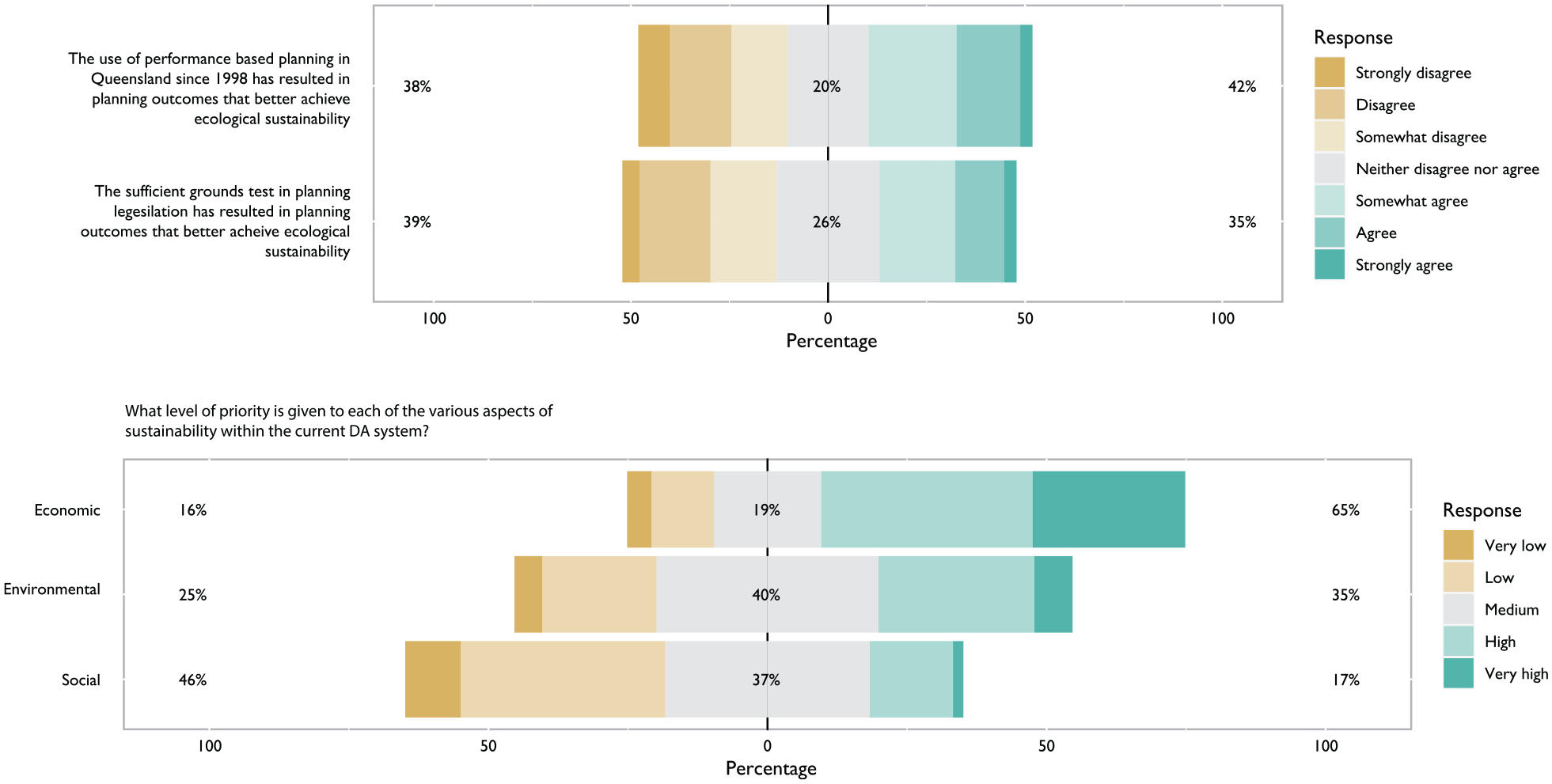
Responses to questions on the achievement of sustainability objectives expressed as a percentage of total responses.
Discretion and Independence
These questions relate to the independence of technical reports used to support planning decisions, and attitudes toward regulations that offer less discretion. While responses were split as to whether Environmental Impact Assessments 2 (EIAs) are independent, a large majority of respondents agreed that these reports would be more independent if they were commissioned by the assessing authority (under the current system, the development proponent commissions associated technical reports).
Under the current planning system, local government authorities (those who generally make and administer planning controls) are not able to prohibit development unilaterally, significantly reducing their discretion in decision making as all applications (other than the few prohibited development types prescribed by the state government) must be assessed in a performance-based manner against qualitative planning outcome statements. Respondents overwhelmingly supported permitting local authorities to unilaterally determine prohibitions on particular forms of development.
The range of responses to these questions is shown in Figure 2.
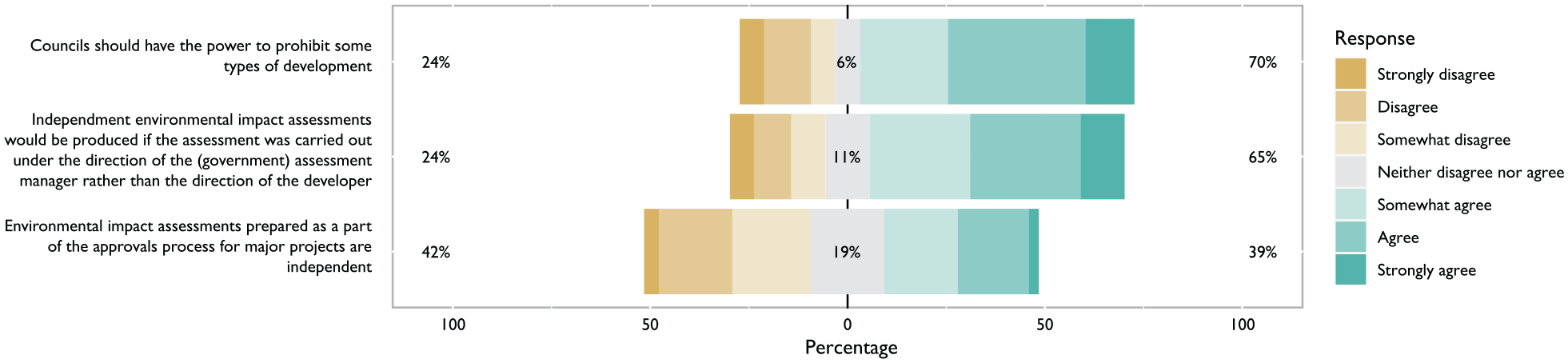
Responses to questions on independence as a percentage of total responses.
Certainty in Decision Making
We asked the participants two questions about the extent to which community members could expect QLD’s performance-based system to approve development, one specific related to heights and the other more generally. The specific question on building heights showed a large majority of respondents felt buildings beyond stated height standards could be expected to be approved. These results were exhibited to a lesser extent when considering developments in conflict with the stated regulatory outcomes more generally. The proportion of each response is displayed graphically in Figure 3.
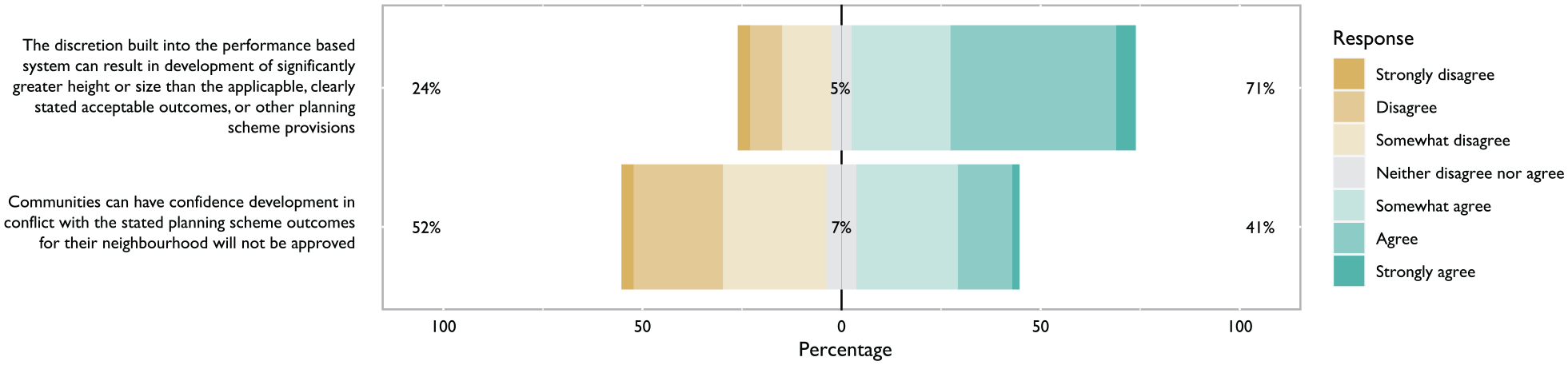
Responses to questions on certainty as a percentage of total responses.
While these results suggest most respondents believe the performance-based system is not providing for community certainty in development outcomes, they could also be interpreted as a PBP system working as intended. In the open-ended questions, several respondents noted that variances between stated outcomes, especially the highly prescriptive “acceptable outcomes” that make up most of the quantifiable regulations in QLD planning rules, are precisely what the PBP system ought to do. However, the more general question indicates issues with community confidence in the certainty of planning approvals. While the question did not specify the level of outcome (QLD planning regulations contain a hierarchy of “outcomes” from specific “acceptable” to more qualitative interest-based outcomes “overall outcomes”), the PBP system is still supposed to ensure compliance with higher order qualitative outcomes. While concerning that more than half of the respondents felt the approvals system was not delivering on this objective, it is possible that the respondents interpreted the term “outcomes” to mean lower order “acceptable outcomes.”
Differences in Responses by Participant Type
Overall, there were few statistically significant associations between the characteristics of the respondents and their responses to the Likert scale questions. The most significant differences related to associations between sectors of work, and responses to the extent to which the planning system prioritizes economic factors and whether EIAs should be commissioned by local authorities rather than developers.
Although several employment sector types were entered by the participants, most participants (91.3%) work in either the private or local government sector. The number of responses for other sectors was too low to show statistically reliable results.
Figure 4 shows the breakdown of responses by sector type, with local government respondents more likely to believe the planning system places higher priority on economic sustainability factors compared with their private sector counterparts (mean difference of 0.74 on a 5-point Likert scale, 95% confidence interval (CI) = 0.214–1.27, p < .01).
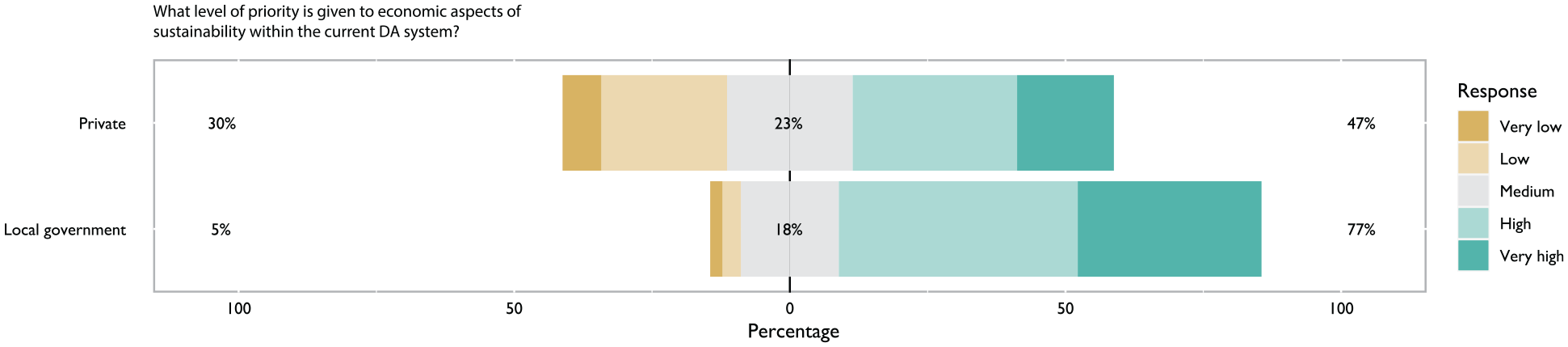
Difference in private/government responses on economic sustainability preferences as a percentage of total private or local government workers.
Local government respondents were also much more likely to believe government-commissioned EIAs would be more independent compared with private sector respondents (mean difference of 1.58 on a 5-point Likert scale, 95% CI = 0.82–2.35, p < .01).
Weak correlations were found between the respondents’ years of experience and other responses. More experience in DA and planning more generally were negatively associated with beliefs that government-commissioned EIAs would be more independent (r = −.27, p < .01 and r = −.19, p < .05, respectively). A weak association was also observed between years of experience and beliefs that the planning system places priority on environmental sustainability factors (r = .16, p < .05).
Qualitative Survey Responses
The survey included two open-ended questions. The first (forced response) asked the participants about what one thing they would change with the current DA system. The second question (optional with a 63% response rate) asked for general comments on PBP. The responses were coded thematically using an inductive approach, identifying key themes that focused on the trust and responsibility relating to the role of the professional in the PBP system, and the benefits and challenges involved in balancing certainty with flexibility.
When respondents were asked to name the single most important change to the current DA system, the most nominated change was more certainty, followed by less political interference, which could be seen as a proxy for “more certainty.” There was little difference between the private sector and local government respondents on these matters. Allowing councils to prohibit some development was also nominated by a relatively large number of respondents.
Support for PBP approaches was often noted by participants who believed such systems enable flexibility to overcome the bureaucratic inanities that inevitably present when blanket prescriptions are applied to site-specific contexts of individual developments. Another commonly ascribed benefit was the potential for more innovative development types that contribute to sustainability, but which would have otherwise been prevented had a rigid interpretation of planning controls been applied.
However, the benefits of the PBP approach were often discussed alongside key challenges. Issues around certainty were commonly identified. These comments typically related to a lack of certainty or consistency (or a desire for more) in relation to development application decisions for developers, but also included concerns about a lack of certainty for the community in relation to planning decisions, with calls to allow local governments to prohibit development types.
The content of planning regulations, their application, and the rules that constrain their drafting were also commonly considered to impact the PBP system. Many participants described regulations written in a way that prevented performance assessment, or simply an unwillingness by local governments to look beyond prescriptive-based standards and apply performance outcomes as intended by the system. The regulations were also often considered to be overly complex, lengthy, and/or unclear. The sentiment that the system is neither designed nor operating under PBP principles was common.
Reasons for this often came back to the role of professionalism in planning and the ability of planners to operate independently. The most common comments of this nature related to the politicization of planning, with many respondents suggesting political interference in planning decisions was making the planning system less certain. There was also a sense of the need for more local control of the planning process, with respondents preferring less top-down state government control over both regulations and process. Independent decision making was also challenged by perceptions of regulatory capture, where some respondents felt the development industry has undue influence in the PBP system, and technical advice is biased in favor of development proponents. Other respondents felt that many planners did not understand how to properly interpret performance standards and that improved training and greater levels of discretion in decision making would help improve the system.
Some also felt members of the community did not understand the performance-based nature of the planning system, and that further education would help to contextualize planning decisions and reduce concerns about uncertainty. Others felt the community was not being meaningfully engaged in planning decisions, and that current formalized submission processes often ignored community concerns over the arguments presented by those familiar with the planning system such as expert consultants.
Discussion and Conclusion
This research highlights that concerns about the performance-based system have persisted after two decades of use. The results align strongly with prior assessments of PBP, reflecting the early issues identified around PBP more generally (Fredland 1980; Jaffe 1993), and those raised specifically in response to the introduction of PBP in Queensland (England 1999; Fisher 1998). The planners surveyed highlighted issues relating to both outcome and process, with a particular focus on matters of trust and transparency, certainty and flexibility, and professional competency. While there was often a sense of overall support to the principles of PBP in the survey responses, these were typically qualified with concerns about one or several of these key issues.
The respondents were split as to whether the PBP approach was facilitating the achievement of ecological sustainability. More concerning was the view that the system overwhelmingly preferences economic factors over environmental and social needs, reflecting what could be expected of a regulatory system subject to market-based liberalization (McGuirk 2005; Ruming 2005; Sandercock 2005; Tonts and Haslam-McKenzie 2005). In such a context, the levels of discretion enabled by PBP are naturally met with suspicion and cynicism when the system routinely fails to provide the promised weight to matters other than economic development.
Urban planning is a function of government and so should be carried out in a manner that promotes “public participation, predictability and accountability” (England and McInerney 2017). In some other Australian states, the risk that “discretionary planning decisions” could undermine public confidence in the planning system is well recognized (Independent Commission Against Corruption 2012). In this regard, performance-based assessment systems are at a higher risk, particularly if the assessment process is complex as it is in Queensland. When viewed through the lens of public accountability and transparency of decision making, PBP systems would not rank highly as they allow several discretionary decisions on each development application. In effect, the balance between competing objectives (e.g., economic, environmental, and social) has been deferred to the point of assessment of each application, thus limiting predictability and transparency.
Yet highly prescriptive rules can also be complex, require significant resources to develop, and can take on a sense of arbitrariness when applied across large geographies without sufficient care. This results in frustration and undermines planning authority when a blanket rule meets a site-specific application and generates impossible or incongruous compliance requirements. Several of the survey participants highlighted such situations when arguing in favor of more flexible PBP approaches. This is supported by previous research that found many practitioners felt the ostensibly PBP system was in fact overly prescriptive in practice (Frew, Baker, and Donehue 2016).
The views expressed in the survey highlight the strengths and vulnerabilities of Queensland’s performance-based system. The flexibility of the system is seen as important by many respondents, while uncertainty about planning outcomes is a cause of concern to many others. It is acknowledged that certainty versus flexibility is a perennial issue in planning and is not specific to PBP systems. 3 An additional source of uncertainty in the Queensland system is the operation of the “sufficient grounds” test in the planning legislation. The original formulation of this test was that an application in conflict with the planning scheme could be approved if there were “sufficient planning grounds” for approval despite the conflict. Since 2006, the grounds for approval in spite of a conflict have been progressively broadened, leading to further uncertainty about development proposals (England and McInerney 2017). Most survey respondents felt this test had not produced better planning outcomes.
Flexibility naturally brings a degree of uncertainty and questions around how to be impartial, fair, and consistent in DA that relies on qualitative criteria (Biggar and Siemiatycki 2023). Several respondents questioned, for example, whether a discretionary system can prevent the ideology, preferences, and/or knowledge of one decision maker resulting in radically different interpretations to another. The inherent uncertainty of a PBP system provides an opportunity for the subjective values of the planner to have more influence on decisions than would be possible with a more prescriptive system. Such differences bring the impartiality of the PBP system into question as evidenced by comments from many respondents who believe decisions under the PBP system are often made for political or personal benefit.
Concerns around impropriety of this nature make the trustworthy implementation of PBP in jurisdictions with strong propertarian values particularly challenging. Where rights in private property (and their associated profits) are sacrosanct and development is principally viewed as a private pursuit, such as within Australia’s planning culture (Sandercock 2005), decisions that allow significant qualitative discretion invite questions of motive. This is heightened by the relatively low level of hierarchical coordination of planning in Australia compared with other OECD nations (Schmidt et al. 2021), whereby high levels of discretion are provided to local decision makers. It would be of interest to measure whether the use of PBP approaches in highly coordinated systems such as the Netherlands, where metropolitan authorities are more directly involved in the development process (and its value capture) (Hartmann and Spit 2015), would present fewer concerns around trust.
There is also a broader question of what the survey reveals about the personal values planners bring to DA. This issue does not appear to have been discussed much, with the focus being more on the related concept of the “roles” planners perform (Perkins and Crews 2013). One survey of local government planners concluded that “most urban planners accept that role conflicts (between serving the council and serving the public interest) are part of their normal working existence within local authorities” (Minnery 1985). More recently, Steele (2009, 189) has argued that “a ‘hybrid’ role for urban planners has emerged within the largely neoliberalised spaces of contemporary Australian governance.” Fischler (2012, 111) asserts that “urban planners play many roles: they are analysts, advisors, designers, advocates, managers, mediators, educators, facilitators. They must sometimes play several roles at the same time.”
The results of this current survey showed less divergence between the attitudes of private and government planners than initially expected but did suggest that on some topics they tend to view the PBP system through different “value lenses.” Private sector planners in the survey were more likely than local government planners to agree that the PBP system produces balanced ecological sustainability outcomes and that supporting reports commissioned by development proponents (specifically, EIAs) are independent. A concern common across all roles, however, related to the role of the professional in the PBP system, with many noting a lack of skilled practitioners capable of developing reliable performance-based criteria and undertaking consistent qualitative assessments within what was widely viewed as a highly complex system. Such views are consistent with previous critiques of modern planning which argue the profession has been “engulfed in microeconomic” considerations to the detriment of broader concerns for the public interest (Gleeson and Low 2000, 156).
The complexity of the PBP system was further highlighted in comments about the timeframes associated with the stages in the PBP process, and concerns of poor community awareness resulting in misunderstandings and political “interference” in the plan development and assessment processes. Some argue that simplifying planning rules and frameworks to avoid such issues has never been more important, and a key component of such a simplified system is ensuring impartiality (Moroni et al. 2020). In this respect, the increased level of discretion involved in PBP undoubtedly makes simplification more challenging to achieve.
The results of this research highlight that few planners surveyed thought the Queensland PBP system has materially achieved its intended aims of promoting ecological sustainability. However, our research also found considerable support for the principles of a PBP approach that can balance certainty and flexibility. The qualitative components in particular, along with findings from previous literature on PBP, highlight that the approach offers the potential to allow for a nuanced and creative application of core planning principles to the regulation of development. The issue therefore has perhaps less to do with the PBP concept itself, than with understanding the context and circumstances in which PBP is most likely to succeed.
We argue that successful PBP requires a context with high levels of institutional trust and a regulatory system that does not commonly result in large personal gains on the basis of planning decisions. Considerable effort must be made to ensure PBP provisions are drafted to reduce complexity and assist in communication. Such provisions should be developed deliberatively with community input with the results clearly establishing the expected outcomes rather than vague appeals to generalized concepts such as “high amenity,” “economic benefit,” and so on.
More fundamentally though, the essence of PBP must clearly reflect the “collective values and ideas” that make up the public interest in planning (Tait 2011, 169). It is when these concepts remain flexible to the service of particular positions on development that PBP unpredictably flexes with the ebbs and flows of market or political contingency, satisfying few beyond its financial beneficiaries in the process. While the need to address such issues could be claimed for any approach to regulatory planning (or even governance more generally), PBP heightens this need and demands a correspondingly high level of resourcing and expertise to be applied to the drafting of its provisions and structures if it is to overcome its innate challenges.
Footnotes
Acknowledgements
We would like to thank the many planners who took the time to participate in this research and the Planning Institute of Australia for their assistance in disseminating the survey. We would also like to acknowledge the anonymous reviewers for their consideration and constructive feedback which has served to improve the paper.
Declaration of Conflicting Interests
The author(s) declared no potential conflicts of interest with respect to the research, authorship, and/or publication of this article.
Funding
The author(s) received no financial support for the research, authorship, and/or publication of this article.
