



Abstract
To achieve their goal to become climate neutral, Swedish municipalities must significantly improve their transformative capacities. Adapting the roles and practices of urban planners is an important element in this process. This paper critically reflects on the way in which improved planning education may help to enable a new generation of planners to face the challenges of rapid urban transformation and provides them with the knowledge and tools needed for these new roles. The results suggest that there are interdependencies between the demand of municipalities for knowledge and skills and the capacity of educational programs for educating planners with transformative abilities.
Introduction
The local consequences of climate change and environmental degradation as global phenomena are threatening cities and urban life. The Swedish government has adopted a target of net-zero greenhouse gas emissions by 2045, as part of its work to improve the situation. Such transformative change requires not only national environmental policies, but also that municipalities play an active role, and that effective initiatives on local, regional, and national levels are set in place to enable innovations for the transformation of existing systems of provision. Urban and regional planning is one of the key instruments for municipalities to shape urban and regional development, and in this way to lead these transitions toward enhanced sustainability (Allmendinger and Haughton 2010; Davoudi and Strange 2008). Furthermore, it has been suggested that strategic spatial planning is a crucial instrument for local authorities, such as municipalities, to address these issues (Albrechts 2010; Albrechts and Balducci 2013). However, the tools and practices of urban and regional planning are still closely aligned with pathways of urban growth, incremental adaptations, and optimization of infrastructure. Although urban planners have been dealing with the issues of urban transformations for many years, achieving ambitious climate targets will require fundamental transformations in the planning processes for transport, agriculture, the built environment, and energy production and use (Boswell, Greve and Seale 2019; Condon, Cavens and Miller 2009; Wamsler, Brink and Rivera 2013).
Established planning tools and practices and their alignment with unsustainable urban structures and governance systems are still prevalent in the current education of planners. This paper will focus on the role of planning education in teaching students how to manage new, pressing issues of climate change, as the skills and knowledge that students gain during their studies affect their ability to plan for the required sustainability transitions. Planning for sustainability transition requires a long-term systemic perspective that focuses on radical changes in the relationships between technologies, institutions, and actors. To be able to play an influential role in transition processes, municipal planning departments need to manage transition through coordinating systemic changes, establish directionality, and develop visions, as well as being open to experimenting with new sociotechnical arrangements. These capabilities enable planners to play the role of transition intermediaries (Berglund-Snodgrass and Mukhtar-Landgren 2020; Kanda et al. 2020). Education is one important element in shaping the practices of planning, even if these practices are subsequently often adapted to, and formed by, specific contexts. There is a risk that the generation of planners currently in education will still lack the urgently needed conceptual understanding and appropriate practical tools that are necessary to plan for urban transformation, if the educational programs are not adapted, and students are not sufficiently trained to deal with challenges of sustainability transitions (Millard-Ball, Desai and Fahrney 2021). At the same time, there is a constant tension between the need for planning professionals to be generalists, navigating between competences and expertise in various fields, and to be sufficiently specialized to make substantial niche contributions (Brinkley and Hoch 2018).
Transformative capacities focus on the degree to which institutional arrangements and organizational processes in cities meet the challenges of transformative change toward sustainability. These capacities of municipalities are linked to a certain extent to the ability of planners to explore and develop coherent ideas and strategies for addressing environmental issues through guiding and intervening in the process of the reciprocal adjustment of space and society. To navigate a transition toward sustainability, planners need appropriate skills, knowledge, and tools to create meaningful links between the current and future initiatives, technologies, projects, and strategies that influence the spatial organization of cities. However, to a large extent today’s planning practices lack the strategies and instruments required to assess, adapt to, and shape urban and regional transitions toward a sustainable society (Isaksson and Heikkinen 2018). Most current planning practices that aim to make incremental improvements are locked into current structures and regulations of systems of mobility or energy, and do not systematically aim at more fundamental long-term transformations (Albrechts, Barbanente and Monno 2019; Isaksson and Heikkinen 2018). Concepts and practices of urban and regional planning have not sufficiently taken on board the rapidly growing knowledge about sustainability transitions in general (Geels 2005) and urban transitions in particular (Frantzeskaki et al. 2017). Core to transformative capacities is to be pro-active, taken into account scenarios and visions of alternative futures with changed regulatory contexts, new technologies, and new social practices (Wolfram 2016). For reaching climate neutrality goals, municipal planners will also need a set of skills to lead or engage in local climate action planning, coordinating sectoral action for climate change adaptation and mitigation, urban experimentations to test innovative solutions that have the potential to contribute to climate-neutral cities, creation of a “community of practice,” development of “coherent strategies tailored to local circumstances,” and to deal with uncertainties in transition toward climate-neutral cities (Boswell, Greve and Seale 2019; Habitat 2015; Kronsell and Mukhtar-Landgren 2018).
Dealing with uncertainty has been an important issue for the planning profession for many years and scholars have sought to explain and find practical approaches to resolve or deal with uncertainty (Schon 1971; Watson, Buede and Buede 1987). To plan for climate-neutral cities, planners need to deal with process uncertainties and environmental uncertainties (Abbott 2005). Reducing the potential negative impacts of future cities and societies on environment (i.e., environmental uncertainties) requires pushing “the bounds of possibility” in the planning processes. However, this can sometimes bring about disagreements and failure (i.e., process uncertainties). Managing these uncertainties is an integrated part of transformative planning for climate-neutral cities (Abbott 2005; Moroni and Chiffi 2021). The climate-related uncertainties necessitate a radical revaluation of how urban planning education addresses such indeterminacies (Mehta, Adam and Srivastava 2022) and demand a robust approach to preparing planners for a future that is fundamentally unknown. These uncertainties can escalate when climate transition intersects with societal issues, as exemplified by Melix et al. (2023). Their work highlights the intricate interplay between climate science and socioeconomic realities, underlining the challenging roles of urban planners in dealing with complexities of climate transition, reinforcing the necessity for a multidimensional approach in planning education. Previous studies of the role of education in the creation of transformative capacities have looked at the collaborations between cities and universities, especially in research projects and showed that universities can play an important role in developing skills required for transformative planning (B.L. Keeler, Hamel, et al. 2019; Rydin 2007; Trencher et al. 2014). However, Hurlimann et al. (2021) investigated the inclusion of climate change in planning education in Australia and concluded that despite the urgency to deal with climate change and its impacts on cities, it is not well integrated in planning education (Hurlimann et al. 2021). To improve future planners’ ability to plan for climate-neutral cities and the inherent uncertainties, one of the first steps that planning education needs to take is mainstreaming climate change management and making it part of core planning curricula (Hamin and Marcucci 2013). Scholars have also indicated that focusing on reflective and empathetic learning through “change-oriented projects in planning students’” assignments can be an effective approach for developing abilities to deal with climate change (Wilson and Beatley 2018). Moreover, the integration of transition management strategies to address uncertainties, conduct, coordinate, and evaluate new technological and social experiments, and to assess the potential for transforming existing infrastructure, has been scarcely addressed in planning education. (Hurlimann et al. 2021; Wilson and Beatley 2018).
Bulkeley (2013) argues that municipal planning plays an essential role in climate transitions. This emphasizes the profound significance of planning education in not only meeting policy requirements but also addressing the pressing issue of climate change, one of the most critical global challenges. Hurlimann et al. (2021) studied if and how climate change was covered in curricula among Australian planning degrees and found that themes of education for sustainability, for example understanding various contexts, critical thinking, ideas of citizenship and public outreach, interdisciplinarity, and equity in processes, were covered to a larger extent than climate change explicitly. They argue for further studies on how to develop this knowledge and how to translate it to teaching activities in planning educations. This paper aims to contribute to this debate. This paper proceeds in two steps: it first analyzes the new roles and practices of urban planners in urban low-carbon transitions in a qualitative study of Swedish municipalities and the demands imposed on planners. It then proceeds to studying educational programs for planning in Sweden and the ways in which these can contribute to preparation of planners in the creation of transformative capacities in cities. The natures of these roles and the changes in the institutional environment of urban planning that they require are still far from clear. The following research questions guide the article:
Transformative Capacities for Sustainability Transition
In this paper, we take a sociotechnical perspective as a point of departure, with a focus on the dynamics between technology and society and their co-evolution. Sociotechnical systems, such as electrical grids, waste management, urban development projects, railroads, or telecommunication systems, co-evolve with social, political, economic, institutional, and environmental aspects that affect system development (Geels 2019; Hughes 1987). Sustainability transition implies a fundamental change of sociotechnical regimes such as our current systems of mobility or energy generation and use, and requires the re-configuration of interactions between actors that shape a sociotechnical system in a specific context (Geels 2019). Sociotechnical regimes are stable configurations of shared routines, rules, values, laws, and technology as embedded in society. Geels (2019) defines the sustainability transition of sociotechnical systems as a process of creating new routines and standards, adaptation of lifestyles to novel technical systems, and investment in the development of infrastructure and competences for emerging technical systems.
It is crucial in urban planning processes to follow technological trends and the application of new technologies for addressing and solving urban challenges (Storbjörk, Hjerpe and Glaas 2019). In the Swedish planning system, municipal planning units and urban planners are responsible for presenting and proposing urban development pathways, based on directives given by decision-makers (i.e., politicians; Persson 2020). These pathways may include the integration of new technologies into existing and future urban systems. Urban transitions toward climate-neutral cities require fundamental changes in urban infrastructures and urban systems. Municipalities must rebuild urban infrastructures and coordinate the transition processes to guide innovation and change for the actors involved (Kivimaa et al. 2019). These transformations are changing the role of urban planners, bringing in the need to deal with issues such as urban experimentation. Urban experimental projects are test beds or pilot projects in which actors are given space to work on innovative solutions for urban issues (Von Wirth et al. 2019). Dealing with experimental planning is a task for planners that puts them into the position of transition intermediaries (Berglund-Snodgrass and Mukhtar-Landgren 2020). Transition intermediaries coordinate and facilitate systemic change and enable transformation through collaborations in which innovative solutions are developed; a transition intermediary is “an organization or body that acts as an agent or broker in any aspect of the innovation process between two or more parties” (Howells 2006, 720).
The new role of planners in which they work with uncertainties and challenge current systems contrasts with their responsibility to maintain the stability of urban systems (Rydin 2007). As transition intermediaries, urban planners must be able to combine new governing tools that enable innovation with traditional planning instruments (Berglund-Snodgrass and Mukhtar-Landgren 2020).
There is a clear separation between traditional urban planning processes within the formal bureaucratic organization, and the newer soft governing tools of enabling. These new tools are something that urban planners can simply add on to their responsibilities, yet there is a clear need to separate the two tasks from each other. (Berglund-Snodgrass and Mukhtar-Landgren 2020, 103)
When filling the role of transition intermediary, planners must deal with uncertainties and work with short-term solutions for experimentation that are not necessarily based on previous planning experiences. Adding this new task to planners’ responsibilities makes planning practices and expertise more complex than they are in traditional planning.
This paper draws on the Wolfram’s (2016) concept of transformative capacity to investigate the capacities that urban planners need to have as transition intermediaries. These abilities are crucial not only for leading sustainable urban changes, but also for disrupting entrenched energy, food, and water systems. Moreover, they play a significant role in transforming urban infrastructures, culture, and practices (Wolfram, Borgström and Farrelly 2019). Transformative capacity is the ability to “create a fundamentally new system when ecological, economic, or social (including political) conditions make the existing system untenable” (Walker et al. 2004, 4). It enables organizations (such as municipalities) and actors (such as planners) to initiate, promote, and contribute to a transition toward sustainability (Broto et al. 2019). Wolfram’s concept identifies three interrelated characteristics of agency and structure that affect the transformative abilities of individuals and organizations: the availability and accessibility of resources, the power to mobilize these resources, and the capability to manage path dependencies (Wolfram 2016, 126). Transformative capacity for the sustainability transition of a sociotechnical system is defined as the ability of actors that shape a regime to adopt disruptive technologies and adapt to the new configuration of relationships and interactions among the actors involved. Stakeholders must have the ability to initiate, navigate, and perform in the transformation process and have adoption and adaptation abilities (L.W. Keeler, Beaudoin, et al. 2019) to be able to contribute to transformation. Adoption capability refers to the power to overcome lock-in and integrate disruptive technologies into existing systems for the transformation of sociotechnical regimes (Wolfram 2016). Lock-in is the term used to refer to the resistance to change of social entities (public and private organizations and communities), material factors (technologies, infrastructures, and buildings), and established regulations that define their relationships (Deleye, Poeck and Block 2019). Actors must adapt and engage in the processes and create new connections and interactions to perform in transformation process (Walker et al. 2004). Adaptation capability is the flexibility of the actors to engage in new configurations (Broto et al. 2019; Walker et al. 2004).
Previous studies showed that planners are expected to contribute to change and sustainability transitions of cities, but existing organizational and bureaucratic contexts may undermine their power and capacity in the transition processes (Taşan-Kok et al. 2017). Planners must have the ability to initiate transition processes and adopt new ideas, if they are to play an effective role in change processes (L.W. Keeler, Beaudoin, et al. 2019). They must begin the transition process and navigate it toward enhanced sustainability. Municipalities, on the other hand, must be able to adapt, perform, and support transition processes that are led by other stakeholders, if they are to support bottom-up efforts toward a sustainability transition (Broto et al. 2019) as explained in Table 1.
Capabilities Required for Transformative Planning.

Since the Bologna Process (cf. Kehm 2010) the Swedish higher education system has moved toward a harmonization with European standards of a bachelor’s level of three years, and a master’s level of two additional years, in Swedish or English. Prior to the harmonization, the programs’ length varied and could be longer than four years for a degree in Physical Planning. Today, all bachelor’s programs in planning are in Swedish and last for three years. The students get a bachelor’s degree with a major in human geography or urban and regional planning. The alumni usually go on to a master’s program with a similar focus or start working as urban planners, physical planners, municipal planning administrators, or consultants. The programs contain a mixture of planning theory and planning practice, covering, for example, legislations and processes, with differences in empirical focus. The programs are run under the Swedish Higher Education Act (1992:1434) that expresses the goals of education which should be mirrored in the education syllabi of each educational organization. These goals are divided into three categories: knowledge and understanding, competence and skills, and judgment and approach. The universities can add specific goals related to programs if they find it necessary. The goals do not explicitly cover anything relating to sustainability or climate neutrality, although they need to relate to sustainability in one way or another as part of the national evaluation, which is based on the Standards and Guidelines for Quality Assurance in the European Higher Education Area (UKÄ 2021). The majority of the employed teachers at Swedish universities have tenure and they have PhD degrees, but it is possible to be employed as a teacher without a PhD degree, based on practical skills. Research is increasingly carried out based on external funding, meaning that not all teachers have research included in their positions, but there are differences between the different universities.
Methodology
The paper investigated the contribution of planning education to enhance the transformative capacities of Swedish municipalities that are needed for sustainability transitions of cities. Sweden is an interesting case since it has clear planning strategy for reaching climate neutrality. There are national policies with focus on climate neutrality and many Swedish municipalities are part of national climate municipality program (Klimatkommunerna), which is a framework for reaching Swedish national climate neutrality goals in all member municipalities. Sweden has traditionally been a forerunner in environmental policy (see, for example, Lidskog and Elander 2012) and has a strong focus on climate transitions. Moreover, there is a municipal “planning monopoly” which makes planning one of the areas where municipalities have a huge influence (Hall 2003). The question about the role of planners in such a transformation has thus become more urgent than ever. While planning systems obviously are shaped by national regulations and cultures, the kind of challenges planners face in transformative change is however similar in different countries.
This analysis attempted to identify (1) the need for further skills and expertise of planners to work on transformative planning from the perspective of municipalities, and (2) the limitations of current planning programs in providing planning students with these skills. This paper compared the competences and possibilities and challenges to provide such capacities within the planning programs, to draw conclusions about how to enhance the education for transformative planning. With this aim, the paper studied the relationships between education and transformative planning in two contexts: (1) cities and regions with ambitious transition-oriented policies identified within existing sustainable cities’ networks. These included what are known as “climate municipalities” (in Swedish: “klimatkommuner”) and ecologically certified municipalities (“ekokommuner”), as well as cities that have been selected within the Strategic Innovation Program “Viable Cities” to become “climate-neutral cities 2030.” (2) Educational programs at bachelor’s and master’s levels for urban and regional planners at Swedish universities.
The data in this study were gathered in four steps. The first step was interviewing urban planners at different Swedish municipalities to gain an understanding of planner’s opinion on required skills, competences, and knowledge for transformative planning. Most of the 302 interviews conducted with teachers and planners were performed in English. However, a few interviews with planners were carried out in Swedish. The transcripts of these Swedish interviews were subsequently translated into English by the authors. After conducting the interviews and the primary analyses of the transcripts, syllabi analyses were done to investigate the skills and knowledge that are covered by current planning education in Swedish universities. The syllabi of all planning programs are preconfigured in the Swedish Higher Education Act, but each program can also have its own local goals. The main difference in the education programs is the courses, and therefore the course coordinators were interviewed in the next step. Finally, to better understand the local goals and to discuss the challenges and possibilities for including the knowledge and skills that are not included in the courses, a workshop was organized with participation of coordinators of planning programs at different Swedish universities (Table 2).
Data Collection Methods.
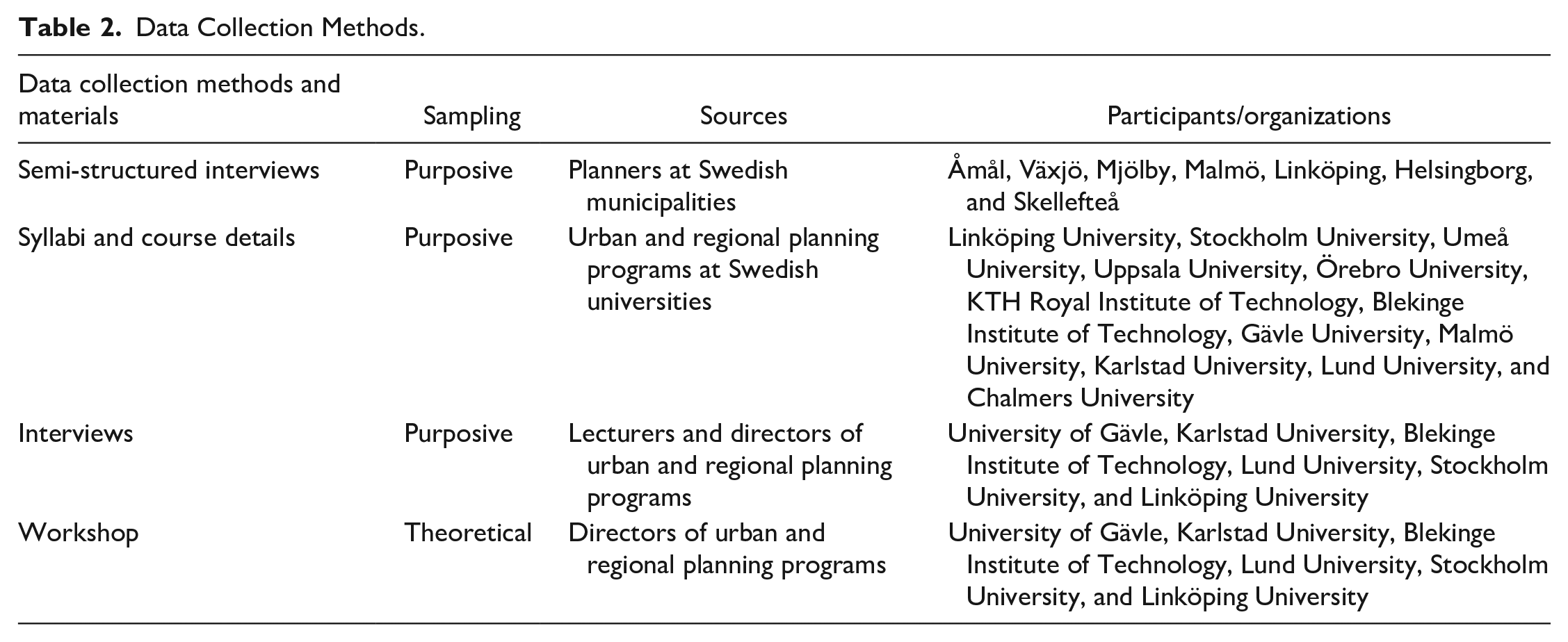
The paper used qualitative methods including semi-structured interviews, content analysis of syllabi, and course plans of bachelor’s and master’s programs in urban and regional planning, and a workshop with directors of urban and regional planning programs. The interviews with program directors are done in English, whereas the other interviews and workshops are done in Swedish.
Sweden has 290 municipalities and twelve universities with urban and regional planning programs. The interviewees were urban planners at seven Swedish municipalities and directors of urban and regional planning programs at six Swedish universities. We used a purposive sampling method to choose and contact planners and directors. A workshop was organized online in December 2020 with nine directors of planning programs. In total, forty-one interviews were conducted between May 2020 and October 2020. All interviews, except for one interview in Malmö, were conducted online due to the COVID-19 pandemic, and then recorded and transcribed. The interview guides are shown in Supplemental Tables S1 and S2. The syllabi of all seventeen Swedish bachelor and master programs in planning were analyzed. The syllabi and transcripts of the interviews were coded and analyzed by NVivo (NVivo qualitative data analysis software; QSR International Pty Ltd., Version 12, 2018). During the coding and data analysis, we identified emerging themes. For coding the data, descriptive coding was used. The descriptive codes, conceptual categories, and interpretive themes are shown in Supplemental Table S3.
Planners were asked about sustainability transition goals and strategies in their municipality and the possibilities they have as planners to influence these processes. The interviews included questions about the planners’ approach in dealing with lock-ins and solving sustainability transition challenges. In these interviews, planners also answered questions concerning a possible lack of expertise and knowledge for transformations toward climate-neutral cities, and the potential role of universities in enhancing urban transformative capacities (among students). Syllabi and course details were studied to gain a better understanding of educational programs (i.e., tools and methods that the students learn during their studies), to select interviewees, and to prepare the interview guide for the program directors. The questions in the interviews with program directors were focused on the teaching tools and concepts of sustainability transition used in the programs to prepare students for their role as future planners. During the workshop, the codes from the interviews and analysis of educational programs and abilities and strategies for transformative planning were discussed.
Enhancing the Transformative Capability of Planners in Swedish Municipalities through Planning Education Programs
This section presents the results of the study and discusses the findings. It is divided in four parts: (1) limits and challenges for applying innovative solutions to transformation toward climate-neutral cities; (2) a lack of knowledge and skills for transforming existing urban systems; (3) obstacles to and opportunities for enhancing transformative capacities; and (4) challenges in meeting changing demands for knowledge and skills.
Limits and Challenges for Applying Innovative Solutions to Transformation toward Climate-Neutral Cities
Planning units in municipalities play important roles in stabilizing urban systems, infrastructure, and the consistent delivery of goods and services to citizens. However, when dealing with climate change and sustainability challenges that require systemic change and collaboration between a variety of actors, urban planners are also expected to play the roles of enablers and catalyzers of innovation (Mukhtar-Landgren et al. 2019).
Our interviews showed that planners at Swedish municipalities experience several challenges to leading the technology-driven transition of cities with respect to, for example, radically different mobility systems, a decentralized energy supply, and use, in sustainable city districts. These challenges include uncertainty and hesitation in integrating new technologies, handling the incompatibility of new technologies with existing infrastructure, the need to meet short-term goals and budgets, and dealing with unknowns of novelties.
In traditional planning practices, planners work with rules, regulations, and safety requirements in urban development. But dealing with uncertainties and enabling innovation projects are challenging tasks for planners (Storbjörk, Hjerpe and Glaas 2019). Planners, as individuals, do not want to risk their career by being involved in a failure that is caused by misinterpretation of the potential of new technologies, or unknown side effects and impacts of novelties. The planners in this study stated that they prefer to work within set limits and frameworks (doing what they are asked to do rather than being innovative), to avoid uncertainty and to protect their career. One of the planners stated: We are afraid of the unknown. And innovation drives costs. So, if you open up the Pandora’s box, you never know what happens. So, it is better to do it in a more controlled way. Maybe you don’t reach as far, but I mean, it is sufficient for what is requested. (Planner at Växjö Municipality)
Another issue that was mentioned by planners was reluctance to opt for new technologies because today’s best technological solution will not remain the best solution for long. They see uncertainties about novelties and the danger of becoming locked-in to suboptimal solutions involving budgets and large investments.
It is also a question of huge investments; how do you invest in one or another? It is difficult to make decisions in physical planning. Should we invest in infrastructure for technologies that seem good now, like solar panels or electric cars, or is there something better coming? . . . It is important not to lock yourself in too much. But then, how can you dare to do new things? (Planner at Mjölby Municipality)
Several planners stated that they see themselves as actors with clearly defined roles in a specific stage of the planning process. They consider the prescription of technologies for urban development plans as an irrevocable step. Therefore, the complexity of dealing with new technologies in plans is increased by the large time gaps between the approval of plans and their implementation.
[In academia] you just decide to work on this or that technology. But it may be wrong to do so [in municipalities], because when we develop a plan, part of it is already being built, and part of it maybe will not be built for 10-15 years. If we prescribe a technology today, there is a chance that in 10-15 years a new technology will come that is much better. (Head of planning unit at Helsingborg Municipality)
Several planners mentioned that the role of politicians in decision-making leads to plans and budgets that are dominated by short-term thinking, which creates an obstacle for the transformation of urban systems. They believe that four-year period between elections is the main reason that short-term goals and investments are made: “This is one of our biggest Achilles’ heels. For some changes it takes longer than four years when you have to make adjustments. And a year is definitely too short” (Project manager at Skellefteå Municipality).
The way the current system orients planning to stability and safety limits the capability of planners to develop new strategies for dealing with transformative change, and the uncertainties and risks involved in this. These findings are in line with an argument put forward by Van den Broeck (2017) that links the challenge of planners to contribute to change and innovation to their being responsible for the public interest. He argues that under these pressures, creating capabilities in planners requires “patience and persistence, specific knowledge and creative skills” (Van den Broeck 2017, 34). These capabilities will allow them to deal with “the short and the long term at the same time, with uncertainty and complexity, with the influence of many known and unknown factors, stakeholders and agencies” (Van den Broeck 2017, 34). Planners identified the ability to deal with short-term visions, uncertainties, and complexity as necessary to deal with the challenges of transformation toward climate-neutral cities. In the next sections, we discuss the role of planning education and its challenges for supplying these competences.
A Lack of Knowledge and Skills for Transforming Existing Urban Systems
Our investigations have demonstrated that Swedish municipalities that were part of this study lack important abilities required for the adoption of a more transition-oriented perspective in urban development plans. Planners at Swedish planning units are responsible for implementing the plans and policies that politicians decide on. Even if they are not directly involved in the development of new solutions to urban problems, planners can use their role as transition intermediaries to create appropriate conditions for change. They can facilitate urban transition processes by actively supporting the development and implementation of innovative solutions to urban problems, and the adoption of new approaches to handle uncertainties and allow for learning. The latter can occur through such processes as urban experiments. To open up plans that will lead to innovative sustainability solutions, planners need a set of skills, knowledge, and strategies that enable them to deal with such questions in planning. Examples of such questions are how to handle risks and uncertainties, how to build resilience into plans, and how to understand and assess the preconditions and implications of novel sustainable solutions, and so on. “The capability of planners to understand and evaluate new technologies and innovative solutions is key to the successful integration of new sustainable technologies in planning documents and urban development proposals,” as the Development coordinator at Malmö Municipality said.
One of these required abilities of planners is to follow trends and “continuously monitor the developments in the outside world” (Planning unit manager at Helsingborg Municipality). Planners must know how and where they should look for relevant innovations and experiences, and how they have been applied in other cities. In addition to the skills required to following trends and emerging technologies, planners need more self-confidence and belief in their own ability, skills, and experience. This will enable them to support experimentation.
One must be familiar with the existing regulatory boundaries to be able to think outside the box.
There is a way of working and a system in municipalities that you follow. In terms of the planning process, which is very regulated, there is not always much space left for these innovations and innovative phases. Transformation requires creating a culture in the organization that gives space for different kinds of innovation. (Development coordinator at Malmö Municipality)
A core strategy to change existing urban systems is to support the development of sociotechnical niches in which new sustainable configurations of technologies, social practices, and new types of actors can stabilize and grow. These niches also allow important lessons to be drawn for further upscaling of these arrangements. Planners stated that they need to be able to create the conditions for change, to play an effective role in transitions. This means that they must be able to influence and shape the conditions for testing new technologies and solutions, for example the design of such test beds and the involvement of different types of actors. When working with such processes, planners must be open for learning about what works and what does not. As one of the planners mentioned: Instead of prescribing technologies, I think, we [planners] should define general requirements, for example the footprint that a project may have. Then you can achieve it in different ways, but you do not lock it into a technology, but you draw the limits. Then you can use different ways and technologies to achieve that limit. (Head of planning unit at Helsingborg Municipality)
Planners suggested that they need to collaborate with a broad range of stakeholders when working to transform urban systems, such as private and public companies, politicians, citizens, and various organizations. “Planning provides conditions, but there are so many other parameters that play a role” (Head of planning unit at Helsingborg Municipality). Collaboration, communication, and presentation skills are needed to inspire other stakeholders, gain their support, and work with them. Presentation and visualization skills can help planners to make their voices heard in the early stages of innovation. These skills are also needed when seeking approval from decision-makers, convincing politicians, and engaging citizens in the plans.
Changes can come with high costs and risks. It is therefore important to spread these risks and be able to use the innovation support provided by external funding bodies. Such external funding can then not only create legitimacy for new developments at the municipal level, but also increase the ability to include new solutions in the urban planning and development process. Grants from Swedish and European funding bodies can provide opportunities for testing new technologies in the form of urban experimentations such as living labs and collaborative pilot projects. One example of this is the sustainability manager in Linköping municipality. Being able to access such funding, and in this way make possible applications and projects with external funding (which often takes place in cooperation with other research and innovation actors), can be a critical skill that planners need to be able to make an impact on urban change. As with earlier examples, the required competence and knowledge are rarely developed in the current planning educational programs.
The result of this study shows that to successfully play the role of an intermediary and facilitator of urban transitions, planners must collaborate with a range of actors on a wide range of issues. These include enabling the development of innovations, adopting innovative solutions in planning practices, and managing instabilities and uncertainties by experimenting with new solutions. A further aspect is the development of structures for learning, following up, and upscaling. Currently, planners in municipalities often lack the skills and knowledge required to perform these new and vital tasks. However, possessing such skills and knowledge has a strong impact on the planners’ ability to integrate new technologies into urban development plans, to collaborate with developers, and to manage uncertainties. Table 3 summarizes the factors that affect the adoption ability and adaptiveness of planners in Swedish municipalities based on the interviews with planners. Adoption capability in municipalities is linked to the ability of planners to take the initiative, think out of the box, and calculate risks when applying new approaches and working with new tools. The transformative capacity of municipalities depends also on the adaptability of planners for collaboration and communication with other stakeholders involved in the transition process (Broto et al. 2019; Walker et al. 2004; Wolfram 2016).
Effective Factors in Building Transformative Capacities in Swedish Municipalities.
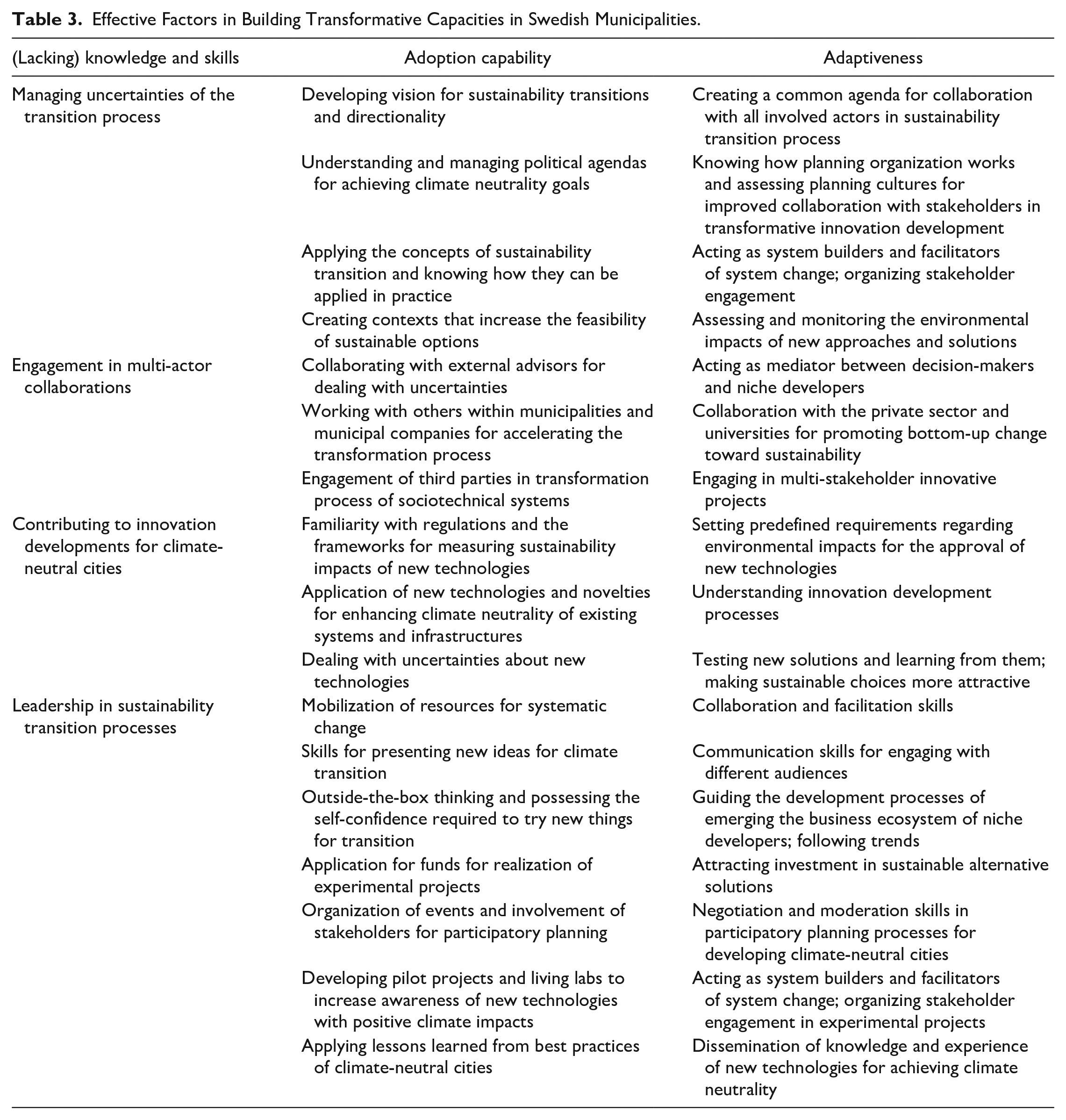
These new sets of knowledge and abilities that are expected from present and future planners make it more complex to planning educations. It is challenging to fit all these competences into a training program. To deal with this challenge, the training given often limits educational activities to local challenges and themes that are important where the organization is located (Taşan-Kok et al. 2017). Contextual conditions in which knowledge and competences depend on the location of a planning faculty lead to the creation of adoption capabilities among planners such that they can act as an expert for leading transition in a particular context. Van den Broeck (2017) noted that planners should not be actors who “enforce their own insights, based on their knowledge and expertise, something which tends to happen all too often” (Van den Broeck 2017, 39). In transition processes, planners should be both experts “with an own identity, values, opinion, knowledge, and creative skills” and facilitators who are able “to make sure that fundamental principles and possibilities are discussed with the necessary charisma, while keeping an open mind for different views and arguments” (Van den Broeck 2017, 39). This means that adaptiveness is complementary to adoption capabilities, and planning education must find new ways to develop a wide range of diverse competences within the training programs.
Obstacles to and Opportunities for Enhancing Transformative Capacities
Previous studies have pointed out that the planning profession is changing, and planning practices are becoming more complex (Berglund-Snodgrass and Mukhtar-Landgren 2020; Jou and Huang 2017). Our study also shows that municipalities are looking to employ planners who have the required competences and knowledge to deal with this complexity. Current planning education, however, does not fully meet the demand for a new generation of planners. Three program directors that were interviewed identified the obligation to comply with the legal provisions of the Swedish Higher Education Act as one of the main obstacles for meeting these “changing” demands. The program directors believed that the requirements that are set by the Swedish Higher Education Act are not covering the knowledge and skills that are needed for dealing with climate change and other sustainability issues. However, each program is allowed to choose local goals and allocate budget to teaching activities that help to reach those goals. The main difference in the curriculum of the Swedish planning programs is in these local goals. Some of the universities such as Linköping University, Stockholm University, and Umeå University have sustainability and climate change adaptation as part of the local goals in their planning programs. Among them only Linköping University, which has a bachelor’s program since 2017 and master’s program since 2020 in urban and regional planning, has sustainability and dealing with climate change as the main local goal. According to a course coordinator, even when the program has sustainability as a local goal, the national goals “lock” local goals and doesn’t not leave space for focusing on local themes.
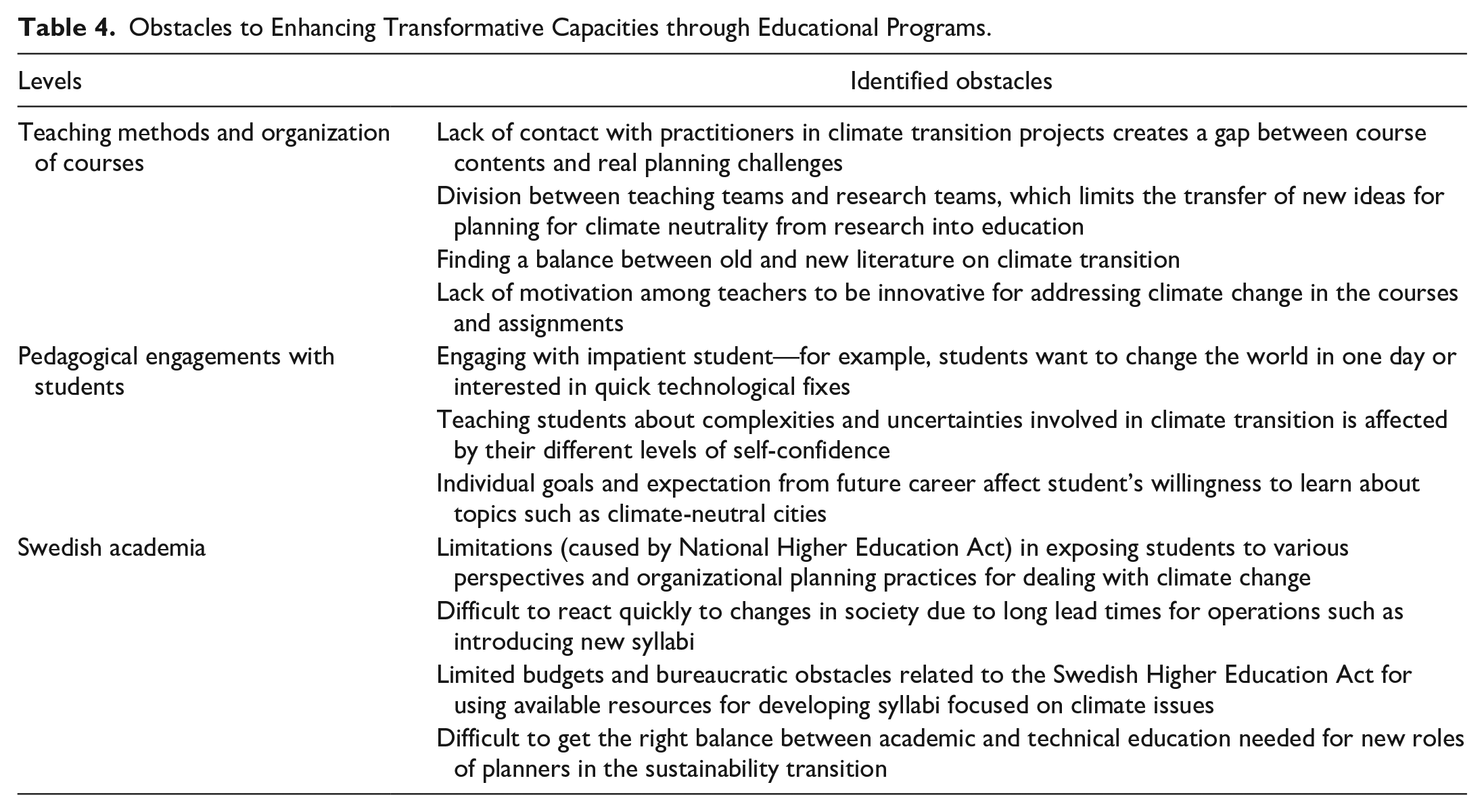
Based on a review of syllabi of bachelor’s and master’s programs in urban planning in Swedish universities, the knowledge and skills requested by municipalities for managing transformative changes in cities are not being given priority. In the current study, we asked teachers to identify the main obstacles to and opportunities for improving the knowledge and skills of future planners, to give them what they need to lead or meaningfully participate in transition processes. The obstacles that they identified are presented in Table 4.
Obstacles to Enhancing Transformative Capacities through Educational Programs.
To engage in planning processes for urban transitions, students need not only theoretical knowledge about sustainability transitions, but also knowledge of how their role in these processes is defined in different planning theories and practice. Planning education should provide such knowledge and show students how they can apply it in local circumstances, one interviewee said (Lecturer at Blekinge Institute of Technology). Educational programs should be in touch with real-world issues and actors. Students can also benefit from hearing about planners’ struggles. “We should invite planners to come and talk about a project and talk about how they handle problems and talk about how they do it” (Lecturer at Karlstad University).
The ability to collaborate and to engage others in planning processes is key in transformative planning. Teachers expressed that communication skills should be incorporated into educational programs in a way that makes talking to different stakeholders and citizens part of student assignments. In addition, students must be prepared to engage in new fields and topics, if they are to lead transformation. So, one important task of the educational programs is to help students obtain and apply new knowledge independently. “It is ok if they don’t know all topics when they leave the program, but they should have the skills to find out how to approach a new topic” (Lecturer at Lund University). It is, furthermore, important to teach students to deal with complex situations, and how to choose a tool or instrument that is relevant to a particular issue. This is perceived as more important than teaching them how to use all available planning tools. A teacher at Lund University stated that internships are the only opportunity for the students “to get in touch with real-world planning issues.” These internships are not obligatory and are done individually. Students can apply for doing an internship in a planning organization of their choice. According to the teacher, although these internships allow students to be involved in planning practices at a planning organization, for example municipalities, “they do not provide the opportunity for reflection and discussion in groups which are essential for the learning process” (Lecturer at Lund University)
Planners need skills not only regarding planning tools, but also to work for transformation within organizations. One planner stated that the first task of a planning education program should be to teach future planners how to find their place in the “continuously changing planning organizations” (Planner at Skellefteå Municipality). Educational programs should teach students how different organizations work, and how they can comprehend roles and relationships in a planning organization. “Students need to be better at thinking about what kind of change can happen, how change can happen, and how you work with that in an organisation” (Lecturer at Lund University). The educational programs allow students to learn about regulations and frameworks in planning departments, “so they don’t come out with a completely naive look that I’m going to change the world. They need to learn these things to understand how they can navigate within a planning department” (Lecturer at Linköping University). This organizational dimension is not limited to planning departments but comprises a planner’s relationships with the whole municipal administration. Collaboration with other departments and other important actors within the organization to organize change processes together is an important competence that is required for enhancing the transformative capabilities of future planners.
Urban planning education is facing challenges such as the “growing complexity of economic, environmental and social conditions, along with different specific features in the politico-administrative environment at the local level” (Maruna, Rodic and Colic 2018, 659). One of the opportunities for building transformative capacity among students that was mentioned by teachers is the opportunity to expose students to “real-world” issues in “real” planning contexts. The strong influence of “the global social, political, and technological context” on change and innovation “defines the boundaries and the potential for planning,” and the way in which planners can lead or engage in innovation processes (Van den Broeck 2017, 34). Taşan-Kok et al. (2017) point out that planners are expected to change things, but they are “shackled by bureaucracy and power relations” because they do not have the “political power, or strong connections to such power” required to implement transformative changes (Taşan-Kok et al. 2017, 25). The changing roles of planners and their new responsibilities as transition intermediaries emphasize the need for not only “technical and legal knowledge” for the facilitation of “social, spatial and economic activities,” but also a broad understanding of “legislative frameworks” that influence planning practices and “urban investment and management” (Taşan-Kok et al. 2017, 25). Our findings are compatible with these results and show how important knowledge of the planning context when building capacity for transformative changes is.
Meeting Changing Demands for New Capacities
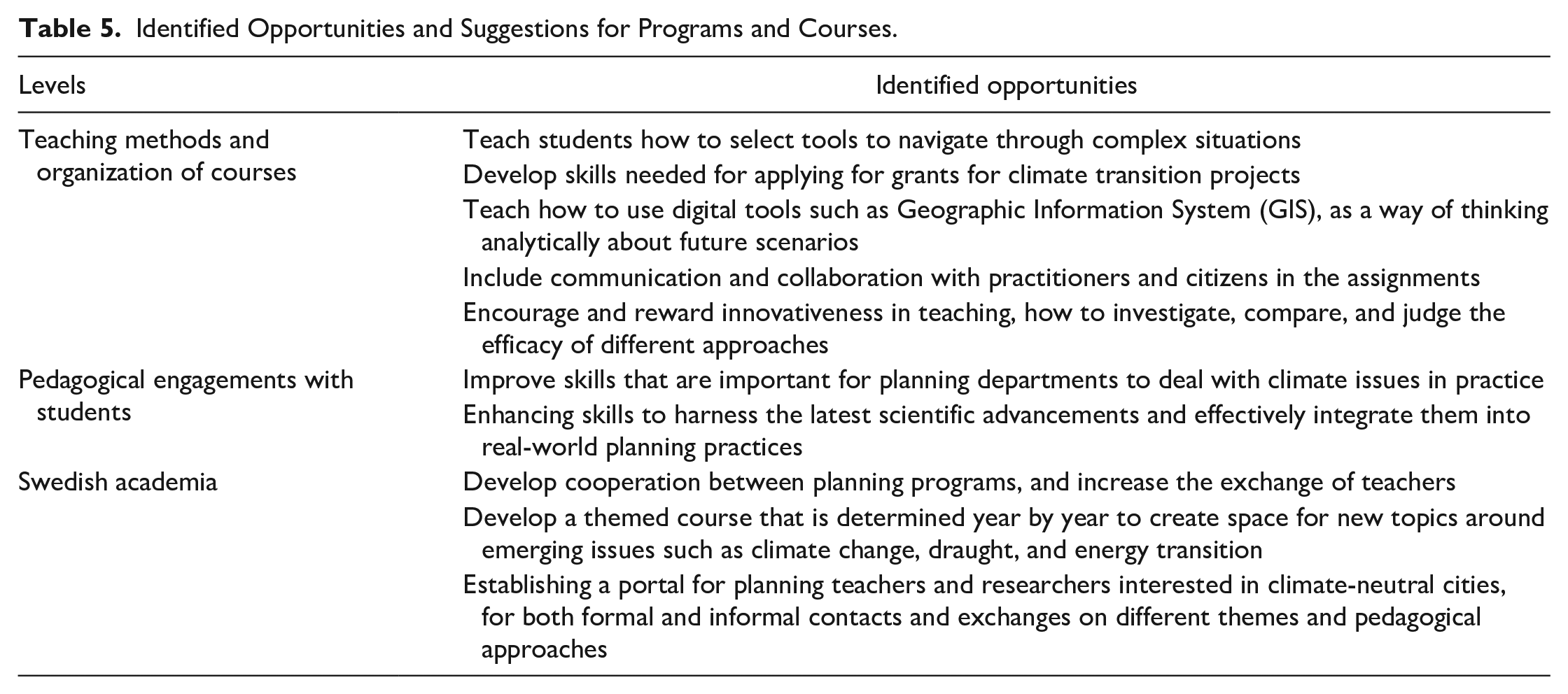
Teachers and directors of planning educational programs believe that educational programs must adapt and change, based on the latest pedagogical and technological developments, if they are to educate planners who are capable of leading sustainability transition processes. Table 5 shows the identified opportunities for meeting the demands for capacities that the new generation of planners need to work on transformative planning for climate-neutral cities.
Identified Opportunities and Suggestions for Programs and Courses.
Planning practices are not the only aspect that must deal with lock-in problems: educational practices can be locked-in structures that are no longer appropriate to deal with sustainability and urban challenges. Teachers suggest that “locked-in” Swedish planning programs are the result of several factors: limited budgets and how they are distributed; defined national goals for educational programs; and conditions that are not conducive to creativity and innovative teaching approaches. The educational activities are often locked into routine teaching activities that limit innovation. One of the teachers mentioned that: I would say that one problem I see is that the courses that are given now are very much locked-in. The teachers are teaching the same class over and over again. And they are not necessarily improving them by looking at real-world applications and new trends within planning or trends within sustainable development. (. . .) The problem is that it takes a lot of energy to change the curriculum. It is hard to introduce new classes, it’s hard to hire new staff, it’s hard to change the literature list. There is very little incentive for the teacher to do so. (Lecturer at University of Gävle)
In the context of the pivotal role cities play in reducing emissions and achieving climate neutrality, the education of planners and their preparedness to meet these challenges are of utmost importance. The recent work of Vanhuyse, Piseddu, and Jokiaho (2023) offers an informative lens on this issue, outlining that even in the face of high political commitment, gaps exist in urban planning strategies and actions, especially concerning transport and household consumption. This further emphasizes the necessity for urban planning education to integrate learning around effective use of regulatory instruments to promote behavioral “modal shifts” and meet climate targets based on consumption. Moreover, the analysis underscores the need for urban planning education to develop planners’ abilities to collaborate with superordinate governments effectively, an aspect that is currently under addressed within municipal governments’ plans. This notion echoes the broader perspective brought forward by Checker (2020) which demonstrates that the effective tackling of sustainability and climate crises necessitates a comprehensive understanding of larger structural issues. This holistic approach to urban planning education, which not only focuses on expanding planners’ skills and competences but also heightens their understanding of the broader political and economic structures governing development, is crucial. As we strive to adjust planning education to meet the demands for transformative capacities, parallel efforts are necessary to confront unresolved broader societal structures toward sustainability.
The educational activities that will increase the development of the ability to adopt and adapt that is needed to lead and engage in transition processes must be synced with the dynamics of cities and the urban planning profession. Taşan-Kok et al. (2017) argue that “the planning discipline has been slow to accommodate the relational and interaction-driven nature of knowledge generation and leadership development” (Taşan-Kok et al. 2017, 19). The conditions currently prevalent in planning education institutions limit the teachers’ space to address the issues that confront planning professionals. These organizational issues of urban planning programs at Swedish universities are one of the reasons that planning education and professional practices are growing apart. The teachers believe that this separation can be avoided by providing educators with more space and resources, such that they can react to transformations in the planning profession. These spaces could be created by, for example, developing annual themed courses organized by early-career teachers, and by designing flexible needs-driven courses.
National qualifications have been defined for urban planning education, which has created a standard model of core skills and knowledge that planning education should focus on. The complexity of transformative planning, however, and changing demands from planning departments have fuelled a debate on how planning education should address the changing demands of municipalities (Maruna, Rodic and Colic 2018; Van den Broeck 2017). Teachers and municipal planners who have participated in our study have agreed about the need for a re-orientation of educational programs, such that they educate planners who have the ability to support sustainability transitions in cities. Although change in educational activities seems easier than changing urban infrastructures, transformation in educational activities requires demand from planning organizations and municipalities. Therefore, dialogue and collaboration between municipalities and universities are essential to define the tasks of a new generation of planners in leading transformative changes in cities. Demand and supply of knowledge and skills and contextual conditions of planning professions are linked, which means that the teaching approaches used in planning education should take the local sociopolitical–legal systems into consideration. Therefore, it is important that universities should not only satisfy national requirements, but also co-operate with leading local actors when defining the core issues of educational programs. Maruna, Rodic, and Colic (2018) also suggest that the engagement of “highly diverse expertise and experts in knowledge production and management, through collective action, based on partnership and the establishment of specific relationships between the actors involved” can be used to develop more effective, collective, and creative teaching approaches to knowledge production (Maruna, Rodic, and Colic 2018, 665).
Planning education should also address the complexity of planning and the dynamics of cities. Both planners and teachers stressed that these complexities and dynamics play an influential role in creating uncertainty and lack of confidence among young planners when using new tools and innovative approaches, for example the challenge of engaging with complex models of climate risk scenarios. Our study suggests that planners often lack the technical knowledge to effectively understand and use these models, thereby hampering their ability to make informed decisions about urban sustainability. Similarly, decisions related to infrastructural investments, such as major power generation or water infrastructure, could lock cities into inefficient pathways due to their high cost, potentially blocking the adoption of newer, superior innovations. This aligns with the conclusions drawn by Ravetz, Neuvonen, and Mäntysalo (2021), who emphasize the importance of synergistic scenario planning for carbon-neutral cities and regions. They too identified a need for planners to possess a robust understanding of complex models and the potential for long-term lock-in effects caused by infrastructure decisions. Van den Broeck (2017) argues that the planner’s hesitation to prepare plans (such as land-use and zoning plans), and their lack of competence to motivate why they have created these plans, is linked to their lack of knowledge and competences to take “the uncertainty, the complexity of reality, and the permanently changing context” into consideration (Van den Broeck 2017, 36). The unpredictability of sustainability problems makes navigating through complex situations as they arise a key ability for the planners who are to lead transformative change. This underscores the critical importance of delivering a holistic and flexible education for urban planners. Such an education should aim to build capacity not only in decision-making within complex scenarios but also in selecting appropriate tools and engaging with groups that can offer valuable contributions to these situations. This, in turn, ensures planners are equipped with the necessary skills and knowledge to respond effectively to rapidly changing environmental and urban challenges.
The capacity of municipalities to shape urban sustainability transitions depends on transformative capabilities of the planners in understanding systemic sociotechnical change processes, enabling innovation, and facilitating collaboration between actors. Taking these new responsibilities seriously will also have far-reaching impacts on planning practices and the tasks undertaken by urban planners and add to the traditional roles of planners. This must be reflected in programs of higher education for planners, and in this lies an important tension. The municipalities may primarily want planners who are familiar with the regulations and are “safe cards” in their organizations, while also being in need for more skills to respond to new challenges, but on the other hand do not want to compromise the knowledge in the Swedish Planning and Building Act.
Much of the theoretical focus in recent debates has been on the role of planners as transition intermediaries, which requires many new skills and abilities. These include mediating between a more diverse group of actors, following general trends of public–private partnerships, and projectification of planning activities, along with the need to navigate a new landscape of applying for grants and networking. This requires skills of collaboration and communication, which are important in the planning programs, but that do not easily fit in as more general knowledge needs to be primarily in focus. The lock-ins in higher education and practical obstacles make bachelor’s and master’s programs difficult to change, and it is thus difficult to make quick adjustments. The current Swedish planning education structure is identified as one of the obstacles for meeting the demands of municipalities for planners with transformative capacities. Some of these issues are general and relevant for all fields in the higher education such as bureaucratic obstacles. But some of these structural issues such as distance between education and practice are more evident in planning programs. We have shown the importance of collaboration between the institutions that provide education, at the one hand, and practicing planners on the other, as this creates a link to the latest developments and challenges. Collaboration will enrich both fields.
Brinkley and Hoch (2018) point to an important tension that exists between the generalist competence needed by planners and the increasing need for specialized knowledge. For enhancing transformative capacities of municipalities, planners need a new type of generalist competence which enable them to take a comprehensive, system perspective and to coordinate different types of actors and their perspectives. At the same time specialized planning knowledge is still needed to deal with specific challenges of societies. This relates back to a question of which skills and abilities the students will need. Planners need to be generalists who can dig into specific questions when needed, although it is equally important that they can pose the right questions to the specialist when needed. As more and more of the work, especially in smaller municipalities, is being outsourced to experts, for such projects as geological or traffic investigations, the need for generalists who possess skills in communicating and navigating different specialist competences increases.
A specific challenge identified among planners is how to navigate (technical) innovations, and how to be innovative in planning while at the same time adhering to the administrative logic of avoiding risks and providing safety and stability. An awareness of basic sociotechnical systems is an important prerequisite, but the planners struggle to see their role in supporting innovation. However, besides technical innovations, a large potential for supporting transformative change lies in other types of innovation, for example organizational and social innovation.
Conclusion
This study focused on the new roles and practices of urban planners following the challenges posed by climate change and sustainability. It has gained an understanding of demands of Swedish municipalities for transformative capacities, and the role that urban planning education can play in meeting these demands. Swedish municipalities have an important responsibility to enable and facilitate these comprehensive and substantial urban systemic transformations toward sustainability and zero emission. For meeting the new challenges, planners must be able to deal with many different kinds of issues, beyond traditional planning. With planners now required to address a broader spectrum of issues, it becomes evident that this expanded scope needs to be reflected in the higher education programs for planners. The paper demonstrated the importance of the link between institutions providing education and practicing planners, fostering collaborations that can enrich both fields and further bridge the gap between theory and practice. The demand from municipalities for planners with new sets of knowledge and competences is a driving force. This makes the establishment of a new kind of relationships between planning education and planning practices an important factor for developing transformative capacities in municipalities. The study underlines that transformative capacities in municipalities can be enhanced through the establishment of new relationships between planning education and planning practices, mutual goal setting, and bilateral dialogues. Furthermore, the inclusion of needs-driven assignments co-developed by educators and planning organizations can provide students with practical exposure while also benefiting planning organizations through the fresh insights that can emerge from supervised student group work. In conclusion, to facilitate the transformative capabilities necessary for planners in this era of climate change and sustainability, our study illuminates the pressing need for transformative changes in planning education itself. A demand-driven approach that seeks to align the knowledge and skills imparted in educational programs with the real-world needs of planning practice will be critical to meeting these emerging challenges.
Supplemental Material
sj-docx-1-jpe-10.1177_0739456X231211572 – Supplemental material for Planning Education and Transformative Capacity for Climate-Neutral Cities
Supplemental material, sj-docx-1-jpe-10.1177_0739456X231211572 for Planning Education and Transformative Capacity for Climate-Neutral Cities by Mosen Farhangi, Harald Rohracher, Dick Magnusson, Kristina Trygg and Karin Skill in Journal of Planning Education and Research
Footnotes
Declaration of Conflicting Interests
The author(s) declared no potential conflicts of interest with respect to the research, authorship, and/or publication of this article.
Funding
The author(s) disclosed receipt of the following financial support for the research, authorship, and/or publication of this article: This paper is the result of a project funded by The Swedish Research Council for Environment, Agricultural Sciences and Spatial Planning (Formas), and the Swedish Energy Agency (Energimyndigheten).

Supplemental Material
Supplemental material for this article is available online.
Author Biographies
References
Supplementary Material
Please find the following supplemental material available below.
For Open Access articles published under a Creative Commons License, all supplemental material carries the same license as the article it is associated with.
For non-Open Access articles published, all supplemental material carries a non-exclusive license, and permission requests for re-use of supplemental material or any part of supplemental material shall be sent directly to the copyright owner as specified in the copyright notice associated with the article.
