



Abstract
Where curb parking is overcrowded, drivers who are searching for a rare open curb space congest traffic, pollute the air, and produce carbon dioxide. To avoid these problems, some cities have established Parking Benefit Districts that charge market prices for curb parking and spend the revenue to pay for public services on the metered blocks. A case study of Manhattan’s Upper West Side found that charging market prices for the currently unmetered curb spaces would eliminate 22 tons of carbon dioxide emissions per block per year and yield at least $1,025 per household per year to improve public services.
To change something, build a new model that makes the existing model obsolete.
Ever since the Model T arrived in 1908, cities have offered free curb parking as a public service, like street sweeping. But the curb lane has many possible uses other than parking. Delivery drivers want loading zones. Transit agencies want bus lanes. Cyclists want bike lanes. Everyone wants to eat outdoors. Storing unused cars is not always the highest and best use of the curb lane.
On a busy street with crowded curb parking, the curb lane serves a few lucky drivers who find an open spot after searching long enough. These searches for parking congest traffic, pollute the air, increase carbon emissions, and endanger cyclists and pedestrians. A study of a fifteen-block business district in Los Angeles estimated that cruising for curb parking created 3,600 vehicle miles of travel per day, which is more than the distance across the United States (Shoup 2011, 348–58).
Cities can eliminate cruising by charging demand-based prices for curb parking to create one or two open spaces on every block (Shoup 2022). Varying the price of parking to keep demand and supply in equilibrium at the right occupancy can create an efficient spot market in land. Nevertheless, market-clearing prices for curb parking rarely make sense to anyone except economists, and even they want to park free.
On a block with many more residents than curb spaces, only a small minority can park a car on the street. This minority does not represent the whole community but they can capture public meetings about parking and create the impression that everyone wants to park free (Cain 2012). Any elected official who even thinks about charging market prices for curb parking probably sees it as a quick way to commit political suicide.
When Manhattan’s Community District 7 (which represents the Upper West Side of New York) held a meeting to discuss parking, one activist asserted, “Free parking for automobiles is an absolute right anywhere there are automobiles—which is to say everywhere” (West Sider 2020). This paid-parking derangement syndrome is hard to refute with reason. 1
Rather than holding public meetings to discuss curb parking, London surveyed residents about their preferences for using the curb lane. Most residents did not own a car or parked off-street, and curb parking was the fifth-highest priority (Centre for London 2020). Higher priorities were trees, green space, and sidewalks free of clutter (Figure 1).
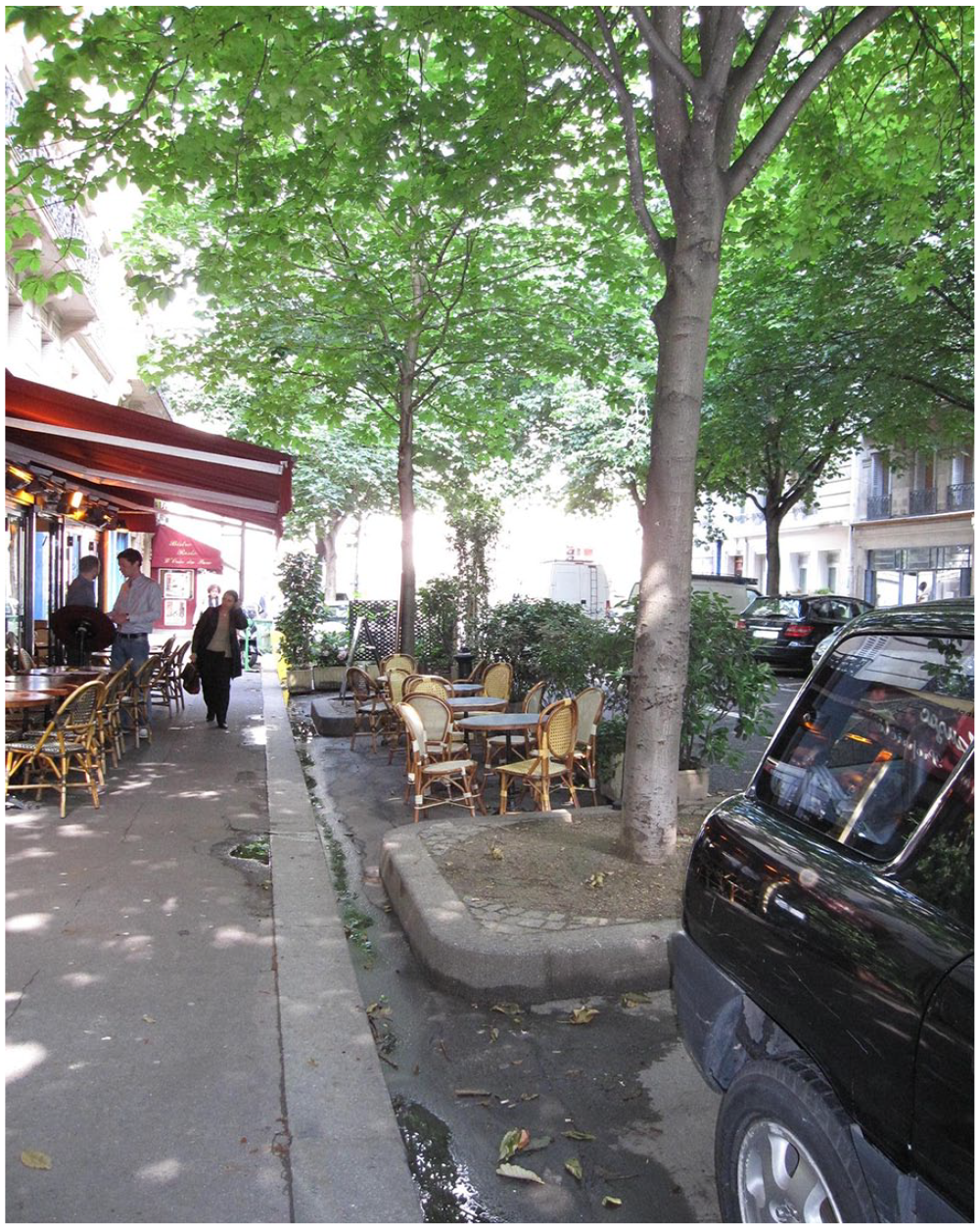
Trees, cars, and cafés in the curb lane.
Demand-Priced Curb Parking
Transportation planners have neglected curb parking because nothing is moving, and land-use planners have neglected it because it is in the roadway. No one seems to know how to solve the curb parking problem, except for followers of Nobel laureate William Vickrey who proposed that cities should set the prices for curb spaces to “keep the amount of parking down sufficiently so there will almost always be space available for those willing to pay the fee” (Vickrey 1954). Prices can vary by place and time of day to leave one or two open curb spaces on every block. Where all but one or two curb spaces on a block are occupied, the parking is both well used and readily available.
If curb parking prices remain fixed all day, occupancy will often be too high or too low and rarely right. The right price for curb parking resembles the Supreme Court’s definition of pornography: I know it when I see it. With Goldilocks parking prices (not too high, not too low), drivers will never have to search for an open space.
Scarce curb parking can be free, convenient, and available, but not all three at once. It can be free and convenient but not available. It can be free and available but not convenient. Or it can be convenient and available but not free. Market-priced curb parking is convenient and available but not always free. When curb parking is overcrowded, drivers block fire hydrants, occupy bus stops, and double-park. Transportation Alternatives (2007) found that where all the legal curb spaces are occupied, reducing the legal parking occupancy by 5 percent (to 95%) reduced violations by 50 percent (Transportation Alternatives 2007). The right prices will also reduce conflicts between drivers and enforcement officers, and reduce injuries and even deaths from disputes among drivers over scarce curb spaces (Bliss 2019). Because drivers cruising for scarce curb parking often look for an open space more than they look where they are going, demand-priced parking is also safer for pedestrians, cyclists, and other drivers.
In 2011, San Francisco became the first city to vary prices by location and time of day according to demand, and the program’s success is well documented (Pierce and Shoup 2013; San Francisco Metropolitan Transportation Agency 2014 and 2019). A few other cities—Baltimore, Boston, Calgary, Los Angeles, Mexico City, Milwaukee, Pittsburgh, Seattle, and Washington, D.C.—also charge market prices for some or all of their metered curb spaces.
Market prices for curb parking exemplify what Jaime Lerner (2013) called urban acupuncture: a simple touch at a critical point (in this case, the curb lane) can benefit the whole city. In another medical metaphor, streets are a city’s blood vessels, and overcrowded free curb parking is like plaque on the vessel walls, leading to a stroke. Market prices for curb parking prevent this urban plaque.
The biggest problem with charging for curb parking is politics. Cities charge for public services like water and electricity to recover the capital and operating costs of providing them, but curb parking doesn’t have any obvious capital or operating cost to recover. Unmoored from the need to recover any costs in the city’s budget, curb parking prices are purely political (Manville and Pinsky 2021). How can cities create political support for paid parking?
The Politics of Parking Benefit Districts
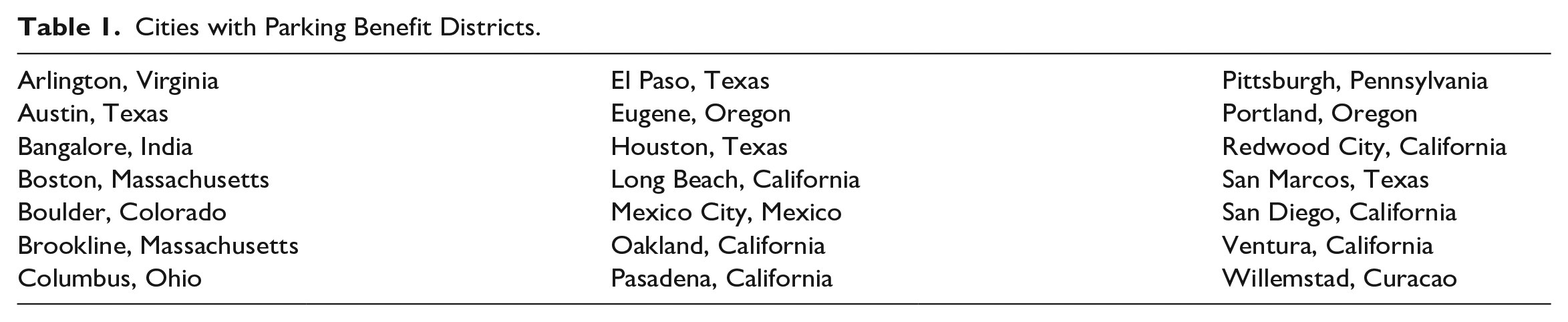
Some cities use the revenue from parking meters to create political support for the meters. These cities have established Parking Benefit Districts (PBDs) that spend the meter revenue to pay for added public services on the metered blocks (Table 1). Using various names such as Parking and Transportation Management District (in Austin) or Parking Enhancement District (in Pittsburgh), cities earmark the curb parking revenue to benefit the districts.
Cities with Parking Benefit Districts.
Residents, merchants, and property owners in a PBD can see their meter money at work cleaning sidewalks, planting street trees, and removing graffiti. 2 If the PBD pays for public services that people in the district want and will not get unless the city charges for curb parking in the district, market prices make political sense.
The goal is not to persuade drivers they should pay for curb parking. The goal is to convince stakeholders they should charge for curb parking. Anyone who does not store a car on the street may begin to see free curb parking the way landlords see rent control. Free curb parking is rent control, for cars. If people want better public services more than they want free curb parking, the curb lane can benefit everyone, not just drivers who store their cars on the street.
PBDs provide “selective public goods” that benefit particular groups or places (Olson 1971). Using parking revenue to finance selective public goods on metered streets can create local political support for parking meters. Putting the revenue into a city’s general fund does not. As Durning (2013) put it, “parking revenue going to the general fund might as well be going to Mars. It has virtually no political salience for most voters.” Guo and McDonnell (2013) surveyed residents of New York City about the political prospects of charging car owners for residential parking permits, and concluded, “without specifying the allocation of revenue from the permit fee, the support from car-free residents to pricing street parking is likely to be lukewarm.”
Charging for curb parking and spending the revenue on general public services produces pain for curb parkers and no obvious gain for anyone else. Spending the revenue to improve public services on the metered streets will turn the pain for curb parkers into gains for businesses in a commercial district or people in a residential neighborhood. The selective public services create a constituency for the parking meters. If delivery drivers and other nonresidents park on the street, PBDs resemble Monty Python’s proposal to “tax foreigners living abroad.” Nonresidents who park at the curb will be paying guests, not freeloaders.
The federal fiscal system has revenue sources for the nation, states, counties, and cities, but rarely for neighborhoods. PBDs fill this gap in the fiscal system, and their absence helps explain the frequent combination of free curb parking and poor public services (Shoup 2011, 447–50). PBDs with market-priced curb parking and good public services can make the old model of free curb parking and poor public services obsolete.
Using the curb lane as an endowment to pay for local public services can help cure the problem Galbraith (1958) called “private affluence and public squalor.” Clean and safe sidewalks, healthy street trees, and other visible neighborhood amenities show the benefits of charging for curb parking. If stakeholders will not support parking meters unless they see local benefits, the invisible non-local benefits, such as reduced carbon emissions, will be lost. But if stakeholders do see local benefits, a new Golden Rule of Parking Prices may emerge: Charge others what they would charge you.
Business Improvement Districts (BIDs) are a precedent for PBDs, and have spread worldwide since Toronto established the first one in 1970 (Briffault 1999; Shoup 2011, 401–403). To pay for public services, BIDs tax the benefited property owners, while PBDs charge drivers who park their cars on public property.
Special Assessment Districts are another precedent for PBDs. In a Special Assessment District, the city provides public services (such as street lighting) and taxes the benefited properties to cover the cost. As explained in one court ruling, “The general public should not be required to pay for special benefits for the few, and the few specially benefitted should not be subsidized by the general public.” 3 Special Assessment Districts capture the increased value of benefited properties, while PBDs capture the land value of the curb lane.
Drivers, however, consider free curb parking an entitlement, and they fight back. As Oliver Wendell Holmes wrote,
A thing which you enjoyed and used as your own for a long time, whether property or opinion, takes root in your being and cannot be torn away without your resenting the act and trying to defend yourself, however you came by it.
Free curb parking is good politics but bad policy, while PBDs are good politics and good policy, a simple solution to a complex problem. If the desire for better public services outweighs the desire to park free, skillful parking politics will enable efficient parking prices. The name Parking Benefit District suggests the curb lane will be used for parking, but other uses can be far more valuable. For example, bus and bike lanes provide faster, cheaper, and safer travel for many people. Where low parking prices reveal a low value of curb parking, cities can more easily reclaim curb lanes from parked cars. But wherever a city does allow curb parking, the city council can set the occupancy goal for curb spaces and the transportation staff can adjust prices to reach that goal (Pierce and Shoup 2013). Only drivers who now park free on crowded streets will pay anything.
The Literature of Parking Benefit Districts
Pasadena, California, established the first PBD in 1993 (Kolozsvari and Shoup 2018; Shoup 2011, Chapter 16). Meter revenue in the fifteen-block Old Pasadena Management District paid to repave all the sidewalks, put overhead utilities underground, install historic light fixtures and street furniture, and plant trees. Dilapidated alleys were turned into walkways with shops and restaurants. Meter revenue of more than $1 million a year pays for cleaning the sidewalks and streets daily, power washing the sidewalks twice a month, and other traditional “clean and safe” services. Old Pasadena’s sales tax revenue (a measure of business activity) tripled in the five years after the city established its first PBD, and since then the city has established four more.
In 2005, Redwood City, California, established a PBD and reduced off-street parking requirements in its downtown (Zack 2018). The meters operate until 10 p.m. every day. Charging for curb parking and reducing off-street parking requirements usually create controversy, but the city council supported the PBD unanimously.
Austin, Texas, established its first PBD in 2012 in a twenty-five-block neighborhood adjacent to the University of Texas (Bojo 2018). Neighborhoods can petition to become PBDs, and three more were formed by 2021. Austin allocates 51 percent of the parking revenue to pay for local public services, and the first priority was to rebuild sidewalks and increase pedestrian safety.
Houston, Texas, established its first PBD in 2013 and has established two more since then; 60 percent of the meter revenue goes to the PBDs (Irshad 2018). El Paso and San Marcos in Texas also have PBDs, and El Paso operates its meters until 3 a.m. in a late-night entertainment district.
Ventura, California, established a PBD in 2010 (Mericle 2018). Parking turnover increased, and the presence of uniformed enforcement officers led to a 40 percent decline in reports of non-parking incidents during parking enforcement hours.
Will the bottom-up approach of PBDs suit countries with a more centralized approach to city planning? Johansson, Hendrickson, and Åkerman (2017) surveyed civil servants and elected officials in Stockholm and found strong support for PBDs. In the words of Stockholm’s Chief Strategy Officer for Transport and Streets,
The principle is very exciting, very interesting. And I think it is very exciting as a way to get commercial actors or property owners or even individual citizens to be interested in charging for on-street parking. It could come as a citizen initiative instead of from the municipality. But I also think the potential it gives to local organizations of commercial actors or property owners to take more ownership of their street would be interesting.
PBDs will help most in low-income cities that have chaotic curb parking, hypercongested traffic, toxic air, and poor public services. Bangkok is a good example. Chalermpong and Ratanawaraha (2020) write,
Another key feature of Bangkok’s parking situation is the informal and illegal governance of curbside space. Particularly at night, illegal parking attendants control on-street parking in many high-demand areas. These parking attendants are usually controlled by local mafia or, allegedly, by the Traffic Police themselves.
In contrast, Mexico City’s EcoParq program charges market prices for curb parking in 26,000 spaces and returns 30 percent of the revenue to provide public services in the metered neighborhoods (Garcia Resendez and Sanudo Galvadon 2018). The city also converted its minimum parking requirements into maximum parking limits.
A pilot program for alley improvements in Beijing showed that parking revenue could repay the capital costs of substantial public investments in sanitation and security in less than three years (Shoup, Yuan, and Jiang 2017). Sixty-five percent of households in the proposed pilot program were carless and would pay nothing for the parking-financed public services. The average income of car-owning households was almost three times that of carless households.
Business Improvement Districts can also manage curb parking. In Bangalore, India, the Brigade Road BID operates the parking meters, sets the meter rates, and collects the revenue (Centre for Science and Environment 2016). The BID keeps half the revenue and the city gets the other half. Where governments have failed to manage the curb effectively, BIDs may succeed.
Manville (2018) analyzed how cities can ease the transition from free to priced curb parking. For example, cities that already have residential parking permit districts can grandfather the current permits at the original low price and phase in higher prices as new residents move in. Vancouver, BC, uses this policy to introduce market prices for residential permits. Because only 20 percent of Vancouver’s residential permits remain active for more than five years, the transition should not take long. Protecting current permit holders is more expedient than fair, but reforms must start from the status quo of free or cheap curb parking. As Supreme Court Justice Benjamin Cardozo wrote, “Justice is not to be taken by storm. She is to be wooed by slow advances.”
Legislation for Parking Benefit Districts
The legislation for a PBD spells out what a neighborhood will get from priced curb parking. Here is the ordinance in Ventura, California:
All moneys collected from parking pay stations and meters in this city shall be placed in a special fund, which fund shall be devoted exclusively to purposes within the geographic boundaries of the parking district from which the revenue is collected. (Section 16.225.050 of the Municipal Code of Ventura)
If a city already has parking meters and puts the revenue into the general fund, returning this revenue to PBDs will pull money out of the general fund. To protect the general fund, Pittsburgh, where the parking meters normally stop operating at 6 p.m., has established Parking Enhancement Districts that receive meter revenue earned after 6 p.m.
4
The first district, South Side Flats, has active nightlife and the meters operate until 3 a.m.
Parking enhancement district means a parking zone that has . . . collection hours extended past 6:00 p.m. in the form of dynamic hours; to have dynamic pricing instituted during all parking hours, and to have the revenue generated from parking collection after the hours of 6:00 p.m. dedicated to funding nighttime business area enhancements within the parking zone. (Section 546.02(e) of the Pittsburgh Municipal Code)
With the right rules, PBDs can be politically popular, economically successful, and environmentally sustainable. Cities can manage the curb lane to serve people, not unused cars.
Parking Benefit Districts in Residential Neighborhoods
Most PBDs have been established in commercial districts, but can they work well in residential neighborhoods? They will work best in densely populated neighborhoods where:
Curb parking is overcrowded.
Public services are undersupplied.
Most residents do not own a car or park off-street.
In a neighborhood with these three characteristics, consider this choice: free curb parking or better public services. Because few residents can park on the street in a densely populated neighborhood, most residents would probably prefer better public services.
Consider a block in New York City with twenty curb spaces and 400 residents (one space for every twenty residents). If the city charges $5.50 a day for curb parking (the price of a round trip on public transit in New York), the block’s twenty spaces will earn $40,000 a year. Suppose the city spends this money to keep the sidewalks clean and safe. Few of the 400 residents would say the city should spend $40,000 a year less for public services so it can offer hard-to-find free parking for twenty cars. For most residents, other people’s money would pay for public services. Should everyone pay for curb parking through reduced public services, or should curb parkers pay $5.50 a day?
Because New York does not charge drivers for parking in 97 percent of its three million curb spaces, it offers a titanic subsidy for cars. If the city charged only $5.50 per curb space per day, it would earn $6 billion a year, about the same as the $6.1 billion farebox revenue from all New York City public transit in 2019 (Metropolitan Transportation Authority 2019).
Because the curb lane is land in fixed supply, its revenue is land rent. When a city forgoes the revenue that demand-priced curb parking could earn, it subsidizes car owners and hides the subsidy in uncollected rent. Curb parking subsidies are a municipal version of “federal tax expenditures” (Joint Committee on Taxation 2020). For example, the income tax deduction for mortgage interest payments hides the subsidy for owner-occupied housing in reduced tax revenue. In 2020, this hidden subsidy—mostly for high-income homeowners—amounted to $27 billion (U.S. Department of the Treasury 2020). Drivers must spend time and fuel while searching for an open space, so the net subsidy drivers receive from free curb parking is less than the meter revenue cities forego (Shoup 2011, 323–324). Time lost in cruising for parking is a truly nonrenewable resource.
There is no such thing as free curb parking in a crowded city, only a choice about who should pay for it—curb parkers or everyone, even people who cannot afford a car. Cities should not subsidize curb parking unless they want more traffic and don’t have any better use for the money.
PBDs unlock the value of the curb lane but do not privatize it. The city owns the curb lane, uses market prices to manage it, and spends the resulting revenue to provide public services. This arrangement is “market socialism” (Schleifer and Vishny 1994). PBDs may turn out as well for elected officials as congestion pricing did for London’s Mayor Ken Livingstone, who said it was the only thing in his political career that “turned out better than I expected” (Timms 2013). Both capitalists and communists may agree that clean and safe sidewalks are better than crowded free parking.
Parking Benefit Districts in Manhattan
New York City Councilmember Mark Levine said, “As anyone who’s ever looked for a parking spot in Manhattan knows all too well, it is a brutal and time-consuming process.” PBDs with cruising-free curb parking can cure this problem. Like in a Hollywood movie about life in Manhattan, drivers will always see an open curb space waiting for them at their destination.
Using data from INRIX, a leading firm in crowd-sourced traffic data, Cookson and Pishue (2017) estimated that drivers in New York spend 107 hours per year cruising for parking, with an annual cost of $2,243 per driver in wasted time, fuel, and vehicle emissions. Market-priced curb parking may be expensive but free curb parking costs far more.
Consider the effects of cruising for parking in Manhattan’s Upper West Side (Figure 2). A six-month study in a fifteen-block area there found that cruising created 366,000 excess vehicle miles traveled per year (Transportation Alternatives 2008). Cruising cars emitted 22 tons of carbon dioxide per block per year. All this cruising helps explain why average vehicle speeds in Manhattan had declined to 7.1 miles per hour before COVID (New York City Department of Transportation 2019).
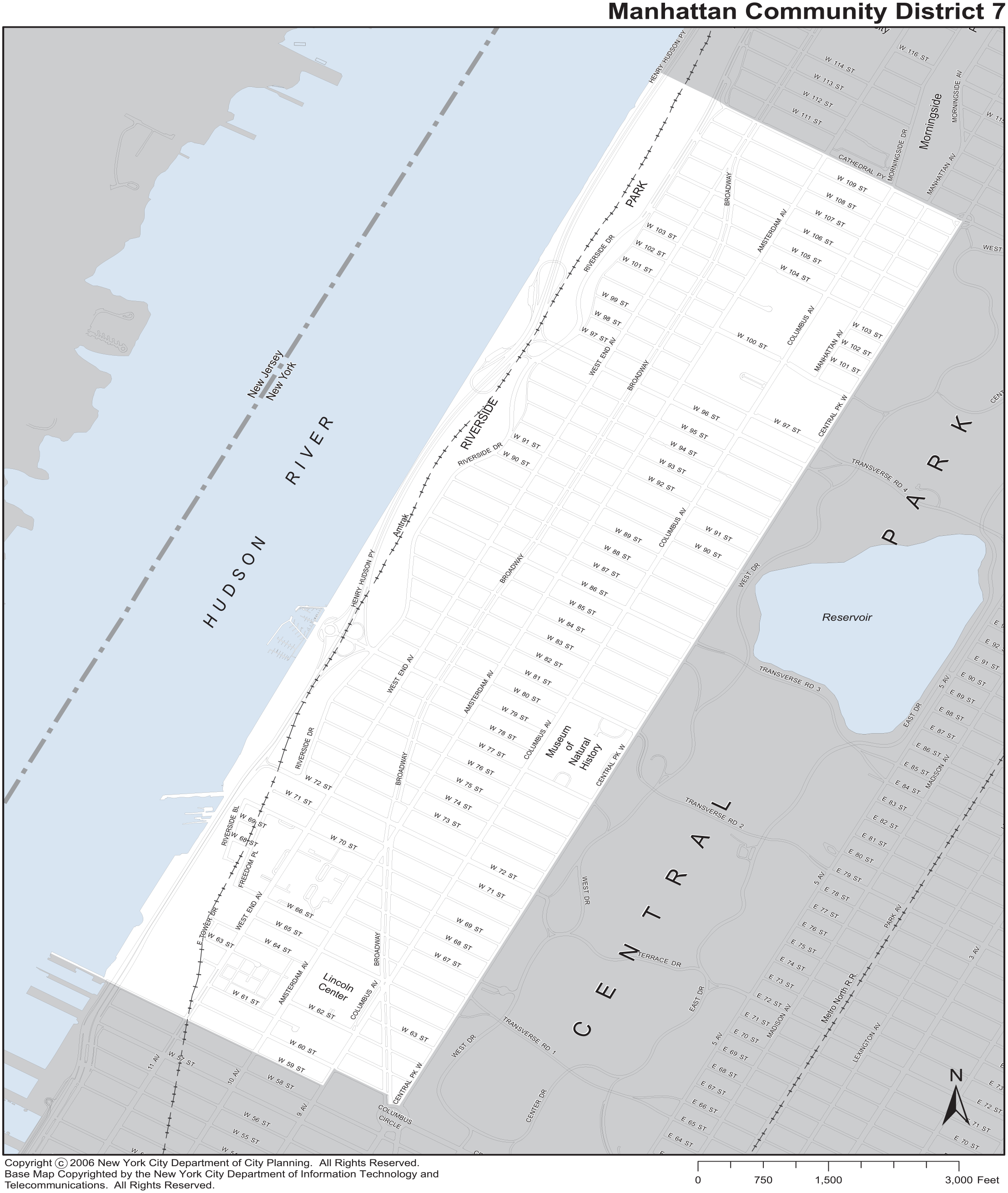
The Upper West Side.
In 2020, the Upper West Side had 222,129 residents and 12,300 unmetered curb spaces, or eighteen residents per unmetered curb space (Table 2, rows 1, 6, and 7). 5 Most residents can afford to buy a car but do not own one because they would have to hunt for a scarce curb space or pay for an off-street space. High population density and expensive off-street parking help explain why the Upper West Side is so walkable.
People, Parking, and Money on the Upper West Side.
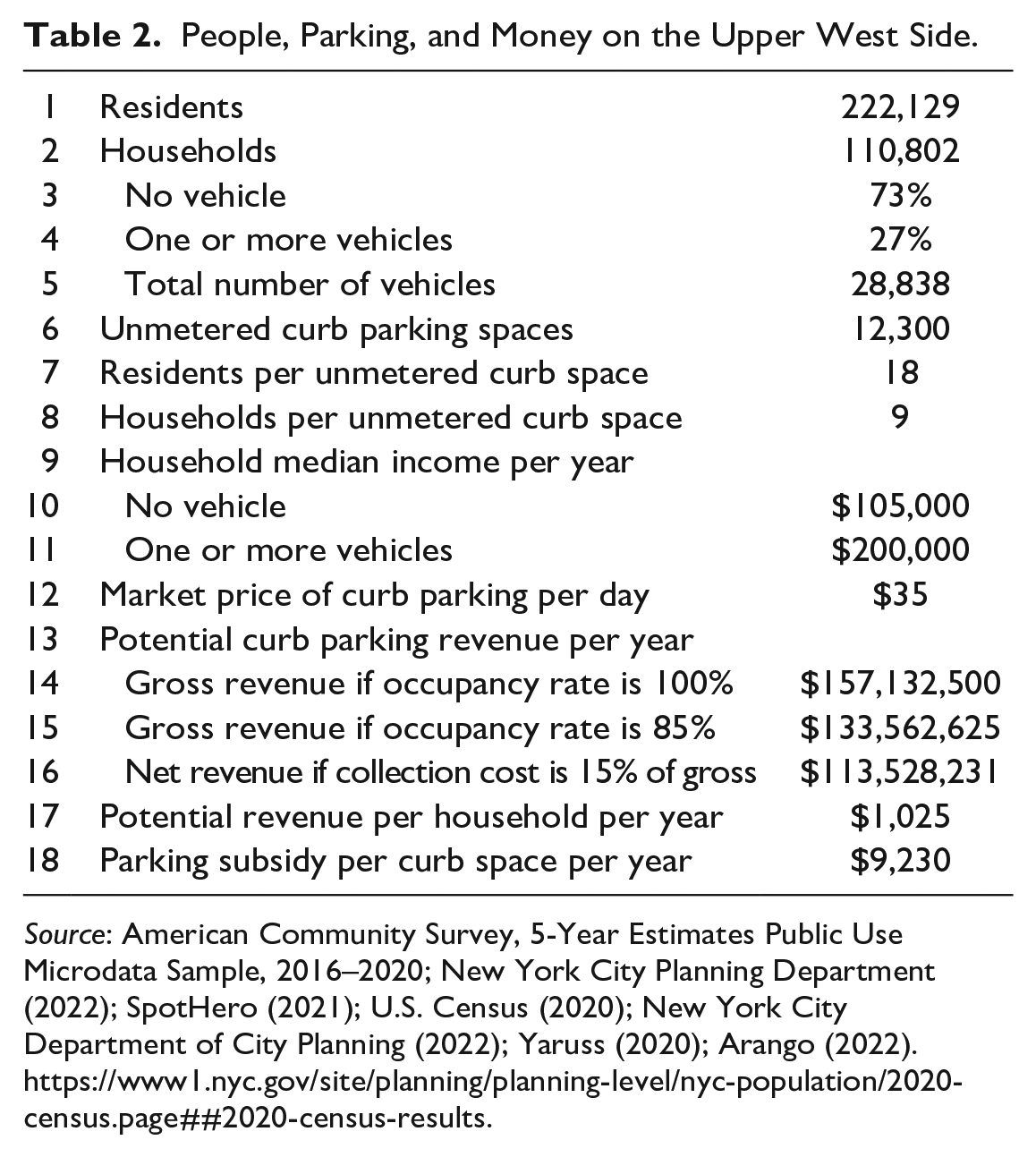
Source: American Community Survey, 5-Year Estimates Public Use Microdata Sample, 2016–2020; New York City Planning Department (2022); SpotHero (2021); U.S. Census (2020); New York City Department of City Planning (2022); Yaruss (2020); Arango (2022). https://www1.nyc.gov/site/planning/planning-level/nyc-population/2020-census.page##2020-census-results.
The market prices for off-street parking on the Upper West Side range from $35 to $147 a day, with a median of $62 (SpotHero 2021). 6 If currently unmetered curb spaces can earn the same revenue as the cheapest off-street space ($35 a day, which is $1.46 an hour), and the curb space occupancy rate is 85 percent (to provide a 15 percent vacancy rate needed for easy access), the gross revenue of the 12,300 unmetered curb spaces would be $134 million a year (row 15). 7 If the cost of collecting the revenue is 15 percent of gross revenue, the net revenue would be $114 million a year, or $1,025 per household per year (rows 16 and 17). 7 Should 111,000 households forgo $114 million a year for public services to provide free but hard-to-find curb parking for a small minority of the residents?
The estimated revenue loss of $114 million a year is conservative. First, it is based on a price of $35 a day, which is the Upper West Side’s lowest daily price for off-street parking (the median is $62 a day). Second, New York has the world’s highest hourly prices for off-street parking (Parkopedia 2019). The price for the first hour of off-street parking on the Upper West Side ranges between $19 and $42 an hour (SpotHero 2021). This price is high because all the legal on-street spaces are usually occupied, so some drivers on urgent trips are forced to park off-street. Third, fines for meter violations are, in effect, delayed payments for curb parking, so the revenue from tickets for meter violations should be added to the meter revenue to estimate the total revenue from metering. If one or two legal curb spaces were open on every block, the prices for the first hour of off-street parking would fall, and the prices of adjacent on- and off-street parking would converge.
Free curb parking resembles a tax of $1,025 per household per year to provide a subsidy of $9,230 per free curb space per year (rows 17 and 18). Perhaps never before have so many people forgone so much public revenue to subsidize free parking for so few cars.
Curb parking revenue could pay to clean and maintain the Upper West Side’s fifteen subway stations (Tempey 2015). Drivers who park on the streets would improve life for many more people who travel underground. The city could use parking revenue to buy free transit passes for all low-income residents. Parking-financed transit passes would fund the transit system, and the free transit would increase ridership.
A quick way to judge the health of a city is to look at the condition of its sidewalks. Curb parking revenue could improve public health by paying to clean sidewalks now covered with black polka dots and piles of trash. The city could install a few large waste bins in the curb lane on each block, emptying them frequently (Beyer 2020; Kessler 2021). The city would lose a few curb parking spaces, but demand-based prices would keep one or two of the remaining spaces open on every block, and the clean sidewalks would be worth it (Figure 3).
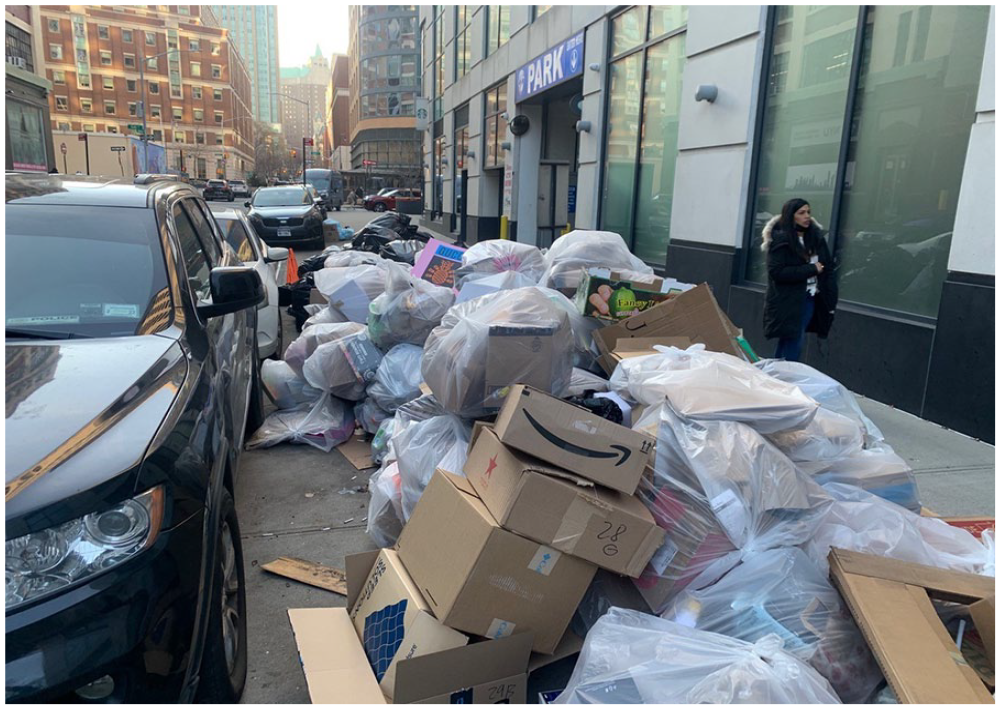
A Manhattan sidewalk.
Businesses would also benefit. Delivery companies need reliable curb parking and are willing to pay to save valuable time. 8 Dalla Chiara and Goodchild (2020) found that delivery drivers in Seattle wasted 1.15 hours per day while cruising for parking. Eliminating this cruising would increase the productivity of the city’s delivery system. 9 Cruising and traffic congestion are big expenses for the business sector, so eliminating cruising would increase the productivity of the entire city (Sickles and Zelenyuk 2019).
Cities can use pay-by-plate technologies to monitor the curb and charge vehicles per minute for parking. Cities can also charge in loading zones according to the length of delivery vehicles. If a 40-foot-long truck pays four times the price per minute as a 10-foot-long cargo bike, they both pay the same price per curb foot (Shoup 2020). Parking prices per curb foot would encourage delivery companies to use cargo bikes for short trips and small packages.
PBDs could use parking revenue to clean under the parked cars, so drivers would not need to move them on street-cleaning days. Guo and Xu (2012) found that New York’s alternate-side street-sweeping policy increased vehicle miles traveled by households with cars and without off-street parking by 27 percent. Ending alternate-side regulations would also eliminate the time drivers now spend in “stationary cruising” when they double-park on one side of the street (often with the engine running in hot or cold weather) while waiting for the other side of the street to be swept (Shoup 2011, 285–289). Market pricing would also reduce “mobile parking” in which a driver double-parks or circles the block while someone else shops, makes a delivery, or attends to other business.
If curb parking is market-priced, carsharing companies like Zipcar might outbid private car owners for some of the curb spaces. The shared cars would benefit residents who do not own a car but occasionally want to use one. The relationship between cars and residents could shift from ownership by a few to availability for many. Fewer private cars, more shared cars, and better public services would improve many neighborhoods.
In some locations, restaurants may be willing to pay more for outdoor dining space than drivers are willing to pay to park a car. If restaurants pay market prices for using the land, flexible curb space can employ more workers, serve more people, and pay more taxes than parking does.
Free curb parking imposes so many costs—wasted time, congested traffic, polluted air, and forgone public services—that the winners in a PBD can gain far more than the free curb parkers lose. The costs of free curb parking have become so high that even current free parkers can gain from priced curb parking and better public services.
A Pilot Parking Benefit District
A city can test PBDs with a pilot program on one block. Consider a typical block on Manhattan’s Upper West Side, surrounded by 75th and 76th Streets and Amsterdam and Columbus Avenues (Figures 4 and 5). The block’s dimensions are 840 feet on 75th and 76th Streets and 235 feet on Amsterdam and Columbus Avenues, so the length of the curb lane surrounding the block is 2,150 feet (0.41 miles or 0.66 kilometers).
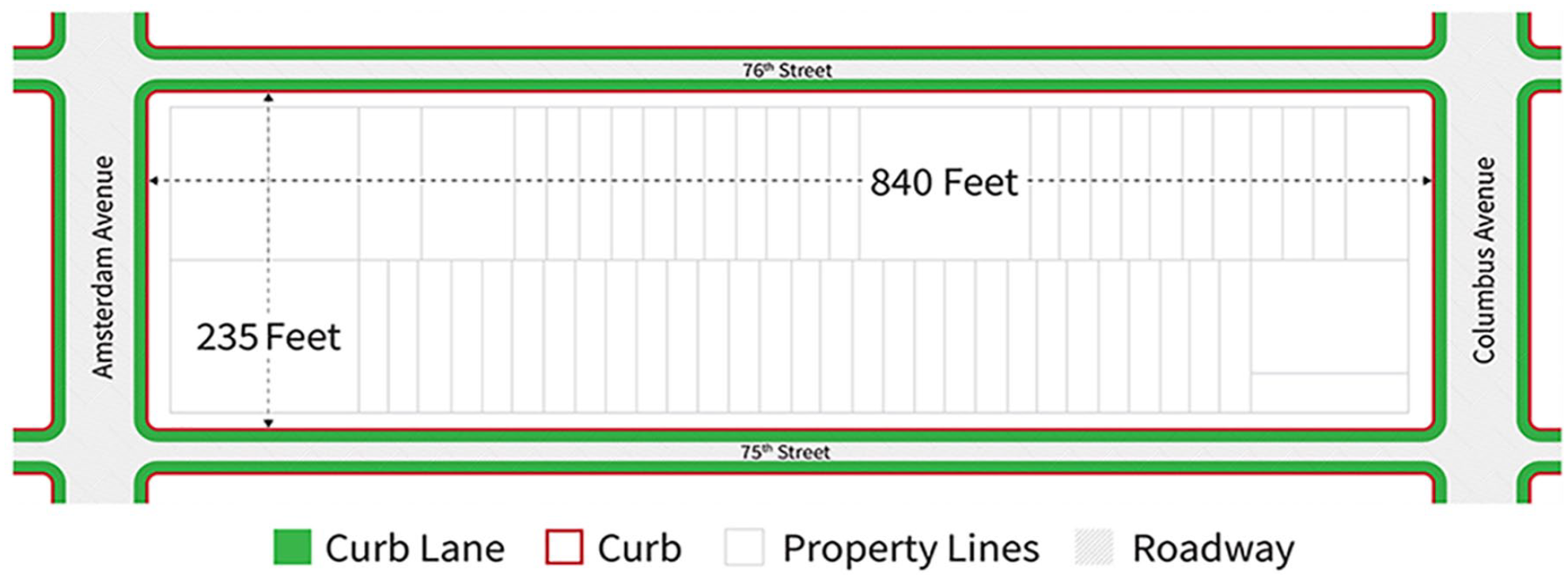
The curb lane surrounding the block between West 75th and 76th Streets and between Amsterdam and Columbus Avenues.
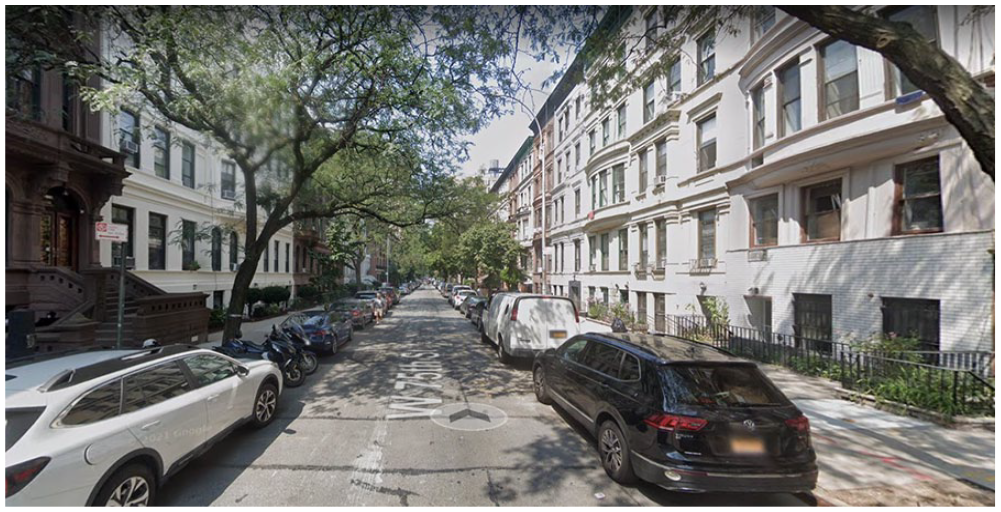
West 75th Street between Amsterdam and Columbus Avenues.
If parking spaces are 18 feet long and all the curb lane is used for parking, the block would provide 119 curb spaces. 10 But the curb lane also has bus stops, fire hydrants, loading zones, driveways, and other no-parking zones. A survey of the block’s curb lane found eighty-six legally parked cars and no vacant spaces where a car could legally park. Of these eighty-six legal spaces, fourteen on Amsterdam and Columbus Avenues are already metered, so there are seventy-two unmetered curb spaces (Table 3, row 6).
People, Parking, and Money on One Block.
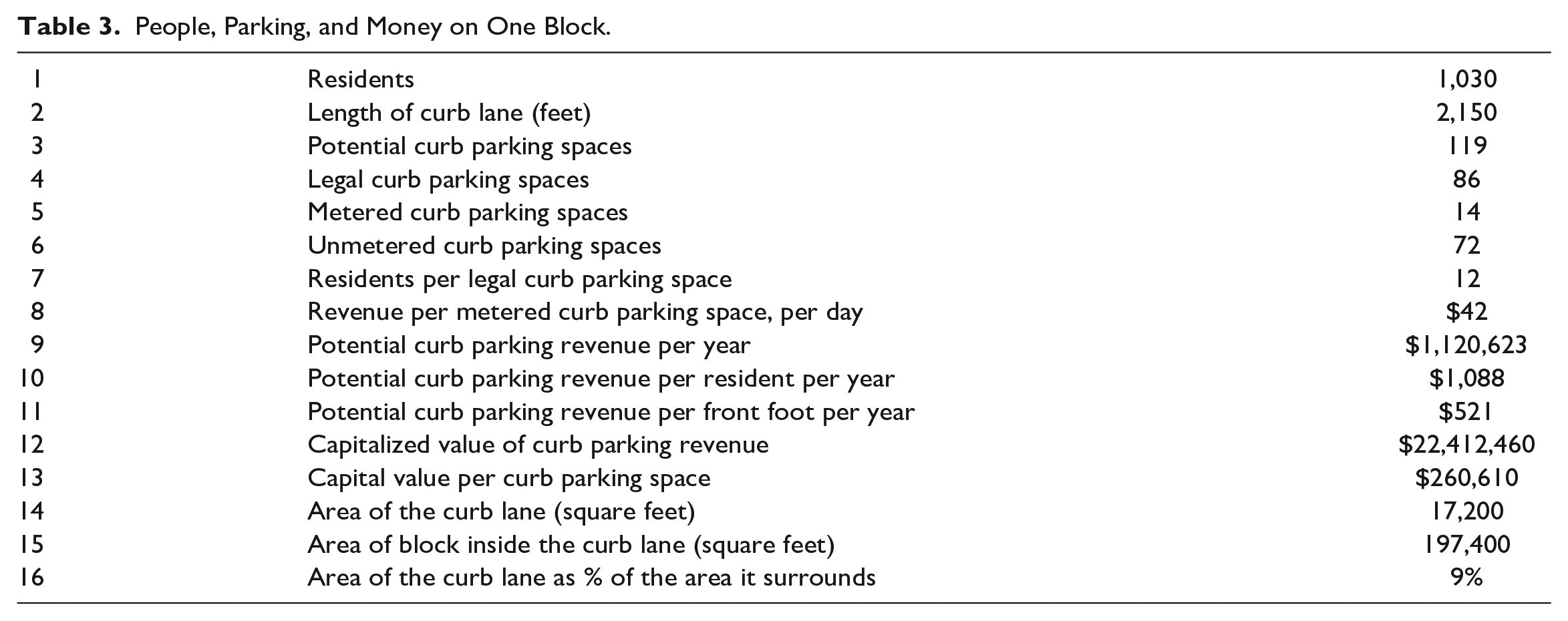
The fourteen metered spaces are priced at either $4 or $5 per hour. If these spaces were occupied 85 percent of the metered time, and the collection cost is 15 percent of the revenue, they would earn $42 per space per day. If the seventy-two now-unmetered spaces could also earn $42 a day, the new revenue to pay for public services on the block would be $1.1 million per year (row 9). The block has 1,030 residents (row 1), so the revenue would be $1,088 per resident per year (row 10). 11
This revenue estimate is conservative because the garage nearest this block charges $62 a day for off-street parking. The city can also earn additional revenue by charging property owners for driveway curb cuts that remove on-street parking spaces (Shoup 2011, 458–459), and by charging for loading zones. Commercial deliveries and ride-hailing pick-ups and drop-offs can pay a high price per minute for the short times they park (Dalla Chiara and Goodchild 2020; Shoup 2011, 513–519). 14
The curb lane around this block is 2,150 feet long and 8 feet wide, so its area is 17,200 square feet (0.4 acre or 0.16 hectare). The area inside the curb lane is 197,400 square feet, so the area of the curb lane is 9 percent of the area it surrounds (rows 14–16). 12
For this 0.4 acre of land in the curb lane, a PBD can put into practice the theory of nineteenth-century reformer Henry George, who argued that land rent should pay for public services (Shoup 2011, Chapter 19). In a PBD, land rent from the curb lane pays for public services.
If the interest rate is 5 percent, the capitalized value of the $1.1 million annual curb revenue would be $22 million, or $257,000 per curb parking space (rows 12 and 13). Thisvalue may seem high but is conservative. Albouy, Ehrlich, and Shin (2018) estimated that land in Manhattan was worth $123 million per acre in 2010. At this value, the 0.4-acre curb lane would be worth $49 million, or $412,000 per potential parking space. 13
Smaller blocks have a higher share of land in the curb lane. Consider the block in Figure 4. Almost all blocks in the Upper West Side have the same 235-foot short sides, but many of the long sides are shorter because of Broadway’s diagonal path through the grid (Figure 2). For a square block with 235 feet on each side, the land in the curb lane equals 14 percent of the land it surrounds.
These data are specific to the Upper West Side, but many cities have dense neighborhoods with crowded curb parking. Megacities like Bangkok, Cairo, Lagos, and Mumbai would benefit the most from market-priced curb parking and better public services. The method used in Table 3 can show the potential parking revenue for any block in any city.
Finally, here’s a thought experiment. Would you prefer free curb parking or clean and safe sidewalks on your own block? If you park off-street or do not own a car, you would probably prefer clean and safe side walks. The difference between free parking on a crowded street and a PBD with good public services could resemble the difference between a Model T and a Tesla.
Mismanaged curb parking causes many urban ills. If a city wants to reduce traffic congestion, clean the air, cut carbon emissions, support public transit, encourage active transportation, promote business, increase employment, and improve public services, a pilot PBD on a block with crowded curb parking is worth considering.
Equity within Parking Benefit Districts
Free curb parking on the Upper West Side creates a veneer of equality without being equal and is a poor way to help poor people, for two reasons. First, 73 percent of households do not own a car, so they get no subsidy from free parking (Table 2, row 3). Second, car-owning households have almost double the incomes of carless households (rows 10 and 11). People who are not poor get most of the subsidy, and most poor people get no subsidy. Parking-financed public services can help many more poor people than free curb parking does. 14
To drivers, priced curb parking that isn’t affordable resembles free parking that isn’t available, but to cities the difference is vast. Priced curb parking pays for public services while free curb parking creates cruising, traffic congestion, air pollution, and carbon emissions. The only downside of priced curb parking is that drivers have to pay for it.
But not all drivers. Cities can give parking discounts to low-income drivers, like the discounts on electricity and water bills for low-income residents. High-income drivers will pay the market price, and low-income drivers will get a subsidy. To be fair to low-income residents who do not own a car, cities can give them an equivalent subsidy, such as free transit passes. To ease the transition from free to paid parking, a city can also use some of the meter revenue to offer a “cash for clunkers” program to buy old cars from the residents of a new PBD.
Portland, Oregon, uses meter revenue to offer “transportation wallets” to all low-income people who live or work in a PBD (Figure 6). 15 The wallet is a collection of credits that recipients can use for public transit, scooters, bike sharing, and car sharing. Boulder, Colorado, uses downtown meter revenue to finance free transit passes for downtown workers, so drivers who park on the street subsidize commuters who ride the bus, which is fairer than free curb parking for a few lucky drivers and nothing for everyone else. Demand-side subsidies for public transit create local political support for the parking meters, while supply-side subsidies given directly to a public transit agency do not. PBDs subsidize people, not cars.
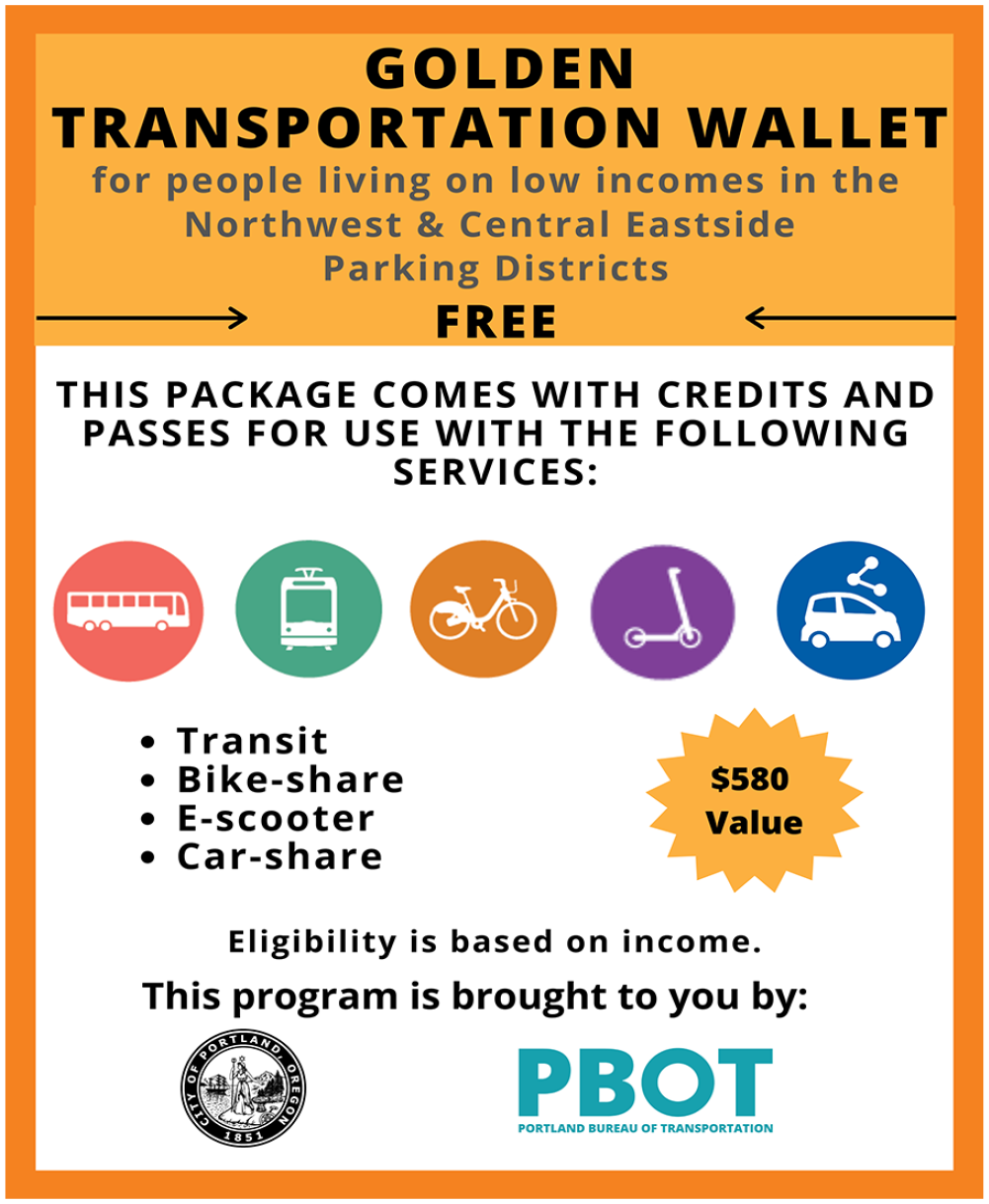
Transportation wallet.
When both the sources and the uses of the revenue are considered, market-priced curb parking can be both efficient and fair. Cities that price curb parking properly can stop subsidizing cars and begin spending more on public services. A city where everyone happily pays for everyone else’s free parking is a fool’s paradise.
Equality among Parking Benefit Districts
Cities can use what in public finance is called power equalization to ensure equality among PBDs. A city can give all the PBDs equal revenue per curb space (or per resident or front foot) for public services.
Sharing PBD revenue equally ensures that all PBDs will fare equally. Suppose a city’s average revenue per metered curb space is $4,000 a year. The city can spend $4,000 per space per year to improve public services in every metered neighborhood. PBDs with higher parking prices will subsidize PBDs with lower prices. Power equalization will also eliminate the incentive to gerrymander the borders of PBDs to include blocks with high revenue and exclude those with low revenue. Power-equalized PBDs seem fairer than installing parking meters in a few neighborhoods and spending the revenue on anything anywhere in the city. 16
PBDs can serve as lightning rods to protect elected officials against predictable thunderbolts from curb parkers. The districts should be small enough to choose the right public services for their residents, but large enough to spend the revenue efficiently and fairly (Shoup 2011, 447–50). Allocating some of the parking revenue to the City Councilmembers’ discretionary budgets to pay for public services in their districts would spread the revenue equally among the Council districts and increase PBDs’ political appeal to elected officials.
All things considered, properly priced curb parking can be fairer and cheaper than free curb parking. PBDs can make cities richer and more equal, economically efficient and socially just.
Conclusion: Cashing in on Curb Parking
PBDs address two major problems: overcrowded curb parking and undersupplied public services. Market prices can prevent crowding and the resulting revenue can pay for public services. In addition, eliminating cruising for parking will reduce traffic congestion, air pollution, and carbon emissions. PBDs convert the poison of crowded curb parking into medicine for the whole city.
PBDs are a new part of the fiscal system, and they can attract support from across the political spectrum. Progressives will see more public spending. Conservatives will see reliance on markets. Residents will see better public services. Environmentalists will see cleaner air and lower carbon emissions. Drivers will see available curb spaces and less traffic congestion. Elected officials will no longer have to deal with the mind-numbing politics of free curb parking. And city planners will find it easier to remove the off-street parking requirements that create abundant free parking at the expense of all other values.
Crowded curb parking is a great opportunity disguised as an insoluble problem. Almost like urban alchemy, PBDs can convert crowded curb parking into better lives for most people.
Footnotes
Acknowledgements
I am grateful to Mauricio Arango, Michael Criste, Nolan Gray, Tony Jordan, Kevin Holliday, Purva Kapshikar, Michael Manville, Graham Rossmore, Ellen Schwartz, Pat Shoup, Karl Storchman, and Howard Yaruss for all their generous help.
Declaration of Conflicting Interests
The author(s) declared no potential conflicts of interest with respect to the research, authorship, and/or publication of this article.
Funding
The author(s) received no financial support for the research, authorship, and/or publication of this article.
