




Abstract
Most studies of transit-induced gentrification rely on statistical analysis that measures the extent to which gentrification is occurring. To extend and enhance our knowledge of its impact, we conducted sixty-five interviews with residents living along the light rail transit (LRT) corridor in Waterloo Region, Ontario, Canada, shortly before the system opened. There was already strong evidence of gentrification, with more than $3 billion (Canadian dollars) worth of investment, largely in condominiums, before a single passenger was carried. In line with contemporary critical conceptualizations of gentrification, our interviews identified new and complex psychological, phenomenological, and experiential aspects of gentrification, in addition to economic- or class-based changes.
Introduction
Across North America, there has been a boom in light rail transit (LRT) and streetcar construction since the 1980s (Spieler 2019). Scholarly literature predominantly focuses on the use of LRTs as tools of economic development (e.g., Olesen 2020), their effect on transit ridership and mobility (e.g., Cao and Ermagun 2017), or evaluations of their localized station-area impacts (e.g., Ratner and Goetz 2013). However, recent (critical) discussions have focused on transit-induced gentrification, that is, the role transit improvements play in driving the gentrification of urban space (see Jones and Ley 2016; Moore 2015).
In parallel, critical scholars have placed increasing emphasis on understanding lived experiences of gentrification and displacement (Atkinson 2015; Davidson 2009; Shaw and Hagemans 2015). This literature takes Marcuse’s (1985) framework of direct and indirect forms of (economic) displacement as its starting point, although more recent work has moved toward incorporating psychological or experiential dynamics of these processes (Atkinson 2015; Elliott-Cooper, Hubbard, and Lees 2020; Shaw and Hagemans 2015). Understanding these diverse lived experiences involves analyzing knowledge that cannot easily be captured through statistical analysis (Easton et al. 2020; Slater 2009). Importantly, it necessitates an epistemological framework that conceptualizes gentrification and displacement not as one-time events, but as much larger and longer processes.
However, within the emerging literature on transit-induced gentrification, few studies have been framed in this way. Instead, the vast majority of research relies on hedonic modeling to measure change in quantifiable variables such as income, occupation, race, or education levels. As a result, there remain a number of gaps with respect to how rail rapid transit shapes residents’ experiences of gentrification. These include tensions among those differently positioned within the process, new forms of (dis)connection, new place identities, and new urban lifestyles.
Therefore, the main aim of this article is to examine perceptions and experiences of local residents living along a newly constructed LRT corridor. By doing so, we contribute to the painting of a more complete (and complex) picture of the impact that transit investment has, particularly on experiences, perceptions, and identities of residents living nearby. This is particularly relevant for policy and planning debates in the growing number of cities that are considering investing in LRT or streetcar networks. Rather than seeing gentrification as an event that can be measured, we interpret it in line with many other critical scholars, as a process that is lived and experienced. Because gentrification is a process, it is also important to understand these experiences before a new transit line opens.
To achieve this aim, we draw on sixty-five interviews conducted with residents living along the ION LRT corridor in Waterloo Region in Canada, prior to its opening in June 2019. Waterloo Region is a mid-sized urban area of approximately 600,000 inhabitants, spread across three cities and four rural townships and located one hundred km west of Toronto (Figure 1). It is the smallest urban area in North America to undertake a major LRT project. There were several ways in which gentrification was already evident before the line opened. The Regional government’s own quantitative monitoring indicated significantly higher increases in average income along the route than the regional average (Region of Waterloo 2019). Qualitative work that we have conducted in conjunction with local non-profits also demonstrated that displacement of low-income residents was also evident well before the line opened (Diwan et al. 2020; Social Development Centre Waterloo Region [SDC] 2020). Finally, there was more than $3 billion (Canadian dollars) in investment made along the Central Transit Corridor (CTC) before a single passenger was carried!
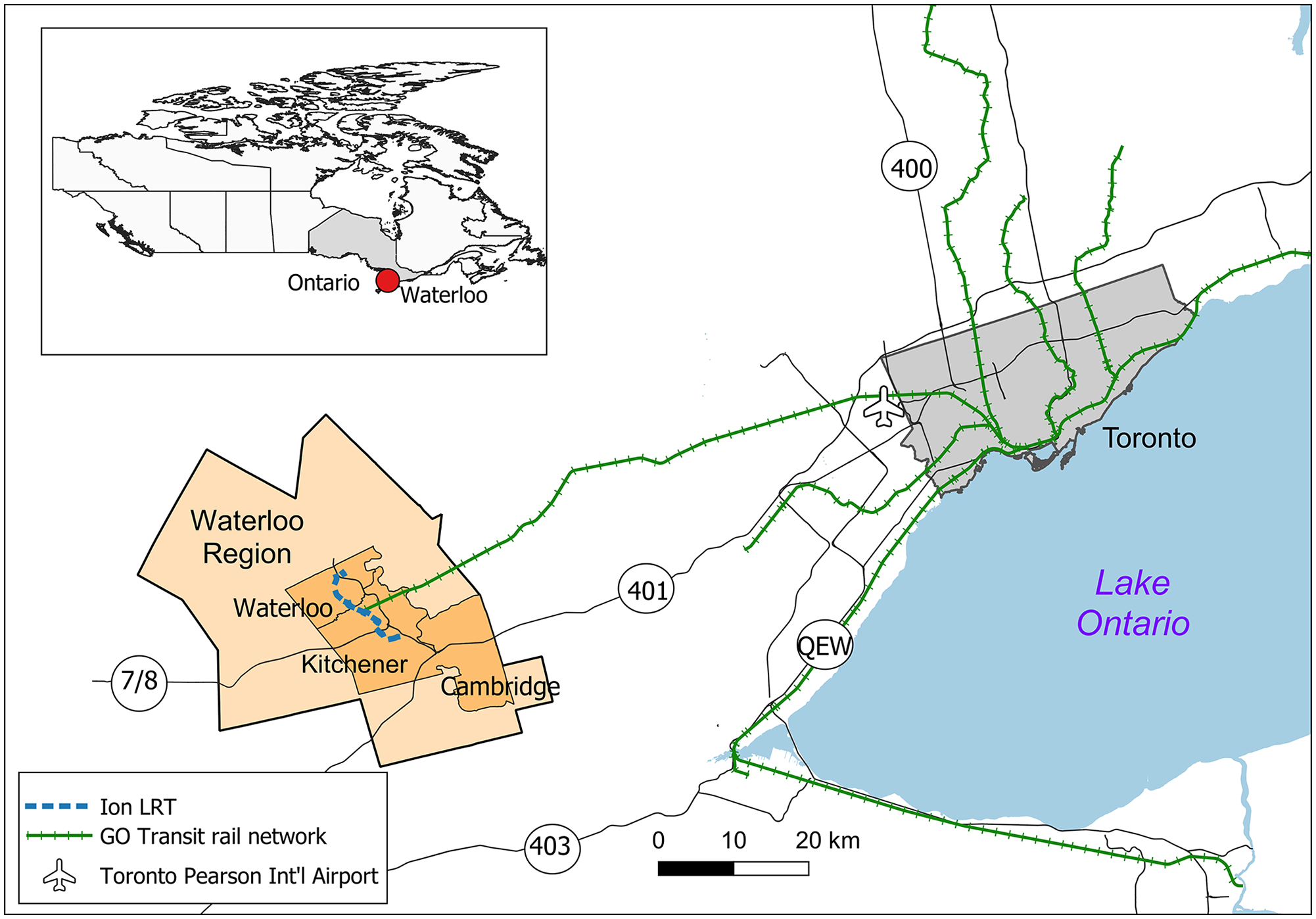
The location of Waterloo Region within Canada.
In this paper, we ask two central questions that seek to bring more critical and qualitative perspectives into research on transit-induced gentrification:
Our analysis focuses on three interrelated experiences of change along the corridor that are all in line with contemporary critical scholarship on gentrification: a shifting sense of community, an evolving urban identity, and new uncertainties surrounding the inclusivity of neighborhood trajectories. These themes speak to conflicting dynamics of inclusion/exclusion and (perceived) benefit/loss that both reinforce and extend current thinking on what constitutes gentrification and displacement (see Elliott-Cooper, Hubbard, and Lees 2020). Each of these experiences connects to measurable and quantifiable physical, social, and economic transformations, but could not be captured in such rich detail using quantitative techniques. However, an understanding of these intangible dynamics is important for achieving more equitable planning decisions along LRT corridors, as they raise questions of who belongs or is prioritized in LRT-adjacent neighborhoods.
Gentrification, Displacement, Urban Identity, and Shifting Connections to Place
A form of neighborhood change, gentrification broadly entails the transformation of demographic, social, and material landscapes through “the production of urban space for progressively more affluent users” (Hackworth 2002, 815). In the contemporary neoliberal age, municipal and regional state actors are a driving force in producing this gentrified space, including through landmark projects that rework a city’s image in a bid to attract new investment (Doucet 2013; Lees, Shin, and Lopez-Morales 2016; Sequera and Janoschka 2015). Here, gentrification is masked behind celebrations of “urban renaissance” (Bridge et al. 2012), which are seen to support certain urban lifestyles and ostensibly more vibrant and cosmopolitan place identities (Davidson and Lees 2005; Porter and Shaw 2009; Rofe 2004).
This idealized urbanity structures conditions of inclusion and exclusion in gentrifying neighborhoods, as higher income residents gain access to new social and consumptive spaces while many existing residents are (further) marginalized even if they are not physically displaced (Kern 2016; Zukin et al. 2009). Consequently, the parameters of gentrification have been expanded in recent years to recognize additional outcomes beyond the forced relocation of established (lower income) residents (e.g., Davidson 2009). Conceptualizations of both gentrification and displacement are therefore increasingly moving beyond an emphasis on a one-time process of outmigration from a spatially delineated area, such as a census tract, to consider social, emotional, psychological, and experiential dynamics. Terms such as “loss of place” (Shaw and Hagemans 2015), “slow violence” (Kern 2016), “un-homing” (Elliott-Cooper, Hubbard, and Lees 2020), and “symbolic displacement” (Atkinson 2015) capture inhabitants’ diminished sense of connection to their changing surroundings as spaces of belonging are replaced by spaces of exclusion.
This diminished sense of connection is partially a product of the loss of frequented places and informal activities, simultaneous to the emergence of upscale developments, amenities, and events that support a new urban lifestyle (Doucet and Koenders 2018; Kern 2016; Shaw and Hagemans 2015). At the same time, residents’ loss of belonging extends to experiences of disempowerment and the disintegration of pre-existing social connections amid an influx of new (more affluent) residents (Atkinson 2015; Davidson 2008). This new scholarship on gentrification and displacement extends the seminal work of Peter Marcuse (1985) by framing displacement as losses beyond purely the economic realm (such as lower income residents’ inability to pay for housing and amenities within gentrifying space). When perceptions and experiences are defined by more than purely economic terms, this also speaks to broader tensions between inclusion/exclusion and benefit/loss.
The emergence of new urban or neighborhood identities, contrived by policy makers or more privileged residents, can also erode the belonging of inhabitants whose attachments to place are being overwritten (Hwang 2016; Rofe 2004). While marginalized residents may seek to reinforce pre-existing connections to place in a bid to resist exclusion (Hwang 2016), privileged residents also respond to perceived threats to neighborhood character in a context of gentrification. In Dalston, London, Davison, Dovey, and Woodcock (2012, 56) note that resistance to upscale redevelopment has come predominantly from “white, well-educated, and middle-income residents” who see its generic design and target market—young professionals—as a threat to the neighborhood’s distinct and diverse character. Here, young professionals are “an unwanted ingredient in the urban mix” (Davison, Dovey, and Woodcock 2012, 58), predicted to remain disconnected from the community in contradiction of “shared values” around participation and associated with the potential displacement of lower income, immigrant residents (Davison, Dovey, and Woodcock 2012). However, the neighborhood character and community values cherished by these resident activists do not represent marginalized perspectives and are seen by other residents as an idealized version of reality on the ground (see also Tolfo and Doucet, 2020). Massey (2005) found that residents’ desire to protect “authentic” place identities in changing neighborhoods may be used to exclude not just affluent populations but also (other) marginalized populations who do not align with these identities.
Connecting Rapid Transit to Gentrification and Neighbourhood Change
Rail rapid transit projects play a major role in these shifting urban identities due to the ways in which they can both dramatically realign neighborhood accessibility and transform urban space. Culver’s (2017, 26) analysis of discourses surrounding ongoing streetcar projects in U.S. cities identifies how rail rapid transit plays into the cosmopolitan reimagining of (exclusionary) urban space, which shapes a “vibrant and liveable urbanity” and builds a city’s global image as a distinct and dynamic urban center (see also Ferbrache and Knowles 2017; Higgins and Kanaroglou 2016). The improved qualities attributed to streetcars are less about their transportation and mobility enhancements, but rather their ability to foster the urban lifestyles of more affluent residents that are partially due to their use as a neoliberal creative city development tool (Culver 2017). Similarly, Olesen (2020, 11) demonstrates municipal support for an LRT project in Aalborg, Denmark, on the basis of its compatibility with policy makers’ conceptualization of the city as a growing “little big city” and emerging cultural hub. As in other contexts (Ferbrache and Knowles 2017), municipal decision makers specifically position LRT as a tool to strengthen this identity by encouraging and structuring development that contributes to a more urban and global atmosphere (Olesen 2020).
These studies are therefore part of a growing body of literature that interprets streetcars and LRT projects as economic development or growth management tools, rather than purely vehicles for transportation (Baker and Lee 2019; Culver 2017; Hess 2020; Higgins and Kanaroglou 2016; King and Fischer 2016; Olesen 2020). Rapid transit infrastructure is increasingly rationalized in planning documents and municipal discourse on the basis of its predicted (but debated) contribution to raising property values, improving cities’ competitiveness, and otherwise advancing revitalization goals. In essence, it has become a tool to attract inward investment and directly or indirectly promote gentrification (Baker and Lee 2019).
Much of this literature has sought to clarify the role of urban rapid transit in processes of gentrification by examining socioeconomic and housing-related changes in transit corridor neighborhoods following rapid transit implementation (e.g., Baker and Lee 2019; Brown 2016; Deka 2017; Dong 2017; Grube-Cavers and Patterson 2015; Hess 2020; Nilsson and Delmelle 2018). This literature has produced mixed results as to whether or not new higher order transit contributes to measurable statistical indicators of gentrification, as different cases and analytical frameworks produce different results. While Dong (2017) and Deka (2017) find little evidence of gentrification along rail rapid transit lines in Portland and New Jersey, respectively, Brown (2016) shows disproportionate increases in both housing costs and education levels within the station areas of a bus rapid transit (BRT) corridor in Los Angeles.
Multi-city studies assessing the impacts of rail transit on neighborhood change are similarly inconclusive, with gentrification recognized along the corridors of some cities but not others (e.g., Grube-Cavers and Patterson 2015). Baker and Lee (2019) in particular identify four different station-area outcomes after light rail implementation across fourteen U.S. cities. In some cities, changes in socioeconomic and housing characteristics, population density, and commuting modes in station areas were indicative of both gentrification and transit oriented development (TOD), while in others, only one or neither of the processes could be identified. Most of these studies to measure transit-induced gentrification rely on statistical analysis; however, recent research by Loukaitou-Sideris, Gonzalez, and Ong (2019) employed a mixed-methods approach to evaluate change around station areas in Los Angeles. While their statistical analysis indicated that more development was taking place around stations than non-station areas, field surveys and interviews also detected early indicators of gentrification that did not show up in their quantitative analysis.
The varied relationships between rapid transit and gentrification across different cities underline the key role that local policies and other context-specific conditions play in shaping change (Baker and Lee 2019; Nilsson and Delmelle 2018). This complexity emphasizes the need for more fine-grain information on perception and experience to help make sense of broad trends identified by existing quantitative studies (Baker and Lee 2019). In addition, as we outlined earlier, contemporary conceptualizations of both gentrification and displacement mean these processes cannot be fully captured in the statistical analysis of population or housing data alone (Easton et al. 2020; Slater 2009). Because of this, there is need for increased consideration of the “day-to-day and long-term impacts [of rapid transit implementation] on residents” (Moore 2015, 474).
To date, however, very little empirical work has sought to understand what these projects (and the wider urban change they catalyze) mean for residents of the city. Only a handful of studies examine residents’ experiences of change along rapid transit corridors in the wake of new transit investment (e.g., Moore 2015, in suburban Bangkok) or new transit-oriented development policies (e.g., Jones and Ley 2016, in Vancouver). In both these studies, lower income residents living near rapid transit stations experience persistent and increasing vulnerability to displacement from their homes and neighborhoods as station areas are redeveloped into affluent, high-density environments. While established residents perceive changes to be for others and fear leaving their neighborhood given existing attachments (Jones and Ley 2016), they also value the safer and more attractive environments, as well as the new proximity to rapid transit and improved economic opportunity (Moore 2015).
Therefore, the specific contribution of our research is to understand how rail rapid transit projects shape residents’ perceptions of benefit and loss, or inclusion and exclusion, in corridor neighborhoods facing gentrification pressures. Importantly, we conducted this research before the LRT line opened in 2019. As we outline below, that does not mean quantitative and qualitative indicators of gentrification were not already present. The line was approved in 2011 and construction began in 2014, thereby providing plenty of time for different processes of gentrification to take place before the LRT became operational.
While there are large bodies of literature that examine both the lived experiences of gentrifiers and those of working-class residents under threat of displacement, it can be a challenge to simply place all residents into discrete, binary categories of “gentrifier” and “displaced,” or “winners” and “losers.” Ernst and Doucet (2014) and Doucet and Koenders (2018) suggest marginalized residents experience gentrification in complex and nuanced ways, particularly if they are not under immediate threat of displacement, identifying feelings of ambivalence and hope for decreased neighborhood stigma alongside a sense of disconnection from gentrified spaces. At the same time, Lavy, Dascher, and Hagelman III (2016) identify the conflicting sentiments of non-marginalized homeowners in a context of gentrification, where potential gains in property value were paired with concern for the impact of new entertainment amenities.
These examples speak to tensions between benefit/loss and inclusion/exclusion that require further exploration in gentrifying and otherwise changing rapid transit corridor neighborhoods. This includes consideration of how the experiences of more privileged residents play into these dynamics, given their different positionality to more marginalized residents who experience specific vulnerabilities to loss of place and belonging in a context of gentrification. The remainder of this article will examine these complex, nuanced, and often contradictory experiences in the context of an LRT line that was about to commence operation. Given the nature of investment along the line, described below, and of residents’ perceptions discussed in the findings, we draw predominantly on the language of gentrification throughout, rather than more general language of neighborhood change.
Waterloo: The Smallest North American Light Rail Region
Waterloo Region, in southern Ontario, is the smallest urban area in North America to build a new LRT system. Its single line of nineteen km opened in June 2019. The Region of Waterloo is an upper tier municipality that consists of the cities of Kitchener, Waterloo, and Cambridge, and four rural townships. Situated one hundred km west of Toronto (approximately ninety minutes by car), it is among the fastest growing urban areas in Canada (Figure 1).
Within Waterloo Region, the LRT connects the cities of Kitchener and Waterloo, starting and ending at the region’s two largest shopping malls. In between, it runs through both downtowns (Downtown Kitchener and Uptown Waterloo), two universities, a major hospital, and several neighborhoods (Figure 2). In line with other LRT projects (see Baker and Lee 2019; Culver 2017; Olesen 2020), a central rationale for the development of the LRT was to manage growth and encourage new development to take place within the existing urban footprint of the region (Thompson 2017). The LRT is part of several major regional policies, including the Countryside Line—a development border around existing urban areas—that work to encourage this shift away from sprawl, toward intensification. The line was funded by the Region of Waterloo, which approved the project in 2011 (after decades of debating and developing the concept), and is integrated into its transit provider, Grand River Transit.
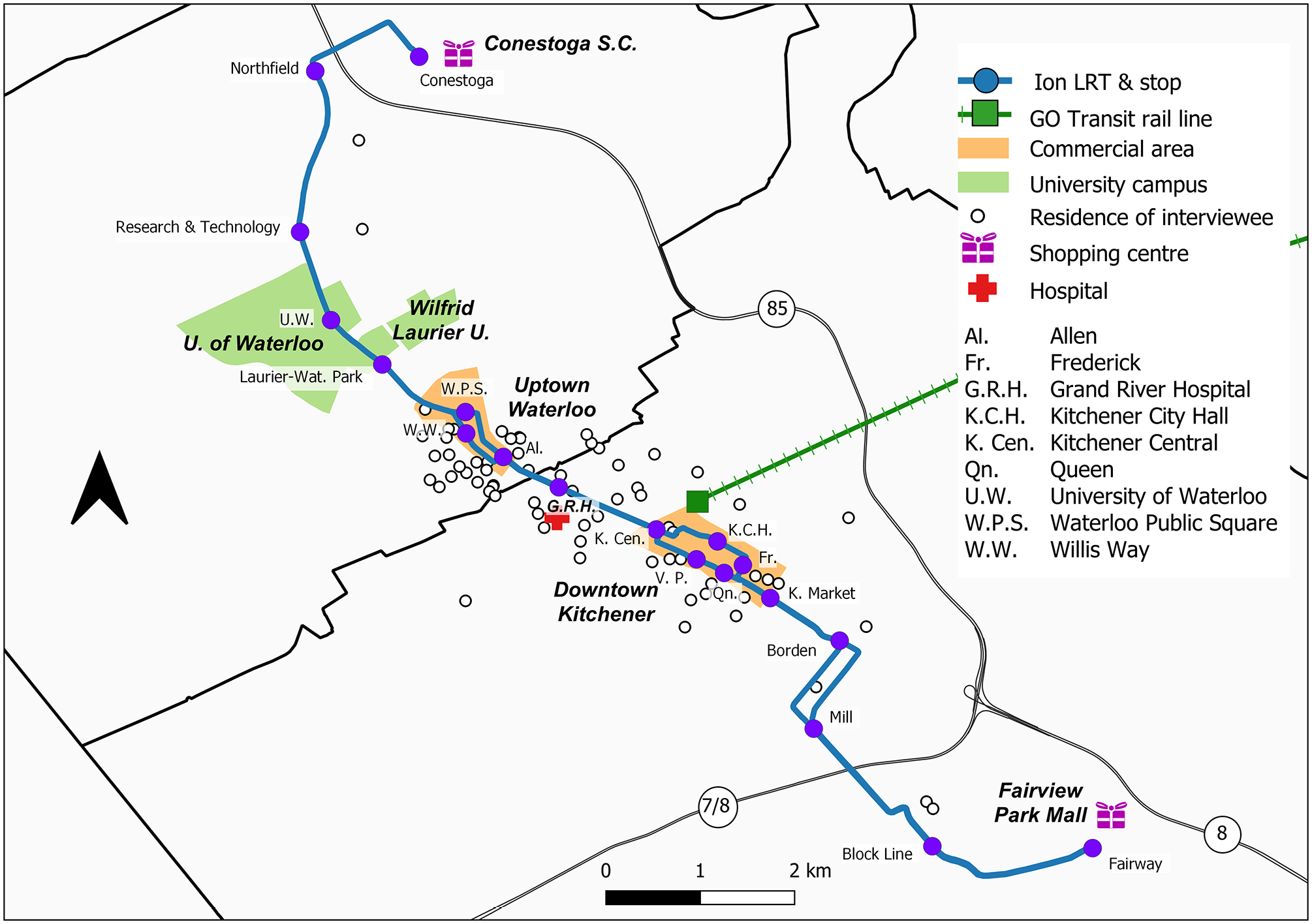
Kitchener/Waterloo and the ION LRT line, with residential locations of our interviewees.
Again, our interviews took place before the line actually opened. However, there are many ways in which gentrification was evident even before a single passenger was carried. First, more than $3 billion (Canadian dollars) in investment took place along the LRT corridor before the line opened. Much of this was in the form of new condominium towers, as well as investments in new and adaptive re-use commercial spaces, new businesses, and public spaces. New-build gentrification such as this has been well-established in the literature, even with little-to-no direct displacement (Davidson and Lees 2005; Marcuse 1985). For local policy makers, this investment already meant success with respect to their growth management policies. In the decade before the line opened, new development in the region switched from two-thirds being built on greenfield sites to two-thirds taking place within the existing urban footprint (De Bono 2018). As of 2018, approximately 20 percent of the Region’s population (~109,000 people) lived along the LRT corridor, up from 17.5 percent in 2011 (Region of Waterloo 2019).
Some academic studies have indicated property price uplift along the LRT corridor (Babin 2016), as well as rising rents that have prohibited many households from living near a station (Pi 2017). To date, however, the most comprehensive analysis comes from the Regional government’s own report titled Monitoring Change along the Central Transit Corridor (Region of Waterloo 2019), which was published before the line opened. It concluded that gentrification was taking place along several parts of the LRT line, particularly in downtown Kitchener (where median household incomes rose 41.2 percent between 2006 and 2016) and Uptown Waterloo (where that increase was 39%). Across the Region as a whole, median incomes rose by only 1.6 percent during this period, although in census tracts along the LRT corridor as a whole, they rose by 20 percent. The report relied on statistics from the Canadian census and therefore questioned whether this gentrification was leading to displacement of lower income residents. It concluded that there was little evidence of displacement, arguing instead that rising average incomes in central census tracts were due to new housing units being constructed on empty or formerly commercial lands.
However, more qualitative research done in partnership with the SDC uncovered evidence of many different forms of direct, indirect, and exclusionary displacement that have been present since well before the line opened (Diwan et al. 2020; SDC 2020). These patterns, such as renovictions, the deconversion of rooming houses, and the demolition of affordable housing units to make space for many of the new condominium developments, do not always show up in the conventional statistics used in the Region’s analysis (see also Thompson 2019a). They are therefore largely absent from planning and policy reports. So too are the perspectives and lived experiences of residents who bear witness to these processes of change. Therefore, our research presented here contributes to a more fulsome account of contemporary gentrification that seeks to interpret the subtle and not-so-subtle changes that are experienced.
It has long been established that urban policy objectives work toward explicitly or implicitly stimulating gentrification (Doucet 2013; Smith 2002; van Weesep 1994). In the City of Kitchener, an Economic Development Investment Fund (EDIF) was established in the mid-2000s to attract post-industrial investment. The city also had a development charge exemption downtown for many years, which expired in 2019. While both of these policies are important, the LRT is generally seen as the main driver of gentrification (Doucet 2019).
Method
We conducted sixty-five in-depth, semi-structured interviews with sixty-eight residents (sixty-two individuals, three couples) living in neighborhoods along the new LRT corridor. Participants lived within a 1,000-meter straight line distance of a station, excepting one participant who lived within a 1,500-meter distance but regularly frequented the nearby station area. We conducted the interviews in person between October 2018 and April 2019 (the LRT began operation on June 21, 2019). We asked participants open-ended questions pertaining to present-day characteristics of their neighborhood, the changes they have been experiencing in their neighborhood, and how they perceive the LRT to have affected their neighborhood prior to its opening. For instance, we asked participants to describe the types of changes, if any, they have observed in recent years, as well as how they feel about these changes (see Supplemental Appendix A for the complete list of questions). We specifically used broad language of change throughout most of the questions to capture a range of perspectives and avoid the definitional complexity of terms such as gentrification. However, the perceptions and experiences that are included in this paper speak to dynamics of gentrification and have thus been interpreted as such.
The interviews were audio recorded, with an average length of approximately forty minutes, and were professionally transcribed. We then coded the interviews in MAXQDA, a software program for qualitative data analysis. Rather than coding the data according to predetermined themes, we identified common themes that emerged from a close reading of the interviews. This inductive approach (Palys and Atchison 2014) allowed us to privilege residents’ experiences and capture unexpected perspectives. Themes identified in the first round of coding were subsequently grouped together under broader thematic headings where appropriate. While a number of themes emerged through the coding process, the themes represented in this paper were among the most prominent and collectively speak to questions of identity and inclusion/exclusion in a context of reinvestment and redevelopment.
Participants were initially recruited via posters in local public spaces, through the sharing of advertisements by community organizations and neighborhood associations, and via social media posts, which were picked up by local media. CBC News and the region’s daily newspaper, Waterloo Region Record, ran stories about this project (Thompson 2019b), while the authors appeared on two local radio shows to discuss the research. This exposure greatly increased the number and range of participants. 1
Participants were selected according to their expression of interest and self-identified location within a station-area neighborhood. Given the modes of recruitment and selection, participants may have been more likely to be involved in neighborhood activities and organizing and/or in local transit and gentrification debates than if a random sample of residents had been selected. As such, it is possible that participants’ perspectives are more reflective of those with a certain level of engagement in local issues. In most instances, participants entered the interview with predominantly positive or negative feelings toward the LRT project, with no clear spatial pattern. 2
As residence in an LRT-adjacent neighborhood was the sole criteria for participation, a variety of ages, educational backgrounds, and income levels were represented. However, as Table 1 (Supplemental Appendix) demonstrates, most participants were relatively highly educated homeowners with household earnings close to or greater than the regional average of $77,000 (Canadian dollars) (Statistics Canada 2016). In addition, although the study recruited residents living near any of the stations, participants were not selected to represent a random sample from the different neighborhoods along the corridor. Thus, fifty-nine of the sixty-five interviews were with residents of central station neighborhoods, from the Uptown Waterloo area to the southern end of Downtown Kitchener and including Midtown. 3 It should also be noted that these are the areas which statistically show the greatest evidence of gentrification.
Given these constraints, we recognize that the voices included in this paper do not represent a random sample of residents in LRT-adjacent neighborhoods. It is therefore important to identify the limitations of our study. While we frame gentrification as a process, rather than an event, it is important to stress that our research took place at a specific moment in time: a brief period when gentrification was already visible, construction of the LRT was largely complete, but before the line was actually open to passengers. This was an important time to document local sentiment and experiences, but it is likely that many experiences have changed. Since this research was conducted, the LRT has become a regular feature of the city and is well-patronized (the COVID-19 pandemic notwithstanding). Gentrification, displacement, and the rise in property values in the urban core have all continued since 2019, in some instances augmented by the pandemic (Doucet and Van der Merwe 2020). It is our intention to re-interview residents in two or three years to gauge how experiences of gentrification have changed.
Another limitation is that while we interviewed a diverse range of people, not all segments of society were fully represented in our study. For instance, our participants’ demographics do not allow us to speak in depth about marginalized residents’ experiences of displacement. In addition, participants’ concentration in station neighborhoods that have experienced the greatest gentrification and redevelopment pressure undoubtedly informed their perspectives. 4 Some of these limitations have been addressed by conducting subsequent research which focuses more specifically on the lived experiences of marginalized populations living along the LRT corridor. This work has been done in partnership with the SDC and includes recording oral histories and documenting stories and knowledge of displacement through critical mapping (Diwan et al. 2020; SDC 2020). Despite these limitations, the perspectives featured in this article are in no way homogeneous and provide important insight into certain dimensions of benefit/loss, connection/disconnection, and inclusion/exclusion in gentrifying and changing corridor neighborhoods.
Experiences of Change along the LRT Corridor
As we have outlined in previous sections, gentrification is about far more than the arrival of new, more affluent residents, or the displacement of lower income ones. In this section, we attempt to capture different aspects of change in a context of LRT investment that work to extend the meanings and conceptualizations of gentrification, following new theoretical thinking on its social, psychological, and experiential dimensions (see Atkinson 2015; Easton et al. 2020; Elliott-Cooper, Hubbard, and Lees 2020; Kern 2016; Moore 2015). Here, residents express conflicting perceptions of inclusion/exclusion and benefit/loss as new forms of social (dis)connection, new place identities, and new urban lifestyles have developed alongside the construction and gentrified redevelopment of the LRT corridor. These dynamics are expressed as both personal experiences and concerns for neighborhood trajectories, including in relation to the inclusion/exclusion of more marginalized residents.
Shifting Perceptions of “Us” and “Them”
Many residents along the corridor recognize the changing social landscapes of their LRT-adjacent neighborhoods have affected their sense of community. This shifting sense of community is reflected in one of two experiences: a growing connection among like-minded residents or the construction of different “us”–“them” divides between like-minded residents and others with “incompatible” values and lifestyles. While these experiences are informed by multiple factors, an influx of residents with a certain level of economic and cultural capital plays explicitly and implicitly into experiences of both growth in community connectedness and loss of sense of community.
On one hand, a number of residents in central corridor neighborhoods recognize the connectedness of those living in their neighborhood has strengthened in recent years as the makeup of the area has changed and, in some cases, stabilized. For a homeowner in Downtown Kitchener (five to ten years), there is “ . . . a little more interest in what’s going on in the neighbourhood. We’re greeting people on the street; people are talking. A few years ago, I think people were maybe more used to seeing a big changeover.” In some instances, this enhanced sense of community is related to the perceived growth of a shared mind-set, shifting, as per one Midtown homeowner (five to ten years), “from the older residents to kind of new families . . . and I think like-minded people in the sense of values, beliefs, education levels.” Indeed, new, younger residents are seen to “embrace having a neighbourhood as opposed to living next door” (Uptown Waterloo homeowner of twenty to twenty-five years). While for some this connectedness is being re-established, for others, including a renter in Midtown (less than five years), it is being amplified in new ways as the community grows, “continuing on with these traditions . . . and starting new . . . projects.”
Some explicitly associate the strengthening of connections within their neighborhood to the addition of the LRT line in close proximity. This is in part a product of upscale station-area redevelopment and residents’ efforts to shape change therein, including to protect an existing understanding of neighborhood character. As one Midtown homeowner (five to ten years) suggests, “with the amount of activity that’s been happening in the development, it’s actually drawn people together more.” In a few instances, the implementation of the LRT is also seen to play an ongoing role in attracting people with ideals and desired urban lifestyles to central neighborhoods along the line, particularly younger people and others seeking ease of mobility and access to amenities without a car.
In this context, perceived growth in shared ideals speaks to a certain accompanying homogeneity in terms of income and cultural capital. This is particularly true given that access to the celebrated urban lifestyle along the LRT corridor that is bringing “like-minded” residents together requires increasing levels of economic privilege, as recognized by both participants and regional monitoring reports (Region of Waterloo 2019).
At the same time, others recognize new rifts emerging among groups of residents amid LRT implementation and changing neighborhood landscapes, which can be understood to take three forms. The first “us”–“them” divide can be recognized between established residents who ascribe to certain ideals of a strong, connected community and incoming residents whose attitudes are seen to undermine these ideals. A number of longer term residents perceive those drawn to their neighborhood in recent years are less community-minded than established residents. The apparent growth in speculative investment within certain CTC neighborhoods, manifest as an increase in rental properties, is one way in which community connectedness is perceived to be challenged. For one Midtown homeowner of more than twenty-five years, renters are portrayed as “others” who disrupt shared values of stability and commitment to neighborhood quality, making the area “more transient, less sense of community.”
A more prominent sentiment, including among higher income participants, identifies incoming residents’ failure to meaningfully engage within the neighborhood as a function of the relative wealth of these new residents. A Midtown homeowner (five to ten years) bemoans the removed attitudes of “these rich people moving in,” elaborating “if you’re going to move into those neighbourhoods you’ve got to be part of the neighbourhood, you know?” Similarly, a homeowner in a Downtown Kitchener neighborhood (more than twenty-five years) positions well-off, disconnected tech workers entering the neighbourhood as undermining the neighborliness that has been carefully cultivated over the past decades: . . . the tech people aren’t exactly friendly. We’re having problems making inroads with them, because most of them . . . are either renting or if they’ve bought a place, they can move tomorrow because they’re in a financial position where they don’t give a damn . . .
This concern of (relatively privileged) established residents for incoming, affluent residents’ contradiction of shared values around neighborhood engagement mirrors Davison, Dovey, and Woodcock’s (2012) findings in Dalston, London. This sentiment also resonates with Tolfo and Doucet’s (2020) analysis of media interpretations of gentrification, where earlier gentrifiers blame “the next wave” for destroying “their” neighborhood. However, rather than contesting a predicted influx of disconnected gentrifiers, these residents frame the loss of community cohesion along the LRT corridor as very much an active threat.
A second divide between “us” and “them” relates to concerns of a shifting geography of “incompatible” or “undesirable” populations along the LRT corridor as certain neighborhoods are made more accessible via transit. As a Midtown homeowner (less than five years) states, . . . the ugly side of that though is [the LRT is] also going to give university students the ability to move further out . . . there’s nothing like a jungle for a front yard because the students don’t care about mowing their lawn and you have absentee landlords.
Similarly, a South Kitchener homeowner of more than twenty-five years fears that rising rental prices in gentrifying Downtown Kitchener will push residents struggling with drug addiction further along the LRT line and into their neighborhood: . . . our concern is that . . . a lot of people who cannot find rentals downtown anymore are going to be coming out to the smaller houses and bringing the downtown problems with them . . . are those [new developments] going to be a nice mix or are they immediately going to, you know, take the overflow from the people who can no longer afford [downtown] . . .
This sentiment reflects the region’s transition toward a bigger city, where poverty and social problems are pushed out of downtown cores toward inner-suburban areas, a trend common in larger cities across Canada.
These perspectives conflict with others who value the opportunity or impetus the LRT provides for new populations to explore and reside in their neighborhood. One homeowner in Downtown Kitchener (less than five years) hopes “[the LRT] brings people downtown and shows what downtown has to offer because some people don’t come downtown at all, right? They only stay uptown [Waterloo].” Thus, as the infrastructure reshapes assumptions of who belongs in different areas along the line, there are both emerging divides and hope that people will be brought together with faster and more reliable transit.
The final divide between “us” and “them” lies between the established “urban” lifestyles of residents and incoming “suburban” residents. Indeed, a few residents living in central neighborhoods along the corridor noted an increase in neighbors with suburban lifestyles, which is seen to clash with prevailing urban sensibilities. As a homeowner of over more than twenty-five years in an Uptown Waterloo neighborhood comments, . . . when you see suburban-style re-developments occurring and three cars in the driveway and two BMWs and that sort of thing. You don’t get the sense that they were traditional core dwellers . . . they’re not in that “I’m living in the core” mentality.
This quote emphasizes the class-dimension of change taking place, particularly the reference to BMWs. However, it also raises other aspects that are part of the gentrifying landscapes along the LRT corridor, in this case, the incongruity of car-oriented lifestyles and “suburban” mentalities as the LRT and corridor redevelopment support new urban lifestyles. Nevertheless, a growing sense of urbanity remains a central component of residents’ imaginaries of their neighborhoods.
Perceptions of a New Urban Identity
Many of the residents interviewed also experience reinvestment along the LRT corridor as part of a new, emerging sense of urbanity in Waterloo Region. For these residents, their changing surroundings reflect a transition to “more of a city than a town . . . a multi-transportation linked city where you have buses, you have the LRT” (Midtown renter, less than five years). Similarly, a homeowner in an Uptown Waterloo neighborhood (five to ten years) notes there are “more things to do, more types of people moving in, more types of businesses, investment, change, more densification.” In describing new experiences of urbanity in their station-area neighborhoods, some draw comparisons with the dynamics of cities such as Toronto and New York. For a homeowner in an Uptown Waterloo neighborhood (five to ten years), the streetscapes in their area simply “feel” more urban: I find myself walking through bits of the neighbourhood now . . . and feeling like I’m in a different city. Like, when I walk past that 144 Park development [in Waterloo, near Allen Station], so, it has brownstones at the bottom, and then, condos above. I feel like I’m in New York, which is actually really cool in some ways . . . as the trees get bigger and things, like, the trains start running, it’s just going to feel like a bigger city, and a more—what’s the word I want? Maybe desirable is coming to mind. Like, some of those big cities like Seattle, Portland . . . When I think of their streetscapes, it’s—we’re starting to look like that.
In a similar vein, many respondents noted how their community was feeling more like Toronto. Yet while certain neighborhood qualities seen to mirror those of larger centers are viewed positively, such as access to amenities, other aspects, such as increased traffic and a higher cost of living, are less desirable.
Indeed, there is particular concern among more established older adult residents that unique neighborhood features are threatened by the emergence of a “big city” atmosphere, including in the creation of more modern and generic urban environments. This fear is reflected in the perceptions of a Downtown Kitchener-area homeowner of more than twenty-five years: . . . my son came back from Toronto to visit . . . and he said “I could be in Vaughan [a suburb north of Toronto]. I’m not in any unique city anymore.” . . . and that’s true. I mean, we had . . . there was a greatness about us . . . I’m terrified we’re going to lose that. All the glass condos . . . so, that is absolutely the LRT.
A number of residents also lament the erosion of a pre-existing small-town character, including a homeowner in an Uptown Waterloo neighborhood (twenty to twenty-five years): . . . I mean, in terms of the intensification of the places that they built so far, I think they’ve gone overboard. I think they are too big, for the nature of . . . this is a small city . . . And that was part of the appeal, that it wasn’t a city. Even if it had 120,000 people in it, it felt like a place of 15, like that’s what it was . . .
In many ways, residents see the LRT as a symbolic representation of Waterloo Region’s growing urban status, as well as contributing to its new “big city” character and shaping new mobility patterns that align with those of larger centers. There is a perception that the addition of rapid transit “gives us more credibility as a city with prominence,” as per a renter in the Uptown Waterloo area (ten to fifteen years), helping to attract new residents and investment with its “image of economic prosperity” (Downtown Kitchener renter, less than five years). Another Downtown Kitchener renter (less than five years) expands on these points, emphasizing the ways in which the LRT acts as a symbol of the area’s growth: . . . not that the LRT is a completely unique thing but I think . . . a city that has streetcars kind of gives this like essence of like, “Oh, they’re already at this point as a city, they’re already developed to this level that they have this infrastructure in place.”
While many residents celebrate the benefits of “becoming a bigger city,” including the new amenities that accompany intensification, there is also recognition that these benefits are not evenly distributed. In particular, the new “big city” character is seen to reflect changes in local attitudes toward a greater focus on revenue generation: what one homeowner in an Uptown Waterloo neighborhood (twenty to twenty-five years) sees as adopting “the big city approach.” At the same time, resident perceptions of this new urban identity suggest inequities in terms of who is prioritized along the corridor. Some, including a homeowner located just beyond Downtown Kitchener (less than five years), view gentrification as the (unfortunate) “sign of a growing city.” For another Downtown Kitchener homeowner of less than five years, it is a requisite component of this transition: “Rents are going up, housing prices are going up. But I think that’s a good thing because if you think about any big city that’s developed, that needed to happen, right?”
Gentrification and Emerging Exclusivities
Nevertheless, a large number of residents living centrally in the Uptown, Midtown, and Downtown areas expressed concern surrounding new and potential instances of exclusion within their LRT-adjacent neighborhoods. These emerging exclusivities are intertwined with the LRT in terms of how it both redefines investment imaginaries and becomes an exclusive space in and of itself. However, these discussions of displacement and exclusion are placed in tension with aspects of gentrified landscapes and transit spaces that residents personally appreciate, even amid their broader concerns.
In some cases, concerns of exclusion relate to residents’ own ability to remain in their neighborhood. One resident, a renter of ten to fifteen years in the Uptown Waterloo area, has already experienced displacement amid LRT implementation: So after long amounts of time for all of us being there, decades, all of a sudden, we’re all ousted because we have cheap rent and the LRT is supposed to be bringing in more people . . .
At the same time, those who are not as vulnerable fear the existing diversity of people and amenities will be lost given the current nature of investment and development. Some, including a homeowner of more than twenty-five years in Downtown Kitchener, speak to displacements that have already taken place as existing apartments are turned into luxury units, with both long-term residents and recent immigrants “booted out and you knew damn well there wasn’t any place for them to go.” Others express concern that valued neighborhood qualities will no longer hold true in future years as the area is remade for a certain type of resident. As one renter in Downtown Kitchener (five to ten years) reflected, Can [the neighbourhood] still be eclectic if only the middle/high income people can live downtown? Can it still be interesting if there’s not still the sort of mix of businesses that there are today and stuff like that? . . . Every new thing trends towards being something catered towards people living on higher income.
However, many residents voicing their concerns of exclusion also experience mixed feelings given the ways in which they benefit from these trajectories, including as property owners and consumers of a new urban lifestyle that is emerging alongside new amenities. This tension is reflected in further discussions with the Downtown Kitchener renter quoted above, whose fears are tempered by their appreciation for the new neighborhood atmosphere, noting that it now “feels like things are happening, like there’s investment and also energy.”
While the LRT project has unfolded alongside development incentives, pressures from Toronto (Doucet and Van der Merwe 2020), and a tech sector boom, many recognize its distinct role in defining change, shifting the investment imaginaries of residents, developers, and local governments. These shifts have implications for emerging geographies of gentrification-related exclusion. For one homeowner of less than five years, their decision to purchase in a neighborhood just south of Downtown Kitchener was made based on the understanding that the LRT and planned station-area redevelopment will strengthen nearby property values in future years: . . . my own personal reason for buying where I did is very much on capitalizing on areas where you can still buy something relatively affordably with the expectation of big returns, right? I mean there’s a reason why I chose to live in the corridor . . .
Other residents also recognize the ways in which the identification of the LRT corridor grants a new sense of centrality to previously overlooked neighborhoods on the edge of core areas. For a homeowner of more than twenty-five years in Downtown Kitchener, the redefinition of “downtown” through station-area planning has brought new attention to their neighborhood: . . . the east end of downtown was always the forgotten end; most of the concentration and effort by the city and the region was always on the west end, and the LRT stops that because it becomes all part of the same downtown . . .
As much as the LRT and associated planning processes are defining new areas of interest along the corridor, residents also observe the concentrating of investment in close proximity to central stations. This concentration of investment underlies a growing vulnerability to displacement. As a renter’s Midtown neighborhood of ten to fifteen years becomes “a bit more modern, because of . . . the LRT happening and all these condos being built,” it is increasingly difficult for them to “move out of [their] mom’s apartment and to find affordable housing.” In helping define new “it” areas, as per a Midtown renter (five to ten years), the LRT is thus implicated in the shaping of exclusionary landscapes along the corridor.
For some, these changes speak not just to neighborhood exclusivity but also to the exclusivity of quality transit. As a homeowner in the Uptown Waterloo area (more than twenty-five years) observes, the LRT allows people to come and work at PriceWaterhouseCooper’s right downtown. They can live in a condo and maybe don’t even need a car but then it doesn’t help the people who can’t afford housing [along the line] but still have to rely on [public] transportation.
Alongside higher income residents’ privileged ability to make use of the LRT given the nature of station-area development, the LRT is also constructed as a more upscale and exclusive transit space in other ways. A Downtown Kitchener homeowner (five to ten years) predicts the LRT will not “be a comfortable place” for marginalized groups, adding “I don’t think it was designed for them.” Indeed, there is a sense that the “shiny and new” LRT will appeal to those who dismiss bus travel. As a Downtown Kitchener renter of less than five years explains, I think you could be like a young professional headed to work and you wouldn’t feel like there was any issue with like hopping onto a streetcar or whatever but like at the same time, you wouldn’t want to be taking a bus to work every day.
In this way, gentrified transit spaces work alongside gentrified neighborhood landscapes to support the emergence of a new urban lifestyle celebrated by many residents, which is held in tension with concern for new forms of exclusion. This conflict, and others raised through residents’ experiences of change along the LRT corridor, will be discussed in greater detail below.
Conclusion
Gentrification is about more than measuring changes in demographics or investment in census tracts. It is something that is experienced and lived. Not all aspects of gentrification show up in statistics. As a growing number of studies demonstrate, research that engages meaningfully with lived experiences works to extend the conceptualization of gentrification by moving beyond economic metrics, and the ability or inability of (low-income) residents to remain in urban space. To date, however, very little research has examined the phenomenological dimensions of transit-induced gentrification, including the tensions that exist among residents who are differently situated within these processes of neighborhood change. By rooting our epistemological framework within experiential interpretations of gentrification (e.g., Elliott-Cooper, Hubbard, and Lees 2020), we have sought to extend our understanding of the relationship between transit investment and gentrification by focusing on the complex meanings held by those living along the line.
We highlight two important aspects of our research. First, we provide detailed, nuanced understandings of how an LRT system was experienced before it opens. There are very few academic studies that have taken such a baseline reading of qualitative perceptions in the period between the end of construction and the commencement of operations. This will prove invaluable for future research, and it is our intention to re-interview these same residents a few years after the line has been up and running to understand how perceived neighborhood impacts of LRT investment shift (or not) over time. Second, our study presents rich qualitative data on big and small experiences of change, as witnessed by residents and told in their own words. Experiential data gathered through open-ended questions and across different temporalities also holds value for planning practice. More specifically, it helps planners to identify perspectives that may be overlooked through more structured engagement practices, such as public meetings or online surveys and to continue to account for changing and conflicting perspectives beyond specific stages of rail rapid transit project delivery. A more robust understanding of residents’ ongoing experiences, and associated tensions of benefit/loss and inclusion/exclusion, along transit corridors can better equip those planning for rapid transit to address concerns of urban inequity.
Rather than competing with traditional transportation studies which tend to rely on quantitative data to measure change (Baker and Lee 2019; Brown 2016; Deka 2017; Dong 2017; Grube-Cavers and Patterson 2015; Hess 2020; Nilsson and Delmelle 2018), our work seeks to extend and enhance our knowledge of the impact of transit investment and its relationship to the gentrification that is a driving force of change along Waterloo’s LRT corridor. In this way, our findings provide insight into residents’ conflicting experiences and perceptions of place identity and belonging in a context of transit-induced gentrification, complementing existing work to capture demographic and other quantifiable changes. While our own work does not employ a mixed-methods approach, Loukaitou-Sideris, Gonzalez, and Ong (2019) highlight the value of using different methods to understand this relationship. Therefore, our research contributes to a collective use of mixed methods, in both Waterloo Region and beyond, that will enhance scholarly and professional planning debates about the impact of transit investment on the communities it serves.
If we examine what our research contributes to knowledge of the impact of Waterloo Region’s LRT, our findings provide a much more complicated interpretation of transit-induced gentrification than existing, quantitative studies (Region of Waterloo 2019). Residents’ perceptions of increasingly (dis)connected neighbors, a new sense of urbanity, and emerging exclusivities along the Waterloo Region LRT corridor have implications for understandings of conflict in gentrifying neighborhoods. More specifically, our findings demonstrate additional tensions between benefit and loss and inclusion and exclusion that exist when urban rail infrastructure is involved in neighborhood transformation. These conflicting dynamics are elements of the urban experience and non-spatial forms of displacement that cannot be captured by statistics alone. On one hand, tensions between diverse and inclusive spaces and beautified, amenity-rich spaces identified in LRT-adjacent neighborhoods reflect conflicts that also exist in gentrifying areas in the absence of transit improvements. However, distinct forms of conflict can also be recognized as LRT-related changes simultaneously align with and disrupt other neighborhood qualities valued by existing residents.
These distinct dynamics of benefit/loss and inclusion/exclusion relate in part to tensions surrounding the loss of a “small town” feel, as the LRT contributes to a mid-sized urban region’s march toward becoming a “big city.” No longer comparable with smaller centers such as London (Ontario) or Guelph, many respondents saw Waterloo Region as having parallel qualities to those of Toronto, Canada’s largest city. The LRT plays a direct role in this shift, both in terms of the “big city” mobility it enables and its symbolic value as an indicator of heightened urban status. In addition, the new geographies that the LRT creates—a denser and wealthier urban core with new condo towers and higher end amenities, while poverty is increasingly displaced to the inner-suburbs—also contribute to the perception that Waterloo Region has entered into a new category of city. However, this big new city and the urban lifestyles associated with it are neither universally desired nor broadly inclusive, as emphasized by residents’ perceptions.
While our article is based on residents’ experiences in one mid-sized urban setting, the findings nevertheless have relevance for planning debates in other contexts. Therefore, to conclude, we raise four points of which both future research and ongoing planning debates need to be aware.
Important work on the impact of transit-induced gentrification needs to be done at all stages of the project, including before a line opens and continuing after it has been up and running. In Waterloo Region, a tremendous wave of investment took place before passengers could ride the LRT; in this sense, transit-induced gentrification began well before the transit actually arrived (cf. Region of Waterloo 2019).
An analysis of the impact of this investment is incomplete without connecting it to resident experiences. Impact reports that do not include some form of lived experiences of residents, or other qualitative research, provide an incomplete picture of the dynamics at play (cf. Loukaitou-Sideris, Gonzalez, and Ong 2019).
Engaging meaningfully with local residents extends our understanding of what gentrification means, how it manifests itself in urban space, and associated psychological, embodied, and lived experiences.
Finally, research that extends beyond large cities such as Toronto, New York, or Vancouver can uncover new trends, experiences, and phenomena. Specifically, we highlighted how the LRT is changing local perceptions by asking what type of community Waterloo Region is, something that would be less important in a larger city such as Toronto. Of particular importance is the potential shift in perceptions of place, from a “big small town” toward a “small big city”; in Waterloo Region, the LRT has played a direct role in this economic, social, spatial, and experiential transition.
Given the number of mid-sized cities in North America considering investing in major transit improvements, planners and policy makers in other cities should pay close attention to this shift, and the associated perceptions of benefit/loss and inclusion/exclusion, in their efforts to shape more equitable neighborhood change.
Supplemental Material
sj-docx-1-jpe-10.1177_0739456X21993914 – Supplemental material for From “Big Small Town” to “Small Big City”: Resident Experiences of Gentrification along Waterloo Region’s LRT Corridor
Supplemental material, sj-docx-1-jpe-10.1177_0739456X21993914 for From “Big Small Town” to “Small Big City”: Resident Experiences of Gentrification along Waterloo Region’s LRT Corridor by Margaret Ellis-Young and Brian Doucet in Journal of Planning Education and Research
Supplemental Material
sj-xlsx-1-jpe-10.1177_0739456X21993914 – Supplemental material for From “Big Small Town” to “Small Big City”: Resident Experiences of Gentrification along Waterloo Region’s LRT Corridor
Supplemental material, sj-xlsx-1-jpe-10.1177_0739456X21993914 for From “Big Small Town” to “Small Big City”: Resident Experiences of Gentrification along Waterloo Region’s LRT Corridor by Margaret Ellis-Young and Brian Doucet in Journal of Planning Education and Research
Footnotes
Acknowledgements
Thank you to Sean Marshall for making the detailed maps for this article. An earlier version of this research was presented at the ACSP Conference in Greenville, SC, in 2019. We would like to thank the four referees for their helpful and constructive comments. The usual disclaimers apply.
Declaration of Conflicting Interests
The author(s) declared no potential conflicts of interest with respect to the research, authorship, and/or publication of this article.
Funding
The author(s) disclosed receipt of the following financial support for the research, authorship, and/or publication of this article: This research was undertaken, in part, thanks to funding from the Canada Research Chairs Program, award number 950-231821. Additional funding was provided by a UW/SSHRC Seed Grant “Experiencing Gentrification: Day-to-Day Geographies of Change along Waterloo Region’s LRT Corridor.”

Supplemental Material
Supplemental material for this article is available online.
Notes
Author Biographies
References
Supplementary Material
Please find the following supplemental material available below.
For Open Access articles published under a Creative Commons License, all supplemental material carries the same license as the article it is associated with.
For non-Open Access articles published, all supplemental material carries a non-exclusive license, and permission requests for re-use of supplemental material or any part of supplemental material shall be sent directly to the copyright owner as specified in the copyright notice associated with the article.
