




Abstract
Through a survey among planning students in China, this research revealed the emergence of divergent standpoints on the values of social justice, where the respondents partially disagreed with the generally acknowledged principles of justice or opted to compromise when experiencing real-world dilemmas. It was observed that these were caused by the dialectical nature of social justice, in particular, by the three conflicting drivers of the modernization of China: freedom, development, and equality. This paper suggests that the moral guidance used in teaching ethics in planning can be enriched by investigating individuals’ ethical choices shaped by the changing sociopolitical ethos of their times.
Introduction
Social justice is an ideological subject. Individuals’ judgments of fairness, equality, or justice reflect their intrinsic consciousness shaped by human nature, a socially calibrated moral compass, social-political contexts, reflections on experiences, and self-interest. Therefore, divergent standpoints on justice are common. Modern China has experienced several major revolutions and reforms, where Western thinking has clashed with its traditional mindset and its socialist planned economy has turned into a globalized market. During these transitions, the social norms and moral standards of old China were constantly challenged, and none of those that newly emerged have been conclusively established. These changes in China’s belief system and social mindset from 1978 to present, which some sociologists have termed “the Chinese experiences” (Cheng 2012; Zhou 2017), are recasting the personal value systems and social psychology of modern China in an unprecedented manner.
Urban planning, as a policy domain associated with social well-being, often claims to promote the idea of social justice. Today’s urban planners in China have the power to allocate spatial resources and layout blueprints, causing them many professional dilemmas (Feng and Chapman 2020), for example, should city planning prioritize economic efficiency over distributional equity? Build satisfactory public services (e.g., education and health care) for all citizens or a privileged few? Provide services that reward hard work or secure basic needs? Refer to experts or involve the general public? The policy choices regarding those matters have revealed the planners’ divergent standpoints on values of social justice (K. Zhou and Pan 2019).
Since the nascent stage of the urban planning profession in China, these individuals have been asked to consider not only the physical and economic aspects but also the social and moral aspects of urban development (Jin 1995, 2002; B. Zhang 1997; T. Zhang 2001). However, academic debates on achieving social justice in planning have been overwhelmed by the more pragmatic preferences for serving growth in China’s rapid urbanization (B. Chen 2005; Z. Liu, Zhu, and Wang 2004; H. Wang 2005). The literature has demonstrated that the greater the planners’ confusion about their role, the fewer the references between the values of planning taught and planning practices in operation, and that the pluralistic interests in urban development have reduced planners from comprehensive, rational, and responsible professionals to a profit-seeking, easily manipulated, and instrumental consultants or technocrats (Cao and Zhang 2019; Gu, Guo, and Liu 2011; Yao and Wang 2006). More recently, disputes and conflicts have been observed on social issues such as “urban villages as migrant enclaves” (Huang and Yi 2015; R. Liu and Wong 2018; Zhu 2016), “unequally distributed public services” (Li et al. 2015; Ouyang et al. 2017), “migrants’ access to social benefits in cities” (Hu and Wang 2019; Swider 2015; X. Wu and Zhang 2015), “class struggles of the precariat” (Lee 2019), “public participation” (G. He, Mol, and Lu 2016; Xie et al. 2017; C. Zhang and Li 2016; P. Zhao 2015), and “tolerating urban informality” (Song, Zenou, and Ding 2008; Swider 2015; Y. Wang, Wang, and Wu 2009) and are continually challenging Chinese cities’ long-standing preference for economic rationale over social rationale (Sun 2006; J. Zhou 2016). The ethical principles of the planning profession in China have become ambivalent, requiring a critical rethinking of its fundamental elements. Further theoretical or empirical discussions on resolving the moral confusion and ethical concerns are necessary.
Recognizing this challenging issue, this research aims to explore the formation of the social justice viewpoints in China from a historical retrospection, with supporting evidence collected from samples of the next generation of urban planners (i.e., college students) whose viewpoints have not been influenced by professional training. Planning educators should understand their views in the context of how equality and justice are structured. Additionally, it is notable to test the taken-for-granted doctrines of social justice against their spontaneously built opinions. By doing so, I hope to achieve a directional focus for interpreting the values of social justice in China and perhaps in other countries enduring radical social changes.
This article is organized as follows: the first section situates the research question in a brief review of the literature on planning ethics. Academic discussions on how to define and approach social justice in planning direct the focus of this paper to the dialectical nature and procedural aspect of moral judgment. Second, it contextualizes the concept in modern China by analyzing its traditional and modern and Western and Eastern sources of influence. This reading of historical contexts that shaped the moral judgment of the people in China is essential for informing the design of the questionnaire (in the “Methods” section) and interpreting empirical evidence collected through the survey (in the “Discussion” section). After reporting the conducting and findings of the survey, I attempted to interpret their diverging standpoints of justice with references to both the changing sociopolitical ethos of China and the qualitative evidence collected from the survey. Finally, I present the concluding remarks.
Planning Ethics
Planning theory has been categorized into theory in planning, theory of planning, and theory for planning (Faludi 1973; McConnell 1981). The theory in planning and the theory of planning focus on the substantive issues and procedural aspects; the theory for planning investigates the ethical justification of planning as a practice and a profession. Blackburn (1998, 1) said, “[Ethics] separates things we will do gladly from those we will not do, or not do without discomfort.” Planning ethics explicitly prescribe the roles for planning and its direction, or to be recognized by planners implicitly and become a position passively orienting their moral judgments (Weitz 2018). The discussions of planning ethics help answer questions such as Why plan? What is planning for? What is the role of planning or planners in society? which are central to planning theory (Campbell 2012; Upton 2002).
Many researchers have posited that the wisdom for taming value-laden planning problems could be recovered from the legacies of substantive ethical theories in moral philosophy. From a utilitarian’s point of view, promoting social justice means maximizing the sum total of happiness or well-being in society. The method was then translated into the rational comprehensive model for calculating costs and benefits in decision-making (Harper and Stein 1995). The concept “public interest” as a justification for planning as a government intervene in markets was philosophically a utilitarian idea (Campbell and Marshall 2002).
The classic liberal philosophers believe that a free, rational, and autonomous individual is capable of making choices based on a sense of social justice, whose theories emphasize the importance of equal rights and a minimal state. Fainstein (2010) further elaborated on these liberal ideas of justice and named three planning objectives for a “just city”: democracy, diversity, and equity. The contemporary liberal theorists (e.g., John Rawls) built their ideas of distributive justice by asserting that fairness can be achieved by applying wealth redistribution to correct the inequalities of modern society (Stein and Harper 2005). The tension between individual liberty and equality is vividly demonstrated when allocating public recourses in urban planning.
From the scope of critical theory, the “right to the city” slogan, first popularized by Henri Lefebvre (1996) and David Harvey (2003), has been adopted by various urban social movements and global nongovernmental organizations in their attempts to achieve equal opportunities in cities (Marcuse 2009, 2015; Mayer 2009). Similarly, Soja (2010) charted a path for seeking distributive justice in city-regions from bottom-up by using his idea of “spatial justice.”
Regarding the collective good, the communitarians believe that the discussion of social justice should include “communal encumbrance,” “collective responsibilities,” and “sense of belonging” as a member of society (Sandel 2009). Therefore, justice as a virtue is essential for maintaining the solidarity of society, especially in managing coexistence in shared spaces (Healey 1997). The implementation of the communitarian value of social justice was embodied by reviving a tradition of public life and advancing the formation of communities (Blanco 1995).
However, all these liberal, critical, and communal values of justice have been vigorously criticized to be too abstract or idealistic to help planners make context-sensitive assessments of particular cases in reality (Campbell and Marshall 2006).
The shift of a planner’s mindset from urban renewal to urban preservation in the 1970s and 1980s in the United Kingdom and the United States has demonstrated that an initial standpoint of planning society is subject to change (Harper and Stein 1993). Therefore, the accepted values of utilitarianism, liberalism, or communitarianism can also be influenced by changing contextual circumstances (Campbell and Marshall 1998). According to procedural ethical theory, moral judgment does not merely follow well-defined labels of value but also reflect individuals’ experiences through . . . working back and forth among our considered judgments (“intuitions”) about particular instances or cases, the principles or rules that we believe govern them, and the theoretical considerations that we believe bear on accepting these considered judgments, principles, or rules, revising any of these elements wherever necessary in order to achieve an acceptable coherence among them. (Daniels 2020)
Stein and Harper (2005) argued that the dialectical procedure of moral judgment, which Rawls (1971) termed the wide reflective equilibrium (WRE), also applies to the formation of planning ethics. Because the thought that empirical investigations and interpretations of the context in which WRE operates could partially address the complexity of the social justice conception in planning, this research began with a hypothesis that planners’ ethical choices are influenced by the changing sociopolitical ethos of their times. In this particular case of China, this research provides historical and contemporary contemplations and empirical evidence of the diversified moral standpoints of Chinese planning professionals, which contributes an alternative perspective to the relevant debates on putting the ethical judgment of planning back in specific contexts (Campbell 2006).
Understanding Social Justice in Modern China
T. Zhang (2004) argued that Chinese planners’ roles and ethics in the transitional period were formulated by their three identities: (1) as ordinary Chinese people experiencing the economic transformation; (2) as well-educated social elites leading the social changes; and (3) as planning professionals learning in the globalizing world. Therefore, their current perceptions of justice should be deconstructed with multidimensional analyses of traditional wisdom, Western thoughts, prevailing ideologies, and the so-called “Chinese experiences.”
Traditional Values: 正(Zheng), 公(Gong), 平(Ping), 义(Yi), 等(Deng), and 均(Jun)
The philosophical legacies of ancient wisdom are presented in classical Chinese literature, featuring Confucian, Taoism, Buddhism, and other belief systems of China. According to Packard (2000), the linguistic morphemes (i.e., the composition of meanings in words and characters) in the Chinese language are fundamental for learning the influence of the traditional values of social justice.
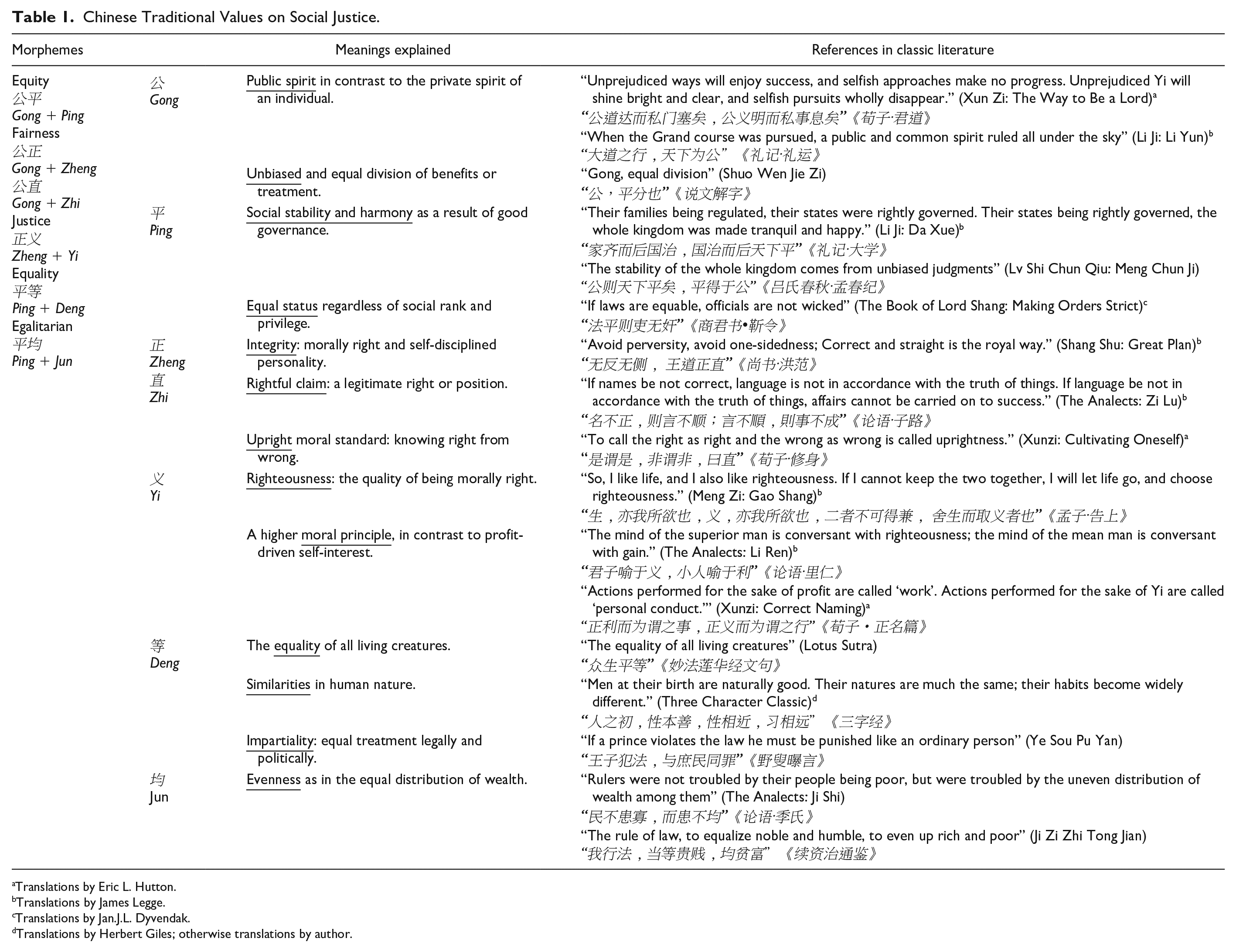
“Equity” in English can be translated as “公平(GongPing)” in Chinese, which is a compilation of two characters: “公(Gong)” and “平(Ping).” Gong denotes an unbiased public spirit, in contrast to self-interest “私(Si),” which Confucius believed was essential for keeping society stable and harmonious and securing equal socioeconomic status for all (the meaning of Ping; see Table 1). Therefore, GongPing in Chinese is a sociopolitical orientation that advocates collectivism to create an equal society by establishing unbiased social norms and public institutions.
Chinese Traditional Values on Social Justice.
Translations by Eric L. Hutton.
Translations by James Legge.
Translations by Jan.J.L. Dyvendak.
Translations by Herbert Giles; otherwise translations by author.
“公正(GongZheng)” or “公直(GongZhi),” the translation of “fairness,” shares the first character Gong with GongPing, denoting merits in public life. The second character “正(Zheng)” or “直(Zhi)” usually describes the distinguishing traits of a respectful person (e.g., integrity, self-discipline), the rightful claim to a legitimate right or position, and a strong sense of right and wrong (Table 1). These virtues are considered important values not only for developing healthy personalities but also for governing states. GongZheng and GongZhi, in traditional China, were the universal principles for resolving disputes at the domestic, neighborhood, municipal, national, and diplomatic levels; therefore, they also denote appropriate and responsible means of managing human interactions.
The closest word to “justice” in Chinese is “正义(ZhengYi).” The first character Zheng, as explained in the prior paragraph, is an adjective for being morally right. The second character “义(Yi)” is commonly used to denote a higher moral standard, both in Confucius’ doctrines and Chinese folk culture, and is the opposite of the hedonistic pursuit of profits “利(Li).” The righteousness of Yi as a traditional social norm was so highly appraised in Confucian philosophy that it surpasses not only self-interest (Li) but also the instinct for survival (Table 1). To scarify oneself by holding fast to the principles of Yi was deemed heroic, whereas an explicitly expressed eagerness to acquire profits was considered despicable in Confucianism. This moral principle of Yi applied to both individuals and society.
“平等(PingDeng),” the proper translation of “equality,” has manifold meanings in Chinese. First, in classical literature, “the equality of all living creatures” was the core value of the Buddhism worldview. Second, Taoist philosophers believe that the universe is ruled by the essential process of “道(Dao),” in which everyone and everything is an equally insignificant object. Third, Confucius sees all human beings as similar in nature; therefore, people are equally naturally good, and anyone can be educated. Fourth, PingDeng also means that everyone is equally regulated by the judicial systems and has equal access to political opportunities.
Finally, a similar concept, “平均(PingJun),” usually translates into English as “egalitarian.” “均(Jun)” means evenness, and it focuses on the equal distribution of wealth or material goods. Notably, egalitarianism has never been achieved in China, and Confucian scholars continue to believe that the uneven distribution of wealth is of greater concern than universal poverty.
Marxist and Maoist Influences: Leftist versus Rightist, Egalitarianism, and Merits of the Working Class
Since the 1900s, China has experienced several ideological revolutions: first, China had to confront the modern technology, democracy, and science of Western society, and then, it had to manage the Marxism imported from the Russian Revolution. As a result, the political “rightist” in China’s context usually refers to intellectuals who favor the Western over the Eastern sociopolitical or economic settings. Additionally, the “leftists” established their legitimacy in seeking the sovereignty and self-determination of China in the so-called antifeudalism, anti-colonialism, and anti-imperialism movements in the first half of the 20th century and were devoted to building a communist or socialist new China after they seized power after the founding of the People’s Republic of China in 1949.
The debate between the two rival schools of thought has redefined the understanding of social justice in modern China. On one hand, as a result of the modernization led by both the leftists and rightists, the traditional values of China have been largely devalued to accommodate Western ideas, including the aforementioned ethical standards; on the other hand, in the decades-long debate between the left and the right, modern liberal ideals, especially social and political theories imported from the West, are overly scrutinized to avoid becoming “completely Westernized” or any sign of colonization. In the context of this radical pendulum of thoughts between extreme ideas, China began its economic reforms in 1979, with a precondition of temporally withholding the ideological debate. In forty years of cautiously opening up to the world and adopting some aspects of the market economy through trial and error, liberal thoughts were once again revived and prevailed in the socialist regime, together with the ideas of the free market, consumerist culture, and globalization in China, which will be discussed in the next section.
Notably, many residents of China and majority of the elites who led the country have experienced near-total social revolutions in the last half of the twentieth century (Whyte 2010): the Great Leap Forward famine of the 1950s, the Cultural Revolution in the 1960s and 1970s, and the economic reforms from 1980s onward. Their personal experiences, involvement, and gains or losses because of those historical events, which pervasively changed the order of China politically and economically, also shaped or reshaped their values of social justice. As a result, the once highly homogeneous communist society has been diversified; however, the influences of Marxist (interpreted in Chinese context) or Maoist ideologies remain critical factors in understanding the personal values and social psychology of postreform China.
The communist ideology promised equal opportunity: however, the pursuit of egalitarianism in the time of low social productivity has become a memory of discontent for many Chinese people who lived through the 1950s, 1960s, and 1970s. To establish a “socialist new China” at that time, most urbanites were leveled to a similar economic and social status by the centrally planned salary system and uniform consumption behavior. In rural areas, residents’ prospects for improving their living standards were designated to the collective farming movement (i.e., the rural people’s communes), and the unauthorized migration to cities was constrained by the Hukou system. As a result, the Chinese people have long had limited opportunities to prosper through individual effort. The economic reform starting in the 1980s, which aimed to increase productivity by implementing national policy, was also a revolutionary turning point at which channels for upward social mobility were reopened in urban and rural areas. Additionally, the Chinese excluded from the opportunities to improve their quality of life have been harmed by the widening income gap and social stratification that has occurred since then. As a result, some individuals viewed old socialist China “as a secure and rewarding system (for all),” while others considered it “a limiting, unpredictable and arbitrary controller” of their fates (Whyte 2010, 25).
The Chinese Communist Party (CCP) eliminated many types of aristocracy that prevailed in old China and successfully replaced them with a broadly defined ruling class, the so-called proletariats. Social stratification was simplified: the majority of people were classified in the working class (including workers in urban areas and peasants in rural areas), and a minority of people were classified as cadres (“干部”). In a world of “comrades,” nobody could claim to be significantly “nobler” than the others, including high-ranking party leaders; however, in practice, the opposite was often true. Since the small income gap was deliberately maintained, the social differentiation between the cadres and the working class, and between urban and rural residents, was only evident in the entitlement to slightly better housing, education, or medical and recreational facilities. The social mindset that accommodated this rigid regime of “unequal citizenship” partially remains in postreform China.
Additionally, according to the ethos of communism, the proletariat maintains a life based on the moral culture of solidarity, collectivism, and mutuality (Thompson 1963). In Mao’s era, the merits of the working class, such as diligence, dedication to work, providing mutual aid, and showing compassion to others, were highly praised (as individual philanthropy and general empathy). However, this spirit of building cooperation and working for the common good was challenged by the profit motive and individualism of the market economy. Therefore, in postreform China, the decision makers (CCP officials) responsible for obtaining prosperity for all must continually prioritize “efficiency” or “equality” in policy formation. Meanwhile, many ordinary Chinese are trapped in a dilemma, believing both that “hard work should be rewarded” and that the “huge income gap is inappropriate.”
Liberalism: Free Market, Personal Choice, Moral Individualism, and Efficiency
Individuals’ rights to survive, prosper, and more importantly, to self-determinate are hard to ignore. Although the Chinese government has not publicly endorsed Western economic and sociopolitical theory or liberalism, many scholars (Harvey 2007; S. He and Wu 2009; F. Wu 2016) continue to view the economic reform and social transformation of China after 1979 as a neoliberal or neoliberal-like shift. To transform the social mindset from the orthodox “socialist new China” toward the “socialism with Chinese characteristics” was an enormously radical task in many aspects. However, the necessary reform was gradually justified in the nation’s policy debates, mostly by the Chinese people’s desire for a higher quality of life. The consensus to build a robust economy with market mechanisms was foreseen by some party leaders, affirmed by many intellects, practiced by daring entrepreneurs, and institutionalized in economic and cultural globalization.
At an individual level, the members of all social strata quickly embraced the benefits of improved personal choice in the market economy and, since the 1980s, have been devoted to economic self-betterment. In addition to collectivism and egalitarianism, the development of this new ideology legitimatized the opportunities to obtain a higher socioeconomic status through market mechanisms. To some extent, the rewards of individual merits outweighed those of the collective merits. Free choice also meant self-reliance. The removal of the socialist system that secured many aspects of personal life was difficult but rewarding, especially in the first two decades of reforms. In contrast to the old, clumsy, bureaucratic, centrally planned, socialist economy in China, the new market ethos of pursuing efficiency and reducing costs was highly commended. Thus, entrepreneurship, meritocracy, and pragmatism began to affect the personal beliefs in China during the 1990s and 2000s, when increasingly more people began to believe that skills and abilities and working diligently would be the major factors required to achieve upward social mobility.
At the national level, Deng Xiaoping settled the debates over social justice in the reform with a concise statement, “Prioritize efficiency while considering equity,” which recognizes the dialectic in the issue and aims to achieve equilibrium reflectively in the wider social and historic context. On one hand, Deng and his successors strategically, periodically, and partially promoted a principle of unequal rewards—“to allow some people and some areas to get rich first” (Wong 2004). Thus, they encouraged market competition, in which many working-class Chinese were forced out of the protection of socialist egalitarianism into the new economy. The old welfare systems were gradually disassembled in the 1990s. The Chinese government expected that the resulting income gap was necessary to stimulate work incentives and encourage creativity. On the other hand, the statement is also committed to the goal of “common prosperity,” reaffirming that equity was not subject to surrender or lay aside permanently. The mitigating of China’s unemployment, extreme poverty, unbalanced regional development, and urban–rural divide continue to be burdens, in large parts of the country, on the party cadres. Even in the south eastern coastal regions and major metropolitans where the market reform was considered a financial success, securing the basic rights of migrant workers to educational and medical resources and, more recently, recognizing the rights of the informal sectors have become urgent concerns. One of the dilemmas for policy makers in governing today’s Chinese cities is how to resolve the “social inequalities” causing disharmony in society while not compromising the high level of “economic efficiency” fueling growth.
Methods
The idea of using the survey method to investigate the complexity of the social justice conception of planners was sparked by the discussions in a special session “Social Justice in Urban Planning” held at the Annual National Planning Conference 2016, Shenyang, China. At that event, a divergence of values on social justice was observed in the debates among planning academics and professionals. It was also demonstrated that an individual’s point of view on social justice can only be expressed by connecting abstract concepts with real-world experiences. The rich meaning of social justice conception must be embodied through relevant cultural events, collective experiences, or public debates on incidents by referring to an agreed-on set of facts.
Based on the topics discussed in the special session, a questionnaire of six “ethics quizzes” (Hendler 1991) was drafted to elicit the respondent’s personal opinions on social justice. After using several small pilot tests to confirm that most of the respondents interpreted the questions in a similar manner, I was confident that the answers to the six questions could be used as empirical manifestations of a respondent’s standpoint on the value of social justice.
Questionnaire Design
The questionnaire had four parts: (1) an introduction, (2) six questions, (3) personal information (age and gender) questions, and (4) an open question: “What else do you have to say about social justice? 1 ” The introduction began with a hypothetical moral position for participants to consider the principles of social justice. Rawls’ (1971) “veil of ignorance” was mentioned, suggesting that “respondents shall be as objective as possible, not biased by your current social, economic or political status. One may assume that you are answering these questions before being born into this world”—with the hope of nullifying the influence of an individual’s current advantageous or disadvantageous position, a premise that has proven to be too idealistic and thus impossible in the latter stages of this research.
Six questions were asked to reveal respondents’ opinions, including their “worldviews” in general (Q1\Q2\Q3) and personal choices in practically situated moral dilemmas (Q4\Q5\Q6; Table 2).
The Six Questions on Questionnaire.
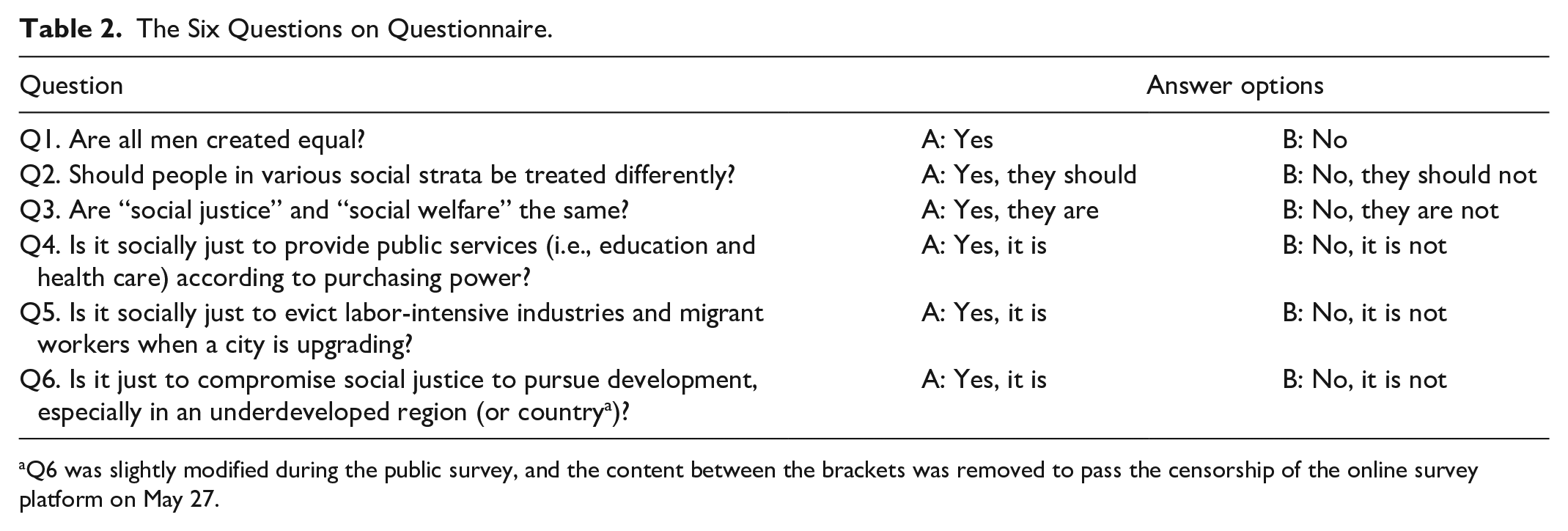
Q6 was slightly modified during the public survey, and the content between the brackets was removed to pass the censorship of the online survey platform on May 27.
The first question (Q1) was “Are all men created equal?” A “Yes” answer to this question is the most important premise in debates on social justice. Agreeing to the notion that people are equal by nature is commonly taken as the first premise when discussing justice.
The second question (Q2) investigates the respondents’ views on social stratification. Preferring “unequal citizenship” conflicted with the majority of “Yes” answers to Q1; however, believing that society is (or should be) an egalitarian world is still too optimistic because the respondents repeatedly reported that “there is no absolute equal (quote 2 )” and “justice is a relative term (quote).” However, the level of acceptance determines how much respondents can tolerate hierarchy and are willing to pursue social justice in a divided society.
The third question (Q3) was designed to elicit respondents’ understanding of the nature of social justice. Is social justice a naturally bestowed human right or a philanthropically based adjustment mechanism? Individuals who believe that social justice is a human right will hold that disadvantaged individuals should be helped because of their unequal access to opportunities. Therefore, the means, social welfare, in this case, applied to correct the wrong is not the same as the end (i.e., social justice) being pursued. Individuals who accept individual differences or a stratified society believe caring for individuals who need help is socially just, and such gestures are all that justice requires; thus, the two concepts are similar.
The fourth question (Q4) is about the role that planners play in the distribution of public resources—whether to allocate the privilege of access to public schools and hospitals in land-use planning to all (e.g., migrant workers) or a few citizens. Among the many other factors (privilege, entitlement, social status, or political power) that determine the distribution of urban resources, purchasing power is the most easily acceptable. This question tests where a respondent believes that the basic liberal rights in cities should be accessible to everyone, regardless of income.
The fifth question (Q5) was a fiercely debated topic in the special session. Disagreements emerged when one discussant suggested that urban public services (education and health care) should be extended to the migrant workers not currently treated as citizens. The debates increased in intensity in response to the criticism of overcrowded megacities (e.g., Shanghai and Beijing) for intending to evict the labor-intensive industries that contribute to the city’s economy but now look shabby and outdated. Their dispute was, in essence, about who is entitled to the benefits of urban development. Asking respondents for their views on the eviction of migrant workers and their sources of income links the questions on social exclusion (Q5) with the question on economic discrimination (Q4) because they must assess injustice in the distribution of public resources in cities.
The sixth question (Q6) is on how much the respondents are willing to compromise their commitment to pursue social justice. Should social justice, the premier aim of society, be compromised? Rawls (1971, 4) wrote the following: “Being first virtues of human activities, truth and justice are uncompromising.” Or is there any other overall goal or short-term agenda that can outweigh the pursuit of social justice, even for a period of time? This question was used to test the idealistic or pragmatic position of the respondent.
All six questions ask the respondents to choose one answer from two options: the affirmative “A” and the negative “B.” Notably, my survey instrument is blunt. However, the purpose of the survey is not to measure the difference between standpoints of value with accuracy; by contrast, the results were used only to reveal the divergence of personal opinions. For the same reason, the answers were intentionally constrained to a dichotomous assessment to avoid ambiguous or indecisive responses. This arrangement was based on the premise that no matter how paradoxical and contradictory the reality, there are judgments of social justice that individuals hold to justify their actions. Thus, respondents were asked to choose between “Yes, it is [just]” and “No, it isn’t [just]” by referring to their instinctive, and perhaps quixotic, consciences.
Survey Process
In the first part of this research, an e-questionnaire was set up on an online survey platform (Wenjuanxin) and disseminated through two major social media platforms (WeChat and QQ). I used the online surveys received from September 26 to October 1, 2016. Of the 658 collected surveys, for 242, the respondent self-identified “student (in urban planning or related majors).” The remaining 416 respondents were categorized into the “nonstudent” group, which I used to create comparisons with the student group.
In the second part of this research, the same questionnaire was used for in-class discussions with undergraduate students (second year) majoring in urban planning and architecture at the author’s university. I conducted three in-class discussions of approximately three hours each and generated 93, 59, and 146 valid responses in the years 2016, 2017, and 2018, respectively. In total, quantitative data from 540 samples were collected. Additionally, personal communications with the respondents during the online survey and in or after class discussions and 173 essay assignments (by the class of 2018) provided insightful text-based materials to interpret the results summarized from the questionnaires. The analysis benefited greatly from comparing the quantitative statistics with qualitative materials to reveal the subtleties of the diverse social and cultural meanings rooted in the words and expressions on ethical topics.
Survey Results
Summary Statistics
Table 3 summarizes the results of the questionnaires from the student group and the nonstudent group. The correct answers to the six questions were not “obvious (quote),” and the responses were also not “similar (quote),” as some respondents predicted. I was surprised to find that approximately 14 percent of the respondents in either group did not agree with “all men are created equal (Q1).” Building on that data, the divergence in responses increased significantly when the questions evolved from the abstract propositions in Q1, Q2, and Q3 to practical dilemmas in Q4, Q5, and Q6, where the proportion of minority opinions increased from 10–25 percent to 35–45 percent. This pattern of moral struggle was observed in the student group and the nonstudent group.
Summary of Questionnaire Results.
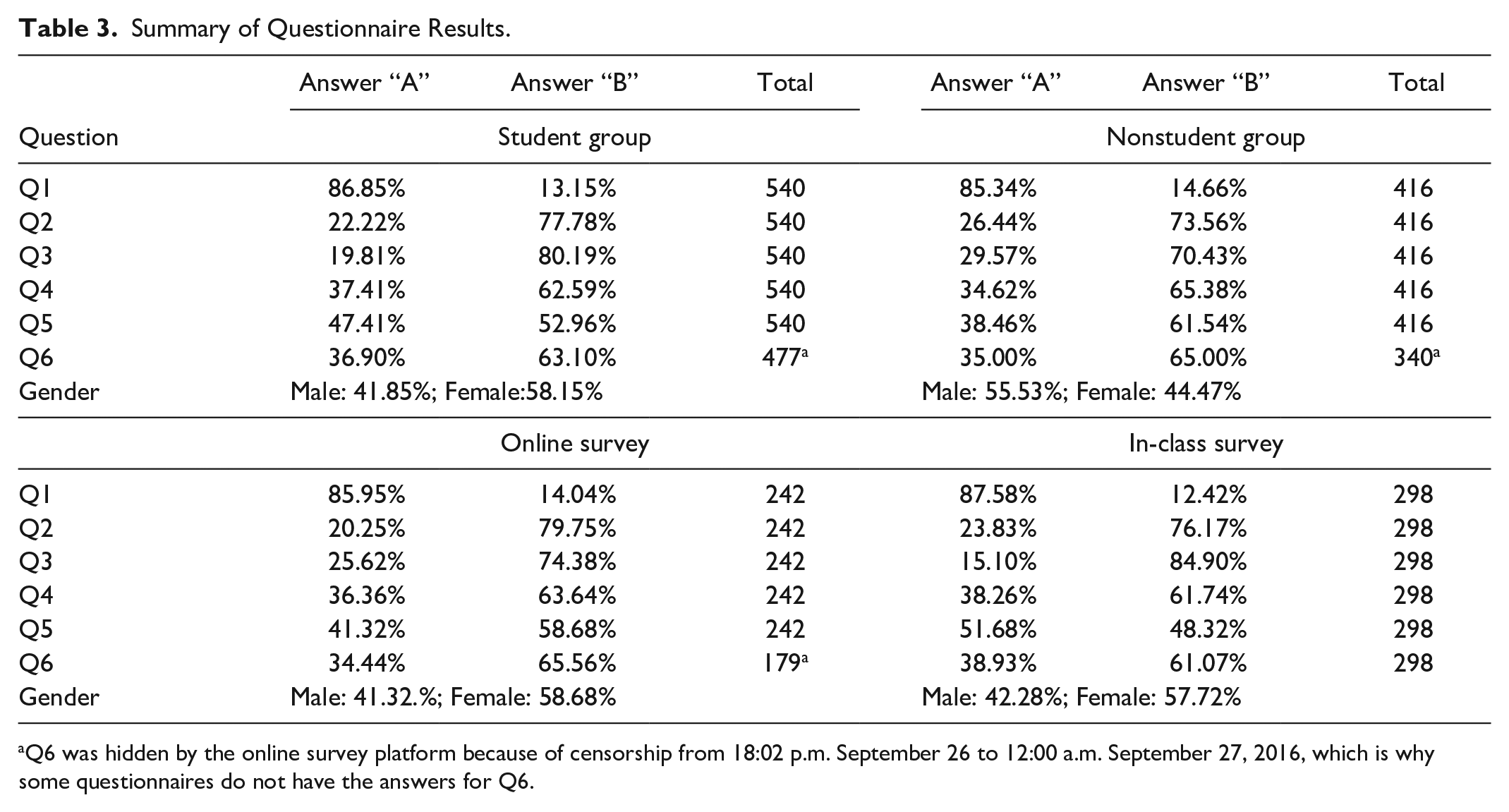
Q6 was hidden by the online survey platform because of censorship from 18:02 p.m. September 26 to 12:00 a.m. September 27, 2016, which is why some questionnaires do not have the answers for Q6.
I compared the data of the two groups and observed that the student group had a slightly stronger faith than the nonstudent group when answering questions on the principles of justice, as shown in the answers to Q1, Q2, and Q3. The students were also more likely to compromise on their beliefs when experiencing real-world challenges, as depicted in Q4, Q5, and Q6. I suspect that the reason for this finding will be that the values taught in schools contradict the realities that our young students have experienced in everyday life in China. One of the students in a class discussion said the following: “We have been given all these ‘right’ ideas about social justice throughout our education, but when looking at reality, we wonder whether those are all true (quote).”
Divergent Opinions
By counting the number of cases in each pattern of answers and ranking them by frequency, I tracked the emergence of different opinions in the student group (Table 4) through statistics. First in rank were the ninety-three (19.5%) respondents who answered the questions with “ABBBBB,” which means approximately one-fifth of all student respondents made the most “righteous” judgments on principle. Among the remaining top-ten patterns, seven of those occurred when students believed otherwise regarding the real-world moral challenges (Q4\Q5\Q6). The question on immigrants’ eligibility for benefits in cities (Q5) was the most controversial; approximately 24.74 percent of respondents (in the top-ten patterns) reported that evicting labor-intensive industries and migrant workers is, in some cases, justifiable. Again, in the first column of Table 4, 19.50 percent of student respondents agreed to an uneven distribution of public resources (in Q4), and 18.66 percent of them thought that the social justice principle was subject to compromise (in Q6). Additionally, the question on social stratification (Q2) and the question on the nature of social justice (Q3) each contributed to the divergence by 4.40 and 3.35 percent, respectively. In total, the top-ten patterns account for 63.31 percent of the divergent opinions in the survey, and the remaining 36.69 percent comprises small groups of fewer than fifteen cases.
Statistics of Answering Patterns in Questionnaires.
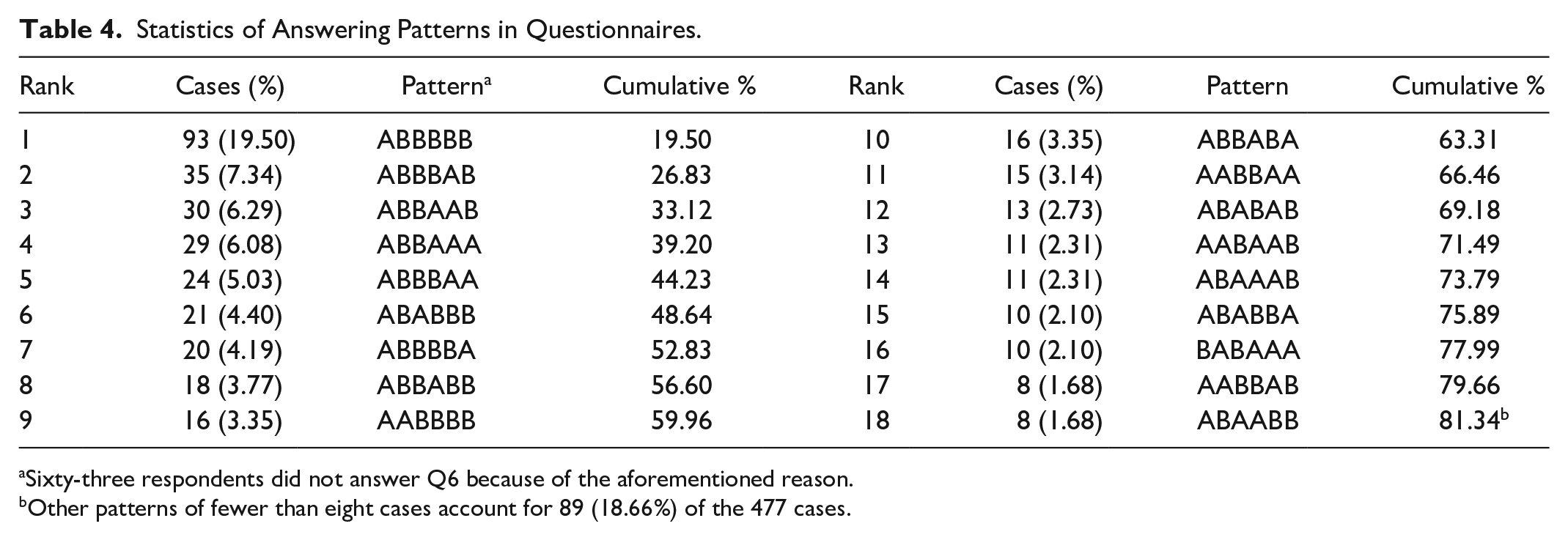
Sixty-three respondents did not answer Q6 because of the aforementioned reason.
Other patterns of fewer than eight cases account for 89 (18.66%) of the 477 cases.
Personal Standpoints
As explained, each of the six questions referred to one theoretical aspect of social justice. This part of analysis was my bold attempt to predict a respondent’s standpoint by observing a combination of answers. For example, the answers to the questions Q1, Q2, and Q3 reveal the general worldview of a respondent. An “ABB” response to those questions may reveal the respondent’s belief in a fair, equal society in which “people are equal by nature and shouldn’t be divided,” and where social justice is a moral right. An “ABA” answer combination might reveal a supporter of social welfare, in which the aim of “social justice is to help the disadvantaged.” Altogether, there are twelve personal standpoints: six on the general worldview, four on the distribution of urban resources, and two on the tendency toward compromise (Table 5).
Personal Standpoints of Respondents.
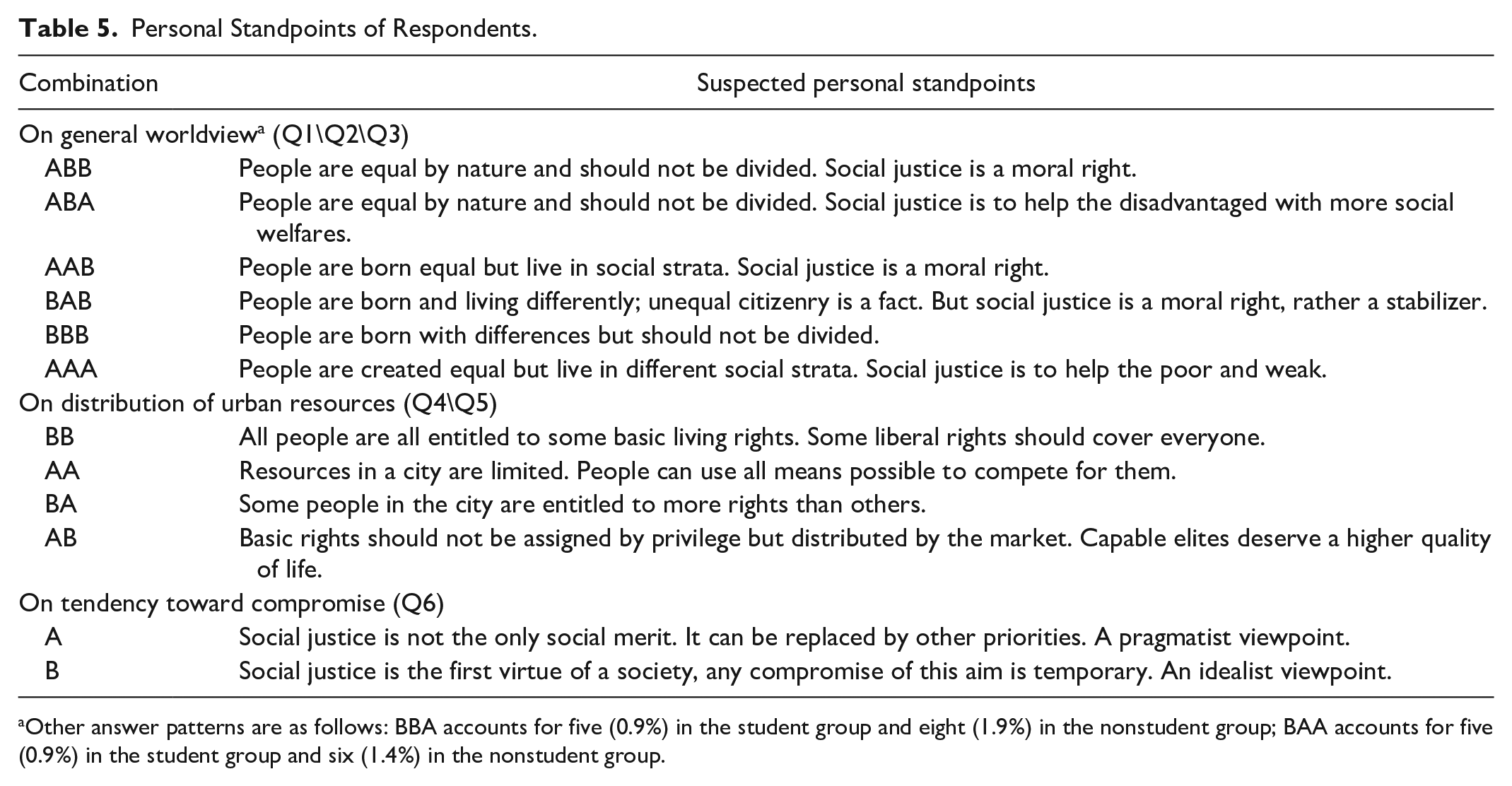
Other answer patterns are as follows: BBA accounts for five (0.9%) in the student group and eight (1.9%) in the nonstudent group; BAA accounts for five (0.9%) in the student group and six (1.4%) in the nonstudent group.
Regarding the respondents’ general worldview, the student group had a more optimistic view of the world than the nonstudent group did (Figure 1). Additionally, 55.00 percent of the student respondents reported that people are born equal and should be treated equally and fairly, and another 5.37 percent of them reported that individuals, although born with differences, should live in a just society—both figures are higher here than for the nonstudent group. The survey demonstrated that alternative worldviews were created mostly by the expectation of social welfare (16.48% of the total sample), that is, considering public aid for the disadvantaged as utterly essential. Notably, 13.89 percent of the respondents agreed with an equal but stratified society, that is, accepting that people are born equal but can live in different social strata; 5.93 percent of the student group and 8.41 percent of the nonstudent group imagined a world of unequal citizens where they are born and live differently but have social justice as a moral right. Finally, 1.48 and 2.64 percent of respondents in the two groups believed in the spirit of philanthropy, which encourages the rich and strong to help the poor and weak.
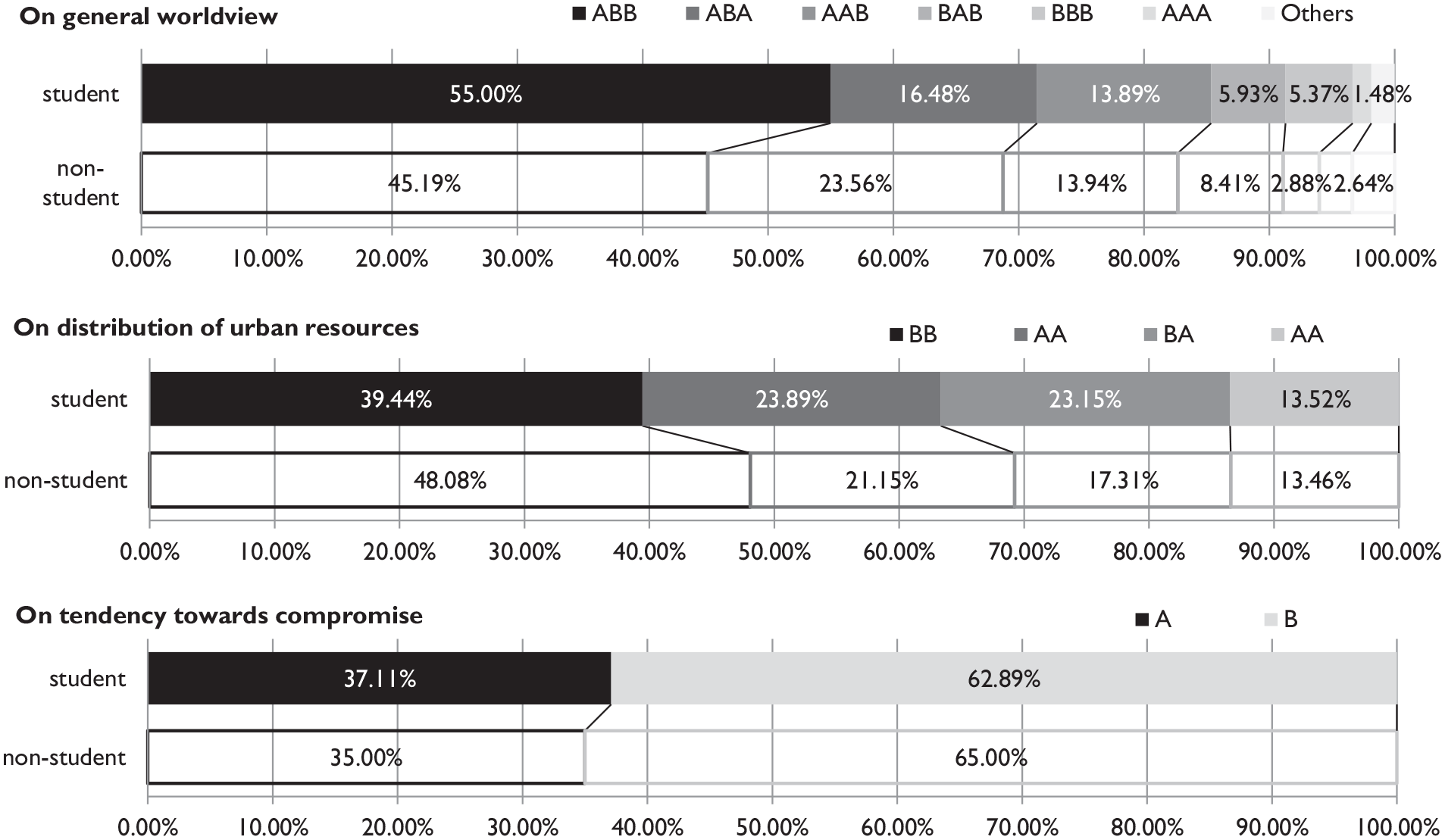
Comparison of the respondents’ personal standpoints.
For the distribution of urban resources, fewer respondents (39.44%) in the student group than in the nonstudent group (48.08%) advocated equal rights for all in cities. Accordingly, 2 to 5 percent more students than nonstudents agreed to the distribution of public resources by a citizen’s privilege or by competition. Approximately 14 percent of the respondents in both groups believed in meritocracy, in which capable elites deserve a higher quality of life than everyone else.
Where I tested the tendency toward compromise, the idealists who consider social justice to be the first virtue of society and the pragmatists who think it could be replaced or superseded by other priorities differentiate the options in the nonstudents into two groups (account for 35.00% and 65.00%). These ratios in the student group are similar: 37.11-percent idealists and 62.89-percent pragmatists.
Discussion
Traditionally in the literature, the moral dilemmas of Chinese planners were interpreted through the prism of contesting concepts, such as idealism and rationalism (F. Chen 2007), efficiency and fairness (S. Zhao 2008), freedom and equality (F. Chen 2009), self-interests and public values (Y. Zhang 2019), or more recently, the “impossible trinity” of a highly market-oriented economy, fully social democracy, and stable planning order (Zeng 2019). By correlating the empirical evidence from surveys with the historical contexts, I observed that the diverging viewpoints on the values of social justice could also be explained by the interplay of three conflicting drivers of China’s modernization: freedom, development, and equality.
First, “freedom” here refers to an individual’s right to prosperity, to pursue a better quality of life, and to make free choices in a market economy. “Freedom” also means self-reliance (living without an overburdened welfare system) and self-responsibility (where individuals accept the risk of failing). A general belief is that a democratic political system is essential to secure such freedom.
Second, “development” has been the overarching goal of China since its economic reform, in which the Chinese government has been “prioritizing efficiency over equity.” The social elites of China were also motivated and devoted themselves to economical self-betterment. Development as a vision in the postreform China has become a device to govern efficiently and smoothly at the national and local levels (Bell 2016).
Finally, although “equality” used to be temporally excluded in policy, it remains a desirable notion in the social consciousness of modern China. To improve the living standard of the general public and provide equal opportunities for all are not only CCP’s old commitments but also urgently required to moderate emerging social conflicts. Additionally, concepts such as solidarity, collectivism, and mutuality are deep-seated in Chinese ancient wisdom on social justice.
These three value systems are in constant conflict. Members of the planning society, including planning students, are forced to find a moral standpoint in the waves of socioeconomic transition of China. Where those standpoints diverge is where moral dilemmas emerge (see Figure 2), as demonstrated in the text-based materials from the survey.
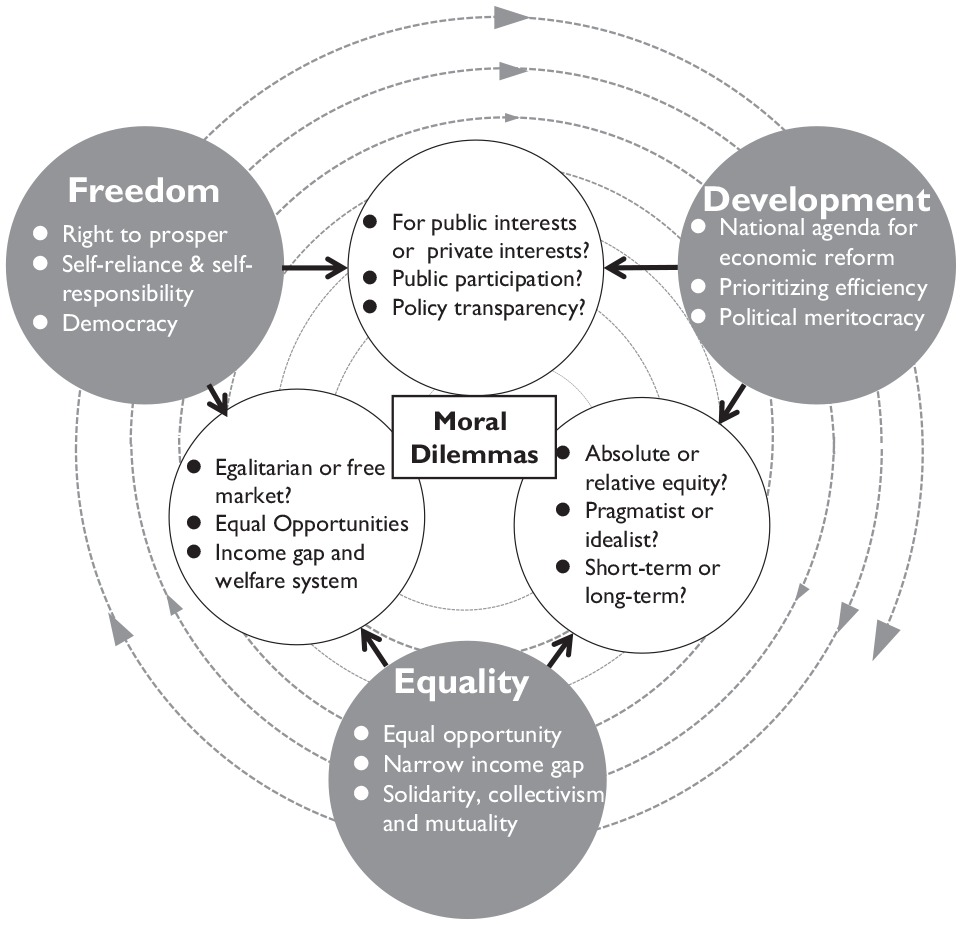
Moral dilemmas among freedom, development, and equality.
Freedom versus Development
The moral dilemmas between “freedom” and “development” are fundamental conflicts between individual rights and public authority. One debatable topic is whom planning should serve. Some respondents argued that centralized planning power “should only be used to defend public interests, not as a tool for one group to exploit another (quote)” and “planning for the people, for the general public (quote).” By contrast, others reported that as long as planning produced “benefits for the majority, some sacrifices are necessary (quote),” and “an absolutely equal society will not develop, thus impossible to plan (quote).” This debate led to the procedural aspects of planning as well. Several respondents called for “better public participation (quote),” “giving voice to the speechless (quote),” and “transparency at an earlier stage of policy formation (quote)”—believing that these are the key milestones to improving social justice. However, democratic decision-making processes, personal autonomy, and transparency in governance do not always align with the national agenda of prioritizing economic efficiency in China, a conflicting viewpoint shared by many in the survey.
Equality versus Development
The trade-off between “equality” and “development” has been debated in public discussions on social justice in China. With these two concepts in rival positions, social justice becomes “a utopian or a beautiful yearning (quote),” and the pursuit of profit seems more rational and pragmatic. Reluctantly, some respondents started to accept compromises, such as conceding to “short-term injustice in order to achieve long-term justice (quote)” or “uneven regional development for a just cause (quote).” In a time of trial and error in China, what is worrisome is that “the bottom line of compromise has never been discussed (quote),” which leaves a wide gray area between what is morally right and wrong. Additionally, more respondents preferred to avoid the question by saying that “there is no absolute equality, and justice is a relative term (quote).” This moral ambiguity may undermine further attempts to pursue equality.
What is the role of urban planning in this debate between equality and development? Several respondents mentioned that the role of planners was to “navigate” conflicts between diversified interests in the market economy, to “balance” wealth distribution in a polarizing society, and to establish “rules of the game that are accepted by multiple players (quote).” Other than the role of a mediator, many planning students still believe that some substantive goals are worth committing to, such as “to maximize public interests (quote),” “to protect the legitimate rights of an individual (quote),” or “to improve the happiness of people (quote).” At least in the survey samples, both procedural and substantive roles in planning have supporters among planning students in China.
Freedom versus Equality
The moral debate between “freedom” and “equality” is a long-standing problem of developing countries, in which an individual’s right to pursue a better quality of life often disrupts the relatively egalitarian status of the existing society. In this survey, the idea of egalitarianism was openly and fiercely rejected by some respondents. To quote but a few, “social justice doesn’t mean an equal distribution of everything (quote),” “an utterly equal society will not develop (quote),” “it is not fair to force the diligent ones to live the same as the lazy ones (quote),” and “to live better than other people is the reason we are working hard (quote).” Additionally, many respondents used equal opportunity to replace egalitarian society and said, “people might not be born equal, but could have equal opportunities (quote),” “to provide an equal chance in competition, not equal material goods (quote),” and “giving hard-working people enough opportunities is good (quote).” However, there were also concerns that the widening income gap would eventually divide society and that the “welfare of the weak and the poor will not be secured (quote).” One respondent commented the following: “As individuals, the poor should have a channel for upward movement and be able to live with dignity; the rich should have a stronger sense of social responsibility (quote),” which summarizes the viewpoints of the majority in the survey.
Conclusion
This research provides insights into the complex, controversial, and ever-evolving belief systems regarding social justice. First, a retrospection shows that personal values and social mindsets in China have been changing. The traditional wisdom of Confucian, Taoism, Buddhism, and other belief systems (e.g., the higher moral principles of public spirit, equal status, integrity, upright, righteousness, or impartiality) was challenged by Western thoughts from both the leftists and rightists. The socialist political regime, which once advocated egalitarianism and the merits of the working class, adapted to fit the global economy. The gradual economic reform and social transformation of China after 1979 resulted in the ethos of moral individualism along with the efficiency of the free market, and the disturbing social inequalities are gaining more attention. Second, through a survey of planning students that comprised six “ethics quizzes,” I observed that only one-fifth of all respondents believed in a fair, equal society, and the others partially disagreed with some principles of social justice or compromised when experiencing real-world challenges. The divergent standpoint on social justice in respondents occurs for the basic doctrines of social justice, and the difference between personal values further widened when the question evolved from abstract propositions to real-world dilemmas. Finally, I conclude that those moral debates can be understood through the conflicts between three drivers of China’s modernization: freedom, development, and equality. By doing so, this paper revealed Chinese planners’ (and college students in particular) opinions on the structure of inequality and unfairness in the age of change.
As planning educators, we are aware that “planning partakes of the personal inward view of those who plan (Hoover 1961, 293)”; therefore, “students should be helped to develop a greater sense of moral obligation and personal responsibility (Kaufman 1981, 33).” The planning ethics course, currently burdened with this responsibility, usually uses normative ethical theories for the principles of right and wrong, searching for guidance among moral philosophers such as J.S. Mill, J. Bentham, I. Kant, J. Rawls, and R. Nozick (Howe 1990). Off campus, these ethical philosophers’ theoretical debates on social justice are commonly announced as a prepackaged rhetorical device (i.e., liberal, radical, conservative, left, or right), which are used either as an “ideological flag” to flaunt or as a “straw man” to argue against in politics or social movements.
This research suggests that planners’ ethical choices are not limited to the single-dimensional conceptions of social justice labeled as utilitarianism, liberalism, neoliberalism, or communitarianism (K. Zhou, Dong, and Pan 2019). Individuals’ moral judgments are also influenced by the changing sociopolitical ethos of their times. Standpoints on the values of social justice are subject to change, diverging or converging in different historical contexts, from which is derived the analogy of “spiral” in the title to illustrate its nonlinear dynamics and periodic occurrences. Therefore, to assume a “high moral standpoint” that has absolute rightness can neither find valid solutions to the value-laden planning questions nor help build a consensus among divergent personal beliefs.
My final remarks are as follows: the dialectical nature of social justice demands comprehensive, contextualized evaluations in real-world situations, and the general theoretical definition should provide the framework for such evaluation. Transcending the vain value judgment of social justice and engaging the examination and reexamination of rationality would open a path toward productive discussions. Empirical approaches to investigate, understand, and interpret the diversified moral standpoints of planning professionals are necessary, if not essential, in establishing a theory for planning.
This research is exploratory; therefore, further study is suggested. The questionnaire was short and brief to attract more responses, which compromises its rigorousness. More questions could be asked and more samples could be collected in further surveys to cross-check the findings against multiple answers. The suspected personal standpoints of the respondents and the analytical framework of moral dilemmas both require more supporting evidence. During the writing and revising of this paper in 2019 and 2020, antiglobalization and xenophobic sentiments were increasing in the West, China was entering a new phase of slow growth and enhanced authority, and the COVID-19 pandemic had changed international politics. How these changing sociopolitical ethos will reshape the personal values of the Chinese people remains unknown.
Footnotes
Acknowledgements
Thanks to all the respondents for participating in this research and contributing their thoughts. Thanks to Professor Justin Hollander of the Department of Urban and Environmental Planning, Tufts University, for allowing me to bring this research to the United States in 2018 and 2019. I gratefully acknowledge financial support from the Fulbright Scholar Program. My deepest gratitude is owed to the anonymous reviewers for their careful work and thoughtful suggestions that have helped to substantially improve this paper.
Declaration of Conflicting Interests
The author(s) declared no potential conflicts of interest with respect to the research, authorship, and/or publication of this article.
Funding
The author(s) disclosed receipt of the following financial support for the research, authorship, and/or publication of this article: This study was supported by the Fulbright Scholar Program and National Natural Science Foundation of China (52078197).
