




Abstract
This study examines the efforts to preserve the Low-Income Housing Tax Credits (LIHTC) projects that are at risk from their year-15 transition in Detroit, Michigan. Using the preservation framework recommended by the National Housing Trust, the paper first identifies the risks LIHTC projects in Detroit face. It then reports what major institutional actors in LIHTC developments have done in addressing those risks, with particular attention to the roles these actors have played in shaping preservation needs and actions. The study concludes by discussing what broader lessons can be learned from Detroit with regard to the preservation of LIHTC projects nationwide.
Introduction
The country’s largest affordable housing production program, the Low-Income Housing Tax Credit (LIHTC) program, is more than thirty years old now. Established in 1986, the program has financed about 46,554 projects and 3.05 million housing units, all privately owned (U.S. Department of Housing and Urban Development (HUD) 2018). While many of the LIHTC projects are aging, how to address the preservation needs that are likely to come up has not become a major concern for the program. Studies of affordable housing preservation have often looked at properties funded by earlier housing programs such as the Project-Based Section 8 program (Blanco et al. 2015; Ray et al. 2018). Few have examined what can be done to preserve LIHTC projects that are at risk of leaving the affordable inventory.
The need to preserve LIHTC projects deserves greater attention from housing policymakers and practitioners. Compared with earlier HUD programs, LIHTC’s funding model and program rules can impose unique challenges. Under the LIHTC program, developers who wish to build affordable housing must apply for tax credit allocation from their state housing finance agencies (HFAs). Developers may apply for 9 percent tax credits through a competitive process where the annual allocation amount in each state is capped based on state population, or 4 percent tax credits for which states have unlimited authority to issue. Because of the smaller amount of tax credit subsidy, the 4 percent tax credits are often used together with tax-exempt bond financing to support affordable housing development. To be eligible for tax credits, a project must provide at least 20 percent of units for households with incomes that are at or less than 50 percent of area median income (AMI) or at least 40 percent of units for households with incomes that are at or less than 60 percent of AMI. Once the tax credits have been awarded, developers sell them to private investors (usually through syndicators that act as intermediaries between investors and developers). By purchasing the tax credits, investors (or syndicators on their behalf) become the projects’ legal owners and are known as limited partners, while developers work with them as general partners.
All LIHTC projects have to maintain affordability for fifteen years known as the compliance period. Otherwise, owners face severe financial penalties imposed by the Internal Revenue Service (IRS). For projects placed in service after 1990, federal law also requires that properties remain affordable for another fifteen years, known as the extended-use period. By the end of the first fifteen years, investors have claimed all the tax credits generated by the projects. Most then seek to transfer their ownership to general partners or a third party. Ownership restructuring is therefore common at year 15.
New owners of LIHTC properties have to meet the affordability requirement for the extended-use period, but two events can release them from this restriction: property foreclosure and a qualified-contract process should owners decide to pursue it. In the case of qualified contract, owners of LIHTC projects may request for it after the fourteenth year of the compliance period. The state HFA has one year to find a buyer who will maintain the project’s affordability and make an offer at the price determined by a federally mandated formula. The calculated price is almost always greater than any reasonable market valuation, so state HFAs often have difficulty finding buyers (Kincer and Shelburne 2017). If the HFA cannot find buyers, the affordability restriction is released, which phases out over three years.
Without foreclosure or the exercise of qualified contract, LIHTC properties are subject to the additional affordability restriction for the next fifteen years. Yet program oversight changes after year 15, when IRS no longer monitors compliance. Instead, state HFAs become solely responsible for enforcing the additional affordability restriction. The LIHTC program does not specify any clear consequence for noncompliance during the extended-use period.
In the early 2000s, when LIHTC projects started to approach year 15, concerns arose about whether this would lead to a significant loss of affordable housing. Several studies were conducted to address this concern. These studies find that nationwide, most LIHTC properties continue to operate as affordable housing after year 15 (Khadduri et al. 2012; Meléndez, Schwartz and Montrichard 2008; A. Schwartz and Meléndez 2008). Few studies have followed up on this topic. A recent study published by the National Low-Income Housing Coalition (NLIHC) identifies year 30 as a major threat, as it means the end of all federal affordability requirements under the program (Aurand et al. 2018).
Efforts to preserve LIHTC projects, however, should not just focus on properties reaching year 30. There is a need to revisit the year-15 issue to see how it affects the provision of affordable housing during the extended-use period. The first and foremost questions of the year-15 transition are who can take over property ownership and whether the new owners have the incentive and capacity to effectively maintain and manage the property over the remaining years of rent restrictions (Black 2017). If they do not, properties could struggle during the second phase. Recent studies in Detroit (Dewar, Deng and Bloem 2020) and St. Louis (Clarke 2015) have shown that finding new owners who are capable of taking over LIHTC projects after year 15 can be challenging in these markets. The Detroit study also identified a much greater loss of LIHTC units after year 15 than earlier national studies have found. With the exception of the Detroit study, very little research exists that examines how LIHTC projects have fared during the extended-use period. 1 The NLIHC study finds that state HFAs’ monitoring and enforcement of program compliance during the extended-use period vary and, in many cases, are unknown (Aurand et al. 2018).
A much larger number of LIHTC projects have passed year 15 since the earlier national studies were conducted. From 2010 to 2019, 15,440 properties with slightly over one million low-income units reached year 15. Another half a million low-income units will reach year 15 from 2020 to 2024 (HUD 2018). As the federal role ends after year 15, ensuring such a large number of LIHTC properties can continue to provide adequate housing has become not only a state responsibility but also a critical local concern. Many communities housing these LIHTC projects are experiencing affordable housing shortages and need to preserve such housing to prevent resident displacement. 2 The physical condition of those projects also has major impacts on community well-being.
The year-15 transition is thus not just a transaction for investors to dispose their ownership interest. It involves major changes in property ownership and program oversight. These changes can pose challenges, which may call for intervention by state and local actors. In many cases, state and local actors may already be part of the year-15 negotiation due to LIHTC projects’ funding structure. The LIHTC itself is seldom sufficient in supporting affordable housing development. In addition to tax credits, projects had to carry some level of hard debt as well as soft debt or grants provided by state and local entities. 3 One example of the soft debt is loans funded by the federal HOME block grant program but administered by state and local governments, which have been frequently used in financing LIHTC projects. To restructure property ownership at year 15, owners of LIHTC projects need to work with those state and local agencies on how to handle the remaining HOME debt, which provides an opportunity for them to intervene in the process.
This study examines a case on how efforts could be made at the state and local levels to address the challenges LIHTC projects face from their year-15 transition. Between 2016 and 2022, 105 LIHTC projects in Detroit—about 7,700 low-income units, or half of the city’s LIHTC housing—will reach year 15, when investors and syndicators seek to exit from property ownership. Yet many of these projects are under financial stress and would not be able to operate on their own. General partners, syndicators, intermediaries, and city officials saw this as an impending crisis. In 2015, a year-15 work group formed that brought together many of the concerned parties to identify the risks that LIHTC projects in Detroit face and determine what can be done to address them. This paper examines these efforts, assesses the issues that have come up in the process, and offers broader lessons on what the Detroit efforts have revealed about preserving LIHTC projects at year 15 and beyond.
What Do We Know from Previous Affordable Housing Preservation Efforts?
While the preservation of LIHTC projects has not become a major national concern, the country has had more than two decades of experience in preserving publicly subsidized but privately owned affordable housing properties. Most of these efforts began in the 1990s, when a number of project-based Section 8 properties were approaching the end of their affordability restriction (Ray et al. 2018; H. L. Schwartz et al. 2016). In response, many efforts have been made to preserve these properties, including an ambitious twenty-year, $187 million Window of Opportunity initiative by the MacArthur Foundation to build preservation infrastructure for the country’s privately owned rental housing, and increased funding commitment for preservation at the state and local levels (Ray et al. 2018; H. L. Schwartz et al. 2016; Treskon and McTarnaghan 2016). These efforts have substantially reduced the loss of subsidized properties.
Despite these achievements, affordable housing preservation has largely remained a state and local task. The MacArthur Foundation’s Window of Opportunity initiative has not been able to prompt major federal actions during the twenty-year program period (H. L. Schwartz et al. 2016). Without major federal commitment, state and local communities have to carve out their own preservation strategies. Studies of these efforts have generated some valuable lessons. In examining preservation work in Chicago, Illinois; Washington, D.C.; and Austin, Texas, Howell, Mueller, and Wilson (2019) highlight the importance of understanding local housing needs and conditions when defining a preservation agenda. After examining preservation projects across different housing market types, Treskon and McTarnaghan (2016) advocate for policy networks to facilitate the transfer of knowledge from one place to another.
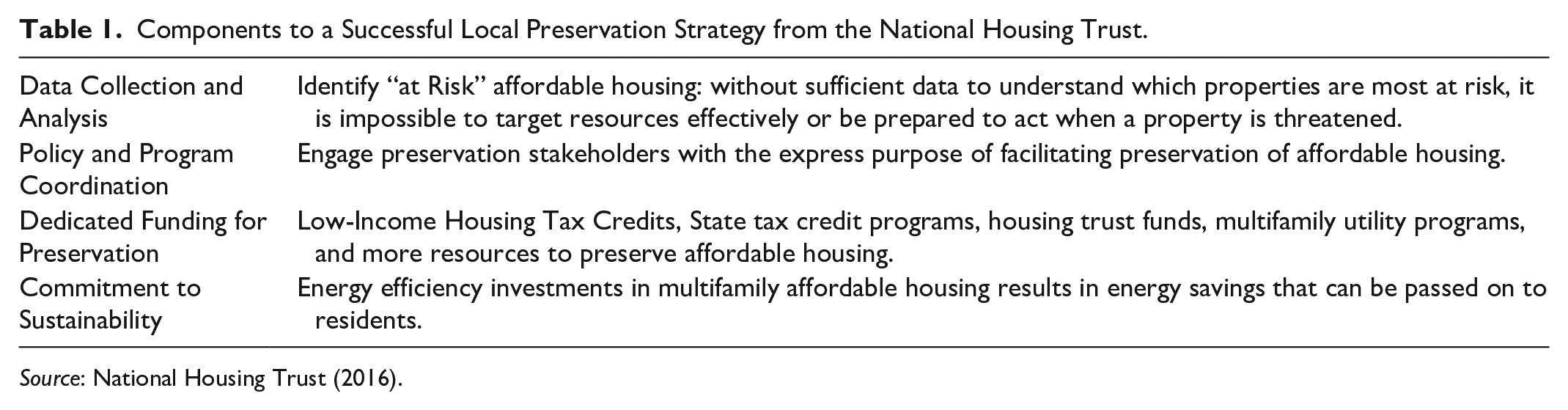
Taking stock of what have been learned from various local practices, the National Housing Trust (NHT) identifies four key components of a successful preservation strategy that prescribe a framework for local preservation actions (Table 1). The first is to collect and analyze data to identify the risks affordable housing properties face; the second is to coordinate policies and programs to engage preservation stakeholders; the third is to secure dedicated funding sources for preservation; and the fourth is to commit to sustainability to ensure the long-run viability of affordable housing provision (NHT 2016).
Components to a Successful Local Preservation Strategy from the National Housing Trust.
Source: National Housing Trust (2016).
The challenge, though, is how to apply this framework to address the needs of the different types of affordable housing projects. Existing studies of affordable housing preservation have often identified LIHTC as an important funding source for preservation, but few have explored how to preserve at-risk LIHTC projects. This study fills the gap by examining efforts in the city of Detroit to preserve LIHTC projects that are at risk of loss from their upcoming year-15 transition. The paper will first describe how these efforts have begun. It will then examine how the tasks identified in the NHT preservation framework have been carried out in Detroit, with particular attention to what roles major institutional actors in LIHTC development have played in shaping the preservation needs and actions. The paper concludes by identifying the broader lessons that can be learned from Detroit on how to preserve LIHTC projects at year 15 and beyond.
The Detroit Year-15 Preservation Efforts
The Beginning of the Year-15 Preservation Efforts in Detroit
LIHTC projects in Detroit have encountered significant challenges since the collapse of the city’s housing market in the early 2000s. Both the mortgage foreclosure crisis and the ensuing recession hit the city hard, leading to large population loss and disinvestment in many of the neighborhoods that house LIHTC projects (Deng et al. 2018). In many cases, syndicators had to intervene to stabilize properties so that they could get through the compliance period to avoid penalty on investors. However, year 15 was approaching, at which point these syndicators would seek to exit from property ownership. The transition would not be easy. As many projects are experiencing financial difficulties, general partners are often unwilling or unable to take on property ownership, which cast great uncertainty on the future of the LIHTC housing in Detroit.
While syndicators and general partners have worked to address the year-15 transition for their own projects for some time, no coordinated actions took place until mid-2015. At that time, Southwest Housing Solutions, one of the largest nonprofit housing developers in Detroit, convened a group of those involved with LIHTC on the belief that by working together, they could identify the challenges facing LIHTC preservation citywide and come up with better solutions than each could alone. The director of the Community Development Advocates of Detroit (CDAD), the community development trade association, offered the group support, at which point the CDAD Affordable Housing Work Group (i.e., the year-15 work group) formed. In addition to the CDAD staff, members of the work group included representatives from syndicators, the Detroit Local Initiatives Support Corporation (LISC), other community development financial institutions (CDFIs), and several nonprofit developers that served as general partners in LIHTC projects; lawyers who work on all stages of LIHTC projects; staff of the Detroit Housing and Revitalization Department; and a research team from the University of Michigan. With funding from the university, the research team was charged with providing a citywide assessment of the risks LIHTC projects face. From 2015 to 2019, the work group met frequently to discuss the research team’s analyses and findings and examine what could be done to address these risks. This paper draws from the research team’s experience of working with the group to identify lessons from the Detroit efforts.
Data Collection and Analysis to Examine Risks for LIHTC Projects
Existing studies of affordable housing preservation have identified two types of risks that could lead to the loss of affordable housing: physical deterioration and the end of the mandated affordability restriction. Factors that can trigger these risks include properties’ financial and physical condition, ownership type, and the dynamics of neighborhood housing markets (Aurand et al. 2018; Ray et al. 2018). Assessing the risks that affordable housing projects face requires data collection and analysis on these factors.
Data collection on LIHTC projects in Detroit turned out to be quite difficult. Unlike the Section 8 properties that HUD monitors, where HUD has regularly assessed their physical conditions and has made such information publicly available, there is no similar dataset for LIHTC properties. Although HUD has built a national LIHTC database based on voluntary reporting from state HFAs, the database has limited coverage and does not provide the level of detail or accuracy needed to determine the preservation needs of individual projects. In Detroit, for example, the HUD database recorded only one address per project and cannot be used to map the locations of the scattered-site single-family housing units that have a large presence in the city. Nor can the database identify property ownership, which is key to the year-15 transition. 4
Because of these challenges, the research team had to retrieve data from a variety of sources, including data from the state’s HFA—the Michigan State Housing Development Authority (MSHDA). MSHDA collected data primarily at the time of tax credit allocation. It does not compile information on how properties were operated and managed unless they fell out of compliance. With the help of the work group participants, the team obtained financial audits for a sample of 63 out of 105 LIHTC properties that are reaching year 15 between 2016 and 2022. This allowed the team to carry out a citywide risk assessment for LIHTC projects approaching year 15. The team also examined the status of the LIHTC projects that passed year 15 but were still under the extended-use period. 5 In the end, results of the data collection and analysis have been shared both within and outside the work group whenever appropriate, which helped fill some long-existing data gaps in the city. 6
Characteristics of Detroit LIHTC Projects Approaching Year 15
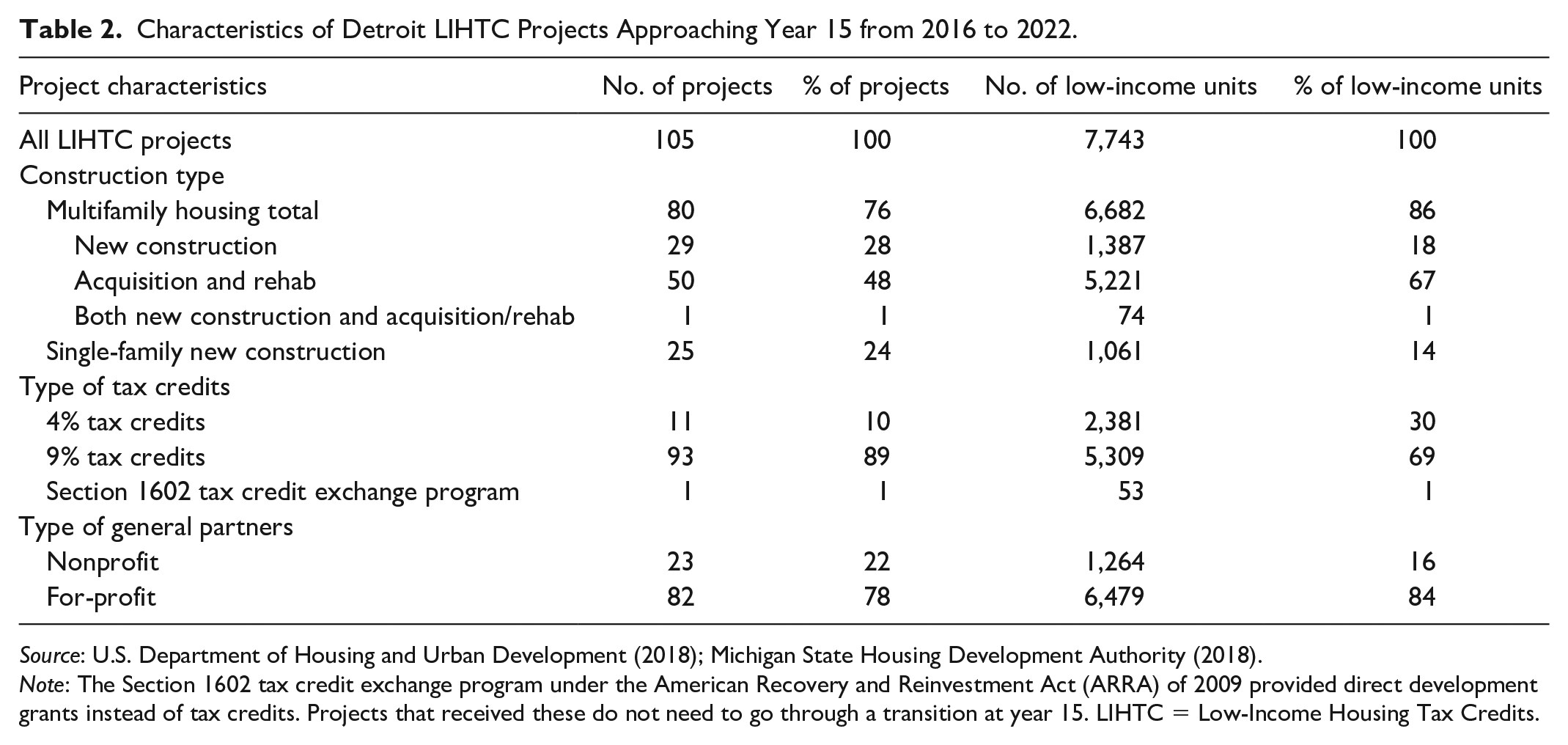
From 1987 to 2015, Detroit has seen the development of 317 LIHTC projects, with a total of 15,257 low-income housing units. Almost half of the stock, 105 LIHTC projects (7,743 low-income units) were approaching year 15 from 2016 to 2022. Table 2 presents the major characteristics of those projects. A majority of the low-income units were in multifamily structure, with about two-thirds of them being in rehabilitated projects; 14 percent of the low-income units are scattered-site, single-family housing, all built through new construction. An overwhelming majority of the LIHTC projects approaching year 15 received 9 percent tax credits, while only about eleven projects, 30 percent of the units, were funded through 4 percent tax credits. Most of the 105 expiring LIHTC projects were for-profit developments, with only about twenty-three projects, 16 percent of the units, owned by nonprofit general partners. The distributions of the low-income units as measured by different characteristics for projects approaching year 15 are largely similar to those of the entire LIHTC housing stock in the city (Dewar, Deng and Bloem 2020). These characteristics have important implications for the type of risks LIHTC projects face at year 15.
Characteristics of Detroit LIHTC Projects Approaching Year 15 from 2016 to 2022.
Source: U.S. Department of Housing and Urban Development (2018); Michigan State Housing Development Authority (2018).
Note: The Section 1602 tax credit exchange program under the American Recovery and Reinvestment Act (ARRA) of 2009 provided direct development grants instead of tax credits. Projects that received these do not need to go through a transition at year 15. LIHTC = Low-Income Housing Tax Credits.
Identifying the Risks LIHTC Projects in Detroit Face at Year 15
The research team’s risk assessment shows that most LIHTC projects in Detroit approaching year 15 are not at risk of losing affordability, given the city’s weak housing market. However, many LIHTC projects are under financial stress that threatens their ability to provide adequate housing after year 15. The team’s study of sixty-three sample LIHTC projects reaching year 15 between 2016 and 2022 identified several financial problems. The first is the cash flow problem, as more than half of the properties being studied do not have enough net operating income to meet their hard debt and required reserve payments. As a result, not only properties failed to fund their replacement reserve at the minimally required level, their outstanding debt balance also grew over time to a level that has exceeded property market value. This is in contrast to what the national survey of the LIHTC property performance by CohnReznick (2018) has found, where a majority of the LIHTC properties being surveyed had strong, positive cash flow. As one of the most impoverished cities in the country, the level of income is so low for Detroit’s rental households that it is difficult for LIHTC projects to charge rents at levels that could cover both the operating cost and the cost of essential capital improvement.
With the help of investors or syndicators, a majority of the LIHTC projects in Detroit got through their first fifteen-year compliance period. Indeed, in a city that has seen little new housing construction except for LIHTC development in the past three decades, the LIHTC housing has been a major part of Detroit’s newer and better quality housing available to lower income households (Deng 2013). After year 15, however, as the limited partners have departed and problems have piled up, properties can fall into despair or experience mortgage or tax foreclosures that take them out of the affordable housing stock. The research team’s study shows that this has been the case for earlier LIHTC projects that have passed year 15. Compared with what national studies have found, a considerably higher share of properties in Detroit went through mortgage or tax foreclosure, and a larger percentage of the units were permanently removed from the housing stock, seeding blight in the neighborhoods (Dewar, Deng and Bloem 2020). Without intervention, the city is likely to see a greater loss of such housing in the future, given the number of LIHTC units that were approaching year 15.
Preserving LIHTC housing will not be easy, as there is considerable variation in the type of risks individual projects face. For example, while owners’ opting out is not a widespread concern in Detroit, some for-profit general partners of LIHTC projects in the greater downtown, an area that has seen rapidly rising market rents in recent years, have expressed interest in pursuing qualified contracts to remove the affordability restriction after year 15. 7 Outside the greater downtown, both the city government and local foundations have chosen to target investment in selected neighborhoods. Thus, while projects outside the greater downtown are likely to maintain affordability, those that are not within the targeted areas are not on the priority list for both the government and foundation investment and would face difficulty in securing resources to address their unmet capital needs.
Construction type as well as project-specific funding structure also affect the type of risk properties face. The city has about 1,000 scattered-site, single-family housing units that were approaching year 15, and these units have experienced greater operation and management challenges than multifamily housing projects. In terms of funding structure, projects that have operating subsidies such as project-based vouchers or Section 8 contract are found to be in stronger financial conditions than those without. 8
The Role of Institutional Actors in Shaping the Preservation Needs of LIHTC Projects
Analyzing the risks LIHTC projects face also reveals the roles different institutional actors can play in shaping the preservation needs of those projects. General partners are directly responsible for building and operating the LIHTC properties and are the most important actor to be considered in examining properties’ preservation needs. National studies have shown that most LIHTC projects rely on general partners to take on full property ownership after year 15 (Khadduri et al. 2012). Because nonprofits are often committed to long-term affordability, studies have identified the presence of a nonprofit owner as an indicator of reduced risk (Aurand et al. 2018; Ray et al. 2018). The Detroit experience challenges this generalization. The city had a weak nonprofit community development industry that was further hampered by the great recession. Considered as one of the lower capacity systems among legacy cities, many of Detroit’s community development corporations (CDC) were small with constrained resources (Dewar 2013; Thomson and Etienne 2017). In the early 2000s, those CDCs without much real estate experience took on LIHTC development, hoping that doing so could generate developer fee to support their other missions. When the recession hit, many of them ceased to operate or lost much of their capacity (Thomson and Etienne 2017).
Projects with for-profit general partners vary in their business model and organizational capacity. The city has seen large real estate firms that specialize in using LIHTC to preserve older HUD properties. Because of these combined subsidies, these projects tend to be more financially viable. However, projects built by small for-profit developers were struggling. Thus, both for-profit and nonprofit LIHTC properties in Detroit face risks in their year-15 transition.
The type of limited partners projects have also plays a crucial role in how the year-15 transition takes place. Given the weak financial conditions many LIHTC projects have, for-profit syndicators often saw them as a liability and wanted to dispose their ownership interest as soon as possible. In contrast, nonprofit syndicators that have underwritten the city’s most tax credit projects such as Cinnaire and National Equity Fund (NEF) were driven both by their social mission and by their fiduciary responsibility to serve their investors’ interests. These syndicators have made great efforts to stabilize troubled properties and structure the year-15 transition in a way that could help sustain the provision of affordable housing in the longer term. The presence of mission-driven, nonprofit syndicators has greatly mitigated the risks properties face.
Outside the partnership, projects’ funding structure introduces additional actors whose involvement could have major impacts on the risks projects face. LIHTC projects can receive either 9 or 4 percent tax credits. The 9 percent tax credits generate a much greater amount of development equity for projects, reducing their need for debt financing. By contrast, because the amount of equity that 4 percent tax credits can raise is much more limited, those projects have to take out more debt. Regardless, all LIHTC projects carry some level of debt. The type of debt they have and who holds it have implications for the year-15 transition.
The study of sample LIHTC projects reaching year 15 shows that MSHDA and the city of Detroit are major debt holders for many projects. MSHDA’s role goes beyond the allocation of tax credits. Almost all 4 percent tax credit projects in Detroit had their first mortgages funded by MSHDA-issued housing bonds. MSHDA also provided other subsidies to Detroit projects through programs such as MSHDA-administered HOME loans and project-based vouchers, as well as its own gap financing program. By contrast, the city of Detroit provided a substantial amount of soft debt to a large number of 9 percent tax credit projects through the city-administered HOME funding. These 9 percent tax credit projects also had a modest amount of hard debt from private lenders, although each private lender was often associated with a small number of LIHTC projects.
With decades of asset-management experience, MSHDA has closely monitored projects that have received additional MSHDA financing other than the tax credits and has intervened whenever needed to preserve properties. However, the nature of MSHDA’s funding sources also brings risks to these properties. Most MSHDA loans were funded by private capital through bond financing. When properties fell into delinquency, MSHDA had to carry out foreclosures according to contract. By contrast, the city of Detroit was not able to provide the same degree of asset management for projects with city funding due to its prolonged financial and administrative struggles. However, because most of the city funding is public debt such as HOME loans, no projects were foreclosed due to delinquency, even though many did fall behind their payment schedule. Still, the growing outstanding debt balance has discouraged ownership transition at year 15.
The risk assessment of LIHTC projects reaching year 15 in Detroit shows the complexity of preserving them. Not only do these efforts need to be substantial enough to address the grave challenges these projects face, they also have to respond to the needs of individual projects. Due to the projects’ layers of financing, their preservation will inevitably involve numerous stakeholders, including general partners, limited partners, state HFAs, lenders that have outstanding loans with the projects, and other parties such as city officials and CDFIs that are interested in preserving such housing.
Efforts to Address the Challenges LIHTC Projects in Detroit Face
This section examines efforts to address the challenges LIHTC projects in Detroit face at year 15. Some of the efforts were informed by the year-15 work group, while others were developed outside the work group. The work group has provided a platform for its participants to identify these efforts and examine how they could work to preserve at-risk properties. These efforts include state-level resources and opportunities, new initiatives the city of Detroit is developing, and special efforts by general partners and syndicators. They address the two major tasks the NHT preservation framework has identified: securing dedicated funding sources and engaging preservation stakeholders for coordinated action.
Preservation Resources and Opportunities at the State Level
LIHTC has been the most important funding source for affordable housing preservation (Ray et al. 2018). Given its control of LIHTC allocation, the state HFA is one of the most important players in preserving LIHTC projects. Many LIHTC projects facing unmet capital needs apply to their state HFA for another round of tax credit allocation after year 15 known as resyndication (Khadduri et al. 2012; A. Schwartz and Meléndez 2008). Whether they succeed depends on how the state HFA prioritizes such requests over other types of development. In examining the preservation challenges LIHTC projects are likely to face after year 30, Aurand et al. (2018) highlight the tension between preserving existing projects and expanding new housing production in areas that can offer residents better access to socioeconomic opportunities such as quality education and jobs. The state of Michigan was also subject to this tension and has made strategic choices to balance the two competing demands. First, to take advantage of the unlimited state authority to issue 4 percent tax credits, MSHDA requires every resyndication application to first go through the 4 percent tax credit program jointly used with tax-exempt bond financing. Only if this financing model does not work will projects be reviewed for the competitive 9 percent tax credit program. As the demand for 9 percent tax credits far exceeds the availability, MSHDA has set aside a quarter of these tax credits for preservation purposes, saving the rest for its other objectives such as expanding new housing production and providing supportive housing (MSHDA 2020).
Feedback from general partners and syndicators shows that these policies make resyndication difficult for Detroit projects. The 4 percent tax credit approach is not viable, as many projects do not have the level of rental income needed to support the amount of debt they must take on from bond financing. Yet in the statewide competition for the 9 percent tax credits, changes in the state’s Qualified Allocation Plan (QAP) have put Detroit projects at a disadvantage. In the past, Michigan QAPs favored projects that promoted community revitalization. Between 2008 and 2012, the QAPs even set a target of 50 percent of tax credits for the Detroit area (MSHDA 2020). 9 These preferences led to a large number of LIHTC developments in Detroit. Beginning in 2013, however, Michigan’s QAP eliminated this target percentage. Its scoring system also shifted toward supporting development that promotes access to opportunities. An example is in the use of Walk Score to score neighborhood amenities. Many Detroit neighborhoods do not have high Walk Score. It is thus difficult for LIHTC projects in these neighborhoods to compete (City of Detroit 2018a). Figure 1 shows how the amount of tax credit allocation and the number of low-income units being subsidized dropped considerably in Detroit from 2013 to 2015.
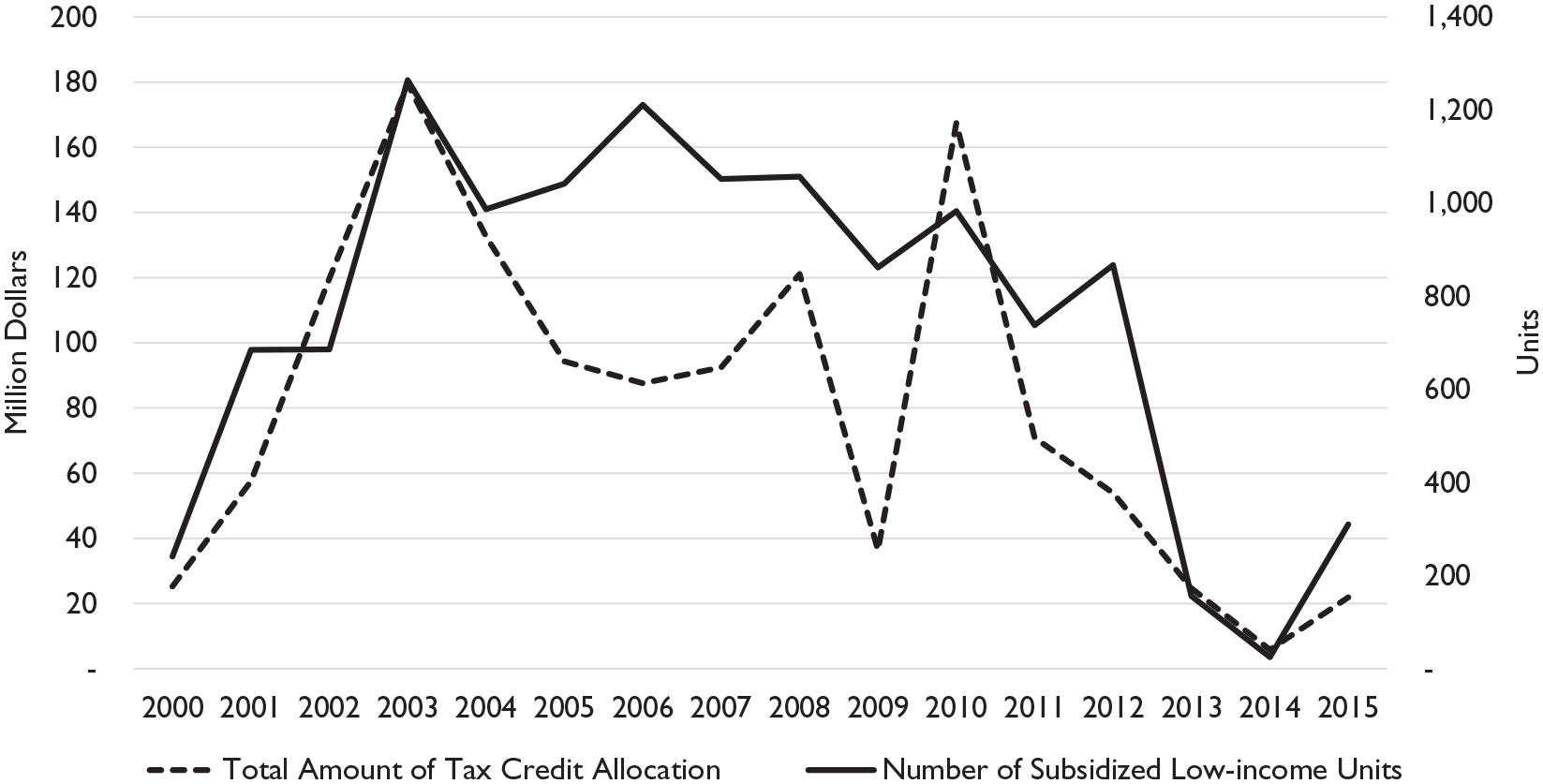
Tax credit allocation and number of subsidized low-income units in Detroit (2000–2015).
In addition to resyndication, the state HFA holds important regulatory powers that could help alleviate some of LIHTC projects’ cash flow problem. An example of this is its ability to modify income and rent restrictions so that projects initially committed to serving lower income households could charge rents up to the maximum allowable level, that is, affordable to households making 60 percent of AMI. However, this may work only for projects in the city’s stronger areas. In many of the weaker neighborhoods, market rents are close to or even less than the maximum allowable rents. Charging rents at the maximum level means that LIHTC projects would have to compete with unsubsidized housing in the neighborhoods, which would affect their ability to attract tenants.
The state HFA can also help preserve LIHTC projects through its monitoring responsibility during the extended-use period. However, staff members at MSHDA acknowledge that they do not have much leverage to hold noncompliant owners accountable, except perhaps by taking them to court, which rarely happens. The state may also exert some leverage by not allocating future tax credits to owners with records of noncompliance. But this action does not have any teeth if owners do not want to continue in this business.
Preservation Efforts by the City of Detroit
The city of Detroit has experienced significant changes since the year-15 work group began. As the city emerges from municipal bankruptcy, development interests have started to come back to the city, mostly in the greater downtown area where large-scale, mixed-use development projects have been built. Yet a large portion of Detroit residents continue to struggle with both high housing cost and deteriorating housing conditions. In 2015, 64 percent of Detroit’s renter households spent over 30 percent of their income on housing (U.S. Bureau of the Census 2015). After much high-profile media coverage of resident displacement due to code violations, financial insolvency, and owners’ opting out (FOX2 2019; Wimbley 2016), the lack of decent affordable housing has become a salient issue for the city (Nagl 2019).
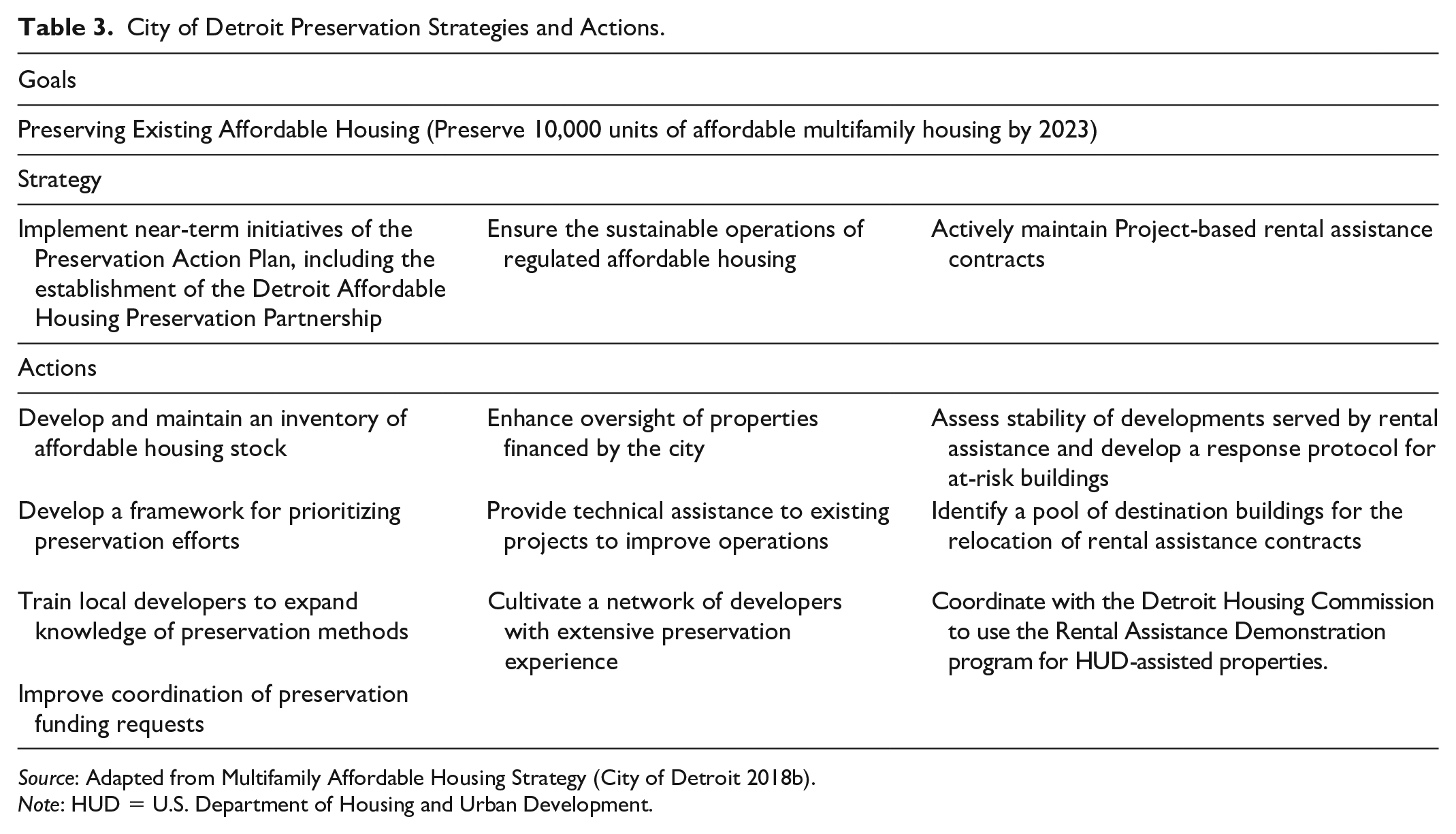
With its new motto “One City for All of Us,” the city government has expended great effort to address this challenge. In 2018, it developed a citywide Preservation Action Plan to examine the needs of its affordable housing stock. As of 2016, the city had approximately 22,000 existing regulated affordable housing units, 14,000 of which were LIHTC housing (City of Detroit 2018a). Based on the action plan’s recommendations, the city issued Multifamily Affordable Housing Strategy, which set goals to preserve 10,000 units of existing affordable multifamily units (City of Detroit 2018b). Table 3 lists the major strategies and actions the city plans to pursue in achieving its goal. These strategies emphasize the need to identify at-risk properties, coordinate resources, and build organizational capacity for both property operation and preservation. As Table 3 shows, the last task in the NHT preservation framework, commitment to sustainability, has also been included as a key element in the city’s strategies. Examining these strategies shows that the city has fully recognized the preservation challenges that LIHTC and other affordable housing properties face, and what it takes to address them at the city level. The city is now in the process of developing its single-family affordable housing strategies.
City of Detroit Preservation Strategies and Actions.
Source: Adapted from Multifamily Affordable Housing Strategy (City of Detroit 2018b).
Note: HUD = U.S. Department of Housing and Urban Development.
Key to the implementation of these strategies is the city’s proposal to establish a $250 million Affordable Housing Leverage Fund (AHLF) and create a Detroit Affordable Housing Preservation Partnership team (PPT) (City of Detroit 2018b). An initiative to better coordinate funding sources, AHLF includes $50 million commitment from the city through its HOME, CDBG (Community Development Block Grant), and other funding sources, an anticipated $75 million in commitments from MSHDA through the 4 percent tax credit program as well as MSHDA’s own gap financing programs, and a goal of $125 million in philanthropic funding in the form of low-interest loans, soft debt, and grants for capital needs assessment. By deploying these different funding sources in coordination, the city hopes that AHLF can better direct funding to impactful affordable housing projects and provide deeper development subsidies than what is possible otherwise. The philanthropic funding is managed by the LISC Detroit office, which started to deploy the private portion of the AHLF funding in 2019.
In March 2020, the city announced the formation of the PPT. The PPT is modeled after some of the country’s best practices in affordable housing preservation, such as the Cook County Preservation Compact (City of Detroit 2018b). It aims to create a multidisciplinary team that brings together a variety of skills needed for affordable housing preservation, including preservation finance, asset management, interagency coordination, and community engagement. Led by the Enterprise Community Partners, members of PPT include syndicator Cinnaire, which has the largest LIHTC portfolio in the city, an organization specializing in data development and analysis, a consulting firm promoting energy efficiency, a tenant advocacy group, and a few others. PPT will work closely with the city to coordinate the preservation task.
Both AHLF and PPT show that the city’s main approach is to engage key stakeholders and build public–private partnerships to bring together resources and expertise. In this approach, the role of local philanthropic foundations and nonprofit financial intermediaries is striking. This echoes what Thomson (2019) finds in his study of Detroit’s revitalization efforts: that philanthropic foundations and nonprofit financial intermediaries not only are major funding providers but also act as the lead coordinators of these broad-based collaborative initiatives. This is necessary due to the city’s resource constraints. It also reflects the complexity of preservation work, which requires joint efforts from the public and private sectors, especially in the case of LIHTC projects. These efforts have started to show results. By actively engaging the state HFA in the process, together with the change of the state government from a republican administration to a democratic administration, the city has seen a large increase in the allocation of LIHTC. In 2018 and 2019, MSHDA funded thirteen LIHTC projects, with approximately $140 million in tax credit funding to support both new construction and rehabilitation of existing housing in Detroit, far higher than what the city received in tax credit allocation in previous years (Heidel 2020).
While developing citywide strategies, the city has also worked to address property-specific preservation needs, such as the excessive amount of HOME debt many LIHTC projects have. While the city has been willing to offer debt relief, it cannot simply write it off. Due to population decline, the city’s HOME fund has dropped from $18 million in the early 2000s to slightly over $4 million in 2016 (City of Detroit 2018b). The city would like to collect some payment back from its HOME loans if possible so that it could fund future development. Meanwhile, as the HOME program requires a twenty-year affordability period, the city also has to ensure that projects will continue to honor the remaining affordability commitment even if it was willing to write down the debt at year 15. The city has thus been negotiating with property owners on a case-by-case basis. Where the City was able to offer debt relief, it has done so in exchange for extended affordability period beyond the initial commitment.
Related to the debt restructuring issue is the problem of property tax payment. Multifamily rental housing is taxed as commercial property. The city of Detroit has one of the highest commercial property tax rates in the country. Under state law, affordable housing properties that receive public subsidies such as HOME loans qualify for Payment in Lieu of Tax (PILOT). PILOT ranges from 4 to 10 percent of properties’ net operating income, far less than the normal property tax payment. Yet once the HOME loan is forgiven or paid off, PILOT expires. The significant increase in property tax payment can impose financial difficulty on many projects. The city has been working to develop solutions to this problem.
Special Efforts by General Partners and Syndicators to Address the Challenges of Scattered-Site Single-Family Housing Units
General partners and syndicators are owners of LIHTC projects and have to work with each other to structure the year-15 transition. Because the nature and capacity of these organizations vary, some are keen to preserve the long-term affordability of these projects, while others may not see it as the highest priority. The conditions of the properties also affect owners’ choices at year 15. While most of the actions owners take are project-specific, some have made special efforts to address the common challenges projects face. An example of this is the efforts by nonprofit developer Southwest Housing Solutions and syndicator Cinnaire to develop solutions for the city’s scattered-site, single-family LIHTC projects that were approaching year 15. The dispersed locations of these units and the level of disinvestment surrounding them have posed great challenges. Some single-family projects were built on the premise that tenants would have the option to transition into homeownership at year 15. But no project had a plan detailing how this would happen, which caused great anxiety among tenants who were expecting this transition (Cwiek 2018).
Because of these challenges, there is a consensus among LIHTC property owners that it would be difficult to sustain a large number of scattered-site units as rental housing in Detroit. Thus, both Cinnaire and Southwest Housing Solutions have worked to identify ways to convert them into owner-occupied housing after year 15. 10 To do so, Cinnaire brought in CHN Housing Partners, a seasoned nonprofit affordable housing developer from Cleveland that has years of experience running a lease-to-purchase program. CHN has also become a member of the citywide PPT, which suggests that this model is likely to be applied to other single-family units that are reaching year 15.
To make homeownership transition possible, Cinnaire and Southwest Housing Solutions have been negotiating with lenders to reduce their projects’ outstanding debt balance, mostly the HOME debt; they also have to address the property tax issue, as these units will no longer qualify for PILOT after becoming owner-occupied. In addition, many residents may not qualify for conventional mortgages and need alternative loan products. Finally, after fifteen years of occupancy, many of these units would require major capital improvements before they could be sold to tenants. The success of these efforts depends on whether Cinnaire and Southwest Housing Solutions as well as other owners interested in pursuing this model can mobilize enough support and resources to address these challenges. Still, not every tenant is willing or able to become a homeowner. Thus, part of the work also involves the development of strategies to make the remaining single-family rental housing viable.
It is impossible to document all of the ongoing efforts to preserve Detroit’s LIHTC housing. Besides the year-15 work group, the city has had several other preservation-focused groups whose work intersects with the work of the year-15 group. These efforts have informed the citywide actions. Meanwhile, the city has been learning from other places to build its preservation infrastructure, most notably by establishing the AHLF and PPT. As these citywide efforts have only just begun, it will take time to see how they perform.
Still, reviewing the Detroit efforts shows how the complexity of LIHTC financing has created challenges in the preservation work, ranging from initial data collection and analysis to the identification of stakeholders for coordinated actions. At the same time, these efforts are also subject to the same constraints that preservation of other affordable housing projects has faced, such as insufficient resources and tension among competing objectives, as we have seen in the allocation of tax credits by the state HFA. The next section will discuss what lessons we can learn from the Detroit experience.
Lessons from Detroit on Preserving LIHTC Projects at Year 15 and Beyond
Detroit’s efforts to preserve LIHTC projects at year 15 are a response to the unique challenges those projects face. Both the challenges and the preservation efforts were shaped by the conditions of the Detroit housing market as well as the capacity of local institutions. In particular, the city’s decades of struggle with population loss and economic decline have made this work much more difficult (Dewar and Thomas 2013). The Detroit experience highlights the challenges that LIHTC projects are likely to face in weak housing markets. While different market conditions may pose different challenges, Detroit’s year-15 work can also offer broader lessons on what needs to happen at the program level to address the preservation needs that may soon come up for the program.
The first lesson for the LIHTC program is the need for renewed attention to the year-15 issue. Studies have shown that most LIHTC projects face significant capital needs after year 15 and are likely to ask for an additional infusion of resources from state and local governments (A. Schwartz and Meléndez 2008). Knowing how the year-15 transition takes place would help state and local agencies better prepare for such needs. The level of involvement may vary depending on the type of challenges projects face at year 15. In places where projects are financially strong and owners are not likely to opt out, state and local agencies may simply need to stay informed about ownership transfer so that they can better monitor property compliance during the extended-use period. In other places where the year-15 transition poses challenges, state and local actors may actively intervene, as in Detroit.
The Detroit experience shows that the year-15 process can be overwhelming for those involved. The challenges are complex, and many general partners in Detroit felt unprepared. Only those who are deeply engaged with the program know how the process works, which has limited the level of external scrutiny. Studies conducted elsewhere have identified similar issues (Clarke 2015). This shows that there is a need to provide broad-based training and education opportunities on those subjects for local affordable housing practitioners. Doing so may also improve program oversight, because the program does not have built-in mechanisms to enforce the affordability restriction after year 15. The National Council of State Housing Agencies (NCSHA) has recommended that state HFAs develop formal policies to regulate and facilitate continued compliance after year 15 (NCSHA 2017). Given the strong local interest in preserving LIHTC housing, state HFAs may consider how to involve local interest in developing and implementing such policies.
With regard to specific preservation tasks as recommended by the NHT preservation framework, Detroit’s year-15 work highlights how critical the data challenge is for LIHTC projects. The country’s most widely used preservation database is the National Housing Preservation Database (NHPD). 11 NHPD’s coverage of LIHTC projects comes from the HUD LIHTC database, which, as discussed before, has major limitations when used to identify local preservation needs. The lack of comprehensive property-level data to quantify the country’s preservation needs was identified as a major reason that the Window of Opportunity Initiative failed to build a national narrative on preservation actions (H. L. Schwartz et al. 2016). As LIHTC projects age, this challenge will only grow. Preserving LIHTC projects requires efforts to overcome the data challenge first.
One example that H. L. Schwartz et al. (2016) have identified in addressing the data challenge is the state of Minnesota, one of the Window of Opportunity Initiative grantees. The Minnesota QAP asks property owners who are applying for preservation funding to provide data that could help quantify property risk. Other public agencies that are likely to fund LIHTC preservation may take similar actions. In addition, as LIHTC property owners need to inform state HFA and other public agencies that hold their debt on any proposed ownership transfer, these agencies could use this as an opportunity to compile property ownership information and make it available to the general public.
Perhaps the most important lesson in the Detroit study is the need to identify stakeholders and examine what roles they play in shaping preservation needs and actions. The different funding structures of LIHTC projects often entail diverse sets of stakeholders who may be driven by different motives. Both the year-15 work group and the development of citywide preservation initiatives in Detroit have involved broad engagement of stakeholders. In particular, the citywide preservation initiatives have garnered a wide array of support from both the public and private sectors, indicating the importance for city government to take a lead in such efforts.
Even in the Detroit case, however, some key stakeholders have been missing, or their roles have not been well understood. For example, while nonprofit syndicators have played a central role in preserving at-risk LIHTC projects in Detroit, for-profit syndicators have been largely absent from these locally organized efforts, even though they own a considerable number of LIHTC projects in Detroit. This is partly due to the lack of information on property ownership, which makes it difficult to track all the limited partners. In addition, many for-profit syndicators are located outside the state and are hard to reach. Acquisitions and mergers in the industry also make it difficult to identify who is responsible for Detroit projects at year 15 and who might be willing to negotiate a workout plan for at-risk projects.
Similarly, for-profit general partners, which own almost 80 percent of the expiring LIHTC housing units in Detroit, have not been fully engaged in the local preservation efforts either. For-profit developers were not part of the year-15 work group, although the city had engaged some of its largest for-profit developers in developing citywide preservation initiatives. While the struggle of the nonprofit community development industry in Detroit has received considerable attention, much less is known about the status of the for-profit affordable housing industry in Detroit. This is especially a concern in areas that experience rising market rent, such as the greater downtown and surrounding neighborhoods, where many projects approaching year 15 are for-profit developments. The lack of knowledge on the for-profit affordable housing industry is not just a Detroit issue, but a national issue as well (Bratt 2018; H. L. Schwartz et al. 2016). Given that most of the LIHTC housing in the country was built by for-profit developers, understanding how this industry works is essential in addressing the preservation needs of LIHTC projects.
Securing dedicated funding sources is key to the success of state and local preservation efforts. The city of Detroit has made significant strides on this by creating the $250 million AHLF. Still, this is far from enough to address the city’s preservation needs. As Bratt (2018) argued, without a strong and committed federal partner, the efforts of public–private partnerships are not sufficient to address the nation’s housing needs. Given the scale of the aging LIHTC housing throughout the country, the need for federal action is becoming ever more important. The recent bipartisan proposal to expand LIHTC, the Affordable Housing Credit Improvement Act of 2019 (S. 1703/H.R. 3077), offers one example of such a possibility, even though it has a broader focus than preservation alone.
Finally, existing studies of affordable housing preservation have often examined places that can offer best practices, such as those with a sophisticated nonprofit housing sector or a history of collaboration between public and private sectors, especially in places with high housing cost. Funders are also more likely to support work in such places (H. L. Schwartz et al. 2016). However, LIHTC developments have been built across the country. Many places, like Detroit, do not appear to have a widespread housing shortage. Still, a broad segment of their residents faces serious housing affordability challenges. Preserving existing affordable housing is key to preventing resident displacement and promoting neighborhood stability (Aurand et al. 2018). Yet these places may not have strong preservation infrastructures in place. Addressing the preservation needs of LIHTC projects nationwide means that policymakers and practitioners need to pay more attention to these places.
Footnotes
Acknowledgements
The author would like to thank members of the CDAD Affordable Housing Work Group in Detroit, Sarida Scott from Community Development Advocates of Detroit, Victor Abla and Tahirih Ziegler from Detroit Local Initiatives Support Corporation, Stephanie Socall and Kirby Burkholder from IFF, Julie Schneider and Rebecca Labov from Detroit Housing and Revitalization Department, Yulonda Byrd and Dennis Quinn from Cinnaire, Timothy Thorland from Southwest Housing Solutions, Warren Dean from Dean Law, Rochelle Lento from Dykema Gossett, Eric Dueweke from CDAD, and U-SNAP-BAC and the University of Michigan research team that includes Margaret Dewar, Lan Deng, and Melissa Bloem. Their work has informed the development of the paper. The author would also like to thank Michael Witt and Andrew Martin from Michigan State Housing Development Authority for their help with the research and Keegan Mahoney from the City of Detroit for feedback on an earlier draft of the manuscript. Alexander Abramowitz and Joshua Childs provided additional research assistance. All errors of interpretation and fact are the responsibility of the author.
Declaration of Conflicting Interests
The author(s) declared no potential conflicts of interest with respect to the research, authorship, and/or publication of this article.
Funding
The author(s) disclosed receipt of the following financial support for the research, authorship, and/or publication of this article: Funding was provided by a Community-Academic Research Partnership Grant from Poverty Solutions and the Ginsberg Center for Community Service and Learning Community Engagement Impact Grant, both at the University of Michigan.
