




Abstract
Fifty years ago, Sherry Arnstein presented “a ladder of citizen participation,” highlighting the relevance of citizen participation for the social imperatives of her time. Today, there is widespread emphasis on public participation in planning practice. Planning education stresses its importance in addressing the principles of social justice. This prompted us to explore how graduate students on the threshold of becoming planning practitioners designed public engagement tools, and facilitated participation to examine proposed transit-oriented development plans. Our paper analyzes the nature of their engagement and reflection, spotlighting the potential and pitfalls of doing public participation. We find that enabling critical pedagogical approaches to engender collaborative and reflective practice benefits students, educators, and the profession in distinct ways.
Introduction
Arnstein’s 1969 opus, “A Ladder of Citizen Participation,” is a touchstone in planning theory and practice that has influenced generations of planners. It has since continued to evolve, with different theoretical interpretations in different contexts, and critiques that articulate alternative approaches. Yet, the fundamental question Arnstein posed fifty years ago remains relevant even today: “What is citizen participation and what is its relationship to the social imperatives of our time” (Arnstein 1969, 216)? Following this question, we explore students’ understanding of participation and reflective practice. We unpack this by studying how graduate students on the verge of entering professional practice attempted to engage socioeconomically disadvantaged ethnic groups 1 in a participatory event to examine proposed transit-oriented development (TOD) plans, providing insight into students’ understanding of the link between theory and praxis and questions about democratizing planning and design practice. We draw on data from participant observation, pre- and post-practicum self-assessments, focus groups, reflection statements, activity logs, and interviews with planning practitioners. Our findings illuminate how learning to engender reflective approaches that extend beyond the mere implements of participatory planning could benefit the next generation of urban planners. They also foreground the constructive collaboration across disciplines in facilitating co-learning through creative strategies for navigating the complex terrain of participation.
Planning, Participation, and Reflective Practice
There is broad agreement that stronger participation results in higher quality plans that are more likely to be implemented (Godschalk, Brody, and Burby 2003). Public participation has become institutionalized in most cases. Mandates sharpen focus on citizen participation and the mechanisms employed to influence the level of such participation; it is important to target relevant stakeholders in addition to public sector organizations and design participation programs that address administration, objectives, stage, targeting, techniques, and information (Brody, Godschalk, and Burby 2003). Nonetheless, translating participation into practice has been arduous, revealing pathologies such as ritualization to meet legal requirements and, in some cases, even polarizing an issue or a community (Innes and Booher 2004). Public engagement processes can be confusing to non-citizens who may not have language competency or are unaccustomed to such practices (Allen and Slotterback 2017; Lee 2019). Technical knowledge and expertise, time, and resources required can stymie public participation by indigenous groups (O’Faircheallaigh 2010). While most planning programs teach about participation and public engagement and its implications for planning, and scholarly work on the topic abounds, few have scrutinized students’ in-depth understanding of participation from a pedagogical perspective. Planners, particularly those in the public sector, frequently interact with the public (Dalton 2007). Yet, as Padt, Bose, and Luloff (2020, 1) state, “universities lack opportunities for students to learn deeply about public engagement in research”; educators must prepare students adequately for such interaction. Our study speaks to this concern.
We situate our study within the theoretical context of reflective practice and critical pedagogy. Professionalism requires planners to possess specialized knowledge while the communicative turn in planning calls for a more pluralistic and equal relationship between the planner and the citizen, accepting “the fact that genuine planning means giving up an element of control” (Hillier 1996, 294). Increasing levels of uncertainty, complexity, and conflict surrounding collective decision-making often require planners to engage in facilitation and mediation in collaborative processes for the implementation of effective plans and policies (Forester 1999; Healey 1997; Innes and Booher 1999) while addressing ethical concerns (Campbell 2012). Professional behavior evolves as individuals learn from their experiences (Fischler 2012). Don Schön’s call for an epistemological shift from rationality to reflection-in-action (Schön 1984, 21) underscored the importance of learning by doing or doing by learning—professionals were not simply technocrats but had to problem-solve in “situations of [complexity], uncertainty, instability, uniqueness, and value conflict” (Schön 1984, 49). Reflection is a dynamic process that allows them to calibrate their actions, capabilities, and knowledge (Forester 1999). Yet, among ideas that inform planning practice, reflective practice and qualities of professional comportment have received little attention (Fischler 2012, 324).
Although planners are expected to foster participatory processes to democratize practice, acting deliberatively remains the planner’s prerogative. Translating theory into practice, therefore, requires the reconciliation of planners’ behaviors, motivations, and dilemmas with relational webs at the institutional level (Tewdwr-Jones 2002). These conflicting frames become particularly evident during participatory processes when dealing with barriers (structural, cultural, effects of governance style) to citizen consultation (Albrechts 2002). There is a constant negotiation of values associated with planning principles and those developed in response to real-world encounters (Tasan-Kok and Oranje 2017). A recent survey of practicing planners finds that most tend to function as technicians, conveying data to stakeholders rather than advocates aligning with particular policies or stakeholders (Lauria and Long 2017); but it takes more than technical knowledge and routine action for young planners to be able to support progressive planning decisions (Tasan-Kok and Oranje 2017). Planning must provide a space for open dialogue and deliberation where differences—of opinion, values, power—are addressed (Forester 2013). Planning approaches and practices are hardly neutral concerning class, age, gender, race, ethnicity, and indigenous identity (Albrechts 2002; Sandercock 1998). Lowry, Adler, and Milner (1997) highlight how possessing the skills to facilitate a meeting may not be adequate for a planner who needs to understand the fundamental nature of political processes in planning. Professional practice has often served as a rational planning stronghold (Hoch 1992, 209); yet, there is much to be gained from learning how culture and power influence practicing planners and their publics (Briggs 1998), and from developing cultural competency or the ability to work with “difference” in cross-cultural contexts (Agyeman and Erickson 2012, 362). Rethinking the nature of professionalism is important to be able to analyze the socioeconomic power structures that sustain injustices, and of which professionals are a part (Sandercock 1998).
Planning programs offer little preparation in this regard and many rely on internships in off-campus offices to provide professional education, often forgoing the opportunity to connect theoretical knowledge acquired in class with practical knowledge in the field (Freestone, Thompson, and Williams 2006; Wachs 2016). They focus on the importance of supplying good data and rigorous analysis to support decision-making and policy; yet, there is less emphasis on how these data are consumed and by whom (Baum 1997; Wachs 2016). Graduate planning programs have supplied more specialized technical skills than what is demanded in practice (Greenlee, Edwards, and Anthony 2015). Professionals in planning and related fields rate communicative skills, including the ability to work with the general public, quite high (Guzzetta and Bollens 2003; Seltzer and Ozawa 2002). However, community-engaged courses require substantial commitments of time and resources making them particularly challenging for faculty and students (Botchwey and Umemoto 2018; Forsyth, Lu, and McGirr 2000). Topics such as professional ethics, communication, and negotiation and mediation, the absence of which was once considered a shortcoming of core planning education (Friedmann 1996), are now included in several programs (Edwards and Bates 2011) but other gaps persist. For instance, gaps in students’ and educators’ knowledge about how equity and advocacy planning unfold in diverse communities are evident in their trepidation in discussing issues of race and racialized inequality and their broader assumption about race neutrality in urban areas (Harwood and Zapata 2014; Lung-Amam et al. 2015, 337). While planning education in the United States has made considerable strides in teaching about diversity and social justice, more needs to be done to encourage faculty and students to further critical dialogue about difference (Agyeman and Erickson 2012; Sen et al. 2017). Complex social problems, new forms of public engagement, and growing inequality will require planning programs to extend beyond specialty and think more broadly about how planning can improve the built and social environments (Dawkins 2016).
Critical Planning Pedagogy
Critical pedagogy is instructive as it connects learning to social change allowing students to become socially responsible and civically engaged citizens. In this sense, it is more than a mere transfer of received knowledge, an inscription of a unified and static identity; a rigid methodology; it presupposes that students are moved by their passions and motivated, in part, by the affective investments they bring to the learning process. (Giroux 2011, 82)
Scholars of critical pedagogy lament that education has been reduced to job training influenced by market logic, insulating it from any meaningful critique or imaginative inquiry (Giroux 2011, 83; hooks 1994; McLaren 2002). At the same time, simply pushing students into the field for firsthand practical experience does not guarantee their understanding of complex issues at play; rather, it is the reflection on such experiences of knowledge production that is salient (Elwood 2004). Active approaches to learning that go beyond the classroom focus on connecting the learner’s community of significance and their understanding of a public world shared with other communities. Deliberating and working together on community projects can help gain a shared understanding of the interdependent nature of lived experiences and learning (Ranson 2018). Some have suggested introducing pedagogical theory and practice into the classroom to acclimatize students to a syllabus that is about service-learning (Levkoe, Friendly, and Daniere 2020), having classrooms that serve as “contact zones” (Steil and Mehta 2020), or even assessing readiness for public engagement by measuring propensity and reflective capacity (Padt, Bose, and Luloff 2020). Others have referred to Schon’s frame reflection as a way of shocking or surprising one into re-thinking by triggering reflection (Sartorio and Thomas 2019).
Lung-Amam et al. (2015) contend that immersing students in real-world experiences through service-learning offers a deeper understanding of what it means to be an equity and advocacy planner. While students working with communities of color in underprivileged neighborhoods are typically aware of the need to be cognizant of the histories and social relations, unless they have firsthand experience, it is difficult for them to interrogate their assumptions about them or to account for this in practice (Lung-Amam et al. 2015; Steil and Mehta 2020). Students can cultivate the ability to embrace the unexpected with “education of self” as the first step to becoming a reflective practitioner (Barry et al. 2019; Sletto 2010, 411). As Sletto (2010) alerts us, the goal of critical service-learning is not simply to impart a set of technical skills but to develop students’ critical reflexivity, deepening their understanding of urban inequality and how that influences their engagement with marginalized communities. Learning for uncertainty requires transformative and risky pedagogies that expose students to dilemmas and uncertainty (Barnett 2004, 257). It is about “encouraging students to take risks, act on their sense of social responsibility, and engage the world as an object of both critical analysis and hopeful transformation” (Giroux 2011, 14). Such an engaged pedagogy is about connecting “the will to know with the will to become” (hooks 1994, 19).
The practicum project in this study was a modest attempt to carve a space for students to explore questions about urban inequality and critically engage the conditions presented to them. By focusing on a group that is seldom discussed in the extant literature on participation and planning—future practitioners—our study seeks to shed light on how they experience public participation, and what this experience means for planning pedagogy and broader efforts to democratize planning and design practice.
Assessing Students’ Understanding of Participation
The study entailed a close examination of the process and product of student-initiated public participation to examine proposed TOD plans in Oahu’s Waipahu neighborhood. Fourteen graduate students in a planning practicum in the Department of Urban and Regional Planning (DURP) designed and hosted a learn-and-share event (henceforth “the event”). They developed tools for public participation in collaboration with seven students from the University of Hawai‘i Community Design Center (UHCDC), 2 School of Architecture. Their goal was to ensure that the public’s concerns and aspirations, particularly those of socioeconomically disadvantaged ethnic groups, are understood and considered by City and State plans. The outcomes were included in alternatives presented to the client, the State of Hawai‘i Office of Planning, forming the basis for subsequent work on a larger project. The class was able to align its academic calendar with the client’s expectations for deliverables (Figure 1). 3

Practicum timeline.
For this study, we used pre- and post-practicum self-assessments administered during the first and last week of the course, respectively, to gauge students’ understanding of participation and reflective practice. In the pre-practicum assessment, students reported about their expectations and their knowledge and skills, having completed core coursework in the master’s curriculum. The post-practicum assessment focused on synthesis and transferable knowledge, and asked students to describe the extent to which they were able to apply concepts and/or skills learned in these courses, and how the practicum helped them prepare for professional practice. Each student was also asked to write a one- to two-page reflection statement following the event to convey a richer sense of how they experienced public participation. We also conducted seven focus group discussions with students 4 to reflect upon and report: (1) what worked well, (2) what could be improved (pre-planning and the event itself), and (3) what they would do differently if they were to plan and implement the event again. The focus groups explored depth and detail by allowing participants to build on their understanding of the process and outcomes. The group context also provided insight into shared understanding, which is often difficult to capture in an interview or survey.
During participant observation, we maintained detailed notes and recorded students’ interactions in the classroom and at the event. 5 These were complemented with photo-documentation and videography at the event, yielding rich data. Once students formed groups to design and plan the event, we asked the group leaders to maintain activity logs. In addition, we conducted five in-depth interviews with practitioners who were engaged in the project at various stages and assisted students as needed. These interviews typically lasted an hour each and focused on their observations about the event, students’ level of preparedness in facilitating, and alignment of students’ assigned roles and tasks with professional practice. The study was granted exempt status by the University of Hawai‘i at Mānoa Institutional Review Board. Being hosted by a university prompted the selection of a neutral public space for the event to bring elected officials, community leaders, and other stakeholders together.
Content analysis allowed us to interpret our textual data and systematically derive themes. We assigned labels to the data and sorted codes into categories based on their relationship (Hsieh and Shannon 2005). The first three authors open coded data into first- and second-order codes before identifying themes from axially coded data within each statement prompted by the reflection topics (e.g., strengths, areas for improvement), employing a constant comparison method of analysis (Charmaz 2005; Corbin and Strauss 1990). There was strong intercoder agreement in the team, which added to the validity of the themes identified (Lincoln and Guba 1985; Sandelowski 1995). We were able to triangulate data from reflection statements and focus groups. To preserve anonymity to the extent possible, we report results in the aggregate. Following Kember et al. (2008), reflection statements were also evaluated by ranking them into a four-category evaluation scheme: non-reflection, understanding, reflection, and critical reflection as shown in Table 1.
Four-Category Evaluation Scheme.
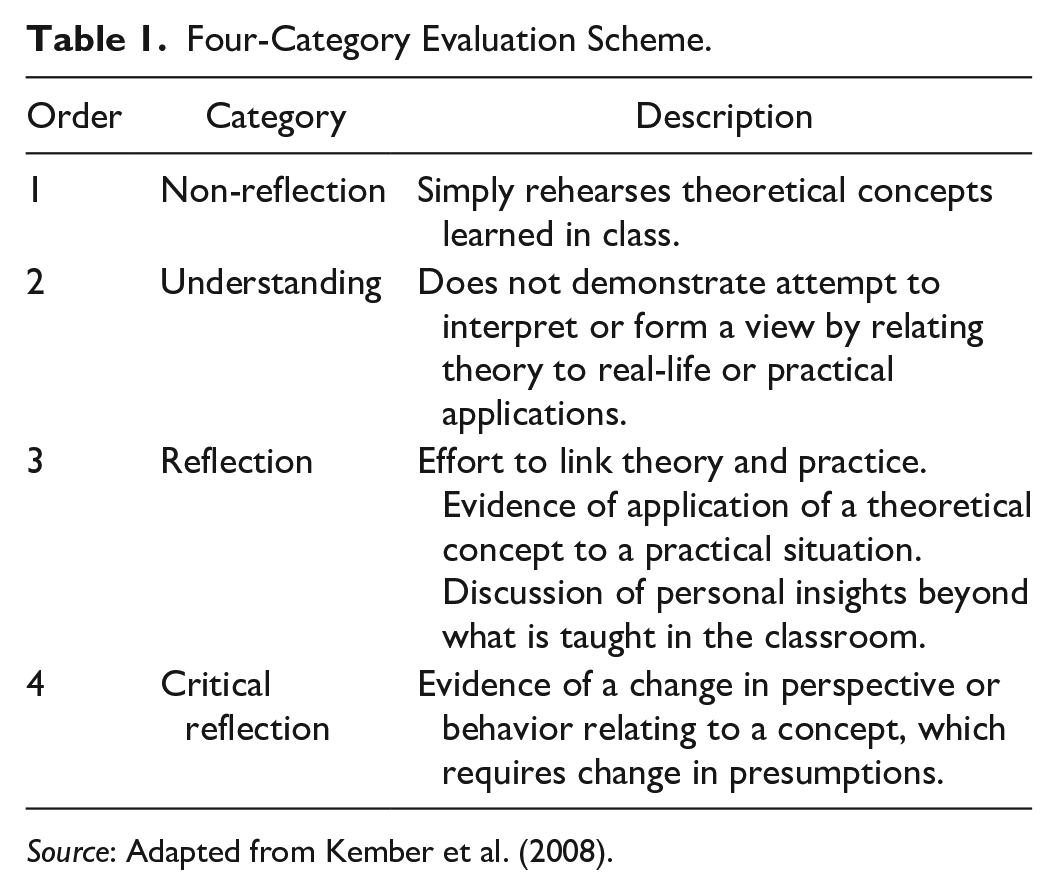
Source: Adapted from Kember et al. (2008).
TOD and Waipahu
The overarching TOD program for Oahu, the major commercial and population center of the state and home to the capital Honolulu, envisions special districts around each rail station along a fixed guideway system giving birth to neighborhood TOD plans that emphasize community participation. Between 2011 and 2014, the City and County of Honolulu Department of Planning and Permitting conducted surveys in seven neighborhoods, which have informed planning around the proposed transit centers (National Resource Center 2015). However, Honolulu’s twenty-mile rail transit project continues to fuel much debate. With a projected price tag close to $9 billion at the time of this writing, the beleaguered project has become embroiled in controversy, leaving the public divided about its touted benefits (Frosch and Overberg 2019).
According to the Honolulu Authority for Rapid Transportation (n.d.), project benefits include the reduction of an estimated 40,000 car trips and construction that is projected to boost the local economy by generating an average of 10,000 jobs per year. Yet, many are concerned about its escalating budget and new development anticipated along the route. A recent report prepared by an independent firm for the Federal Transit Administration indicates that the construction budget is short by $134 million (Honore 2018). Others believe that an at-grade system or bus rapid transit would have been a better alternative that could easily be extended to other parts of the island in the future (Levine and LaFrance 2011).
Students studied TOD in several courses as part of a collaborative research project, coordinated by the UHCDC to assist the State of Hawai‘i Office of Planning in exploring future urban development on state parcels adjacent to Pouhala Station at the intersection of Farrington Highway and Mokuoloa Street in Waipahu. As shown in Figure 2, Waipahu is located close to Pearl Harbor and the primary urban center, with relatively easy access to the airport. It has a long history as one of the largest sugar plantation towns on Oahu. Existing land uses within a half-mile radius of the proposed station include neighborhood retail, business, single- and multi-family residential, light industrial, and civic uses such as the library, civic center, and bus transfer station. Table 2 presents the sociodemographic profile of Waipahu CDP (census-designated place). It has a population of 38,216, of which 67.6 percent is Asian, 15.6 percent is Native Hawaiian or other Pacific Islander, 12.4 percent is two or more races, and only 3.7 percent is white alone. A sizable number (42.3%) is foreign-born and more than 53.7 percent speak a language other than English at home. The poverty level of 11.8 percent is higher than that in Honolulu County (7.7%) and Hawai‘i (8.8%) (U.S. Census Bureau 2016).
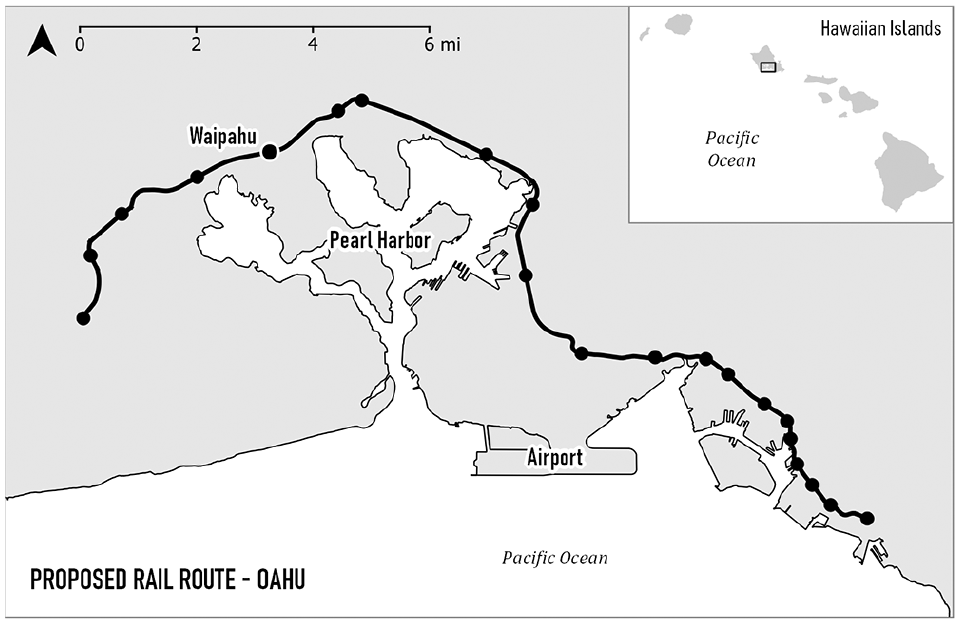
Rail route, Oahu, Hawai‘i.
Sociodemographic Characteristics, Waipahu CDP, Hawai‘i.
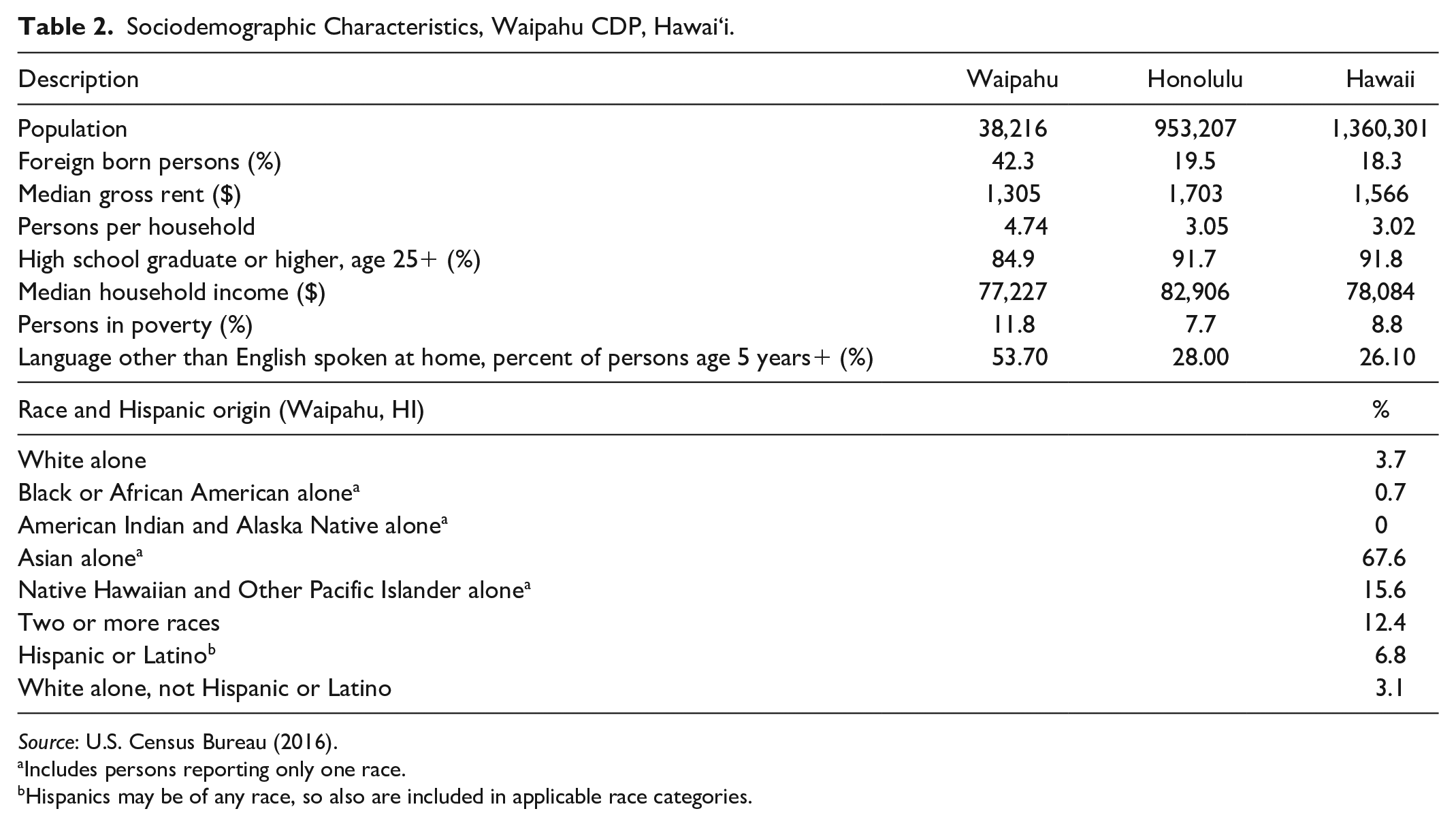
Source: U.S. Census Bureau (2016).
Includes persons reporting only one race.
Hispanics may be of any race, so also are included in applicable race categories.
The Waipahu Neighborhood TOD Plan seeks to foster a livable neighborhood, reducing the cost of transportation and housing by encouraging the effective use of land and enhancing mobility by promoting different modes of transit (City & County of Honolulu). Preliminary field visits revealed a deep divide between those who supported the rail project and those who opposed it.
The Participation Program
The planning practicum 6 is essential in the transition from student to practitioner as it provides practical training through service-learning (Kotval 2003) where knowledge, skills, and values can be assessed (Németh and Long 2012). In this practicum, the primary goal was to involve local groups and individuals in researching the potential of TOD in Waipahu and craft a set of preliminary recommendations that could help catalyze urban development around the proposed transit center. There were five thematic working groups: climate change adaptation, affordable housing, community economic development, transportation and land use, and placemaking. The deliverables, which included gathering and synthesizing relevant information about Waipahu, will eventually help the client develop a proof of concept and contribute to a professional report prepared for them by the UHCDC, DURP, and the Public Policy Center in the College of Social Sciences. 7
Initial discussion in class about public participation in developing TOD plans revealed students’ dissatisfaction with the workshops conducted by the City. These entailed formal presentations followed by group discussion or breakout sessions facilitated by a consultant. The topics ranged from land use and preferred station area plan to specific actions on the Waipahu Town Action Plan. They typically saw thirty to fifty participants and tended to attract an older demographic of residents and business owners. 8 Students pointed out that these meetings lacked diverse voices. They expressed concern about the inclusion of socioeconomically disadvantaged ethnic groups and decided to design and facilitate public participation featuring rail and TOD. The motivation for this endeavor was twofold. For the students, it was primarily to provide a safe space for talking about the rail project. For the faculty, it was to take the classroom into the community allowing students to understand participation without bracketing off its cultural and political entanglements. At this point, the faculty switched roles with the students placing them in the driver’s seat. Students led deliberations in class about appropriate participatory tools and mechanisms to encourage robust participation. They were expected to draw on planning theory and use the research skills they had acquired in the program. The UHCDC students prepared an interactive physical site model and outreach materials. Given the political tenor around this topic, students collectively decided to host a learn-and-share event at a local church—a “talk story” 9 —that would allow them to facilitate dialog among participants to elicit divergent views. The talk story accommodated “drop-in” style participation that was informal and interactive. In preparing the site, students included a supervised keiki (children) station with activities, local food, and seating arrangements where groups could talk story.
Pre-practicum self-assessments indicated that twelve of the fourteen students had completed the core courses that form the foundation of the urban and regional planning curriculum, in addition to methods and elective courses in their areas of interest. Eight had completed at least one required practice methods course, which can be on facilitation, negotiation, and mediation; four reported having facilitation skills. The majority of students, however, had little or no experience facilitating outside the classroom. We, therefore, provided a facilitator training module in class to review concepts, skills, and techniques. The instructors had extensive collective experience teaching studios and in professional practice that they brought to bear on this collaborative project.
Planning the Waipahu Talk Story
A SEED (Student Equity, Excellence, and Diversity) IDEAS grant and the UHCDC helped co-fund public participation. 10 Each thematic working group selected their method of gathering and integrating community inputs. As the rail project had been regularly featured in the local media, students decided that the event should provide a platform for raising critical questions and addressing nuance through conversations (talking story) about TOD and its impending impacts, however disquieting. 11 They were particularly interested in drawing out groups who may have been unaware or unable to voice their concerns in earlier workshops conducted by the City.
The tools devised for the talk story by the UHCDC focused on collective platforms that allow non-designers to communicate through writing, drawing, and building or arranging models and artifacts. In this case, the primary tool was a large, generative, 4′ × 8′ “co-design” site model composed of movable blocks representing existing and projected TOD development, a kit of variously sized wooden blocks, and a chalkboard-painted base for participants to sketch new territories and configurations. The model encompassed the six state-owned parcels in the TOD area and the surrounding context. It was accompanied by a 3D animation demonstrating proposed zoning and density within a half-mile radius of the Pouhala transit station. The co-design model’s facilitators invited participants to use the blocks and chalk to design and shape what they most wanted to see on the state-owned land (Figure 3). A second tool called “Keep it, Toss it, Create it” offered a large aerial map that participants marked with annotated Post-its, identifying spaces and conditions that they wanted to keep, remove, or add (Figure 4). The third tool was a visual questionnaire, asking participants to sketch their feedback directly onto an aerial image of the TOD site (Figure 5). The goal was to select participatory techniques that would capture the breadth and depth of citizen knowledge and inputs (Brody, Godschalk, and Burby 2003, 260).
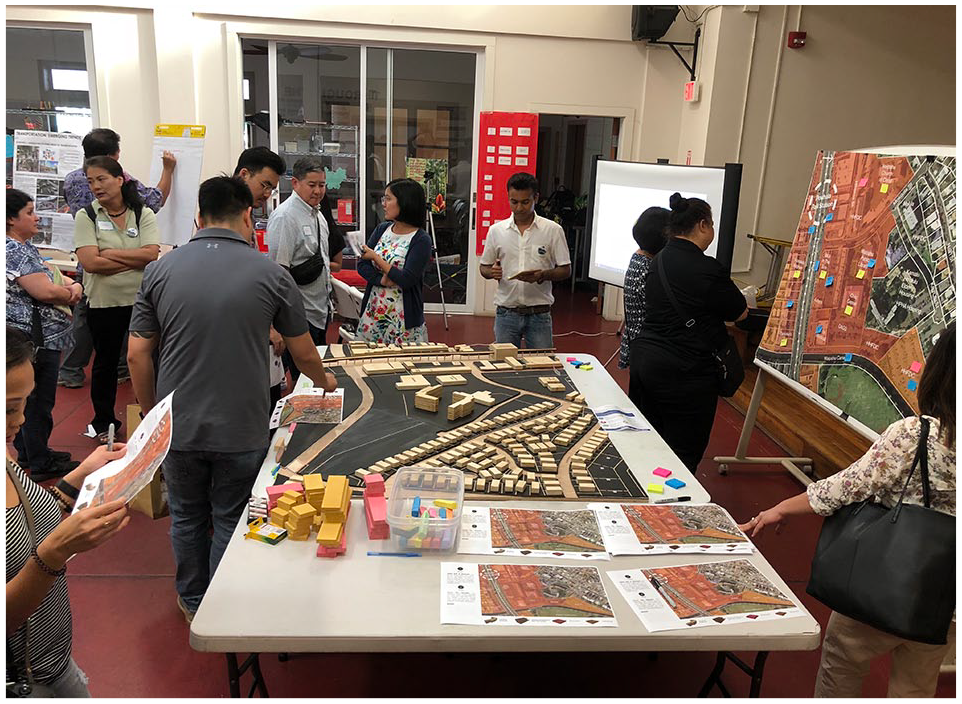
Co-design model.
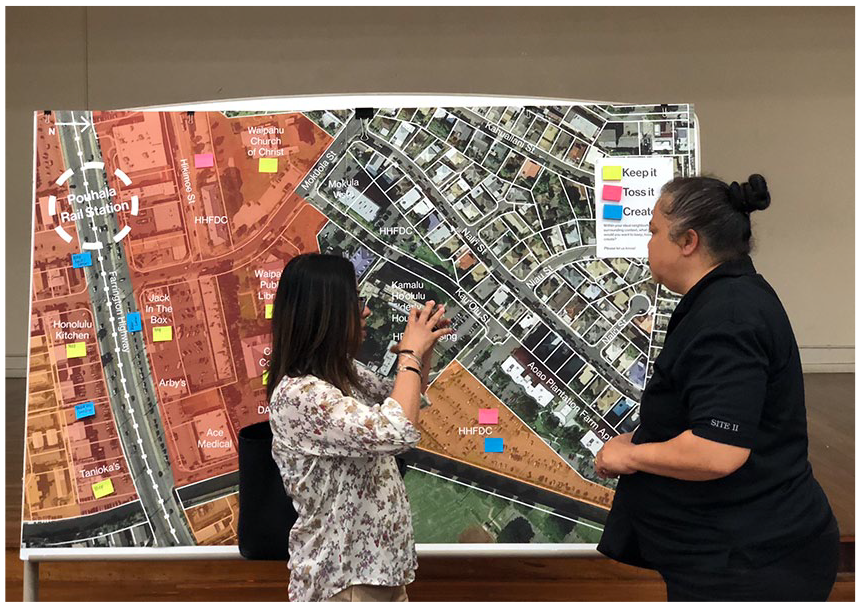
Keep it, toss it, create it.
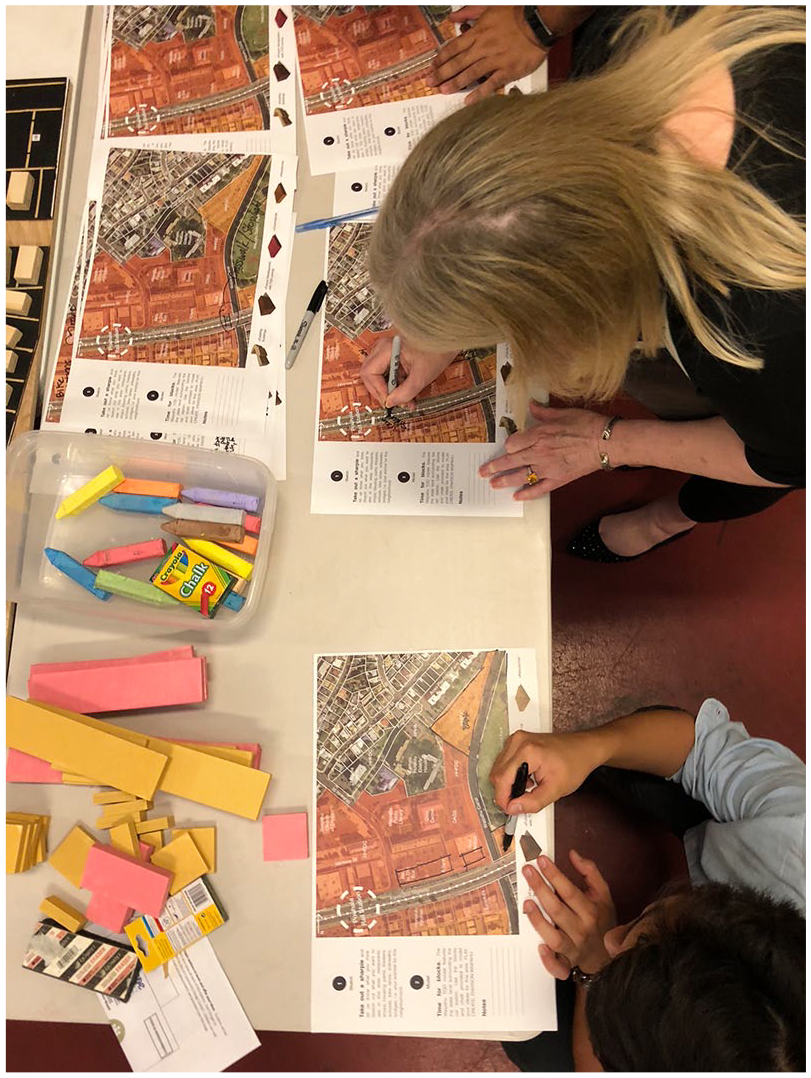
Visual questionnaire.
Each working group prepared two presentation boards and selected facilitation tools to engage participants. The class scripted advertisements for radio, newspaper, and social media in English, and Tagalog and Ilocano (languages spoken in the Philippines), and created leafleting strategies and an Eventbrite page for participants to register for the event. The UHCDC students designed postcards, flyers, and an 8′ × 3′ banner announcing the talk story. “Waipahu Talk Story” was advertised as a free, interactive event with free food, hosted by UH Manoa students, inviting those who live and work in Waipahu to “come, reimagine Waipahu.” It welcomed families and children.
As more than 50 percent of Waipahu residents speak a language other than English, we hired translators for Tagalog, Ilocano, and Chuukese (a language spoken in Chuuk, Federated States of Micronesia) from the Pacific Gateway Center (a non-profit organization that serves immigrants) and had student volunteers who speak Marshallese and Samoan. We also solicited assistance from the Department of Planning and Permitting, Office of Planning (client), the non-profit organization SHADE (Sustainable, Humanitarian, Architecture and Design for the Earth) Institute, and neighborhood-level community organizations such as the Waipahu Neighborhood Association and the Filipino Community Center, to spread the word. Figure 6 presents areas within a half-mile radius of the Pouhala Station targeted for outreach.
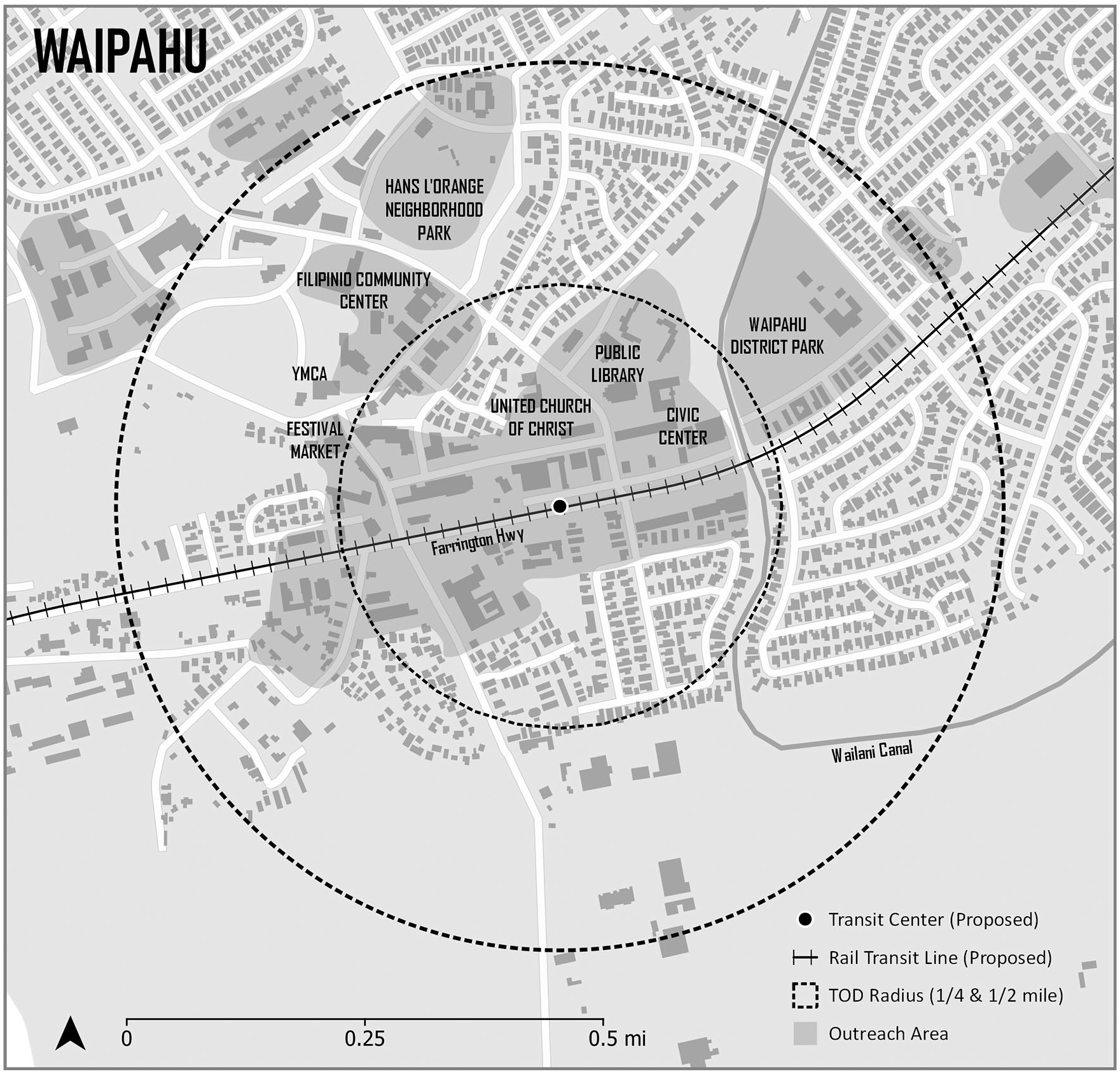
Waipahu town, Oahu, Hawai‘i.
In the remaining sections, we discuss efforts to meet the goals and objectives of public participation followed by reflection on the process and outcomes, before concluding with takeaways for planning pedagogy.
Participation, Its Potential, and Pitfalls
There were 52 participants at the talk story of whom about 29 percent identified themselves as Waipahu residents. The remaining participants were from government agencies working on TOD, community organizations, and area legislators. The event saw maximum attendance between 6.20 p.m. and 6.45 p.m. Participants typically appeared to be between thirty to forty years of age. A majority of the women participants arrived and left earlier than men. Few participants brought children to the event. Conspicuous among groups that were missing were the elderly and youth except for two students from Waipahu High School’s Academy of Engineering. 12
Three key themes from our data analysis shed light on students’ understanding of participation. First, students were typically satisfied with the outcomes of the talk story and considered it a success. Most students had anticipated a lower level of participation. For many, it exceeded expectations in terms of the number of participants and as an event. Students stated, “ . . . this [talk story] will make a deeper impactful experience as our role as community planners engaged with the community instead of planners planning for the community,” “ . . . our goal was not to speak at them [participants] but have them talk with us.” Some reported that the array of outreach materials contributed to a higher than expected turnout. Others stated that the talk story format and venue made participants comfortable and willing to engage, and students’ preparedness helped guide the flow of conversations.
The majority of students were, however, concerned about being unable to adequately engage socioeconomically disadvantaged ethnic groups despite their efforts. Some were flummoxed by this while others ruminated on their absence, searching for reasons. As one student remarked, From my experience, most of the people who came up and engaged in discussion seemed to be pretty knowledgeable about transit-oriented developments and future developments in Waipahu. I had a feeling that the less knowledgeable residents were too intimidated to come and talk to us.
Another stated, “. . . it was rather unfortunate to note that not many Pacific Islander community members, particularly Micronesians, did not show up . . . ” Others mentioned shortcomings such as the dearth of information about the event on postcards and flyers, the title not capturing the intent adequately, and the lack of time to translate outreach materials into other languages. Some students offered suggestions for enhancing participation such as requesting residents to invite friends and family to foster a relationship, selecting a non-religious site to host the event to attract a wider range of participants, and more appropriate targeting potentially through church groups and community organizations to emphasize the value of community inputs. Others criticized the postcards, the decision to limit outreach to a half-mile radius from the transit center, and our inability to seek assistance from specific community leaders in reaching the targeted audience.
Second, students brought up challenges in preparing and facilitating the talk story. Our field notes supported students’ observations, which showed how, despite the range of outreach tools, there was little time for face-to-face interaction with community members. Similarly, our interviews highlighted the challenge of building long-term community relations that may not be feasible for academic calendars. Aside from postcard distribution and a few targeted personal invitations, in-person outreach was limited, particularly to minority-serving organizations, including faith-based ones and small minority-owned businesses. This was primarily due to time constraints (students had other academic and work commitments) and the inability to use time during the spring recess, which left about a week before the event. Some students also reported feeling awkward facing people who were “skeptical, uninterested, or even offended” when asked to participate. Door-to-door distribution of postcards revealed the public’s sentiments about the rail project with comments like “ . . . I’d like to blow up the rail . . . ” or “ . . . we should have thought of this [rail] 20 years ago . . . ” The co-design model proved to be an effective visual focal point, orientation tool, and conversation piece that attracted participants who tended to admire it, but from afar. They rarely engaged with it. The highly interactive “Keep it, Toss it, Create it” tool galvanized more participants to provide feedback. The visual questionnaires were informative but proved far less appealing to participants.
Students also mentioned their apprehension about navigating hostile views expressed by participants and feeling unprepared to face the public, especially “disruptive participants.” Although a class session devoted to preparing for the public presentation had, to some extent, allayed students’ anxieties about the uncertainty surrounding the event, some students reported needing more time to prepare for the “worst-case scenario.” For instance, one student stated, . . . going into the Waipahu talk story I was unsure if our project, and especially my group (climate change), would be welcomed. Along with being concerned about if our class project would be accepted, I was unsure if the event was going to be well attended by individuals who generally care about the community of Waipahu. Basically, heading to the United Church of Christ on Thursday, I was preparing to use several conflict resolution tactics that were used to dissolve hostile situations.
Students reported having to “answer difficult questions that forced them to think beyond the scope of the project.”
Third, the majority of students reported receiving substantive feedback from participants. Some were even surprised that the participants were so knowledgeable about TOD. Others reported that their interaction was healthy and they received thoughtful suggestions from participants who were enthusiastic about sharing their views. Still others hoped that the learning was two-way. As one student stated, “Hopefully we helped the residents that attended feel a little more empowered to take control of their future.” Students also framed their presentations to build community support as illustrated by this statement, Our pictures and descriptions of Shared Streets received a lot of positive feedback. People would shout—“Yes! I want to see that here in Waipahu!” To my surprise, no one criticized or questions the notion of the car-free zone, but I was more focused on more modest measures and on the Shared Street typology.
Interviews with practitioners indicated that they too thought the talk story was successful and presented relevant topics. However, they reported that mechanisms for participation adopted tended to play it safe by not presenting schemes or scenarios for change in the neighborhood. As one interviewee stated, . . . planners . . . often even the professional planners today are very scared of contentious public engagement and . . . let’s be honest . . . sometimes these community meetings can turn really ugly . . . and . . . so I can sympathize with planners who are trying to say . . . let’s not have real open forums . . . let’s just put dots on things and say what you like or what you don’t like . . .
In the pre- and post-practicum self-assessments, students reported that the practicum met their expectations of being able to apply their skills, facilitate, and engage stakeholders. For some students, it even exceeded expectations, allowing them to learn to build networks and relations with the larger community. In the post-practicum self-assessment, eight of the fourteen students reported applying knowledge and skills learned in other planning courses to a “great extent” whereas the remaining students reported applying them. Typically, students referred to courses that they were able to draw upon while conducting their research. Several students mentioned using their skills (e.g., mapping, graphics, analytical, and writing) to prepare for the event. This is consistent with literature supporting such courses (Forsyth, Lu, and McGirr 2000; Kotval 2003; Botchwey and Umemoto 2020). It is interesting to note that the majority of 57 percent specifically mentioned the talk story. They reported being able to communicate with the public, network with practitioners, and build mental fortitude.
Reflection-on-Action to Reflection-in-Action
Our data analysis indicates that hosting the talk story influenced students’ awareness about the salience of participation and public engagement. The extent and depth of their reflection, however, varied. Using the framework described in Table 1 to code students’ reflections, we found that the majority of the fourteen students fell in the categories of critical reflection and reflection (three and five students, respectively), and understanding (five students) with only one student in the non-reflection category. Their reflection ranged from description and recording of experiences (low) to questions about the fundamental nature of planning (high). Our analysis indicated students’ desire to engage with multiple publics and their disappointment at being unable to do so despite concerted outreach given the challenges discussed in the literature (Albrechts 2002; Allen and Slotterback 2017; Innes and Booher 2004; Lee 2019; O’Faircheallaigh 2010).
Focus groups suggested how mechanisms to encourage engagement could be improved such as better note-taking strategies, hosting in a larger space with more room for circulation, and partnering with City and State agencies to offer incentives for participation such as discounted monthly bus passes. Not all agreed about the mechanisms. For instance, one student criticized outreach materials for not stating that the talk story was about TOD, saying, “I think that our approach to ‘trick’ people into coming to the event was wrong and created problems for both the marketing and execution of the event.” Students also attempted to unearth how participation could be made more robust. For instance, one student stated, “Perhaps more targeted outreach to churches and religious communities in Waipahu would have helped bring in the Pacific Islander communities (thinking specifically of Chuukese and Samoan).” Others reported speaking with community members to delve deeper into community relations as illustrated by this statement: I got some answers to these questions by the residents who attended our speak-out. One resident in particular explained to me how the Filipino community is structured. She explained there is a hierarchy in the community and the home. In the community, there are three people who are at the “top” in the sense that they can speak for the community because the community trusts them. Then, there are heads of different smaller factions, and hierarchies among different smaller clans. Each of these are very complicated and there is a method for which these networks exist in the community.
These indicate that students were able to go beyond hosting the talk story to grapple with questions about who they were engaging and how (Lowry, Adler, and Milner 1997) and whether their modalities of participation were pushing the boundary of ethical considerations. In seeking to improve engagement practices for groups that may not be inclined to participate, they learned that such groups were selective in how and where they engage; building community trust, and using alternative space for engagement beyond their neighborhood with assistance from organizations that support them, is therefore essential (Lee 2019, 273). In this case, the lack of participation by Micronesians, for instance, could be related to the discrimination they face in Hawai‘i, our inability to connect with their community leaders or organizations that support them such as We Are Oceania, or to the fact that TOD may not be a priority given their more immediate needs such as shelter and services (see, for instance, Hawaii Advisory Committee 2019; Rita et al. forthcoming). Moreover, despite the intention of hosting a “talk story” to facilitate honest, reflective conversations, the activities tended to be instruction-laden, which could have deterred outcomes. Students wrestled with the need to create awareness about the realm of possibility by sharing their ideas about TOD and how best to communicate them in an informal talk story.
Reflection on the talk story by the UHCDC students prompted other noteworthy revelations. For instance, they commented on the adjustments they needed to make in their communication with participants. Their self-reflection showed how each making tool,
13
which required different levels of instruction, participation, and attention, experienced different challenges and levels of success. The co-design exercise seemed to require too much instruction and commitment from participants and remained largely unexplored. Focus groups stated that “more communication between the architecture and planning students could have improved the model” and “presenting examples of proposed changes such as density or renderings of ‘Waipahu 2030’ would have helped communicate” neighborhood change. Overall, the tools appeared to circumscribe the UHCDC students’ efforts, and their reticence in engaging participants relative to their peers became evident at the event. Our interviews with practitioners also pointed to the inability of the model to engage the participants. One interviewee despaired that presenting existing conditions in the neighborhood without future scenarios made it less compelling, and stated, One of the things I notice in my profession and also in the talk story in Waipahu is that many times we go to the community and we ask them . . . what do you want . . . and the community is not always prepared to answer what do I want . . . you know . . . it’s only through conversations where you give suggestions or give ideas . . . or how about this . . . then people can kind of reflect.
A month after the talk story, the UHCDC hosted a classroom workshop at Waipahu High School, where the students were able to practice and refine their engagement tools in a different setting. 14 Both these events allowed the UHCDC students to reflect on the merits of each engagement tool relative to the venue, format of the event, and participants. “The best way to learn how to apply the making tools and techniques is by doing, i.e. by making, in as many different situations as possible” (Brandt, Binder, and Sanders 2013, 155). They reflected on questions that surround all making tools: How do you anticipate the amount of time or attention a participant will be willing to commit? How do you effectively communicate instructions? What kind of space and conditions are required for each tool? In what order should participants engage the tools? How do you meaningfully synthesize and document the findings so the engagement has impact? Such reflection sharpened students’ focus on critical practice in architecture.
Learning to Democratize Planning and Design through Participation
We analyzed how a cohort of graduate students conceptualized and delivered a participatory event featuring the rail and proposed TOD in a racially and ethnically diverse neighborhood on Oahu. We were interested in examining their understanding of participation and reflective practice. Our findings underscore the merits of transporting the classroom into the community to experience participation. We found that embedding such an experience in a student’s pre-professional academic trajectory deepens understanding of the potential and pitfalls of democratizing planning and design, particularly as it relates to questions of urban inequality.
Before the talk story, students were skeptical about the City’s efforts to engage socioeconomically disadvantaged ethnic groups in community meetings for neighborhood TOD plans, emphasizing the need to expand outreach to achieve higher levels of participation. Their reflections, after the talk story, revealed a nuanced understanding of participation including challenges in attaining robust participation and, particularly, from those whose voices may have been missing or drowned out in previous participation programs. There was awareness about the knowledge and skills required for participation, self-interrogation, and scrutiny of institutionalized practices. Despite a growing interest in service-learning in planning curricula, the implications of service-learning for graduate planning education remains relatively unexplored (Levkoe, Friendly, and Daniere 2020). Our findings contribute to this understanding, reinforcing what others have hailed about the deep impact of reflexive education on planning practice (e.g., Sletto 2010; Steil and Mehta 2020). Our study is bounded by the natural limitations of data gathered from a small sample of students enrolled in a graduate planning practicum course. Also, although beyond the scope of this study, we are cognizant that students’ experiences of engagement with the myriad intersecting issues in Waipahu may also have been shaped by their individual lived experiences. Our research hints that teasing out variations in understanding by students’ personal positions, backgrounds, and politics could be instructive—something that needs to be explored further. Nonetheless, our findings offer useful insights, for students and educators alike, into why and how critical pedagogy ought to underpin urban planning and design education. The remaining paragraphs distill this study’s takeaways.
For students, first, such an experience familiarizes them with contextual particularities as they attempt to link theoretical concepts and rigorous research and analysis to real settings and immediate problems. Moving from learning about participatory planning to doing participatory planning exposes them to questions about participation as citizen power and foundational planning ethics. It also prepares them to deal with external pressures that may require them to act against, or recalibrate, their values at times to mirror reality. Second, preparing a participatory event and its ensuing outcomes facilitate a range of reflection. Each type of reflection, no matter how insignificant, provides scaffolding for experiential learning. It allows students to reflect on their understanding of difference, heightening their self-awareness. This may not always be possible in a classroom setting. Encountering and negotiating the challenges in executing such an event on their own instead of being instructed by the faculty nudges them towards reflexive practice. Moreover, building confidence in facilitating participation could inspire future practitioners with a greater sense of purpose, preparing them to transition from reflection-on-action to reflection-in-action in situations of uncertainty and complexity. Requiring students to attend a community meeting facilitated by a professional organization could be useful in this regard. In some cases, it may even minimize the risk of dampening the young planner’s motivation to become a guardian of the public interest, whether by tempering their expectation, injecting a dose of activism, or equipping them to develop their ways of confronting ethical challenges before they transition from student to practitioner.
For educators, first, integrating structured reflection impresses upon students the importance of reflective practice by tying it to what they have learned in other courses in the curriculum. It could help them understand course sequencing and the relevance of linking theory and praxis. Second, for graduate planning programs that do not require an internship, a practicum or studio with public engagement may better integrate the academic curriculum with professional practice by allowing students to develop networks and leadership skills. It is important to note, however, that programs with a culture of encouraging service-learning in courses other than the practicum may be better suited for this as students will be able to build on their previous experiences. For those that do not, an engagement tool that measures readiness for public engagement in research could be useful as others have suggested (see, for instance, Padt, Bose, and Luloff 2020). Including discussion about the complexity of professional planning, and the meaning and importance of ethics to stimulate critical thinking and develop personal codes before public engagement could also help prepare students (Levkoe, Friendly, and Daniere 2020). Such courses also benefit from having instructors who engage in practice-oriented scholarship. Third, this endeavor highlights the need to be nimble and willing to risk negative evaluations if the course objectives remain unaccomplished. Instructors have to be able to change and adapt the course without losing sight of the overall objective. They also have to be willing to accommodate a different student–teacher relationship than what they may be accustomed to.
Collaboration between DURP and the UHCDC sparked discussion about the design and refinement of engagement tools and pointed to this gap in the architecture curriculum. Effective communication is critical for architectural practice. Engagement tools are often used but rarely taught in professional practice or studio coursework. Pooling resources, knowledge, and skills to administer the participatory event let us test the efficacy of engagement tools and learn how to adapt them for different audiences. A lesson that emerged is the need for such tools to be flexible and responsive to context and sociodemographic characteristics. Having an assortment of tools could help reach a broader, diverse audience. It also underscored the importance of budgeting adequate time and effort to cultivate relationships with those whose participation and trust is sought. Collaboration in the development of engagement strategies accentuated differences in the disciplinary approaches of these professional fields—planning as social science with its emphasis on process and collective action and architecture with its penchant for design. At the same time, it facilitated reciprocal learning and reflection and pointed to avenues for curricular development for both programs. For instance, the graduate professional practice course in the School of Architecture will integrate engagement tools.
The incongruity of planning education and practice has been the subject of much debate. Planning can be messy. The knowledge, skills, and values required for maneuvering deftly through the messiness are often difficult to codify in curricula. Nonetheless, it is worthwhile to integrate the experience of practice with planning education. Public engagement has changed from the twentieth-century “notice, hearing, review and comment” to the more dialogic “workshop and charrette” or even online and pop up engagement that is gaining currency. Future practitioners need to be prepared for the messier versions of participation that may not be about achieving a set of well-defined ends by deploying a meticulously planned participation program but, rather, a process that comes with political and economic pressures that may or may not align well with individual comportment. Encouraging young planners to think critically about how the planning process can engage civil society actors - in mutually reinforcing ways - could begin to address Arnstein’s question: What is citizen participation and what is its relationship to the social imperatives of our time?
Footnotes
Acknowledgements
We are grateful to Jennifer Darrah-Okike, Ashok Das, Luciano Minerbi, Karen Umemoto, the JPER editors, and four anonymous reviewers for their constructive comments. We would also like to thank all those who participated in the practicum and inspired us to write about it.
Declaration of Conflicting Interests
The author(s) declared no potential conflicts of interest with respect to the research, authorship, and/or publication of this article.
Funding
The author(s) received no financial support for the research, authorship, and/or publication of this article.
