




Abstract
We examine conformance and performance dimensions of demolition recommendations in seven “Neighborhood Action Plans” (NAPs) issued between 2015 and 2017 in the shrinking city of Youngstown, Ohio. We use geographic information systems (GIS) to compare plan-suggested and actual demolitions. We examine whether overall statistics are similar and who was responsible for demolition. We conduct interviews with informants to understand causality. We find that NAPs are better implemented from performance than from conformance perspectives, but that nongovernmental organization (Land Bank) demolitions conformed more closely than local government. Interviewees provided several causes: procedural differences, overlapping responsibilities, influence of political decision makers on plan implementation, and shifting NAP goals.
Introduction
Neighborhood planning is a widely accepted and popular model of projecting future allocations of public, nonprofit, and private resources at the sub-municipal scale in American cities (Rohe 2009; Silver 1985). The comparatively limited geographic scope and audience of city neighborhoods permit planning processes to be more fully accountable to the democratic interests and demands of neighborhood residents (Chaskin 2005). In addition, the small spatial compass of most city neighborhoods permits neighborhood planning goals to be more specific and realizable, in comparison with the often vague, long-term, and challenging goals of larger scale comprehensive plans (Keating and Krumholz 2000; Silver 1985). In the United States, where local governance and land use planning are typically decentralized to the municipal level, neighborhood planning permits an even greater scale of resolution for the creation of planning goals. The results of such planning processes are sometimes published in the form of printed or online neighborhood plans.
Neighborhood planning is particularly important for low-income, disempowered, and marginalized residents and communities. In the United States, such neighborhoods typically suffer from deficiencies in housing quality, education, transportation, and access to economic benefits. Neighborhood plans therefore permit such communities to project, announce, and ideally realize spatial, social, and economic goals that address these challenges in a manner that is geared to and often authored by residents themselves (Sirianni 2007). Neighborhood plans also permit low-income neighborhoods to qualify for or place a stronger claim upon often scarce municipal resources, thereby gaining the ear of city officials who might otherwise ignore or deemphasize expenditure of resources in such neighborhoods (Thomas 2004). Given the comparative lack of public resources available for low-income neighborhoods, such plans and planning are often carried out by nonprofit actors and agencies rather than public actors.
Shrinking cities, characterized by overall population loss, economic decline, and social and political challenges, are difficult environments for neighborhood planning. City resources are constrained, political and institutional capacity often lacking, and the neighborhood-level effects of larger scale problems—property abandonment, safety hazards, and poor-quality public services—are exacerbated (Hollander et al. 2009; Joseph Schilling and Logan 2008). Yet the existence of these same problems makes the need for neighborhood plans more pressing. Several shrinking cities have undertaken neighborhood planning processes; for example, neighborhood plans have been published in the cities of Cleveland, Youngstown, and Flint (City of Flint 2019; Rhodes 2019; Ryberg-Webster 2016).
One of the most pressing problems at the neighborhood scale in shrinking cities is housing abandonment, as such properties are often the locus for crime and have been demonstrated to negatively affect quality of life and property value (Wachter 2005). Neighboring properties that directly adjoin abandoned houses are particularly negatively affected. Demolition is thus a major focus of neighborhood plans in shrinking cities, an issue that is meaningful to neighborhood residents, and an issue whose precise implementation—the demolition of abandoned homes that have motivated complaints and that adjoin inhabited houses—is of particular importance.
Our study sought to determine whether or not shrinking-city neighborhood plans that recommended demolition were able to achieve demolition that conformed (both in quantity and spatially) with these neighborhood plans. We also sought to determine whether or not such demolition targets matched projected demolition targets in quantity only, even if not conforming spatially to plan recommendations. In other words, we were interested in the spatial consistency of achieved demolitions with published plans (conformance) as well as the ratio between achieved demolitions and a plan’s or plans’ suggested number of demolitions (performance). We were additionally interested in the causality or lack thereof of such plan conformance and performance. Studies of plan conformance and performance have been undertaken for a wide variety of other plans (Brody and Highfield 2005; Laurian et al. 2004), but such studies at the scale of neighborhood planning, and in particular in shrinking cities, are much less common. Given the importance and widespread nature of demolition as a policy in shrinking cities, we felt that our study was important in clarifying how and why neighborhood plans achieve their demolition goals, and in providing knowledge that could inform the nonprofit and public makers of such neighborhood plans.
We selected Youngstown, Ohio, for our study of neighborhood planning and demolition. Youngstown is a paradigmatic shrinking city, having lost almost 60 percent of its population in the last fifty years, from 166,689 (1960) to 66,982 (2010). Youngstown is also a city with substantial experience in “planning for shrinkage” (Hollander et al. 2009; Wiechmann and Pallagst 2012), and the city has substantial nonprofit capacity in planning as well. Since late 2014, Youngstown city government, together with quasi-governmental entities including the Youngstown Neighborhood Development Corporation (YNDC) and local nongovernmental organization, the Mahoning County Land Bank (MCLB), has released a series of Neighborhood Action Plans (NAPs). These NAPs give clear and thorough demolition recommendations, down to the parcel level, to the MCLB and the Youngstown city government, both of which carry out demolitions (YNDC, 2018). We examined the conformance and performance of the NAP’s demolition recommendations with achieved demolitions. By collecting and comparing a sample of published NAPs with demolition data, this study evaluated a significant policy element of NAP implementation. To clarify the causality of conformance and/or performance in NAPs, we interviewed several local informants involved in NAP formulation and implementation.
Ultimately, we discovered variable conformance and performance in NAP implementation, and in particular, disparities between local government and land bank demolition achievement. We conclude that demolition in conformance with neighborhood planning is achievable, but that both structural and stochastic causes inhibited local government from fully conforming to plan demolition goals. The land bank is charged with demolishing a certain subset of neighborhood properties and finds it easier than local government to achieve conformance with demolition-based neighborhood planning goals. And while the spatial precision of demolition may not always conform to neighborhood plan goals, we found overall numbers of demolished buildings to exceed neighborhood plan goals, indicating that demolition remains a priority even if conformance with plan goals is not always perceived to be necessary or possible.
Planning for Demolition
Planning for Shrinkage: An Ideal with Obstacles, and a Troubled History
Although many cities in the United States began to lose population overall beginning in the 1950s, the idea of planning for shrinkage did not emerge until the first decade of the 21st century. Specific planning to confront consequences of shrinkage like population loss and surplus building stock has been inhibited by a number of factors, including a growth-oriented paradigm deeply embedded in local authorities’ political agenda (Logan and Molotch 1987); popular perceptions of shrinking cities not as a long-term phenomenon but as a short-term break from growth (Beauregard 1993); a national dislike of congestion and high-density development (Conn 2014); and a focus on related problems instead of the issue of shrinkage itself (Mallach 2017). The U.S. growth-oriented paradigm has sometimes resulted in continued development even in the face of decline, a phenomenon criticized by Glaeser (2011), who said “overbuilding a declining city [with] more structures than it needs is nothing but folly.”
A conceptual reframing of urban planning to accommodate the reality of shrinking cities has been proposed by scholars under various terms like smart shrinkage, smart decline, and right-sizing (Hollander et al. 2009; Popper and Popper 2002; Joseph Schilling and Logan 2008). Advocates of “smart shrinkage” recommend downsizing shrinking cities’ built environment, for example, demolishing abandoned properties and reregulating vacant land, to match shrinking demand for living and working spaces. Smart shrinkage has begun to gain recognition in planning practice, and a series of shrinking cities have released smart-shrinkage-related plans (Hackworth 2015; Hummel 2015).
Smart-shrinkage planning faces many obstacles. A lack of market incentives to implement smart shrinkage creates a collective action problem where every property owner realizes the benefits of smart-shrinkage ideas like reregulation, but no one is willing to sacrifice his or her own property for the greater public good (Bernt 2009). Market failure incentivizes local governments to engage in smart shrinkage, but legal problems like eminent domain hinder local government’s ability and willingness to act, creating a deadlock that neither market nor government can solve (Hackworth 2015). As a result, ambitious comprehensive plans recommending smart shrinkage face implementation obstacles and have remained largely unrealized (Ryan and Gao 2019). Other scholars have found that the effort to plan for smart shrinkage pits a minority of private property owners, who resist smart shrinkage, against the larger public, who desires it (Beckman 2010).
Another method of downsizing in shrinking cities removes infrastructure and public services from highly abandoned neighborhoods, with the tacit assumption that such removal will incentivize remaining inhabitants to voluntarily leave the area. The first appearance of the idea of infrastructure downsizing was in the fiscal austerity era of the 1970s. As cities like New York, Philadelphia, and St. Louis faced deindustrialization and catastrophic losses in population, local government applied methods labeled by some as “urban triage” to rank neighborhoods based on their perceived viability. “Triage” would have recalled public resources from deeply troubled neighborhoods in favor of less troubled ones, thereby both conserving scarce resources, and preventing such neighborhoods balanced on a “tipping point” from becoming more troubled themselves (Cooper-McCann 2016, Kleniewski 1986; Schmidt 2011; Starr 1976). The triage concept incurred extensive criticism from local residents and organizations, and arguably caused public safety and hygiene issues as well (Kirkpatrick 2015; Wallace and Wallace 2011). In more recent times, while “urban triage” and “tipping points” have been mooted again as heuristics for planning shrinking cities, the troubled history of these terms has not faded fully from public consciousness.
Confronting Vacant and Abandoned Properties in Shrinking Cities
Despite the barriers to smart shrinkage, and despite the concept’s troubled history, the impetus for confronting the consequences of population loss remains for shrinking cities. Scholars have found and residents affirm that vacant and abandoned properties are the most pressing issues to address when planning for shrinking cities (Frazier and Bagchi-Sen 2015; Hollander et al. 2009; Joseph Schilling and Logan 2008). In a growing city, one might justifiably expect market demand to lead to reoccupation of abandoned structures, but the weak market of shrinking cities has generated a very large number of vacant and abandoned properties, making this inventory hard to refill. In addition, vacancy begets additional vacancy: shrinking cities’ high number of vacant and abandoned properties is both an effect of a weak market and a cause of additional abandonment. In other words, the higher the proportion of properties that are vacant, the more property owners are prone to abandon their own properties. Thus, vacant properties in shrinking cities tend to remain vacant until they are either demolished or literally collapse from lack of intervention (Mallach 2010).
The deleterious effect of vacant properties on the value and ultimately on the occupancy and condition of adjoining properties has been clearly demonstrated. The canonical “Broken Window” theory argues that any signs of neglect in a vacant property may spur further vandalism and deterioration (Wilson and Kelling 1982). Vacant properties can contribute to higher rates of drug use, violent crime, arson, and/or pollution in adjoining areas, thereby contributing to depreciation of these neighboring properties’ value (Bass et al. 2005; Cui and Walsh 2015; Immergluck and Smith 2006; Nassauer and Raskin 2014; Whitaker and Fitzpatrick 2013). As previously noted, vacant and abandoned properties are not an effect of depopulation, but a potential cause. Without intervention, each abandoned or vacant property can be perceived as a magnet for crime and nuisance, even if surrounding areas are well-protected (Kelling and Coles 1997; Spelman 1993).
Confronting vacant and abandoned properties has also been demonstrated to have many benefits. A variety of approaches, including the boarding up of broken doors and windows, rapid resale of the property, maintenance and mowing of the vacant lots, and demolition of the vacant structure and replanting of property can all reduce nuisances caused by abandoned structures, and help nearby properties appreciate in value. Such remedial actions have been shown to stabilize highly vacant neighborhoods to some extent (Heckert and Mennis 2012; Mallach 2010; Pagano and Bowman 2000; Wachter 2005).
Although, as previously mentioned, local government is often confronted with the burden of dealing with vacant, abandoned properties, these authorities must be selective in taking action. Strategies like demolition and greening can be very costly (Mallach 2012b). Because shrinking cities usually have tight budgets, only a small percentage of vacant, abandoned properties can be treated in any fiscal year. Thus, even if a municipality wishes to demolish all of its vacant houses, a substantial portion of vacant properties will persist year after year until they collapse or are finally demolished. In addition, legislative obstacles often limit a local government’s ability and willingness to address vacant and abandoned properties that are intestate or otherwise having unclear legal status (Samsa 2008).
Land Banks: An Emerging Actor in Confronting Widespread Abandonment
Under ordinary circumstances, the number of vacant and abandoned properties in a city is comparatively small. Local governments have conventionally confronted this issue through either code enforcement, where a property can be demolished for failure to bring it up to legal building standards, or condemnation for nonpayment of taxes, where a property can be foreclosed upon for being in arrears of local property taxes. Properties that have been condemned or foreclosed are typically placed up for auction or for sale to be returned to the market (Accordino and Johnson 2000). Under ordinary circumstances, demolition, whether a property has been condemned or not, only occurs if a structure is too dilapidated to make code compliance or rehabilitation possible. However, in shrinking cities with a very high number of vacant and abandoned properties, properties may deteriorate for some time before either being demolished outright for code noncompliance or coming into public ownership for tax noncompliance and possibly then being demolished. Thus, demolition becomes a more common and practicable option for vacant, abandoned, and deteriorated structures with very low value that face little prospect of returning to the housing market.
Typically, American local governments have administered both code enforcement and foreclosed property sales. In recent decades, however, new quasi-governmental and nonprofit entities called land banks have emerged in several shrinking cities. One of a land bank’s responsibilities is to provide additional capacity in confronting the problem of vacant and abandoned properties. A land bank’s function entails clearing the title of vacant or abandoned properties, temporarily maintaining them, and repurposing them (Alexander 2005, 2011; Heins and Abdelazim 2014; Tappendorf and Denzin 2010). A land bank may place an acquired property on the market for sale; if there is a structure on the property, the land bank may either retain and rehabilitate that property or demolish it. A land bank may also choose to retain its property inventory until a later time when it sees fit to dispose of that property. In most land banks, unsold foreclosed properties take up the largest amount of their inventory, while other land banks, for example, the Genesee County Land Bank in Michigan, take a more aggressive approach by absorbing all foreclosed properties into their inventory.
Scholars have observed the emergence of land banks and conducted several studies on their role and effectiveness. Dewar (2006, 2015) and Hackworth (2014) have compared shrinking cities with and without land banks, concluding that shrinking cities with land banks may outperform those without land banks in a variety of ways: lower foreclosure rates, higher new development rates, better housing conditions, higher occupancy rates, and so on. Some econometric studies (Griswold and Norris 2007; Whitaker and Fitzpatrick 2016) have indicated that land banks are making a positive impact on their properties’ surrounding home values. Other studies (e.g., Hackworth 2014) have found that weak links between land bank actions and planning processes endanger the broader goal of comprehensively confronting the problem of vacant and abandoned properties in shrinking cities.
Recent planning scholarship on land banks has clarified the importance of these institutions in facilitating the property acquisition, disposition, and in some cases, demolition process in shrinking cities, providing a comparative perspective on different shrinking cities’ utility of these institutions (Dewar 2015; Hackworth 2014). However, few studies have examined land bank performance at the scale of the neighborhood plan, nor have these studies directly compared the performance of land banks and local governments with respect to demolition. It is these lacunae in the literature that this study hopes to fill.
Method
Youngstown, Ohio, and Its NAPs
Youngstown, Ohio, is as previously noted a paradigmatic shrinking, or “legacy” city (Mallach 2012a). Beginning in the 1970s, the city began to suffer economically with the closure of several of its manufacturing facilities. Job loss was followed by population loss and further economic decline; today Youngstown is a much smaller, poorer city than it was at its peak (Linkon and Russo 2002; Safford 2009). Job losses continue; in early 2019, General Motors mothballed its Lordstown plant, a few miles outside of Youngstown, cutting 1,500 jobs (Guilford, 2018). By the early 21st century, confronted by thousands of abandoned houses and vacant lots, Youngstown city government elected to plan for shrinkage instead of denying it. The 2005 comprehensive plan Youngstown 2010 applied smart-shrinkage principles to Youngstown, proposing land use changes that would convert abandoned residential, manufacturing, and commercial land into open space or into lower density land use categories (City of Youngstown, 2005; Schatz 2013; Joseph Schilling and Logan 2008). Implementation of the plan has been questionable; Rhodes and Russo (2013) found no clear implementation to have occurred, while Ryan and Gao (2019) found that Youngstown’s 2013 rezoning mostly did not follow the plan’s proposals.
As part of the process of generating Youngstown 2010, the city’s territory was designated as eleven neighborhood clusters, encompassing thirty-one neighborhoods. These neighborhood clusters provided a convenient focus for geographic analyses, collection of residents’ opinions, and formulation of plan visions (City of Youngstown, 2005). However, resource restraints inhibited the Youngstown 2010 plan framers from providing any neighborhood-scale propositions, although the plan did propose implementation of “smart shrinkage” concept at a neighborhood scale in a general sense.
Youngstown subsequently paralleled its citywide, comprehensive planning and zoning with an active neighborhood planning effort, undertaken with the nonprofit YNDC. Founded in 2009, YNDC has taken an active role in catalyzing neighborhood reinvestment in neighborhoods throughout the city. YNDC’s purpose is consistent with typical neighborhood planning aims to leverage public, nonprofit, or private investment that otherwise might go elsewhere into one or more particular neighborhoods. Neighborhood planning is a significant activity of YNDC. Following a 2013 planning process, YNDC and the City of Youngstown initiated a series of Neighborhood Action Plans, or NAPs, to “address the top three priorities of neighborhood residents . . . [including] a need for code enforcement, demolition, housing repairs [sic], and debris cleanup” (YNDC n.d., 8). Following the 2014 Neighborhood Conditions Report (YNDC 2014), a study that categorized the city’s neighborhoods with housing markets ranging from “stable” to “extremely weak,” NAPs were created for “weak” to “stable” housing markets. Neighborhoods with “the most severe distress and very weak housing markets,” or that were adjacent to “significant assets” did not receive NAPs, but were targeted for “Acquisition strategy” or “asset based micro plan[ning]” (YNDC n.d., 8). By the end of 2018, YNDC and the City of Youngstown had published thirteen NAPs (Figure 1). NAPs are distributed across the city’s seven wards, although not totally evenly, as will be discussed later in this study. Some NAPs overlap with one or more of the thirty-one Youngstown 2010 neighborhoods, and each NAP was provided “revitalization objectives” intended to occur over a five-year period.
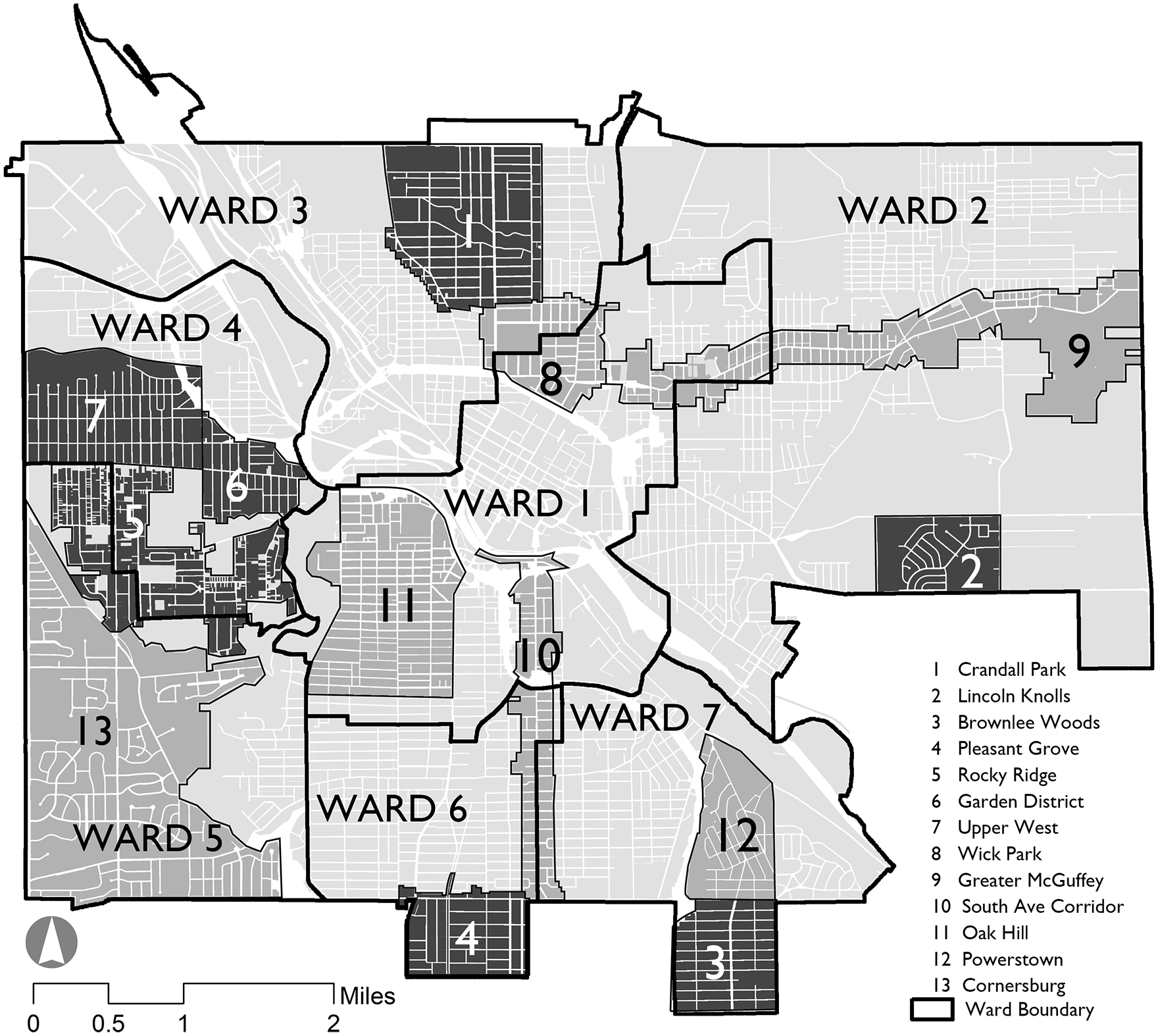
Youngstown’s thirteen NAP areas.
Given Youngstown’s widespread housing abandonment and economic distress, it was not surprising that “housing and property issues” were commonly cited by residents as a top neighborhood priority (Figure 2). Demolition of deteriorated properties was accordingly a significant focus of NAPs (Figure 3). Given our interest in examining the effectiveness of neighborhood planning in addressing housing abandonment through demolition, we selected for examination seven of thirteen NAPs that had been published as of late 2017 (Tables 1 and 2). Our selection criteria for the study were as follows. To examine implemented demolitions, we examined only those NAPs that had been issued one year or more prior to the initiation of the study. To compare and contrast demolitions carried out by either land bank or city government, we examined only those NAPs that specifically designated demolitions specified by agency.
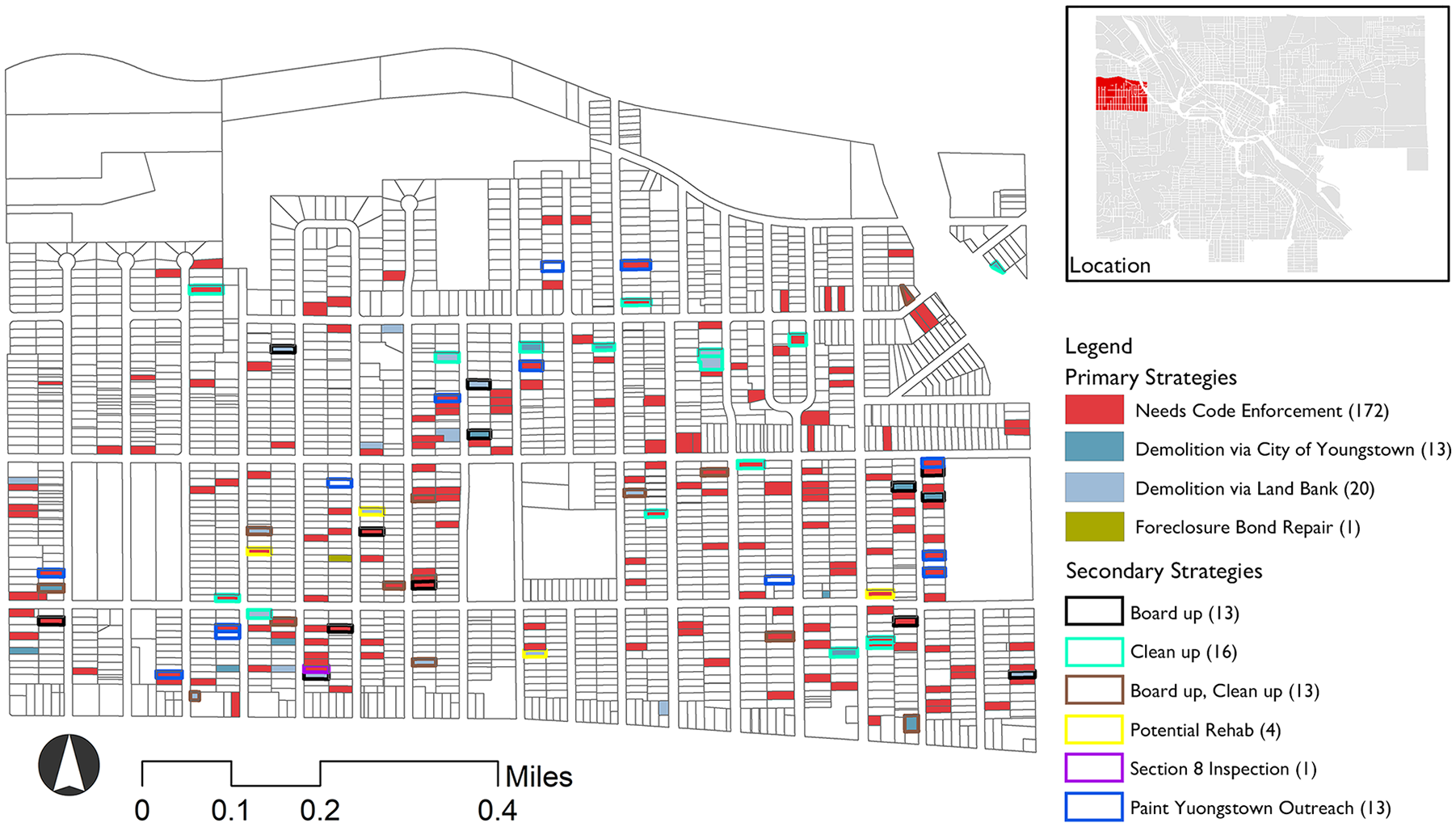
Neighborhood Action Plan of Upper West Side, housing, and property strategy.
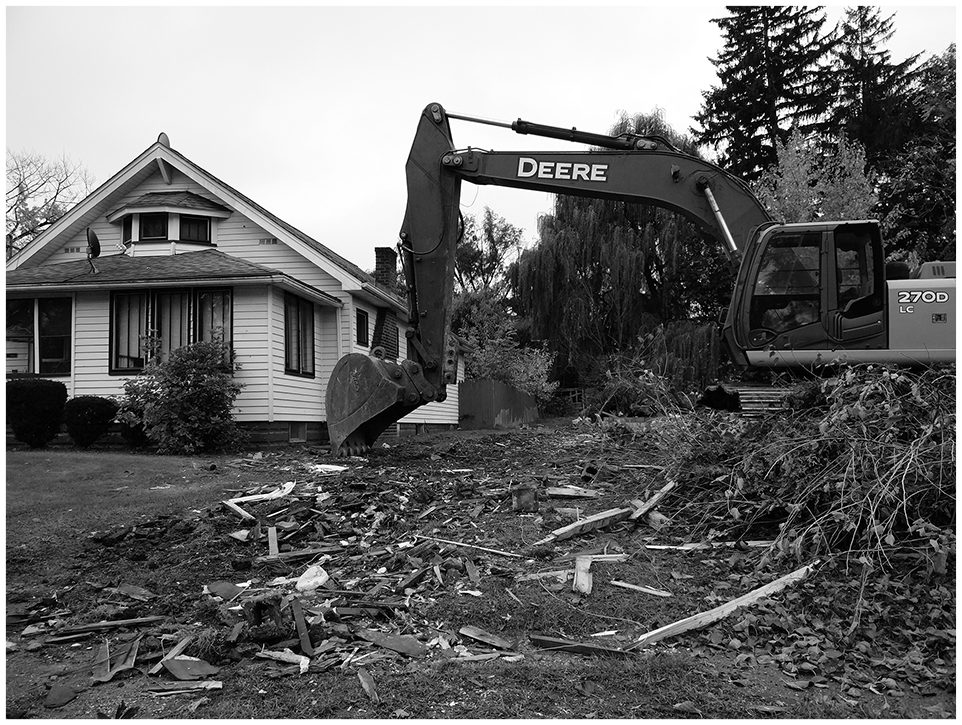
Demolition is widespread in Youngstown.
Youngstown’s Eleven NAP Neighborhoods and Number of Recommended Demolitions by Either City of Youngstown or Mahoning County Land Bank.
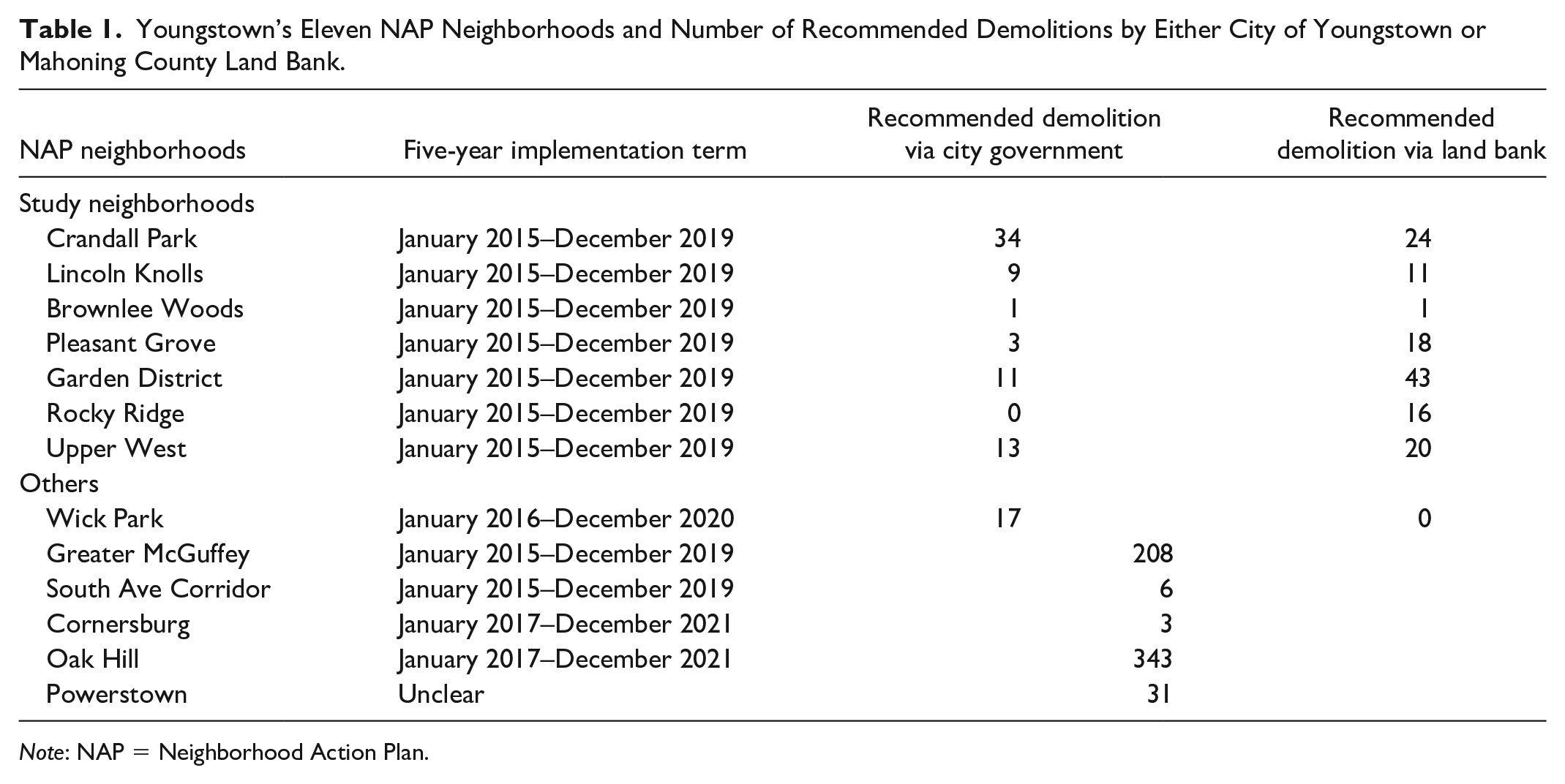
Note: NAP = Neighborhood Action Plan.
Overall Conformance and Performance of Suggested and Actual Demolitions in the Seven Study NAP Areas, January 2015 to October 2017.
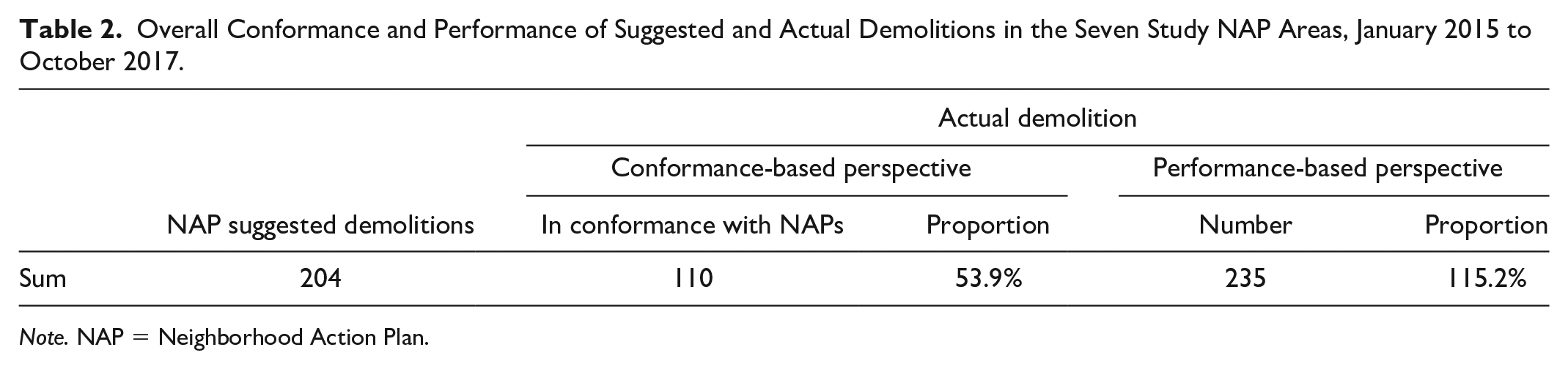
Note. NAP = Neighborhood Action Plan.
NAPs identified both “core” and “secondary” strategies for implementation (YNDC 2018). Core strategies included demolition, grass cutting, debris removal, rehabilitation, and preparing properties for sale. Secondary strategies included inspection, boarding up of windows and doors, and cleaning up yards or vacant lots. We examined the implementation of only the “core” NAP strategy of demolition.
Consistent with other U.S. shrinking cities in the past decade, demolition in Youngstown was largely achieved by two entities: the MCLB and Youngstown’s local government (Joe Schilling, Frater, and Leeper 2015). Similar to other land banks in the United States, a significant funding source for MCLB is the Hardest Hit Fund (HHF) Program. This fund was established by President Obama to offset the damage caused by the 2008 economic recession on the housing market and is administered by the Department of the Treasury. As one of eighteen states and the District of Columbia that were granted HHF access, Ohio’s Housing Finance Agency (OHFA) established the Neighborhood Initiative Program (NIP) to manage and govern HHF allocation within the state. By the end of 2016, OHFA had released five rounds of NIP funding, of which MCLB received more than ten million dollars (OHFA 2014; The Alliance Review, 2016). In addition to this federal funding, the state government established other programs to support county land banks in Ohio, including the Moving Ohio Forward Program. These federal and state dollars usually set a cap for reimbursement. For example, Ohio’s NIP maximum reimbursement for demolition per property is $25,000 (OHFA 2014).
MCLB formulated strategic goals for its acquisition and demolition activity, reflecting both its funders’ criteria and the land bank’s own policy preferences for spatial focus of its work. OHFA also established several priorities for MCLB regarding funding usage: first, that actual homeowners are being affected personally and financially by the presence of blighted, potentially to-be-demolished property. As a result, most MCLB target areas are in urban, not rural areas of the county. Second, OHFA required that MCLB focus on “tipping points,” meaning areas where residents are still departing because of mortgage foreclosure and other reasons. The intention of the tipping-point focus was to stabilize potentially salvageable areas, thereby ignoring both well-off and highly abandoned neighborhoods. As a policy focus, MCLB also pays close attention to corridors and intersections, where the large numbers of people are affected by blighted properties, and where blighted properties are highly visible. Although returning its property inventory to the market is at the core of MCLB’s agenda, demolition occurs first in many cases.
MCLB facilitates qualified buyer acquisition of tax-delinquent properties (Mahoning County Land Reutilization Corp [MCLRC] 2011). MCLB also proactively acquires foreclosed properties that have foreseeable potential for larger neighborhood revitalization efforts. Such proactive property acquisition typically acquires properties adjacent to existing MCLB inventory with the aim of enlarging land parcels to ease redevelopment and/or land sales. In this manner, MCLB acts somewhat in the manner of redevelopment authorities of the urban renewal era of the 1960s and 1970s, when large-scale land acquisition was prioritized to enable downtown and neighborhood revitalization.
Youngstown’s local government confronts those declining and/or abandoned properties that do not fall into tax or mortgage delinquency status. The city’s primary approach to confronting these properties is via code enforcement, which may lead to demolition if a property owner fails to pay fines on time or fails to appeal a demolition decision. The city also pursues a secondary approach of emergency demolition for hazardous properties (usually burnt down after a fire) that may endanger public safety. In such cases, the local government can immediately demolish the dangerous property without notifying the property owner first.
Research Questions, Methodology, and Data
The study applied quantitative and qualitative methods to answer five research questions. First, are there spatial, for example, conformance-based discrepancies, and/or numerical, for example, performance-based discrepancies between recommended demolitions and actual demolitions at the city level? Second, are conformance-based or performance-based discrepancies at the city level, if any, greater or lesser for demolitions carried out by city government and/or MCLB? Third, are there performance and conformance discrepancies at the NAP level, and whether statistics vary between neighborhoods? Fourth, do MCLB and city demolitions differ in conformance or performance at the NAP level? Last, if there are discrepancies between recommended and actual demolitions, or discrepancies between city and MCLB demolitions, why is this so?
Both conformance-based and performance-based evaluation methods were applied to examine potential discrepancies. In this study, “conformance” refers to actual demolitions’ spatial conformity with the NAP suggestions, and “performance” refers to the total number of actual demolitions, where recommended and actual demolitions are compared. We acquired parcel-level geographic information system (GIS) data of NAP and city actual demolitions from Youngstown State University (YSU), which is under contract with city government to provide data services. The dataset contained all structure demolition data in the city of Youngstown from January 2015 to October 2017, a period of thirty-four months. We then deployed a four-stage quantitative evaluation process. First (RQ1), to examine overall implementation in the study areas, we bundled the seven NAPs together and examined overall conformance and performance of demolition. Second (RQ2), to compare local government and MCLB demolition implementation overall, we compared suggested and implemented demolitions by both entities. Third (RQ3), to examine and compare implementation of demolition at the NAP scale, each of the seven NAPs was measured separately, with results compared subsequently. Fourth (RQ4), to examine government and the MCLB demolition variation at NAP level, we compared the two entities’ implementations in the study NAPs.
Last (RQ5), to answer our qualitative research question regarding causality, we conducted semi-structured interviews, mostly comprised of open-ended questions, with initial informants based at YSU. We applied a “snowball” method to interview additional informants from Youngstown city government, the MCLB, the Rocky Ridge Neighborhood Association, and the Youngstown city council. We also applied a cross-validation interview method in which we asked similar questions of different stakeholders. Between 2017 and 2018, we conducted fifteen telephone-based interviews and two in-person interviews with Youngstown informants. Interview findings were interpreted qualitatively to provide the findings in the section “Qualitative Research Findings.”
Quantitative Research Findings
Demolition Conformance and Performance: Overall (All Seven NAPs)
We found strong differences in conformance and performance of demolition recommendations (Figure 4) and implementation overall (Table 2). From a conformance-based perspective, of 235 actual demolitions in the thirty-four-month period, only 110 (53.9%) spatially conformed with NAP recommendations. From a performance-based perspective, however, demolition implementation was excessive. While the study’s demolition data included only thirty-four months of the projected sixty-month period of NAP action, the number of actual demolitions (235) in all seven NAPs surpassed the total suggested number of demolitions (204). In other words, although about half of demolition was not occurring precisely where it had been projected, a large amount of demolition occurred within the seven NAP areas. From a performance-based perspective, MCLB exceeded its projected demolition numbers overall, while the city achieved almost 98 percent of its projected demolitions overall (Table 3). However, from a conformance-based perspective, MCLB vastly outperformed the city: MCLB conformance was almost 77 percent, compared with the city’s less than 12 percent conformance.
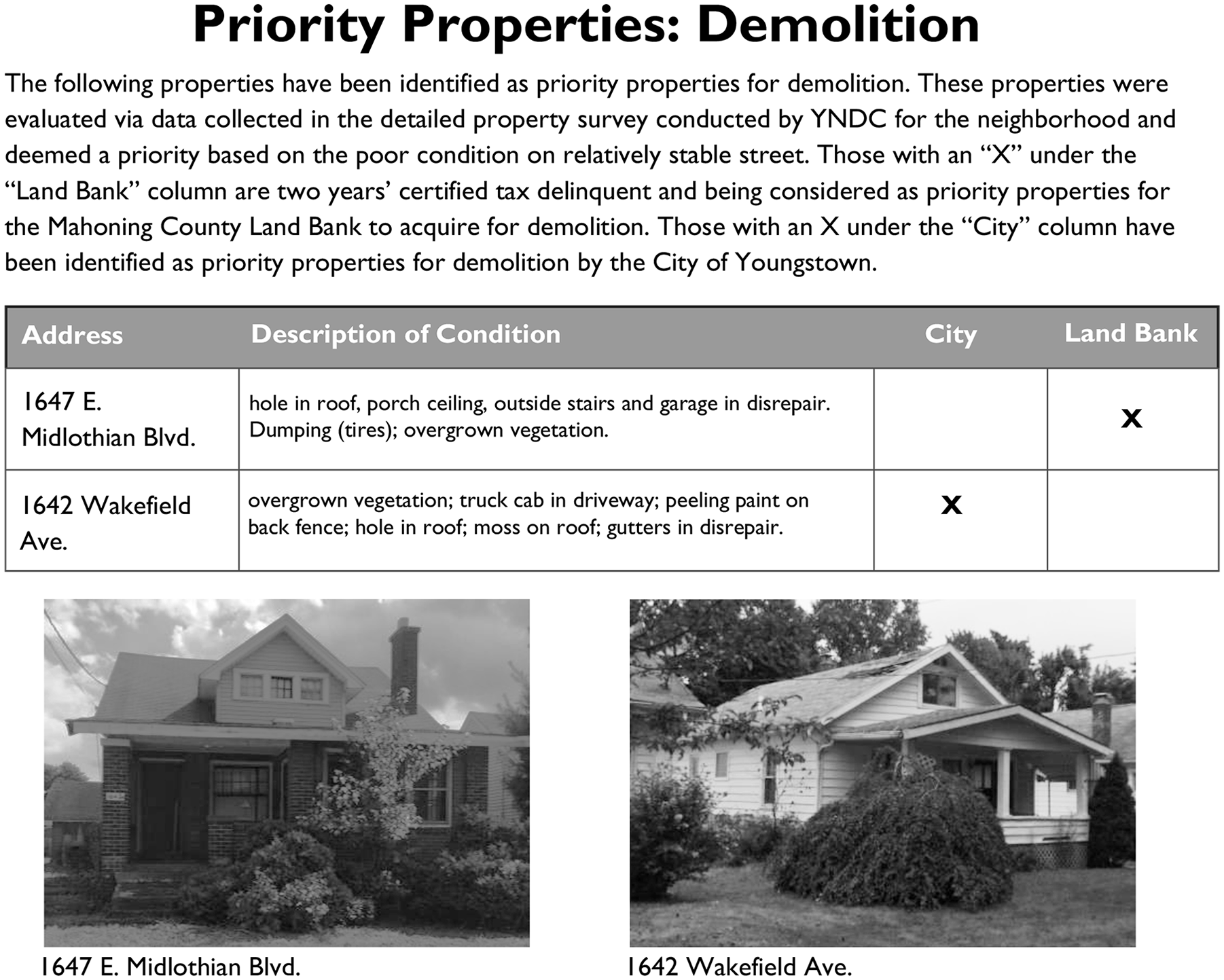
A diagram explaining identification of properties for priority demolition by either the city of Youngstown or the Mahoning County Land Bank.
Overall Conformance and Performance of NAP Suggested and Actual Demolitions by Mahoning County Land Bank and the City of Youngstown, January 2015 to October 2017.
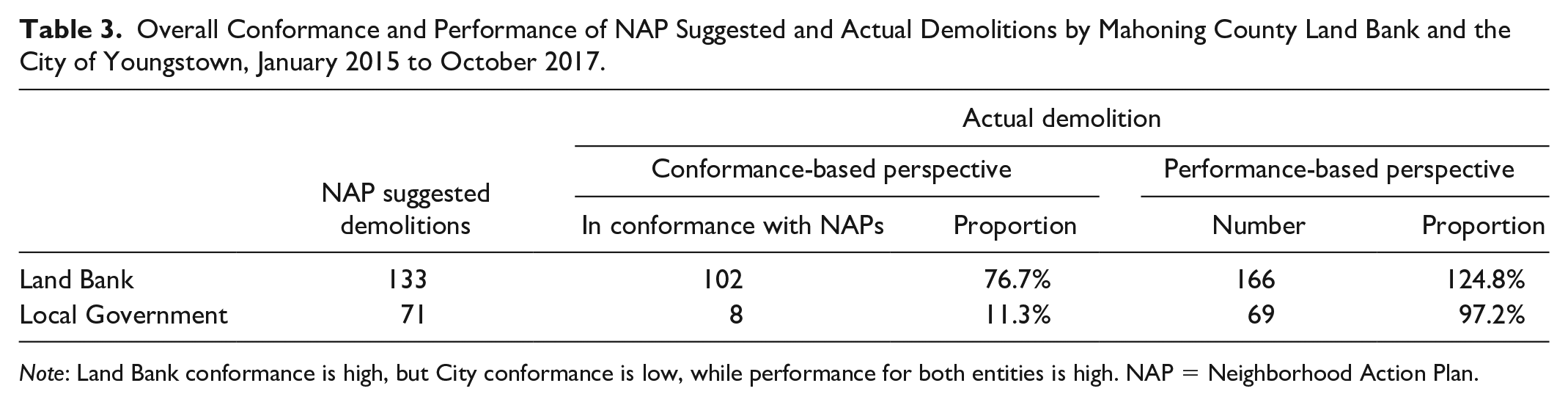
Note: Land Bank conformance is high, but City conformance is low, while performance for both entities is high. NAP = Neighborhood Action Plan.
Neighborhood-Level Conformance and Performance (by NAP)
In general, neighborhood-level evaluation results followed overall results in that within every neighborhood, actual demolitions were performed at a higher level from a performance-based perspective than from a conformance-based perspective. Neighborhood-level evaluation results demonstrated that NAP demolition implementation differed among the seven neighborhoods. Some neighborhoods, for example, Brownlee Woods, had high performance and conformance findings, while some others, for example, Lincoln Knolls, had lower findings from both perspectives (Table 4).
Conformance and Performance of NAP Suggested and Actual Demolitions at Neighborhood Level in Seven Study NAP Areas, January 2015 to October 2017.
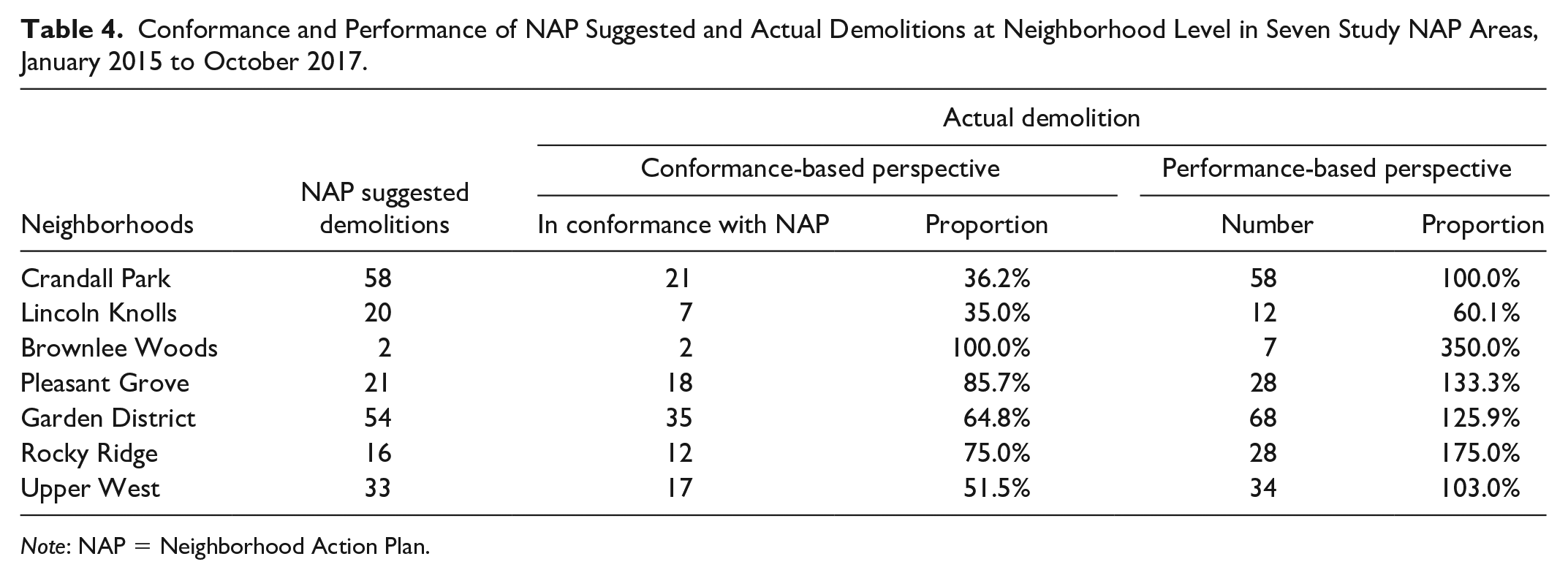
Note: NAP = Neighborhood Action Plan.
At the neighborhood level, MCLB and local government also differed in implementing NAP suggested demolitions. From a conformance-based perspective, the land bank again outperformed local government in every NAP except Brownlee Woods (Table 5). However, from a performance-based perspective, Youngstown government outperformed the land bank in two NAP areas (Brownlee Woods and Pleasant Grove, Table 5). Using an F-test of equality of variances, we found that the MCLB had much smaller variance than the city with respect to both conformance and performance in all seven NAP areas (Table 6). In other words, MCLB performed better at the NAP level with respect to both performance and conformance than the city. In each NAP area, MCLB typically demolished precisely those structures that had been designated for MCLB demolition in the NAP, while MCLB also demolished most of the structures that the NAP had recommended for MCLB demolition.
Conformance and Performance of NAP Suggested and Actual Demolitions by Mahoning County Land Bank and the City of Youngstown at Neighborhood Level in Seven Study NAP Areas, January 2015 to October 2017.
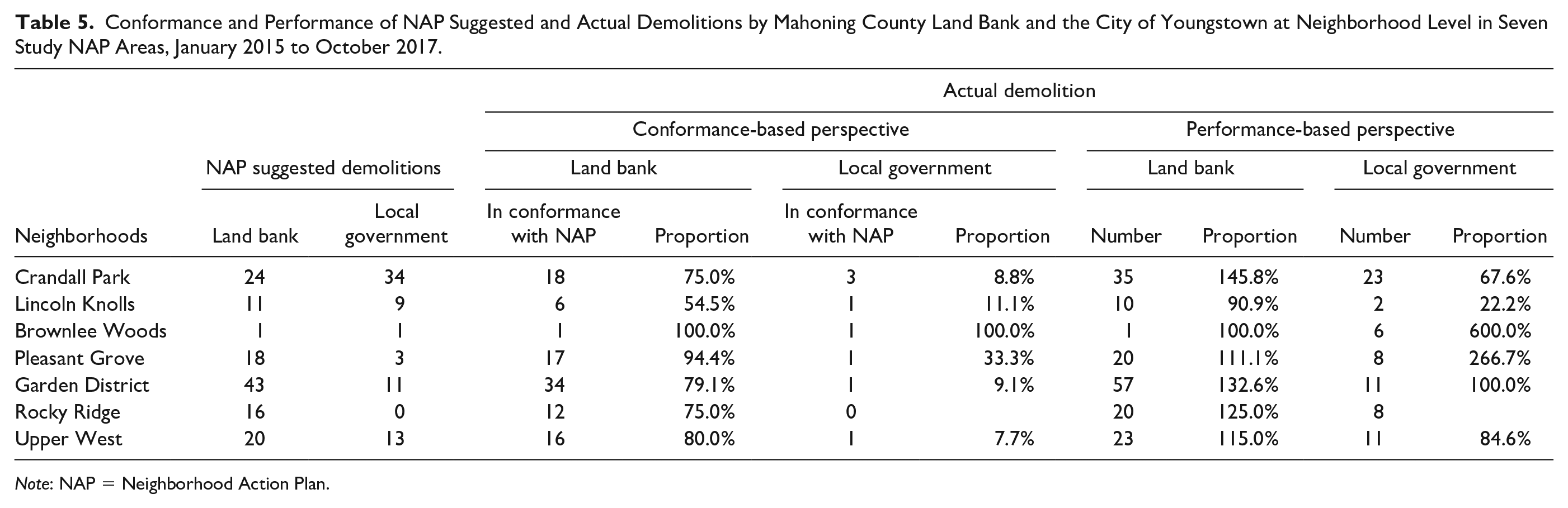
Note: NAP = Neighborhood Action Plan.
F-Test of Equality of Variance Results for MCLB and the City of Youngstown Conformance and Performance of Demolitions in the Seven Neighborhoods.
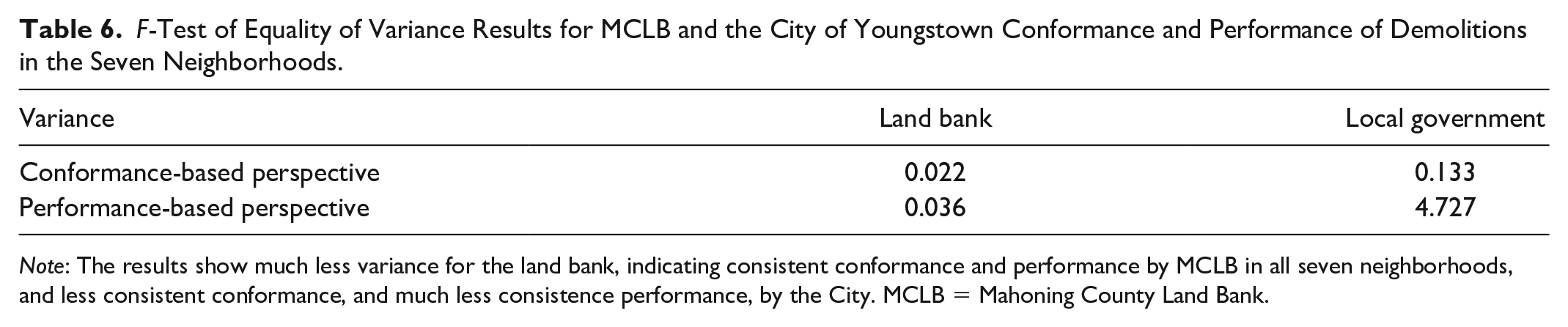
Note: The results show much less variance for the land bank, indicating consistent conformance and performance by MCLB in all seven neighborhoods, and less consistent conformance, and much less consistence performance, by the City. MCLB = Mahoning County Land Bank.
The distinction, in both conformance and performance, between MCLB and city demolitions was surprising. Why was it, we wondered, that MCLB appeared to be both more precise, and more effective, in its demolition actions than Youngstown City government? We addressed this issue in our qualitative interviews.
Qualitative Research Findings
Interviews indicated three causes for the quantitative study findings: differences between tax-delinquent and code-violating properties, procedural and political differences between MCLB and city government; and the dynamic quality of abandonment, where events sometimes outran projections. Below, we discuss each of these causes in turn.
Code-Violating versus Tax-Delinquent Properties
Both tax-delinquent property owners and code-violating building owners are guilty of too little maintenance to maintain their property’s integrity. However, informants clarified that code-violating owners are typically in a better financial situation to be able to pay for necessary home maintenance expenditures. When faced with fines or condemnation, these property owners were often willing to quickly address the code violation, at least up to the point where they judged the likely expense to exceed their property’s value. Given the existing legal provisions for property owners to bring their property up to code before condemnation, the city only rarely goes through the process of acquiring and demolishing such properties. As a government staff member stated, The City of Youngstown never owned a piece of property that we were going to demolish. So you’ve got a lot of property owner’s due process before you go and take down their property, unless it’s some type of structural emergency or fire emergency . . . I’ve got to give that property owner the opportunity to appeal that order that we put on them, time to make repairs if requested.
Neighborhood residents and city officials also differed in their perception of the extent of code violations, and in their perceptions of which properties needed to be demolished (Figure 5). Although NAPs resulted from collaborative planning efforts involving different participants, parties, and stakeholders, interviewees indicated that NAP recommendations primarily reflected local resident opinions. And these opinions sometimes contradicted the opinion of city officials when it came to code violations. Interviewees provided two explanations for this difference. First, without expertise in building code, local residents often made inappropriate suggestions for demolition, assuming that a property merited demolition when according to code it did not. According to informants, in plan-making meetings with citizens, organizers often provided photographs of properties that had been determined as dilapidated according to NAP survey (Figure 5). However, this survey only judged appearance of properties, while structural soundness, a determining factor for the final demolition decision by government officials, was not included.
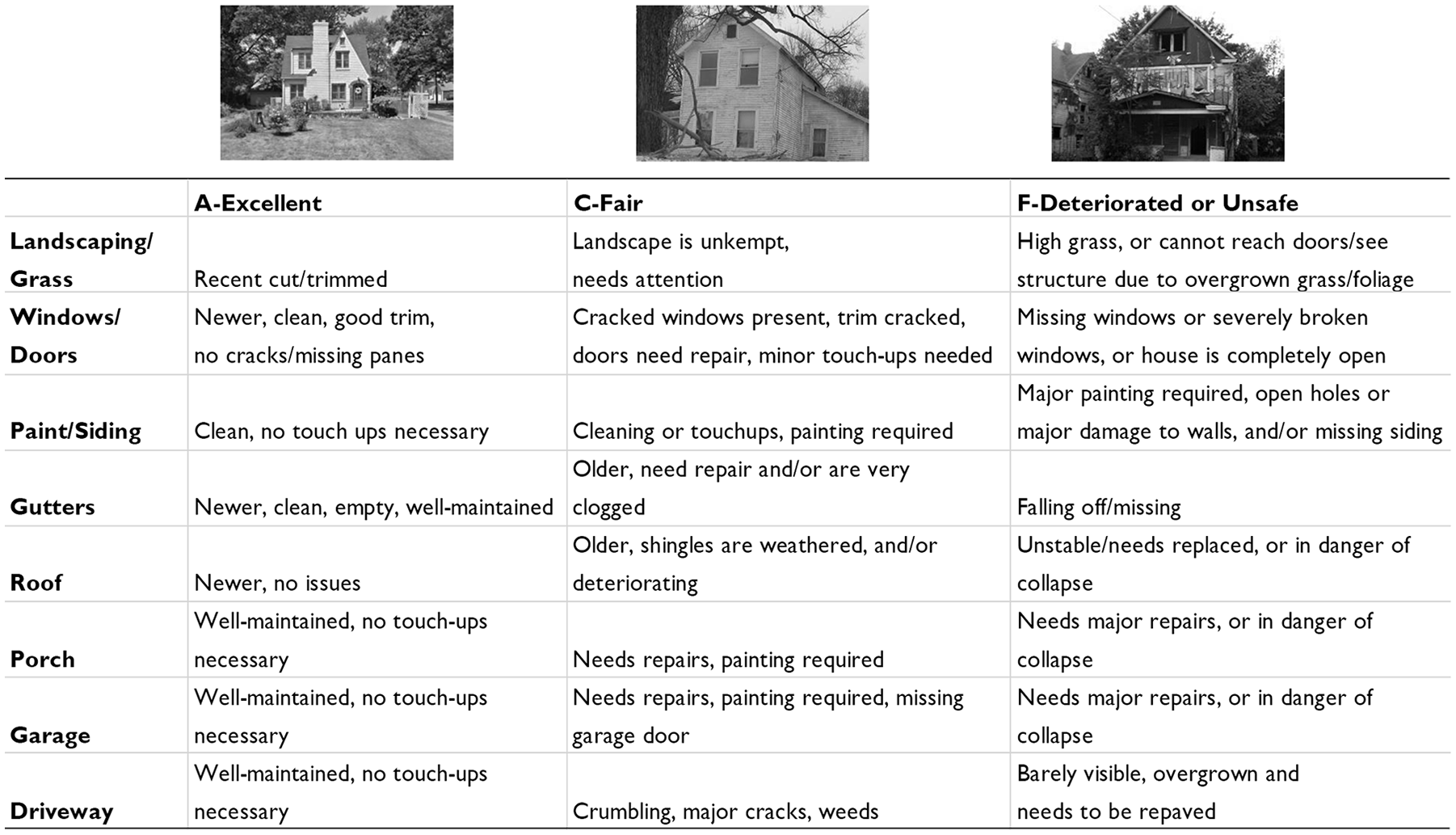
Reference guide used by City and Land Bank to judge condition of vacant or occupied housing structures.
Second, NAP demolition recommendations reflected the wishes of residents who attended NAP plan-making discussions, but these wishes, according to informants, were as often based on self-interest as they were on locally specific knowledge. In other words, residents recommended demolition for adjacent properties even if those properties were not objectively unsound enough to merit demolition for code noncompliance. Claiming greater objectivity, a staff member from local government said, “all of our decisions are . . . based on the condition of these structures and whether or not they’re structurally sound or unsound.” A land bank staff member noted resident subjectivity, saying You know, priority [for residents] depends on how close a person lives to that address . . . toward the end of the meeting there’s kind of a round table discussion where somebody says, “Well, I think there are three more addresses we should be talking about.”
Tax-delinquent properties were easier for participants to assess because the threshold for determination was less complex than that for code violations. Unlike code-violating properties, tax-delinquent properties have owners who have typically lost the ability or willingness to financially maintain their properties. Thus, in a shrinking city like Youngstown with very weak real estate markets, a tax-delinquent property will in all probability be foreclosed upon by the county, making it available for acquisition by MCLB, if the land bank chooses to acquire this property. Interviewees noted that participants in the NAP plan-making process found it easier to judge whether a deteriorated property was in tax-delinquency status or already foreclosed upon than to judge whether a deteriorated property reached the threshold for code violation. The different qualities of tax-delinquent properties led to higher demolition conformance by the land bank. As there was less uncertainty in determining tax-delinquent properties, the MCLB could more easily conform to plan recommendations than Youngstown government. The latter faced greater uncertainty to determining the status of code-delinquent properties, whose owners could always take steps to rehabilitate the structure, thereby averting demolition.
Although NAPs provide demolition goals for both MCLB and city government, the two entities have some overlap in actual implementation responsibility because tax-delinquent and code-violating properties are not always entirely distinct. In Youngstown, interviewees discussed how local government will check potential code-violating properties first for tax-delinquency status, before moving on to code inspection or any further actions. If a tax-delinquent property is targeted for demolition by NAPs, the land bank will first request foreclosure from the county court, then wait until the property is foreclosed upon, at which point title can be transferred and demolition undertaken. This process is explained in Figure 6.
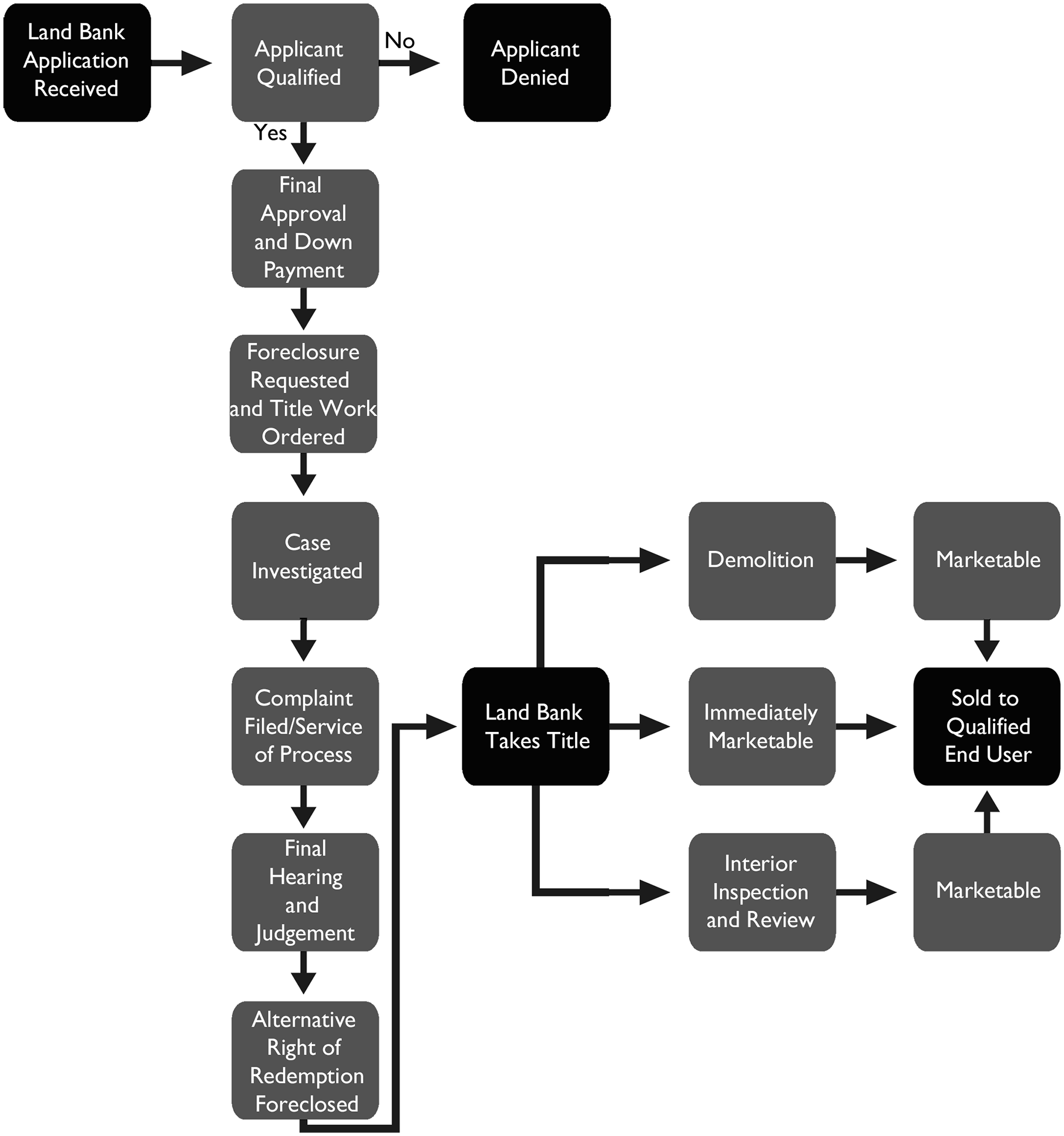
Mahoning County Land Bank tax foreclosure acquisition process.
While the aforementioned process would appear to work well in the abstract, in reality, properties often transition from code-violating to tax-delinquent during the course of an investigation. Because property values in Youngstown are typically quite low, interviewees discussed how some property owners often decide that “coming up to code” is not worth the expense. Instead, property owners may simply abandon a property and cease to pay taxes, once a code enforcement investigation is underway, thereby becoming both code-violating and tax-delinquent. One city staff member described how lines blur: “I started a condemnation process, and in the middle of the 3–6 months that it takes me to go through that process, the property’s fallen tax delinquent so then the Land Bank starts tax foreclosure.” Youngstown government and the MCLB have negotiated a cooperative mechanism for this type of property. In these cases, the land bank will take responsibility for these properties once foreclosure is complete. Although this study did not quantify this further, such “transitioned” properties accounted, according to interviewees, for a large portion of those properties suggested for land bank demolition in NAPs (Table 7).
Mahoning County Land Bank and the City of Youngstown’s Demolition of NAP-Recommended Demolition by the Other Entity, January 2015 to October 2017.
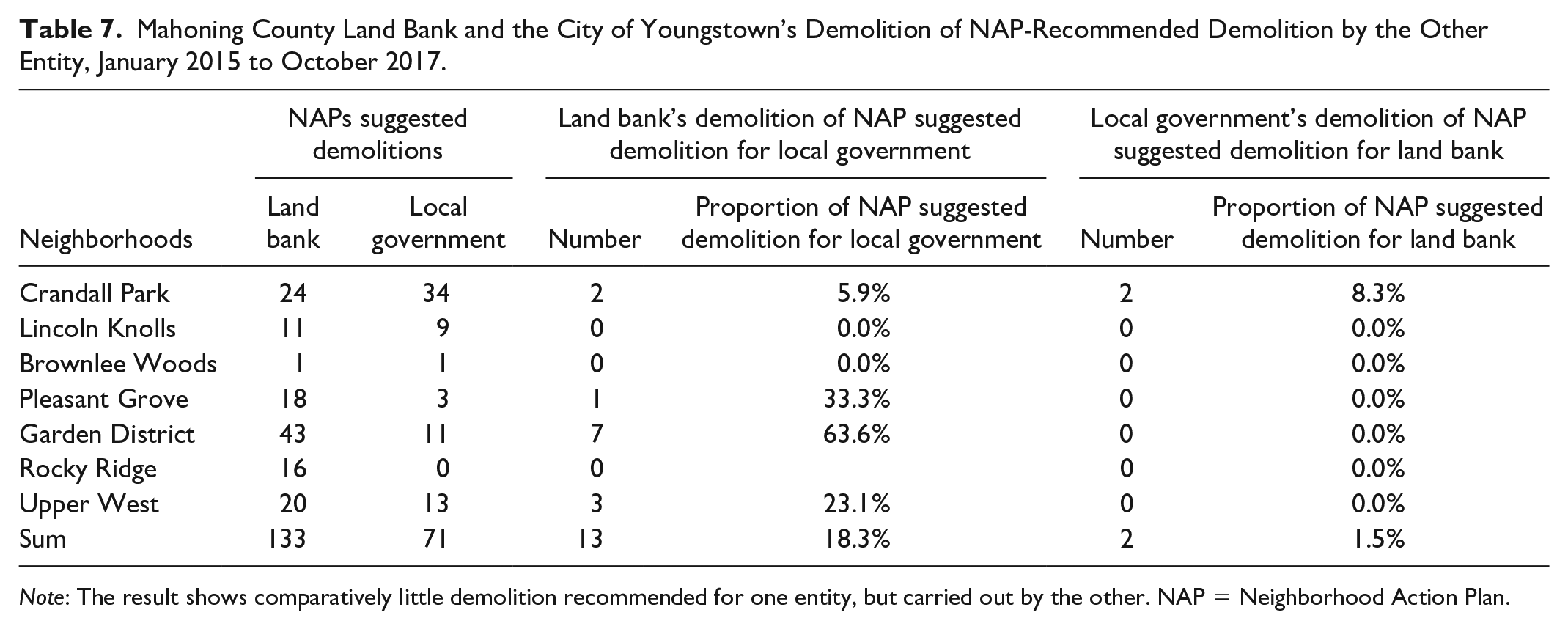
Note: The result shows comparatively little demolition recommended for one entity, but carried out by the other. NAP = Neighborhood Action Plan.
Interviewees discussed other cases when the Youngstown local government might take responsibility for properties over from MCLB. Properties that may have been tax-delinquent and in process of foreclosure are occasionally burned, requiring the city to take action to demolish. A staff member from city government informed us that Youngstown “[has] had one of the highest arson rates in the state of Ohio, so there were a handful of times where a house that the Land Bank was working on had been burned and needed to come down immediately.” Such properties were rare, according to the interviewee, numbering no more than two cases in the seven NAP areas examined (Table 7).
Procedural and Political Differences between Land Bank and City Government
Differing political and legislative responsibilities were a more significant cause of the discrepancy between NAP demolition objectives and implementation, and a clear reason for the discrepancy between MCLB and the city demolition achievements. Interviewees explained how Youngstown’s government structure, with an executive branch headed by the Mayor and a legislative branch comprised of the city council, provided multiple, and sometimes, conflicting avenues for citizens to express opinions about demolition. Council members elected by and responsible to a neighborhood provided an accessible and effective means for citizens to communicate their wishes, and such council members were apparently sometimes able to influence city demolition decisions in a manner that was inconsistent with NAP specifications. As a staff member described, Some councilpeople may have contacted City Hall and said, “I need that house gone now.” And so that’s what happened . . . I think there’s also some tension between developing a demolition list and making it the playbook for the city versus having a council representative who, in wanting to appear to be effective in their roles, wants results right now.
Youngstown’s differentiated demolition patterns reflect, at least in part, the city’s differentiated power structure. While councilpeople are quite naturally responsible to their (local) constituents, the resulting decentralized demolition requests in every ward do not necessarily coincide with a demolition strategy derived from other sources, such as a master plan. City councilpeople do not have NAP conformance as their highest priority; assuaging constituent concerns is more important. And given the city’s limited demolition resources, these politically motivated demolitions took priority over the more abstract needs of the NAP. As a result, city government found NAP conformance challenging, although NAP performance was high.
Ultimately, both NAP demolition goals and the city’s and MCLB’s implementation of those demolition goals reflected an equity-driven approach to demolition that did not necessarily mesh with economic efficiency, nor perhaps with neighborhood revitalization. As a Youngstown councilman stated, we want more demolitions . . . (city government and land bank) demolitions used to be scattered . . . [but] we found out that it’s much more economically feasible to saturate an area—do all of the demolitions in that area.
While this concentrated demolition may have been ideally feasible, the social and political reality of Youngstown generated a very different demolition outcome. The influence of city councilmembers wishing to please their constituents with quick demolition results explains the city’s weak level of conformance with NAP recommendations, as well as the city’s excessive demolition from a performance viewpoint. The city was a willing participant in demolition, but it was a participant that was subject to short-term imperatives and that was challenged to comply with longer term goals that may not have matched these imperatives.
However, such allegiance with short-term imperatives does not adequately explain the high variance in the city’s conformance and performance of demolition objectives at the NAP level. As Table 6 shows, city demolitions ranged from 22 to 600 percent of demolition numbers suggested by NAPs, indicating that other factors were certainly at play. These differences, according to interviewees, reflected nothing more than simple political influence, where certain neighborhoods were favored by the executive, or were favored by legislative–executive cooperation. In some cases, interviewees indicated, the mayor simply wished certain places to receive more demolitions, for reasons that doubtless reflected political priorities. This led to a comparative lack of objectivity on the part of city policy, as a staff member described: Code enforcement and [the] Demolition Department [are] completely politically driven by the administration . . . I think ultimately where we were going and what we were doing was always dictated and directed by the Mayor, and it lined up with what was going on in the NAPs . . .
By comparison, the MCLB, although quasi-governmental, was a county-level agency with its own chain of command and fiscal stream. Structurally, it was an agency that was not subject to the same city-level or neighborhood-level political imperatives as Youngstown’s mayor and council members. A staff member from MCLB stated this independence in no uncertain terms: “My future is not dependent on an election. My future is dependent on if a nine-member Board of Directors feels I am delivering on what our mission and our goals are.” Moreover, the land bank’s demolition funding, much of which comes from federal and state sources, actually requires compliance with demolition lists, such as those proposed by the NAPs. MCLB reimbursement, according to interviewees, is in fact dependent upon conformance with these existing demolition lists. In addition, the MCLB’s priority on “tipping point” neighborhoods was also completely consistent with the areas designated as NAP areas. As a staff member said, “OHFA [the Ohio Housing Finance Agency] was stressing how they wanted to see activity happen in tipping-point neighborhoods. The funding that OHFA has to reimburse us for the demolitions actually traces back to the federal Hardest Hit program.”
The seemingly objective demolition recommendations of Youngstown’s NAPs did not communicate the widely varying political roles and responsibilities of its actors. While the land bank was statutorily incentivized via its funding structure to conform with NAP recommendations, and insulated from other voice that might have argued otherwise, the city was the opposite. Municipal actors made demolition decisions according to political pressure from the executive, the legislature, or both. Conformance with NAP objectives was trumped by shorter term imperatives to address constituent needs or to please politically influential entities in Youngstown. Thus, while performance was high on both sides, land bank conformance was also high, and exhibited much less variation than the demolition carried out by city agencies.
NAPs and Neighborhood Change
Built environments are dynamic, and any static projection of a future for a built environment such as a neighborhood plan will by necessity rely on a conditions assessment of a built environment that will continue to evolve after the plan publication. This is certainly the case in shrinking cities, where property abandonment is dynamic and where buildings are subject to stochastic events like arson and emergency-driven demolition. “Things change” was a watchword of interviewees when asked about changes to NAP demolition targets during the implementation process. Reflecting the reality of evolving conditions in NAP areas, neighborhood action teams—containing members from local government, the land bank, the YNDC, and residents—continued to meet quarterly after NAP publication to review implementation and to add to, and change, demolition goals. Any changes determined by such processes reduced compliance, but not performance, with respect to NAP goals. City staff members described a process where plan goals shifted as the situation evolved and as resident perceptions and priorities changed in turn: I think one of the issues that you’re running into is that it’s a moving target . . . One specific property that wasn’t a problem a year ago is now a problem . . . things always got added and changed. There would be [houses] that residents just were tired that they were abandoned in their neighborhood and wanted demolished . . .
Discussion
Neighborhood Planning for Demolition
This study began with the question, “Can neighborhood planning in shrinking cities achieve demolition goals?” The answer to this question is a heavily qualified, “Yes!” In Youngstown, neighborhood plans did sometimes achieve their demolition goals, but a variety of structural and stochastic factors inhibited full conformance of achieved demolition with the published plans. Demolition performance, however, exceeded plan goals. Below, we review the structural and stochastic factors that interfered with full realization of Youngstown’s NAP demolition goals, and also the question of how one might evaluate the city’s partial implementation performance, together with the perspectives that Youngstown’s NAP experience provides on neighborhood planning more broadly. Last, we address the issue of whether and how NAP demolition goals might be better realized through policy changes.
Structural factors both promoted and inhibited NAP demolition conformance. The MCLB, one of two entities responsible for demolition, was institutionally constrained by funding requirements to conform with earlier projected demolition targets. These requirements no doubt explained the closer conformance of MCLB-sponsored demolitions with NAP demolition goals. By the same token, MCLB was structurally insulated from many of the factors that drove city government, the other entity responsible for demolition, to demolish structures in a manner inconsistent with NAP demolition goals. As a county-level agency, MCLB did not have direct political responsibility or accountability to Youngstown citizens or legislators, providing it with a degree of insulation that interviewees credited as permitting a higher degree of conformance with NAP goals. This comparative lack of accountability of MCLB to neighborhood residents might be considered a liability by some. In fact, MCLB’s political neutrality and high conformance and performance with NAP objectives is potentially vulnerable to larger scale political factors. Youngstown is only a comparatively small piece of Mahoning County, and with a shrinking population, the city’s political influence is reduced. Hackworth (2014) observed that county land banks often experience pushback from rural legislators whose districts have fewer vacant structures than urban areas. Indeed, in Mahoning County, some public officials from rural towns in Mahoning County have argued that they were not treated equitably by MCLB (Weir 2017). In response, MCLB expanded its target area beyond the City of Youngstown’s boundary to include more rural regions in Mahoning County (MCLB 2017), a clear reflection of growing rural influence and priorities within MCLB.
Youngstown’s city government could safely ignore rural legislators, but it was instead subject to structural obligations that led it to establish demolition priorities inconsistent with NAP goals. The city’s politicization of demolition also placed it in tacit conflict with the communicative and rationally based ideals of neighborhood planning. While NAPs were the result of citizen outreach, and while demolition recommendations reflected priorities of residents involved in NAP formulation, city legislators had their own constituent relationships and therefore may have had demolition priorities that differed from those published in NAPs. In the words of de Souza Briggs (1998), Youngstown’s “planners and residents did not speak the same language or understand each other’s politics.” In addition, city legislators had differing amounts of political influence, and to the extent that they were able to sway the executive branch to recommend demolitions, this influence further reduced city conformance with NAP goals. Last, the executive branch itself had its own demolition goals that also differed from NAP recommendations. Overall, the city government’s democratic accountability to resident and legislator priorities for demolition was also a structural disincentive for its conformance to plan demolition goals. This structural disincentive explained the city’s very low demolition conformance, but high demolition performance.
Housing abandonment is a stochastic process, and demolition efforts to some extent reflected this stochastic quality. The conditions that incentivize abandonment, among them very low values, low homeownership, and high-poverty households, are widespread, but predicting exactly when a house or other property might be abandoned is more difficult. Even city policy, as we saw, could spur abandonment, as when a code enforcement effort led some owners to “walk away” from their property, thereby abandoning it and causing eventual demolition. The dynamic, unpredictable quality of abandonment naturally led to an equally dynamic and unpredictable quality of demolition, reducing conformance with plan goals.
Was Youngstown’s NAP demolition process a success? Interviewees credited the NAP process with providing priorities for demolition that guided what otherwise might have been an even more stochastic, politically driven process. With NAPs, “you had an actual document of ‘here’s your priority properties’, so they [demolition actors city and MCLB] would try to hit those—you didn’t have that before, it was straight scattershot.” Interviewees also credited the NAP process with fostering civic engagement. NAPs involved residents in decision making about their neighborhoods’ future, and provided a means for residents to engage with larger scale decision makers (YNDC, MCLB, and city government) in a manner that might not have been possible outside of a specific planning process. In other words, NAPs gave the public a chance to express their preferences for improving their own neighborhoods and provided a degree of transparency and accountability regarding demolition decision making and prioritizing. A neighborhood resident who recommended a demolition and then saw that structure demolished later would see this transparency and accountability in action. This was the intention of the NAP process and in this respect, the demolition conformance found in the study reflected a clear accountability of demolition actors to NAP priorities. One interviewee appreciated the NAP process and recommended it continue: Do I believe [further neighborhood planning] should happen? Yes, most definitely. The type of resident engagement that is happening right now [2018] because of the NAPs is something that should be continued . . . I would be a proponent of it continuing . . . You want them [city officials] to stick around, you want them to make some commitment.
However, the widespread lack of conformance to NAP demolition goals reflected a different side of governmental accountability, one in which government intervention, while present, was skewed by political influence, reflecting the influence of the strongest and most powerful voices at both neighborhood and city levels, and potentially silencing the voices of those citizens who did not have access to political influence. The resulting overt lack of conformance with neighborhood planning demonstrated the conversion of what could be perceived as a routine public service (demolition) into an aspect of clientelism, where those citizens with access to power received goods while others did not. In this sense, the city’s distortion of demolition priorities served to exclude citizens’ voices, rather than to include them, thereby violating the spirit and perhaps the letter of neighborhood planning.
The structural causes of Youngstown’s lack of conformance with NAP priorities did not inhibit the implementation of demolition from a performance perspective: demolition remained a priority for all actors during the study period. And the NAP process doubtless did not or could not fully register every demolition priority accurately, particularly given the ever-changing nature of the problem. Yet by the same token, in a resource-constrained environment, any prioritization by definition subtracts resources from other potentially worthy priorities. In this sense, Youngstown’s limited NAP demolition conformance reflected this inevitable trade-off, and doubtless left some resource claimants unsatisfied. Without a full provision of resources, that is, funding, needed for demolition, it is difficult to see how this shortcoming of the NAP demolition process might be rectified, and even then, the structural factors that led the city to prioritize other demolitions would remain. We can thus conclude that full conformance with Youngstown’s NAP-recommended demolitions is both impossible, because of the aforementioned structural factors, and undesirable, because of the stochastic nature of abandonment and need for demolition.
Nevertheless, we identified several avenues for improvement of the NAP demolition recommendation process. First, the plan itself might become more dynamic. It is important to address whether it is more appropriate to have a fixed plan to be carried out for a certain number of years or to have a plan that frequently adjusts itself. The original NAPs have a five-year term that was perhaps too long for some unstable neighborhoods. One suggestion would be to reduce the term to match a full cycle of foreclosure, about three years in Ohio. Another suggestion is to retain the five-year term of NAPs, but to update them quarterly and to publicize the updates so that every neighborhood resident can have access to them.
Enhanced civic engagement is another potential avenue for bridging the gap found between public and professionals. Youngstown residents did not always understand specific terms and details related to NAPs, including foreclosure processes, or the distinct roles of city government versus MCLB. An agency like YNDC might train neighborhood representatives on these aspects of abandonment and demolition policy as part of the civic engagement portion of the neighborhood planning process. As a resident stated, There’s a point for me which I think is the most valuable, which I don’t have a lot of knowledge about, [for example], the foreclosure process, whether it be from a legal or ownership perspective . . . I still don’t fully understand it . . . when something gets demolished, people are [not always] aware of who has done the demolition . . .
Other potential improvements include the Youngstown neighborhood planning process, the appropriate scale of planning within the city, and potential shifts in agency responsibilities. As noted in Hutcheson’s (1984) neighborhood planning study, drastic differences may exist in concerns expressed by neighborhood representatives in planning processes, and underrepresented residents, who may not participate in such processes fully. In Youngstown’s NAP-making process, the subjective viewpoints of neighborhood residents provided subjective demolition recommendations; a more objective sample of neighborhood resident opinions might produce more objective recommendations. However, any such objective sample would by necessity confront the typically voluntary nature of resident participation in neighborhood planning and require additional capacity. For example, a neighborhood council or analogous entity might aid in creating a more representative process, such as elections from block clusters, from among affected neighborhoods (A. Mallach, personal communication, January 5, 2019).
The nature of representative legislative government in Youngstown, and in all American cities, conflicts with the often highly spatially concentrated nature of abandonment and decline in shrinking cities. In Youngstown, a city with substantial abandonment, some neighborhoods still had much more than others. A citywide plan would provide an obvious means of proposing hierarchies and priorities in demolition, just as such plans prioritize other public investments. While Youngstown’s 2014 housing market study did provide such hierarchies, and the NAP process responded to them, one might envision an even stricter generation of priorities for plan creation and demolition enforcement. Whether such a stricter set of priorities, which could possibly concentrate demolition recommendations, could attain support in Youngstown’s decentralized political environment is unclear.
The most obvious vector for such a stricter set of demolition priorities would be the MCLB. This study showed the MCLB responding both to NAP-recommended demolitions and to changing demolition priorities caused by stochastic abandonment, thereby generating a relatively high conformance with NAP goals. Given that code enforcement was a demolition-related issue subject to a high degree of political influence, one could imagine partially or even wholly allocating code enforcement responsibilities to such a quasi-government organization as the land bank. Such an organization, if insulated further from political influence, could appraise, inspect, and recommend code enforcement actions including demolition. Whereas certain code enforcement actions might be the responsibility of city agencies, others like demolition could be usefully “shifted up” the ladder of governmental responsibility, introducing additional objectivity into the code–enforcement–demolition nexus. Such changes would require legislative shifts, perhaps at the state level, analogous to those that created land banks to begin with.
Study Limitations and Recommendations for Future Research
Several issues arose during the course of this study that were not fully resolvable, but that we hope to address further in future studies, as well as to see in studies conducted by others. We were somewhat surprised to find that there was some resident opposition to further demolition in neighborhoods. While the literature argues that demolition brings positive effects in terms of economics and public safety, some residents expressed reluctance having to do with retention of quality of life. As one resident said, I think that demolition is definitely the last step . . . there were two demolitions two months ago on my street, for the first time it [the street] went from having continuous houses all the way down to having two gaps . . . I think it’s [demolition is] preferable to a house caving in on itself, [and] I wish there were more resources . . . that people would consider renovation, but beggars can’t be choosers.
Ultimately, demolition is a compromise, a method that addresses urban vacancy and quality of life problems by reducing oversupply. Demolition is not intended to, and cannot by its very nature, solve other problems in disinvested neighborhoods, like a lack of quality affordable housing (Hollander 2018; Rosenman and Walker 2016). The reduction of housing stock in neighborhoods where additional, better housing stock is needed is one of the chief paradoxes of demolition as a planning strategy. Demolition solves some problems by removing homes, but by the same token, it forecloses upon the realization of other hopes such as neighborhood revitalization. It is difficult to revitalize a neighborhood in which half of the previously existing homes no longer exist. Whether demolition is in fact the most sensible strategy for shrinking cities, as opposed to rehabilitation or perhaps other strategies, is a question that should be evaluated in future studies.
The process of selecting neighborhoods for the NAP process was not examined as part of this study, but this process merits additional future investigation. The number of NAPs, as previously noted, has continued to increase, indicating that they are popular, yet this ongoing growth in planning is not necessarily consistent with the concept of neighborhood “tipping points” being the spur for NAP creation. Are all neighborhoods potentially at the tipping point and thereby all eligible for NAPs? One government staff member explained that originally, they [NAP neighborhoods] were chosen based on neighborhoods had somewhat of a viable infrastructure left to the neighborhoods, where there was a viable housing market . . . I think it has grown a little bit since then from political pressure (and) from different council people to identify other areas of the city.
Whether or not this growth in NAPs reflects an actual change in tipping points, and to what extent NAP designation truly reflected political pressure as opposed to objective analysis of neighborhood problems, remains unknown. Preliminary evidence indicates that political or even racial factors may have played a role. Just as Skolnick (2015) found an African American ward councilwoman contending that her neighborhoods had been treated unequally by YNDC, the existence of NAPs appeared unequally distributed between white and black majority neighborhoods in Youngstown. Wards 4 and 5, which are mostly white, have NAPs covering most of their areas, while Wards 1 and 6, which have mostly black residents, do not have NAPs covering a similar extent. The earliest NAPs were particularly unequally distributed in this regard (Figure 1).
Although we evaluated the conformance and performance of NAPs’ suggested demolitions in this study, we did not evaluate the effects of these demolitions; in other words, whether or not the variable implementation of NAP demolitions affected a neighborhood’s socio-economic status. To what extent does implementation of NAPs change (or not change) these neighborhoods? With the increasing number of NAPs, do new NAPs remove public resources from older NAP areas, making the entire NAP process less effective? We also wish to note that the existence of NAPs did not mean that Youngstown city government and MCLB ceased demolishing houses, and attempting to improve living conditions, in other neighborhoods during this time. A study that compared NAP neighborhoods with non-NAP neighborhoods, or that compared wards with more areas within NAPs with those with less areas within NAPs, would permit the mapping of potential patterns of improvement and/or disadvantage. Investigating these questions would provide a better understanding of NAP effectiveness, and provide planners with additional information and enhance the potential of instituting improved demolition practices in other settings.
Conclusion
Across the United States, shrinking cities are struggling to reconcile seemingly permanent or long-term decline and abandonment with the governmental institutions and democratic responsibilities of America’s partly decentralized system of public institutions. The evidence of this study indicates that in Youngstown, such institutions are productive at generating neighborhood plans to confront abandonment, but are only partially successful at implementing the recommendations of such plans, due to both structural and stochastic factors.
We found strong differences between NAP implementation from a performance perspective (successful) and conformance perspective (partially successful). Our evaluation of NAP implementation at the neighborhood level revealed strong differences in the NAPs’ two implementing agencies: the land bank implemented NAP-recommended demolitions from both perspectives in every neighborhood with little variance across different neighborhoods, while city government implementation varied significantly across different neighborhoods from both conformance and performance perspectives.
Interviews provided three causes for the aforementioned differences between NAPs and their implementation. Code-violating properties proved harder to assess and legislatively more challenging to demolish than tax-delinquent properties. Overlapping responsibilities for vacant properties, and different levels of responsibility to local needs, caused additional inconsistency between plan proposals and realized demolitions. Last, the evolving nature of abandonment and of shifting resident concerns led to shifts in priorities that sometimes previously varied from plan goals.
Youngstown’s neighborhood planning provided increased accountability and transparency to neighborhood residents, an objective and statutorily necessary foundation for land bank–motivated demolitions, and at a larger scale, evidence of the effectiveness of neighborhood planning. In this sense, the NAP demolition process accomplished its goals. However, both structural and stochastic factors operated against this process, and by extension against the enterprise of planning for shrinkage in Youngstown. Decline was episodic, sometimes accidental, unpredictable, while demolition was prone to the political process just like many other aspects of city life, with the result that many citizens were deprived of the full benefits of neighborhood planning. Increased objectivity of plan formulation and implementation, as well as enhanced public participation in plan making, remains a worthy goal. To help accomplish this, we suggest reconsidering the projected term length of plans, to make them more dynamic by regularly updating and publicizing updates to the plans; training neighborhood participants by giving them tailored knowledge and details regarding such plans, so as to build bridges between professionals and the public; randomly selecting neighborhood representatives or selecting representatives from an analogous scale smaller than that of the ward, so as to achieve more democracy in decision making; guiding scattered neighborhood-level plans with a citywide demolition plan; and creating independent entities to partially administer code enforcement so as to shield it from political interference.
Local government and institutions vary to some degree across the United States, but all of America’s shrinking cities also have substantial commonality with much of the Youngstown NAP demolition experience. Neighborhood planning is widespread across the United States; so, too, are neighborhood-based city legislatures accountable to citizens and to their own political priorities. Land banks are a growing form of institutional capacity, mostly at the county level, nationwide, and the idea for planning for shrinkage, too, has increasing currency. Shrinking-city planners and policy makers will learn much from this study’s understanding of planning for demolition in Youngstown, and we hope that other shrinking cities might learn from Youngstown to develop their own neighborhood planning innovations, to promote progress in planning, to improve resident quality of life, and to enhance the built environment of shrinking cities.
Footnotes
Acknowledgements
We would like to thank Alan Mallach for his comments on an early version of this paper. Our special appreciation goes to Ben-Rosen Filardo who helped us to conduct interviews. We also thank Esther Luo, Elizabeth Champion, and Tyler Rynne for their assistance with research.
Declaration of Conflicting Interests
The author(s) declared no potential conflicts of interest with respect to the research, authorship, and/or publication of this article.
Funding
The author(s) disclosed the following financial support for the research, authorship, and/or publication of this article: This study is partially funded by MIT Greater China Fund for Innovation and Basic Research Program of Jiangsu Province (BK20190364).
