




Abstract
This article examines claims about the judicialization of the planning process. How does the judiciary manage disputes between constitutional rights to housing and a healthy environment in São Paulo’s informal settlements? We scrutinize thirty-six legal cases from 2013 to 2016 in the State Court of Appeals, examining the litigants and their argumentations. The findings demonstrate judicial deference to planning. Court rulings defer to municipal plans by invoking separation of powers and budgetary constraints principles. The supremacy of the plan highlights the ethical responsibilities of educators and practitioners and has implications for housing and environmental activists in their organizing strategies.
Introduction
In the Global South, courts are becoming more involved in protecting the socioeconomic rights of vulnerable populations (Brinks and Gauri 2014). Scholars claim that the judicial influence on public policy has been one of the most important features of post-transition Latin American politics (Ríos-Figueroa and Taylor 2006; Sieder, Schjolden, and Angell 2016). This increased judicial role in the realm of social policy also encompasses environmental rights (Kramarz, Cosolo, and Rossi 2017). In India and the Philippines, public support for judicial empowerment enabled the courts to take on prescriptive roles in the rejuvenation of the Ganges River and the rehabilitation of Manila Bay, respectively (Boyd 2012; Dreyfus 2013). This expanding global influence of the courts on issues beyond the enforcement of existing laws, policies, and plans is called the judicialization of policy. Ríos-Figueroa and Taylor (2006, 741) define the judicialization of policy as “the increasing displacement of policy conflicts from their traditional arenas in the executive and legislative branches to the judiciary.” Scholars warn against the preponderance of judicial power over the power of other government branches. Using the courts to provide palliative care for environmental policy failures, due to executive and legislative inaction, creates widespread public accountability deficits (Kramarz, Cosolo, and Rossi 2017).
In Latin America, the transition to democratic rule at the end of the 1980s resulted in the establishment of a new wave of constitutions that expanded some citizenship rights, including the right to a healthy environment. This newly adopted constitutional right had a comprehensive effect, generating a wave of environmental laws in Argentina, Brazil, Bolivia, Colombia, Costa Rica, and so on (Boyd 2012). Anthropocentric rights prevail in all these constitutions, where individuals and nations have legal standing to exercise the right to a healthy environment in court (Espinosa 2019). By contrast, Ecuador was the first nation in the world to enact ecocentric rights of nature through its 2008 constitutional amendments (Kotzé and Calzadilla 2017). Nevertheless, Ecuador faces difficulties enforcing such rights, as it lacks an independent enforcement body with a mandate to protect rights of nature and a standing doctrine to implement them (Whittemore 2011).
The 1988 Brazilian Constitution empowered the Public Prosecutor’s Office (Ministério Público) to enforce constitutional environmental rights, resulting in a dramatic increase in the implementation of environmental laws (Boyd 2012; Donaghy 2009, 8; McAllister 2008). The Ministério Público has the power to file public civil and criminal lawsuits to protect the environment (Cavalcanti 2006, 42; McAllister 2008). Environmental groups came to see the Ministério Público as a potential ally in unveiling a new sphere of activism in the courts (Alonso and Maciel 2010, 304; Soares-Filho et al. 2014). Municipal governments often become the defendants in lawsuits involving informal occupations of environmentally protected municipal land (Dantas 2015).
At the federal level, the National Conservation System of 2000 established areas of environmental protection, and the 2012 Forest Code included provisions for permanent preservation areas. State-level laws define the areas of protection and water supply recovery. Nevertheless, these regulations do not prevent informal settlements in environmentally protected areas; often in occupied land that is poorly suited for development and prone to floods and landslides. Simultaneously, several enabling legislative measures regulate the fundamental right to housing and the urban chapter of the Brazilian Constitution. Federal laws, such as the 2001 City Statute, facilitate tenure security and land regularization in favelas through the use of specific instruments, such as prescriptive acquisition (usucapião), if families occupy private land and special use concessions for housing purposes (Concessão Especial de Uso para Fins de Moradia [CUEM]), if the occupied land is publicly owned (Fernandes 2011, 306). Special Areas of Social Interest (Zonas Especiais de Interesse Social [ZEIS]) is another City Statute mechanism providing zoning designations for informal settlements and future affordable housing. Public housing and land regularization laws are constantly evolving. In 2009, My House, My Life Law (Minha Casa, Minha Vida [MCMV]) established the mechanisms to produce housing units for low-income residents and the regularization of existing informal settlements. Later, Federal Law 13.465 of 2017 replaced MCMV in regulating urban land regularization and the provision of services for consolidated informal settlements.
Thus, Brazilian courts must resolve legal conflicts between the two fundamental rights secured by the Brazilian Federal Constitution—the rights to housing and a clean and ecologically cohesive environment. This article empirically investigates the judicialization of politics and policy in the realm of urban planning. Have the courts replaced or undermined the role of municipal planners in managing land conflicts, especially conflicts involving informal housing and environmental protection? By contrast, how do city planners use the courts to advance and enforce their plans for addressing conflicts involving informality and the environment?
We joined this debate by systematically investigating how the courts manage urban land conflicts between environmental protection and the right to a safe shelter for those living in informal and precarious settlements. Our work investigates whether the judiciary assumes the role of urban planning in addressing these conflicts in the city of São Paulo. According to data from the municipality (Prefeitura Municipal de São Paulo), there are 445,112 estimated households in slums (favelas) and 385,080 households in irregular subdivisions (loteamentos irregulares). 1 Of these favelas and irregular subdivisions, there are 171,771 households in 684 settlements located in the Billings and Guarapiranga water supply protection and recovery areas (Área de Proteção e Recuperação dos Mananciais [APRM]) (Denaldi and Ferrara 2018).
We examined court cases from the São Paulo State Court of Appeals (Tribunal de Justiça do Estado de São Paulo), focusing on appeals from district courts filed between 2013 and 2016, and accessed thirty-six cases involving informal settlements in areas under environmental protection. São Paulo City was selected because of the active housing movements working to advance tenure rights and the right to the city for informal dwellers (see Donaghy 2017; Irazábal 2018; Rodrigues and Barbosa 2010). There are also strong environmental movements and non-governmental organizations (NGOs) in the city, which call on public prosecutors to enforce environmental protection provisions via public civil action lawsuits (see Alonso and Maciel 2010; Jacobi 2003; Soares-Filho et al. 2014).
This article is organized into six sections. After the introduction and methodology, we outline the structure of the Brazilian court system and the legal actors involved. The following section identifies the prevalence of different lawsuit types and litigants in the sample, focusing on the role of municipal governments as plaintiffs and defendants. The section preceding the conclusion presents the concept of judicial deference to planning and examines court cases and argumentations as part of the judicialization question—whether judges in São Paulo defer to the autonomy of city planners or interfere with the rationale of their plans and actions. The conclusion follows.
Method
This study utilized mixed methods of data collection and analysis (e.g., Bernard 2011), which comprised four components: (1) reviews of the legal and policy framework regulating urban environmental protection and access to adequate housing, (2) analysis of the actors involved in the legal system, (3) case law research using the online database of São Paulo’s Justice Tribunal, and (4) twenty-six in-depth interviews with key legal actors in the judicial system of São Paulo and legal aid offices, including the architects, planners, engineers, and geologists who work with them on court cases. The interviews were conducted between October 2016 and December 2018.
To compile the sample of court cases, we conducted a court case search of the São Paulo State Court of Appeals website, including all fifteen chambers of São Paulo City. 2 A keyword filter, with the synonymous function activated, was restricted to “environmental protection areas” or “permanent preservation areas” (área de proteção ambiental or área de preservação permanente). Three publication types encompassed all searchable decisions in the database of São Paulo’s Appellate Court—judicial panel decisions, ratification of agreements, and single-judge appeal decisions (acórdãos, homologações de acordo, e decisões monocráticas). Consequently, our database excluded cases that never left the lower district courts but included cases with non-merit appeals. Feasibility and relevance guided the decision to exclude lawsuits that never left the lower courts. First, the search engines of the Brazilian judiciary do not provide a topic-based search function for first circuit decisions, which are only available with a case number or the full name of the plaintiffs, defendants, or their legal representatives. Thus, each judge would need to provide a list of their cases for the research team to triage. Second, the decisions of the higher circuit are poised to exert greater influence on future cases, as lower court lawsuits often cite them. Our database sample includes second circuit court decisions and jurisprudence as well as original pleadings and procedural documents. 3
Between 2013 and 2016, the initial search retrieved 433 environmental protection and preservation cases. A secondary search included the keywords “informal area, precarious settlement, irregular subdivision, slum” (área informal, assentamento precário, loteamento irregular, favela) with the synonymous function activated. Following a preliminary reading of the cases, we excluded those involving less than twenty households or constructions. The result was a sample of thirty-nine cases, and we accessed and categorized thirty-six of them. 4 Although we did not reach 7.7 percent of the cases, which might have influenced the findings, our sample included all cases within a three-year period, which helped attenuate the bias.
We scrutinized the thirty-six resulting cases through content analysis, especially the legal argumentations, as they shed light on the role of the legal actors in mediating land conflicts. The data analysis included three main areas of interests: (1) case identification and current status, including the actors involved and specific data on the households affected and their geographical location; (2) types of legal actions advanced and the environmental conflicts identified in the case; (3) legal argumentations included in the case by each of the parties and the judges involved, specifically as they referred to fundamental rights, such as the rights to housing, life, property, health, and a balanced and cohesive environment; and (4) final rulings.
The article draws insights from interviews conducted with public prosecutors in the Divisions of Housing and Urbanism and the Environment at the São Paulo State Public Prosecutors’ Office and with the public defenders, architect, planner, and social worker in the Office of the Public Defender at the Housing and Urbanization Center. We also interviewed lawyers, architects, and planners working for legal aid organizations for the right to housing, such as Escritório Modelo at Pontifical Catholic University of São Paulo and the Gaspar Garcia Human Rights’ Center in São Paulo. Finally, we interviewed the engineer and planner working for the Municipal Office of the Attorney General. We did not interview planners working in other municipal departments, which limited the perspectives presented here.
The Court System and Its Actors
This section discusses the Brazilian court system as it pertains to São Paulo. In framing how plaintiffs and defendants articulate their rights, it introduces the different actors involved in cases addressing housing and environmental rights in informal settlements.
Brazil’s legal system is based on civil law, where legislative bodies enact statutory laws, which exert greater authority than that of past court decisions (precedent). Nonetheless, the principle of precedent, stare decisis, which is typical of common law countries such as the United States, has become highly influential, particularly in the realm of Brazilian public law (Kapiszewski 2010). The Brazilian court structure, similar to that of the U.S. judiciary, operates at the state and federal levels, with municipalities holding no judicial powers (Figure 1). This system separates cases into several jurisdictions, including labor, electoral, military, civil and criminal, and constitutional and non-constitutional. Brazil’s judiciary includes three instances of appeal, with the possibility of cases advancing from first-level courts all the way to either the Supreme Court or the Superior Court of Justice (Superior Tribunal de Justiça [STJ]). The cases in this research belong to the state level. State courts are responsible for judging lawsuits that are excluded from the jurisdiction of the federal court—common or specialized. Therefore, they have residual competence or jurisdiction. Military courts are the only specialized courts that appear at both the federal and state levels.
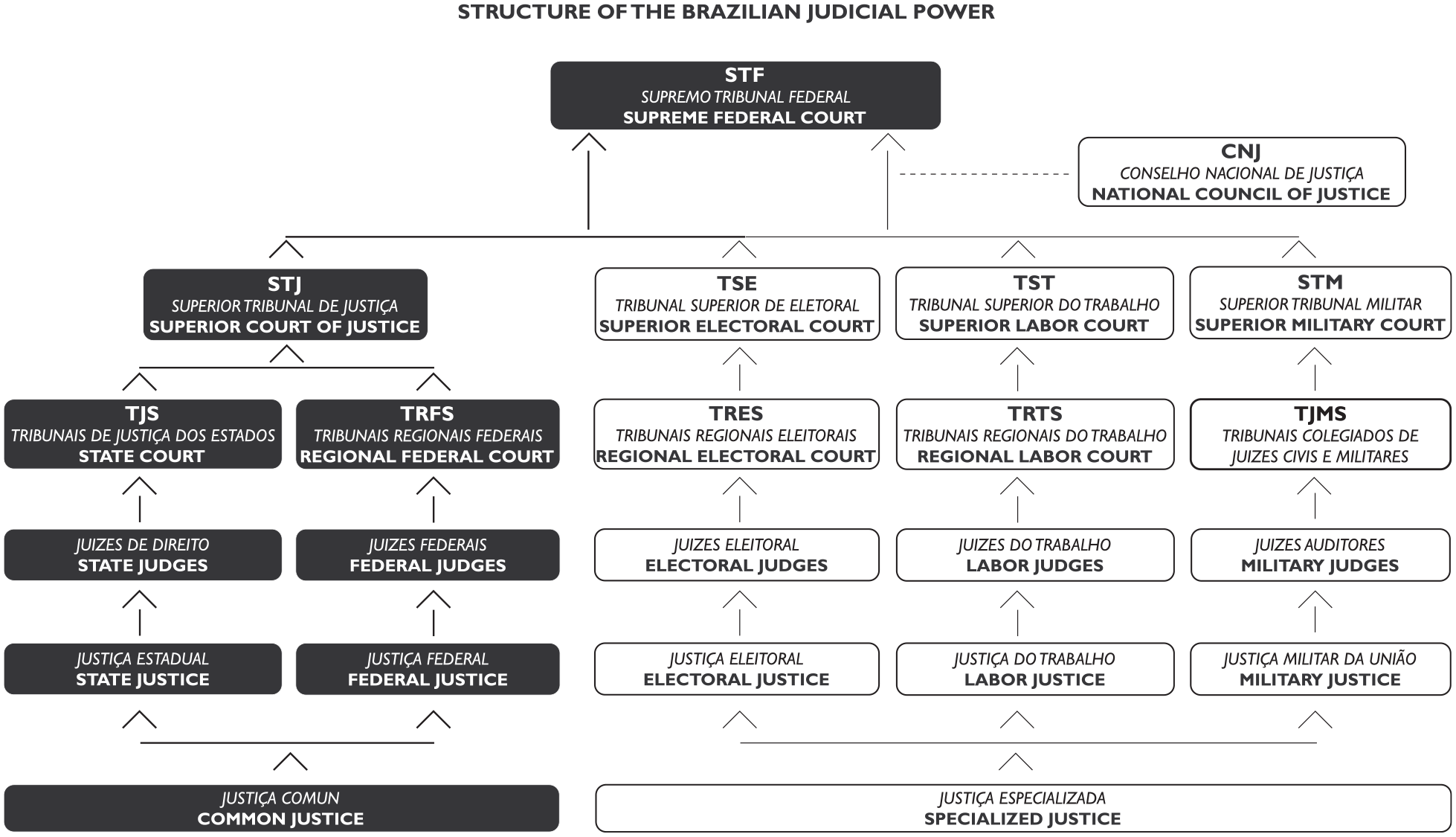
Structure of the Brazilian court system (the courts relevant to the thirty-six cases under study are highlighted).
The Offices of the Public Defender and the Public Prosecutor are distinct state actors, each with different and competing factions in charge of enforcing the relevant aspects of urban planning law in São Paulo (Coslovsky 2015). These offices are independent of the executive, legislative, and judicial branches of government and are fundamental to democracy and the rule of law. On one hand, the function of the Public Defender’s Office is “to offer, to the people in need, in an integral and gratuitous way, legal guidance, promotion of human rights and defense, in all levels, judicial and extrajudicial, of individual and collective rights.” 5 In São Paulo, the public defenders in the Housing Office (Núcleo de Habitação) work on many cases involving informal areas. On the other hand, public prosecutors in the area of urbanism and the environment have the mission of “promoting and defending environmental, urban, cultural and human values that guarantee an ecologically balanced environment for present and future generations, contributing to the process of social transformation.” 6
Although the Federal Constitution of 1988 mandated the creation of the Public Defender’s Office (Defensoria Pública) in Brazil, the state of São Paulo only did so in 2006. Ever since, public defenders have been active in representing the low-income residents of informal settlements and illegal subdivisions against eviction and displacement, eminent domain, and environmental crime charges. Before 2006, the Public Prosecutor’s Office had to protect the right to both a balanced environment and housing for informal dwellers. Our public defender and public prosecutor interviewees mentioned that some conflicts of jurisdiction emerged after the Public Defender’s Office began operations, especially with regard to who could better represent the interests of precarious housing dwellers in zones of geological risk. The Civil Procedure Code of 2015 establishes that the Office of the Public Prosecutor must provide an expert opinion on all urban and rural land tenure conflicts involving a large number of families. The legal assessment does not replace the right to legal representation. Thus, informal dwellers should still have access to either public defenders or private attorneys.
Housing movements had trusted the Public Prosecutor’s Office to represent them against forced and violent evictions, but since the creation of the São Paulo Public Defender’s Office, social movements have turned to this institution to secure housing and civil rights. Acting on several cases of land regularization, tenure security, and evictions involving informal dwellers, the Public Defender’s Office began proactively tackling these cases by scheduling mediation meetings with several municipal departments to brainstorm collective solutions to similar problems (group interview with three Santo Amaro public defenders on July 31, 2017). The public defenders and public prosecutors noted that judges agree to suspend court proceedings while the parties attempt mediation.
Using their power to file civil and criminal suits for protecting the environment (Cavalcanti 2006, 42; McAllister 2008), public prosecutors may file lawsuits against both municipalities and land occupiers of municipal land if the environment is compromised (Dantas 2015). Even when the occupied land is private, the municipality may be the defendant for failing to monitor land use or provide infrastructure in informal areas. In fact, public prosecutors from the Centre for Technical Support on Urbanism and the Environment at the São Paulo State Public Prosecutor’s Office reported to us in an October 18, 2016, interview that the lack of municipal capacity to implement the city’s master plan and enforce zoning was the root cause of most lawsuits involving issues of environmental protection and informal settlements.
Conflicts Involving Informal Housing in Environmentally Protected Areas
Fundamental rights to private property, housing, life, and security and diffuse rights to a healthy and ecologically cohesive environment are difficult to rank and reconcile when concrete conflicts occur (Dantas 2015). Several of these conflicts unfold in the city and involve municipal laws, plans, and policies (Pimentel Walker and Arquero de Alarcón 2018). Housing became a fundamental social right through a constitutional amendment in 2000, and the City Statute (Federal Law 10.257 of 2001) works as the enabling legislation for the urban policy chapter of the Constitution (Caldeira and Holston 2015; Friendly 2013; Macedo 2008). New land-use laws guaranteed greater tenure security for squatters, special subdivision standards for informal and illegal settlements, and special zoning laws targeting informal settlements and affordable housing (called ZEIS). Prescriptive acquisition (usucapião) and CUEM aimed to facilitate tenure security on private and public land, respectively (Fernandes 2011, 306). Nonetheless, the enforcement of these new regulations at the municipal level has been uneven (Pimentel Walker 2016; Rolnik 2013), opening up opportunities for resorting to the courts.
The most common environmental violations in our sample were infringements of the Federal Forest Code of 2012, specifically the provisions for permanent preservation areas (areas de preservação permanente [APP]). APPs establish non-development zones and vegetation preservation within pre-established buffer areas to natural water bodies, which are widespread in the city. Two-thirds of our court cases involved APPs, as informal housing sits too close to natural springs and creeks. Informal areas suffer greater exposure to risk because of the occupation of land poorly suited for development and lacking infrastructural remediation. About one-third of the lawsuits in our sample involved informal settlements in areas of geological risk, many of which were also classified as APPs. The last survey of risk areas in São Paulo by the Technological Research Institute (Instituto de Pesquisas Tecnológicas) in 2010 identified 407 risk areas comprising over 14.6 km2. These areas, classified from low (R1) to very high (R4) risk, were included in the 2014 São Paulo Master Plan. The Ministério Público prioritizes high- and very high-risk areas (R3 and R4) for lawsuits (interview with public prosecutor, October 19, 2016). Also relevant to the cases are state laws for the protection and recovery of water supply areas (APRM). These laws aim to protect water quality and quantity in the Billings and Guarapiranga reservoirs, which are critical water supply resources for more than 23 million inhabitants of the São Paulo metropolitan region.
Of the thirty-six cases analyzed, the Public Defender’s Office, the Public Prosecutor’s Office, and the São Paulo municipality initiated about half of the lawsuits. The São Paulo municipality was the sole defendant in 36 percent of the lawsuits and the co-defendant in an additional 8 percent (Figure 2). Thus, the municipality responded to wrongdoing or inertia in 44 percent of the cases. As the defendant or co-defendant, the municipality responded to public civil action lawsuits in 69 percent of the lawsuits. Public civil action suits (Ações Civis Públicas [ACPs]) aim to protect fundamental constitutional rights that go beyond the individual by procedurally securing collective, group, and diffuse fundamental rights. Typically, the public prosecutor or the public defender sues the municipality, with the former mostly protecting the diffuse right to a balanced environment and the latter defending the housing and social rights of informal dwellers. Public prosecutors have also filed ACPs to defend the right to life and physical integrity, especially in situations in which informal housing is located in areas of geological risk.
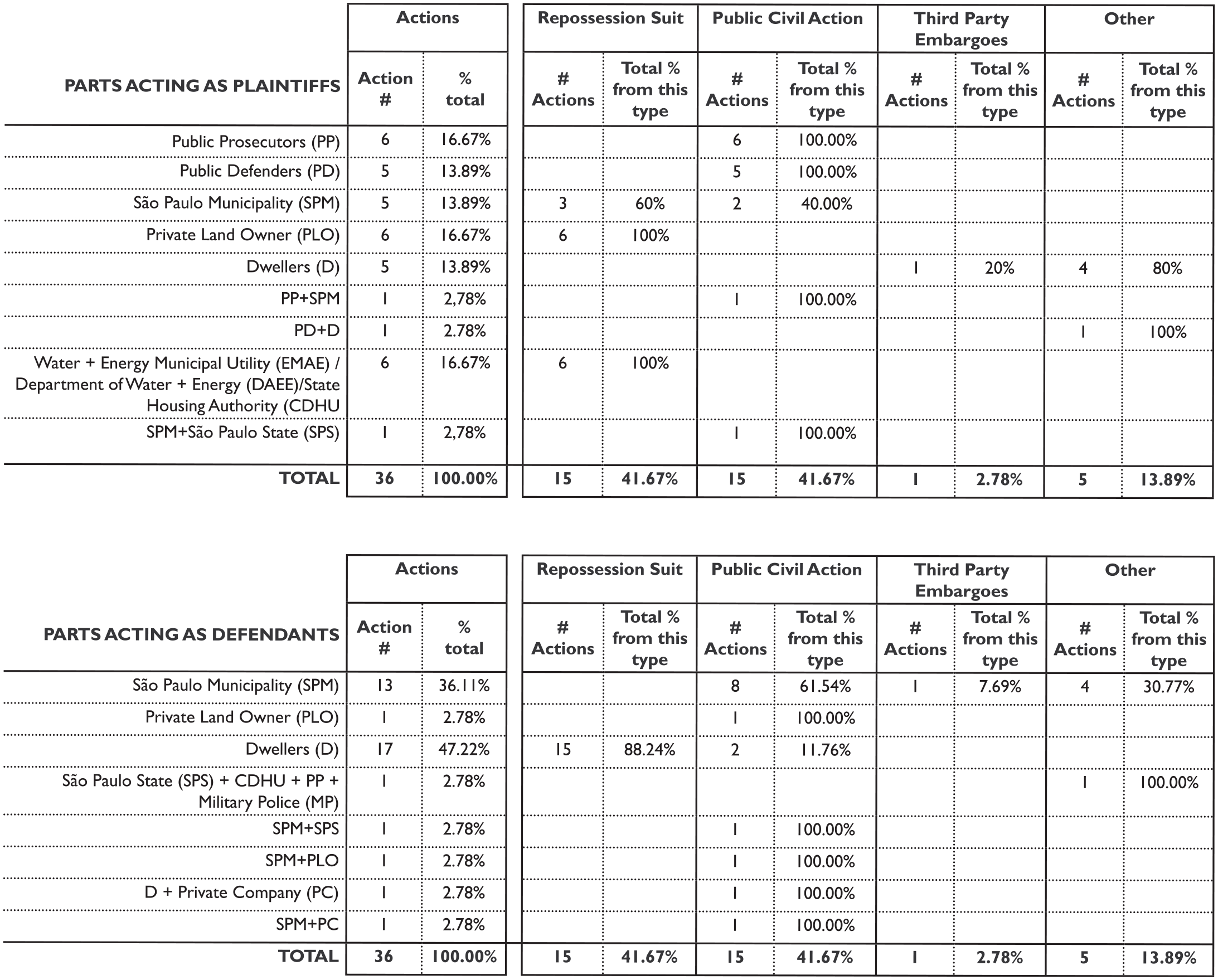
The different actors involved as plaintiffs or defendants in the thirty-six legal cases assessed and the number and types of actions filed by each actor.
By contrast, the municipal government acted as the sole plaintiff in 14 percent of the cases and a co-plaintiff in another 5.6 percent. Thus, the municipality has not been very active in pursuing the enforcement of the rule of law in courts regarding issues of informal settlements and environmental protection. As the sole plaintiff, the municipality filed claims for repossession against informal dwellers of public land in 60 percent of the cases (three cases) and civil action lawsuits in the other 40 percent (two cases). If we included cases with the municipality as the co-plaintiff, the repossession cases would drop to 43 percent, and the public civil action lawsuits would increase to 57 percent, many targeting illegal subdivisions. Illegal sub-dividers either own or purchase land on the periphery, subdividing and selling the plots to informal dwellers. As the plaintiff of ACPs against illegal sub-dividers, the municipality’s argument is that irregular land parceling cannot achieve compliance with building and land parceling codes because the subdivision has disturbed the ecological functions of the land. Consequently, the municipal government requests that sub-dividers restore the environment and compensate those who purchased the lots.
Regarding repossession suits, the municipal government has the right to repossess wrongfully occupied municipal land. For this type of lawsuit, the issue of environmental protection usually substantiates eviction in the face of an environmental crime. According to the architect and planner from the Office of the Public Defender, the Office of the Municipal Attorney General often starts repossession suits in response to ACPs filed by the public prosecutor, demanding that the municipal government relocate the families. Thereafter, informal dwellers seek support from the Office of the Public Defender in an attempt to hold ground (interview with the architect and planner of the Public Defender’s Office, October 21, 2016).
Figure 2 indicates that the São Paulo municipality underutilized the judiciary in prosecuting illegal and irregular sub-dividers for their clandestine commercialization of plots in areas of environmental protection or risk. Furthermore, it demonstrates the relevance of the independent enforcement bodies (the Offices of the Public Prosecutor and Public Defender) in the judicial oversight of socioeconomic and environmental rights. They were responsible for 80 percent of the ACPs seeking the enforcement of housing and environmental rights in informal settlements. All other court cases were in the realm of property law. Without these institutions, the issue of judicial deference to planning in housing and environmental conflicts would be moot, and checks and balances among the three powers would be compromised.
Judicial Deference to Planning and Court Case Analysis
This section discusses the legal principles that justified judicial deference to planning in our study. Our findings demonstrate that in general, judges hesitate to command municipal agencies to displace families from risk or protected areas or dictate that the municipality provide housing assistance to informal dwellers. Judges from district and appellate courts usually accept the defense that the municipal government presents, which is generally based on two legal principles: the German vorbehalt des möglichen or princípio da reserva do possível (in Portuguese), and the principle of the separation of powers. The former, whose literal English translation is “precondition of the possible,” acknowledges that the executive branch of government lacks the resources to meet citizens’ fundamental social rights to proper health, education, basic sanitation, and housing services. This principle originated in Germany after the high courts exonerated public agencies from the duty to provide social rights that went beyond the bare minimum required for survival if government budgets did not permit (Perlingeiro 2015).
Brazilian courts retained the same meaning of vorbehalt des möglichen, and Brazilian legal doctrine establishes that the courts must respect administrative discretion, which prevents the judicial enforcement of a social right under some circumstances. Thus, the municipality invokes the princípio da reserva do possível when it lacks budgetary resources and the capacity to implement and monitor approved urban policy. However, according to Brazilian Supreme Court Justice Celso de Mello, this principle is not applicable when it compromises the minimum necessary for subsistence (Suspensão da tutela antecipada, STA, 223 AgR, rel. min. Celso de Mello, j. 14-4-2008, P, DJE de 9-4-2014). As such, the principle is not mentioned in the Brazilian Constitution and statutory law.
By contrast, the separation of powers has its origins in national constitutional law as opposed to legal doctrine and precedent, which is the case for the princípio da reserva do possível. The separation of powers is based on the Brazilian Constitution, Article 2, which states that the legislative, executive, and judicial branches are the three powers of the Federation. These powers are independent and harmonic, with their own spheres of operation, as delimited by constitutional law (Araújo and Nunes 2018). The state’s functions are distributed to diverse public bodies with mutual control mechanisms among them, that is, checks and balances, to protect individuals against potential abuse from absolute power (Barroso 2015, 208).
Together, the principles of separation of powers and reserva do possível constitute the bulk of justification for judicial deference to planning. The municipality often applies them to argue for its discretionary power and to substantiate its claim of judicial deference to planning. The municipal government was the defendant in sixteen of the cases (Figure 2). Nevertheless, only ten cases addressed judicial deference to planning. Of these, the judges ruled for judicial deference to planning in seven cases, overruling the plaintiffs’ complaints. Only in three cases, they ruled against the application of the discretionary power of local governments to plan and enact social policy. Figure 3 summarizes the ten cases involving judicial deference to planning. The subsequent sections discuss the exemplary cases.
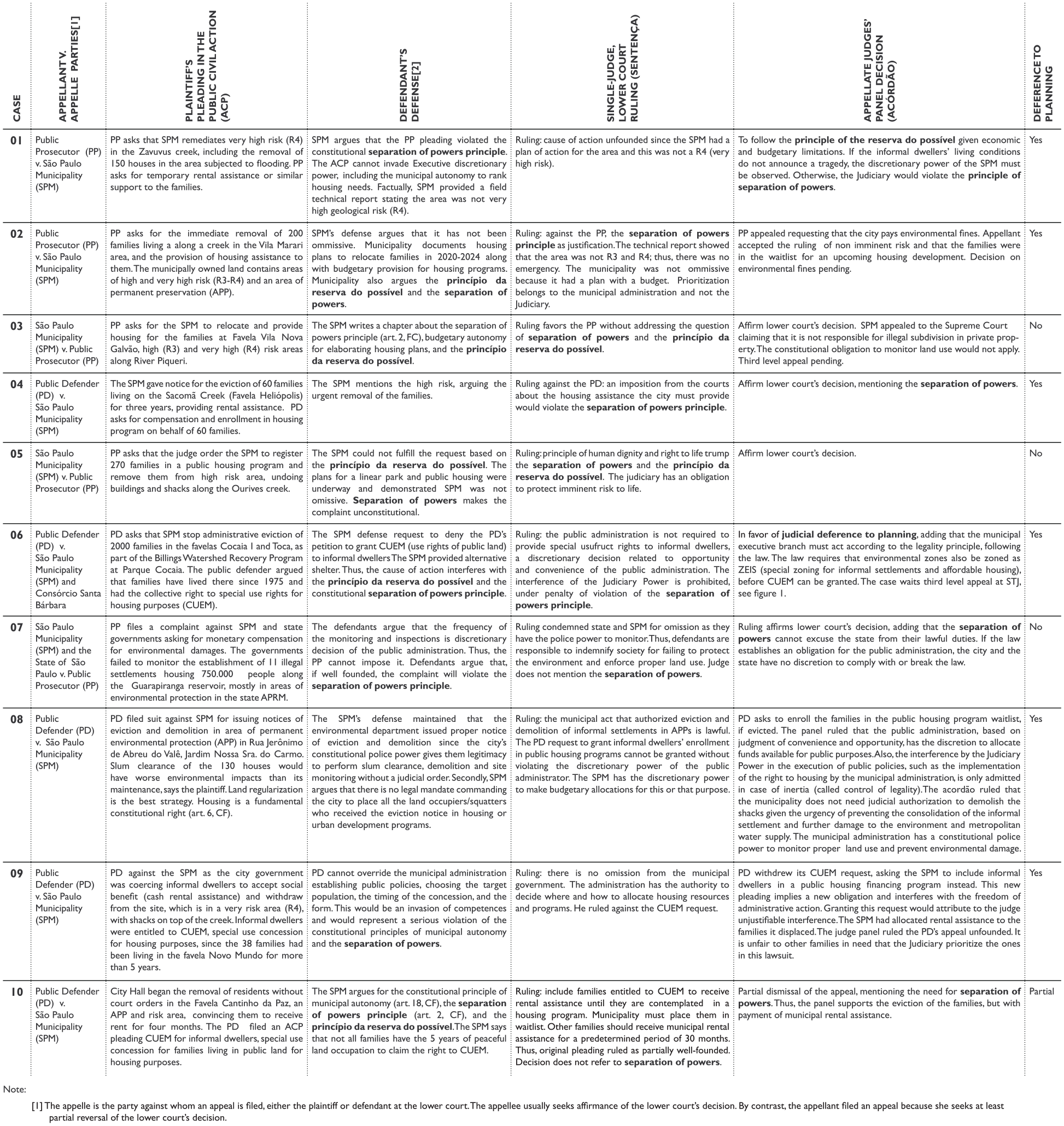
Table of verdicts and summaries of the ten cases addressing judicial deference to planning.
Public Prosecutor (Appellant) v. São Paulo Municipality (Appellee): The Case of 150 Families Living on Top of the Zavuvus Creek
In a typical ACP, public prosecutors demand that judges and appellate judges issue a mandamus requiring the municipality to relocate informal dwellers from very high-risk areas (R4), where the right to life is compromised, or from APPs, a violation of the Federal Forest Code. In the case with the Zavuvus Creek (row 1, Figure 3), the public prosecutor requested that the municipal government relocate and shelter 150 families living in proximity to a creek that floods frequently. The ACP demanded that the municipality relocate the families in a proper shelter or provide temporary cash assistance for rent, risking financial sanctions in case of delays. Furthermore, the public prosecutor petitioned that the court mandate the city to permanently fix the creek’s recurrent flooding problem. The municipal government answered that it had not been omissive, demonstrating that it had an agreement with the federal government to build public housing. The municipal housing department included evidence that informal dwellers had been placed on the waiting list for public housing after the public prosecutor filed the lawsuit. 7
Regarding flooding, the city annexed a valid bidding announcement to contract private services for the drainage of the creek. The three-member panel of judges upheld the district court judgment for the defendant (municipality). For the panel, flooding did not pose as serious a risk as landslides. Therefore, the appellate ruling explained that helping the informal dwellers of Zavuvus Creek would first infringe on the principle of isonomy by privileging the destitution of some at the expense of others. Here, the appellate judges were referring to the informal dwellers across the city who have been placed on the housing waitlist and would have had their position moved down by the court order. For the appellate judges, if there is no omission, interfering in municipal planning constitutes a violation of the separation of powers and the autonomy of the municipality, as per the Federal Constitution, Articles 2 and 18, respectively. The opinion further explains, Not demonstrating any risk of tragedies of immeasurable proportions, there is no justifiable reason for the Judiciary to intrude in the discretionary decisions informing the defendant’s public policy making. In fact, the wish to dictate to the Administration the development of a particular social policy, entails an interference in the discretionary power of that Administration, and a violation of the principle of the harmonious coexistence of powers, as I pointed out in another appeal. (Appellate case nº 1029872-93.2014.8.26.0053, 629)
Three Rulings against Deference to Planning
The courts ruled against judicial deference to planning in only three of the ACPs that public prosecutors filed against the municipality (cases in rows 3, 5, and 7, Figure 3). For the cases in Vila Nova Galvão (row 3) and the Reservoir (row 7), the judges understood that the police power that the Federal Constitution (Article 30, Inc. VIII) confers onto municipalities to monitor and enforce land use constitutes a duty and not an option. The latter case does not involve a request for informal settlement displacement but a claim for damages against the municipal and state governments to address environmental degradation at the Reservoir. The damage was caused by a lack of monitoring in the construction of eleven irregular subdivisions housing 750,000 people. We discuss below the case of Ourives Creek in detail (row 5, Figure 3).
Although judges have mostly declined to mandate the city to implement the relocation of dwellers, the Ourives Creek case represents an exception. The public prosecutor complained that the municipal government did not properly monitor land use along the creek, allowing unhealthy and inhumane informal settlements to damage the environment and negatively affect public health. The public prosecutor requested the immediate demolition of the houses, relocation of the families to a safe place, and the contention of the problem. The plaintiff annexed detailed site survey maps and pictures of the São Pedro and Liveiro favelas—which showed extremely precarious shacks on stilts on top of the flooding creek—to substantiate their request to immediately relocate the families. The case also included a risk assessment, identifying R2 and R4 risk areas and detailing the housing units in each area (case in row 3, Figure 3, Apelação n. 0043819-13.2009.8.26.0053).
The municipality responded that an administrative process was underway to study alternatives for the creek’s transformation into a linear park project with additional public housing and a stormwater retention facility to manage frequent flooding. Finally, given the urgency of the situation, the defendant (municipality) ordered its municipal health department to act immediately on urban pest control. The city’s formal response included constitutional arguments for the separation of powers and their autonomy to govern, as per Articles 2 and 18 of the Federal Constitution, respectively. It listed all municipal housing programs targeting low-income residents, thus attending to obligations to provide social housing. Finally, the city invoked the princípio da reserva do possível, explaining that because of budgetary constraints, housing programs must be implemented incrementally. The city recommended that the families join the housing waitlist to honor the principle of equality with other families in similar situations. Notably, the municipal government complemented this argument with constitutional references about legislative limitations on how the municipal government can unilaterally change budgetary allocations, citing Article 165 of the Federal Constitution.
The district court judge ruled in favor of the plaintiff, mandating that the municipality develop a census of favela dwellers within 60 days, relocate them to a proper shelter within 180 days, and demolish the shacks and properly monitor the area to avoid future re-occupation, all under penalty of daily financial sanctions for delays. The opinion rejected the principles of separation of powers and reserva do possível because the municipal government had been omissive with the life of residents by not relocating them, despite the severe environmental risks. The right to human dignity and life itself was at risk because of landslides, building collapse, death, diseases, and flooding. The decision concluded that the judiciary had a constitutional duty to protect the right to life and safety under imminent threat/risk conditions. Regarding the separation of powers and judicial deference to planning, the three-member panel of judges decided, citing a non-binding decision from the Supreme Court, that the judiciary can exceptionally mandate public administrators to adopt measures that secure fundamental constitutional rights, without the mandamus constituting a violation of the separation of powers principle. The municipality appealed to the STJ, where the appeals await consideration (see Figure 1).
Public Defender (Appellant) v. São Paulo Municipality (Appellee): Defending the Right to Housing
The Office of the Public Defender filed five ACPs against the municipality (cases in rows 4, 6, 8, 9, and 10, Figure 3). In three of them (cases in rows 4, 6, and 8), public defenders sued against administrative acts of removal, requesting the inclusion of informal dwellers in municipal housing programs. For instance, in the case in Rua Jerônimo de Abreu do Valê (row 8, Figure 3), the public defender challenged municipal police powers to issue notices and administratively implement slum clearance, demolitions, and site monitoring without judicial authorization. The appellate court ruled in favor of the municipal police power to evict and demolish shacks, especially in urgent cases, to prevent the consolidation of a new informal settlement in ecologically sensitive areas of risk. The self-applicability of the municipal police power to enforce slum clearance and evictions from public property and environmental zones remains unsettled. The municipalities avoided the controversy because municipal and state police forces often hesitated to send their personnel to execute repossessions and demolitions without a court order. Furthermore, courts are likely to grant injunctive relief to stop slum clearance until the facts are analyzed. Nevertheless, most recently, executive orders have contradicted this practice. For instance, former São Paulo Governor Alckmin and current President Bolsonaro have issued instructions about the self-applicability of this police power to their administrations.
Public defenders also requested that residents gain CUEM, the concession of special use rights for housing purposes (the cases in rows 6, 9, and 10, Figure 3). All complaints had been either fully or partially ruled in favor of the municipality based on the discretionary power of the local administration to plan and establish urban policy. The rulings affirm that the judiciary cannot mandate the inclusion of informal dwellers in municipal housing programs because of the constitutional autonomy of the municipality. Municipalities decide when it is convenient and opportune to grant CUEM. This reasoning has been contested, as the Favela Cocaia I and Toca case (row 6, Figure 3) awaits the third level of appeal at the STJ (see Figure 1).
In a study of fifty public civil action lawsuits that public defenders filed against the São Paulo municipality, only 12 percent were successful (Nassar 2011, 107). The research concluded that São Paulo courts do not secure the right to housing but the right to housing policy. Even when the public defender was not the plaintiff, Figure 3 corroborates Nassar’s (2011) findings, as the appellate rulings affirmed that the existence of a housing plan satisfied the shared obligation of municipal governments to provide this fundamental social right. Other research has documented a similar lack of judicial interference in housing plans or enforcement of specific housing rights in third-level tribunals (STJ and Supremo Tribunal Federal; Coutinho 2010).
Access to Justice Curtailed: Informal Dwellers as Co-joinders
Informal dwellers are frequently absent from the ACPs that public prosecutors file against the São Paulo municipality, even when public prosecutors request their displacement. If the municipality does not want to intervene in a particular place, they ask, often unsuccessfully, that the judge bring informal dwellers into the case as co-joinders. For instance, the Zavuvus Creek and Ourives Creek cases (rows 1 and 5, Figure 3) involved the public prosecutor’s request to displace informal dwellers, who were not co-defendants in the lawsuit. In both circumstances, the municipality requested their inclusion as compulsory joinders. In the Zavuvus Creek case, the municipality won, and no displacement ensued, so the judgments at the district and appellate court levels did not rule about the municipality’s request for the passive joinder. Nevertheless, in the Ourives Creek case, in which both court levels ruled against the municipality based on an exception to the principle of judicial deference to planning, the opinion established that informal dwellers did not need to participate as joinders because their rights to a safe shelter were guaranteed by both rulings. We observed this situation with frequency and understood the lack of inclusion of informal dwellers as reminiscent of a patronizing attitude toward the poor by public prosecutors and judges. These rulings curtail the right of access to justice, negatively affecting equality in procedural justice.
Conclusion
This article analyzed the proceedings of court cases from 2013 to 2016 in the São Paulo Court of Appeals to examine whether the courts defer to the autonomy of urban planning. The cases addressed the conflict between the constitutional rights to a healthy environment and housing in the city’s informal settlements. We developed a case taxonomy tracking specific characteristics—the parties involved, the types of legal actions and environmental damage, the legal arguments, the rulings, and other relevant data. We identified evidence of judicial deference to planning through diverse legal argumentations. City planners and judges often invoked the principles of separation of powers and reserva do possível to support their defenses and rulings of judicial deference.
Although scholars have raised concerns about the progressive judicialization of planning and policy, we did not obtain proof that the courts have been legislating or developing urban policy on behalf of the municipality. The court case analysis revealed that legal actors, especially public prosecutors and public defenders, activate the courts to pressure the São Paulo municipality to enforce environmental regulations and housing and civil rights. The ACPs reflect the municipality’s lack of capacity to fulfill its duty to monitor land use and protect the environment or its shared duty to enforce the right to housing. Nevertheless, for the São Paulo Court of Appeals, the municipal government fulfills its obligations if it has a housing plan with pending budgetary allocations (e.g., rental cash assistance, emergency housing, future subsidized mortgage) or a plan for environmental recovery (e.g., linear park, water sewage treatment, reforestation). Similar to the Kelo case decided by the U.S. Supreme Court, in which the presence of an economic plan was sufficient to justify eminent domain, 8 our table of verdicts (Figure 3) also demonstrates that the mere existence of a plan prevents most court discussions about its quality or feasibility.
The supremacy of the plan has an enormous impact on the education and practice of urban planning. In the teaching of U.S. and comparative planning law, we often hear students’ concerns that they will not be able to innovate in their plans because of constitutional limitations on land use and municipal police power. Our research contextualizes the literature on the judicialization of politics and policy in the realm of urban planning, providing valuable information not only for city planners who work as civil servants for the Office of the Public Defender, public prosecutors, or city governments but also for advocacy groups, such as housing movements, NGOs, and environmental organizations.
Thus, for housing advocates, knowing that the rulings did not mandate the government to increase its housing budget or build more housing units is important. If partially successful, the lawsuits required that families receive temporary rental cash assistance or be placed on a public housing waitlist. Judicial deference to planning and, less often, environmental protection justified the lack of judicial enforcement of housing rights. One exception, when factually proven, was the right to life, security, and physical integrity. The courts ruled that the public administration must act in a timely manner, regardless of the principles of separation of powers and reserva do possível. The same logic applied to areas of risk, where rulings interfered with the municipality’s discretionary power if the public prosecutor could factually prove the very high risk involved.
Our sample also shows that the municipal government rarely used the court system to enforce environmental protection and land-use regulations either in public or private lands. Court case research demonstrates the challenges that city planners and legal actors face managing informal settlements in areas of environmental protection and risk. The municipality has both overemphasized (e.g., Sacomã Creek case, row 4, Figure 3) and downplayed (e.g., Zavuvus Creek case, row 1, Figure 3) the significance of risk and environmental damage to legally defend its plans of informal settlement eradication or permanence. None of the cases incorporated the local knowledge of informal dwellers regarding risk management and environmental remediation. Likewise, court decisions did not recommend environmental stewardship programs for informal dwellers, which is a missed opportunity. Environmental reparations as well as the provision of adequate housing that goes beyond emergency shelter and the right to life rank as a low priority. Noticeably, the legal principle of budgetary constraints has often justified the discretion of municipal planners to postpone action. Informal dwellers are citizen planners (Beard 2012), experts at building the city, who would be further empowered by programs for sustainable informal settlements. Only the Ourives Creek case (row 5, Figure 3) mentioned an education plan for waste management, but techniques to safely build in slopes, implement decentralized sewage, and conduct site planning to avoid water pollution were not mentioned.
Judicial deference to planning means that local administrators have the discretionary power to implement their plans; in practice, planners must prioritize action in highly deprived human and natural environments. With hundreds of thousands of families living in informal and precarious settlements in the city of São Paulo, there is a need for greater investments in public housing, slum upgrading, and environmental restoration. The fact that the rights to housing and an ecologically balanced environment are a shared competence between the local, state, and federal governments calls for greater intergovernmental cooperation and accountability.
Footnotes
Acknowledgements
Special thanks to Thiago Santos do Nascimento, Benedito R. Barbosa, Renê Ivo Gonçalves, and Luiz Kohara at Center Gaspar Garcia for Human Rights. In addition, University of Michigan (UM) research assistant Olaia Chivite Amigo has collaborated in different stages of the project.
Declaration of Conflicting Interests
The author(s) declared no potential conflicts of interest with respect to the research, authorship, and/or publication of this article.
Funding
The author(s) disclosed receipt of the following financial support for the research, authorship, and/or publication of this article: This research, in partnership with the Center Gaspar Garcia for Human Rights, has been funded by the University of Michigan through the Office for Research, the Brazil Initiative in the Office of the Provost, a 2016 Research through Planning grant, and seed funding at Taubman College of Architecture and Urban Planning.
